


The Main Provisions
What’s new in this work:
- Industrial trials demonstrated pressed wall products with compressive strengths of 3.43–7.36 MPa at Portland cement contents of 50–110 kg/m3.
- Binder intensity was 14.6–15.3 kg m−3 MPa−1; this metric indicates efficient clinker use within the investigated low-strength range but is not, by itself, evidence of superior overall performance.
- Material cost decreased from KZT 24,785 (USD 54.32) to KZT 9982 (USD 21.87) per cubic meter, based on the 2023 average exchange rate of KZT 456.31 per USD.
Abstract
Shell limestone sawing generates large quantities of porous carbonate waste that is difficult to reuse because of its high water demand and variable fine-particle content. This study evaluates an industrial-scale route for converting this waste into low-cement, vibration-compacted pressed wall materials at LLP “Firma Fial” in the Mangystau Region of Kazakhstan. The work combines industrial process documentation, compressive strength testing, binder intensity calculations, XRD phase identification, contact zone microhardness measurements, SEM observations, and a material cost comparison. Waste was crushed to below 5 mm without removing fines, moisture was checked before batching, and the mixtures were vibration-filled for 15–30 s at a compaction factor of approximately 2, followed by immediate demolding. Cement contents of 50, 75, and 110 kg/m3 produced 28-day strengths of 3.43, 4.90, and 7.36 MPa, respectively. The corresponding binder intensity was 14.6–15.3 kg m−3 MPa−1. XRD identified calcite as the dominant phase with minor dolomite and magnesite, while SEM and microhardness observations confirmed a distinct cement-paste/carbonate-aggregate interfacial region. The comparison with higher-strength reference concretes is interpreted cautiously because the strength ranges and compaction concepts differ. At 2023 prices, material cost decreased from KZT 24,785 (USD 54.32) to KZT 9982 (USD 21.87) per m3. The results demonstrate industrial feasibility while identifying mixture reproducibility, interfacial characterization, and full life-cycle assessment as priorities for further work.
1. Introduction
Shell limestone is a Quaternary biogenic carbonate stone widely used as a wall material in arid regions because of its low density, thermal resistance, and ability to be sawn directly in the quarry [1,2,3]. Product geometry is obtained through outlining, chipping, sawing, edging, and polishing, and each operation converts part of the rock mass into fragments and wet fines. In the layered and brittle shell rock of the Mangyshlak and Ustyurt plateaus, losses reach 60–70% of the extracted mass [4,5], whereas utilization remains close to 10% [4]. The accumulated waste occupies land and, under regional winds of 8–12 m/s, contributes to dust dispersion [6,7].
Recent research confirms that limestone processing residues can act as fine aggregate, filler, or feedstock for pressed masonry products. Studies have examined quarry dust in concrete [8,9,10,11,12], road layers [13], artificial stone and masonry elements [14,15,16,17], hydration and microstructural effects of limestone waste [18], limestone slurry replacement in self-compacting concrete [19], durability of limestone waste used as aggregate [20], and low-cement dry-pressed bricks made from limestone sawing waste [21]. These studies show that particle size distribution, water absorption, compaction, and the aggregate–paste interface govern performance; consequently, results obtained for dense limestone dust cannot be transferred directly to highly porous shell limestone sawdust.
Shell limestone sawdust differs from dense quarry fines. The parent rock is weak and highly porous, the waste is generated wet, particles below 0.14 mm may constitute up to approximately one quarter of the material, and the 0–5 mm fraction has reported water absorption of about 4.3–7.15%. Direct use of formulations developed for dense screenings therefore produces water- and binder-intensive mixtures. The present approach instead exploits rigid vibration compaction to form a pressed material in which packing density and contact quality contribute strongly to load transfer.
Binder intensity, defined as cement content divided by compressive strength, is a useful resource efficiency indicator [22], but it does not replace comparison at equivalent strength, durability, and functional class. This distinction is particularly important here because the pressed products reach 3.43–7.36 MPa, whereas the reference concretes cover 8.8–38.1 MPa. The novelty of the present study is therefore not a claim of universally superior concrete performance. It is the combined industrial validation of a low-cement processing route, quantitative reporting of binder use, XRD and interfacial evidence for porous shell limestone aggregate, and a techno-economic assessment under quarry-adjacent production conditions.
The aim of this work is to evaluate the industrial production of pressed wall products made with shell limestone sawing waste and to quantify binder use within the intended low-strength masonry range. The objectives are to (i) document reproducible industrial processing parameters; (ii) report mixture constituents and the cement contents required for grades 35, 50, and 75; (iii) compare binder intensity with previously produced concretes while explicitly acknowledging differences in strength range and compaction; (iv) characterize the cement-paste/carbonate-aggregate region using XRD, SEM, and microhardness evidence; and (v) compare material costs and practical limitations.
2. Materials and Methods
2.1. Raw Materials and Binders
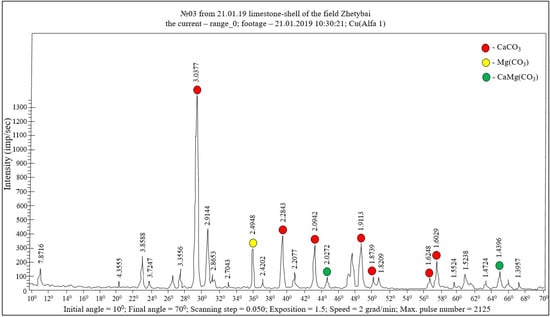
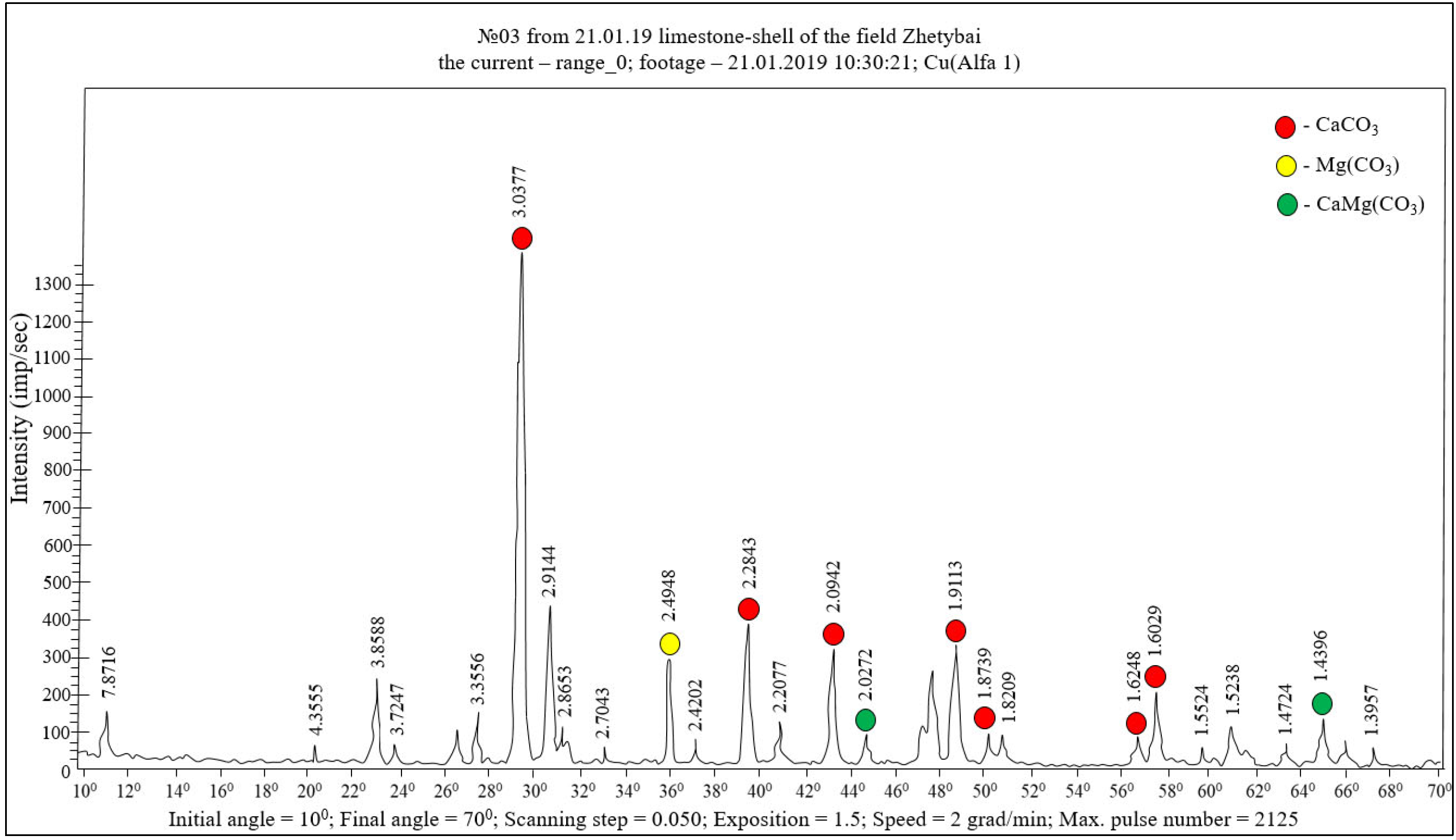
The main aggregate was shell limestone sawing waste from the Zhetybay deposit (Mangystau Region, Kazakhstan). Additional carbonate aggregates from the Beyneu, Mangyshlak, and Tasbolat deposits, all located in the Mangystau Region, Kazakhstan, were used for the comparative contact zone study. The 0–5 mm Zhetybay screening had a bulk density of approximately 1490 kg/m3 and a fineness modulus of 2.34; particles below 0.14–0.16 mm were retained, and the water absorption of fine fractions varied from approximately 4.3% to 7.15%. XRD identified calcite (CaCO3) as the dominant crystalline phase, with minor magnesite and dolomite [23]. The XRD pattern is shown in Figure 1, and selected material properties are summarized in Table 1. Portland cement CEM II/A-I 42.5B (M400; ExtraCem 500, CEMENTUM, Voskresensk, Russia) was used. Its measured 2-day and 28-day strengths were 15.2 and 40.7 MPa, initial and final setting times were 159 and 203 min, normal consistency was 28.8%, and the calculated clinker composition was 69.0% C3S, 8.2% C2S, 5.4% C3A, and 12.7% C4AF. PAA and sulfite-alcohol stillage were used as plasticizing agents at an optimum dosage of 0.2% by cement mass in the supporting experimental program. A separate patented polymer-cement composition used for the economic comparison contained white cement, ground shell limestone screening, 0.15% aqueous PAA solution, white spirit, and a 1% aluminum-salt accelerator solution [24,25].
Figure 1.
XRD pattern of Zhetybay shell limestone waste. The dominant reflections correspond to calcite, with minor dolomite and magnesite.
Table 1.
Selected properties of the waste aggregate and cement used in the supporting experimental program. Values originate from the archived dissertation dataset.
2.2. Industrial Technological Scheme
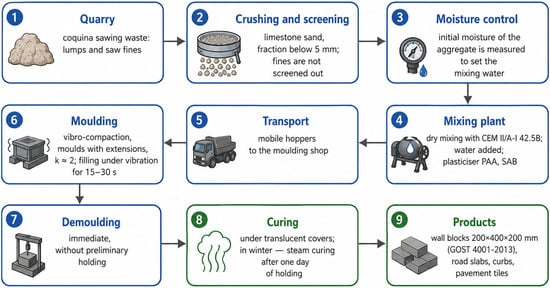
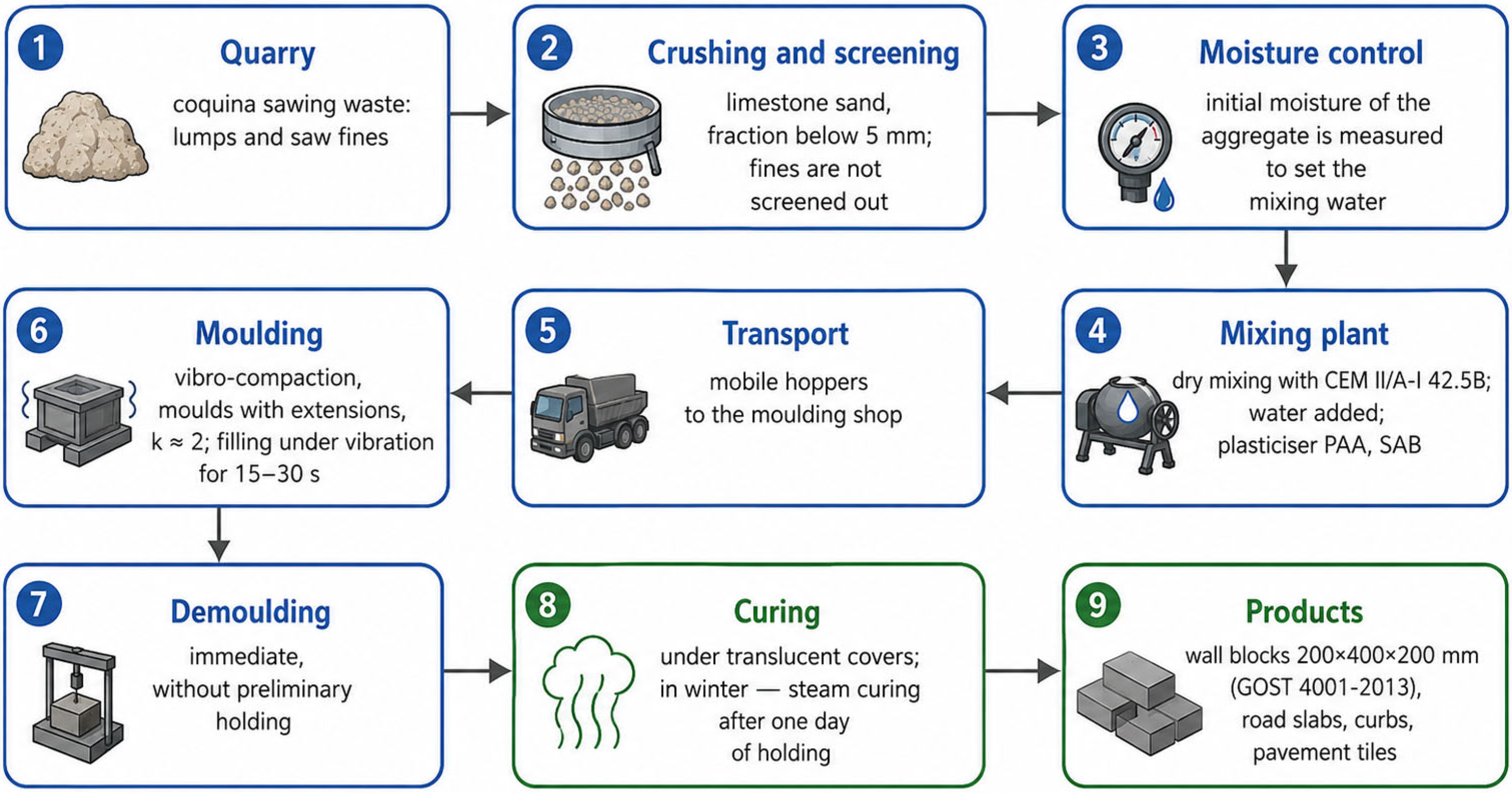
The industrial scheme was included because scale-up is a principal contribution of this work: it documents how moisture-variable sawing waste was integrated into an operating production sequence rather than evaluated only in laboratory batches. At LLP “Firma Fial”, waste was crushed and screened to below 5 mm without removing fines. Aggregate moisture was measured before batching. The dry aggregate and cement were first mixed to homogeneity; water and the selected plasticizer were then introduced, and mixing continued until a uniform, stiff consistency was obtained. Water was adjusted to the measured initial moisture and anticipated holding time. The mixture was transferred in mobile hoppers, vibration-filled into molds for 15–30 s, and compacted at a factor of approximately 2. Immediate demolding was possible because of the high green density. Products were cured under translucent covers during warm periods [26]; in winter, they were held for 24 h before steam curing. The scheme therefore establishes the operational sequence, moisture control point, mold-filling time, demolding strategy, and seasonal curing route needed for industrial reproduction. Figure 2 presents the technological scheme, and Table 2 summarizes the operating parameters.
Figure 2.
Technological diagram of industrial production of concrete products using aggregate made from shell limestone sawing waste (test site of LLP “Firma Fial”).
Table 2.
Operating parameters of the industrial processing of concrete products.
2.3. Manufacturing and Testing of Products
Wall blocks measured 200 × 400 × 200 mm (16,000 cm3) in accordance with GOST 4001-2013 [27], corresponding to approximately 60 units per cubic meter including joints. Compressive strength was determined at 28 days in accordance with GOST 10180-2012 [28]. The supporting experimental protocol used four 100 mm cubes per series; mean strength was calculated from the individual results, and homogeneity was assessed using the standard deviation and coefficient of variation. The industrial records available for the three reported betonite grades retained the grade-level means but not the complete individual replicate readings; consequently, variance cannot be reconstructed retrospectively for Table 3, and this is stated as a limitation. The strength-testing device had a stated measurement uncertainty of ±1%. Density was determined according to GOST 12730.1-78 [29].
Table 3.
Cement consumption and indicators of binder efficiency by concrete grade.
2.4. Investigation of the Contact Area
The contact zone was investigated on polished sections by microhardness profiling and by SEM. For each microhardness profile, 9–11 indentations were made, including 6–8 positions in the contact layer and three reference positions in the aggregate and cement paste masses. Measurements were arranged along a line normal to the aggregate surface and plotted as a function of distance from the interface. Natural-cured and steam-cured specimens were compared for four carbonate aggregates. The archived dissertation materials do not report the indentation load, dwell time, or complete point-level values; therefore, the profiles are interpreted qualitatively, and no new dispersion statistics are claimed.
2.5. Indicators of the Effectiveness of Binder Use
Two indicators were used to quantify binder use. Specific cement demand S was calculated as the ratio of cement content C (kg/m3) to grade strength R (kgf/cm2) using Equation (1). Because both quantities are measured, the uncertainty of S can be approximated by standard propagation: uS/S = [(uC/C)2 + (uR/R)2]1/2. Cement batching and strength testing uncertainties should therefore be reported with S; for the available industrial dataset, only the testing device uncertainty (±1%) is documented, so the calculated ratios are treated as indicative rather than high-precision estimates.
S = C/R
The intensity of the binder bi was determined as the ratio of cement consumption to compressive strength, expressed in megapascals, according to the formula (2):
where R1 is the compressive strength at 28 days, MPa (1 kgf/cm2 = 0.0981 MPa). The base for comparison is the compositions of ordinary concrete obtained earlier using the same aggregate, with a cement content of 222–540 kg/m3 and a strength of 8.8–38.1 MPa.
bi = C/R1
2.6. Technical and Economic Assessment
The economic efficiency was calculated using the methodology for assessing the introduction of new equipment at 2023 prices, applied to the Zhetybay deposit of wall stone. The expected annual effect was determined using Equation (3):
where Cc is the cost per 1 m3 of the mixture using the current technology, in tenge; Cn is the cost per 1 m3 of the composition using the new technology, in tenge; K = 0.15 is the coefficient of unit capital investments for the construction industry; N is the output volume, in m3. The costs for wages and electricity are assumed to be the same for both technologies; the savings on ongoing operating costs and deductions from related capital investments are assumed to be zero, given an equal equipment service life.
E = [Cc − (Cn − K · Cn)] · N
3. Results and Discussion
3.1. Operational Parameters of Industrial Conversion
Industrial testing confirmed that the process could be operated at production scale under the stated conditions. Crushing below 5 mm retained carbonate fines and improved particle packing. Their possible participation in reactions with aluminate phases is consistent with published cement chemistry [18], but the present XRD and SEM observations do not directly quantify reaction products, and this interpretation is therefore treated as a hypothesis. A compaction factor of approximately 2 required mold extensions and vibration-assisted filling. The resulting green density enabled immediate demolding, reducing the number of molds needed for small-scale quarry-adjacent production.
3.2. Cement Consumption and Grade Strength
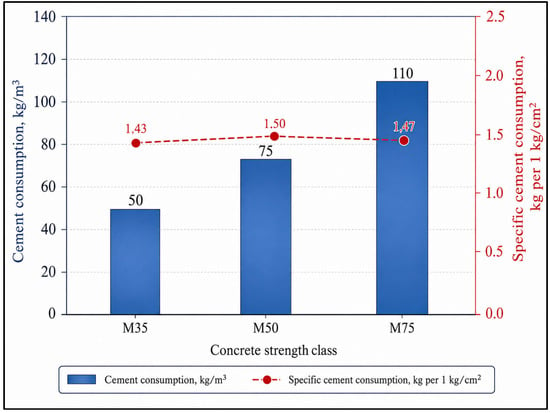
For the three industrial betonite grades, CEM II/A-I 42.5B contents were 50, 75, and 110 kg/m3, and the corresponding 28-day compressive strengths were 3.43, 4.90, and 7.36 MPa (Table 3 and Figure 3). These results define the cement demand for the intended low-strength pressed wall product range. They should not be interpreted as a direct strength advantage over conventional concrete. The response reflects the combined effects of retained fines, moisture demand, particle packing, vibration compaction, and the porous aggregate–paste interface. Because no otherwise identical control mixture made with natural sand was produced in the industrial campaign, the isolated causal contribution of the waste aggregate cannot be quantified from this dataset.
Figure 3.
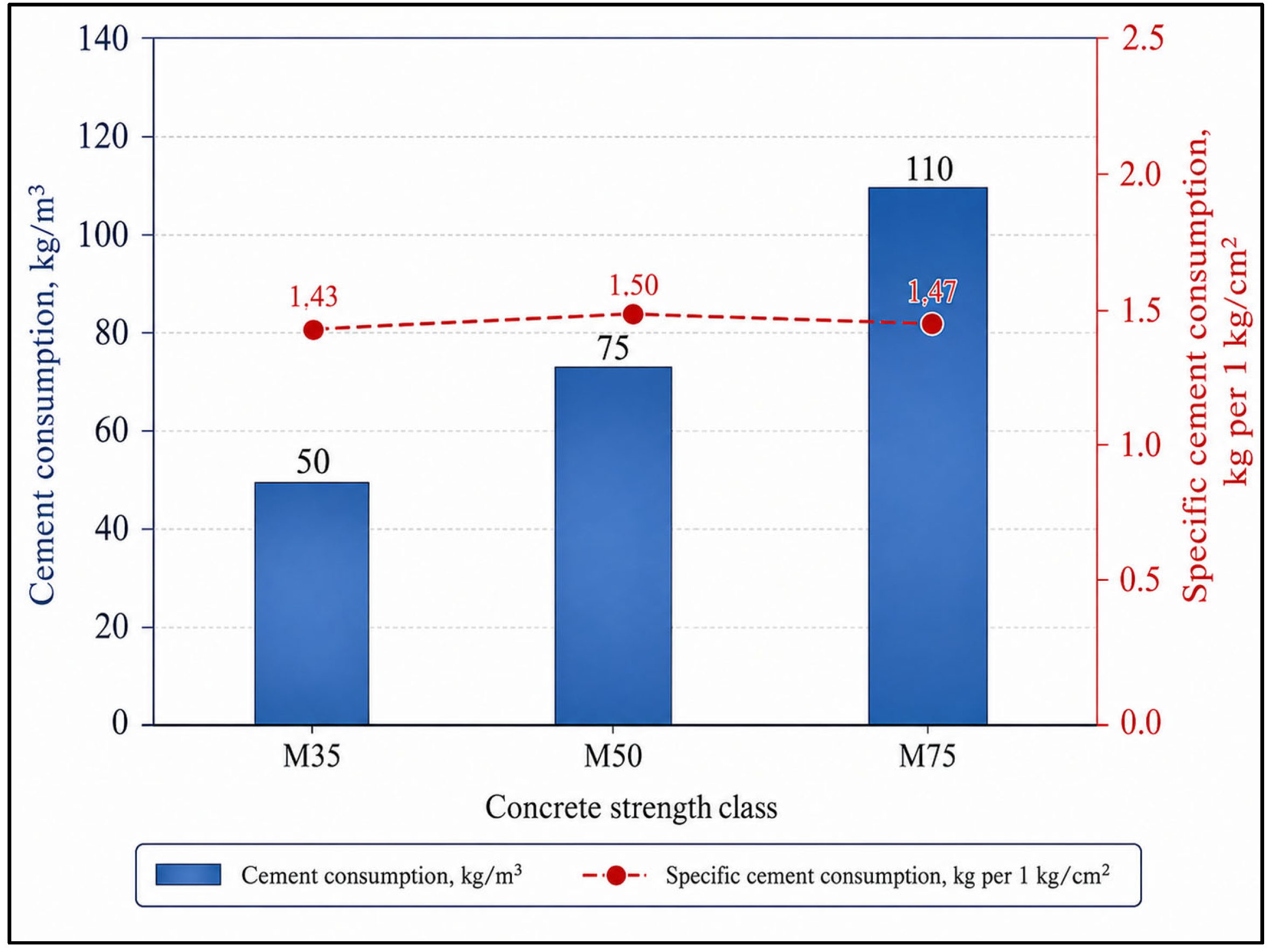
Cement consumption (bars, left axis) and specific cement consumption per unit of strength (line, right axis) for concrete grades 35, 50, and 75.
3.3. Effectiveness of Binder Use
Specific cement demand was 1.43, 1.50, and 1.47 kg per 1 kgf/cm2 for grades 35, 50, and 75, respectively. These similar values show internal consistency across the investigated production grades. They are lower than the ratios calculated for previously produced concretes with the same general aggregate source, but the comparison is not strength-equivalent and involves different mixture concepts and compaction conditions. It therefore demonstrates efficient binder use within the intended pressed product class rather than generally superior mechanical performance.
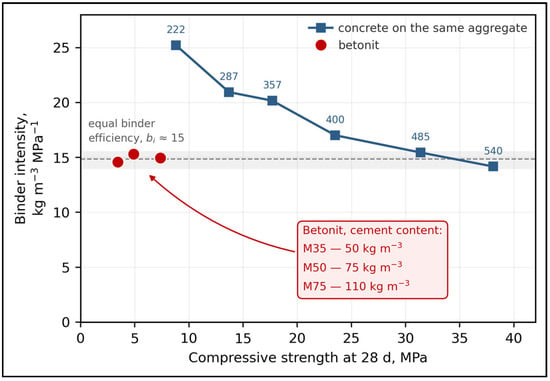
Binder intensity was 14.6–15.3 kg m−3 MPa−1 at strengths of 3.43–7.36 MPa (Figure 4). The reference concretes used 222–540 kg/m3 cement, water/cement ratios of 0.55–0.41, and achieved approximately 8.8–38.1 MPa under different casting and curing conditions. Their binder intensity decreased as strength increased. The apparent 7–9-fold difference in specific cement demand must consequently be interpreted with caution: it combines differences in strength range, mixture consistency, compaction, and intended product function. Binder intensity is retained as a resource-use descriptor, not as proof that the present material is mechanically superior to conventional concrete.
Figure 4.
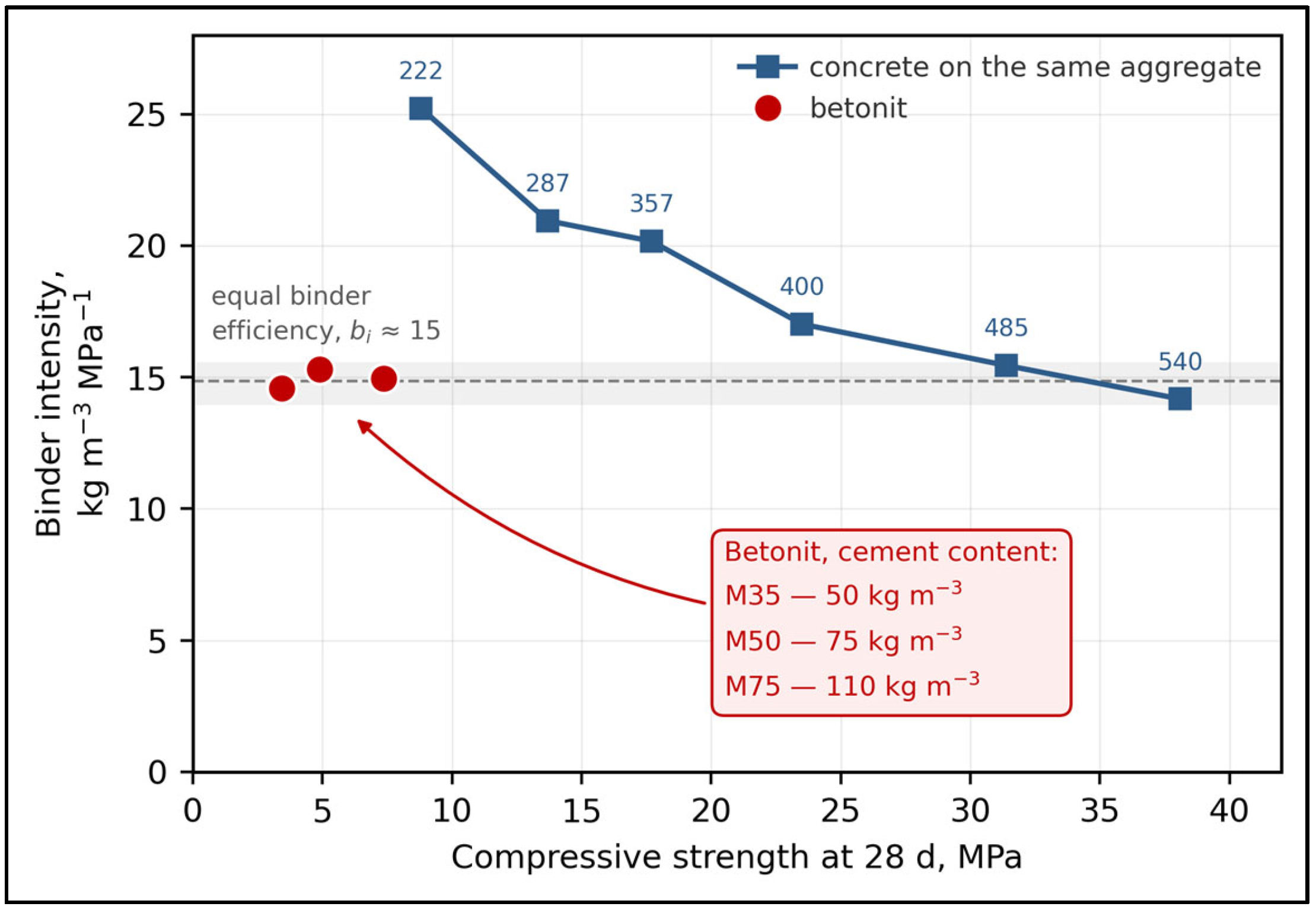
Binder intensity depending on compressive strength: betonite (grades 35, 50, 75) and concrete with the same aggregate made from shell rock sawdust.
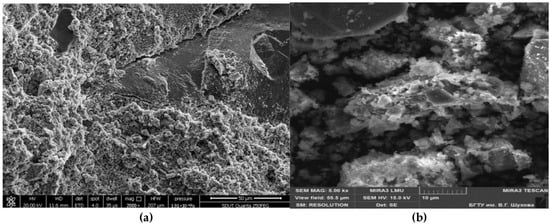
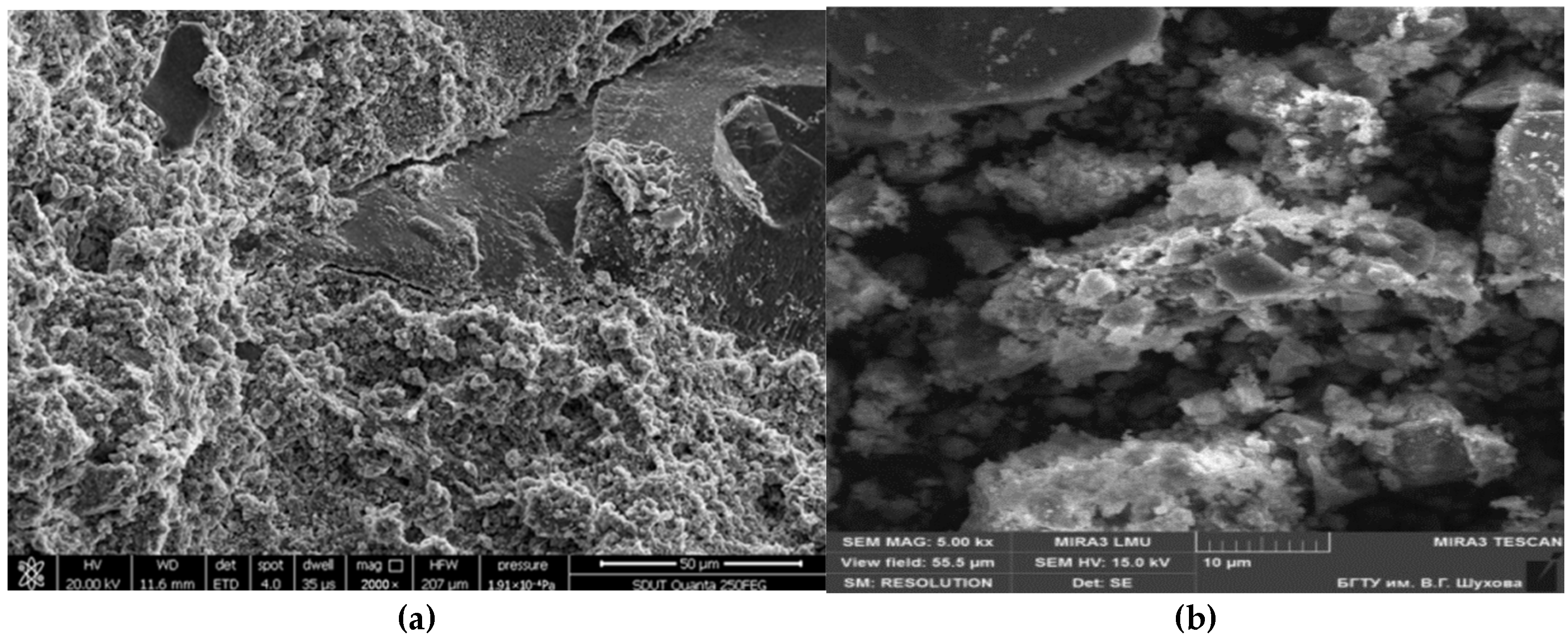
The observed efficiency is plausibly related to dense particle packing and localized load transfer at grain contacts. SEM images show carbonate particles embedded in a hydrated cementitious matrix and a distinct interfacial region (Figure 5). However, the images do not establish the three-dimensional spatial distribution of cement, and XRD identifies bulk crystalline phases rather than interface-specific reaction products. Accordingly, localization of cement at contacts and formation of calcium carboaluminate are presented as literature-supported mechanistic hypotheses [18], not as reactions proven directly in this study. Targeted SEM/EDS mapping, interface-resolved XRD or spectroscopy, and quantitative image analysis are required for confirmation.
Figure 5.
(a) SEM image of the cement-paste/carbonate-aggregate contact region. (b) SEM image of the cementitious composite based on shell limestone waste.
3.4. Cement Stone–Carbonate Aggregate Contact Area
Microhardness profiles showed a decrease close to the contact line on both the cement paste and aggregate sides for the four carbonate aggregates examined. SEM observations showed coarse and fine limestone particles connected by the hydrated matrix and visually confirmed the presence of a distinct interfacial region. Because the archived point-level microhardness values and indentation settings were incomplete, the present analysis supports only a qualitative comparison; it does not establish statistical significance among aggregates or curing conditions.
Porous carbonate aggregate can absorb liquid from fresh paste and locally alter the effective water/cement ratio and packing of the interfacial layer. Natural- and steam-cured specimens displayed different qualitative profiles, but the earlier statement that steaming definitively “enhances” the microhardness reduction has been withdrawn because dispersion data are unavailable. The observed trend is discussed as a hypothesis consistent with pore-air expansion and moisture redistribution during heat treatment. Future work should use replicated instrumented indentation, SEM/EDS maps, and phase-resolved characterization.
The contact zone is therefore a plausible target for improving the material, but its contribution relative to aggregate strength, moisture state, and packing cannot be isolated from the present dataset. Physics-based fracture and damage models could generate controlled datasets for studying interface-controlled cracking; coupled with modern deep-learning methods, such datasets may support damage localization and severity estimation in future work [30,31]. No AI modelling was performed in the present study.
3.5. Operational Properties and Product Range
The industrial campaign established the reported compressive strength range and documented frost resistance classification in the supporting program. Broader claims concerning impact toughness, thermal or acoustic insulation, and reinforced structural applications require dedicated standardized tests and have therefore been removed. On the available evidence, the most defensible applications are non-load-bearing pressed wall products and comparable small precast elements within the verified strength and durability classes.
3.6. Technical and Economic Indicators
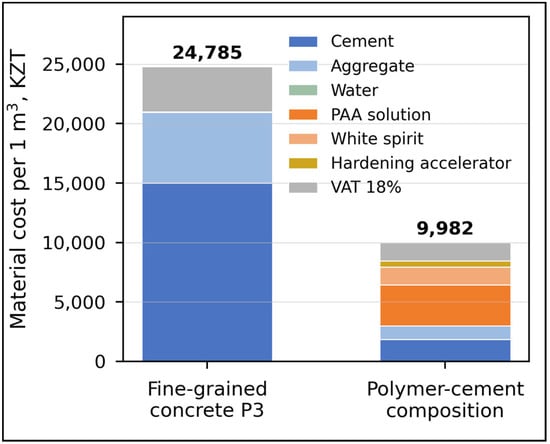
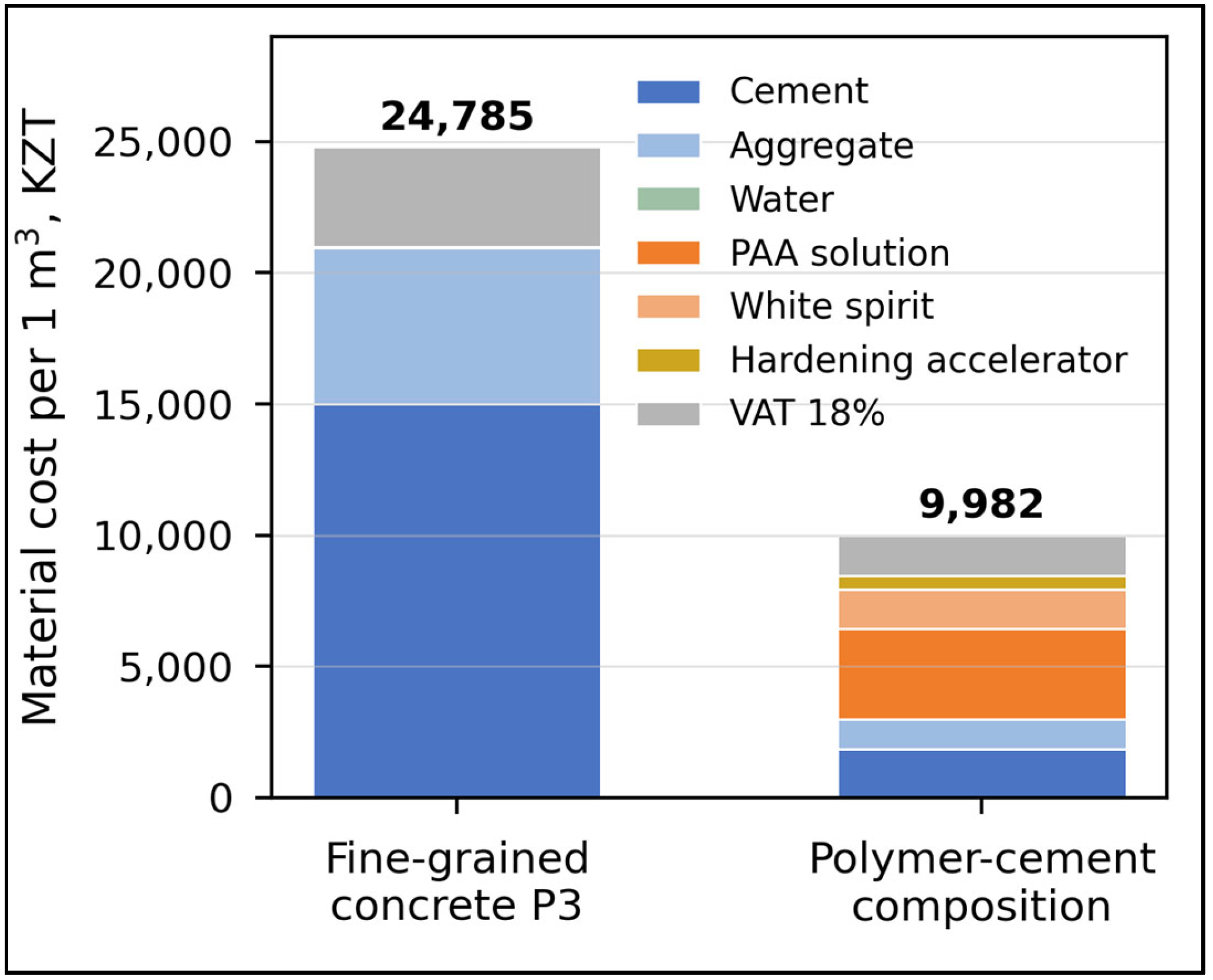
Table 4, Table 5 and Table 6 compare the reported material costs of the conventional fine-grained concrete and the proposed polymer-cement composition. Figure 6 illustrates the corresponding cost structure. At 2023 prices, the cost decreased from KZT 24,785.19 to KZT 9982.08 per m3. Using the 2023 average rate of KZT 456.31 per USD, these values correspond to approximately USD 54.32 and USD 21.87 per m3. Cement content decreased from 650 kg/m3 in the conventional cost baseline to 50–110 kg/m3 in the pressed product dataset. This comparison is economic rather than strength-equivalent and does not constitute a full carbon assessment. A defensible low-carbon claim would require cradle-to-gate inventories for cement, additives, electricity, transport, avoided disposal, and service life [32,33].
Table 4.
Cost of materials for producing 1 m3 of factory-made fine-grained concrete of grade P3 (prices as of 2023).
Table 5.
Cost of materials for the preparation of 1 m3 polymer-cement composition (prices in 2023).
Table 6.
Summary technical and economic indicators.
Figure 6.
The structure of the cost of materials per 1 m3 for fine-grained concrete grade P3 and for polymer-cement composition based on shell saw waste.
Using Equation (3) and an annual output of 1000 m3 gives an expected effect of KZT 16,300,420, equivalent to approximately USD 35,722 at KZT 456.31 per USD. The calculation reflects 2023 material prices and the assumptions stated in Section 2.6. Labor and electricity were assumed equal, and transport, avoided landfill management, maintenance, and environmental externalities were not monetized. The result should therefore be interpreted as a comparative material cost scenario, not a complete life-cycle cost or carbon assessment.
3.7. Study Limitations
This study has several limitations. The three grade-level strength means were retained in the industrial records, but individual replicate readings were unavailable for retrospective variance analysis. XRD confirmed the bulk carbonate phases, and SEM documented the interfacial morphology, but SEM/EDS maps, FTIR spectra, and interface-specific phase quantification were not available. Microhardness metadata were incomplete with respect to load and dwell time, preventing a fully reproducible quantitative comparison. The binder intensity comparison spans different strength ranges and compaction concepts. Finally, the economic assessment uses 2023 material prices and excludes a complete life-cycle inventory. These limitations define the required validation program for subsequent work.
4. Conclusions
Industrial trials demonstrated that shell limestone sawing waste can be processed into low-cement pressed wall products using crushing below 5 mm, moisture-controlled batching, vibration-assisted mold filling for 15–30 s, a compaction factor of approximately 2, and immediate demolding.
- Cement contents of 50, 75, and 110 kg/m3 produced 28-day strengths of 3.43, 4.90, and 7.36 MPa. Binder intensity remained between 14.6 and 15.3 kg m−3 MPa−1, but comparison with higher-strength reference concrete is not strength-equivalent and should be used only as a resource efficiency descriptor.
- XRD identified calcite as the dominant aggregate phase with minor dolomite and magnesite. SEM and microhardness observations confirmed a distinct cement-paste/carbonate-aggregate region, while the proposed chemical and load-transfer mechanisms remain hypotheses requiring replicated SEM/EDS, spectroscopy, and quantitative indentation.
- At 2023 prices, material cost decreased from KZT 24,785 (USD 54.32) to KZT 9982 (USD 21.87) per m3. Full validation requires replicate statistics, complete mixture-water records, standardized functional property tests, and life-cycle carbon and cost assessment.
5. Patents
The polymer–cement composition using ground coquina limestone screenings as filler is protected by Patent No. 4370 of the Republic of Kazakhstan [25].
Author Contributions
Conceptualization, Y.B.; methodology, Y.B. and E.J.M.-A.; investigation, Y.B.; formal analysis, Y.B.; validation, E.J.M.-A.; writing—original draft preparation, Y.B.; writing—review and editing, Y.B. and E.J.M.-A.; supervision, Y.B. All authors have read and agreed to the published version of the manuscript.
Funding
This research was funded by the Committee of Science of the Ministry of Science and Higher Education of the Republic of Kazakhstan under the project grant number AP22686399 “Reduction of environmental impact by using sawed limestone production waste in new building materials”.
Data Availability Statement
The original contributions presented in this study are included in the article. Further inquiries can be directed to the corresponding author.
Conflicts of Interest
The authors declare no conflicts of interest.
References
- Meshcheryakov, S.V.; Potulov, O.E. Limestone-Shell Rock of Mangyshlak and Ustyurt; Nauka: Alma-Ata, USSR, 1974. [Google Scholar]
- Gafarova, N.E. Application of shell limestone waste for monolithic construction. Int. J. Appl. Fundam. Res. 2016, 6, 630–632. [Google Scholar]
- Klyuev, S.V.; Klyuev, A.V. Study of the physical and mechanical properties of composite binders. Adv. Mod. Sci. 2015, 1, 21–24. [Google Scholar] [CrossRef] [Scilit]
- Bukayev, Y.Z.; Mutalibova, G.K.; Bukayeva, A. A new technology for manufacturing polymer-cement composition from limestone-shell mining waste. News Natl. Acad. Sci. Repub. Kazakhstan Ser. Geol. Tech. Sci. 2022, 2, 73–88. [Google Scholar] [CrossRef] [Scilit]
- Bukayev, Y.Z.; Nurbayeva, F.K.; Muralev, Y.D. Prospects for the utilization of limestone-shell rock mining waste by processing into new building materials. Min. J. Kazakhstan 2024, 12, 49–54. [Google Scholar]
- Kafu-Quvane, B.; Mlaba, S. Assessing the impact of quarrying as an environmental ethic crisis: A case study of limestone mining in a rural community. Int. J. Environ. Res. Public Health 2024, 21, 458. [Google Scholar] [CrossRef] [Scilit] [PubMed]
- Bukayev, Y.; Bukayeva, A.; Muralev, Y.; Nurbayeva, F.; Uisimbayeva, Z.; Jumasheva, K. Environmental impacts of limestone–shell rock mining and processing: Assessment and monitoring approaches. Acta Innov. 2025, 58, 1–19. [Google Scholar] [CrossRef] [Scilit]
- Cavaleri, L.; Borg, R.P.; La Mantia, F.P.; Liguori, V. Quarry limestone dust as fine aggregate for concrete. IOP Conf. Ser. Mater. Sci. Eng. 2018, 442, 012003. [Google Scholar] [CrossRef] [Scilit]
- Kibriya, T.; Tahir, L. Sustainable construction: High-performance concrete containing limestone dust as filler. World J. Eng. Technol. 2017, 5, 404–411. [Google Scholar]
- Yang, H.; Liang, D.; Deng, Z.; Qin, Y. Effect of limestone powder in manufactured sand on the hydration products and microstructure of recycled aggregate concrete. Constr. Build. Mater. 2018, 188, 1045–1049. [Google Scholar] [CrossRef] [Scilit]
- Felekoglu, B. Utilisation of high volumes of limestone quarry wastes in concrete industry (self-compacting concrete case). Resour. Conserv. Recycl. 2007, 51, 770–791. [Google Scholar] [CrossRef] [Scilit]
- Duran-Herrera, A.; De-Leon-Esquivel, J.; Bentz, D.P.; Valdez-Tamez, P. Self-compacting concretes using fly ash and fine limestone powder: Shrinkage and surface electrical resistivity of equivalent mortars. Constr. Build. Mater. 2019, 199, 50–62. [Google Scholar] [CrossRef] [Scilit]
- Segui, P.; Safhi, A.E.M.; Amrani, M.; Benzaazoua, M. Mining wastes as road construction material: A review. Minerals 2023, 13, 90. [Google Scholar] [CrossRef] [Scilit]
- Galetakis, M.; Raka, S. Utilization of limestone dust for artificial stone production: An experimental approach. Miner. Eng. 2004, 17, 355–357. [Google Scholar] [CrossRef] [Scilit]
- Galetakis, M.; Alevizos, G.; Leventakis, K. Evaluation of fine limestone quarry by-products for the production of building elements: An experimental approach. Constr. Build. Mater. 2012, 26, 122–130. [Google Scholar] [CrossRef] [Scilit]
- Scioti, A.; Bernardo, G.; Mecca, I.; Fatiguso, F. Characterization of stone waste sludge and preliminary investigation on green materials based on traditional lime putty for sustainable construction. Sustainability 2024, 16, 9173. [Google Scholar] [CrossRef] [Scilit]
- Scioti, A.; Fabbrocino, F.; Fatiguso, F. Sustainable production of building blocks by reusing stone waste sludge. Appl. Sci. 2025, 15, 5031. [Google Scholar] [CrossRef] [Scilit]
- Ji, G.; Chi, H.; Sun, K.; Peng, X.; Cai, Y. Effect of limestone waste on the hydration and microstructural properties of cement-based materials. Constr. Build. Mater. 2024, 438, 137784. [Google Scholar] [CrossRef] [Scilit]
- Mandolia, R.; Kalla, P.; Nagar, R.; Khichad, J.S. Effect of fine aggregate replacement with limestone slurry waste in self-compacting concrete: A microstructural approach. Mater. Lett. 2025, 381, 137779. [Google Scholar] [CrossRef] [Scilit]
- Jamshidi, A. A laboratory study on the durability of limestone wastes in harsh environments for their suitability as aggregate in concrete. Case Stud. Constr. Mater. 2024, 20, e03274. [Google Scholar] [CrossRef] [Scilit]
- Israelyan, R.G.; Margaryan, A.Y.; Israelyan, M.A.; Grigoryan, A.A. Results of experimental research on obtaining low-cement wall materials from waste of sawing of local limestones. Bull. High Technol. 2023, 4, 20–27. [Google Scholar] [CrossRef] [Scilit]
- Damineli, B.L.; Kemeid, F.M.; Aguiar, P.S.; John, V.M. Measuring the eco-efficiency of cement use. Cem. Concr. Compos. 2010, 32, 555–562. [Google Scholar] [CrossRef] [Scilit]
- Bukayev, Y.; Nurbayeva, F.; Bukayeva, A. Study of chemical-mineralogical composition of limestone-shell from the Zhetibai field. News Natl. Acad. Sci. Repub. Kazakhstan Ser. Geol. Tech. Sci. 2025, 3, 27–38. [Google Scholar] [CrossRef] [Scilit]
- Bukayev, Y.Z.; Kenzhetayev, G.Z.; Serikbayeva, A.K.; Mutalibova, G.K. Development of a new material based on a polymer-cement composition for the production of concrete blocks. In Proceedings of the International Scientific and Practical Conference “Global Science, 2019”; OGTI: Orsk, Russia, 2020; pp. 341–345. [Google Scholar]
- Kenzhetayev, G.Z.; Serikbayeva, A.K.; Bukayev, Y.Z.; Aitimova, A.M.; Boranbayeva, A.N.; Baimukasheva, S.K. Polymer Cement Composition. Patent No. 4370, 25 October 2019. [Google Scholar]
- Aruova, L.B.; Dauzhanov, N.T. Energy and resource saving technologies of building materials production using solar energy. MOJ Civ. Eng. 2017, 3, 1–7. [Google Scholar] [CrossRef] [Scilit]
- GOST 4001-2013; Wall Stones of Rock. Specifications. Standartinform: Moscow, Russia, 2014.
- GOST 10180-2012; Concretes. Methods for Strength Determination Using Reference Specimens. Standartinform: Moscow, Russia, 2018.
- GOST 12730.1-78; Concretes. Method for Determination of Density. Standartinform: Moscow, Russia, 2018.
- De Maio, U.; Garro, A.; Greco, F.; Pranno, A.; Silvestri, A. Vibration-based damage identification in concrete beams via a decomposed deep learning approach. Prog. Eng. Sci. 2026, 3, 100280. [Google Scholar] [CrossRef] [Scilit]
- Ani, A.; Nakka, R.; Subhash, G.; Molinari, J.-F.; Ponnusami, S.A. Machine learning for computational fracture and damage mechanics: Status and perspectives. Eng. Fract. Mech. 2026, 332, 111778. [Google Scholar] [CrossRef] [Scilit]
- Salcedo Fontalvo, J.E.; Vega A., D.L.; Polo-Mendoza, R.; Puc Hernandez, F.Á.; Navarro Ortiz, L.; Meneses Vides, G. Valorization of fine recycled concrete aggregate by-products from construction waste as a sustainable material for granular subbases: Mechanical and environmental assessments. Appl. Sci. 2025, 15, 11184. [Google Scholar] [CrossRef] [Scilit]
- Gao, S.; Xu, J.; Huang, Z.; Nishiwaki, T.; Rong, C. Life cycle environmental evaluation framework for mining waste concrete: Insights from molybdenum tailings concrete in China. Buildings 2025, 15, 3755. [Google Scholar] [CrossRef] [Scilit]

Disclaimer/Publisher’s Note: The statements, opinions and data contained in all publications are solely those of the individual author(s) and contributor(s) and not of MDPI and/or the editor(s). MDPI and/or the editor(s) disclaim responsibility for any injury to people or property resulting from any ideas, methods, instructions or products referred to in the content. |
© 2026 by the authors. Licensee MDPI, Basel, Switzerland. This article is an open access article distributed under the terms and conditions of the Creative Commons Attribution (CC BY) license.