


Abstract
This study evaluates the costs and benefits of participatory forest management (PFM) versus non-participatory forest management based on the perceptions and involvement of local communities in the Kilombero Valley Ramsar site, Tanzania. The area hosts ecologically significant wetlands managed through different regimes: forests managed by local communities under PFM and protected areas controlled by national authorities. Using data collected through focus groups, key interviews, household surveys, and direct observations in two villages—Siginali (PFM) and Kilama (non-participatory)—this research explores perceptions of two different forest management approaches. The results revealed: (i) a generally low awareness and participation in forest management activities in both villages; (ii) restrictions on forest resource access, essential for local livelihoods, were common and often poorly accepted in the two villages; (iii) neither approach alleviates poverty, instead, strict regulations have worsened livelihoods by eliminating traditional income sources; (iv) forced participation in patrols and fire control was also noted as an unfair burden without direct compensation; and (v) the “fortress” model is perceived as more effective at improving forest health and stopping illegal activity due to stricter patrols. The study concludes that while PFM supports forest sustainability, it needs enhanced local engagement, benefit-sharing mechanisms, and complementary income-generating initiatives such as ecotourism to sustainably balance conservation and community welfare.
1. Introduction
Forests and woodlands cover 45.8% of the terrestrial land surface of Tanzania (≈886,000 km2). These are public lands, of which two thirds are exploited by local communities and the remaining third are protected forest reserve areas [1,2]. Both systems should contrast in forest management; on one hand, local communities, supported by local governments, NGO’s and the private sector, are owners and managers of the nearby forests. This system is termed participatory forest management (PFM), which is considered a strategy or framework to achieve sustainable forest management involving local communities [3]. This can include different forms of management, such as Community-Based Forest Management (CBFM) [4,5], which applies to forests on village land where local communities are designated the sole owners and managers, and Joint Forest Management (JFM), in which local communities co-manage natural forest reserves on government-owned reserved lands [6]. On the other hand, forest reserves are managed by national authorities, and these are perceived as a “fortress” by local people since they cannot access them to use their natural resources: burning wood, construction materials, etc. [7].
PFM programs are spread around the world, showing different kinds of results. These programs have been useful to regenerate degraded forests, increase tree cover, enhance biodiversity, promote carbon sequestration, and protect watersheds [8,9]. At the same time, PFM increases the wealth of local communities, diversifying and increasing rural income and contributing to poverty reduction, food security and better education and health outcomes [8,10]. Moreover, PFM can strengthen community participation and governance where local institutions are empowered [8,11,12].
Nevertheless, some studies express skepticism regarding the tangible benefits of PFM programs [13]. For instance, the degree to which these initiatives actually reduce forest degradation and improve quality of life remains a point of contention [14]. This skepticism is often rooted in a persistent implementation gap between policies and on-the-ground execution [15,16]. Furthermore, rather than fostering genuine collaboration, many schemes risk reproducing or deepening existing power imbalances, effectively serving as mechanisms of control [17,18].
Luswaga and Nuppenau [19] insisted on the necessity of raising awareness and improving communication with villagers after observing better results in the JFM forests in Tanzania. So, more in-depth studies are needed, aiming to gather qualitative and quantitative data to assess the effectiveness of PFM programs, at least in Tanzania, since environmental degradation is influenced and caused by multiple interacting factors at different spatio-temporal scales [20].
Tanzania introduced PFM strategies for the very first time in the Kilombero District (Morogoro Region) in 1994 [21]. They were aimed at protecting forests from unplanned exploitation as response to the increase in human pressure on natural resources: fertile soils for agriculture, timber, burning wood, clay for buildings, etc. [22]. The idea was to provide forest products and services to alleviate poverty in local communities while preserving ecosystems as a feasible alternative to the top-down environmental protection observed across the country [23]. In other words, awareness of the sustainable management of forests would be increased and continued resource provision guaranteed. These strategies contrast with the traditional perception of a fortress inherited by the protection policy during the colonial and post-colonial period [21]. In this context, the idea of “learning to milk the forest” (personal communication with a local stakeholder) illustrates an increased awareness of sustainable forest management.
Among the protected areas in Tanzania, the Kilombero Valley, within the Kilombero District, is one of the most important wetlands in the country and around the world. It was recognized as a Ramsar site by UNESCO in 2002 and its importance is recognized by local communities due to its fertile floodplain soils and heavy forests, among many other natural resources [24]. This valley is surrounded by protected areas such as Udzungwa Mountain National Park, Selous Game Reserve, Mikumi National Park, West Kilombero Forest Reserves, Wildlife Management Areas and many other Nature Reserve Forests of different typologies. Around these protected areas, some communities are located in nearby forests under PFM, while others are adjacent to forests managed by national authorities (non-participatory, “fortress-style”) [25].
Previous studies about the impact of forest management on adjacent communities [26,27] have remarked on the perceived costs of non-participatory forests on communities’ livelihoods: (1) loss of access to forest resources, water, and farming land; (2) damage provoked by wildlife; and (3) harassment by game rangers. In this study, we aim to confirm if these costs are also perceived by those communities living in the PFM forests. In addition, we focused on the perceived benefits, effects on forest preservation and community wealth, and the degree of local involvement in management activities, comparing these to well-known results from non-participatory forests.
The primary objective of this study was to compare the perceived costs and benefits of PFM communities with those living adjacent to non-participatory forests. To achieve this, we assessed local perceptions, the degree of involvement in management activities, the impact of PFM on livelihoods and quality of life, and the subsequent effects on forest conservation. We utilized the conceptual framework by Sumbi [28], which postulates that while the benefits of conservation often accrue globally, the costs are largely borne by local communities. We aimed to verify whether the perceptions of PFM-adjacent communities align with this postulate. Our hypothesis is that communities living adjacent to PFM forests will report significantly higher perceived net benefits and lower livelihood costs compared to those living adjacent to non-participatory forests.
2. Materials and Methods
2.1. Study Area
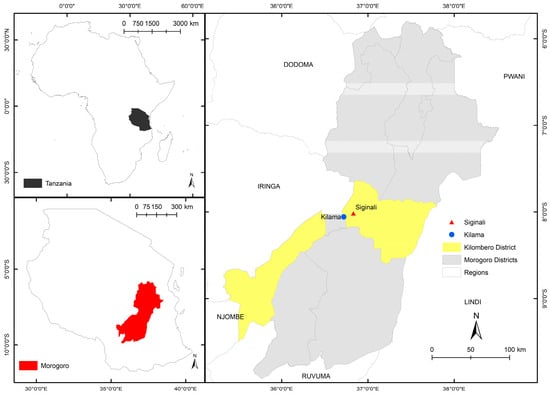
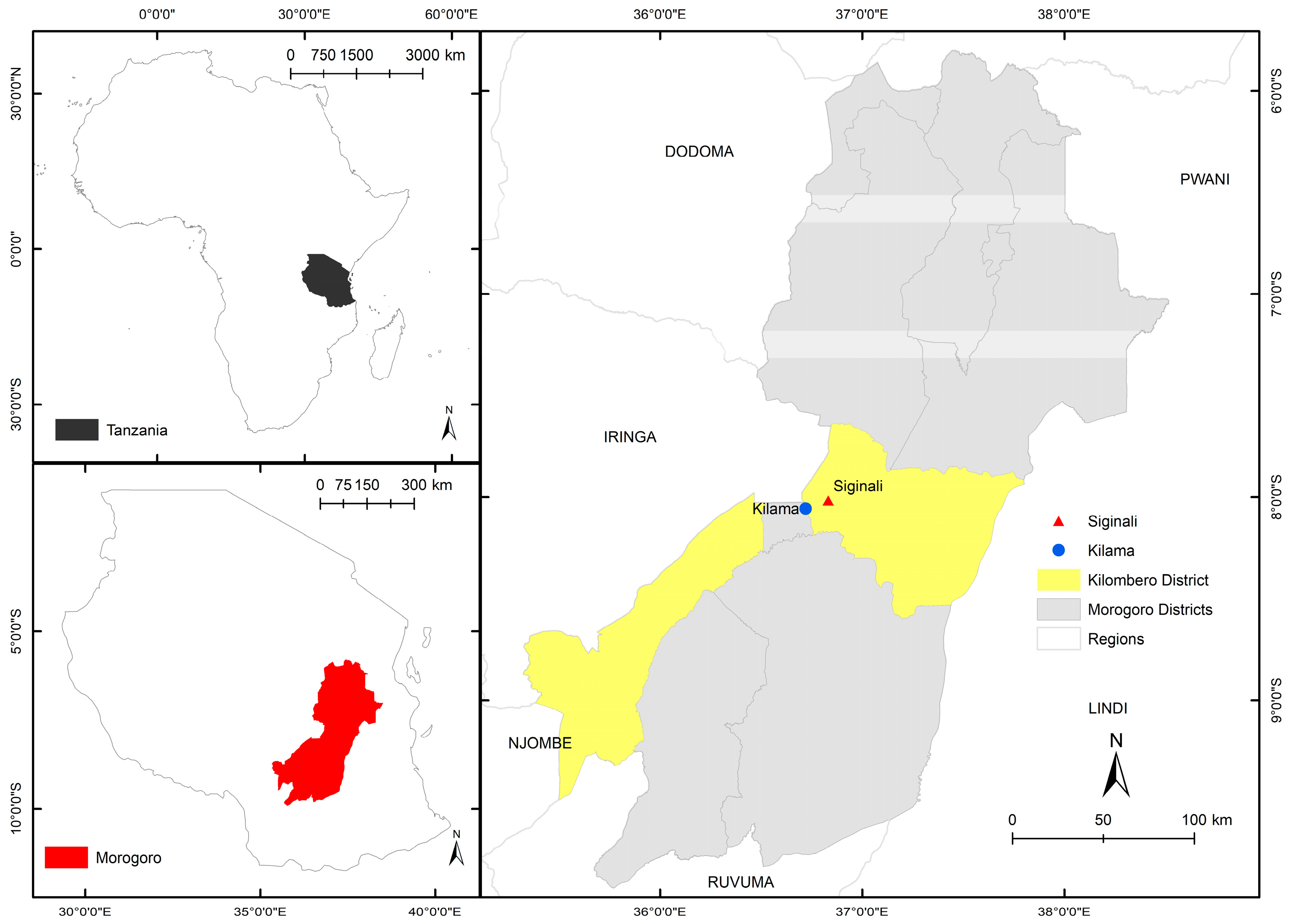
The Kilombero District (7°40′–9°21′ S; 35°20′–37°48′ E), with a land size of 14,918 km2, is located on the western side of the Morogoro Region, SE Tanzania (Figure 1). Situated in a vast floodplain of the Kilombero River, the dominant land uses are residential (38.8%), followed by arable lands (29.9%), forests (16.1%), grazing lands (8.0%) and wetlands (7.2%). The forests are divided into natural (8.4%), reserved (7.2%) and planted (0.5%) forests. The district has 38 rivers and several water bodies that provide power and irrigation schemes for the arable lands.
Figure 1.
Map of the geographical location of the Kilombero District. The map was produced by the authors.
From a physical point of view, the study area is dominated by an Aw climate type (equatorial with dry winters), according to the Köppen–Geiger classification [29], with high temperatures during the year (average: 26–32 °C) and an average total annual rainfall between 1200 and 1600 mm and seasonal flooding.
Regarding its territorial organization, the district is divided into 5 divisions (Ifakara, Kidatu, Mang’ula, Mngeta and Mlimba) and 19 wards (ward means a set of nearby villages and/or settlements) with a total population of 907,456 inhabitants [30], including the population of the Ifakara Township. From an ethnical point of view, most of the population is of Bantu (indigenous), Ndamba, Mbunga and Ngindo origin, although minorities such as Masai, Sukuma, Barbaigs, Pogoro, Hehe and Bena are also present in the territory. The main economic activity is agriculture, both subsistence and commercial, engaging about 80% of the total population. Livestock keeping (pastoralism and agropastoralism) and fishing are also other frequent activities.
In relation to nature protection, the system is characterized by a network of a combination of protected areas (PA) established through formal laws, alongside various forest management strategies, such as PFM, JFM and village forest reserves. In total, there are 14 forest reserves over 191,330 ha. The management is primarily overseen by the Tanzania National Parks Authority (TANAPA) and the Forest and Beekeeping Division (FBD), with the support of the World Wide Fund for Nature (WWF) and several NGOs. These regulatory frameworks are critical as ecosystems face mounting pressure from commercial agriculture, large-scale livestock grazing, and the rising resource demands of a local population that has increased since 2002.
2.2. Experimental Design
For the study, two representative villages of the Kilombero district were selected: Kilama (8°3′23.98″ S, 36°43′9.31″ E), located in the Kibaoni ward, and Siginali (8°0′59.58″ S, 36°49′54.48″ E), located in the Kiberege ward. At the time when the study was conducted, these communities were both part of the Mang’ula division.
Kilama and Siginali are among the villages in the Kilombero Valley Ramsar site (land area of 796,735 ha) [31] located in the Morogoro region, southern Tanzania, between the Udzungwa mountains and the Mahenge escarpment, part of the Eastern Arc Mountains. These villages were selected because they both lie along the natural reserved forests of Udzungwa Mountain National Park, West Kilombero Forest Reserves, Nanganje Forest Reserves, Selous Game Reserve, and Ibiki Community-Based Forest Management, which form basic conservation areas along the Kilombero Ramsar site, and where various forest management approaches and strategies are employed.
In the district, a mix of ecosystems can be observed. Much of the area is covered by Miombo woodlands that are found at approximately 1700 m above sea level. Although Kilama borders the Udzungwa Mountains National Park (land area of 199,000 hectares) and the Nangaje Forest Reserve (18,988 hectares), villagers rely on scattered trees on their farmland and private forests due to restrictions by the TANAPA. Conversely, Siginali manages its own forest under community schemes, using the Ibiki forest (under Community-Based Forest Management—CBFM) and the Siginali Village Land Forest Reserve (VLFR).
Kilama is a good example of non-participatory forest management since it is done by the national authorities (TANAPA) under a fortress approach with protected areas, meaning that residents are not involved in the parks’ management and are not allowed to enter the forest to harvest resources or conduct economic activities. Siginali is the opposite because forest management is done by a participative approach under different ways: JFM, CBFM and VLFR. Therefore, the selection of these two representative villages allows us to establish comparisons between the costs and benefits of the two dominant forest management strategies as well as to know the level of participation of the local communities in management activities.
At the time of the study, the village of Kilama comprised 384 households, while Siginali consisted of 839. Household sizes in Kilama were comparatively smaller, the majority (55.8%) containing 1–5 members, followed by 44.1% with 6–10 members. In contrast, Siginali exhibited larger household structures; most (52.8%) had between 6 and 10 members, with a notable 13.4% containing 11–15 members. Our research involved 39 and 41 households randomly selected from Kilama and Siginali, respectively. These samples carry a maximum margin error of 14.89% and 14.94% at a 95% confidence level. Despite these margins, we consider the sample sizes representative and robust, particularly given the high refusal rates common in such field surveys. Furthermore, according to Kothari [32], a sample representing 5–10% of the total population can provide a reliable and accurate representation of the study area.
Utilizing a Participatory Rural Appraisal (PRA) approach, empirical data were obtained through a combination of qualitative and quantitative techniques. Information was collected from 80 households and four key informant groups via structured and semi-structured interviews conducted in English. To deepen the analysis, we conducted six focus groups (four formal and two informal) and utilized transect walks for direct observations. Wealth ranking was established based on economic strata identified during household interviews to ensure social representativeness across the sample. The application of PRA methods allowed researchers to maintain an objective stance while facilitating a bottom-up understanding of the subjects’ realities [33]. In this capacity, our role was to systematically gather information and analyze the local situation. Finally, the findings from the focus groups, interviews, transect walks, and wealth ranking were triangulated to cross-check the data and minimize bias.
2.3. Interviews
We conducted in-depth interviews with small and large-scale farmers, forest officers, environmental committee members, local government leaders, and TANAPA officers, among others (interview guides can be consulted in the Supplementary Material S1–S3). Most interviews followed a semi-structured format, providing respondents the flexibility to express their concerns and opinions. Prior to the study, an interview guide was developed and pilot-tested with a small group to ensure the reliability and validity of the research instrument. A proportion of 69.1% of the respondents were males and 30.9% females. All the interviews addressed the ethical issues of anonymity and confidentiality. The interviews provided adequate information on how local people perceive, understand, and participate in forest management.
2.4. Wealth Ranking
The wealth ranking used a PRA technique to examine the social stratification and/or status of the local villagers, aiming to understand the different means of access, control and use of factors of production such as land, forests and capital. It facilitates the understanding of power relationships between different social groups [34]. For this reason, first we consulted elderly community members to establish ranking criteria based on the ownership of assets. Secondly, we asked farmers, fishermen, pastoralists, employees and businesspeople (key informants) to provide a general overview on power relationships and social structure including household income ratios, energy sources, forest products, land ownership, education and other basic needs, as well as their average income and their position in the village wealth rank strata. The key informants were identified with the support of the village executive officers, including members of the community with different socio-demographic backgrounds. The classification resulting from the wealth ranking was used to create a sampling frame for the interview guides, ensuring that different power groups were represented.
Since wealth ranking is a qualitative method based on individual judgment, which makes it difficult to eliminate elements of bias, wealth ranking questions were included in the household interviews to cross-check with the initial evaluation. Household representatives were asked to explain their average income and rank themselves according to the village wealth rank stratum. By correlating the qualitative ranking with the quantitative income data, the study identified three specific wealth groups based on household income capacity. This capacity was measured by tangible indicators, such as the number of rice bags obtained per year, involvement in petty business, or formal employment. The wealth ranking data was triangulated with information from household interviews and focus group discussions to validate findings regarding social classes and resource tenure systems.
2.5. Focus Groups
The focus groups (FGs) were organized to facilitate discussions between local residents and community leaders on key research topics. These included power dynamics, land access and control, involvement in decision-making, cost–benefit sharing, gender issues, and local perceptions of participatory management. Participants were selected based on their experience, with the assistance of village executive officers. The groups comprised a diverse range of stakeholders, including village environmental committee members, elders, forest officers, primary and secondary school teachers, youth and religious leaders. In Kilama, two formal focus groups were conducted with a total of 23 participants (FG1: 10; FG2: 13), consisting of 10 males and 13 females. Similarly, two groups were held in Siginali with 32 participants (FG3: 15; FG4: 17), including 17 males and 15 females.
The formal FGs were combined with information gathered in two informal focus groups held in the local village bar of Kilama and the Mturumbe Youth Motorcycle Group, in Siginali. In those informal groups we dealt with concerns about local communities’ livelihoods. To ensure balanced participation, we monitored discussions closely to prevent a few vocal individuals from dominating the sessions. This active facilitation guaranteed that all respondents could contribute and that the conversation stayed focused on the study’s specific themes.
In this study, the primary benefit of FGs was their ability to serve as a triangulation method, validating information obtained from household interviews and wealth rankings to ensure the data regarding social classes and resource tenure was not biased by individual perspectives. Unlike individual interviews, this technique provided a dynamic environment where diverse community representatives could deliberate on sensitive issues, such as power relations and cost–benefit sharing, until they reached a collective consensus. Additionally, the use of informal FGs in social settings allowed the researcher to uncover “hidden marginalized truths” from social groups that might otherwise be suppressed in formal settings, thus revealing critical perspectives on illegal survival strategies and the reality of power dynamics that statistical data alone could not capture.
2.6. Transect Walks
The study incorporated direct field observations, conducted alongside a local researcher and key informants, to investigate the status of land use, agricultural landscapes, forests, livelihoods, and catchments. This technique enabled us to observe, listen, and identify specific zones while asking targeted questions to detect problems and discuss potential solutions [33]. Serving as a triangulation method, these site visits were used to confirm data gathered during interviews and focus groups. By physically traversing the landscape, we gained a firsthand insight into the area’s topography, soil quality, land uses, watershed health, forests, and community assets. These field walks were informed by an extensive preliminary literature review, including publications, reports, articles, books, official letters, press clippings, etc., on the study area (literature review).
2.7. Data Analysis
This study employed a mixed-methods approach to data analysis. The quantitative data were analyzed using descriptive statistics, including mean, range, and percentage distributions, to provide a clear overview of the socio-economic context.
The qualitative data were processed through thematic coding, which facilitated both a structured content analysis and a deeper exploration of local perspectives. To move beyond simple descriptions, we applied political ecology frameworks, utilizing discourse and narrative analysis to identify underlying power dynamics and environmental logics. This involved the development of typologies and analytical matrices to compare responses and interpret complex social narratives. Findings are presented through a combination of narrative explanations and thematic summaries.
In alignment with the objectives of this paper, Table 1 presents the key concepts, research variables, and measurement indicators employed in this study. These include: (i) community awareness and understanding, (ii) levels of participation and involvement, (iii) livelihood costs (including restrictions and enforcement), and (iv) livelihood benefits (including economic incentives and resource access). These quantitative indicators were analyzed alongside qualitative categories that emerged from focus group discussions and semi-structured interviews to provide a comprehensive view of forest management impacts.
Table 1.
Conceptual framework and measurement strategies.
3. Results
The findings of this study reveal a complex socio-environmental landscape characterized by a significant disconnect between formal forest management policies and the lived realities of adjacent communities in the Kilombero Valley. While quantitative data provides a baseline for understanding the socio-demographic structure and resource usage patterns, qualitative thematic coding synthesized through Participatory Rural Appraisal identified four critical categories that define the current state of forest governance: Institutional Inefficacy, Access and User Rights, Conservation vs. Poverty, and Conflict and Power Dynamics. These themes underscore a persistent “implementation gap” where the theoretical benefits of PFM in Siginali often feel “verbal and not practical,” making the system nearly indistinguishable from the “fortress” approach observed in Kilama. The following sections detail these findings, illustrating how strict conservation mandates frequently overlap with “miserable” socio-economic conditions and uncompensated local labor.
3.1. Socio-Demographic Characteristics of the Interviewees
Table 2 summarizes the main socio-demographic characteristics of the 80 household representatives. The majority of the respondents were aged between 21 and 50 years old, representing the economically active population tasked with both raising children and supporting elderly relatives. Notably, a substantial percentage lived in households with more than five members. These multigenerational, extended families are often driven by the cultural and economic necessity of caring for aging parents and grandparents. In terms of education, over 80% of respondents completed primary school, which is mandatory in Tanzania. Economically, many households report annual incomes below 500,000 TSH. This socio-economic context suggests that residents face significant pressure to exploit surrounding natural resources to meet basic needs. Furthermore, distinct differences emerged between the two villages: Siginali (PFM) exhibits a trend toward smaller household sizes and higher average incomes, reflecting a shift toward a more modernized socio-economic structure.
Table 2.
Socio-demographic characteristics of the interviewees. FM: Forest management; NP: Non-participatory; P: Participatory; Tsh: Tanzanian shillings.
Beyond forest harvesting, agriculture is the primary economic activity in Kilama and Siginali, with 91% of respondents in both villages depending on farming and crop sales as their main livelihood. Fertile soils and seasonal flooding in the Kilombero River provide ideal conditions for cultivating paddy (rice), maize, and other food and cash crops. Fishing is also a recognized economic activity, primarily conducted along the Kilombero River and in smaller swamps, though it remains underutilized. Finally, a small portion of the population engages in commerce and formal employment. In Kilama, 5.8% of respondents were identified as business owners, while in Siginali, 4% were engaged in both farming and business. Formal employment remains rare, accounting for only 2.9% of respondents in Kilama and 3.1% in Siginali.
The economic profile of the study area reveals a population living under significant financial strain, with a substantial portion of households reporting annual incomes below 500,000 TSH. This low-income data serves as more than just a statistic; it is the primary driver for the “Conservation vs. Poverty” tension observed throughout the valley, as residents face constant pressure to exploit surrounding natural resources to meet basic survival needs. Because 91% of households in both Kilama and Siginali depend almost exclusively on agriculture and crop sales for their livelihood, forest products represent an essential secondary safety net. Consequently, strict management restrictions on forest access do not merely impact supplemental income but directly threaten the primary socio-economic resilience of these forest-dependent communities.
3.2. Awareness and Understanding of Forest Management
The awareness and understanding of forest management in both communities, types of management, training activities, and forest meetings are summarized in Table 3. Firstly, local people were asked if they had basic knowledge and understanding of forest management and conservation, and 73.6% in Kilama and 40.5% in Siginali responded affirmatively. Upon further investigation into forest management types, we found that residents of Kilama (characterized by “fortress” style) demonstrated a better understanding of participatory management than those in Siginali (PFM). Notably, many residents lacked knowledge of PFM—including JFM and CBFM—despite living in communities where these frameworks directly govern their access to forest resources.
Table 3.
Awareness and understanding of local communities of forest management, types of management, training activities and forest meetings. FM: Forest management.
Secondly, we assessed participation in forestry-related seminars, conferences, training activities and/or public meetings. While the majority of residents in both villages (Kilama: 70.5% and Siginali: 86.4%) had not attended formal training, most of them were aware that forest meetings existed (76.4 and 70.4%) and some used to attend them (76.3% and 51.3%). These figures suggest a general disinterest in technical forest management, particularly in Siginali, except for public meetings where local people can directly discuss issues affecting the household economy. While training is typically sponsored by external bodies like TANAPA and Ramsar, public meetings are hosted by local authorities, making them feel more relevant. In addition, the population receives information through audiovisual media, including TV, radio, posters, and magazines.
However, during the focus groups discussions, it was noted that there was a relatively high community awareness of forest management in both communities, despite low formal education levels, driven by alternative mediums such as radios and public meetings, while informal discussions in social settings exposed the reality of unequal power relations where local governments are often marginalized and treated as mere subordinates to TANAPA in decision-making processes.
The data suggests a generalized “Institutional Inefficacy” characterized by a significant “implementation gap” between high-level policy and local reality. While residents in the “fortress” village of Kilama demonstrated better awareness of management types, the high percentage of Siginali residents with “no idea” about PFM (54.1%) reveals that living under a participatory framework does not automatically equate to understanding its mechanics. This reveals a paradox of passive awareness: while a high majority of residents in both villages are aware of the existence of forest meetings (70.4% in Siginali and 76.4% in Kilama), the actual technical understanding of PFM types remains significantly lower in the participatory village of Siginali (45.9%) compared to Kilama (61.7%). This lack of technical awareness stems from policies that are perceived as “verbal and not practical,” where the lack of formal training, evidenced by 86.4% non-attendance in Siginali, leaves villagers governed by frameworks they do not fully comprehend.
3.3. Local Participation and Involvement
Beyond the limited awareness and understanding discussed in Section 3.2, both communities exhibited low levels of active involvement in forest management. In this context, “participation” encompasses both voluntary engagement and compulsory duties. When surveyed, 58.8% of respondents in Kilama and 40.5% in Siginali claimed to participate; however, much of this involvement was mandatory, such as emergency firefighting in protected areas.
Focus groups revealed two primary drivers behind this low participation: minimal perceived benefits and a strained relationship with TANAPA officials. In Siginali (PFM), 59.4% of respondents held a negative view of TANAPA due to their perceived overreach into all forest types. This sentiment was even stronger in Kilama (fortress) where 70.5% reported negative feedback. Furthermore, local leaders highlighted a pattern of top-down, authoritarian practices by national authorities, summarized by one informant: “when they come here they only give us command of what to do” (anonymous informant).
This dynamic is deeply rooted in “Conflict and Power Dynamics”, where the relationship between communities and national authorities is defined by a “top-down” hierarchy. The perception of local governments as mere subordinates to TANAPA, who often enter village lands to give “commands” rather than consult, marginalizes community leadership. Consequently, “participation” is largely involuntary; it is seen as a compulsory duty, such as emergency firefighting or patrols, rather than a collaborative decision-making process. This forced involvement, coupled with a negative view of TANAPA (shared by 70.5% in Kilama and 59.4% in Siginali), creates a barrier to genuine community engagement.
3.4. Perception of Costs and Benefits
This study was focused on the users’ rights to access, control and harness products and services provided by the forests around both villages. Local leaders listed a set of essential products for local peoples’ livelihoods: firewood, timber, rope, medicine, grasses for thatching, poles, mushrooms, honey, fodder, wild meat, and fruits (Table 4). These products have gone from being abundant to very scarce as a result of TANAPA restrictions (opinion expressed in the focus groups). Another important resource is water. Local villagers have expressed that the amount of water for irrigation agriculture has been reduced drastically as a consequence of pastoralists and their occupation of most of the catchments and water sources. They claimed that pastoralists clear trees to obtain pastures. So, our findings suggest the existence of two unsolved conflicts: local villagers vs. TANAPA restrictions and local villagers vs. pastoralists.
Table 4.
Percentage of local people that use forest products.
Table 4 shows the percentage of people that use forest products despite existing restrictions, highlighting a gap between conservation policy and local necessity. Notably, the percentages in Kilama were always higher than in Siginali, except for those of ropes, wild meat, water for irrigation and fodder. The imposition of restrictions has significantly increased the opportunity cost of resource collection, forcing residents to walk distances of up to 10 km to access these products. This spatial barrier, however, has not acted as a total deterrent; instead, it has shifted harvesting patterns towards strategies such as nocturnal and weekend extraction. The admission of these illegal activities, despite the risk of penalties, suggests that the utility of these products outweighs the perceived risk of enforcement, showing that the current management models fail to provide adequate livelihood alternatives.
Ultimately, the communities in both Kilama and Siginali perceived substantial and similar costs regardless of whether the forest management approach is “fortress” or “participatory” to the extent that villagers often find it difficult to distinguish between the two systems. The most significant cost is the prohibition of access to essential forest resources, such as firewood, timber, charcoal, and bushmeat, which has eliminated key income-generating activities and deepened poverty by forcing reliance on subsistence agriculture. Furthermore, residents bear the burden of uncompensated and dangerous labor, as they are forced to participate in fire extinguishing and patrols without training or protective gear, facing risks of injury without support. These economic and physical costs are compounded by conflict and harassment; villagers report being subjected to excessive fines, physical violence or imprisonment by authorities when caught in the forests. Additionally, specific costs in the participatory village of Siginali include bureaucratic hurdles to access their own community forest and conflicts arising from the invasion of pastoralists, which causes environmental degradation and social tension.
The emergence of these adaptive behaviors highlights a critical struggle over “Access and User Rights”. As spatial barriers increase, forcing residents to walk up to 10 km to bypass restricted zones, villagers have transitioned to “nocturnal survival strategies,” extracting timber and charcoal at night to evade the “harshness and cruelty” of patrols. The high percentage of households still utilizing firewood (97.2% in Kilama; 94.5% in Siginali) despite strict prohibitions proves that the utility of forest resources for basic survival outweighs the perceived risk of fines, physical violence, or imprisonment.
3.5. Perception of Incoming Opportunities for Poverty Alleviation: Conservation vs. Poverty
Local residents typically perceive the extraction of forest products for daily use as the primary benefit of the forest, whereas authorities view conservation and sustainable management as the principal long-term benefits provided to adjacent communities. Therefore, the tourism income by means of visitor fees as well as the services of accommodation, food, guided visits, entertainment, merchandising, etc., are often perceived as a compensation mechanism for the local communities’ livelihood. In both villages, Kilama and Siginali, tourism is not perceived as a realistic alternative yet. In addition, the villagers claimed that they did not receive any support or dividend for participation in management activities such as patrols, fire extinction, and/or the sales of trophies caught from illegal harvesting. Consequently, many participants perceive PFM strategies as failing to offer viable opportunities for income generation.
Regarding poverty alleviation, a subset of villagers supports the current management approaches due to some specific environmental benefits. These include improved water provision, better protection of catchment sources, and the accumulation of humus from decomposed biomass, which enhances agricultural yields. Moreover, in Siginali, timber from the CBFM Ibiki forest has been used to build schools and hospitals as well as poles and logs for their private houses through specific permits. Nonetheless, this opinion contrasts with the one expressed by other villagers in Siginali that believe PFM does not differ from TANAPA-protected areas. It has been argued that the introduction of PFM has converted local residents to poorer citizens. These perspectives align with the views of Kilama residents, who describe their current situation as “miserable” due to the prohibition of traditional livelihoods without the provision of viable alternatives. Furthermore, several respondents reported instances of physical abuse and injury at the hands of authorities when caught engaging in restricted forest activities.
These findings illustrate the Conservation vs. Poverty paradox: a fundamental tension between the demand for resources from a growing population and strict environmental mandates. While the current management systems are legally effective at improving forest health and biomass—recognized by over 64% of respondents in both villages—this success is achieved by eliminating traditional livelihoods. Without the provision of viable alternatives like ecotourism, which is currently not perceived as a realistic option, conservation is viewed as a mechanism that deepens poverty.
This situation is further exacerbated by a significant “implementation gap” rooted in “Institutional Inefficacy”. The failure to deliver tangible tourism benefits is compounded by local grievances regarding the selection of community representatives, with allegations of “nepotism” in elections undermining the legitimacy of the management framework. Ultimately, this creates a critical mismatch where the long-term ecological benefits, such as humus accumulation and water protection, fail to offset the immediate “miserable” socio-economic reality of forest-dependent households.
3.6. Perception of Policies, Regulations and Institutional Set-Up
Local residents were asked about their knowledge of environmental policies and regulations, apart from commonly known prohibitions. A proportion of 76.5% of those surveyed in Kilama and 62.1% of those in Siginali responded that they had no knowledge of this matter. Secondly, they were asked about the degree of adequacy and effectiveness of these policies and regulations; only 23.5% in Kilama and 37.8% in Siginali reported positive comments. Regarding the institutional set-up for forest management and conservation, 50.0% in Kilama and 64.8% in Siginali expressed their agreement with the current set-up improving the status of the forest and recommended its replication in other territories of the country. Of those asked, 32.4% in Kilama and 21.6% in Siginali thought this system is ineffective, since local communities are not involved and often ignored, discriminated, marginalized and excluded from the potential benefits. Nonetheless, 64.7% of respondents in Kilama and 67.6% in Siginali recognized that the forests are in very good condition in comparison with previous years before the introduction of PFM. Moreover, illegal hunting, lumbering, burning of charcoal, and logging have been reduced.
Another critical issue identified was the latent conflict between villagers and livestock keepers or pastoralists, who are frequently blamed for current forest degradation. Residents accused them of overgrazing and the indiscriminate cutting of trees—including saplings—leading to physical confrontations with local villagers. Furthermore, some interviewees alleged that forestry officers permitted these destructive practices, suggesting that corruption and illicit benefits influenced the authorities’ failure to enforce regulations.
The persistence of conflicts with pastoralists, who are blamed for overgrazing and tree destruction, further exemplifies “Institutional Inefficacy”. Allegations from interviewees that forestry officers permit these destructive practices in exchange for illicit benefits suggest that corruption undermines the enforcement of existing regulations. Furthermore, the identification of “nepotism” in the selection of community representatives indicates that the institutional set-up often lacks the transparency needed for genuine community inclusion, leading to a system where local voices remain marginalized and excluded from potential benefits.
Additional insights were obtained from the focus group discussions, revealing a collective consensus that despite the substantial costs and widespread complaints about harassment, some community members acknowledged that without the strict intervention of TANAPA and the central government, the forests would likely have been completely destroyed. These discussions also uncovered “hidden” adaptive strategies, as villagers admitted to extracting essential resources like timber and charcoal at night to evade the “harshness and cruelty” of patrols, explaining the persistence of illegal activities despite strict prohibitions. Thematic analysis of these narratives, specifically regarding “nocturnal survival strategies” and the “spatial barriers” to resources, led to the emergence of the category “Access and User Rights,” while accounts of “harassment by game rangers” and the “top-down” nature of TANAPA’s authority over village lands gave rise to the category “Conflict and Power Dynamics”.
3.7. Synthesis of the Thematic Findings
The results of this study point to a convergence of social and political factors that define the relationship between local communities and the forest landscape. To synthesize these findings, Table 5 maps the qualitative categories identified through thematic coding: Institutional Inefficacy, Conflict and Power Dynamics, Access and User Rights, and Conservation vs. Poverty to the specific empirical evidence gathered in Kilama and Siginali.
Table 5.
Synthesis of thematic categories and empirical findings.
These categories explain why, despite the differing management frameworks, local perceptions remain consistently negative. For instance, the transition to “nocturnal survival strategies” to extract resources like charcoal and timber at night illustrates the direct impact of spatial barriers on “Access and User Rights”. Similarly, the “Conservation vs. Poverty” paradox highlights how successful environmental protection, recognized by over 64% of respondents, is achieved at the cost of eliminating traditional livelihoods without providing viable economic alternatives.
4. Discussion
4.1. Historical Evolution of Forest Management in Tanzania
Forest management and conservation has been the paramount task for Tanzanian authorities because 40% of the country is covered by forests and woodlands that provide essential products and ecosystem services for the whole population [1]. In the pre-colonial area, forests were preserved for times of need and scarcity [35]. With the arrival of Europeans, the concept of conservation changed to the need for protection against overexploitation [36]. After the independence of the country, this European view of top-down conservationism was maintained as a consequence of the rapid depletion of natural resources and illegal hunting [37]. Nowadays, there is currently a widespread consensus that forest management must involve adjacent communities, as they are the ones who bear the greatest burden of restrictions while also being the primary beneficiaries of forest goods, services, and economic opportunities [28].
4.2. Comparative Analysis: “Fortress” vs. “Participatory” Approaches
This study revealed that community awareness and participation in forest management are critically low in both “fortress” (Kilama) and “participatory” (Siginali) villages, with participation often limited to uncompensated labor like fire extinguishing rather than decision-making, as reported in other territories where PFM or similar approaches have been implemented [19,38]. Moreover, communities under both management approaches incur similar costs, such as the total prohibition of access to essential forest products like firewood and timber. With both systems offering only limited economic benefits, a trend highlighted in other studies [39,40], residents ultimately find the two systems practically indistinguishable.
Participatory forest management, in its different forms, is witnessed as the panacea by many authors that consider that motivated people can become the best forest custodians [41,42]. This view might be considered as correct since some fruitful results have been already observed in certain contexts: more land surface covered by trees and an increase in income and livelihood opportunities for local people (e.g., in Zambia [43]; in Nepal [44]). In our particular case study of the village of Siginali, local residents did not perceive participatory management as something beneficial for them. Remarkably, residents perceived the forest management in their own village to be indistinguishable from the fortress-style approach used in nearby Kilama. This significantly explains the low levels of awareness and understanding of forest management, as well as the limited involvement in management activities. These findings align with similar studies conducted in Kenya [45] and Tanzania [16], where PFM initiatives failed to achieve high levels of community engagement.
4.3. Socio-Economic Impacts and Livelihood Challenges
Regarding the socio-economic impacts of the approaches considered, neither management style has contributed to poverty alleviation; instead, strict regulations have negatively impacted livelihoods by eliminating key income sources, thereby deepening the poverty of forest-dependent households. This underscores the reality that achieving conservation and poverty reduction simultaneously is highly context-specific and remains a significant challenge [39]. Despite these social shortcomings, the “fortress” conservation approach managed by TANAPA is perceived to be more legally effective at improving forest conditions and reducing illegal activities compared to the participatory model, primarily due to strict enforcement and regular patrols [19,39].
In this context, the villagers of Siginali (also in Kilama) expressed that the conversion of the local forest into a PFM area has resulted in several costs, such as no access to essential products and forced involvement in patrols and fire-extinction tasks (Table 4), and it has not provided them any benefit. This fact contrasts with the benefits recognized by Blomley et al. [46] in other regions of Tanzania where PFM is implemented: improving microclimate conditions, cash for the sale of products and collection of fines, royalties, duties and taxes, etc.; nonetheless, this study was more focused on forest conservation than the assessment of costs and benefits for adjacent communities.
From the perspective of local involvement, many villagers reported being compelled to participate in forest patrols twice weekly and in emergency firefighting. They view this forced labor, performed without compensation, as inherently unfair, particularly given that their access to forest products is restricted and revenue from fines or the sale of confiscated items has not been reinvested into community infrastructure, such as schools, roads, or hospitals. Conversely, some participants acknowledged that certain public facilities had indeed been constructed and argued that strict conservation measures are vital, as the forest would likely disappear without them (perspective shared during a focus group).
4.4. Institutional Inefficacy and Environmental Outcomes
In terms of the institutional set-up, the study found that interventions by TANAPA extend even into community-managed forests, undermining local authority. This creates a “top-down” environment that, consistent with prior research [40,47], lacks the necessary tangible incentives to motivate genuine community support for sustainable management. These findings explain why there are no significant differences in perception, even though the two communities employ different forest management strategies.
This imbalance between the perceived costs and benefits could be, on one hand, a plausible reason that justified the low level of awareness and understanding of forest management of the local residents. In fact, many residents of Siginali did not find significant differences between PFM restrictions and those done in Kilama by TANAPA because the agency intervened in forests that were not under their mandate, making the restrictions feel identical. They also claimed PFM was “verbal and not practical” because the restrictions prohibited access to forest products just like the fortress approach. On the other hand, this generalized disinterest might also influence the non-participation of local people in decision-making processes, although some of them expressed in the informal focus groups that the election of the village representatives is a system based on nepotism. This situation has been documented in other parts of Tanzania [16] and Africa [48] where PFM is practiced.
Another cost highlighted by local villagers was the reduction in water sources, although the origin of this problem seems to be more related to a conflict in land use between farmers and pastoralists than the conversion of local forests into PFM areas. In addition, some people expressed in the focus groups that due to the PFM protection there are still trees and consequently water sources. This finding is in accordance with Iddi [49], who reported benefits of PFM in improving forest cover and increasing water sources. This fact is particularly remarkable for Siginali’s villagers since most of their agriculture is based on the fertile flood plains of the Kilombero River.
4.5. Study Validity
The validity of this study design rests on aspects such as the selection of the two villages, the sample robustness within villages, data triangulation, and the reliability of the instruments. Firstly, this study employs a two-village comparative design, a widely used approach in African forest governance research where small-N, purposively selected cases are chosen to represent contrasting management regimes or institutional arrangement [16,46,48]. Therefore, the selection of Kilama and Siginali was purposively designed to capture the two dominant, polar-opposite forest management regimes in the Kilombero Valley. Kilama serves as a representative case for the national authority “fortress” approach, while Siginali represents the “participatory” framework (PFM/CBFM). This comparative design allows systemic governance issues to be identified beyond individual village boundaries [16,48,50].
Secondly, regarding sample robustness, the 80 household interviews conducted (39 in Kilama and 41 in Siginali) represent between 5% and 10% of the total household populations. According to established research methodologies [32], a 5–10% sample provides a statistically reliable and accurate representation of a rural study area [51] especially when using random or cluster sampling [52]. Moreover, in rural research, the choice of sample size is often determined by a “precision requirement” rather than just a population percentage. A 5–10% sample often aligns with achieving a 5% to 10% margin of error at a 95% confidence level, which is considered the standard for reliability in non-clinical social research [53].
Thirdly, to minimize bias inherent in individual judgment, particularly in qualitative assessments like wealth ranking, the study employed a Participatory Rural Appraisal (PRA) approach. Findings were rigorously triangulated by cross-checking results from household interviews against data from formal and informal focus groups, key informant interviews with government and TANAPA officials, and direct field observations via transect walks. Triangulation involves using multiple data sources and methods to cross-check results and establish validity [54]. This process is essential in qualitative research to capture a “comprehensive picture” and offset the biases of any single method [55].
Lastly, the research instruments, including the semi-structured interview guides, were pilot tested with a small group prior to the full field study to ensure the reliability and validity of the questions. Pilot testing serves as a “dress rehearsal” to detect flaws in the design and administration of research instruments. It is essential for ensuring that participants understand the terminology as intended by the researcher, thereby strengthening both face and content validity. This process ensured that the “Access and User Rights” and “Institutional Inefficacy” themes emerged from a validated data collection process. Particularly when exploring complex social issues, the interview guide must be flexible yet robust. Pilot testing ensures the prompts are open-ended enough to allow these themes to emerge naturally without leading the participant [56,57].
4.6. Future Outlook: Pressures and Recommendations
Another remarkable point of debate is the fact that population in Siginali has doubled in the last 20 years and most of them work in the agriculture sector, despite the small benefits. This Malthusian imbalance between current human needs and the actual provision of forest products is likely to drive significant migration to urban centers or other regions or necessitate fundamental shifts in the local economy. In this context, it would be positive if local authorities could design and exploit tourism products such as visitor fees, guided visits, etc., aimed at creating the generation of new income opportunities: rangers, tourism guides, accommodation facilities, food, entertainment, etc. It would also mean the creation of providers of products and services for tourists and for the companies that work directly with them, increasing the chains and added value of local products.
Therefore, our findings suggest PFM in Siginali has been quite positive for forest conservation, but it has not been useful to alleviate poverty so far. Also, some local people expressed that their quality of life is lower now than before PFM. Regardless of the adequacy and effectiveness of participatory management, one handicap that local people must overcome is their low level of education, since most of them only attended primary school. Mombo et al. [58] reported that many initiatives led by TANAPA and WWF to plant exotic trees for fuel wood, timber, charcoal, etc., have failed due to a poor understanding about tree planting in local villagers and a lack of interest in this kind of tree species.
Based on the results of the study, the key recommendations for authorities and policymakers focus on integrating community livelihoods with conservation efforts through tangible incentives and structural reforms. Local communities should be compensated for the substantial costs they incur in protecting forests by supporting essential social services, such as schools, hospitals, and water supply, rather than relying solely on strict prohibitions. Additionally, it is highly recommended to reinforce capacity building to train villagers in planting family trees for domestic needs, such as firewood and timber, to reduce pressure on protected reserves. Furthermore, there is a critical need to improve sectoral coordination by clearly defining the mandates and power relations among stakeholders, while simultaneously revising policies to ensure genuine community inclusion in decision-making processes regarding forest management.
4.7. Limitations and Future Research
The study encountered some methodological limitations, primarily driven by the limited time available to conduct fieldwork, which prevented us from replicating interviews with different informants to improve the reliability of the findings. Additionally, a potential for case study bias was observed, noting that specific data collection methods, such as wealth ranking, rely on individual judgment and possess inherent weaknesses. The research also faced challenges regarding the reliability of secondary data, as statistics tended to change between different sources (such as government reports versus other documents), making data handling difficult. Furthermore, during informal group discussions, eloquent individuals attempted to dominate the conversation, requiring active monitoring to ensure marginalized voices were adequately heard.
Ultimately, future investigations should overcome the above-mentioned limitations but also focus on assessing the impact of proposed policy reforms to address the effectiveness of sectoral coordination between TANAPA, District Officers, and Village Governments, which is currently lacking. Furthermore, future research should expand its scope to include a broader range of villages, both with and without PFM, to allow for a comparative analysis of results and the discovery of new insights into forest management dynamics. Moreover, the impact of tangible incentives (socio-economic benefits) on the willingness of communities to participate in conservation needs to be assessed, testing the hypothesis that a lack of benefits is the primary driver of failure.
5. Conclusions
The study carried out in the villages of Kilama (fortress style) and Siginali (PFM) along the Kilombero Valley Ramsar site has shown that the level of awareness and understanding of local communities on forest management is still low as a consequence of an overall disinterest in training activities. Also, communities’ involvement and participation in management activities is still very low, being reduced to patrols or fire extinction. Regarding costs and benefits, participatory-managed forests did not show substantial differences compared to those managed by TANAPA in a “fortress” style, even though it was initially expected that PFM would bring benefits for the local population. All of them have restrictions that are not well-accepted by most of the members of the local communities since they represent a lack of access to forest products that villagers use as part of their livelihoods. Local people did not accept and understand the institutional set-up but most of them recognized that forest conservation is necessary. In addition, there is still an existing conflict with pastoralists. Therefore, we encourage environmental authorities to involve more local communities in forest management and consider the design of some infrastructure to promote income from tourist activities, which is still necessary to favor sustainable activities. Nonetheless, further research is still needed in order to compare the adequacy and efficiency of forest management types in the whole of Tanzania.
Supplementary Materials
The following supporting information can be downloaded at: https://www.mdpi.com/article/10.3390/geographies6010031/s1.
Author Contributions
Conceptualization, S.K.; methodology, S.K.; formal analysis, S.K.; M.P.-F.; V.A.G.-L.; investigation, S.K.; writing—original draft preparation, S.K.; M.P.-F.; V.A.G.-L.; writing—review and editing, S.K.; M.P.-F.; V.A.G.-L.; F.M.; E.E.; I.G.; J.B.-G.; visualization, S.K.; M.P.-F.; V.A.G.-L.; J.B.-G.; supervision, F.M.; E.E.; I.G.; M.P.-F. All authors have read and agreed to the published version of the manuscript.
Funding
This study was supported by the European Union’s Horizon 2020 Marie Skłodowska-Curie Actions (MSCA) Research and Innovation Staff Exchange (RISE) program under grant agreement No. 872384 (UNDERTREES—“Creating knowledge for understanding ecosystem services of agroforestry systems through a holistic methodological framework”). V.A.G.L. gratefully acknowledges the support of the Spanish Ministry of Science, Innovation, and Universities through the predoctoral research contract FPU20/03568.
Institutional Review Board Statement
The study involved a non-interventional, minimal-risk survey of household perceptions related to participatory forest management without any medical or clinical interventions. According to the National Institute for Medical Research (NIMR) Guidelines on Ethics for Health Research in Tanzania (2023), ethical approval and national ethics committee review are specifically required for human health-related research, including clinical trials and biomedical studies. As this research did not involve health or clinical protocols but focused on socio-environmental household data, it does not fall within the scope of mandatory review by the Tanzanian National Health Research Ethics Committee (NIMR, 2023).
Informed Consent Statement
Informed consent was obtained from all subjects involved in the study.
Data Availability Statement
The original contributions presented in this study are included in the article. Further inquiries can be directed to the corresponding author.
Acknowledgments
During the preparation of this manuscript/study, the author(s) used Gemini 3.1 for the purposes of improving the language and readability. The authors have reviewed and edited the output and take full responsibility for the content of this publication.
Conflicts of Interest
The authors declare no conflicts of interest.
References
- John, E.; Bunting, P.; Hardy, A.; Santos Silayo, D.; Masunga, E. A Forest Monitoring System for Tanzania. Remote Sens. 2021, 13, 3081. [Google Scholar] [CrossRef] [Scilit]
- Gizachew, B.; Shirima, D.D.; Rizzi, J.; Kukunda, C.B.; Zahabu, E. Conservation and Avoided Deforestation: Evidence from Protected Areas of Tanzania. Forests 2024, 15, 1593. [Google Scholar] [CrossRef] [Scilit]
- Tazebew, E.; Woldie, Z.; Alemu, A.; Taddese, H. Contributions of Participatory Forest Management for Sustainable Livelihoods and Forest Conservation in Ethiopia. Discov. Sustain. 2025, 6, 749. [Google Scholar] [CrossRef] [Scilit]
- Lusambo, L.P.; Midtgaard, F.; Nyamoga, G. Effects of Participatory Forest Management on Livelihoods of Communities Adjacent to Forests in Redd+ Pilot Areas of Mufindi, Iringa Rural and Mbozi Districts, Tanzania. Tanzan. J. For. Nat. Conserv. 2021, 90, 104–116. [Google Scholar]
- Komalawati, K.; Hidayat, S.; Praptana, R.H.; Pertiwi, M.D.; Romdon, A.S.; Hidayat, Y.; Yuniati, D.; Syahyuti, S.; Ramadhan, R.P.; Saptana, S.; et al. Community-Government, and Private Partnership (CGPP): Revisiting the Concept of Community-Based Forest Management. Int. For. Rev. 2023, 25, 310–326. [Google Scholar] [CrossRef] [Scilit]
- Nzunda, E.F.; Manyanda, B.J. A SWOT Analysis of Community-Based Forest Management Policy as a Basis for REDD+ in Tanzania. GSC Adv. Res. Rev. 2023, 15, 22–37. [Google Scholar] [CrossRef] [Scilit]
- Bariam, R. State and Local Conservation Traditions: A Comparative Study of Fortress Conservation and Traditional Forest Forts. J. North East India Stud. 2023, 13, 31–54. [Google Scholar]
- Muluneh, A.; Sime, G. Participatory Forest Management for Sustainable Rural Livelihoods and Forest Ecosystem Services: The Case of Deneba Forest Managing Cooperative in Ethiopia. J. Nat. Conserv. 2024, 78, 126580. [Google Scholar] [CrossRef] [Scilit]
- Mengie, T.; Szemethy, L. Outcomes of Community-Based Forest Management for Biodiversity Conservation in Northwest Ethiopia. Forests 2025, 16, 1488. [Google Scholar] [CrossRef] [Scilit]
- Ararsa, F.; Debele, C.; Masha, M. Participatory Forest Management and Rural Livelihoods: Evidence from Sagi-Tagata State Forest, Southwestern Ethiopia. Am. J. Agric. For. 2025, 13, 169–177. [Google Scholar] [CrossRef] [Scilit]
- Theuri, A. Analyzing the Level of Implementation of Kereita Participatory Forest Management Plan, Aberdare Forest Ecosystem; Kiambu County Kenya. Master’s Thesis, University of Nairobi, Nairobi, Kenya, 2021. [Google Scholar]
- Hajjar, R.; Oldekop, J.A.; Cronkleton, P.; Newton, P.; Russell, A.J.M.; Zhou, W. A Global Analysis of the Social and Environmental Outcomes of Community Forests. Nat. Sustain. 2020, 4, 216–224. [Google Scholar] [CrossRef] [Scilit]
- Nzau, J.M.; Ulrich, W.; Rieckmann, M.; Habel, J.C. The Need for Local-Adjusted Participatory Forest Management in Biodiversity Hotspots. Biodivers. Conserv. 2022, 31, 1313–1328. [Google Scholar] [CrossRef] [Scilit]
- Mbeche, R.; Ateka, J.; Herrmann, R.; Grote, U. Understanding Forest Users’ Participation in Participatory Forest Management (PFM): Insights from Mt. Elgon Forest Ecosystem, Kenya. For. Policy Econ. 2021, 129, 102507. [Google Scholar] [CrossRef] [Scilit]
- Kairu, A.; Upton, C.; Huxham, M.; Kotut, K.; Mbeche, R.; Kairo, J. From Shiny Shoes to Muddy Reality: Understanding How Meso-State Actors Negotiate the Implementation Gap in Participatory Forest Management. Soc. Nat. Resour. 2018, 31, 74–88. [Google Scholar] [CrossRef] [Scilit]
- Magessa, K.; Wynne-Jones, S.; Hockley, N. Does Tanzanian Participatory Forest Management Policy Achieve Its Governance Objectives? For. Policy Econ. 2020, 111, 102077. [Google Scholar] [CrossRef] [Scilit]
- Baten, M.A. Revisiting the Success of Co-management in Forest Protected Areas of Bangladesh: Untangling the Interplay of Power, Participation, and Community Empowerment. Environ. Policy Gov. 2024, 34, 649–662. [Google Scholar] [CrossRef] [Scilit]
- Siddique, M.R.H.; Hossain, M.; Rashid, A.Z.M.M.; Shuvo, S.N.; Hasan, M.Z. Collaboration or Capture? Unpacking the Notion of Forest Governance in Madhupur and Lawachara Forests of Bangladesh. Environ. Policy Gov. 2025, 35, 709–722. [Google Scholar] [CrossRef] [Scilit]
- Luswaga, H.; Nuppenau, E.-A. Participatory Forest Management in West Usambara Tanzania: What Is the Community Perception on Success? Sustainability 2020, 12, 921. [Google Scholar] [CrossRef] [Scilit]
- Hermans, K.; McLeman, R. Climate Change, Drought, Land Degradation and Migration: Exploring the Linkages. Curr. Opin. Environ. Sustain. 2021, 50, 236–244. [Google Scholar] [CrossRef] [Scilit]
- Kangalawe, H.R.; Swart, S. Everyone Is Becoming a Forester”: From State Monopoly to Participatory Forest Management in Sao Hill Forest, Tanzania, c. 1990–2015. Historia 2021, 66, 74–100. [Google Scholar] [CrossRef] [Scilit]
- Ndyamukama, F. Impacts of Deforestation on Sustainability in Tanzania. Bachelor’s Thesis, Tampere University of Applied Sciences, Tampere, Finland, 2015. [Google Scholar]
- Schaafsma, M.; Eigenbrod, F.; Gasparatos, A.; Gross-Camp, N.; Hutton, C.; Nunan, F.; Schreckenberg, K.; Turner, K. Trade-off Decisions in Ecosystem Management for Poverty Alleviation. Ecol. Econ. 2021, 187, 107103. [Google Scholar] [CrossRef] [Scilit]
- Msofe, N.K.; Sheng, L.; Lyimo, J. Mapping and Assessment of Ecosystem Services Supply and Demand of the Kilombero Valley Floodplain, Tanzania. Ghana J. Geogr. 2024, 16, 101–109. [Google Scholar] [CrossRef] [Scilit]
- Hilton, T.; Smit, J.B.; Jones, T.; Mwalugelo, J.; Lim, K.; Seidl, A.; Jones, K.W.; Bruyere, B.; Salerno, J. Cost–Benefit Analysis as a Decision Tool for Effective Conservation Planning—The Case of the Nyerere Selous-Udzungwa Wildlife Corridor in Tanzania. Conserv. Sci. Pract. 2024, 6, 13273. [Google Scholar] [CrossRef] [Scilit]
- Frey, G.E.; Charnley, S.; Makala, J. Economic Viability of Community-Based Forest Management for Certified Timber Production in Southeastern Tanzania. World Dev. 2021, 144, 105491. [Google Scholar] [CrossRef] [Scilit]
- Kegamba, J.J.; Sangha, K.K.; Wurm, P.A.; Meitamei, J.L.; Tiotem, L.G.; Garnett, S.T. The Human and Financial Costs of Conservation for Local Communities Living around the Greater Serengeti Ecosystem, Tanzania. Glob. Ecol. Conserv. 2024, 52, e02974. [Google Scholar] [CrossRef] [Scilit]
- Sumbi, P. Community Perceptions of Costs and Benefits of Different Forest Management Approaches: A Case Study of Udzungwa Mountains Forests and the Surrounding Woodlands, Tanzania; LAP Lambert Academic Publishing: Saarbrücken, Germany, 2020; ISBN 978-6200782595. [Google Scholar]
- Kottek, M.; Grieser, J.; Beck, C.; Rudolf, B.; Rubel, F. World map of the Köppen-Geiger climate classification updated. Meteorol. Z. 2006, 15, 259–263. [Google Scholar] [CrossRef] [Scilit]
- NBS. Official Population and Housing Census; NBS: Dodoma, Tanzania, 2022. [Google Scholar]
- Bakengesa, S.; Munishi, P.; Ngaga, Y.; Navrud, S. Estimating Direct Use Value of Kilombero Ramsar Site Based on Market Price Method. Tanzan. J. For. Nat. Conserv. 2012, 81, 133–146. [Google Scholar]
- Kothari, C.R. Research Methodology—Methods and Techniques, 2nd ed.; New Age International Publishers: New Delhi, India, 2004. [Google Scholar]
- Cavestro, L. PRA—Participatory Rural Appraisal Concepts, Methodologies and Techniques. Master’s Thesis, University of Padua, Padua, Italy, 2003. [Google Scholar]
- Adams, A.M.; Evans, T.G.; Mohammed, R.; Farnsworth, J. Socioeconomic stratification by wealth ranking: Is it valid? World Dev. 1997, 25, 1165–1172. [Google Scholar] [CrossRef] [Scilit]
- Murombedzi, J.C. Pre-Colonial and Colonial Conservation Practices in Southern Africa and Their Legacy Today; IUCN: Harare, Zimbabwe, 2003. [Google Scholar]
- Adams, W.M.; Hutton, J. People, Parks and Poverty: Political Ecology and Biodiversity Conservation. Conserv. Soc. 2007, 5, 147–183. Available online: https://www.jstor.org/stable/26392879 (accessed on 9 March 2026).
- MacKenzie, J.M. The Empire of Nature: Hunting, Conservation and British Imperialism; Manchester University Press: Manchester, UK, 1988. [Google Scholar]
- Nagahama, K.; Tachibana, S.; Rakwal, R. Critical Aspects of People’s Participation in Community-Based Forest Management from the Case of Van Panchayat in Indian Himalaya. Forests 2022, 13, 1667. [Google Scholar] [CrossRef] [Scilit]
- Santika, T.; Wilson, K.A.; Budiharta, S.; Kusworo, A.; Meijaard, E.; Law, E.A.; Friedman, R.; Hutabarat, J.A.; Indrawan, T.P.; St. John, F.A.; et al. Heterogeneous Impacts of Community Forestry on Forest Conservation and Poverty Alleviation: Evidence from Indonesia. People Nat. 2019, 1, 204–219. [Google Scholar] [CrossRef] [Scilit]
- Sheppard, J.P.; Chamberlain, J.; Agúndez, D.; Bhattacharya, P.; Chirwa, P.W.; Gontcharov, A.; Sagona, W.C.J.; Shen, H.; Tadesse, W.; Mutke, S. Sustainable Forest Management Beyond the Timber-Oriented Status Quo: Transitioning to Co-Production of Timber and Non-Wood Forest Products—A Global Perspective. Curr. For. Rep. 2020, 6, 26–40. [Google Scholar] [CrossRef] [Scilit]
- Palmer, C.; Souza, G.I.; Laray, E.; Viana, V.; Hall, A. Participatory Policies and Intrinsic Motivation to Conserve Forest Commons. Nat. Sustain. 2020, 3, 620–627. [Google Scholar] [CrossRef] [Scilit]
- Nzau, J.M.; Gosling, E.; Rieckmann, M.; Shauri, H.; Habel, J.C. The Illusion of Participatory Forest Management Success in Nature Conservation. Biodivers. Conserv. 2020, 29, 1923–1936. [Google Scholar] [CrossRef] [Scilit]
- Bwalya, S.M. Rural Livelihoods and Collective Action in Joint Forest Management in Zambia; University of Rhode Island: Kingston, RI, USA, 2004. [Google Scholar]
- Dhakal, M.; Masuda, M. Role of Participatory Forest Management in Rural Livelihood Improvement: A Case of Nawalparasi District, Nepal. Tropics 2008, 17, 159–168. [Google Scholar] [CrossRef] [Scilit]
- Frank, C.; Kairo, J.G.; Bosire, J.O.; Mohamed, M.O.S.; Dahdouh-Guebas, F.; Koedam, N. Involvement, Knowledge and Perception in a Natural Reserve under Participatory Management: Mida Creek, Kenya. Ocean Coast. Manag. 2017, 142, 28–36. [Google Scholar] [CrossRef] [Scilit]
- Blomley, T.; Pfliegner, K.; Isango, J.; Zahabu, E.; Ahrends, A.; Burgess, N. Seeing the Wood for the Trees: An Assessment of the Impact of Participatory Forest Management on Forest Condition in Tanzania. Oryx 2008, 42, 380–391. [Google Scholar] [CrossRef] [Scilit]
- Jagger, P.; Cheek, J.Z.; Miller, D.; Ryan, C.; Shyamsundar, P.; Sills, E. The Role of Forests and Trees in Poverty Dynamics. For. Policy Econ. 2022, 140, 102750. [Google Scholar] [CrossRef] [Scilit]
- Ngome, C.; Yeom, C. Comparative Analysis of Participatory Forest Management in Kenya: Embaringo and Gathiuru Community Forest Associations. Asia-Pac. J. Converg. Res. Interchange 2024, 10, 227–245. [Google Scholar] [CrossRef] [Scilit]
- Iddi, S. Community Participation in Forest Management in the United Republic of Tanzania. In Proceedings of the Second International Workshop on Participatory Forestry in Africa; FAO: Rome, Italy, 2009; p. 455. [Google Scholar]
- Nchanji, Y.K.; Ramcilovic-Suominen, S.; Kotilainen, J. Power Imbalances, Social Inequalities and Gender Roles as Barriers to True Participation in National Park Management: The Case of Korup National Park, Cameroon. For. Policy Econ. 2021, 130, 102527. [Google Scholar] [CrossRef] [Scilit]
- Memon, M.A.; Ting, H.; Cheah, J.-H.; Thurasamy, R.; Chuah, F.; Cham, T.H. Sample Size for Survey Research: Review and Recommendations. J. Appl. Struct. Equ. Model. 2020, 4, i–xx. [Google Scholar] [CrossRef] [Scilit] [PubMed]
- Serdar, C.; Cihan, M.; Yücel, D.; Serdar, M. Sample Size, Power and Effect Size Revisited: Simplified and Practical Approaches in Pre-Clinical, Clinical and Laboratory Studies. Biochem. Med. 2021, 31, 27–53. [Google Scholar] [CrossRef] [Scilit]
- Piepho, H.-P.; Gabriel, D.; Hartung, J.; Büchse, A.; Grosse, M.; Kurz, S.; Laidig, F.; Michel, V.; Proctor, I.; Sedlmeier, J.E.; et al. One, Two, Three: Portable Sample Size in Agricultural Research. J. Agric. Sci. 2022, 160, 459–482. [Google Scholar] [CrossRef] [Scilit]
- Schlunegger, M.C.; Zumstein-Shaha, M.; Palm, R. Methodologic and Data-Analysis Triangulation in Case Studies: A Scoping Review. West. J. Nurs. Res. 2024, 46, 611–622. [Google Scholar] [CrossRef] [Scilit] [PubMed]
- Chand, S.P. Methods of Data Collection in Qualitative Research: Interviews, Focus Groups, Observations, and Document Analysis. Adv. Educ. Res. Eval. 2025, 6, 303–317. [Google Scholar] [CrossRef] [Scilit]
- Kallio, H.; Pietilä, A.; Johnson, M.; Kangasniemi, M. Systematic Methodological Review: Developing a Framework for a Qualitative Semi-structured Interview Guide. J. Adv. Nurs. 2016, 72, 2954–2965. [Google Scholar] [CrossRef] [Scilit] [PubMed]
- Galletta, A. Mastering the Semi-Structured Interview and Beyond: From Research Design to Analysis and Publication; New York University Press: New York, NY, USA, 2013. [Google Scholar]
- Mombo, F.; Speelman, S.; Huylenbroeck, G.; Hella, J.; Munisi, P.; Moe, S. Ratification of the Ramsar Convention and Sustainable Wetlands Management: Situation Analysis of the Kilombero Valley Wetlands in Tanzania. J. Agric. Ext. Rural Dev. 2011, 3, 153–164. [Google Scholar]

Disclaimer/Publisher’s Note: The statements, opinions and data contained in all publications are solely those of the individual author(s) and contributor(s) and not of MDPI and/or the editor(s). MDPI and/or the editor(s) disclaim responsibility for any injury to people or property resulting from any ideas, methods, instructions or products referred to in the content. |
© 2026 by the authors. Licensee MDPI, Basel, Switzerland. This article is an open access article distributed under the terms and conditions of the Creative Commons Attribution (CC BY) license.