Article

Tornado Impact and the Built Environment: The Development of an Integrated Risk-Exposure and Spatial Modeling Metric


1
Department of Civil and Environmental Engineering, Florida Agricultural and Mechanical University–Florida State University College of Engineering, 2525 Pottsdamer Street, Tallahassee, FL 32310, USA
2
Department of City and Regional Planning, Middle East Technical University, Ankara 06800, Turkey
*
Authors to whom correspondence should be addressed.
Geographies 2026, 6(1), 32; https://doi.org/10.3390/geographies6010032 (registering DOI)
Submission received: 26 January 2026 / Revised: 3 March 2026 / Accepted: 10 March 2026 / Published: 14 March 2026

Abstract

Tornadoes pose growing threats to both communities and the built environment, yet few studies have quantified how spatial characteristics of the built environment interact with social and economic factors while influencing tornado impacts. This paper introduces an integrated metric that combines tornado risk and exposure to evaluate localized disaster impact. Focusing on Florida’s Panhandle, we examine how housing density and affordability, network connectivity, and urban form efficiency, together with demographic and socioeconomic attributes, shape tornado impacts at the U.S. census block group (CBG) level. To address spatial autocorrelation and non-stationarity, five statistical models were compared, including both global and local spatial regressions. The findings indicate that multiscale geographically weighted regression (MGWR) most effectively captures the spatial heterogeneity of tornado impacts. Built-environment and affordability factors show clear spatial heterogeneity— smart location indexand housing cost burden (h_ami) are positively associated with tornado impact in CBGs near Tallahassee and parts of Pensacola—suggesting amplified impacts in location-efficient urban areas where exposure is concentrated and affordability stress may limit preparedness and recovery. In contrast, network density is negatively associated with the impact of key clusters, consistent with the idea that denser, more redundant road networks can reduce canopy-weighted disruption by providing alternative routes for emergency access and restoration. Overall, these findings can inform our understanding of how the built environment influences tornado exposure, offering critical insights for planners and policymakers seeking to strengthen communities against tornadoes.

1. Introduction

Over the past few decades, tornadoes led to over $1 billion annually in property damage and disrupted thousands of lives and businesses [1], causing an enduring impact on the mental health of the public [2]. Additionally, on average, they resulted in 70 fatalities per year in the U.S. between 1995 and 2018, making them the third deadliest disaster over the past 30 years [3]. Adding to the complexity of this problem, the tornado risk is predicted to elevate because of factors associated with elevated exposure and climate change [4]. These figures clearly indicate the necessity to develop strategies that aim to assess and mitigate the impact of tornadoes.
Investigating the experiences of tornado victims is crucial for understanding individual perception of risk, preparedness, response, protection practices, and recovery processes. Qualitative evaluation of community resilience in survivors of the Jacksonville, Alabama tornado was conducted in [5] where the experiences of the twenty-five citizens (homeowners and renters), impacted by the EF3 (Enhanced Fujita)tornado that struck Jacksonville on 19 March 2018, were studied. Lasting trauma and recovery challenges were observed in the studied rural areas since widespread and sudden damage and inadequate temporary housing were commonly attributed to those locations. In a similar study [6], the role of informal warning systems in the 2021 U.S. quad-state tornado outbreak was examined by semi-structured interviews among Hispanic immigrants to understand how these systems contributed to vulnerabilities. Interviews suggested that language obstacles and sophisticated English jargon limited access to crucial information. Senkbeil et al. investigated the impact of differences in ethnicity on the 2011 EF4, Alabama tornado and suggested that there were significant differences in risk awareness, emergency readiness, and evacuation timing across different demographic groups [7]. First et al. [8], on the other hand, focused on long-term recovery by qualitatively examining the response of 359 residents who faced one of the deadliest tornadoes: 2011 EF-5 Joplin tornado in Missouri. The survivors provided open-ended comments regarding their unmet long-term needs. This revealed that they continued to face challenges related to mental health, affordable housing, safe shelters, community rebuilding, and household finances.
Strader et al. [9] assessed how tornado risk and societal vulnerability have evolved over the past four decades by tracking changes in multiple vulnerability indicators, including poverty, unemployment, race/ethnicity, age structure, and housing characteristics. Their results indicate that increasing exposure and vulnerability have outweighed shifts in atmospheric risk, and they also show that manufactured (mobile) housing experienced one of the largest increases in vulnerability between 1980 and 2020. Mobile and manufactured homes are particularly at risk because their structures are highly susceptible to damage from strong winds and debris [10,11]. Strader and Ashley [12] further assessed tornado impact risk for this group by comparing Alabama and Kansas using a Monte Carlo simulation to estimate mobile home exposure. By integrating historical tornado paths with detailed mobile home location data and developing a Socioeconomic and Demographic Vulnerability Index (SEDVI), they identified clear geographic patterns of risk. Their results showed a substantially greater tornado impact potential in Alabama, driven by its dispersed mobile home distribution and larger population of mobile home residents [13].
Assessing sociodemographic variables helps identify areas that may be more vulnerable to tornado impacts. Dixon and Moore examined county-level tornado vulnerability in Texas using various population characteristics [14]. They emphasized that disaster susceptibility is shaped by both societal exposure and hazard occurrence as suggested by Pielke et al. [15] and applied three evaluation techniques to map vulnerability, finding that several counties consistently appeared highly vulnerable despite differing spatial patterns. Similarly, a GIS-based (geographic information system) study of Mexican municipalities defined tornado risk as a function of exposure, vulnerability, and hazard [16]. Historical tornado records were used to characterize hazard, while multivariate statistics produced a socioeconomic vulnerability index. Municipalities were then classified into risk categories from minimal to extreme, and the spatial distribution of tornado risk was mapped across states.
Tornado reports and ratings can be skewed by where people live, because tornadoes in more populated/urban areas are more likely to be observed, reported, and documented, a reporting artifact known as population bias. According to Schaefer and Galway [17], a tornado that affected an urban area was more likely to be rated higher than one impacting a rural counterpart due to the population bias in the western plains from Oklahoma to the Dakotas. Moreover, a study that attempted to estimate tornado reporting rates and expected tornado counts throughout the central U.S. between 1975 and 2016 discovered that the frequency of tornado reporting decreased significantly in less populated areas. For instance, more than 90% of tornadoes were reported to occur within 5 km of a city with a population greater than 100,000 [18].
Spatial analysis has been widely used to identify regions vulnerable to tornado and other meteorological hazards. Blinn [19] calculated the density of tornado days in Kentucky and classified the state into three tornado risk zones, finding elevated risk in the southwest and unusually low activity in the southeast. Hwang and Meier [20] similarly analyzed U.S. tornadoes from 1950 to 2015 using map algebra and point density techniques, documenting a shift in high-risk areas from the traditional Tornado Alley toward eastern states, including Florida. While certain areas face higher tornado occurrence [19], their social vulnerability can vary substantially. Because global regression models such as OLS (ordinary least squares) do not account for spatial autocorrelation or non-stationarity [21], local models like GWR (geographically weighted regression) provide a better means of capturing spatial variation in hazard–vulnerability relationships. For example, Wang et al. [22] used GWR to examine spatial drivers of inundation frequency, and another study applied GWR to evaluate local flood risk indicators and social resiliency in Seoul [23]. In both cases, the local model outperformed global OLS, demonstrating the advantage of spatially adaptive approaches for assessing hazard vulnerability.
While prior work has advanced understanding of tornado vulnerability and resilience, most assessments still emphasize either tornado hazard patterns or past events rather than the combined ways that hazard and exposure translate into community impact. Several studies evaluate vulnerability using tornado risk or historical occurrences alone [14,24], yet future losses are expected to be driven increasingly by where and how the built environment grows, potentially outweighing changes in tornado climatology [4]. Thus, combining tornado exposure with tornado hazard offers a more comprehensive basis for evaluating vulnerability. Accordingly, this study develops a tornado impact metric that combines tornado risk with exposure and incorporates vegetation and built-environment characteristics together with sociodemographic and transportation-related factors. Using Florida’s Panhandle as a case study, spatial econometric models are applied to quantify these relationships and to evaluate whether their effects are spatially stationary or vary across the region. The study addresses three objectives: (1) construct a canopy-weighted, exposure-scaled tornado impact metric at the CBG level; (2) compare global and local modeling approaches (e.g., OLS and spatial econometric models versus MGWR) for explaining tornado impact; and (3) identify which built-environment, transportation, and sociodemographic factors show spatially varying versus region-wide associations with tornado impact.

2. Study Area and Data Collection

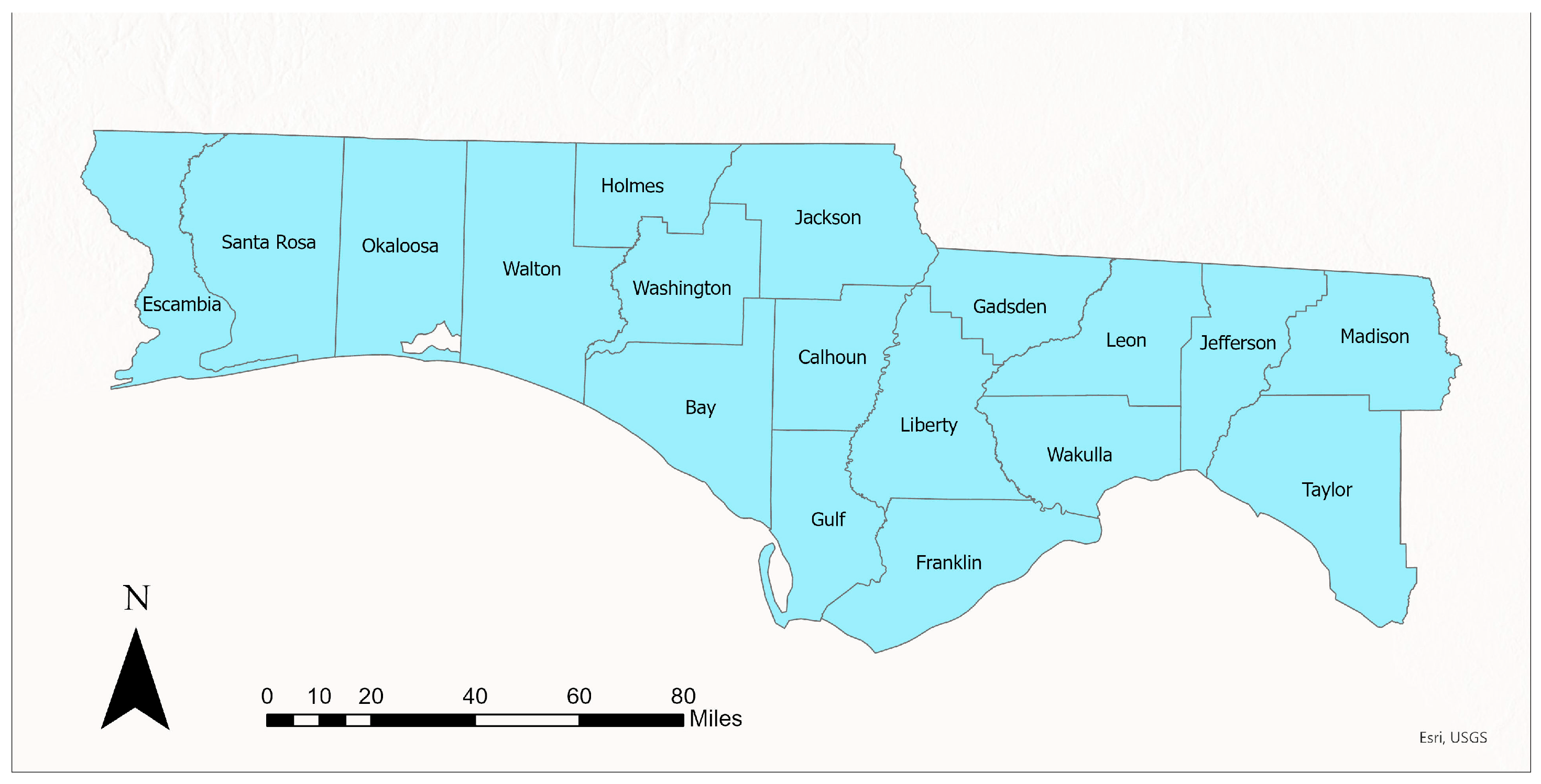
Florida’s Panhandle was selected for three main reasons. First, limited research has examined tornado impacts in this region (see Figure 1 for county locations). Second, recent studies indicate a spatial shift in tornado activity from the traditional Tornado Alley toward the Southeastern U.S. [25,26], heightening risk for the Panhandle. Leon County, home to Tallahassee, experienced three tornadoes on May 10, 2024. Third, increasing population density intensifies exposure [9]. Together, these factors highlight the need to assess tornado threats in the Panhandle to enhance preparedness and awareness. The state boundary GIS database for each census block group (CBG) in Florida’s Panhandle was constructed using the Topologically Integrated Geographic Encoding and Referencing (TIGER) cartographic boundary file from the U.S. Census Bureau. Demographic and socioeconomic variables were derived from the 2019 American Community Survey (ACS), including the percentage of nonwhite population [9], median household income [27,28], vulnerable age groups [9,27,29] (under 18 and over 65), number of housing units [9,27], population below poverty [9,14], and prevalence of mobile homes [9,14], factors commonly used to assess regional vulnerability.
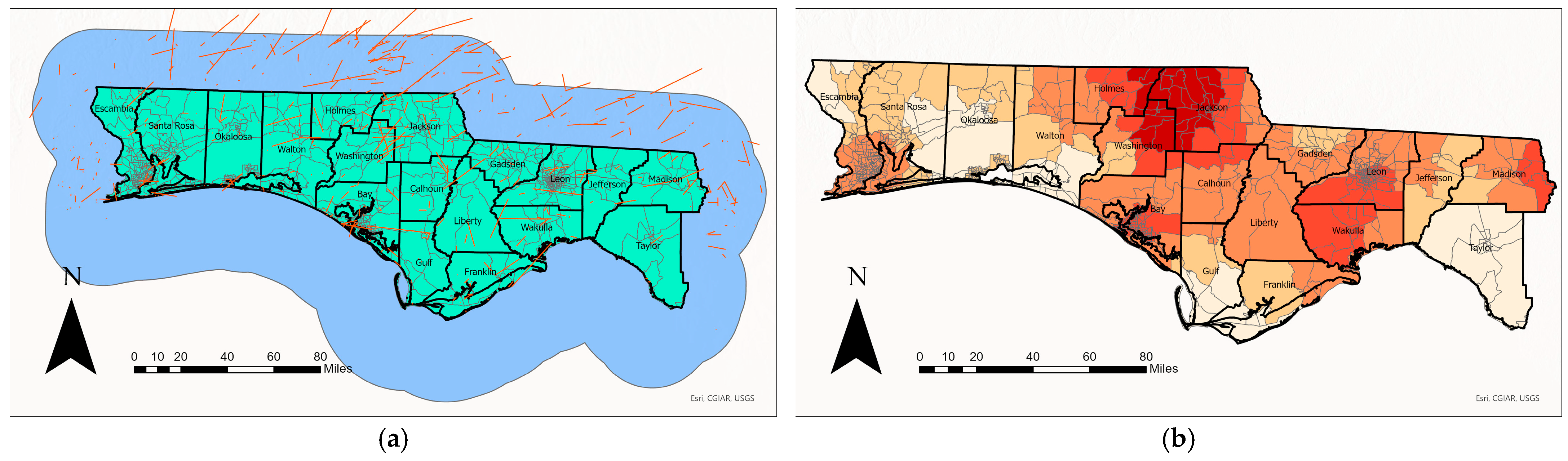
Additional indicators were obtained from the Smart Location Database [30] and the Center for Neighborhood Technology’s Housing and Transportation (H+T) Affordability Index [31], which provide demographic, mobility, housing, and transportation-cost information for each CBG; these datasets are summarized in Table 1. Tornado characteristics were obtained from the Storm Prediction Center (SPC) dataset, including tracks, fatalities, injuries, and event timing. Only post-1980 tornadoes and those within 25 miles of the study area were included to minimize reporting inconsistencies and boundary effects [19]. Distribution of included tornadoes and tornado risk over the study area can be seen in Figure 2. Over Figure 2b, darker colors represent higher risks. As can be seen from Figure 2b, there is higher tornado risk in the north–central to northeastern Florida Panhandle, especially across Holmes–Jackson–Calhoun–Gadsden, and parts of Leon/Jefferson/Wakulla (dark red areas). Finally, the 2021 Forest Service Science Tree Canopy Cover data were incorporated to characterize vegetation density across the study area and to support the canopy-based adjustment used in the tornado impact metric (see Section 3).

3. Methods

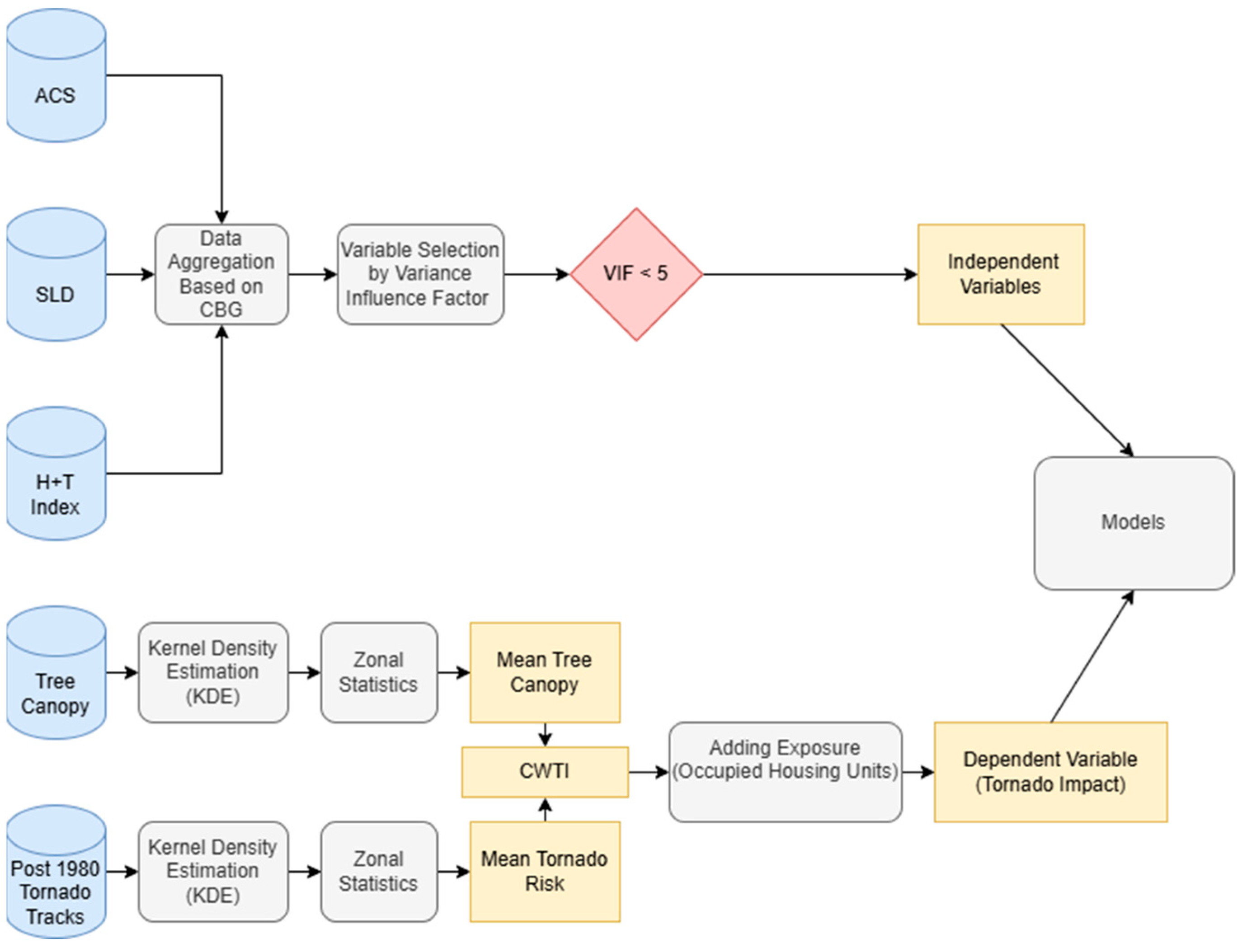
This section describes the methodological approach used to assess tornado impacts in Florida’s Panhandle. The first part focuses on data preparation, including deriving tornado density and tree canopy cover, constructing the impact metric, and selecting explanatory variables. The second part compares global and local spatial regression models to evaluate spatial dependence, heterogeneity, and overall model performance. Figure 3 shows the flowchart of this section.

3.1. Data Preparation

3.1.1. Assigning Tornado Density and Tree Canopy Cover (TCC)

In the proposed tornado impact metric, both mean tree canopy cover and mean tornado risk were calculated for each census block group (CBG). Tornado event concentration across space was estimated using Kernel Density Estimation (KDE), a spatial method that applies a distance-decay function to determine feature density (Equation (1)):
D e n s i t y = 1 h 2 i = 1 n 3 π 1 d i s t i h 2 2 0   o t h e r w i s e i f   d i s t i < h
where h represents the bandwidth, disti is the distance between a given pixel i and a tornado event, and n is the number of pixels within h. KDE generates a smooth surface where density declines with distance from each event. Consistent with prior studies [19,24,32], a 25-mile bandwidth was applied to capture the spatial influence of tornado occurrences.
Following KDE, the Zonal Statistics tool in ArcGIS Pro 3.0 was used to calculate mean tornado density within each CBG boundary, representing average tornado risk. The same procedure was applied to the tree canopy cover (TCC) dataset to compute mean canopy coverage for each CBG.

3.1.2. Proposed Tornado Impact Metric

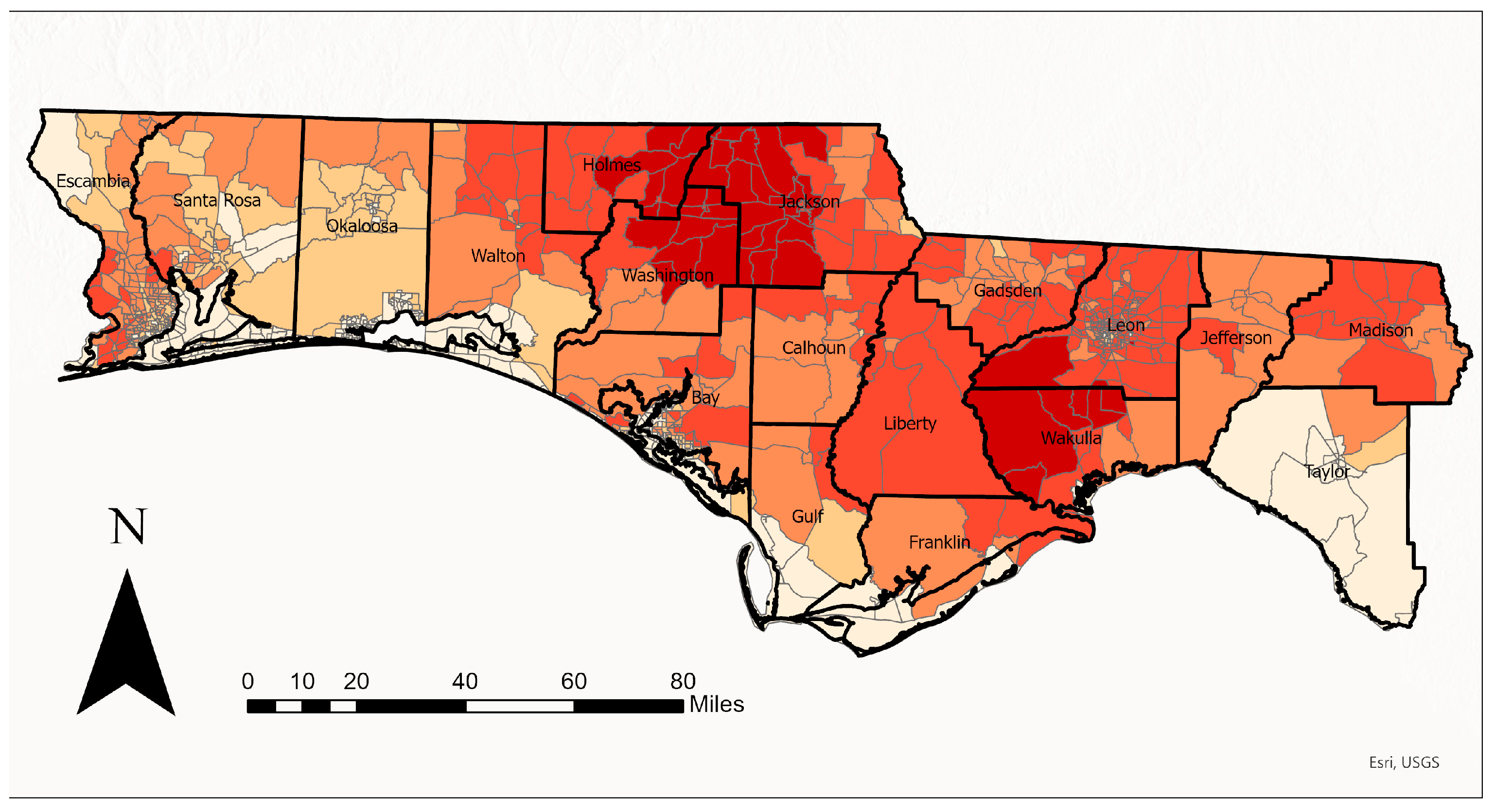
Tornado impact was modeled as a function of risk and exposure. Tornado risk was represented by the normalized mean tornado density. Because a substantial share of tornado-induced damage in the study area is tree-related, mean tree canopy was incorporated as a correction factor to account for vegetation-related damage potential. Accordingly, a Canopy-Weighted Tornado Intensity (CWTI) index was defined as the product of mean tree canopy and mean tornado risk (Equation (2)). The distribution of CWTI over the Panhandle region can be seen in Figure 4. Higher CWTI values are associated with darker colors. Figure 4 shows higher CWTI values concentrated in the north–central and eastern Panhandle, particularly around Holmes–Jackson–Washington–Calhoun and the Leon/Wakulla area, whereas lower values are more common along parts of the coastal counties.
C W T I = M e a n   T r e e   C a n o p y M e a n   T o r n a d o   R i s k
Exposure was defined by the number of occupied housing units within each CBG. Tornado impact was then computed by scaling CWTI by the number of occupied housing units (Equation (3)).
T o r n a d o   I m p a c t = C W T I O c c u p i e d   H o u s i n g   U n i t s

3.1.3. Selection of Variables

Demographic, socioeconomic, and mobility-related variables were compiled from multiple sources at the CBG level. Variable selection was conducted using forward selection in the base Ordinary Least Squares (OLS) model. To address multicollinearity, Variance Inflation Factors (VIF) were evaluated, and variables with VIF values above 5 were inspected. Intersection density (VIF = 5.62) and network density (VIF = 5.59) were highly correlated; therefore, intersection density was removed. After adjustment, the highest VIF value decreased to 2.02, indicating acceptable correlation among explanatory variables.

3.2. Model Comparison and Evaluation

Five regression models were employed to examine spatial relationships and compare model performance: one global non-spatial model (OLS), two global spatial models (SLM and SEM), and two local spatial models (GWR and MGWR).
The Ordinary Least Squares (OLS) model, expressed in Equation (4), served as the global baseline [33,34]:
y i = β 0 + X i β + ε i  
where for each CBG i, y i denotes the proposed metric, β 0 is the intercept, X i represents the matrix of explanatory variables, β is the coefficient vector, and ε i is the random error term.
The Spatial Lag Model (SLM) and Spatial Error Model (SEM) extend OLS by accounting for spatial dependence. SLM incorporates a spatially lagged dependent variable [35] (Equation (5)):
y i = β 0 + X i β + ρ W i y i + ε i
where ρ measures spatial interdependence, and W i is the spatial weights matrix. SEM, in contrast, assumes that only the error terms are spatially correlated (Equation (6)):
y i = β 0 + X i β + λ W i ξ i + ε i
where λ is the spatial error coefficient, W i ξ i represents the spatially correlated error, and ε i is the uncorrelated residual term.
Global models assume spatial stationarity. To capture spatially varying relationships, Geographically Weighted Regression (GWR) fits local regressions at each observation (Equations (7) and (8)):
y i = β i 0 + k = 1 p β i k X i k + ε i
β i   ^ = X T W i X 1 X T W i Y
where for CBG i , k represents the input parameter, and differs from variable 1 to variable p ; ε i shows random error; β i 0 is the intercept; X i k denotes to the independent variable k; and β i k represents local regression coefficient of independent variable k. Nearby points are weighted by W i based on their spatial relation to point i . GWR assumes all variables operate at a common spatial scale. The multiscale geographically weighted regression (MGWR) relaxes this assumption by allowing each variable to have its own bandwidth, as shown in Equation (9):
y i = β i 0 + k = 1 p β b w k X i k + ε i
The parameter β b w k varies by spatial scale, enabling variable-specific spatial bandwidths.
Model selection was conducted by the assessment of spatial heterogeneity and spatial autocorrelation. All variables were standardized (Z-score) prior to analysis. The OLS model was first estimated in the spreg Python package 1.3.2, as recommended in prior spatial regression literature [33,34]. Residual randomness was tested using Moran’s I with a Queen contiguity spatial weights matrix. The significant Moran’s I result (Table 2) confirmed spatial autocorrelation, suggesting the use of spatial regression models (SLM or SEM) [36,37].
To determine the more suitable global spatial specification, Lagrange Multiplier (LM) and Robust LM tests were performed. Both tests were significant, but the SLM exhibited stronger significance (lower p-value), indicating its higher suitability [35]. Accordingly, the SLM was developed using the Queen contiguity matrix, and the subsequent Moran’s I test confirmed the absence of residual spatial autocorrelation. We report only the SLM results among the global spatial models because diagnostic tests favored SLM over SEM.
The presence of spatial heterogeneity was checked by Breusch–Pagan test [38]. The test revealed significant non-stationarity, supporting the need for local models (GWR or MGWR) [34,36]. The MGWR was developed in ArcGIS Pro v3.0 to address non-stationary relationships. Due to non-uniform CBG sizes, an adaptive kernel bandwidth was applied, adjusting to the number of nearest neighbors to improve local accuracy [39]. Bandwidths were optimized via the Golden Search method based on AICc (Corrected Akaike Information Criterion) criteria, with a bi-square weighting function. Because MGWR allows variable-specific bandwidths, it was compared to GWR by examining parameter bandwidths. The differing sizes across variables confirmed that MGWR better represented the spatial processes [36,38]. Finally, model performance was compared using Adjusted R2, AICc, and Moran’s I value to evaluate model fit, performance, and spatial independence.

4. Results and Discussion

In this study, MGWR is chosen as the final model since diagnostic tests indicated significant spatial non-stationarity, and MGWR captures spatially varying relationships through variable-specific bandwidths and improved model fit. The OLS and SLM tables are retained to provide a transparent baseline and global spatial benchmark.

4.1. OLS Results

Results of the OLS model are reported in Table 2 and are used as a global baseline. While several predictors are statistically significant in the OLS specification, diagnostic tests indicate that key assumptions are violated. Residual Moran’s I is 0.37 (p < 0.001), suggesting remaining spatial autocorrelation, and the Breusch–Pagan test is significant (p < 0.0001), indicating spatial heterogeneity/non-constant variance. These diagnostics motivate the use of spatial and local models (SLM/MGWR) for inference.

4.2. SLM Results

The results of the SLM are reported in Table 3 and provide a global spatial benchmark. The spatial lag parameter (ρ) is statistically significant, indicating meaningful spatial spillover in tornado impact across neighboring CBGs; the estimated value (ρ = 0.55) suggests a substantial spatial dependence component. Residual diagnostics indicate that the SLM adequately addresses spatial autocorrelation (Moran’s I = −0.02, p = 0.24), implying that remaining errors are approximately spatially random. However, the Breusch–Pagan test remains significant (p < 0.001), indicating persistent spatial heterogeneity/non-stationarity across the study area [38]. Coefficient directions are broadly consistent with the baseline OLS results (Table 2), but inference focuses on MGWR due to detected non-stationarity.

4.3. MGWR Results

To address spatial autocorrelation and spatial non-stationarity problems, we chose MGWR to be used as a spatial local model. On the contrary to GWR, MGWR enables variables to have different spatial variation across the study area, by allowing different bandwidths. As such, we prioritized MGWR over GWR.
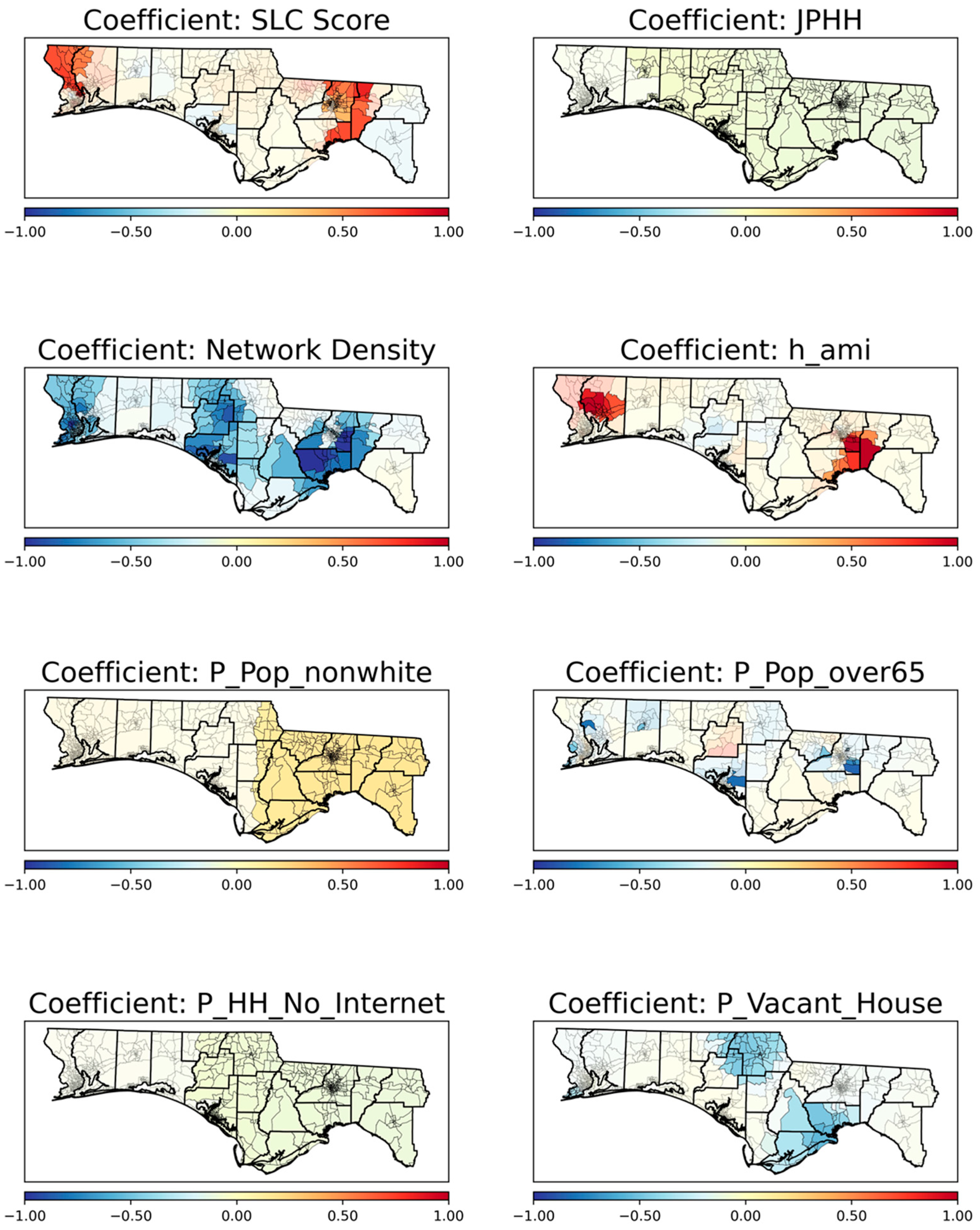
Table 4 presents the bandwidths and corresponding spatial scales for each parameter, alongside the number of significant census block groups with the percentage of significant parameters, and the distribution of their signs (positive or negative). The spatial scale, shown in parentheses in the bandwidth column, ranges from 0 to 100, where a value of 0 indicates a local scale, and values approaching 100 represent the global scale. Therefore, variables that have small bandwidths such as SLC Score, network density, h_ami (housing cost-to-income ratio for a typical household in the region), P_Pop_65 (% of elderly people (aged 65 and over)) have local spatial scales. On the other hand, variables such as JPHH (jobs per household), R_PCTLOWWA (% of low-wage workers) and P_HH_no_int (% of households without internet access) have higher bandwidths and are global variables. Finally, some variables such as P_Pop_nonwhite, P_HH_below_poverty and P_Vacant_house are in meso-scale.
JPHH (64.91%) and P_HH_no_int (51.43%) had the highest number of significant parameters, followed by network density (48.03%), and P_Pop_nonwhite (33.66%). Similarly to the other models, locally significant coefficients of SLC Score, h_ami, and P_Pop_nonwhite had positive relationships with tornado impact, as opposed to JPHH, network density, P_Pop_65, P_HH_no_int and P_Vacant_house, having negative relationships in all cases. Thus, these relationships are consistent and do not differ in sign depending on the scale.
Spatial distributions of significant variables can be seen in Figure 5. Comparison of the coefficients can help explore spatial variations among variables and their spatial scales. For comparison purposes, spatial distributions were portrayed using the same range. We observed that many factors affected tornado impact in various ways throughout the Florida Panhandle, both in terms of spatial heterogeneity and spatial distribution. For example, some coefficients such as JPHH, P_Pop_nonwhite and P_HH_No_Internet exhibited significant relationships across large portions of the study area with higher bandwidths and more uniform values. On the other hand, coefficients like SLC Score, h_ami, network density and P_Pop_over 65 that had smaller bandwidths, displayed more localized or meso-scale patterns of influence with higher spatial heterogeneity. Spatial patterns of the coefficient estimate on urban form and affordability, transportation connectivity, and digital access are discussed in more detail below with practical insights.

4.3.1. Urban Form and Affordability (SLC and h_ami)

The SLC coefficient is significantly positive in CBGs near Tallahassee and partially to Pensacola, indicating that tornado impact increases more strongly in location-efficient urban areas characterized by higher population density, diversity in land-use, and transit accessibility. This aligns with the Smart Location Database interpretation of SLC as a location-efficiency measure [30]. The housing affordability coefficient (h_ami) is also significantly positive in two urban-adjacent clusters, suggesting that tornado impact is amplified where households face higher housing-cost burdens as urbanized areas are characterized by more expensive housing provision. Those results may imply that urban form concentrates exposure (more households), while affordability stress constrains preparedness and recovery capacity. From a resilience standpoint, the spatial co-occurrence of significant SLC and h_ami coefficients supports targeted interventions near Pensacola and Tallahassee, including wind-mitigation retrofit incentives for cost-burdened households and resilience upgrades to affordable/rental housing, paired with accessibility-based siting of shelters/safe rooms and equitable risk communication strategies.

4.3.2. Transportation Connectivity and Canopy-Weighted Disruption

Network density (square mile) exhibited significantly negative coefficients in two spatial clusters: (i) a Western Panhandle cluster spanning Escambia and portions of Santa Rosa, and (ii) a broader interior cluster extending from Bay–Washington and parts of Holmes eastward toward the Tallahassee region, including portions of Leon, Wakulla, and Jefferson. Because the tornado impact metric explicitly incorporates mean tree canopy as a weighting term intended to capture susceptibility to wind-driven debris and obstruction, these negative network density clusters can be interpreted through a canopy-weighted disruption pathway. Within this outcome definition, areas with higher canopy are more prone to roadway obstruction and utility damage from wind-driven treefall; where road networks are also sparse, the consequences of debris-related blockages are amplified due to limited route redundancy, increasing the likelihood of temporary isolation and delaying emergency access and restoration logistics. This mechanism is most consistent with the interior cluster, which aligns with higher-canopy environments. In the Escambia–Santa Rosa cluster, where CWTI is generally lower compared to the surrounding CBGs, the negative pattern is better explained by better connectivity, as can be seen in Figure 4. Block groups with denser road networks offer more alternate routes and reduce reliance on a few key corridors, allowing travel, emergency response, and restoration to reroute around localized disruptions and lowering the measured impact.
From a practice perspective, the negative results of network density suggest that improving redundancy and maintaining access and connectivity can reduce canopy-weighted tornado impact, particularly in the interior cluster where CWTI is higher and networks are sparser. These findings support various interventions on those areas such as lifeline-route designation and clearance prioritization, pre-event debris planning with vegetation management along critical connectors, and operational emergency routing plans [40]. In addition, shelter and safe-room accessibility can be improved by using travel-time coverage to prioritize low-redundancy areas for community safe rooms.

4.3.3. Digital Access (P_HH_No_Internet) as a Vulnerability Planning Signal

The percentage of households without internet access (P_HH_No_Internet) operates at a global scale in MGWR and exhibits an overall negative relationship with the tornado impact metric. This pattern should not be interpreted as digital disconnection being protective; rather, it likely reflects a contextual proxy effect, since lack of internet access is strongly correlated with rurality and exposure composition, and its association can change direction after controlling for built-environment and socioeconomic covariates in an exposure-scaled outcome. Those rural areas are not having the density-caused susceptibility but could suffer from both physical and digital connection issues. For those areas with significant association, alternative communication efforts such as NOAA (National Oceanic and Atmospheric Administration) weather radio coverage and community-based outreach should be improved to decrease the reliance on broadband access and reduce the barriers to aid and recovery services.

4.4. Model Comparison

The goodness of fit-based comparison was performed using four metrics: R2, Adjusted R2, AICc, and Sigma-Squared MLE (maximum likelihood estimation). Based on all these metrics, MGWR (Adjusted R2 = 0.70, Sigma-Squared MLE = 0.30) performed better than the global spatial model, SLM (Adjusted R2 = 0.32, Sigma-Squared MLE = 0.51), and the global non-spatial model, OLS (Adjusted R2 = 0.28, Sigma-Squared MLE = 0.72).
In addition to the predictive accuracy, the spatial autocorrelation of the residuals should also be considered. In the analysis, SLM and MGWR both had randomly distributed residuals whereas OLS failed to meet this criterion. It should also be noted that, in terms of the randomness of the residuals, SLM (p value = 0.24) performed better than MGWR (p value = 0.06). However, it was not chosen as the final model due to a spatial heterogeneity problem in SLM.

5. Conclusions

In this study, we introduced a new tornado impact metric that combines exposure, hazard, and environmental damage potential, offering a more complete representation of how tornadoes would affect the built environment. Using this metric, we examined the influence of demographic, socioeconomic, transportation, and built-environment characteristics on tornado impacts in Florida’s Panhandle. To avoid historical reporting inconsistencies [41,42,43,44], only post-1980 tornado events were included. Because the dataset exhibited spatial autocorrelation and non-stationarity, multiple spatial models were tested to identify an appropriate framework for capturing these effects. The results highlight that spatial structure and built-environment conditions significantly shape tornado impacts, underscoring the need for spatially informed planning and resilience strategies.
We started our evaluation by OLS as a base model. Afterwards, we considered the suitability of two global (SLM and SEM) and two local (GWR and MGWR) spatial models to ensure the accuracy and robustness of findings. Based on the spatial autocorrelation values, LM statistics concluded that SLM was more suitable for our dataset than SEM. However, SLM still had issues related to spatial heterogeneity. Therefore, we also considered local models like MGWR and GWR. As the variables had different spatial scales, MGWR was found to be more suitable than GWR. When MGWR was used, we scaled the data, as suggested in [39]. To make the coefficients of other models comparable with MGWR, we have also used scaled data in other models. Model comparison based on R2 and AICc score results also justified the choice of the MGWR model, in addition to the model selection process.
Using MGWR, we obtained location-specific insights related to different indices. In this study, we found out that different variables are associated with tornado impact in different ways in terms of spatial distribution and magnitude across the Florida Panhandle. Some variables like JPHH, P_Pop_nonwhite and P_HH_No_Internet showed consistent significant relationships over large portions of the study areas with weak associations in magnitude. On the other hand, variables like P_Pop_over 65, h_ami and SLC Score were found to have stronger positive relationships that were localized.
Several limitations should be acknowledged. First, inconsistencies between available tornado damage records (2010–2022) and historical tornado data (1980–2022) prevented us from directly incorporating damage observations into the proposed metric, although doing so would further strengthen future analyses. Second, while the Florida Panhandle has historically experienced fewer tornadoes than regions such as Texas and Oklahoma, recent severe events and emerging evidence indicate increasing tornado activity across the Southeastern U.S. [25,26]. Despite this trend, the region remains understudied. As tornado risk expands into areas with growing populations and aging infrastructure, our findings underscore the need for proactive planning, particularly in updating building standards, prioritizing mitigation investments, and enhancing community preparedness. Strengthening resilience in the built environment now will be critical for reducing future tornado impacts in the Florida Panhandle and similar emerging risk zones. Future work should also benchmark the proposed impact metric against uncertainty-aware approaches (e.g., stochastic or Monte Carlo frameworks and numerical simulations) and extend the framework to other tornado-prone regions to evaluate transferability and comparability across geographic contexts.

Author Contributions

Study conception and design: M.B.K., O.A., E.E.O., and R.M.; data collection: M.B.K., O.A., E.E.O., and R.M.; analysis and interpretation of results: M.B.K., O.A., E.E.O., and R.M.; draft manuscript preparation: M.B.K., O.A., E.E.O., and R.M. All authors have read and agreed to the published version of the manuscript.

Funding

This research was funded by the Rural, Safe Efficient and Advanced Transportation (RSEAT) Center, a Tier-1 University Transportation Center (UTC) funded by the United States Department of Transportation (USDOT), through the agreement number 69A3552348321.

Institutional Review Board Statement

Not applicable.

Informed Consent Statement

Not applicable.

Data Availability Statement

The original data presented in the study are openly available in US Census Bureau 2020 Census (TIGER, ACS) at https://www.census.gov/programs-surveys/decennial-census/about/rdo/summary-files/2020.html (accessed on 21 May 2024); Smart Location Database at https://www.epa.gov/system/files/documents/2023-10/epa_sld_3.0_technicaldocumentationuserguide_may2021_0.pdf (accessed on 31 May 2024); Center for Neighborhood Technology’s Housing and Transportation (H+T) Affordability Index at https://htaindex.cnt.org/ (accessed on 1 June 2024); Storm Prediction Center (SPC) at https://www.spc.noaa.gov/wcm/ (accessed on 5 June 2024); The 2021 Forest Service Science Tree Canopy Cover at https://data.fs.usda.gov/geodata/rastergateway/treecanopycover// (accessed on 5 September 2024).

Acknowledgments

The contents of this paper reflect the views of the authors, who are responsible for the facts and the accuracy of the information presented herein. The Florida Department of Transportation, and the U.S. Government assumes no liability for the contents or use thereof. The authors declare that they have no known competing financial interests or personal relationships that could have appeared to influence the work reported in this paper.

Conflicts of Interest

The authors declare no conflicts of interest. The funders had no role in the design of the study; in the collection, analyses, or interpretation of data; in the writing of the manuscript; or in the decision to publish the results.

References

  1. Bluestein, H.B. Economics and Societal Impacts of Tornadoes. Eos Trans. Am. Geophys. Union 2011, 92, 261. [Google Scholar] [CrossRef]
  2. First, J.M.; Ellis, K.; Held, M.L.; Glass, F. Identifying Risk and Resilience Factors Impacting Mental Health among Black and Latinx Adults Following Nocturnal Tornadoes in the U.S. Southeast. Int. J. Environ. Res. Public Health 2021, 18, 8609. [Google Scholar] [CrossRef] [PubMed]
  3. Fricker, T.; Friesenhahn, C. Tornado Fatalities in Context: 1995–2018. Weather Clim. Soc. 2022, 14, 81–93. [Google Scholar] [CrossRef]
  4. Strader, S.M.; Ashley, W.S.; Pingel, T.J.; Krmenec, A.J. Projected 21st Century Changes in Tornado Exposure, Risk, and Disaster Potential. Clim. Change 2017, 141, 301–313. [Google Scholar] [CrossRef]
  5. Wang, C.; Rider, E.; Manning, S.; Fast, J.; Islam, T. Qualitative Analysis of the Lived Experience of Tornado Survivors and Factors Affecting Community Resilience: A Case Study of an EF3 Tornado in Jacksonville, Alabama. Weather Clim. Soc. 2023, 15, 133–144. [Google Scholar] [CrossRef]
  6. Trujillo-Falcón, J.E.; Pabón, A.R.G.; Reedy, J.; Klockow-Mcclain, K.E. Systemic Vulnerabilities Created an Informal Warning System for U.S. Hispanic and Latinx Immigrants in the 2021 Quad-State Tornado Outbreak. Nat. Hazards Rev. 2023, 25. [Google Scholar] [CrossRef]
  7. Senkbeil, J.C.; Scott, D.A.; Guinazu-Walker, P.; Rockman, M.S. Ethnic and Racial Differences in Tornado Hazard Perception, Preparedness, and Shelter Lead Time in Tuscaloosa. Prof. Geogr. 2014, 66, 610–620. [Google Scholar] [CrossRef]
  8. First, J.M.; Carnahan, M.; Yu, M.; Lee, S.; Houston, J.B. ‘Recovering from Tornado Brain’: A Qualitative Analysis of Long-Term Needs after One of the Deadliest Tornadoes in U.S. History. Clin. Soc. Work. J. 2024. [Google Scholar] [CrossRef]
  9. Strader, S.M.; Gensini, V.A.; Ashley, W.S.; Wagner, A.N. Changes in Tornado Risk and Societal Vulnerability Leading to Greater Tornado Impact Potential. npj Nat. Hazards 2024, 1, 20. [Google Scholar] [CrossRef]
  10. Standohar-Alfano, C.D.; van de Lindt, J.W.; Holt, E.M. Comparative Residential Property Loss Estimation for the April 25–28, 2011, Tornado Outbreak. J. Archit. Eng. 2018, 24. [Google Scholar] [CrossRef]
  11. McPeak, B.G.; Ertas, A. The Good, the Bad, and the Ugly Facts of Tornado Survival. Nat. Hazards 2012, 60, 915–935. [Google Scholar] [CrossRef]
  12. Strader, S.M.; Ashley, W.S. Finescale Assessment of Mobile Home Tornado Vulnerability in the Central and Southeast United States. Weather Clim. Soc. 2018, 10, 797–812. [Google Scholar] [CrossRef]
  13. Strader, S.; Ash, K.; Wagner, E.; Sherrod, C. Mobile Home Resident Evacuation Vulnerability and Emergency Medical Service Access during Tornado Events in the Southeast United States. Int. J. Disaster Risk Reduct. 2019, 38, 101210. [Google Scholar] [CrossRef]
  14. Dixon, R.W.; Moore, T.W. Tornado Vulnerability in Texas. Weather Clim. Soc. 2012, 4, 59–68. [Google Scholar] [CrossRef]
  15. Pielke, R.A., Jr.; Pielke, R.A., Sr. Hurricanes: Their Nature and Impact on Society; FAO: Rome, Italy, 1997. [Google Scholar]
  16. León-Cruz, J.F.; Castillo-Aja, R. A GIS-Based Approach for Tornado Risk Assessment in Mexico. Nat. Hazards 2022, 114, 1563–1583. [Google Scholar] [CrossRef]
  17. Schaefer, J.T.; Galway, J.G. Population Biases in the Tornado Climatology. In Proceedings of the 12th Conference on Severe Local Storms, San Antonio, TX, USA, 11–15 January 1982. [Google Scholar]
  18. Potvin, C.K.; Broyles, C.; Skinner, P.S.; Brooks, H.E.; Rasmussen, E. A Bayesian Hierarchical Modeling Framework for Correcting Reporting Bias in the U.S. Tornado Database. Weather Forecast. 2019, 34, 15–30. [Google Scholar] [CrossRef]
  19. Michael Blinn, C. Creation of a Spatial Decision Support System as a Risk Assessment Tool Based on Kentucky Tornado Climatology. Master’s Thesis, Western Kentucky University, Bowling Green, KY, USA, 2012. [Google Scholar]
  20. Hwang, S.N.; Meier, K. Tornado Impacts in the US from 1950-2015: A GIS-Based Analysis of Vulnerability and Evolving Risk Zones for Human Casualties. J. Geogr. Inf. Syst. 2023, 15, 563–579. [Google Scholar] [CrossRef]
  21. Anselin, L. Exploratory Spatial Data Analysis and Geographic Information Systems. New Tools Spat. Anal. 1994, 17, 45–54. [Google Scholar]
  22. Wang, C.; Du, S.; Wen, J.; Zhang, M.; Gu, H.; Shi, Y.; Xu, H. Analyzing Explanatory Factors of Urban Pluvial Floods in Shanghai Using Geographically Weighted Regression. Stoch. Environ. Res. Risk Assess. 2017, 31, 1777–1790. [Google Scholar] [CrossRef]
  23. Chun, H.; Chi, S.; Hwang, B.G. A Spatial Disaster Assessment Model of Social Resilience Based on Geographically Weighted Regression. Sustainability 2017, 9, 2222. [Google Scholar] [CrossRef]
  24. Kaya, M.B.; Alisan, O.; Karaer, A.; Ozguven, E.E. Assessing Tornado Impacts in the State of Kentucky with a Focus on Demographics and Roadways Using a GIS-Based Approach. Sustainability 2024, 16, 1180. [Google Scholar] [CrossRef]
  25. Gensini, V.A.; Brooks, H.E. Spatial Trends in United States Tornado Frequency. npj Clim. Atmos. Sci. 2018, 1, 38. [Google Scholar] [CrossRef]
  26. Coleman, T.A.; Thompson, R.L.; Forbes, G.S. A Comprehensive Analysis of the Spatial and Seasonal Shifts in Tornado Activity in the United States. J. Appl. Meteorol. Climatol. 2024, 63, 717–730. [Google Scholar] [CrossRef]
  27. Fricker, T. Tornado-Level Estimates of Socioeconomic and Demographic Variables. Nat. Hazards Rev. 2020, 21, 04020018. [Google Scholar] [CrossRef]
  28. Simmons, K.M.; Sutter, D. Tornado Warnings, Lead Times, and Tornado Casualties: An Empirical Investigation. Weather Forecast. 2008, 23, 246–258. [Google Scholar] [CrossRef]
  29. Lim, J.; Loveridge, S.; Shupp, R.; Skidmore, M. Double Danger in the Double Wide: Dimensions of Poverty, Housing Quality and Tornado Impacts. Reg. Sci. Urban Econ. 2017, 65, 1–15. [Google Scholar] [CrossRef]
  30. Chapman, J.; Bachman, W.; Frank, L.D.; Thomas, J.; Reyes, A.R. Smart Location Database Technical Documentation and User Guide About This Report; The United States Environment Protection Agency: Washington, DC, USA, 2021. [Google Scholar]
  31. H + T Index Methods; Center for Neighborhood Technology: Chicago, IL, USA, 2022; Available online: https://htaindex.cnt.org/about/method-2022.pdf (accessed on 1 June 2025).
  32. Dixon, P.G.; Mercer, A.E.; Choi, J.; Allen, J.S. Tornado Risk Analysis: Is Dixie Alley an Extension of Tornado Alley. Bull. Am. Meteorol. Soc. 2011, 92, 433–441. [Google Scholar] [CrossRef]
  33. Wubuli, A.; Xue, F.; Jiang, D.; Yao, X.; Upur, H.; Wushouer, Q. Socio-Demographic Predictors and Distribution of Pulmonary Tuberculosis (TB) in Xinjiang, China: A Spatial Analysis. PLoS ONE 2015, 10, e0144010. [Google Scholar] [CrossRef] [PubMed]
  34. Regression Analysis Basics—Help. ArcGIS Desktop. Available online: https://desktop.arcgis.com/en/arcmap/10.3/tools/spatial-statistics-toolbox/regression-analysis-basics.htm (accessed on 21 October 2024).
  35. Anselin, L. Exploring Spatial Data with GeoDa TM: A Workbook; Center for Spatially Integrated Social Science: Santa Barbara, CA, USA, 2005. [Google Scholar]
  36. Comber, A.; Brunsdon, C.; Charlton, M.; Dong, G.; Harris, R.; Lu, B.; Lü, Y.; Murakami, D.; Nakaya, T.; Wang, Y.; et al. A Route Map for Successful Applications of Geographically Weighted Regression. Geogr. Anal. 2023, 55, 155–178. [Google Scholar] [CrossRef]
  37. Pljakić, M.; Jovanović, D.; Matović, B.; Mićić, S. Macro-Level Accident Modeling in Novi Sad: A Spatial Regression Approach. Accid. Anal. Prev. 2019, 132, 105259. [Google Scholar] [CrossRef]
  38. Zafri, N.M.; Khan, A. A Spatial Regression Modeling Framework for Examining Relationships between the Built Environment and Pedestrian Crash Occurrences at Macroscopic Level: A Study in a Developing Country Context. Geogr. Sustain. 2022, 3, 312–324. [Google Scholar] [CrossRef]
  39. Oshan, T.M.; Li, Z.; Kang, W.; Wolf, L.J.; Fotheringham, A.S. MGWR: A Python Implementation of Multiscale Geographically Weighted Regression for Investigating Process Spatial Heterogeneity and Scale. ISPRS Int. J. Geo-Inf. 2019, 8, 269. [Google Scholar] [CrossRef]
  40. O’Rourke, L.; Klotz, E.; Purdy, J. Implementing Solutions for Emergency Routing; U.S. Department of Transportation: Washington, DC, USA, 2024.
  41. Agee, E.; Childs, S. Adjustments in Tornado Counts, F-Scale Intensity, and Path Width for Assessing Significant Tornado Destruction. J. Appl. Meteorol. Climatol. 2014, 53, 1494–1505. [Google Scholar] [CrossRef]
  42. Tippett, M.K. Changing Volatility of U.S. Annual Tornado Reports. Geophys. Res. Lett. 2014, 41, 6956–6961. [Google Scholar] [CrossRef]
  43. Anderson, C.J.; Wikle, C.K.; Zhou, Q.; Royle, J.A. Population Influences on Tornado Reports in the United States. Weather Forecast. 2007, 22, 571–579. [Google Scholar] [CrossRef]
  44. Elsner, J.B.; Michaels, L.E.; Scheitlin, K.N.; Elsner, I.J. The Decreasing Population Bias in Tornado Reports across the Central Plains. Weather Clim. Soc. 2013, 5, 221–232. [Google Scholar] [CrossRef]
Figure 1. Study area in Florida: Florida’s Panhandle counties.
Geographies 06 00032 g001
Figure 2. (a) Tornado tracks in Panhandle since 1980, and (b) the corresponding tornado risk in the study area.
Geographies 06 00032 g002
Figure 3. Tornado impact modeling workflow.
Geographies 06 00032 g003
Figure 4. Spatial distribution of CWTI over the Panhandle region.
Geographies 06 00032 g004
Figure 5. Spatial heterogeneity in MGWR local coefficients for the tornado impact model at the census block group (CBG) level.
Geographies 06 00032 g005
Table 1. Variables and their explanations.
TIGER and ACS Dataset
VariableExplanation
Median_hh_incomeMedian household income in the past 12 months (2019)
P_Pop_nonwhite% of nonwhite population
P_Pop_under 5% of people below 5
P_Pop_under18% of people below 18
P_Pop_over65% of elderly people (aged 65 and over)
P_HH_no_veh% of households without any vehicle
P_HH_below_poverty% of households whose income in the past 12 months below the poverty level
P_HH_no_int_acc% of households without internet access
P_HH_no_tel_acc% of households without telephone access
P_Mobile_home% of housing units that are mobile home
Smart Location Database (SLD)
Variable Explanation
SLC ScoreSmart location index (0–100)
P_WrkAge% of the working population between the age of 18 to 64
JPHHJobs per household
Network DensityTotal road network density
R_PCTLOWWA% of low-wage workers in CBG (2017)
Housing and Transportation Affordability (H+T) Index
Variable Explanation
h_amiHousing cost-to-income ratio for a typical household in the region
compact_ndxCompact neighborhood score (0–10)
res_densityResidential density (households per residential acre)
intersection_densityIntersection density (number of intersections per square miles)
pct_renter_occupied_hu% of households that are renters
Table 2. OLS results.
VariableExplanationCoefficientStd. Errort-Statisticp-Value
Intercept-−0.0000.0289.980.0000
SLC ScoreSLC Score0.2330.0376.290.0000
JPHHJobs per household−0.0680.029−2.350.0188
Network DensityTotal road network density
(square mile)
−0.5240.038−13.830.0000
R_PCTLOWWA% of low-wage workers−0.1130.040−2.820.0049
h_amiHousing cost-to-income ratio for a typical household in the region0.0560.0341.660.0973
P_Pop_nonwhite% of nonwhite population0.1520.0383.970.0001
P_Pop_65% of elderly people (aged 65 and over)−0.1030.033−3.110.0019
P_HH_below_poverty% of households whose income in the past 12 months below the poverty level0.0810.0382.110.0347
P_HH_no_int% of households without internet access−0.1400.037−3.830.0001
P_Vacant_house% of age of unoccupied housing units−0.2390.031−7.680.0000
OLS: R2 = 0.289, AIC = 2298.95
Distribution of errors: Moran’s I = 0.37, p-value = 0.0000
Breusch–Pagan (BP) test: BP = 36.313, p-value = 0.0001
Table 3. Spatial Lag Model (SLM) diagnostics and results.
Metric/VariableExplanationDFValue/CoefficientStd. Errorz-Statisticp-Value
Lagrange Multiplier (lag)Spatial dependence test1365.65--0.0000
Robust LM (lag)Spatial dependence test133.239--0.0000
Lagrange Multiplier (error)Spatial dependence test1346.894--0.0000
Robust LM (error)Spatial dependence test114.483--0.0001
Lagrange Multiplier (SARMA)Spatial dependence test2380.133--0.0000
Spatial Lag Model (SLM) Results
Intercept--−0.0350.024−1.490.1352
SLC ScoreSmart location score-0.1320.0324.130.0000
JPHHJobs per household-−0.0530.024−2.190.0282
Network DensityTotal road network density (square mile)-−0.3150.034−9.190.0000
R_PCTLOWWA% of low-wage workers-−0.0260.034−0.770.4385
h_amiHousing cost-to-income ratio for a typical household-0.0850.0282.980.0029
P_Pop_nonwhite% of nonwhite population-0.0960.0322.970.0030
P_Pop_65% of elderly population (aged 65+)-−0.0840.028−3.040.0024
P_HH_below_poverty% of households below poverty level-0.0370.0321.160.2471
P_HH_no_int% of households without internet access-−0.0860.031−2.770.0056
P_Vacant_house% of unoccupied housing units-−0.1410.027−5.280.0000
ρ (rho)Spatial lag coefficient-0.5500.03016.130.0000
Model statistics: Pseudo R2 = 0.494 | AIC = 2051.065 | Moran’s I = −0.02 (p = 0.24) | BP test = 214.42 (p < 0.001).
Table 4. MGWR results: Variable-specific bandwidths (spatial scale) and the share/sign of statistically significant local coefficients across census block groups (CBGs).
VariableExplanationBandwidth (% of Extent)Significance
(% of CBGs)
Significant+
(%)
Significant−
(%)
Intercept-42 (4.61)255 (27.96)46.6753.33
SLC ScoreSLC Score50 (5.48)182 (19.96)1000
JPHHJobs per household912 (100.00)592 (64.91)0100
Network DensityTotal road network density
(square mile)
50 (5.48)438 (48.03)0100
R_PCTLOWWA% of low-wage workers832 (91.23)0 (0.00)--
h_amiHousing cost-to-income ratio for a typical household in the region47 (5.15)68 (7.46)1000
P_Pop_nonwhite% of nonwhite population496 (54.39)307 (33.66)1000
P_Pop_65% of elderly people (aged 65 and over)42 (4.61)27 (2.96)0100
P_HH_below_poverty% of households with income under the poverty line in the previous 12 months435 (47.70)0 (0.00)--
P_HH_no_int% of households without internet access912 (100.00)469 (51.43)0100
P_Vacant_house% of unoccupied housing units182 (19.96)95 (10.42)0100
Disclaimer/Publisher’s Note: The statements, opinions and data contained in all publications are solely those of the individual author(s) and contributor(s) and not of MDPI and/or the editor(s). MDPI and/or the editor(s) disclaim responsibility for any injury to people or property resulting from any ideas, methods, instructions or products referred to in the content.