


Abstract
Background/Objectives: Quasi-static inverse dynamics is widely used in biomechanical analyses due to its computational simplicity; however, neglecting inertial effects may introduce joint-specific torque estimation errors during dynamic movements. The purpose of this study was to quantify torque estimation errors introduced by quasi-static assumptions during bodyweight squats performed at different movement frequencies. Methods: A planar MATLAB-based (version R2022a) musculoskeletal model incorporating standard anthropometric parameters was developed to simulate squat motions at 1.00, 0.75, 0.50, and 0.25 Hz. Joint torques calculated using quasi-static inverse dynamics were compared with fully dynamic inverse dynamics at the ankle, knee, and hip. Model agreement was evaluated using Root Mean Square Error (RMSE), normalized percentage error relative to peak dynamic torque, and bootstrapped 95% confidence intervals (CI). Results: Quasi-static modeling produced negligible torque estimation errors at the ankle and knee across all movement frequencies, with percentage errors consistently below 0.1% and narrow confidence intervals. In contrast, the hip joint demonstrated a clear frequency-dependent underestimation of torque when inertial effects were neglected. At 1.00 Hz, the hip RMSE reached 14.4 Nm, corresponding to 14.01% of peak dynamic torque (95% CI: 13.97–14.06%). Error magnitude increased systematically with movement speed. Conclusions: The validity of quasi-static inverse dynamics strongly depends on joint location and movement frequency. While quasi-static models are appropriate for ankle and knee torque estimation during moderate-speed squats, accurate hip torque assessment during faster squats requires full dynamic modeling. These findings provide quantitative benchmarks to inform model selection in biomechanical research, rehabilitation engineering, and assistive device design.
1. Introduction
Inverse dynamics (ID) modeling is a foundational method used in biomechanics to estimate internal joint torques based on kinematic data, external forces, and anthropometric properties [1,2]. These models are essential for understanding muscle function, joint loading, and movement mechanics. ID models are broadly categorized as either dynamic or quasi-static models. Dynamic models integrate both gravitational and inertial influences (linear and angular accelerations), whereas quasi-static models disregard inertial forces, hence simplifying calculations by presuming minimal accelerations. This quasi-static simplification is often employed in clinical and ergonomic contexts when measurement tools or processing time may be constrained [3,4]. The fidelity of any biomechanical model remains critical, as modeling choices directly influence the robustness and interpretation of simulated results [5]. In particular, multi-joint movements such as vertical jumps are fundamental in lower-limb analysis for evaluating joint kinetics and load distribution across the hip, knee, and ankle [6]. In addition, movement conditions (including feedback modality and phase-timing) significantly influence joint-moment responses in multi-joint tasks such as squats [7].
Although the accuracy of quasi-static inverse dynamics decreases with increasing movement speed due to growing inertial effects [2], the quantitative impact of this simplification during squat motion remains poorly defined. In particular, it is unclear how torque estimation errors vary across different lower-limb joints and movement speeds. Establishing such joint- and speed-dependent error benchmarks would be valuable for researchers and engineers when selecting appropriate modeling fidelity in biomechanical studies.
Inverse dynamics has been widely applied to high-impact tasks such as lifting and jumping [8], and computationally efficient models have been proposed for real-time rehabilitation and assistive robotics applications [4,9]. Experimental comparisons of squat techniques (e.g., high-bar versus low-bar squats) further demonstrate how movement strategy influences joint loading patterns and modeling assumptions [10]. Similarly, recent studies on gait simulation and lower-limb exoskeleton design emphasize the need for real-time modelling but do not explicitly quantify the torque errors introduced by quasi-static assumptions [11,12].
Previous work has also shown that inverse-dynamics outcomes are highly sensitive to modeling choices such as scaling procedures and kinematic weighting strategies [13], and that joint loading is strongly affected by movement speed and segmental accelerations in highly dynamic tasks [14,15]. Despite these advances, the literature still lacks quantitative, joint-specific benchmarks that define when quasi-static modelling becomes unreliable. This technical note addresses this gap by simulating bodyweight squats of varying durations under idealized conditions and directly comparing quasi-static and dynamic joint torques to provide actionable, frequency-dependent error profiles.
In many biomechanical and engineering applications, precise estimation of joint torque is crucial. Using simplified models to underestimate joint torques during the development of rehabilitation robots or wearable assistive technologies can result in suboptimal control strategies, unsafe actuation levels, or inadequate mechanical support. Conversely, precise dynamic models are vital for establishing real-time control system safety features, defining energy efficiency trade-offs, and correctly sizing actuators. Therefore, understanding the validity limits of quasi-static modeling is critical for translating biomechanical insights into reliable assistive and ergonomic technologies.
This study provides a focused contribution to biomechanics literature by explicitly quantifying the torque error introduced by quasi-static inverse dynamics assumptions. While inverse dynamics analyses are widely used, many studies either rely on static or quasi-static equilibrium formulations for computational efficiency [3,8] or employ fully dynamic models without explicitly isolating and reporting the joint-specific torque error associated with neglecting inertial effects [4,9,13]. In contrast, the present work compares fully dynamic and quasi-static joint torque estimates at the ankle, knee, and hip during squat motion to characterize the joint-specific and frequency-dependent limitations of quasi-static modeling. By directly quantifying how neglecting inertial effects biases torque estimates as movement speed increases and by assessing uncertainty using 95% bootstrap confidence intervals, this study provides statistically robust error benchmarks that clarify the trade-off between modeling simplicity and torque accuracy. These results enable more informed modeling decisions and support the appropriate selection of inverse dynamics fidelity in biomechanics research, rehabilitation engineering, and assistive device design.
2. Materials and Methods
2.1. Simulation Setup and Assumptions
This study aimed to quantify the joint torque discrepancies between quasi-static and dynamic inverse dynamics models under controlled squat conditions. A sagittal-plane (2D) biomechanical model of the lower limb was implemented in MATLAB (version R2022a) [16]. Anthropometric parameters, including segment masses, lengths, centers of mass, and moments of inertia, were taken from Winter [2] to simulate a 70 kg, 1.75 m adult male subject. The upper extremities and trunk were modeled as a single rigid segment referred to as the head–arms–trunk (HAT). To simulate a range of movement speeds, squatting frequencies of 1.00 Hz, 0.75 Hz, 0.50 Hz, and 0.25 Hz were selected for analysis and visualization. Each joint (ankle, knee, hip) followed sinusoidal flexion-extension trajectories in the sagittal plane, with peak-to-peak angular ranges of 90–180° (ankle), 20–60° (knee), and 65–125° (hip). The sinusoidal form ensured continuous and differentiable profiles. Angular velocities and accelerations were derived numerically using second-order finite differences.
The assumptions of the simulations are as follows. A constant vertical ground reaction force (GRF) equivalent to bodyweight was applied at the foot segment. The acceleration of the center of mass of the foot was assumed to be zero, consistent with a stationary foot in full contact with the ground. Horizontal motions in the frontal and transverse planes and forces were disregarded. The moments acting in the transverse and frontal planes during squatting are relatively low [17]. Full foot contact and left/right limb symmetry were assumed in the simulations. Neither compliance nor segment-to-segment sliding was modeled. To ensure sufficient resolution of dynamic changes, simulations were sampled at 100 Hz.
2.2. Inverse Dynamics Equations
Joint torques were computed using Newton–Euler inverse dynamics equations in a bottom-up manner, starting at the foot-ground interface and progressing proximally through the ankle, knee, and hip joints. Two modeling approaches were considered. In the quasi-static model, joint torques were calculated based solely on gravitational effects by assuming zero angular acceleration for each segment, such that the resulting torque () represents the gravity-induced moment at the joint. In the dynamic model, both gravitational and inertial contributions were included, and the net joint torque () was computed as the sum of the quasi-static torque and the inertial term, expressed as Equation (1):
where I is the moment of inertia of the segment about its center of mass and is the segment angular acceleration. Both models neglect horizontal forces, frictional effects, soft tissue compliance, and asymmetrical or out-of-plane motion; therefore, all results should be interpreted within the context of idealized sagittal-plane squat movement.
2.3. Error Metrics
The root mean square error (RMSE) is calculated using Equation (2) to quantify the deviation between quasi-static and dynamic torque profiles at each joint over time. RMSE is suitable for this comparison as it reflects average absolute deviation and penalizes larger errors.
where and are the quasi-static and dynamic torques at time step i, and n is the total number of time steps.
In addition, the percentage error was computed at each joint to express the magnitude of quasi-static torque error relative to the dynamic torque. This normalizes error magnitude and enhances interpretability across joints with different torque ranges. The Percentage Error was calculated using Equation (3) as:
where peak dynamic torques () were extracted from each joint profile at each squat frequency.
These metrics were used to assess the magnitude and practical significance of errors induced by neglecting inertial contributions during squatting.
2.4. Statistical Analysis
To provide a more rigorous assessment of model error, we performed a bootstrap-based uncertainty analysis on the percentage torque error estimates. For each joint and movement frequency, 10,000 bootstrap samples were drawn from synthetic percentage error data (generated with ±5% noise based on original model values). The bootstrap analysis was not intended to infer population variability, but to assess the numerical robustness of error estimates under small perturbations. The 95% confidence intervals (CIs) were calculated using percentile bootstrapping, which offers a non-parametric estimate of the error variability. These intervals help assess the robustness of the error metrics and support comparisons across frequencies and joints. Bootstrapped CIs are particularly useful when comparing small-magnitude errors to assess whether the error values are statistically distinguishable from zero. These statistical bounds were subsequently reported alongside the RMSE and percentage error values to reinforce the validity of the quasi-static approximation in specific joints and conditions.
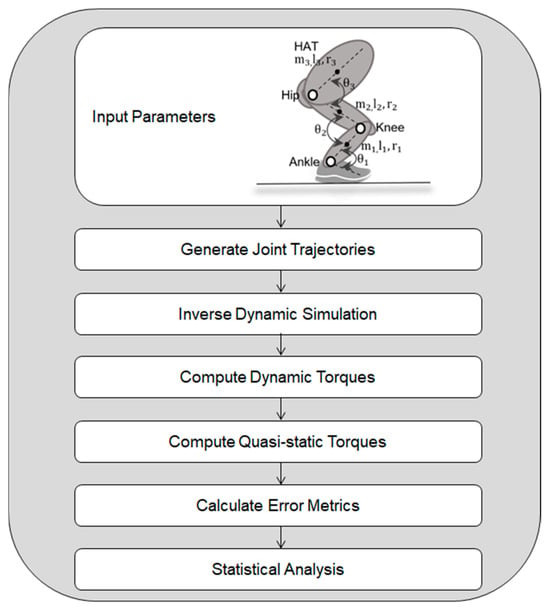
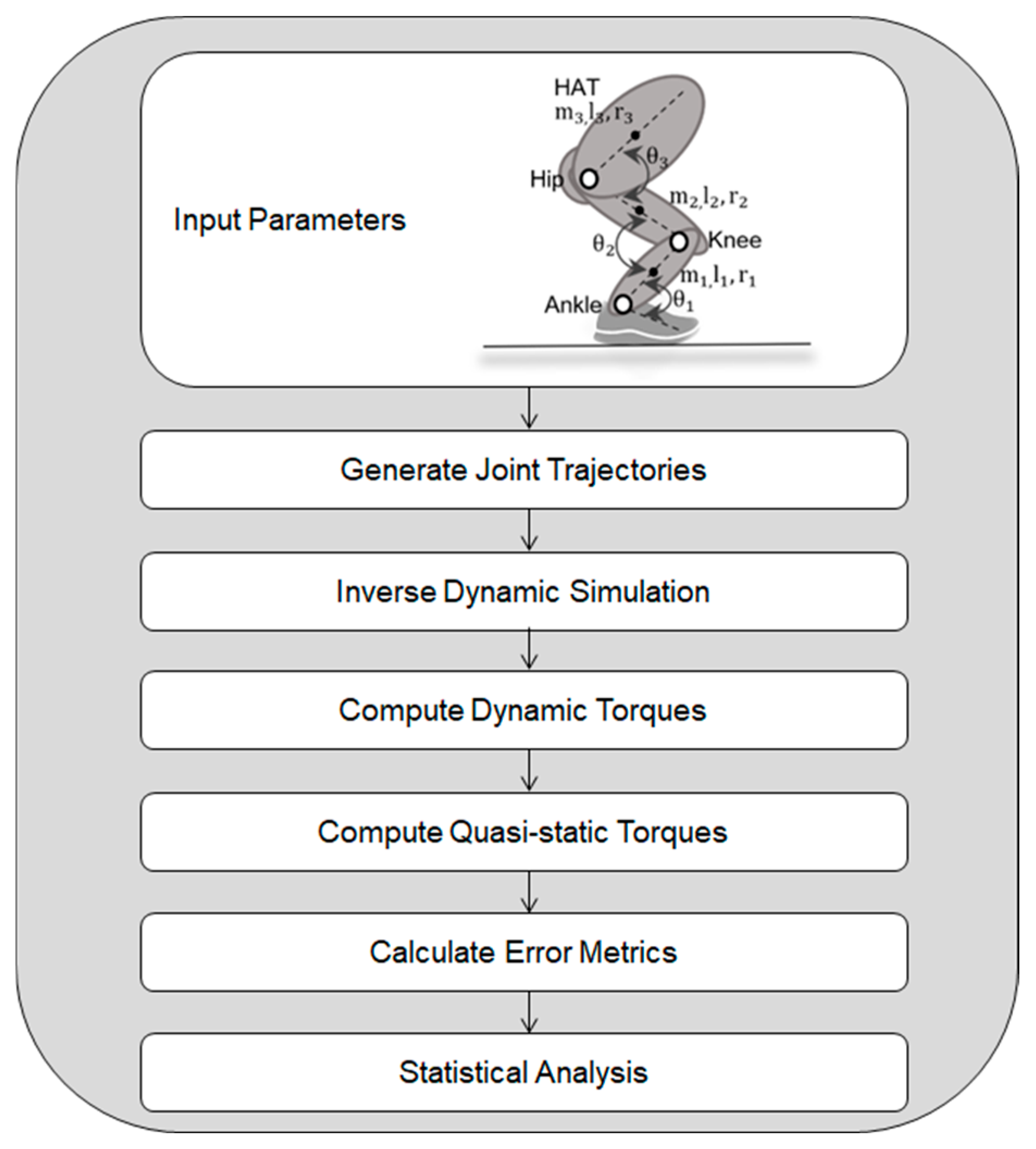
An overview of the simulation workflow is represented in Figure 1. This simulation flowchart is used to compare quasi-static and dynamic inverse dynamics models during squat motion.
Figure 1.
Flowchart of the simulation pipeline for quantifying inverse dynamics modeling errors. The process progresses from defining anthropometric parameters (m, l, r) for a 3-link model (Shank, Thigh, HAT) to generating sinusoidal joint trajectories , , and ). It details the Newton–Euler inverse dynamic simulation used to compute both dynamic and quasi-static torques, followed by RMSE calculation and 10,000-iteration bootstrap statistical analysis for error robustness.
The simulation workflow, as represented in Figure 1, follows a structured computational pipeline implemented in MATLAB (version R2022a). Initially, input parameters are established using Winter’s [2] anthropometric data to define the mass (m), length (l), and center of mass (r) for the shank, thigh, and HAT segments. These parameters are then utilized to generate joint trajectories, where segment angles (, , and ) follow sinusoidal profiles to simulate squat motions across four frequencies (0.25–1.00 Hz). In the inverse dynamic simulation phase, joint torques are computed using a Newton–Euler framework. The dynamic torque calculation incorporates both gravitational moments and inertial effects, whereas the quasi-static torque calculation is restricted to gravitational contributions. Finally, error metrics (RMSE and percentage error) are calculated, and a statistical analysis utilizing 10,000 bootstrap resamples is performed to establish 95% confidence intervals, which ensures the robustness of the joint-specific error benchmarks.
3. Results
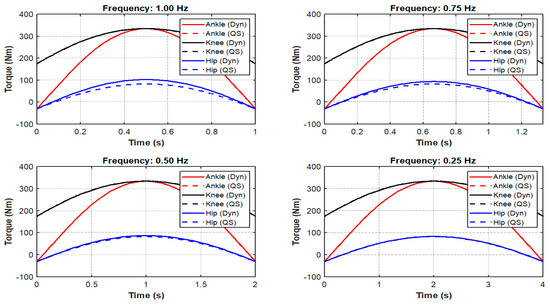
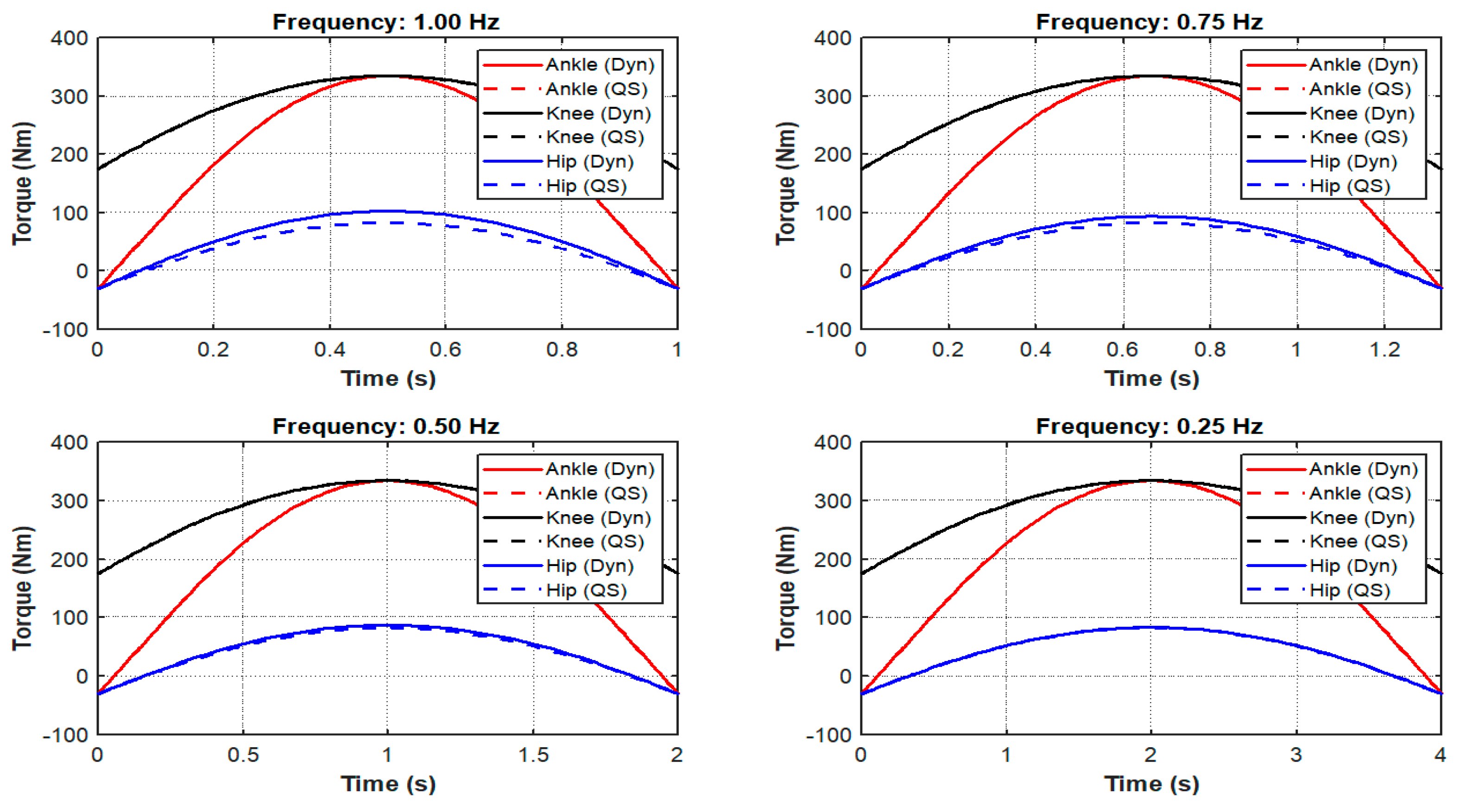
The simulation compared joint torque profiles calculated using the quasi-static and dynamic inverse dynamics models across four controlled squat frequencies: 1.00 Hz, 0.75 Hz, 0.50 Hz, and 0.25 Hz. Figure 2 displays the joint torque profiles computed using quasi-static and dynamic models.
Figure 2.
Joint torques from dynamic (Dyn) (solid lines) and quasi-static (QS) (dashed lines) inverse dynamics models for ankle (red), knee (black), and hip (blue) during squats at four different frequencies (1 Hz, 0.75 Hz, 0.5 Hz, and 0.25 Hz).
For both the ankle (red) and knee (black), torque curves from the two models are nearly indistinguishable across all movement speeds, with the quasi-static (QS Ankle and Knee) curves visually overlapping the dynamic (Dyn Ankle and Knee) curves. In contrast, the hip torque profiles (blue) show clear divergence at faster squatting speeds, particularly at 1.00 Hz (1 s duration), where dynamic torques are consistently higher than quasi-static estimates throughout the motion.
To rigorously quantify these differences, root mean square error (RMSE) and percentage error were computed for each joint at each squat frequency. Furthermore, bootstrapped 95% confidence intervals (CIs) were calculated for the percentage error using 10,000 synthetic resamples to assess the statistical robustness of the error estimates. Table 1 summarizes these results.
Table 1.
RMSE, peak dynamic torque, percentage error, and bootstrapped 95% confidence intervals (CI) for quasi-static vs. dynamic joint torque estimates across different squat frequencies.
Based on Table 1, the RMSE and percentage error remained negligible for the ankle and knee joints across all frequencies. For these distal joints, percentage errors were consistently below 0.1%. The extremely narrow 95% confidence intervals reinforce that these small discrepancies are not statistically significant.
In contrast, the hip joint displayed a significant, frequency-dependent increase in torque estimation error. At the fastest condition (1.00 Hz), the RMSE reached 14.4 Nm, which corresponds to a peak percentage error of 14.01%. This error demonstrated statistical significance, confirmed by the tight confidence bounds of 13.97–14.06%, which clearly do not include zero. Appreciable errors were also evident at intermediate speeds, with hip torque errors of 8.67% and 4.12% observed at 0.75 Hz and 0.50 Hz, respectively.
These results confirm that the quasi-static assumption becomes increasingly inaccurate for the hip joint as movement frequency increases but is generally valid for the ankle and knee.
4. Discussion
Our results reveal a clear divergence in how individual joints respond to quasi-static assumptions. For the ankle and knee joints, quasi-static inverse dynamics provided torque estimates that were nearly indistinguishable from those obtained using a fully dynamic formulation across all tested frequencies (0.25–1.00 Hz). RMSE for these distal joints remained below 0.33 Nm, corresponding to percentage errors well under 0.1%, and the bootstrapped 95% confidence intervals were effectively zero. These findings indicate that inertial effects contribute negligibly to ankle and knee joint torques during controlled squat motions, which supports the use of simplified quasi-static models for distal joint analysis in slow to moderately paced lower-limb tasks. This observation is consistent with classical biomechanical descriptions and shows that distal segments typically experience relatively low angular accelerations during slow and moderate lower-limb movements, thereby minimizing inertial contributions to net joint moments [2].
The negligible error at the ankle aligns with previous research on high-acceleration stance-phase tasks. Johnson and Buckley [18] explicitly tested the hypothesis that ground reaction forces (GRF), rather than segmental accelerations, are the primary contributors to joint moments during the stance phase of sprinting. They demonstrated that removing segmental linear and angular accelerations from the inverse dynamic calculations resulted in almost 1% decrease in peak ankle plantar flexor moments. This indicates a GRF-dominant contribution at the ankle. The present findings suggest that this GRF-dominated behavior of the ankle joint also applies to lower-velocity, non-impact movements such as bodyweight squats.
In contrast, the hip joint exhibited pronounced sensitivity to dynamic effects as movement speed increased. At the highest tested frequency (1.00 Hz), the quasi-static model systematically underestimated peak hip torque, with an RMSE of approximately 14.4 Nm, corresponding to about 14% of the peak dynamic torque. The associated 95% confidence intervals did not include zero, which confirms that this discrepancy is statistically meaningful rather than numerical noise. Substantial errors were also observed at intermediate frequencies, indicating a progressive degradation of quasi-static accuracy rather than a discrete breakdown threshold. This behavior is attributable to the large mass and moment of inertia of the head–arms–trunk (HAT) segment and its increasing angular acceleration at higher squat speeds. Because the HAT segment contributes disproportionately to hip joint loading, inertial effects at the hip become increasingly dominant as movement frequency rises.
We chose to maintain a constant vertical ground-reaction force (GRF) to specifically isolate the influence of segmental inertia. While vertical GRF fluctuates in real-world squats, fixing this variable ensures that the reported torque discrepancies are a direct result of modeling fidelity rather than external force variability. In real squat movements, vertical GRFs fluctuate over time and exceed body weight during upward acceleration phases and fall below body weight during descent. Incorporating such time-varying external forces would increase absolute joint torque magnitudes and may further amplify discrepancies between quasi-static and dynamic formulations, particularly at higher movement speeds. Consequently, the torque errors reported here should be interpreted as lower-bound estimates under idealized loading conditions rather than comprehensive representations of in vivo joint loading.
Furthermore, the analysis used idealized, smooth, sinusoidal joint trajectories and a single anthropometric model of a 70 kg, 1.75 m adult male. While this approach isolates inertial effects, real-world kinematic data from motion capture systems includes measurement noise, which is amplified when differentiating displacement to compute accelerations. Therefore, in experimental applications, quasi-static torque errors may be more variable, especially at the hip. Similarly, variations in body proportions or segmental mass distribution could substantially alter hip torque estimation errors. For example, individuals with higher BMI or a higher center of mass may experience larger quasi-static underestimations at the hip. Future work should incorporate subject-specific scaling and experimental validation to assess sensitivity to anthropometric variability and real-world measurement noise.
Although no single definitive speed threshold exists where quasi-static modeling fails, our results suggest a practical rule of thumb: for squat movements exceeding approximately 0.50 Hz, dynamic modeling of the hip is recommended to maintain torque errors below 5–10%. This guide can inform applied biomechanics and rehabilitation engineering applications, such as exoskeleton or wearable assistive device design, where accurate hip torque estimation is critical for actuator sizing and control strategy.
From an applied biomechanics perspective, these findings carry important implications. Quasi-static inverse dynamics can provide reliable ankle and knee torque estimates for low-speed or rhythmic tasks without sacrificing accuracy, reducing computational load for real-time systems. Similar quasi-static modeling assumptions have been successfully applied to other structured, low-speed full-body movements under controlled conditions, such as salaah postures [19]. However, for rapid or hip-dominant movements, reliance on quasi-static formulations may lead to substantial underestimation of hip joint torques, potentially compromising device safety or control performance. In such cases, the additional complexity of fully dynamic inverse dynamics modeling is justified to ensure accurate torque estimation.
Several limitations of this study should be acknowledged. The analysis was conducted entirely in simulation using idealized, smooth, and symmetric joint kinematics, generic anthropometric parameters, and planar motion assumptions. While these simplifications facilitate clear interpretation of inertial effects, they limit direct quantitative generalization to real human movement. Future work should incorporate experimental motion capture data, measured time-varying GRFs, three-dimensional kinematics, and subject-specific anthropometry to validate whether the joint-dependent error trends observed here persist under realistic conditions.
In summary, this study acknowledges that the influence of segmental accelerations on inverse dynamics is a well-established principle in the biomechanics literature, particularly in high-acceleration tasks, and does not claim originality in identifying inertial effects as an isolated concept. Instead, the primary contribution of this work is the provision of a controlled, frequency-dependent, and joint-specific quantification of the torque errors introduced by quasi-static assumptions in the bodyweight squat, an activity that is frequently analyzed using simplified inverse dynamics approaches. By defining the conditions under which quasi-static modeling remains valid and identifying the movement frequencies at which dynamic effects become critical for the hip joint, this study establishes clear and practical benchmarks. These findings provide valuable quantitative guidance for improving the accuracy of biomechanical simulations, informing rehabilitation engineering practices, and supporting the safe design of wearable assistive technologies while making certain assumptions.
5. Conclusions
This study provides a quantitative benchmark for joint torque estimation errors introduced by quasi-static inverse dynamics assumptions during bodyweight squats. Our findings demonstrate that the validity of these assumptions is highly joint-specific. At the ankle and knee, torque errors remained negligible (below 0.1%) across all movement frequencies up to 1.00 Hz, which suggests that quasi-static models are sufficient for analyzing distal joint kinetics in low-to-moderate speed tasks.
In contrast, the hip joint is significantly sensitive to movement frequency due to the inertial influences of the upper body. Neglecting these effects resulted in torque underestimations of approximately 14% at a 1.00 Hz squat frequency. Based on these results, we suggest a practical “rule of thumb” for biomechanical modeling: while quasi-static approximations are robust for the ankle and knee, dynamic modeling should be prioritized for the hip joint when movement frequencies exceed 0.50 Hz to maintain torque errors within acceptable clinical and engineering margins.
These benchmarks provide actionable guidance for the design and control of assistive technologies, such as lower-limb exoskeletons and rehabilitation robots. By selecting the appropriate modeling fidelity based on the joint of interest and movement speed, researchers and engineers can better balance computational efficiency with the accuracy required for safe and effective device performance.
Author Contributions
Conceptualization, M.A., Ş.M. and M.Y.; methodology, Ş.M.; software, M.A. and M.Y.; validation, M.A., M.Y. and Ş.M.; formal analysis, M.A.; investigation, M.A. and Ş.M.; data curation, M.A. and M.Y.; writing—original draft preparation, M.A.; writing—review and editing, M.A., M.Y. and Ş.M.; visualization, M.A.; supervision, Ş.M.; project administration, Ş.M.; funding acquisition, Ş.M. All authors have read and agreed to the published version of the manuscript.
Funding
This research was funded by Türkiye Bilimsel ve Teknolojik Arastirma Kurumu TUBITAK 2232 Funding Scheme with Grant No of 118C188.
Institutional Review Board Statement
The study was conducted in accordance with the Declaration of Helsinki, and approved by the Institutional Review Board of İzmir Atatürk Institute of Health and Research (protocol code 781 and 18 June 2020).
Informed Consent Statement
Informed consent was obtained from all subjects involved in the study. However, all the data were anonymized, and no subject-specific results were published in this research. Only normalized data was used, hence there is no need for submission of individual consent forms.
Data Availability Statement
MATLAB simulation code and example data used in this study are available upon request.
Conflicts of Interest
The authors have no conflicts of interest.
Abbreviations
The following abbreviations are used in this manuscript:
| RMSE | Root mean square error |
| CI | Confidence intervals |
| ID | Inverse dynamics |
| HAT | Head–arms–trunk |
| GRF | Ground reaction force |
| Dyn | Dynamic model |
| QS | Quasi-static model |
References
- Delp, S.L.; Anderson, F.C.; Arnold, A.S.; Loan, P.; Habib, A.; John, C.T.; Guendelman, E.; Thelen, D.G. OpenSim: Open-source software to create and analyze dynamic simulations of movement. IEEE Trans. Biomed. Eng. 2007, 54, 1940–1950. [Google Scholar] [CrossRef] [Scilit] [PubMed]
- Winter, D.A. Biomechanics and Motor Control of Human Movement, 4th ed.; John Wiley & Sons: Hoboken, NJ, USA, 2009. [Google Scholar]
- Wagner, D.W.; Reed, M.P.; Rasmussen, J. Assessing the importance of motion dynamics for ergonomic analysis of manual materials handling tasks using the AnyBody Modeling System. SAE Trans. 2007, 116, 2092–2101. [Google Scholar]
- Farhat, N.; Zamora, P.; Reichert, D.; Mata, V.; Page, A.; Valera, A. A computationally efficient musculoskeletal model of the lower limb for the control of rehabilitation robots: Assumptions and validation. Appl. Sci. 2022, 12, 2654. [Google Scholar] [CrossRef] [Scilit]
- Rocha, C.; Lobo, J.; Parente, M.; Oliveira, D. Biomechanical Modeling and Simulation of the Knee Joint: Integration of AnyBody and Abaqus. Biomechanics 2025, 5, 57. [Google Scholar] [CrossRef] [Scilit]
- Fessl, I.; Harbour, E.; Kröll, J.; Schwameder, H. Effect of Additional Loads on Joint Kinetics and Joint Work Contribution in Males and Females Performing Vertical Countermovement Jumps. Biomechanics 2022, 2, 319–330. [Google Scholar] [CrossRef] [Scilit]
- Nataraj, R.; Sanford, S.P.; Liu, M. Joint Moment Responses to Different Modes of Augmented Visual Feedback of Joint Kinematics during Two-Legged Squat Training. Biomechanics 2023, 3, 425–442. [Google Scholar] [CrossRef] [Scilit]
- Cleather, D.J.; Bull, A.M.J. Influence of inverse dynamics methods on the calculation of inter-segmental moments in vertical jumping and weightlifting. Biomed. Eng. Online 2010, 9, 74. [Google Scholar] [CrossRef] [Scilit] [PubMed]
- Pizzolato, C.; Reggiani, M.; Saxby, D.J.; Ceseracciu, E.; Modenese, L.; Lloyd, D.G. Biofeedback for gait retraining based on real-time estimation of tibiofemoral joint contact forces. IEEE Trans. Neural Syst. Rehabil. Eng. 2017, 25, 1612–1621. [Google Scholar] [CrossRef] [Scilit] [PubMed]
- González, M.; Navandar, A.; González-Ravé, J.M.; Ojeda, R.; González-Mohíno, F.; Juárez Santos-García, D. Comparative Analysis of Performance in the High-Bar vs. Low-Bar Squat. Appl. Sci. 2025, 15, 3143. [Google Scholar] [CrossRef] [Scilit]
- Almeida, J.F.; André, J.; Santos, C.P. Ankle Exoskeletons in Walking and Load-Carrying Tasks: Insights into Biomechanics and Human-Robot Interaction. IRBM 2025, 46, 100911. [Google Scholar] [CrossRef] [Scilit]
- Firouzi, V.; Seyfarth, A.; Song, S.; von Stryk, O.; Sharbafi, M.A. Biomechanical models in the lower-limb exoskeletons development: A review. J. Neuroeng. Rehabil. 2025, 22, 12. [Google Scholar] [CrossRef] [Scilit] [PubMed]
- Schellenberg, F.; Taylor, W.R.; Jonkers, I.; Lorenzetti, S. Robustness of kinematic weighting and scaling concepts for musculoskeletal simulation. Comput. Methods Biomech. Biomed. Eng. 2017, 20, 720–729. [Google Scholar] [CrossRef] [Scilit] [PubMed]
- Maldonado, G.; Bailly, F.; Souères, P.; Watier, B. Inverse dynamics study of the parkour kong-vault during take-off. Comput. Methods Biomech. Biomed. Eng. 2019, 22, S331–S333. [Google Scholar] [CrossRef] [Scilit]
- Willson, A.M.; Anderson, A.J.; Richburg, C.A.; Muir, B.C.; Czerniecki, J.; Steele, K.M.; Aubin, P.M. Full body musculoskeletal model for simulations of gait in persons with transtibial amputation. Comput. Methods Biomech. Biomed. Eng. 2023, 26, 412–423. [Google Scholar] [CrossRef] [Scilit] [PubMed]
- The MathWorks, Inc. MATLAB, version R2022a; The MathWorks, Inc.: Natick, MA, USA, 2022.
- Bergmann, G.; Bender, A.; Dymke, J.; Duda, G.; Damm, P. Standardized loads acting in hip implants. PLoS ONE 2016, 11, e0155612. [Google Scholar] [CrossRef] [Scilit] [PubMed]
- Johnson, M.D.; Buckley, J.G. Muscle power patterns in the mid-acceleration phase of sprinting. J. Sports Sci. 2001, 19, 263–272. [Google Scholar] [CrossRef] [Scilit] [PubMed]
- Mihçin, S.; Şahin, A.M.; Yılmaz, M.; Alpkaya, A.T.; Tuna, M.; Akdeniz, S.; Korkmaz, N.C.; Tosun, A.; Şahin, S. Database covering the prayer movements which were not available previously. Nat. Sci. Data 2023, 10, 276. [Google Scholar] [CrossRef] [Scilit] [PubMed]

Disclaimer/Publisher’s Note: The statements, opinions and data contained in all publications are solely those of the individual author(s) and contributor(s) and not of MDPI and/or the editor(s). MDPI and/or the editor(s) disclaim responsibility for any injury to people or property resulting from any ideas, methods, instructions or products referred to in the content. |
© 2026 by the authors. Licensee MDPI, Basel, Switzerland. This article is an open access article distributed under the terms and conditions of the Creative Commons Attribution (CC BY) license.