
Differences in Sprinting-Related Force–Velocity Mechanical Variables Between Under-19 and Senior Players: Physical Performance Readiness in Elite Youth Soccer

 , ,
, ,
Abstract
1. Introduction
2. Materials and Methods
2.1. Study Design
2.2. Participants
2.3. Data Collection
2.4. Data Processing
3. Results
3.1. Differences in Linear Sprint Mechanical Variables
3.2. Reference Percentile Data for Linear Sprint Mechanical Variables
4. Discussion
5. Practical Application
6. Conclusions
Author Contributions
Funding
Institutional Review Board Statement
Informed Consent Statement
Data Availability Statement
Acknowledgments
Conflicts of Interest
Abbreviations
| F–v | Force–velocity |
| F0 | Maximal theoretical force |
| v0 | Maximal theoretical velocity |
| RFmax | Maximal ratio of horizontal-to-resultant force |
| DRF | Decrease in the ratio of forces |
| PHV | Peak height velocity |
| SP | Senior players |
| YP | Youth players |
References
- Stølen, T.; Chamari, K.; Castagna, C.; Wisløff, U. Physiology of Soccer: An Update. Sports Med. 2005, 35, 501–536. [Google Scholar] [CrossRef]
- Kellmann, M.; Bertollo, M.; Bosquet, L.; Brink, M.; Coutts, A.J.; Duffield, R.; Erlacher, D.; Halson, S.L.; Hecksteden, A.; Heidari, J.; et al. Recovery and Performance in Sport: Consensus Statement. Int. J. Sports Physiol. Perform. 2018, 13, 240–245. [Google Scholar] [CrossRef] [PubMed]
- Faude, O.; Koch, T.; Meyer, T. Straight Sprinting Is the Most Frequent Action in Goal Situations in Professional Football. J. Sports Sci. 2012, 30, 625–631. [Google Scholar] [CrossRef] [PubMed]
- Barnes, C.; Archer, D.; Hogg, B.; Bush, M.; Bradley, P. The Evolution of Physical and Technical Performance Parameters in the English Premier League. Int. J. Sports Med. 2014, 35, 1095–1100. [Google Scholar] [CrossRef]
- Garcia, G.R.; Gonçalves, L.G.C.; Clemente, F.M.; Nakamura, F.Y.; Nobari, H.; Bedo, B.L.S.; Azevedo, A.M.; Guerra, M.A.; Aquino, R. Effects of Congested Fixture and Matches’ Participation on Internal and External Workload Indices in Professional Soccer Players. Sci. Rep. 2022, 12, 1864. [Google Scholar] [CrossRef]
- Kryściak, J.; Maly, T.; Tomczak, M.; Modric, T.; Malone, J.; Zahálka, F.; Clarup, C.; Phillips, K.; Andrzejewski, M. Relationship between Aerobic Performance and Match Running Performance in Elite Soccer Players Including Playing Position and Contextual Factors. Biol. Sport 2026, 43, 213–225. [Google Scholar] [CrossRef]
- Modric, T.; Versic, S.; Sekulic, D. Aerobic Fitness and Game Performance Indicators in Professional Football Players; Playing Position Specifics and Associations. Heliyon 2020, 6, e05427. [Google Scholar] [CrossRef]
- Cross, M.R.; Samozino, P.; Brown, S.R.; Morin, J.-B. A Comparison between the Force–Velocity Relationships of Unloaded and Sled-Resisted Sprinting: Single vs. Multiple Trial Methods. Eur. J. Appl. Physiol. 2018, 118, 563–571. [Google Scholar] [CrossRef] [PubMed]
- Morin, J.-B.; Samozino, P. Interpreting Power-Force-Velocity Profiles for Individualized and Specific Training. Int. J. Sports Physiol. Perform. 2016, 11, 267–272. [Google Scholar] [CrossRef]
- Morin, J.-B.; Gimenez, P.; Edouard, P.; Arnal, P.; Jiménez-Reyes, P.; Samozino, P.; Brughelli, M.; Mendiguchia, J. Sprint Acceleration Mechanics: The Major Role of Hamstrings in Horizontal Force Production. Front. Physiol. 2015, 6, 404. [Google Scholar] [CrossRef]
- Samozino, P.; Rabita, G.; Dorel, S.; Slawinski, J.; Peyrot, N.; Saez De Villarreal, E.; Morin, J.-B. A Simple Method for Measuring Power, Force, Velocity Properties, and Mechanical Effectiveness in Sprint Running. Scand. J. Med. Sci. Sports 2016, 26, 648–658. [Google Scholar] [CrossRef]
- Hicks, D.S.; Drummond, C.; Williams, K.J.; Pickering, C.; Van Den Tillaar, R. Individualization of Training Based on Sprint Force-Velocity Profiles: A Conceptual Framework for Biomechanical and Technical Training Recommendations. Strength Cond. J. 2023, 45, 711–725. [Google Scholar] [CrossRef]
- Morin, J.-B.; Edouard, P.; Samozino, P. Technical Ability of Force Application as a Determinant Factor of Sprint Performance. Med. Sci. Sports Exerc. 2011, 43, 1680–1688. [Google Scholar] [CrossRef]
- Fernández-Galván, L.M.; Boullosa, D.; Jiménez-Reyes, P.; Cuadrado-Peñafiel, V.; Casado, A. Examination of the Sprinting and Jumping Force-Velocity Profiles in Young Soccer Players at Different Maturational Stages. Int. J. Environ. Res. Public Health 2021, 18, 4646. [Google Scholar] [CrossRef] [PubMed]
- Fernández-Galván, L.M.; Jiménez-Reyes, P.; Cuadrado-Peñafiel, V.; Casado, A. Sprint Performance and Mechanical Force-Velocity Profile among Different Maturational Stages in Young Soccer Players. Int. J. Environ. Res. Public Health 2022, 19, 1412. [Google Scholar] [CrossRef]
- Edouard, P.; Lahti, J.; Nagahara, R.; Samozino, P.; Navarro, L.; Guex, K.; Rossi, J.; Brughelli, M.; Mendiguchia, J.; Morin, J.-B. Low Horizontal Force Production Capacity during Sprinting as a Potential Risk Factor of Hamstring Injury in Football. Int. J. Environ. Res. Public Health 2021, 18, 7827. [Google Scholar] [CrossRef]
- Forsythe, B.; Knapik, D.M.; Crawford, M.D.; Diaz, C.C.; Hardin, D.; Gallucci, J.; Silvers-Granelli, H.J.; Mandelbaum, B.R.; Lemak, L.; Putukian, M.; et al. Incidence of Injury for Professional Soccer Players in the United States: A 6-Year Prospective Study of Major League Soccer. Orthop. J. Sports Med. 2022, 10, 23259671211055136. [Google Scholar] [CrossRef]
- Ekstrand, J.; Hägglund, M.; Waldén, M. Epidemiology of Muscle Injuries in Professional Football (Soccer). Am. J. Sports Med. 2011, 39, 1226–1232. [Google Scholar] [CrossRef] [PubMed]
- Mendiguchia, J.; Edouard, P.; Samozino, P.; Brughelli, M.; Cross, M.; Ross, A.; Gill, N.; Morin, J.B. Field Monitoring of Sprinting Power–Force–Velocity Profile before, during and after Hamstring Injury: Two Case Reports. J. Sports Sci. 2016, 34, 535–541. [Google Scholar] [CrossRef] [PubMed]
- Mendiguchia, J.; Samozino, P.; Martinez-Ruiz, E.; Brughelli, M.; Schmikli, S.; Morin, J.-B.; Mendez-Villanueva, A. Progression of Mechanical Properties during On-Field Sprint Running after Returning to Sports from a Hamstring Muscle Injury in Soccer Players. Int. J. Sports Med. 2014, 35, 690–695. [Google Scholar] [CrossRef]
- Kenneally-Dabrowski, C.; Brown, N.A.T.; Serpell, B.G.; Perriman, D.; Spratford, W.; Sutherland, A.; Pickering, M.; Lai, A.K.M. Hamstring Musculotendon Mechanics of Prospectively Injured Elite Rugby Athletes. Res. Sports Med. 2024, 32, 597–608. [Google Scholar] [CrossRef]
- McKay, A.K.A.; Stellingwerff, T.; Smith, E.S.; Martin, D.T.; Mujika, I.; Goosey-Tolfrey, V.L.; Sheppard, J.; Burke, L.M. Defining Training and Performance Caliber: A Participant Classification Framework. Int. J. Sports Physiol. Perform. 2022, 17, 317–331. [Google Scholar] [CrossRef]
- Rakovic, E.; Paulsen, G.; Helland, C.; Haugen, T.; Eriksrud, O. Validity and Reliability of a Motorized Sprint Resistance Device. J. Strength Cond. Res. 2022, 36, 2335–2338. [Google Scholar] [CrossRef] [PubMed]
- Røkke, O. Validation of Force-, Velocity-, and Acceleration-Time Curves and Temporal Characteristics as Output Data from the 1080 Sprint. Master’s Thesis, Norwegian School of Sports Sciences: Department of Physical Performance, Oslo, Norway, 2018. [Google Scholar]
- Jeffreys, I. Warm-up Revisited: The Ramp Method of Optimizing Warm-Ups. Prof. Strength Cond. 2007, 6, 12–18. [Google Scholar]
- Cohen, J. Statistical Power Analysis for the Behavioral Sciences, 2nd ed.; Routledge: New York, NY, USA, 2013; ISBN 9781134742707. [Google Scholar]
- Devismes, M.; Aeles, J.; Philips, J.; Vanwanseele, B. Sprint Force-Velocity Profiles in Soccer Players: Impact of Sex and Playing Level. Sports Biomech. 2021, 20, 947–957. [Google Scholar] [CrossRef]
- Haugen, T.A.; Breitschädel, F.; Seiler, S. Sprint Mechanical Properties in Soccer Players According to Playing Standard, Position, Age and Sex. J. Sports Sci. 2020, 38, 1070–1076. [Google Scholar] [CrossRef]
- Vigh-Larsen, J.F.; Dalgas, U.; Andersen, T.B. Position-Specific Acceleration and Deceleration Profiles in Elite Youth and Senior Soccer Players. J. Strength Cond. Res. 2018, 32, 1114–1122. [Google Scholar] [CrossRef]
- Hermosilla-Palma, F.; Loro-Ferrer, J.F.; Merino-Muñoz, P.; Gómez-Álvarez, N.; Bustamante-Garrido, A.; Cerda-Kohler, H.; Portes-Junior, M.; Aedo-Muñoz, E. Changes in the Mechanical Properties of the Horizontal Force-Velocity Profile during a Repeated Sprint Test in Professional Soccer Players. Int. J. Environ. Res. Public Health 2022, 20, 704. [Google Scholar] [CrossRef]
- Jiménez-Reyes, P.; Garcia-Ramos, A.; Párraga-Montilla, J.A.; Morcillo-Losa, J.A.; Cuadrado-Peñafiel, V.; Castaño-Zambudio, A.; Samozino, P.; Morin, J.-B. Seasonal Changes in the Sprint Acceleration Force-Velocity Profile of Elite Male Soccer Players. J. Strength Cond. Res. 2022, 36, 70–74. [Google Scholar] [CrossRef] [PubMed]
- Zhang, Q.; Pommerell, F.; Owen, A.; Trama, R.; Martin, C.; Hautier, C.A. Running Patterns and Force-velocity Sprinting Profiles in Elite Training Young Soccer Players: A Cross-sectional Study. Eur. J. Sport Sci. 2021, 21, 1718–1726. [Google Scholar] [CrossRef] [PubMed]
- Ben Hassen, D.; Zghal, F.; Peyrot, N.; Samozino, P.; Rebai, H.; Rahmani, A. Jump and Sprint Force Velocity Profile of Young Soccer Players Differ According to Playing Position. J. Sports Sci. 2023, 41, 1915–1926. [Google Scholar] [CrossRef]
- Lindberg, K.; Solberg, P.; Rønnestad, B.R.; Frank, M.T.; Larsen, T.; Abusdal, G.; Berntsen, S.; Paulsen, G.; Sveen, O.; Seynnes, O.; et al. Should We Individualize Training Based on Force-velocity Profiling to Improve Physical Performance in Athletes? Scand. Med. Sci. Sports 2021, 31, 2198–2210. [Google Scholar] [CrossRef] [PubMed]
- Monteiro, R.; Monteiro, D.; Nunes, C.; Torregrossa, M.; Travassos, B. Identification of Key Career Indicators in Portuguese Football Players. Int. J. Sports Sci. Coach. 2020, 15, 533–541. [Google Scholar] [CrossRef]
- Steenbok, W.; Morris-Eyton, H.; Kubayi, A. An Investigation into the Player Development Pathway among Youth Soccer Players in South Africa. S. Afr. J. Sports Med. 2025, 37. [Google Scholar] [CrossRef] [PubMed]
- Malina, R.; Králík, M.; Kozieł, S.M.; Cumming, S.; Konarski, J.; Sousa-e-Silva, P.; Martinho, D.; J. Figueiredo, A.; Coelho-e-Silva, M. Ages at Peak Height Velocity in Male Soccer Players 11–16 Years: Relationships with Skeletal Age and Comparisons among Longitudinal Studies. Biol. Sport 2024, 41, 135–144. [Google Scholar] [CrossRef]
- Wik, E.H. Growth, Maturation and Injuries in High-Level Youth Football (Soccer): A Mini Review. Front. Sports Act. Living 2022, 4, 975900. [Google Scholar] [CrossRef]



| Variable | SP n = 38 (Mean ± SD) | YP n = 214 (Mean ± SD) | SP (CV %) | YP (CV %) | SP (95% CI) | YP (95% CI) | ||
|---|---|---|---|---|---|---|---|---|
| Lower | Upper | Lower | Upper | |||||
| Age (years) | 24.5 ± 4.3 | 17.4 ± 0.5 | 17.6 | 2.9 | 23.1 | 25.9 | 17.3 | 17.5 |
| Body Height (cm) | 180.1 ± 5.7 | 179.8 ± 6.4 | 3.2 | 3.5 | 178.2 | 182 | 178.9 | 180.7 |
| Body Weight (kg) | 77.3 ± 5.6 | 71.8 ± 6.5 | 7.2 | 9.1 | 75.5 | 79.1 | 70.9 | 72.7 |
| Variable | SP (Mean ± SD) | YP (Mean ± SD) | Δ SP vs. YP | SP (CV %) | YP (CV %) | p-Value | d (Effect Size) |
|---|---|---|---|---|---|---|---|
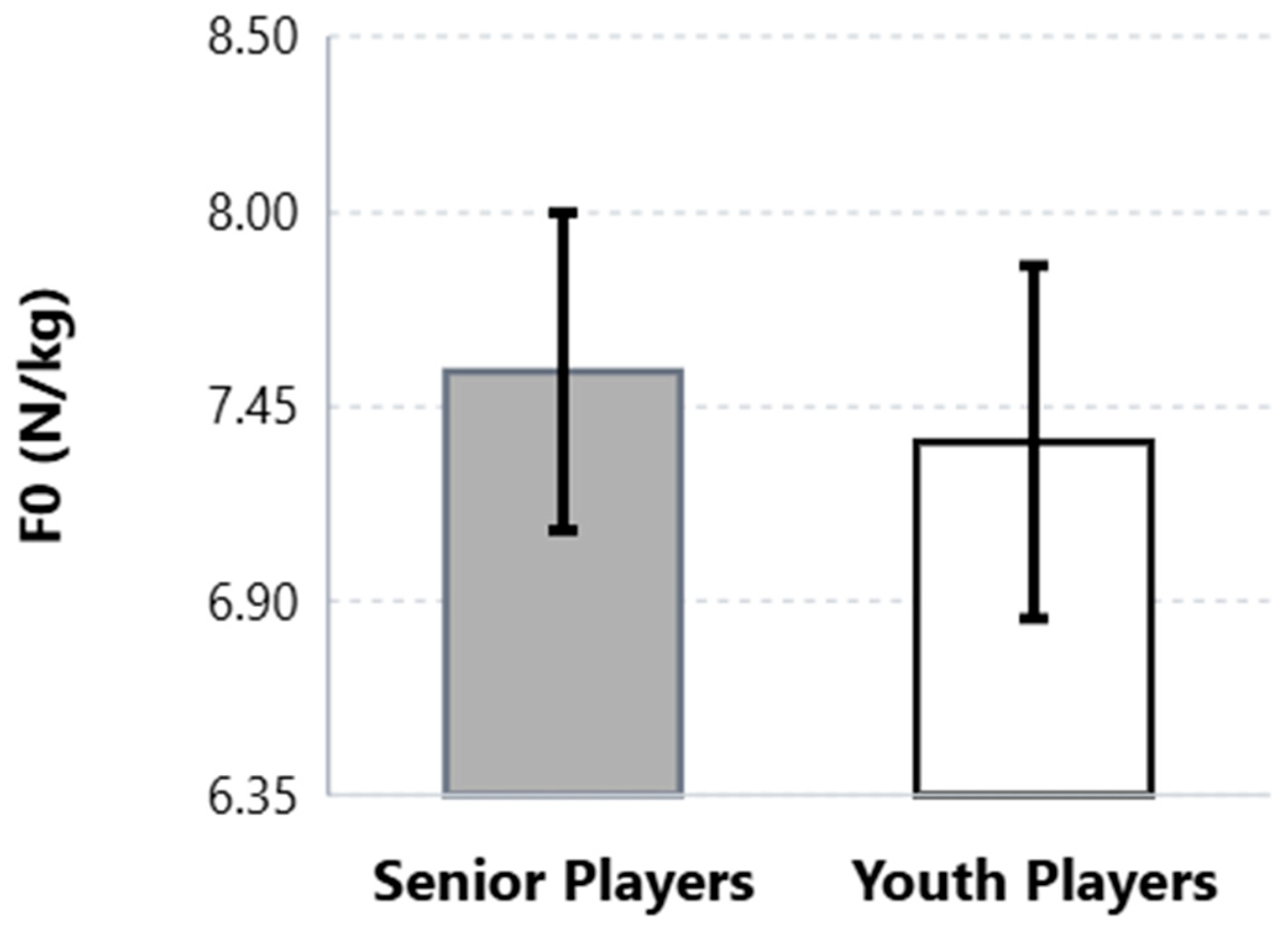
| F0 (N·kg−1) | 7.57 ± 0.46 | 7.35 ± 0.49 | 0.22 | 6.08 | 6.67 | 0.009 | 0.46 |
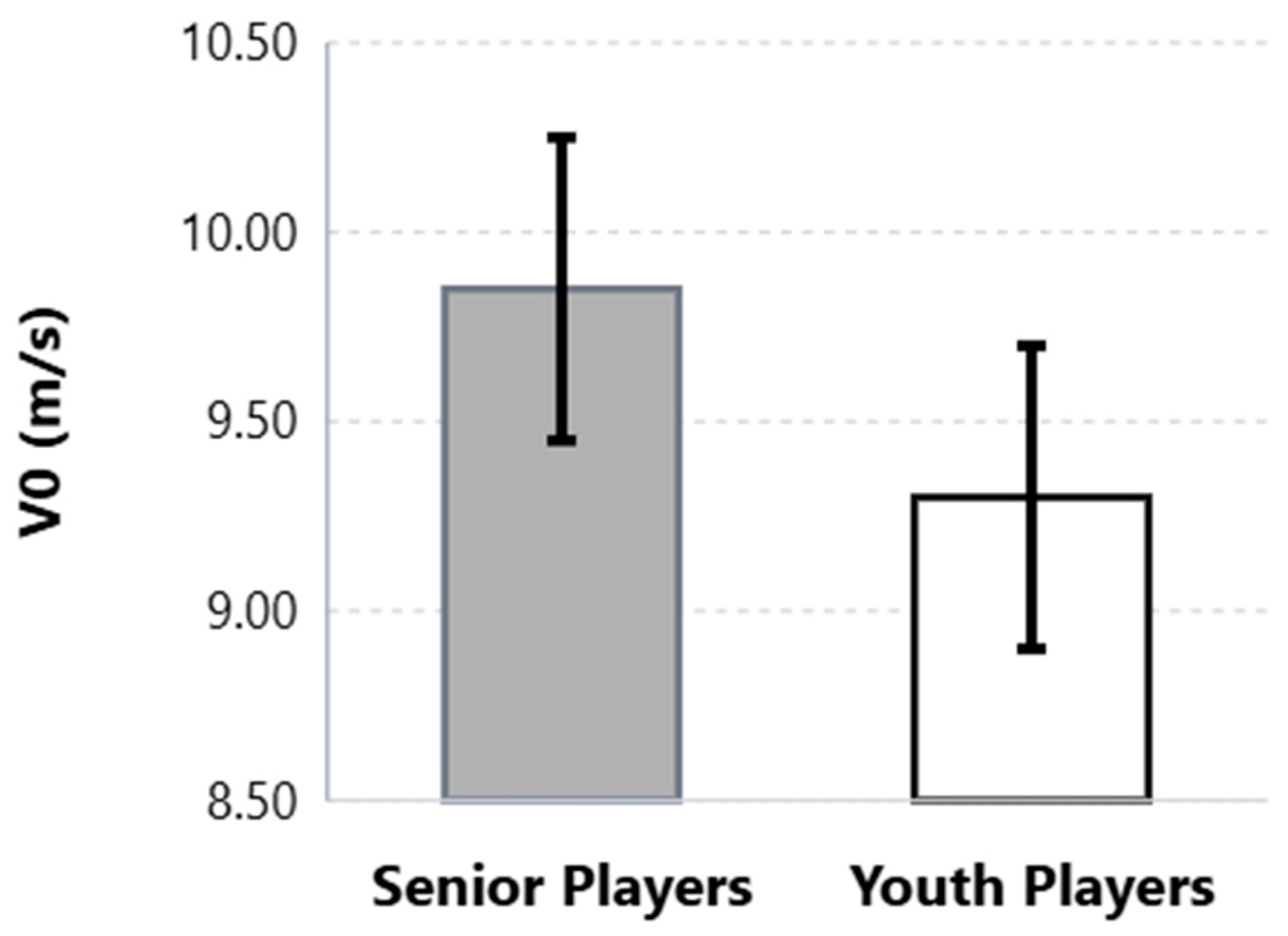
| v0 (m·s−1) | 9.86 ± 0.40 | 9.30 ± 0.55 | 0.56 | 4.06 | 5.91 | <0.001 | 1.07 |
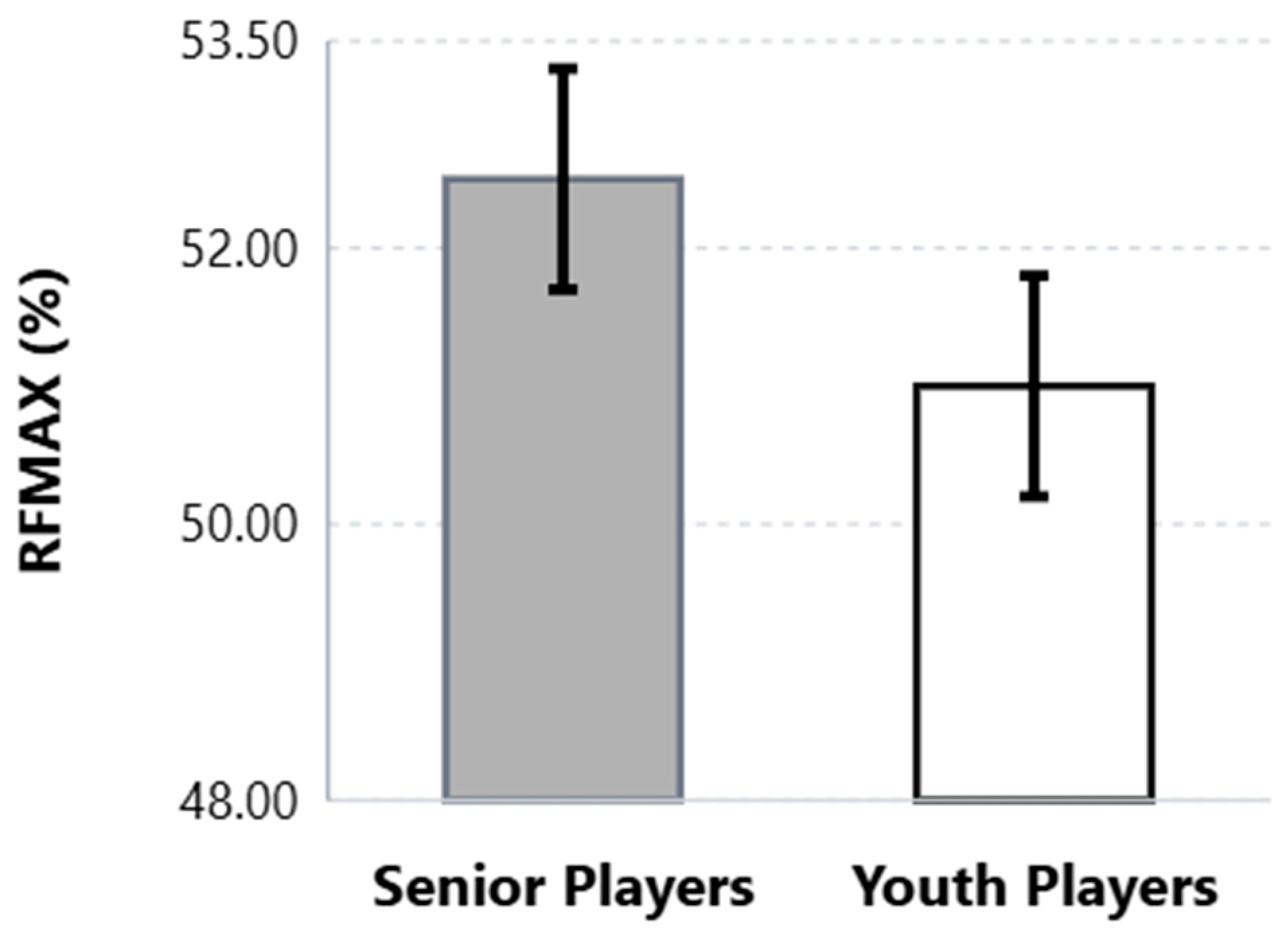
| RFmax (%) | 52.50 ± 1.74 | 51.03 ± 2.20 | 1.47 | 3.31 | 4.31 | <0.001 | 0.69 |
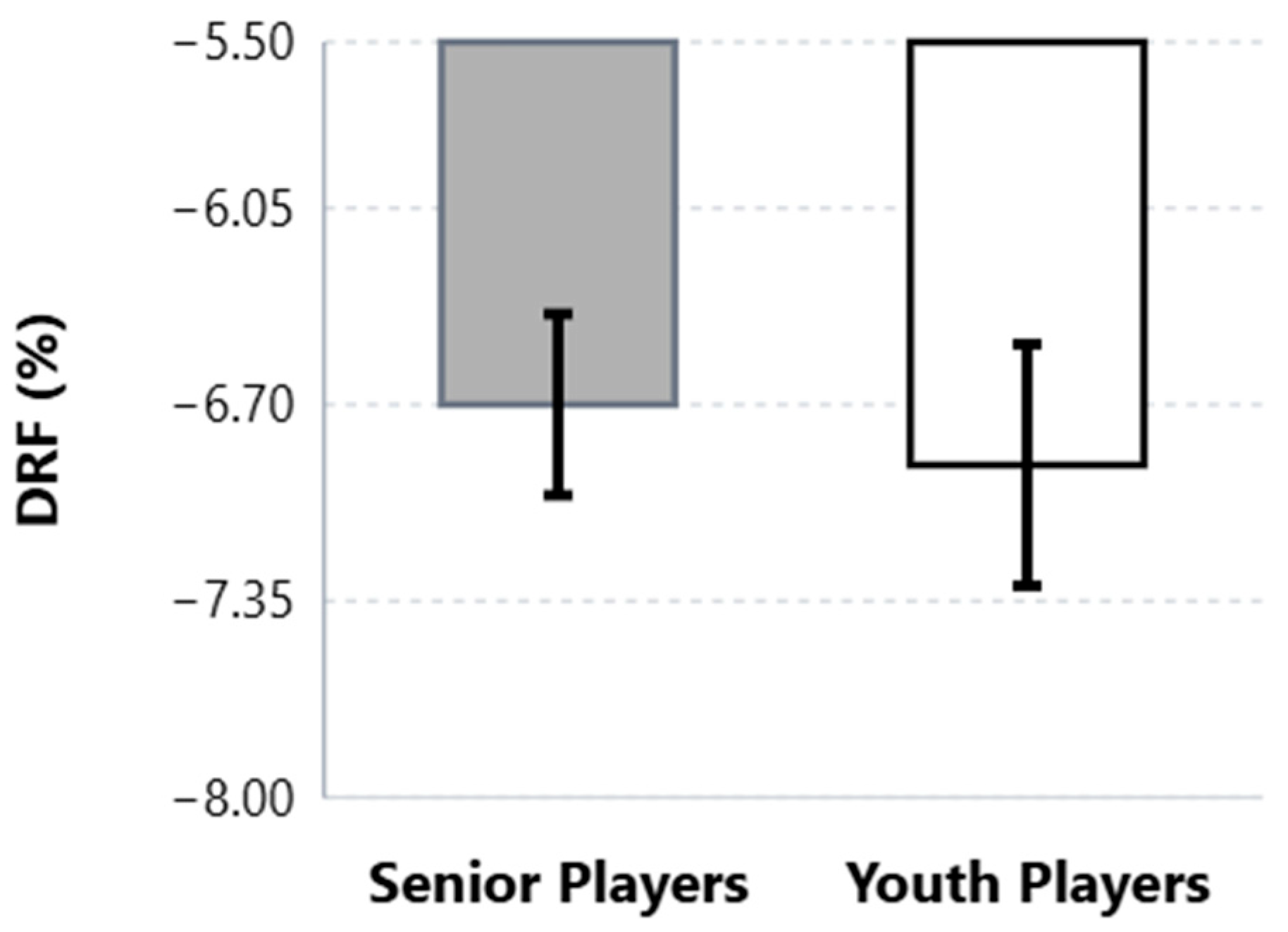
| DRF (%) | −6.67 ± 0.43 | −6.93 ± 0.52 | −0.26 | 6.45 | 7.50 | 0.001 | 0.53 |
| Percentiles | |||||||||||
|---|---|---|---|---|---|---|---|---|---|---|---|
| P5 | P10 | P20 | P30 | P40 | P50 | P60 | P70 | P80 | P90 | P95 | |
| F0 (N·kg−1) | 6.51 | 6.75 | 6.98 | 7.09 | 7.23 | 7.36 | 7.46 | 7.64 | 7.80 | 7.99 | 8.10 |
| v0 (m·s−1) | 8.40 | 8.52 | 8.84 | 9.01 | 9.20 | 9.35 | 9.48 | 9.61 | 9.76 | 9.99 | 10.10 |
| RFmax (%) | 47.00 | 48.30 | 49.50 | 50.00 | 50.50 | 51.10 | 51.70 | 52.40 | 53.00 | 53.60 | 54.25 |
| DRF (%) | −7.80 | −7.60 | −7.30 | −7.20 | −7.00 | −6.90 | −6.80 | −6.70 | −6.60 | −6.30 | −6.10 |
| Profile | Velocity-Dominant (Low Force/High Velocity) | Force-Dominant (High Force/Low Velocity) | Balanced Profile (P30–70 for Both F0 and v0) | Underdeveloped (Both < P30) |
|---|---|---|---|---|
| Criteria | F0 < P30 (7.09 N·kg−1) v0 > P70 (9.61+ m·s−1) | F0 > P70 (7.64+ N·kg−1) v0 < P30 (9.01 m·s−1) | F0 P30–70 (7.09–7.64 N·kg−1) v0 P30–70 (9.01–9.61 m·s−1) | F0 < P30 (7.09 N·kg−1) v0 < P30 (9.01 m·s−1) |
| Focus | PRIMARY: Force/power development SECONDARY: Maintain velocity capacity | PRIMARY: Velocity-oriented development SECONDARY: Maintain force production | PRIMARY: Maintain and optimize power output SECONDARY: Position-specific adaptations | PRIMARY: Simultaneous force and velocity training. SECONDARY: Reduce DRF through RFmax optimization |
| Examples | • Resisted sprints (sled, uphill) • Heavy strength training • Plyometrics with resistance • Eccentric loading exercises | • Assisted sprints (1080 sprint, downhill) • Flying starts (30 m acceleration + 30 m maximal) • High-speed plyometrics | • Complex training (strength + plyometrics) Max velocity training • Resisted sprint variations • Reactive strength training | • General strength training progressions • Plyometric exercises • Resisted sprints • Acceleration and Max velocity drills |
| Frequency | 2–3 strength sessions + 1 velocity maintenance session | 2–3 velocity sessions + 1 strength maintenance session | 1–2 strength sessions + 1–2 velocity sessions | 2 strength sessions + 2–3 velocity sessions + 1 plyometric session |
Disclaimer/Publisher’s Note: The statements, opinions and data contained in all publications are solely those of the individual author(s) and contributor(s) and not of MDPI and/or the editor(s). MDPI and/or the editor(s) disclaim responsibility for any injury to people or property resulting from any ideas, methods, instructions or products referred to in the content. |
© 2026 by the authors. Licensee MDPI, Basel, Switzerland. This article is an open access article distributed under the terms and conditions of the Creative Commons Attribution (CC BY) license.
Share and Cite
Karabin, L.; Sýkora, J.; Švantner, R.; Ford, K.R.; Pupiš, M.; Maly, T. Differences in Sprinting-Related Force–Velocity Mechanical Variables Between Under-19 and Senior Players: Physical Performance Readiness in Elite Youth Soccer. Biomechanics 2026, 6, 30. https://doi.org/10.3390/biomechanics6010030
Karabin L, Sýkora J, Švantner R, Ford KR, Pupiš M, Maly T. Differences in Sprinting-Related Force–Velocity Mechanical Variables Between Under-19 and Senior Players: Physical Performance Readiness in Elite Youth Soccer. Biomechanics. 2026; 6(1):30. https://doi.org/10.3390/biomechanics6010030
Chicago/Turabian StyleKarabin, Lukáš, Jozef Sýkora, Roman Švantner, Kevin R. Ford, Martin Pupiš, and Tomas Maly. 2026. "Differences in Sprinting-Related Force–Velocity Mechanical Variables Between Under-19 and Senior Players: Physical Performance Readiness in Elite Youth Soccer" Biomechanics 6, no. 1: 30. https://doi.org/10.3390/biomechanics6010030
APA StyleKarabin, L., Sýkora, J., Švantner, R., Ford, K. R., Pupiš, M., & Maly, T. (2026). Differences in Sprinting-Related Force–Velocity Mechanical Variables Between Under-19 and Senior Players: Physical Performance Readiness in Elite Youth Soccer. Biomechanics, 6(1), 30. https://doi.org/10.3390/biomechanics6010030