


Abstract
Background/Objectives: In pole vaulting, the capacity to store elastic energy within the pole (Epole) significantly influences performance. This study investigated the characteristics of Epole storage by analyzing the box reaction force and vector angle. Methods: Eight male pole vaulters, including World Championships participants, were examined. A motion capture system (VICON) and force plates (Kistler) were used to measure the vector angle (angle between the compression force (CF) and box reaction force vectors) and horizontal velocity of the center of gravity (COG) (Vcogh). Epole was calculated as the integral of the CF (estimated from the box reaction forces), and pole bending displacement. The relationships between each variable and the peak height of COG (HP) were assessed using Pearson’s product–moment correlation coefficients. Results: HP correlated with Vcogh in the pole plant (PP) (r = 0.82) and Epole (r = 0.94). Vaulters with a higher HP maintained a vector angle < 2° between 20% and 80% of the pole bending phase, indicating closer directional alignment between the box reaction force vector and pole chord direction, whereas vaulters with lower HP exhibited larger vector angles (4–8°), associated with a relative reduction in the axial component of force transmitted to the pole. Conclusions: A smaller vector angle effectively enhanced the CF, thereby increasing pole bending and promoting greater accumulation of Epole. Therefore, maintaining a small vector angle may enable more effective force transmission along the pole chord, and vector angle characteristics and PP horizontal velocity may assist appropriate pole selection and training strategies to enhance elastic energy storage and performance.
1. Introduction
Pole vaulting is a sport in which athletes compete to achieve maximum height by converting the velocity acquired during the run-up into elastic energy stored within the pole (Epole), which is subsequently transformed into potential energy during the vault [1,2]. The advent of fiberglass poles in recent years has enabled the generation of greater rebound forces, making the amount of Epole a crucial factor influencing performance. Consequently, the ability to effectively bend a highly stiff pole and maximize Epole storage is essential for better performance. However, the specific mechanical factors contributing to the accumulation of Epole remain inadequately elucidated. A quantitative understanding of these factors is anticipated to directly enhance vaulting height.
During pole bending, Epole is contingent upon both the degree of pole bending and its stiffness. Therefore, employing an index that integrates these two elements facilitates a more precise quantification of the Epole accumulation process. Previous studies have identified a strong correlation between Epole and the peak height of the center of gravity (HP) [3]. Additionally, during pole bending, the compression force (CF) has been demonstrated to contribute more significantly to Epole than the bending moment, with approximate contributions of 75% and 25%, respectively [4,5,6]. Since the CF is quantified by projecting the reaction force (box reaction force) generated during pole contact in the direction of the pole axis (chord) [5], both the magnitude of the box reaction force and the alignment of its direction are crucial factors for increasing the CF.
A directional mismatch (vector angle) exists between the CF and the box reaction force in pole vaulting. Although orientation of the ground reaction force vector is a meaningful indicator of movement performance in sprinting [7], this perspective has not been systematically applied to pole vaulting. Specifically, the extent to which the alignment between the box reaction force and the CF vector affects the elastic energy storage in the pole remains unknown. To date, no study has quantitatively evaluated this vector angle, leaving the role of directional energy transfer in pole vault performance largely unexplored.
During the take-off (TO) phase, which marks the commencement of Epole transmission, energy is transferred from the athlete’s body to the pole. This phase, spanning from touchdown (TD) to TO, marks the initiation of energy transfer, with the pole plant (PP) serving as its inception point [8]. The horizontal velocity of the center of gravity (COG) at TO is strongly correlated with the HP [9,10,11,12], and biomechanical energy analyses have traditionally utilized TO as a reference point [8]. However, because the pole is already bent and energy conversion by TO has begun, the horizontal velocity of the COG (Vcogh) at the PP, when pole bending commences, may play a critical role in the effective transmission of Epole.
Few studies have directly examined the effects of Vcogh at the PP on the HP and the accumulation of Epole, and its quantitative assessment remains limited. A decrease in Vcogh during the TO phase has been reported [13,14], and this reduction is primarily attributed to the impact generated when the pole makes contact with the box at the PP [15].
Although the effects of Vcogh at TO (TO Vcogh) on HP have been well established, the effects of Vcogh and the vector angle at PP on the accumulation of Epole and HP remain unclear. Novel insights into the mechanisms underlying Epole accumulation and performance enhancement in pole vaults may be obtained by quantifying variations in Vcogh, box reaction force, and vector angle at the PP.
Therefore, the present study quantified Vcogh, the vector angle, and Epole at the PP in elite male Japanese pole vaulters and investigated the characteristics of Epole accumulation based on differences in Vcogh, the box reaction force, and vector angle. In this study, it was hypothesized that the alignment of the vector angle increases the CF and promotes the accumulation of Epole, and that Vcogh at the PP contributes to its transmission.
2. Materials and Methods
2.1. Subjects
Eight male pole vaulters (age: 24.4 ± 3.2 years; height: 1.78 ± 0.05 m; body weight: 69.6 ± 4.8 kg) participated in this study (Table 1). Among them, two athletes (Subjects A and B) were classified as Japan’s top-level vaulters, both of whom had competed in the World Championships, with Subject A achieving a top-eight finish. The remaining six athletes were finalists in the Japan National Championships and prize-winners in the Intercollegiate Championships. All participants were fully informed of the purpose, procedures, and safety considerations of the study and provided written informed consent prior to participation. This study was conducted as part of the Athletics Research Project under the Sports Medicine and Science Research Program of the Japan Institute of Sports Sciences and was also included in the 2015 performance-enhancement initiatives of the Japan Association of Athletics Federations. This study was conducted in accordance with the Declaration of Helsinki, and the study protocol was approved by the Ethics Committee of Nippon Sport Science University (No. 016-H036) on 9 August 2016.
Table 1.
Basic information of eight male pole vaulters, including their personal best, season best, pole specifications, and the number of run-up steps used in the experiment.
2.2. Experimental Equipment
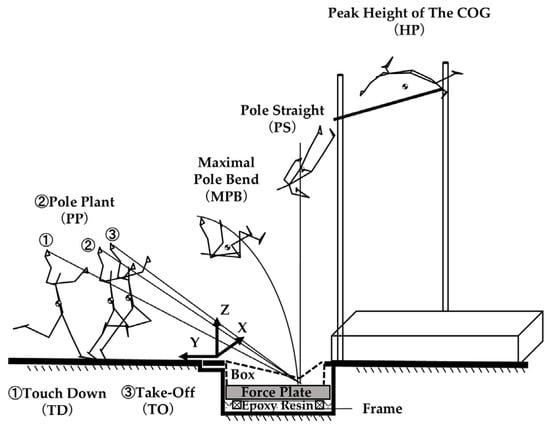
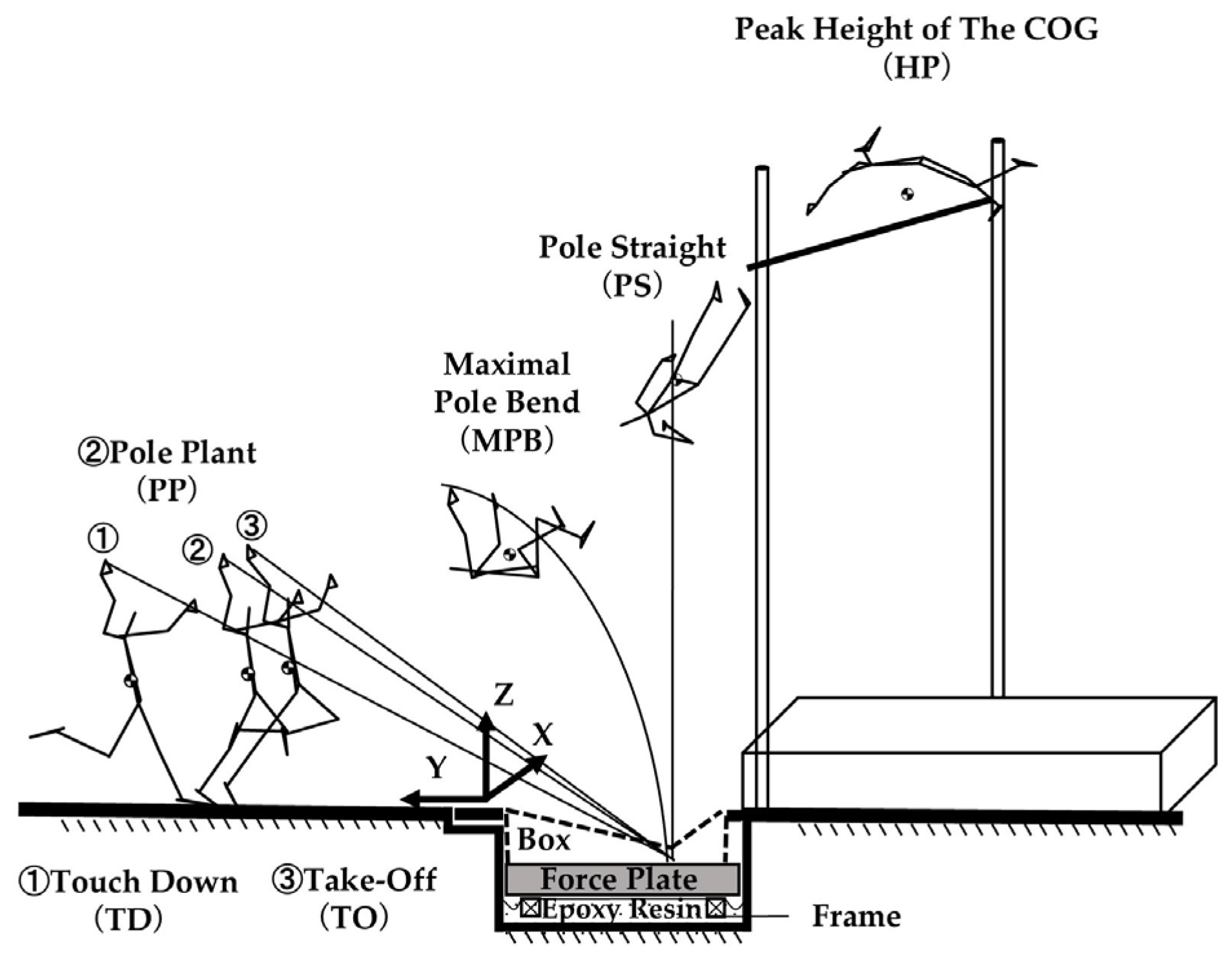
Data related to the athletes’ run-up and pole motions were captured using a 24-camera VICON (three MX Giganets, four T40 cameras, 16 T20 cameras) motion capture system (VICON, Oxford Metrics, Yarnton, UK; 250 Hz). The capture volume extended 7 m toward the runway side and 3 m toward the landing mat from the box, covering the period from just before the TD to the instant of reaching the HP. The global coordinate system (X, Y, Z) shown in the figure corresponds to the laboratory coordinate system defined by the VICON motion capture system (Figure 1). The coordinate system was defined such that the y-axis was aligned with the athlete’s runway direction, the z-axis was vertical, and the x-axis was orthogonal to both the y- and z-axes.
Figure 1.
Definition of each analytical phase. TD: touchdown; PP: pole plant; TO: take-off; MPB: maximum pole bending; PS: pole straightening; HP: peak height of COG.
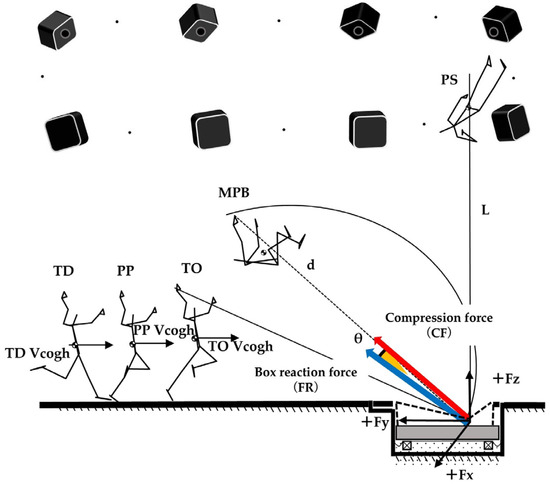
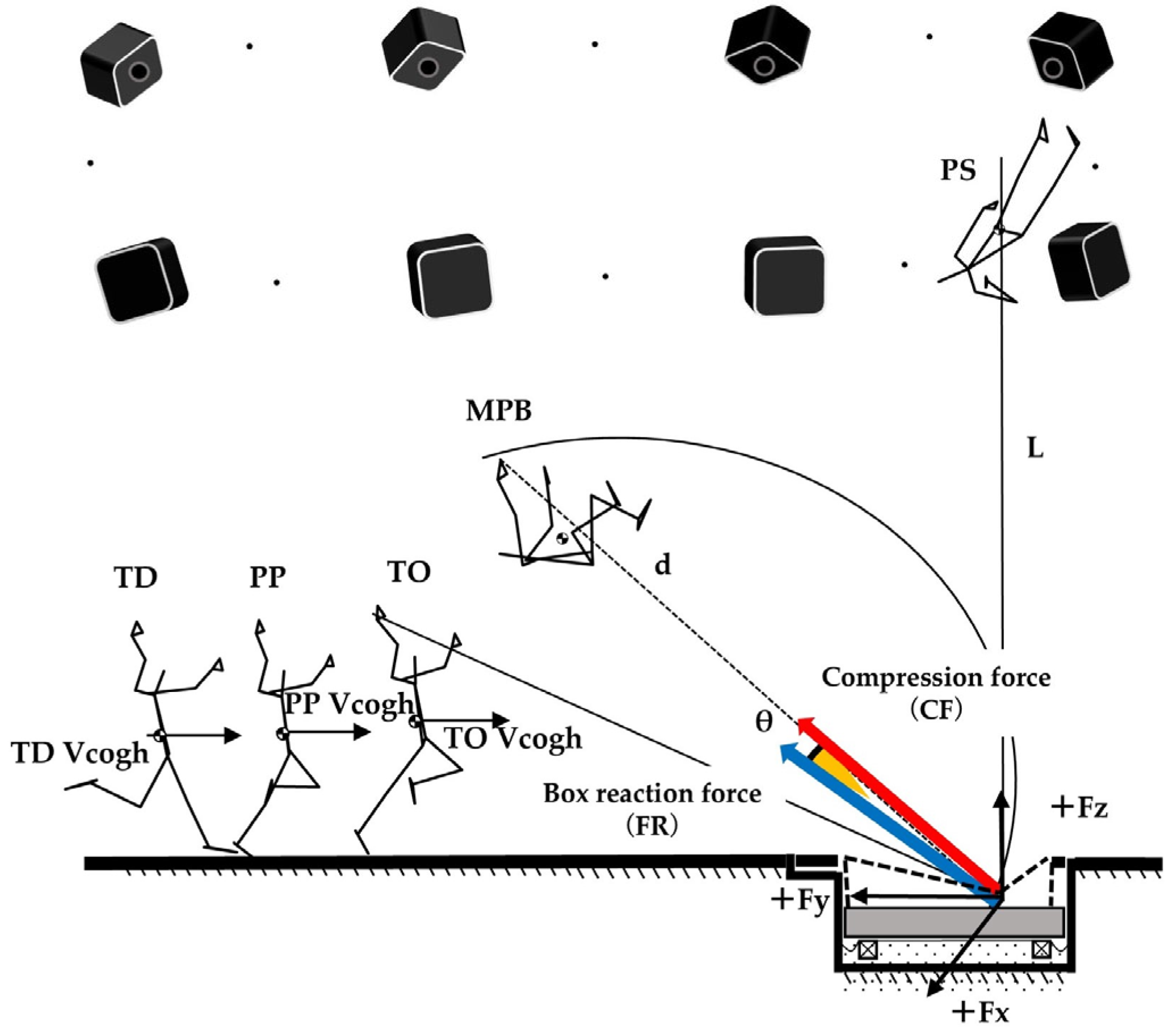
The ground reaction force data (box reaction force) were obtained using a single force plate (1 kHz; Kistler Instrumente AG, Winterthur, Switzerland) installed approximately 41 cm below the runway surface on a fixed foundation. The force plate was secured at four points to an epoxy-embedded frame and was isolated from the surrounding floor and wall with a gap of approximately 1 mm. It was positioned directly beneath the bottom of the box, at a depth of approximately 20 cm (Figure 1). The global coordinate system (Fx, Fy, Fz) corresponds to the laboratory coordinate system defined by the VICON motion capture system (Figure 2).
Figure 2.
Variables analyzed. Vcogh: horizontal velocity of COG; L: pole chord length during PS; d: distance between the upper grip and lower end of the pole (pole chord); blue arrow: box reaction force; red arrow: CF; vector angle (θ). The vector angle (θ) is de-fined as the angle between the box reaction force vector and the pole chord direction and serves as an index of their directional alignment.
The run-up velocity was measured utilizing a laser velocity measurement system (LDM301S; 100 Hz; LAVEG, Jenoptik, Jena, Germany). The laser was directed from behind the athlete toward the midpoint of the waist, with the device fixed on a tripod positioned 60 m along the runway, with the box location designated as 0 m.
2.3. Experimental Protocol
After completing a thorough warm-up, each athlete performed three practice trials to select the optimal pole, following the same conditions as those in an actual competition. Participants were then instructed to perform trials at maximal effort using their usual run-up lengths. The height of the elastic crossbar was set between 4.60 m and 5.30 m, depending on each athlete’s preference, and five official vault trials were conducted per participant. This study aimed to focus on biomechanical characteristics during maximal performance; therefore, for each athlete, the trial that achieved the greatest recorded height was selected for analysis. The HP measured in this study corresponded to approximately 93–96% of the season-best performance reported by each participant (Table 2).
Table 2.
Correlation coefficients between each variable and Epole as well as HP.
2.4. Data Analysis and Calculated Variables
Definitions of the pole vault motion phases were based on previous studies. The analytical period ranged from TO to the instant of HP. The key events analyzed were TD, PP, TO, maximum pole bending (MPB), pole straightening (PS), and HP (Figure 1) [8].
2.4.1. Kinematics Analysis
Thirty-five reflective markers were attached to anatomical landmarks of each participant. Segmental centers of mass were calculated using the VICON Plug-in Gait model, which consists of 15 body segments and employs the segmental parameters reported by Dempster [16]. Whole-body COG was then measured from the segmental data [16]. Vcogh and the vertical velocity of the COG (Vcogv) were calculated by differentiating the COG displacement with respect to time.
Pole bending was assessed based on the change in chord length between two coordinate points: the lower end of the pole and upper grip position. The chord length was measured from the onset of pole bending to the completion of PS (Figure 2). The amount of pole bending was calculated as the difference between the chord lengths during PS and pole bending (Figure 2). The ratio of the maximal pole bending was computed using Equation (1), and the time point at which this value reached its maximum was defined as the moment of MPB (Figure 2).
where L represents the chord length of the pole during PS and d represents the chord length during pole bending.
Ratio of maximal pole bending = (L − d)/L × 100
The time intervals between key events (from TO to MPB and TO to PS) were normalized to 100% using a cubic spline function, and the data values were interpolated at intervals of 1%.
Coordinate data obtained from the VICON system were labeled using the VICON Nexus software (version 2.0). The coordinates of the 35 body markers were smoothed using a fourth-order Butterworth low-pass filter (10–12 Hz) after selecting the optimal cut-off frequency based on residual analysis [16]. The coordinate system was defined as follows: the y-axis represented the direction opposite to the run-up, the x-axis represented the mediolateral direction, and the z-axis represented the vertical direction.
The maximum run-up velocity (Vmax) was calculated from time–distance data obtained using the LAVEG system. The velocity data were smoothed using a Butterworth low-pass filter with a cut-off frequency of 0.5 Hz [17].
2.4.2. Box Reaction Force Analysis
The analysis period was defined as the period from the TD to the PS. The three components of the box reaction force obtained from the force plate (forward direction, Fy; mediolateral direction, Fx; and vertical direction, Fz) were smoothed using a fourth-order low-pass Butterworth filter with a cut-off frequency of 10 Hz. The moment of the PP was identified as the time corresponding to the peak value of the three-dimensional resultant reaction force between the TD and TO.
The impulse between the TO and MPB was calculated by numerically integrating the Fy and Fz components of the box reaction force over time.
The Epole was then calculated according to Equation (2) based on previous studies [5,6].
Epole = ECF = ∫CFdLPB
Herein, ECF represents the Epole derived from compression, CF denotes the CF projected from the box reaction force in the direction of the pole chord, and LPB indicates the change in chord length (m) between the lower end of the pole and the upper grip.
The CF was calculated by projecting the measured box reaction force components (Fx, Fy, and Fz) in the direction of the pole chord vector, as shown in Equation (3).
CF = a11 Fx + a21 Fy + a31 Fz
The coefficients a11, a21, and a31 represent the direction cosines of the pole chord vector, which were calculated using Equation (4).
where r denotes the pole chord vector.
The compression force (CF) was not directly measured as an independent force acting within the pole, but was defined as the axial component of the box reaction force projected onto the pole chord. Accordingly, CF was treated as a scalar axial component derived from the force vector, rather than as an independently measured three-dimensional force vector. The vector angle (θ), defined as the angle between the box reaction force vector and CF vector, was calculated using Equation (5) (Figure 2).
The vector angle (θ), used in this study does not represent a new physical force, but is defined as an index describing the directional alignment between the box reaction force vector and the pole chord.
was defined as the resultant box reaction force vector, and was defined as the CF vector projected in the direction of the pole chord.
2.5. Statistical Analysis
All statistical analyses were performed using statistical software (IBM SPSS Statistics, Version 22; IBM Corp., Armonk, NY, USA). The calculated variables are expressed as mean ± standard deviation. The normality of all data distributions was verified using the Shapiro–Wilk test. As all variables satisfied the assumption of normality, Pearson’s product–moment correlation coefficients were used to examine the relationships among the variables. Significance was set at p < 0.05.
3. Results
The measured HP for all participants ranged from 93% to 96% of their best seasonal performance. HP correlated with seasonal best height (r = 0.94, p < 0.01), indicating that each vault trial was performed at a competitive level close to the athletes’ seasonal peak performance.
Table 2 shows the correlations between HP and the key variables (Vmax, V cogh, ratio of pole bending, Epole, vector angle, and impulse). Vmax during run-up was correlated with HP (r = 0.92, p < 0.01). The athletes with the highest HP (Subject A) also recorded the greatest Vmax (9.77 m/s). The ratio of pole bending correlated with the HP (r = 0.88, p < 0.01). Vcogh correlated with HP at TD (r = 0.82, p < 0.05), PP (r = 0.82, p < 0.05), and TO (r = 0.79, p < 0.05). The absolute value of the Epole (r = 0.94, p < 0.01) and the Epole normalized to body weight (r = 0.88, p < 0.01) correlated with HP. The vector angle did not correlate with the HP at the TO or MPB. Absolute and body mass-normalized Fy impulses between TO and MPB were correlated with HP (r = 0.89, p < 0.01; r = 0.75, p < 0.05, respectively). In contrast, neither absolute nor body mass-normalized Fz impulses during the same phase were correlated with the HP.
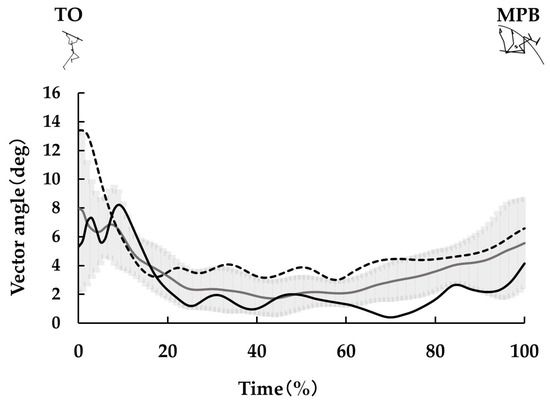
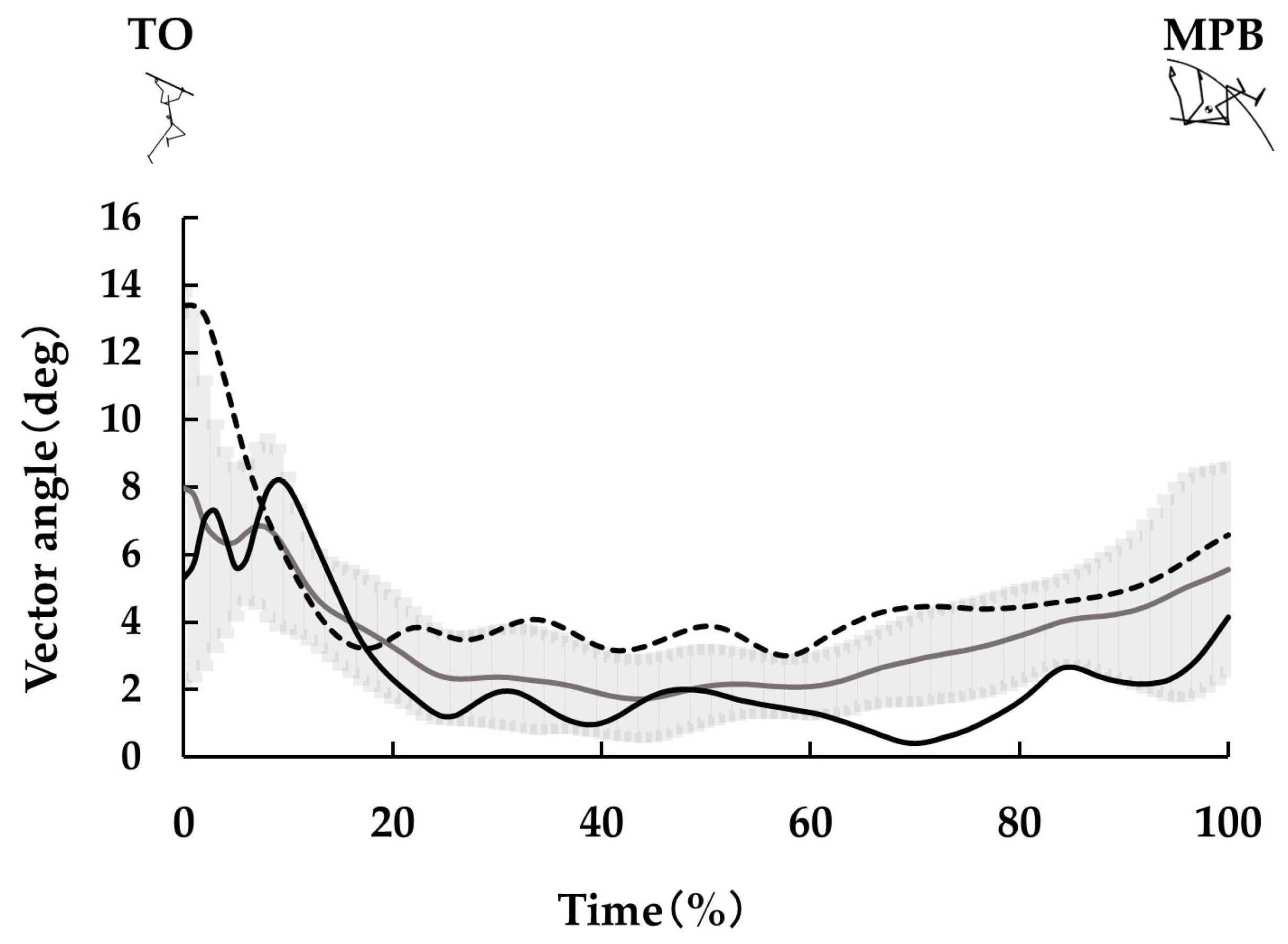
Figure 3 depicts the mean and standard deviation of the vector angle values between TO and MPB. The vector angle was large immediately after TO, averaging approximately 8°, but rapidly decreased to approximately 4° by 20% of the phase, and then remained near 2° up to 60%, after which it slightly increased again toward the MPB. The athlete with the highest HP (Subject A black line) maintained smaller vector angles throughout the phase, remaining at <2° between 20% and 80%. In contrast, the athlete with the lowest HP (Subject H, black dashed line) exhibited a larger vector angle of approximately 13° immediately after TO, which decreased thereafter, but remained high (4–8°) until just before the MPB.
Figure 3.
Mean (gray line) and standard deviation (gray shading) of the vector angle from TO to MPB, along with two representative athletes: Subject A (black line, HP = 5.38 m) and Subject H (black dashed line, HP = 4.46 m). The shaded area represents ±1 standard deviation and is provided to illustrate data variability rather than inferential uncertainty.
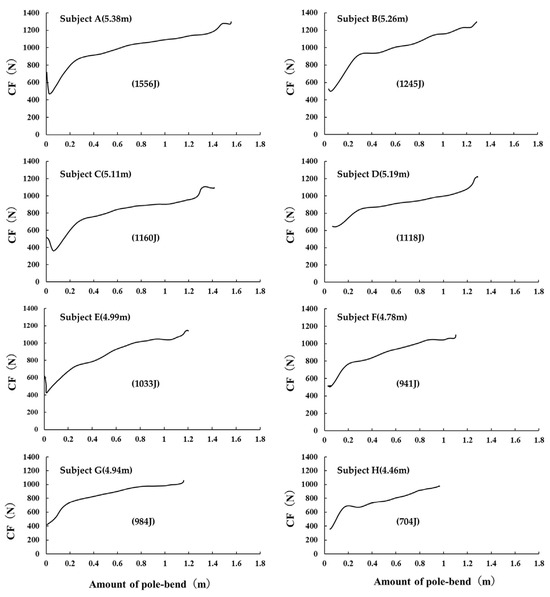
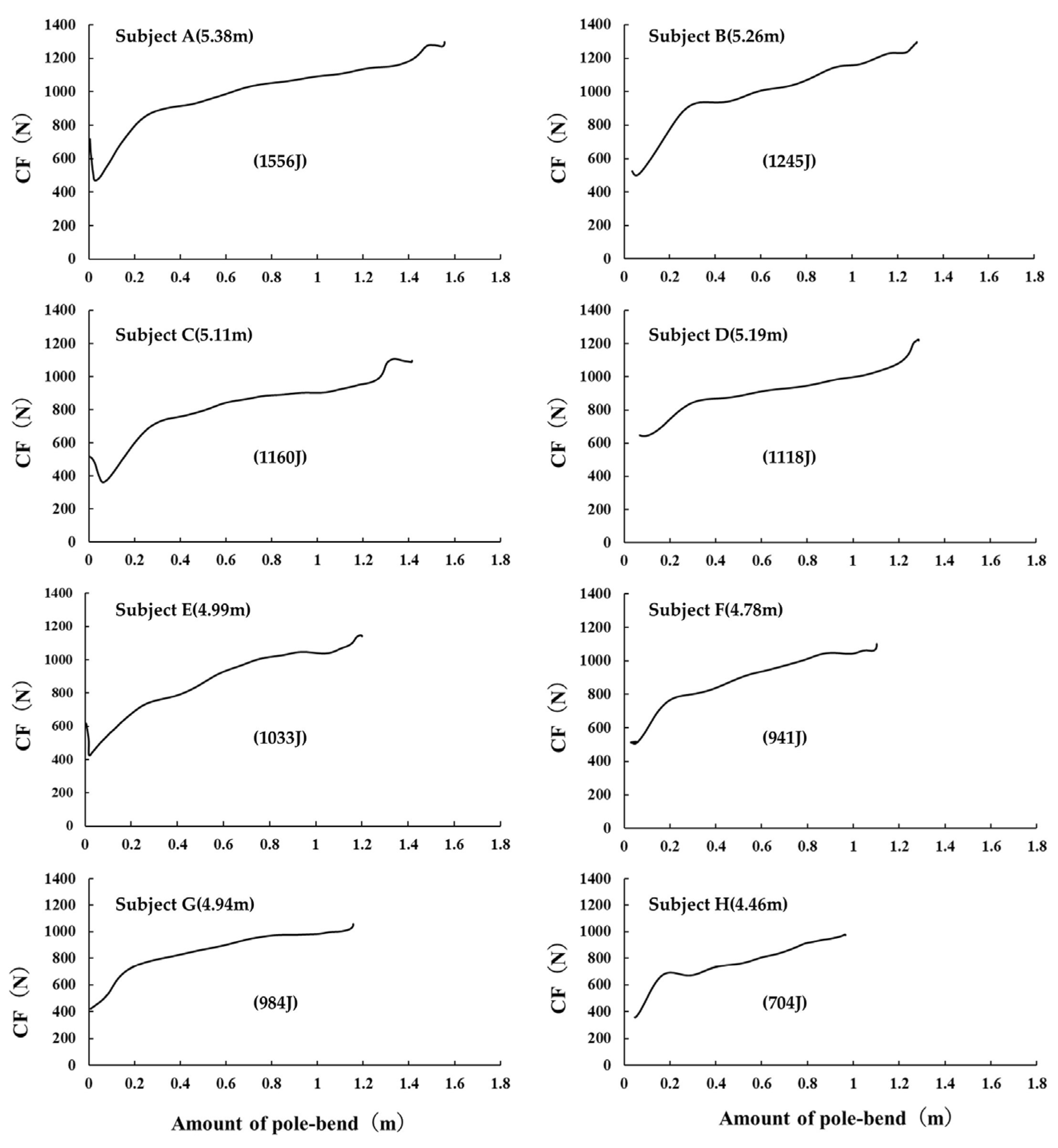
Figure 4 displays the relationship between the pole bending displacement and CF for all participants from TO to MPB. The CF increases slightly with a greater amount of pole bending. The athlete with the highest HP (5.38 m, Subject A) demonstrated a greater amount of pole bending (1.56 m) and a correspondingly higher CF (1297 N) than the other athletes. Conversely, the athlete with the lowest HP (4.46 m, Subject H) exhibited a smaller amount of pole bending (0.97 m) and a lower CF (973 N) than the other athletes. The Epole for Subject A was 1556 J, whereas that for Subject H was 704 J.
Figure 4.
Changes in CF relative to pole bending displacement from TO to MPB in all athletes (n = 8). Parentheses indicate HP and Epole. Amount of pole bending: pole bending displacement.
4. Discussion
The present study quantitatively evaluated the Vcogh at the PP, the vector angle, and Epole in pole vaulters with different performance levels to investigate the characteristics of Epole accumulation based on differences in COG velocity, the box reaction force, and vector angle. The results indicate that Vcogh and the vector angle at the PP are both related to the box reaction force and Epole accumulation, thereby affecting the overall performance. In the following sections, we discuss (1) the relationship between Vcogh, Epole, and HP, (2) the differences in CF associated with the vector angle, and (3) the relationship between the box reaction force and Epole accumulation.
4.1. Vcogh
In pole vaulting, athletes aim to optimize TO Vcogh as a crucial determinant of HP [9]. Linthorne et al. reported that the run-up velocity substantially influences HP, with an approximate 0.5 m increase in HP for every 1 m/s increment in velocity [12]. Consistent with these findings, the present study demonstrated that both Vmax and TO Vcogh are correlated with HP. These results reaffirm that maintaining the velocity acquired during run-up through TO is a critical factor directly contributing to a higher HP.
However, TO Vcogh alone cannot fully account for the factors affecting HP, suggesting that other variables may also play a contributory role. TO Vcogh for Subject A, who achieved the highest HP, was 7.94 m/s, which was similar to or slightly greater than the mean TO Vcogh of 7.84 m/s reported for world championship finalists by Hanley et al. [18]. Nevertheless, Subject A’s HP remained below the performance levels reported in that study (5.45–5.90 m) [18]. This implies that although Japan’s top-level vaulters achieve a TO Vcogh similar to that of world-class athletes, their HP is generally lower, possibly due to Vcogh prior to TO. In the present study, Vcogh at the PP correlated with HP (Table 2), indicating that Vcogh at the PP is an important variable impacting HP. The Vcogh at PP of Subject A (8.21 m/s) was lower than the mean Vcogh at PP for world-class athletes (9.44 m/s) reported by Hanley et al. [18], suggesting a pronounced velocity loss at PP. This reduction may be attributed to the impact generated when the pole contacts the box, as noted in previous studies [14,19]. Therefore, the present results highlight the important role of Vcogh at the PP in enhancing HP.
Vcogh at the PP appears to be a key variable affecting Epole accumulation. In the present study, the Vcogh score at the PP was correlated with Epole (r = 0.73, p < 0.05) (Table 2). Petrov regarded the PP as an important phase for using a longer and more elastic pole [20], and the results of the present study support this instructional viewpoint. Subject A used a longer and stiffer pole (16.9 ft, 190 lbs) than the other athletes (Table 1). These results suggest that maintaining a higher Vcogh at the PP facilitates the use of poles with greater stiffness, thereby promoting greater Epole accumulation.
One potential technical factor for enhancing Vcogh at the PP is the angle of attack. The attack angle was calculated as the ratio of the horizontal distance between the lower end and the grip of the pole to the vertical distance between the lower end and the upper grip. An increased attack angle has been reported to reduce the loss of Vcogh [12]. In the present study, although Subject A exhibited a velocity exceeding the world-class average at TO, his Vcogh score at the PP was lower. This suggests that the attack angle at the PP is an important technical element for maintaining a higher Vcogh value at the PP.
Overall, the present results indicate that the PP represents a critical phase contributing to both the attainment of higher HP and Epole accumulation.
4.2. Vector Angle
The present study represents the first quantitative examination of the vector angle as a variable related to HP.
In this study, the vector angle is defined as the angle between the box reaction force vector and the pole chord direction and is used as an index describing their directional alignment. Although CF was examined in previous studies that investigated the mechanical energy of pole vaulting and the estimation of Epole [2,6], no study to date has defined or analyzed the angular difference (vector angle) between the CF vector and the box reaction force vector.
The results obtained herein reveal that the vector angle was large immediately after TO, then sharply decreased and remained low until approximately 60% of the phase, followed by a slight increase toward the MPB (Figure 3). The athlete with the highest HP (Subject A) maintained a vector angle < 2° between 20% and 80% of the phase, indicating a near-complete alignment between the box reaction force vector and the pole chord direction. In contrast, the athlete with the lowest HP (Subject H) exhibited a vector angle ranging from approximately 4° to 8°, which corresponds to a small directional reduction in the axial component of the compressive force, as estimated from the trigonometric relationship between the vector angle and the force projection along the pole axis. It should be noted that these values do not represent the actual energy transfer efficiency or energy loss of the system, but rather a directional estimate of the relative change in the force component along the pole chord direction associated with variations in the vector angle (cosθ). The accumulated difference in CF between these athletes corresponded to a pronounced difference in Epole storage, with Subject A achieving 1556 J and Subject H 704 J. These results indicate that maintaining a small vector angle contributes to an increase in the CF.
To clarify the mechanical meaning of the vector angle, this variable should be interpreted not as a new physical force, but as an index of directional alignment between the box reaction force vector and the pole chord direction. A smaller vector angle indicates closer alignment of the applied force with the pole axis, thereby increasing the axial force component transmitted to the pole. Mechanically, this enhanced axial loading increases the compressive force component, which promotes pole bending and elastic energy storage.
One factor contributing to a smaller vector angle is the TO angle. The TO angle refers to the angle between the V cogh vector and the ground. Simulation model studies demonstrated that the optimal TO angle at TO was approximately 18° [21]. Moreover, the TO angle was significantly higher (20–23°) when the decrease in COG velocity during the TO phase was large [22]. Therefore, it is possible that the athlete with the highest HP (Subject A) was able to direct the COG more effectively toward the pole chord through an appropriate TO angle.
As the box reaction force represents the acceleration component of the body–pole system, any misalignment between the two vectors may produce a moment acting on the COG system. In the present study, the vector angle slightly increased during the latter half of the pole bending phase (Figure 3). After the MPB point, the athlete must move the COG vertically upward, transitioning the body motion from Fy to Fz. During this phase, as the COG approaches the lower end of the box, the moment of inertia around the body–pole pendulum axis decreases, facilitating the rotational motion of the swing. Therefore, a slight increase in the vector angle may occur during the latter phase of pole bending, promoting rotational motion.
Maintaining the vector angle within approximately 2–6° from immediately after TO to MPB appears to be effective for sustaining CF and promoting Epole accumulation, thereby contributing to higher HP. Future studies are required to examine the relationship between the vector angle and body motion during this phase.
4.3. Epole
Epole is typically estimated by considering both CF and the bending moment [6]; however, in the present study, Epole was quantified based on CF only. Previous studies reported a mean Epole value of 15.09 J/kg and demonstrated a correlation between Epole at MPB and HP [2,5]. In the present study, the mean Epole value was 15.70 J/kg, which was slightly higher than that previously reported, and strongly correlated with HP (r = 0.94). These results indicate that the CF serves as a representative indicator reflecting Epole accumulation and directly contributes to an improved HP.
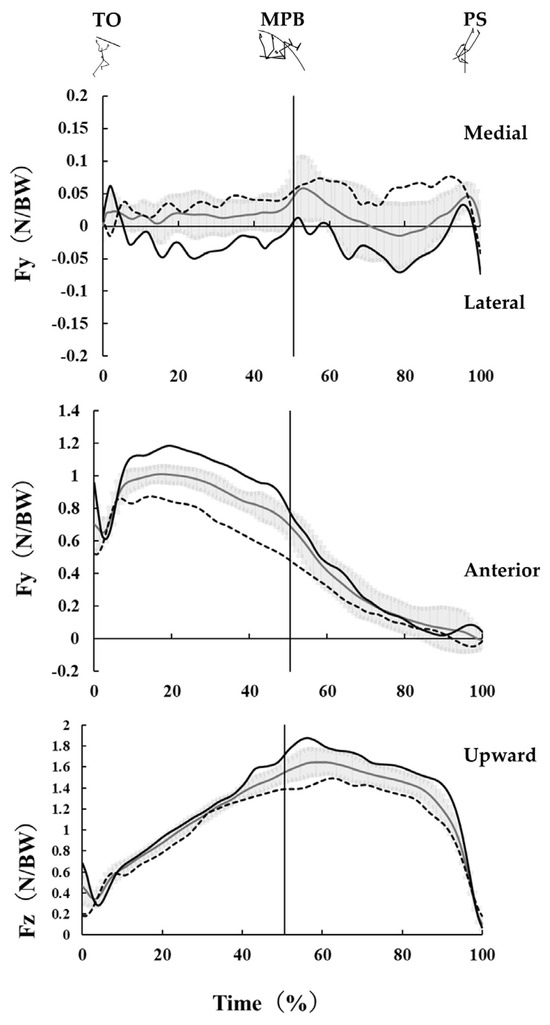
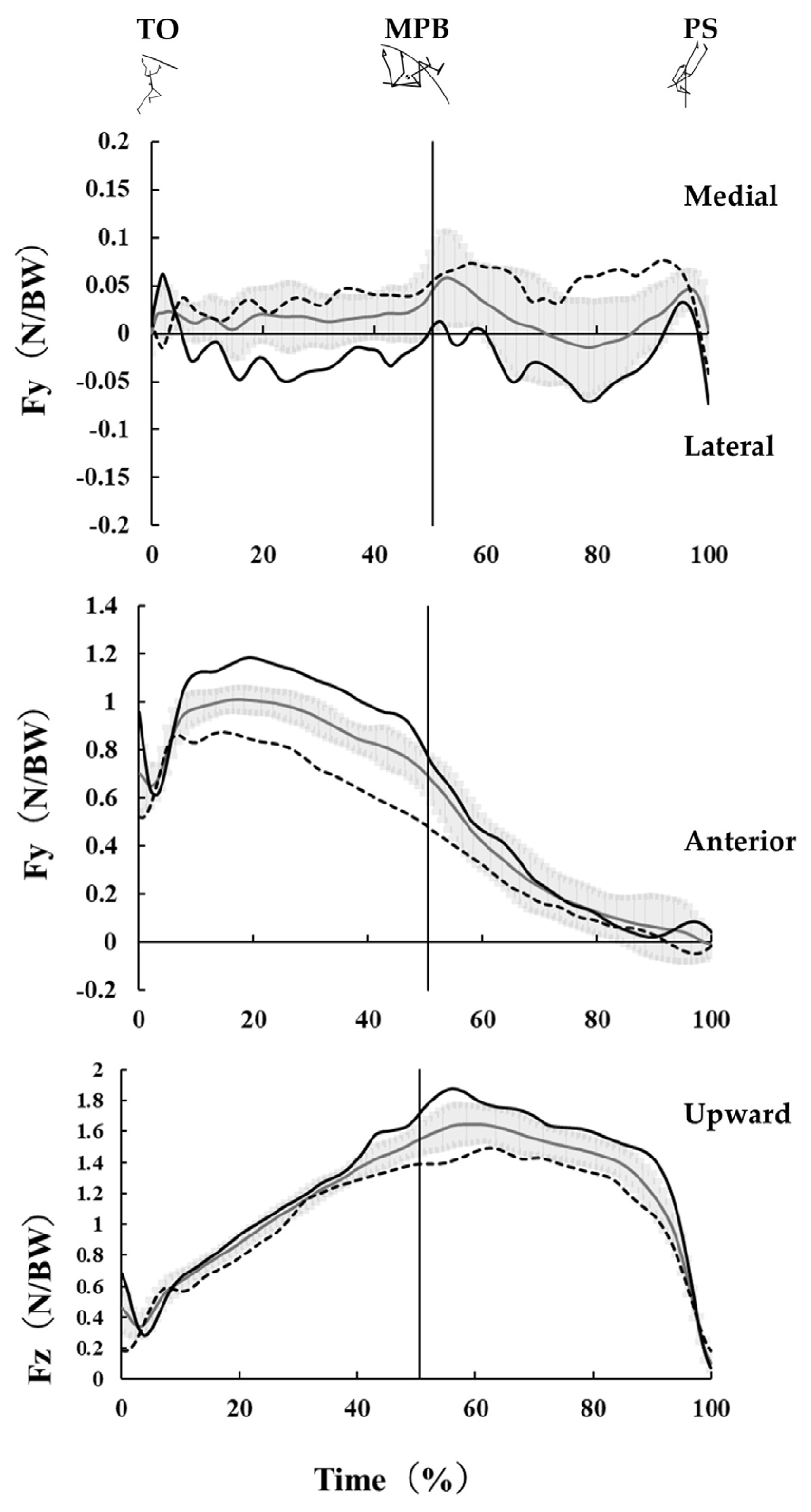
An increase in CF is associated with the impulse of the box reaction force in Fy and an increase in Fz during the latter half of the pole bending. In the present study, the impulse of the box reaction force in Fy strongly correlated with Epole (r = 0.91, p < 0.01), and the impulse of the box reaction force in Fy correlated with HP (r = 0.84, p < 0.01) (Table 2). To increase the impulse of the box reaction force in Fy, it is important to decrease Vcogh following the pole contact, thereby promoting greater CF development. During the latter half of the pole bending, Fz of the box reaction force increased [6]. Subject A achieved a greater vertical component of the box reaction force (Fz) relative to body weight, exerting approximately 1.6 N/BW after the 40% point, which was higher than that of the other athletes (Figure 5). This suggests that, from approximately 40% onwards, the application of a greater downward force toward the lower end of the box contributed to the observed increase in Fz.
Figure 5.
Mean (gray line) and standard deviation (gray shading) of three − dimensional box reaction forces from TO to PS, along with two representative athletes: Subject A (black line, HP = 5.38 m) and Subject H (black dashed line, HP = 4.46 m). The shaded area represents ±1 standard deviation and is provided to illustrate data variability rather than inferential uncertainty. The vertical line indicates the ratio of MPB.
The increase in the impulse of the forward component of the box reaction force (Fy) and the enhancement of Fz during the latter half of pole bending may be associated with upper limb strength and body rotational motion. After TO, the activity of the latissimus dorsi was the highest among the upper limb muscles, contributing to the promotion of pole bending [23]. The shoulder joint extension torque can reach approximately 366 N·m, whereas the flexion torque of the lower hand can reach approximately 250 N·m [24]. It is inferred that athletes increased the impulse of the box reaction force in Fy and accumulated Epole by using both the latissimus dorsi and shoulder joint moments.
During the latter half of pole bending, the swing motion of the body contributes to the conversion of COG to Fz. Previous studies reported that greater angular momentum around the COG is associated with better performance [19]. The execution of a hip flexion-based leg swing when the COG passes through the pole chord enhances the force applied to the pole [25]. Therefore, adjusting the timing and speed of the swing motion may facilitate Epole accumulation through an increase in Fz of the box reaction force.
Overall, the findings indicate that the impulse of Fy in the early phase of pole bending, which accompanies a decrease in Vcogh, and the increase in Fz produced by the swing motion toward the lower end of the pole in the latter phase both contribute to enhanced CF and Epole, ultimately leading to an improved HP.
4.4. Limitations
This study has some limitations. Recruitment of elite pole vaulters was difficult, resulting in a small sample size (n = 8). Therefore, statistical analyses were exploratory and hypothesis-generating rather than confirmatory; thus, reported correlations should be interpreted with caution.
In addition, the participants were limited to Japanese male pole vaulters, with a maximum personal best height of 5.77 m. Accordingly, the present findings should be interpreted within this specific population, and caution is required when generalizing the conclusions to athletes of different sexes, competitive levels, or performance ranges. Furthermore, only each athlete’s best trial was analyzed, which may introduce a selection bias. While this approach was intentionally adopted to focus on biomechanical characteristics related to maximum performance, it hindered the assessment of within-subject variability and represents a methodological constraint.
We acknowledge that Epole was estimated solely based on the compressive force component in the present study, and the box reaction force measured does not allow direct evaluation of frictional forces within the box. This approach represents a simplified model derived from previous studies and does not fully capture the total elastic energy stored in the pole. Furthermore, the present study did not evaluate energy losses arising from friction, vibration, or hysteresis of the pole material. Accordingly, Epole should be interpreted as a partial estimate rather than a complete representation of pole energy storage. The development of more comprehensive mechanical models incorporating additional energy components will be required in future studies.
Additionally, future studies should employ larger samples including athletes of varying performance levels and sexes in order to account for within-subject variability.
5. Conclusions
This study clarified the characteristics of Epole accumulation in elite male pole vaulters in Japan by examining the differences in Vcogh at the PP, box reaction force, and vector angle.
Vcogh at the PP correlated with both HP and Epole, indicating that the PP represents a critical phase affecting pole vault performance.
Maintaining a smaller vector angle was associated with an increase in the compressive force component and promoted greater accumulation of elastic energy in the pole. Athletes who maintained a smaller vector angle demonstrated closer directional alignment between the box reaction force vector and the pole chord direction, whereas larger vector angles were associated with a relative reduction in the axial component of the force transmitted to the pole. The Epole was strongly correlated with the HP. Subject A accumulated 1556 J of Epole and achieved a higher HP, whereas Subject H accumulated 704 J. The increase in Epole was associated with the impulse of the box reaction force in Fy during the early phase of pole bending and with the increase in Fz during the latter phase, both of which appeared to be affected by the swing motion of the body.
Maintaining a small vector angle enables the box reaction force to act more effectively along the pole chord direction, thereby increasing the CF. Therefore, pole bending is enhanced, and Epole accumulation is more efficiently promoted. These results extend previous energy-based models of pole vault biomechanics by introducing a directional perspective to energy transfer efficiency.
Author Contributions
Conceptualization, T.Y.; methodology, T.Y.; validation, T.Y.; formal analysis, T.Y. and T.K.; investigation, T.Y.; data curation, T.Y. and T.K.; writing—original draft preparation, T.Y.; writing—review and editing, Y.K., T.K., F.K. and K.F.; visualization, K.F.; supervision, K.F. All authors have read and agreed to the published version of the manuscript.
Funding
This research received no external funding.
Institutional Review Board Statement
This study was conducted in accordance with the Declaration of Helsinki, and the protocol was approved by the Ethics Committee of Nippon Sport Science University (No. 016-H036) on 9 August 2016.
Informed Consent Statement
Informed consent was obtained from all subjects involved in the study.
Data Availability Statement
The data presented in this study are available from the corresponding author upon request. Owing to privacy concerns, the data are not publicly available.
Acknowledgments
The authors thank the pole vault athletes who demonstrated the best performance in this study.
Conflicts of Interest
The authors declare no conflicts of interest.
Abbreviations
The following abbreviations are used in this manuscript:
| TD | Touchdown |
| PP | Pole plant |
| TO | Take-off |
| MPB | Maximum pole bending |
| PS | Pole straightening |
| CF | Compression force |
| Epole | Elastic energy |
| HP | Peak height of the COG |
References
- Dillman, C.J.; Richard, C.N. The Mechanical Energy Transformations of Pole Vaulting with a Fiberglass Pole. J. Biomech. 1968, 1, 175–183. [Google Scholar] [CrossRef] [Scilit] [PubMed]
- Schade, F.; Adamantios, A.; Brüggemann, G. Reproducibility of Energy Parameters in the Pole Vault. J. Biomech. 2006, 39, 1464–1471. [Google Scholar] [CrossRef] [Scilit] [PubMed]
- Barlow, D.A. Kinematic and Kinetic Factors Involved in Pole Vaulting. Track Field Q. Rev. 1979, 1, 19–20. [Google Scholar]
- Schade, F.; Adamantios, A.; Gert-Peter, B. Influence of Different Approaches for Calculating the Athlete’s Mechanical Energy on Energetic Parameters in the Pole Vault. J. Biomech. 2000, 33, 1263–1268. [Google Scholar] [CrossRef] [Scilit]
- Kageyuki, T.; Takeo, M.; Tomoki, Y.; Fumiaki, K.; Takeshi, A.; Keigo, O.; Kiyonobu, K. Mechanical Factors Influencing Bending of Pole in Pole Vault. Int. J. Sport. Health Sci. 2020, 18, 134–143. [Google Scholar] [CrossRef] [Scilit]
- Arampatzis, A.; Falk, S.; Brüggemann, G. Effect of the Pole–Human Body Interaction on Pole Vaulting Performance. J. Biomech. 2004, 37, 1353–1360. [Google Scholar] [CrossRef] [Scilit]
- Kadlec, D.; Colyer, S.; Nagahara, R.; Nimphius, S. An Exploratory Vector Field Analysis of Ground Reaction Force during Maximum Sprinting Efforts in Male Soccer Players and Sprinters. Scand. J. Med. Sci. Sports 2024, 34, e14763. [Google Scholar] [CrossRef] [Scilit]
- Frère, J.; L’hermette, M.; Slawinski, J.; Tourny-Chollet, C. Mechanics of Pole Vaulting: A Review. Sports Biomech. 2010, 9, 123–138. [Google Scholar] [CrossRef] [Scilit]
- Enoki, S.; Nakayama, K.; Takigawa, H.; Kuramochi, R. An Examination of Kinematic Parameters Related to Pole Vault Performance. Int. J. Perform. Anal. Sport 2023, 23, 186–195. [Google Scholar] [CrossRef] [Scilit]
- Li, X.; Xia, Z.; Liu, F.; Guo, J.; Wu, X.; Liu, Y. Factor Analysis of the Biomechanical Parameters of Pole Vault Run-up and Takeoff: Exploring Sports Performance. Sports Biomech. 2024, 23, 2974–2994. [Google Scholar] [CrossRef] [Scilit]
- Steben, R.E. A Cinematographic Study of Selective Factors in the Pole Vault. Res. Q. Am. Assoc. Health Phys. 1970, 41, 95–104. [Google Scholar] [CrossRef] [Scilit]
- Linthorne, N.P.; Weetman, A.H. Effects of Run-up Velocity on Performance, Kinematics, and Energy Exchanges in the Pole Vault. J. Sports Sci. Med. 2012, 11, 245–254. [Google Scholar]
- Schade, F.; Arampatzis, A.; Brüggemann, G.-P. Biomechanical analysis of the pole vault at the VIth World Championships in Athletics. In Proceedings of the XVI International Symposium on Biomechanics in Sports, Konstanz, Germany, 21–25 July 1998; pp. 243–246. [Google Scholar]
- McGinnis, P.M. Performance Limiting Factors in the Pole Vault. Med. Sci. Sports Exerc. 1987, 19, S18. [Google Scholar] [CrossRef] [Scilit]
- McGinnis, P.M. Mechanics of the Pole Vault Take-Off. New Stud. Athl. 1997, 12, 43–46. [Google Scholar]
- Winter, D.A. Biomechanics and Motor Control of Human Movement, 4th ed.; John Wiley & Sons: Hoboken, NJ, USA, 2009. [Google Scholar]
- Shimizu, Y.; Koyama, H.; Kariyama, Y.; Shibata, A. Attempt to estimate maximum approach speed in male and female pole vault. Bull. Stud. Athl. JAAF 2020, 16, 203–206. (In Japanese) [Google Scholar]
- Hanley, B.; Gravestock, H.J.; Hopkinson, M.; Paradisis, M.; Merlino, S.; Bissas, A. Kinematics of the Final Approach and Take-off Phases in World-Class Men and Women Pole Vaulters. Front. Sports Act. Living 2022, 4, 835659. [Google Scholar] [CrossRef] [Scilit]
- Angulo-Kinzler, R.M.; Kinzler, S.B.; Balius, X.; Turro, C.; Caubet, J.M.; Escoda, J.; Prat, J.A. Biomechanical Analysis of the Pole Vault Event. J. Appl. Biomech. 1994, 10, 147–165. [Google Scholar] [CrossRef] [Scilit]
- Petrov, V. Pole Vault-the State of the Art. New Stud. Athl. 2004, 19, 23–32. [Google Scholar]
- Linthorne, N.P. Energy Loss in the Pole Vault Take-Off and the Advantage of the Flexible Pole. Sports Eng. 2000, 3, 205–218. [Google Scholar] [CrossRef] [Scilit]
- Linthorne, N.P.; Guzman, M.S.; Bridgett, L.A. Optimum Take-Off Angle in the Long Jump. J. Sports Sci. 2005, 23, 703–712. [Google Scholar] [CrossRef] [Scilit]
- Frère, J.; Göpfert, B.; Slawinski, J.; Tourny-Chollet, C. Effect of the Upper Limbs Muscles Activity on the Mechanical Energy Gain in Pole Vaulting. J. Electromyogr. Kinesiol. 2012, 22, 207–214. [Google Scholar] [CrossRef] [Scilit]
- McGinnis, P.M.; Bergman, L.A. An Inverse Dynamic Analysis of the Pole Vault. J. Appl. Biomech. 1986, 2, 186–201. [Google Scholar] [CrossRef] [Scilit]
- Hay, J. The Biomechanics of Sports Techniques, 2nd ed.; Prentice-Hall: Upper Saddle River, NJ, USA, 1978; pp. 452–466. [Google Scholar]

Disclaimer/Publisher’s Note: The statements, opinions and data contained in all publications are solely those of the individual author(s) and contributor(s) and not of MDPI and/or the editor(s). MDPI and/or the editor(s) disclaim responsibility for any injury to people or property resulting from any ideas, methods, instructions or products referred to in the content. |
© 2026 by the authors. Licensee MDPI, Basel, Switzerland. This article is an open access article distributed under the terms and conditions of the Creative Commons Attribution (CC BY) license.