


Abstract
Internalized weight stigma is related to psychological and physiological consequences independent of actual weight status. However, as peers assume an increasingly important role in early adolescence, peer support may protect adolescents from the related costs of weight stigma. The current study examines concurrent associations between internalized weight stigma and heart rate variability in response to an acute stressor in a non-clinical early adolescent sample using a novel peer-to-peer discussion task. We hypothesized that peer acceptance will moderate the effect of internalized weight stigma on changes in sympathetic and parasympathetic indices of HRV. The study included 31 adolescents (58.1% boys; Mage = 12.82, SDage = 1.00) from a charter middle school who completed self-report questionnaires to assess internalized weight stigma and perceived peer acceptance. Participants also completed a novel peer-to-peer discussion task to induce stress responses. Heart rate variability (HRV) was recorded during the baseline and the discussion task, and baseline-to-task change scores were used as an index of sympathetic and parasympathetic responses. Peer acceptance significantly moderated the association between internalized weight stigma and sympathetic reactivity (∆r2 = 0.07, B = −0.97 *, p < 0.05). Specifically, only for adolescents with low peer acceptance, increased internalized weight stigma predicted heightened sympathetic reactivity (B = 0.84, p = 0.03). The findings of this study support the development of a novel peer-to-peer discussion task as an acute stressor and suggest that peer acceptance may alter the association between internalized weight stigma and physiological stress reactivity.
1. Introduction
As obesity rates in the US and other countries have increased [1,2], a social weight-centered health paradigm that frames fatness as both an unhealthy disease and moral deviance has emerged [3]. As a result of this cultural paradigm, weight stigma, defined as social devaluation of an individual due to their perceived weight [4], is commonplace and often considered acceptable. Despite the frequency of these weight-related attitudes, weight stigma can negatively impact psychological and physiological well-being [5,6]. Specifically, weight stigma may correspond to increased sensitivity to acute stress, hypothetically increasing physiological stress reactivity and decreasing physiological stress regulation. Moreover, the experience of weight stigma during adolescence is likely particularly salient, due to pubertal-timed changes in body composition [7], subsequent decreases in body self-esteem [8], and high exposure of adolescents to weight stigma [9]. The current study explores the concurrent associations between weight stigma and physiological responses to acute stress in early adolescence.
Additionally, the current study evaluates the protective effect of peer acceptance on the relation between internalized weight stigma and physiological stress responses. Peers are critically important during adolescence, providing support for developing youth [10]. Considering that many individuals experience weight stigma during adolescence, yet not all youths develop corresponding negative outcomes, a factor such as peer acceptance may theoretically serve a protective function and alter the association between weight stigma and physiological responses to stress.
1.1. Weight Stigma
Weight stigma is defined as an individual’s social devaluation due to their perceived excess body weight, leading to prejudice and discrimination [4]. Weight stigma can be experienced by anyone regardless of their actual weight status, although it is experienced more frequently by individuals who are fat [11]. Weight stigma can be experienced externally (externalized weight stigma) from other individuals with whom the person interacts, such as family members, peers, educators, health care providers, and even strangers [12]. Additionally, weight stigma can be experienced within the individual (internalized weight stigma) and be experienced as self-hatred, body dissatisfaction, and social vigilance [13,14]. Both externalized and internalized weight stigma might be linked to various negative outcomes [15]; however, internalized weight stigma might be particularly relevant to physiological stress outcomes because it acts as a continuous, ever-present self-stressor, reflecting the importance of this weight-centered shame and self-criticism to the individual.
Research examining the correlates of internalized weight stigma demonstrates the high physical and psychological costs for the individual. Pearl and colleagues [16] demonstrated a significant association between internalized weight stigma and metabolic syndrome, which is a cluster of risk factors for cardiometabolic disease. They found that adults who had higher internalized weight stigma had an increased likelihood of meeting criteria for metabolic syndrome regardless of their weight status. In addition to the physiological effects, internalized weight stigma can have serious psychological effects. In a longitudinal study of Chinese adolescents [17], higher internalized weight stigma predicted increased psychosocial impairment, decreased happiness, increased psychological distress, increased disordered eating and body dissatisfaction. Internalized weight stigma also predicted poorer self-rated health over time.
Moreover, it is possible that these costs of internalized weight stigma operate through increased stress and stress responsivity. In an adult non-clinical sample, Figueroa and colleagues [18] found that increased perceived stress explained the association between the experience of weight stigma and increased mental health symptoms, even after accounting for weight status. This suggests that individuals who experience increased weight stigma have a poorer stress response, and this heightened response to stress places them at an increased risk of psychological distress. This increase in stress related to weight stigma might be explained by the presence of social appearance anxiety, or the fear an individual has about their appearance being evaluated in a social setting. In a large sample of adolescents, social appearance anxiety explained the link between internal weight stigma and psychological distress [19]. Together, these findings link internalized weight stigma to both physiological and psychological outcomes and identify perceived stress responses and social appearance anxiety as key mechanisms. These empirical findings and theoretical mechanisms may also suggest that individuals who have increased internalized weight stigma may exhibit heightened physiological responses to acute stressors.
1.2. Weight Stigma as a Predictor of Physiological Stress Responses
However, existing research has not directly examined this proposed association between weight stigma and physiological stress responses in adolescence. Physiological stress responses are functions of the autonomic nervous system that take place automatically in response to challenging or stressful situations. The autonomic nervous system includes both activation of the sympathetic nervous system (SNS; stress reactivity) and deactivation of the parasympathetic nervous system (PNS; stress regulation). The immediate arousal response to a stressor is described as the “fight-or-flight” response, in which the SNS is activated in response to a stressful or challenging situation [20]. Additionally, a down-regulatory response to a stressor is often described as “rest and digest,” in which the PNS is deactivated (or withdrawn) to respond to the stressful or challenging situation [21]. These response systems can be coordinated, but SNS and PNS responses are two independent physiological responses of the autonomic nervous system and can show unique changes [22]. Moreover, the autonomic nervous system shows different maturation patterns across adolescence, specifically the PNS plateaus between 10 and 15 years of age, whereas the SNS shows linear change during this age range [23]. Despite this, there are individual differences in adolescence that are related to stress reactivity.
SNS and PNS responses can be indexed using heart rate variability (HRV), which refers to the changes in time intervals in consecutive heartbeats [24]. Changes in HRV in response to an acute stressor might be related to internalized weight stigma. HRV is influenced by both increased SNS reactivity and PNS regulation to an acute stressor, both as a function of neural influences and vagal tone [25]. Although the interpretation and use of HRV remains debated, as HRV has both SNS and PNS influences and has multiple methods of quantification [22], it is still widely used in the psychophysiological literature. The time-varying quantification of low-frequency HRV using Baevsky’s stress index can be used to indicate SNS reactivity [26]. Whereas the quantification of high-frequency HRV using the root mean square of successive differences (RMSSD) can be used to indicate PNS regulation, as it is a good assessment of vagal tone free of the effects of respiration [24]. Although SNS and PNS responses to stress pose significant benefits in the face of danger, more dysfunctional physiological stress responses are linked to disease and illness and poorer physiological stress responses over time [27]. Internalized weight stigma may act as a chronic stressor that theoretically might predict dysfunctional physiological stress responses to an acute stressor, specifically increased SNS reactivity and decreased PNS regulation indexed by HRV.
Current stressor paradigms designed to elicit the concurrent autonomic response of an individual and assess these physiological responses might fail to adequately stimulate this response in adolescents. Many studies have utilized public speaking tasks (e.g., Trier Social Stress Test) [28] to increase physiological reactivity and regulation of participants as a social-evaluative task. These tasks are theoretically meant to elevate stress responses by threatening self-identity; however, research using this stress task in early adolescence has demonstrated mixed results [29]. In addition to these social-evaluation stress tasks, researchers more recently used a parent–adolescent discussion task to also elicit increased autonomic arousal responses [30]. However, for adolescents, these tasks might not be an appropriate stressor stimulus, because these tasks do not adequately threaten their main sources of security (parent–attachment figure) [29]. Rather, a novel peer-to-peer discussion task might elicit even more autonomic nervous system responses and be more appropriate to gauge SNS and PNS responses to stress and their relations to internalized weight stigma due to the increasing importance of peers during adolescence [31]. Existing evidence has demonstrated that changes in HRV are linked to simulated peer exclusion tasks [29] and social communication in adolescents [32]. Thus, SNS reactivity and PNS regulation might also be elicited by peer-to-peer discussion tasks that center on negative topics. Thus, the current study examined SNS and PNS responses to a novel peer-to-peer discussion task developed to induce stress responses in adolescents. Preliminary evidence [33] suggests that the peer-to-peer discussion task elicits observable reactivity (both emotional and physiological) in adolescents when comparing baseline to task, supporting its utility as a stimulus for physiological stress responding.
Moreover, adolescents who have increased internalized weight stigma might be particularly sensitive to peer-to-peer discussion tasks, and experience increased SNS reactivity and decreased PNS regulation. Theoretically, this link could be explained by weight-stigmatized adolescents expecting more negative treatment from their peers because of their weight and increased sensitivity to peer conflict/exclusion and peer weight stigma. A peer-to-peer discussion on weight stigma specifically might represent an increased stressor to adolescents who have already experienced increased externalized weight stigma and internalized this weight stigma. Relatedly, a study that focused primarily on peer-related stress and peer rejection in association with internalized weight stigma found that increased sensitivity to peer rejection was directly associated with increased internalized weight stigma [34]. Additionally, weight stigma is also associated with increased vigilance and sensitivity for future stigma [14], increased social anxiety [35], and social appearance anxiety [19]. The increase in sensitivity and vigilance to future weight stigma coupled with social anxiety and appearance anxiety might increase an individual’s physiological reactivity in response to the peer-to-peer discussion tasks, especially if discussing topics such as weight stigma. Evidence for this theoretical association was found in a related study by Ehrlich and colleagues [36], such that individuals with high rejection sensitivity were more apt to recognize social cues linked to peer rejection and had elevated physiological responses (indexed by event-related potentials). Thus, it is possible that an individual who has increased levels of internalized weight stigma might experience more physiological responses due to a peer-to-peer discussion task related to weight stigma. However, this association might be dependent on the quality of the individuals’ peer relationships.
1.3. The Moderating Role of Peer Acceptance
As previously stated, adolescents who experience increased internalized weight stigma have increased sensitivity to their peers. Thus, it is likely that the quality of their peer relationships might influence the association between internalized weight stigma and SNS and PNS responses. Specifically, peer acceptance, defined as being liked by peers [37], may serve a protective role in the link between internalized weight stigma and physiological stress responses. Youth who experience high peer inclusion may be better equipped to cope with negative weight-related beliefs corresponding to attenuated physiological stress responses. Conversely, low peer inclusion may intensify this relationship by amplifying feelings of rejection and self-directed stigma, thereby corresponding to increased SNS reactivity and decreased PNS regulation.
Previous research supports the many benefits of increased peer acceptance. Individuals with increased peer acceptance also had improved overall health outcomes across the lifespan [38]. Research also shows that peer acceptance was associated with improved psychological well-being [39], including increases in self-esteem, empathy, and resilience [40]. Increased resilience is also associated with better management of physical functioning when faced with stressful situations [41]. Thus, peer acceptance theoretically may protect adolescents from the negative consequences of internalized weight stigma and decrease SNS reactivity and increase PNS regulation to peer stressors.
1.4. Current Study
The current study examined the association between internalized weight stigma and SNS reactivity and PNS regulation to an acute peer-to-peer stress task as moderated by peer acceptance in a sample of early adolescents while controlling for gender and current grade level. We hypothesized that adolescents who have increased internalized weight stigma will have increased SNS reactivity and decreased PNS regulation during a peer-to-peer discussion task. We also hypothesized that peer acceptance will have a moderating effect on the associated physiological responses predicted by internalized weight stigma, such that adolescents who have high peer acceptance will have decreased SNS reactivity and increased PNS regulation to increased internalized weight stigma. Additionally, adolescents who have low peer acceptance will have increased SNS reactivity and decreased PNS regulation to increased internalized weight stigma. Due to the potential physiological differences between genders and age groups [42,43,44], these variables are utilized as covariates when examining the moderating effects of peer acceptance on SNS reactivity and PNS regulation.
2. Methods
2.1. Participants and Procedure
The research team recruited adolescents between the ages of 11 and 15 from a charter school located on a university campus in the southeastern United States. Parents of these adolescents provided consent for their adolescents to participate and were asked to provide demographic information for themselves and their adolescents. These participants were recruited with recruitment flyers and consent forms sent home with the students. In addition to parental consent, the participants were given the opportunity to provide assent after being provided with details as to what their participation entailed. To determine the required sample size for adequate statistical power, an a priori power analysis was conducted using G*Power version 3.1.9.7 [45]. A linear regression power analysis with 6 predictors, an expected large effect size (F2 = 0.35), and an alpha of 0.05 showed that a total sample of 33 participants was required to achieve the minimum acceptable power level. The final sample included 31 participants (sample descriptives in Table 1) after two waves of recruitment and data collection. Data collection was conducted during school hours (between 8:00 a.m. and 2:30 p.m. EST). The participants were offered snacks, fidget toys, and 10 min of playing games on an iPad at the end of the testing session for their participation.
Table 1.
Descriptive statistics of participant characteristics.
The data collection process took place from 15 April 2024 to 13 November 2024 during free periods in the participants’ school day as part of a larger study examining cognitive regulation. Following the completion of questionnaires and other tasks, participants were administered an electrocardiogram to measure heart rate and heart rate variability while they were engaged in a peer-to-peer discussion.
2.2. Discussion Task
The peer-to-peer discussion was a novel paradigm that was developed to increase physiological arousal based on parent–adolescent conflict discussion tasks [30]. To eliminate the need for confederates, the participants were randomly paired with a gender-matched peer from the same class who was also participating in the study. Although the quality of the relationship with the peer was not directly measured, given the school philosophy of collaboration and small class size, it can be assumed the participants had a high degree of familiarity with one another and generally positive peer relationships. Two participants at a time were moved to a separate testing area in the school building, where they were fitted with a Polar H10 heart sensor (Polar Electro Oy, Kempele, Finland) by a trained researcher supervising the discussion. The discussion session was videotaped for later analysis of discussion topics. After waiting approximately 30 s for a clear signal, they were instructed to sit quietly and stare straight ahead for a baseline measurement. One participant was assigned the discussant role and the other participant was assigned the listening role (these roles were switched after completion). They were then provided with a weight stigma discussion prompt. The primary prompt provided was: “Talk about a time you were bullied or teased by your classmates/peers about your weight. Discuss what you thought about, how you felt, what you did in this situation.” Participants were also granted permission to abstain from participation (n = 1) or to select an alternate topic (e.g., “Describe a conflict you have recently had with a peer” or “Talk about a time you were excluded from an activity by your classmates/peer”). During the discussion, researchers provided additional prompts to encourage the discussant to continue for the full time (e.g., “Your time is not complete,” “What happened?” “How did you feel?” “What did you think about during the situation?”). The listener did not engage in discussion. Nine participants discussed weight stigma, fifteen participants discussed general peer conflict, and four participants discussed peer exclusion.
Participants wore a Polar H10 heart rate sensor to measure heart rate and HRV. Trained experimenters demonstrated and instructed sensor band placement so that the sensor band was snug, and the primary sensor was placed on the epigastric region of their abdomen. One participant declined to wear the heart rate monitor during the conversation portion of the study but completed the questionnaires. Each participant was equipped with the heart rate sensor for 60 s for a baseline measure of HRV, followed by either 180 s of discussing their personal experience or listening to their peers before switching roles of discussant and listener (total task time = 360 s). Participants were asked to minimize movement during the discussion. If at any point students appeared visibly upset (e.g., crying), made any statements pertaining to actively considering/engaging in self-injury and/or suicide, statements about current interest in severely hurting someone else, or any child abuse and/or neglect, the participant would be informed they could talk to the trained researcher and the trained researcher would notify the supervising graduate students or teachers on site or by phone. At the end of the testing session, participants were allowed to grab a prize/snack and thanked for their participation.
To minimize the production of missing or confounded data, each participant’s ECG data was collected in its entirety during a single session. However, participants were allowed to complete questionnaires on multiple days to eliminate time constraint-related response patterns and potential missing data due to participant absenteeism [46].
Due to the potential bias that can result from missing data [47], multiple imputation using the R package mice 3.14.0 [48] was utilized in RStudio version 2026.01.0+392 to impute values for the five participants with missing heart rate variability values. The software used predictive mean matching and five imputations to estimate incomplete values. Specifically, three participants were imputed due to their small abdominal circumference not allowing for an adequate fitting of the heart rate sensor. One participant refused to participate in the peer-to-peer discussion portion of the task. One other participant’s heart rate data was corrected by the Kubios HRV software (Kuopio, Finland) using a cubic spline interpolation [49], due to technological malfunctions (i.e., disconnection of the sensor from the device) resulting in significant artifacts present within the sample. Due to the limited number of parent demographic questionnaires that were completed (n = 5), participant height, weight, and family income were not measured in the current study.
2.3. Measures
2.3.1. Internalized Weight Stigma
The Weight Bias Internalization Scale (WBIS-M) [50] was used to assess internalized weight stigma. The WBIS-M is a 10-item self-report measure utilizing a seven-point Likert scale ranging from strongly disagree through strongly agree. The scale was modified to change language to make it more appropriate for more diverse body sizes by changing the word “overweight” and replacing it with “my weight.” Specific questions include: “I am less attractive than most other people because of my weight,” “I hate myself for being overweight,” and “Because I’m overweight, I don’t feel like my true self.” Higher mean scores indicate greater internalized weight stigma. This measure is recognized as being psychometrically valid within this sample (α = 0.94) as a univariate measure in adolescents (α = 0.92; [51]) and has appropriate predictive value for outcomes such as body dissatisfaction, drive for thinness, and binge eating [50].
2.3.2. Peer Acceptance
Items based on the Interpersonal Relations scale from the Behavior Assessment System for Children, Third Edition (BASC-3; [52]) were used to assess the participants’ beliefs on how their peers perceive them. Participants provided ratings of how often they experience or feel specific interpersonal attributes on a four-point Likert scale listed as never, sometimes, often, and almost always. This study utilized the following three items (α = 0.89): “I get along well with others,” “I am liked by others,” and “People think I am fun to be with.” A mean score was created, with higher mean scores indicating more peer acceptance.
2.3.3. Sympathetic Nervous System Reactivity and Parasympathetic Nervous System Regulation
To index SNS reactivity and PNS regulation, heart rate variability (HRV) was assessed via an electrocardiogram monitoring of participants’ heart rate and heart rhythm. These participants were monitored at baseline and then again during the peer discussion task in order to obtain measurements at rest and during acute stress [53]. HRV is defined as the fluctuation in time intervals between adjacent heartbeats [54]. Using HRV standards set by the Task Force of the European Society of Cardiology, the North American Society of Pacing Electrophysiology, and updated based on more recent methodological reviews [24,55], HRV was measured at baseline and during the task based on the power of the HRV frequency bands.
Following data collection, participants’ raw heart rate data was transformed using Kubios HRV software into the square root of the mean of the squares of the successive differences between adjacent NN intervals (RMSSD; PNS regulation assessed by calculating the high frequency band power) and Baevsky Stress Index [26] (SNS reactivity assessed by calculating the low frequency band power). Each participant’s aggregated HRV results were partitioned into baseline and talking segments of the peer-to-peer discussion task. To compute SNS reactivity, each participant’s Baevsky Stress Index at baseline was aggregated and subtracted from their aggregated Baevsky Stress Index during the talking segment of the peer-to-peer discussion task. More positive scores in Baevsky Stress Index changes indicate more SNS reactivity during the task. In addition, to compute PNS regulation, each participant’s high RMSSD at baseline was aggregated and subtracted from their aggregated RMSSD during the talking segment of the peer-to-peer discussion task. Less positive scores in RMSSD changes indicate less PNS regulation during the task (not adequately withdrawing PNS influence to effectively respond to the challenge).
2.3.4. Demographics
Participants were asked to provide their current grade level, gender, and date of birth.
3. Results
Descriptive statistics of the self-reported characteristics for the 31 participants are included in Table 1. We also conducted a paired samples t-test to examine the assumption that the novel peer-to-peer discussion task stimulated SNS reactivity and PNS regulation by comparing values from baseline to task. Results indicated a non-significant increase in SNS reactivity during the task (M = 8.16, SD = 3.55) compared to baseline (M = 8.03, SD = 5.13), t(30) = −0.18, p = 0.430, d = −0.03. Results indicated a non-significant decrease in PNS regulation during the task (M = 81.74, SD = 60.80) compared to baseline (M = 100.68, SD = 80.26), t(30) = 1.67, p = 0.053, d = 0.30. The direction of effects suggests that SNS reactivity and PNS regulation were activated during the task, reflecting an increase in SNS activity and a withdrawal of PNS activity from baseline to task.
The covariates and focal variables were then analyzed through a correlation matrix to assess for any bivariate associations between these variables (see Table 2) to test the first hypothesis that internalized weight stigma would be significantly and positively correlated with heightened SNS reactivity and significantly and negatively correlated with increased PNS regulation. However, internalized weight stigma was not significantly correlated with SNS reactivity or PNS regulation. Peer acceptance was also not significantly related to SNS reactivity or PNS regulation. These null findings may be influenced by the limited power of this study, or the associations are only in the context of the interaction. Interestingly, gender was significantly negatively associated with SNS reactivity. Although this effect was not hypothesized, it suggests that boys had increased SNS reactivity in response to the acute stressor.
Table 2.
Correlations for study variables.
Additional analyses were then conducted to examine the moderating effects of perceived peer acceptance in a multiple linear regression to test the second and third hypotheses. Further analysis of these variables is considered appropriate given the support from previous research and the potential for this study’s limited power being a factor in the correlational properties of the focal variables. These analyses were run using SPSS 29.0 (IBM Corp., Armonk, NY, USA) through the Model 1 PROCESS macro; this was deemed most appropriate due to the limited ability for a standard linear regression equation to appropriately predict the moderating effect of designated variables upon the independent variable(s). Indeed, the PROCESS model evaluated the proportion of variance in physiological arousal (y) uniquely attributable to peer acceptance’s (w) moderating effects on weight stigma (x) [56]. The PROCESS model tests the interaction term of the mean-centered values of weight stigma with peer acceptance. This increased sensitivity for variable interaction allows for a more accurate analysis of these variables.
Prior to conducting the regression analyses, assumptions of linear regression were evaluated. Variable distributions were examined for skewness and kurtosis. Residual plots, tests of normality, and indices of influential observations were examined to evaluate normality of residuals, homoscedasticity, and presence of influential cases. Only baseline RMSDD had high skewness and kurtosis (>5). Further examination revealed one influential value, which was identified as a true outlier and was Winsorized by replacing it with the next-highest non-outlying value. This adjustment was made to reduce skewness and kurtosis while retaining the observation in the dataset. Analyses were conducted using the Winsorized value. Additional assumption testing indicated no substantial violations of linear regression assumptions. Visual inspection of residual histograms and Q-Q plots suggested approximately normal residuals. Residual-versus-fitted-value plots indicated homoscedasticity. Multicollinearity was not evident (VIFs = 1.03–1.97; tolerance = 0.51–0.97), and no influential observations were identified (largest Cook’s distance = 0.90).
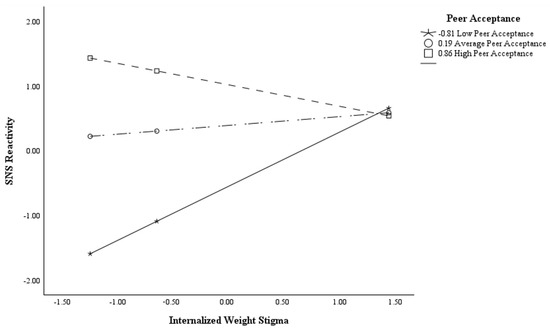
Results of the multiple linear regression examining the effect of weight stigma on SNS reactivity, with peer acceptance as a moderator, were significant (F(6, 24) = 9.54, p < 0.001, r2 = 0.71) (see Table 3). Gender (boy = 1, girl = 0) and grade were included as covariates in the model. The mean-centered interaction term between peer acceptance and internalized weight stigma was significant (B = −0.24, p < 0.05) and predicted a ∆r2 = 0.06, suggesting that the relationship between internalized weight stigma and SNS reactivity is significantly moderated by peer acceptance. Probing the simple slopes effects demonstrates that this relationship is only significant at low levels of peer acceptance (B = 0.84, p = 0.03), such that, for adolescents who have low peer acceptance, as internalized weight stigma increased, SNS reactivity also increased significantly (see Figure 1).
Table 3.
Regression predicting sympathetic nervous system reactivity from internalized weight stigma and peer acceptance.
Figure 1.
The moderating effect of peer acceptance on internalized weight stigma on sympathetic reactivity. Note. Weight stigma predicted sympathetic reactivity at low levels of peer acceptance (B = 0.84, p = 0.03) but not at high levels of peer acceptance (B = −0.33, p = 0.46); Dash line: average peer acceptance.
A second moderated linear regression was conducted to examine the effect of internalized weight stigma on PNS regulation with peer acceptance as a moderator (see Table 4). Gender and grade were included as covariates in the model. The overall model yielded statistically significant results, F(6, 24) = 5.32, p < 0.001, r2 = 0.57. The mean-centered interaction term between peer acceptance and weight-based internalized stigma was not significant (B = 6.50, p = 0.472), suggesting that the relationship between weight-based internalized stigma and PNS regulation is not significantly moderated by peer acceptance.
Table 4.
Regression predicting parasympathetic nervous system regulation from internalized weight stigma and peer acceptance.
4. Discussion
The present study investigated weight-based internalized stigma as a predictor of SNS reactivity and PNS regulation and the moderating effects of peer acceptance in a sample of adolescents. Additionally, this study utilized a novel peer-to-peer discussion task to elicit increased autonomic nervous system activity when discussing experiences of weight stigma. Preliminary findings support the use of this task to stimulate SNS reactivity and PNS regulation, as indicated by HRV measurements.
The first hypothesis that adolescents who have increased internalized weight stigma will have increased SNS reactivity and decreased PNS regulation during a peer-to-peer discussion task was not supported. Although previous research suggests that cognitive perceived stress responses are associated with weight stigma [18], the physiological stress responses are not equally associated with weight stigma in the current study. It is important to note, however, that the results of this study suggest that there is no significant relation between internalized weight stigma and SNS reactivity or PNS regulation; this is likely attributed to the limited number of participants and limited experiences of weight stigma discussed within this sample population (most participants chose to discuss alternative peer conflict topics). However, this finding should be interpreted in light of the significant interaction with peer acceptance. The absence of a main effect may suggest that internalized weight stigma may not exert a generalized influence on SNS reactivity and PNS regulation; rather, its association with autonomic nervous system functioning may only emerge under conditions of lower peer acceptance.
Although not hypothesized, a significant effect of gender was revealed, demonstrating that boys had more SNS reactivity to peer-to-peer discussions. Theoretically, these results might suggest that at this age boys are more resistant to discussing these topics with peers, which may increase their physiological arousal in response to having these conversations. Anecdotally, during the data collection, the boys seemed rather unfamiliar and uncomfortable in these conversations, indicated behaviorally (lack of engagement and limited discussion) and emotionally (inappropriate laughter). Existing research supports gender differences in peer interactions, such that boys less frequently engage in peer dyads or participate in self-disclosures to peers than girls [57]. It is also possible that gender differences are a function of differential pubertal timing and physiological differences at this age, with boys experiencing significantly greater stress responses, because they are more likely in the transition to puberty during this age range [29].
However, additional exploration of gender differences in the hypothesized interactive associations could not be explored due to small sample size. Gender differences should be considered in future research when examining these variables. Future studies may benefit from a larger sample of adolescents to analyze these focal variables with separate analyses for each gender. Indeed, the mechanisms of the relationship between these focal variables may operate differently for boys and girls. Research has suggested that girls more often experience increased internalization of negative beliefs than boys [58]. Additionally, the influence of culturally accepted body standards present in adolescence is believed to be imposed more heavily onto girls than boys. Thus, girls might be more sensitive to internalized weight stigma and experience increased physiological reactivity and decreased regulation compared to boys.
The second hypothesis was supported, such that results demonstrated that the relation between internalized weight stigma and SNS reactivity was moderated by peer acceptance. Specifically, only for those adolescents who had low levels of peer acceptance, increased internalized weight stigma predicted increased SNS reactivity. Indeed, this association between internalized weight stigma, low peer acceptance, and heightened sympathetic reactivity is likely a representation of how our experiences and cognitions directly influence autonomic responses to acute stressors. For example, theoretically, it is possible that when an adolescent internalizes negative beliefs about themselves and perceives decreased peer acceptance, they may be more sensitive to negative peer responses, specifically having more social appearance anxiety, subsequently feeling more distress in these conversations. And linked to this distress, they might have more SNS reactivity to peer-to-peer discussions than adolescents who feel more included by their peers. This is similar to research that discusses the increased vigilance and sensitivity of adolescents who have increased weight stigma and poor peer relationships [14,34] and the research indicating that social appearance anxiety and the fear of negative appearance evaluation predict increased distress as a correlate of increased internalized weight stigma [40].
Despite the significant findings related to SNS reactivity, the lack of evidence for peer acceptance moderating the link between internalized weight stigma and PNS regulation is likely attributable to the important role of age and gender on physiological functioning. Previous research has found that there is a negative relationship between age and PNS regulation, which suggests that adolescents are likely to exhibit high levels of PNS regulation following exposure to stress [44]. Additionally, previous studies found that girls have greater vagal tone than boys, which also might play a role in the overall sample’s limited dysregulation during the discussion task [43]. This highlights the complexity of the relationship and suggests that other factors may also play a major role in physiological responses in adolescence. It is important to note that although SNS and PNS responses are often coordinated, both being derived from heart rate variability (HRV), these are independent physiological responses of the autonomic nervous system [22]. Thus, the unique findings in these models are not necessarily surprising and might reflect that adolescents are experiencing elevated stress reactivity; however, they are attempting to regulate this stress (some successfully and some unsuccessfully) in the presence of their peers to not appear sensitive or weak.
Limitations
Due to this study focusing on adolescents in a charter school, the sample may have limited internal and external validity. The positive student environment present within the charter school posed a potential barrier for negative experiences of peer exclusion, weight stigma by peers, and general conflicts amongst peers. Most of the participants discussed events at other schools and seemed relatively positive in the relationships they had with their current peers. Specifically, several students had a difficult time thinking of any negative peer experiences to discuss, and conversations were somewhat limited. One student stated, “I used to get bullied at my old school but not here.” Another student shared a similar sentiment and stated that “the girls at my last school were really mean to each other.” This is believed to be due to the increased levels of cohesion present within smaller groups as opposed to large groups [59] that would be increasingly present within more traditional school settings. Further, most of the conversations regarded peer conflict generally, and not weight stigma specifically; thus, the discussions might not have elicited stress in response to the construct of internalized weight stigma or introduced heterogeneity in the discussions that contributed to additional measurement error. Moreover, physiological responses might have been influenced by factors unrelated to weight stigma, including general social anxiety or personality characteristics. Although the comparison of baseline to task should account for these characteristics, these other factors might have limited and explained the physiological responses within the peer-to-peer discussion task. Future studies should further standardize discussion content and control for these other factors to better understand their influence on physiological responses to acute stressors.
The small sample size (n = 31) posed a risk of non-significant findings based on the a priori power analysis findings. However, other preliminary work collecting physiological responses relies on similar sample sizes (about 20–40 participants) and identifies meaningful changes in heart rate to laboratory-based tasks [60,61], which supports the use of our sample size in the development and validation of our novel paradigm. A sensitivity power analysis for the regression models using the observed sample size (n = 31) was conducted. The analysis indicated that with α = 0.05 and 95% power, the study was able to detect interaction effects of approximately f2 = 0.65 or larger. Thus, it is important to note that the study was sufficiently powered to detect medium-to-large interaction effects, whereas smaller effects may have gone undetected. Future studies may benefit from a larger sample of adolescents to analyze these focal variables with separate analyses for each gender. Indeed, the mechanisms of the relationship between these focal variables may operate differently for boys and girls. Research has suggested that girls more often experience increased internalization of negative beliefs than boys [58]. Additionally, the influence of culturally accepted body standards present in adolescence is believed to be imposed more heavily onto girls than boys. Thus, girls might be more sensitive to internalized weight stigma and experience increased physiological reactivity and decreased regulation compared to boys.
Along with a limited sample size, this study was conducted within a single town with limited diversity. According to the 2021 census data, the location of the school (Cullowhee, NC) has a 72.7% white (non-Hispanic) population, which is 13.3% greater than the estimated national census data of 59.4% white (non-Hispanic). Additionally, the community has higher poverty rates than are observed statewide. This discrepancy reveals the potential for reduced generalizability of our sample as compared to the United States of America as a whole. Moreover, the restricted demographic diversity within western North Carolina was likely further exacerbated by the selective nature of charter programs. Demographic diversity is important to consider as racial minority groups may differentially internalize weight stigma [62]. Along with the limited demographic variability within this sample, the school’s philosophy on promoting caring, collaboration, and a socially just environment might have further restricted the findings as well as the generalizability.
An additional limitation concerns our HRV data collection. The current study was unable to meet all the recommended standards for HRV methodology set by the Task Force of the European Society of Cardiology and the North American Society of Pacing and Electrophysiology and updated HRV methodological reviews [24,55]. Factors known to influence HRV, such as time of day, caffeine consumption, and recent physical activity, were not systematically controlled or recorded. For example, the current study was at the mercy of the school’s schedule as participants were tested during free periods during their school day (between 8:00 a.m. and 2:30 p.m. EST). As a result, variability attributable to these influences may have affected HRV estimates and introduced uncontrolled variance into the findings. Future work should explore additional measures of SNS reactivity and PNS regulation, such as skin conductance and respiratory sinus arrhythmia.
Additionally, the inability to obtain parent-reported height and weight did not allow for the assessment of how these focal variables might be affected by weight status. Although previous research suggests that weight stigma might be affected by weight status, research also suggests that all different body types can experience weight stigma and weight stigma predicts negative outcomes regardless of weight status [16]. Although weight status could not be tested directly due to not receiving usable measures of height and weight, participants described their weight status (very underweight, underweight, about the right weight, slightly overweight, and very overweight) as a measure of weight perception. Weight perception is typically strongly positively associated with self-reported BMI-based weight status in adolescents [63] and has been used in other studies to measure internalized weight stigma as a proxy for BMI [35]. There was no significant effect of perceived weight status on the physiological responses, and the interactive effect of internalized weight bias and peer acceptance was not affected by the inclusion of perceived weight status in the analysis. Additionally, due to physiological functioning being related to genetics [64], the lack of parental engagement did not allow for race to be utilized as a covariate.
5. Conclusions
This study advances understanding of internalized weight stigma’s relation to adolescent physiological responses in a novel peer-to-peer stressor task. Additionally, we demonstrate the role of peer acceptance in moderating this concurrent relation. The significant interaction between low levels of peer acceptance and high levels of internalized weight stigma on SNS reactivity suggests peer acceptance may be a potential area of intervention to reduce the negative impacts of internalized weight stigma. Future studies would likely benefit from utilizing a larger, more generalizable youth population, a comparison to more traditional non-peer stress tasks, and a comparison of other physiological measures. However, the current results have important theoretical implications in increasing our understanding of why not all adolescents who internalize their experiences of weight stigma exhibit poor physiological responses to acute stress, and future interventions that highlight this necessary specificity.
Author Contributions
Conceptualization, M.J.G. and D.H.; methodology, M.J.G., D.H., and A.P.R.B.; software, M.J.G. and D.H.; validation, M.J.G., D.H., and A.P.R.B.; formal analysis, D.H.; investigation, M.J.G., D.H., and A.P.R.B.; resources, M.J.G. and A.P.R.B.; data curation, Daniel Gangel; writing—original draft preparation, D.H. and M.J.G.; writing—review and editing, M.J.G., D.H., and A.P.R.B.; supervision, M.J.G. and A.P.R.B.; project administration, M.J.G. and A.P.R.B. All authors have read and agreed to the published version of the manuscript.
Funding
This research received no external funding.
Institutional Review Board Statement
The study was conducted in accordance with the Declaration of Helsinki and approved by the Institutional Review Board of Western Carolina University (protocol code 2023-11-20-03 and 20 November 2023).
Informed Consent Statement
Informed assent was obtained from all subjects, and informed consent was obtained from all subjects’ parents involved in the study.
Data Availability Statement
Data is currently unavailable due to confidentiality concerns. The small, school-based sample and qualitative responses from minors make participants potentially identifiable.
Conflicts of Interest
The authors declare no conflicts of interest.
References
- Fan, H.; Zhang, X. Recent trends in overweight and obesity in adolescents aged 12 to 15 years across 21 countries. Pediatr. Obes. 2022, 17, e12839. [Google Scholar] [CrossRef] [Scilit] [PubMed]
- Parikh, N.I.; Pencina, M.J.; Wang, T.J.; Lanier, K.J.; Fox, C.S.; D’Agostino, R.B.; Vasan, R.S. Increasing trends in incidence of overweight and obesity over 5 decades. Am. J. Med. 2007, 120, 242–250. [Google Scholar] [CrossRef] [Scilit] [PubMed]
- O’Hara, L.; Gregg, J. The war on obesity: A social determinant of health. Health Promot. J. Aust. 2006, 17, 260–263. [Google Scholar] [CrossRef] [Scilit] [PubMed]
- Tomiyama, A.J.; Carr, D.; Granberg, E.M.; Major, B.; Robinson, E.; Sutin, A.R.; Brewis, A. How and why weight stigma drives the obesity ‘epidemic’ and harms health. BMC Med. 2018, 16, 123. [Google Scholar] [CrossRef] [Scilit] [PubMed]
- Puhl, R.M.; Heuer, C.A. Obesity stigma: Important considerations for public health. Am. J. Public Health 2010, 100, 1019–1028. [Google Scholar] [CrossRef] [Scilit] [PubMed]
- Wu, Y.; Berry, D.C. Impact of weight stigma on physiological and psychological health outcomes for overweight and obese adults: A systematic review. J. Adv. Nurs. 2018, 74, 1030–1042. [Google Scholar] [CrossRef] [Scilit] [PubMed]
- Chun, D.; Kim, S.J.; Suh, J.; Kim, J. Timing, velocity, and magnitude of pubertal changes in body composition: A longitudinal study. Pediatr. Res. 2025, 97, 293–300. [Google Scholar] [PubMed]
- Toselli, S.; Grigoletto, A.; Zaccagni, L.; Rinaldo, N.; Badicu, G.; Grosz, W.R.; Campa, F. Body image perception and body composition in early adolescents: A longitudinal study of an Italian cohort. BMC Public Health 2021, 21, 1381. [Google Scholar] [CrossRef] [Scilit] [PubMed]
- Monaghan, L.F. Civilising recalcitrant boys’ bodies: Pursuing social fitness through the anti-obesity offensive: Sport, education and society. Sport Educ. Soc. 2014, 19, 691–711. [Google Scholar] [CrossRef] [Scilit]
- Helsen, M.; Vollebergh, W.; Meeus, W. Social support from parents and friends and emotional problems in adolescence. J. Youth Adolesc. 2000, 29, 319–335. [Google Scholar] [CrossRef] [Scilit]
- Puhl, R.M.; Telke, S.; Larson, N.; Eisenberg, M.E.; Neumark-Stzainer, D. Experiences of weight stigma and links with self-compassion among a population-based sample of young adults from diverse ethnic/racial and socio-economic backgrounds. J. Psychosom. Res. 2020, 134, 110134. [Google Scholar] [CrossRef] [Scilit] [PubMed]
- Magson, N.R.; Rapee, R.M. Sources of weight stigma and adolescent mental health: From whom is it the most harmful? Stigma Health 2022, 7, 152–160. [Google Scholar] [CrossRef] [Scilit]
- Lucibello, K.M.; Nesbitt, A.E.; Solomon-Krakus, S.; Sabiston, C.M. Internalized weight stigma and the relationship between weight perception and negative body-related self-conscious emotions. Body Image 2021, 37, 84–88. [Google Scholar] [CrossRef] [Scilit] [PubMed]
- Wetzel, K.E.; Himmelstein, M.S. Constant vigilance: The impact of weight stigma, vigilance, and internalization on maladaptive eating behaviors: Health Psychology. Health Psychol. 2023, 42, 712–722. [Google Scholar] [CrossRef] [Scilit]
- Prunty, A.; Hahn, A.; O’Shea, A.; Edmonds, S.; Clark, M.K. Associations among enacted weight stigma, weight self-stigma, and multiple physical health outcomes, healthcare utilization, and selected health behaviors: Epidemiology and Population Health. Int. J. Obes. 2023, 47, 33–38. [Google Scholar]
- Pearl, R.L.; Wadden, T.A.; Hopkins, C.M.; Shaw, J.A.; Hayes, M.R.; Bakizada, Z.M.; Alfaris, N.; Chao, A.M.; Pinkasavage, E.; Berkowitz, R.I.; et al. Association between weight bias internalization and metabolic syndrome among treatment-seeking individuals with obesity. Obesity 2017, 25, 317–322. [Google Scholar] [CrossRef] [Scilit]
- Barnhart, W.R.; Cui, S.; Cui, T.; He, J. Relationships between weight bias internalization and biopsychosocial health outcomes: A prospective study in Chinese adolescents. Int. J. Eat. Disord. 2023, 56, 1021–1033. [Google Scholar] [CrossRef] [Scilit] [PubMed]
- Figueroa, D.G.; Murley, W.D.; Parker, J.E.; Hunger, J.M.; Tomiyama, A.J. Weight stigma and mental health symptoms: Mediation by perceived stress. Front. Psychiatry 2025, 16, 1587105. [Google Scholar] [CrossRef] [Scilit] [PubMed]
- Tang, C.; Zhang, X.; Zhou, C.; Li, K.; Cai, Y. The effects of weight self-stigma on psychological distress in adolescents: The chain-mediated roles of fear of negative appearance evaluation and social appearance anxiety. Front. Psychol. 2025, 16, 1619694. [Google Scholar] [CrossRef] [Scilit] [PubMed]
- McCorry, L.K. Physiology of the autonomic nervous system. Am. J. Pharm. Educ. 2007, 71, 78. [Google Scholar] [CrossRef] [Scilit] [PubMed]
- Porges, S.W. Emotion: An evolutionary by-product of the neural regulation of the autonomic nervous system. Integr. Neurobiol. Affil. 1997, 807, 62–67. [Google Scholar] [CrossRef] [Scilit]
- Berntson, G.G.; Cacioppo, J.T.; Quigley, K.S. Autonomic determinism: The modes of autonomic control, the doctrine of autonomic space, and the laws of autonomic constraint. Psychol. Rev. 1991, 98, 459. [Google Scholar] [CrossRef] [PubMed]
- Harteveld, L.M.; Nederend, I.; Ten Harkel, A.D.; Schutte, N.M.; De Rooij, S.R.; Vrijkotte, T.G.; Oldenhof, H.; Popma, A.; Jansen, L.M.C.; Suurland, J.; et al. Maturation of the cardiac autonomic nervous system activity in children and adolescents. J. Am. Heart Assoc. 2021, 10, e017405. [Google Scholar] [CrossRef] [Scilit] [PubMed]
- Laborde, S.; Mosley, E.; Thayer, J.F. Heart rate variability and cardiac vagal tone in psychophysiological research–recommendations for experiment planning, data analysis, and data reporting. Front. Psychol. 2017, 8, 238557. [Google Scholar] [PubMed]
- Berger, R.D.; Saul, J.P.; Cohen, R.J. Transfer function analysis of autonomic regulation. I. Canine atrial rate response. Am. J. Physiol. 1989, 256, H142–H152. [Google Scholar] [CrossRef] [Scilit] [PubMed]
- Baevsky, R.M.; Chernikova, A.G. Heart rate variability analysis: Physiological foundations and main methods. Cardiometry 2017, 10, 66–76. [Google Scholar] [CrossRef] [Scilit]
- McCarty, R. The alarm phase and the general adaptation syndrome. Stress Concepts Cogn. Emot. Behav. 2016, 1, 13–19. [Google Scholar] [CrossRef] [Scilit]
- Kirschbaum, C.; Pirke, K.-M.; Hellhammer, D.H. The ‘Trier Social Stress Test’—A tool for investigating psychobiological stress responses in a laboratory setting. Neuropsychobiology 1993, 28, 76–81. [Google Scholar] [CrossRef] [Scilit] [PubMed]
- Gunnar, M.R.; Talge, N.M.; Herrera, A. Stressor paradigms in developmental studies: What does and does not work to produce mean increases in salivary cortisol. Psychoneuroendocrinology 2009, 34, 953–967. [Google Scholar] [CrossRef] [Scilit] [PubMed]
- Thomas, S.A.; Wilson, T.; Jain, A.; Deros, D.E.; Um, M.; Hurwitz, J.; Jacobs, I.; Myerberg, L.; Ehrlich, K.B.; Dunn, E.J.; et al. Toward developing laboratory-based parent–adolescent conflict discussion tasks that consistently elicit adolescent conflict-related stress responses: Support from physiology and observed behavior. J. Child Fam. Stud. 2017, 26, 3288–3302. [Google Scholar] [CrossRef] [Scilit] [PubMed]
- Lam, C.B.; McHale, S.M.; Crouter, A.C. Time with peers from middle childhood to late adolescence: Developmental course and adjustment correlates. Child Dev. 2014, 85, 1677–1693. [Google Scholar] [CrossRef] [Scilit] [PubMed]
- Quintana, D.S.; Guastella, A.J.; Outhred, T.; Hickie, I.B.; Kemp, A.H. Heart rate variability is associated with emotion recognition: Direct evidence for a relationship between the autonomic nervous system and social cognition. Int. J. Psychophysiol. 2012, 86, 168–172. [Google Scholar] [CrossRef] [Scilit] [PubMed]
- Balance, J.; Bell, L.; Hamill, D.; Glawe, N.; Cleroux, A.; Broomell, A.; Gangel, M.J. The use of behavioral coding to understand emotional reactivity of adolescents during a peer-based discussion. In Proceedings of the Society for Research in Child Development Biennial Meeting, Minneapolis, MN, USA, 1–3 May 2025. [Google Scholar]
- Schell, S.E.; Racine, S.E. Reconsidering the role of interpersonal stress in eating pathology: Sensitivity to rejection might be more important than actual experiences of peer stress. Appetite 2023, 187, 106588. [Google Scholar] [CrossRef] [Scilit] [PubMed]
- Wang, K.; Qiu, F. Longitudinal associations between weight self-stigma, physical exercise, and social anxiety among adolescents: Between-and within-person effects. Psychiatr. Q. 2025, 84, 1–19. [Google Scholar]
- Ehrlich, K.B.; Gerson, S.A.; Vanderwert, R.E.; Cannon, E.N.; Fox, N.A. Hypervigilance to rejecting stimuli in rejection sensitive individuals: Behavioral and neurocognitive evidence. Personal. Individ. Differ. 2015, 85, 7–12. [Google Scholar] [CrossRef] [Scilit] [PubMed]
- Hymel, S.; Vaillancourt, T.; McDougall, P.; Renshaw, P.D. Peer acceptance and rejection in childhood. In Blackwell Handbook of Childhood Social Development; Blackwell Publishing: Hoboken, NJ, USA, 2002; pp. 265–284. [Google Scholar]
- Shah, E.N.; Szwedo, D.E.; Allen, J.P. Adolescent close friendships, self-perceived social acceptance, and peer-rated likeability as predictors of wellbeing in young adulthood. Front. Dev. Psychol. 2024, 2, 1435727. [Google Scholar] [CrossRef] [Scilit]
- Portt, E.; Person, S.; Person, B.; Rawana, E.; Brownlee, K. Empathy and positive aspects of adolescent peer relationships: A scoping review. J. Child Fam. Stud. 2020, 29, 2416–2433. [Google Scholar] [CrossRef] [Scilit]
- Tang, A.; McLaughlin, K.A.; Sheridan, M.A.; Nelson, C.A.; Zeanah, C.H.; Fox, N.A. Autonomic reactivity to social rejection, peer difficulties, and the buffering effects of adolescent friendships following early psychosocial deprivation. Emotion 2022, 22, 318–330. [Google Scholar] [CrossRef] [Scilit] [PubMed]
- Kalisch, R.; Russo, S.J.; Müller, M.B. Neurobiology and systems biology of stress resilience. Physiol. Rev. 2024, 14, 1205–1263. [Google Scholar] [CrossRef] [Scilit]
- Balhara, Y.S.; Verma, R.; Gupta, C. Gender differences in stress response: Role of developmental and biological determinants. Ind. Psychiatry J. 2011, 20, 4. [Google Scholar] [CrossRef] [Scilit] [PubMed]
- Venkata Pothineni, N.; Shirazi, L.F.; Mehta, J.L. Gender differences in autonomic control of the cardiovascular system. Curr. Pharm. Des. 2016, 22, 3829–3834. [Google Scholar] [CrossRef] [Scilit] [PubMed]
- Abhishekh, H.A.; Nisarga, P.; Kisan, R.; Meghana, A.; Chandran, S.; Raju, T.; Sathyaprabha, T.N. Influence of age and gender on autonomic regulation of heart. J. Clin. Monit. Comput. 2013, 27, 259–264. [Google Scholar] [CrossRef] [Scilit] [PubMed]
- Faul, F.; Erdfelder, E.; Lang, A.G.; Buchner, A. GPower 3: A flexible statistical power analysis program for the social, behavioral, and biomedical sciences. Behav. Res. Methods 2007, 39, 175–191. [Google Scholar] [CrossRef] [Scilit] [PubMed]
- Kang, H. The prevention and handling of the missing data. Korean J. Anesthesiol. 2013, 64, 402–406. [Google Scholar] [CrossRef] [Scilit] [PubMed]
- Dettori, J.R.; Norvell, D.C.; Chapman, J.R. The Sin of Missing Data: Is All Forgiven by Way of Imputation? Glob. Spine J. 2018, 8, 892–894. [Google Scholar] [CrossRef] [Scilit] [PubMed]
- van Buuren, S.; Groothuis-Oudshoorn, K. mice: Multivariate Imputation by Chained Equations in R. J. Stat. Softw. 2011, 45, 1–67. [Google Scholar] [CrossRef] [Scilit]
- Lipponen, J.A.; Tarvainen, M.P. A robust algorithm for heart rate variability time series artefact correction using novel Beat Classification. J. Med. Eng. Technol. 2019, 43, 173–181. [Google Scholar] [CrossRef] [Scilit] [PubMed]
- Pearl, R.L.; Puhl, R.M. Measuring internalized weight attitudes across body weight categories: Validation of the modified weight bias internalization scale. Body Image 2014, 11, 89–92. [Google Scholar] [CrossRef] [Scilit] [PubMed]
- Roberto, C.A.; Sysko, R.; Bush, J.; Pearl, R.; Puhl, R.M.; Schvey, N.A.; Dovidio, J.F. Clinical Correlates of the Weight Bias Internalization Scale in a Sample of Obese Adolescents Seeking Bariatric Surgery. Obesity 2012, 20, 533–539. [Google Scholar] [CrossRef] [Scilit] [PubMed]
- Reynolds, C.R.; Kamphaus, R.W.; Vannest, K.J. BASC-3: Behavior Assessment System for Children; PsychCorp: San Antonio, TX, USA, 2015. [Google Scholar]
- Electrocardiogram (ECG or EKG)—Mayo Clinic. Available online: https://www.mayoclinic.org/tests-procedures/ekg/about/pac-20384983 (accessed on 19 March 2022).
- Shaffer, F.; Ginsberg, J.P. An overview of heart rate variability metrics and norms. Front. Public Health 2017, 5, 258. [Google Scholar] [CrossRef] [Scilit] [PubMed]
- Task Force of the European Society of Cardiology the North American Society of Pacing Electrophysiology. Heart rate variability: Standards of measurement, physiological interpretation, and clinical use. Circulation 1996, 93, 1043–1065. [Google Scholar] [CrossRef] [Scilit] [PubMed]
- Hayes, A.F. Introduction to Mediation, Moderation, and Conditional Process Analysis, 2nd ed.; Guilford Publications: New York, NY, USA, 2017. [Google Scholar]
- Rose, A.J.; Rudolph, K.D. A review of sex differences in peer relationship processes: Potential trade-offs for the emotional and behavioral development of girls and boys. Psychol. Bull. 2006, 132, 98. [Google Scholar] [CrossRef] [Scilit] [PubMed]
- Gutman, L.M.; Codiroli McMaster, N. Gendered pathways of internalizing problems from early childhood to adolescence and associated adolescent outcomes. J. Abnorm. Child Psychol. 2020, 48, 703–718. [Google Scholar] [CrossRef] [Scilit] [PubMed]
- Carron, A.V.; Spink, K.S. The Group size-cohesion relationship in minimal groups. Small Group Res. 1995, 26, 86–105. [Google Scholar] [CrossRef] [Scilit]
- Gulewitsch, M.D.; Jusyte, A.; Mazurak, N.; Weimer, K.; Schönenberg, M. Preliminary evidence for increased parasympathetic activity during social inclusion and exclusion in adolescents with functional abdominal pain. J. Psychosom. Res. 2017, 98, 106–112. [Google Scholar] [CrossRef] [Scilit] [PubMed]
- Held, J.; Vîslă, A.; Wolfer, C.; Messerli-Bürgy, N.; Flückiger, C. Heart rate variability change during a stressful cognitive task in individuals with anxiety and control participants. BMC Psychol. 2021, 9, 44. [Google Scholar] [CrossRef] [Scilit] [PubMed]
- Himmelstein, M.S.; Puhl, R.M.; Quinn, D.M. Intersectionality: An understudied framework for addressing weight stigma. Am. J. Prev. Med. 2017, 53, 421–431. [Google Scholar] [CrossRef] [Scilit] [PubMed]
- Park, E. Overestimation and underestimation: Adolescents’ weight perception in comparison to BMI-based weight status and how it varies across socio-demographic factors. J. Sch. Health 2011, 81, 57–64. [Google Scholar] [CrossRef] [Scilit] [PubMed]
- Karoly, H.C.; Stevens, C.J.; Magnan, R.E.; Harlaar, N.; Hutchison, K.E.; Bryan, A.D. Genetic influences on physiological and subjective responses to an aerobic exercise session among sedentary adults. J. Cancer Epidemiol. 2012, 2012, 540563. [Google Scholar] [CrossRef] [Scilit] [PubMed]

Disclaimer/Publisher’s Note: The statements, opinions and data contained in all publications are solely those of the individual author(s) and contributor(s) and not of MDPI and/or the editor(s). MDPI and/or the editor(s) disclaim responsibility for any injury to people or property resulting from any ideas, methods, instructions or products referred to in the content. |
© 2026 by the authors. Licensee MDPI, Basel, Switzerland. This article is an open access article distributed under the terms and conditions of the Creative Commons Attribution (CC BY) license.