


Abstract
The genera Bombax and Pseudobombax (Malvaceae) are widely used in traditional medicine. This narrative review provides a hierarchical appraisal of their phytochemical and pharmacological profiles based on 35 studies, identifying 22 biological activities. A pronounced taxonomic bias was observed, with research heavily concentrated on Bombax ceiba, while other species, particularly within Pseudobombax, remain poorly explored. Hierarchical analysis indicates that Bombax reaches Level I evidence in metabolic and organ-protective activities, whereas Pseudobombax is largely limited to preliminary Levels II–III. Although antioxidant activity is the most frequently reported effect, it is predominantly supported by in vitro assays with limited physiological relevance. A morphological bias was also evident, with studies prioritizing stem bark and leaves over seeds and roots. Overall, the evidence reveals a significant translational gap, marked by the scarcity of pharmacokinetic data and mechanistic studies. Future research should prioritize standardized, mechanism-driven approaches and expand taxonomic coverage to advance the therapeutic potential of these genera.
1. Introduction
The use of medicinal plants continues to be a pivotal strategy for the discovery of bioactive compounds and the development of new therapeutic agents. Plant-derived metabolites have demonstrated significant pharmacological relevance, reinforcing the necessity of scientific validation for traditionally used species. Among plant families with recognized medicinal potential, Malvaceae stands out due to its wide distribution in tropical and subtropical regions and its richness in species capable of producing structurally diverse secondary metabolites [1].
Within this family, the genera Bombax and Pseudobombax (subfamily Bombacoideae) comprise large tropical tree species distributed mainly across Central and South America [2]. Species from these genera have been traditionally employed to treat inflammatory disorders, infections, metabolic diseases, and skin-related conditions. In recent years, experimental studies have reported several biological activities associated with extracts and isolated compounds, including antioxidant, anti-inflammatory, antimicrobial, cytoprotective, and metabolic regulatory effects [3,4,5]. These properties are frequently attributed to phenolic compounds, flavonoids, and terpenoids.
Despite the growing number of studies, scientific evidence regarding the phytochemical composition and pharmacological activities of Bombax and Pseudobombax remains fragmented. Most investigations focus on a limited number of species, particularly Bombax ceiba, while most of the genera remain poorly explored. Additionally, existing studies often evaluate different plant parts and employ heterogeneous experimental approaches, hindering direct comparisons and limiting broader conclusions regarding their pharmacological relevance [6]. This gap is particularly evident in high-biodiversity regions, such as Brazil, where native species represent a vast, yet underexplored, reservoir of bioactive molecules [7,8].
Previous review studies have addressed specific aspects of Bombax species. For example, Kumari et al. [9] summarized the phytochemical composition, biological activities, and nutraceutical potential of Bombax ceiba flowers, highlighting their relevance as functional food ingredients. Earlier reviews have also discussed the traditional uses and medicinal properties of Bombax species. However, these studies generally focused on specific species, plant organs, or thematic aspects. To our knowledge, no previous review has comprehensively integrated the phytochemical and pharmacological evidence available for both Bombax and Pseudobombax species. This gap underscores the need for a broader and updated synthesis of the current knowledge regarding these genera.
Considering these limitations, the present study aims to compile and critically analyze the available literature on the phytochemical constituents and pharmacological activities described in the literature of Bombax and Pseudobombax. This narrative review seeks to address the following questions: (i) which pharmacological activities present the strongest experimental evidence; (ii) which species and plant parts remain underexplored; and (iii) what are the main gaps that should guide future phytochemical and pharmacological investigations. Ultimately, this work intends to contribute to a better understanding of the therapeutic potential of these genera and support future efforts in natural product discovery.
2. Materials and Methods
2.1. Study Design
This study was conducted as a narrative literature review aiming to compile and critically analyze available scientific evidence regarding the phytochemical constituents and pharmacological activities of species belonging to the genera Bombax and Pseudobombax. The narrative review approach was selected due to the heterogeneity of experimental designs, plant parts evaluated, extraction methods, and biological models reported in the literature, which limits the applicability of systematic review methodologies and meta-analysis. Although this approach allows broader conceptual interpretation, it may present limitations related to study selection bias and variability in methodological quality.
2.2. Literature Search Strategy
The literature search was conducted between March and December 2025 using the PubMed and ScienceDirect databases, considering their relevance in pharmacology, phytochemistry, ethnopharmacology, and natural product research.
The following descriptors were used:
- “Bombax”;
- “Bombax AND pharmacological activity”;
- “Pseudobombax”;
- “Pseudobombax AND pharmacological activity”.
Search terms were combined using Boolean operators (“AND” and “OR”) to expand the retrieval of relevant publications. Only studies published between 2013 and 2025 and written in English were considered.
2.3. Eligibility Criteria
Studies were selected based on the following criteria: (i) presentation of experimental evaluation of biological or pharmacological activities; (ii) investigation of extracts, fractions, or isolated compounds from Bombax or Pseudobombax species; (iii) availability of full-text access; and (iv) publication as peer-reviewed original research articles.
Studies were excluded if they: (i) mentioned the target genera only superficially; (ii) lacked experimental biological or pharmacological data; or (iii) were conference abstracts, editorials, or duplicated publications. Review articles were excluded to prioritize primary experimental data; however, relevant reviews were consulted to support the contextual interpretation and discussion of findings.
Despite our efforts to conduct a comprehensive literature survey, some potentially relevant publications may not have been included. The selection of studies was guided by predefined eligibility criteria and methodological considerations established for this review. Consequently, the absence of a particular study should not be interpreted as a judgment regarding its scientific merit or importance. We apologize for any inadvertent omissions and recognize that additional publications may offer meaningful insights into the topic discussed herein.
2.4. Study Selection Process
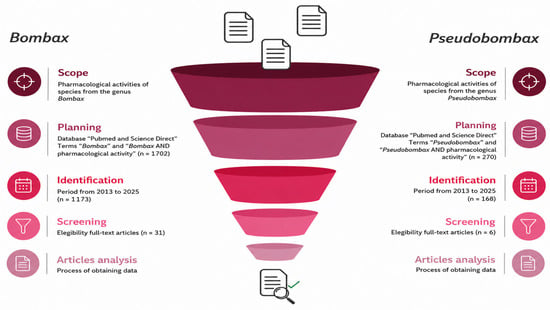
The initial search identified 1702 publications related to Bombax and 270 publications related to Pseudobombax. After applying the defined temporal filter (2013–2025), 1173 studies related to Bombax and 168 related to Pseudobombax remained.
Titles and abstracts were screened to evaluate relevance according to the eligibility criteria. Following this step, 31 articles involving Bombax species and 6 articles involving Pseudobombax species were selected for full-text analysis and data extraction.
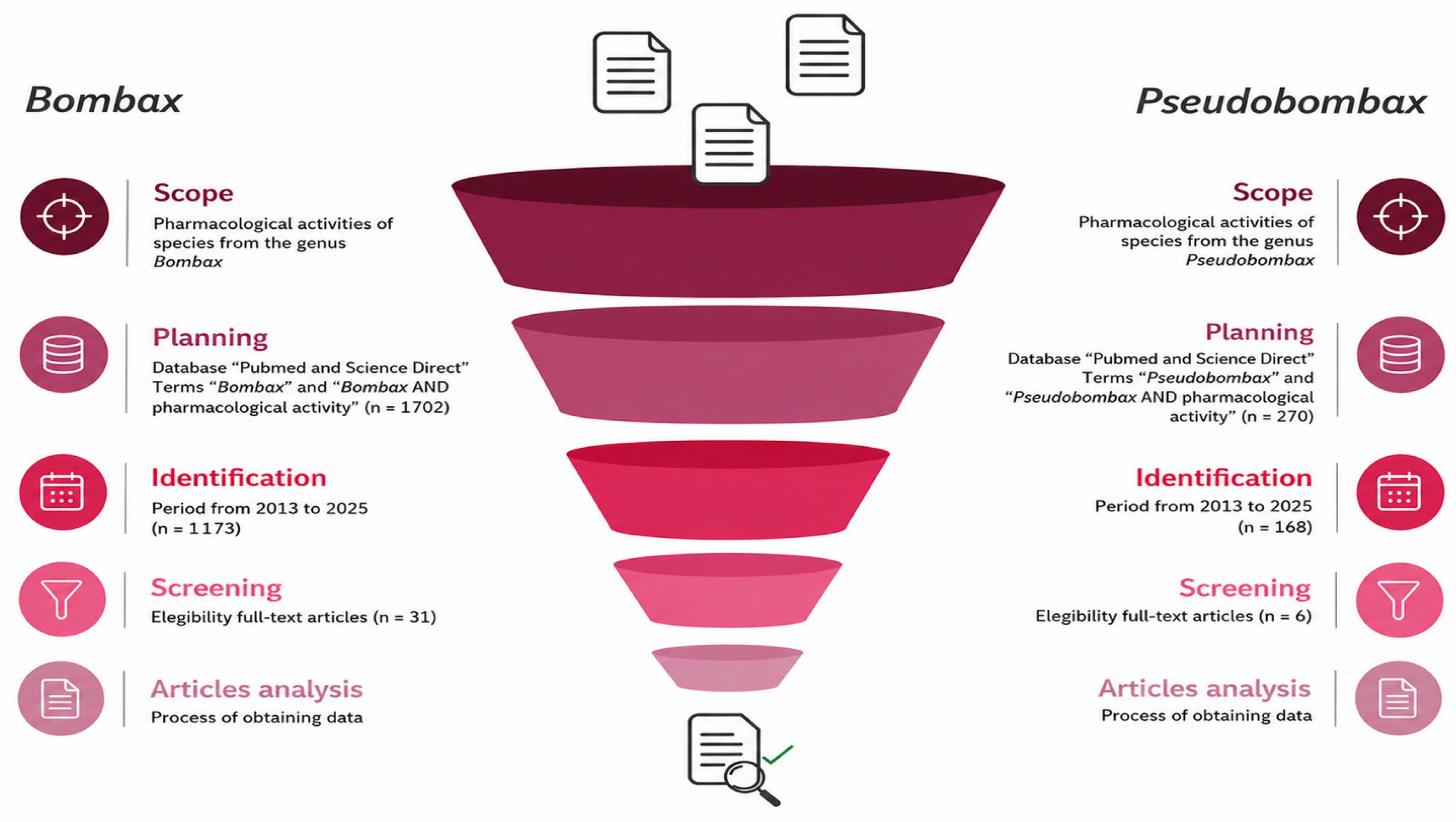
A flow chart summarizing the study selection process is presented in Figure 1.
Figure 1.
Flowchart summarizing the literature search and study selection process for Bombax and Pseudobombax species (2013–2025). Numbers represent records identified, screened and included according to predefined eligibility criteria. Created in https://BioRender.com.
2.5. Data Extraction and Synthesis
All selected studies underwent full-text analysis. Data were extracted and organized into a descriptive matrix comprising the following variables:
- Botanical species investigated;
- Plant part(s) utilized;
- Type of extract, fraction, or isolated compound;
- Biological or pharmacological activity evaluated;
- Experimental model employed (in vitro, in vivo, or in silico);
- Identified bioactive compounds (when applicable).
Subsequently, the gathered information was qualitatively categorized and synthesized to identify patterns of pharmacological activity, phytochemical diversity, and potential research gaps within the field.
2.6. Assessment of Evidence Quality
Due to the diversity of experimental approaches, a formal risk-of-bias tool was not applied. Instead, the overall quality of evidence was assessed qualitatively by considering the experimental models used, reproducibility of findings, and level of biological validation.
Most studies involved in vitro assays or animal experimental models, with limited clinical validation. Additionally, considerable variability was observed regarding extraction methods, phytochemical characterization, and pharmacological protocols, which restricts direct comparison between studies and highlights the need for standardized experimental designs in future investigations.
2.7. Hierarchical Classification of Evidence Strength
To contextualize the robustness of the available data and to avoid overstatement of therapeutic potential, the reported biological activities were classified according to experimental depth and translational relevance (Table 1).
Table 1.
Hierarchical classification of evidence strength for reported biological activities in Bombax and Pseudobombax species.
To the best of our knowledge, no standardized framework currently exists for hierarchically classifying heterogeneous pharmacological evidence in Bombax and Pseudobombax studies. Therefore, this hierarchical framework was developed by the authors specifically for the present review, aiming to provide a standardized and transparent approach to compare heterogeneous pharmacological evidence across studies involving Bombax and Pseudobombax species.
The classification criteria were defined based on three main parameters:
- (i)
- The level of biological complexity (in vitro vs. in vivo);
- (ii)
- The presence of functional versus mechanistic outcomes;
- (iii)
- The degree of experimental validation, including dose–response relationships and biomarker assessment.
Thus, four levels of evidence were established:
- Level I: Studies with in vivo validation supported by biochemical and/or molecular mechanistic markers, including dose–response relationships.
- Level II: In vivo studies demonstrating functional outcomes without detailed mechanistic elucidation.
- Level III: In vitro studies assessing cellular or biochemical activities.
- Level IV: Exploratory or preliminary studies with limited experimental rigor.
This approach allows for a more critical interpretation of the literature, emphasizing not only the presence of biological activity but also the strength and translational relevance of the supporting evidence.
3. Results
3.1. Study Identification and Selection
By December 2025, the initial database search identified 1702 publications related to the genus Bombax and 270 related to Pseudobombax (Figure 1). Following the application of temporal and eligibility criteria, 1173 and 168 articles remained, respectively. Subsequent screening of titles and abstracts led to the selection of 31 Bombax species articles and six Pseudobombax species articles for full-text analysis. Ultimately, only 37 studies met the inclusion criteria for qualitative synthesis, representing approximately 2.6% of the initially screened Bombax records and approximately 3.5% of the Pseudobombax records. This significant reduction (Figure 1) underscores the paucity of studies specifically addressing phytochemical characterization coupled with experimentally validated pharmacological activity within the established scope.
3.2. General Characteristics of the Evidence Base
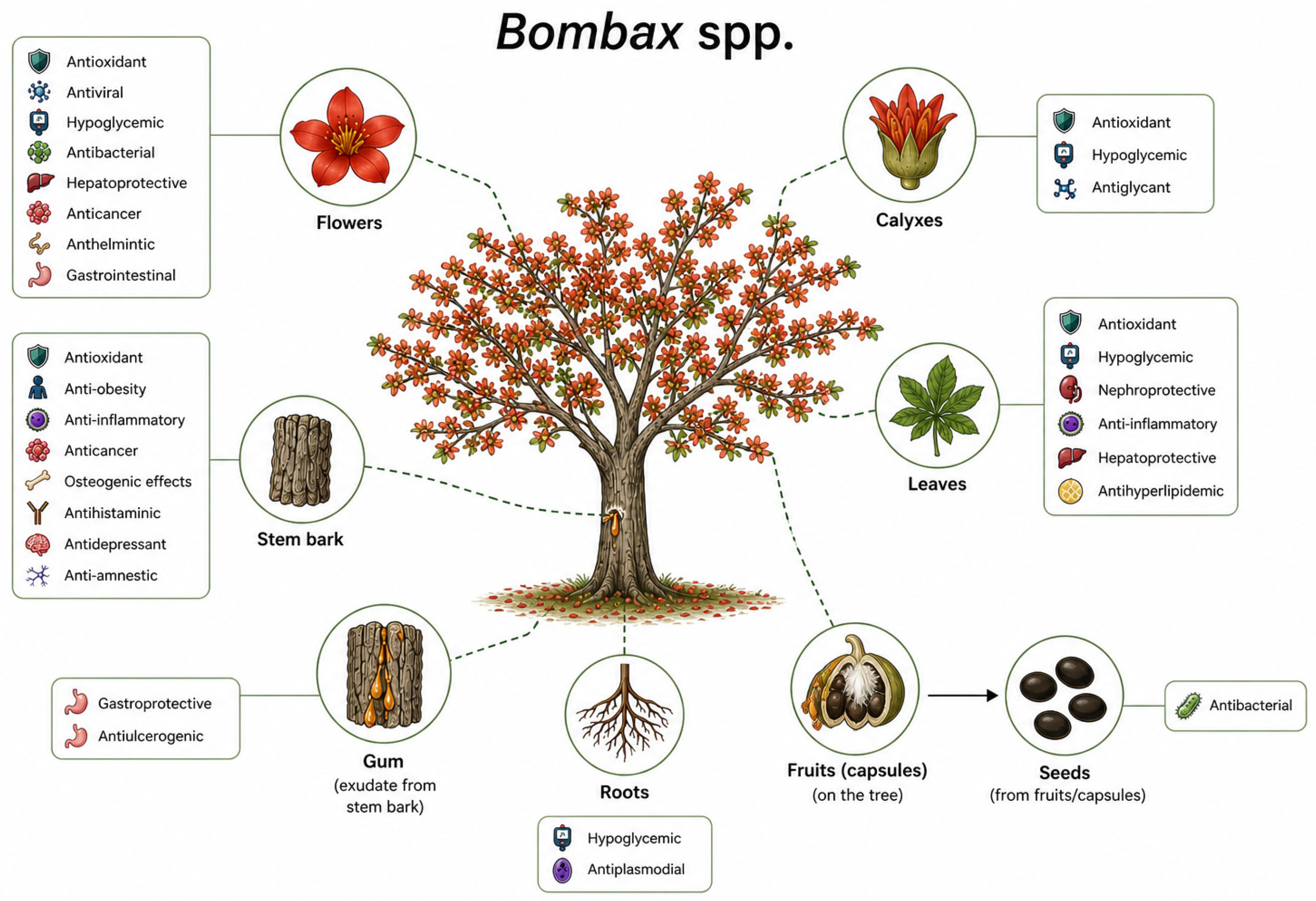
A structured synthesis of the included studies (encompassing investigated species, plant organs, extraction strategies, phytochemical profiling, and reported biological activities) is detailed in Table 2 and Table 3 and visually summarized in Figure 2 and Figure 3. The overall evidence landscape reveals a marked asymmetry between the two analyzed genera.
Table 2.
Reported biological activities of Bombax species, including experimental models, plant parts, and associated metabolites.
Table 3.
Reported biological activities of Pseudobombax species, including experimental models, plant parts, and associated metabolites.
Figure 2.
Organ-specific pharmacological landscape of the genus Bombax. The infographic illustrates the diversity of biological activities identified in literature for specific plant parts, including flowers, calyxes, leaves, stem bark, seeds, and roots. Note the high concentration of reported activities for flowers and stem bark, reflecting their prominence in pharmacological research. Created in https://BioRender.com.
Figure 3.
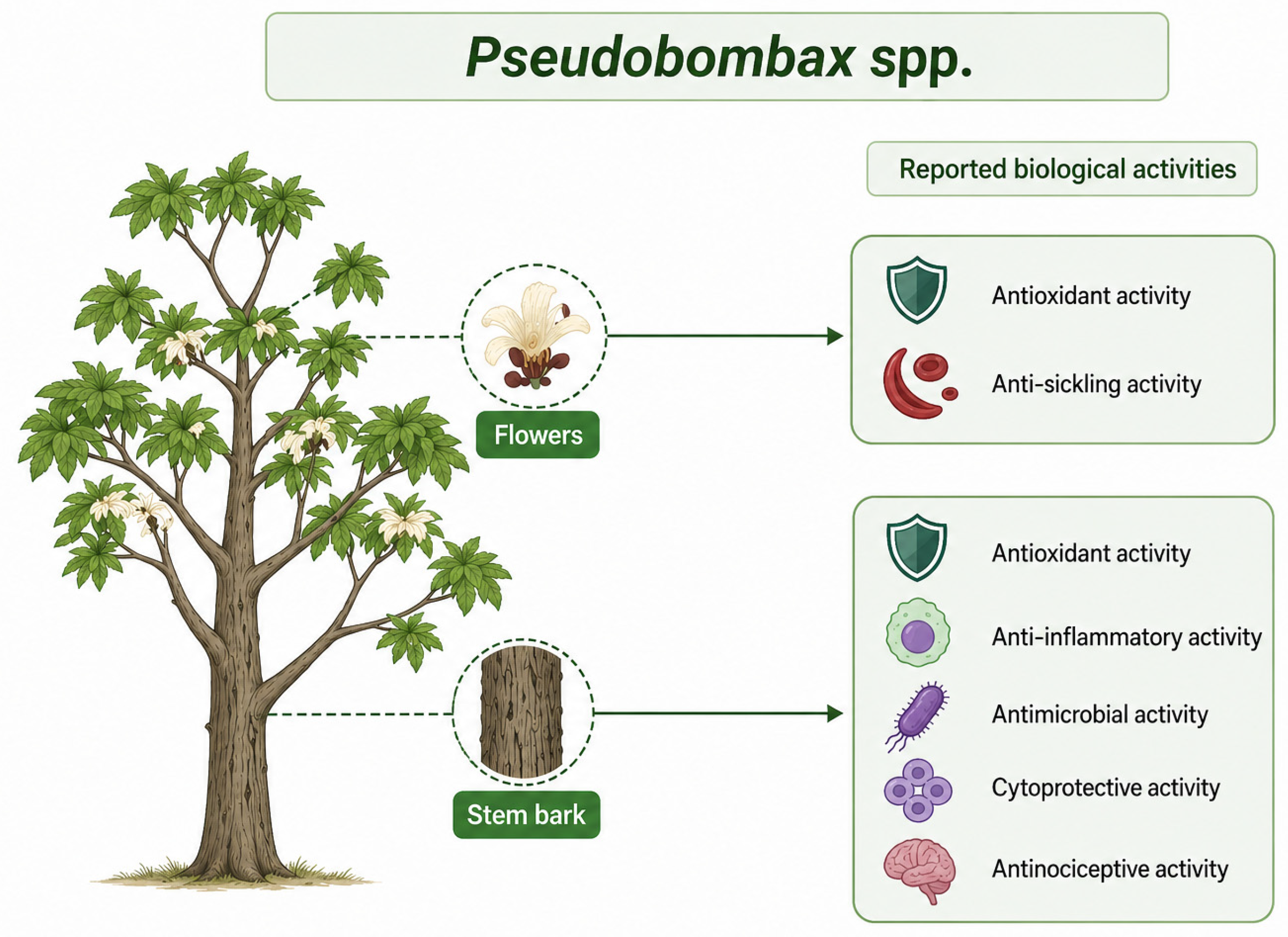
Organ-specific pharmacological landscape of the genus Pseudobombax. The diagram summarizes the biological activities associated with plant organs investigated in the included studies. In contrast to Bombax, research on Pseudobombax is markedly concentrated on stem bark and flowers, with reported activities such as antisickling, antinociceptive, and cytoprotective effects. This comparatively restricted mapping highlights the existing gaps in the pharmacological exploration of other plant parts within this genus. Created in https://BioRender.com.
Of the 37 included studies, 83.7% focused on Bombax, while only 16.2% investigated Pseudobombax, demonstrating a pronounced taxonomic imbalance. Within Bombax, B. ceiba predominated with 28 publications, representing 90.3% of the genus-specific research and 75.7% of the total selected articles. Conversely, other species such as B. costatum and B. buonopozense were minimally represented. In the six studies involving Pseudobombax, the distribution was more equitable among P. ellipticum (33.3%), P. marginatum (33.3%), P. simplicifolium (16.7%) and P. parvifolium (16.7%), with no single species showing research dominance comparable to B. ceiba.
This concentration pattern suggests that research efforts have been driven primarily by historical usage, geographic accessibility, and legacy phytochemical data rather than by systematic taxonomic or comparative strategies. Consequently, pharmacological generalizations at the genus level remain constrained, particularly for Pseudobombax, where the evidence base is sparse.
The organ-specific distribution of biological activities for the genera Bombax and Pseudobombax is visually synthesized in Figure 2 and Figure 3, respectively. While these mappings underscore a multifaceted pharmacological profile, the broader evidence landscape reveals a significant taxonomic disparity. Regarding plant morphology, leaves, flowers, and stem bark were the most frequently investigated organs overall. However, this distribution varies strictly by taxa: Bombax species were evaluated across a wide range of plant parts (Figure 2), whereas Pseudobombax investigations remain largely restricted to stem bark and flowers (Figure 3). Such preference appears to reflect research convenience and geographic accessibility rather than demonstrated phytochemical superiority. Consequently, the scarcity of systematic organ-to-organ comparisons limits robust conclusions regarding tissue-specific bioactive potential, particularly for the less-studied Pseudobombax.
Methodological heterogeneity was also pervasive across the literature. Experimental designs varied significantly in extraction procedures, the depth of chemical characterization, and the selection of biological validation models. Several studies relied on crude extracts lacking standardized profiling, and inter-study comparability was often hindered by inconsistent reporting of experimental parameters. Such variability constrains reproducibility and complicates the integrative interpretation of pharmacological evidence.
Collectively, the current body of literature reveals a research landscape characterized by taxonomic concentration, organ-level selectivity, and methodological disparity. While both genera exhibit significant biological activity and phytochemical richness, the uneven distribution of investigative efforts highlights the urgent need for broader species coverage, standardized analytical profiling, and systematic comparative approaches.
3.3. Phytochemical Characterization: Analytical Scope and Depth
As summarized in Table 2 and Table 3, phytochemical investigations of Bombax and Pseudobombax species predominantly reported phenolic compounds, flavonoids, tannins, alkaloids, terpenoids, and polysaccharides. Analytical characterization was mainly conducted using chromatographic and spectrometric techniques, including high-performance liquid chromatography (HPLC) coupled with diode-array detection (DAD), liquid chromatography–mass spectrometry (LC–MS/MS), and gas chromatography–mass spectrometry (GC–MS).
In most studies, compound identification was based on retention times, UV absorption spectra, and mass fragmentation patterns, often compared with reference standards or spectral libraries. However, detailed analytical parameters, such as column type, mobile phase composition, gradient elution profiles, ionization modes, and mass analyzer settings, were inconsistently reported, limiting reproducibility and cross-study comparisons.
Bombax ceiba exhibited the most chemically characterized profile, with recurrent detection of compounds such as mangiferin, β-sitosterol, gallic acid, and lupeol. These identifications were frequently supported by LC–MS fragmentation data or co-elution with authentic standards. In contrast, phytochemical data for other species were sparse and often restricted to preliminary screening assays or non-targeted analyses without compound confirmation.
Notably, the analytical scope remained largely qualitative. Only a minority of studies employed quantitative approaches, such as calibration curves with external standards or internal normalization methods, to determine the concentration of individual metabolites. Additionally, validation parameters, including limits of detection (LOD), limits of quantification (LOQ), precision, and accuracy, were rarely addressed.
Despite the use of advanced analytical platforms, several methodological limitations were consistently observed:
- Limited quantitative rigor: Few studies provided absolute or relative quantification of bioactive compounds using validated analytical methods.
- Heterogeneity in extraction procedures: Variability in solvent polarity (e.g., methanol, ethanol, aqueous systems), extraction techniques (maceration, Soxhlet, ultrasonic-assisted extraction), and plant part selection hindered data comparability.
- Lack of reproducibility assessment: Most studies did not evaluate intra- or inter-batch variability, nor did they consider environmental or seasonal influences on metabolite composition.
- Insufficient use of bioassay-guided fractionation: Isolation and structural elucidation of active compounds using integrated phytochemical–pharmacological approaches remain limited.
Consequently, biological activities were frequently attributed to broad classes of compounds rather than to structurally characterized molecules. Although metabolites such as mangiferin, β-sitosterol, gallic acid, lupeol, and flavonoid derivatives have been repeatedly reported in B. ceiba, direct mechanistic correlations between these compounds and specific pharmacological effects remain inadequately established.
Major Phytochemical Classes and Bioactive Compounds
In addition to general phytochemical screening, several structurally characterized bioactive compounds have been identified across Bombax and Pseudobombax species, predominantly belonging to phenolic derivatives, flavonoids, and triterpenoids. These classes are consistently associated with the pharmacological activities reported in the literature and represent key contributors to the biological potential of these genera.
Among the most frequently reported metabolites, mangiferin stands out as a major bioactive constituent of Bombax ceiba. This compound has garnered significant attention due to its multifaceted antioxidant, anti-inflammatory, and antihyperglycemic properties. Mechanistically, mangiferin mitigates oxidative stress not only through direct radical scavenging but primarily by activating endogenous defense pathways, such as the Nrf2 signaling cascade. Furthermore, its anti-inflammatory and cytoprotective effects are largely mediated via the inhibition of pro-inflammatory mediators (including TNF-alpha and IL-6) and the modulation of the NF-κB pathway [41]. Regarding glucose homeostasis, mangiferin improves insulin sensitivity and regulates carbohydrate metabolism through AMPK-related mechanisms and the inhibition of carbohydrate-hydrolyzing enzymes, highlighting its potential translational relevance in metabolic disorders [42].
Flavonoids represent another major class of secondary metabolites recurrently identified in both genera, with quercetin, rutin, kaempferol derivatives, vitexin, and isovitexin being the most prominent. These compounds exert broad pharmacological effects, ranging from vascular protection to direct free radical scavenging. Among them, quercetin [43] and kaempferol [44] stand out due to their ability to modulate intracellular redox status by targeting ROS-dependent signaling pathways and down-regulating pro-inflammatory cytokine production.
Although the high concentration of these flavonoids is frequently used to explain the potent antioxidant and anti-inflammatory activities observed in Bombax and Pseudobombax extracts, these conclusions remain largely correlative. The limited use of compound-isolation strategies in the current literature prevents the establishment of direct causal relationships, underscoring the need for more rigorous mechanistic validation of these individual constituents.
Triterpenoids and phytosterols represent another chemical and pharmacologically significant group of metabolites identified in Bombax and Pseudobombax species, particularly B. ceiba and P. simplicifolium. Among the triterpenoids, lupeol and taraxerol deserve particular attention due to their reported anti-inflammatory, cytoprotective, and antiproliferative actions. Mechanistically, lupeol has been shown to attenuate oxidative stress and down-regulate NF-κB -mediated inflammatory cascades [45], while taraxerol exhibits complementary anti-inflammatory effects in experimental models [46]. Similarly, the phytosterol beta-sitosterol is widely recognized for its hypolipidemic, immunomodulatory, and hepatoprotective properties, which may underline some of the metabolic regulatory and lipid-lowering effects reported for these plant extracts [47]. Nevertheless, despite the well-documented efficacy of these pure constituents in other botanical systems, their precise contribution to the overall biological activities observed in Bombax and Pseudobombax remains largely unvalidated.
Additionally, simple phenolic compounds such as gallic acid [48] and protocatechuic acid [49] contribute to antioxidant and cytoprotective effects, reinforcing the role of low-molecular-weight phenolics in redox modulation.
Overall, although a diverse range of bioactive compounds has been identified, the current literature is largely based on qualitative detection and class-level attribution. The lack of bioassay-guided fractionation and mechanistic validation limits the establishment of direct relationships between specific compounds and pharmacological effects. This highlights a critical gap and underscores the need for compound-oriented studies integrating phytochemical isolation, structural elucidation, and target-based biological evaluation.
3.4. Genus Bombax
A critical limitation across the evaluated studies is the insufficient integration between phytochemical composition and pharmacological outcomes. While several biological activities are reported, only a limited number of studies establish direct mechanistic links between specific compounds and observed effects. Compounds such as mangiferin, flavonoids, and triterpenoids (e.g., lupeol and β-sitosterol) are frequently cited; however, their individual contributions and molecular targets remain poorly defined.
3.4.1. Biological Activities of Bombax: Critical Appraisal of Experimental Evidence
The spectrum of pharmacological activities reported for Bombax ceiba and related species is broad (Table 2), encompassing antioxidant, anti-inflammatory, metabolic, antimicrobial, and cytotoxic effects. Among these, antioxidant and antidiabetic activities are the most consistently investigated, supported by both in vitro assays (e.g., DPPH, ABTS, enzyme inhibition) and in vivo models, particularly using leaf and flower extracts. These studies frequently associate bioactivity with phenolic compounds such as mangiferin, flavonoids, and phenolic acids.
Metabolically related effects, including antihyperglycemic, antihyperlipidemic, and antiobesity activities, are also relatively well represented, especially in rodent models, suggesting a potential role of B. ceiba in metabolic regulation. Similarly, anti-inflammatory and hepatoprotective effects have been demonstrated in vivo, although often without detailed identification of the active constituents.
In contrast, other reported activities, such as antiviral, antiosteoporotic, anti-arthritic, and neuropharmacological effects, remain limited to a small number of studies, frequently with restricted experimental replication. Antibacterial and cytotoxic activities are commonly reported based on in vitro assays, but their translational relevance remains uncertain due to the lack of complementary in vivo validation.
A recurrent pattern across studies is the association of biological effects with broadly defined chemical classes rather than isolated compounds, which complicates mechanistic interpretation. Additionally, the predominance of single-model studies and the limited integration of pharmacological and phytochemical approaches restrict the robustness of the current evidence base.
Overall, while B. ceiba demonstrates a wide range of promising biological activities, the strength of evidence varies considerably, with the most consistent support observed for antioxidant and metabolic effects and more preliminary evidence for other pharmacological properties.
3.4.2. Antioxidant Activity
Antioxidant capacity represents the most frequently evaluated biological property (Figure 2). Nevertheless, most studies relied on chemical-based assays, such as DPPH, ABTS, and FRAP, which measure radical-scavenging capacity in vitro but do not necessarily translate to physiological redox modulation. Only a limited number of investigations evaluated in vivo oxidative stress biomarkers, and mechanistic insights into endogenous antioxidant signaling pathways (e.g., Nrf2/ARE) were rarely explored. Consequently, while antioxidant activity is consistently reported, its translational relevance remains largely unverified.
3.4.3. Antimicrobial and Antiviral Activities
Antimicrobial activity has been predominantly assessed via in vitro growth inhibition assays (Table 2). While inhibitory effects were observed against multiple pathogenic strains, there is a lack of data regarding pharmacokinetics, systemic toxicity, or efficacy in in vivo infection models. Similarly, antiviral activity (against respiratory syncytial virus—RSV) was demonstrated exclusively in cell-based systems. The absence of mechanistic elucidation and in vivo validation limits the extrapolation of these findings toward therapeutic applications.
3.4.4. Cytotoxic and Anticancer Effects
Cytotoxic activity against various tumor cell lines has been reported (Table 2). However, the evidence is frequently constrained by significant methodological limitations, including:
- Lack of selectivity indices: Failure to evaluate toxicity in non-tumoral (healthy) cell lines.
- Absence of mechanistic confirmation: Lack of data regarding apoptosis induction or cell cycle arrest pathways.
- Inadequate validation: Absence of in vivo tumor xenograft models.
- Pharmacological gaps: No assessment of pharmacodynamic or pharmacokinetic profiles.
As illustrated in Figure 2, cytotoxicity represents a secondary research focus compared to antioxidant screening. Therefore, current findings should be interpreted as preliminary cytotoxic screening rather than substantiated anticancer efficacy.
3.4.5. Metabolic and Organ-Protective Effects
Metabolic and organ-protective activities, including antidiabetic, antihyperlipidemic, nephroprotective, hepatoprotective, and antiosteoporotic effects, were primarily evaluated in rodent models (Table 2). Although improvements in biochemical surrogate markers were commonly observed, molecular pathway validation and target-specific analyses were frequently omitted. While specific secondary metabolites were hypothesized to drive these effects, the definitive molecular mechanisms and their direct targets remain insufficiently established.
3.4.6. Hierarchical Assessment of Evidence Strength
The hierarchical classification framework was applied to all included studies, resulting in the categorization of 23 distinct pharmacological activities (Table 4). Level II evidence predominated (34.8%) with Level I (34.8%), followed by Level III (21.7%) and Level IV (8.7%) (Table 4).
Table 4.
Hierarchical classification and critical appraisal of pharmacological activities reported for Bombax species.
Although 69.6% of the reported activities (Levels I–II) involved in vivo experimental models, only 34.8% fulfilled the criteria for robust validation supported by established disease models and quantifiable biochemical or molecular biomarkers (Level I). In addition, no clinical-level evidence was identified among the included studies.
Activities classified as Level I were primarily associated with metabolic and organ-protective effects, including hypoglycemic, antihyperlipidemic, hepatoprotective, nephroprotective, anti-inflammatory, gastroprotective and osteogenic properties, generally employing validated in vivo models and objective biochemical endpoints. Level II activities comprised functional in vivo evidence lacking detailed mechanistic elucidation (e.g., antiobesity, anti-arthritic, and antidepressant effects). Conversely, Level III evidence was largely restricted to in vitro systems, particularly antioxidant and antibacterial assays, which represent a substantial proportion of the exploratory investigations (Figure 2 and Figure 3). Level IV corresponded to preliminary validation, such as ex vivo or isolated cellular systems without systemic confirmation.
3.5. Genus Pseudobombax
3.5.1. Biological Activities of Pseudobombax: Critical Appraisal of Experimental Evidence
The range of reported pharmacological activities for Pseudobombax is markedly more restricted compared to Bombax (Table 3), with research efforts concentrated on a limited number of species and plant organs.
3.5.2. Antioxidant Activity
As illustrated in Figure 3, antioxidant activity is one of the few properties investigated for this genus. Like the trends observed in Bombax, these evaluations relied almost exclusively on in vitro radical-scavenging assays (e.g., DPPH and ABTS). There is an absence of in vivo redox modulation studies or mechanistic investigations into cellular antioxidant pathways. Consequently, the antioxidant activity of Pseudobombax remains at a preliminary screening stage, lacking physiological validation.
3.5.3. Antimicrobial Activity
Antimicrobial investigations in Pseudobombax are largely confined to in vitro assessments of stem bark extracts (Table 3). Although inhibitory effects against specific bacterial strains have been identified, the evidence base lacks diversity in tested pathogens and is devoid of in vivo efficacy trials, toxicity profiles, or pharmacokinetic data. No antiviral activities were identified for this genus within the evaluated timeframe.
3.5.4. Anti-Inflammatory and Antinociceptive Effects
A significant portion of the research on Pseudobombax (mainly P. marginatum) focuses on anti-inflammatory and antinociceptive properties. While these studies often employ in vivo functional models, such as paw edema or writhing tests, they frequently lack molecular depth. The specific mediators involved and the potential modulation of signaling pathways (e.g., COX-2 or cytokine cascades) remain insufficiently characterized.
3.5.5. Other Biological Properties
Other reported effects, such as antisickling and cytoprotective activities, represent isolated investigative efforts (Figure 3). These findings, while promising, are predominantly based on in vitro or ex vivo models without systemic confirmation. The lack of broader pharmacological screening across different plant parts, such as leaves or roots, limits the understanding of the genus’s full therapeutic potential.
3.5.6. Hierarchical Assessment of Evidence Strength
The hierarchical classification of Pseudobombax research highlights a fragmented evidence landscape. In contrast to Bombax, where Level I evidence is more prevalent, Pseudobombax studies are largely situated at Levels II and III (Table 5).
Table 5.
Critical appraisal of biological activities reported for Pseudobombax species.
Collectively, this distribution (Figure 3) reveals that the evidence base for Pseudobombax is not only smaller in volume but also lower in hierarchical strength. The reliance on a few species and the focus on stem bark research emphasize a significant taxonomic and morphological bias, precluding robust generalizations at the genus level.
4. Discussion
The present narrative review reveals not merely a disparity in research volume between Bombax and Pseudobombax, but a structural imbalance in scientific maturity, mechanistic depth, and translational progression. Although both genera display a wide array of reported biological activities, the evidence landscape is unevenly distributed, with research efforts disproportionately concentrated on a limited number of species and plant organs. This dual taxonomic and morphological bias restricts a comprehensive pharmacological interpretation of these taxa and may obscure chemically distinct and therapeutically relevant species that remain underexplored.
Within Bombax, the overwhelming predominance of B. ceiba likely reflects its broad geographical distribution and long-standing incorporation into traditional Asian medical systems [6]. However, this concentration has shaped the pharmacological identity of the genus in a way that may not accurately represent its internal chemical diversity. While B. ceiba demonstrates relatively advanced experimental validation in metabolic, organ-protective, and osteogenic contexts, other species such as B. costatum and B. buonopozense remain largely confined to functional screening stages. This imbalance narrows phytochemical discovery pipelines and limits opportunities to identify structurally novel metabolites potentially restricted to less-investigated taxa. From a drug discovery perspective, this concentration represents a clear constraint on chemical diversification and translational innovation.
A similar bias is evident at the morphological level. Leaves, flowers, and stem bark dominate the experimental landscape across both genera. Although ethnobotanical guidance partially explains this preference, methodological convenience appears equally influential. As discussed by Penido et al. [50], these organs are readily accessible and, in the case of bark and leaves, often available year-round, facilitating repeated experimental use. Nevertheless, the scarcity of systematic organ-to-organ comparative studies precludes definitive conclusions regarding tissue-specific bioactive superiority. Importantly, flowers are metabolically specialized structures enriched in flavonoids and anthocyanins [51], and the antisickling activity reported in Pseudobombax flowers underscores how underexplored organs may harbor clinically relevant bioactivities. Conversely, the predominant use of stem bark, particularly in Pseudobombax, raises sustainability concerns, as excessive harvesting can compromise plant viability and ecological balance [52]. These findings reinforce the necessity of aligning pharmacological exploration with conservation-aware research strategies.
Perhaps the most consequential finding of this review is the persistence of a pronounced translational gap. Antioxidant activity represents the most frequently reported biological property across both genera; however, its predominance is largely driven by chemical assays such as DPPH and ABTS, which provide limited physiological relevance. The reliance on rapid screening methodologies reflects a broader research paradigm oriented toward exploratory bioactivity detection rather than mechanistically grounded pharmacological development. In Bombax, several biological properties have progressed beyond this stage into validated in vivo models supported by biochemical and histological endpoints, suggesting a more advanced position along the preclinical validation continuum. In contrast, Pseudobombax remains predominantly positioned in early investigative phases, with activities frequently lacking systemic confirmation, molecular target identification, or pharmacokinetic characterization. Although both genera exhibit methodological limitations in extract standardization and pathway-level analysis, these constraints are more structurally limiting for Pseudobombax, where foundational translational infrastructure remains insufficiently developed.
In this context, a critical limitation across the available studies is the predominant reliance on in vitro experimental approaches, particularly for antioxidant, antimicrobial, and cytotoxic activities. While these assays are valuable for initial screening and hypothesis generation, they inherently lack physiological complexity. Chemical-based assays such as DPPH, ABTS, and FRAP measure the capacity of compounds to neutralize synthetic radicals under controlled conditions, which does not necessarily reflect their behavior in biological systems [53]. In vivo, redox homeostasis is regulated by complex enzymatic and non-enzymatic defense networks, and antioxidant activity is frequently mediated through modulation of endogenous pathways rather than direct radical scavenging. Therefore, the extrapolation of in vitro antioxidant activity to physiological or clinical efficacy remains limited and should be interpreted with caution [54].
From a phytochemical perspective, an important limitation of the current literature lies not only in the incomplete chemical profiling of Bombax and Pseudobombax species, but also in the insufficient pharmacological exploration of identified compounds. Although several bioactive metabolites, including mangiferin, flavonoids, and triterpenoids, have been reported, most studies attribute biological effects to broad chemical classes rather than to individual compounds [55]. This limits mechanistic interpretation and weakens the translational relevance of the findings.
Advancing this field will require a shift toward compound-oriented research approaches, prioritizing bioassay-guided fractionation, isolation of active constituents, and validation of molecular targets. Such strategies are essential to move beyond descriptive phytochemistry and establish robust chemical–biological relationships that support drug discovery efforts.
Similarly, antimicrobial and antiviral activities reported for these genera are largely supported by in vitro growth inhibition or cell-based assays, which do not account for critical determinants of therapeutic efficacy, such as pharmacokinetics, tissue distribution, host–pathogen interactions, and immune system modulation. Moreover, in vitro cytotoxicity assays often lack selectivity assessments against non-tumoral cells and are not supported by in vivo tumor models, further restricting their translational relevance [56]. Collectively, these limitations highlight a substantial gap between experimental bioactivity detection and clinically meaningful outcomes.
Collectively, this asymmetry delineates two distinct developmental trajectories. Bombax represents a genus with consolidating pharmacological credibility that now requires deeper mechanistic refinement and chemical standardization to sustain translational progression. Pseudobombax, in contrast, emerges as a largely untapped phytochemical reservoir situated at the threshold of systematic exploration. Advancing the field will require a deliberate transition from repetitive exploratory screenings toward integrated, mechanism-oriented investigations combining phytochemical fingerprinting, target-based validation, and pharmacokinetic assessment. Expanding taxonomic coverage beyond B. ceiba, implementing comparative organ profiling, and strengthening molecular-level confirmation are essential to transform descriptive evidence into clinically meaningful insight.
Ultimately, the current body of literature reflects not the full pharmacological potential of Bombax and Pseudobombax, but rather the limitations of prevailing investigative paradigms. Bridging this gap demands a strategic reorientation from exploratory abundance to mechanistic precision. Only through such a shift can these genera transition from ethnopharmacological relevance to evidence-driven candidates within the modern drug discovery framework.
5. Conclusions
This narrative review provides a comprehensive and hierarchically structured appraisal of the pharmacological evidence available for the genera Bombax and Pseudobombax, revealing a pronounced asymmetry in research depth, taxonomic coverage, and translational maturity. While Bombax, particularly B. ceiba, exhibits a relatively advanced preclinical evidence profile supported by validated in vivo models and biochemical endpoints, the genus remains heavily centralized around a single species, limiting broader phytochemical and pharmacological generalization. In contrast, Pseudobombax is positioned at an earlier stage of scientific development, with most activities confined to exploratory or functionally descriptive investigations that lack mechanistic and pharmacokinetic refinement.
Across both genera, antioxidant activity predominates; however, it is largely anchored in chemical assays with limited physiological correlation, highlighting a persistent translational gap between in vitro screening and clinically relevant validation. Additionally, the preferential investigation of specific plant organs, particularly stem bark and flowers, reflects methodological and ethnobotanical influences rather than systematic phytochemical comparisons, raising both scientific and sustainability concerns regarding plant survival.
Author Contributions
Conceptualization, H.A.O.R. and J.S.P.d.S.; methodology, J.S.P.d.S. and O.L.T.d.S.; validation, J.S.P.d.S. and O.L.T.d.S.; formal analysis, J.S.P.d.S. and O.L.T.d.S.; investigation, J.S.P.d.S. and O.L.T.d.S.; resources, H.A.O.R.; data curation, H.A.O.R.; writing—original draft preparation, J.S.P.d.S.; writing—review and editing, H.A.O.R., J.S.P.d.S. and O.L.T.d.S.; supervision, H.A.O.R.; project administration, H.A.O.R.; funding acquisition, H.A.O.R. All authors have read and agreed to the published version of the manuscript.
Funding
This research was supported by Ministério de Ciência, Tecnologia e Inovação (MCTI—Brazil), Coordenação de Aperfeiçoamento de Pessoal de Nível Superior (CAPES—Brazil) (Finance Code 001).
Data Availability Statement
No new data were created or analyzed in this study. Data sharing is not applicable to this article.
Acknowledgments
The authors thank the National Council for Scientific and Technological Development (CNPq, Brazil) for the research productivity fellowships awarded to H.A.O.R. (Process n◦ 308727/2023-1). The authors also thank the Coordination for the Improvement of Higher Education Personnel (CAPES, Brazil) for the Ph.D. scholarships granted to O.L.T.d.S. and the Master’s scholarship granted to J.S.P.d.S. This research was submitted to the Graduate Program in Health Science at the Federal University of Rio Grande do Norte as part of the Ms.C. thesis of Julia. During the preparation of this manuscript the authors used ChatGPT, version 4.0 for the purposes of improving the English. The authors have reviewed and edited the output and take full responsibility for the content of this publication.
Conflicts of Interest
The authors declare no conflicts of interest.
Abbreviations
The following abbreviations are used in this manuscript:
| ABTS | 2,2′-azino-bis(3-ethylbenzothiazoline-6-sulfonic acid |
| AGE | Advanced Glycation End-products |
| ARE | Antioxidant Response Element pathway |
| CD56 | Cluster of Differentiation 56 |
| COX-2 | Cyclooxygenase-2 |
| DPPH | 2,2-diphenyl-1-picrylhydrazyl |
| EGFR | Epidermal Growth Factor Receptor |
| ESR1 | Estrogen Receptor 1 |
| FRAP | Ferric Reducing Antioxidant Power |
| GC-MS | Gas Chromatography–Mass Spectrometry |
| GPx | Glutathione Peroxidase |
| HPLC | High-Performance Liquid Chromatography |
| LC-MS | Liquid Chromatography–Mass Spectrometry |
| Nrf2 | Nuclear factor erythroid 2–related factor 2 pathway |
| SDF-1 | Stromal Cell-Derived Factor 1 |
| SRC | Proto-oncogene tyrosine-protein kinase Src |
| STZ | Streptozotocin |
| T2DM | Type 2 Diabetes Mellitus |
References
- Shao, L.; Jin, S.; Chen, J.; Yang, G.; Fan, R.; Zhang, Z.; Deng, Q.; Han, J.; Ma, X.; Dong, Z.; et al. High-Quality Genomes of Bombax ceiba and Ceiba pentandra Provide Insights into the Evolution of Malvaceae Species and Differences in Their Natural Fiber Development. Plant Commun. 2024, 5, 100832. [Google Scholar] [CrossRef] [Scilit] [PubMed]
- Das, G.; Shin, H.-S.; Ningthoujam, S.S.; Talukdar, A.D.; Upadhyaya, H.; Tundis, R.; Das, S.K.; Patra, J.K. Systematics, Phytochemistry, Biological Activities and Health Promoting Effects of the Plants from the Subfamily Bombacoideae (Family Malvaceae). Plants 2021, 10, 651. [Google Scholar] [CrossRef] [Scilit] [PubMed]
- Posinasetty, B.; Chikatipalli, R.; Chenchula, S.; Kuttiappan, A.; G, S.; GNA, L.; Audinarayana, N. Anti-Arthritic Efficacy of Bombax Ceiba Ethanolic Extract in a Murine Model for Rheumatoid Arthritis Using In Vivo, In Vitro and Radiological Analysis. Bioinformation 2023, 19, 833–839. [Google Scholar] [CrossRef] [Scilit] [PubMed]
- Diab, K.A.; El-Shenawy, R.; Helmy, N.M.; El-Toumy, S.A. Polyphenol Content, Antioxidant, Cytotoxic, and Genotoxic Activities of Bombax ceiba Flowers in Liver Cancer Cells Huh7. Asian Pac. J. Cancer Prev. 2022, 23, 1345–1350. [Google Scholar] [CrossRef] [Scilit] [PubMed]
- Senes-Lopes, T.F.D.; Luz, J.R.D.D.; Guterres, Z.D.R.; Barbosa, E.A.; Batista, D.; Galdino, O.A.; Ururahy, M.A.G.; Gomes dos Santos, E.C.; López, J.A.; Araujo-Silva, G.; et al. Pseudobombax parvifolium Hydroalcoholic Bark Extract: Chemical Characterisation and Cytotoxic, Mutagenic, and Preclinical Aspects Associated with a Protective Effect on Oxidative Stress. Metabolites 2023, 13, 748. [Google Scholar] [CrossRef] [Scilit] [PubMed]
- Collares, L.J.; Turchen, L.M.; Guedes, R.N.C. Research Trends, Biases, and Gaps in Phytochemicals as Insecticides: Literature Survey and Meta-Analysis. Plants 2023, 12, 318. [Google Scholar] [CrossRef] [Scilit] [PubMed]
- Pacheco, G.; Vianna-Almeida, M.G.; Oliveira Garcia, R.; Mansur, E. Challenges and Recent Progress on the Use of Cryobiotechnology for Conserving Brazilian Native Plants. Cryo Lett. 2025, 46, 143–163. [Google Scholar] [CrossRef] [Scilit]
- Noguera, N.H.; Noguera, D.C.L.H.; da Fonseca Machado, A.P.; Reguengo, L.M.; do Nascimento, R.D.P. Emerging Berries from the Brazilian Amazon and Atlantic Forest Biomes: New Sources of Bioactive Compounds with Potential Health Benefits. Food Funct. 2024, 15, 5752–5784. [Google Scholar] [CrossRef] [Scilit] [PubMed]
- Kumari, N.; Radha; Puri, S.; Kumar, M.; Natta, S.; Dhumal, S.; Raman, P.; Rajalingam, S.; Singh, J. Exploring the Therapeutic Potential of Bombax Ceiba L. Flowers as Source of Functional Food Development: A Review. Chem. Biodivers. 2025, 22, e00247. [Google Scholar] [CrossRef] [Scilit] [PubMed]
- Taher, M.A.; Hossain, M.J.; Zahan, M.S.; Hasan, M.M.; Ferdous, J.; Rahman, A.; Khan, M.; Hosain, M.K.; Rashid, M.A. Phyto-Pharmacological and Computational Profiling of Bombax ceiba Linn. Leaves Revealed Pharmacological Properties against Oxidation, Hyperglycemia, Pain, and Diarrhea. Heliyon 2024, 10, e35422. [Google Scholar] [CrossRef] [Scilit] [PubMed]
- Komati, A.; Anand, A.; Nagendla, N.K.; Madhusudana, K.; Mudiam, M.K.R.; Babu, K.S.; Tiwari, A.K. Bombax ceiba Calyx Displays Antihyperglycemic Activity via Improving Insulin Secretion and Sensitivity: Identification of Bioactive Phytometabolomes by UPLC-QTof-MS/MS. J. Food Sci. 2022, 87, 1865–1881. [Google Scholar] [CrossRef] [Scilit]
- Haque, M.U.; Alam, A.K.; Islam Shovon, M.T.; Sujon, K.M.; Hasan Maruf, M.M.; Kabir, S.R.; Faisal Hoque, K.M.; Reza, M.A. Unveiling the Apoptotic Potential of Antioxidant-Rich Bangladeshi Medicinal Plant Extractives and Computational Modeling to Identify Antitumor Compounds. Heliyon 2024, 10, e38885. [Google Scholar] [CrossRef] [Scilit] [PubMed]
- Ullah, M.N.; Ali, I.; Hanif, S.; Ali Syed, M.; Talha, M.; Samran, M.A.; Haider, A.; Huraira, M. Phytochemical Screening and Physicochemical Analysis of Oil Extracted from Seeds of Bombax ceiba and Determination of Antioxidant Activity. Pak. J. Pharm. Sci. 2024, 37, 743–751. [Google Scholar] [PubMed]
- Xu, G.-K.; Qin, X.-Y.; Wang, G.-K.; Xie, G.-Y.; Li, X.-S.; Sun, C.-Y.; Liu, B.-L.; Qin, M.-J. Antihyperglycemic, Antihyperlipidemic and Antioxidant Effects of Standard Ethanol Extract of Bombax ceiba Leaves in High-Fat-Diet- and Streptozotocin-Induced Type 2 Diabetic Rats. Chin. J. Nat. Med. 2017, 15, 168–177. [Google Scholar] [CrossRef] [Scilit] [PubMed]
- Masood-Ur-Rehman; Akhtar, N.; Mustafa, R. Antibacterial and Antioxidant Potential of Stem Bark Extract of Bombax ceiba Collected Locally from South Punjab Area of Pakistan. Afr. J. Tradit. Complement. Altern. Med. 2017, 14, 9–15. [Google Scholar] [CrossRef] [Scilit] [PubMed]
- Laoung-On, J.; Ounjaijean, S.; Sudwan, P.; Boonyapranai, K. Phytochemical Screening, Antioxidant Effect and Sperm Quality of the Bombax ceiba Stamen Extracts on Charolais Cattle Sperm Induced by Ferrous Sulfate. Plants 2024, 13, 960. [Google Scholar] [CrossRef] [Scilit] [PubMed]
- Amat-Ur-Rasool, H.; Symes, F.; Tooth, D.; Schaffert, L.-N.; Elmorsy, E.; Ahmed, M.; Hasnain, S.; Carter, W.G. Potential Nutraceutical Properties of Leaves from Several Commonly Cultivated Plants. Biomolecules 2020, 10, 1556. [Google Scholar] [CrossRef] [Scilit] [PubMed]
- Sinha, S.; Kumar, B.; Luqman, S.; Singh, D.K. Neuroprotective Potential of Cucurbita maxima Duchesne ex Poir, Caeselpenia bunduc (L.) Roxb and Bombax ceiba Linn Extracts. S. Afr. J. Bot. 2019, 120, 319–325. [Google Scholar] [CrossRef] [Scilit]
- Zhang, Y.-B.; Wu, P.; Zhang, X.-L.; Xia, C.; Li, G.-Q.; Ye, W.-C.; Wang, G.-C.; Li, Y.-L. Phenolic Compounds from the Flowers of Bombax malabaricum and Their Antioxidant and Antiviral Activities. Molecules 2015, 20, 19947–19957. [Google Scholar] [CrossRef] [Scilit] [PubMed]
- Yasien, S.; Iqbal, M.M.; Javed, M.; Alnuwaiser, M.A.; Iqbal, S.; Mahmood, Q.; Elkaeed, E.B.; Dera, A.A.; Alrbyawi, H.; Pashameah, R.A.; et al. Comparative Evaluation of Various Extraction Techniques for Secondary Metabolites from Bombax ceiba L. Flowering Plants along with In Vitro Anti-Diabetic Performance. Bioengineering 2022, 9, 486. [Google Scholar] [CrossRef] [Scilit] [PubMed]
- Yin, K.; Yang, J.; Wang, F.; Wang, Z.; Xiang, P.; Xie, X.; Sun, J.; He, X.; Zhang, X. A Preliminary Study of the Chemical Composition and Bioactivity of Bombax ceiba L. Flower and Its Potential Mechanism in Treating Type 2 Diabetes Mellitus Using Ultra-Performance Liquid Chromatography Quadrupole-Time-Flight Mass Spectrometry and Network Pharmacology Analysis. Front. Nutr. 2022, 9, 1018733. [Google Scholar] [CrossRef] [Scilit] [PubMed]
- Gavade, N.L.; Deshmukh, S.P.; Serena Dossou, A.; Raut, S.; Garadkar, K.M. Phytosynthesis of Anisotropic Silver and Gold Nanoparticles: Characterization and Anticancer Activity towards HIO180 and HeyA8 Cells. Spectrochim. Acta A Mol. Biomol. Spectrosc. 2025, 333, 125905. [Google Scholar] [CrossRef] [Scilit] [PubMed]
- Dolsophon, K.; Nak-On, S.; Chontananarth, T.; Tegumental SurfaceArafa, A.F.; Foda, D.S.; Mahmoud, A.H.; Metwally, N.S.; Farrag, A.R.H. Bombax Ceiba Flowers Extract Ameliorates Hepatosteatosis Induced by Ethanol and Relatively Moderate Fat Diet in Rats. Toxicol. Rep. 2019, 6, 401–408. [Google Scholar] [CrossRef] [Scilit] [PubMed]
- Tundis, R.; Rashed, K.; Said, A.; Menichini, F.; Loizzo, M.R. In Vitro Cancer Cell Growth Inhibition and Antioxidant Activity of Bombax ceiba (Bombacaceae) Flower Extracts. Nat. Prod. Commun. 2014, 9, 691–694. [Google Scholar] [CrossRef] [Scilit]
- Change in Paramphistomum epiclitum Caused by Bombax ceiba Flowers and Black Pepper Seed Extract. Exp. Parasitol. 2024, 260, 108724. [CrossRef] [Scilit] [PubMed]
- Komati, A.; Anand, A.; Shaik, H.; Mudiam, M.K.R.; Suresh Babu, K.; Tiwari, A.K. Bombax ceiba (Linn.) Calyxes Ameliorate Methylglyoxal-Induced Oxidative Stress via Modulation of RAGE Expression: Identification of Active Phytometabolites by GC-MS Analysis. Food Funct. 2020, 11, 5486–5497. [Google Scholar] [CrossRef] [PubMed]
- Wang, L.; Xie, S.; Jiang, X.; Xu, C.; Wang, Y.; Feng, J.; Yang, B. Therapeutic Effects of Bombax ceiba Flower Aqueous Extracts against Loperamide-Induced Constipation in Mice. Pharm. Biol. 2023, 61, 125–134. [Google Scholar] [CrossRef] [Scilit] [PubMed]
- Anandhan, P.; Kumar, M.H.; Elshafey, S.H.; Jones, S.; Sheriff, D.; Roy, A.P.; Ayyaswamy, G.; Balaji, T.K.; Prabhu, K.; Elshafey, S. Evaluation of In-Vitro Studies of the Shalmali Extract on Human Endometrial Stromal Cells. Cureus 2024, 16, e60699. [Google Scholar] [CrossRef] [Scilit] [PubMed]
- Chauhan, S.; Sharma, A.; Upadhyay, N.K.; Singh, G.; Lal, U.R.; Goyal, R. In-Vitro Osteoblast Proliferation and in-Vivo Anti-Osteoporotic Activity of Bombax ceiba with Quantification of Lupeol, Gallic Acid and β-Sitosterol by HPTLC and HPLC. BMC Complement. Altern. Med. 2018, 18, 233. [Google Scholar] [CrossRef] [Scilit] [PubMed]
- Upadhyay, S.S.; Parate, S.S.; D’Souza, U.P.; Kurian, A.T.; Biradar, S.; Bhat, G.S.; Sadananda, V.; Prasad, T.S.K. An Integrative Omics and Network Pharmacology Approach to Evaluate the Antiulcer Activity of Bombax ceiba L. Gum in Rats. ACS Omega 2025, 10, 59044–59055. [Google Scholar] [CrossRef] [Scilit] [PubMed]
- Xu, G.-K.; Sun, C.-Y.; Qin, X.-Y.; Han, Y.; Li, Y.; Xie, G.-Y.; Min-Jian, Q. Effects of Ethanol Extract of Bombax ceiba Leaves and Its Main Constituent Mangiferin on Diabetic Nephropathy in Mice. Chin. J. Nat. Med. 2017, 15, 597–605. [Google Scholar] [CrossRef] [Scilit] [PubMed]
- Gupta, P.; Goyal, R.; Chauhan, Y.; Sharma, P.L. Possible Modulation of FAS and PTP-1B Signaling in Ameliorative Potential of Bombax ceiba against High Fat Diet Induced Obesity. BMC Complement. Altern. Med. 2013, 13, 281. [Google Scholar] [CrossRef] [Scilit] [PubMed]
- Antwi-Adjei, M.; Yeboah, K.O.; Oppong-Kyekyeku, J.; Osafo, N. Inflammation Modulating Activity of the Hydroethanol Stem Bark Extract of Bombax costatum in Murine Models. Scientifica 2022, 2022, 6882147. [Google Scholar] [CrossRef] [Scilit] [PubMed]
- Léa Blondelle, K.D.; Simplice, F.H.; Hervé Hervé, N.A.; Eglantine, K.W.; Roland, R.N.; Jorelle Linda, D.K.; Balbine, K.N.; Simon Désiré, G.N.; Guillaume, C.W.; Alin, C. Antidepressant, Anti-Amnesic and Vasoprotective Effect of Bombax costatum Pellegr. & Vuillet Aqueous Stem Bark Extract on Chronic Mild Unpredictable Stress Induced in Rat. J. Ethnopharmacol. 2022, 293, 115315. [Google Scholar] [CrossRef] [Scilit] [PubMed]
- Christian, A.G.; Thecla, E.C.; Dick, E.A.; Chile, A.E.; Chimsorom, C.K.; Ckukwu, N.D.; Nwobodo, N.N. In vivo antiplasmodial activity of Bombax buonopozense root bark aqueous extract in mice infected by Plasmodium berghei. J. Tradit. Chin. Med. 2017, 37, 431–435. [Google Scholar] [CrossRef] [Scilit]
- Fikry, E.; Mahdi, I.; Buğra Ortaakarsu, A.; Tawfeek, N.; Adhiambo Ochieng, M.; Ben Bakrim, W.; Ao Abdelfattah, M.; Omari, K.W.; Mahmoud, M.F.; Sobeh, M. Dermato-Cosmeceutical Properties of Pseudobombax ellipticum (Kunth) Dugand: Chemical Profiling, In Vitro and In Silico Studies. Saudi Pharm. J. 2023, 31, 101778. [Google Scholar] [CrossRef] [Scilit] [PubMed]
- Mohamed, A.S.; Abd El Dayem, O.Y.; El Shamy, A.M.; El Sakhawy, F.S.; El Gedaily, R.A. Comparative Antisickling and Antioxidant Activities of Pseudobombax ellipticum Cultivars in Relation to Their Metabolite Profiling Using LC/MS. RSC Adv. 2023, 13, 21327–21335. [Google Scholar] [CrossRef] [Scilit] [PubMed]
- Santos, M.E.N.; Queiroz, W.A.M.; Santos, W.M.; Veras, B.O.; Silva, M.V.; Filho, A.A.O.; Gomes, M.A.; Torres, M.C.M. Phytochemical Characterization, Antioxidant, and Photoprotective Activities of Pseudobombax simplicifolium A. Robyns. Chem. Biodivers. 2026, 23, e01237. [Google Scholar] [CrossRef] [Scilit] [PubMed]
- da Silva Santana, K.T.; Do Nascimento Marinho, K.S.; de Melo Alcântara, L.F.; da Silva Carvalho, C.M.; Alves Viturino da Silva, W.; Assunção Ferreira, M.R.; da Silva, M.M.; Dos Santos Souza, T.G.; Soares, L.A.L.; Chagas, C.A.; et al. Phytochemical Profile and Determination of Cytotoxicity, Acute Oral Toxicity, Genotoxicity, and Mutagenicity of Aqueous and Ethanolic Extracts of Pseudobombax marginatum (A. St.-Hil.) A. Robyns. J. Toxicol. Environ. Health Part A 2024, 87, 662–673. [Google Scholar] [CrossRef] [Scilit] [PubMed]
- Paiva, D.C.C.; dos Santos, C.A.; Diniz, J.C.; Viana, F.A.; Thomazzi, S.M.; Falcão, D.A. Anti-Inflammatory and Antinociceptive Effects of Hydroalcoholic Extract from Pseudobombax marginatum Inner Bark from Caatinga Potiguar. J. Ethnopharmacol. 2013, 149, 416–421. [Google Scholar] [CrossRef] [Scilit] [PubMed]
- Shang, Y.; Tian, J.; Zhang, Z.; Luo, L.; Saeheng, S.; Qiu, S.; Zhou, R.; Chen, J.; Li, L. Mangiferin: Sources, Anti-Inflammatory Activities, and Molecular Mechanisms. J. Agric. Food Chem. 2025, 73, 27145–27160. [Google Scholar] [CrossRef] [Scilit] [PubMed]
- Xiang, G.; Guo, S.; Xing, N.; Du, Q.; Qin, J.; Gao, H.; Zhang, Y.; Wang, S. Mangiferin, a Potential Supplement to Improve Metabolic Syndrome: Current Status and Future Opportunities. Am. J. Chin. Med. 2024, 52, 355–386. [Google Scholar] [CrossRef] [Scilit] [PubMed]
- Alizadeh, S.R.; Ebrahimzadeh, M.A. Quercetin Derivatives: Drug Design, Development, and Biological Activities, a Review. Eur. J. Med. Chem. 2022, 229, 114068. [Google Scholar] [CrossRef] [Scilit] [PubMed]
- Bangar, S.P.; Chaudhary, V.; Sharma, N.; Bansal, V.; Ozogul, F.; Lorenzo, J.M. Kaempferol: A Flavonoid with Wider Biological Activities and Its Applications. Crit. Rev. Food Sci. Nutr. 2023, 63, 9580–9604. [Google Scholar] [CrossRef] [Scilit] [PubMed]
- Sen, K.; Kumar Das, S.; Ghosh, N.; Sinha, K.; Sil, P.C. Lupeol: A Dietary and Medicinal Triterpene with Therapeutic Potential. Biochem. Pharmacol. 2024, 229, 116545. [Google Scholar] [CrossRef] [Scilit] [PubMed]
- Mus, A.A.; Goh, L.P.W.; Marbawi, H.; Gansau, J.A. The Biosynthesis and Medicinal Properties of Taraxerol. Biomedicines 2022, 10, 807. [Google Scholar] [CrossRef] [Scilit] [PubMed]
- Dwivedi, J.; Wal, P.; Sachan, P.; Dwivedi, M.; Gunjal, S.D.; Wasnik, U.; Singhai, A. Aspects of β-Sitosterol’s Pharmacology, Nutrition and Analysis. Curr. Pharm. Biotechnol. 2024, 26, 2234–2256. [Google Scholar] [CrossRef] [Scilit]
- Xiang, Z.; Guan, H.; Zhao, X.; Xie, Q.; Xie, Z.; Cai, F.; Dang, R.; Li, M.; Wang, C. Dietary Gallic Acid as an Antioxidant: A Review of Its Food Industry Applications, Health Benefits, Bioavailability, Nano-Delivery Systems, and Drug Interactions. Food Res. Int. 2024, 180, 114068. [Google Scholar] [CrossRef] [Scilit] [PubMed]
- Zhang, S.; Gai, Z.; Gui, T.; Chen, J.; Chen, Q.; Li, Y. Antioxidant Effects of Protocatechuic Acid and Protocatechuic Aldehyde: Old Wine in a New Bottle. Evid.-Based Complement. Altern. Med. 2021, 2021, 6139308. [Google Scholar] [CrossRef] [Scilit] [PubMed]
- Penido, A.B.; Morais, S.M.D.; Ribeiro, A.B.; Silva, A.Z. Ethnobotanical study of medicinal plants in Imperatriz, State of Maranhão, Northeastern Brazil. Acta Amaz. 2016, 46, 345–354. [Google Scholar] [CrossRef] [Scilit]
- Dötterl, S.; Gershenzon, J. Chemistry, Biosynthesis and Biology of Floral Volatiles: Roles in Pollination and Other Functions. Nat. Prod. Rep. 2023, 40, 1901–1937. [Google Scholar] [CrossRef] [Scilit] [PubMed]
- Beltrán-Rodríguez, L.; Valdez-Hernández, J.I.; Saynes-Vásquez, A.; Blancas, J.; Sierra-Huelsz, J.A.; Cristians, S.; Martínez-Ballesté, A.; Romero-Manzanares, A.; Luna-Cavazos, M.; Borja de la Rosa, M.A.; et al. Sustaining Medicinal Barks: Survival and Bark Regeneration of Amphipterygium adstringens (Anacardiaceae), a Tropical Tree under Experimental Debarking. Sustainability 2021, 13, 2860. [Google Scholar] [CrossRef] [Scilit]
- Shahidi, F.; Samarasinghe, A. How to Assess Antioxidant Activity? Advances, Limitations, and Applications of In Vitro, In Vivo, and Ex Vivo Approaches. Food Prod. Process. Nutr. 2025, 7, 50. [Google Scholar] [CrossRef] [Scilit] [PubMed]
- Gulcin, İ. Antioxidants: A Comprehensive Review. Arch. Toxicol. 2025, 99, 1893–1997. [Google Scholar] [CrossRef] [Scilit] [PubMed]
- Atanasov, A.G.; Zotchev, S.B.; Dirsch, V.M.; International Natural Product Sciences Taskforce; Supuran, C.T. Natural Products in Drug Discovery: Advances and Opportunities. Nat. Rev. Drug Discov. 2021, 20, 200–216. [Google Scholar] [CrossRef] [Scilit] [PubMed]
- Cos, P.; Vlietinck, A.J.; Berghe, D.V.; Maes, L. Anti-Infective Potential of Natural Products: How to Develop a Stronger In Vitro “Proof-of-Concept”. J. Ethnopharmacol. 2006, 106, 290–302. [Google Scholar] [CrossRef] [Scilit] [PubMed]

Disclaimer/Publisher’s Note: The statements, opinions and data contained in all publications are solely those of the individual author(s) and contributor(s) and not of MDPI and/or the editor(s). MDPI and/or the editor(s) disclaim responsibility for any injury to people or property resulting from any ideas, methods, instructions or products referred to in the content. |
© 2026 by the authors. Licensee MDPI, Basel, Switzerland. This article is an open access article distributed under the terms and conditions of the Creative Commons Attribution (CC BY) license.