1. Introduction
Poly(vinyl chloride) resin (PVC) is the third most abundantly produced plastic globally and is principally used in the construction sector [
1]. However, despite PVC’s widespread use, it is hardly recycled, owing mainly to the technoeconomic challenges associated with recycling methods for this polymer [
2,
3,
4,
5]. Some limitations of traditional mechanical recycling methods are that they are not tolerant of contaminants and require a homogeneous feedstock (which is not consistent with the formulation of commercial PVC) [
6]. Additionally, chemical recycling methods, while well studied, are expensive to implement and must carefully manage toxic or corrosive products resulting from PVC thermal degradation [
6,
7,
8].
An alternate method of PVC recycling is solvent-based recycling wherein PVC is dissolved, filtered away from any contaminants (e.g., textiles, metals, wood, etc.), and then recovered, which in effect purifies the PVC [
6]. Such solvent-based methods face their own set of challenges given the complicated nature of PVC waste, which contains a significant amount (up to 65% by mass in some cases) of additives to control polymer stability, processability, color, and so on [
6,
9]. In specific solvent-based methods, the small-molecule additives will continuously become more concentrated as the solvent is reused for the recycling process [
10]. Consequently, developing new methods to remove and address these additives is desirable for improving solvent-based PVC recycling strategies [
4,
6].
Plasticizers specifically pose the greatest challenge for solvent-based recycling given their high loading (typically 35–40% of the plastic’s weight) and the health hazards associated with these classes of compounds [
11]. Phthalate esters are the most predominant plasticizers; they alone represent 80–85% of the global PVC plasticizer market [
12]. Accordingly, they are frequently observed in a wide variety of both recycled and virgin plastic products [
13]. This is despite the fact that phthalate plasticizers are associated with reproductive toxicity and endocrinal disruption among other adverse health-related conditions [
11,
14,
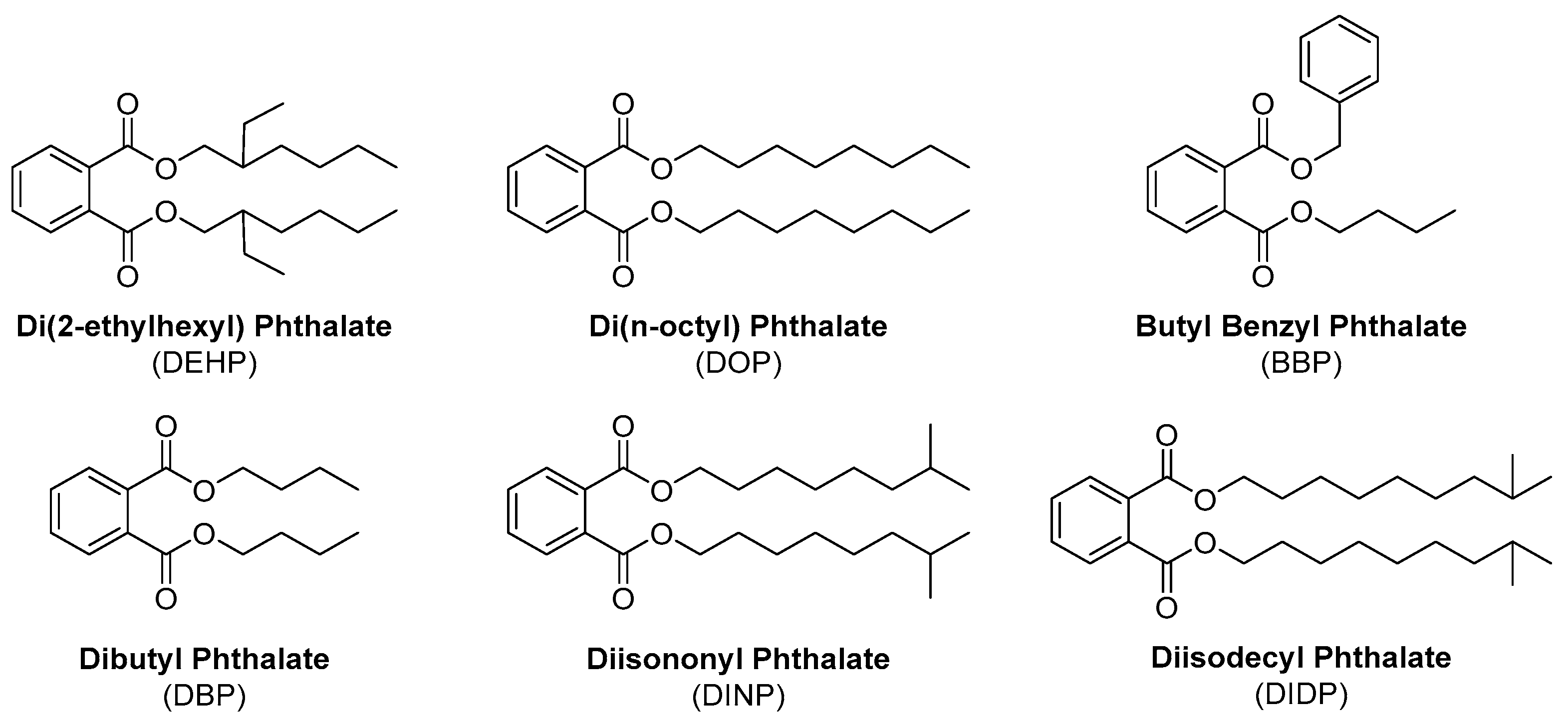
15]. Given the harm they pose to human health, six phthalate esters have been the focus of legislative attention in the United States and European Union [
12,
14]. These are di(2-ethylhexyl) phthalate (DEHP), di(n-octyl) phthalate (DOP), butyl benzyl phthalate (BBP), di(n-butyl) phthalate (DBP), di(isononyl) phthalate (DINP), and di(isodecyl) phthalate (DIDP) (
Figure 1).
DEHP is of particular concern due to its widespread use [
16]. Despite new regulations on DEHP, its legacy of widespread use ensures that disposed PVC products will continue to contain DEHP for years to come. Despite ortho-phthalate toxicity, other 2-ethylhexyl esters such as adipates, sebacates, trimellitates, terephthalates, and phosphates have been commercialized as safer plasticizers [
12]. These, and other alternate plasticizers, represented 35% of the global plasticizer market as of 2017 [
12]. Nearly 3.3 Mt (megatons) of 2-ethylhexanol (EHOH) is produced each year almost exclusively for plasticizer applications; 2-ethylhexyl esters represent 35% of the global plasticizer market [
17]. EHOH also receives use in coating materials, namely poly(2-ethylhexyl acrylate) [
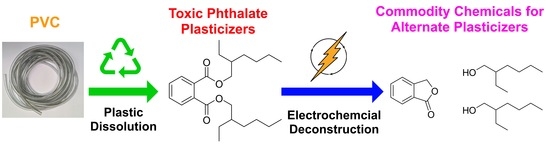
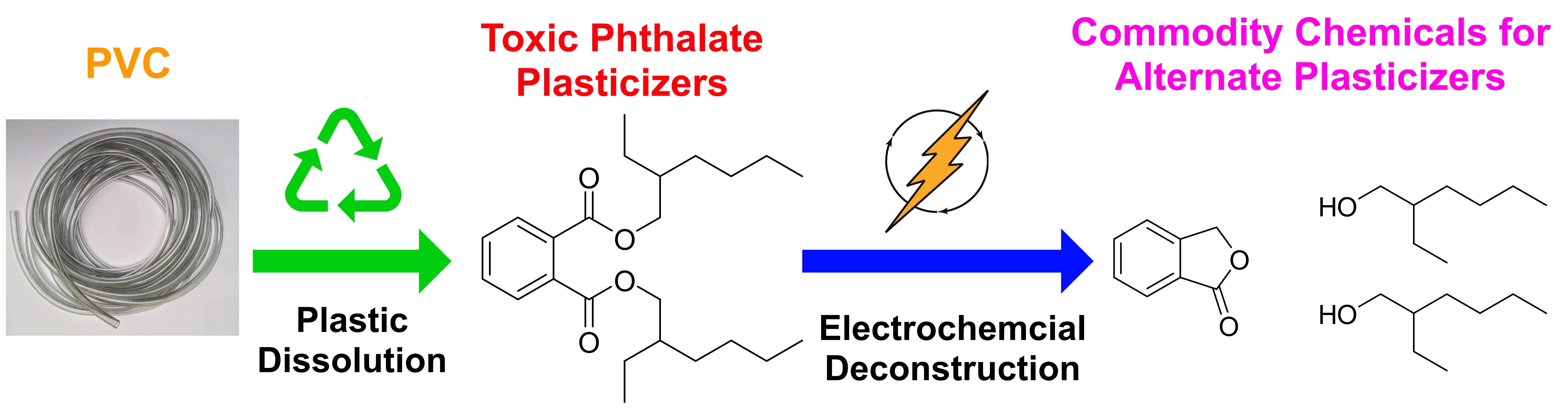
17]. It is against this backdrop that we sought to establish a strategy to deconstruct DEHP while producing the valuable commodity, EHOH. In this way, the work presented herein may serve as a method of detoxifying PVC waste in tandem with reclaiming a useful commodity chemical product.
The prospect of using electrochemical processes to degrade toxic phthalates has been considered before. Prior reports note how phthalates can leach from discarded plastics waste and enter environmental waterways [
18,
19]. Accordingly, electrochemical phthalate degradation typically addresses these molecules through the lens of waste or municipal water treatment [
18,
20]. Consequently, most methodologies present reaction conditions that do not translate readily to DEHP valorization given that their principle motivation is destruction [
18,
20,
21,
22,
23]. In consideration of the above prior art, progression to DEHP valorization for solvent-based PVC recycling requires phthalate electrochemistry to be considered under non-aqueous conditions. Electrochemical DEHP degradation has been studied in non-aqueous solvents to isolate and characterize the redox behavior of DEHP [
24]. Through cyclic voltammetry (CV) experimentation and modeling, it has been shown that DEHP is reduced to a radical anion (in which the ester carbonyl carbon is reduced) followed by the ejection of the 2-ethylhexyl radical [
24]. In principle, this initial process provides the opportunity for further reduction and protonation steps to further reduce the ester and produce EHOH instead of the radical.
Advancements in electrochemical methods to achieve de-esterification are rather recent; prior to 1992, alkyl esters required high electrochemical potentials and electrochemical reduction was not viable [
25]. Initial reports of efficient de-esterification documented conversion of methyl esters into an alcohol or an ether over platinum or magnesium electrodes in excellent yields [
26,
27,
28]. Such methods have been further advanced primarily to remove
p-tolyl ester-protecting groups electrochemically [
29,
30,
31,
32]. The reports propose a mechanism that is initiated by forming the same aromatic ester radical as discussed above. Subsequently, the reduction can then proceed further through the addition of H
+ followed by another 1
e−/1 H
+ transfer step to generate aliphatic alcohols for an overall 2
e−/2 H
+ process. Despite these reports, the use of electrochemical methods to drive de-esterification chemistry remains under explored and generally requires highly forcing conditions, high temperatures, and sacrificial electrodes. Improving the viability of such methods and applying them to the challenge of ortho-phthalate deconstruction provide important impetus for the work detailed herein.
2. Materials and Methods
Tetrabutylammonium salts (TBABF4 and TBAClO4) were purchased from Tokyo Chemical Inc. (Tokyo, Japan), further purified by recrystallization in ethanol and dried for at least one week at 60 °C in a vacuum oven prior to use. All other materials were used as purchased without any further purification unless otherwise noted. Products were supplied as follows: Fisher Scientific (Hampton, NH, USA): isopropanol (iPrOH, 99%), acetonitrile (MeCN, 99%), diethyl ether (Et2O, 99%), tetrahydrofuran (THF, 99%), methanol (MeOH, 99%), anhydrous sodium sulfate (100%), and PVC lab tubing. Oakwood Chemical (Estill, SC, USA): n-methyl-2-pyrrolidinone (NMP, 99%), 1,2-dichloroethane (DCE, 99%), and DEHP (95%). Cambridge Isotope Labs (Tewksbury, MA, USA): deuterium enriched chloroform (CDCl3, 99.8%). Tokyo Chemical Inc.: DBP (97%), BBP (97%), DINP (branched isomers), and DIDP (branched isomers). J&K Scientific (Beijing, China): DOP (98%).
Electrochemical analysis was performed on a CH Instruments (Bee Cave, TX, USA) 760D bipotentiostat or 620D potentiostat. CVs and differential pulse voltammograms (DPVs) were recorded using a 0.07 cm2 glassy carbon disk as the working electrode (CH Instruments) that had been sequentially polished with 0.3 µm and 0.05 µm alumina slurries and then sonicated for 5 min. A 1 cm2 flame-polished piece of platinum wire mesh was used as the counter electrode. A leak-free Ag/AgCl electrode (eDAQ, Inc., Colorado Springs, CO, USA) or piece of silver wire was used as the reference electrode. All electrolytic solutions were sparged for at least 30 min with dry argon and kept under a headspace of dry argon during all electroanalytical experiments. CVs were recorded using a scan rate of ν = 100 mV/s with 1 mV intervals and iR drop compensation. DPVs were recorded with iR drop compensation and an incremental voltage of 4 mV and 50 mV amplitude; the pulse period employed was 0.5 s with a 50-millisecond pulse width and 16.7-millisecond sample width.
Controlled potential or controlled current electrolysis was conducted with a CH Instruments 620D potentiostat when using a three-electrode configuration. Two-electrode electrolysis was conducted using a Kiprim (Shenzhen, China) DC310S DC switching-stabilized power supply. The electrolyte was sparged with dry N2 for at least 30 min, after which time, the sparge needle was raised above the solution, and the headspace was continuously purged with dry N2. The electrolyte solution was stirred under magnetic power using a 0.5 cm Teflon-coated stir bar at 600 rpm. In the two-electrode configuration, readings of the current were taken periodically, and the overall charge passed was calculated through integration of the i/t measurements. Graphite plates (AR14, Ohio Carbon Blank, Willoughby, OH, USA) or a 1 cm2 piece of platinum gauze were used as the anode and cathode where noted. Prior to setting up the electrolysis reactions, the graphite plates were sanded with 1000 grit sandpaper and sonicated for 5 min in MeCN; the platinum gauze was flame polished prior to use.
To concentrate/isolate the electrolysis products of interest, the electrolyte was processed via the following methods (following electrolytic reactions). For bulk electrolysis using NMP-based electrolytes, the crude electrolyte solution was added to approximately 50 mL of Et2O. The Et2O was then washed with three 150 mL portions of saturated brine, collected, dried over Na2SO4, and filtered. The Et2O was then removed by rotary evaporation. For bulk electrolysis using acetonitrile-based electrolytes, the crude electrolyte solutions were directly concentrated by rotary evaporation. Then, 50 mL of Et2O was added to the resulting slurry, and the resulting mixture was sonicated for 30 s to precipitate TBAClO4. The heterogenous solution was then filtered over a medium glass frit and washed with three portions of Et2O. All Et2O fractions were combined and concentrated by rotary evaporation.
Preparatory reverse phase high-pressure liquid chromatography (HPLC) was employed to concentrate/characterize the aromatic products formed during the electrolysis reactions. To isolate such products, the crude electrolyte was concentrated to a slurry by rotary evaporation and then dissolved in 2 mL of methanol. Subsequently 250 µL of the analyte was injected on to an Agilent (Santa Clara, CA, USA) Pursuit XRs 5 µm C-18 reverse-phase column (150 mm long). Elution was performed using an Agilent 1290 Infinity II system to elute with MeCN and water containing 0.1% formic acid at a flow rate of 20 mL/min. Elution began at 10% MeCN which was then ramped up to 50% over the course of 15 min, then was increased to 95% over the next 3 min, and finally held for 2 min to completely flush the column. Aromatic products of interest were detected by absorbance at 210 and 230 nm via an Agilent 1260 Infinity III variable wavelength detector and collected according to peaks triggered by a response at 230 nm. The eluent was also monitored by an Agilent Infinity Pro iQ standard quadrupole detector with electrospray ionization to evaluate the mass of eluted products. Isolated fractions were then concentrated by rotary evaporation for subsequent characterization.
For all procedures, the focus of this work was primarily to investigate the extent of electro-conversion; for that reason, the yield of the alkyl alcohol products resulting from phthalate reduction were then quantified via 1H nuclear magnetic resonance spectroscopy (NMR) unless otherwise noted. DCE was used as an internal standard, 0.100 mmol of DCE (7.9 µL) was mixed with the product followed by CDCl3, NMR spectra were acquired on a portion of this mixture and the products were compared to known 1H spectra of the relevant molecules. Decoupled 13C NMR spectroscopy, 1H–13C heteronuclear single quantum coherence spectroscopy (HSQC), and 1H–13C heteronuclear multiple-bond correlation spectroscopy (HMBC) were each employed to characterize complex products formed upon phthalate electrolysis. All NMR spectra were recorded on a Bruker (Billerica, MA, USA) AVIII 600 MHz NMR spectrometer equipped with a 5 mm Bruker SMART probe.
3. Results and Discussion
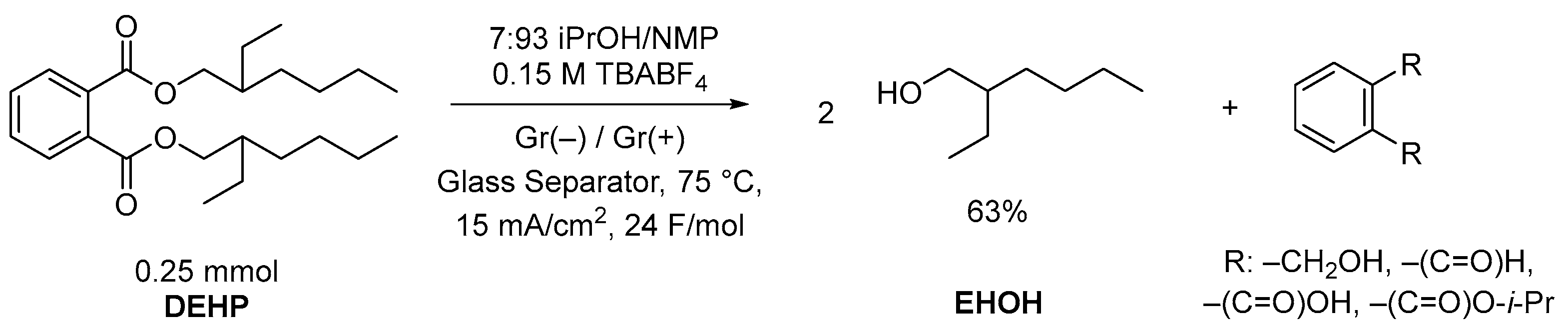
Considering the utility of EHOH and the prevalence of DEHP as a plasticizer, we used this phthalate (DEHP) as the principal model compound for method development. We initially surveyed conditions intended to approximate prior reported conditions for electrochemical ester reduction [
30,
31]. This initial reaction process, shown in
Scheme 1, employs graphite wafers as both the anode and cathode, with a two-compartment electrolysis cell and TBABF
4 in a solution of 7% isopropanol (iPrOH) in NMP as the electrolyte solution. These controlled current electrolysis conditions (
j = 15 mA/cm
2 at 75 °C) returned 63% of the total possible EHOH, which is a significantly diminished yield compared to prior reports of ester reduction electrochemistry. Furthermore, the process depicted in
Scheme 1 proceeded with low Faradaic efficiency (FE = 11%). Sequential reaction optimization steps were performed to improve the reaction conditions. We also noted that the use of TBABF
4 and NMP to comprise the electrolyte posed several practical challenges, as detailed below.
Given the above conversion, a series of reaction optimizations were considered as presented in
Table 1. The first optimization step (
Table 1, Entry 1) aimed to improve product isolation/quantification and to lower the overall energy profile of the reaction since initial conditions required >30 V of applied potential. Since it is challenging to separate both TBABF
4 and NMP from the phthalate electrolysis products, they were substituted with TBAClO
4 and MeCN, respectively. Switching to TBAClO
4 allowed for straightforward removal of the electrolyte salt via precipitation in Et
2O, following electrolysis. Furthermore, substituting NMP for a lower boiling point solvent facilitated reaction workup and solvent removal, thus greatly reducing the amount of Et
2O required for TBAClO
4 precipitation.
Additional changes to the reaction conditions aimed to significantly lower the energy profile of the electrolysis reaction. The overall cell voltage was lowered by switching to a one-compartment electrolysis cell configuration and changing the anode material to Pt. Overall energy requirements were further optimized by adjusting the electrolysis temperature to room temperature (25 °C) and shortening the electrolysis time by more than half (10 F/mol as opposed to 24 F/mol, while maintaining current at
j = 15 mA/cm
2; note:
n F/mol correlates with passing
n equivalents of electrons over the course of the electrolysis reaction). The combination of modifications outlined (
Table 1, Entry 1) resulted in the nearly doubling of the reaction’s current efficiency to FE = 20%, with a slightly decreased yield of EHOH (52%). These initial steps served as a springboard to further improving the yield and efficiency of the phthalate deconstruction process.
Subsequent optimizations focused on improving the yield of EHOH. Constant current electrolysis conducted at a reduced current of
j = 7.5 mA/cm
2 showed a significant improvement in EHOH generation (
Table 1, Entry 2), with the yield of the product alcohol rising from 52% to 80%. Increasing the concentration of iPrOH (which serves as the proton source for the reaction) in the electrolyte further improved the electrolysis yield and FE (
Table 1, Entry 3); however, we found that under these conditions, the cell voltage required to drive DEHP deconstruction increased by more than three volts to
Ecell ~ 9.3 V. To improve the energy efficiency (i.e., the applied cell voltage) of the electrolysis reaction, electrochemical deconstruction was conducted potentiostatically instead of at a set current. The switch to controlled potential electrolysis (CPE) conditions permitted the amount of energy delivered at the cathode to be specifically optimized for the DEHP reduction process. Electrolyzing DEHP using a three-electrode configuration in a one-compartment cell using a silver wire as a quasi-reference electrode required that the cathode be poised at
Ecat = −2.37 V (
Ecell = 6.2 V). Under these conditions (
Table 1, Entry 4), the working potential remained stable over the course of the electrolysis reaction (total of 8 F/mol passed), which returned a quantitative amount of EHOH at the cost of maintaining a low current (see
Supplementary Materials,
Figure S1). To improve the overall kinetics of the electrolysis, we found that CPE may be conducted using a two-electrode configuration at
Ecell = 6.3 V (
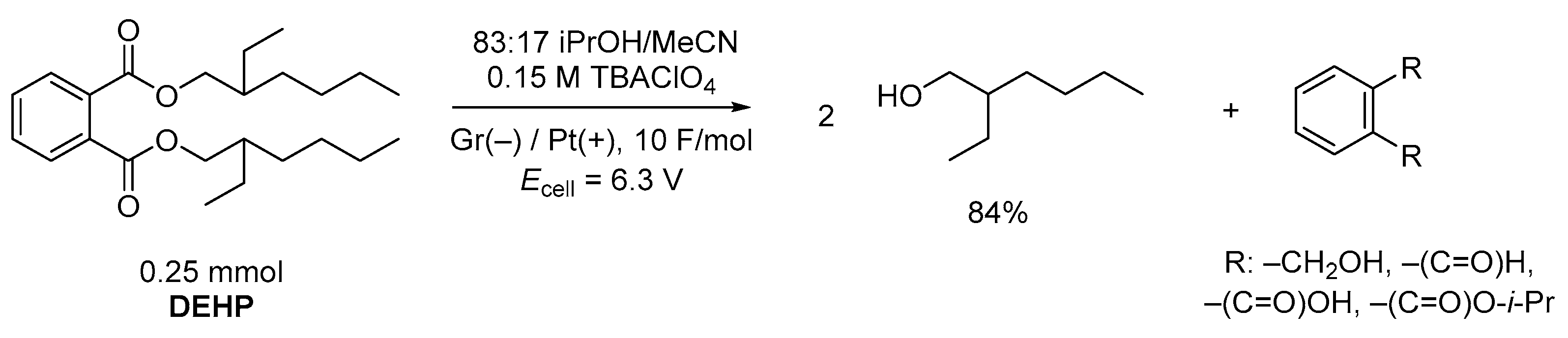
Table 1, Entry 5), which provides consistent and high yields for the DEHP deconstruction product, EHOH (yields consistently ~85%), with reasonable current efficiencies (FE ~ 35%). The final optimized set of electrolysis conditions and reaction process developed for EHOH production for DEHP is shown in
Scheme 2.
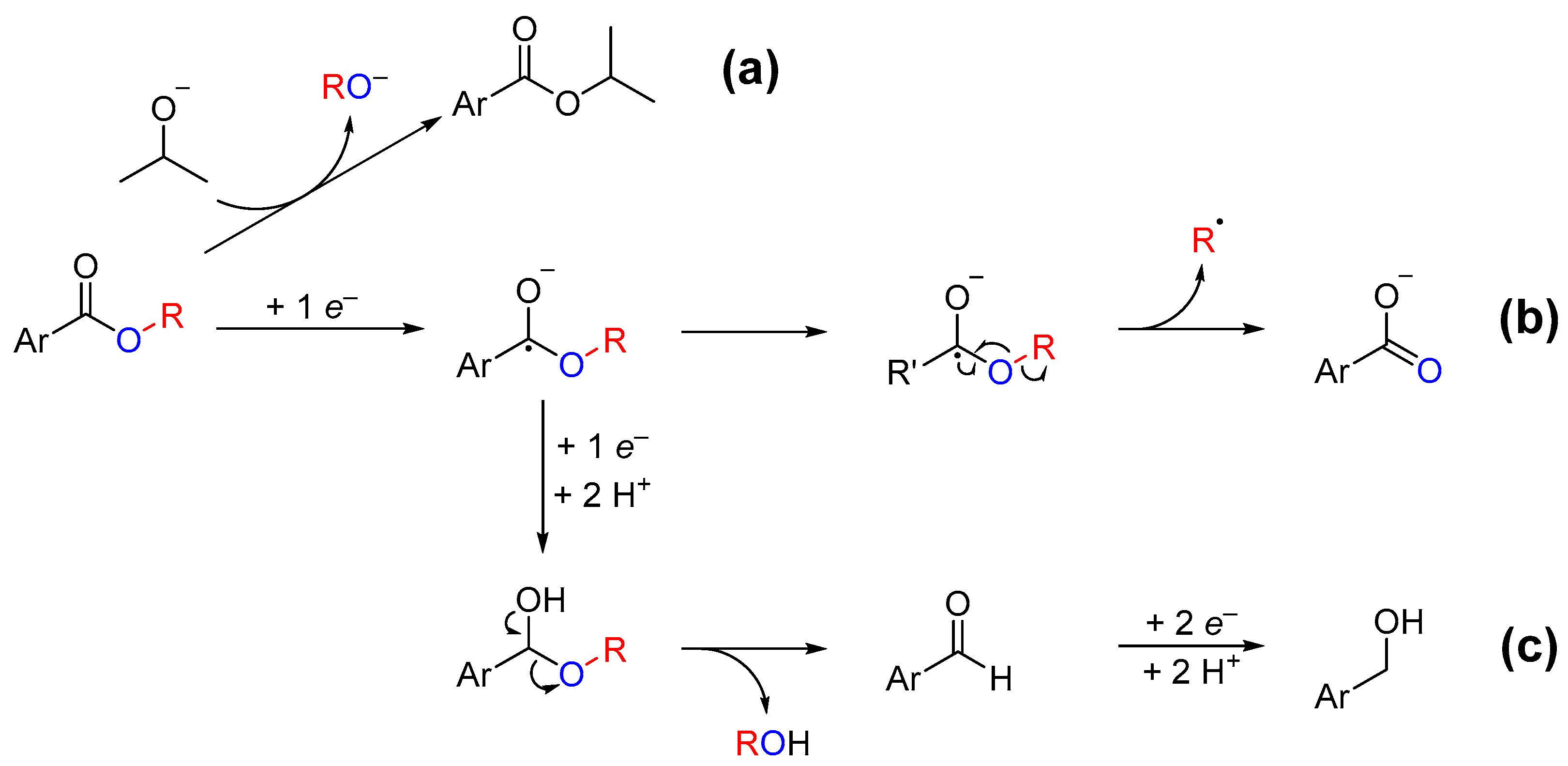
Notably, several different reductive pathways may feasibly result in liberation of the 2-ethylhexyl branch from DEHP. Three such pathways are illustrated in
Scheme 3. The first pathway (a) is an indirect process that would effectively transesterify DEHP with the iPrOH solvent. This process may be viable if H
2 generation (from iPrOH reduction) takes place with sufficient efficiency to cogenerate the iPrOH anion, isopropoxide, in high enough levels such that it can nucleophilically facilitate transesterification. The second potential pathway (b) occurs through one-electron reduction of the ester, which triggers an electronic rearrangement to produce the carboxylate and 2-ethylhexyl radical, which may in theory dimerize, undergo further reduction, or otherwise be trapped to generate off-target products. The third pathway (c) is initiated via the same process as pathway (b); however, instead of an electron rearrangement/fragmentation process taking place from the initially formed carbonyl radical anion, 1
e− and 2 H
+ are delivered to form a hemiacetal intermediate. The hemiacetal can then eject the EHOH product, leaving behind the resulting aryl aldehyde. The aldehyde may then also be reduced in a subsequent 2
e−/2 H
+ fashion to form the corresponding benzyl alcohol.
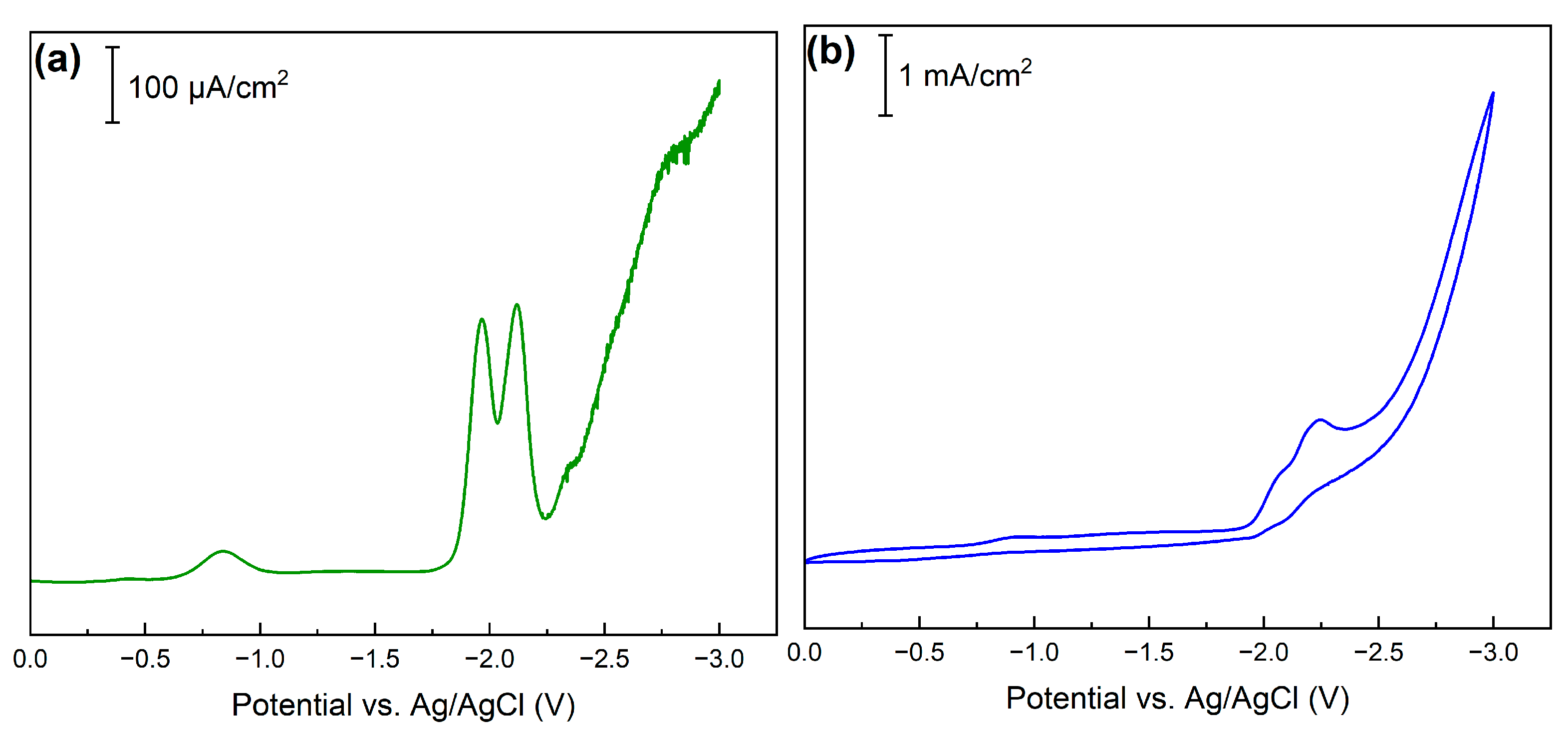
A combination of electroanalytical data and results from the electrolysis experiments described above suggest that the third pathway (c) is the most likely pathway by which DEHP deconstruction takes place. To this point, voltametric analysis supports a two-electron reduction pathway. A differential pulse voltammogram (DPV) recorded for DEHP using the optimized electrolyte system for EHOH production is shown in
Figure 2a and reveals four electrochemical events. These include an initial wave at −0.8 V vs. Ag/AgCl which is consistent with an electrode adsorption process. The DPV then exhibits two redox waves at −1.96 and −2.12 V vs. Ag/AgCl. These have both been confirmed to be single electron events based on electron counting experiments conducted using an equimolar amount of ferrocene in the electrolyte. The same electrochemical events monitored using the cyclic voltammogram (CV) are shown in
Figure 2b and demonstrate that both of these one-electron redox processes are irreversible. This observation can be attributed to significantly increased diffusion of the products formed during reduction given that they are dramatically lower in molecular weight than DEHP. The final increase in current (at potentials more negative than approximately −2.3 V) observed in both the CV and DPV is typical of solvent activation, namely iPrOH reduction to form H
2 and isopropoxide.
The results obtained upon optimization of the DEHP bulk electrolysis conditions further support pathway (c) as being the dominant process by which EHOH is liberated. When electrolysis is carried out using a three-electrode setup where the potential is held only slightly above the first reversible wave (
E = −2.2 V vs. Ag/Ag
+) for 6 F/mol (i.e., 6 equivalents of electrons passed per mol ortho-phthalate present in the reaction solution), a paltry current efficiency of just FE = 6% is observed. However, when the potential is raised to
E = −2.37 V vs. Ag/Ag
+, which is only ~200 mV more negative than the second redox event, the amount of EHOH produced (and associated FE) is quantitative (
Figures S2 and S3). Regardless of whether
Ecat is −2.2 V or −2.37 V (i.e., both of the conditions highlighted above), insufficient potential is provided to generate the high concentrations of isopropoxide needed to traverse pathway (a). Additionally, it is only when the electrode is held at the more negative bias (
Ecat = −2.37 V) that there is sufficient driving potential to perform the second reductive step for pathway (c).
When taken together, the above results point to the two-electron pathway (c) being the dominant process by which electrochemical DEHP deconstruction takes place. We note that pathway (b) is a much less plausible process under the conditions surveyed, since this pathway does not terminate in the formation of EHOH, but rather would be predicted to generate the primary 2-ethylhexyl radical. Importantly, no side-products that might be expected to form from the alkyl radical were detected following any of the electrolysis experiments described herein. Furthermore, the primary radical would not only be an energetically unfavorable intermediate to access, but there is no major source of •OH present that would allow pathway (b) to efficiently generate EHOH.
We note that the above results can be evaluated independently of the oxidative processes occurring in the cell, since similar results are obtained when conducting potentiostatic DEHP electrolysis at varying working biases in two-compartment cells separated by a sintered glass frit. When electrolysis was conducted in a two-compartment cell at
Ecat = −2.37 V vs. Ag/Ag
+, high EHOH product yield (yield = 81%) and current efficiency (FE = 53%) were observed. By contrast, running a similar two-compartment electrolysis reaction at
Ecat = −2.2 V vs. Ag/Ag
+ exhibited low yield (yield = 47%) and current efficiencies (FE = 15%) for EHOH generation (
Figures S4 and S5). Once again, the results from the two-compartment electrolysis experiments are consistent with a second 1
e− reduction of the carbonyl anion radical shown in pathway (b) to generate the hemiacetal, which is critical to efficient phthalate deconstruction.
Additional support for pathway (c) is also garnered by identification via multiple NMR techniques of the principal aromatic product that is produced following electrolysis under these two-compartment conditions (
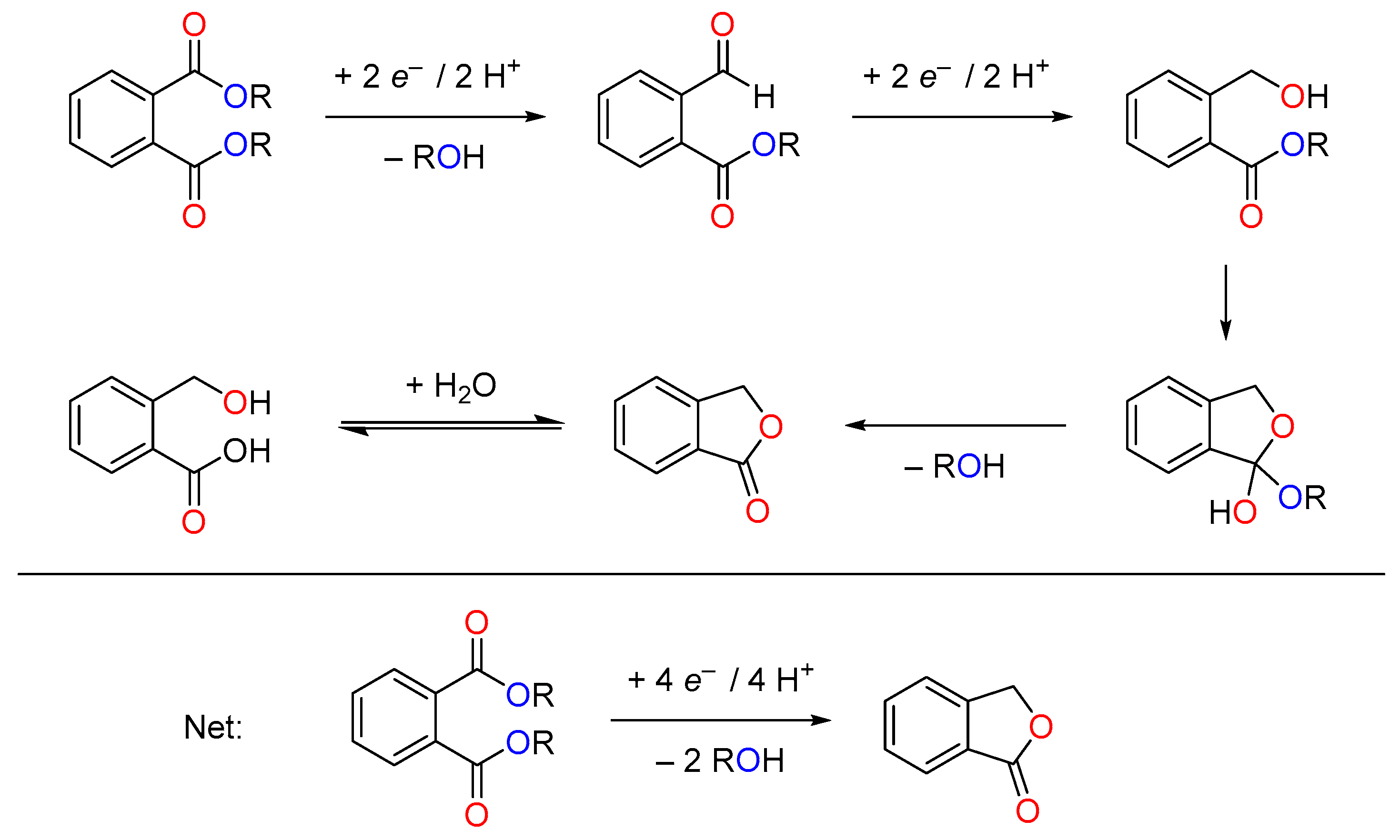
Figure S6). Attempts to isolate and characterize the aromatic products of DEHP electrolysis revealed the presence of 2-hydroxymethylbenzoic acid in 67% yield (
Figures S7–S10). Such a yield of the aromatic product corresponds well with the EHOH yields of ~80%. Formation of this primary alcohol-containing product is consistent with the route illustrated by pathway (c) following a second 2
e−/2 H
+ reduction of a hypothesized aldehyde intermediate formed upon ejection of the first EHOH equivalent (making for an overall 4
e−/4 H
+ process). Although this product includes a carboxylic acid moiety that would be typical of pathway (b), the carboxylate likely forms via anchimeric assistance from the neighboring alchohol and is further encouraged by the basic conditions at the cathode [
33,
34,
35]. In this fashion, we propose that the electrochemically formed benzylic alcohol nucleophilically adds to the neighboring 2-ethylhexyl ester to eject EHOH and form phthalide. Adventitious water within the reaction conditions may hydrate the inferred intermediate γ-lactone to regenerate the hydroxymethyl moiety alongside a carboxylate (
Scheme 4).
With the electrolysis reaction optimized for DEHP reduction and the primary pathway of phthalate deconstruction identified, we turned our attention to the other five phthalates of concern that frequently appear in PVC waste streams (see
Figure 1): DOP, DBP, DINP, DIDP, and BBP. As shown in
Table 2, in general, the phthalates that bear long-chain aliphatic groups (i.e., DEHP, DOP, DINP, DIDP) show high yields for the release of their corresponding alcohols upon electrolysis. By contrast, DBP and BBP both showed relatively poor electrochemical conversion to generate
n-butanol and benzyl alcohol products. Notably, we found that the degradation of the benzyl moiety of BBP produced appreciable levels of benzaldehyde (7 ± 2% yield) instead of benzyl alcohol, which may result from migration of the benzyl alcohol generated at the cathode and subsequent oxidation at the anode. To investigate whether these lower yields for DBP and BBP were a result of the electric double-layer (EDL) structure formed by the TBA cation, DBP was electrolyzed using the smaller, less greasy tetraethylammonium chloride-based electrolyte; however, very similar conversions to
n-butanol were observed. Thus, the improved yields with larger phthalates may be a result of their decreased diffusion or enhanced absorption on the cathode surface, both of which would facilitate multiple redox steps that are shown to be important for phthalate ester deconstruction, and alcohol release.
To evaluate the practical utility of the phthalate deconstruction method on an authentically derived sample, we harvested DEHP directly from PVC resin and then subjected the material to electrolysis. Briefly, a piece of PVC lab tubing was dissolved in THF and precipitated in MeOH. The solution was then filtered to remove the plasticizer-free PVC polymer and the organic extract was concentrated to produce a solid mixture of the additives that had been present in the PVC tubing (31% w/w of the initial tubing). NMR evaluation of the extracted solids showed that the predominant additive was DEHP (79% v/v).
When the additives were subjected to electrolysis under the same, optimized conditions detailed in
Scheme 2, EHOH was delivered in 67 ± 12% yield (FE 27 ± 5%). The slightly diminished yield (relative to when virgin DEHP is employed) is likely the result of the oxidative products of the other additives or metals such as Zn or Sn present in the PVC extract (formed at the anode) being reduced at the cathode instead of the DEHP. Notably, longer electrolysis times (19 F/mol) and mid-electrolysis electrode exchanges had no significant effect on EHOH yield in one-compartment cells (61% and 71%, respectively). To confront this limitation, we found that the generation of EHOH could be increased to 91% when electrolysis of the PVC additives extract was conducted using a two-compartment cell, thereby preventing these deleterious additives from being continuously oxidized and reduced. Accordingly, these results demonstrate that authentic plasticizer additives found in commercial samples of PVC can be efficiently addressed using the electrochemical methods that have been developed in this study.
4. Conclusions
This work establishes a practical electrochemical strategy for the deconstruction of ortho-phthalate plasticizers and provides a potential route to transform these persistent compounds of environmental concern into recoverable chemical value streams. By systematically optimizing reaction conditions, we demonstrate that di(2-ethylhexyl) phthalate (DEHP) can be selectively reduced under mild, non-aqueous conditions to generate the valuable commodity chemical 2-ethylhexanol (EHOH) in high yield and with moderate Faradaic efficiency.
A combination of electroanalytical data along with results from controlled electrolysis experiments supports the stepwise 2 e−/2 H+ reduction of DEHP that results in ejection of one equivalent of EHOH upon collapse of a purported hemiacetal intermediate. A subsequent 2 e−/2 H+ process further activates the resultant ortho-ester aldehyde to liberate a second equivalent of EHOH. Efforts to understand the pathway for phthalate deconstruction help demonstrate that electrochemical ester activation can be tuned toward productive bond cleavage and molecular recovery, rather than indiscriminate degradation processes, which have been employed for phthalate degradation in wastewater streams. The identification of anchimeric assistance as an important element that facilitates ortho-phthalate deconstruction and EHOH product release further highlights how the plasticizer’s inherent structure and local reaction environment can be leveraged to promote efficient deconstruction pathways.
The optimized electrolytic conditions were shown to be extendable across a representative set of regulated phthalate plasticizers. High conversion efficiencies were observed for long-chain phthalates (e.g., DEHP, DINP, DIDP, DOP), suggesting that substrate size, adsorption behavior, and interfacial dynamics play a critical role in enabling the multi-electron reduction processes that lead to productive phthalate deconstruction.
Finally, a key advance of this study is the demonstration that these electrochemical transformations are directly applicable to real-world materials. Chemical additives extracted from commercial PVC can be efficiently processed under the optimized electrochemical method developed in this study, delivering EHOH in high yield. This result establishes a compelling proof-of-concept for integrating electrochemical deconstruction into solvent-based PVC recycling workflows, where removal and valorization of legacy additives remain substantial bottlenecks. The presented method may be further advanced to a flow-type process, as is utilized in industrial electrolyzers, to demonstrate process scalability and evaluate electrolyte reusability, which would both be required for this method to have utility on a commercial scale. In sum, the electrochemical approach described herein provides a foundation for closing the loop on plasticizer lifecycles, advancing our understanding of phthalate electro-reduction chemistry and the practical realization of circular strategies for PVC and related materials.