


Abstract
This study investigates the pressure-dependent structural, electronic, mechanical, and thermoelectric properties of LiYN (Y = Sr, Mg, Zn) half-Heusler compounds using first-principles calculations. The structural stability was analyzed by fitting the total energy versus volume curves using the Birch–Murnaghan equation of state, allowing the determination of equilibrium lattice parameters and bulk moduli at pressures of 0, 5, and 10 GPa. Elastic constants were calculated to assess the mechanical stability, and all compounds satisfy the Born stability criteria over the entire pressure range. The Pugh ratio (B/G) and Poisson’s ratio (ν) indicate that LiSrN, LiMgN, and LiZnN exhibit predominantly brittle behavior under 0 GPa. Electronic band structure calculations reveal that LiMgN and LiZnN exhibit direct band gaps, whereas LiSrN shows an indirect band gap. Increasing pressure leads to a systematic widening of the band gaps due to lattice compression. Thermoelectric properties were evaluated using the Boltzmann transport theory within the constant relaxation time approximation. The Seebeck coefficient, electrical conductivity, and figure of merit (ZT) were found to be strongly dependent on both temperature and pressure. Notably, at 300 K, the ZT values increase from 0.005, 0.35, and 0.54 at 0 GPa to 0.027, 1.12, and 1.13 at 10 GPa for LiMgN, LiSrN, and LiZnN, respectively. These results demonstrate that hydrostatic pressure significantly enhances the thermoelectric performance of LiYN compounds, highlighting their promising potential for thermoelectric energy conversion applications.
1. Introduction
The increasing global energy demand has motivated researchers to search for alternative energy sources and high-efficiency materials and energy-conversion devices [1,2]. In the past ten years, the field of thermoelectric materials has become more significant because of its potential to address the world’s energy dilemma. Renewable energy sources, particularly solar energy, play a crucial role in meeting the growing global energy demand [3,4]. The use of solar panels has increased significantly because they are environmentally friendly and with efficiencies above 18%. Half-Heusler compounds have attracted considerable attention for optoelectronic and energy-related applications due to their promising physical properties. Half-Heusler compounds have attracted significant interest for energy-related applications due to their high energy conversion efficiency. Thermoelectric devices are capable of directly converting heat into electrical energy and vice versa [5,6]. These materials are beneficial for smart metering as well as energy harvesting and heat flow sources [7,8].
Half-Heusler materials are compounds with the formulation XYZ. These compounds have attracted considerable interest recently and are seen as materials with potential for various uses [9], such as topological and spintronic insulators [10], as well as thermoelectric materials [11]. The total quantity of valence electrons in these compounds allows for their identification. Compounds with 18 valence electrons are typically semiconductors, while those with 22 valence electrons often exhibit metallic or magnetic behavior [12].
Recently, lithium atom-based Heusler semiconductors have attracted much attention for their potential applications, such as spintronics, optoelectronic systems, and solar cells [13]. Moreover, several studies have shown that these compounds exhibit direct or indirect band gaps over a wide energy range, which can be tuned by pressure and by the electronegativity differences among their constituent elements [14]. In addition, they have a high figure of merit, which makes these materials more suitable for optoelectronic applications; they have received great attention, especially in solar cells and thermoelectrics. Among these studies, we find the study of the two crystalline structures LiMgN and LiZnN [5]. They explored the electronic band structures obtained, indicating that LiZnN and LiMgN are semiconductors with a direct band gap. Furthermore, LiMgN and LiZnN compounds have calculated lattice thermal conductivities of 19.31 Wm−1 K−1 and 18.74 Wm−1 K−1, respectively; however, their Kt/τ rapidly decreases as the temperature rises to 1100 K. Additionally, we investigated the thermoelectric properties of LiMgN and LiZnN at various temperatures. Our findings demonstrated that LiMgN and LiZnN exhibit promising thermoelectric performance, particularly at elevated temperatures, with reported ZT enhancement depending strongly on the computational approach and transport assumptions, suggesting that these materials have the potential to be thermoelectric. At high temperatures, these materials show improved thermoelectric performance. On the other hand, in the study of LiCaX (X: N, P, and As) composites by A. Azouaoui et al. [15], they concluded that as the temperature rises, lattice thermal conductivity falls, and the figure of merit rises as well. For LiCaN, LiCaP, and LiCaAs, the maximum values are 0.73, 0.49, and 0.57 at 1000 K, respectively. Because of these characteristics, LiCaX is a promising material for thermoelectrics. Parsamehr et al. [16], also investigated the LiMgZ (Z = P, As, Bi) compounds, where structural calculations were performed. Furthermore, the electron transport properties of these materials at different temperatures revealed that the dimensionless figure of merit (ZT) reaches maximum values of 0.81, 0.810, and 0.780 at 200 K for LiMgN, LiMgAs, and LiMgBi, respectively. The elastic constants further validate the stability of these compounds. In addition, the compounds ScPtSb and YPtSb were studied by M. Radjai et al. [17]. This study focused on exploring the calculated equilibrium lattice parameters, finding that they match available experimental and theoretical values quite well.
Despite previous studies on Li-based nitrides, the impact of hydrostatic pressure on their thermoelectric properties remains insufficiently understood, particularly regarding the interplay between electronic structure and transport behavior. There is a study that aims to evaluate and develop them by modeling and modifying the structural and electronic properties in order to make these materials more applicable and efficient in the installation of photovoltaic solar cells (PSCs). We find the study of MCoSb compounds (M: Ti, Zr, and Hf) conducted by Himanshu Joshi et al. [18], in which it was found that for the half-Heusler compounds being examined, the modulus of elasticity increases with increasing pressure as it does when the temperature increases. Although several studies have examined the structural and electronic properties of Li-based nitrides, the impact of hydrostatic pressure on their thermoelectric performance remains poorly understood. Most previous research has focused on ambient conditions, leaving open questions regarding how pressure influences the band structure, Fermi level, and transport coefficients [19]. Similar trends in structural, transport, and optical properties have also been reported in related complex oxide systems under varying conditions, as discussed in recent studies [20,21,22]. In particular, the effect of different cation substitutions (Sr, Mg, Zn) on tuning the electronic density of states under compression has not been systematically investigated. Our study addresses these gaps by employing first-principles calculations to analyze both the structural stability and pressure-dependent thermoelectric properties of Li(Sr/Mg/Zn)N compounds, thereby offering new insights into their potential as high-performance thermoelectric materials. Applying pressure is a highly effective method for enhancing material properties because it directly alters their electronic and crystalline structures. By compressing the lattice, pressure changes interatomic distances and affects band dispersion. These modifications shift the Fermi level and alter the density of states, which in turn influence transport properties. As a result, pressure can improve conductivity, the Seebeck coefficient, and the thermoelectric figure of merit. Consequently, pressure is considered a valuable approach for modeling and optimizing material performance, as supported by several studies [23,24,25]. In this work, we investigate the properties of LiSrN, LiMgN, and LiZnN compounds. LiSrN, LiMgN, and LiZnN half-Heusler (HH) compounds are materials with a lithium base that are members of the HH ternary semiconductor family. Lithium (Li) crystals are among these minerals, as are ions of strontium (Sr), nitrogen (N), zinc (Zn), and magnesium (Mg). LiSrN, LiMgN, and LiZnN materials have recently drawn attention because of their exceptional electronic qualities for a range of applications. Their unique characteristics and peculiar crystal structure make them attractive options for electronic and optoelectronic devices. This study is based on the effect of pressure on three materials, LiSrN, LiMgN, and LiZnN, in order to evaluate their structural, electronic, and thermoelectric properties. Pressure provides an effective route to tune structural properties, and thus stability and thermoelectric properties are evaluated, all of which contribute to improving their thermoelectric performance and energy conversion efficiency.
Hydrostatic pressure is employed here as a fundamental tuning parameter to probe intrinsic structure–property relationships under isotropic lattice compression. Although practical thermoelectric devices often experience strain or uniaxial stress rather than externally applied hydrostatic pressure, hydrostatic compression can simulate chemical pressure, epitaxial strain, and high-pressure synthesis conditions. Therefore, pressure serves as an effective route for understanding and optimizing material performance.
In this work, we systematically investigate the effect of hydrostatic pressure (0–10 GPa) on the structural, electronic, mechanical, and thermoelectric properties of LiSrN, LiMgN, and LiZnN compounds using DFT and Boltzmann transport theory.
2. Calculation Methodology
First-principles calculations were performed using the WIEN2k code (version 23.2) within density functional theory employing the GGA-PBE exchange-correlation functional [26,27,28]. The exchange and correlation effects were treated using the generalized gradient approximation (GGA) proposed by Perdew, Burke, and Ernzerhof (PBE) [29,30]. The electronic structure calculations were carried out within the full-potential linearized augmented plane wave (FP-LAPW) method implemented in WIEN2k [28]. The BoltzTraP package (version 1.2.5) was used to investigate thermoelectric transport properties within the constant relaxation time approximation (CRTA) [31,32]. The properties of LiYN (Y = Sr, Mg, and Zn) were modeled using the WIEN2k code.
The self-consistent calculations were performed with a total energy convergence criterion of 0.0001 Ry and a charge convergence of 0.001 e. In the computation, 1000, or 10 × 10 × 10 k-mesh, is selected as the number of points k in the Brillouin zone. The DFT approach will be used in this work to analyze these materials under various pressure scenarios and look into the alterations that follow their structural, electronic, and thermoelectric properties.
3. Results and Discussion
3.1. Structural Properties
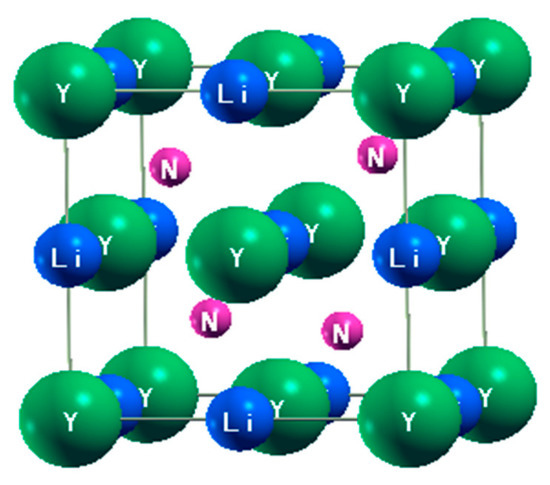
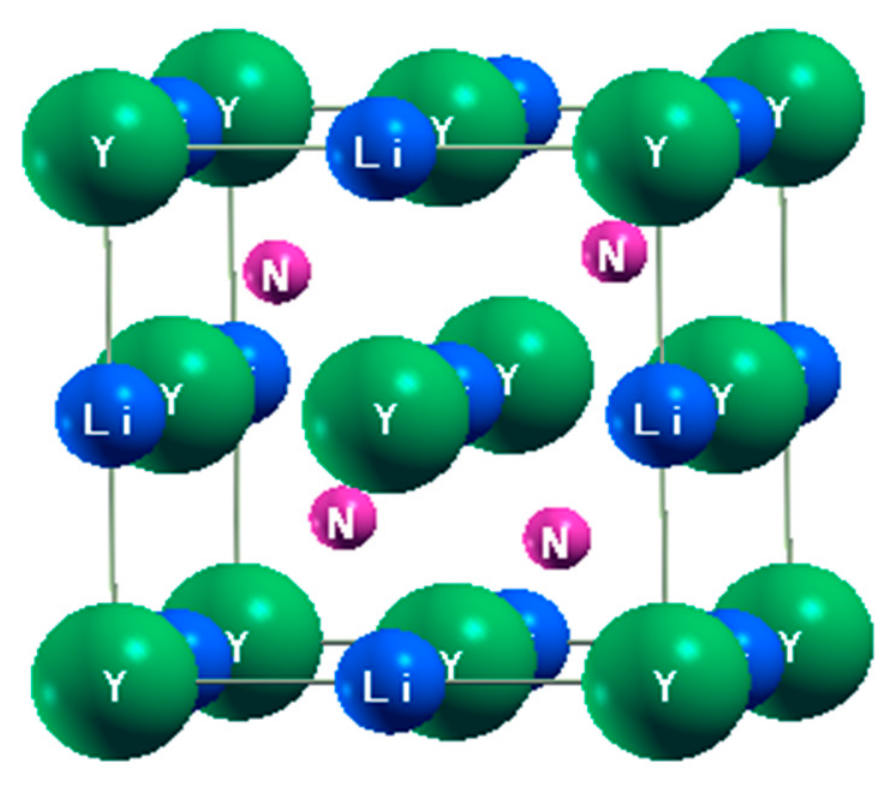
LiYN (Y = Sr, Mg and Zn) crystallize in the cubic half-Heusler structure (space group F-43m, No. 216), characteristic of XYZ-type ternary compounds. The first atom (Li) occupies the Wyckoff position 4a (0, 0, 0), while Y and N atoms occupy 4b (1/2, 1/2, 1/2) and 4c (1/4, 1/4, 1/4), respectively [14]. Figure 1 illustrates the crystal structure of LiYN compounds.
Figure 1.
Cubic crystal structure of LiYN (Y: Sr, Mg and Zn).
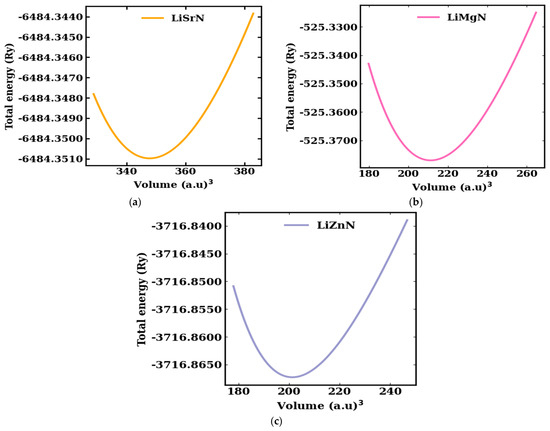
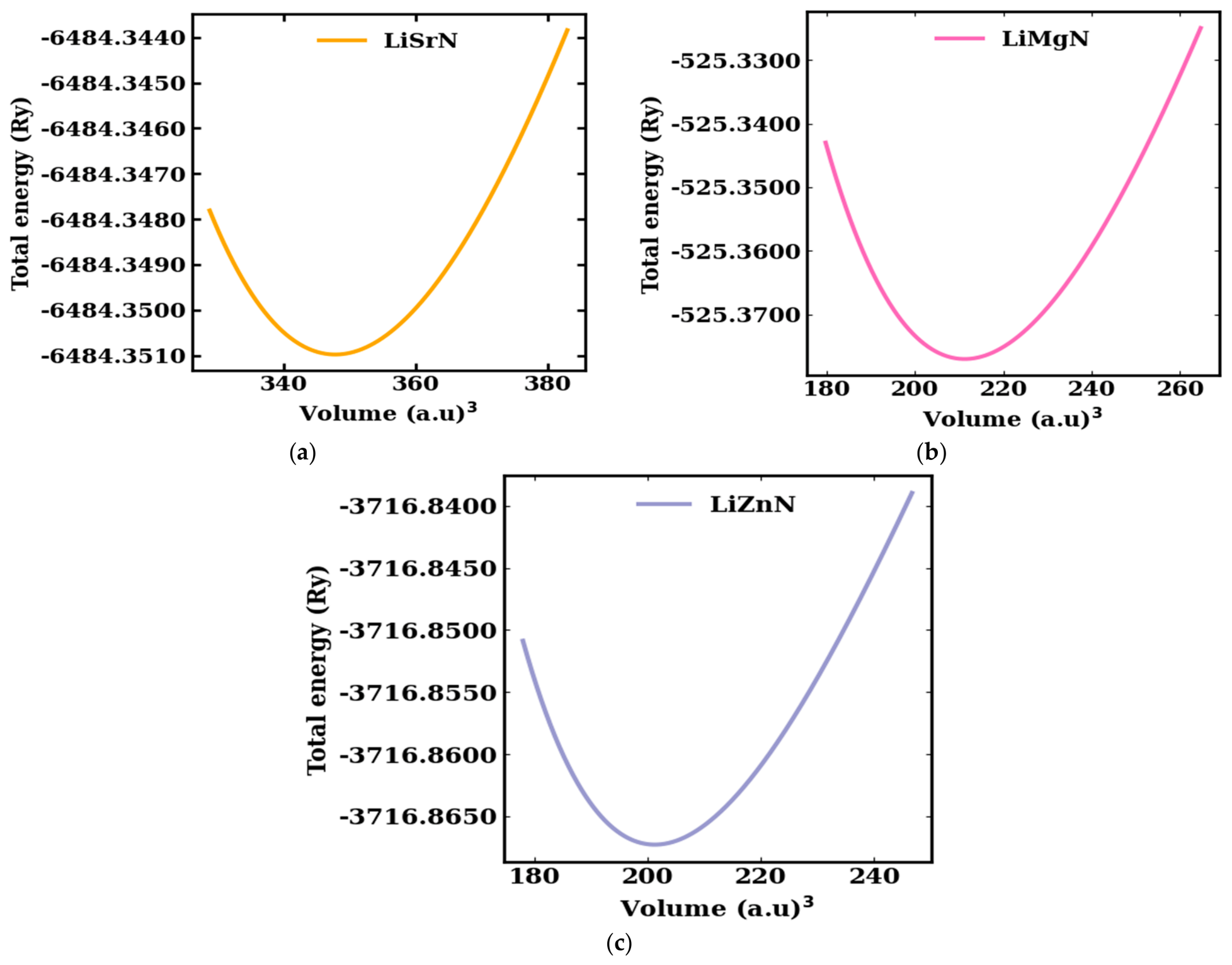
In order to determine the structural characteristics of bulk modulus (B), pressure derivative of bulk modulus B′, lattice constant (a), and total unit cell energy (E) are examples for half-Heusler compounds. It is necessary to optimize the unit cell volume of the compounds. These parameters play a crucial role in describing the structural stability and mechanical response of the system. It also determines the structural arrangements and material response under different available conditions. During optimization, the total energy of the unit cell was calculated for different volumes (Figure 2). The volume is expressed in atomic units (a.u.3) per formula unit. The total energy as a function of volume was fitted using the third-order Birch–Murnaghan equation of state [33,34,35,36]:
Figure 2.
Total energy as a function of volume for the investigated materials: (a) LiSrN, (b) LiMgN, and (c) LiZnN.
The analysis of LiYN crystalline alloys began by examining their structural characteristics. First, the equilibrium lattice parameters were found by calculating the total energy values that corresponded to various values of the equilibrium lattice parameters. The total energy calculations were performed based on different dimensions to determine the ground state volume of the studied LiYN half-Heusler crystals. Using this method, the lattice parameter and the bulk modulus B and B′ are used. B′ represents the pressure derivative of the bulk modulus, indicating how incompressibility evolves under pressure, while B describes resistance to volume compression [37]. A high value of B indicates high crystal rigidity, and the bulk modulus’s pressure variant was computed. All these calculated values for LiYN are given in Table 1. These findings suggest that the B′ of LiZnN is larger than that of LiMgN and also larger than that of LiSrN, which indicates that LiSrN exhibits lower resistance to compression compared to LiMgN and LiZnN. The hardness of LiYN increases as Y changes from Sr to Mg and then Zn. The calculated total energy curves are used here for equilibrium equation-of-state fitting rather than direct comparison of compound stability through cohesive energies. The lattice parameters of LiYN are shown in Table 1, demonstrating good agreement with both experimental data and previously reported theoretical results.
Table 1.
Optimized parameters a, V, E, B and B′ of materials LiYN (Y: Sr, Mg and Zn).
3.2. Elastic Properties
Elastic constants of solids are indicators that define the mechanical properties of materials. The studied samples of LiYN (Y: Sr, Mg and Zn) are characterized by three independent elastic constants Cij: C11, C12 and C44 [42]. These coefficients are useful for determining the mechanical stability and internal forces of solids, as well as to establish a correlation between the dynamic and mechanical characteristics of crystals [43]. In order to ensure the mechanical stability of materials, it is necessary that the elastic coefficients comply with the Born criteria established by [44]:
C11 − C12 > 0, C44 > 0, C11 + 2C12 > 0 and C11 > B > C12
Analyzing Table 2, it is clear that there is a crystalline stability for LiYN, since the three parameters C11, C12 and C44 meet the previous limit criteria. This confirms the mechanical stability of the investigated LiYN compounds. The elastic constant and other mechanical property values that were determined under zero pressure are consistent with the previous theoretical investigation [11,38]. Our interest is in the analysis of materials exposed to pressures between 0 and 10 GPa. Regarding the behavior of the mechanical constants, the results indicate that the mechanical parameters of the investigated materials exhibit consistent and well-defined trends. From Table 2, it appears that the constants Cij of the materials LiSrN, LiMgN and LiZnN increase with increasing pressure, so that C11 increases slowly compared to the other constant C12 and more quickly compared to the constant C44. This indicates that the C11 coefficient of compressibility is very sensitive compared to C12 and C44. A crucial metric for assessing a material’s brittleness and elasticity is the Cauchy pressure (Cp = C12 − C44). Positive Cp generally suggests ductile bonding character, while negative value indicates brittle behavior. LiYN compounds exhibit brittle behavior at ambient pressure, as evidenced by the Cp value for LiYN, which stays negative at all pressures examined and slightly rises with pressure.
Table 2.
Calculated elastic constants Cij under pressure of materials LiYN (Y: Sr, Mg and Zn).
For the study of the hardness of the studied solids, Young’s modulus E, bulk modulus B, and modulus G are examples of mechanical constants. They provide valuable data on the behavior of the material under various conditions. In addition to measuring the strength and the resulting changes within a material, they also allow the prediction of the ductile/brittle nature and elastic behavior of the half-Heusler materials. These are obtained from the previously calculated elastic constants Cij. These mechanical constants are obtained using well-known expressions, such as the Voigt–Reuss–Hill approximation [45], which is represented by the formulas listed below [46]:
where BR and BV are given as follows, respectively [47,48]:
Poisson’s ratio (ν) is expressed as
The anisotropy coefficient is expressed by:
The ratio of the tensile stress to strain is known as Young’s modulus E, which is linked with two parameters, B and G. It is also used to measure the rigidity of the solid. From the analysis of the results in Table 3, it is observed that the B and G parameters of LiZnN are larger than those of LiMgN material, and then LiSrN. The B parameter includes has values of 60.74, 89.49, and 133.34 GPa, and the G has values of 36.87, 78.49 and 103.72 GPa for all LiSrN, LiMgN, and LiZnN at 0 GPa, respectively. These parameters improve with the effect of increased pressure. While Young’s modulus (E) has a higher value for LiZnN than LiMgN, and it is also larger than LiSrN, it means that LiZnN material indicates higher stiffness than other compounds.
Table 3.
Calculated elastic parameters of materials LiYN (Y: Sr, Mg and Zn).
To determine the isotropic properties of materials, the anisotropy coefficient is defined as A [49], such that if the value of A = 1, it indicates that the material is isotropic, while A ≠ 1, confirms the crystals are anisotropic [50]. According to the values, A was 0.40, 0.61 and 0.67 for LiSrN, LiMgN, and LiZnN materials, respectively at 0 GPa. Since A ≠ 1, all compounds are anisotropic. Using the parameters B, G, and Young’s E, it is possible to calculate two ratios, namely the Pugh’s ratio (B/G) and Poisson’s ratio (v). There are two critical parameters that also describe the ductile and brittle character, which are determined using equations that have been well known, as indicated in the literature. Two parameters, namely the Cauchy pressure and Pugh’s ratio, indicate the presence of ionic character and provide information about the nature of the bonding forces in the studied crystals. Their calculated values are 1.75 and 0.26, respectively [51,52].
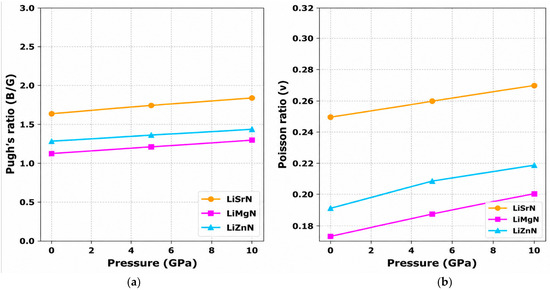
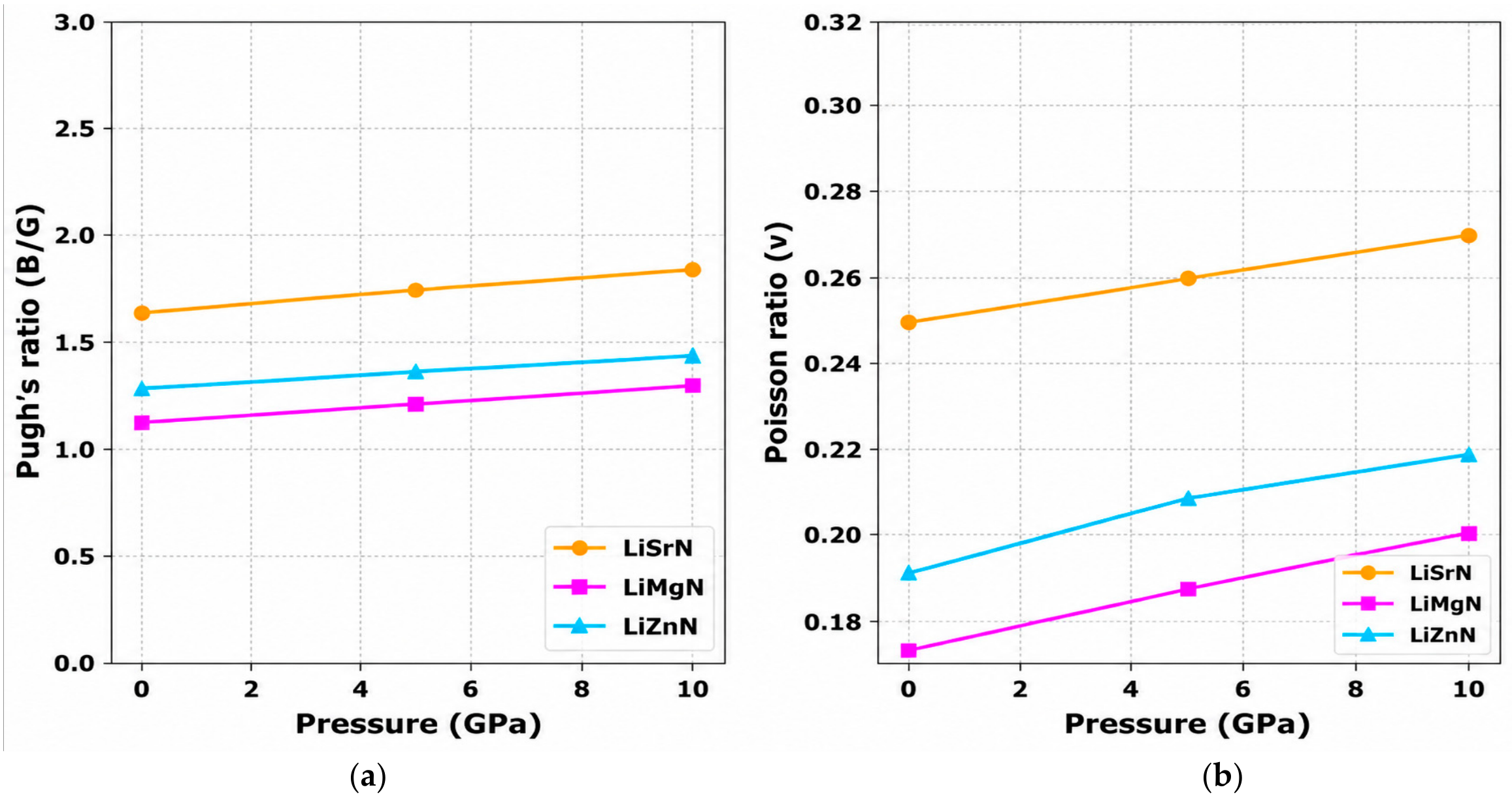
Even when involving two ratios (B/G) and (v), the calculated values at 0 GPa are 1.65 and 0.25 for LiSrN, 1.14 and 0.17 for LiMgN, and 1.29 and 0.19 for LiZnN, respectively, the B/G ratios of the compounds LiSrN, LiMgN, and LiZnN are lower than the critical value of 1.75, these materials are brittle at 0 GPa. From the analysis of the results as graphed in Figure 3, it is clearly seen that two ratios (B/G) and v are also related to the effect of pressure. The ratios (v) for LiSrN, LiMgN, and LiZnN become 0.27, 0.20, and 0.22 under an applied pressure of 10 GPa. We conclude that Poisson’s ratio increases with pressure and remains close to, but generally below, the reference value of 0.26 for brittle-to-ductile transition. On the other hand, the ratio (B/G) varies with pressure with increasing values; at 10 GPa, it has an estimated value of 1.85, 1.32, and 1.44 for LiSrN, LiMgN, and LiZnN, respectively. These results indicate an enhancement of ductile behavior under pressure. Moreover, the ductility of LiYN (Y: Sr, Mg, and Zn) is strengthened when pressure is applied, supporting the examination of both Pugh’s ratio (B/G) and Poisson’s (v) ratios. Therefore, wherever strong ductility is needed to construct 3D half-Heusler compounds devices, pressure can be a useful strategy.
Figure 3.
(a) Variation of Pugh’s ratio (B/G), (b) variation of Poisson’s ratio (v) of LiYN (Y: Sr, Mg and Zn) materials under pressures 0, 5 and 10 GPa.
3.3. Electronic Properties
Hydrostatic pressure significantly modifies the lattice parameters of both LiYN crystal compounds; the lattice contraction was observed, as shown in Table 4. At 0 GPa, the parameter values of LiSrN, LiMgN, and LiZnN are respectively set to 5.90, 5.01, and 4.93 Å, which become 5.64, 4.84, and 4.76 Å at 10 GPa. It was also noted that the decrease in parameter values affects LiSrN, LiMgN, and LiZnN compounds, corresponding to the estimated reduction variance percentage of 4.61%, 3.58%, and 3.25%, respectively. This confirms that the LiSrN compound is more sensitive to pressure than the others. This behavior is mainly attributed to differences in ionic radii and electronegativity among the Y-site elements (Sr, Mg, and Zn).
Table 4.
Calculated lattice parameter and gap energy versus pressure of materials LiYN (Y: Sr, Mg and Zn).
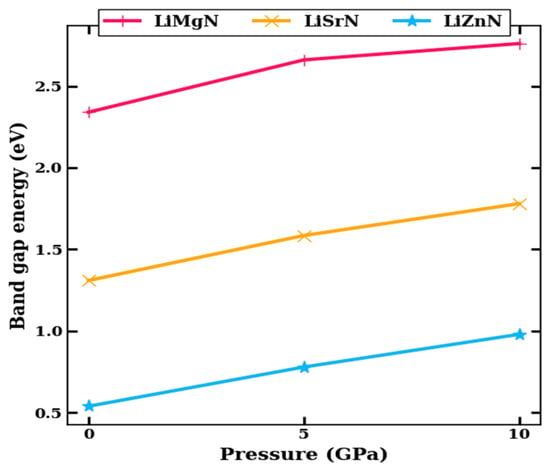
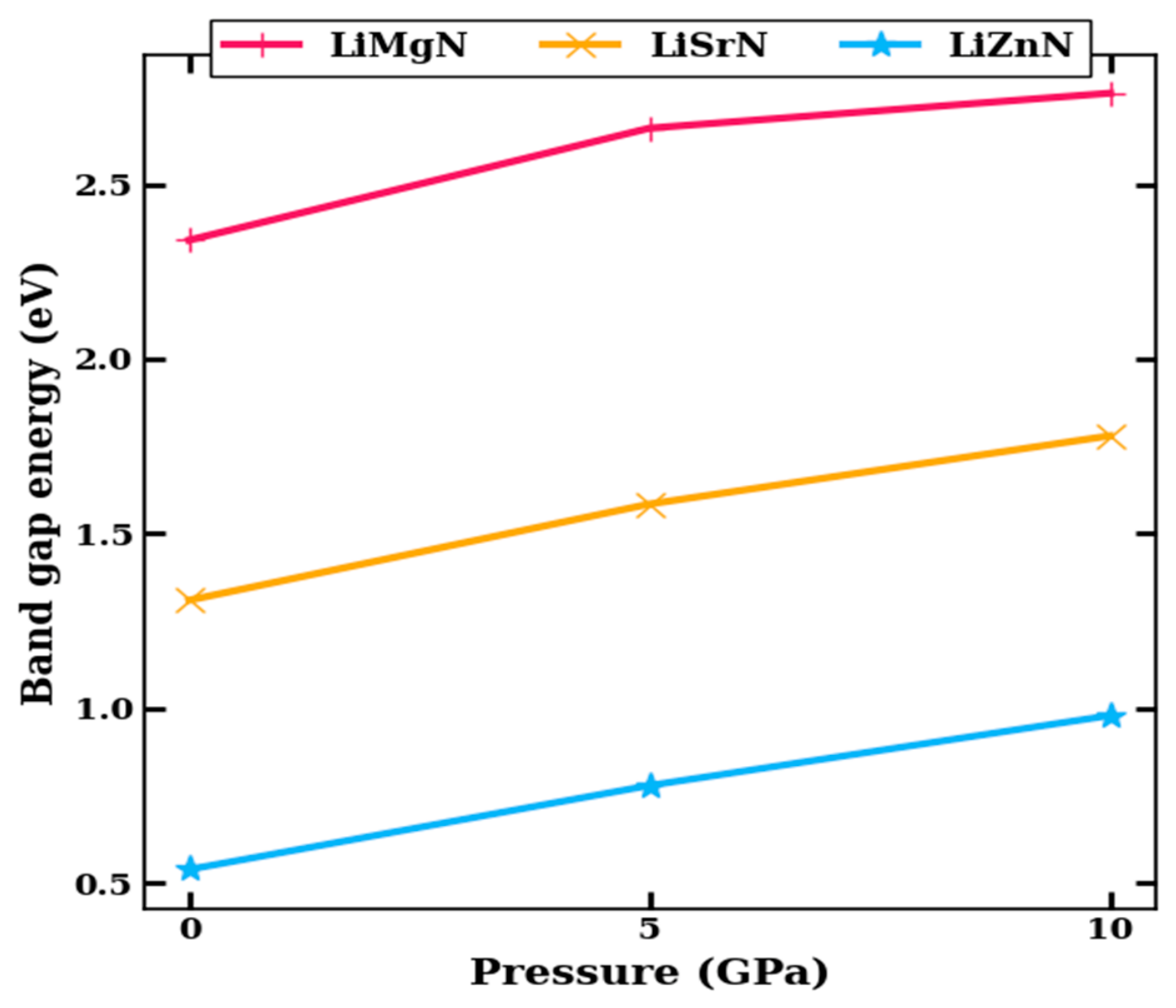
The calculated band gaps show a clear tendency to vary the energy values when the pressure effect is applied. A linear increase in the gap values between compounds was observed, as shown in Figure 4. This is due to the pressure causing a decrease in the cell volume with respect to the ionic radii of the Li, Y, and N anion atoms. This leads to a widening of the band gaps. The band gap values of LiSrN, LiMgN, and LiZnN materials increase from 1.31, 2.34, and 0.54 eV in the absence of pressure P, to the estimated values of 1.58, 2.65, and 0.78 eV at 5 GPa, and at 10 GPa they increase to become the same values of 1.78, 2.76, and 0.98 eV, respectively. This behavior indicates that the evolution of the band gap is directly linked to pressure-induced structural modifications, while the decrease in the cell parameters corresponds to the increase in the gap value.
Figure 4.
Variation of energy gap Eg under the effect of pressure of the crystalline compounds, LiYN (Y: Sr, Mg and Zn).
We employ the analysis of the band structure to comprehend the electrical characteristics of materials because the band structure provides a description of the energy states distributed between the different points of symmetry of the crystal lattice. In addition, it also allows the identification of the various electronic states of solids and whether they are semiconducting, conductive, or insulating [54]. The investigation of the energy band structures corresponding to the valence band maximum (VBM) and the conduction band minimum (CBM) serves as the foundation for the examination of the electrical characteristics, in addition to describing the DOS to predict the composition and components of the performance of solar cells by estimating the light absorption capacity.
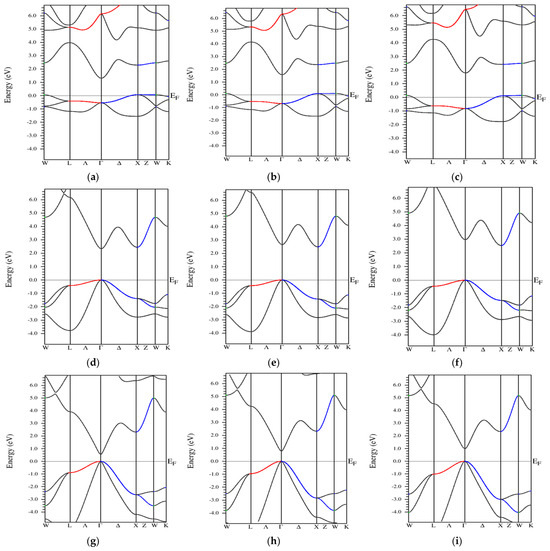
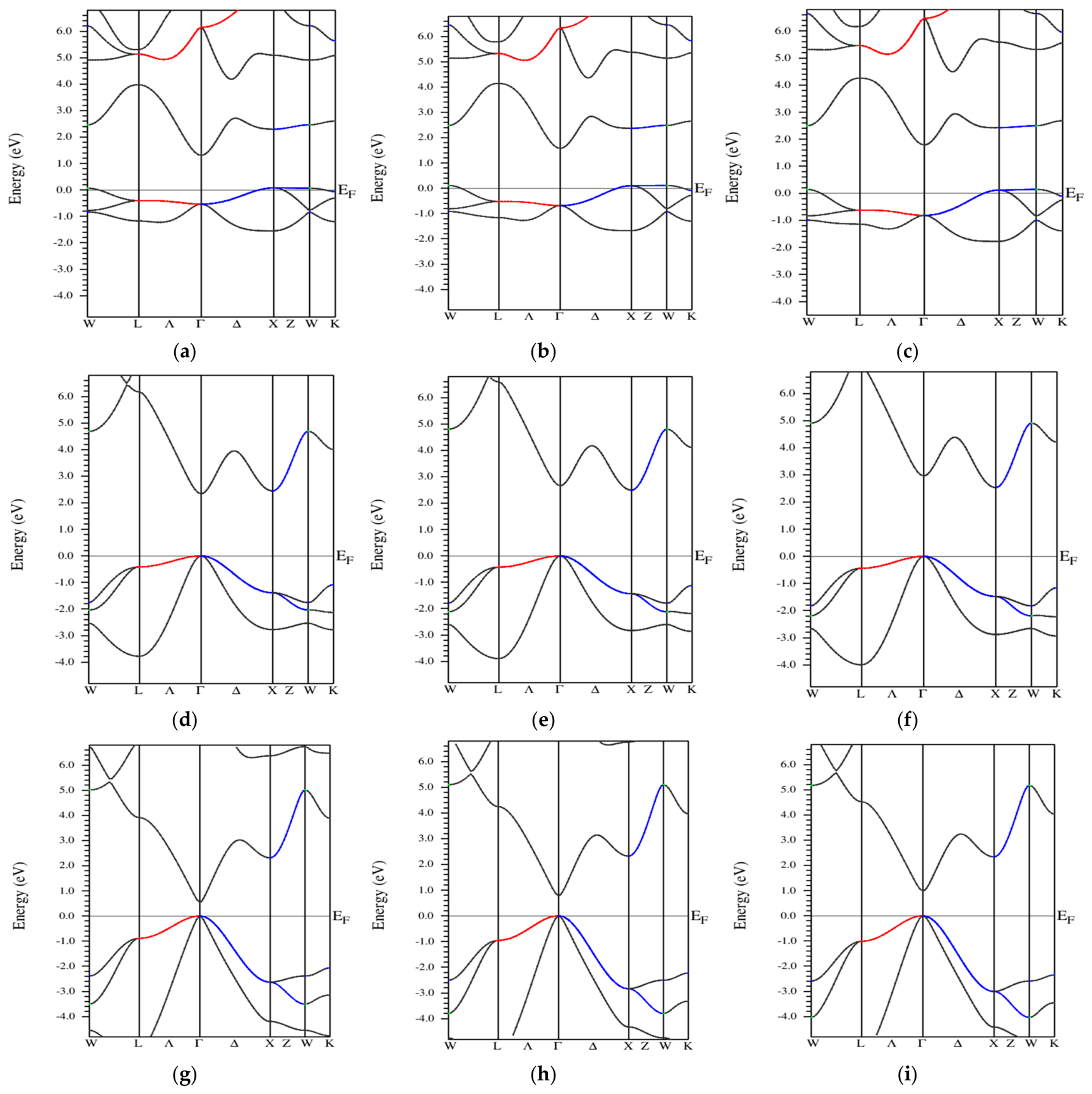
The band structures of LiMgN and LiSrN are calculated using the GGA-PBE functional, an energy range that stretches between −4.8 eV and 6.8 eV, along the high symmetry path W-Γ-L-X-W-K. The Fermi level is set to 0 eV as a reference energy. Figure 5, an examination of LiYN’s band structures at 0 GPa, demonstrates that the L point is where the VBM and CBM are situated for two compounds, LiMgN and LiZnN, while for LiSrN they are at the X-L points. This confirms that LiMgN and LiZnN have direct band gaps while LiSrN has an indirect band gap, where the band gap values are 1.31, 2.34, and 0.54 eV, respectively. This indicates that both LiYN crystals exhibit semiconducting behavior. We further investigate the evolution of the band gap of the two materials when subjected to pressure, with values estimated at 5 and 10 GPa. Interestingly, when the pressure was increased to 5 GPa and 10 GPa, The conduction band minimum shifts toward higher energies under pressure, while the maximum VB value remained at the Fermi level EF. The nature of the band gap remains unchanged under pressure, as shown by the calculated and increasing band gap values for LiSrN, LiMgN, and LiZnN, which are equal to 1.78, 2.76, and 0.98 eV, respectively, at 10 GPa.
Figure 5.
Band structures of LiSrN (a–c), LiMgN (d–f), and LiZnN (g–i) calculated at 0, 5, and 10 GPa, respectively.
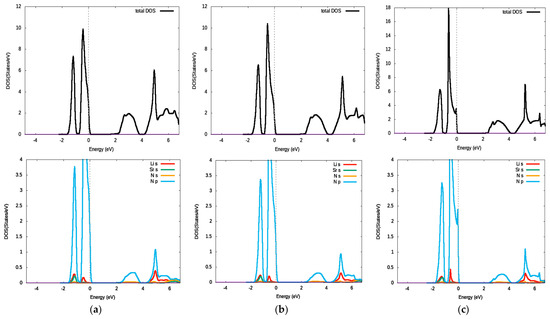
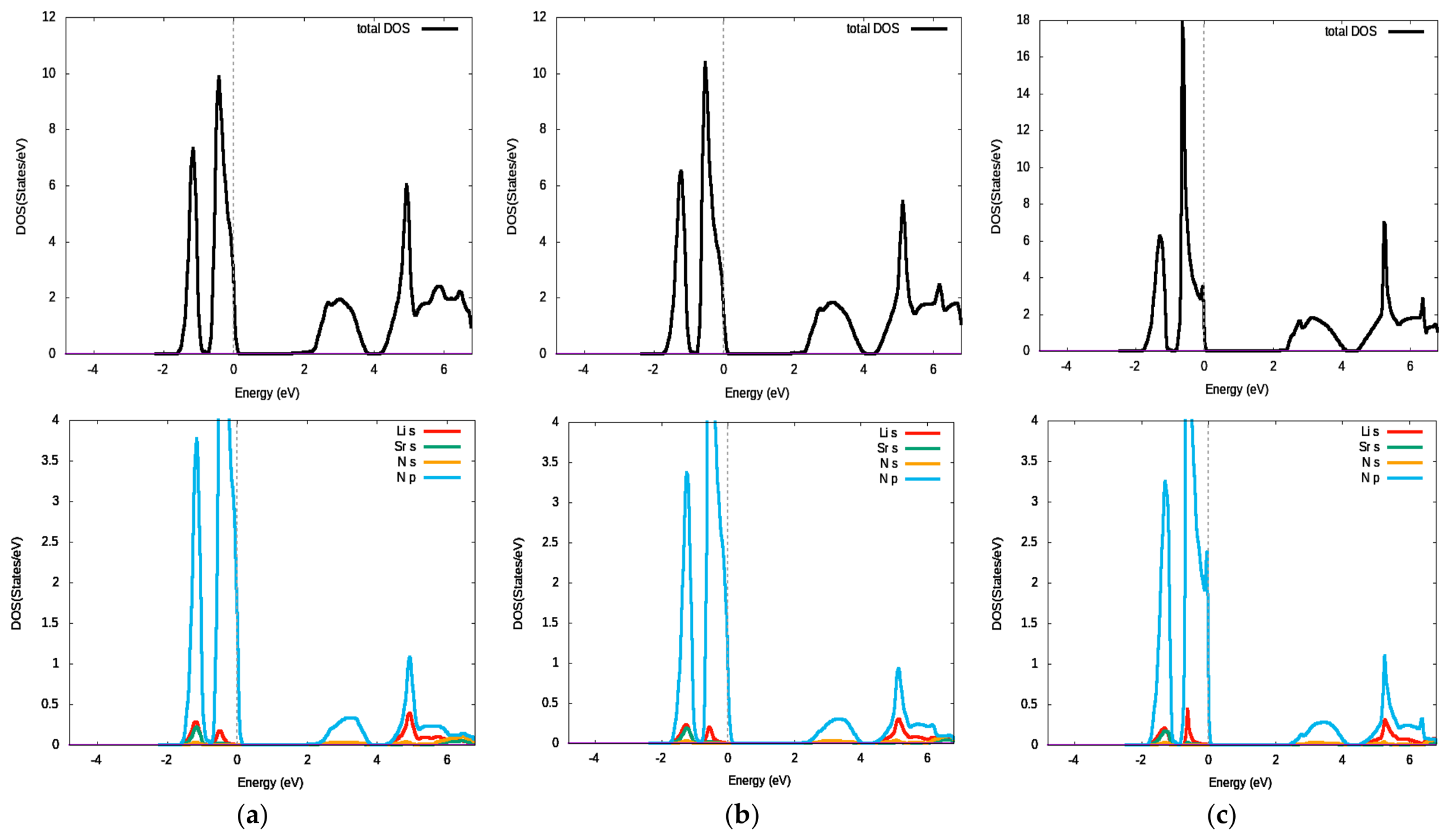
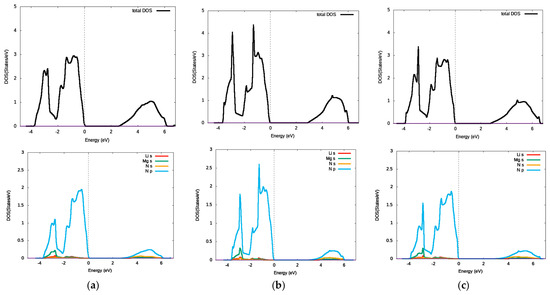
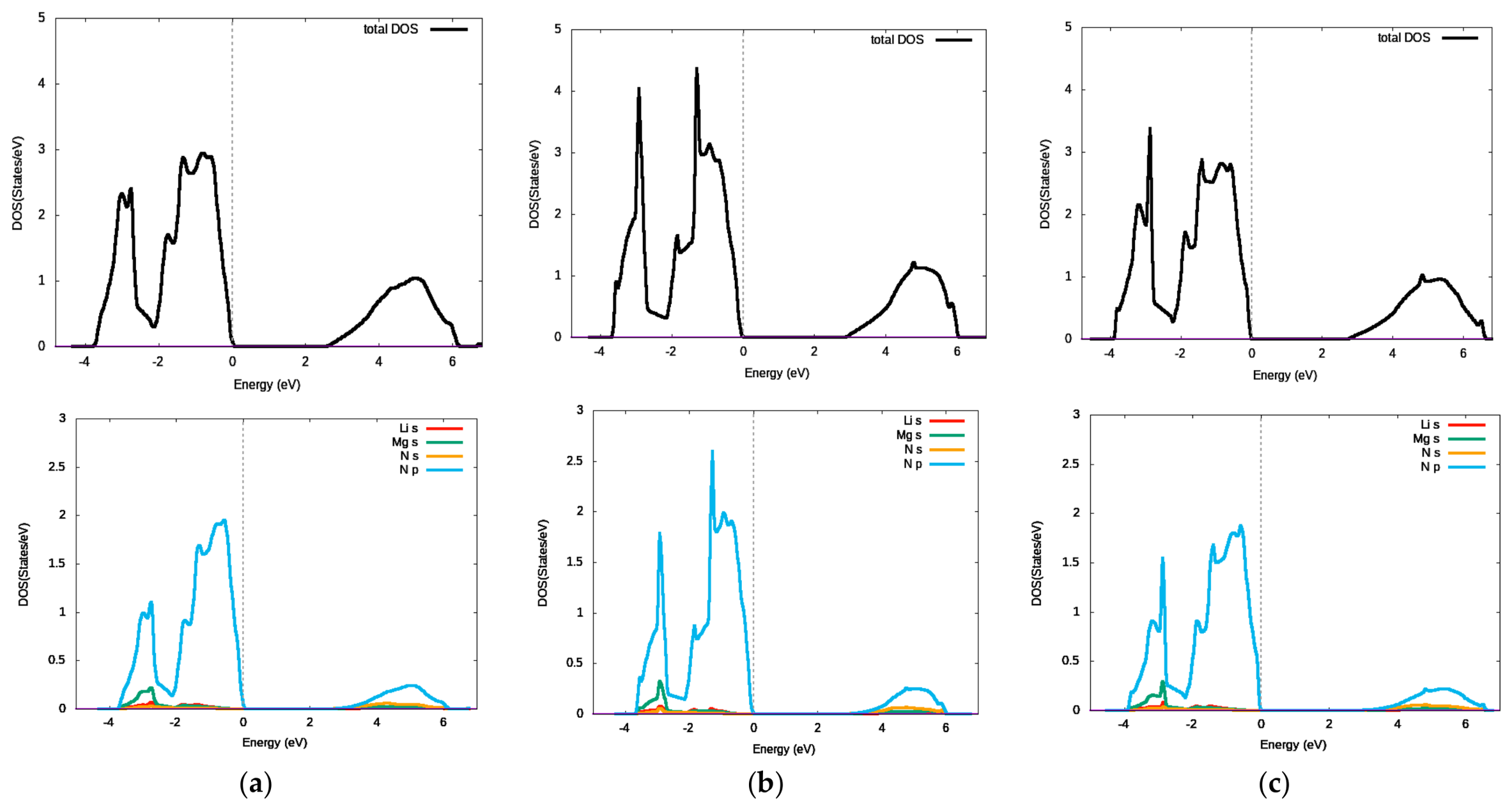
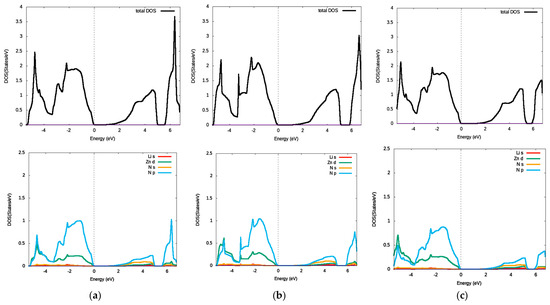
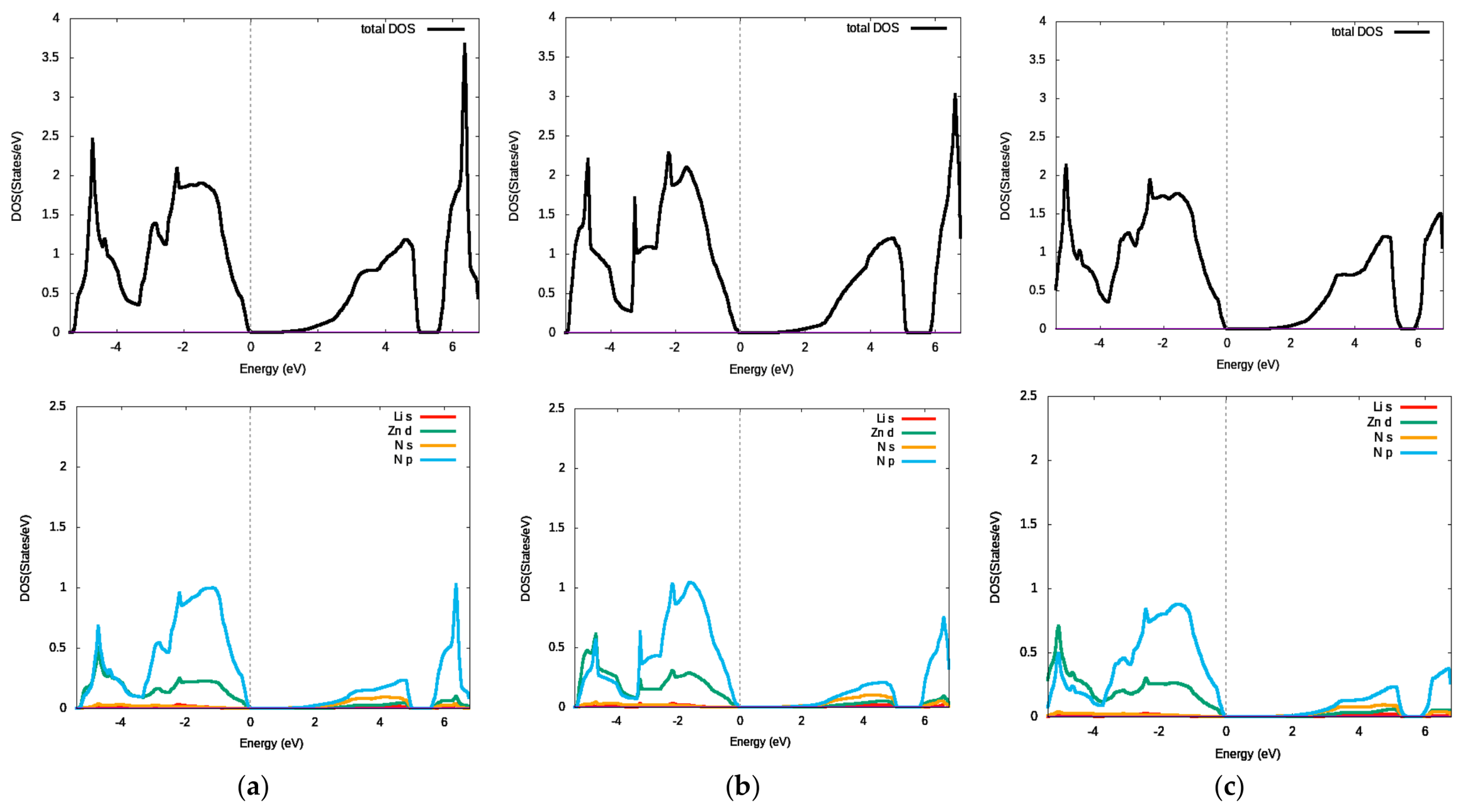
Both partial and total densities of states (TDOS and PDOS) have been studied to better understand the fundamental factors that influence the observed behaviors on band structures, especially regarding the fundamental band gaps. In addition, they help to describe the distribution of energy in the various material states, and aid in the analysis and comprehension of materials’ electrical and thermal characteristics. PDOS is a precise readout of TDOS, which detects the density of states of atoms and specific orbitals or subspaces of materials. Through this study, it is possible to analyze the contribution of each atom to the electrical structure and the prevalence of atomic hybridization of the device. In the three crystals LiSrN, LiMgN, and LiZnN, the valence band is predominantly composed of the N-3p atomic orbital, while the dominant compound in the conduction band is atomic orbitals of Li and Sr, Mg, or Zn, to a small extent, as shown in Figure 6, Figure 7 and Figure 8. Noting the peaks formed by the presence of Li and Sr, Mg, or Zn atoms slightly separated at the Fermi level, it can be argued that their contribution appears relatively limited, and therefore the electronic transitions are primarily controlled by the transition of p-orbital states. In all cases, the nitrogen p-orbitals (N-p) dominate around the Fermi level. The material retains semiconducting behavior, with a discernible Fermi-level band gap. Applying pressure primarily broadens the bands, indicating an increase in orbital interactions, without fundamentally changing the electronic structure of the material. Therefore, it maintains stable semiconducting properties, even at high pressure. Upon gradually and successively increasing the pressure from 0 to 5 and then 10 GPa, we did not observe any abrupt shift in the observed peaks toward the Fermi level. However, the valence band (VB) peaks shift to lower energy regions, while the peaks forming the conduction band (CB) decrease, indicating that the compounds exhibit semiconducting behavior.
Figure 6.
TDOS and PDOS of LiSrN at (a) 0 GPa, (b) 5 GPa, and (c) 10 GPa.
Figure 7.
TDOS and PDOS of LiMgN at (a) 0 GPa, (b) 5 GPa, and (c) 10 GPa.
Figure 8.
TDOS and PDOS of LiZnN at (a) 0 GPa, (b) 5 GPa, and (c) 10 GPa.
It can be concluded that pressure is a crucial tool for band gap expansion from modified electronic states. In particular, according to LiSrN, nitrogen N-p orbitals play a crucial role in electrical characteristics by being the primary contributor to states close to the Fermi level. Li and Sr, on the other hand, contribute little, indicating ionic behavior. The valence band broadens, and the PDOS peaks move somewhat to lower energies under pressure (0–10 GPa). LiSrN is still a semiconductor in spite of these modifications, while the LiMgN compound exhibits a more pressure-sensitive behavior. Although the N-p orbitals remain dominant, the contributions of Mg-s and Mg-p increase in importance under pressure, reflecting increased hybridization between magnesium and nitrogen. This evolution is accompanied by an expansion of the energy gap, indicating that the compound retains its semiconductor behavior despite higher pressure. However, the LiZnN compound is more pronounced. In addition to the N-p orbitals, the d states of zinc (Zn-d) play an important role, especially under pressure. The delocalization of Zn-d electrons, observed at pressures of 5 and 10 GPa, reflects a significant shift in the electronic states. While LiSrN remains a strong semiconductor, LiMgN, and especially LiZnN, exhibit significant electronic evolution, paving the way for applications at high pressure or in tunable electronic devices.
3.4. Thermoelectric Properties
Lithium-based half-Heusler crystalline materials LiSrN, LiMgN, and LiZnN are considered thermoelectric (TE) materials, which are of great interest due to their moderate thermoelectric performance in thermoelectric capacity; they are known for their great importance in the conversion of thermal energy into electrical energy, represented by the Seebeck coefficients, the figure of merit, and thermal and electrical conductivity. These transport properties, calculated using Boltzmann transport theory, depend on the carrier relaxation time (τ). Within this approach, transport properties are expressed as σ/τ, since the relaxation time is not directly accessible. However, the relative trends remain meaningful. To achieve a high TE conversion efficiency, a high ZT value must be achieved [55]. This corresponds to a reduction in heat conductivity and an increase in electrical conductivity. Applying external pressure modifies the electronic band structure of LiYN. Specifically, pressure tends to increase the band gap energy, which in turn shifts the position of the Fermi level. This adjustment of EF influences the distribution of charge carriers and enhances transport properties. As a result, key thermoelectric coefficients such as the Seebeck coefficient and the power factor (PF = σS2) can be improved. In other words, pressure not only alters the fundamental electronic structure but also provides a pathway to optimize the material’s efficiency for thermoelectric applications.
The Seebeck coefficient S expresses the potential variation ΔV resulting from the temperature effect T and is expressed by S = ΔV/ΔT [56]. S is a measurement of the size of the thermoelectric voltage that is produced when a temperature gradient occurs. It is also a parameter that allows us to know if we have a charge carrier type. If the Seebeck coefficient is negative, the material exhibits n-type behavior; conversely, a positive value indicates p-type conductivity [57,58].
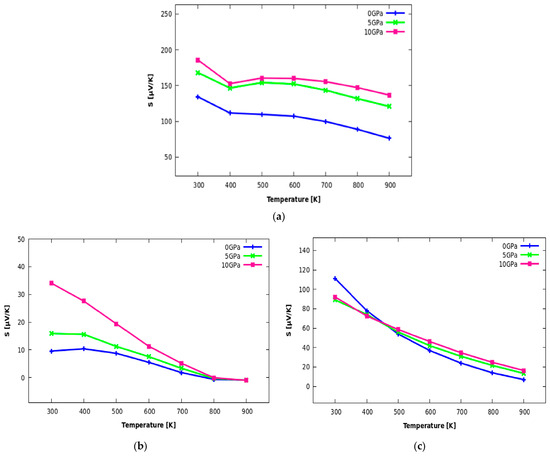
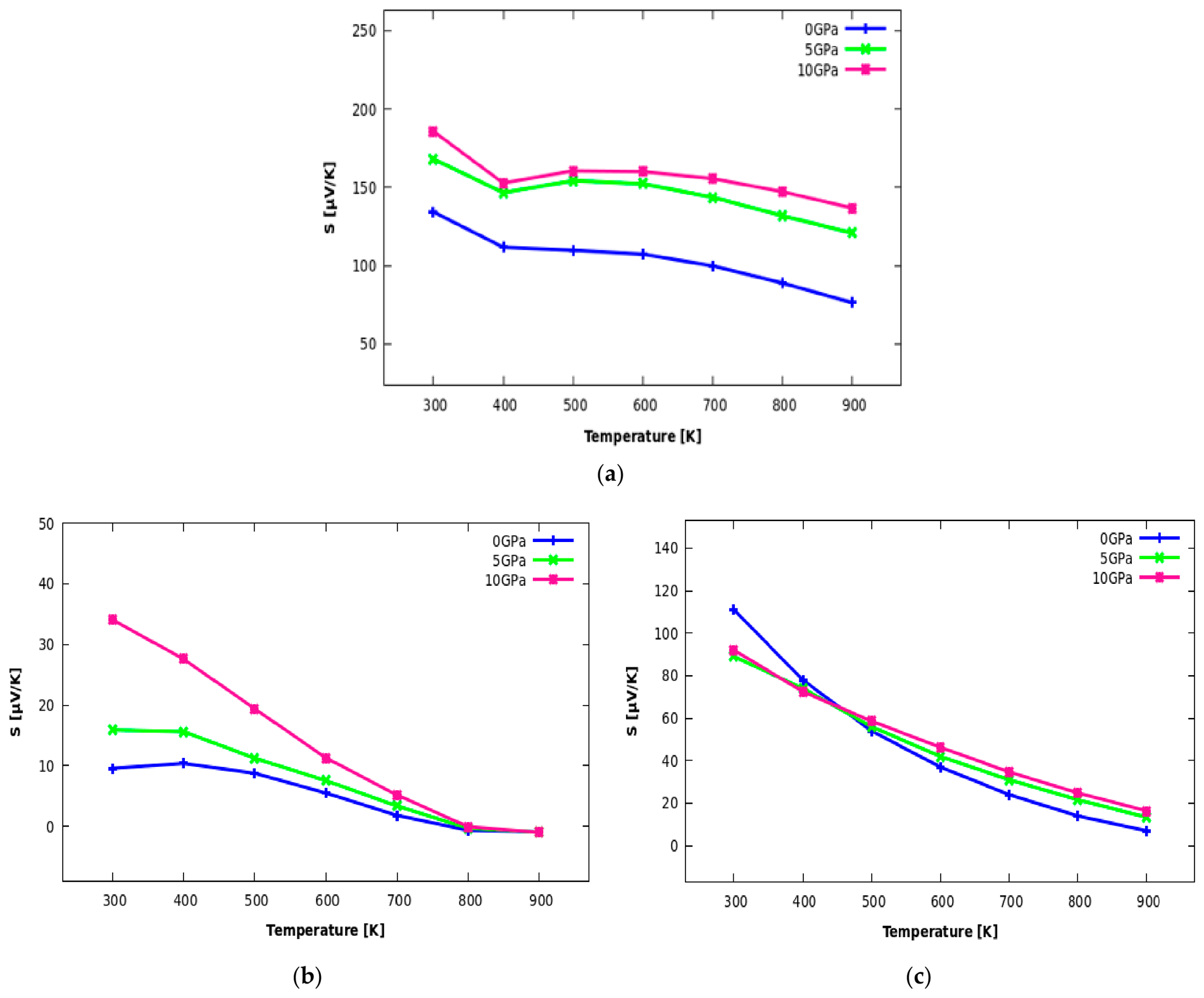
Figure 9a illustrates how the Seebeck coefficient (S) varies for three crystalline components as a function of temperature relative to the LiSrN crystal. In the absence of pressure (0 GPa), S starts from 130 μV/K at 300 K and then decreases with the increase in the temperature while remaining positive over the entire temperature range. Moreover, for LiSrN subjected to pressures of 5 and 10 GPa, the Seebeck coefficient S remains positive at 300 K, with values of 170 μV/K and 190 μV/K, respectively. These values gradually decrease with temperature while remaining positive up to 900 K. LiSrN exhibits p-type behavior over the whole temperature range. For LiMgN, which is represented in Figure 9b, all variations of the S parameter have positive values, indicating that LiMgN is a p-type material. The graph shows that the Seebeck coefficient increases with pressure and gradually decreases with increasing temperature. The enhancement of S under pressure is associated with pressure-induced modifications in the electronic structure and carrier transport. This carrier transport is enhanced by pressure, resulting in a larger thermoelectric voltage. From Figure 9c, it can be seen that the value of S of LiZnN at 0 GPa is larger than at 5 and 10 GPa; this value decreases rapidly with increasing temperature, from a maximum value of 110 μV/K corresponding to 300 K to an estimated minimum value of 7.5 μV/K corresponding to 900 K. This behavior is related to pressure-induced modifications of the electronic band structure, which affect carrier concentration and transport behavior. These variations highlight an antagonistic role of temperature and pressure: the former enhances carrier scattering and decreases the Seebeck coefficient, while the latter modifies the band structure, which can both improve or deteriorate the thermoelectric response depending on the material.
Figure 9.
Seebeck coefficient as a function of temperature under pressure of materials: (a) LiSrN, (b) LiMgN and (c) LiZnN.
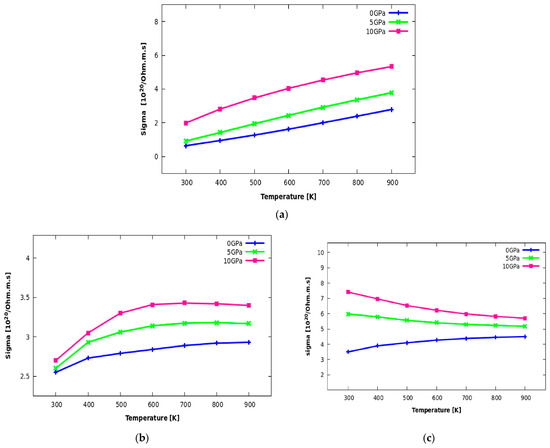
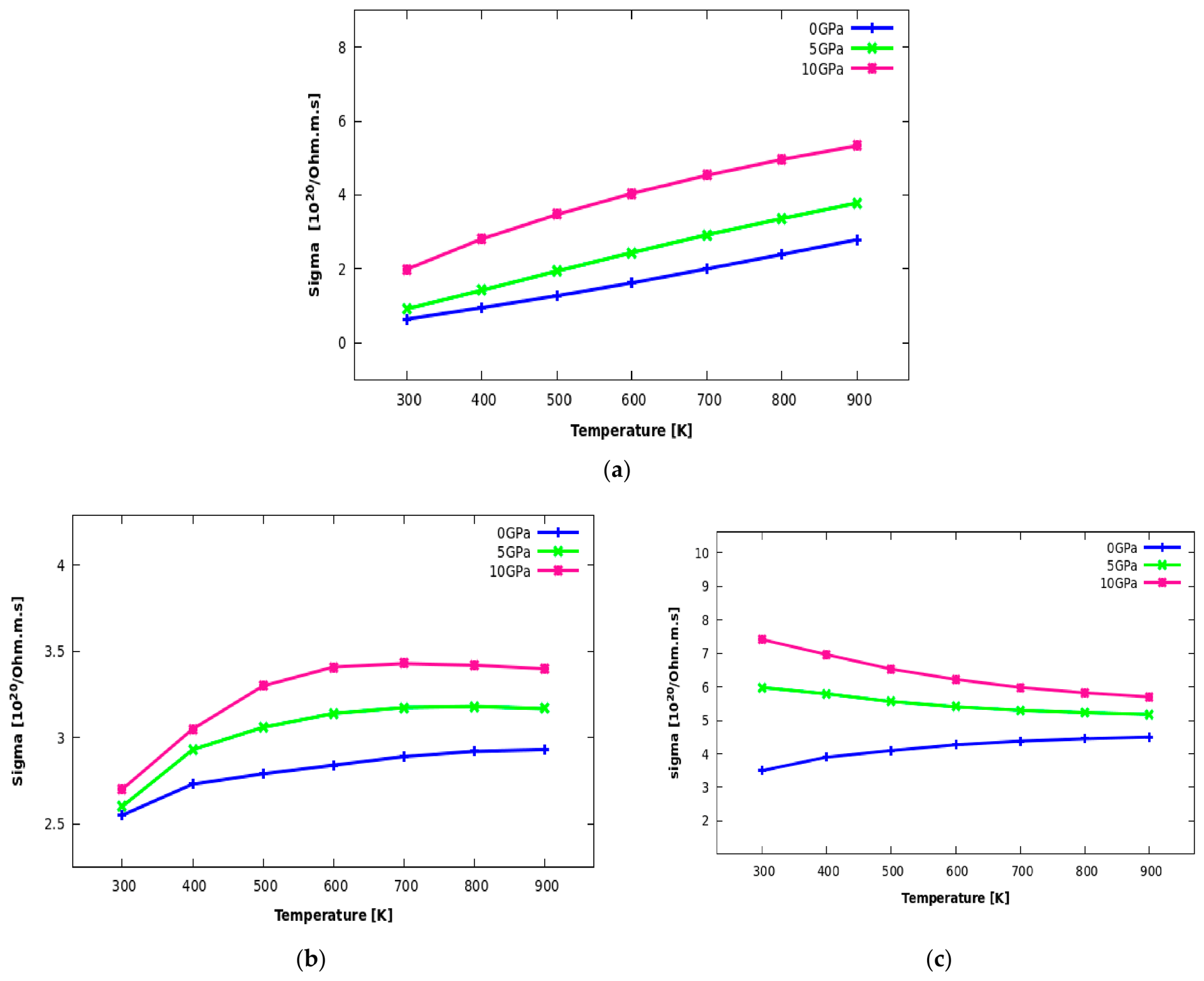
Figure 10a–c show the electrical conductivity (σ/τ) of LiSrN, LiMgN, and LiZnN materials. The value σ/τ describes the free carrier flow resulting from the process of carrier concentration when they gain heat in a material. We find an increase in electrical conductivity with increasing temperature for LiSrN materials, reaching the minimum value of 2.50 × 10²⁰ and maximum of 2.95 × 10²⁰ at 0 GPa, but at pressure 10 GPa, the values of σ/τ become 2.90 × 10²⁰ and 3.40 × 10²⁰, with corresponding minimum and maximum values of 300 K and 900 K, respectively. For LiSrN material, in the case of 0 GPa, (σ/τ) reaches the minimum and maximum values of 0.20 × 10¹⁹ [1/(Ω·m·s)] and 2.45 × 10¹⁹ [1/(Ω·m·s)], corresponding to 300 and 900 K, respectively. Concerning the conductivity of LiZnN at 10 GPa, it is larger than those at 5 and 0 GPa, the estimated maximum value is 7.50 × 10²⁰ [1/(Ω·m·s)] at 10 GPa, and the minimum is equal to 3.40 × 10²⁰ [1/(Ω·m·s)] at 0 GPa, corresponding to 300 K. Conductivity of all three compounds increases slowly during the temperature period up to 900 K. It can be concluded that LiSrN, LiMgN, and LiZnN compounds at 10 GPa exhibit high electrical conductivities compared to LiSrN, LiMgN, and LiZnN materials at 5 GPa and also more than at 0 GPa. This behavior may be attributed to pressure-induced modifications of carrier mobility and electronic band dispersion rather than band-gap narrowing, since the calculated band gap increases under pressure.
Figure 10.
The electrical conductivity as a function of temperature under pressure of materials: (a) LiSrN, (b) LiMgN and (c) LiZnN.
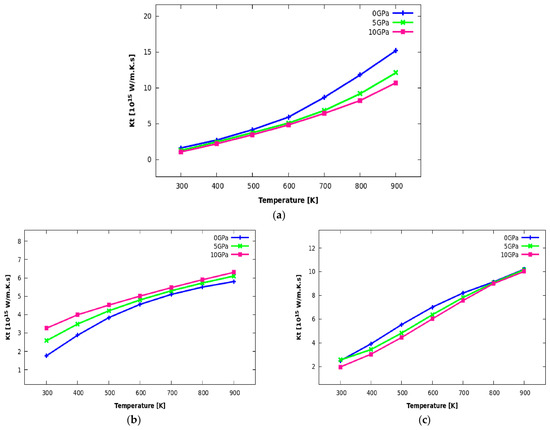
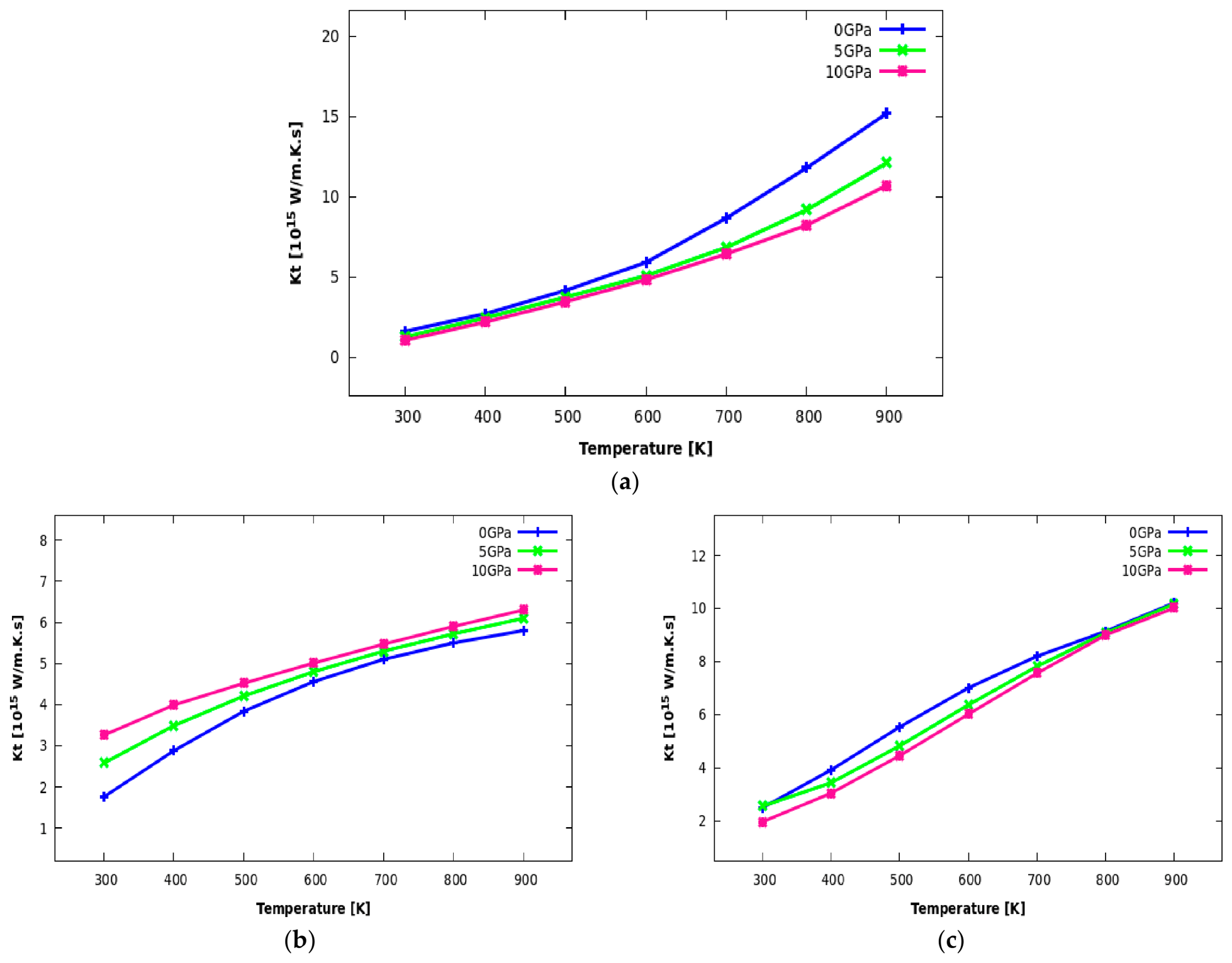
The total thermal conductivity Kt/τ is a combination of two terms, the lattice thermal conductivity kL (which corresponds to the lattice vibration) and the electronic conductivity ke (which corresponds to the electronic contribution). As shown in Figure 11, the thermal conductivity generally increases with increasing temperature for all investigated compounds over the temperature range of 300–900 K. At 0 GPa, LiSrN exhibits the highest thermal conductivity, reaching approximately 15 × 1015 [W/(m·K·s)] at 900 K, whereas LiMgN and LiZnN show comparatively lower values. The effect of pressure is found to be compound dependent. For LiSrN, thermal conductivity decreases slightly with increasing pressure, while LiMgN exhibits an opposite trend with enhanced thermal conductivity under compression. In the case of LiZnN, pressure effects remain relatively moderate, particularly at high temperatures where the curves tend to converge. Thus, we can conclude that the rise in lattice vibrations is caused by the temperature increase in the compounds LiSrN, LiMgN and LiZnN, and that this effect is enhanced under applied pressure. In our results, the increase in thermal conductivity with temperature is explained by the electronic contribution, which becomes dominant at high temperatures. This behavior, although less common, is consistent with low-band-gap materials where electronic conductivity increases rapidly with temperature.
Figure 11.
The thermal conductivity as a function of temperature under pressure of materials: (a) LiSrN, (b) LiMgN and (c) LiZnN.
The figure of merit (ZT) predicts the performance of a thermoelectric material, and is directly proportional to the high Seebeck coefficient (S) and electrical conductivity (σ/τ), while being inversely proportional to the thermal conductivity (Kt/τ), according to the equation defined by [59]:
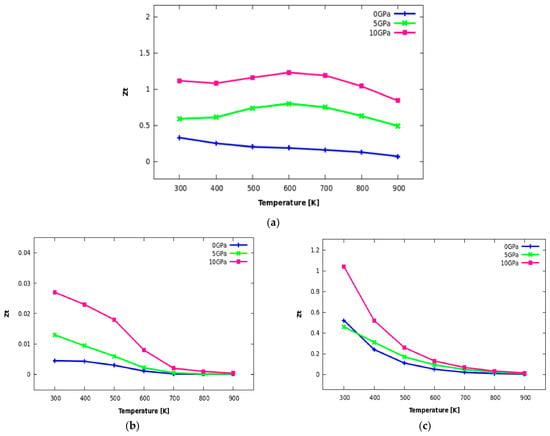
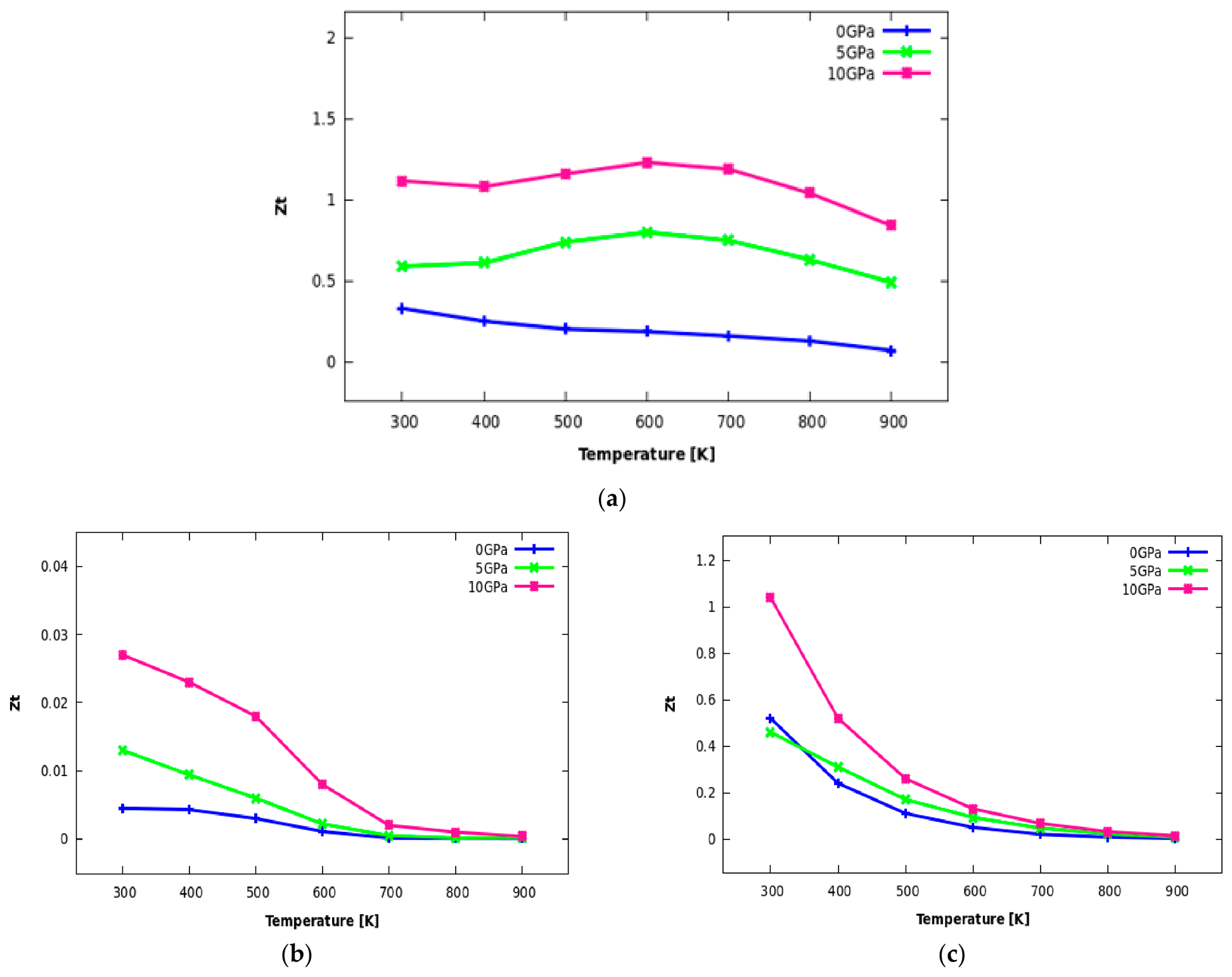
It represents the energy conversion efficiency of a thermoelectric material. Figure 12a–c illustrates the variation of the thermoelectric figure of merit (ZT) as a function of temperature under different hydrostatic pressures. The ZT values strongly depend on both pressure and temperature. For LiZnN, ZT initially increases with temperature, reaches a maximum value around intermediate temperatures (≈600 K), and then gradually decreases at higher temperatures. In contrast, LiMgN and LiSrN exhibit a monotonic decrease in ZT with increasing temperature. In all compounds, the application of pressure is predicted to enhance the ZT values over the investigated temperature range. At 300 K and 0 GPa, the calculated ZT values for LiMgN, LiSrN, and LiZnN are approximately 0.005, 0.35, and 0.54, respectively. Under an applied pressure of 10 GPa, these values increase to 0.027, 1.12, and 1.13, respectively. These results indicate that hydrostatic pressure improves the thermoelectric performance of LiYN compounds, mainly through the enhancement of electrical transport properties and the power factor. Although thermal conductivity also increases with temperature and pressure, the improvement in electronic transport dominates, leading to enhanced thermoelectric efficiency under pressure. Therefore, pressure can be considered an effective parameter for tuning and optimizing the thermoelectric behavior of LiYN (Y = Sr, Mg, and Zn) compounds for energy conversion applications [60,61].
Figure 12.
The figure of merit (ZT) as a function of temperature under pressure of material: (a) LiSrN, (b) LiMgN and (c) LiZnN.
4. Conclusions
In this work, we systematically investigated the structural, mechanical, electronic, and thermoelectric properties of LiYN (Y = Sr, Mg, and Zn) compounds under hydrostatic pressure using first-principles calculations. Structural stability was analyzed through crystal structure optimization, while elastic constants were employed to evaluate mechanical stability. Electronic properties were examined based on the density of states and band structure, and thermoelectric performance was assessed using the Seebeck coefficient and electrical conductivity. Density functional theory (DFT) calculations performed using the WIEN2k code within the GGA framework revealed that the elastic constants Cij satisfy the mechanical stability criteria at 0 GPa, confirming the stability of all studied compounds. Furthermore, these elastic constants increase with increasing pressure, indicating enhanced rigidity under compression. Regarding thermoelectric properties, the results show that electrical conductivity and the power factor improve significantly with increasing pressure. Hydrostatic pressure in this study should be viewed as a model-tuning parameter that may emulate strain engineering routes accessible in practical devices. Overall, these findings demonstrate that hydrostatic pressure provides a promising route for tuning thermoelectric performance and energy conversion efficiency of LiYN compounds, highlighting their potential for advanced thermoelectric applications.
Author Contributions
M.M.: Writing—original draft, Visualization, Validation, Investigation, Formal analysis, Data curation, Conceptualization. Y.Z.: Supervision, Visualization, Formal analysis. H.B.: Visualization, Validation, Formal analysis. A.B.: Software, Writing—original draft. Y.A.E.K.: Visualization, Formal analysis. All authors have read and agreed to the published version of the manuscript.
Funding
The authors are warmly grateful to the support of “The Moroccan Association of Sciences and Techniques for Sustainable Development (MASTSD), Beni Mellal, Morocco”.
Data Availability Statement
The raw data supporting the conclusions of this article will be made available by the authors on request.
Conflicts of Interest
The authors declare no conflicts of interest.
References
- Bouzaid, A.; Ziat, Y.; Belkhanchi, H. Photocatalytic Optimization of ATiO3 Codoped with Se/Zr: A DFT Study for Hydrogen Production. Materials 2025, 18, 4389. [Google Scholar] [CrossRef] [Scilit]
- Koufi, A.; Ziat, Y.; Belkhanchi, H.; Bouzaid, A. Investigation of Thermoelectric and Structural Properties of BeAlH3, BeGaH3, and BeInH3 perovskite Hydrides for Energy Applications. Sol. Energy Sustain. Dev. J. 2025, 14, 1–14. [Google Scholar] [CrossRef] [Scilit]
- Kannan, N.; Vakeesan, D. Solar energy for future world—A review. Renew. Sustain. Energy Rev. 2016, 62, 1092–1105. [Google Scholar] [CrossRef] [Scilit]
- Breyer, C.; Bogdanov, D.; Aghahosseini, A.; Gulagi, A.; Child, M.; Oyewo, A.S.; Farfan, J.; Sadovskaia, K.; Vainikka, P. Solar photovoltaics demand for the global energy transition in the power sector. Prog. Photovolt. Res. Appl. 2018, 26, 505–523. [Google Scholar] [CrossRef] [Scilit]
- Luo, X.; Zhang, T.; Hu, C.-E.; Cheng, Y.; Geng, H.-Y. First-principles studies on the structural, electronic and thermal transport characteristics of half-Heusler compounds LiXN (X = Mg, Zn). Solid State Commun. 2023, 366, 115156. [Google Scholar] [CrossRef] [Scilit]
- Paul, S.; Ghosal, S.; Pati, S.K. Strategies to Suppress Thermal Conductivity in Half-Heusler Compounds for Thermoelectric Applications: A Comprehensive Review. ACS Appl. Energy Mater. 2025, 8, 15585–15617. [Google Scholar] [CrossRef] [Scilit]
- Walia, S.; Weber, R.; Balendhran, S.; Yao, D.; Abrahamson, J.T.; Zhuiykov, S.; Bhaskaran, M.; Sriram, S.; Strano, M.S.; Kalantar-Zadeh, K. ZnO based thermopower wave sources. Chem. Commun. 2012, 48, 7462–7464. [Google Scholar] [CrossRef] [Scilit]
- Walia, S.; Balendhran, S.; Yi, P.; Yao, D.; Zhuiykov, S.; Pannirselvam, M.; Weber, R.; Strano, M.S.; Bhaskaran, M.; Sriram, S.; et al. MnO2-Based Thermopower Wave Sources with Exceptionally Large Output Voltages. J. Phys. Chem. C 2013, 117, 9137–9142. [Google Scholar] [CrossRef] [Scilit]
- Ziat, Y.; Zarhri, Z.; Belkhanchi, H. Crystal field, electronegativity and magnetic behavior of Mn-, Fe-, Co- and Ni-doped LiMgN half-Heusler: KKR-CPA approximation. Int. J. Mod. Phys. B 2024, 38, 2450388. [Google Scholar] [CrossRef] [Scilit]
- Felser, C.; Fecher, G.H. (Eds.) Spintronics: From Materials to Devices; Springer: Dordrecht, The Netherlands, 2013; ISBN 978-90-481-3831-9. [Google Scholar]
- Yu, C.; Zhu, T.-J.; Shi, R.-Z.; Zhang, Y.; Zhao, X.-B.; He, J. High-performance half-Heusler thermoelectric materials Hf1−xZrxNiSn1−ySby prepared by levitation melting and spark plasma sintering. Acta Mater. 2009, 57, 2757–2764. [Google Scholar] [CrossRef] [Scilit]
- Kandpal, H.C.; Felser, C.; Seshadri, R. Covalent bonding and the nature of band gaps in some half-Heusler compounds. J. Phys. D Appl. Phys. 2006, 39, 776–785. [Google Scholar] [CrossRef] [Scilit]
- Ziat, Y.; Zarhri, Z.; Belkhanchi, H.; Ifguis, O.; Cano, A.D.; Lazrak, C. Effect of Be and P doping on the electron density, electrical and optoelectronic conduct of half-Heusler LiMgN within ab initio scheme. Phys. Scr. 2022, 97, 105802. [Google Scholar] [CrossRef] [Scilit]
- Casper, F.; Graf, T.; Chadov, S.; Balke, B.; Felser, C. Half-Heusler compounds: Novel materials for energy and spintronic applications. Semicond. Sci. Technol. 2012, 27, 063001. [Google Scholar] [CrossRef] [Scilit]
- Azouaoui, A.; Hourmatallah, A.; Benzakour, N.; Bouslykhane, K. First-principles study of optoelectronic and thermoelectric properties of LiCaX (X = N, P and As) half-Heusler semiconductors. J. Solid State Chem. 2022, 310, 123020. [Google Scholar] [CrossRef] [Scilit]
- Parsamehr, S.; Boochani, A.; Amiri, M.; Solaymani, S.; Sartipi, E.; Naderi, S.; Aminian, A. Thermodynamic phase diagram and thermoelectric properties of LiMgZ (Z = P, As, Bi): Ab initio method study. Philos. Mag. 2020, 101, 369–386. [Google Scholar] [CrossRef] [Scilit]
- Radjai, M.; Bouhemadou, A.; Maouche, D. Structural, elastic, electronic and optical properties of the half-Heusler ScPtSb and YPtSb compounds under pressure. arXiv 2021, arXiv:2112.09940. [Google Scholar] [CrossRef] [Scilit]
- Joshi, H.; Rai, D.; Hnamte, L.; Laref, A.; Thapa, R. A theoretical analysis of elastic and optical properties of half Heusler MCoSb (M = Ti, Zr and Hf). Heliyon 2019, 5, e01155. [Google Scholar] [CrossRef] [Scilit]
- Miri, M.; Ziat, Y.; Belkhanchi, H.; Bouzaid, A.; Jouad, Y.; El Kadi, Y.A. DFT Analysis of Structural, Elastic and Optoelectronic Enhancements in LiGeCl3 Under Pressure for Photovoltaic Applications. Sol. Energy Sustain. Dev. J. 2026, 14, 230–252. [Google Scholar] [CrossRef] [Scilit]
- Yunusov, N.; Otajonov, S.; Abdulvakhidov, K.; Alshoekh, A.; Zhengyou, L.; Angadi, V.J.; Kim, D.; Soldatov, A.; Abdulvakhidov, B.; Nazarenko, A.; et al. Structural, transport, optical and magnetic properties of (1 − x)SrFe12O19–xBaTiO3 composites. Ceram. Int. 2025, 51, 45459–45471. [Google Scholar] [CrossRef] [Scilit]
- Ciftci, Y.O.; Evecen, M. First principle study of structural, electronic, mechanical, dynamic and optical properties of half-Heusler compound LiScSi under pressure. Phase Transit. 2018, 91, 1206–1222. [Google Scholar] [CrossRef] [Scilit]
- Muhammad, I.; Zhang, J.-M.; Ali, A.; Rehman, M.U.; Muhammad, S. Structural, mechanical, thermal, magnetic, and electronic properties of the RhMnSb half-Heusler alloy under pressure. Mater. Chem. Phys. 2020, 251, 123110. [Google Scholar] [CrossRef] [Scilit]
- Dixit, A.; Saxena, A.; Abraham, J.A.; Dubey, S.; Sharma, R.; Qaid, S.M.H.; Štich, I.; Aslam, M.; Zetsepin, A. Hydrostatic pressure-tuning of opto-electronic and thermoelectric properties of half-Heusler alloy RhTiP: DFT analysis. Int. J. Quantum Chem. 2024, 124, e27482. [Google Scholar] [CrossRef] [Scilit]
- Hrida, E.M.; Bahhar, S.; Tahiri, A.; Naji, M.; Idiri, M. Pressure-induced band gap shift and enhanced optical properties of quaternary Heusler TaAlCuCo: DFT study. Opt. Quantum Electron. 2024, 56, 1535. [Google Scholar] [CrossRef] [Scilit]
- He, R.; Zhu, T.; Ying, P.; Chen, J.; Giebeler, L.; Kühn, U.; Nielsch, K. High-pressure-sintering-induced microstructural engineering for ultimate phonon scattering of thermoelectric half-Heusler compounds. Small 2021, 17, 2102045. [Google Scholar] [CrossRef] [Scilit]
- Blaha, P.; Schwarz, K.; Tran, F.; Laskowski, R.; Madsen, G.K.H.; Marks, L.D. WIEN2k: An APW+lo program for calculating the properties of solids. J. Chem. Phys. 2020, 152, 074101. [Google Scholar] [CrossRef] [Scilit]
- Kohn, W. Nobel Lecture: Electronic structure of matter—Wave functions and ensity functionals. Rev. Mod. Phys. 1999, 71, 1253. [Google Scholar] [CrossRef] [Scilit]
- Blaha, P.; Schwarz, K.; Madsen, G.K.; Kvasnicka, D.; Luitz, J. wien2k. An augmented plane wave+ local orbitals program for calculating crystal properties. J. Chem. Phys. 2001, 60, 155–169. [Google Scholar]
- Perdew, J.P.; Burke, K.; Ernzerhof, M. Generalized gradient approximation made simple. Phys. Rev. Lett. 1996, 77, 3865. [Google Scholar] [CrossRef] [Scilit]
- Kohn, W.; Sham, L.J. Self-Consistent Equations Including Exchange and Correlation Effects. Phys. Rev. 1965, 140, A1133–A1138. [Google Scholar] [CrossRef] [Scilit]
- Madsen, G.K.; Singh, D.J. BoltzTraP. A code for calculating band-structure dependent quantities. Comput. Phys. Commun. 2006, 175, 67–71. [Google Scholar] [CrossRef] [Scilit]
- Allen, P.B. Boltzmann theory and resistivity of metals. In The Kluwer International Series in Engineering and Computer Science; Springer: Boston, MA, USA, 1996; pp. 219–250. [Google Scholar] [CrossRef] [Scilit]
- Jouad, Y.; Ziat, Y.; Bouzaid, A.; Belkhanchi, H. First-principles examination of hydrostatic pressure effects on the structural, mechanical, phonon, and optoelectronic properties of TlGeX3 (X = Br, I). Next Mater. 2026, 12, 102052. [Google Scholar] [CrossRef] [Scilit]
- Katsura, T.; Tange, Y. A simple derivation of the Birch–Murnaghan equations of state (EOSs) and comparison with EOSs derived from other definitions of finite strain. Minerals 2019, 9, 745. [Google Scholar] [CrossRef] [Scilit]
- Jouad, Y.; Ziat, Y.; Bouzaid, A.; Miri, M.; Belkhanchi, H.; Zarhri, Z. Exploring the influence of hydrostatic pressure on the structural, mechanical, and optoelectronic behavior of AlSnBr3 and AlSnI3 halide perovskites via DFT. Chem. Phys. 2025, 603, 113062. [Google Scholar] [CrossRef] [Scilit]
- Murnaghan, F.D. The Compressibility of Media under Extreme Pressures. Proc. Natl. Acad. Sci. USA 1944, 30, 244–247. [Google Scholar] [CrossRef] [Scilit]
- Goble, R.J.; Scott, S.D. The relationship between mineral hardness and compressibility (or bulk modulus). Can. Mineral. 1985, 23, 273–285. [Google Scholar]
- Benazouzi, Y.; Rozale, H.; Hacene, M.A.B.; Khethir, M.; Chahed, A.; Lucache, D. Electronic and Thermoelectric Properties in Li-Based Half-Heusler Compounds: A First Principle Study. Ann. West Univ. Timis.-Phys. 2019, 61, 44–55. [Google Scholar] [CrossRef] [Scilit]
- Kalarasse, F.; Bennecer, B.; Mellouki, A. Optical properties of the filled tetrahedral semiconductors LiMgX (X = N, P and As). J. Phys. Condens. Matter 2006, 18, 7237–7247. [Google Scholar] [CrossRef] [Scilit]
- Kuriyama, K.; Yamashita, Y.; Ishikawa, T.; Kushida, K. Raman scattering from the filled tetrahedral semiconductor LiMgN: Identification of the disordered arrangement between Li and Mg. Phys. Rev. B 2007, 75, 233204. [Google Scholar] [CrossRef] [Scilit]
- Kuriyama, K.; Taguchi, R.; Kushida, K.; Ushiyama, K. Growth and band gap of the filled tetrahedral semiconductor LiZnN. J. Cryst. Growth 1999, 198–199, 802–805. [Google Scholar] [CrossRef] [Scilit]
- Mouhat, F.; Coudert, F.-X. Necessary and sufficient elastic stability conditions in various crystal systems. Phys. Rev. B 2014, 90, 224104. [Google Scholar] [CrossRef] [Scilit]
- Naumov, P.; Karothu, D.P.; Ahmed, E.; Catalano, L.; Commins, P.; Mahmoud Halabi, J.; Al-Handawi, M.B.; Li, L. The rise of the dynamic crystals. J. Am. Chem. Soc. 2020, 142, 13256–13272. [Google Scholar] [CrossRef] [Scilit]
- Born, M. On the stability of crystal lattices. I. In Mathematical Proceedings of the Cambridge Philosophical Society; Cambridge University Press: Cambridge, UK, 1940; Volume 36, pp. 160–172. [Google Scholar]
- Chung, D.H.; Buessem, W.R. The voigt-reuss-hill approximation and elastic moduli of polycrystalline MgO, CaF2, β-ZnS, ZnSe, and CdTe. J. Appl. Phys. 1967, 38, 2535–2540. [Google Scholar] [CrossRef] [Scilit]
- Hill, R. The elastic behaviour of a crystalline aggregate. Proc. Phys. Soc. A 1952, 65, 349–354. [Google Scholar] [CrossRef] [Scilit]
- Reuß, A. Berechnung der fließgrenze von mischkristallen auf grund der plastizitätsbedingung für einkristalle. ZAMM-J. Appl. Math. Mech./Z. Für Angew. Math. Und Mech. 1929, 9, 49–58. [Google Scholar] [CrossRef] [Scilit]
- Voigt, W. Lehrbuch der Kristallphysik; Vieweg+ Teubner: Wiesbaden, Germany, 1966. [Google Scholar]
- Screiber, E.; Anderson, O.L.; Soga, N. Elastic Constants and Their Measurements; McGrawHill: New York, NY, USA, 1973. [Google Scholar]
- Kube, C.M.; De Jong, M. Elastic constants of polycrystals with generally anisotropic crystals. J. Appl. Phys. 2016, 120, 165105. [Google Scholar] [CrossRef] [Scilit]
- Wang, G.; Jiang, Y.; Li, Z.; Chong, X.; Feng, J. Balance between strength and ductility of dilute Fe2B by high-throughput first-principles calculations. Ceram. Int. 2021, 47, 4758–4768. [Google Scholar] [CrossRef] [Scilit]
- Pugh, S.F. XCII. Relations between the elastic moduli and the plastic properties of polycrystalline pure metals. Lond. Edinb. Dublin Philos. Mag. J. Sci. 1954, 45, 823–843. [Google Scholar] [CrossRef] [Scilit]
- Kieven, D.; Klenk, R.; Naghavi, S.; Felser, C.; Gruhn, T. I-II-V half-Heusler compounds for optoelectronics: Ab initio calculations. Phys. Rev. B—Condens. Matter Mater. Phys. 2010, 81, 075208. [Google Scholar] [CrossRef] [Scilit]
- Nayak, A.P.; Bhattacharyya, S.; Zhu, J.; Liu, J.; Wu, X.; Pandey, T.; Jin, C.; Singh, A.K.; Akinwande, D.; Lin, J.-F. Pressure-induced semiconducting to metallic transition in multilayered molybdenum disulphide. Nat. Commun. 2014, 5, 3731. [Google Scholar] [CrossRef] [Scilit]
- Takeuchi, T. Conditions of Electronic Structure to Obtain Large Dimensionless Figure of Merit for Developing Practical Thermoelectric Materials. Mater. Trans. 2009, 50, 2359–2365. [Google Scholar] [CrossRef] [Scilit]
- Zuo, G.; Liu, X.; Fahlman, M.; Kemerink, M. High Seebeck Coefficient in Mixtures of Conjugated Polymers. Adv. Funct. Mater. 2017, 28, 1703280. [Google Scholar] [CrossRef] [Scilit]
- Bharti, M.; Singh, A.; Debnath, A.; Chauhan, A.; Muthe, K.; Gupta, S.; Marumoto, K.; Mori, T.; Aswal, D. Anionic conduction mediated giant n-type Seebeck coefficient in doped Poly(3-hexylthiophene) free-standing films. Mater. Today Phys. 2021, 16, 100307. [Google Scholar] [CrossRef] [Scilit]
- Xie, Z.; Feng, K.; Xiong, Y.; Chen, X.; Liang, Y.; Abid, K.; Xu, L. A High Seebeck Voltage Thermoelectric Module with P-type and N-type MAPbI3 Perovskite Single Crystals. Adv. Electron. Mater. 2021, 7, 2001003. [Google Scholar] [CrossRef] [Scilit]
- Rabin, O.; Yu-Ming, L.; Dresselhaus, M.S. Anomalously high thermoelectric figure of merit in Bi1−xSbx nanowires by carrier pocket alignment. Appl. Phys. Lett. 2001, 79, 81–83. [Google Scholar] [CrossRef] [Scilit]
- Zhang, Y.; Hao, S.; Zhao, L.-D.; Wolverton, C.; Zeng, Z. Pressure induced thermoelectric enhancement in SnSe crystals. J. Mater. Chem. A 2016, 4, 12073–12079. [Google Scholar] [CrossRef] [Scilit]
- Huang, S.; Liu, X.; Zheng, W.; Guo, J.; Xiong, R.; Wang, Z.; Shi, J. Dramatically improving thermoelectric performance of topological half-Heusler compound LuPtSb via hydrostatic pressure. J. Mater. Chem. A 2018, 6, 20069–20075. [Google Scholar] [CrossRef] [Scilit]

Disclaimer/Publisher’s Note: The statements, opinions and data contained in all publications are solely those of the individual author(s) and contributor(s) and not of MDPI and/or the editor(s). MDPI and/or the editor(s) disclaim responsibility for any injury to people or property resulting from any ideas, methods, instructions or products referred to in the content. |
© 2026 by the authors. Licensee MDPI, Basel, Switzerland. This article is an open access article distributed under the terms and conditions of the Creative Commons Attribution (CC BY) license.