


Abstract
(1) Background: Giardia duodenalis is a common protozoan parasite infecting various mammalian hosts, yet data on its prevalence in Cypriot ruminants, including the endemic and protected mouflon (Ovis gmelini ophion), remain absent. This study aimed to evaluate the prevalence and molecular characteristics of Giardia species (sp.) in domestic and wild ruminants in Cyprus to assess potential risks to wildlife. (2) Methods: We analysed 146 faecal samples—comprising 32 domestic sheep, 10 domestic and 34 free-ranging goats, and 70 wild mouflons—using nested polymerase chain reaction (PCR) and multi-locus sequence typing of the ssrRNA, tpi, bg, and gdh genes. (3) Results: Giardia was detected in only 1 of the 42 domestic ruminant samples (1/32 sheep; 3.1%), which was characterized as G. duodenalis assemblage E. No Giardia DNA was detected in the the domestic goats (0/10), wild mouflons (0/70) or the free-ranging goats (0/34) co-inhabiting the forest environment. (4) Conclusions: This study provides the first molecular report of Giardia sp. in domestic sheep in the Republic of Cyprus. While the parasite is present in domestic ruminants, the findings suggest a low positivity rate and no immediate evidence of transmission to the endangered mouflon. Further research with a larger sample size is recommended to confirm these observations and guide future conservation strategies.
1. Introduction
Giardia duodenalis (also known as G. lamblia or G. intestinalis) is a common protozoan parasite that can infect the gastrointestinal system of a variety of mammalian hosts, including humans and ruminants [1,2,3]. Giardia duodenalis infections are often asymptomatic [4,5] but can sometimes cause severe diarrhoea and chronic disease in humans [6,7,8]. Because domestic sheep (Ovis aries) can shed high loads of zoonotic Giardia cysts, heavily infected flocks may be considered a potential environmental reservoir for human infections [9,10,11].
This parasite is diverse, with eight morphologically identical genetic assemblages [1,5,12] that have been assigned the letters A to H. Humans are most commonly infected by parasites belonging to assemblages A and B [13] that also have the potential to infect a range of other mammals. Assemblages C and D are considered canine-specific. While assemblage E is primarily found in livestock, assemblage F is found in felids, G in murids, and H in seals and gulls [12]. However, in recent studies, assemblages C, D, E and F have also been found in a few symptomatic human cases [14,15,16,17].
In sheep, G. duodenalis assemblage E is the most common. In contrast, assemblage A occurs less frequently [1,9,10,11,18,19,20,21,22,23,24,25], and assemblage B appears to be rarely reported [26,27]. G. duodenalis can affect the growth and development of sheep. Therefore, giardiasis can cause economic loss for farmers [28]. Furthermore, some studies on goats (Capra hircus) have resulted in the isolation of G. duodenalis assemblages A and E [19,20,22,24]. The Cyprian mouflon (Ovis gmelini ophion) is the largest wild terrestrial mammal on the island. It is endemic to Cyprus and classified as endangered and strictly protected [29]. There have been no data on Giardia infection in mouflons to date, and therefore, its infection rate needs to be investigated.
The classification of Giardia in different species is based on the gene sequencing of the small subunit of ribosomal RNA (ssrRNA). Also, three Giardia genes are used to genotype Giardia across the eight assemblages. These genes encode the β-giardin (bg) protein, the enzyme triose phosphate isomerase (tpi), and the glutamate dehydrogenase (gdh) enzyme [1,30,31,32,33].
The present study aimed to determine, for the first time in Cyprus, the prevalence and molecular identification of Giardia species in the Cyprus mouflon, domestic sheep, and free-ranging and domestic goats.
2. Materials and Methods
2.1. Sample Collection
A total of 146 faecal samples were collected across two distinct ecological zones in Cyprus between January 2021 and August 2022.
For the targeted farm investigation, 42 faecal samples were randomly collected between January and September 2021 from a small, mixed-species farm in the Larnaca District (comprising 32 sheep and 10 goats). This site was specifically selected due to reported cases of fatal diarrhoeal infections in lambs and goat kids. The cohort included 10 samples from juvenile animals (7 lambs and 3 goat kids, all under five months old) and 32 samples from adult (3-year-old) sheep and goats. Diarrhoea samples from symptomatic animals, which were routinely separated from the healthy herd by the owner, were carefully collected directly from the shelter floor. Written informed consent was obtained from the farm owner prior to sample collection.
For the wildlife surveillance, 104 faecal samples were collected between November 2021 and August 2022 from the Paphos State Forest, a 620 km2 mountainous region in the northwestern part of the island. This area serves as the natural habitat for the endemic Cyprian mouflon (Ovis gmelini ophion). Officers from the Cyprus Game and Wildlife Service collected 70 endemic mouflon samples along forest trails, bedding sites, and water points, as well as 34 samples from free-ranging domestic goats near the forest–agriculture interface where domestic livestock and wild populations overlap. As part of a broader surveillance framework, these 104 faecal samples were also evaluated in parallel for Cryptosporidium spp. and Blastocystis sp. and published as preliminary data [34,35].
All samples were collected non-invasively by experienced field staff to ensure sample integrity. To minimize environmental contamination and DNA degradation, sampling was restricted to the upper portions of fresh, moist faecal boluses. Samples were immediately placed into sterile 50 mL polystyrene tubes, transported to the laboratory on the same day, and stored at −20 °C until DNA extraction (performed within three weeks of collection). Because all samples were collected non-invasively from the environment and shelter floors, formal bioethics approval was not required.
2.2. DNA Extraction and PCR
Total genomic DNA from each faecal sample was isolated using the QIAamp Fast DNA Stool Mini Kit (Qiagen, Hilden, Germany). For the specific detection and subtyping of Giardia species, nested polymerase chain reaction (PCR) amplification of four genetic loci using previously described primers was performed. For the amplification of the ssrRNA locus fragment (292 bp), the primers and PCR protocol were used as described by Faria et al. [36].
Furthermore, the specific primers and the PCR protocols used in this study for the amplification of the gdh (530 bp) and bg (511 bp) loci were described by Minetti et al. [37] and, for the tpi locus (530 bp), as defined by Sulaiman et al. [32].
More specifically, for the amplification of the ssrRNA gene, the primers used were Gia2029 (5′-AAGTGTGGTGCAGACGGACTC-3′) and Gia2150c (5′-CTGCTGCCGTCCTTGGATGT-3′) in the primary PCR and primers RH11 (5′-CATCCGGTCGATCCTGCC-3′) and RH4 (5′-AGTCGAACCCTGATTCTCCGCCAGG-3′) in the secondary reaction. After an initial denaturation of 96 °C for 4 min, a set of 35 cycles was run, each consisting of 45 s at 96 °C, 30 s of annealing (55 °C for the first reaction, 59 °C for the second), and 45 s at 72 °C, followed by a final extension step of 7 min at 72 °C.
For the amplification of the gdh gene, the primers used were GDH1 (5′-TTCCGTRTYCAGTACAACTC-3′) and GDH2 (5′-ACCTCGTTCTGRGTGGCGCA-3′) for the first reaction and GDH3 (5′-ATGACYGAGCTYCAGAGGCACGT-3′) and GDH4 (5′-GTGGCGCARGGCATGATGCA-3′) for the nested PCR. Initial denaturation was set at 94 °C for 3 min, followed by 35 cycles, each including denaturation at 94 °C for 20 s, annealing at 58 °C and 68 °C for the primary and nested reactions for 30 s, and extension at 72 °C for 1 min, followed by a final extension step of 7 min at 72 °C.
For the amplification of the tpi gene, primers AL3543 (5′-AAATIATGCCTGCTCGTCG-3′) and AL3546 (5′-CAAACCTTITCCGCAAACC-3′) were used for the first PCR reaction, and primers AL3544 (5′-CCCTTCATCGGIGGTAACTT-3′) and AL3545 (5′-GTGGCCACCACICCCGTGCC-3′) were used for the nested PCR. The PCR amplification consisted of an initial denaturation at 95 °C for 5 min; 35 cycles of 94 °C for 60 s, 54 °C and 58 °C (for the primary and nested reactions, respectively) for 60 s, and 72 °C for 60 s; and a final extension at 72 °C for 10 min.
Finally, for the bg gene, primers G7F (5′-AAGCCCGACGACCTCACCCGCAGTGC-3′) and G759R (5′-GAGGCCGCCCTGGATCTTCGAGACGAC-3′) were used for the first PCR, and primers BGF (5′-GAACGAACGAGATCGAGGTCCG-3′) and BGR (5′-CTCGACGAGCTTCGTGTT-3′) were used for the nested PCR. PCR cycling conditions consisted of an initial denaturation at 94 °C for 5 min; 35 cycles at 94 °C for 30 s; 30 s at 65 °C (primary PCR) or at 64 °C (secondary PCR); 60 s at 72 °C; and a final extension step for 10 min at 72 °C. Positive and negative controls were included in all PCR runs. Genomic DNA isolated from a commercial Giardia lamblia reference strain (Waterborne Inc., New Orleans, LA, USA; Cat. No. P101) using the QIAamp Fast DNA Stool Mini Kit (Qiagen, Hilden, Germany) served as a positive control. As a negative control, template DNA was replaced with an equal volume of nuclease-free, molecular-grade water and served as a No Template Control (NTC).
2.3. Sequencing and Phylogenetic Analysis
The PCR products were purified from an agarose gel and extracted using the Blirt ExtractMe DNA Kit (Blirt, Gdansk, Poland). All purified DNA samples were sent for sequencing to Macrogen Ltd., Amsterdam, The Netherlands (using the forward primer of the nested PCR reaction). To determine Giardia species, the nucleotide sequence of the ssrRNA gene was subjected to BLAST searches https://blast.ncbi.nlm.nih.gov/Blast.cgi?PROGRAM=blastn&PAGE_TYPE=BlastSearch&LINK_LOC=blasthome (accessed on 5 August 2025) in NCBI GenBank. The nucleotide sequences of the gdh, bg, and tpi genes were also subjected to BLASTn (version BLAST+ 2.17.0) for subtyping Giardia species. All four sequences were deposited in NCBI GenBank under the accession numbers OQ832600 and OQ856776-OQ856778.
Using the maximum likelihood method, a phylogenetic tree for the tpi gene was constructed in MEGA 11 with 1000 bootstrap replicates. Evolutionary distances were calculated using the Kimura two-parameter model (https://www.megasoftware.net/, accessed on 10 May 2026) (version 11.0).
2.4. Statistical Analysis
The positivity rate of Giardia was calculated as the proportion of positive samples within each study population. Given the study design, 95% confidence intervals (CIs) for positivity rate proportions were calculated using the Clopper–Pearson (exact) method, which is the standard approach for estimating binomial proportions, particularly for small sample sizes or zero-positive findings. Statistical calculations were performed using the GraphPad QuickCalcs online tool https://www.graphpad.com/quickcalcs/confinterval1/ (accessed on 10 May 2026) (GraphPad Software, Boston, MA, USA).
3. Results
3.1. Targeted Investigation: Domestic Ruminant Farm
A total of 42 faecal samples were collected from a single mixed-species farm comprising 32 sheep and 10 goats.
From the domestic sheep flock (n = 32), one sample was PCR-positive for Giardia (1/32; 3.1%; 95% CI: 0.08–16.2%). The isolate was identified as G. duodenalis assemblage E via multi-locus sequence typing (MLST) of the ssrRNA, tpi, bg, and gdh genes. In the domestic goat group (n = 10), no Giardia DNA was detected in any samples (0/10; 95% CI: 0.0–30.8%).
3.2. Wildlife Surveillance
A total of 104 faecal samples were collected from the Paphos State Forest, comprising 70 samples from wild mouflons and 34 samples from free-ranging domestic goats. No Giardia DNA was detected in any of the 104 samples (0/104; 95% CI: 0.0–3.5%).
3.3. Molecular and Phylogenetic Analysis
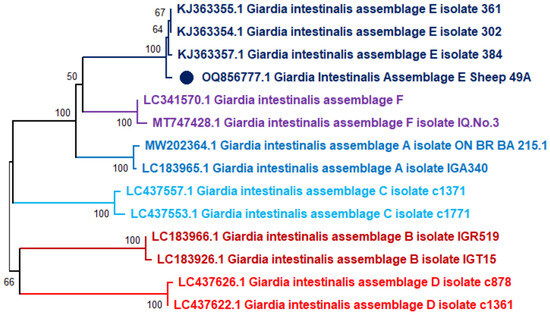
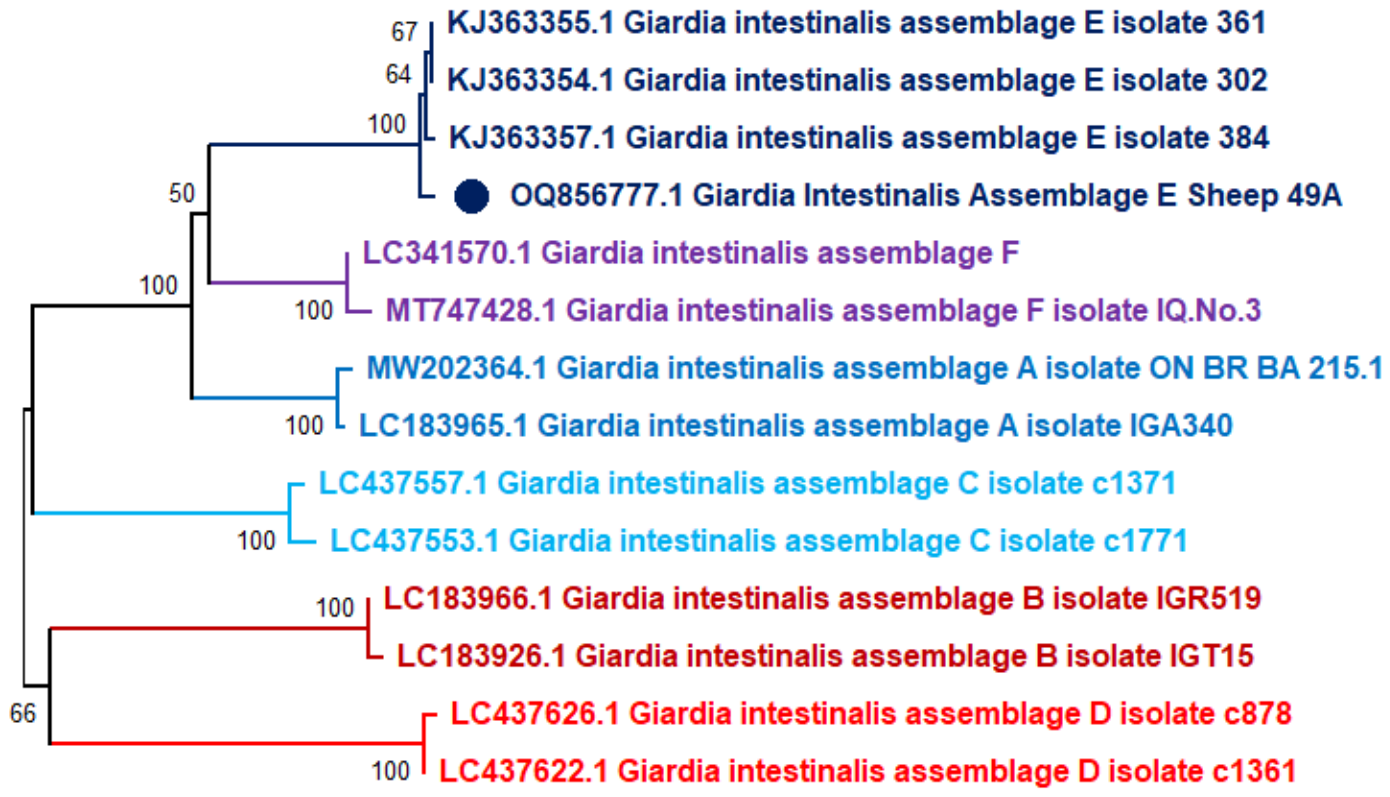
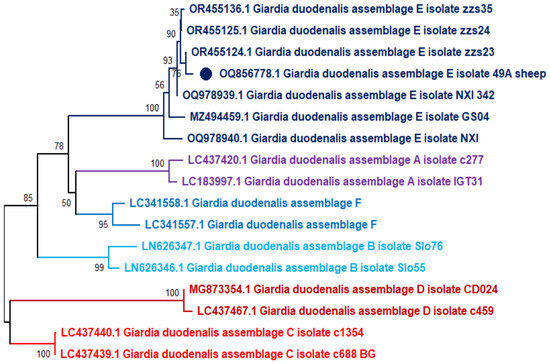
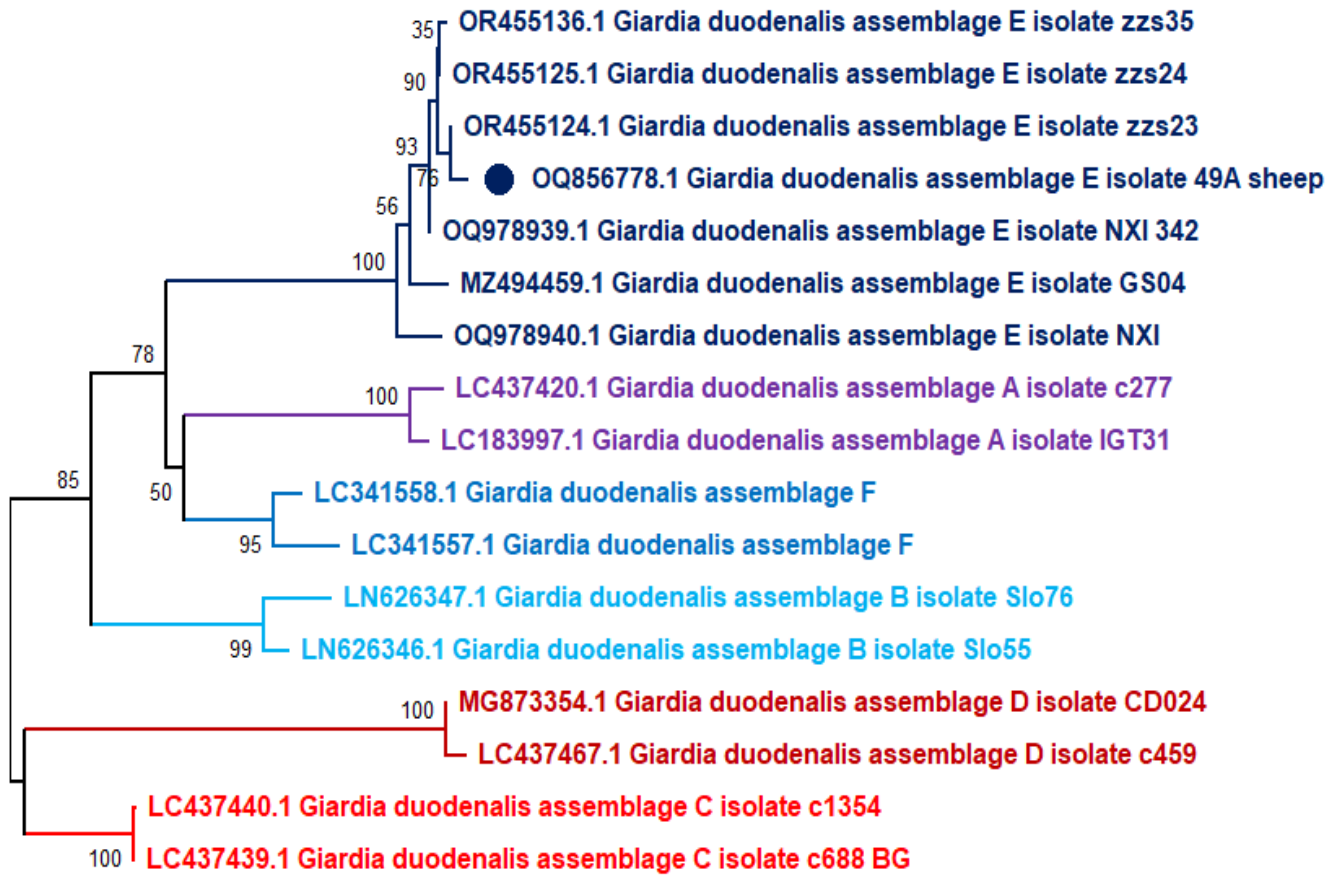
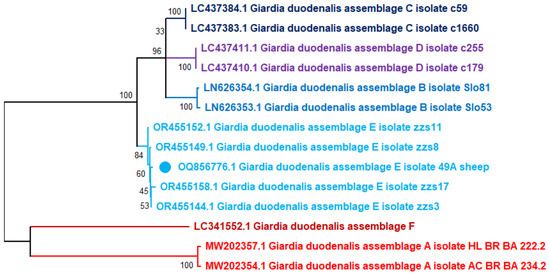
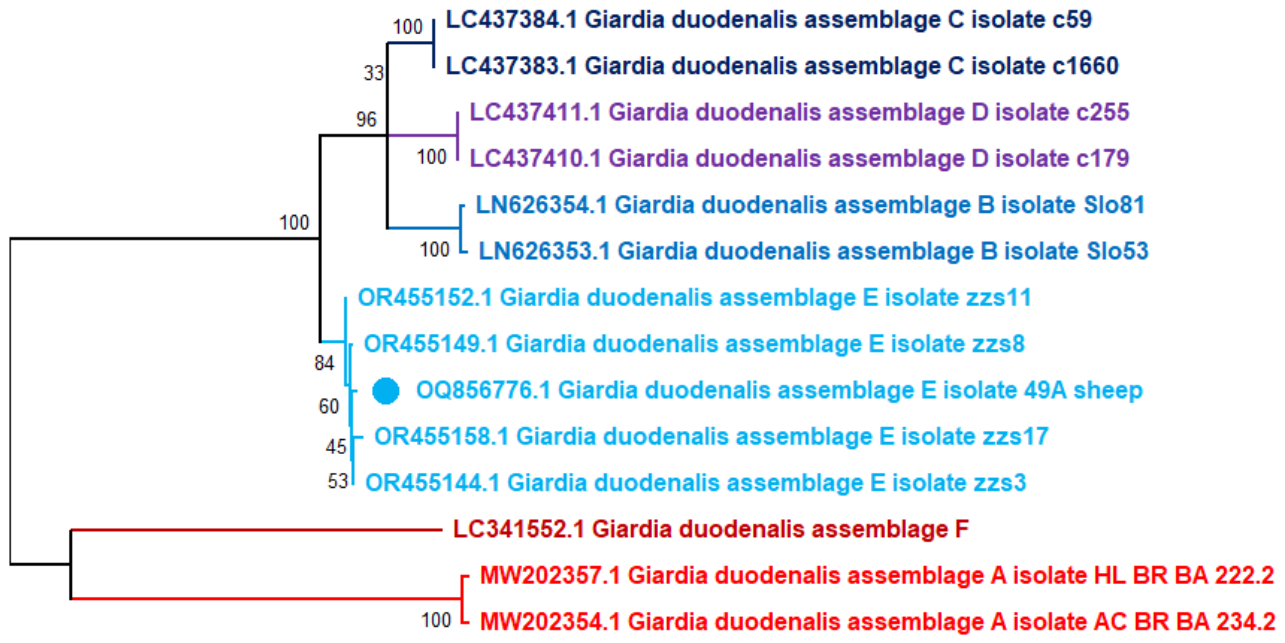
The positive sheep isolate was sequenced and compared to reference sequences via BLASTn (version BLAST+ 2.17.0). Phylogenetic trees for the tpi, bg, and gdh genes were constructed in MEGA 11 (Figure 1, Figure 2 and Figure 3). In all analyses, the isolate clustered definitively with G. duodenalis assemblage E reference sequences.
Figure 1.
Maximum likelihood phylogenetic tree based on the 530 bp sequence of the tpi gene, illustrating the genetic relationship of Giardia duodenalis identified from a faecal sample of a domestic sheep in Cyprus (indicated with a solid circle) alongside reference sequences retrieved from GenBank. Evolutionary distances were calculated using the Kimura two-parameter model, and bootstrap percentages (1000 replicates) are shown above the branches. The tree was constructed using MEGA 11.0 software.
Figure 2.
Maximum likelihood phylogenetic tree based on the 511 bp sequence of the bg gene, illustrating the genetic relationship of Giardia duodenalis identified from a faecal sample of a domestic sheep in Cyprus (indicated with a solid circle) alongside reference sequences retrieved from GenBank. Evolutionary distances were calculated using the Kimura two-parameter model, and bootstrap percentages (1000 replicates) are shown above the branches. The tree was constructed using MEGA 11.0 software.
Figure 3.
Maximum likelihood phylogenetic tree based on the 530 bp sequence of the gdh gene, illustrating the genetic relationship of Giardia duodenalis identified from a faecal sample of a domestic sheep in Cyprus (indicated with a solid circle) alongside reference sequences retrieved from GenBank. Evolutionary distances were calculated using the Kimura two-parameter model, and bootstrap percentages (1000 replicates) are shown above the branches. The tree was constructed using MEGA 11.0 software.
4. Discussion
This is the first molecular characterization of Giardia species in Cyprus and the first detection of Giardia species in domestic animals in Cyprus. G. duodenalis assemblage E is generally considered to be a ruminant-specific subtype [12] that is rarely found in humans [15,17]. Therefore, there is a low risk of zoonotic transmission of this parasite to humans in Cyprus.
All 42 faecal samples investigated in this study from domestic sheep and goats were previously analysed as part of our preliminary screening for the protozoan intestinal parasites Cryptosporidium and Blastocystis, which can also cause diarrhoea in humans and animals [34,35]. While there was a high positivity rate for Cryptosporidium spp. (14/42, 33.3%) [34] and Blastocystis sp. (9/42, 20.5%) [35], no domestic goats (0/10) and only 1/32 (3.1%) sheep tested positive for Giardia. This low detection rate from our preliminary study suggests that Giardia infection may not be common among domestic ruminants in Cyprus. Notably, the single sheep that tested positive for G. duodenalis was concurrently positive for Cryptosporidium (specifically C. xiaoi).
While our targeted investigation on a symptomatic domestic farm identified G. duodenalis assemblage E, our preliminary wildlife surveillance in the forest interface yielded no positive detections (95% CI: 0.0–3.5%). This provides a baseline for the Paphos State Forest area and suggests that if the parasite is circulating in this wildlife–livestock interface, it is doing so at a low prevalence. In addition, when these same 104 DNA extracts from free-ranging goats and wild mouflons were evaluated in our prior published screening, only one mouflon sample (0.96%) was found to be positive for Cryptosporidium (specifically C. parvum) [38], while 13/104 (12.5%) samples were positive for Blastocystis sp., including 8 mouflons and 5 free-ranging goats [35]. However, none of the wildlife samples in our preliminary study were positive for Giardia. These comparative results support the findings of previous studies [34,39,40], which suggested that domestic animals could be more likely to be infected with intestinal parasites than wild animals in Cyprus. According to Hadjisterkotis [41], wild sheep are extremely susceptible to livestock-borne diseases, and the spread of the above parasites should be kept under monitoring. In this way, the wildlife management authorities, as well as the Veterinary Services of Cyprus, could take appropriate management and conservation measures to prevent the spread of such pathogens. These measures should include establishing active seasonal molecular surveillance of shared water sources, enforcing controlled grazing buffers between domestic flocks and the Paphos State Forest, and implementing routine diagnostic screening for protozoan parasites in both livestock and the endangered Cyprian mouflon. A meta-analysis estimated the global prevalence of G. duodenalis in sheep and goats at 14% [42]. The prevalence of this parasite varies considerably across continents, with the highest prevalence reported in Europe (30.2%) and the lowest in Asia (8.6%) and Africa (12.2%). Prevalence also differs among individual countries, with Greece reporting the highest prevalence (42.5%), followed by Spain (34.8%), India (31.9%), and Belgium (31.2%). The lowest prevalence was observed in Nepal (0.5%), followed by Bangladesh (3.0%), Thailand (3.9%), Malaysia (4.5%), and Egypt (4.8%) [42].
Cyprus is an isolated island located at the crossroads of three continents: Europe, Asia, and Africa. While a recent meta-analysis estimates the global prevalence of G. duodenalis in small ruminants at 14%, our findings from the current study indicate a preliminary positivity rate of 3.1% (1/32) for domestic sheep only; however, a larger sampling size is needed for Cyprus to assess all ruminants. When positioned within the global landscape of reported prevalence rates, these results suggest that the Giardia positivity rate in the Cypriot animals sampled might be among the lowest reported, comparable to values observed in Nepal (0.5%) and substantially lower than those reported in neighbouring countries such as Greece (45.2%) and Turkey (15.2%) [42]. Further studies using larger, standardized, random-sampling designs are required to confirm these observations and to better understand the factors contributing to these regional differences.
Regarding mouflons, international data are very limited. To the authors’ knowledge, only one study from France has reported the detection of G. duodenalis in mouflons, with a positivity rate of 6.4% [43]. Rather than implying true biological rarity, the scarcity of available literature on this species highlights the need for cautious interpretation. Consequently, the zero-detection finding in the present preliminary study (0/70, 0%) must be analysed within its proper context, particularly given that a formal sample size calculation was not performed. The low positivity rate of G. duodenalis observed in this study is remarkable, particularly given that our study cohort included juvenile animals (3–5 months old), an age group that typically exhibits higher susceptibility and prevalence rates due to immature immune systems and increased environmental exposure. While environmental factors characteristic of the Cypriot climate (such as high solar UV exposure and aridity) could theoretically reduce the viability of G. duodenalis cysts and lower transmission pressure, these parameters were not systematically measured and remain speculative. More critically, due to the convenience sampling design, restricted cohort sizes, and the absence of a formal sample size calculation, these findings represent localized snapshots rather than definitive national prevalence estimates, serving strictly as exploratory baseline evidence. Additionally, while the farm management practice of separating symptomatic animals likely acts as a bottleneck for parasite transmission, these observational factors must be interpreted with caution. Ultimately, these results highlight that while Giardia is present, accurate assessment of its transmission dynamics in Cypriot ruminant populations will require larger, statistically powered, and randomized studies.
5. Conclusions
Conclusively, the results of this study indicate that animal pathogenic Giardia species are present in Cyprus, providing foundational baseline data for domestic ruminant populations. Given the methodological limitations of this exploratory work, including convenience sampling and the absence of a formal sample size calculation, these findings should be interpreted with caution. Future research utilizing larger, statistically powered, and randomized surveillance designs is essential to accurately determine true regional prevalence and transmission dynamics. Ultimately, establishing routine diagnostic screening within integrated One Health frameworks will be crucial for better understanding zoonotic transmission and supporting effective infectious disease management in Cyprus.
Author Contributions
Conceptualization, K.A.H., P.K. and I.C.; methodology, K.A.H. and C.O.P.; software, K.A.H. and C.S.; validation, K.A.H., N.K., E.H., C.S. and P.K.; formal analysis, K.A.H.; investigation, K.A.H., C.O.P., S.K., N.K., E.H. and C.S.; resources, N.K., E.H. and C.S.; data curation, K.A.H., E.H. and C.S.; writing—original draft preparation, K.A.H.; writing—review and editing, K.A.H., C.O.P., S.K., N.K., E.H., C.S., I.C. and P.K.; visualization, K.A.H. and C.S.; supervision, I.C. and P.K.; project administration, K.A.H., I.C., C.S. and P.K. All authors have read and agreed to the published version of the manuscript.
Funding
This research received no external funding.
Institutional Review Board Statement
Ethical review and approval were waived for this study. No animals were handled or harmed; samples were collected non-invasively from the environment.
Informed Consent Statement
Before collecting faecal samples, informed written consent to perform and anonymously publish the present study was obtained from the sheep and goat owner. No invasive, traumatic, or clinical procedures were used to collect the faecal samples. No specific ethical approval was required.
Data Availability Statement
The data generated and analysed from this study are available from the corresponding author upon request. The raw molecular data (sequences) generated during this study are available in the NCBI GenBank database under accession numbers OQ856776-OQ856778.
Acknowledgments
The authors would like to thank the Game Wardens of the Game and Fauna Service who assisted in the collection of faecal samples, the Agricultural Research Institute for supporting this research, as well as the University of Nicosia Medical School. During the preparation of this manuscript, the authors used Gemini (model version: Gemini 3.5 Flash) for the purposes of text proofreading and generating the graphical abstract. The authors have reviewed and edited the output and take full responsibility for the content of this publication.
Conflicts of Interest
The authors declare no conflicts of interest.
References
- Feng, Y.; Xiao, L. Zoonotic potential and molecular epidemiology of Giardia species and giardiasis. Clin. Microbiol. Rev. 2011, 24, 110–140. [Google Scholar] [CrossRef] [Scilit] [PubMed]
- Xiao, L.; Fayer, R. Molecular characterisation of species and genotypes of Cryptosporidium and Giardia and assessment of zoonotic transmission. Int. J. Parasitol. 2008, 38, 1239–1255. [Google Scholar] [CrossRef] [Scilit] [PubMed]
- Savioli, L.; Smith, H.; Thompson, R.C.A. Giardia and Cryptosporidium join the ‘Neglected Diseases Initiative’. Trends Parasitol. 2006, 22, 203–208. [Google Scholar] [CrossRef] [Scilit] [PubMed]
- Cacciò, S.M.; Ryan, U. Molecular epidemiology of giardiasis. Mol. Biochem. Parasitol. 2008, 160, 75–80. [Google Scholar] [CrossRef] [Scilit] [PubMed]
- Thompson, R.C.A.; Ash, A. Molecular epidemiology of Giardia and Cryptosporidium infections. Infect. Genet. Evol. 2016, 40, 315–323. [Google Scholar] [CrossRef] [Scilit] [PubMed]
- Certad, G.; Viscogliosi, E.; Chabé, M.; Cacciò, S.M. Pathogenic Mechanisms of Cryptosporidium and Giardia. Trends Parasitol. 2017, 33, 561–576. [Google Scholar] [CrossRef] [Scilit] [PubMed]
- Lebbad, M.; Petersson, I.; Karlsson, L.; Botero-Kleiven, S.; Andersson, J.O.; Svenungsson, B.; Svärd, S.G. Multilocus genotyping of human Giardia isolates suggests limited zoonotic transmission and association between assemblage B and flatulence in children. PLoS Negl. Trop. Dis. 2011, 5, e1262. [Google Scholar] [CrossRef] [Scilit] [PubMed]
- Ryan, U.; Cacciò, S.M. Zoonotic potential of Giardia. Int. J. Parasitol. 2013, 43, 943–956. [Google Scholar] [CrossRef] [Scilit] [PubMed]
- Van Der Giessen, J.W.; De, V.A.; Roos, M.; Wielinga, P.; Kortbeek, L.M.; Mank, T.G. Genotyping of Giardia in dutch patients and animals: A phylogenetic analysis of human and animal isolates. Int. J. Parasitol. 2006, 36, 849–858. [Google Scholar] [CrossRef] [Scilit] [PubMed]
- Giangaspero, A.; Paoletti, B.; Iorio, R.; Traversa, D. Prevalence and molecular characterization of Giardia duodenalis from sheep in central Italy. Parasitol. Res. 2005, 96, 32–37. [Google Scholar] [CrossRef] [Scilit] [PubMed]
- Ryan, U.M.; Bath, C.; Robertson, I.; Read, C.; Elliot, A.; Mcinnes, L.; Traub, R.; Besier, B. Sheep may not be an important zoonotic reservoir for Cryptosporidium and Giardia parasites. Appl. Environ. Microbiol. 2005, 71, 4992–4997. [Google Scholar] [CrossRef] [Scilit] [PubMed]
- Heyworth, M.F. Giardia duodenalis genetic assemblages and hosts. Parasite 2016, 23, 13. [Google Scholar] [CrossRef] [Scilit] [PubMed]
- Sprong, H.; Cacciò, S.M.; van der Giessen, J.W.B. Identification of zoonotic genotypes of Giardia duodenalis. PLoS Negl. Trop. Dis. 2009, 3, e558. [Google Scholar] [CrossRef] [Scilit] [PubMed]
- Ryan, U.; Hijjawi, N.; Feng, Y.; Xiao, L. Giardia: An under-reported foodborne parasite. Int. J. Parasitol. 2019, 49, 1–11. [Google Scholar] [CrossRef] [Scilit] [PubMed]
- Zahedi, A.; Field, D.; Ryan, U. Molecular typing of Giardia duodenalis in humans in Queensland—First report of assemblage E. Parasitology 2017, 144, 1154–1161. [Google Scholar] [CrossRef] [Scilit] [PubMed]
- Abdel-Moein, K.A.; Saeed, H. The zoonotic potential of Giardia intestinalis Assemblage E in rural settings. Parasitol. Res. 2016, 115, 3197–3202. [Google Scholar] [CrossRef] [Scilit] [PubMed]
- Fantinatti, M.; Bello, A.R.; Fernandes, O.; Da-Cruz, A.M. Identification of Giardia lamblia assemblage E in humans points to a new anthropozoonotic cycle. J. Infect. Dis. 2016, 214, 1256–1259. [Google Scholar] [CrossRef] [Scilit] [PubMed]
- Zhao, Q.; Lu, C.; Pei, Z.; Gong, P.; Li, J.; Jian, F.; Jing, B.; Qi, M.; Ning, C. Giardia duodenalis in Hu sheep: Occurrence and environmental contamination on large-scale housing farms. Parasite 2023, 30, 2. [Google Scholar] [CrossRef] [Scilit] [PubMed]
- Wang, P.; Zheng, L.; Liu, L.; Yu, F.; Jian, Y.; Wang, R.; Zhang, S.; Zhang, L.; Ning, C.; Jian, F. Genotyping of Cryptosporidium spp., Giardia duodenalis and Enterocytozoon bieneusi from sheep and goats in China. BMC Vet. Res. 2022, 18, 361. [Google Scholar] [CrossRef] [Scilit] [PubMed]
- Fu, Y.; Dong, H.; Bian, X.; Qin, Z.; Han, H.; Lang, J.; Zhang, J.; Zhao, G.; Li, J.; Zhang, L. Molecular characterizations of Giardia duodenalis based on multilocus genotyping in sheep, goats, and beef cattle in Southwest Inner Mongolia, China. Parasite 2022, 29, 33. [Google Scholar] [CrossRef] [Scilit] [PubMed]
- Liu, A.; Yang, F.; Shen, Y.; Zhang, W.; Wang, R.; Zhao, W.; Zhang, L.; Ling, H.; Cao, J. Genetic analysis of the Gdh and Bg genes of animal-derived Giardia duodenalis isolates in Northeastern China and evaluation of zoonotic transmission potential. PLoS ONE 2014, 9, e95291. [Google Scholar] [CrossRef] [Scilit] [PubMed]
- Zhang, W.; Zhang, X.; Wang, R.; Liu, A.; Shen, Y.; Ling, H.; Cao, J.; Yang, F.; Zhang, X.; Zhang, L. Genetic characterizations of Giardia duodenalis in sheep and goats in Heilongjiang Province, China and possibility of zoonotic transmission. PLoS Negl. Trop. Dis. 2012, 6, e1826. [Google Scholar] [CrossRef] [Scilit] [PubMed]
- Lebbad, M.; Mattsson, J.G.; Christensson, B.; Ljungström, B.; Backhans, A.; Andersson, J.O.; Svärd, S.G. From mouse to moose: Multilocus genotyping of Giardia isolates from various animal species. Vet. Parasitol. 2010, 168, 231–239. [Google Scholar] [CrossRef] [Scilit] [PubMed]
- Geurden, T.; Thomas, P.; Casaert, S.; Vercruysse, J.; Claerebout, E. Prevalence and molecular characterisation of Cryptosporidium and Giardia in lambs and goat kids in Belgium. Vet. Parasitol. 2008, 155, 142–145. [Google Scholar] [CrossRef] [Scilit] [PubMed]
- Santín, M.; Trout, J.M.; Fayer, R. Prevalence and molecular characterisation of Cryptosporidium and Giardia species and genotypes in sheep in Maryland. Vet. Parasitol. 2007, 146, 17–24. [Google Scholar] [CrossRef] [Scilit] [PubMed]
- Castro-Hermida, J.A.; Almeida, A.; González-Warleta, M.; Da Correia, C.J.M.; Rumbo-Lorenzo, C.; Mezo, M. Occurrence of Cryptosporidium parvum and Giardia duodenalis in healthy adult domestic ruminants. Parasitol. Res. 2007, 101, 1443–1448. [Google Scholar] [CrossRef] [Scilit] [PubMed]
- Robertson, L.J.; Gjerde, B.K.; Furuseth, H.E. The zoonotic potential of Giardia and Cryptosporidium in Norwegian sheep: A longitudinal investigation of 6 flocks of lambs. Vet. Parasitol. 2010, 171, 140–145. [Google Scholar] [CrossRef] [Scilit] [PubMed]
- Aloisio, F.; Filippini, G.; Antenucci, P.; Lepri, E.; Pezzotti, G.; Cacci, S.M.; Pozio, E. Severe weight loss in lambs infected with Giardia duodenalis Assemblage B. Vet. Parasitol. 2006, 142, 154–158. [Google Scholar] [CrossRef] [Scilit] [PubMed]
- Michel, S.; Kassinis, N. Ovis gmelini (Europe assessment). IUCN Red List Threat. Species. 2025. Available online: https://www.iucnredlist.org/species/54940218/215862493 (accessed on 15 March 2026).
- Caccio, S.M.; Beck, R.; Lalle, M.; Marinculic, A.; Pozio, E. Multilocus genotyping of Giardia duodenalis reveals striking differences between Assemblages A and B. Int. J. Parasitol. 2008, 38, 1523–1531. [Google Scholar] [CrossRef] [Scilit] [PubMed]
- Read, C.M.; Monis, R.T.; Thompson, R.C.A. Discrimination of all genotypes of Giardia duodenalis at the glutamate dehydrogenase locus using PCR-RFLP. Infect. Genet. Evol. 2004, 4, 125–130. [Google Scholar] [CrossRef] [PubMed]
- Sulaiman, I.M.; Fayer, R.; Bern, C.; Gilman, R.H.; Trout, J.M.; Schantz, P.M. Triosephosphate isomerase gene characterisation and potential zoonotic transmission of Giardia duodenalis. Emerg. Infect. Dis. 2003, 9, 1444–1452. [Google Scholar] [CrossRef] [Scilit] [PubMed]
- Caccio, S.M.; De Giacomo, M.; Pozio, E. Sequence analysis of the beta-giardin gene and development of a polymerase chain reaction-restriction fragment length polymorphism assay to genotype Giardia duodenalis cysts from human faecal samples. Int. J. Parasitol. 2002, 32, 1023–1030. [Google Scholar] [CrossRef] [Scilit] [PubMed]
- Schou, C.; Hasapis, K.A.; Karanis, P. Molecular identification of Cryptosporidium species from domestic ruminants and wild reptiles in Cyprus. Parasitol. Res. 2022, 121, 2193–2198. [Google Scholar] [CrossRef] [Scilit] [PubMed]
- Hasapis, K.A.; Schou, C.; Charalambidou, I.; O’Dowd Phanis, C.; Kazamia, S.; Hadjisterkotis, E.; Kassinis, N.; Karanis, P. First detection and molecular characterization of Blastocystis species in mouflons, sheep and goats in Cyprus. Next Res. 2026, 8, 101562. [Google Scholar] [CrossRef] [Scilit]
- Faria, C.P.; Zanini, G.M.; Dias, G.S.; da Silva, S.; Sousa Mdo, C. Molecular characterisation of Giardia lamblia: First report of assemblage B in human isolates from Rio de Janeiro (Brazil). PLoS ONE 2016, 11, e0160762. [Google Scholar] [CrossRef] [Scilit] [PubMed]
- Minetti, C.; Lamden, K.; Durband, C.; Cheesbrough, J.; Fox, A.; Wastling, J.M. Determination of Giardia duodenalis assemblages and multi-locus genotypes in patients with sporadic giardiasis from England. Parasit. Vectors 2015, 8, 444. [Google Scholar] [CrossRef] [Scilit] [PubMed]
- Hasapis, K.A.; Charalambidou, I.; Schou, C.; O’Dowd Phanis, C.; Kazamia, S.; Kassinis, N.; Hadjisterkotis, E.; Karanis, P. First detection of Cryptosporidium parvum in the endemic Cyprus mouflon (Ovis gmelini ophion). Acta Parasitol. 2024, 69, 1035–1040. [Google Scholar] [CrossRef] [Scilit] [PubMed]
- Hasapis, K.A.; Charalambidou, I.; Tsouma, E.; Sotiriadou, K.; Kassinis, N.; Schou, C.; Karanis, P. First detection of Cryptosporidium proventriculi from wild birds in Cyprus. Parasitol. Res. 2023, 122, 201–205. [Google Scholar] [CrossRef] [Scilit] [PubMed]
- Hoque, S.; Mavrides, D.E.; Pinto, P.; Costa, S.; Begum, N.; Azevedo-Ribeiro, C.; Liapi, M.; Kváč, M.; Malas, S.; Gentekaki, E.; et al. High occurrence of zoonotic subtypes of Cryptosporidium parvum in Cypriot dairy farms. Microorganisms 2022, 10, 531. [Google Scholar] [CrossRef] [Scilit] [PubMed]
- Hadjisterkotis, E. The Cyprus Mouflon Ovis gmelini ophion Management, Conservation and Evolution. Ph.D. Thesis, McGill University, Montreal, QC, Canada, 1992. [Google Scholar]
- Li, Z.; Wei, W.; Ma, Y.; Hao, L.; Guo, Y.; Wang, R. Prevalence and risk factors of Giardia duodenalis in sheep and goats in global: A systematic review and meta-analysis. Prev. Vet. Med. 2025, 244, 106623. [Google Scholar] [CrossRef] [Scilit] [PubMed]
- Bourgoin, G.; Portanier, E.; Poirel, M.T.; Itty, C.; Duhayer, J.; Benabed, S.; Cockenpot, A.; Callait-Cardinal, M.P.; Garel, M. Reproductive females and young mouflon (Ovis gmelini musimon × Ovis sp.) in poor body condition are the main spreaders of gastrointestinal parasites. Parasitology 2021, 148, 809–818. [Google Scholar] [CrossRef] [Scilit] [PubMed]
Disclaimer/Publisher’s Note: The statements, opinions and data contained in all publications are solely those of the individual author(s) and contributor(s) and not of MDPI and/or the editor(s). MDPI and/or the editor(s) disclaim responsibility for any injury to people or property resulting from any ideas, methods, instructions or products referred to in the content. |
© 2026 by the authors. Licensee MDPI, Basel, Switzerland. This article is an open access article distributed under the terms and conditions of the Creative Commons Attribution (CC BY) license.