


Abstract
Background: Postmortem redistribution (PMR) is a major challenge in forensic toxicology, particularly when drug concentrations are measured in central blood rather than peripheral blood. Although peripheral blood remains the preferred specimen for postmortem interpretation, it is not always available in routine forensic practice. Methods: This retrospective descriptive study evaluated postmortem central blood drug findings from judicial autopsies analyzed at the Forensic Toxicology Laboratory of the University of Catania between 2017 and 2024. Approximately, 700 forensic toxicological investigations were reviewed. Overall, 52 therapeutic drugs were identified, resulting in a final dataset of 313 individual drug findings. For each finding, central blood concentrations were compared with published reference ranges and cautiously classified as normal/therapeutic, high but non-toxic, toxic, or potentially lethal. Results: Most findings were classified as normal/therapeutic (84.3%), while 28 (8.9%) were high but non-toxic, 15 (4.8%) toxic, and 6 (1.9%) potentially lethal. The distribution remained broadly consistent in sensitivity analyses restricted to drugs represented by more than 3, 5, or 8 findings. In cases with toxic or potentially lethal findings and available paired peripheral blood data, observed C/P ratios were moderate, ranging from 1.07 to 2.15. Conclusions: These findings do not indicate that central blood can replace peripheral blood or that PMR can be disregarded. However, they suggest that central blood drug concentrations are not intrinsically uninterpretable and may retain practical forensic value when interpreted cautiously within the broader medico-legal context. Central blood results should not be used in isolation to diagnose poisoning, estimate the ingested dose, or reconstruct exact ante mortem concentrations.
1. Introduction
Postmortem Redistribution (PMR) is one of the most debated worldwide issues in forensic toxicology. It refers to after death changes in drug concentrations caused by the passive diffusion of xenobiotics between anatomical compartments. Although PMR is a well-known postmortem phenomenon, its mechanisms are not yet fully understood. In general, passive diffusion might occur from tissues or organs with higher drug concentrations, such as the lungs, liver, myocardium, or brain, to adjacent blood compartments [1].
Blood collected from central sites (central blood, CB) is generally considered more susceptible to PMR than peripheral blood (PB). In contrast, femoral blood is usually regarded as less affected by redistribution, due to the anatomic distance from the major organs, and therefore more representative of ante-mortem concentrations. For this reason, peripheral blood is widely considered the gold standard specimen for postmortem toxicological interpretation [2].
The ratio between central and peripheral blood concentrations (C/P ratio) is commonly used as an index of redistribution [3]. A ratio greater than 1 already indicates interference from postmortem redistribution, while progressively higher values generally suggest greater potential for redistribution. In particular, C/P ratios above 3 are considered suggestive of marked redistribution [4].
However, peripheral blood is not always available in forensic practice. Technical problems during sampling, postmortem alterations, traumatic injuries, or other specific conditions may limit its collection. In these circumstances, central blood may represent the first alternative specimen for toxicological investigation. However, the interpretation of drug concentrations measured in central blood remains controversial, and such findings are sometimes dismissed a priori as unreliable or of limited forensic significance.
Reference tables of therapeutic, toxic, and potentially lethal drug concentrations are widely used as interpretive tools. However, their applicability to postmortem toxicology is limited, as such values are often derived from clinical settings and may lack essential contextual information regarding sampling conditions, timing, and biological matrices. As a result, they may be potentially misleading if applied uncritically in postmortem investigations [5]. Indeed, despite extensive mechanistic research on postmortem redistribution, there is limited empirical evidence describing how central blood drug findings are typically classified and interpreted in routine forensic toxicology practice.
In this context, the present study aims to examine the interpretive value and limitations of postmortem central blood drug concentrations in routine forensic investigations, with particular attention to whether such findings may still provide meaningful information in the assessment of possible fatal or non-fatal poisoning when peripheral blood is unavailable. It does not seek to validate central blood as a substitute for peripheral blood, nor to investigate postmortem redistribution itself.
2. Materials and Methods
2.1. Study Design
This retrospective descriptive study was based on toxicological findings obtained from postmortem central blood samples collected during judicial autopsies and analyzed at the Forensic Toxicology Laboratory of the University of Catania, Italy, between 2017 and 2024.
Approximately 700 forensic toxicological investigations were reviewed. Cases were included when all the following criteria were met: availability of a postmortem central blood sample, quantitative determination of one or more therapeutic drugs, and availability of sufficient analytical data to assign each finding to one of the predefined interpretive categories. Cases involving only drugs of abuse, ethanol, or non-therapeutic substances were excluded. Findings without quantitative results or without suitable literature reference ranges for interpretive comparison were also excluded.
Overall, 52 different drugs were identified. The drugs included in the study reflect the real distribution of therapeutic drug findings observed in routine postmortem casework at the Laboratory during the study period.
Since the same compound could be detected in multiple cases and more than one drug could be detected in a single case, the final dataset consisted of 313 individual drug findings.
2.2. Toxicological Analysis
The investigated compounds mainly included benzodiazepines, antidepressants, antipsychotics, antiepileptics, and other therapeutic drugs selected according to case-specific information, including medical history, documented treatments, autopsy findings, and circumstantial evidence.
All analytes were determined using validated LC-MS/MS methods.
2.3. Classification of Drug Concentrations
For each individual drug finding, the measured concentration in central blood was compared with reference concentration ranges reported in the literature [6,7,8,9]. These ranges were used as interpretive guidance rather than as strict absolute thresholds. This approach reflects current recommendations in forensic toxicology, which emphasize that reference concentration tables should be interpreted with caution in postmortem settings due to their inherent limitations and lack of case-specific contextualization [5]. Borderline cases were classified cautiously, considering proximity to reported cut-offs, variability of published ranges, analytical uncertainty, and the limitations of postmortem blood interpretation. Each finding was then assigned to one of four interpretive categories: normal/therapeutic (N), high but non-toxic (H), toxic (T), or potentially lethal (L). The four-tier classification reflects a pragmatic interpretive framework commonly adopted in forensic casework rather than a strict toxicodynamic categorization.
2.4. Data Analysis
For each drug and for the overall dataset, the number and percentage of findings classified as N, H, T, or L were calculated. Descriptive statistics were used to summarize the dataset. For each drug, the number of findings, mean concentration, minimum concentration, maximum concentration, and percentage distribution across the four interpretive categories were reported.
A secondary descriptive analysis was performed by grouping individual drug findings according to the main pharmacological class of the detected compound. Drugs were classified into five categories: benzodiazepines/Z-drugs, antidepressants, antipsychotics, antiepileptics/anticonvulsants, and others. This grouping was based on the prevalent therapeutic class of each compound. For each pharmacological class, the total number of findings and the percentage of findings classified as N, H, T, or L were calculated relative to the total number of findings within that class.
To assess whether the overall interpretive pattern was disproportionately influenced by drugs represented by only a small number of findings, additional descriptive sensitivity analyses were performed by progressively restricting the dataset to drugs represented by more than 3, more than 5, and more than 8 findings. For each restricted dataset, the number and percentage of findings classified as N, H, T, or L were calculated relative to the total number of included findings.
Finally, an illustrative descriptive comparison was performed for drugs showing at least one toxic or potentially lethal finding and for which paired peripheral blood data were available in the same case. This comparison was not intended as a validation analysis, but only as an additional interpretive illustration of the relationship between central blood values and corresponding peripheral blood concentrations. For each drug, the observed central-to-peripheral concentration ratio (C/P ratio) was calculated. In addition, the highest central blood concentration was compared with the upper therapeutic limit and, when available, with the lower toxic and lethal reference thresholds reported in the literature. The magnitude of exceedance was expressed as fold increase, calculated by dividing the highest observed concentration by the corresponding reference value.
Inferential statistical testing was not performed because the study was not designed to test causality or predictive accuracy, but to characterize interpretive distributions in routine forensic practice.
3. Results
For each drug, the number of findings, concentration range, and percentage distribution across the four interpretive categories were calculated. These results are summarized in Table 1.
Table 1.
Number of individual drug findings, mean concentration (minimum–maximum), and percentage distribution across the four interpretive categories: normal/therapeutic (%N), high but non-toxic (%H), toxic (%T), and potentially lethal (%L).
Toxic or potentially lethal findings were identified in 15 of the 52 detected drugs. Toxic findings were observed for bromazepam, citalopram, clozapine, lamotrigine, lorazepam, nordiazepam, olanzapine, promazine, sertraline, triazolam, and zolpidem. Potentially lethal findings were observed for citalopram, diazepam, flurazepam, olanzapine, quetiapine, and vortioxetine.
Overall, among the 313 individual drug findings included in the study, 264 (84.3%) were classified as normal/therapeutic, 28 (8.9%) as high but non-toxic, 15 (4.8%) as toxic, and 6 (1.9%) as potentially lethal. The overall distribution of findings across the four interpretive categories is reported in Table 2.
Table 2.
Number and percentage of individual drug findings classified as normal/therapeutic, high but non-toxic, toxic, or potentially lethal in the overall study dataset.
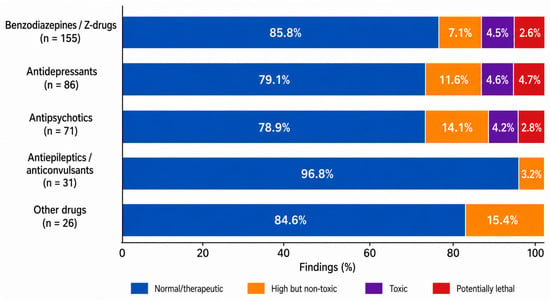
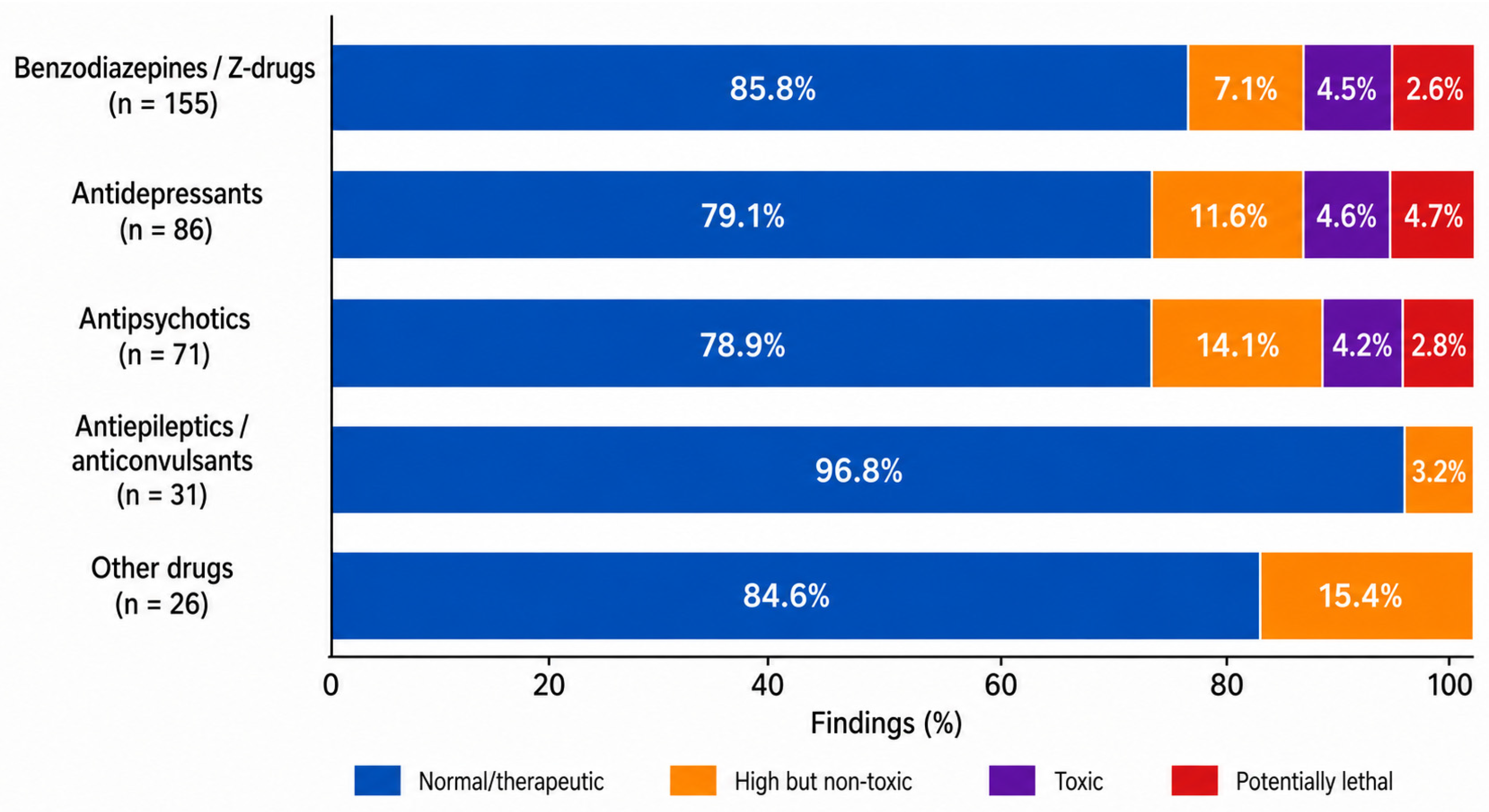
When individual findings were grouped according to the main pharmacological class of the detected drug, benzodiazepines/Z-drugs accounted for the largest subgroup (n = 155), followed by antipsychotics (n = 71), antidepressants (n = 43), antiepileptics/anticonvulsants (n = 31), and other drugs (n = 13). The highest proportion of normal/therapeutic findings was observed among antiepileptics/anticonvulsants (96.8%), whereas potentially lethal findings were proportionally more represented among antidepressants (4.7%) and antipsychotics (2.8%). These results are summarized in Figure 1, showing the percentage distribution of interpretive categories within each pharmacological class.
Figure 1.
Distribution of individual drug findings across interpretive categories (normal/therapeutic, high but non-toxic, toxic, and potentially lethal) according to pharmacological class. Values are expressed as percentages relative to the total number of findings within each class.
When the analysis was restricted to drugs represented by more than 3, 5, and 8 findings, the distribution across the four interpretive categories remained broadly consistent, with normal/therapeutic findings accounting for approximately 86–88% of cases and potentially lethal findings remaining below 2%. These results are summarized in Table 3.
Table 3.
Distribution of findings across the four interpretive categories in the full dataset and in the sensitivity analyses restricted to drugs represented by more than 3, more than 5, and more than 8 findings.
For drugs showing at least one toxic or potentially lethal finding, the highest observed central blood concentration was compared with the corresponding peripheral blood concentration and with the upper therapeutic limit and, when available, with the lower toxic and lethal reference thresholds. The fold increase relative to the upper therapeutic limit ranged from 1.58 for nordiazepam to 44.15 for vortioxetine. When toxic thresholds were available, the fold increase ranged from 1.15 for sertraline to 8.31 for lorazepam. When lethal thresholds were available, the fold increase ranged from 0.43 for zolpidem to 3.94 for citalopram. The observed C/P ratios ranged from 1.07 for diazepam to 2.15 for quetiapine. In 8 of the 15 paired comparisons, the interpretive category remained unchanged when passing from central to peripheral blood. In 12 of the 15 cases, peripheral blood concentrations still fell within the toxic or potentially lethal range, whereas in 14 of the 15 cases they remained above the upper therapeutic limit. These results are summarized in Table 4.
Table 4.
Highest observed central blood concentrations for drugs showing at least one toxic or potentially lethal finding, expressed as fold increase relative to the upper therapeutic limit and, when available, to the lower toxic and lethal reference thresholds.
4. Discussion
PMR remains one of the main interpretive concerns in forensic toxicology, especially when toxicological data are obtained from central rather than peripheral blood. Since central blood is collected in close proximity to organs that may release drugs after death, its concentrations are generally considered more vulnerable to redistribution phenomena and therefore less representative of ante-mortem circulating levels [10,11,12,13]. For this reason, peripheral blood is still regarded as the preferred specimen whenever it is available. Nevertheless, in routine forensic investigation peripheral blood may be unavailable or unsuitable for analysis. In such cases, the relevant question is not whether central blood can replace peripheral blood, but whether it may still provide useful information if interpreted with appropriate caution.
Previous studies and reviews have extensively addressed the mechanisms underlying PMR and the reasons why central blood is more vulnerable than peripheral blood to postmortem concentration changes. The present study does not challenge these established principles. Rather, it adds a casework-based quantitative perspective by showing how central blood findings are distributed across interpretive categories in routine forensic investigations.
The interpretive use of therapeutic, toxic, and potentially lethal reference ranges in postmortem toxicology remains inherently problematic. As highlighted by Stephenson et al. [5], such values may be potentially misleading when applied to postmortem investigations, as they are often derived from clinical data, lack information on sampling conditions and time intervals, and do not account for PMR and other case-specific factors. For this reason, in the present study these ranges were used as interpretive guidance rather than as strict diagnostic thresholds and always considered within the broader medico-legal context. An additional issue concerns the origin of the reference concentration ranges used for classification. Published therapeutic, toxic, and potentially lethal ranges are derived from heterogeneous sources and biological matrices, including plasma, serum, whole blood, ante-mortem clinical samples, postmortem peripheral blood, and, in some cases, central or heart blood. Therefore, direct comparison between these literature values and postmortem blood concentrations, whether central or peripheral, should always be interpreted cautiously. This heterogeneity further supports the use of these ranges as general interpretive guidance rather than strict diagnostic thresholds.
This study was conceived from that practical perspective. In our series, 52 different drugs were identified in postmortem central blood, for a total of 313 individual drug findings. Most of them were classified as normal/therapeutic (84.3%), whereas 8.9% were classified as high but non-toxic, 4.8% as toxic, and only 1.9% as potentially lethal. These data suggest that PMR alone is not enough to shift central blood findings automatically into the potentially lethal range. This does not mean that redistribution is negligible, nor that central blood may be interpreted in the same way as peripheral blood. It means, more cautiously, that central blood should not be dismissed a priori as forensically meaningless.
Supporting this interpretation, the proportion of findings falling within the normal/therapeutic range is noteworthy. For many drugs repeatedly detected in this series, central blood concentrations remained within ranges broadly compatible with therapeutic or non-toxic exposure. This suggests that central blood findings may still be informative when the question is whether drug exposure was excessive or not. This is particularly true when toxicological results are interpreted together with medical history, autopsy and pathological findings, and the circumstances of death. At the same time, these results should not be overinterpreted. They do not demonstrate that central blood accurately reflects ante-mortem concentrations and certainly do not allow a reliable reconstruction of the ingested dose.
A subgroup analysis by pharmacological class showed a broadly similar interpretive pattern across the main therapeutic categories. In all groups, most findings remained within the normal/therapeutic or high but non-toxic range, whereas potentially lethal findings were limited and were proportionally more represented among antidepressants and antipsychotics. This suggests that the overall trend observed in the study was not driven by a single pharmacological class.
This impression was also supported by the sensitivity analyses based on drug representation. When the dataset was progressively restricted to drugs represented by more than 3, more than 5, and more than 8 findings, the overall distribution across the four interpretive categories remained broadly comparable to that observed in the full dataset. This suggests that the overall interpretive trend observed in the study was stable and not merely the result of drugs represented by a very small number of findings.
The cases classified as high but non-toxic or toxic are more problematic and probably represent the area in which PMR creates the greatest interpretive difficulty. In such cases, elevated concentrations may reflect redistribution, chronic therapy with accumulation, reduced elimination, tolerance, or true overdose. Recent drug administration before death could also be particularly relevant. In such cases, central/peripheral differences may reflect not only postmortem redistribution, but also incomplete ante-mortem distribution. In a postmortem study on lidocaine distribution in human autopsy material [14], authors showed that the interval between drug administration and death exerted a crucial influence on compartmental distribution, with very short intervals being associated with markedly higher concentrations in central blood than in peripheral. For this reason, although blood drug concentrations represent a central element in forensic toxicological investigations, numerical values alone are not sufficient. The finding of high drug concentrations in postmortem blood, whether central or peripheral, should always be interpreted in the context of the whole case, rather than being taken as direct proof of acute poisoning. This applies even to peripheral blood, which, while generally preferable to central blood, can still be altered by postmortem phenomena and other case-specific conditions. Accordingly, toxicological findings in general, whether obtained from peripheral blood, central blood, or any other matrix, should never be interpreted in isolation. When drug toxicity is suspected, regardless of the pharmacological class involved, the diagnosis of fatal or non-fatal poisoning should always be based on the overall consistency of medico-legal criteria, including toxicological findings, medical and circumstantial history, autopsy findings, and histopathological evidence. In particular, it is necessary to establish, in each specific case, a plausible material causal relationship between exposure, dose, active drug concentrations, and the observed toxic or lethal effects, by critically integrating all available toxicological, pathological, circumstantial, and histopathological data and comparing them with similar autopsy cases reported in the literature.
Some of the cases included in this study illustrate this point well. In one case, a high central blood concentration of bromazepam was detected in a subject with a documented history of substance abuse who was struck by a vehicle while walking in the roadway in an evidently altered state. Hair analysis demonstrated repeated exposure to several psychoactive substances. In that setting, the elevated bromazepam concentration was more consistent with substantial ante-mortem intake than with a mere redistribution artifact. In another case, a subject receiving high-dose clozapine therapy showed a toxic central blood concentration of clozapine in association with syncopal episodes and impaired liver and kidney function in the days before death. In this case, the toxicological finding was more suggestive of accumulation during chronic treatment than of acute overdose. Both examples show that blood findings, especially central blood, acquire meaning only when integrated with the clinical, circumstantial, and pathological background.
The subgroup of potentially lethal findings deserves specific attention. In the present series, potentially lethal concentrations were observed for citalopram, diazepam, flurazepam, olanzapine, quetiapine, and vortioxetine. These cases are important because they directly address a common forensic objection, namely that a potentially lethal concentration measured in central blood may simply reflect redistribution and therefore have little or no interpretive value. Our data do not support such an absolute view. PMR certainly has to be considered, especially for drugs known to redistribute markedly, but a very high concentration in central blood cannot automatically be explained away on that basis alone.
The paired comparison between central and peripheral blood values available for the drugs listed in Table 4 provides an additional interpretive perspective. Although central concentrations were consistently higher than peripheral ones, the observed C/P ratios were generally moderate, ranging from 1.07 to 2.15. In this selected subset, in most cases peripheral blood concentrations remained either toxic/potentially lethal or at least clearly above the therapeutic range. Although this analysis is limited and cannot replace a systematic paired comparison study, it supports the view that central blood concentrations are not necessarily rendered forensically meaningless by redistribution alone. In several of the paired comparisons, the magnitude by which the central concentration exceeded therapeutic, toxic, or lethal reference values was greater than the observed central-to-peripheral ratio. This suggests that, in these selected cases, redistribution may have contributed to the increase in central blood concentrations, but often not to an extent sufficient to fully account for the magnitude of the observed values.
This point is also supported by two previously investigated cases in which both central and peripheral blood were available. In a fatal vortioxetine case, central and peripheral blood concentrations were 1457 ng/mL and 1197 ng/mL, respectively, with a C/P ratio of 1.2 [8]. In another case involving escitalopram, central and peripheral blood concentrations were 2852 ng/mL and 1972 ng/mL, respectively, with a C/P ratio of 1.4 [15]. In both cases, the diagnosis did not rest on blood data alone, but neither was the central blood result devoid of diagnostic value.
When peripheral blood is unavailable, literature C/P ratios may provide only a rough interpretive frame. They can help to contextualize the possible magnitude of redistribution, but they cannot replace direct paired measurement in the individual case. In fact, redistribution is influenced by several variables, including the specific drug involved, postmortem interval, sampling site, decomposition, co-exposures, and case-specific conditions. For this reason, any attempt to infer a hypothetical peripheral concentration from a central blood value should be regarded as approximate and only supportive. It may help the reasoning process, but it cannot establish the exact ante-mortem concentration or the dose taken.
Taken together, these findings support a pragmatic view of central blood interpretation. Central blood is not equivalent to peripheral blood, and it should not be used as if it were. At the same time, when no better specimen is available, it may still provide relevant forensic information, particularly when the question is whether the detected exposure is broadly compatible with therapeutic use, possible intoxication, or markedly excessive intake. The main problem with central blood is therefore not its automatic invalidity, but the risk of overinterpreting its numerical values outside the broader medico-legal context.
This study has several limitations that should be acknowledged when interpreting the findings. As a retrospective analysis of routine forensic casework, the availability and completeness of contextual information varied among cases. Detailed data on postmortem interval, degree of decomposition, agonal phase, exact sampling conditions, and storage history were not systematically available for all investigations. In addition, several cases involved polypharmacological exposure, chronic therapy, tolerance, organ dysfunction, or terminal clinical events, all of which may have influenced the observed drug concentrations and their postmortem behavior. In the present study, the causes of death in cases classified as toxic or potentially lethal were heterogeneous and were determined within the original medico-legal investigations; therefore, they were not systematically reported, as the study was not designed as a clinicopathological correlation analysis. The study was conducted at a single forensic toxicology laboratory and reflects the analytes, case mix, and interpretive practices of that setting. Peripheral blood was not systematically available and paired central–peripheral comparisons could be performed only in a limited subset of cases. Consequently, the study does not allow validation of central blood concentrations against peripheral blood values, nor does it support causal inferences regarding PMR mechanisms. The classification of findings into normal/therapeutic, high but non-toxic, toxic, and potentially lethal categories was based on published reference ranges used as interpretive guidance rather than as strict postmortem diagnostic cut-offs. Such ranges are largely derived from clinical data and do not fully account for PMR, interindividual pharmacokinetic variability, or case-specific circumstances. Accordingly, toxicological classification should not be equated with determination of cause of death, which always requires integration with autopsy findings, histology, scene investigation, and circumstantial evidence. Importantly, these limitations are inherent to real-world forensic toxicology practice and reflect the constraints under which routine postmortem investigations are conducted, rather than methodological shortcomings of the study itself. The present work was intentionally designed to describe and contextualize how central blood findings are interpreted in everyday casework, acknowledging the complexity and uncertainty that characterize forensic decision-making.
5. Conclusions
In conclusion, the present findings do not support the idea that postmortem central blood is inherently uninterpretable or automatically misleading in every case. Although it is more vulnerable to redistribution than peripheral blood, it may still retain interpretive value in routine forensic practice when peripheral blood is unavailable. Its significance, however, depends on cautious case-by-case evaluation, and central blood results should never be interpreted in isolation or used to reconstruct with certainty either the ingested dose or the exact ante-mortem blood concentration. More generally, they should not be used to diagnose either fatal or non-fatal poisoning solely by comparison with reference values. Future prospective studies based on systematically paired central and peripheral blood samples, with controlled information on postmortem interval, decomposition, sampling site, and case circumstances, are needed to better define the interpretive boundaries of central blood toxicology in forensic practice. When interpreted cautiously and contextually, central blood toxicology may assist forensic experts in excluding, contextualizing, or supporting hypotheses of drug involvement when peripheral specimens are unavailable.
Author Contributions
Conceptualization, P.Z.; Methodology, P.Z.; Writing—review & editing, P.Z.; Formal analysis, G.C.; Investigation, M.E. and M.F.; Writing—original draft preparation, G.G.P.; Visualization, M.F.; Supervision, F.S.; Data curation, N.B.; Project administration, N.B.; funding acquisition, N.B. All authors have read and agreed to the published version of the manuscript.
Funding
This research was supported by the University of Catania under the PIACERI Research Funding Program 2024–2026 (Project VOLTEMORT).
Institutional Review Board Statement
Not applicable. Ethical review and approval were not required for this study. Under Italian law, the jurisdiction of ethics committees is defined positively by D.M. 27 January 2023 (Ministero della Salute), Art. 1, covering clinical trials, clinical investigations with medical devices, and observational studies on medicinal products. The present study falls outside each of these categories. It was not a clinical study and did not involve living subjects, identifiable individuals, clinical interventions, drug administration, experimental procedures, or biological sampling performed for research purposes. The study was based exclusively on secondary analysis of fully anonymized analytical toxicology data generated during routine judicial autopsies and medico-legal investigations conducted under judicial authority, with irreversible removal of identifiers and no possibility of re-identification. The term “retrospective” as used in the manuscript refers exclusively to the fact that the analytical data preexisted the study design; it does not imply a clinical or epidemiological study design involving patients, health outcomes, or identifiable cohorts. Pursuant to Recital 26 of Regulation (EU) 2016/679, anonymized information does not constitute personal data and falls outside the scope of applicable data protection legislation.
Informed Consent Statement
Not applicable. Informed consent was not required because the study did not involve living subjects, identifiable individuals, recruitment, clinical intervention, drug administration, or biological sampling performed for research purposes. The study was based exclusively on fully anonymized analytical toxicology data generated during routine judicial autopsies and medico-legal investigations conducted under judicial authority. Pursuant to the Italian Data Protection Authority (1 March 2012 as published in Italy’s Official Journal No. 72 dated 26 March 2012) and Recital 26 of Regulation (EU) 2016/679, anonymized information does not constitute personal data.
Data Availability Statement
The data presented in this study are not publicly available due to legal and ethical restrictions related to forensic casework. Aggregated data supporting the findings are included within the article.
Conflicts of Interest
The authors declare no conflicts of interest.
Abbreviations
The following abbreviations are used in this manuscript:
| PMR | Postmortem redistribution |
| CB | Central blood |
| PB | Peripheral blood |
| C/P | Central-to-peripheral concentration ratio |
| LC-MS/MS | Liquid chromatography–tandem mass spectrometry |
References
- Skopp, G. Preanalytic aspects in postmortem toxicology. Forensic Sci. Int. 2004, 142, 75–100. [Google Scholar] [CrossRef] [Scilit] [PubMed]
- Abdelaal, G.M.M.; Hegazy, N.I.; Etewa, R.L.; Elmesallamy, G.E.A. Postmortem redistribution of drugs: A literature review. Forensic Sci. Med. Pathol. 2024, 20, 1483–1490. [Google Scholar] [CrossRef] [Scilit] [PubMed]
- Gerace, E.; Salomone, A.; Di Corcia, D.; Mazzucco, P.; Vincenti, M. Postmortem redistribution of triazolam, alprazolam, delorazepam (chlordesmethyldiazepam) and zolpidem in a suicide case. Toxicol. Anal. Clin. 2015, 27, 233–238. [Google Scholar] [CrossRef] [Scilit]
- Sastre, C.; Bartoli, C.; Baillif-Couniou, V.; Leonetti, G.; Pelissier-Alicot, A.L. Post mortem redistribution of drugs: Current state of knowledge. Curr. Pharm. Des. 2017, 23, 5530–5541. [Google Scholar] [CrossRef] [Scilit] [PubMed]
- Stephenson, L.; Van Den Heuvel, C.; Scott, T.; Byard, R.W. Difficulties associated with the interpretation of postmortem toxicology. J. Anal. Toxicol. 2024, 48, 405–412. [Google Scholar] [CrossRef] [Scilit] [PubMed]
- Schulz, M.; Schmoldt, A.; Andresen-Streichert, H.; Iwersen-Bergmann, S. Revisited: Therapeutic and toxic blood concentrations of more than 1100 drugs and other xenobiotics. Crit. Care 2020, 24, 195. [Google Scholar] [CrossRef] [Scilit] [PubMed]
- Gong, C.; Agbokponto, J.E.; Yang, W.; Simpemba, E.; Zheng, X.; Zhang, Q.; Ding, L. Pharmacokinetics of levosulpiride after single and multiple intramuscular administrations in healthy Chinese volunteers. Acta Pharm. Sin. B 2014, 4, 402–407. [Google Scholar] [CrossRef] [Scilit] [PubMed]
- Zuccarello, P.; Carnazza, G.; Giorlandino, A.; Cosentino, S.; Arcifa, V.; Barbera, N. Lethal vortioxetine poisoning? A forensic investigation. Leg. Med. 2023, 65, 102314. [Google Scholar] [CrossRef] [Scilit] [PubMed]
- Zuccarello, P.; Carnazza, G.; Barbera, N. Development and validation of a LC-MS/MS method for analysis of vortioxetine in postmortem specimens: First data from an authentic case. J. Forensic Sci. 2023, 68, 578–585. [Google Scholar] [CrossRef] [Scilit] [PubMed]
- Lusthof, K.J.; Bosman, I.J.; Kubat, B.; Vincenten-van Maanen, M.J. Toxicological results in a fatal and two non-fatal cases of scopolamine-facilitated robberies. Forensic Sci. Int. 2017, 274, 79–82. [Google Scholar] [CrossRef] [Scilit] [PubMed]
- Staeheli, S.N.; Gascho, D.; Ebert, L.C.; Kraemer, T.; Steuer, A.E. Time-dependent postmortem redistribution of morphine and its metabolites in blood and alternative matrices: Application of CT-guided biopsy sampling. Int. J. Leg. Med. 2017, 131, 379–389. [Google Scholar] [CrossRef] [Scilit] [PubMed]
- Zaitsu, K.; Nakayama, H.; Yamanaka, M.; Hisatsune, K.; Taki, K.; Asano, T.; Kamata, T.; Katagai, M.; Hayashi, Y.; Kusano, M.; et al. High-resolution mass spectrometric determination of the synthetic cannabinoids MAM-2201, AM-2201, AM-2232, and their metabolites in postmortem plasma and urine by LC/Q-TOFMS. Int. J. Leg. Med. 2015, 129, 1233–1245. [Google Scholar] [CrossRef] [Scilit] [PubMed]
- Pélissier-Alicot, A.L.; Gaulier, J.M.; Champsaur, P.; Marquet, P. Mechanisms underlying postmortem redistribution of drugs: A review. J. Anal. Toxicol. 2003, 27, 533–544. [Google Scholar] [CrossRef] [Scilit] [PubMed]
- Oertel, R.; Arenz, N.; Zeitz, S.G.; Pietsch, J. Investigations into distribution of lidocaine in human autopsy material. Biomed. Chromatogr. 2015, 29, 1290–1296. [Google Scholar] [CrossRef] [Scilit] [PubMed]
- Zuccarello, P.; Carnazza, G.; Salerno, M.; Esposito, M.; Cosentino, S.; Giorlandino, A.; Sessa, F.; Pomara, C.; Barbera, N. Forensic investigation on a combined death by food aspiration and acute escitalopram intoxication occurred to a psychiatric subject in a nursing home. Int. J. Leg. Med. 2024, 138, 1653–1658. [Google Scholar] [CrossRef] [Scilit] [PubMed]

Disclaimer/Publisher’s Note: The statements, opinions and data contained in all publications are solely those of the individual author(s) and contributor(s) and not of MDPI and/or the editor(s). MDPI and/or the editor(s) disclaim responsibility for any injury to people or property resulting from any ideas, methods, instructions or products referred to in the content. |
© 2026 by the authors. Licensee MDPI, Basel, Switzerland. This article is an open access article distributed under the terms and conditions of the Creative Commons Attribution (CC BY) license.