1. Introduction
Animal cruelty is recognized as a significant global concern [
1]. Cruelty comprises physical abuse, inadequate welfare management, and the psychological abuse of animals [
2]. Various forms of animal cruelty have been reported, including physical abuse (direct harm to animals such as beating, shooting, or the intentional use of vehicles to injure them) [
3], poisoning (the deliberate use of chemical substances to harm animals) [
4], sexual abuse (sexual acts inflicted on animals) [
5], and animal hoarding (the accumulation of an excessive number of animals without adequate welfare management or with neglect) [
6]. All forms should be taken into consideration, as they not only affect animal welfare but may also serve as indicators or predictors of human-directed violence [
7].
Veterinarians working in clinics or hospitals are on the frontline of detecting animal welfare issues when animals are presented for care [
2]. However, owners may conceal information or provide inaccurate histories [
8]. Therefore, veterinarians play an essential role in investigating potential concerns and establishing trust through physical examinations and laboratory findings [
9]. To address these concerns, veterinary forensics has emerged as an important field for investigating animal abuse and inadequate welfare management, as well as linking animal, human, and crime scene evidence [
10]. This field applies forensic principles, including the identification, collection, preservation, and transfer of evidence, while maintaining the integrity of the chain of custody to ensure the reliability and admissibility of findings [
11].
This study presents the clinical management of a dog initially brought to an animal clinic, which was later found to be associated with a broader situation of animal hoarding. During the subsequent investigation, additional animals were identified under conditions of inadequate care and compromised welfare. The case highlights how an initial clinical presentation can reveal a larger underlying problem of environmental neglect. It also emphasizes the importance of the early recognition and reporting of suspected animal cruelty in clinical practice, particularly within a multidisciplinary and veterinary forensic framework.
2. Case Presentation
A 7-year-old male mixed-breed dog was presented to a private veterinary clinic with seizures. The owner reported that other dogs in the same area had exhibited similar clinical signs. The dog had reportedly received annual vaccination boosters; however, no official vaccination record or pet health passport was available, and the owner was unable to specify the type of vaccines administered. One week prior to presentation, the dog showed signs of depression, weakness, and anorexia. On the day of admission, the dog developed seizures. The dog had been receiving monthly ectoparasite prevention; however, the product was purchased through a social media platform, and its formulation and authenticity could not be verified. The dog was kept in a private residential property together with multiple other dogs. The premises were not a licensed or authorized animal shelter.
Physical Examination
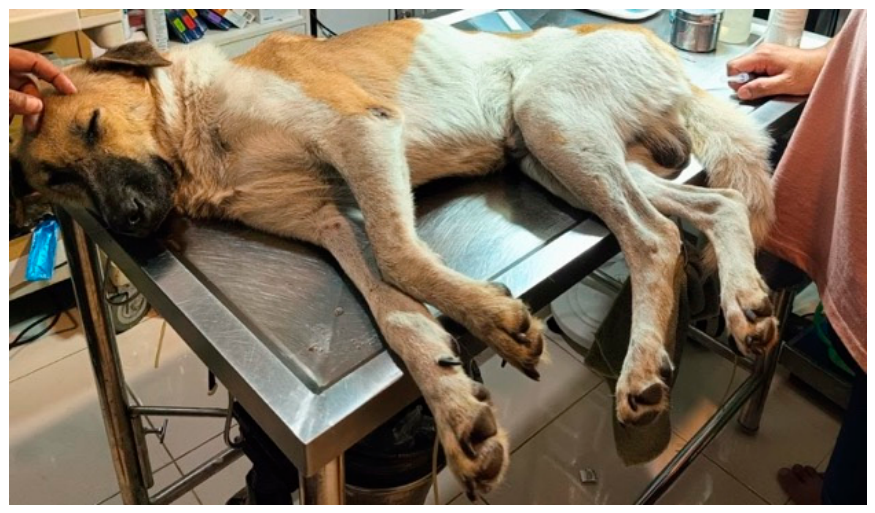
The dog was presented in an emaciated and dehydrated condition, with a body condition score (BCS) of 2/5. The capillary refill time (CRT) was less than 2 s. Rectal temperature was 102.5 °F. Cardiac auscultation revealed increased heart sounds, while lung sounds were clear. Facial muscle spasms were observed, along with bilateral ocular discharge and nystagmus. Numerous ticks were found attached to the skin at multiple sites (
Figure 1).
Blood was collected from the cephalic vein using an aseptic technique, with a total volume of 3 mL. Of this, 1 mL was placed into an EDTA tube for complete blood count (CBC) and blood parasite testing, while 2 mL was placed into a heparin tube for biochemical analysis. Conjunctival, nasal, and rectal swabs were collected using sterile cotton swabs and processed separately for infectious disease testing, including canine distemper virus (CDV), canine parvovirus (CPV), canine coronavirus (CCV), and
Giardia spp. Blood samples were submitted to the Vet Clinical Center (Vet Clinical Center Company Limited, Thailand), Bangkok, a specialized laboratory in Thailand that accepts animal specimens. Leukopenia and anemia were identified on CBC (
Table 1).
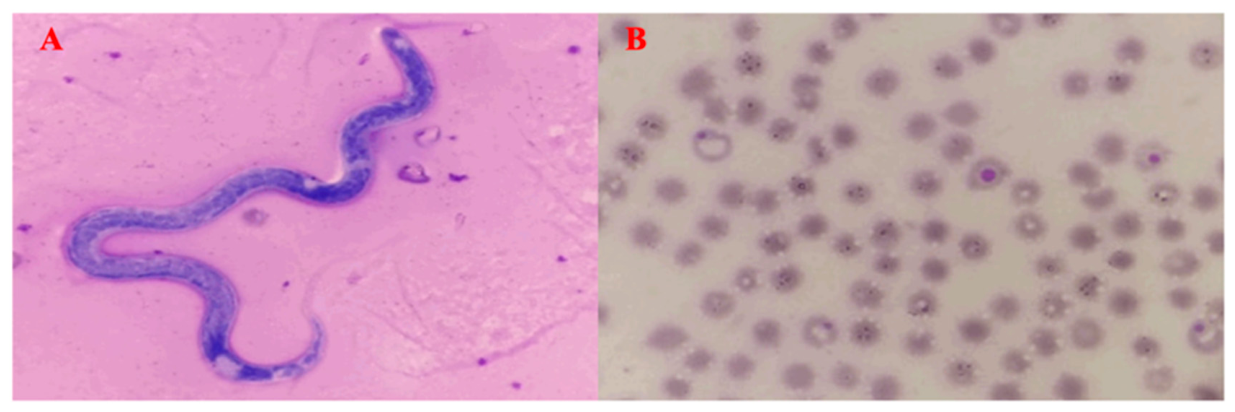
Testing for blood parasites was positive for
Dirofilaria immitis using a commercial kit (SNAP 4Dx Plus, IDEXX Laboratories) and blood smear, which also revealed inclusion body-like structures within erythrocytes (
Figure 2A,B). CDV tested positive on a conjunctival swab sample using a single-pathogen commercial kit (Vet-Smart Antigen Test, BEC), whereas CCV, CPV, and
Giardia spp. tested negative on fecal samples using a commercial combination kit (Saber Vet Test, PFC Companion) (
Table 1). The results of these commercial tests should be interpreted with caution, as their accuracy may be influenced by factors such as the stage of infection, pathogen load, sample quality, and test performance characteristics. As confirmatory testing such as polymerase chain reaction (PCR) was not performed, the results were interpreted in conjunction with the clinical presentation.
The dog received primarily supportive and empirical treatment aimed at stabilizing its condition and alleviating clinical signs. Intravenous (IV) fluid therapy with acetate. Marbofloxacin (4 mg/kg, SC), prednisolone (0.5 mg/kg, IM), tramadol (4 mg/kg, IV), diazepam (0.5 mg/kg, IV), and vitamin B complex (0.1 mL/kg, IV) were administered. However, despite treatment, the dog continued to experience seizures and died after 48 h. The owner declined a necropsy.
Based on the owner’s report that other dogs in the same area had begun exhibiting clinical signs, a request was made to inspect the remaining animals, to which the owner consented (
Supplementary Material). The inspection was conducted by a veterinarian in coordination with local police authorities. The study was limited to veterinary forensic documentation, and any subsequent legal procedures following police involvement were beyond the scope of this report. The inspection was carried out in accordance with crime scene investigation principles adapted from the Federal Bureau of Investigation (FBI) protocols for human investigations [
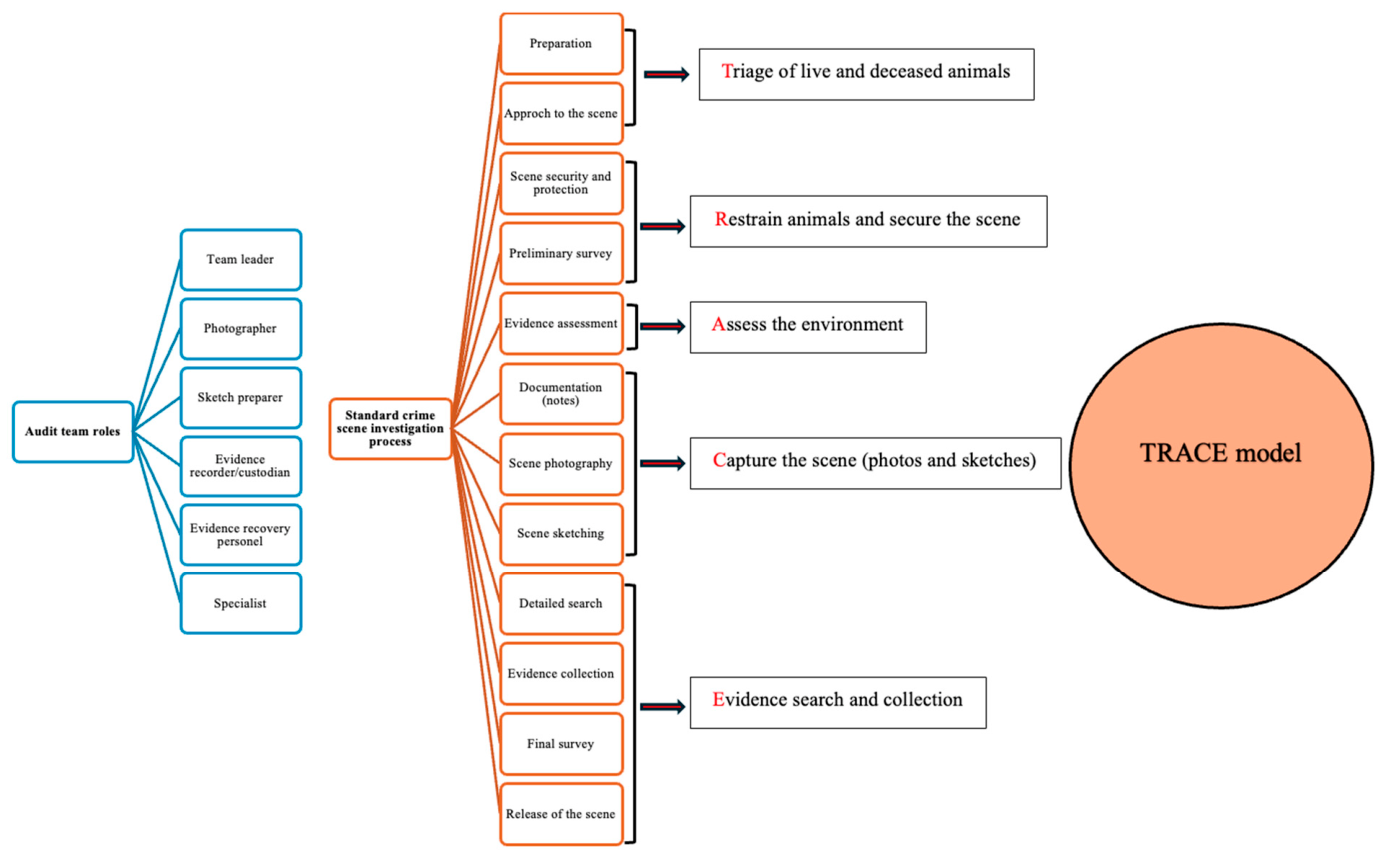
12]. These principles were subsequently modified for veterinary forensic applications and organized into the TRACE model, a proposed conceptual model developed by the authors based on established crime scene investigation principles. The TRACE model was designed to provide a practical and easily remembered structure for organizing veterinary forensic investigations and has not yet undergone formal validation (
Figure 3).
The field survey team was led by a forensic veterinarian responsible for planning the management strategy and was supported by assistants responsible for photography, animal restraint, and the collection of evidence from both the animals and the environment. The TRACE model consists of five key steps: (1) triage of live and deceased animals; (2) restraint of animals and scene security; (3) assessment of the environment; (4) scene documentation (photography and sketching); and (5) evidence search and collection.
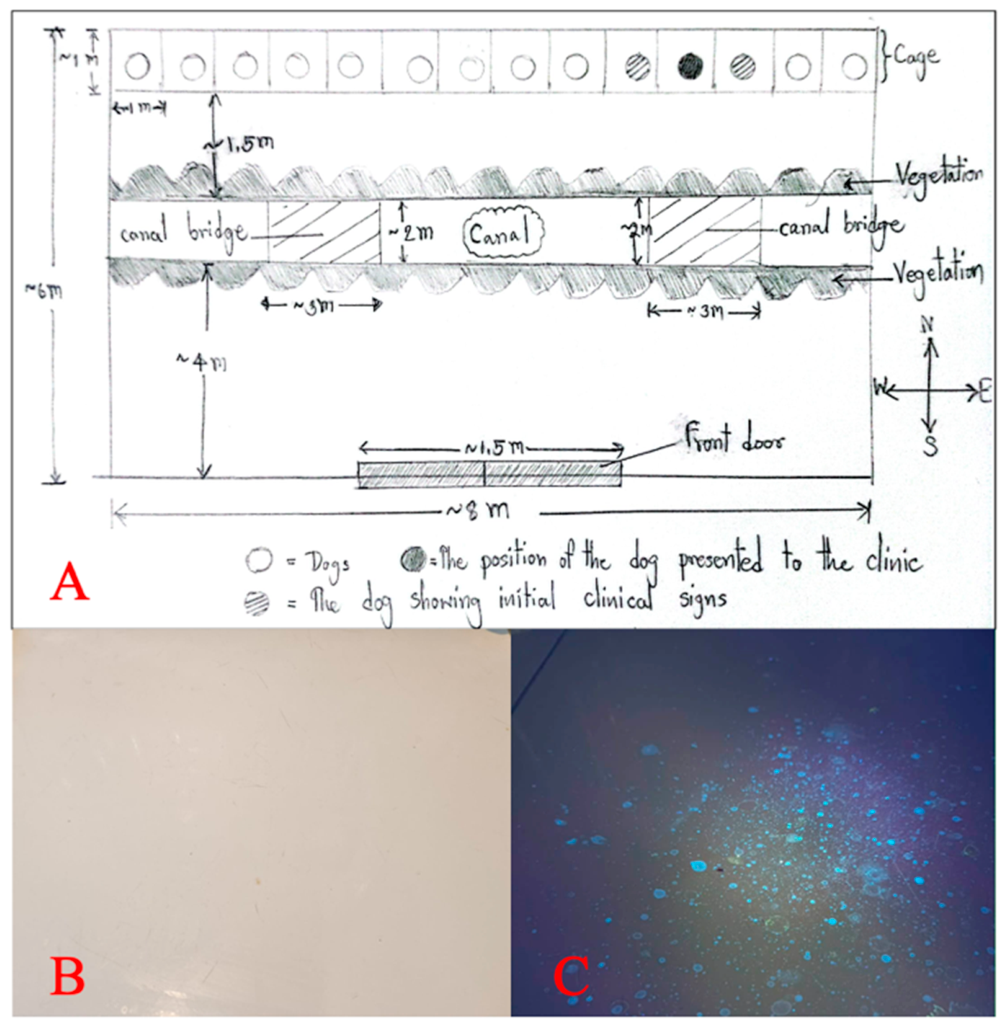
Upon arrival, the area where the animals were kept was found to be overcrowded, with 13 dogs confined within the same space. The surrounding environment included a canal running through the property and overgrown vegetation (
Figure 4A). Many dogs were emaciated, and a pungent odor was noted in the housing area. Dogs housed in adjacent cages to clinically ill animals exhibited muscle tremors. Dogs suspected of having canine distemper were isolated from apparently healthy individuals, and appropriate treatment was initiated. Upon illumination with UV light (~365 nm), fluorescent stains of unknown origin not visible to the naked eye were observed on the floor of the affected dog’s cage (
Figure 4B,C). A top-view sketch map of the scene was generated through rough sketching (
Figure 4A). The owner was informed of the applicable legal provisions in Thailand under the Prevention of Cruelty to Animals and Animal Welfare Act B.E. 2557 (2014) [
11] and was provided with guidance on appropriate corrective measures in response to animal hoarding and neglect.
The veterinary clinic assisted in publicizing the case and facilitating the adoption of the dogs to reduce overcrowding, and coordinated with non-governmental organizations (NGOs) to identify potential adopters. Sterilization services were provided to prevent population growth, and vaccinations were administered. During the intervention phase, areas within the property were cleared to eliminate mosquito breeding sites, and flea, tick, and heartworm preventive measures were implemented regularly. Follow-up was conducted through monthly veterinary visits on the remaining eight dogs following rehoming through adoption, including general clinical examinations, commercial tests, and routine hematological testing, with medical treatment provided as needed. At the one-year follow-up, no new dogs had been introduced, and the animals’ overall health had improved.
3. Discussion
Animal hoarding has been reported worldwide and generally involves the accumulation of multiple animals within a single household. Although owners commonly believe that they can provide adequate care, animal welfare is frequently compromised, and new animals may still be acquired despite limited resources [
13]. Animal hoarders can be broadly grouped into three types. The overwhelmed caregivers initially manage animal care adequately, but this declines over time, often due to socioeconomic or health-related factors, and they may still accept help. The rescuer hoarder, in contrast, strongly believes that their care is sufficient despite evidence to the contrary and typically refuses outside assistance. The exploiter hoarder acquires animals for personal benefit, provides inadequate care, and does not allow intervention [
14]. In the present study, the owner’s behavior was compatible with features of an overwhelmed caregiver type, as they were willing to accept external assistance and showed an intention to improve husbandry practices following veterinary recommendations. Nevertheless, the accumulation of animals under conditions of inadequate care constitutes neglect. Therefore, such actions are considered a violation of animal welfare legislation and are subject to legal penalties under the Prevention of Cruelty to Animals and Animal Welfare Act B.E. 2557 (2014) in Thailand [
11].
Mapping is crucial in crime scene investigations and is typically performed through sketching. It helps visualize the locations of witnesses, as standard photographs cannot capture all details [
15]. Furthermore, when accessing private areas where photography is prohibited, sketching a map provides a comprehensive overview from a shared perspective. Distances should be measured; if this is not possible on-site, the locations of objects can be used for comparison or estimation [
16]. In this study, it was found that the dog cages were located near a canal, and the sick dogs were housed in adjacent cages, potentially increasing exposure risk for neighboring animals.
Based on hematological findings in dogs presented to the clinic, leukopenia may be induced by stress or infection. Stress stimulates cortisol release, which subsequently leads to immunosuppression [
17]. Previous studies have shown that CDV can infect the bone marrow and induce lymphocyte apoptosis, resulting in anemia and leukopenia [
18]. Additionally, inclusion body-like structures have been occasionally observed within erythrocytes in CDV-infected animals, and have been suggested as a potential indicator of viral activity [
19]. However, these structures were assessed based on routine morphology to exclude artifacts and hemoparasites, and their significance has not been fully validated; confirmation by molecular techniques would be required, and thus they should be interpreted with caution. In the investigated scene, multiple dogs were confined in cages near a canal, an environment highly conducive to vector-borne disease transmission. The detection of
Dirofilaria immitis in over half of the population (53.85%) suggests inadequate vector control within the housing environment. Additionally, two dogs housed adjacent to the index case presented with mild muscular tremors, raising suspicion of early neurological involvement. Clinically affected animals were subsequently separated and subjected to diagnostic evaluation and appropriate treatment as a precautionary disease control measure. Overall, 13 dogs were examined, revealing a high burden of infectious diseases, including canine distemper virus (CDV) in 3/13 (23.08%),
Dirofilaria immitis in 7/13 (53.85%), and
Ehrlichia canis in 8/13 (61.54%). The co-occurrence of these infections suggests chronic exposure to both vector-borne and contagious pathogens, consistent with inadequate husbandry and poor biosecurity measures.
Environmental assessment further identified a strong ammonia-like odor within the cages, indicative of accumulated urine and inadequate sanitation. Such conditions are known to compromise respiratory health and may increase susceptibility to infectious diseases. Although ammonia concentrations were not measured in this case, recommended environmental ammonia levels in animal housing should generally not exceed 20 ppm [
20]. Exposure to elevated ammonia concentrations may cause irritation of the respiratory tract and eyes and increase susceptibility to respiratory infections, including pneumonia [
20,
21,
22].
In forensic science, alternative light sources (ALSs) are fluorescence-based tools that emit a wide range of wavelengths to detect latent biological traces not visible under normal lighting conditions. Previous studies have demonstrated their application in the detection of visible semen stains [
23], latent fingerprints [
24], salivary secretion [
25], and blood [
26]. However, due to the relatively high cost of ALSs and its limited applications, it is not commonly used in veterinary medicine. Nevertheless, in clinical veterinary practice, a Wood’s lamp is routinely used to detect
Microsporum canis, which produces an apple-green fluorescence when positive [
26]. This device emits ultraviolet light at approximately 365 nm [
26], making it potentially useful for identifying suspicious biological stains at crime scenes, as substances such as serum [
26], saliva, or mucus containing fluorescent organic compounds may exhibit fluorescence at this wavelength [
27]. In this study, ultraviolet light at 365 nm was used to reveal previously undetected stains beneath and surrounding the cages, and fluorescence was observed on the floor of the house near the clinically affected dog, as well as on the fur of some dogs. These stains were suspected to be biological secretions, such as nasal discharge or saliva, which may act as fomites contributing to disease transmission among animals in close confinement. Nevertheless, fluorescence observed under ultraviolet light should be regarded as a screening tool rather than a definitive indicator of biological material, and can be used to guide further confirmatory testing.
Physical examination of the animal, along with the observation of neglect-related physical conditions, is a crucial consideration. This is supported by previous studies reporting that animals examined postmortem exhibited signs of prior neglect and were suspected to have been killed by their owners prior to suicide [
9]. This study, based on owner-reported information, physical examinations, and laboratory examinations of the dogs, clearly indicates neglect resulting in adverse health outcomes. Therefore, a plan to inspect the animal housing environment is warranted. In cases involving private property, consent from the owner or a search warrant issued by law enforcement is required. Once an inspection is authorized, clearly defined team roles and systematic procedures are essential. A veterinarian trained in forensic veterinary science can lead the operation by coordinating the plan and assigning specific roles. Veterinary assistants may serve as the photographer and sketch preparer. The roles of evidence recorder/custodian and evidence recovery personnel must be performed by individuals trained in crime scene investigation and evidence collection. The transfer of evidence must be properly documented, including the recipient’s signature, as well as the date and time [
27]. If the veterinarian is not trained in crime scene investigation and evidence collection, coordination with relevant specialists or law enforcement is necessary to prevent contamination or loss of evidence at the scene.
The TRACE model was applied in this study. Following permission from the owner to access the premises, the team leader developed a plan to triage the dogs by separating clinically normal animals from those that were ill, with priority given to treating dogs in suspected emergency conditions. During handling and restraint, animals must be managed using low-stress techniques to minimize distress and prevent harm while ensuring the safety of personnel involved in the operation. Subsequently, the investigative team was established, and the scene was systematically assessed. Environmental conditions were documented using both wide-angle and close-up photography, supplemented by scene sketches that included the positions of cages. Evidence was not touched, altered, or removed until it had been properly documented, measured, and photographed. This approach is based on the principle that every contact leaves a trace, as described by Locard’s exchange principle [
28], and is essential to preserve the integrity of the evidence and ensure its reliability.
4. Conclusions
This case highlights the critical role of veterinarians in clinical assessment and their contribution to the identification of animal hoarding and neglect within a forensic investigation framework. The integration of clinical examination, laboratory diagnostics, and crime scene investigation provided comprehensive evidence of animal neglect associated with large-scale animal accumulation in an unsuitable environment. Infectious diseases, including CDV, likely related to inadequate vaccination, and Dirofilaria immitis infection associated with insufficient vector control, were identified. These findings collectively reflect compromised animal welfare. From a forensic perspective, the application of the TRACE model facilitated a structured approach to documenting and interpreting information from multiple sources, enabling the systematic recording of relevant clinical and environmental evidence.
Although this single case does not permit conclusions regarding the overall effectiveness of the TRACE model, it illustrates its potential utility as a framework for organizing evidence in veterinary forensic investigations. Further studies involving a larger number of cases are needed to evaluate its broader applicability and usefulness in animal cruelty investigations. Continued collaboration among veterinarians, forensic scientists, law enforcement personnel, NGOs, and mental health professionals may also contribute to more consistent identification, documentation, and management of suspected animal welfare violations.




 ,
,