


Abstract
Background/Objectives: Mass suicide events represent complex socio-cultural phenomena requiring multidisciplinary investigation. The 1978 Jonestown event (>900 deaths) remains the most extensively documented modern case. Methods: We conducted a systematic literature review adhering to PRISMA guidelines, searching PubMed, Web of Science, and Scopus databases for peer-reviewed articles published between 1978 and 2026 using the query: ((mass) AND (suicide)) OR (suicide) AND (jonestown). Following screening, 10 papers were selected for inclusion. We integrated these findings with forensic autopsy reports (n = 7), toxicological analyses, discourse analysis of the 45 min audio recording preceding the mass deaths, field investigation data, scholarly monographs, reputable popular science publications, and archival materials from contemporary sources to examine the forensic and criminological aspects of the event. Results: Toxicological analysis detected cyanide in 2/7 autopsied bodies; multiple sedatives (promethazine, chlorpromazine, diphenhydramine, pentobarbital) in gastric tissue indicated recent ingestion. Two gunshot fatalities presented additional complexity. Manner of death was classified as undetermined due to ambiguous circumstances regarding volition versus coercion. Discourse analysis revealed the community’s response was actively debated and constructed through persuasive communication: Reverend Jones strategically framing the situation as hopeless while preserving the appearance of individual agency. Psychosocial analysis identified characteristic patterns: charismatic authoritarian leadership, progressive isolation, apocalyptic ideology, and deindividualization processes. Conclusions: The Jonestown event exemplifies the intersection of forensic pathology challenges in mass casualty investigations and complex group dynamics culminating in collective death. Analysis demonstrates group members actively participated in leadership–followership dynamics, constructing narrative fit between identity and action through discourse. Findings emphasize the importance of immediate toxicological sampling, preservation of forensic evidence, recognition of warning signs in high-control groups, and understanding how narratives of hopelessness and foreclosure of options can be exploited for extremist mobilization.
1. Introduction
Mass suicide (MS) events, defined here as coordinated deaths of an entire social group, require conceptual frameworks that distinguish their underlying causation. Mancinelli et al. [1] proposed a binary typology differentiating internally motivated events (self-induced) from those precipitated by external existential threats (heteroinduced). The former category encompasses groups whose belief systems, rather than authentic external dangers, drive collective death. The latter describes populations facing genuine threats such as military conquest, slavery, or genocide, where collective suicide represents an escape from intolerable circumstances. This framework, while not capturing all nuances, provides a useful heuristic for analyzing historical events. For the purposes of this study, MS is defined as the simultaneous suicide of all the members of a social group in the context of different social and cultural models [1]. It occurs within the same spatiotemporal context and is motivated by shared beliefs, coercive group dynamics, or a combination thereof. This definition explicitly encompasses events in which volition may be partial or absent in some victims, as in the case of minors or individuals who are physically coerced, and therefore includes episodes more accurately described as mass murder–suicide.
Numerous historical MS events occurred, as shown in Table 1. These events occur across diverse cultural contexts, with notable clustering in religious movements during periods of social upheaval. Previous investigations of mass casualty religious group events, including the Solar Temple (1994–1997) and Heaven’s Gate (1997), have identified common patterns including charismatic authoritarian leadership, social isolation, and apocalyptic ideology. The most extensively documented modern example is the 1978 Jonestown (JT) event in Guyana, where more than 900 members of the Peoples Temple (PT), led by Reverend James Warren “Jim” Jones, died in a MS-homicide event [1,2]. Casualties included a United States (U.S.) Congressman, journalists, and numerous infants and children who were killed by their parents before the adult members consumed cyanide [3].
Cyanide is common in suicide, accidents, and occasionally homicides. While acute cyanide poisoning diagnosis is rarely uncertain at autopsy, toxicological analysis can be challenging due to both the destruction and de novo production of cyanide in stored blood samples [4].
Contemporary psychological and lay explanations of the JT event have often depicted it as irrational processes, with obedience, conformity, and identification with a charismatic leader leaving community members in a state where they become passive victims. These frameworks suggest extreme behaviors occur when individuals lose reason and will control through deindividuation, agentic states, or charismatic influence via coercive techniques. However, alternative theoretical frameworks propose the JT event may be better understood as identity-based collective action rather than irrational individual action, making room for individual agency even in extreme situations [5].
Building upon these diverse perspectives, this study seeks to provide a multidimensional analysis of the JT event by bridging the gap between clinical findings and socio-theoretical constructs. The primary objective is to evaluate the forensic pathology findings and the specific toxicological hurdles encountered when documenting cyanide poisoning within a mass casualty framework. Beyond the medical evidence, the research aims to deeply investigate the psychosocial mechanisms and group dynamics that facilitated the event, paying particular attention to the interplay between coercive environmental factors and the maintained agency of the participants. Ultimately, the study intends to perform a broad comparative analysis that synthesizes forensic–pathological data, psychological drivers, and religious-ideological influences. By integrating these disparate elements into a unified criminological discourse, the work aspires to develop a more holistic and nuanced understanding of how multiple variables converge to produce such extreme collective outcomes. Specifically, the study addresses three research objectives, beginning with an inquiry into what forensic and toxicological evidence may be gleaned from the limited post-mortem examinations conducted at JT and what inherent constraints limit the interpretation of such data. Furthermore, it examines which psychosocial and criminological mechanisms underpin the collective participation in the mass death event, with a specialized focus on the nuanced interplay between systemic coercion and individual agency. Finally, the research evaluates how a multidisciplinary integration of forensic, criminological, and psychological perspectives might enhance the conceptualization of MS phenomena beyond the scope of traditional, single-discipline analyses.
Table 1.
Selected Historical Cases of Mass Suicidal Events.
2. Materials and Methods
This study adopts a mixed-methods integrative review design, combining a focused systematic search of biomedical databases with a non-systematic retrieval of historical, criminological, and archival sources. This design was selected because the JT event, as a singular historical mass casualty incident, does not lend itself to a conventional systematic review of homogeneous comparative studies. The biomedical search component followed PRISMA 2020 reporting guidelines [16] with respect to documentation and transparency of the selection process.
This systematic review was conducted and reported in accordance with the PRISMA 2020 guidelines [16]. A completed PRISMA 2020 checklist is provided as Supplementary Materials. Registration of this review in PROSPERO was not performed due to the retrospective and archival natura of data sources, which preclude prospective registration: the authors acknowledge this as a limitation.
Systematic searches for peer-reviewed articles were conducted across PubMed, Web of Science, and Scopus, focusing on journals in forensic medicine and criminology. The search query used was: ((mass) AND (suicide)) OR (suicide) AND (jonestown). Articles published between 1978 and 2026 were included. This specific timeframe was chosen due to the JT event in 1978, which is a pivotal case in the context of MS studies.
It must be acknowledged that the three databases selected (PubMed, Web of Science, and Scopus) primarily index biomedical and science literature. The present search strategy therefore represents a focused forensic–medical core, supplemented by non-systematic retrieval of sociological, criminological, and historical sources through the inclusion of scholarly monographs and archival materials.
To broaden the analytical scope and provide comprehensive historical and psychosocial context, the systematic search was supplemented through non-systematic retrieval of additional source types. These included: scholarly monographs, reputable popular science publications dedicated to the JT event, and archival materials from contemporary sources. This multifaceted approach ensured access to original historical documents, forensic autopsy reports (n = 7), toxicological analyses, field investigation data, police reports, and contemporary medical accounts that might not be available through traditional academic databases. The inclusion of these supplementary materials was guided by relevance to the three research objectives defined in the Introduction and by availability of primary documentation; no formal quality appraisal instrument was applied to non-peer-reviewed sources. Readers should be aware that conclusions derived from these supplementary sources carry a different level of evidentiary weight than those supported by the peer-reviewed corpus and are presented accordingly throughout the Discussion.
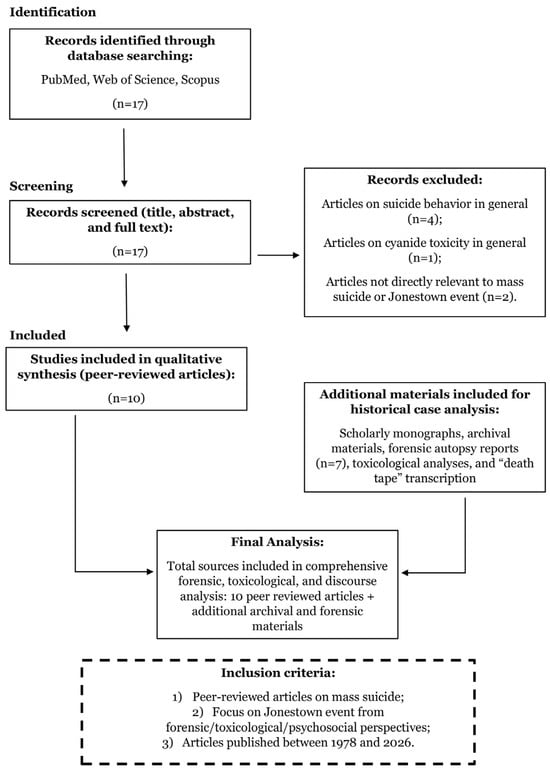
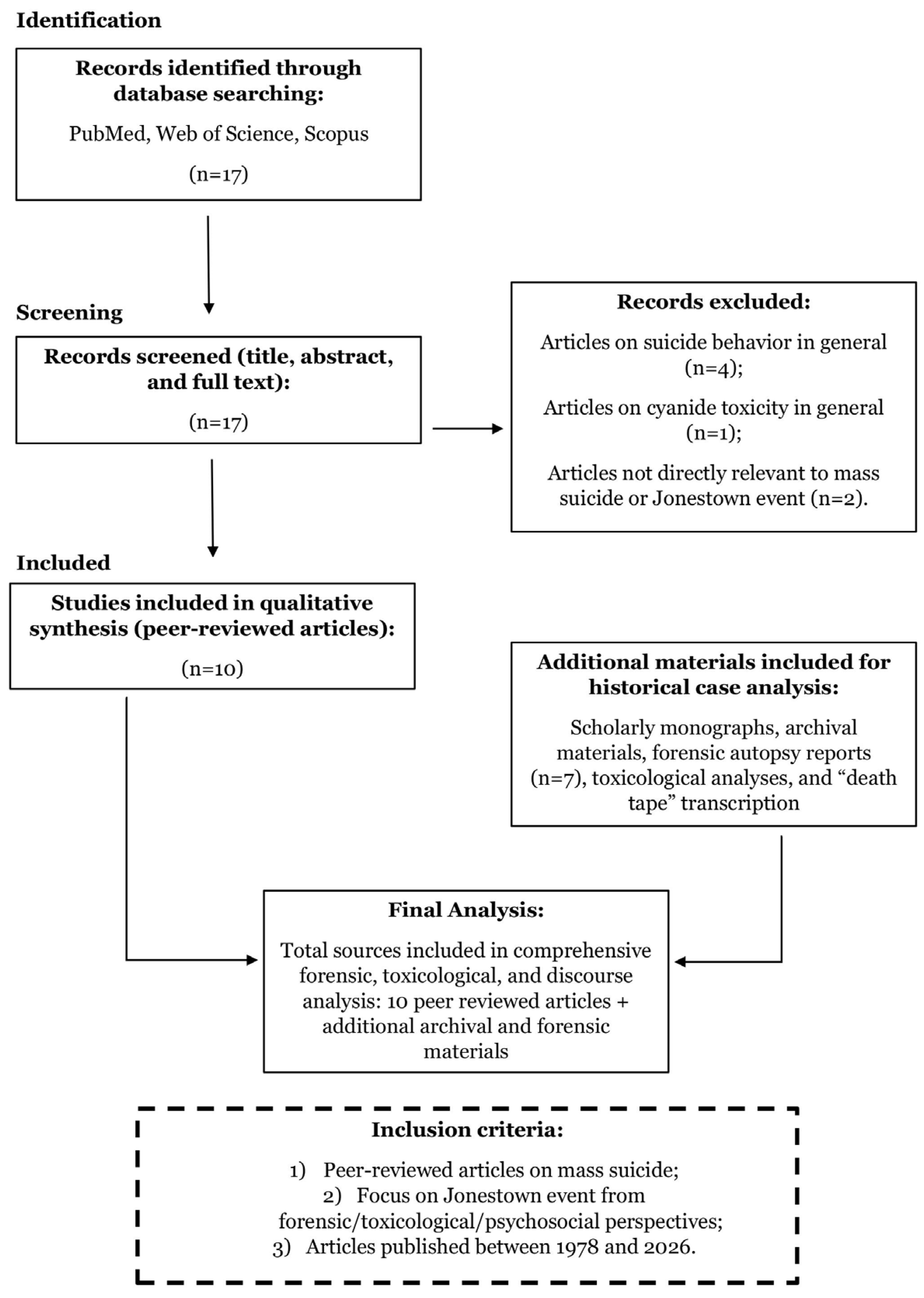
The systematic literature search and selection process followed PRISMA guidelines as illustrated in Figure 1. The initial database search identified 17 potentially relevant studies. Following screening of titles and abstracts, full-text articles were assessed for eligibility according to predefined inclusion criteria: (1) peer-reviewed articles addressing MS phenomena, (2) articles specifically examining the JT event from forensic, toxicological, or psychosocial perspectives, and (3) articles published between 1978 and 2026. Exclusion criteria included: (1) articles on suicide behavior in general (n = 4), (2) articles focused on cyanide toxicity in general (n = 1), and (3) articles not directly relevant to MS or the JT event (n = 2). Following this screening process according to the eligibility criteria, a final cohort of 10 papers was selected for inclusion (as shown in Table 2).
Figure 1.
Search strategy following PRISMA criteria.
Table 2.
Characteristics of Included Studies. The following table summarizes the key characteristics of the 10 peer-reviewed studies included in the systematic review. For each study, the reference, year of publication, primary focus, population or data source examined, and main outcomes relevant to the research objectives are reported.
Additionally, within the selected papers we extracted and incorporated the analysis of the transcription of the live audio recording (the so-called “death tape”) of the final 45 min preceding the mass deaths to understand the discursive construction of the situation and the leadership–followership dynamics during the event [5]. To broaden the analytical scope and provide comprehensive historical context, we extended our research beyond peer-reviewed literature to include scholarly monographs, reputable popular science publications dedicated to the JT event, and archival materials from contemporary sources. This multifaceted approach ensured access to original historical documents, forensic autopsy reports (n = 7), toxicological analyses, field investigation data, police reports, and contemporary medical accounts that might not be available through traditional academic databases. The forensic analysis component focused on the seven autopsies performed in 1978 by a specialist team from the Armed Forces Institute of Pathology and a civilian consultant [17]. Toxicological identification was conducted using ultraviolet spectrometry and gas chromatography, with subsequent confirmation via gas chromatography/mass spectrometry.
3. Results
The PT was established in Indianapolis, Indiana, in the 1950s under Reverend Jim Jones, who began his religious career as a Methodist preacher. Initially, the PT’s mission centered on racial integration and social welfare programs within the segregated regional context. The church’s integrationist ideology attracted a predominantly African American following [5]. However, following Reverend Jones’s pronouncements of prophetic visions concerning a nuclear apocalypse, he relocated approximately 150 members to Northern California during the early 1960s. This relocation fulfilled dual strategic functions: bypassing anticipated catastrophe and preempting institutional scrutiny following Reverend Jones’s secession from the Methodist hierarchy. The group subsequently reconsolidated in Redwood Valley, California, where Reverend Jones’s charismatic authority intensified alongside the implementation of centralized organizational structures [22,23].
The late 1960s and early 1970s witnessed substantial growth in the PT’s political influence, with Reverend Jones becoming a prominent figure within the socio-political landscape in San Francisco and Los Angeles. This reflected the media attention he received. By 1977, escalating pressure from U.S. authorities, media disclosures, and allegations from former members, prompted Reverend Jones’s relocation to Guyana with approximately 1000 adherents [24]. They settled in an agricultural commune, designated as JT [5], where residents endured 11 h workdays under suboptimal nutritional and sanitary conditions within an essential infrastructure (e.g., dining facilities, a medical clinic) [25]. Social control was maintained through progressive isolation, including passport confiscation and monitored communication, while internal dissent was suppressed via public censure, restricted food access, and confinement [10].
JT residents began rehearsing collective suicide, termed “revolutionary suicide,” as leadership had previously done in San Francisco. Audio recordings and written notes document the frequency of these rehearsals. A martyrdom narrative permeated the community [12]. The PT habitually recorded all its sessions. The recovery of over 1000 tapes at JT has provided crucial insight into the atmosphere within the group leading to MS [22].
On 18 November 1978, U.S. Congressman Leo J. Ryan, accompanied by a delegation of journalists and “Concerned Relatives,” conducted an onsite investigation of JT following allegations of systemic abuse and fraud [5,24]. The mission focused on assessing the safety and voluntary nature of members’ affiliation with the PT. During the subsequent evacuation of 15 defectors at a nearby airstrip, PT militants assassinated Congressman Ryan, three journalists, and one departing member [5]. Simultaneously, Reverend Jones initiated the previously rehearsed MS protocol. Parents administered a lethal agent to their children before consuming a potassium cyanide-laced beverage themselves. The community killed themselves by drinking a lethal cocktail of juice mixed with sedatives and cyanide [5]. Evidence suggests the adults proceeded under varying degrees of coercion and autonomy. A related incident in the PT’s Georgetown headquarters resulted in a member committing familicide by incised wounds before suicide. By the close of 18 November 1978, total mortality in Guyana reached 918 individuals: five were shot at Port Kaituma; four died from incised wounds in Georgetown; and 909 died in JT, primarily from potassium cyanide ingestion, with two fatalities (including Reverend Jones) resulting from gunshot wounds [12,24,25,26].
The JT event has been classified as murder/suicide because a third of total victims were minors [5]. Investigators at the scene discovered the community had maintained an open microphone and had recorded the 45 minutes of interaction during the suicide event. This so-called “death tape” was transcribed, providing peculiar insight into real-time negotiations between followers and Reverend Jones in the process of extremist collective action [5].
Dr. Leslie Mootoo, the Guyanese Chief Medical Examiner, visually examined over 200 bodies and reported needle marks on at least seventy. Guyanese authorities exempted the cases of unnatural death from mandatory autopsy. As a result, U.S. physicians conducted post-mortem examinations on only seven individuals. Documentation indicates that the remains arrived at Dover Air Force Base on November 23, with formal forensic examinations initiating on November 27 [17]. Following refrigerated transport from Guyana, the cadavers underwent systematic weight-based and pathological scrutiny. Initial biometric assessments revealed advanced postmortem decomposition, characterized by maggot infestation and partial saponification. Additionally, the cataloging of personal effects identified apparel labeling discrepancies, suggesting the postmortem interchange of items among the deceased.
Although State Department officials were advised to conduct autopsies on a statistically significant sample, legal opinion initially precluded authorization, leading to immediate embalming. After obtaining next-of-kin consent, investigators performed post-mortem examinations only in cases with traumatic injuries and a selected few without. Consequently, only seven autopsies were performed on 15 December 1978, by a specialist team from the Armed Forces Institute of Pathology and a civilian consultant. During the dental examination, a distinct pink discoloration was noted on the teeth, attributed the discoloration to advanced postmortem decomposition. Of the seven bodies subjected to autopsy, only two presented lethal traumatic injuries. One body displayed a close-contact gunshot wound to the left temporal region, with the exit wound located at the right temple. The remaining five autopsied bodies exhibited no significant anatomic changes, save for signs of postmortem decomposition and evidence consistent with the prior embalming process. Toxicological findings, specifically the presence of various drugs in each body, are presented in Table 3.
Table 3.
Toxicological findings, adapted from Thompson et al., 1987 [17].
A critical forensic dimension that received limited attention in the JT investigation was the formal identification of the deceased. With over 900 victims in advance state of decomposition under tropical conditions, positive identification posed an extraordinary challenge. The advanced putrefaction, partial saponification, and documented interchange of personal effects among the bodies severely compromised the reliability of visual identification. Dental records and fingerprinting were employed were feasible, but the lack of antemortem records for many victims limited the effectiveness of these methods. DNA analysis, now a standard tool in mass-disaster-victim identification, was not yet available in 1978. The apparel labeling discrepancies noted during biometric assessment further underscore the systemic identification failures, which ultimately meant that a number of victims could not be positively identified. This represents a significant forensic limitation of the JT investigation and highlights the importance of pre-establishing victim identification protocols in the context of high-control religious communities, where documentation of members may be deliberately concealed or destroyed.
Given the extensive decomposition and pervasive contamination with embalming fluid, brain and muscle tissues were prioritized for analysis due to their minimal fluid infiltration; conversely, blood and urine specimens were unavailable. Initial toxicological screening utilized ultraviolet spectrometry and gas chromatography, with results confirmed via gas chromatography/mass spectrometry. Cyanide was quantified in two subjects using ultraviolet spectrophotometry to measure ionic tetracyanonickelate complexes. However, the presence of formaldehyde significantly confounded the assessment of cyanide concentrations. Specifically, the reaction between cyanide and formaldehyde at ambient temperatures yields ammonia and alkali salts, including glycolic acid, glycine, and iminodiacetic acid. While glycolic acid was initially evaluated as a potential biomarker for cyanide exposure via high-pressure liquid chromatography, its detection in non-exposed control tissues rendered it an unreliable indicator. Cyanide is also known to disappear in the postmortem state secondary to evaporation, thiocyanate formation, and cyanide combining with tissue [27]. A small amount of cyanide is also produced by postmortem decomposition [28,29]. Table 4 shows drug distribution in one body’s tissues.
Table 4.
Example of the drug distribution in the tissues of one body (mg/100 g), adapted from Thompson et al., 1987 [17].
Except for chloroquine, most likely given for malaria prophylaxis, all drugs found had higher concentrations in the stomach than in other tissues, indicating the drugs were ingested and still in the absorptive phase of distribution. Notably, cyanide was also identified in the muscle tissue of one of these two bodies. Coexisting gunshot wounds and cyanide intoxication suggest several possible sequences. One hypothesis posits the individual who survived the initial cyanide ingestion longer than anticipated, subsequently sustaining gunshot wounds, either self-inflicted or inflicted by another party. Alternatively, the individual may have succumbed to cyanide intoxication first, with the gunshot wounds being a postmortem artifact inflicted by a third party. Consequently, the cause of death for this case was formally recorded as a combination of acute cyanide intoxication and gunshot wounds to the head. In the remaining five autopsied cases, the cause of death was designated as acute cyanide intoxication, despite analytical detection of cyanide occurring in only one of these bodies. This determination is supported by initial field data: Dr. Leslie Mootoo reported aspirating the stomach contents of 65 bodies, with all 65 yielding positive results for cyanide via a field test; these findings were subsequently confirmed through laboratory analysis [30]. The confluence of scientific findings and circumstantial evidence leads to the justifiable conclusion that acute cyanide intoxication was the cause of death in these cases. Nonetheless, the manner of death for the seven autopsied bodies was officially designated as undetermined. Significant ambiguity remains regarding whether the cyanide ingestion was a volitional act of suicide or the result of coercion. Furthermore, establishing a precise manner of death for the two gunshot victims is not possible, as the circumstantial evidence equally supports classifications of suicide or homicide.
The interpretation of these toxicological and pathological findings in relation to the circumstances of death, the role of sedatives, and the significance of cyanide detection patterns in addressed in the Discussion (Section 4.2 and Section 4.3).
4. Discussion
The following discussion addresses the three research questions set out in the Introduction. Section 4.1 examines the psychosocial and criminological mechanisms underpinning the collective death event. Section 4.2. interprets the forensic pathology findings considering those mechanisms, and Section 4.3 discusses the toxicological challenges and their implications. Section 4.4 reflects on the strengths and limitations of integrating these analytical dimensions. It is essential to note at the outset that the forensic component rests on a sample of only seven autopsied cases, while the psychosocial component draws on documentary, archival, and audio evidence pertaining to the broader community of approximately 909 deceased individuals. These two evidentiary bases are qualitatively distinct and cannot be formally integrated through statistical or comparative methods. Throughout this Discussion, the evidentiary source of each claim is explicitly identified. Where forensic and psychosocial observations converge, this convergence is presented as a consistent hypothesis rather than an empirically demonstrated conclusion and should be interpreted accordingly.
4.1. Psychosocial and Criminological Dynamics
Various interpretations exist concerning the collective homicidal–suicidal action undertaken by the PT. One perspective [31] identifies the progressive decline of Reverend Jones’s psychophysical health following the migration to Guyana as the primary destabilizing factor. Due to Reverend Jones’s perceived divinity, a structured succession was impossible; thus, the community faced a choice between organizational disintegration or a “consecration in death”, a final act framed as a transcendental rebirth to preserve eternal unity. Furthermore, the defection of several members during the investigative commission likely precipitated Jones’s demand for a definitive reaffirmation of loyalty and ideological purity from the remaining adherents.
Building on Mancinelli et al.’s [1] theoretical framework, we can analyze JT event through the lens of internal versus external causation. Historical evidence suggests MS events evolved from externally driven ancient cases (e.g., Numantia facing military conquest) to modern religious movements where internal dynamics predominate, with external pressures serving as catalysts rather than root causes. The JT event exemplifies this pattern: while external pressures precipitated the crisis, the response reflected endogenous factors cultivated through years of conditioning.
The psychological dynamics at JT align with established patterns in high-control religious groups, driven by several interrelated mechanisms: charismatic authority creating systemic dependency [1,32], socio-physical isolation, and progressive commitment, whereby “suicide rehearsals” normalized extreme behaviors. These factors, alongside deindividualization, erode autonomous decision-making. Such groups are universally characterized by apocalyptic ideologies and Manichean worldviews [1,33]. Furthermore, Durrheim and Blackwood [5] illustrate how Reverend Jones executed a tripartite leadership role: staging collective identity enactment, defining intergroup boundaries, and mobilizing identity-based action. Through structured dialogue, he strategically framed the community’s situation as hopeless by amplifying external threats and emphasizing the absence of alternatives.
Reverend Jones strategically facilitated dissent from PT member Christine Miller, the sole recorded dissenter during the final meeting, to maintain a discursive framework of individual agency. By acknowledging Miller’s challenges, Reverend Jones validated personal autonomy while simultaneously utilizing inescapable situational realities to steer the group toward a predetermined outcome [5]. Reverend Jones and followers constructed an identity as powerless, oppressed outsiders, then framed MS as revolutionary action congruent with this identity, normalizing death through dignity and ideological principles [5].
Reverend Jones’s role in JT evolved toward what Mancinelli et al. [1] term a “placental function”: the leader becomes the sole mediator between community and external world, controlling all information flow and resource distribution. Leaders within groups prone to collective suicide typically exhibit paranoid-type defensive structures while enacting a dual psychological role. They function as the omnipotent child, claiming to satisfy infinite desires, whose presumption validates the division of the world into desired possessions and intolerable elements, and as the protective mother, unilaterally determining the provision and timing of nurture to followers.
This maternal role sustains itself by continually subjecting members to fears of ruptured existential contact, ensuring control and punishing non-conformity. These leaders characteristically project their own anxieties onto their followers, simultaneously instilling profound distrust toward the outside world while placating them with the certainty of ultimate vindication. Crucially, leaders cultivate the illusion of an everlasting embrace and the promise of transcendent realities existing beyond restrictive, perishable bodily dimensions. Final hours’ evidence demonstrates Reverend Jones’s placental function operating to its fatal conclusion. The systematic administration of cyanide-laced fruit beverages, preceded by sedatives to facilitate consumption, reflects meticulous planning that could only have been only implemented through absolute community control. The sequence of deaths, children first, followed by adults, reflects the stated protective ideology: the children must be “saved from falling into evil hands” by being ushered into the promised afterlife.
This power is absolute, non-transmissible, and inflexible. Leaders often exhibit paranoid defensive structures and projection mechanisms, defending against all threats while fostering persecutor/persecuted dualism [34]. Members regress progressively, losing autonomy as separation becomes increasingly difficult [35].
Communal life creates closed systems fostering deindividualization, where members identify with leaders rather than each other. These volatile systems, governed by perceived persecution and paranoid structures, disrupt social order while rapidly exhausting themselves [1].
Regressive behavior increases, individuals accept further coercion as necessary for greater leader attachment, and aggressiveness accumulates. This aggressiveness may channel toward domineering enemies (source of external violence) or inward, leading to suicide when confronting evil sources seems overwhelming. The instability characterizing the group’s isolated environment closely relates to charismatic power’s intrinsic nature [18].
The JT event demonstrates both channels: external violence at the airstrip channeled toward enemies, then inward-directed aggressiveness in MS within hours. This temporal proximity illustrates the volatile system’s culmination, where rehearsed collective death overrode survival instincts across more than 900 individuals.
MS provides martyrdom and historical permanence while forcing external attention, representing an extreme reaction to impotence and the final attempt to avoid overwhelming by external forces [36,37].
4.2. Forensic Pathology and Autopsy Findings
Forensic pathology findings from the seven autopsied bodies are consistent with the psychosocial mechanisms discussed above. However, it must be emphasized that these seven cases represent a critically small and non-randomly selected subset of the total 909 deaths at JT, and the following observations cannot be statistically generalized to the broader victim population. The orderly sequence (children first) and drug concentrations in stomach tissue suggest a rehearsed plan with recent ingestion rather than chaos or chronic use. This inference, however, is grounded primarily in field observations, audio recordings, and eyewitness testimony rather than in the autopsy data alone.
Tissue distribution patterns of sedative medications (promethazine, chlorpromazine, diphenhydramine, and pentobarbital) as shown in Table 4 reveal significantly higher stomach concentrations than other organs, confirming recent ingestion during the absorptive phase rather than chronic therapeutic use. This pattern is consistent with the hypothesis that these sedatives were administered as part of the fatal event in order to facilitate the consumption of cyanide-laced beverages, particularly among individuals who may have been reluctant among children; however, as noted above, the toxicological data alone cannot establish intent or volition. Chloroquine detected across multiple bodies, while likely representing malaria prophylaxis given the tropical environment, indicates that routine medical practices were ongoing in the period immediately preceding the deaths. The co-occurrence of prophylactic medication and lethal substances in the same individuals further illustrates the complexity of reconstructing the sequence of events from toxicological data alone and underscores the need to integrate forensic findings with documentary and contextual evidence when interpreting this case.
JT toxicological challenges parallel contemporary acute cyanide poisoning cases. Coentrão and Moura [19] reported a case series of acute cyanide poisoning by ingestion among jewelry and textile industry workers, demonstrating that metabolic acidosis with high anion gap represents a reliable surrogate marker of severe cyanide intoxication. In their series of 9 patients, the 5 cases presenting severe neurologic impairment invariably exhibited severe metabolic acidosis. This parallels JT: the presence of multiple sedatives (promethazine, chlorpromazine, diphenhydramine, pentobarbital) alongside cyanide in gastric tissue suggests a deliberate strategy to facilitate consumption, as these agents would have reduced consciousness and resistance to ingestion. The correlation between metabolic acidosis severity and neurologic impairment in contemporary cases provides retrospective validation of the presumed acute systemic toxicity experienced by JT victims, even in the absence of comprehensive acid–base parameters from the 1978 investigation [19].
Initial misinterpretation of pink dental discoloration as cyanide poisoning [17], subsequently corrected to postmortem hemoglobin diffusion from decomposing red blood cells, illustrates how preconceived expectations can influence forensic interpretation in mass casualty events. This emphasizes the necessity for rigorous differential diagnosis even when circumstantial evidence strongly suggests a particular cause of death. This initial misattribution emphasizes the critical importance of distinguishing true toxicological findings from postmortem artifacts in decomposed remains.
Extensive washing to remove embalming powder for anatomical examination compromised surface evidence and precluded gunpowder residue analysis on the gunshot victims. Furthermore, premature embalming severely hindered toxicology; the reaction between cyanide and formaldehyde-based fluids destroyed the primary analyte, yielding confounding byproducts such as glycolic acid and glycine. This highlights the critical necessity of prioritizing forensic preservation over administrative body preservation in mass casualty events.
Determining the manner of death in JT reflects broader historical forensic limitations, including incomplete documentation and absent modern techniques constraining definitive conclusions. These limitations underscore the importance of systematic evidence preservation protocols in mass casualty events, lessons that continue to inform contemporary forensic practice [38].
“Undetermined” manner of death in all seven cases reflects the impossibility of definitively establishing individual volition. The question of whether victims consumed cyanide voluntarily or under coercion cannot be answered through forensic pathology alone, as it requires assessment of psychological states along a continuum from autonomous choice to complete coercion. The “undetermined” classification acknowledges this fundamental ambiguity: when individuals exist within a closed system characterized by absolute charismatic authority, progressive deindividualization, and systematic psychological conditioning through repeated rehearsals of “revolutionary suicide,” the concept of autonomous choice becomes forensically indeterminate.
4.3. Toxicological Analysis
Cyanide detection in muscle tissue infiltrated by embalming fluid emphasizes the need for selective tissue sampling in compromised forensic cases. While ultraviolet spectrophotometric quantification of tetracyanonickelate complexes is standard, it was invalidated here by interference from advanced decomposition and formaldehyde. Specifically, the reaction between cyanide and formaldehyde produces condensation and hydrolysis byproducts, including glycolic acid and glycine, which eliminate accurate quantification. Furthermore, the presence of glycolic acid in non-cyanide-exposed controls confirms it as an embalming artifact rather than a reliable biomarker.
The identification of cyanide in muscle tissue alongside gunshot wounds indicates a complex perimortem sequence: the victim either survived cyanide ingestion long enough to sustain gunshot trauma or was shot postmortem. Consequently, the cause of death was officially determined to be the combined effect of acute cyanide intoxication and cranial gunshot wounds.
The documented difficulties in cyanide detection and quantification, exacerbated by decomposition, embalming, and the inherent instability of cyanide in postmortem tissues, required reliance on Dr. Mootoo’s field testing of 65 stomach contents at the scene in Guyana. The universal positive results in these field tests, subsequently confirmed by laboratory analysis, provided the empirical foundation for determining cyanide intoxication as the cause of death despite analytical challenges in the seven autopsied cases. This reliance on field testing immediately post-mortem, before significant decomposition or embalming, demonstrates the critical temporal window for toxicological sampling in mass poisoning events.
Cyanide persistence is highly dependent on microenvironmental factors; Kuniyil et al. [20] detected hydrocyanic acid three years post-interment in a body entombed in a concrete-covered laterite grave, which prevented volatilization. Their finding of cyanide exclusively in decomposition fluid, with negative results in soil, bone, and hair, parallels the JT findings, where detection shifted from universal in fresh field samples to selective (2 of 7) in autopsied tissues. The JT cases occupied an intermediate degradation stage, where tropical heat accelerated loss between field testing and formal autopsy. This comparative evidence confirms that while sealed environments can extend the detection window, immediate field sampling remains the only reliable method in non-optimal logistical conditions [20].
Due to the postmortem instability of cyanide, driven by evaporation, thiocyanate conversion, and tissue binding, immediate field testing was essential to preserve ephemeral evidence. Furthermore, potential endogenous cyanide production during decomposition necessitated cautious interpretation of toxicological data. Despite specimen degradation, the sequential use of ultraviolet spectrometry and gas chromatography, followed by gas chromatography/mass spectrometry confirmation, ensured methodological robustness.
The absence of optimal matrices (blood/urine) necessitated the analysis of embalmed solid tissues, complicated by cyanide’s postmortem instability and endogenous production. Consequently, forensic conclusions integrated limited toxicological data with circumstantial and eyewitness evidence. The systematic administration of sedative-laced cyanide, prioritizing children, reflects long-term psychological conditioning through charismatic leadership and deindividualization. Ultimately, while toxicology provides objective documentation of the final events, interpreting the manner of death requires accounting for a psychosocial continuum ranging from autonomy to total coercion.
Forensic Sample Preservation Strategies for Future Mass Casualty Events
The forensic deficiencies documented in the aftermath of the JT event highlight a need for standardized sample preservation protocols in mass casualty events involving suspected toxic agents. In such high-magnitude scenarios, biological specimens, specifically blood, gastric contents, urine, and any available vomitus, must be collected and packaged to eliminate any biological or chemical hazard to personnel during handling and transport. Given the logistical chaos inherent in the JT recovery, the necessity of seeking laboratory guidance prior to dispatch remains a critical lesson for future investigations [4]. Crucially, specimens must reach the laboratory within the shortest feasible interval to preclude the spurious endogenous formation of cyanide in stored blood matrices, a phenomenon that can confound the distinction between lethal ingestion and postmortem artifacts [39,40].
The question of appropriate storage temperature is particularly salient for tropical environments like Guyana. Experimental data demonstrates that cyanide concentrations in spiked human blood decline across all temperatures during the first week, with subsequent stability being highly temperature-dependent: fluctuations are least pronounced at −20 °C, while specimens at ambient temperature exhibit the greatest instability. Notably, in vitro cyanide generation has been observed even in unspiked control blood stored at −20 °C. Consequently, it is recommended that blood with low cyanide content be stored at 4 °C, while specimens with high cyanide content be maintained at −20 °C to limit further transformation [29].
Chemical stabilization represents a necessary strategy to mitigate the effects of delayed autopsies. The utility of sodium fluoride as an additive has been shown to minimize postmortem cyanide instability, even in complex cases such as fire fatalities. Comparative analysis over a 25–30-day period confirms that samples preserved with 2% sodium fluoride maintain concentrations close to baseline values, whereas untreated controls exhibit marked and unpredictable increases. The routine addition of 2% sodium fluoride is therefore essential in mass casualty contexts to inhibit bacteriological activity and preserve the chemical integrity of the evidence [41].
Interpretation of cyanide levels in the JT victims must also account for the temporal interval between administration and death, which may extend from minutes to hours depending on the dose and individual response. Any analytically significant cyanide level identified in the absence of a plausible exogenous source constitutes presumptive evidence of poisoning [4]. However, interpretive caution is warranted in cases involving postmortem thermal injury; burning can elevate blood cyanide to potentially fatal-seeming concentrations, up to 10 mg/L, through passive diffusion across body cavities, even in victims who did not die from cyanide [42].
Reference ranges for cyanide in fatal poisoning remain broad and must be applied carefully to the JT data. In acute oral ingestion deaths, blood cyanide concentrations typically range from 1 to 53 mg/L, while splenic levels, reflecting the organ’s high erythrocyte content, span 0.5 to 398 mg/L. Systematic assessments of 21 oral cyanide fatalities have reported heart blood concentrations (mean 38.1 ± 56.6 mg/L) and gastric content values (mean 859.0 ± 1486.2 mg/kg) that provide a roadmap for confirming ingestion routes. The heart-to-peripheral blood concentration ratio (mean 3.4) and the gastric-to-peripheral ratio (mean 86.0) are vital for detecting postmortem redistribution [21].
Collectively, these considerations outline a practical framework that was largely absent during the JT investigation: (i) immediate collection of multiple matrices including gastric contents and vomitus; (ii) chemical preservation with 2% sodium fluoride; (iii) temperature-stratified storage; (iv) expeditious transport; and (v) comprehensive multi-site analysis to corroborate the route of exposure. The implementation of such protocols at JT, had logistical and political conditions permitted, would have substantially enhanced the toxicological evidence base and reduced the interpretive ambiguities regarding the exact nature of the deaths that persist to this day.
4.4. Strengths and Limitations
This investigation employs a multidisciplinary framework, integrating forensic pathology, toxicology, and psychosocial criminology to examine both the immediate mechanisms of death and the broader contributing factors. The empirical foundation is established through primary forensic documentation complemented by the analysis of historical audio recordings that offer insights into the construction of collective reality and leadership dynamics. Methodological rigor is further evidenced by using control samples to isolate artifacts induced by embalming fluids, ensuring a sound differential diagnosis. These elements allow the event to be situated within the wider scholarship of MS and charismatic authority.
However, significant limitations persist. The restricted autopsy sample constrains the generalizability of forensic data. It must be stressed that forensic conclusions derived from seven autopsied individuals cannot be straightforwardly extended to all deaths at JT. Throughout this manuscripts, statements describing community-wide practice, such as the administration of sedatives to reluctant participants or the orchestration of the sequence of deaths, are grounded in documentary, audio, and eyewitness evidence rather than in the autopsy sample itself, and should be read accordingly. Discrepancies in cyanide detection between field tests and laboratory results suggest substantial postmortem degradation, exacerbated by premature embalming which triggered confounding chemical reactions. The lack of liquid biosamples necessitated a reliance on solid tissues compromised by tropical decomposition, significantly reducing analytical sensitivity. From a psychosocial perspective, the reliance on retrospective documentation rather than direct interviews introduces potential bias. Ultimately, the “undetermined” classification of death underscores the inherent difficulty in forensically distinguishing volition from coercion under extreme psychological influence, illustrating the challenges of empirically validating theoretical models through a single-event retrospective analysis.
A particularly significant constraint is that formal forensic autopsies were performed on only seven of the victims. This critically small sample limits the evidentiary basis for any forensic or toxicological conclusions and makes it virtually impossible to draw statistically valid comparisons between post-mortem findings and the psychological or criminological factors described elsewhere in this study. The forensic and psychosocial components of this manuscript therefore rest on qualitatively different evidentiary foundations, and any integration between them must be interpreted with substantial caution. Readers should be aware that the convergence of forensic, toxicological, and psychosocial dimensions presented here is largely inferential rather than empirically demonstrated and constitutes a framework for future investigation rather than a proven explanatory model.
Reference Currency Limitation
Given the historical nature of the subject matter, a significant proportion of the cited references predate the 10-year window. This is an unavoidable constraint of the topic: the primary forensic documentation of the JT event was produced between 1978 and 1990, while the foundational psychosocial literature on MS and charismatic authority largely dates from the same period. We have included all relevant recent publications (2016–2026) and maintain that the historical references are indispensable for accurately contextualizing and interpreting the primary evidence.
5. Conclusions
This investigation extends beyond historical documentation by integrating toxicological data with complex psychosocial dynamics to analyze the JT mass casualty event. While forensic evidence of cyanide and sedative co-administration suggests a premeditated protocol, environmental degradation and premature embalming significantly limited toxicological depth, leaving the “undetermined” manner of death as a reflection of the forensic difficulty in distinguishing between volition and coercion. Analysis of the “death tape” further challenges traditional views of JT as a purely irrational event, revealing instead a sophisticated leadership–followership dynamic [5]. Rather than a passive reaction to external pressure, the MS emerged from a negotiated discourse that reframed collective persecution into a narrative of present hopelessness, aligning the group’s identity as revolutionary outsiders with “revolutionary suicide” as a logic identity performance. Jones strategically utilized an “illusion of choice” by hosting open deliberations, where even the rejection of dissenters served to reinforce group prototypes over individual interests. This narrative fit transformed a mass killing into an act of perceived agency, where the choice of a dignified end was constructed as the ultimate expression of collective essence [5].
These dynamics highlight critical psychosocial markers, including the filtration of information and the systematic rehearsal of death, which rendered collective fatality the only perceived viable option. Such findings provide essential insights for mental health professionals identifying warning signs in high-control groups, law enforcement agencies balancing religious freedom with the protection of vulnerable populations, and forensic pathologists developing protocols for mass casualties in closed systems. Despite limitations such as a small autopsy sample and the retrospective nature of the analysis, this study points toward future research in improved toxicological methods for degraded specimens and the investigation of how minority voices might subvert extremist narratives to prevent violent outcomes.
Ultimately, JT demonstrates that MS is a social product of staged discourse and group dynamics rather than a predetermined outcome of individual vulnerability. Prevention, therefore, requires multi-level strategies, spanning individual support, regulatory oversight, and professional training, to disrupt the convergence of factors that lead to such catastrophic collective actions.
Supplementary Materials
The following supporting information can be downloaded at: https://www.mdpi.com/article/10.3390/forensicsci6020048/s1. PRISMA 2020 Checklist: The completed PRISMA 2020 checklist is provided as a Supplementary Material, as required for systematic review manuscripts. The PRISMA flow diagram is presented as Figure 1 in the main text.
Author Contributions
Conceptualization, F.O.; methodology, F.O. and S.F.; validation, S.F., L.C. and S.D.S.; formal analysis, F.O. and S.F.; resources, F.O.; data curation, F.O., C.F. and K.K.; writing—original draft preparation, F.O.; writing—review and editing, F.O.; visualization, C.F. and K.K.; supervision, S.F., L.C. and S.D.S. All authors have read and agreed to the published version of the manuscript.
Funding
This research received no external funding.
Institutional Review Board Statement
This study was conducted in accordance with Italian national regulations. The principles outlined in the Declaration of Helsinki were respected insofar as they are applicable to studies on deceased individuals. According to the Italian Ministry of health Decree of 8 February (Criteri per la composizione e il funzionamento dei comitati etici), ethics committee approval is required only for studies involving living human subjects or clinical trials. This study involved only deceased individuals. The data were retrieved from publicly available historical records, specifically archival materials and published academic works.
Informed Consent Statement
Not applicable. The data were retrieved from publicly available historical records, specifically archival materials and published academic works.
Data Availability Statement
The original contributions presented in this study are included in the article.
Conflicts of Interest
The authors declare no conflicts of interest.
Abbreviations
The following abbreviations are used in this manuscript:
| MS | Mass Suicide |
| JT | Jonestown |
| PT | Peoples Temple |
| U.S. | United States |
References
- Mancinelli, I.; Comparelli, A.; Girardi, P.; Tatarelli, R. Mass Suicide: Historical and Psychodynamic Considerations. Suicide Life Threat. Behav. 2002, 32, 91–100. [Google Scholar] [CrossRef] [Scilit]
- Seiden, R.H. Reverend Jones on Suicide. Suicide Life Threat. Behav. 1979, 9, 116–119. [Google Scholar] [CrossRef] [Scilit]
- Takahashi, Y. Mass Suicide by Members of the Japanese Friend of the Truth Church. Suicide Life Threat. Behav. 1989, 19, 289–296. [Google Scholar] [CrossRef] [Scilit]
- Knight, B.; Saukko, P.J. Knight’s Forensic Pathology, 4th ed.; Taylor & Francis Group: Boca Raton, FL, USA, 2016. [Google Scholar]
- Durrheim, K.; Blackwood, L. Leadership and Discursive Mobilizing of Collective Action in the Jonestown Mass Killing. Br. J. Soc. Psychol. 2024, 63, 2121–2134. [Google Scholar] [CrossRef] [Scilit]
- Arnold, T. The History of Rome: From the Gaulish Invasion to the End of the Second Punic War; D. Appleton & Company: New York, NY, USA, 1846. [Google Scholar]
- Marolla, G. Girolamo, Epistola 123 ad Geruchiam de Monogamia; Biblioteca Della Tradizione Classica: Bari, Italy, 2024. [Google Scholar]
- Josephus, F.; Williamson, G.A.; Josephus, F. The Jewish War: Revised Edition (Penguin Classics); Penguin Publishing Group: London, UK, 1981. [Google Scholar]
- Gaspar, D.B.; Hine, D.C. (Eds.) More than Chattel: Black Women and Slavery in the Americas; Blacks in the Diaspora; Nachdruck Indiana University Press: Bloomington, IN, USA, 1998. [Google Scholar]
- Robbins, T. Religious Mass Suicide before Jonestown: The Russian Old Believers. Sociol. Anal. 1986, 47, 1. [Google Scholar] [CrossRef] [Scilit]
- Pinnock, S.K. Sacred Suicide, James, R. Lewis and Carole, M. Cusack (Eds.), Ashgate, 2014 (ISBN 978-1-4094-5086-3), x + 299 pp., hb£ 70. Rev. Relig. Theol. 2018, 25, 97–99. [Google Scholar] [CrossRef] [Scilit]
- Moore, R. Understanding Jonestown and Peoples Temple, 1st ed.; Praeger: Santa Barbara, CA, USA, 2018. [Google Scholar]
- Adityanjee, M.D. Jauhar: Mass Suicide by Self-Immolation in Waco, Texas. J. Nerv. Ment. Dis. 1994, 182, 727–728. [Google Scholar] [CrossRef] [Scilit] [PubMed]
- Krompecher, T.; Brandt-Casadevall, C.; Horisberger, B.; Perrier, M.; Zollinger, U. The Challenge of Identification Following the Tragedy of the Solar Temple (Cheiry/Salvan, Switzerland). Forensic Sci. Int. 2000, 110, 215–226. [Google Scholar] [CrossRef] [Scilit] [PubMed]
- Selim, N. An Extraordinary Truth? The Ādam “Suicide” Notes from Bangladesh. Ment. Health Relig. Cult. 2010, 13, 223. [Google Scholar] [CrossRef] [Scilit]
- Page, M.J.; McKenzie, J.E.; Bossuyt, P.M.; Boutron, I.; Hoffmann, T.C.; Mulrow, C.D.; Shamseer, L.; Tetzlaff, J.M.; Akl, E.A.; Brennan, S.E.; et al. The PRISMA 2020 Statement: An Updated Guideline for Reporting Systematic Reviews. Rev. Esp. Cardiol. (Engl. Ed.) 2021, 74, 790–799. [Google Scholar] [CrossRef] [PubMed]
- Thompson, R.L.; Manders, W.W.; Cowan, W.R. Postmortem Findings of the Victims of the Jonestown Tragedy. J. Forensic Sci. 1987, 32, 433–443. [Google Scholar] [CrossRef] [Scilit]
- Maris, R.W. 5 Social Suicide. Suicide Life Threat. Behav. 1997, 27, 41–49. [Google Scholar] [CrossRef] [Scilit]
- Coentrão, L.; Moura, D. Acute Cyanide Poisoning among Jewelry and Textile Industry Workers. Am. J. Emerg. Med. 2011, 29, 78–81. [Google Scholar] [CrossRef] [Scilit] [PubMed]
- Kuniyil, P.; Sreenivas, C.S.; Mohan, P.V.H. Detection of Cyanide in a Decomposed Exhumed Body: A Case Report. Cureus 2024, 16, e62108. [Google Scholar] [CrossRef] [Scilit] [PubMed]
- Rhee, J.; Jung, J.; Yeom, H.; Lee, H.; Lee, S.; Park, Y.; Chung, H. Distribution of Cyanide in Heart Blood, Peripheral Blood and Gastric Contents in 21 Cyanide Related Fatalities. Forensic Sci. Int. 2011, 210, e12–e15. [Google Scholar] [CrossRef] [Scilit]
- Pozzi, E.; Nesci, D.A.; Bersani, G. The narrative of a mass suicide: The Peoples Temple’s last tape. Acta Medica Roma 1988, 26, 150–175. [Google Scholar]
- Ulman, R.B.; Abse, D.W. The Group Psychology of Mass Madness: Jonestown. Political Psychol. 1983, 4, 637. [Google Scholar] [CrossRef] [Scilit]
- Reiterman, T. Raven: The Untold Story of the Rev. Jim Jones and His People; Penguin Publishing Group: East Rutherford, NJ, USA, 2008. [Google Scholar]
- Hall, J.R. Gone from the Promised Land: Jonestown in American Cultural History, 2nd ed.; Routledge: London, UK, 2017. [Google Scholar]
- Maaga, M. Hearing the Voices of Jonestown: Putting a Human Face on an American Tragedy; Syracuse University Press: Syracuse, NY, USA, 2020. [Google Scholar]
- Ballantyne, B.; Bright, J.E.; Williams, P. The Post-Mortem Rate of Transformation of Cyanide. Forensic Sci. 1974, 3, 71–76. [Google Scholar] [CrossRef] [Scilit] [PubMed]
- Curry, A.S.; Price, D.E.; Rutter, E.R. The Production of Cyanide in Post Mortem Material. Acta Pharmacol. Toxicol. 1967, 25, 339–344. [Google Scholar] [CrossRef] [Scilit]
- Ballantyne, B. Changes in Blood Cyanide as a Function of Storage Time and Temperature. J. Forensic Sci. Soc. 1976, 16, 305–310. [Google Scholar] [CrossRef] [Scilit]
- Mootoo, L. Forensic Aspects of the Investigation of the Deaths at Jonestown, Guyana. In Proceedings of the the 31st Annual Meeting of the American Academy of Forensic Sciences, Atlanta, GA, USA, 12–17 February 1979. [Google Scholar]
- Nesci, A.D. La Notte Bianca: Studio Etnopsicanalitico del Suicidio Collettivo; Armando Editore: Rome, Italy, 1991. [Google Scholar]
- Sorrel, W.E. Cults and Cult Suicide. Int. J. Group Tens. 1978, 8, 96–105. [Google Scholar]
- Mack, J.E. The Conditions of Collective Suicide and the Threat of Nuclear War. Bull. Menn. Clin. 1986, 50, 464–479. [Google Scholar]
- Heuyer, G. Psicosi Collettive e Omicidi Collettivi; Il Pensiero Scientifico: Rome, Italy, 1976. [Google Scholar]
- Pozzi, E. Il Carisma Malato. I Peoples Temple e il Suicidio Collettivo di Jonestown; Liguori: Naples, Italy, 1992. [Google Scholar]
- Jones, D.R. Secondary Disaster Victims: The Emotional Effects of Recovering and Identifying Human Remains. Am. J. Psychiatry 1985, 142, 303–307. [Google Scholar] [CrossRef] [Scilit]
- Rosen, B.K. Suicide Pacts: A Review. Psychol. Med. 1981, 11, 525–533. [Google Scholar] [CrossRef] [Scilit] [PubMed]
- Orsini, F.; De Simone, S.; Bibbò, R.; Pollice, G.; Cipolloni, L.; Ferracuti, S. Dissecting Overkill: An Analysis of Jack the Ripper’s Final Act. Forensic Sci. 2025, 5, 55. [Google Scholar] [CrossRef] [Scilit]
- Curry, A.S. Cyanide poisoning. Acta Pharmacol. Toxicol. 1963, 20, 291–294. [Google Scholar] [CrossRef] [Scilit]
- Curry, A.S. Poison Detection in Human Organs; Thomas: New York, NY, USA, 1963. [Google Scholar]
- McAllister, J.L.; Roby, R.J.; Levine, B.; Purser, D. The Effect of Sodium Fluoride on the Stability of Cyanide in Postmortem Blood Samples from Fire Victims. Forensic Sci. Int. 2011, 209, 29–33. [Google Scholar] [CrossRef] [Scilit] [PubMed]
- Karhunen, P.J.; Lukkari, I.; Vuori, E. High Cyanide Level in a Homicide Victim Burned after Death: Evidence of Post-Mortem Diffusion. Forensic Sci. Int. 1991, 49, 179–183. [Google Scholar] [CrossRef] [Scilit]

Disclaimer/Publisher’s Note: The statements, opinions and data contained in all publications are solely those of the individual author(s) and contributor(s) and not of MDPI and/or the editor(s). MDPI and/or the editor(s) disclaim responsibility for any injury to people or property resulting from any ideas, methods, instructions or products referred to in the content. |
© 2026 by the authors. Licensee MDPI, Basel, Switzerland. This article is an open access article distributed under the terms and conditions of the Creative Commons Attribution (CC BY) license.