Article

Sex Estimation from CT-Derived Craniofacial Measurements in Thai Adults: Comparative Performance of Discriminant Function Analysis, Support Vector Machine, and Random Forest with Forensic Case Application Examples

by
Suthat Duangchit
1,
Woranan Kirisattayakul
2,
Prin Twinprai
2,
Naraporn Maikong
2,
Nattaphon Twinprai
3,
Jiratcha Witchathrontrakul
4,
Thongjit Mahajanthavong
4,
Chalermphon Pitirith
4,
Kanokwan Lamai
4,
Phatthiraporn Aorachon
5,
Sararat Innoi
5,
Nareelak Tangsrisakda
5,
Sitthichai Iamsaard
5 and
Chanasorn Poodendaen
6,*
1
Department of Physiology, Faculty of Medical Science, Naresuan University, Phitsanulok 65000, Thailand
2
Department of Radiology, Faculty of Medicine, Khon Kaen University, Khon Kaen 40002, Thailand
3
Department of Orthopaedic, Faculty of Medicine, Khon Kaen University, Khon Kaen 40002, Thailand
4
Radiology Medical Services, Srinagarind Hospital, Faculty of Medicine, Khon Kaen University, Khon Kaen 40002, Thailand
5
Department of Anatomy, Faculty of Medicine, Khon Kaen University, Khon Kaen 40002, Thailand
6
Department of Anatomy, Faculty of Medical Science, Naresuan University, Phitsanulok 65000, Thailand
*
Author to whom correspondence should be addressed.
Forensic Sci. 2026, 6(2), 35; https://doi.org/10.3390/forensicsci6020035
Submission received: 2 March 2026 / Revised: 7 April 2026 / Accepted: 7 April 2026 / Published: 8 April 2026

Abstract

Background/Objectives: Sex estimation from craniofacial morphology is a fundamental component of biological profile construction in forensic anthropology. Population-specific reference data for Thai individuals derived from computed tomography (CT) remain limited, and direct comparisons between discriminant function analysis (DFA) and machine learning classifiers are frequently complicated by inconsistent validation protocols. This study aimed to characterize sexual dimorphism in CT-derived craniofacial measurements, compare the classification performance of DFA, support vector machine (SVM), and random forest (RF) under a unified validation protocol, and demonstrate their practical application in a forensic context. Methods: CT images from 300 Thai adults (150 males, 150 females; age range 20–90 years) were obtained from Srinagarind Hospital, Khon Kaen University. Eight linear craniofacial measurements spanning the cranial vault, facial skeleton, nasal aperture, and orbital region were obtained from each case. DFA, SVM, and RF were developed and compared under a unified leave-one-out cross-validation protocol. Classification performance was assessed using accuracy, AUC, and Matthews correlation coefficient (MCC). Results: Seven of eight measurements exhibited statistically significant sexual dimorphism, with facial breadth and nasal height demonstrating the greatest dimorphism. DFA achieved the highest classification accuracy of 85.7%, AUC of 0.924, and MCC of 0.713, incorporating five measurements into the canonical function. SVM and RF achieved comparable accuracy of 84.7% and 84.0%, respectively. All three classifiers correctly classified both forensic application cases with high confidence. Conclusions: CT-derived craniofacial measurements provide a reliable basis for sex estimation in Thai adults. The convergence of performance across all three classifiers under a unified internal validation protocol strengthens confidence in the internally validated performance estimates. The derived discriminant function equation and saved machine learning models constitute a complementary and immediately applicable toolkit for CT-based forensic sex estimation in the Thai population.

1. Introduction

Establishing a biological profile from unidentified skeletal remains is a fundamental objective in forensic anthropology, with sex estimation representing the first and most critical step in this process. Accurate sex determination reduces the pool of potential matches by approximately 50%, substantially improving the efficiency of subsequent identification procedures [1]. Although molecular methods such as DNA analysis remain the most definitive approach, the degraded or fragmented condition of remains encountered in forensic casework frequently precludes their application, necessitating reliable morphological alternatives [2]. Under such circumstances, osteometric methods derived from skeletal measurements provide a practical and reproducible basis for sex estimation.
The skull is the second most sexually dimorphic skeletal element after the pelvis and offers practical advantages in forensic contexts due to its structural resilience and frequent recovery in cases of fragmented or incomplete remains [3]. Linear craniofacial measurements reflect cumulative effects of hormonal and biomechanical influences on skeletal development, resulting in consistently larger dimensions in males than females across multiple anatomical regions [4,5]. Measurements of the cranial vault, facial skeleton, nasal aperture, and orbital region have each demonstrated discriminatory value for sex estimation in diverse populations [6,7,8,9]. However, the degree of sexual dimorphism in craniofacial dimensions varies considerably across populations, rendering reference standards derived from one group inappropriate for direct application to another [10,11]. Population-specific data for Thai individuals derived from computed tomography (CT) remain limited, representing a gap that constrains the forensic applicability of existing models in this population.
Discriminant function analysis (DFA) has historically served as the primary statistical approach for osteometric sex estimation and remains widely used owing to its interpretability and established track record in forensic practice [12,13]. However, DFA requires assumptions of multivariate normality and homogeneity of covariance matrices that may not be satisfied in skeletal datasets, potentially compromising classification performance [14]. Machine learning algorithms, including support vector machine (SVM) and random forest (RF), have attracted increasing attention as complementary approaches, as these methods operate without parametric assumptions and are capable of capturing non-linear relationships among predictor variables [15,16]. SVM identifies an optimal separating hyperplane in a high-dimensional feature space, while RF constructs an ensemble of decision trees that aggregates predictions across multiple weak learners to improve classification stability [16,17,18]. Despite growing interest in machine learning for forensic applications, direct comparisons between DFA and machine learning classifiers in published studies are complicated by inconsistent validation protocols, with different methods frequently evaluated under different cross-validation schemes, precluding fair assessment of their relative performance. Furthermore, validation of sex estimation models against actual forensic cases with confirmed biological sex is rarely reported, leaving the practical utility of these approaches inadequately demonstrated [19,20].
The present study therefore aimed to address these gaps through three specific objectives. First, to characterize the pattern and magnitude of sexual dimorphism in CT-derived craniofacial measurements across the cranial vault, facial skeleton, nasal aperture, and orbital region in a Thai adult population. Second, to develop and compare sex estimation models incorporating DFA, SVM, and RF under a unified leave-one-out cross-validation protocol to enable direct and unbiased performance comparison. Third, to demonstrate the practical application of the developed models through illustrative case examples using two cases with confirmed biological sex.

2. Materials and Methods

2.1. Study Sample and Ethical Approval

This study was conducted as a retrospective cross-sectional investigation using CT imaging data from Srinagarind Hospital, Faculty of Medicine, Khon Kaen University, a tertiary referral center in Thailand. Non-contrast CT imaging of the brain was performed using two CT scanners, namely a single-source 128-slice SOMATOM go.Top and a dual-source SOMATOM Drive with 2 × 128 acquired slices (Siemens Healthineers, Forchheim, Germany), with a tube voltage of 120 kV, tube current adjusted according to head thickness, and a slice thickness of 1 mm. A total of 300 CT scans were included, comprising 150 males and 150 females, with biological sex confirmed through medical records. The sample covered an adult age range of 20–90 years, distributed across three age groups: 20–40, 41–60, and 61–90 years. Only Thai individuals with adequate image quality for landmark identification were included. Cases involving craniofacial pathology, history of trauma or surgical intervention, or severe dental malocclusion with significant alveolar resorption were excluded. The research protocol was approved by the Center for Ethics in Human Research, Khon Kaen University (approval code: HE 681105), with a waiver of informed consent granted in accordance with institutional guidelines.

2.2. Landmark Definition and Measurement Protocol

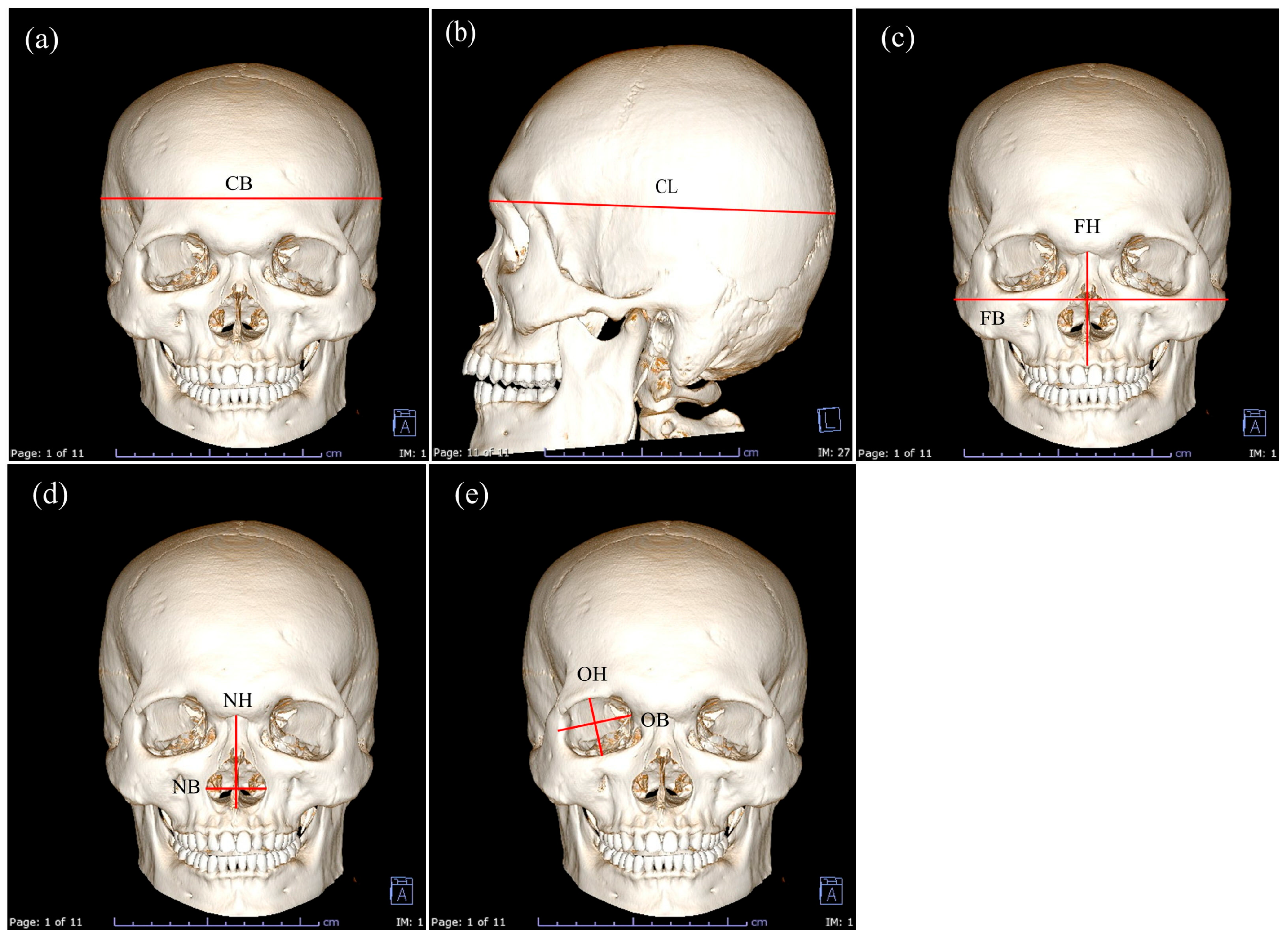
All measurements were performed on three-dimensional reconstructed CT images using Syngo.via software (Siemens Healthineers, Forchheim, Germany, https://www.siemens-healthineers.com/digital-health-solutions/syngovia, accessed on 6 April 2026). Raw axial CT images were reconstructed into three-dimensional images, and linear measurements were obtained using the ruler function within the software, recorded in millimeters to one decimal place. Eight linear craniofacial measurements were selected to represent key dimensions of the cranial vault, facial skeleton, nasal aperture, and orbital region, corresponding to the anatomical regions commonly assessed in craniofacial morphometric analysis [21,22,23], as defined in Table 1 and illustrated in Figure 1. Right orbital measurements were used throughout, as the right side demonstrated consistently superior image quality. Measurement reliability was assessed in a randomly selected subsample of 60 cases (30 males and 30 females), representing 20% of the total sample, using the technical error of measurement (TEM), relative technical error of measurement (rTEM), and coefficient of reliability (R). Intra-observer reliability was evaluated by repeating all measurements after a minimum two-week interval, and inter-observer reliability was assessed between two independent observers.

2.3. Statistical Analysis

Measurement reliability was evaluated using the technical error of measurement (TEM), relative technical error of measurement (rTEM), and coefficient of reliability (R). Descriptive statistics, including mean, standard deviation, and range, were calculated for all eight linear measurements separately for males and females. Sexual dimorphism was assessed using the independent samples t-test for normally distributed variables or the Mann–Whitney U test where normality was not satisfied. Effect size was quantified using Cohen’s d, and a p-value of less than 0.05 was considered statistically significant throughout. All descriptive and sexual dimorphism analyses were performed using IBM SPSS Statistics, version 26.0 (IBM Corp., Armonk, NY, USA).
DFA was performed in SPSS using a stepwise procedure to identify the most discriminating subset of measurements, with LOO-CV applied to minimize the risk of overfitting. SVM and RF classifications were conducted using Orange Data Mining software, version 3.39 (Bioinformatics Laboratory, Faculty of Computer and Information Science, University of Ljubljana, Ljubljana, Slovenia). For SVM, a radial basis function (RBF) kernel was applied with the cost parameter C set to 1.0 and gamma set to the reciprocal of the number of input features (g = 1/8 = 0.125), using the default configuration of Orange Data Mining software. For RF, the number of trees was set to 100, and the number of features considered at each split was set to three (round (√8) = 3), following the standard default convention for classification tasks. Default parameter configurations were retained for both classifiers to ensure reproducibility and to facilitate direct comparability across methods; it is acknowledged that hyperparameter optimization may yield different performance estimates. All three classifiers were evaluated under LOO-CV as an internal validation procedure, in which each case was successively withheld from model development and classified by the function derived from the remaining cases, with the primary aim of estimating classification performance and minimizing overfitting within the development sample. Male was designated as the positive class, consistent with the DFA convention whereby positive discriminant scores indicate male classification. Overall accuracy, sensitivity, specificity, positive predictive value (PPV), negative predictive value (NPV), and area under the receiver operating characteristic curve (AUC) were reported for each classifier. Matthews correlation coefficient (MCC) was additionally computed from the confusion matrix of each method to provide a balanced performance measure accounting for all four classification outcomes. The saved SVM and RF models are provided as Supplementary Materials S1 and S2 to facilitate direct application in future forensic casework. This comparative multi-method approach evaluates three analytically independent classifiers under a unified validation protocol.

2.4. Applied Case Examples Protocol

To demonstrate the practical application of the developed models in a forensic context, two cases with confirmed biological sex were selected as illustrative examples, with the aim of demonstrating the procedural workflow and output interpretation for each classifier when applied to an unknown individual, rather than formally validating model performance. For each case, CT images were processed using the same landmark definitions and measurement protocol described in Section 2.2. The eight linear measurements were obtained and subsequently entered into the DFA canonical discriminant function and the saved SVM and RF models developed from the main sample. The discriminant score (D) was recorded for DFA, with positive values indicating male and negative values indicating female classification. For SVM and RF, male-class probabilities were recorded from the Predictions widget in Orange Data Mining software. Predicted outcomes were then compared with the confirmed biological sex to assess the correctness of classification across all three methods.

3. Results

3.1. Sample Characteristics

A total of 300 CT scans were included in the present study, comprising 150 males and 150 females. The overall mean age of the entire sample was 55.8 ± 18.5 years (median 59.0 years, range 20–90 years), with males averaging 54.6 ± 17.4 years and females 57.0 ± 19.5 years. The distribution of cases across the three age groups is summarized in Table 2. The largest proportion of participants fell within the over 60 years group (n = 135, 45.0%), followed by the 41–60 years group (n = 93, 31.0%), and the 20–40 years group (n = 72, 24.0%).

3.2. Measurement Reliability

Intra- and inter-observer reliability results for all eight linear measurements are presented in Table 3. Intra-observer TEM values ranged from 0.22 to 0.32 mm, with rTEM values below 1.0% for all measurements, and R values exceeding 0.97 throughout, indicating excellent intra-observer reliability. Inter-observer TEM values ranged from 0.40 to 0.90 mm, with rTEM values remaining below 2.0% for all parameters. Inter-observer R values ranged from 0.921 to 0.995, indicating good to excellent reliability across all measurements. The lowest reliability was observed for orbital measurements, which yielded the highest rTEM values for both intra-observer and inter-observer assessments, though all values remained within acceptable limits.

3.3. Sexual Dimorphism of Craniofacial Measurements

The Shapiro–Wilk test confirmed normal distribution for all eight measurements in both sexes (p > 0.05). Seven of the eight measurements demonstrated statistically significant sexual dimorphism (p < 0.05), with males consistently larger than females across all regions. The largest effect sizes were observed for facial breadth (d = 1.61) and cranial length (d = 1.35), followed by nasal height (d = 1.31), all indicating large sexual dimorphism according to Cohen’s criteria. Orbital height was the only measurement without significant sexual dimorphism (p = 0.07, d = 0.21). Full descriptive statistics and t-test results are presented in Table 4.

3.4. Sex Classification Performance of DFA, SVM, and RF

Stepwise DFA selected five of the eight measurements for inclusion in the canonical discriminant function: facial breadth, nasal height, cranial length, orbital height, and facial height, entered in order of their contribution to minimizing Wilks’ lambda. The overall Wilks’ lambda for the final function was 0.472 (χ2 = 222.094, df = 5, p < 0.001), with a canonical correlation of 0.727 and an eigenvalue of 1.120. The canonical discriminant function equation was:
D = 0.223(nasal height) + 0.069(cranial length) + 0.117(facial breadth) − 0.059(facial height) − 0.127(orbital height) − 30.456
A positive discriminant score (D) indicates male classification, consistent with the equal and opposite group centroids observed for each sex (male: +1.055; female: −1.055). Among the selected variables, nasal height demonstrated the largest standardized coefficient (0.680), followed by facial breadth (0.551). Box’s M test indicated no significant violation of the equal covariance matrix assumption (Box’s M = 13.856, F(15, 357,552.95) = 0.907, p = 0.556).
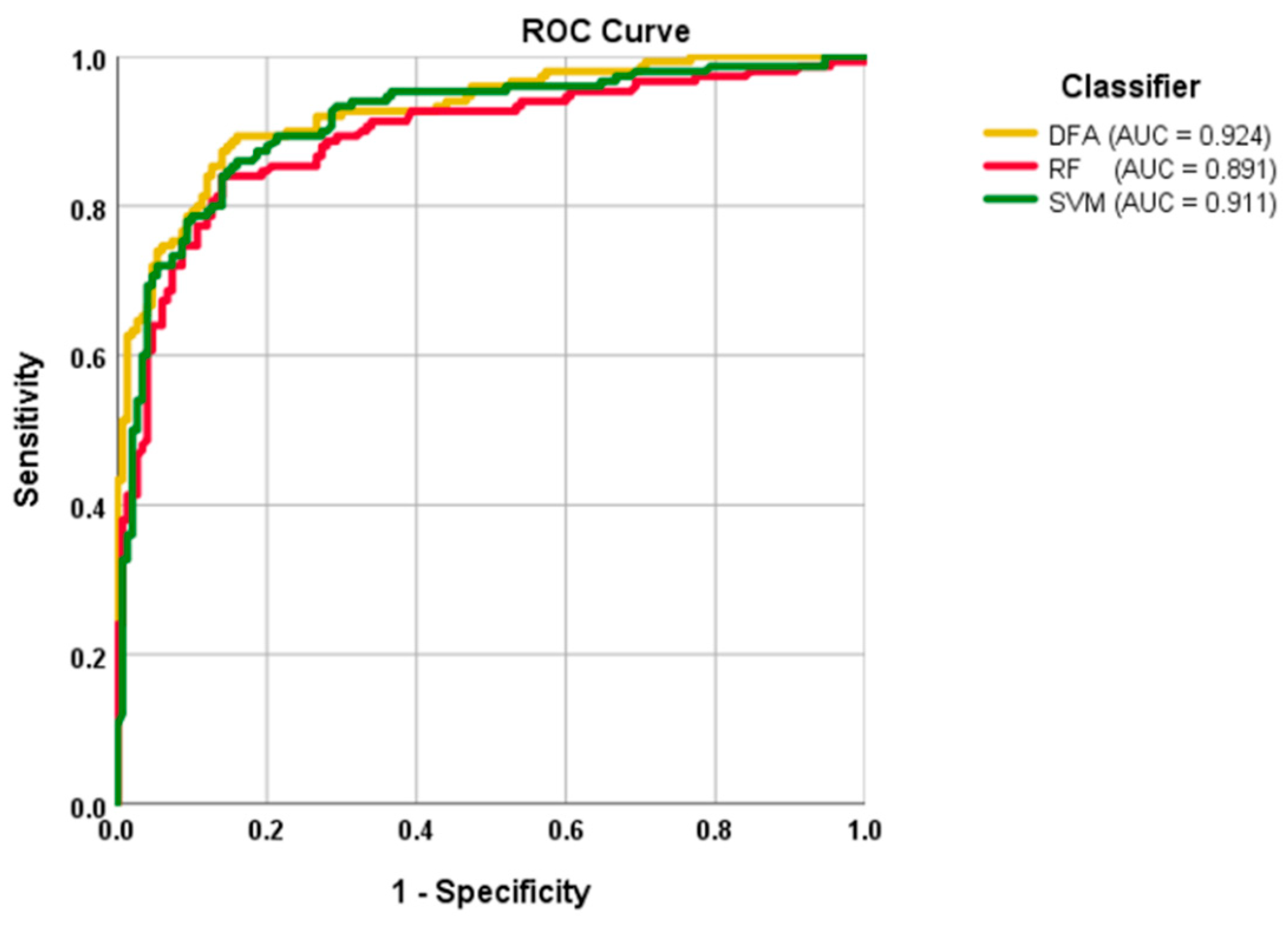
Under LOO-CV, all three classifiers achieved comparable overall accuracy, ranging from 84.0% to 85.7%, with DFA achieving the highest overall accuracy (85.7%), AUC (0.924), and MCC (0.713). SVM and RF models were evaluated using Orange Data Mining software under the same LOO-CV protocol. The SVM model achieved an AUC of 0.911 and the most balanced sensitivity and specificity among the three classifiers. The RF model achieved the highest specificity of 86.7% but demonstrated the greatest imbalance between sensitivity and specificity. The saved SVM and RF models are provided in Supplementary Materials to facilitate direct application in future forensic casework. Full classification performance metrics are presented in Table 5, and ROC curves for all three classifiers are presented in Figure 2.

3.5. Applied Case Examples

Two cases with confirmed biological sex were selected to illustrate the practical application of the three developed models in a forensic context. These examples are intended to demonstrate the procedural workflow of applying the developed models to new cases, and should not be interpreted as a formal assessment of real-world classification performance. Case 1, a female aged 59 years, and Case 2, a male aged 75 years. Craniofacial measurements obtained from each case are presented in Table 6. All three classifiers correctly predicted the biological sex of both cases. For Case 1, the five selected measurements were substituted into the canonical discriminant function equation derived from the main sample, yielding a discriminant score of −1.749, indicating female classification as the score fell below the zero-decision boundary. Case 1 measurements were additionally entered into the saved SVM and RF models provided in Supplementary Materials and evaluated using the Predictions widget in Orange Data Mining software, returning male-class probabilities of 0.09 and 0.03, respectively. As the predicted probability of male and female classification sum to 1.0, these low male-class probabilities correspond to female-class probabilities of 0.91 and 0.97, respectively, both reflecting high classification confidence. For Case 2, substitution of measurements into the discriminant function yielded a score of +1.543, indicating male classification as the score exceeded the zero-decision boundary. Evaluation against the saved models via the Predictions widget returned male-class probabilities of 0.93 and 0.95 for SVM and RF, respectively, similarly reflecting high confidence in male classification. Classification outcomes for all methods are summarized in Table 7 and Supplementary Materials S3.

4. Discussion

The present study examined sexual dimorphism in CT-derived craniofacial measurements and evaluated the performance of three classification methods for sex estimation in a Thai adult population. Seven of the eight measurements demonstrated statistically significant sexual dimorphism, with facial breadth (d = 1.61) and nasal height (d = 1.31) showing the greatest dimorphism. Under a unified LOO-CV protocol, all three classifiers achieved comparable accuracy ranging from 84.0% to 85.7%. DFA demonstrated the highest overall discriminating ability, achieving an accuracy of 85.7%, AUC of 0.924, and MCC of 0.713, while SVM and RF achieved accuracy of 84.7% and 84.0%, respectively. All three classifiers yielded concordant correct classifications in both forensic case application examples. These findings suggest that CT-derived craniofacial measurements provide a reliable basis for sex estimation in the Thai population, and that DFA remains a competitive approach alongside machine learning classifiers in this context.
The pattern of sexual dimorphism observed in the present study is broadly consistent with findings reported in other Asian and Southeast Asian populations, in which males consistently demonstrate larger craniofacial dimensions than females across multiple anatomical regions [3,6,13]. Nasal height and facial breadth exhibited the greatest degree of dimorphism in the present sample, with percentage differences of 8.12% and 5.84%, respectively, findings that align with previous reports identifying the facial skeleton as a region of pronounced sexual dimorphism in Thai and neighboring populations [3,24]. The relatively modest dimorphism observed in cranial breadth is consistent with the brachycephalic cranial morphology characteristic of Asian populations, in which transverse cranial dimensions are proportionally enlarged in both sexes, thereby reducing the magnitude of sex-related differences in this measurement [3,6,24,25]. Orbital height was the only measurement without statistically significant sexual dimorphism (p = 0.07, d = 0.21), indicating that this measurement contributes limited independent discriminatory value at the univariate level in the present sample. Notably, however, orbital height was retained in the stepwise DFA model, indicating that it contributes incrementally to sex discrimination within a multivariate context despite its lack of univariate significance, a pattern consistent with the well-established statistical principle that stepwise selection optimizes collective discriminatory power rather than individual variable significance.
The narrow accuracy range of 84.0–85.7% across the three classifiers in the present study suggests that the discriminatory information available from the selected craniofacial measurements was similarly captured by DFA, SVM, and RF, regardless of their underlying algorithmic assumptions. DFA achieved the highest AUC of 0.924 and MCC of 0.713, indicating superior overall discriminating ability and balanced classification performance. SVM demonstrated the most balanced sensitivity and specificity, reflecting the effectiveness of margin-based optimization in minimizing asymmetric misclassification. The lower sensitivity observed for RF (81.3%) relative to its specificity (86.7%) suggests a tendency toward female over classification, which may reflect the influence of ensemble averaging on borderline cases in a balanced sample, a pattern previously noted in RF-based sex estimation studies [26,27]. Although machine learning classifiers offer theoretical advantages in capturing non-linear relationships among predictor variables, the present findings indicate that these advantages did not translate into meaningful performance gains over DFA when applied to a relatively small set of linear craniofacial measurements in a homogeneous population sample, suggesting that the discriminatory relationships among these variables are largely linear in nature [27]. SVM and RF were evaluated using default parameter configurations, with C = 1.0 and gamma = 1/8 for SVM, and 100 trees with round (√8) features per split for RF; while these defaults provide a reproducible baseline, hyperparameter optimization may yield different performance estimates and should be considered in future comparative studies.
The classification performance observed in the present study is broadly consistent with the literature on craniometric sex estimation across diverse populations. The overall DFA accuracy of 85.7% falls within the range of 80–95% reported across CT-based and dry bone craniometric studies worldwide [6,7,8,10,27,28,29], and DFA and machine learning methods have not consistently demonstrated superior accuracy over one another [8,28]. Within Thai populations, DFA applied to dry cranial collections has yielded higher accuracy of 90.6% using six measurements in a northern Thai sample [29], likely reflecting methodological distinctions between dry bone specimens and CT-derived measurements rather than a fundamental limitation of CT-based craniometry. Among CT-based studies in neighboring Asian populations, Hoshioka et al. reported 93.9% accuracy using DFA in a Japanese sample [6], while Imaizumi et al. achieved 89.6% using SVM with dimensionality reduction in the same population [30], with higher rates potentially attributable to greater sexual dimorphism or larger measurement sets. In European populations, comparable accuracy ranges have been reported, including 90.25% using logistic regression in an Italian sample [7], 86.25% using morphoscopic traits in a Croatian MSCT sample [28], and 91.9% using rule induction algorithms in a Bulgarian population [8]. Collectively, these comparisons suggest that performance differences across studies reflect variation in measurement sets, sample size, skeletal material, and analytical approaches rather than population-specific limitations of CT-based sex estimation.
A methodological strength of the present study is the adoption of a comparative multi-method approach, in which DFA, SVM, and RF were evaluated as three analytically independent classifiers under a unified LOO-CV protocol. This approach differs from the majority of published sex estimation studies, in which classification performance is reported for a single method and validated solely through internal cross-validation, limiting the extent to which observed performance can be attributed to genuine discriminatory ability rather than method-specific characteristics [12,31]. The use of a unified LOO-CV protocol across all three classifiers is particularly important, as inconsistent validation schemes represent a common source of incomparability in the forensic literature, where DFA and machine learning classifiers are frequently evaluated under different cross-validation procedures, precluding direct performance comparison [32,33]. In the present study, the convergence of correct classifications across all three methodologically independent classifiers under a unified protocol therefore provides multilayered evidence that the reported accuracy estimates reflect genuine discriminatory ability of the selected craniofacial measurements within the development sample, rather than artifacts of method-specific optimization or overfitting. Although LOO-CV is well-suited for moderate sample sizes and minimizes bias in performance estimation, it exhibits higher variance in performance estimates compared with repeated k-fold cross-validation and does not assess model stability across different data partitions; this should be considered when interpreting the reported performance metrics.
The procedural workflow for practical application of the developed models was illustrated using two cases with confirmed biological sex. These examples demonstrate that craniofacial measurements obtained from CT images can be directly entered into the canonical discriminant function equation or the saved machine learning models to yield classification outputs with quantified confidence. For DFA application, the five selected measurements are substituted into the canonical discriminant function equation, yielding a discriminant score that can be interpreted using basic arithmetic without dependence on specialized statistical software, which is particularly relevant in resource-limited forensic settings. For SVM and RF application, measurements are entered into the saved models provided in Supplementary Materials and evaluated using the Predictions widget in Orange Data Mining software, returning sex-class probabilities that quantify classification confidence for each case. In both illustrative cases, discriminant scores were situated well away from the zero-decision boundary, and machine learning classifiers returned probabilities exceeding 0.90 for the correct sex class, indicating unambiguous classification. The concordance of correct classifications across all three methods serves as an illustrative example of how the models function in practice and is consistent with the convergent LOO-CV performance estimates: when DFA, SVM, and RF yield concordant outputs for a given case, the examiner can interpret the result with greater confidence than when relying on a single classifier alone [32,33]. The population-specific nature of the developed models further addresses a critical limitation of applying reference data derived from non-Thai populations to Thai forensic cases, where morphological differences may systematically bias classification outcomes [11]. Collectively, the DFA equation and saved machine learning models constitute a complementary and immediately applicable multi-method toolkit for CT-based forensic sex estimation in the Thai population, directly supporting practitioners in settings where population-specific reference data have previously been unavailable. In this context, DFA and machine learning classifiers are best regarded as complementary approaches: DFA provides an interpretable equation applicable without specialized software, while SVM and RF offer probabilistic outputs that quantify classification confidence and may assist decision-making in borderline cases. Future studies may further explore geometric morphometrics and deep learning-based image analysis, both of which capture craniofacial complexity beyond linear measurements and may offer additional discriminatory power for sex estimation.

5. Conclusions

The present study demonstrates that CT-derived craniofacial measurements provide a reliable basis for sex estimation in Thai adults, with seven of eight measurements exhibiting statistically significant sexual dimorphism. Under a unified LOO-CV protocol, DFA, SVM, and RF achieved comparable classification accuracy ranging from 84.0% to 85.7%, with DFA demonstrating the highest overall discriminating ability as reflected by AUC and MCC. The convergence of performance across three methodologically independent classifiers under a unified validation protocol, further supported by concordant correct classifications in both forensic case application examples, provides multilayered evidence for the internal robustness of the developed models, though external validation remains necessary to confirm generalizability beyond the development sample. The canonical discriminant function equation and saved machine learning models constitute a complementary and immediately applicable toolkit for CT-based forensic sex estimation in the Thai population, addressing a critical gap in population-specific reference data for forensic practitioners in this region.

Limitations

Several limitations of the present study should be acknowledged. First, the sample was drawn from a single tertiary referral center in northeastern Thailand, and the unequal age distribution reflects the clinical profile of the institution rather than population demographics; although cases with craniofacial pathology, trauma, and significant alveolar resorption were excluded, subtle age-related craniofacial changes cannot be fully excluded, and age-stratified analyses in future studies would provide additional insight. Second, all three classifiers were evaluated using LOO-CV as an internal validation procedure, which estimates performance within the development sample but does not substitute for external validation. External validation using independent samples would be required to confirm model generalizability under realistic forensic conditions, and should be pursued when sufficient resources are available. Third, variation in scanner settings and image reconstruction protocols across institutions may influence measurement reproducibility when the developed models are applied in other settings. Fourth, the present models were developed exclusively from Thai adults, and application to other populations should be approached with caution, as performance may vary due to morphological differences; prior validation is recommended before use.


Supplementary Materials

The following supporting information can be downloaded at: https://www.mdpi.com/article/10.3390/forensicsci6020035/s1, Supplementary Material S1: Saved Random Forest classification model for direct application in forensic sex estimation; Supplementary Material S2: Saved Support Vector Machine classification model for direct application in forensic sex estimation; Supplementary Material S3: Predictions widget output from Orange Data Mining software illustrating the classification results for both applied case examples.

Author Contributions

Conceptualization, S.D., W.K., S.I. (Sitthichai Iamsaard) and C.P. (Chanasorn Poodendaen); methodology, S.D., W.K., P.A., S.I. (Sararat Innoi), N.T. (Nareelak Tangsrisakda), S.I. (Sitthichai Iamsaard) and C.P. (Chanasorn Poodendaen); validation, S.D.; formal analysis, S.D. and C.P. (Chanasorn Poodendaen); investigation, W.K., P.T., N.M., N.T. (Nattaphon Twinprai), J.W., T.M., C.P. (Chalermphon Pitirith), K.L., P.A. and S.I. (Sararat Innoi); resources, W.K., P.T., N.M., N.T. (Nattaphon Twinprai), J.W., T.M., C.P. (Chalermphon Pitirith) and K.L.; data curation, W.K., P.A., S.I. (Sararat Innoi), N.T. (Nareelak Tangsrisakda) and S.I. (Sitthichai Iamsaard); writing—original draft preparation, S.D.; writing—review and editing, W.K. and C.P. (Chanasorn Poodendaen); visualization, S.D.; supervision, W.K.; project administration, S.I. (Sitthichai Iamsaard) and C.P. (Chanasorn Poodendaen). All authors have read and agreed to the published version of the manuscript.

Funding

This research was funded by an undergraduate student thesis grant from the Faculty of Medical Science, Naresuan University, Thailand.

Institutional Review Board Statement

The research protocol was approved by the Center for Ethics in Human Research, Khon Kaen University (approval code: HE 681105, date of approval: 15 February 2025), in accordance with the Declaration of Helsinki and the ICH Good Clinical Practice Guidelines.

Informed Consent Statement

Patient consent was waived due to the retrospective nature of the study and the use of de-identified CT imaging data, as approved by the Center for Ethics in Human Research, Khon Kaen University.

Data Availability Statement

The data presented in this study are available upon reasonable request from the corresponding author. The data are not publicly available due to patient privacy regulations and institutional data governance policies.

Acknowledgments

The authors gratefully acknowledge the Department of Radiology, Faculty of Medicine, Khon Kaen University, for providing access to the CT imaging data used in this study, and all radiology technologists for their assistance in facilitating data collection.

Conflicts of Interest

The authors declare no conflicts of interest.

References

  1. Spradley, M.K. Metric Methods for the Biological Profile in Forensic Anthropology: Sex, Ancestry, and Stature. Acad. Forensic Pathol. 2016, 6, 391–399. [Google Scholar] [CrossRef]
  2. Pilli, E.; Palamenghi, A.; Cattaneo, C. Forensic skeletal and molecular anthropology face to face: Combining expertise for identification of human remains. Ann. N. Y. Acad. Sci. 2025, 1550, 77–107. [Google Scholar]
  3. Ibrahim, A.; Alias, A.; Nor, F.M.; Swarhib, M.; Abu Bakar, S.N.; Das, S. Study of sexual dimorphism of Malaysian crania: An important step in identification of the skeletal remains. Anat. Cell Biol. 2017, 50, 86–92. [Google Scholar] [CrossRef]
  4. Tunheim, E.G.; Skallevold, H.E.; Rokaya, D. Role of hormones in bone remodeling in the craniofacial complex: A review. J. Oral Biol. Craniofac. Res. 2023, 13, 210–217. [Google Scholar]
  5. New, B.T.; Stull, K.E.; Corron, L.K.; Wolfe, C.A. Exploring Cranial Growth Patterns from Birth to Adulthood for Forensic Research and Practice. Forensic Sci. 2025, 5, 32. [Google Scholar] [CrossRef]
  6. Hoshioka, Y.; Torimitsu, S.; Makino, Y.; Yajima, D.; Chiba, F.; Yamaguchi, R.; Inokuchi, G.; Motomura, A.; Tsuneya, S.; Iwase, H. Sex estimation from skull measurements of a contemporary Japanese population using three-dimensional computed tomography images. Int. J. Legal Med. 2025, 139, 383–391. [Google Scholar] [PubMed]
  7. Cappella, A.; Bertoglio, B.; Di Maso, M.; Mazzarelli, D.; Affatato, L.; Stacchiotti, A.; Sforza, C.; Cattaneo, C. Sexual Dimorphism of Cranial Morphological Traits in an Italian Sample: A Population-Specific Logistic Regression Model for Predicting Sex. Biology 2022, 11, 1202. [Google Scholar] [CrossRef] [PubMed]
  8. Toneva, D.H.; Nikolova, S.Y.; Agre, G.P.; Zlatareva, D.K.; Hadjidekov, V.G.; Lazarov, N.E. Data mining for sex estimation based on cranial measurements. Forensic Sci. Int. 2020, 315, 110441. [Google Scholar] [CrossRef] [PubMed]
  9. Spradley, M.K.; Jantz, R.L. Sex Estimation in Forensic Anthropology: Skull Versus Postcranial Elements. J. Forensic Sci. 2011, 56, 289–296. [Google Scholar] [CrossRef]
  10. Absalan, F.; Eftekhari Moghadam, A.R.; Rezaian, J. Morphometric cranial standards for sex estimation of a population in two ethnic groups in Southwest Iran. Transl. Res. Anat. 2023, 31, 100249. [Google Scholar] [CrossRef]
  11. Poodendaen, C.; Choompoo, N.; Namvongsakool, P.; Linlad, S.; Chalermrerm, J.; Duangchit, S.; Boonthai, W.; Iamsaard, S.; Aorachon, P.; Putiwat, P. External validation of femoral sex estimation equations: Evidence supporting population-specific standards in forensic anthropology. Transl. Res. Anat. 2025, 41, 100445. [Google Scholar] [CrossRef]
  12. Poodendaen, C.; Choompoo, N.; Srisen, K.; Linlad, S.; Chalermrerm, J.; Boonthai, W.; Iamsaard, S.; Tangsrisakda, N.; Arun, S.; Duangchit, S. Sex Estimation from Fragmented Thai Femora: Developing Segment-Specific Models Using Discriminant Function Analysis. Forensic Sci. 2025, 5, 69. [Google Scholar] [CrossRef]
  13. Berkban, T.; Iamsaard, S.; Lapyuneyong, N.; Tasu, P.; Poodendaen, C.; Srisen, K.; Boonthai, W.; Duangchit, S. Sex determination by using discriminant function analyses from the Northeastern-Thai occipital bones. Int. J. Morphol. 2024, 42, 1195–1199. [Google Scholar] [CrossRef]
  14. Bartholdy, B.P.; Sandoval, E.; Hoogland, M.L.P.; Schrader, S.A. Getting Rid of Dichotomous Sex Estimations: Why Logistic Regression Should be Preferred Over Discriminant Function Analysis. J. Forensic Sci. 2020, 65, 1685–1691. [Google Scholar] [CrossRef] [PubMed]
  15. Sarker, I.H. Machine Learning: Algorithms, Real-World Applications and Research Directions. SN Comput. Sci. 2021, 2, 160. [Google Scholar] [CrossRef] [PubMed]
  16. Toneva, D.; Nikolova, S.; Agre, G.; Harizanov, S.; Fileva, N.; Milenov, G.; Zlatareva, D. Enhancing Sex Estimation Accuracy with Cranial Angle Measurements and Machine Learning. Biology 2024, 13, 780. [Google Scholar] [CrossRef]
  17. Diac, M.M.; Toma, G.M.; Damian, S.I.; Fotache, M.; Romanov, N.; Tabian, D.; Sechel, G.; Scripcaru, A.; Hancianu, M.; Iliescu, D.B. Machine Learning Models for Prediction of Sex Based on Lumbar Vertebral Morphometry. Diagnostics 2023, 13, 3630. [Google Scholar] [CrossRef] [PubMed]
  18. Triantafyllou, G.; Botis, G.G.; Piagkou, M.; Papanastasiou, K.; Tsakotos, G.; Paschopoulos, I.; Matsopoulos, G.K.; Papadodima, S. Sex Estimation Through Orbital Measurements: A Machine Learning Approach for Forensic Science. Diagnostics 2024, 14, 2773. [Google Scholar] [CrossRef]
  19. Putiwat, P.; Srisen, K.; Phetnui, P.; Kamwong, J.; Duangchit, S.; Arun, S.; Iamsaard, S.; Boonthai, W.; Poodendaen, C. Independent validation of sex estimation equations using ulnar dimensions and weight in a northeastern Thai population. Transl. Res. Anat. 2025, 40, 100405. [Google Scholar] [CrossRef]
  20. Phetnui, P.; Poodendaen, C.; Choompoo, N.; Srisen, K.; Iamsaard, S.; Chaiyamoon, A.; Arun, S.; Berkban, T.; Duangchit, S. Independent Validation of Population-Specific Equations for Sex and Stature Estimation from the Humerus in Northeastern Thailand. Forensic Sci. 2026, 6, 1. [Google Scholar] [CrossRef]
  21. Grabcika, A.; Kazoka, D.; Vetra, J.; Pilmane, M. Craniofacial Measurements and Indices Trends in Latvian Children Aged 1–15. Children 2024, 11, 1141. [Google Scholar] [CrossRef]
  22. Ward, R.E.; Jamison, P.L.; Farkas, L.G. Craniofacial variability index: A simple measure of normal and abnormal variation in the head and face. Am. J. Med. Genet. 1998, 80, 232–240. [Google Scholar] [CrossRef]
  23. Langley, N.R.; Meadows Jantz, L.; Ousley, S.D.; Jantz, R.L.; Milner, G. Data Collection Procedures for Forensic Skeletal Material 2.0; Department of Anthropology and Forensic Anthropology Center, University of Tennessee: Knoxville, TN, USA, 2016. [Google Scholar]
  24. Sangchay, N.; Tangmanpakdeepong, K.; Boonyarud, S.; Wansopha, S.; Chatthai, N.; Rattanachet, P.; Chetsawang, J. Sexual Dimorphism in Cranial and Post-Cranial Skeletal Elements: Forensic Implications for Sex Estimation in a Contemporary Thai Population. Siriraj Med. J. 2025, 77, 858–876. [Google Scholar] [CrossRef]
  25. Zar, M.S.; Rubab, T.; Qureshi, M.Z.; Khan, M.A.; Akhtar, M.S.; Nowak, O. Anthropometric Study of the Human Craniofacial Morphology among different castes of Punjab Pakistan. Adv. Life Sci. 2023, 10, 216–222. [Google Scholar] [CrossRef]
  26. Corda, J.V.; Karthikeyan, A.; Zuber, M.; Jacob, M.; Ramos, A.; Hosapatna, M.; Dsouza, A.; Pandey, A.K.; Ankolekar, V.H. Estimation of sexual dimorphism of adult human mandibles of South Indian origin using non-metric parameters and machine learning classification algorithms. Sci. Rep. 2025, 15, 34534. [Google Scholar] [CrossRef]
  27. Toy, S.; Secgin, Y.; Oner, Z.; Turan, M.K.; Oner, S.; Senol, D. A study on sex estimation by using machine learning algorithms with parameters obtained from computerized tomography images of the cranium. Sci. Rep. 2022, 12, 4278. [Google Scholar] [CrossRef]
  28. Bareša, T.; Jerković, I.; Bašić, Ž.; Jerković, N.; Dolić, K.; Dujić, G.; Ćavar Borić, M.; Budimir Mršić, D.; Krešić, E.; Čavka, M.; et al. Walker’s traits for sex estimation in modern Croatian population using MSCT virtual cranial database: Validation and development of population-specific standards. Forensic Imaging 2024, 36, 200578. [Google Scholar] [CrossRef]
  29. Mahakkanukrauh, P.; Sinthubua, A.; Prasitwattanaseree, S.; Ruengdit, S.; Singsuwan, P.; Praneatpolgrang, S.; Duangto, P. Craniometric study for sex determination in a Thai population. Anat. Cell Biol. 2015, 48, 275–283. [Google Scholar] [CrossRef] [PubMed]
  30. Imaizumi, K.; Usui, S.; Nagata, T.; Hayakawa, H.; Shiotani, S. Sex-estimation method for three-dimensional shapes of the skull and skull parts using machine learning. Forensic Sci. Int. 2025, 373, 112532. [Google Scholar] [CrossRef] [PubMed]
  31. Marques, S.; Pinto, C.; Ferreira, M.T.; Garcia, S.; Curate, F. Sex Estimation from the Fibula and Tibia: A Study in Three Portuguese Reference Collections. Forensic Sci. 2025, 5, 2. [Google Scholar] [CrossRef]
  32. Bidmos, M.A.; Olateju, O.I.; Latiff, S. Machine learning and discriminant function analysis in the formulation of generic models for sex prediction using patella measurements. Int. J. Legal Med. 2023, 137, 471–485. [Google Scholar] [CrossRef] [PubMed]
  33. Dutta, A.; Saini, V. A Comparative Study on Different Machine Learning Algorithms to Explore Sexual Dimorphism in Cephalometric Measurements of North Indian Population. J. Indian Acad. Forensic Med. 2025, 47, 405–413. [Google Scholar] [CrossRef]
Figure 1. Three-dimensional CT reconstructions illustrating the eight craniofacial measurements obtained in the present study. (a) Cranial breadth (CB); (b) Cranial length (CL); (c) Facial height (FH) and facial breadth (FB); (d) Nasal height (NH) and nasal breadth (NB); (e) Orbital height (OH) and Orbital breadth (OB). Red lines indicate the measurement axes applied to each landmark pair.
Forensicsci 06 00035 g001
Figure 2. Receiver operating characteristic (ROC) curves for discriminant function analysis (DFA), support vector machine (SVM), and random forest (RF) under leave-one-out cross-validation. DFA achieved the highest area under the curve (AUC = 0.924), followed by SVM (AUC = 0.911) and RF (AUC = 0.891).
Forensicsci 06 00035 g002
Table 1. Craniofacial landmarks, measurements.
MeasurementLandmark Definition
Cranial length (CL)Glabella (g): most anterior midline point of the frontal bone to Opisthocranion (op): most posterior midline point of the skull
Cranial breadth (CB)Euryon (eu): most lateral point on the squama of the temporal bone, excluding the inferior temporal lines and the area immediately surrounding them (bilateral)
Facial height (FH)Nasion (n): intersection of the internasal and frontonasal sutures in the midsagittal plane to Prosthion (pr): most anterior inferior midline point on the premaxilla between the upper central incisors
Facial breadth (FB)Zygion (zy): most lateral point on the zygomatic arch (bilateral)
Nasal height (NH)Nasion (n): intersection of the internasal and frontonasal sutures in the midsagittal plane to Nasospinale (ns): point where a line drawn across the lower margin of the nasal aperture intersects the midsagittal plane
Nasal breadth (NB)Alare (al): most lateral point on the outer margin of each nasal aperture (bilateral)
Orbital height (OH)The distance between the superior and inferior orbital margins perpendicular to orbital breadth, bisecting the orbit into equal medial and lateral halves (right side)
Orbital breadth (OB)The distance from dacryon (d) to ectoconchion (ec) of the right orbit
Table 2. Distribution of study sample by sex and age group.
Age GroupMale n (%)Mean ± SD (Years)Female n (%)Mean ± SD (Years)Total n (%)
20–40 years38 (25.3%)30.6 ± 6.134 (22.7%)28.0 ± 7.072 (24.0%)
41–60 years47 (31.3%)51.4 ± 6.446 (30.7%)52.9 ± 5.993 (31.0%)
61–90 years65 (43.3%)70.9 ± 5.670 (46.7%)73.9 ± 7.9135 (45.0%)
Total150 (100%)54.6 ± 17.4150 (100%)57.0 ± 19.5300 (100%)
Table 3. Intra- and Inter-observer Reliability of Linear Measurements.
ParameterIntra-ObserverInter-Observer
TEM (mm)rTEM (%)RTEM (mm)rTEM (%)R
Cranial length0.310.180.9980.810.470.992
Cranial breadth0.290.210.9970.900.650.973
Facial height0.300.420.9960.650.910.982
Facial breadth0.220.170.9990.400.300.995
Nasal height0.320.620.9930.681.300.971
Nasal breadth0.220.820.9890.421.600.961
Orbital height0.280.840.9810.571.720.921
Orbital breadth0.310.780.9720.521.320.928
Note: TEM = technical error of measurement; rTEM = relative technical error of measurement; R = coefficient of reliability, acceptable thresholds: rTEM < 5%; R > 0.90.
Table 4. Descriptive statistics and sexual dimorphism of craniofacial measurements in Thai adults.
MeasurementMale Mean ± SDFemale Mean ± SD% Difft-Valuep-ValueCohen’s d
Cranial length176.73 ± 7.04167.94 ± 5.905.2311.72<0.011.35
Cranial breadth141.45 ± 5.59138.87 ± 5.481.864.04<0.010.47
Facial height71.76 ± 4.7968.13 ± 4.295.336.92<0.010.80
Facial breadth136.79 ± 4.78129.24 ± 4.625.8413.91<0.011.61
Nasal height52.86 ± 3.2948.89 ± 2.788.1211.30<0.011.31
Nasal breadth27.21 ± 2.0326.59 ± 1.992.332.64<0.010.31
Orbital height33.29 ± 1.9532.89 ± 1.811.231.850.070.21
Orbital breadth39.33 ± 1.7737.72 ± 1.494.258.48<0.010.98
Note: All measurements in millimeters. % Diff = percentage mean difference calculated as (male − female)/female × 100. Cohen’s d effect size interpretation: ≥0.8 = large; 0.5–0.79 = medium; 0.2–0.49 = small.
Table 5. Classification performance of discriminant function analysis, support vector machine, and random forest under leave-one-out cross-validation.
MetricDFASVMRF
Overall accuracy (%)85.7084.7084.00
Sensitivity (%)85.3084.0081.30
Specificity (%)86.0085.3086.70
PPV (%)85.9085.1085.90
NPV (%)85.4084.2082.30
MCC0.7130.6930.681
AUC0.9240.9110.891
Note: DFA = discriminant function analysis; SVM = support vector machine; RF = random forest; PPV = positive predictive value; NPV = negative predictive value; MCC = Matthews correlation coefficient; AUC = area under the receiver operating characteristic curve.
Table 6. Craniofacial measurements of forensic case application examples.
MeasurementCase 1Case 2
Cranial length (CL)168.53179.20
Cranial breadth (CB)149.38146.18
Facial height (FH)64.5866.40
Facial breadth (FB)125.05138.23
Nasal breadth (NB)25.5030.38
Nasal height (NH)46.3351.23
Orbital breadth (OB)38.2839.85
Orbital height (OH)32.0831.85
Confirmed sexFemaleMale
Age (years)5975
Note: All linear measurements in millimeters.
Table 7. Classification outcomes for forensic case application examples.
MethodCase 1Case 2
Score/ProbabilityPredictedResultScore/ProbabilityPredictedResult
DFAD = −1.749FemaleCorrectD = +1.543MaleCorrect
SVMP(male) = 0.09FemaleCorrectP(male) = 0.93MaleCorrect
RFP(male) = 0.03FemaleCorrectP(male) = 0.95MaleCorrect
Confirmed sexFemale Male
Note: DFA = discriminant function analysis; SVM = support vector machine; RF = random forest. DFA classification was based on the discriminant score (D), where D > 0 indicates male and D < 0 indicates female classification. SVM and RF scores represent the predicted probability of male classification.
Disclaimer/Publisher’s Note: The statements, opinions and data contained in all publications are solely those of the individual author(s) and contributor(s) and not of MDPI and/or the editor(s). MDPI and/or the editor(s) disclaim responsibility for any injury to people or property resulting from any ideas, methods, instructions or products referred to in the content.