1. Introduction
Fingerprints are among the most important and widely used types of biological–morphological evidence in forensic science, primarily because of their individuality, uniqueness, and permanence [
1,
2]. For this reason, forensic practice places great emphasis on their reliable visualization, recovery, and subsequent evaluation, as the quality of these steps fundamentally determines their evidential value [
3,
4]. Friction ridge skin results from complex genetic and epigenetic processes during embryonic development, making its morphology unique to each individual [
5,
6,
7].
In forensic and dermatoglyphic practice, three levels of identification characteristics are commonly distinguished, together forming the basis of personal identification [
6]. The first level of characteristics includes the general ridge flow and overall pattern type, traditionally classified as arches, loops, and whorls [
8]. This level mainly provides orientation and functions as a preliminary classification; however, by itself, it does not offer sufficient identification value [
7,
8].
Second-level identification characteristics consist of irregularities in the ridge flow, known as minutiae. These are local morphological features such as ridge endings, bifurcations, dots, and other structural anomalies [
8,
9]. Minutiae have significant identification value, primarily due to their random distribution, individual number, and unique spatial arrangement within a given fingerprint. The combination of these features enables reliable discrimination between fingerprints from different individuals [
8,
10]. Several studies confirm that even monozygotic twins do not share identical ridge configurations, highlighting the high identification potential of fingerprints and their importance in personal identification within forensic science [
7]. In Slovak forensic practice, a classification system comprising 13 types of minutiae is used, based on Gutiérrez et al. [
9]. This classification provides a standardized approach for describing minutiae and serves as a methodological foundation for assessing fingerprint comparability and usability in personal identification.
According to internal methodological regulations, institutional guidelines, and the long-term practical experience of forensic experts, the minimum number of minutiae required for using a fingerprint for personal identification has been established in the Slovak Republic [
11]. Fingerprints containing more than 10 minutiae are considered usable; those with 7–9 minutiae are partially usable; and fingerprints with fewer than 7 minutiae are classified as non-usable [
11,
12]. It should be emphasized that these quantitative criteria are not internationally standardized and may vary between countries depending on national methodologies and legal frameworks [
13].
Third-level identification characteristics are used in forensic practice mainly as supplementary features, as their identification potential is not routinely applied in standard casework [
14,
15]. These characteristics include sweat pores, white lines, incipient ridges, scars, and warts [
16]. Among these features, sweat pores show the highest identification potential due to their individual variability and stability [
17], and may also serve as an auxiliary sex predictor in cases with a smaller number of minutiae or incomplete fingerprints [
16,
17,
18].
Latent fingerprints in experimental and forensic studies are commonly classified as natural or groomed, depending on their mode of deposition and chemical composition [
19]. Natural fingerprints are deposited without deliberate pre-conditioning of the fingers, and their residues consist primarily of eccrine sweat with a low proportion of lipids. In contrast, groomed fingerprints are produced after intentional contact of the fingers with lipid-rich areas of the body, resulting in an increased lipid content. Several studies have shown that groomed fingerprints exhibit higher lipid concentrations and lower intra-individual variability compared to natural fingerprints [
20]. This significantly affects their stability, degradation, and detectability using forensic methods. Distinguishing between these two types of fingerprints is therefore crucial when interpreting experimental results and evaluating the effectiveness of development techniques in forensic casework [
19,
20,
21].
Once deposited, latent fingerprints are exposed to various degrading conditions. They are strongly influenced by environmental factors, which fundamentally determine their stability, degradation, and detectability [
22]. Experimental studies have shown that ambient temperature, relative humidity, light and UV radiation, exposure time, substrate material, and mechanical action affect both the chemical and physical properties of the residues forming the latent trace [
23]. The combined effects of these factors may result in substantial degradation or even complete loss of friction ridge impressions [
24]. Despite intensive research in this field, universally established degradation metrics for latent fingerprints are still lacking. Such metrics would enable reliable quantification of the degree of degradation and allow it to be accurately related to the time since deposition, which considerably complicates forensic interpretation of recovered fingerprints [
25].
Light, particularly as natural daylight and direct sunlight, is a major degrading factor for latent fingerprints. Exposure to light can cause both physical and chemical changes in fingerprint residues [
26]. These changes mainly involve photochemical reactions, oxidation of lipid components, and gradual evaporation of the aqueous component of eccrine sweat. The ultraviolet component of solar radiation is considered one of the principal mechanisms of degradation [
23,
27,
28]. It accelerates the breakdown of organic substances in the fingerprint residue, which may result in reduced contrast, loss of fine ridge detail, and a decrease in the number of minutiae [
29,
30]. However, several experimental studies suggest that latent fingerprints, particularly those with higher lipid content deposited on non-porous surfaces, may still retain sufficient morphological integrity for forensic processing even after prolonged light exposure [
1,
23,
26]. The effect of light on fingerprint quality is strongly time-dependent. Its impact may vary depending on the type of surface, the chemical composition of the fingerprint residue, and the intensity of radiation [
27,
28,
29,
30]. This highlights the need for a systematic investigation of this environmental factor in the context of forensic identification [
23,
26].
The most suitable development method for latent fingerprints exposed to direct sunlight is magnetic fingerprint powder [
25]. Magnetic powders are considered more suitable than conventional powders, as they generally have a larger optimal particle size and cause less background staining on areas of the surface where ridge detail is absent. They are available in various compositions and colors, depending on the type and color of the substrate on which latent fingerprints were deposited, to provide sufficient contrast with the background surface [
31,
32].
This pilot study examines whether latent fingerprints exposed to direct sunlight can still be successfully developed and used for personal identification. It evaluates the effect of prolonged solar exposure on fingerprint quality, with particular emphasis on the preservation of minutiae. The findings aim to support forensic practice by providing insights into the recoverability and evidential value of latent fingerprints subjected to intense sunlight at outdoor crime scenes.
2. Materials and Methods
2.1. Sample Description and Evaluation Method
A total of 322 groomed latent fingerprints were collected from a single Caucasian male participant from Slovakia, after obtaining written informed consent. Latent fingerprints were obtained from a single volunteer primarily to eliminate interindividual variability in eccrine–sebaceous secretions, which are known to be highly individual-specific.
Latent fingerprints were consistently collected from the index finger of the right hand of the same volunteer. The experimental design is based on repeated evaluation of the same fingerprint samples across different exposure intervals. As such, the observations are not fully independent but represent a repeated-measures approach aimed at assessing temporal changes within the same fingerprints. While this design reduces inter-individual variability, it may introduce limitations related to statistical independence, and the results should therefore be interpreted with appropriate caution.
The latent fingerprints were deposited on a non-porous glass surface and then exposed to direct sunlight for periods ranging from 1 to 7 weeks after deposition. The study was conducted in Central Slovakia, at an altitude of 636 m above sea level, under ambient environmental conditions.
The experimental procedure followed the methodology described by Soták et al. [
33]. Before fingerprint deposition, the glass plates were thoroughly cleaned with water and dried to remove surface contaminants. The volunteer first washed and dried his hands to remove any contaminants. After a few minutes, the finger was touched to the nape of the neck, and groomed fingerprints were deposited on glass plates using standardized and uniform pressure. Latent fingerprints were then deposited on eight glass plates. One plate served as a control sample, while the remaining seven plates with latent fingerprints were exposed to direct sunlight. Each glass plate contained 46 groomed contact latent fingerprints. After deposition, the plates were placed in a location with intense solar radiation.
2.2. Control Sample and Light Intensity Measurement
In addition to fingerprints exposed to direct sunlight, a control sample was evaluated as a reference for comparison during the degradation assessment. The control sample enabled differentiation between natural ageing and sunlight-induced degradation of latent fingerprints. The intensity of solar illumination was monitored throughout the experimental period (
Table 1). Measurements were taken daily using a Uni-Trend UT383S digital light meter (Uni-trend Technology Co., Ltd., Dongguan City, China). Ambient temperature and relative humidity were measured using a UNI-T UT333S (Uni-trend Technology Co., Ltd., Dongguan City, China) digital temperature and humidity sensor. The ambient temperature in which the latent fingerprints were exposed remained constant at approximately 22 °C, and the relative humidity ranged from 45.21% to 47.69%.
2.3. Fingerprint Development
Latent fingerprints, both those exposed to sunlight and those from the control sample, were developed using Silver-grey Hi-Fi magnetic dactyloscopic powder (LT Sezam s.r.o., Prague, Czech Republic). The powder was applied with a MaxMag magnetic fingerprint brush (15 cm) (LT Sezam s.r.o., Prague, Czech Republic), which operates using a strong magnetic field, allowing precise control over the amount of powder applied. Developed fingerprints were then lifted using fingerprint lifting tape. The tape was carefully applied to the developed fingerprint, gently pressed, and then slowly removed. The lifted fingerprints were transferred onto paper backing sheets.
All lifted fingerprints were scanned at a resolution of 1200 dpi using a Brother DCP-L2512D scanner (Brother Industries, Ltd., Nagoya, Japan). The scanned images were evaluated using Preview 11.0 (1048) by Apple Inc. (Cupertino, CA, USA).
2.4. Minutiae Evaluation and Usability Assessment
The number of minutiae present in each fingerprint was recorded in data tables (
Table 1). Minutiae counts obtained from degraded latent fingerprints were compared with those from the control sample. To minimize evaluation errors and avoid omission of minutiae, a reference fingerprint sample with all minutiae identified on the distal phalanx was used during analysis. Minutiae were evaluated according to the methods described by Gutiérrez et al. [
9].
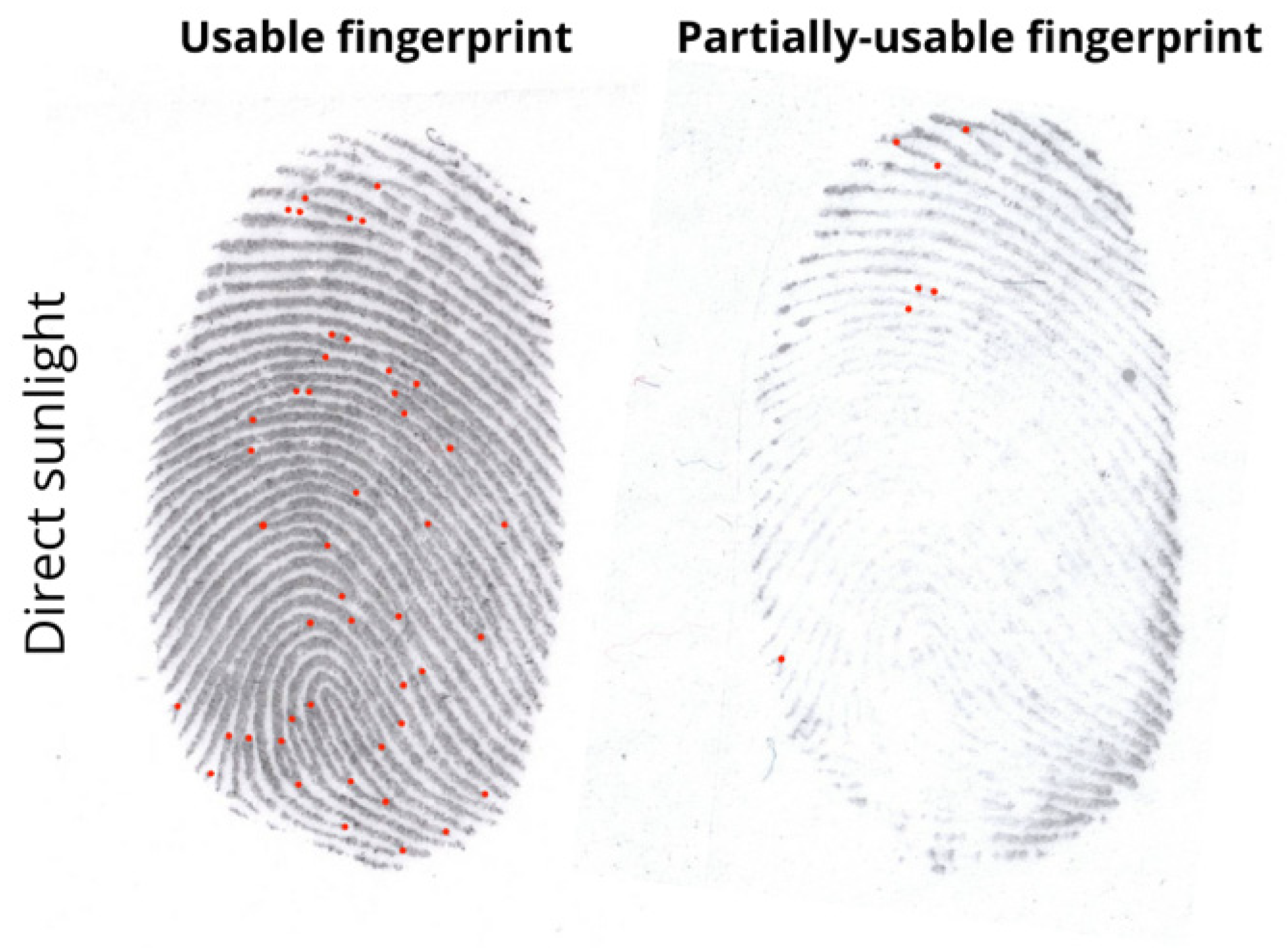
The usability of degraded latent fingerprints was determined based on the internal evaluation guidelines of investigators of the Slovak Republic. Fingerprints were classified into three categories: usable (more than 10 minutiae), partially usable (7–9 minutiae) and non-usable (fewer than 7 minutiae) [
11].
All procedures involving fingerprint exposure, development, and evaluation were performed by a single experienced forensic dactyloscopy examiner, ensuring methodological consistency.
Data collection was conducted as part of a dermatoglyphic research project. The study was approved by the Ethics Committee of the Faculty of Natural Sciences, Comenius University in Bratislava (Approval No. ECH19019).
2.5. Statistical Analysis
Data processing was carried out using Microsoft Office Excel 2025, and statistical analyses were performed with Jamovi 2.6.25.0 (Jamovi Computer Software). Descriptive statistics were calculated for latent fingerprints exposed to direct sunlight. Data normality was assessed using the Shapiro–Wilk test, which showed that the data were not normally distributed. Since the data represent repeated measurements and were not normally distributed, the non-parametric Friedman test was used to assess differences in minutiae counts across exposure intervals. Post hoc pairwise comparisons were performed using the Durbin–Conover test.
All statistical tests were performed at a significance level of α = 0.05, with p values less than 0.05 considered statistically significant.
To assess intra-examiner reliability, 40 randomly selected fingerprints were re-evaluated by the same examiner three months after the initial evaluation. This procedure enabled estimation of intrapersonal error and calculation of the technical error of measurement (TEM).
3. Results
The TEM (0.051) and reliability coefficient (R = 0.989) indicate minimal measurement error in the evaluation of the data. This high reliability, with R ranging from 0 to 1, where 1 represents minimal measurement error, confirms the accuracy of minutiae assessment on latent fingerprints exposed to direct sunlight.
The Friedman test revealed a statistically significant effect of exposure time on minutiae counts (χ
2(7) = 49.6,
p < 0.001). Post hoc pairwise comparisons using the Durbin–Conover test revealed significant differences between several exposure intervals (
Table 2). Direct sunlight reduced minutiae counts by: 15.87 (1 w), 7.61 (2 w), 17.39 (3 w), 16.09 (4 w), 5.65 (5 w), 8.91 (6 w), and 8.48 (7 w). Compared with the control sample, significant differences were observed after 1 week (
p < 0.001), 3 weeks (
p < 0.001), 4 weeks (
p < 0.001), 6 weeks (
p = 0.008), and 7 weeks (
p = 0.004) of direct sunlight exposure. No significant differences were found between the control and 2 weeks (
p = 0.489) or 5 weeks (
p = 0.134) of exposure.
Significant differences were also detected between several exposure intervals, including 1 and 2 weeks (p < 0.001), 1 and 5 weeks (p < 0.001), 1 and 6 weeks (p = 0.004), and 1 and 7 weeks (p = 0.007). Additionally, differences were found between 2 and 3 weeks (p < 0.001), 2 and 4 weeks (p < 0.001), 2 and 6 weeks (p < 0.048), 2 and 7 weeks (p < 0.029), 3 and 5 weeks (p < 0.001), 3 and 6 weeks (p < 0.019), 3 and 7 weeks (p < 0.032), and 4 and 5 weeks (p < 0.009).
No statistically significant differences were observed among the remaining pairwise comparisons (all p > 0.05).
4. Discussion
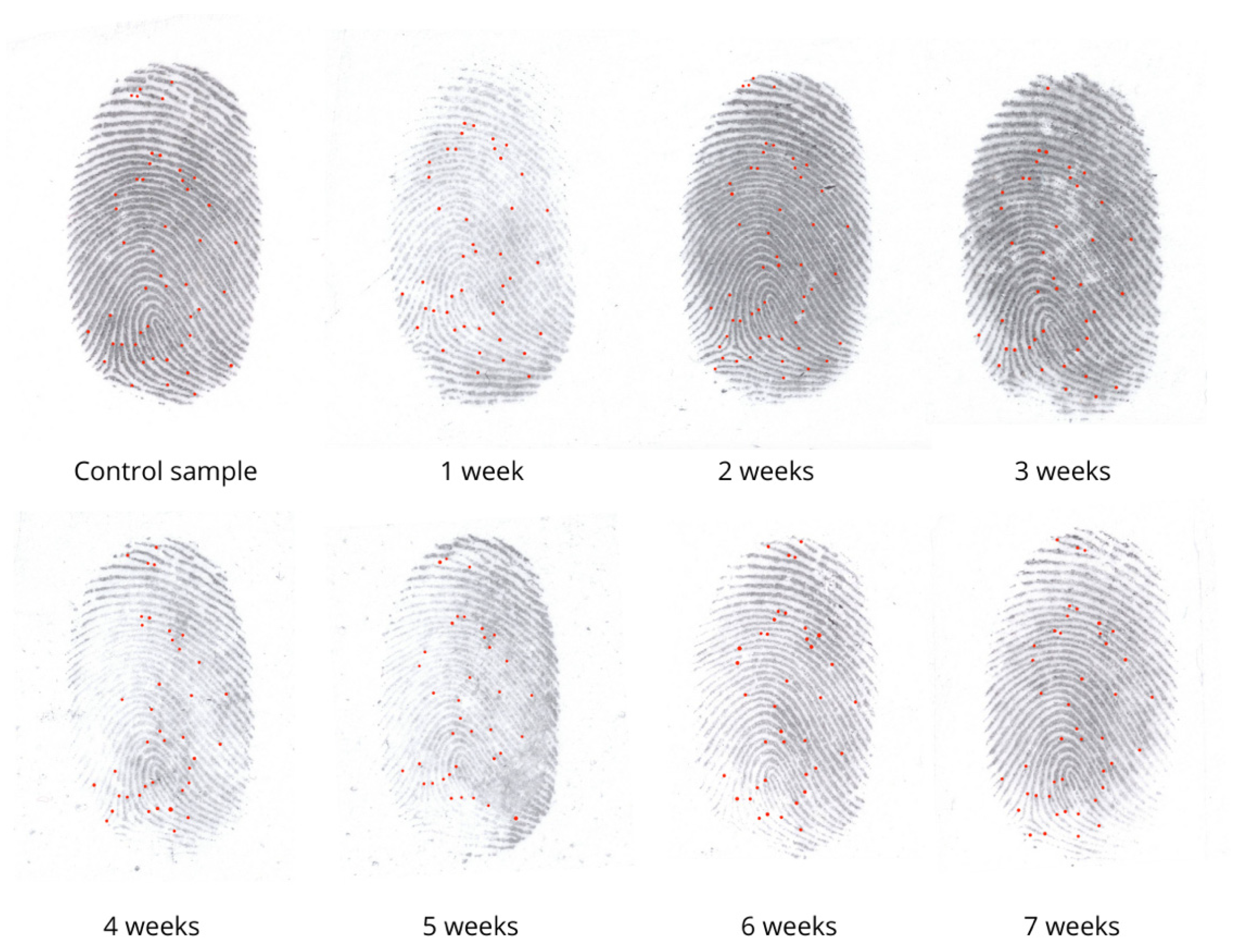
In this study, we evaluated how direct sunlight affects the quality of groomed latent fingerprints deposited on a non-porous glass surface. We assessed quality by counting the number of minutiae, with fingerprints exposed to direct sunlight for periods of time ranging from 1 to 7 weeks (
Figure 1). Previous studies have mostly described the effect of direct sunlight on latent fingerprints in terms of visual changes, such as reduced contrast or poorer visibility of the friction ridge skin. In contrast, our study focused on a quantitative evaluation from a forensic perspective—specifically, the number of minutiae and the classification of fingerprints as usable, partially usable, or non-usable for personal identification. Our results showed that even after long-term exposure to direct sunlight, the fingerprints were, in most cases, still very well preserved, and their identification value was not significantly reduced.
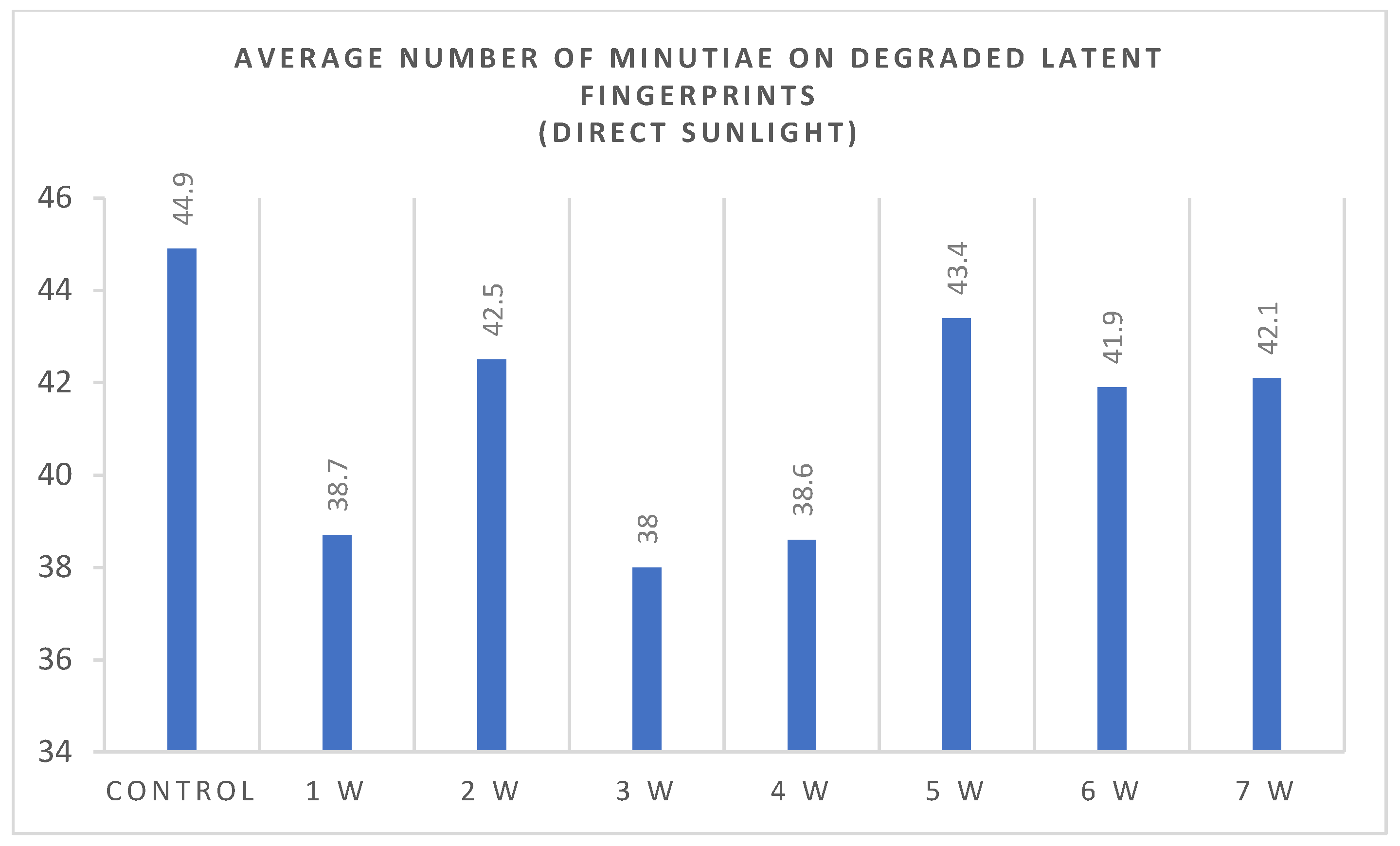
In the descriptive statistics, we observed that exposure of latent fingerprints to direct sunlight resulted in a decrease in the average number of minutiae during some time intervals. The largest decrease was observed after the 1st and 3rd weeks of exposure (
Figure 2). However, in subsequent intervals, the values did not continue to decline steadily. The average number of minutiae stabilized and, in some periods (the 5th, 6th, and 7th weeks), was close to the values in the control sample (
Figure 2). This suggests that fingerprint degradation due to direct sunlight exposure does not follow a linear trend over time and may be influenced by several factors, such as radiation intensity, spectral composition, and microclimatic conditions. The observed temporary degradation of latent prints during the initial weeks of direct sunlight exposure may be attributed to a transitional phase in which the latent fingerprints had not yet undergone stabilization by solar radiation. During this period, additional environmental factors may have contributed to partial degradation, potentially reducing the capacity of fingerprint powder to adhere effectively to the print residue. Following subsequent stabilization induced by direct sunlight, the quality of the developed fingerprints approached their near-original condition.
Based on the Friedman test and subsequent post hoc analysis, significant differences were found between the control sample and several exposure intervals—specifically, between the control and the 1st, 3rd, 4th, 6th and 7th weeks (
Table 2). Significant differences were also observed between certain exposure intervals themselves, for example, between weeks 1 and 2, 1 and 5, 1 and 6, 1 and 7, as well as between weeks 2 and 3, 2 and 4, 2 and 6, 2 and 7, 3 and 5, 3 and 6, 3 and 7, and 4 and 5 (
Table 2). These findings suggest that the most substantial changes in fingerprint quality may occur during the earlier stages of exposure, while later intervals do not necessarily result in further gradual deterioration.
From a forensic perspective, an important finding is the high rate of fingerprint usability even after exposure to direct sunlight (
Table 3). Of all analyzed fingerprints (
n = 322), 320 (99.38) were classified as usable, 2 (0.62) as partially usable, and none as non-usable. These results show that although direct sunlight affected the number of minutiae, in most cases, it did not result in a loss of identification value.
This apparent discrepancy between statistical significance and practical forensic usability can be explained in several ways. Statistical significance reflects differences in mean values between groups, but it does not automatically indicate that a fingerprint becomes unsuitable for identification.
In our case, the average number of minutiae in all intervals remained well above the minimum threshold for usability established in Slovak forensic practice [
11]. Even when the average number of minutiae decreased in some intervals, the fingerprints still remained suitable for personal identification (
Figure 3).
A significant role was played by the type of analyzed fingerprints. Groomed fingerprints are characterized by a higher proportion of lipid components (fatty acids, cholesterol, and squalene), which are generally more stable than the aqueous component of eccrine sweat. Lipids are less prone to rapid evaporation and exhibit a higher affinity for non-porous substrates. This may explain why ridge detail remained sufficiently preserved even after prolonged exposure to direct sunlight. In practical terms, groomed fingerprints therefore represent a more resistant type of trace, which may be analogous to scenarios where the sweat–sebum residue is particularly rich in lipid constituents.
The substrate material also appeared to be an important factor. Glass, as a non-porous surface, does not absorb sweat–sebum residue into its structure; consequently, degradation is expected to occur primarily through surface-level chemical changes. Furthermore, glass has a smooth surface, which contributes to greater clarity and sharpness of the deposited fingerprints. However, latent fingerprints may remain relatively well preserved provided that mechanical disruption does not occur and the residue is not fully chemically degraded. Moreover, glass is among the surfaces on which magnetic powders typically demonstrate high effectiveness, enabling the visualization of latent fingerprints even at more advanced stages of degradation.
Our results suggest that the degradation of latent fingerprints under direct sunlight may occur at multiple levels. We observed an initial decline in fingerprint quality during the early exposure intervals, particularly in the first week. In later weeks, the quality appeared to stabilize. This pattern may be explained by the faster degradation of the aqueous component of eccrine sweat. Although variations in the measured intensity of direct sunlight (LUX) were recorded during the exposure time period. These differences did not appear to have a significant impact on latent fingerprint quality, as the mean minutiae counts remained comparable across the evaluated minutiae (
Table 1). In contrast, lipid components are more stable and may persist for a longer period. Over time, these lipid constituents may become dominant in the remaining residue. Furthermore, the temporary degradation of latent fingerprints during the initial weeks of direct sunlight exposure may reflect a transitional phase prior to stabilization by solar radiation. During this period, environmental factors may have caused partial degradation, reducing fingerprint powder adhesion. After stabilization, the quality of the developed prints approached their near-original condition. As a result, degradation may reach a relatively stable phase, during which no substantial further loss of friction ridge skin detail is observed.
In addition, direct sunlight may induce photochemical processes that lead to more than just degradation [
30]. It may also cause partial changes in lipid components. Oxidative reactions (e.g., oxidation of squalene and fatty acids) can alter the physical properties of the residue. For example, they may increase viscosity or promote partial solidification of the deposited layer [
28]. Under certain conditions, such changes could support better preservation of latent fingerprints on non-porous surfaces. In this context, direct sunlight may therefore act not only as a degradative factor. One of the hypotheses considered in this study is that sunlight may partially stabilize the lipid components of fingerprint residues. However, confirming this assumption would require additional targeted analyses beyond the scope of the present work. In particular, further investigation should include chemical analysis of fingerprint residues, quantification of lipid oxidation products, and precise measurement of UV radiation exposure. Such approaches would allow for a more detailed understanding of the underlying mechanisms and help to verify the proposed stabilizing effect of sunlight on lipid constituents. This effect may help maintain their forensic usability.
The preservation of high fingerprint quality may also have been influenced by the development method itself. Magnetic Hi-Fi dactyloscopic powder is particularly sensitive to lipid components and is considered one of the most effective development techniques on non-porous surfaces [
4]. Even when partial degradation of the aqueous component occurs, the powder may still adhere to the lipid component of the latent fingerprint. This suggests that the choice of an appropriate development method can substantially affect the interpretation of how environmental factors influence latent fingerprint quality.
Our findings support previous studies [
23,
27,
28,
29], which highlight the complexity of latent fingerprint degradation. They also indicate that degradation depends on a combination of several environmental factors, such as substrate type and the chemical composition of the fingerprint residue. Previous research has reported that light and UV radiation may accelerate the breakdown of organic components. This can result in reduced contrast and decreased fingerprint quality [
1,
26]. In the present study, however, no marked decrease in fingerprint usability was observed, despite statistically significant differences in the mean number of minutiae. This suggests that even degraded fingerprints may still provide sufficient identifying features for personal identification in practical casework.
A limitation of this study is the use of fingerprints from a single volunteer. Based on the use of fingerprints from a single volunteer, aimed at minimizing the influence of factors such as sex, age, physiological conditions, hygiene habits, and cosmetic product use, it should be noted that the findings cannot be generalized and should be considered preliminary pilot data. Future studies should include a larger number of volunteers. In addition, the present study is based on groomed latent fingerprints, which are known to contain a higher lipid content and to exhibit greater stability compared to naturally deposited fingerprints. As such, they represent a best-case scenario for fingerprint preservation. This experimental design may have contributed to the high usability rate observed in this study (99.38) and should be considered when interpreting the results. In routine forensic practice, fingerprints are most commonly deposited naturally, without prior preparation, and are therefore more susceptible to environmental and individual variability. Consequently, fingerprints encountered under real-world conditions may demonstrate reduced stability and usability following exposure to the evaluated factor compared to those analyzed in this study. Future research should focus on direct comparisons between groomed and natural fingerprints in order to better approximate real forensic scenarios. Another limitation of this study is that while ambient temperature remained relatively constant and relative humidity showed minimal variation, other environmental factors, such as UV radiation, which is a key driver of photochemical degradation, and microclimatic conditions, were not systematically controlled, which could influence fingerprint degradation in real-world scenarios. Moreover, a wider range of substrates and different levels of light exposure should be investigated.
This study is based exclusively on manual counting of minutiae. While this method is widely used in forensic practice, the research could be further strengthened by incorporating additional objective measures, such as ridge clarity scores, image quality indices, or automated minutiae detection. These approaches may offer valuable insights for future studies.
Despite these limitations, the results provide a practically relevant conclusion for forensic practice. Latent fingerprints deposited on glass may remain suitable for personal identification even after several weeks of exposure to direct sunlight. This indicates that systematic development and collection of such traces is still justified, even when long-term light exposure is expected. Degradation does not necessarily imply a complete loss of identification value.