


Abstract
During a parasitological survey of freshwater fishes from Khun Thale Swamp, Surat Thani Province, Thailand, a new species of opecoelid trematode, Dactylostomum brayi n. sp., was recovered from the intestine of the Asian redtail catfish Hemibagrus nemurus (Bagridae). Of the 1065 fishes examined, representing 33 species, 27 genera, and 16 families, the parasite was found exclusively in H. nemurus, with a prevalence of 27.27% and a mean intensity of 2.33 worms per infected host, suggesting a high degree of host specificity. The new species differs from all recognised freshwater congeners in the number of ventral sucker papillae, body proportions relative to the oral sucker, and the morphology of the reproductive organs. This represents the second record of Dactylostomum from Thailand, following specimens identified as Dactylostomum sp. by R. A. Bray from the same host and deposited in the Natural History Museum, London, in 1983. The present study also provides the first molecular characterisation (18S, ITS2, and 28S rRNA) for the genus Dactylostomum and reveals a close phylogenetic relationship with Dimerosaccus. These findings contribute to the taxonomy and distribution of Dactylostomum and provide a basis for future systematic and phylogenetic studies of this poorly known genus.
1. Introduction
Studying parasites is important for understanding their ecological and biological impacts on hosts and ecosystems, as parasites can influence various aspects of host biology. For this reason, basic research on parasite taxonomy is an essential first step towards understanding parasite–host relationships. The genus Dactylostomum Woolcock, 1935 (Opecoelidae), was originally established by Woolcock [1] with the type species Dactylostomum gracile Woolcock, 1935, from the marine fish Myxus elongatus Günther, 1861 (Mugilidae) in Australia. Subsequently, eleven additional species were described from marine fishes, the most recent being Dactylostomum nicolli Aken’Ova, Cribb & Bray, 2003, from Australia [2].
According to Bray [3], although Dactylostomum has traditionally been regarded as a marine genus, it was suggested that the genus may also include representatives from freshwater fishes. Bray [3] recognised the two nomina nuda Dactylostomum jhansiensis Agarwal & Agarwal, 1988, and Dactylostomum mastacembeli Agarwal & Agarwal, 1981 (the latter, for which we found no evidence of its existence, appears to be an error in Bray [3]), as belonging to Dactylostomum. He also included the genera Gangatrema Agarwal & Kumar, 1981, currently regarded as a synonym of Nicolla Wisniewski, 1934 [4], and Opedunculata Dwivedi, 1975, synonymised with Dactylostomum by Cribb [4]. In addition, Bray [3] included Coitocaecum parvum Crowcroft, 1945, which is currently retained as a valid species of Coitocaecum [4].
Following the review of Bray [3], the following three additional species were described from the spiny eel Mastacembelus armatus (Lacepède, 1800) (Mastacembelidae) in India: Dactylostomum harishii Agarwal & Agarwal, 1988 [5], Dactylostomum kashiensis (Maurya, Agarwal & Singh, 1989) Cribb, 2005 [6], and Dactylostomum satpali Agrawal & Sharma, 1989 [7]. However, these descriptions do not conform to current taxonomic standards because of the absence of deposited type material, incomplete morphometric descriptions, and inadequate differential diagnoses separating the proposed taxa from previously described congeners. Consequently, these species may be regarded as species inquirendae.
In addition to the nominal species described from M. armatus, several species assigned to Dactylostomum have been described from other freshwater fishes in India, including Dactylostomum gayaprashadi Tripathi & Jauhari, 1991, from Xenentodon cancila (Hamilton, 1822) (Belonidae) [8], Dactylostomum cuchia Sen, 2011, from Ophichthys cuchia (Hamilton, 1822) (Synbranchidae) [9], D. matatiliansis Sen, 2014, and D. govindsagerii Sen & Siddiqui, 2014, from Ophichthys cuchia (Hamilton, 1822) (Synbranchidae) [10,11], and Dactylostomum ramgangaii and Dactylostomum elongatus Kumar, 2016, from Sperata seenghala (Sykes, 1839) (Bagridae) [12]. These taxa are likewise based on inadequate taxonomic descriptions and should also be regarded as species inquirendae.
In Australia, Dactylostomum cribbi Gibson, Bray & Langdon, 1990, was described from the freshwater fish Gadopsis marmoratus Richardson, 1848, an endemic species of southeastern Australia [13]. Consequently, the currently recognised freshwater representatives of Dactylostomum comprise Dactylostomum armatum (Dwivedi, 1975) Cribb, 2005, Dactylostomum sapani (Dwivedi & Dwivedi, 1982) Cribb, 2005 (both originally described in Opedunculata), and the above-mentioned D. cribbi.
Knowledge of Dactylostomum remains limited and is further constrained by the complete absence of molecular characterisation. This is unsurprising, as no recent collections suitable for molecular analyses have been available. Moreover, the most recently described marine species, D. nicolli, was preserved in formalin, preventing the generation of DNA sequences [2]. In addition to the three recognised freshwater species, the genus currently comprises the following twelve marine species: D. gracile, D. vitellosum Manter, 1940, D. caballeroi Martin, 1960, D. winteri Caballero & Caballero, 1971, D. epinepheli Wang, 1982, D. longivesiculum Shimazu & Machida, 1985, D. manteri Ramadan, 1985, D. tanegashimense Shimazu & Machida, 1985, D. woolcocki Ramadan, 1985, D. yamagutii Ramadan, 1985, D. griffithsi Bray, 1987, and D. nicolli.
During a parasitological survey of freshwater fishes from Khun Thale Swamp, Surat Thani Province, Thailand, specimens of a trematode attributable to the genus Dactylostomum according to the diagnosis of Cribb [4] were recovered. The present study aims to describe this new species and to provide the first molecular characterisation and phylogenetic position in the subfamily Opecoelinae for the genus Dactylostomum.
2. Materials and Methods
2.1. Sample Collection
Freshwater fishes were collected from Khun Thale Swamp, Surat Thani Province, Thailand (9°4′3″ N, 99°19′52″ E), using gill nets and cast nets obtained from a local fisherman during the dry season (February–April 2020) and the rainy season (September–November 2020). This swamp is the largest freshwater lake-like wetland in Surat Thani Province, covering approximately 203 ha. It is an open freshwater system connected to tributary canals and the Tapi River and is occasionally influenced by tidal seawater intrusion during the dry season, making it an ecologically important wetland [14]. Live fish were transported to the Scientific Laboratory and Equipment Centre (SLEC), Prince of Songkla University, Surat Thani, Thailand (it is a short distance of less than six kilometres, making the logistics of sampling feasible). The whole gastrointestinal tract of each fish was examined for helminths under a stereomicroscope. Fish were identified following [15,16,17]. The animal study was approved by the Institutional Animal Care and Use Committee, Prince of Songkla University, Thailand, under approval number MHESI 6800.11/965. The study was conducted in accordance with the local legislation and institutional requirements.
2.2. Morphological Study
Digenean trematodes were recovered from the digestive tract under a Zeiss stereomicroscope (Jena, Germany) using 0.85% saline solution. Specimens were rinsed in 0.85% saline solution, fixed in 4% formalin, and gently flattened between a microscope slide and a coverslip under light pressure. They were subsequently stained with acetocarmine, dehydrated through a graded ethanol series, cleared in xylene, and permanently mounted in Permount (Fisher Scientific, NJ, USA) [18]. A total of six gravid, stained specimens were examined morphologically. All examined specimens were deposited in the Museum of Natural Sciences of Barcelona under collection numbers MZB 2026–0497 to MZB 2026–0502. Prevalence and mean intensity were calculated following [19].
2.3. Morphometrical Study
Stained specimens were examined using a Leica DMLB light microscope (Leica Microsystems, Wetzlar, Germany) equipped with a digital camera Euromex (sCMEX) (Duiven, the Netherlands). Identification to the generic level followed the key to Cribb [4]. Measurements are given in micrometres (μm) as the mean followed by the range in parentheses.
2.4. Molecular Study
Molecular analyses of one specimen were performed using rRNA (18S, ITS2 and 28S) markers. DNA was extracted using the DNeasy Blood & Tissue Kit® (Qiagen, Hilden, Germany) according to the manufacturer’s instructions. The 18S, ITS2 and 28S regions of the rRNA were amplified by PCR. The PCRs were performed in a total volume of 25 μL containing 1x Green GoTaq® Reaction Buffer (1.5 mM MgCl2) (Promega, Madison, WI, USA), 0.2 mM each dNTP, 1 μM of each primer, and 5 U/μL GoTaq® DNA Polymerase (Promega, Madison, WI, USA). The 18S region was amplified using the primers 18S F (5′–ATCCGAAGTAATGGTTAAGAGGG–3′) and 18S R (5′–ACCTACGGAAACCTTGTTACG–3′); the ITS2 region using ITS2 F (5′–GCTCGTGTGTCGATGAAGAG–3′) and ITS2 R (5′–AGGCTTCGGTGCTGGGCT–3′); and the 28S region using the primers 28S F (5′–GTGAATACCCGCTGAACTTAAGC–3′) and 28S R (5′–TCTCCTTGGTCCGTGTTTCAA–3′) [20]. The cycling conditions included an initial denaturation at 94 °C for 5 min, followed by 40 cycles of 30 s at 94 °C, 30 s at 52 °C for 28S and 18S, 56 °C for ITS2 (annealing), and 2 min at 72 °C, with a final extension step of 10 min at 72 °C. Amplified PCR products were electrophoretically separated in a 1% (w/v) agarose gel stained with Green Gel. Negative controls were always included in the PCRs to check for contamination. Relevant bands were sent for purification and sequencing, and all sequences have been deposited in GenBank (Table 1). Sequencing was performed by the Genomics Unit of the Scientific and Technological Centres (CCiTUB), University of Barcelona.
Table 1.
GenBank accession numbers and ITS2 genetic distances for Opecoelidae species included in the phylogenetic analyses. Sequences generated in the present study are indicated in bold. Outgroups are indicated as OG. N.C: New Caledonia. Numbers in brackets link GenBank accession numbers to their corresponding host and locality.
2.5. Phylogenetic Analysis
To infer the position and determine the sister-group relationships of Dactylostomum within an Opecoelidae phylogenetic framework, a concatenated phylogenetic tree was constructed using the partial 18S rRNA region, the ITS2 and the partial 28S rRNA region (see species and outgroup data in Table 1). Alignments of the individual regions were performed using MAFFT (available at http://www.ebi.ac.uk/Tools/msa/mafft/) (accessed on 20 July 2026) and the concatenation was performed using MEGA 12.1.2 [21]. Phylogenetic and molecular evolutionary analyses were conducted using the aligned and concatenated nucleotide sequences and inferred using both the maximum-likelihood (ML) method in MEGA 12.1.2 and Bayesian inference (BI) using BEAST [22]. To determine the evolutionary model that best fitted our dataset, jModeltest 2.1.1 [23] was employed, with model selection based on the Akaike information criterion (AIC). The results indicated that the general time-reversible model with an estimate of gamma-distributed among-site rate variation and invariant sites (GTR + G + I) was the most appropriate for the analyses. The number of substitution types was fixed to 6. The 4 × 4 substitution model was used, while rate variation across sites was modelled with a gamma distribution. Node support was evaluated using the ultrafast bootstrap with 1000 replicates [24]. The percentage of trees in which the associated taxa clustered together is shown next to the branches. Four Markov Chain Monte Carlo (MCMC) chains were run for 10,000 generations, with sampling performed every 10 generations, with the first 250 sampled trees discarded as burn-in. Finally, a 50% majority-rule consensus tree was constructed. The concatenated 18S–ITS2–28S tree involved 44 sequences with a total of 6700 positions in the final dataset. For the ITS2 sequences, evolutionary divergence was calculated using p-distance with 1000 bootstrap replicates in MEGA 12.1.2.
3. Results
A total of 1065 freshwater fish belonging to 16 families, 27 genera, and 33 species were collected and examined for trematodes. Of the species examined, six of 22 Hemibagrus nemurus (Valenciennes, 1840) (Bagridae) were infected with a trematode belonging to the genus Dactylostomum. The 22 fish examined ranged from 24 to 46 cm (35 cm) in length and from 118 to 800 g (436 g) in weight. The prevalence, mean intensity, and intensity range were 27.27%, 2.33, and 1–4 worms per infected host, respectively.
The only other bagrid examined was Mystus nigriceps (Valenciennes, 1840), of which both specimens examined were uninfected. All remaining fish species were negative for Dactylostomum.
3.1. Systematic Account
Phylum: Platyhelminthes Minot, 1876;
Class: Trematoda Rudolphi, 1808;
Order: Plagiorchiida La Rue, 1957;
Family: Opecoelidae Ozaki, 1925;
Genus: Dactylostomum Woolcock, 1935.
Dactylostomum brayi n. sp.
Type host: Hemibagrus nemurus (Valenciennes, 1840) (Siluriformes: Bagridae), Asian redtail catfish;
Type locality: Khun Thale Swamp, Surat Thani Province, Thailand (9°4′3″ N, 99°19′52″ E);
Site of infection: Intestine;
Type specimens: Holotype MZB 2026–0497; paratypes MZB 2026–0498 to MZB 2026–0502, deposited in the Museum of Natural Sciences of Barcelona, Barcelona, Spain;
Date of collection: November 2020;
Prevalence, mean intensity, and intensity range: Six of twenty-two (27.27%, 2.33, and 1–4 worms per infected host, respectively);
GenBank accession numbers: 18S rDNA (PZ787884), 28S rDNA (PZ787886), and ITS2 (PZ787885);
Etymology: The specific epithet brayi honours Dr Rodney A. Bray (Natural History Museum, London) in recognition of his outstanding contributions to the taxonomy and systematics of digenean trematodes, including the family Opecoelidae. The name also acknowledges his examination and deposition of specimens of the same species collected in Thailand more than four decades before the present study;
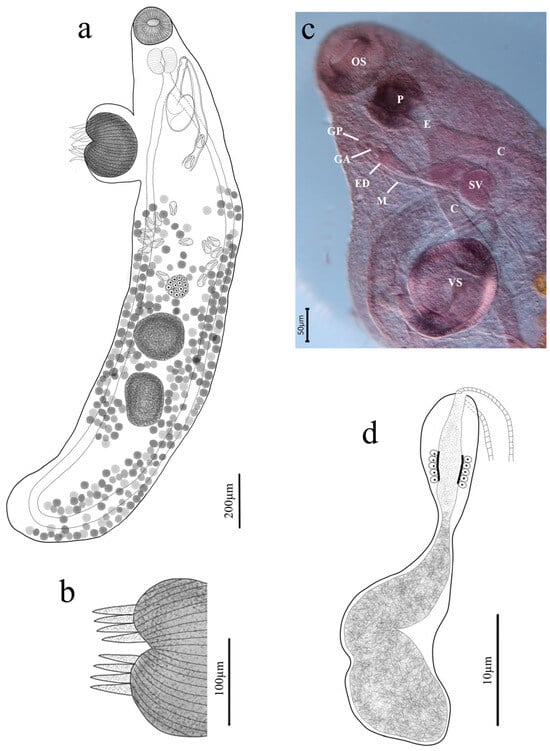
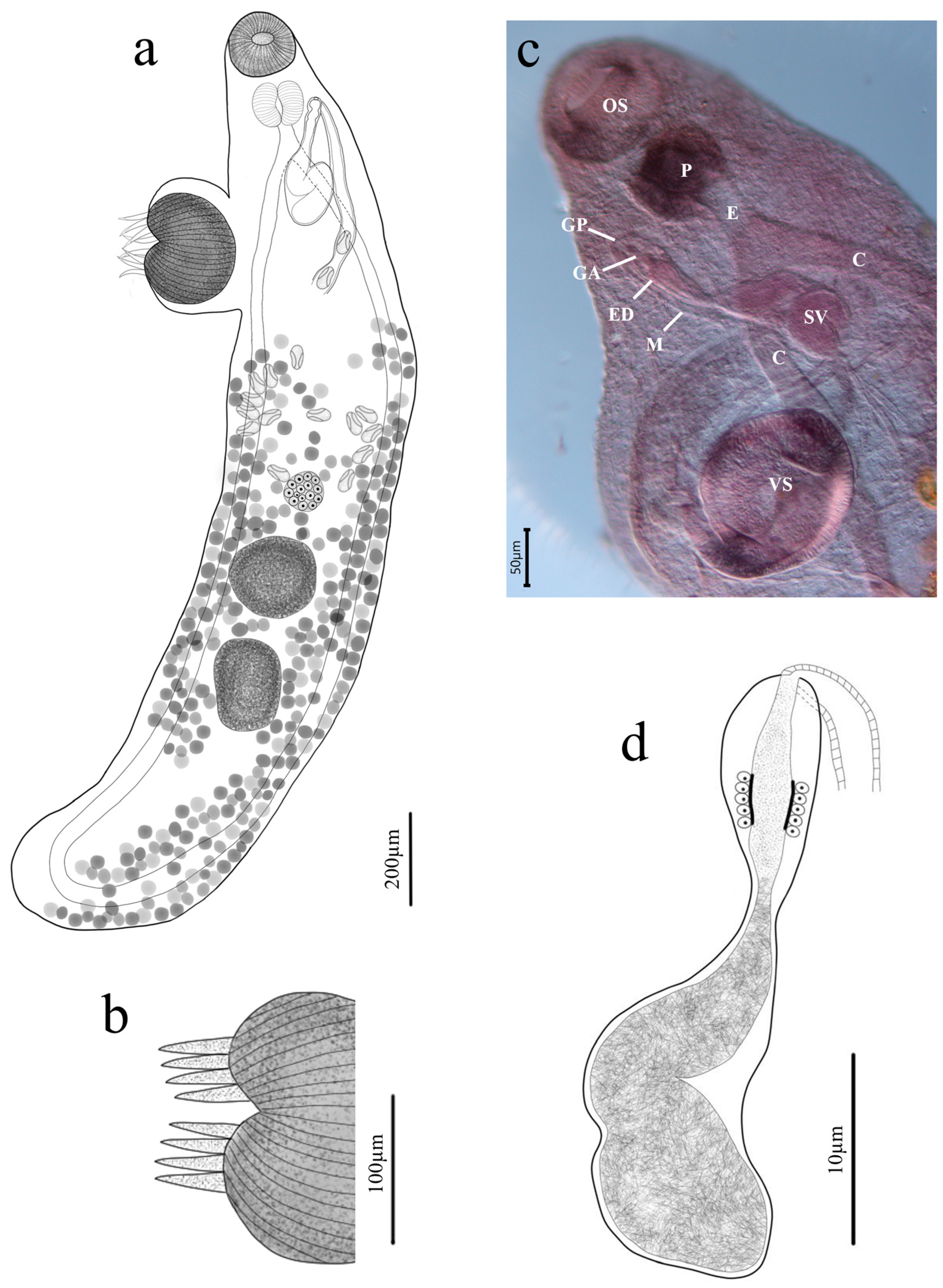
Description. Based on six whole-mounted specimens, including two mounted in lateral view and four in ventral view (Figure 1a–d). Measurements are in micrometres and are given as the range followed by the mean in parentheses.
Figure 1.
Dactylostomum brayi n. sp. from the intestine of Hemibagrus nemurus (Valenciennes, 1840). (a) Line drawing of the whole worm in lateral view showing the general arrangement of the internal organs; inset showing the ventral sucker bearing eight prominent horn-like papillae. Scale bar = 200 μm. (b) Photomicrograph of the anterior region in lateral view. Abbreviations: C, caeca; E, oesophagus; ED, ejaculatory duct; GA, genital atrium; GP, genital pore; M, metraterm; OS, oral sucker; P, pharynx; SV, seminal vesicle; VS, ventral sucker. Scale bar = 50 μm. (c) Detail of the ventral sucker. Scale bar = 100 μm. (d) Terminal genitalia. Scale bar = 10 μm.
Body elongate, slender, with body surface unarmed, 1629–2299 (1946)-long and 306–463 (390)-wide (Figure 1a). Oral sucker oval, subterminal, 107–137 (118) long and 99–146 (127) wide. Prepharynx 3–21 (10)-long. Pharynx oval, well-developed, 84–124 (106)-long and 94–113 (104)-wide. Oesophagus 28–73 (50)-long. Intestinal bifurcation in posterior forebody (Figure 1b). Intestinal caeca extending posteriorly and uniting to form a cyclocoel near posterior extremity of body. Distance from posterior margin of cyclocoel to posterior extremity of body 62–103 (86) (this measurement could not be obtained in one specimen). Ventral sucker larger than oral sucker, oval, pedunculate, 147–274 (191)-long and 140–208 (168)-wide, protuberant, bearing eight horn-like papillae on luminal margin (Figure 1b). Oral sucker: ventral sucker width ratio 1:1.2–1.4 (1.3). Forebody representing 15.7–27.5% of body length.
Seminal vesicle short, sigmoid to sinuous, situated anteriorly at mid-level of ventral sucker and continuing as tubular ejaculatory duct opening into conspicuous genital atrium. Genital pore situated approximately at mid-pharyngeal level, apparently sinistrally sublateral. External seminal vesicle entirely enclosed within thin, delicate membranous sac; cirrus-sac wall thin around seminal vesicle, becoming thicker at level of ejaculatory duct and genital atrium. Pars prostatica and prostatic gland cells observed (Figure 1d).
Anterior testis 76–197 (157)-long and 107–210 (166)-wide. Posterior testis 142–215 (191)-long and 122–201 (166)-wide. Inter-testicular distance 9–67 (35). Post-testicular region 502–673 (571)-long.
Ovary transversely oval, irregular, 58–90 (77)-long and 67–98 (84)-wide; separated from ventral sucker by 176–418 (274) and from anterior testis by 14–54 (30). Eggs operculate, 7–83 (28) in number, 34–54 (45)-long and 17–33 (26)-wide (n = 54). Metraterm muscular, running alongside cirrus sac, with its proximal end at approximately level of pars prostatica. Uterus extending between ovary and genital pore. Vitellarium follicular; vitelline fields extending from posterior extremity to approximately midway between ovary and ventral sucker, –157–102 (–26) anterior to ventral sucker; follicles mainly lateral to caeca, confluent ventrally posterior to posterior testis and ovary, confluent dorsally posterior to testes, almost confluent dorsally between testes and between anterior testis and ovary, with distinct dorsal gap at level of caeca. Excretory pore terminal. Excretory vesicle I-shaped, tubular, extending anteriorly dorsal to cyclocoel and reaching level of ovary.
Remarks. The present specimens are assigned to Dactylostomum Woolcock, 1935, based on the presence of prominent horn-like papillae on the ventral sucker, the principal diagnostic character of the genus within Opecoelinae [4]. Dactylostomum brayi n. sp. differs from all previously described freshwater species of Dactylostomum in the number of ventral sucker papillae, body proportions versus oral sucker, and the morphology of the reproductive organs.
Related to the marine species, Dactylostomum brayi n. sp. can be assigned to Group B of Bray [3], characterised by the vitellarium being confined to the hindbody. More specifically, it belongs to Group B1 of Aken’Ova et al. [2], comprising species with simple ventral sucker papillae and an entire to irregular ovary. This group includes D. griffithsi, D. woolcocki, D. winteri, and D. nicolli. Although D. brayi n. sp. is a freshwater species, it can be readily distinguished from the first three marine species. Dactylostomum griffithsi possesses six or seven horn-like papillae rather than eight [3], D. woolcocki bears six horn-like papillae [25], and D. winteri possesses only three horn-like papillae [26,27].
Among the currently recognised freshwater species, D. cribbi shares the presence of four pairs of ventral sucker papillae with D. brayi n. sp. but differs in possessing a markedly larger and more muscular ventral sucker (more than one-third of body length) and a maximum of seven eggs, compared with up to 83 eggs in D. brayi n. sp. [13]. Dactylostomum armatum differs from the new species in having six ventral sucker papillae instead of eight and in having vitelline fields extending anteriorly to the caecal bifurcation [4,28], whereas in D. brayi n. sp. the posterior extent of the vitelline fields remains well posterior to the caecal bifurcation. D. govindsagerii and D. matatiliansis differ from D. brayi n. sp. in having a vitellarium that extends into the forebody. In addition, D. govindsagerii has three dactylae on the ventral sucker, whereas D. matatiliansis is described as lacking dactylae [10,11]. Dactylostomum sapani can be readily distinguished by the presence of four ventral sucker papillae rather than the eight present in D. brayi n. sp., and by having transversely elongated testes not separated compared with testes tandem, oval to nearly spherical, well separated in D. brayi n. sp. In addition, D. brayi n. sp. has smaller eggs than all other freshwater species of the genus.
3.2. Molecular Phylogenetic Analyses
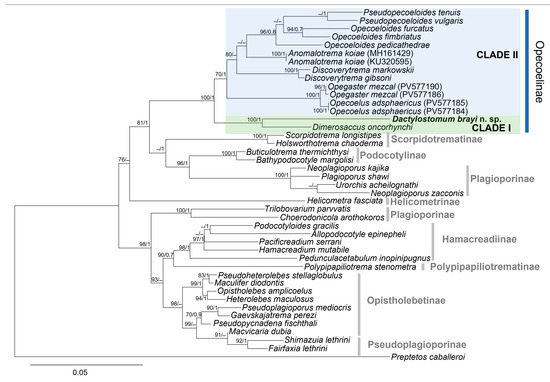
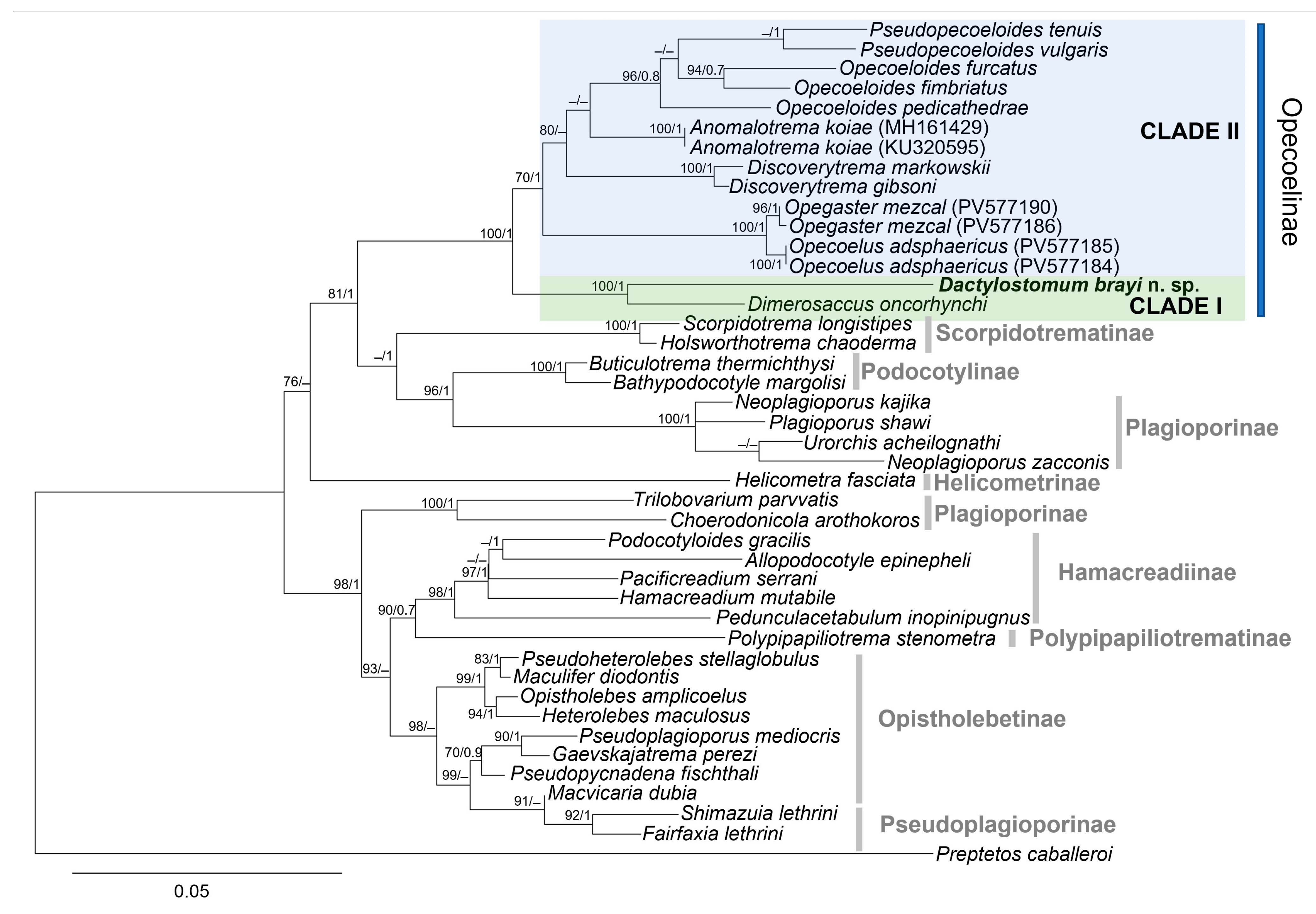
In the ML and BI analyses of the concatened 18S–ITS2–28S rRNA sequences, D. brayi n. sp. belongs to a monophyletic and well-supported clade including all species of the subfamily Opecoelinae (node supports 100/1). There are no other Dactylostomum molecular sequences available; however, D. brayi n. sp. appears as the sister taxon, with strong support, to Dimerosaccus oncorhynchi (Eguchi, 1931) Shimazu, 1980, in all three phylogenetic trees (node supports 100/1.0) (Figure 2).
Figure 2.
Phylogenetic relationships of Opecoelidae species inferred from maximum-likelihood analysis and Bayesian inference of concatenated 18S–ITS2–28S ribosomal RNA sequences. Newly generated sequences are shown in bold. Bootstrap support values lower than 70% and posterior probabilities lower than 0.8 are indicated by a dash. The scale bar represents the expected number of substitutions per site.
The Opecoelinae clade included the following two distinct subclades: Clade I (node supports 100/1), encompassing D. brayi n. sp. and D. oncorhynchi, and Clade II (node supports 70/1), containing the other available sequences (species of the genera Pseudopecoelus, Pseudopecoeloides, Opecoeloides, Anomalotrema, Discoverytrema, Opegaster, Opecoelus, Paropecoelus, Poracanthium, and Coitocaecum).
The genetic distance between the ITS2 sequences of D. brayi n. sp. and D. oncorhynchi was 9.6% (Table 1), while genetic distances between D. brayi n. sp. and the other species within Clade II varied between 11.3 and 20.8%. The genetic distances among species within Clade II varied between 5.9 and 18.5%. Considering the genetic variability of other subfamilies within Opecoelidae, such as Plagioporinae (4.5–11.2%) and Hamacreadinae (9.5–13.9%), the placement of Dactylostomum and Dimerosaccus within the Opecoelinae subfamily is supported.
4. Discussion
Despite several parasitological studies reporting digenean trematodes from freshwater fishes in Thailand, including the Asian redtail catfish Hemibagrus nemurus, there have been no published records of Dactylostomum. Nevertheless, the helminth collection of the Natural History Museum, London, contains four specimens identified by R. A. Bray as Dactylostomum sp. (catalogue numbers 1983.8.8.101–104). These specimens were collected in Thailand in 1982 by Supranee Chinabut, former Director of the Aquatic Animal Health Research and Development Division, Bangkok, Thailand, from the bagrid catfishes Hemibagrus wyckii (Bleeker, 1858) and H. nemurus. The occurrence of Dactylostomum in H. nemurus more than four decades before the present study further supports this fish as the natural host of the newly described species. Furthermore, considering that the present survey examined 1065 freshwater fishes representing 33 species, 27 genera, and 16 families, and that the parasite was recovered exclusively from H. nemurus, the available evidence indicates a high degree of host specificity. However, the host specificity of other Dactylostomum species is difficult to assess reliably because sampling designs have not been equivalent among studies, with many surveys not involving intensive sampling within a defined area covering the full local fish community, as was done in the present study.
The present study also provides the first molecular characterisation for the genus Dactylostomum, establishing a foundation for future phylogenetic studies. Phylogenetic analysis revealed that this genus, together with Dimerosaccus, constitutes a well-supported clade within the Opecoelinae, separated from the other genera. The subfamily Opecoelinae is characterised by possessing both a naked seminal vesicle and a uterine seminal receptacle but lacking both a distinct cirrus sac containing an internal seminal vesicle and a canalicular seminal receptacle [29].
The morphological similarities observed in the male reproductive system of Dactylostomum and Dimerosaccus may provide useful evidence for assessing their possible evolutionary relationship. Shedko et al. [30] redescribed the terminal genitalia of Dimerosaccus oncorhynchi, the type species and only representative of the opecoelid genus Dimerosaccus [4], which possesses an elongated, sinuous external seminal vesicle surrounded by compact prostatic gland cells and entirely enclosed within a thin, delicate membranous sac that connects to a highly reduced distal cirrus sac. The presence of a similarly specialised and modified cirrus sac in both taxa may represent a shared morphological feature and could be consistent with common ancestry. However, given that molecular sequences are currently available for only one species of each genus, the available data are insufficient to determine whether this similarity represents a synapomorphy uniting Dactylostomum and Dimerosaccus. Moreover, other molecularly uncharacterised or unsampled taxa within Opecoelinae may prove to be more closely related to Dactylostomum. Therefore, the apparent close relationship between these genera should be considered tentative, pending broader taxon sampling and additional molecular and morphological data. On the other hand, obtaining molecular characterisation from the marine species of Dactylostomum will be essential to determine whether the freshwater and marine representatives constitute a single evolutionary lineage or represent distinct evolutionary units that may warrant taxonomic re-evaluation.
5. Conclusions
The present study describes Dactylostomum brayi n. sp. from the intestine of the Asian redtail catfish Hemibagrus nemurus in Khun Thale Swamp, southern Thailand. The new species is distinguished from all recognised congeners by a combination of morphological characters, particularly the presence of eight prominent papillae on the ventral sucker, together with features of the reproductive organs. This represents the second record of Dactylostomum from Thailand and the first molecular characterisation of the genus. The newly generated DNA sequences provide an essential reference for future phylogenetic and taxonomic studies and will facilitate comparisons with marine representatives to clarify the evolutionary relationships within Dactylostomum.
Supplementary Materials
The following supporting information can be downloaded at https://www.mdpi.com/article/10.3390/taxonomy6040059/s1, Table S1: List of fishes (excluding family Bagridae that data is included in main text) that were examined in Khun Thale Swamp and resulted negative for the prescence of Dactylostomum brayi n. sp.
Author Contributions
Conceptualization; methodology; formal analysis; investigation; K.K., A.R., C.G. and S.P.; resources, K.K.; writing—original draft preparation, A.R., C.G. and S.P.; writing—review and editing K.K., A.R., C.G. and S.P.; visualisation, C.G. and S.P.; funding, K.K. and A.R. All authors have read and agreed to the published version of the manuscript.
Funding
The authors declare that financial support was received for this work. This project was financially supported by Prince of Songkla University, Surat Thani Campus, Surat Thani, Thailand, under Research Fund number CR003/2569.
Institutional Review Board Statement
The animal study was approved by the Institutional Animal Care and Use Committee, Prince of Songkla University, Thailand, under approval number MHESI 6800.11/965, 23 August 2019.
Data Availability Statement
All data generated in this study are included in the published article and its Supplementary Files. The sequences have been deposited in the NCBI database under the accession numbers PZ787884 for the 18S rDNA gene, PZ787886 for the 28S rDNA gene and PZ787885 for the ITS2 gene.
Acknowledgments
We are grateful to the staff and students of Prince of Songkla University, Surat Thani Campus, Thailand, for their valuable support and assistance during the fieldwork. We thank Amaya Amador and Elia Diestra from the Genomics Unit of the Scientific and Technological Centres (CCiTUB), University of Barcelona, for their support and advice on sequencing.
Conflicts of Interest
The authors declare no conflicts of interest.
References
- Woolcock, V. Digenetic trematodes from some Australian fishes. Parasitology 1935, 27, 309–331. [Google Scholar] [CrossRef] [Scilit]
- Aken’Ova, T.O.L.; Cribb, T.H.; Bray, R.N. A new species of Dactylostomum Woolcock, 1935 (Digenea: Opecoelidae) from the goatfish Upeneichthys lineatus (Bloch & Scheider) (Mullidae) in western australian waters. Syst. Parasitol. 2003, 56, 63–68. [Google Scholar] [CrossRef] [Scilit]
- Bray, R.A. Some helminth parasites of marine fishes of south Africa: Family Opecoelidae (Digenea). J. Nat. Hist. 1987, 21, 1049–1075. [Google Scholar] [CrossRef] [Scilit]
- Cribb, T.H. Family Opecoelidae Ozaki, 1925. In Keys to the Trematoda; Jones, A., Bray, R., Gibson, D., Eds.; The Natural History Museum and CABI: London, UK, 2005; pp. 443–531. [Google Scholar]
- Agarwal, S.C.; Agarwal, G.P. Dactylostomum harishii sp. nov. from fresh water eel, Mastacembelus armatus (Lac.). Indian J. Helminthol. 1988, 40, 44–46. [Google Scholar]
- Maurya, A.K.; Agarwal, G.P.; Singh, S.P.N. On a new species of the genus Opedunculata Dwivedi, 1975 from a fresh water fish Mastacembelus armatus (Lacepede) from River Ganga at Varanasi. JSR-BHU 1989, 39, 39–42. [Google Scholar]
- Agrawal, S.C.; Sharma, S.K. Dactylostomum satpali sp. nov. from the intestine of a fresh water eel, Mastacembelus armatus (Lac.). Indian J. Helminthol. 1989, 41, 108–112. [Google Scholar]
- Tripathi, L.K.; Jauhari, R.K. Dactylostomum gayaprashadi n.sp. (Trematoda: Digenea) from the intestine of a freshwater fish Xenentodon cancila (Ham.). Uttar Pradesh J. Zool. 1991, 11, 70–72. [Google Scholar]
- Sen, J.M. A new Digenetic trematode Dactylostomum cuchia from fresh water fish Amphinous cuchia (Ham.) of Matatila Dam, Jhansi (U.P) India. Biozone 2011, 3, 526–529. [Google Scholar]
- Sen, J.M. On a new digenetic trematode Dactylostomum matatiliansis n. sp. (Family: Opecoelidae Ozaki, 1925) from the intestine of fresh water eel fish Amphipnous cuchia (Ham.) of Matatila Reservoir, Bundelkhand Region, Jhansi (UP), India. Int. J. Fish. Aquac. Sci. 2014, 4, 31–34. [Google Scholar]
- Sen, J.M.; Siddiqui, S.F. On a new digenetic trematode Dactylostomum govindsagerii n. sp. (Family: Opecoelidae Ozaki, 1925) from the intestine of fresh water eel fish Amphipnous cuchia (Ham.) of Govind Sager Reservoir, Bundelkhand Region, Lalitpur (UP), India. J. Exp. Zool. India 2014, 17, 277–279. [Google Scholar]
- Kumar, M. On the morphology and pathogenic significance of the two new species Dactylostomum ramgangaii and Dactylostomum elongatus from fresh water edible fishes of river Ramganga and river Nakatia and local fish ponds of Bareilly region. J. Environ. Sci. Technol. 2016, 4, 27–30. [Google Scholar]
- Gibson, D.I.; Bray, R.A.; Langdon, J.S. Dactylostomum cribbi n. sp., a new opecoeline digenean from the Australian freshwater fish Gadopsis marmoratus Richardson. Syst. Parasitol. 1990, 17, 75–80. [Google Scholar] [CrossRef] [Scilit]
- Surat Thani Freshwater Fisheries Research and Development Centre. Major Water Sources in Surat Thani Province; Surat Thani Freshwater Fisheries Research and Development Centre: Surat Thani, Thailand, 2026. [Google Scholar]
- Rainbow, W.J. Fishes of the Cambodian Mekong. In FAO Species Identification Field Guide for Fishery Purposes [Internet]; FAO: Rome, Italy, 1996. [Google Scholar]
- Froese, R.; Pauly, D. Hemibagrus nemurus (Valenciennes, 1840) Asian Redtail Catfish; FishBase [Internet]. World Wide Web Electronic Publication. 2026. Available online: https://www.fishbase.org (accessed on 12 July 2026).
- Panitvong, N. Freshwater Fishes of Thailand, 2nd ed.; Siamensis Press: Bangkok, Thailand, 2022; 820p. [Google Scholar]
- Kumchoo, K.; Wongsawad, C.; Chai, J.Y.; Vanittanakom, P.; Rojanapaibul, A. High prevalence of Haplorchis taichui metacercariae in cyprinoid fish from Chiang Mai Province, Thailand. Southeast Asian J. Trop. Med. Public Health 2005, 36, 451–455. [Google Scholar]
- Bush, A.O.; Lafferty, K.D.; Lotz, J.M.; Shostak, A.W. Parasitology meets ecology on its own terms: Margolis et al. revisited. J. Parasitol. 1997, 83, 575–583. [Google Scholar] [CrossRef] [Scilit]
- Cremonte, F.; Gilardoni, C.; Pina, S.; Rodrigues, P.; Ituarte, C. Revision of the family Gymnophallidae Odhner, 1905 (Digenea) based on morphological and molecular data. Parasitol. Int. 2015, 64, 202–210. [Google Scholar] [CrossRef] [Scilit]
- Kumar, S.; Stecher, G.; Suleski, M.; Sanderford, M.; Sharma, S.; Tamura, K. Molecular evolutionary genetics analysis version 12 for adaptive and green computing. Mol. Biol. Evol. 2024, 41, msae263. [Google Scholar] [CrossRef] [Scilit]
- Drummond, A.; Rambaut, A.; Suchard, M. Bayesian Evolutionary Analysis Sampling Trees [Internet]. BEAST 2006, v. 1.4. Available online: http://beast.bio.ed.ac.uk (accessed on 12 July 2026).
- Darriba, D.; Taboada, G.L.; Doallo, R.; Posada, D. JModelTest 2: More models, new heuristics and parallel computing. Nat. Methods 2012, 9, 772. [Google Scholar] [CrossRef] [Scilit] [PubMed]
- Hoang, D.T.; Chernomor, O.; Von Haeseler, A.; Minh, B.Q.; Vinh, L.S. UFBoot2: Improving the ultrafast bootstrap approximation. Mol. Biol. Evol. 2018, 35, 518–522. [Google Scholar] [CrossRef] [Scilit] [PubMed]
- Ramadan, M.M. On three new species of Dactylostomum Woolcock, (Trematoda: Opecoelidae) from the Red Sea fishes. Jpn. J. Parasitol. 1985, 34, 473–478. [Google Scholar]
- Caballero, E.; Caballero, G. Estudios de la colección de tremátodos colectados por Howard A. Winter en peces del Océano Pacifico de México y de los Estados Unidos de Norte América. IV. Rev. Biol. Trop. 1971, 18, 139–147. [Google Scholar]
- Caballero, E.; Caballero, G. Estudios de la colección de tremátodos colectados por Howard A. Winter en peces del Océano Pacífico de México y de los Estados Unidos de Norte América. VI. Rev. Biol. Trop. 1976, 24, 229–234. [Google Scholar]
- Dwivedi, M.P. A New Genus of Trematode with Anus (Trematoda: Opecoelidae) from Sapna Dam, Betul, M. P; Ti-Wari, K., Srivastava, C., Eds.; Dr BS Chauhan Commemoration Volume; Zoological Society of India: Bhubaneshwar, India, 1975; pp. 93–97. [Google Scholar]
- Gibson, D.I.; Bray, R.A. A study and reorganization of Plagioporus Stafford, 1904 (Digenea: Opecoelidae) and related genera, with special reference to forms from European Atlantic waters. J. Nat. Hist. 1982, 16, 529–559. [Google Scholar] [CrossRef] [Scilit]
- Shedko, M.B.; Sokolov, S.G.; Atopkin, D.M. The first record of Dimerosaccus oncorhynchi (Trematoda: Opecoelidae) in fishes from rivers of Primorsky Territory, Russia, with a discussion on its taxonomic position using morphological and molecular data. Parazitologiya 2015, 49, 171–189. [Google Scholar]

Disclaimer/Publisher’s Note: The statements, opinions and data contained in all publications are solely those of the individual author(s) and contributor(s) and not of MDPI and/or the editor(s). MDPI and/or the editor(s) disclaim responsibility for any injury to people or property resulting from any ideas, methods, instructions or products referred to in the content. |
© 2026 by the authors. Licensee MDPI, Basel, Switzerland. This article is an open access article distributed under the terms and conditions of the Creative Commons Attribution (CC BY) license.