


Abstract
A novel bacterium (designated y65-5T) was identified using a polyphasic approach in this study. Strain y65-5T was isolated from ‘Suan cai’, a kind of traditional Chinese pickle. Both 16S rRNA gene phylogeny and phylogenomic analysis indicated that strain y65-5T was related to the type strains of Companilactobacillus allii, Companilactobacillus insicii, Companilactobacillus hulinensis, Companilactobacillus nodensis, and Companilactobacillus jidongensis. Strain y65-5T had the highest 16S rRNA gene sequence similarities (98.8 and 98.7%, respectively) with C. hulinensis 8-1(1)T and C. jidongensis 204-8T. Strain y65-5T had 77.4–80.8% average nucleotide identity, 21.1–23.9% digital DNA-DNA hybridization, and 80.1–84.5% average amino acid identity values with the type strains of C. allii, C. insicii, C. hulinensis, C. nodensis, and C. jidongensis. Based upon the data obtained in the present study, a novel species, Companilactobacillus beilinensis sp. nov., is proposed, and the type strain is y65-5T (=JCM 38530T=GDMCC 1.6611T).
1. Introduction
Companilactobacillus belongs to lactic acid bacteria (LAB). Before 2020, Lactobacillus was the largest LAB genus. In 2020, the genus Lactobacillus was subdivided, and the original Lactobacillus alimentarius group was reclassified as Companilactobacillus (Zheng et al., 2020) [1]. To date, the genus Companilactobacillus consists of 36 species with a validly published and correct name (https://lpsn.dsmz.de/genus/companilactobacillus; accessed on 22 August 2026). The species of the genus Companilactobacillus are usually associated with food and fermented food, including fermented vegetables and fruits, sourdough or related cereal fermentations, sausages or meat, fermented dairy products, and other plant sources, and they are Gram-positive, homofermentative, and non-spore-forming rods (Zheng et al., 2020) [1].
Recently, the International Committee on Systematics of Prokaryotes Subcommittee on the taxonomy of Bifidobacterium, Lactobacillus and related organisms published a meeting report (Mattarelli et al., 2026) [2], and they had a final consensus that “single-strain species descriptions should continue to be accepted, as requiring multiple strains can limit our ability to describe microbial diversity and ecology”.
In February 2025, a sample of “Suan cai”, a kind of traditional Chinese pickle (Miyamoto et al., 2005) [3], was collected from Beilin District, Suihua City, Heilongjiang Province, China. A total of 15 strains were isolated from this sample. By pheS sequencing, they were characterized as eight species: Loigolactobacillus coryniformis (one strain), Levilactobacillus brevis (two strains), Lacticaseibacillus nasuensis (one strain), Companilactobacillus nodensis (one strain), Lentilactobacillus sunkii (three strains), Lapidilactobacillus mulanensis (five strains), Lapidilactobacillus luobeiensis (one strain), and Companilactobacillus sp. (strain y65-5T).
Strain y65-5T had the highest pheS sequence similarity (86.32%) with Companilactobacillus allii WiKim39T based on NCBI blast analysis, so it could not be characterized as a known species. To clarify its taxonomic position, strain y65-5T was identified by a polyphasic approach (including 16S rRNA gene sequence analysis; analyses of average nucleotide identity (ANI); digital DNA-DNA hybridization (dDDH); and average amino acid identity (AAI) values; phylogenomic analysis; analysis of phenotypic characteristics; and whole-cell fatty acids analysis) in the present study.
2. Materials and Methods
2.1. Isolation and Cultivation of Strain
A modified de Man–Rogosa–Sharpe (mMRS) medium was used to isolate strains by plate streaking (Li et al., 2020) [4]. Strains were aerobically incubated at 30 °C and stored at –80 °C with glycerol (10% final concentration, v/v) as a protectant.
After cultivating for 2 days at 30 °C, colonies of strain y65-5T on mMRS agar were circular, with entire margins, smooth, convex, beige, and approximately 1 mm in diameter.
2.2. 16S rRNA Gene Phylogeny
The DNA was extracted using a genomic DNA extraction kit (Bioteke, Wuxi, China). The 16S rRNA gene was amplified using primers 27F and 1492R with a standard program: (1) 5 min at 95 °C; (2) 30 cycles of 1 min at 95 °C+1 min at 58 °C + 1 min at 72 °C; (3) a final 10 min at 72 °C. The PCR amplification system (50 μL) included: 25 μL 2× FastAmp Taq Master Mix (YoungGen, Kuming, China), 2 μL forward primer 27F (10 μM), 2 μL reverse primer 1492R (10 μM), 2 μL template DNA, 19 μL ultrapure water. The 2× FastAmp Taq Master Mix contained Taq DNA polymerase, dNTPs, and an optimized buffer system. PCR products were sequenced with primers 27F and 1492R by the Huada Company in Beijing, China. Sequences were assembled with the DNAMAN 7 software. BLAST alignment of the 16S rRNA gene sequence was performed on the NCBI BLAST website (https://blast.ncbi.nlm.nih.gov/Blast.cgi (accessed on 20 June 2026)) with the BLASTN suite. The standard database (core nucleotide database) was selected, and the program “highly similar sequences (megablast)” was used. If BLAST alignment of the 16S rRNA gene sequence could place strain y65-5T into a specific genus, the type strains of all species in this genus were selected as reference strains. The sequences of reference strains were downloaded from GenBank according to their accession numbers. The sequences were aligned using clustal W. A phylogenetic tree was reconstructed using the maximum-likelihood method with the default Tamura-Nei model (Tamura and Nei, 1993) [5]. The 16S rRNA gene sequence (AF469172) of Lacticaseibacillus casei ATCC 393T was used as the outgroup. The bootstrap analysis was performed with 1000 replicates. Gaps and missing sites were completely removed, resulting in a final alignment of 1351 bp. For gaps and missing sites, MEGA12 (Kumar et al., 2024) [6] provides three options: complete deletion, pairwise deletion, and partial deletion; in the complete-deletion option, sites containing missing data or alignment gaps are removed before the analysis begins. MEGA 12 was used for all phylogenetic analyses, and pairwise similarities were obtained using an online tool (https://www.ezbiocloud.net/tools/pairAlign (accessed on 20 June 2026)).
2.3. Whole-Genome Sequencing
The genomic DNA was prepared by using the Cetyltrimethyl Ammonium Bromide (CTAB) method according to the bacterial DNA CTAB extraction protocol of DOE Joint Genome Institute (https://jgi.doe.gov/sites/default/files/2025-01/JGI-Bacterial-DNA-isolation-CTAB-Protocol.pdf (accessed on 25 September 2025)). The DNA concentration, quality, and integrity were checked with a Qubit Flurometer (Invitrogen, Carlsbad, CA, USA) and a NanoDrop Spectrophotometer (Thermo Scientific, Waltham, MA, USA). Sequencing libraries were generated using the TruSeq DNA Sample Preparation Kit (Illumina, San Diego, CA, USA). The sequencing was performed on the Illumina Novaseq platform with the paired-end (2 × 150 bp) sequencing mode by Personal Biotechnology Company (Shanghai, China).
Quality control of raw sequences was performed using fastp (v0.23.1) (Chen et al., 2018) [7]. The filtered reads were assembled using SPAdes (v3.12.0) (Bankevich et al., 2012) [8] to construct scaffolds and contigs. The assembly was subsequently polished using Pilon (v1.24) (Walker et al., 2014) [9], and finally the genome sequence was obtained.
CheckM (v1.0.18) was used to assess the completeness and contamination (Parks et al., 2015) [10]. The annotation of the genome was done by the RAST server (Aziz et al., 2008) [11]. The authenticity of the genome was checked by comparing the 16S rRNA gene sequences obtained from Sanger sequencing and from whole-genome sequencing.
The Type (Strain) Genome Server (TYGS) (tygs.dsmz.de/(accessed on 15 June 2026)) (Meier-Kolthoff and Göker, 2019) [12] was used to identify strain y65-5T automatically by uploading only its genome. TYGS was also used to reconstruct a Genome BLAST Distance Phylogeny (GBDP) by uploading the genomes of strain y65-5T and reference strains and restricting the query to these genomes.
GTDB-Tk (v2.3.2) was also used to classify strain y65-5T by running the APP “Classify Microbes with GTDB-Tk-v2.3.2” in KBase (https://www.kbase.us/ (accessed on 23 June 2026)). The Genome Taxonomy Database (GTDB) version r214 was used.
A multigene-based phylogenomic tree was reconstructed with the codon tree method using the Bacterial and Viral Bioinformatics Resource Center (BV-BRC; https://www.bv-brc.org/app/PhylogeneticTree (accessed on 23 June 2026)) server (Olson et al., 2023) [13]. The number of genes used for analysis was set to 1000. The maximum allowed deletions/duplications were set to zero.
The ANI and AAI values were calculated using the online ANI calculator (https://www.ezbiocloud.net/tools/ani (accessed on 25 June 2026)) (Lee et al., 2016; Yoon et al., 2017) [14,15] and the AAI calculator (https://newman.lycoming.edu/AAI.html (accessed on 25 June 2026)), respectively. The dDDH values based on formula d4 were obtained from the results of TYGS analysis.
The genes encoding some key enzymes, typically implicated in carbohydrate metabolism, stress tolerance and adaptation to plant-associated environments (Zipori et al., 2025) [16], including lactaldehyde dehydrogenase (aldA), diol dehydratase (pduCDE), glutathione reductase (gshR), hydroxycinnamic acid decarboxylate (pad), vinyl phenol reductase (vprA), hydroxycinnamic acid reductase (par1), and hydroxybenzoic acid decarboxylate (lpdC), were detected by BLASTP alignment with thresholds of ≥40% identity and ≥70% coverage as described by Zipori et al. (2025) [16]. The query sequences of aldA included MYV05750.1 (Furfurilactobacillus rossiae), MYV17209.1 (Furfurilactobacillus milii), KRM30456.1 (Agrilactobacillus composti), CCK23494.1 (Lacticaseibacillus paracasei), and CAJ1229574.1 (Levilactobacillus zymae). The query sequences of gshR included APX72644.1 (C. allii) and APX71155.1 (C. allii).
2.4. Phenotypic Characteristics
Phenotypic characteristics were investigated as described previously (Li et al., 2020) [4]. The characteristics were as follows: carbohydrate fermentation profile and enzyme activity based on API 50CHL and ZYM systems (bioMérieux, Lyon, France); growth at different temperatures and pH values; tolerance 1–6% NaCl; tolerance to 0.02% tellurite; gas production from glucose and gluconate; nitrate and nitrite reduction; production of indole, urease, H2S, catalase and NH3 from arginine; hydrolysis of hippurate; pyruvate fermentation; Voges–Proskauer (VP) test; isomers of lactic acid; cell-wall peptidoglycan. Growth on mMRS agar plates containing different antibiotics was also investigated in this study, and here it was a taxonomic phenotypic test rather than a clinical antimicrobial susceptibility test. An appropriate amount of bacterial biomass was collected using an inoculating loop and streaked directly onto agar plates. For each concentration, three replicates were performed. After cultivating for 48 h at 30 °C, results were observed. When there was obvious visible growth, it was regarded as positive.
2.5. Whole-Cell Fatty Acids Analysis
The MIDI Microbial Identification system with database TSBA6 was used to analyze whole-cell fatty acids. After cultivating for 24 h at 30 °C on mMRS agar plates, cells were collected. Fatty acid methyl esters (FAMEs) were extracted and prepared according to the protocol of Sasser (2001) [17].
3. Results and Discussion
3.1. 16S rRNA Gene Phylogeny
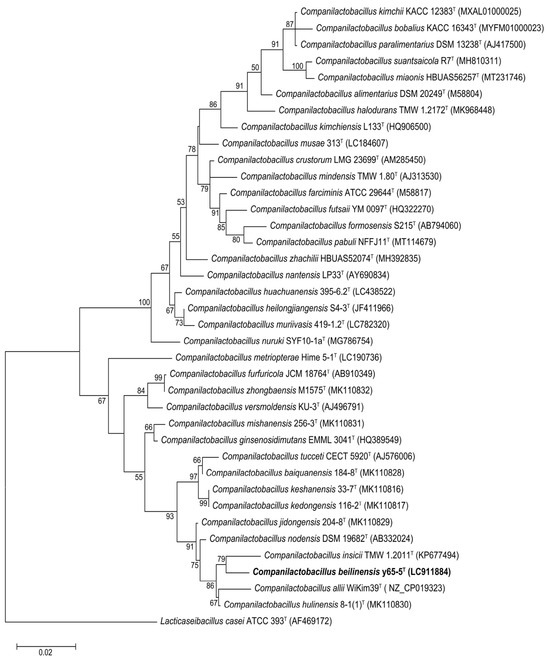
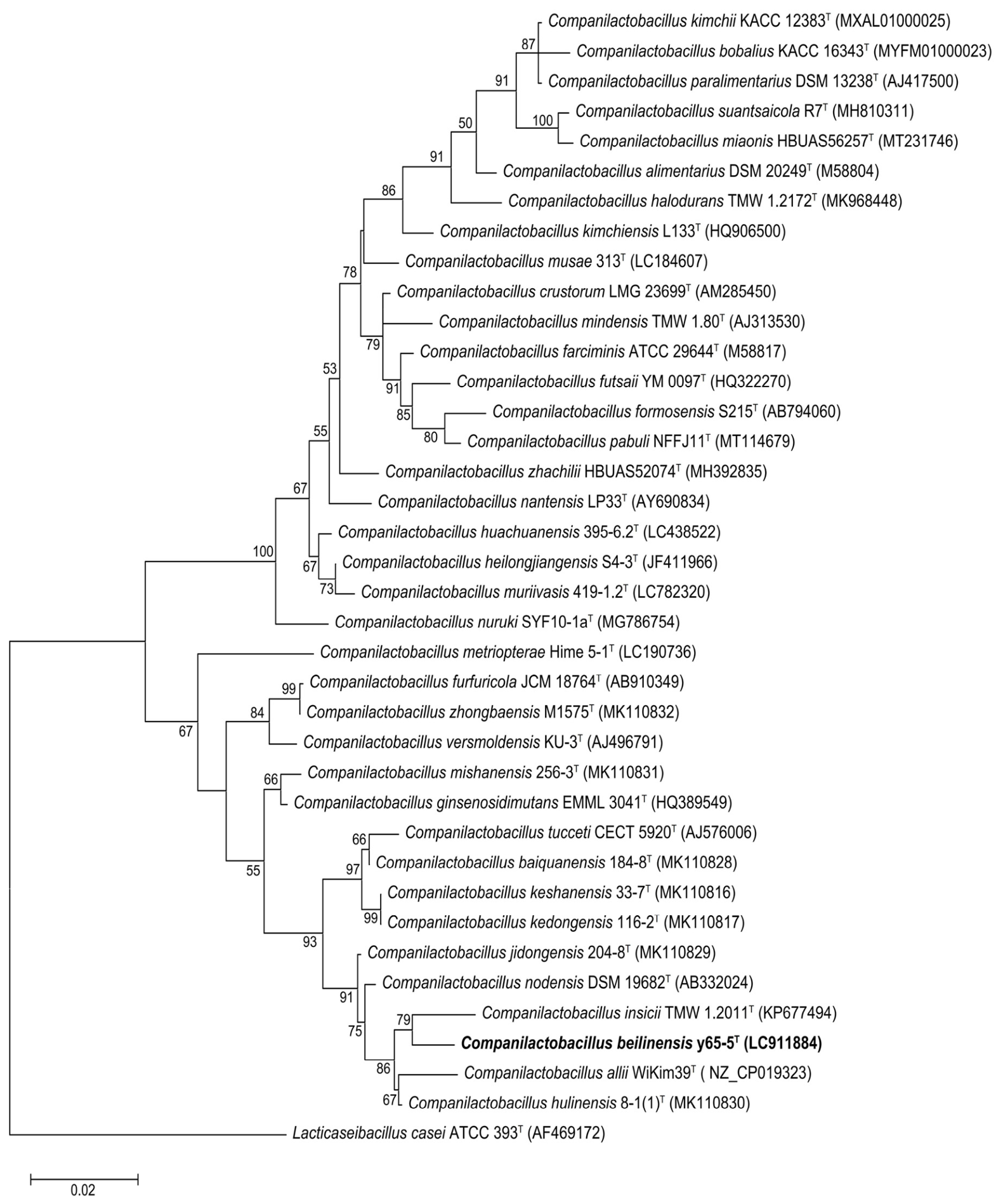
BLAST results of the 16S rRNA gene sequence indicated that strain y65-5T was a member of the genus Companilactobacillus and exhibited the highest sequence similarity (98.77%) with Companilactobacillus hulinensis 8-1(1)T. Therefore, a 16S rRNA gene phylogenetic tree including strain y65-5T and the type strains of all Companilactobacillus species was reconstructed. The 16S rRNA gene phylogeny indicated that strain y65-5T was related to the type strains of C. allii, Companilactobacillus insicii, C. hulinensis, C. nodensis, and Companilactobacillus jidongensis (Figure 1), having 97.7–98.8% 16S rRNA gene sequence similarities. Strain y65-5T had the highest 16S rRNA gene sequence similarities (98.8 and 98.7%, respectively) with C. hulinensis 8-1(1)T and C. jidongensis 204-8T, close to the 98.7% threshold for species demarcation (Kim et al., 2014) [18], indicating that strain y65-5T might be a potential novel species and deserves further investigation through whole-genome sequencing.
Figure 1.
Maximum-likelihood tree showing the phylogenetic relationship of strain y65-5T and type strains of all Companilactobacillus species based on the aligned 1351 bp 16S rRNA gene sequences. The scale bar indicates 2% substitutions per site. Bootstrap values greater than 50% are displayed.
3.2. Whole-Genome Sequencing
Basic genomic features of strain y65-5T are presented in Table S1. The genome of strain y65-5T consisted of 22 contigs and had an N50 length of 317,631 bp, a 496× sequencing coverage, and 2629 predicted genes. The genome of strain y65-5T had 99.5% completeness and 1.1% contamination, indicating that it was of high quality (Parks et al., 2015) [10].
The identification based on TYGS indicated that strain y65-5T belonged to a potential new species and did not belong to any species found in the TYGS database (accessed on 21 August 2026).
Strain y65-5T was placed in the genus Companilactobacillus by GTDB-Tk, but strain y65-5T could not be assigned to any closest species. In the 120 genes analyzed by GTDB-Tk, 115 genes belonged to unique genes, two genes belonged to multiple genes, three genes belonged to missing genes. The phylogeny (Figure S1) indicated that strain y65-5T was most closely related to C. hulinensis, C. allii, C. insicii, C. nodensis, and C. jidongensis.
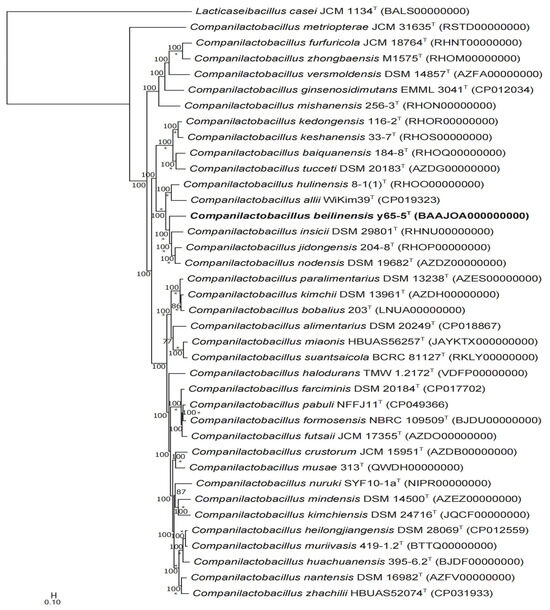
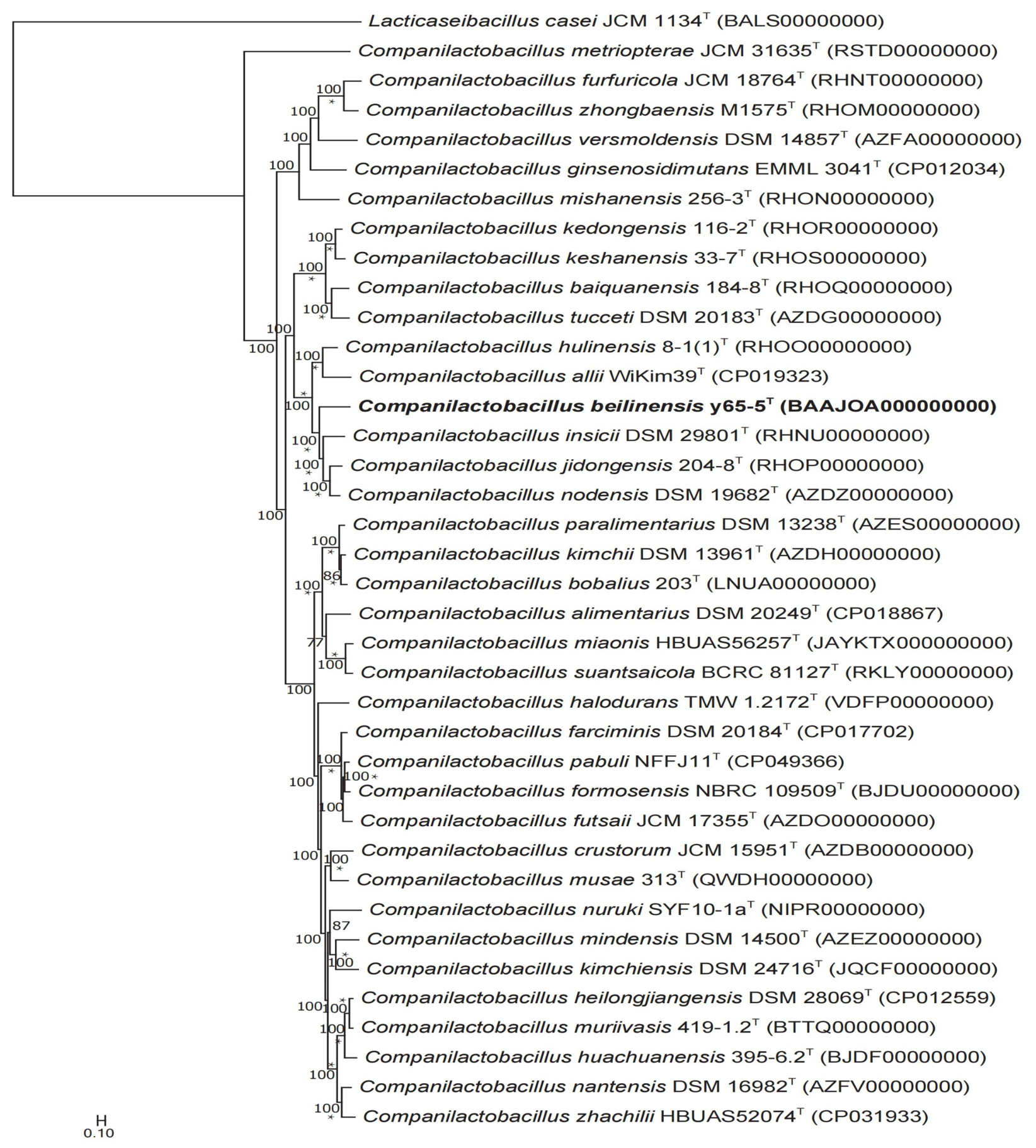
Although 1000 single-copy genes were requested, only 275 single-copy genes were found and used for the phylogenomic tree based on BV-BRC. That is to say, when the maximum allowed deletions/duplications were set to zero, strain y65-5T and the reference strains had only 275 single-copy genes in common. The final gene set was sufficient for robust phylogenomic analysis. Both the phylogenomic tree based on BV-BRC (Figure 2) and the GBDP (Figure S2) based on genome data indicated that strain y65-5T was most closely related to C. allii WiKim39T, C. insicii DSM 29801T, C. hulinensis 8-1(1)T, C. nodensis DSM 19682T, and C. jidongensis 204-8T. This phylogeny was in agreement with those obtained by GTDB-Tk and 16S rRNA gene sequences.
Figure 2.
Phylogeny of strain y65-5T and type strains of all Companilactobacillus species based on maximum-likelihood analysis using RAxML of the combined alignments of amino acids and nucleotide coding sequences for 275 single-copy genes totaling 363,876 aligned positions. The nodes recovered from GBDPs are marked with *.
Strain y65-5T had 77.4–80.8% ANI, 21.1–23.9% dDDH, and 80.1–84.5% AAI values with the type strains of C. allii, C. insicii, C. hulinensis, C. nodensis, and C. jidongensis (Table 1), lower than the inter-species threshold (95–96% for ANI, 70% for dDDH and 95–96% for AAI), indicating that strain y65-5T represented a novel species within the genus Companilactobacillus (Riesco and Trujillo, 2024; Konstantinidis and Tiedje, 2005) [19,20].
Table 1.
ANI, dDDH, and AAI values (%) between strain y65-5T and type strains of phylogenetically related species.
The genome size and DNA G+C content of strain y65-5T were 2.6 Mbp and 38.6%, respectively, which were close to those (2.5–2.7 Mbp and 34.9–37.6%, respectively) of phylogenetically related reference strains. Strain y65-5T and C. nodensis DSM 19682T had higher values (23 and 19) than those (2–11) of other reference strains in the subsystem feature counts of phages, prophages, transposable elements, and plasmids. Strain y65-5T and C. jidongensis 204-8T had higher values (164 and 161) than those (127–143) of other reference strains in the subsystem feature counts of amino acids and derivatives. Strain y65-5T and C. insicii DSM 29801T had higher values (160 and 166) than other reference strains (112–134) in the subsystem feature counts of carbohydrates. Strain y65-5T and C. allii WiKim39T had higher values (128 and 121) than other reference strains (104–106) in the subsystem feature counts of protein metabolism.
pad, vprA, par1, and lpdC are involved in the metabolism of hydroxycinnamic acids (Zipori et al., 2025) [16]. Strain y65-5T, C. nodensis DSM 19682T, C. jidongensis 204-8T, C. insicii DSM 29801T, C. hulinensis 8-1(1)T, and C. allii WiKim39T contained par1 and vprA. Strain y65-5T and C. insicii DSM 29801T did not contain pad, whereas C. nodensis DSM 19682T, C. jidongensis 204-8T, C. hulinensis 8-1(1)T, and C. allii WiKim39T contained pad. Strain y65-5T and C. nodensis DSM 19682T did not contain lpdC, whereas C. jidongensis 204-8T, C. insicii DSM 29801T, C. hulinensis 8-1(1)T, and C. allii WiKim39T contained lpdC. Glutathione reductase (gshR) catalyzes the NADPH-dependent reduction of glutathione disulfide (Jänsch et al., 2007) [21]. Strain y65-5T, C. nodensis DSM 19682T, C. jidongensis 204-8T, C. insicii DSM 29801T, C. hulinensis 8-1(1)T, and C. allii WiKim39T contained gshR. Strain y65-5T, C. nodensis DSM 19682T, C. jidongensis 204-8T, C. insicii DSM 29801T, C. hulinensis 8-1(1)T, and C. allii WiKim39T did not contain aldA and pduCDE, suggesting that these strains may lack the genetic capacity to convert lactate to 1,2-propanediol and use 1,2-propanediol and glycerol as a carbon source (Gänzle, 2015; Liang et al., 2021) [22,23].
In the diversity investigation of LAB, some potential novel species cannot be found when only16S rRNA gene sequencing is used. In the present study, strain y65-5T had 98.8% 16S rRNA gene sequence similarity with C. hulinensis 8-1(1)T, indicating that the 16S rRNA gene alone provided insufficient resolution to reliably distinguish these two closely related taxa. Therefore, during the diversity investigation aiming to recognize potential novel species of LAB, housekeeping genes with high resolution are more efficient than the 16S rRNA gene. The reason why strain y65-5T can attract our attention is that it exhibited low pheS sequence similarity during the NCBI blast alignment.
3.3. Phenotypic Characteristics
Distinctive features among strain y65-5T and phylogenetically related reference strains are given in Table 2. The transmission electron micrograph of strain y65-5T is given in Figure S3.
Table 2.
Distinctive phenotypic features among strain y65-5T and type strains of phylogenetically related species.
Although strain y65-5T had the highest (98.8%) 16S rRNA gene sequence similarity with C. hulinensis 8-1(1)T, many phenotypic characteristics could distinguish them. Strain y65-5T could produce acid from D-ribose and D-arabitol, whereas C. hulinensis 8-1(1)T could not. C. hulinensis 8-1(1)T could produce acid from methyl α-D-mannopyranoside, amygdalin, arbutin, salicin, cellobiose, maltose, lactose, sucrose, and gentiobiose, and hydrolyze aesculin, whereas strain y65-5T could not. Strain y65-5T could produce acetoin, whereas C. hulinensis 8-1(1)T could not. C. hulinensis 8-1(1)T could tolerate 6% and 7% NaCl, whereas strain y65-5T could not. Strain y65-5T could produce cystine arylamidase and α-glucosidase, whereas C. hulinensis 8-1(1)T could not. C. hulinensis 8-1(1)T could produce N-acetyl-β-glucosaminidase, whereas strain y65-5T could not. Strain y65-5T could grow on mMRS plates containing 50 μg/mL erythromycin, 100 μg/mL erythromycin and 300 μg/mL erythromycin, but not 50 μg/mL neomycin sulfate, 100 μg/mL neomycin sulfate, 300 μg/mL neomycin sulfate, 50 μg/mL tetracycline hydrochloride and 300 μg/mL gentamicin sulfate, whereas C. hulinensis 8-1(1)T gave the opposite reactions.
Although strain y65-5T had the second highest (98.7%) 16S rRNA gene sequence similarity with C. jidongensis 204-8T, many phenotypic characteristics could distinguish them. Strain y65-5T could produce acid from D-ribose and D-arabitol but not cellobiose, sucrose, gentiobiose, and turanose, whereas C. jidongensis 204-8T gave the opposite reactions. C. jidongensis 204-8T could grow at 40 °C, whereas strain y65-5T could not. Strain y65-5T could produce cystine arylamidase and β-glucosidase, whereas C. jidongensis 204-8T could not. Strain y65-5T could grow on mMRS plates containing 5 μg/mL erythromycin, 50 μg/mL erythromycin, 100 μg/mL erythromycin, 300 μg/mL erythromycin, 5 μg/mL chloramphenicol, and 300 μg/mL bacitracin, but not 50 μg/mL neomycin sulfate, 100 μg/mL neomycin sulfate, and 300 μg/mL neomycin sulfate, whereas C. jidongensis 204-8T gave the opposite reactions.
Therefore, by combining with phenotypic characterization, 16S rRNA gene sequencing is also likely to classify strain y65-5T as a potential novel species. However, phenotypic characterization is rarely used in preliminary screening nowadays. Therefore, in order to quickly and efficiently identify novel species of LAB, housekeeping gene sequencing is still useful.
3.4. Whole-Cell Fatty Acids Analysis
Data for strain y65-5T were obtained from this study, and data for reference strains were from our previous study (Wei and Gu, 2019) [27]. All data were obtained under the same conditions in our laboratory. Comparative fatty acid compositions of strain y65-5T and phylogenetically related strains are presented in Table S2. C16:0 (19.6%) and C18:1 ω9c (56.6%) were major fatty acids (higher than 10%) in strain y65-5T, which were in agreement with that of C. allii JCM 31938T and were different from those of C. insicii DSM 29801T, C. hulinensis 8-1(1)T, C. nodensis JCM 14932T and C. jidongensis 204-8T (Wei and Gu, 2019) [27].
4. Conclusions
On the basis of the results presented here, strain y65-5T is considered to represent a novel species of the genus Companilactobacillus, for which the name Companilactobacillus beilinensis sp. nov. is proposed.
5. Description of Companilactobacillus beilinensis sp. nov.
Companilactobacillus beilinensis (bei.lin.en’sis. N.L. masc. adj. beilinensis, pertaining to Beilin District, a district located in Suihua city, Heilongjiang province, PR China, where the bacterium was isolated).
Cells are Gram-stain-positive, non-motile, non-spore-forming rods, 0.7–0.9 × 2.1–4.1 µm, that usually occur singly or in pairs. Colonies on mMRS agar are circular, with entire margins, smooth, convex, beige, and approximately 1 mm in diameter after 2 days of cultivation at 30 °C. Growth occurs at 15–37 °C, but not at 40 °C, with optimum growth at 30 °C, at pH 5.0–8.0 but not at pH 4.0 or 9.0, and on mMRS agar supplemented with 1–5% (w/v) NaCl, but not with 6% (w/v) NaCl. Growth occurs in the presence of 0.02% tellurite. They produce acetoin. They do not produce indole, catalase, or urease, as well as NH3 from arginine, H2S or gas from glucose and gluconate. They do not hydrolyze hippurate, reduce nitrate and nitrite, or ferment pyruvate. Only L-lactate is produced. They produce acid from D-ribose, D-galactose, D-glucose, D-fructose, D-mannose, N-acetylglucosamine, and D-arabitol, but not glycerol, erythritol, D-arabinose, L-arabinose, D-xylose, L-xylose, D-adonitol, methyl β-D-xylopyranoside, L-sorbose, L-rhamnose, dulcitol, inositol, D-mannitol, D-sorbitol, methyl α-D-mannopyranoside, methyl α-D-glucopyranoside, amygdalin, arbutin, salicin, cellobiose, maltose, lactose, melibiose, sucrose, trehalose, inulin, melezitose, raffinose, starch, glycogen, xylitol, gentiobiose, turanose, D-lyxose, D-tagatose, D-fucose, L-fucose, L-arabitol, gluconate, 2-keto-gluconate, and 5-keto-gluconate. Aesculin is not hydrolyzed. They produce leucine arylamidase, valine arylamidase, cystine arylamidase, acid phosphatase, naphthol-AS-BI-phosphohydrolase, α-glucosidase, and β-glucosidase, but not alkaline phosphatase, esterase (C4), esterase lipase (C8), lipase (C14), trypsin, α-chymotrypsin, α-galactosidase, β-galactosidase, β-glucuronidase, N-acetyl-β-glucosaminidase, α-mannosidase, and α-fucosidase. The cell-wall peptidoglycan is of the A4α L-Lys–D-Asp type. The major fatty acids are C16:0 and C18:1 ω9c. The type strain y65-5T (=JCM 38530T=GDMCC 1.6611T) was isolated from traditional Chinese pickle, Heilongjiang province, PR China. The genome size and DNA G+C content of strain y65-5T are 2.6 Mbp and 38.6%, respectively. The GenBank/ENA/DDBJ accession numbers for the 16S rRNA gene and draft genome sequences of strain y65-5T are LC911884 and BAAJOA000000000, respectively.
Supplementary Materials
The following supporting information can be downloaded at https://www.mdpi.com/article/10.3390/taxonomy6040058/s1, Figure S1: Phylogenomic tree based on GTDB-Tk; Figure S2: GBDP phylogeny based on genome data of strain y65-5T and type strains of all Companilactobacillus species. Greater than 50% bootstrap values are displayed; Figure S3: Transmission electron micrograph of strain y65-5T; Table S1: Basic features and subsystem feature counts of strain y65-5T and phylogenetically related reference strains; Table S2: Comparative fatty acid content (%) of strain y65-5T and type strains of phylogenetically related species.
Author Contributions
Conceptualization: L.J. and C.-T.G.; Data curation: L.J. and C.-T.G.; Funding acquisition: C.-T.G.; Investigation: L.J.; Software: L.J. and C.-T.G.; Visualization: L.J.; Supervision: C.-T.G.; Writing—original draft: L.J.; Writing—review and editing: C.-T.G. All authors have read and agreed to the published version of the manuscript.
Funding
This research was funded by the National Natural Science Foundation of China (no. 31471594).
Data Availability Statement
The GenBank/ENA/DDBJ accession numbers for the 16S rRNA gene and draft genome sequences of strain y65-5T are LC911884 and BAAJOA000000000, respectively. All remaining data are provided in the text or are available from the corresponding author upon request.
Acknowledgments
We are grateful to Aharon Oren for checking the nomenclature and etymology.
Conflicts of Interest
The authors declare no conflicts of interest.
Abbreviations
The following abbreviations are used in this manuscript:
| ANI | Average nucleotide identity |
| dDDH | digital DNA-DNA hybridization |
| AAI | Average amino acid identity |
| LAB | Lactic acid bacteria |
| mMRS | modified de Man–Rogosa–Sharpe |
| CTAB | Cetyltrimethyl ammonium bromide |
| TYGS | Type (Strain) Genome Server |
| GBDP | Genome BLAST Distance Phylogeny |
| GTDB | Genome Taxonomy Database |
| BV-BRC | Bacterial and Viral Bioinformatics Resource Center |
| FAME | Fatty acid methyl ester |
References
- Zheng, J.; Wittouck, S.; Salvetti, E.; Franz, C.M.A.P.; Harris, H.M.B.; Mattarelli, P.; O’Toole, P.W.; Pot, B.; Vandamme, P.; Walter, J.; et al. A taxonomic note on the genus Lactobacillus: Description of 23 novel genera, emended description of the genus Lactobacillus Beijerinck 1901, and union of Lactobacillaceae and Leuconostocaceae. Int. J. Syst. Evol. Microbiol. 2020, 70, 2782–2858. [Google Scholar] [CrossRef] [Scilit]
- Mattarelli, P.; Felis, G.E.; Pot, B.; Holzapfel, W.H.; Franz, C.M.A.P. International Committee on Systematics of Prokaryotes Subcommittee on the Taxonomy of Bifidobacterium, Lactobacillus and related organisms Minutes of the closed meeting by videoconference, 14 and 21 February 2024. Int. J. Syst. Evol. Microbiol. 2026, 76, 007221. [Google Scholar] [CrossRef] [Scilit]
- Miyamoto, M.; Seto, Y.; Hao, D.H.; Teshima, T.; Sun, Y.B.; Kabuki, T.; Yao, L.B.; Nakajima, H. Lactobacillus harbinensis sp. nov., consisted of strains isolated from traditional fermented vegetables ‘Suan cai’ in Harbin, Northeastern China and Lactobacillus perolens DSM 12745. Syst. Appl. Microbiol. 2005, 28, 688–694. [Google Scholar] [CrossRef] [Scilit]
- Li, T.T.; Liu, D.D.; Fu, M.L.; Gu, C.T. Proposal of Lactobacillus kosoi Chiou et al. 2018 as a later heterotypic synonym of Lactobacillus micheneri McFrederick et al. 2018, elevation of Lactobacillus plantarum subsp. argentoratensis to the species level as Lactobacillus argentoratensis sp. nov., and Lactobacillus zhaodongensis sp. nov., isolated from traditional Chinese pickle and the intestinal tract of a honey bee (Apis mellifera). Int. J. Syst. Evol. Microbiol. 2020, 70, 3123–3133. [Google Scholar] [CrossRef] [Scilit]
- Tamura, K.; Nei, M. Estimation of the number of nucleotide substitutions in the control region of mitochondrial DNA in humans and chimpanzees. Mol. Biol. Evol. 1993, 10, 512–526. [Google Scholar] [CrossRef] [Scilit]
- Kumar, S.; Stecher, G.; Suleski, M.; Sanderford, M.; Sharma, S.; Tamura, K. MEGA12: Molecular evolutionary genetic analysis version 12 for adaptive and green computing. Mol. Biol. Evol. 2024, 41, msae263. [Google Scholar] [CrossRef] [Scilit]
- Chen, S.; Zhou, Y.; Chen, Y.; Gu, J. fastp: An ultra-fast all-in-one FASTQ preprocessor. Bioinformatics 2018, 34, i884–i890. [Google Scholar] [CrossRef] [Scilit]
- Bankevich, A.; Nurk, S.; Antipov, D.; Gurevich, A.A.; Dvorkin, M.; Kulikov, A.S.; Lesin, V.M.; Nikolenko, S.I.; Pham, S.; Prjibelski, A.D.; et al. SPAdes: A new genome assembly algorithm and its applications to single-cell sequencing. J. Comput. Biol. 2012, 19, 455–477. [Google Scholar] [CrossRef] [Scilit]
- Walker, B.J.; Abeel, T.; Shea, T.; Priest, M.; Abouelliel, A. Pilon: An integrated tool for comprehensive microbial variant detection and genome assembly improvement. PLoS ONE 2014, 9, e112963. [Google Scholar] [CrossRef] [Scilit]
- Parks, D.H.; Imelfort, M.; Skennerton, C.T.; Hugenholtz, P.; Tyson, G.W. CheckM: Assessing the quality of microbial genomes recovered from isolates, single cells, and metagenomes. Genome Res. 2015, 25, 1043–1055. [Google Scholar] [CrossRef] [Scilit]
- Aziz, R.K.; Bartels, D.; Best, A.A.; DeJongh, M.; Disz, T.; Edwards, R.A.; Formsma, K.; Gerdes, S.; Glass, E.M.; Kubal, M.; et al. The RAST server: Rapid annotations using subsystems technology. BMC Genom. 2008, 9, 75. [Google Scholar] [CrossRef] [Scilit]
- Meier-Kolthoff, J.P.; Göker, M. TYGS is an automated high-throughput platform for state-of-the-art genome-based taxonomy. Nat. Commun. 2019, 10, 2182. [Google Scholar] [CrossRef] [Scilit]
- Olson, R.D.; Assaf, R.; Brettin, T.; Conrad, N.; Cucinell, C.; Davis, J.J.; Dempsey, D.M.; Dickerman, A.; Dietrich, E.M.; Kenyon, R.W.; et al. Introducing the Bacterial and Viral Bioinformatics Resource Center (BV-BRC): A resource combining PATRIC, IRD and ViPR. Nucleic Acids Res. 2023, 51, D678–D689. [Google Scholar] [CrossRef] [Scilit]
- Lee, I.; Ouk Kim, Y.; Park, S.C.; Chun, J. OrthoANI: An improved algorithm and software for calculating average nucleotide identity. Int. J. Syst. Evol. Microbiol. 2016, 66, 1100–1103. [Google Scholar] [CrossRef] [Scilit]
- Yoon, S.-H.; Ha, S.-M.; Lim, J.; Kwon, S.; Chun, J. A large-scale evaluation of algorithms to calculate average nucleotide identity. Antonie Van Leeuwenhoek 2017, 110, 1281–1286. [Google Scholar] [CrossRef] [Scilit]
- Zipori, D.; Qiao, N.; Brychcy, M.; Gänzle, M.G.; Schmidt, H. Proposal of Furfurilactobacillus cerevisiae sp. nov. isolated from spoiled beer and Furfurilactobacillus cerealis sp. nov. isolated from sourdough. Int. J. Syst. Evol. Microbiol. 2025, 75, 007009. [Google Scholar] [CrossRef] [Scilit]
- Sasser, M. Identification of Bacteria by Gas Chromatography of Cellular Fatty Acids; Technical Note 101; Microbial ID, Inc.: Newark, NJ, USA, 2001. [Google Scholar]
- Kim, M.; Oh, H.S.; Park, S.C.; Chun, J. Towards a taxonomic coherence between average nucleotide identity and 16S rRNA gene sequence similarity for species demarcation of prokaryotes. Int. J. Syst. Evol. Microbiol. 2014, 64, 346–351. [Google Scholar] [CrossRef] [Scilit]
- Riesco, R.; Trujillo, M.E. Update on the proposed minimal standards for the use of genome data for the taxonomy of prokaryotes. Int. J. Syst. Evol. Microbiol. 2024, 74, 006300. [Google Scholar] [CrossRef] [Scilit]
- Konstantinidis, K.T.; Tiedje, J.M. Towards a genome-based taxonomy for prokaryotes. J. Bacteriol. 2005, 187, 6258–6264. [Google Scholar] [CrossRef] [Scilit]
- Jänsch, A.; Korakli, M.; Vogel, R.F.; Gänzle, M.G. Glutathione reductase from Lactobacillus sanfranciscensis DSM20451T: Contribution to oxygen tolerance and thiol exchange reactions in wheat sourdoughs. Appl. Environ. Microbiol. 2007, 73, 4469–4476. [Google Scholar] [CrossRef] [Scilit]
- Gänzle, M.G. Lactic metabolism revisited: Metabolism of lactic acid bacteria in food fermentations and food spoilage. Curr. Opin. Food Sci. 2015, 2, 106–117. [Google Scholar] [CrossRef] [Scilit]
- Liang, N.; Neužil-Bunešová, V.; Tejnecký, V.; Gänzle, M.; Schwab, C. 3-Hydroxypropionic acid contributes to the antibacterial activity of glycerol metabolism by the food microbe Limosilactobacillus reuteri. Food Microbiol. 2021, 98, 103720. [Google Scholar] [CrossRef] [Scilit]
- Jung, M.Y.; Lee, S.H.; Lee, M.; Song, J.H.; Chang, J.Y. Lactobacillus allii sp. nov. isolated from scallion kimchi. Int. J. Syst. Evol. Microbiol. 2017, 67, 4936–4942. [Google Scholar] [CrossRef] [Scilit]
- Ehrmann, M.A.; Kröckel, L.; Lick, S.; Radmann, P.; Bantleon, A.; Vogel, R.F. Lactobacillus insicii sp. nov., isolated from fermented raw meat. Int. J. Syst. Evol. Microbiol. 2016, 66, 236–242. [Google Scholar] [CrossRef] [Scilit]
- Kashiwagi, T.; Suzuki, T.; Kamakura, T. Lactobacillus nodensis sp. nov., isolated from rice bran. Int. J. Syst. Evol. Microbiol. 2009, 59, 83–86. [Google Scholar] [CrossRef] [Scilit][Green Version]
- Wei, Y.X.; Gu, C.T. Lactobacillus yilanensis sp. nov., Lactobacillus bayanensis sp. nov., Lactobacillus keshanensis sp. nov., Lactobacillus kedongensis sp. nov., Lactobacillus baiquanensis sp. nov., Lactobacillus jidongensis sp. nov., Lactobacillus hulinensis sp. nov., Lactobacillus mishanensis sp. nov. and Lactobacillus zhongbaensis sp. nov., isolated from Chinese traditional pickle and yogurt. Int. J. Syst. Evol. Microbiol. 2019, 69, 3178–3190. [Google Scholar] [CrossRef] [Scilit]

Disclaimer/Publisher’s Note: The statements, opinions and data contained in all publications are solely those of the individual author(s) and contributor(s) and not of MDPI and/or the editor(s). MDPI and/or the editor(s) disclaim responsibility for any injury to people or property resulting from any ideas, methods, instructions or products referred to in the content. |
© 2026 by the authors. Licensee MDPI, Basel, Switzerland. This article is an open access article distributed under the terms and conditions of the Creative Commons Attribution (CC BY) license.