


Abstract
Phytoseiids play a fundamental role in biological control, but their diversity in the Brazilian Amazon remains poorly known. This publication reports the phytoseiids found in a survey conducted in Parauapebas, southeastern Pará. In July 2023, plant parts of spontaneous and cultivated plants were collected at different sites of that municipality. In total, 941 specimens representing 53 species of 19 genera were collected. The most abundant were Euseius concordis (Chant) (98), Iphiseiodes zuluagai Denmark & Muma (74), Euseius citrifolius Denmark & Muma (70), Amblyseius aerialis (Muma) (68) and Typhlodromalus aripo De Leon (56), together accounting for 38.9% of all specimens. Amblyseius Berlese was the most diverse genus (11 species), followed by Proprioseiopsis Muma (7) and Neoseiulus Hughes (6). Euseius concordis occurred on the largest number of plants (29), followed by E. citrifolius (22) and I. zuluagai (19). Three species are reported for the first time from Brazil, Neoseiulus longispinosus (Evans), Phytoscutus aff. vaughni (Chant & Baker) and Phytoseius rhabdifer De Leon; two new species were found, one of which (Typhlodromalus carajaensis Lacerda, Castilho & Moraes n. sp.) is here described; 48 other species were found, raising to 62 the total number of species known from Pará.
1. Introduction
Phytoseiidae (Acari: Mesostigmata) is a family of predatory mites widely recognized for its ecological importance and extensive use in biological control programs. Species of this family play a central role in the natural regulation of populations of phytophagous mites and small insects, including thrips (Thysanoptera) and whiteflies (Hemiptera: Aleyrodidae) [1,2,3]. The remarkable species diversity within Phytoseiidae, together with the ability of its members to adapt to a wide range of environmental conditions, has made this family the most intensively studied group of predatory mites [4]. Over the past 70 years, knowledge of phytoseiid diversity has expanded drastically. The number of described species increased from just 26 in 1951 to 2985 in 2024, representing an increase of more than 100-fold, given the attention this mite group has received [3].
In Brazil, approximately 280 species have been recorded [5]. However, given the country’s continental dimensions and the remarkable biome diversity, this number is estimated to represent only a fraction of the actual species richness [6]. The known distribution of phytoseiid species in Brazil is highly uneven, with most records originating from the southeastern region [6], whereas surveys remain scarce in less accessible regions, particularly the Amazon. Consequently, current knowledge of the Amazonian phytoseiid fauna is still fragmentary.
The Brazilian Amazon is the largest tropical biome on Earth, covering approximately 5.2 million km2. It is characterized by high temperatures, humidity and environmental heterogeneity [7,8], which provide favorable conditions for the establishment of rich and complex biological communities, including predatory mites.
Pará, located in the eastern Brazilian Amazon, is the second largest state in Brazil, covering more than 1.2 million km2 [9], an area comparable to the combined territories of Portugal, Spain and France. Available studies of plant-associated mites in the state are still relatively few and have generally been centered on few plant species [10,11,12,13,14,15,16,17]. Thus, the principal gap is not only the small number of published records, but also the absence of multi-host inventories, capable of revealing how phytoseiid assemblages are distributed among cultivated and non-cultivated plants within the same region. To date, only 24 phytoseiid species have been reported from Pará [5].
Faunistic surveys of Phytoseiidae have historically provided the biological material needed to identify promising predators and locally adapted populations for biological control. A well-known example is the classical biological control program against the cassava green mite, Mononychellus tanajoa (Bondar), in Africa. Surveys in South America identified several phytoseiids in association with this pest, of which Typhlodromalus aripo De Leon became successfully established after introduction and subsequently disseminated in the extensive African cassava-producing area [1,18]. This example illustrates why inventories in poorly surveyed regions can have consequences that extend beyond enlarging species lists, by revealing predator populations that merit subsequent biological and applied evaluation.
The objective of this study was to provide an initial characterization of the phytoseiid fauna associated with plants in the municipality of Parauapebas, southeastern Pará, thereby contributing to the knowledge of predatory mite diversity in eastern Amazon and providing a basis for the development of sustainable pest management strategies. Parauapebas is located approximately 1100 km from Manaus and about 2000 km from Recife, the nearest regions where considerable effort has been dedicated to determining the phytoseiid fauna.
2. Materials and Methods
Sampling was conducted in July 2023 at 13 sites located at elevations ranging from 156 to 223 m above sea level. During the year preceding the sampling period, the mean annual temperature in Parauapebas was 26.4 °C (range: 19–40 °C), and cumulative precipitation totaled 1242 mm. In June and July 2023, the mean temperature was 27 °C, while total precipitation was approximately 11 mm [19]. The sampling sites are listed in Table 1, and their spatial distribution within the municipality is shown in Figure 1.
Table 1.
Sampling sites in the municipality of Parauapebas, Pará state, Brazil.
Figure 1.
(A) Location of Pará (green) within Brazil. (B) Location of Parauapebas (yellow line) within Pará. (C) Sampling sites (red circles) within Parauapebas, whose names and coordinates are given in Table 1. Based on Sirgas 2000 by IBGE [20] and IBGE [21].
Collections were authorized by the Chico Mendes Institute for Biodiversity Conservation (ICMBio), under SISBIO permit Nr. 89189.
Sampling Procedure
Leaves, fruits and inflorescences (when available) were collected from 92 plant species, including cultivated plants and species from the native vegetation. To standardize the sampling effort, each composite sample consisted of approximately 3 L of plant material, whenever possible, collected from 5–10 individual plants of the same species.
Plant material was collected from all vegetation strata, with particular attention to symptoms and signs indicative of phytophagous mite infestation, such as discoloration, deformation or webbing. Representative portions of the sampled plants were pressed and preserved for identification using identification keys available in the literature [22] or, when necessary, with the assistance of botanists from the Vale Zoobotanical Park, in Parauapebas.
Samples were placed in paper bags, which were then enclosed in plastic bags and stored in a cooler containing reusable ice packs (Gelox®; purchased from a local market in Parauapebas, Brazil) to maintain the temperature between 10 and 20 °C during transport. In the laboratory, each sample was examined under a stereomicroscope, collecting the mites with a fine brush and transferring them to vials containing 70% ethanol.
For plant samples with rigid structures and/or small or compound leaves, the material was hit several times with a stick over a black cardboard sheet (40 × 40 cm) to dislodge the mites. These were then collected with a fine brush. Additionally, the plant material was examined under a stereomicroscope to assess the efficiency of the procedure and recover any mites remaining on the substrate.
After completion of the sorting process, the collected mites were transported to the Department of Entomology and Acarology, Escola Superior de Agricultura “Luiz de Queiroz”, University of São Paulo (ESALQ/USP), Piracicaba, Brazil, where phytoseiid specimens were mounted on microscope slides in Hoyer’s medium and subsequently identified.
Specimens were identified using a Zeiss AX10 phase-contrast microscope (Jena, Germany) equipped with a measuring eyepiece and an Axiocam 305 color digital camera (Jena, Germany). Measurements are presented as mean values, followed by the corresponding minimum and maximum values (in parentheses) when variations among the examined specimens were observed. At most ten females of each species were measured.
Illustrations were prepared in Adobe Illustrator® (version 16.0.0) by vectorizing images captured with the digital camera. In the section on nomenclature and taxonomic information, only references considered most relevant were cited; a complete list of references for each species is available in Demite et al. [5].
The nomenclature of dorsal idiosomal setae follows the system proposed by Lindquist & Evans [23], whereas that of the ventral idiosomal setae follows Chant & Yoshida-Shaul [24] and Lindquist [25]. Nomenclature of pores and lyrifissures is based on Athias-Henriot [26]. Leg chaetotaxy follows Evans [27]. Shield length was measured from the most anterior to the most posterior margins along the midline, and shield widths were measured at their maximum level, except if specified otherwise.
The section “Previous Records” provides data on the worldwide occurrence of each species, based on published articles cited in the Phytoseiidae Database [5]. All identified phytoseiid specimens were deposited in the Mite Reference Collection of the Department of Entomology and Acarology, Escola Superior de Agricultura Luiz de Queiroz (ESALQ), University of São Paulo (USP), Piracicaba, São Paulo, Brazil.
3. Results and Discussion
A total of 941 phytoseiid specimens, including both sexes and different developmental stages (of which 772 were adults), were collected, representing 53 species in 19 genera, as listed below. In addition, a morphospecies of the subfamily Typhlodrominae, apparently representing an undescribed genus, was collected. However, this taxon is not officially assigned a new name, as a single specimen (adult female) was collected. A new species of Typhlodromalus Muma was also collected and is described herein.
Among the 53 phytoseiid species recorded, 43 belong to Amblyseiinae, five to Phytoseiinae and five to Typhlodrominae. A total of 92 plant species were examined, and phytoseiids were found on 84 of them (Table 2).
Table 2.
Phytoseiid species found on each of the evaluated host plants in Parauapebas, state of Pará, Brazil; n = number of adults collected; (*) cultivated plants.
3.1. Phytoseiid Taxa Recorded
- Amblyseiinae Muma 1961 [28]
- Amblydromalus Chant & McMurtry
- Amblydromalus Chant & McMurtry, 2005: [29] (p. 203).
- Amblydromalus itacoatiarensis Demite, Cavalcante & Lofego
- Amblydromalus itacoatiarensis Demite et al. [30] (p. 2484).
- Amblydromalus itacoatiarensis–Demite et al. [5], internet data; Lofego et al. [6] (p. 154).
Examined material: Site 12, on Lantana sp. (1♀).
Female (n = 1): Dorsal shield smooth, 300 long and 187 wide. Setal lengths: j1 25, j3 35, j4 5, j5 5, j6 6, J2 7, J5 6, z2 8, z4 8, z5 5, Z1 9, Z4 9, Z5 58, s4 42, S2 9, S4 7, S5 7, r3 9 and R1 8. Peritreme extending to level of j1. Distances: st1-st3 57, st2-st2 66 and st5-st5 67. Ventrianal shield 100 long, 52 wide at level of Zv2 and 60 at level of anus. Calyx of spermatheca tubular, 18 long, with marked sclerotization near the atrium. Fixed cheliceral digit 30 long, with nine teeth; movable digit 31 long, with four teeth. Macrosetae sharp-tipped: SgeI 35, SgeII 30, SgeIII 36, SgeIV 60, StIII 29, StIV 39 and StIV 74.
Previous Records: Brazil (states of Amazonas and Pará [16,17]).
Remarks: The measurements of the specimens collected in this study are similar to those reported by Lofego et al. [6], except for the length of the calyx of spermatheca, ca. approximately 1.3 times longer in the specimen collected.
- Amblydromalus limonicus (Garman & McGregor)
- Amblyseius limonicus Garman & McGregor, 1956 [31] (p. 11).
- Amblydromalus rapax De Leon, 1965 [32] (p. 125) (junior synonym according to Moraes et al. [33] (p. 19)).
- Amblydromalus limonicus–Demite et al. [5], internet data; Lofego et al. [6] (p. 155).
Examined material: Site 5, on Citrus sp. (1♀); Site 12, on C. speciosa (4♀).
Female (n = 5): Dorsal shield smooth, 320 (312–335) long and 229 (225–243) wide. Setal lengths: j1 30 (28–34), j3 45 (44–49), j4 6 (6–8), j5 8 (6–11), j6 10 (8–13), J2 12 (13–16), J5 10 (6–12), z2 12 (9–13), z4 11 (9–13), z5 10 (8–11), Z1 15 (13–17), Z4 14 (9–16), Z5 56 (50–61), s4 66 (64–72), S2 12 (10–15), S4 17 (15–19), S5 12 (8–15), r3 18 (16–20) and R1 13 (9–16). Peritreme extending to level of j1. Distances between st1-st3 65 (59–72), st2-st2 78 (69–81) and st5-st5 83 (79–90). Ventrianal shield 119 (112–124) long, 63 (59–68) wide at level of Zv2, and 80 (79–82) at level of anus. Calyx of spermatheca tubular, 27 (26–29) long; atrium elongated. Fixed cheliceral digit 30 long, with ten teeth; movable digit 32 (30–33) long, with three teeth. Macrosetae sharp-tipped: SgeI 37 (35–39), SgeII 34 (32–37), SgeIII 44 (40–52), SgeIV 82 (77–90), StiIII 38 (32–40), StiIV 55 (49–60) and StIV 99 (90–110).
Previous Records: Bolivia, Brazil (nine states, not including Pará), Colombia, Costa Rica, Ecuador, French Guiana, Guatemala, Guyana, Hawaii, Honduras, Jamaica, Mexico, Nicaragua, New Zealand, Portugal, Puerto Rico, Slovenia, Spain, Suriname, Trinidad, Turkey, United States of America and Venezuela.
Remarks: Measurements similar to those reported by Lofego et al. [6].
- Amblyseius Berlese
- Amblyseius Berlese, 1914 [34] (p. 143).
- Amblyseius acalyphus Denmark & Muma
- Amblyseius acalyphus Denmark & Muma, 1973 [35] (p. 243).
- Amblyseius acalyphus–Demite et al. [5], internet data; Lofego et al. [6] (p. 9).
Examined material: Site 3, on C. reticulata (1♀); Site 11, on A. occidentale (4♀) and S. dulcis (3♀); Site 12, on N. wightii (5♀).
Female (n = 10): Dorsal shield almost entirely smooth, with some anterolateral striae, 354 (340–390) long and 234 (220–243) wide. Setal lengths: j1 24 (21–26), j3 35 (30–32), j4 6, j5 5 (4–6), j6 7 (6–8), J2 8 (7–9), J5 6 (5–6), z2 13 (11–14), z4 8 (9–10), z5 6 (5–7), Z1 10 (8–11), Z4 74 (70–79), Z5 180 (170–190), s4 60 (59–64), S2 9 (8–10), S4 8 (7–9), S5 8, r3 12 (8–14) and R1 10 (8–11). Peritreme extending to level of j1. Distances between st1-st3 58 (56–62), st2-st2 71 (70–75) and st5-st5 72 (70–76). Ventrianal shield 115 (100–121) long, 76 (71–79) wide at level of Zv2 and 74 (70–78) at level of anus. Calyx of spermatheca funnel-shaped, 6 (5–6) long; atrium nodular. Fixed cheliceral digit 27 (24–28) long, with seven teeth; movable digit 26 (25–27) long, with two teeth. Macrosetae sharp-tipped: SgeI 32 (30–33), SgeII 39 (38–41), SgeIII 47 (42–51), SgeIV 72 (69–73), StiIII 32 (30–33), StiIV 52 (50–54) and StIV 57 (51–59).
Previous Records: Brazil (states of Espírito Santo, Goiás, Mato Grosso, Mato Grosso do Sul, Minas Gerais, Roraima and São Paulo) and Guadeloupe.
Remarks: The measurements of the specimens collected in this study are similar to those reported by Lofego et al. [6].
- Amblyseius aerialis (Muma)
- Amblyseiopsis aerialis Muma, 1955 [36] (p. 264).
- Amblyseius aerialis–Demite et al. [5], internet data; Lofego et al. [6] (p. 11).
Examined material: Site 1, on Eucalyptus sp. (3♀); Site 3, on A. speciosa (2♀ and 2♂), T. grandiflorum (4♀) and Vernonia sp. (2♀); Site 5, Citrus sp. (3♀); Site 6, on C. tocantinum (4♀); Site 7, on A. heterophyllus (3♀ and 2♂) and Vitis sp. (5♀); Site 8, on C. annuum (6♀ and 1 ♂) and S. melongena (4♀ and 1♂); Site 10, on C. nucifera (4♀) and E. oleracea (6♀); Site 11, on B. crassifolia (3♀), I. marginata (5♀) and S. dulcis (2♀); Site 12, on M. indica (5♀ and 1♂).
Female (n = 10): Dorsal shield smooth, 404 (380–420) long and 295 (285–300) wide. Setal lengths: j1 34 (29–39), j3 52 (48–55), j4 4, j5 4, j6 4, J2 4 (3–5), J5 6 (5–7), z2 12 (11–14), z4 8 (7–11), z5 6 (5–7), Z1 9 (5–10), Z4 141 (121–160), Z5 299 (270–315), s4 104 (93–108), S2 11 (9–12), S4 8 (7–10), S5 9 (8–10), r3 15 (14–16) and R1 11 (9–12). Peritreme extending to level of j1. Distances between st1-st3 65 (60–71), st2-st2 83 (73–89) and st5-st5 82 (77–87). Ventrianal shield 126 (120–138) long, 84 (77–87) wide at level of Zv2 and 85 (79–87) at level of anus. Calyx of spermatheca tubular, with marked sclerotization near the atrium, 21 (19–24) long. Fixed cheliceral digit 38 (38–40) long, with twelve teeth; movable digit 40 (39–41) long, with four teeth. Macrosetae sharp-tipped: SgeI 40 (38–42), SgeII 38 (37–39), SgeIII 58 (53–63), SgeIV 130 (128–140), StiIII 36 (32–40), StiIV 86 (79–94) and StIV 77 (74–80).
Previous Records: Algeria, Argentina, Bermuda, Brazil (22 states, including Pará [10,13,37]), Colombia, Cuba, Dominican Republic, Galapagos, Guadeloupe, Guyana, Honduras, India, Jamaica, Martinique, Mexico, Peru, Saint Martin, United States of America and Venezuela.
Remarks: The measurements of the specimens collected in this study are similar to those reported by Lofego et al. [6]
- Amblyseius aff. adhatodae Muma
- Amblyseius adhatodae Muma, 1967 [38] (p. 268).
- Amblyseius adhatodae–Demite et al. [5], internet data; Lofego et al. [6] (p. 10).
Examined material: Site 10, on E. oleracea (1♀).
Female (n = 1): Dorsal shield smooth, 331 long and 227 wide. Setal lengths: j1 32, j3 32, j4 8, j5 8, j6 8, J2 6, z2 12, z4 8, z5 5, Z1 7, Z4 113, Z5 238, s4 99, S2 6, S4 8, S5 10, r3 10 and R1 6. Peritreme extending to level of j1. Distances between st1-st3 69, st2-st2 68 and st5-st5 64. Ventrianal shield 121 long, 63 wide at level of Zv2 and 70 at level of anus. Calyx of spermatheca sinuous, tubular, 24 long, with a bulbous atrium. Fixed cheliceral digit 34 long, apparently with eleven teeth; movable digit 33 long, with four teeth. Macrosetae sharp-tipped: SgeI 43, SgeII 38, SgeIII 46, SgeIV 90, StiIII 34, StiIV 53 and StIV 69.
Previous records: Brazil (states of Bahia and Ceará), Maldives, Pakistan, Kenya and Sri Lanka.
Remarks: The original description is simple and lacks basic information such as the length of the spermatheca. The measurements of the specimen collected are close to those reported in the redescription provided by Lofego et al. [6]. However, the literature indicates setae j3, Z5 and s4 are respectively 1.3, 1.3 and 1.6 times longer than those observed in this study. Moreover, the same redescription reports that the macroseta SgeIV is 1.8 times longer than that observed in the specimen collected in Pará. It possibly refers to a new species, which is not described for the availability of a single specimen.
- Amblyseius chiapensis De Leon
- Amblyseius chiapensis De Leon, 1961 [39] (p. 85).
- Amblyseius triplaris De Leon, 1967 [40] (p. 25) (junior synonym according to Denmark & Muma, [41] (p. 94)).
- Amblyseius chiapensis–Demite et al. [5], internet data; Lofego et al. [6] (p. 20).
Examined material: Site 2, on B. glabra (1♀); Site 3, T. cacao (1♀); Site 4, on U. brizantha (2♀ and 1♂); Site 5, on B. oleracea (2♀ and 1♂) and C. anguria (2♀); Site 6, on O. gratissimum (2♀) and T. erecta (1♀); Site 7, on S. officinarum (3♀) and Vitis sp. (3♀); Site 12, on M. emarginata (2♀) and T. subulata (2♀); Site 13, on M. esculenta (1♀).
Female (n = 10): Dorsal shield smooth, with anterolateral striae; 327 (315–349) long and 210 (206–220) wide. Setal lengths: j1 30 (28–32), j3 44 (41–49), j4 7 (6–7), j5 4 (3–5), j6 5 (5–6), J2 6 (5–6), J5 6 (6–7), z2 10 (9–13), z4 8 (8–10), z5 4 (3–5), Z1 6 (6–7), Z4 117 (106–120), Z5 183 (174–192), s4 82 (80–89), S2 9 (8–10), S4 8 (7–10), S5 9 (7–10), r3 19 (18–22) and R1 9 (8–10). Peritreme extending to level of j1. Distance between st1-st3 66 (61–69), st2-st2 73 (65–78) and st5-st5 69 (67–71). Ventrianal shield 131 (128–134) long, 75 (72–77) wide at level of Zv2 and 71 (70–73) at level of anus. Calyx of spermatheca cup-shaped, 6 (5–7) long. Fixed cheliceral digit 34 (32–36) long, with approximately thirteen teeth; movable digit 38 (36–40) long, with three teeth. Macrosetae sharp-tipped: SgeI 38 (36–40), SgeII 36 (33–39), SgeIII 42 (32–46), SgeIV 89 (84–103), StiIII 31 (26–33), StiIV 59 (48–65) and StIV 71 (69–73).
Previous records: Argentina, Brazil (19 states, not including Pará), Colombia, Dominican Republic, El Salvador, Guatemala, Honduras, Mexico, Peru, Puerto Rico and Venezuela.
Remarks: The measurements of the specimens collected in this study are similar to those reported by Lofego et al. [6]. According to these authors, only minor morphological differences exist between A. chiapensis, A. impressus Denmark & Muma and A. pravus, which may indicate that these species may be synonymous, however, more detailed studies are required for a definitive conclusion.
- Amblyseius compositus Denmark & Muma
- Amblyseius compositus Denmark & Muma, 1973 [35] (p. 240).
- Amblyseius compositus–Demite et al. [5], internet data; Lofego et al. [6] (p. 23).
Examined material: Site 3, T. cacao (2♀); Site 10, on S. paniculatum (4♀ and 1♂).
Female (n = 6): Dorsal shield almost entirely smooth, with some anterolateral striae, 331 (325–337) long and 203 (198–210) wide. Setal lengths: j1 28 (27–30), j3 45 (43–47), j4 8 (8–10), j5 7 (5–9), j6 7 (6–8), J2 8 (7–9), J5 10 (9–12), z2 14 (13–15), z4 13 (12–16), z5 6 (5–7), Z1 8 (7–10), Z4 87 (76–94), Z5 124 (120–137), s4 74 (69–78), S2 12 (10–14), S4 11 (9–14), S5 11 (10–13), r3 18 (17–19) and R1 11 (10–12). Peritreme extending to level of j1. Distance between st1-st3 62 (61–63), st2-st2 75 (74–76) and st5-st5 70 (65–73). Ventrianal shield 120 (118–122) long, 72 (64–76) wide at level of Zv2 and 73 (62–76) at level of anus. Spermatheca with cup-shaped calyx, 6 (5–9) long; atrium bifurcate. Fixed cheliceral digit 35 (34–36) long, with ten teeth; movable digit 36 (35–37) long, with three teeth. Macrosetae sharp-tipped: SgeI 30 (30–34), SgeII 31 (30–32), SgeIII 30 (29–31), SgeIV 55 (52–57), StiIII 58 (54–59), StiIV 38 (35–40) and StIV 60 (54–65).
Previous records: Brazil (12 states, not including Pará).
Remarks: The measurements of the specimens collected in this study are similar to those reported by Lofego et al. [6], except for StIII, which is 1.8 times longer in the specimens in this study then the measurements given in the redescription.
- Amblyseius fernandezi Chant & Baker
- Amblyseius fernandezi Chant & Baker, 1965 [42] (p. 19).
- Amblyseius fernandezi–Demite et al. [5], internet data; Lofego et al. [6] (p. 32).
Examined material: Site 13, on P. guajava (1♀).
Female (n = 1): Dorsal shield smooth, 351 long and 208 wide. Setal lengths: j1 29, j3 51, j4 9, j5 8, j6 11, J2 10, J5 8, z2 16, z4 11, z5 12, Z1 11, Z4 114, Z5 251, s4 93, S2 10, S4 11, S5 13, r3 13 and R1 10. Peritreme extending to level of j1. Distance between setae st1-st3 61, st2-st2 74 and st5-st5 76. Ventrianal shield 115 long, 61 wide at level of Zv2 and 89 at level of anus. Calyx of spermatheca tubular, 18 long. Fixed cheliceral digit 40 long, with eleven teeth; movable digit 40 long, with four teeth. Macrosetae sharp-tipped: SgeI 36, SgeII 36, SgeIII 51, SgeV 94, StiIII 43, StiIV 73 and StIV 69.
Previous records: Brazil (states of Amazonas and Roraima), Costa Rica, Dominican Republic, El Salvador, Guadeloupe, Honduras, Mexico, Nicaragua and Venezuela.
Remarks: The measurements of the specimen collected in this study are similar to those reported by Lofego et al. [6].
- Amblyseius ica Lofego, Demite & Feres
- Amblyseius ica Lofego et al., 2011 [43] (p. 2348).
- Amblyseius ica–Demite et al. [5], internet data; Lofego et al. [6] (p. 36).
Examined material: Site 4, on C. arabica (2♀).
Female (n = 2): Dorsal shield almost entirely smooth, with scarce anterolateral striae, measuring 315–321 long and 177–181 wide. Seta lengths: j1 19, j3 25–27, j4 4–6, j5 5, j6 5–7, J2 7, J5 4–6, z2 13, z4 22–26, z5 6, Z1 10, Z4 [broken], Z5 90, s4 43, S2 14–16, S4 10–14, S5 10, r3 18–22 and R1 10. Peritreme extending to level of j1. Distances between st1-st3 60–62, st2-st2 62–68, st5-st5 56–58. Ventrianal shield 108–110 long, 76–80 wide at level of Zv2 and 69–71 at level of anus. Calyx of spermatheca tubular, 14–16 long. Chelicerae could not be measured because of position. Macrosetae sharp-tipped: SgeI 28–30, SgeII 26–28, SgeIII 22–24, SgeIV 38–42, StiIII 26–30, StiIV 30–34 and StIV 57–61.
Previous records: Brazil (state of São Paulo).
Remarks: The measurements of the specimens collected in this study are similar to those presented by Lofego et al. [6], except for Z5, which is approximately 1.3 times longer in the specimens collected in Pará.
- Amblyseius lynnae McMurtry & Moraes
- Amblyseius lynnae McMurtry & Moraes, 1989 [44] (p. 183).
- Amblyseius lynnae–Demite et al. [5]: internet data; Lofego et al. [6] (p. 45).
Examined material: Site 5, on V. unguiculata (1♀); Site 6, on T. zebrina (1♀).
Female (n = 2): Dorsal shield smooth, 331–338 long and 185–200 wide. Setal lengths: j1 25–27, j3 35–38, j4 7–8, j5 6–7, j6 6–7, J2 7, J5 5, z2 12–13, z4 11–12, z5 6–7, Z1 7–8, Z4 88–91, Z5 91–95, s4 85–89, S2 7–8, S4 9–10, S5 8–9, r3 21–23 and R1 9–10. Peritreme extending to level of j1. Distance between st1-st3 63–69, st2-st2 74–81, st5-st5 68–74. Ventrianal shield 119–130 long, 74–81 wide at level of Zv2 and 68 at level of anus. Calyx of spermatheca cup-shaped, 7–10 long. Fixed cheliceral digit 39–40 long, with ten teeth; movable digit 38–39 long, with three teeth. Macrosetae sharp-tipped: SgeI 37–40, SgeII 32–35, SgeIII 29–32, SgeIV 59–67, StiIV 44–49 and StIV 61–67.
Previous records: Brazil (states of Bahia, Ceará and Piaui), Colombia and Peru.
Remarks: The measurements of the specimens collected in this study are similar to those presented by Lofego et al. [6], except for SgeI, approximately 1.3 times longer in the specimens from Pará.
- Amblyseius neochiapensis Lofego, Moraes & McMurtry
- Amblyseius neochiapensis Lofego et al. 2000 [45] (p. 462).
- Amblyseius neochiapensis–Demite et al. [5], internet data; Lofego et al. [6] (p. 52).
Examined material: Site 7, on P. vulgaris (1♀); Site 11, on A. occidentale (1♀).
Female (n = 2): Dorsal shield smooth, 333–346 long and 176–193 wide. Setal lengths: j1 26, j3 42–43, j4 6–7, j5 4–5, j6 4–5, J2 4, J5 5–7, z2 11–13, z4 7–10, z5 3–6, Z1 8, Z4 80–81, Z5 113–114, s4 74–75, S2 8, S4 7–8, S5 6–7, r3 19 and R1 7–9. Peritreme extending to level of j1. Distance between st1-st3 62, st2-st2 75–76 and st5-st5 70–71. Ventrianal shield 107 long, 71–73 wide at level of Zv2 and 67–74 at level of anus. Calyx of spermatheca cup-shaped, 7–10 long. Fixed cheliceral digit 36–37 long, with eleven teeth; movable digit 35–36 long, with three teeth. Macrosetae sharp-tipped: SgeI 31, SgeII 30–32, SgeIII 32–35, SgeIV 57–63, StiIII 23–38, StiIV 31–35 and StIV 63–66.
Previous records: Argentina and Brazil (states of Bahia, Distrito Federal, Goiás, Mato Grosso, Minas Gerais, Pernambuco, Rio Grande do Sul and São Paulo).
Remarks: The measurements of the specimens collected are generally close to those reported by Lofego et al. [6], except Z5, about 1.5 times longer in specimens from Pará.
- Amblyseius pravus Denmark
- Amblyseius usitatus Denmark & Muma, 1973 [35] (p. 245).
- Amblyseius pravus Denmark, 1977 [46] (p. 171) (replacement name due to the existence of Amblyseius usitatus Van der Merwe, 1965 [47] (p. 71)).
- Amblyseius pravus–Demite et al. [5], internet data; Lofego et al. [6] (p. 58).
Examined material: Site 3, on C. × latifolia (3♀).
Female (n = 3): Dorsal shield smooth, 401 (391–414) long and 275 (265–283) wide. Setal lengths: j1 38, j3 52 (51–52), j4 5 (5–6), j5 6 (5–6), j6 7 (7–8), J2 6 (5–7), J5 7 (6–7), z2 11 (10–12), z4 9 (8–9), z5 6 (5–6), Z1 10 (9–11), Z4 143 (137–154), Z5 317 (310–322), s4 112 (109–116), S2 10 (10–11), S4 12 (12–13), S5 10, r3 14 (12–16) and R1 10 (9–11). Distance between st1-st3 79 (77–80), st2-st2 84 (83–84) and st5-st5 83 (82–83). Ventrianal shield 141 (140–142) long, 86 (85–87) wide at level of Zv2 and 90 (89–91) at level of anus. Calyx of spermatheca cup-shaped, 10 (9–12) long. Fixed cheliceral digit 44 (44–45) long, with thirteen teeth; movable digit 46 (45–47) long, with four teeth. Macrosetae sharp-tipped: SgeI 45 (44–48), SgeII 43 (40–48), SgeIII 50 (48–54), SgeIV 118 (108–136), StiII 26 (26–27), StiIII 36 (34–39), StiIV 92 (90–98) and StIV 95 (94–98).
Previous records: Brazil (states of Rio Grande do Sul and São Paulo) and El Salvador.
Remarks: The measurements of the specimens collected in this study are similar to those presented by Lofego et al. [6], except Z5, approximately 1.5 times longer in specimens from Pará, and similar to those reported by Moraes et al. [48]. The redescription by Lofego et al. [6] indicates a higher number of teeth on the fixed (fifteen teeth) and on the movable (five teeth) cheliceral digits when compared to the specimens collected in Pará, with respectively thirteen and four teeth. The species is probably a synonym of A. impressus and A. chiapensis [6], but additional studies are needed to elucidate the relationship among these species.
- Amblyseius tamatavensis Blommers
- Amblyseius tamatavensis Blommers, 1974 [49] (p. 144).
- Amblyseius (Amblyseius) maai Tseng, 1976 [50] (p. 123) (junior synonym according to Denmark & Muma, [41] (p. 13)).
- Amblyseius aegyptiacus Matthysse & Denmark, 1981 [51] (p. 343) (junior synonym according to Denmark & Muma, [41] (p. 13)).
- Amblyseius tamatavensis–Demite et al. [5], internet data; Lofego et al. [6] (p. 61).
Examined material: Site 1, on C. suberosus (3♀ and 1♂); Site 5, on C. sinensis (6♀ and 3♂); Site 10, on C. nucifera (6♀); Site 11, on B. crassifolia (3♀); Site 13, on C. papaya (4♀ and 1♂) and P. guajava (5♀ and 1♂).
Female (n = 10): Dorsal shield almost entirely smooth, with some anterolateral striae; 326 (305–334) long and 219 (215–229) wide. Setal lengths: j1 28 (27–30), j3 42 (38–45), j4 6 (5–6), j5 5 (4–5), j6 5 (5–6), J2 6 (4–7), J5 8 (7–9), z2 9 (8–10), z4 8 (7–9), z5 4 (3–4), Z1 8 (7–10), Z4 113 (110–116), Z5 238 (231–242), s4 81 (79–83), S2 8 (7–8), S4 8 (8–9), S5 8 (7–8), r3 12 (12–13) and R1 8 (7–8). Peritreme extending to level of j1. Distance between st1-st3 63 (60–65), st2-st2 64 (63–71) and st5-st5 76 (74–79). Ventrianal shield 113 (110–116) long, 95 (84–99) wide at level of Zv2 and 87 (85–94) at level of anus. Calyx of spermatheca tubular, 19 (18–21) long. Fixed cheliceral digit 32 (31–34) long, with fourteen teeth; movable digit 33 (31–34) long, with four teeth. Macrosetae sharp-tipped: SgeI 38 (34–40), SgeII 36 (35–41), SgeIII 48 (42–51), SgeIV 94 (89–96), StiIII 38 (35–39), StiIV 62 (58–66) and StIV 64 (60–68).
Previous records: Australia, Benin, Brazil (16 states, including Pará [13,16,17,37]), Burundi, Cameroon, Cook Islands, Cuba, Democratic Republic of the Congo, Dominican Republic, Easter Island (Chile), Fiji, Ghana, Guadeloupe, Indonesia, Japan, Kenya, Madagascar Island, Malawi, Malaysia, Marie-Galante, Martinique, Mauritius, Mayotte Island, Mozambique, Nigeria, Papua New Guinea, Peru, Philippines, Réunion Island, Rodrigues Island (Mauritius), Rwanda, Singapore, South Africa, Sri Lanka, Taiwan, Thailand, Uganda, United States of America, Vanuatu, Venezuela, Vietnam and Western Samoa.
Remarks: The measurements of the specimens collected are close to those observed in the original description and reported by Lofego et al. [6].
- Euseius Wainstein
- Euseius Wainstein, 1962 [52] (p. 15).
- Euseius alatus De Leon
- Euseius alatus De Leon, 1966 [53] (p. 87).
- Euseius paraguayensis Denmark & Muma, 1970 [54] (p. 224) (junior synonym according to Moraes & McMurtry, [55] (p. 137)).
- Euseius alatus–Demite et al. [5], internet data; Lofego et al. [6] (p. 128).
Examined material: Site 5, on B. oleracea (2♀); Site 1, on Eupatorium sp. (2♀) and P. edulis (3♀).
Female (n = 7): Dorsal shield reticulate, 311 (270–320) long and 217 (170–225) wide. Setal lengths: j1 28 (22–30), j3 23 (21–26), j4 14 (11–17), j5 14 (12–15), j6 15 (15–17), J2 19 (17–20), J5 7 (5–9), z2 18 (16–20), z4 21 (17–23), z5 16 (13–19), Z1 18 (17–24), Z4 21 (20–24), Z5 58 (49–61), s4 29 (26–34), S2 24 (21–26), S4 25 (20–27), S5 26 (22–29), r3 14 (13–17) and R1 14 (12–18). Peritreme extending to the level between j3 and z2. Distance between st1-st3 55 (50–59), st2-st2 69 (60–75), st5-st5 73 (64–76). Ventrianal shield 102 (80–112) long, 57 (42–59) wide at level of Zv2 and 65 (53–71) at level of anus. Calyx of spermatheca tubular, 20 (18–22) long. Fixed cheliceral digit 23 (22–24) long, with four teeth; movable digit 24 (23–25) long, with one tooth. Macrosetae on leg IV capitate, others sharp-tipped: SgeI 21 (20–22), SgeII 15 (14–17), SgeIII 35 (33–37), SgeIV 42 (39–51), StiIII 21 (18–23), StiIV 25 (20–29) and StIV 57 (41–60).
Previous records: Brazil (22 states, including Pará [17,37]), Colombia, Guyana, Martinique, Peru and Venezuela.
Remarks: The measurements of the specimens collected in this study are similar to those presented by Lofego et al. [6].
- Euseius citrifolius Denmark & Muma
- Euseius citrifolius Denmark & Muma, 1970 [54] (p. 222).
- Euseius citrifolius–Demite et al. [5], internet data; Lofego et al. [6] (p. 130).
Examined material: Site 1, on Eucalyptus sp. (2♀ and 1♂), Eupatorium sp. (3♀), P. edulis (2♀), Z. mays (1♀); Site 2, on A. pavonina (2♀); Site 3, on C. reticulata (3♀); Site 4, on C. arabica (4♀) and P. nigrum (1♀); Site 5, on B. oleracea (3♀), C. moschata (4♀ and 1♂) and Citrus sp. (2♀); Site 6, on C. cajan (1♀) and T. diversifolia (4♀); Site 8, on I. batatas (2♀ and 1♂); Site 10, on S. urens (5♀) and S. paniculatum (2♀); Site 11, on A. occidentale (4♀) and A. squamosa (3♀); Site 12, on S. cordifolia (3♀ and 2♂) and T. catappa (4♀); Site 13, on C. citratus (4♀ and 2♂) and R. communis (3♀ and 1♂).
Female (n = 10): Dorsal shield reticulate, 326 (300–340) long and 216 (200–238) wide. Setal lengths: j1 28 (25–31), j3 27 (25–30), j4 14 (12–16), j5 13 (10–14), j6 15 (13–17), J2 15 (14–17), J5 7 (6–8), z2 20 (18–23), z4 22 (19–23), z5 13 (14–17), Z1 17 (12–19), Z4 18 (16–21), Z5 62 (58–65), s4 34 (30–41), S2 18 (16–20), S4 20 (18–22), S5 26 (24–30), r3 18 (16–20) and R1 14 (12–16). Peritreme extending to the level between j3 and z2. Distance between st1-st3 58 (56–59), st2-st2 67 (65–80), st5-st5 70 (68–80). Ventrianal shield 100 (95–105) long, 54 (50–60) wide at level of Zv2 and 61 (60–64) at level of anus. Calyx of spermatheca tubular, 16 (14–19) long. Fixed cheliceral digit 22 (21–24) long, with three teeth; movable digit 23 (22–24) long, with one tooth. Macrosetae sharp-tipped, SgeIV with a slight distal deflexion: SgeI 18 (17–19), SgeII 21 (18–24), SgeIII 24 (20–26), SgeIV 46 (42–48), StiIII 20 (18–22), StiIV 31 (28–36) and StIV 57 (56–60).
Previous records: Argentina, Brazil (22 states, not including Pará) Colombia, Nicaragua, Paraguay and Peru.
Remarks: The measurements of the specimens collected in this study are similar to those presented by Lofego et al. [6].
- Euseius concordis (Chant)
- Typhlodromus (Amblyseius) concordis Chant, 1959 [56] (p. 69).
- Euseius caseariae De Leon, 1967 [40] (p. 21) (junior synonym according to Lopes et al., [57] (p. 180)).
- Euseius flechtmanni Denmark & Muma, 1970 [54] (p. 223) (junior synonym according to Moraes et al., [33] (p. 18); McMurtry, [58] (p. 258); Denmark et al., [59] (p. 65); Lopes et al., [57] (p. 178)).
- Euseius concordis–Demite et al. [5], internet data; Lofego et al. [6] (p. 131).
Examined material: Site 1, on I. edulis (2♀) and M. × paradisiaca (3♀); Site 2, on B. glabra (4♀) and H. heptaphyllus (3♀); Site 3, on A. speciosa (3♀ and 2♂), C.× latifolia (3♀ and 1♂), T. cacao (3♀) and T. grandiflorum (3♀); Site 5, on C. anguria (4♀); Site 6, on C. tocantinum (5♀), G. hirsutum (3♀), O. gratissimum (2♀) and T. erecta (3♀); Site 8, on H. sabdariffa (3♀ and 1♂), I. batatas (4♀) and S. melongena (5♀ and 1♂); Site 9, on B. gasipaes (4♀); Site 10, on C. nucifera (2♀ and 1♂) and S. paniculatum (3♀); Site 11, on A. occidentale (1♀), A. squamosa (2♀), B. crassifolia (2♀) and S. lycopersicum (2♀); Site 12, on M. emarginata (3♀ and 1♂); Site 13, on Bauhinia sp. (5♀), C. papaya (3♀ and 1♂), Luehea sp. (3♀), M. esculenta (5♀) and P. guajava (2♀).
Female (n = 10): Dorsal shield smooth, with anterolateral striae; 314 (302–338) long and 213 (190–232) wide. Seta lengths: j1 28 (24–32), j3 39 (33–42), j4 9 (8–12), j5 10 (9–13), j6 12 (11–15), J2 11 (9–13), J5 5 (3–5), z2 21 (15–27), z4 33 (24–50), z5 9 (8–12), Z1 11 (10–14), Z4 11 (11–15), Z5 63 (59–68), s4 55 (44–63), S2 14 (12–19), S4 16 (15–18), S5 19 (18–26), r3 17 (16–18) and R1 10 (9–13). Peritreme extending to level between j3 and z2. Distance between st1-st3 57 (55–58), st2-st2 66 (60–70) and st5-st5 73 (70–77). Ventrianal shield 101 (89–110) long, 51 (49–54) wide at level of Zv2 and 68 (64–70) at level of the anus. Calyx of spermatheca tubular, 25 (22–28) long. Fixed cheliceral digit 24 (23–24) long, with three teeth; movable digit 24 (23–26) long, with one tooth. Macrosetae of legs I–IV capitate, except SgeI, sharp-tipped: SgeI 28 (27–29), SgeII 28 (27–30), SgeIII 30 (29–32), SgeIV 45 (41–49), StiIII 23 (21–25), StiIV 33 (31–35) and StIV 53 (49–56).
Previous records: Argentina, Brazil (21 states, not including Pará), Colombia, Costa Rica, El Salvador, Guatemala, Honduras, Montenegro, Nicaragua, Paraguay, Peru, Portugal, Trinidad, United States of America and Venezuela.
Remarks: The measurements of the specimens collected in this study are similar to those reported by Lofego et al. [6].
- Euseius sakagamii (Ehara)
- Amblyseius sakagamii Ehara, 1966 [60] (p. 130).
- Euseius sakagamii–Demite et al. [5], internet data; Lofego et al. [6] (p. 138).
Examined material: Site 12, S. occidentalis (16♀ and 7♂).
Female (n = 10): Dorsal shield reticulate, 286 (281–290) long and 177 (171–180) wide. Setal lengths: j1 25 (24–26), j3 23 (22–24), j4 21 (20–22), j5 21 (20–22), j6 26 (25–34), J2 23 (23–24), J5 6 (6–7), z2 26 (25–27), z4 29 (28–31), z5 22 (18–23), Z1 23 (21–25), Z4 26 (23–28), Z5 52 (49–54), s4 34 (33–35), S2 25 (24–26), S4 25 (23–27), S5 25 (23–28), r3 26 (25–28) and R1 17 (16–19). Peritreme extending to level of r3. Distances between st1-st3 56 (55–56), st2-st2 63 (62–64) and st5-st5 66 (65–68). Ventrianal shield 75 (73–77) long, 41 (38–46) wide at level of Zv2 and 52 (48–56) at level of the anus. Calyx of spermatheca tubular, 24 (21–25) long. Fixed cheliceral digit 22 (21–23) long, with three teeth; movable digit 23 (20–23) long, with one tooth. Macrosetae capitate: SgeIV 29 (26–30), StiIV 21 (19–22) and StIV 31 (28–33).
Previous records: Brazil (São Paulo).
Remarks: The measurements of the specimens collected in this study are similar to those presented in the original description. Lofego et al. [6] did not present new measurements, just reproducing the measurements provided in the original description. However, the specimens collected in this study have S2 about as long as the neighboring setae, which seems compatible with illustration, but not with the text of the original description.
- Euseius sibelius (De Leon)
- Amblyseius (Typhlodromalus) sibelius De Leon, 1962 [61] (p. 21).
- Euseius sibelius Muma et al. 1970 [62] (p. 98).
- Euseius subalatus De Leon, 1965 [32] (p. 127) (junior synonym according to Muma et al., [62] (p. 98)).
- Euseius sibelius–Demite et al. [5], internet data; Lofego et al. [6] (p. 139).
Examined material: Site 2, on B. glabra (2♀); Site 3, on T. grandiflorum (4♀); Site 10, on C. nucifera (3♀).
Female (n = 9): Dorsal shield reticulate, 270 (265–290) long and 179 (170–188) wide. Setal lengths: j1 22 (21–24), j3 21 (15–24), j4 20 (17–24), j5 20 (18–22), j6 22 (20–24), J2 21 (20–21), J5 7 (6–8), z2 22 (21–24), z4 27 (23–30), z5 21 (20–23), Z1 21 (20–23), Z4 25 (24–27), Z5 56 (53–59), s4 32 (30–35), S2 23 (20–25), S4 22 (19–23), S5 25 (24–26), r3 25 (24–26) and R1 17 (15–18). Peritreme extending to the level between z2 and z4. Distance between st1-st3 60 (58–62), st2-st2 63 (62–64) and st5-st5 64 (60–66). Ventrianal shield 86 (84–90) long, 48 (46–52) wide at level of Zv2 and 63 (60–67) at level of anus. Spermatheca with calyx tubular, 20 (19–21) long. Fixed cheliceral digit 22 (22–23) long, with three teeth; movable digit 23 (23–24) long, with one tooth. Macrosetae capitate, only found on leg IV: Sge 29 (25–31), Sti 19 (19–22), St 31 (30–33).
Previous records: Brazil (16 states, not including Pará), Colombia, Dominican Republic, El Salvador, Guadeloupe, Honduras, Jamaica, Les Saintes, Martinique, Peru, Puerto Rico, United States of America and Venezuela.
Remarks: The measurements of the specimens collected in this study are similar to those presented in the original description and in the redescription of Lofego et al. [6].
- Iphiseiodes De Leon
- Iphiseiodes De Leon, 1966 [53] (p. 84).
- Iphiseiodes kamahorae De Leon
- Iphiseiodes kamahorae De Leon, 1966 [53] (p. 84).
- Iphiseiodes kamahorae–Demite et al. [5], internet data; Lofego et al. [6] (p. 93).
Examined material: Site 3, on A. speciosa (3♀), B. excelsa (1♀), T. cacao (4♀), T. grandiflorum (2♀) and Vernonia sp. (1♀).
Female (n = 10): Dorsal shield slightly reticulate, 343 (325–350) long and 299 (290–310) wide. Setal lengths: j1 11 (10–12), j3 8 (7–9), j4 2, j5 2 (2–3), j6 2 (2–3), J2 2 (2–3), J5 3 (3–4), z2 2, z4 2 (2–3), z5 2 (2–3), Z1 3 (2–3), Z4 70 (69–71), Z5 70 (67–75), s4 73 (71–76), S2 2 (2–3), S4 2, S5 2 (2–3), r3 5 and R1 3 (2–3). Peritreme extending to the level between j1 and j3. Distance between st1-st3 41 (40–42), st2-st2 66 (64–68) and st5-st5 96 (95–96). Ventrianal shield with 81 (77–85) long, 101 (98–104) wide at level of Zv2 and 78 (73–85) at level of anus. Calyx of spermatheca funnel-shaped, 27 (25–30) long. Fixed cheliceral digit with 31 (30–33) long, with ten teeth; movable digit with 32 (29–33) long, with seven teeth. Macrosetae with blunt tips, except StIII, sharp-tipped: SgeI 25 (24–25), SgeII 19 (18–20), SgeIII 25 (23–26), SgeIV 43 (42–51), StiIII 16 (14–17), StiIV 28 (26–29) and StIV 26 (25–27).
Previous records: Brazil (state of Amazonas), Costa Rica and Guyana.
Remarks: The measurements of the specimens collected in this study are similar to those reported by Lofego et al. [6], except StiIV, which is about twice as long in the specimens collected in Pará.
- Iphiseiodes katukina Nuvoloni, Lofego, Rezende & Feres
- Iphiseiodes katukina Nuvoloni et al. 2015 [63] (p. 195).
- Iphiseiodes katukina–Demite et al. [5], internet data; Lofego et al. [6] (p. 95).
Examined material: Site 3, on B. excelsa (1♀).
Female (n = 1): Dorsal shield slightly reticulate, 344 long and 234 wide. Setal lengths: j1 8, j3 8, j4 2, j5 2, j6 3, J2 2, J5 3, z2 2, z4 2, z5 3, Z1 3, Z4 3, Z5 37 s4 49, S2 2, S4 2, S5 3, r3 4 and R1 3. Peritreme extending to level of j3. Distance between st1-st3 41, st2-st2 67 and st5-st5 93. Ventrianal shield 85 long, 100 wide at level of Zv2 and 85 at level of anus. Calyx of spermatheca bell-shaped, 5 long. Fixed cheliceral digit 35 long, with 8 teeth; movable digit 29 long, with two teeth. Macrosetae distally bulbous, except SgeI and SgeII, sharp-tipped: SgeI 18, SgeII 17, SgeIII 25, SgeIV 34, StiIII 17, StiIV 25 and StIV 24.
Previous records: Brazil (states of Acre and Amazonas).
Remarks: The specimen collected in this study shows some morphological differences with the original description. The length of j3 of the specimen collected in this study is about 1.6 times the length reported in the original description, whereas the length of SgeIV given in the original description is about 1.6 the length determined in the specimen collected in this study. In addition, in the specimen collected in this study, the calyx of spermatheca is bell-shaped, instead of funnel-shaped as reported in the original description. However, a re-examination of the type specimens deposited in the Acari collection (DZSJRP), Departamento de Zoologia e Botânica, Universidade Estadual Paulista (UNESP), São José do Rio Preto, São Paulo, Brazil, showed j3 to be 9–10 and SgeIV to be 42–44, i.e., the differences in relation to the Pará specimens are conceived to refer to instraspecific variations.
- Iphiseiodes zuluagai Denmark & Muma
- Iphiseiodes zuluagai Denmark & Muma, 1972 [64] (p. 23).
- Iphiseiodes zuluagai–Demite et al. [5], internet data; Lofego et al. [6] (p. 107).
Examined material: Site 1, on I. edulis (5♀) and M. × paradisiaca (2♀); Site 2, A. pavonina (2♀) and B. spectabilis (5♀); Site 3, on T. cacao (2♀); Site 4, on K. grandifoliola (5♀ and 1♂); Site 6, on G. hirsutum (1♀) and T. diversifolia (3♀); Site 7, on H. rostrata (5♀ and 1♂); S. officinarum (4♀) and Vitis sp. (3♀ and 1♂); Site 8, on H. sabdariffa (3♀); Site 10, on C. nucifera (5♀) and S. paniculatum (4♀ and 1♂); Site 11, on B. crassifolia (3♀); Site 12, on M. emarginata (3♀ and 1 ♂) and M. indica (6♀); Site 13, on C. papaya (4♀ and 1♂) and P. guajava (3♀).
Female (n = 10): Dorsal shield almost entirely smooth, lightly reticulate in the posteromedial region, 386 (376–400) long and 310 (281–342) wide. Setal lengths: j1 24 (23–30), j3 26 (21–32), j4 2 (2–3), j5 3 (2–3), j6 3 (3–4), J2 3 (2–4), J5 4 (3–5), z2 3 (3–4), z4 3 (3–5), z5 3 (3–4), Z1 4 (3–4), Z4 4, Z5 126 (110–156), s4 106 (99–129), S2 3 (3–4), S4 3 (3–4), S5 3 (3–4), r3 6 (5–7) and R1 6 (4–8). Peritreme extending to the level between j1 and j3. Distances between st1-st3 52 (51–55), st2-st2 79 (76–86) and st5-st5 115 (109–120). Ventrianal shield 102 (99–104) long, 120 (115–130) wide at level of Zv2 and 105 (85–120) at level of anus. Calyx of spermatheca cone-shaped, 10 (8–14) long. Fixed cheliceral digit 35 (34–36) long, with nine teeth; movable digit 34 (34–37) long, with three teeth. Macrosetae of legs I and II sharp-tipped and others knobbed: SgeI 54 (44–60), SgeII 35 (32–39), SgeIII 45 (43–52), SgeIV 88 (85–95), StiIII 25 (22–27), StiIV 54 (52–56) and StIV 38 (36–41).
Previous records: Brazil (25 states, including Pará [13,16,17]), Colombia, Cuba, Guadeloupe, Dominican Republic, Marie-Galante, Martinique, Panama, Peru, Puerto Rico and Venezuela.
Remarks: The measurements of the specimens collected in this study are close to those reported by Lofego et al. [6], except R1, which is about 1.5 times longer in the Pará specimens. As reported by Lofego et al. [6] (p. 107), the fact that the major duct is well sclerotised near the atrium, renders a funnel-shaped aspect to the sclerotized part of the spermatheca.
- Neoseiulus Hughes
- Neoseiulus Hughes, 1948 [65] (p. 141).
- Neoseiulus anonymus (Chant & Baker)
- Amblyseius anonymus Chant & Baker, 1965 [42] (p. 21).
- Neoseiulus anonymus–Demite et al. [5], internet data; Lofego et al. [6] (p. 193).
Examined material: Site 1, on I. edulis (2♀); Site 3, on A. speciosa (6♀ and 2♂); Site 4, on C. arabica (4♀); Site 5, on G. max (3♀); Site 7, on P. vulgaris (1♀); Site 8, on C. annuum (5♀); Site 13, on Luehea sp. (1♀ and 1♂).
Female (n = 10): Dorsal shield reticulate, 341 (334–352) long and 167 (160–188) wide. Setal lengths: j1 26 (24–28), j3 47 (44–52), j4 42 (37–44), j5 40 (38–42), j6 54 (53–57), J2 57 (53–59), J5 13 (11–15), z2 45 (43–49), z4 53 (48–61), z5 43 (40–46), Z1 54 (50–58), Z4 76 (70–79), Z5 73 (64–79), s4 55 (47–64), S2 59 (58–62), S4 42 (36–48), S5 40 (39–44), r3 37 (35–39) and R1 35 (33–38). Peritreme extending almost to level of j1. Posterior margin of sternal shield usually well discernible and about strait; distance between setae st1-st3 61 (60–62), st2-st2 56 (55–59) and st5-st5 60 (58–63). Ventrianal shield 120 (115–126) long, 91 (88–95) wide at level of Zv2 and 84 (82–89) at level of anus. Calyx of spermatheca saccular, 18 (17–20) long. Fixed cheliceral digit 23 (22–23) long, with seven teeth; movable digit 24 (23–25) long, with three teeth. Macrosetae sharp-tipped, only on basitarsus IV: St 63 (59–68).
Previous records: Brazil (12 states, not including Pará), Chile, Colombia, Cuba, Guadeloupe, Guatemala, Honduras, Mexico, Peru, Saint Barthélemy and Venezuela.
Remarks: The measurements of the specimens collected in this study are similar to those reported by Lofego et al. [6]. Among the Neoseiulus species reported from Brazil, N. anonymus is most similar to the also widespread N. idaeus, from which it can be distinguished mainly by the shape of the spermatheca (more elongate) and by the ratio of S2 and S5 (nearly 1.5 instead of about 2.0).
- Neoseiulus barkeri Hughes
- Neoseiulus barkeri Hughes, 1948 [65] (p. 141).
- Neoseiulus cydnodactylon Shehata & Zaher, 1969 [66] (p. 177) (junior synonym according to Abo-Shnaf & Moraes, [67] (p. 22)).
- Neoseiulus kermanicus Daneshvar, 1987 [68] (p. 14) (junior synonym according to Faraji et al., [69] (p. 233)).
- Neoseiulus masiaka Blommers & Chazeau, 1974 [70] (p. 308) (junior synonym according to Ueckermann & Loots, [71] (p. 148)).
- Neoseiulus mckenziei Schuster & Pritchard, 1963 [72] (p. 268) (junior synonym according to Ragusa & Athias-Henriot, [73] (p. 668)).
- Neoseiulus mycophilus Karg, 1970 [74] (p. 290) (junior synonym according to Ragusa & Athias-Henriot, [73] (p. 668)).
- Neoseiulus oahuensis Prasad, 1968 [75] (p. 1518) (junior synonym according to Ragusa & Athias-Henriot, [73] (p. 668)).
- Neoseiulus picketti Specht, 1968 [76] (p. 681) (junior synonym according to Ragusa & Athias-Henriot, [73] (p. 668)).
- Neoseiulus usitatus Van der Merwe, 1965 [47] (p. 71) (junior synonym according to Ueckermann & Loots, [71] (p. 148)).
- Neoseiulus barkeri–Demite et al. [5], internet data; Lofego et al. [6] (p. 195).
Examined material: Site 1, on Z. mays (3♀); Site 2, on P. roebelenii (7♀ and 1♂).
Female (n = 10): Dorsal shield almost totally smooth, with scant anterolateral striae; 350 (342–352) long and 186 (179–196) wide. Seta lengths: j1 15 (12–19), j3 22 (20–25), j4 17 (15–18), j5 17 (16–20), j6 19 (18–21), J2 23 (21–25), J5 10 (9–11), z2 18 (14–25), z4 20 (17–24), z5 18 (17–20), Z1 22 (21–24), Z4 35 (33–38), Z5 54 (49–56), s4 25 (23–28), S2 25 (24–27), S4 21 (20–26), S5 18 (17–23), r3 16 (14–23) and R1 16 (15–18). Peritreme extending nearly to level of j1. Distances between st1-st3 64 (62–72), st2-st2 66 (64–68) and st5-st5 61 (60–63). Ventrianal shield 119 (118–125) long, 102 (98–105) wide at level of Zv2 and 81 (71–88) at level of anus. Calyx of spermatheca horn-shaped, 24 (21–26) long, with the atrium distinctly bifurcate. Fixed cheliceral digit 30 (29–31) long, with four teeth; movable digit 31 (30–33) long, with two teeth. Macrosetae sharp-tipped, only on basitarsus IV: St 62 (59–64).
Previous records: Algeria, Argentina, Australia, Benin, Brazil (Amazonas, Bahia, Paraná, Pernambuco, Piaui, São Paulo and Tocantins), Burundi, Canary Islands, Cape Verde, China, Cyprus, Egypt, England, Finland, France, Georgia, Germany, Ghana, Greece, Guinea, Hawaii, India, Iran, Israel, Italy, Japan, Jordan, Kenya, Latvia, Lebanon, Malawi, Mayotte, Morocco, Mozambique, Netherlands, New Zealand, Nigeria, Norway, Oman, Portugal, Réunion, Rodrigues Island (Mauritius), Russia, Saudi Arabia, Senegal, Slovenia, South Africa, South Korea, Spain, Sweden, Syria, Taiwan, Thailand, Tunisia, Turkey, Ukraine, United States of America, West Bank and Yemen.
Remarks: The measurements of the specimens collected in this study are similar to those reported by Lofego et al. [6].
- Neoseiulus idaeus Denmark & Muma
- Neoseiulus idaeus Denmark & Muma, 1973 [35] (p. 266).
- Neoseiulus picanus Ragusa, 2000 [77] (p. 4) (junior synonym according to Tixier et al., [78] (p. 278)).
- Neoseiulus tridenticus Zannou et al. 2006 [79] (p. 271) (junior synonym according to Guanilo et al., [80] (p. 28)).
- Neoseiulus idaeus–Demite et al. [5], internet data; Lofego et al. [6] (p. 211).
Examined material: Site 1, on Eucalyptus sp. (2♀ and 1♂) and P. edulis (3♀); Site 4, on P. nigrum (1♀ and 1♂); Site 5, on V. unguiculata (1♀); Site 8, on I. batatas (5♀ and 1♂) and C. sativus (5♀); Site 11, on P. angulata (2♀).
Female (n = 10): Dorsal shield reticulate, 329 (316–345) long and 167 (156–179) wide. Setal lengths: j1 22 (20–24), j3 50 (48–55), j4 40 (37–44), j5 42 (38–45), j6 55 (52–60), J2 52 (48–56), J5 11 (9–13), z2 46 (43–51), z4 52 (49–56), z5 37 (29–40), Z1 54 (48–61), Z4 65 (59–70), Z5 73 (71–81), s4 61 (53–65), S2 57 (52–62), S4 32 (28–36), S5 29 (26–33), r3 29 (23–33) and R1 30 (28–35). Peritreme extending almost to the level of j1. Posterior margin of sternal shield ill defined, so that st3 occasionally seem to be off the shield; distances between st1-st3 61 (56–66), st2-st2 60 (59–64) and st5-st5 64 (59–66). Ventrianal shield 112 (102–119) long, 83 (71–87) wide at level of Zv2 and 73 (69–80) at level of anus. Calyx of spermatheca cup-shaped, 14 (11–16) long. Fixed cheliceral digit 22 (21–23) long, with six teeth; movable digit 23 (22–24) long, with two teeth. Macrosetae sharp-tipped, only on basitarsus IV: St 50 (46–53).
Previous records: Argentina, Brazil (21 states, not including Pará), Cabo Verde, Chile, Colombia, Kenya, Paraguay, Peru and Venezuela.
Remarks: The measurements of the specimens collected in this study are similar to those reported by Lofego et al. [6].
- Neoseiulus longispinosus (Evans)
- Typhlodromus longispinosus Evans, 1952 [81] (p. 413).
- Neoseiulus longispinosus–Kreiter et al. [82] (p. 391); Bhowmik & Karmakar [83] (p. 416); Demite et al. [5], internet data.
Examined material: Site 1, on P. lappulacea (6♀ and 2♂).
Female (n = 6): Dorsal shield smooth, 325 (316–333) long and 185 (179–192) wide. Setal lengths: j1 18 (17–25), j3 63 (60–69), j4 60 (58–68), j5 70 (68–77), j6 71 (69–75), J2 75 (72–81), J5 8 (7–9), z2 69 (67–75), z4 73 (71–79), z5 36 (34–40), Z1 78 (76–81), Z4 73 (72–79), Z5 80 (78–83), s4 80 (76–87), S2 74 (72–79), S4 60 (58–66), S5 15 (14–19), r3 56 (54–64) and R1 60 (58–70). Peritreme extending to level of j1. Distance between setae st1-st3 60 (58–65), st2-st2 61 (59–64) and st5-st5 63 (62–67). Ventrianal shield 122 (120–128) long, 96 (94–100) wide at level of Zv2 and 73 (69–83) wide at level of the anus. Spermatheca calyx funnel-shaped, 19 (16–21) long. Fixed cheliceral digit 23 (22–25) long, with four teeth; movable digit 25 (24–27) long, with 1–2 teeth. Macrosetae sharp-tipped, only on basitarsus IV: St 72 (69–76).
Previous records: Australia, China, Cuba, Dominican Republic, Egypt, Grande Comore Island (Comoros), Guadeloupe, Hawaii, India, Indonesia, Japan, Les Saintes, Malaysia, Marie-Galante, Martinique, New Zealand, Nicaragua, Pakistan, Papua New Guinea, Philippines, Réunion Island, Rodrigues Island (Mauritius), Russia, Saint Barthélemy, South Korea, Sri Lanka, Taiwan, Thailand, United States of America, Venezuela and Vietnam. This is the first report of this species from Brazil.
Remarks: The measurements of the specimens collected are similar to those given in the original description and in the redescription by Bhowmik & Karmakar [83]. However, unlike what was observed in the mites collected in this study, only two teeth were reported on the fixed digit in the original description, whereas six were reported by Kreiter et al. [82] in specimens from La Réunion. Available data do not allow the determination of the reason of the reported variation, whether due to mistaken determination or to the same type of variation reported for Neoseiulus melinis Lofego & Moraes, 2003 in Brazil by Lofego et al. [84].
- Neoseiulus paspalivorus (De Leon)
- Typhlodromus paspalivorus De Leon, 1957 [85] (p. 143).
- Neoseiulus paspalivorus–Demite et al. [5], internet data; Lofego et al. [6] (p. 217).
Examined material: Site 1, on Z. mays (4♀).
Female (n = 4): Dorsal shield reticulate, 334 (325–340) long and 123 (110–128) wide. Setal lengths: j1 10 (9–11), j3 10 (9–11), j4 10 (9–12), j5 9 (8–10), j6 10 (9–11), J2 11 (9–12), J5 9 (9–10), z2 10 (9–11), z4 10 (10–11), z5 8 (8–9), Z1 10 (9–11), Z4 17 (16–19), Z5 52 (49–53), s4 12 (10–13), S2 13 (12–14), S4 14 (13–16), S5 19 (17–20), r3 11 (11–13) and R1 10. Peritreme extending to level between j1 and j3. Distance between st1-st3 80 (79–81), st2-st2 55 (53–57) and st5-st5 57 (53–59). Calyx of spermatheca cup-shaped, 8 (7–9) long, with nodular atrium. Fixed cheliceral digit 19 (19–20) long, with six teeth; movable digit 21 (21–22) long, with one tooth. Macrosetae sharp-tipped, only on basitarsus IV: St 19 (18–21).
Previous records: Benin, Brazil (ten states, including Pará [37]), Cuba, Ghana, Guadeloupe, India, Iran, Jamaica, Oman, Philippines, Réunion Island, Saudi Arabia, Sri Lanka, Tanzania, Tunisia and United States of America.
Remarks: The measurements of the specimens collected are close to those reported by Lofego et al. [6]. Hajizadeh & Mortazavi [86] considered this species to be a senior synonym of Neoseiulus benjamini Schicha. Lofego et al. [6] distinguished these species by the distance between their pre-anal pores, much shorter in N. paspalivorus. The association of Neoseiulus paspalivorus with plants of the family Poaceae has been recognized since its original description in 1957, based on specimens collected from Paspalum sp. in Florida, USA, in association with tarsonemid mites of the genus Steneotarsonemus [85]. The species has also been reported from rice, Oryza sativa L., in Mexico, where it was found in association with Steneotarsonemus spinki Smiley [87], and on Cynodon dacytylum (L.) Pers. in Saudi Arabia [88]. However, subsequent studies have revealed a particularly strong association of this predator with coconut palms (Cocos nucifera L.) (Arecaceae), especially in northern and northeastern Brazil, where it is frequently found in association with populations of Aceria guerreronis Keifer, an economically important pest of coconut [37].
- Neoseiulus tunus (De Leon)
- Typhlodromips tunus De Leon, 1967 [40] (p. 29).
- Typhlodromips neotunus Denmark & Muma, 1973 [35] (p. 255) (junior synonym according to Cavalcante et al. [89] (p. 593)).
- Amblyseius neotunus–Moraes & Mesa, 1988 [90] (p. 75).
- Amblyseius tunus–McMurtry & Moraes, 1989 [44] (p. 181).
- Neoseiulus neotunus–Chant & McMurtry 2003 [91] (p. 21).
- Neoseiulus tunus–Demite et al. [5], internet data, Lofego et al. [6] (p. 223).
Examined material: Site 13, on B. pilosa (1♀).
Female (n = 1): Dorsal shield reticulate, 276 long and 158 wide. Setal lengths: j1 22, j3 27, j4 19, j5 19, j6 24, J2 26, J5 9, z2 25, z4 28, z5 22, Z1 29, Z4 36, Z5 56, s4 38, S2 36, S4 24, S5 18, r3 24 and R1 20. Peritreme extending to level of j1. Distance between st1-st3 56, st2-st2 63 and st5-st5 59. Ventrianal shield 92 long and 64 wide at level of Zv2 and 53 at level of anus. Calyx of spermatheca cup-shaped, 9 long. Fixed cheliceral digit 31 long and movable digit 30 long; dentition could not be observed due to the position of the mite on the slide. Genu II with 8 setae. Macrosetae slightly capitate, only on leg IV: Sge 23, Sti 17 and St 37.
Previous records: Argentina, Brazil (11 states, not including Pará), Guadeloupe, Jamaica, Marie-Galante, Martinique, Peru and Trinidad.
Remarks: The measurements of the specimen collected are close to those reported by Lofego et al. [6]. However, its dorsal setae are only weakly serrate, differing from the condition described in the original description [40]. A similar difference in the degree of dorsal setal serration was originally used to distinguish N. neotunus from N. tunus. Subsequent examination of the type specimens and additional material demonstrated that this character is variable, leading to the recognition of N. neotunus as a junior synonym of N. tunus [89]. Therefore, the weak serration observed in the present specimen is here interpreted as intraspecific variation.
- Paraamblyseius Muma
- Paraamblyseius Muma, 1962 [92] (p. 8).
- Paraamblyseius multicircularis Gondim Jr. & Moraes
- Paraamblyseius multicircularis Gondim Jr. & Moraes, 2001 [93] (p. 79).
- Paraamblyseius multicircularis–Demite et al. [5], internet data; Lofego et al. [6] (p. 109).
Examined material: Site 9, on E. oleracea (5♀).
Female (n = 5): Dorsal shield with punctations throughout its entire surface; 302 (282–310) long and 255 (235–265) wide. Setal lengths: j1 14 (7–16), j3 24 (23–25), j4 31 (30–32), j5 37 (35–41), j6 38 (36–40), J2 44 (40–46), J5 12 (11–14), z2 28 (26–30), z4 33 (31–36), z5 25 (24–27), Z1 42 (41–44), Z4 43 (42–46), Z5 27 (25–29), s4 42 (39–45), S2 32 (34–30), S4 34 (31–36), S5 21 (21–22), r3 13 (11–14) and R1 18 (17–19). Peritreme extending almost to level of j1. Distances between st1-st3 31 (30–33), st2-st2 63 (62–65) and st5-st5 101 (97–105). Ventrianal shield 101 (98–103) long, 186 (173–194) wide at level of Zv2 and 125 (116–130) wide at level of anus. Calyx of spermatheca tubular, 20 (20–21) long. Cheliceral fixed digit 22 (21–22) long, with five teeth; movable digit 21 (20–21) long, with two teeth. No leg macrosetae.
Previous records: Brazil (states of Acre, Amazonas, Bahia, Mato Grosso, São Paulo and Pará [16]).
Remarks: The measurements of the specimens collected in this study are close to those reported in the original description and in the redescription by Lofego et al. [6].
- Paraphytoseius Swirski & Shechter
- Paraphytoseius Swirski & Shechter, 1961 [94] (p. 113).
- Paraphytoseius orientalis (Narayanan, Kaur & Ghai)
- Typhlodromus (Amblyseius) orientalis Narayanan et al. 1960 [95] (p. 394).
- Paraphytoseius multidentatus Swirski & Shechter, 1961 [94] (p. 114) (junior synonym according to Chant & McMurtry, [96] (p. 220)).
- Paraphytoseius ipomeai El-Banhawy, 1984 [97] (p. 126) (junior synonym according to Chant & McMurtry, [96] (p. 220)).
- Paraphytoseius narayanani Ehara & Ghai, in Ehara, 1967 [98] (p. 77) (junior synonym according to Chant & McMurtry, [96] (p. 220)).
- Paraphytoseius santurcensis De Leon, 1965 [32] (p. 130) (junior synonym according to Matthysse & Denmark, [51] (p. 342)).
- Paraphytoseius seychellensis Schicha & Corpuz-Raros, 1985 [99] (p. 71) (junior synonym according to Chant & McMurtry, [96] (p. 220)).
- Paraphytoseius orientalis–Noronha et al. [10] (p. 2); Demite et al. [5], internet data; Lofego et al. [6] (p. 189).
Examined material: Site 6, on C. tocantinum (5♀).
Female (n = 5): Dorsal shield smooth, 279 (272–285) long and 159 (150–168) wide. Setal lengths: j1 37 (33–40), j3 89 (85–93), j4 4 (3–5), j5 4 (3–4), j6 5 (4–6), J5 5 (5–6), z2 8 (7–10), z4 9 (7–11), z5 4 (3–4), Z1 6 (6–7), Z4 77 (68–81), Z5 121 (115–127), s4 111 (100–119), r3 41 (38–44) and R1 25 (22–29). Peritreme extending to level of j1. Distance between st1-st3 64 (60–70), st2-st2 65 (64–73) and st5-st5 78 (73–84). Ventrianal shield 95 (89–102) long, 54 (49–58) wide at level of Zv2 and 57 (53–63) at level of anus. Calyx of spermatheca disk-shaped, 3 (3–4) long. Fixed cheliceral digit 26 (25–27) long, with eight teeth; movable digit 29 (28–30) long, with two teeth. Macrosetae spatulate: SgeI 9 (8–10), SgeII 11 (9–13), SgeIII 11 (8–12), StiIII 12 (11–13), SgeIV 29 (27–33), StiIV 36 (30–39), SbtIV 48 (45–55) and SttIV 39 (38–43).
Previous records: Argentina, Brazil (18 states, including Pará [10,17]), Burundi, Grande Comore Island (Comoros), India, Japan, Kenya, Martinique, Mauritius, Mayotte Island, Mohéli Island (Comoros), Mozambique, Philippines, Réunion Island, Rwanda, Taiwan and Vietnam.
Remarks: The measurements of the specimens collected in this study are similar to those reported by Lofego et al. [6].
- Phytoscutus Muma
- Phytoscutus Muma, 1961 [28] (p. 275).
- Phytoscutus aff. vaughni (Chant & Baker)
- Amblyseius vaughni Chant & Baker, 1965 [42] (p. 16).
- Phytoscutus vaughni–Yoshida shaul & Chant [100] (p. 236); Demite et al. [5], internet data.
Examined material: Site 9, on E. oleracea (1♀).
Female (n = 1): Dorsal shield punctate, 325 long and 270 wide. Setal lengths: j1 15, j3 28, j4 9, j6 9, J5 8, z2 11, z4 13, z5 10, Z1 15, Z4 181, Z5 234, s4 184, S4 9, S5 13, r3 11 and R1 12. Peritreme extending to level of j1. Distance between setae st1-st3 49, st2-st2 57 and st5-st5 89. Ventrianal shield 135 long, 163 wide at level of Zv2 and 108 at level of anus. Calyx of spermatheca funnel-shaped, 17 long. Fixed cheliceral digit 21 long, with eight teeth; movable digit 20 long, apparently with three teeth. Macrosetae sharp-tipped, only on leg IV: Sge 72, Sti 65.
Previous records: Honduras and Mexico.
Remarks: The measurements of the specimen examined are generally similar to those reported in the redescription of the species by Yoshida-Shaul & Chant [100], except for the spermathecal calyx, which is approximately 1.6 times longer in that study. The specimen from Pará also differs by lacking one seta on each of femora I and II. This represents the first record of this mite from Brazil.
- Phytoseiulus Evans
- Phytoseiulus Evans, 1952 [101] (p. 397).
- Phytoseiulus macropilis (Banks)
- Laelaps macropilis Banks, 1904 [102] (p. 59).
- Phytoseiulus chanti Ehara, 1966 [60] (p. 135) (junior synonym according to Denmark & Muma, [35] (p. 236)).
- Phytoseiulus speyeri Evans, 1952 [101] (p. 398) (junior synonym according to Kennet, [103] (p. 477)).
- Phytoseiulus macropilis–Demite et al. [5], internet data; Lofego et al. [6] (p. 231).
Examined material: Site 6, on C. cajan (8♀); Site 8, on I. batatas (6♀ and 1♂).
Female (n = 10): Dorsal shield smooth, with lateral striae; 335 (310–347) long and 189 (176–210) wide. Setal lengths: j1 24 (22–25), j3 39 (38–42), j4 45 (43–49), j5 57 (52–60), j6 141 (126–166), J5 6 (6–7), z2 13 (9–15), z4 58 (54–62), z5 9 (9–10), Z1 98 (87–117), Z4 126 (118–133), Z5 112 (105–119), s4 162 (150–169), S5 28 (17–38), r3 25 (20–35) and R1 20 (14–23). Peritreme extending to level between j3 and z2. Distance between st1-st3 65 (62–66), st2-st2 72 (70–78) and st5-st5 80 (70–83). Ventrianal shield 94 (90–118) long and 66 (65–78) wide at level of Jv2 and 70 (68–72) at level of anus. Calyx of spermatheca funnel-shaped, inflated near atrium, 30 (26–33) long. Fixed cheliceral digit 24 (23–25) long, with nine teeth; movable digit 25 (23–25) long, with three teeth. Macrosetae sharp-tipped and serrate, only on leg IV: Sge 79 (69–84), Sti 38 (37–44) and St 97 (90–112).
Previous records: Angola, Argentina, Azores, Barbados, Brazil (states of Bahia, Ceará, Espírito Santo, Mato Grosso do Sul, Minas Gerais, Pernambuco, Rio Grande do Sul, Santa Catarina and São Paulo), Canada, Canary Islands, Cape Verde, Colombia, Costa Rica, Cuba, Dominican Republic, Egypt, Fiji, France (Guadeloupe), France (Les Saintes), France (Marie Galante), France (Martinique), French Polynesia, Guatemala, Hawaii, Honduras, Italy, Jamaica, Mexico, Montenegro, Moto Quavarei, New Caledonia, Panama, Peru, Poland, Portugal, Puerto Rico, Saint Martin, Slovakia, Tahiti, Turkey and Venezuela.
Remarks: The measurements of the specimens collected in this study are similar to those reported by Lofego et al. [6].
- Proprioseiopsis Muma
- Proprioseiopsis Muma, 1961 [28] (p. 277).
- Proprioseiopsis aff. jasmini (El-Banhawy)
- Amblyseius jasmini El-Banhawy, 1984 [97] (p. 128).
- Propriseiopsis jasmini–Demite et al. [5], internet data; Lofego et al. [6] (p. 117).
Examined material: Site 9, on E. oleracea (1♀).
Female (n = 1): Dorsal shield smooth, 430 long and 334 wide. Setal lengths: j1 42, j3 43, j4 15, j5 3, j6 3, J5 5, z2 24, z4 16, z5 5, Z1 5, Z4 170, Z5 188, s4 149, S2 5, S4 6, S5 6, r3 22 and R1 14. Peritreme extending to level of j1. Distance between setae st1-st3 70, st2-st2 87 and st5-st5 108. Ventrianal shield 125 long, 115 wide at level of Zv2 and 97 wide at level of anus. Calyx of spermatheca saccular, 21 long. Fixed cheliceral digit 38 long, with 14 teeth; movable digit 36 long, with three teeth. Macrosetae sharp-tipped: SgeI 46, SgeII 40, SgeIII 57, SgeIV 130, StiIII 41, StiIV 84 and StIV 87.
Previous records: Brazil (state of Espirito Santo) and Costa Rica.
Remarks: Setae j1, s4 and Z4 of the single specimen collected in Pará are 1.6, 1.5 and 1.4 times longer, respectively, than those reported in the redescription by Lofego et al. [6], but the dorsal shield is also 1.5 times longer than that reported in the literature, which could justify those differences.
- Proprioseiopsis biologicus Lofego, Demite & Moraes
- Proprioseiopsis biologicus Lofego et al. 2009 [84] (p. 51).
- Proprioseiopsis biologicus–Demite et al. [5], internet data; Lofego et al. [6] (p. 113).
Examined material: Site 3, on T. cacao (2♀); Site 10, on S. paniculatum (3♀).
Female (n = 5): Dorsal shield mostly smooth, except for the scant anterolateral striae; 377 (360–390) long and 226 (218–243) wide. Setal lengths: j1 30 (30–32), j3 25 (24–26), j4 5, j5 6 (5–6), j6 7 (7–8), J5 8 (7–8), z2 7 (7–8), z4 10 (9–10), z5 6 (6–7), Z1 10, Z4 138 (133–142), Z5 141 (137–149), s4 118 (112–124), S2 10 (9–10), S4 10 (10–11), S5 9 (9–10), r3 25 (24–25) and R1 9 (9–10). Peritreme extending to level of j1. Distance between st1-st3 72 (68–74), st2-st2 80 (80–81) and st5-st5 75 (74–78). Ventrianal shield 134 (130–138) long, 106 (104–108) wide at level of Zv2 and 85 (83–88) wide at level of anus. Calyx of spermatheca saccular, 10 (10–11) long. Fixed cheliceral digit 32 (31–33) long, with thirteen teeth; movable digit 33 (32–34) long, with three teeth. Macrosetae sharp-tipped: SgeI 35 (33–38), SgeII 37 (35–39), SgeIII 34 (33–36), SgeIV 71 (66–79), StiIII 30 (29–31), StiIV 58 (54–63) and StIV 79 (70–88).
Previous records: Brazil (states of Goiás and São Paulo).
Remarks: The measurements of the specimens collected are close to those reported by Lofego et al. [6].
- Proprioseiopsis dominigos (El-Banhawy)
- Amblyseius dominigos El-Banhawy, 1984 [97] (p. 130).
- Proprioseiopsis dominigos–Demite et al. [5], internet data; Lofego et al. [6] (p. 116).
Examined material: Site 4, on U. brizantha (1♀).
Female (n = 1): Dorsal shield smooth, 458 long and 358 wide. Setal lengths: j1 36, j3 140, j4 3, j5 4, j6 4, J5 5, z2 30, z4 58, z5 5, Z1 6, Z4 175, Z5 141, s4 165, S2 6, S4 5, S5 6, r3 18 and R1 10. Peritreme extending to level of j1. Distance between st1-st3 61, st2-st2 88 and st5-st5 131. Ventrianal shield 127 long, 141 wide at level of Zv2 and 111 at level of anus. Calyx of spermatheca saccular, 18 long. Fixed cheliceral digit 40 long, with five teeth; movable digit 42 long, toothless. Macrosetae sharp-tipped: SgeII 27, SgeIII 42, SgeIV 76, StiIII 36, StiIV 39 and StIV 50.
Previous records: Brazil (12 states, not including Pará), Colombia and Peru.
Remarks: Setae j3, Z4 and s4 about 1.3 times longer in the specimen from Pará than reported by Lofego et al. [6].
- Proprioseiopsis mexicanus (Garman)
- Amblyseiopsis mexicanus Garman, 1958 [104] (p. 75).
- Proprioseiopsis amotus Zack, 1969 [105] (p. 72) (junior synonym according to Denmark & Evans, [106] 209).
- Proprioseiopsis asetus Chant, 1959 [56] (p. 80) (junior synonym according to Denmark & Evans, [106] (p. 209)).
- Proprioseiopsis clausae Muma, 1962 [92] (p. 1) (junior synonym according to Denmark & Evans, [106] (p. 210)).
- Proprioseiopsis kogi Chant & Hansell, 1971 [107] (pp. 713–714) (junior synonym according to Denmark & Evans, [106] (p. 210)).
- Proprioseiopsis putmani Chant, 1959 [56] (p. 91) (junior synonym according to Denmark & Evans, [106] (p. 210)).
- Proprioseiopsis temperellus Denmark & Muma, 1967 [108] (p. 171) (junior synonym according to Denmark & Evans, [106] (p. 210)).
- Proprioseiopsis tropicanus Garman, 1958 [104] (p. 77) (junior synonym according to Denmark & Evans, [106] (p. 210)).
- Proprioseiopsis tulearensis Blommers, 1976 [109] (p. 100) (junior synonym according to Denmark & Evans, [106] (p. 211)).
- Proprioseiopsis versutus Zack, 1969 [105] (p. 74) (junior synonym according to Denmark & Evans, [106]: (p. 211)).
- Proprioseiopsis mexicanus–Moraes & McMurtry, [55] (p. 134); Demite et al. [5], internet data; Lofego et al. [6], (p. 117).
Examined material: Site 1, on C. papaya (12♀).
Female (n = 10): Dorsal shield mostly smooth, with scant anterolateral striae; 345 (338–350) long and 219 (197–235) wide. Setal lengths: j1 21 (20–23), j3 28 (27–30), j4 5 (5–6), j5 6 (5–6), j6 6 (6–8), J5 9 (8–10), z2 13 (12–15), z4 12 (10–13), z5 5 (4–5), Z1 8 (6–9), Z4 72 (67–81), Z5 96 (84–104), s4 58 (53–65), S2 9 (8–10), S4 9 (8–10), S5 9 (9–11), r3 13 (12–15) and R1 10 (9–11). Peritreme extending to level of j1. Distance between st1-st3 62 (58–68), st2-st2 65 (63–66) and st5-st5 70 (68–71). Ventrianal shield 108 (105–112) long, 97 (96–99) wide at level of Zv2 and 77 (71–80) at the anal level. Calyx of spermatheca cup-shaped, 7 (6–8) long. Fixed cheliceral digit 30 (29–31) long, with eight teeth; movable digit 31 (30–33) long, with two teeth. Macrosetae sharp-tipped: SgeII 23 (19–26), SgeIII 24 (22–25), SgeIV 46 (41–50), StiIII 20 (18–22), StiIV 29 (27–31) and StIV 56 (54–60).
Previous records: Australia, Benin, Brazil (14 states, not including Pará), Colombia, Cuba, Ghana, Guadeloupe, Hawaii, Kenya, Martinique, Mexico, New Zealand, Panama, Peru, Réunion Island, Rodrigues Island (Mauritius) and the United States of America.
Remarks: The measurements of the specimens collected in this study are similar to those reported by Lofego et al. [6].
- Proprioseiopsis neotropicus (Ehara)
- Amblyseius neotropicus Ehara, 1966 [60] (p. 133).
- Proprioseiopsis neotropicus–Demite et al. [5], internet data; Lofego et al. [6] (p. 120).
Examined material: Site 1, on Eupatorium sp. (11♀ and 2♂), M. × paradisiaca (3♀) and P. edulis (2♀); Site 5, on C. sinensis (2♀ and 1♂); Site 12, on M. indica (4♀); Site 13, on R. communis (4♀).
Female (n = 10): Dorsal shield almost entirely smooth with scant anterolateral striae; 389 (367–407) long and 305 (297–310) wide. Setal lengths: j1 31 (29–35), j3 45 (42–50), j4 3 (3–4), j5 4 (3–5), j6 4 (3–5), J5 5 (4–5), z2 23 (21–26), z4 17 (14–21), z5 4 (3–4), Z1 5 (5–6), Z4 119 (112–122), Z5 103 (96–108), s4 116 (111–125), S2 7 (6–7), S4 8 (7–9), S5 7 (6–8), r3 22 (21–23) and R1 12 (10–14). Peritreme extending to level of j1. Distance between st1-st3 61 (58–69), st2-st2 88 (85–92) and st5-st5 110 (104–117). Ventrianal shield 117 (107–125) long, 116 (115–122) wide at level of Zv2 and 101 (100–112) wide at anus level. Spermatheca calyx saccular, 22 (20–24) long. Fixed cheliceral digit 34 (32–36) long, with twelve teeth; movable digit 36 (35–36) long, with three teeth. Macrosetae sharp-tipped: SgeII 34 (31–37), SgeIII 35 (31–38), SgeIV 75 (72–78), StiIII 32 (30–33), StiIV 59 (58–60) and StIV 67 (64–71).
Previous records: Argentina, Brazil (14 states, including Pará [13,16,17].), Colombia, Ecuador, French Guiana and Peru.
Remarks: Measurements of the specimens collected in this study are similar to those reported by Lofego et al. [6].
- Proprioseiopsis ovatus (Garman)
- Amblyseiopsis ovatus Garman, 1958 [104] (p. 78).
- Proprioseiopsis antonelli Congdon, 2002 [110] (p. 15) (junior synonym according to Denmark & Evans, [106] (p. 214)).
- Proprioseiopsis cannaensis Muma, 1962 [92] (p. 4) (junior synonym according to Denmark & Evans, [106] (p. 214)).
- Proprioseiopsis hundsonianus Chant & Hansell, 1971 [107] (p. 723) (junior synonym according to Denmark & Evans, [106] (p. 214)).
- Proprioseiopsis parapeltatus Wu & Chou, 1981 [111] (p. 274) (junior synonym according to Tseng, [112] (p. 42)).
- Proprioseiopsis peltatus Van der Merwe, 1968 [113] (p. 119) (junior synonym according to Tseng, [112] (p. 42)).
- Proprioseiopsis ovatus–Demite et al. [5], internet data; Lofego et al. [6] (p. 121).
Examined material: Site 6, on C. cajan (1♀) and T. erecta (1♀); Site 11, on S. dulcis (2♀).
Female (n = 4): Dorsal shield almost entirely smooth, with scant anterolateral striae; 333 (330–337) long and 266 (250–282) wide. Setal lengths: j1 30 (28–31), j3 65 (63–67), j4 6 (6–7), j5 5 (4–6), j6 10 (9–11), J5 8 (7–9), z2 43 (38–50), z4 26 (19–32), z5 6 (6–7), Z1 23 (21–25), Z4 112 (105–112), Z5 89 (82–93), s4 102 (99–105), S2 22 (21–23), S4 14 (10–17), S5 12 (11–13), r3 21 (20–22) and R1 11 (10–12). Peritreme extending to level of j1. Distance between st1-st3 59 (56–62), st2-st2 75 (72–77) and st5-st5 95 (94–97). Ventrianal shield 107 (103–110) long, 109 (107–111) wide at level of Zv2 and 73 (71–75) at level of anus. Calyx of spermatheca saccular, 16 (15–17) long. Fixed cheliceral digit 31 (30–33) long, with three teeth; movable digit 32 (32–33) long, with one tooth. Macrosetae sharp-tipped: SgeII 25 (21–28), SgeIII 29 (26–32), SgeIV 59 (50–62), StiIII 20 (17–22), StiIV 39 (34–43) and StIV 84 (82–89).
Previous records: Argentina, Brazil (12 states, including Pará [13]), Colombia, Costa Rica, Cuba, Ecuador, Egypt, French Guiana, Ghana, Grande Comore Island (Comoros), Hawaii, Honduras, Japan, Malaysia, Martinique, Mayotte Island, Mozambique, Peru, Philippines, Puerto Rico, Réunion Island, Saudi Arabia, Sierra Leone, South Africa, Spain, Sri Lanka, Taiwan, Thailand, Turkey, United States and Venezuela.
Remarks: The measurements of the specimens collected in this study are similar to those reported by Lofego et al. [6].
- Proprioseiopsis pentagonalis (Moraes & Mesa)
- Amblyseius pentagonalis Moraes & Mesa, in Moraes et al. [114] (p. 127).
- Proprioseiopsis pentagonalis–Demite et al. [5], internet data; Lofego et al. [6] (p. 124).
Examined material: Site 10, on S. urens (5♀).
Female (n = 5): Dorsal shield smooth, 314 (310–330) long and 220 (188–232) wide. Setal lengths: j1 21 (18–23), j3 24 (23–26), j4 5 (4–6), j5 5 (4–5), j6 7 (5–9), J5 9 (7–10), z2 12 (10–13), z4 11 (9–13), z5 5 (4–5), Z1 7 (6–8), Z4 90 (85–94), Z5 136 (127–148), s4 69 (64–73), S2 10 (9–11), S4 10 (9–10), S5 9 (9–10), r3 19 (18–20) and R1 10 (10–11). Peritreme extending to level of j1. Distance between st1-st3 61 (60–64), st2-st2 67 (65–70) and st5-st5 66 (62–73). Ventrianal shield 110 (102–123) long, 82 (75–87) wide at level of Zv2 and 67 (64–70) at level of anus. Calyx of sermatheca trumpet-shaped, swollen near the atrium, 56 (55–57) long. Fixed cheliceral digit 31 (30–32) long, with ten teeth; movable digit 32 (30–33) long, with three teeth. Macrosetae sharp-tipped: SgeII 23 (22–24), SgeIII 19 (18–20), SgeIV 53 (51–55), StiIII 15 (15–16), StiIV 35 (33–38) and StIV 50 (45–53).
Previous records: Brazil (states of Amazonas, Bahia, Goiás, Maranhão, Piaui and São Paulo), Colombia and Guadeloupe.
Remarks: The measurements of the specimens collected in this study are similar to those reported by Lofego et al. [6].
- Ricoseius De Leon
- Ricoseius De Leon, 1965 [32] (p. 128).
- Ricoseius loxocheles (De Leon)
- Amblyseius (Ricoseius) loxocheles De Leon, 1965 [32] (p. 128).
- Ricoseius loxocheles–Demite et al. [5], internet data; Lofego et al. [6] (p. 146).
Examined material: Site 3, on H. courbaril (5♀ and 1♂), and Vernonia sp. (3♀). Site 7, on H. rostrata (2♀ and 1♂); Site 13, on Bauhinia sp. (3♀).
Female (n = 10): Dorsal shield smooth, 316 (312–321) long and 235 (217–242) wide. Setal lengths: j1 31 (29–32), j3 68 (64–79), j4 43 (35–48), j5 42 (39–46), j6 160 (154–164), J2 165 (165–173), J5 6 (5–7), z2 37 (35–41), z4 128 (120–133), z5 25 (20–27), Z1 51 (45–54), Z4 175 (167–180), Z5 140 (137–149), s4 161 (155–167), S2 81 (75–86), S4 62 (61–65), S5 159 (154–165), r3 64 (62–67), r5 69 (60–76) and R1 71 (69–82). Peritreme extending forward to level between j1 and j3. Distance between st1-st3 61 (58–64), st2-st2 73 (71–79) and st5-st5 77 (69–81). Ventrianal shield 114 (110–120) long, 56 (54–59) wide at level of Zv2 and 75 (70–81) wide at level of anus. Calyx of spermatheca tubular, 22 (16–24) long. Fixed cheliceral digit 33 (30–35) long, with ten teeth; movable digit 30 (28–31) long, with two teeth. Macrosetae capitate: SgeI 20 (17–22), SgeII 19 (18–20), SgeIII 20 (18–22), SgeIV 21 (20–22), StiIII 17 (16–18), StiIV 43 (40–46) and StIV 20 (16–22).
Previous records: Brazil (states of Bahia, Goiás, Mato Grosso, Roraima, Santa Catarina and São Paulo), Colombia, Costa Rica, Guadeloupe, Honduras, Martinique, Mexico, Puerto Rico and United States of America.
Remarks: The measurements of the specimens collected in this study are similar to those reported by Lofego et al. [6]. This species differs morphologically from other phytoseiids collected by bearing r5, by having considerable disparity among the lengths of the dorsal setae of the idiosoma and by the fact that basically all idiosomal setae that are at least as long as j1, as well as the macrosetae, are distally knobbed.
- Typhlodromalus Muma
- Typhlodromalus Muma, 1961 [28] (p. 288).
- Typhlodromalus aripo De Leon
- Typhlodromalus aripo De Leon, 1967 [40] (p. 21).
- Typhlodromalus aripo–Demite et al. [5], internet data; Lofego et al. [6] (p. 169).
Examined material: Site 1, on Eupatorium sp. (1♀ and 2 ♂) and I. edulis, (2♀); Site 5, on A. esculentus (4♀); Site 6, on G. hirsutum (3♀), S. cayennensis (3♀) and T. diversifolia (3♀); Site 7, on A. heterophyllus (3♀ and 2♂); Site 8, on C. annuum (4♀ and 2♂) and S. melongena (5♀ and 2♂); Site 13, on M. esculenta (13♀ and 2♂) and R. communis (5♀).
Female (n = 10): Dorsal shield mostly areolate, except posteriad J2, smooth; 330 (328–343) long and 205 (193–215) wide. Setal lengths: j1 30 (28–32), j3 42 (40–44), j4 10 (10–12), j5 10 (9–11), j6 14 (12–17), J2 12 (11–14), J5 8 (8–9), z2 16 (14–19), z4 36 (35–40), z5 9 (7–11), Z1 20 (16–24), Z4 63 (59–69), Z5 78 (72–83), s4 54 (52–59), S2 29 (25–32), S4 20 (19–22), S5 9 (8–11), r3 19 (16–22) and R1 17 (12–19). Peritreme extending to level of j1. Distance between st1-st3 63 (61–66), st2-st2 69 (66–73) and st5-st5 78 (75–81). Ventrianal shield 112 (102–119) long, 68 (56–72) wide at level of Zv2 and 71 (62–75) wide at level of anus. Calyx of spermatheca tubular, 17 (15–19) long. Fixed cheliceral digit 29 (28–32) long, with nine teeth; movable digit 33 (31–35) long, with three teeth. Most leg macrosetae sharp-tipped, but SgeIV and StIV capitate: SgeI 20 (19–22), SgeII 24 (20–27), SgeIII 26 (23–30), SgeIV 53 (48–59), StiIII 18 (16–20), StiIV 24 (17–28) and StIV 69 (59–75).
Previous records: Argentina, Benin, Brazil (22 states, including Pará [10,16]), Cameroon, Colombia, Costa Rica, Democratic Republic of the Congo, El Salvador, Guadeloupe, Guyana, Jamaica, Kenya, Malawi, Mexico, Mozambique, Paraguay, Peru, Trinidad and Tobago and Uganda.
Remarks: The measurements of the specimens collected in this study are similar to those reported by Lofego et al. [6].
- Typhlodromalus clavicus Denmark & Muma
- Typhlodromalus clavicus Denmark & Muma, 1973 [35] (p. 257).
- Typhlodromalus simus Denmark & Muma, 1973 [35] (p. 259) (junior synonym according to Lofego et al., [6] (p. 171)).
- Typhlodromalus clavicus–Cruz et al. [115] (p. 322); Demite et al. [5], internet data; Lofego et al. [6] (p. 171).
Examined material: Site 5, on C. moschata (2♀); Site 6, on P. aduncum (4 ♀); Site 8, on C. sativus (1♀).
Female (n = 7): Dorsal shield slightly areolate, except posteriad J2, smooth; 335 (325–339) long and 207 (195–224) wide. Setal lengths: j1 30 (27–33), j3 45 (44–48), j4 11 (9–12), j5 10 (8–11), j6 14 (12–15), J2 14 (10–16), J5 9 (8–11), z2 15 (14–17), z4 45 (37–47), z5 9 (7–10), Z1 19 (15–23), Z4 67 (65–68), Z5 84 (81–90), s4 55 (54–57), S2 27 (25–30), S4 21 (19–23), S5 11 (8–13), r3 22 (17–24) and R1 16 (14–17). Peritreme extending to level of j1. Distance between st1-st3 63 (62–65), st2-st2 68 (65–69) and st5-st5 79 (77–83). Ventrianal shield 112 (106–118) long, 61 (58–63) wide at level of Zv2 and 72 (65–74) at level of anus. Calyx of spermatheca tubular, 15 (13–18) long. Fixed cheliceral digit 33 (32–35) long, with eight teeth; movable digit 32 (31–34) long, with three teeth. Most leg macrosetae sharp-tipped, but SgeIV and StIV capitate: SgeI 19 (18–20), SgeII 23 (21–26), SgeIII 31 (27–34), SgeIV 58 (51–60), StiIII 20 (18–23), StiIV 24 (21–26) and StIV 69 (65–72).
Previous records: Brazil (states of Goiás, São Paulo and Tocantins), El Salvador and Honduras. The report of this species by Cruz et al. [115] was considered incorrect by Cruz et al. [116].
Remarks: The measurements of the specimens collected in this study are similar to those reported by Lofego et al. [6].
- Typhlodromalus carajaensis Lacerda, Castilho & Moraes n. sp.
Zoobank: (urn:lsid:zoobank.org:act:C39070E4-E653-45A1-8573-9B9F69BF6B09)
Female (n = 3)
Diagnosis Females with dorsal shield reticulate, especially in the podonotal region; dorsal setae mostly smooth and blunt-tipped, except j1, J5 and S5 sharp-tipped, and Z5 serrate; calyx of spermatheca tubular to trumpet-shaped; fixed and movable cheliceral digits with eight and two teeth, respectively; leg macrosetae smooth and blunt-tipped.
Dorsal Region (Figure 2A and Figure 3A)—Dorsal shield reticulate, but reticulation more evident in podonotal region (Figure 3A,B); 329 (327–332) long and 199 (195–202) wide. Setal lengths: j1 29 (29–30), j3 40 (39–41), j4 20 (18–24), j5 16 (15–17), j6 28 (28–30), J2 29 (27–31), J5 10 (9–11), z2 30 (29–32), z4 41 (40–42), z5 22 (20–23), Z1 37 (37–38), Z4 56 (54–57), Z5 67 (67–68), s4 53 (52–54), S2 44 (41–46), S4 29 (27–30), S5 11 (10–13), r3 21 (19–22) and R1 18 (17–20). Most setae smooth and blunt-tipped, except j1, J5 and S5, sharp-tipped, and Z5, serrate. Seta j3 about as long as distance j3-j4 and z4 about half as long as distance z4-s4. Dorsal shield with seven pairs of gland pores (gd1, gd2, gd4, gd5, gd6, gd8 and gd9) and ten pair of distinct lyrifissures (id1, idm1, idm2, idm3, idm5 idm6, idl3, idl4, is1 and idx). Three distinct pairs of lyrifissures in the soft cuticle surrounding the dorsal shield (idR3, idR4 and idR5). Anterior portion of peritrematic shield fused to dorsal shield between setae j1 and j3; peritreme extending to level of j1.
Figure 2.
Female of Typhlodromalus carajaensis Lacerda, Castilho & Moraes n. sp.: (A) Dorsal idiosoma; (B) ventral idiosoma; (C) spermathecae; (D) chelicera; (E) genu, tibia and basitarsus IV.
Figure 3.
Female of Typhlodromalus carajaensis Lacerda, Castilho & Moraes n. sp.: (A) Dorsal idiosoma; (B–D) ventral idiosoma; (E1,E2) spermathecal apparatus: (E1) general view; (E2) detail of atrium and surrounding area; (F) chelicera; (G) genu, tibia and basitarsus IV.
Ventral Region (Figure 2B and Figure 3B–D)—Anterior and posterior margins of the sternal shield indistinguishable; with three pair of setae (st1–st3) and two pairs of lyrifissures (iv1–iv2); distances st1-st3 66 (63–68) and st2-st2 64 (63–65), seta st4 inserted in the slightly sclerotized metasternal plate (in some specimens, the plate cannot be distinguished). Distance st5-st5 73 (72–76); lyrifissure iv5 posterolaterad st5. Ventrianal shield vase-shaped, 107 (106–109) long, 67 (65–69) wide at level of Zv2 and 64 (62–66) at level of anus; with three pairs of preanal setae and one pair of preanal pores (gv3), about in line with Jv2 setae. In two of the three specimens examined, the shield is malformed, with irregular margins and lacking a clearly sclerotized anterior portion. Unsclerotized opisthogastric cuticle with four pairs of setae (Jv4, Jv5, Zv1 and Zv3), three pairs of ivo and one of ivp lyrifissures. With two pairs of metapodal plates: anteriormost 8 (7–10) long and 2 (1–2) wide, posteriormost 19 (18–21) long and 6 (5–6) wide. All ventral setae smooth and sharp-tipped.
Spermatheca (Figure 2C and Figure 3(E1,E2))—Calyx of spermatheca tubular to trumpet-shaped, 21 (20–22) long; atrium distinctly more sclerotized.
Chelicera (Figure 2D and Figure 3F)—Fixed cheliceral digit 28 (27–29), with eight teeth, movable digit 30 (29–31), with two teeth.
Legs (Figure 2E, Figure 3G and Figure 4A–D)—Legs I, II, III and IV 308 (301–319), 272 (266–280), 286 (275–301) and 387 (373–395) long, respectively. Chaetotactic formulae as follows: coxae I–IV: 2, 2, 2, 1; trochanters I–IV: 5, 5, 5, 5; femora I–IV: 2,3/1-2/2,2; 2,3/1-2/1,1; 1,2/1-1/0,1; 1,2/1-1/0,1; genua I–IV: 2,2/1-2/1,2; 2,2/0-2/0,1; 1,2/1-2/0,1; 1,2/1-2/0,1; tibiae I–IV: 2,2/1-2/1,2; 1,2/1-1/1,1; 1,1/1-2/1,1; 1,1/1-2/0,1; tarsi I–III: 18 each; All macrosetae smooth and blunt: SgeI 13 (12–14), SgeII 16 (16–18), SgeIII 26 (25–27), SgeIV 43 (42–44), StiIII 16 (16–17), StiIV 21 (21–23) and StIV 55 (55–56).
Figure 4.
Female of Typhlodromalus carajaensis Lacerda, Castilho & Moraes n. sp., Coxae, trochanters, genua, tibiae and tarsi of legs I–IV: (A) leg I; (B) leg II; (C) leg III; (D) leg IV.
Male. Unknown.
Etymology—The specific designation (carajaensis) refers to the name of the region where the type specimens were collected, meaning from the Carajás region.
Remarks—Together with three other species (T. feresi Lofego et al., [45], T. feresisimilis Moraes et al., [48] and T. ingae Moraes et al., [48]), the new species constitutes what could be termed the feresi species group of Typhlodromalus, characterized by having most of the setae of the dorsum of the idiosoma stout, except J5 and S5. These three species differ from the new species by having fixed cheliceral digit with only five teeth and st4 inserted in well-defined metasternal plates. Other differences between these species and the new species are as follows: T. feresi: most of the dorsal setae of the idiosoma distally bulbous, j3 about 2/3 as long as distance j3-j4 and z4 about half as long as distance z4-s4; T. feresisimilis: most dorsal idiosomal setae lanceolate and r3 much stouter and longer than R1; T. ingae: most dorsal idiosomal setae subcylindrical, but j1 sharp-tipped and r3 much stouter as well as longer than R1. The lyrifissures idR4 and idR5 observed in T. carajaensis are not commonly reported in descriptions or redescriptions of Typhlodromalus species. This indicates that these structures may have been overlooked in previous taxonomic studies. Therefore, a detailed taxonomic study of the genus would be valuable to evaluate the occurrence, consistency and taxonomic significance of these lyrifissures.
Type material: The holotype and two paratype females were collected by J.D.A. Lacerda on leaves of C. pachystachya (Urticaceae) on 27-VII-2023 in Parauapebas (6°4′27.79″ S; 49°49′8.68″ W), state of Pará, Brazil. All type specimens deposited in the mite collection of Escola Superior de Agricultura “Luiz de Queiroz” (ESALQ), University of São Paulo, Piracicaba, state of São Paulo, Brazil.
- Typhlodromips De Leon
- Typhlodromips De Leon, 1965 [32] (p. 23).
- Typhlodromips mangleae De Leon
- Typhlodromips mangleae De Leon, 1967 [40] (p. 28).
- Typhlodromips mangleae–Rocha et al. [117] (p. 28); Demite et al. [5], internet data; Lofego et al. [6] (p. 251).
Examined material: Site 6, on G. hirsutum (1♀); Site 9, on B. gasipaes (1♀).
Female (n = 2): Dorsal shield mostly reticulate, but smooth posteriad Z4; 280–315 long and 165–190 wide. Setal lengths: j1 22–25, j3 26–29, j4 10–14, j5 10–12, j6 10, J2 11, J5 8–10, z2 8–12, z4 12–14, z5 10–12, Z1 10, Z4 34–38, Z5 68–72, s4 24 (22–26), S2 14 (12–16), S4 8–12, S5 8–12, r3 12–16 and R1 14–18. Peritreme extending to level of j1. Distance between st1-st3 62–64, st2-st2 64–68 and st5-st5 60–64. Ventrianal shield 100–108 long, 74–76 wide at level of Zv2 and 64 wide at level of anus. Calyx of spermatheca disc-shaped, 4 long. Fixed cheliceral digit 25 long, with seven teeth; movable digit 26 long, with two teeth. Macrosetae sharp-tipped: SgeI 28–30, SgeII 25, SgeIII 26–28, SgeIV 44–46, StiIII 24–26, StiIV 30–34 and StIV 48–54.
Previous records: Brazil (14 states, including Pará [16,17]), Colombia, Peru, Puerto Rico and Trinidad and Tobago.
Remarks: The measurements of setae j1 and j3 of the specimens collected in this study are approximately 1.4 and 1.3 times longer, respectively, than reported by Lofego et al. [6], but similar to the values reported by Rocha et al. [117] for specimens collected in the state of Rio Grande do Sul.
- Phytoseiinae Berlese 1913 [118]
- Phytoseius Ribaga
- Phytoseius Ribaga, 1904 [119] (p. 177).
- Phytoseius intermedius Evans & MacFarlane
- Phytoseius (Dubininellus) intermedius Evans & Macfarlane, 1961 [120] (p. 588).
- Phytoseius yira Pritchard & Baker, 1962 [121] (p. 227) (senior synonym according to Denmark, [122] (p. 70)).
- Phytoseius intermedius–Moraes et al. [123] (p. 242); Demite et al. [5], internet data; Ferragut & Navia [124] (p. 203).
Examined material: Site 4, on K. grandifoliola (7♀ and 2♂); Site 13, on Bauhinia sp. (3♀).
Female (n = 10): Dorsal shield rugose; 289 (280–300) long and 151 (148–154) wide. Setal lengths: j1 26 (25–27), j3 21 (21–22), j4 6 (5–7), j5 6 (5–7), j6 7 (5–8), J5 7 (6–7), z2 22 (21–24), z3 35 (33–40), z4 17 (16–19), z5 6 (5–8), Z4 79 (74–83), Z5 64 (61–70), s4 62 (60–64), s6 77 (74–80) and r3 37 (35–41). Distance between st1-st3 58 (58–59), st2-st2 59 (56–64) and st5-st5 65 (62–68). Peritreme extending to level of j1. Ventrianal shield 88 (85–94) long, 35 (34–38) wide at level of Zv2 and 46 (45–49) wide at level of anus. Calyx of spermatheca bell-shaped, 8 (7–8) long. Fixed cheliceral digit 19 (18–21) long, with two teeth; movable digit 19 (18–20) long, with one tooth. Leg macrosetae absent.
Previous records: Benin, Brazil (20 states, not including Pará), Burundi, Cape Verde, Democratic Republic of the Congo, India, Japan, Kenya, Madagascar Island, Malawi, Mozambique, Pakistan, Philippines, Réunion Island, Rodrigues Island (Republic of Mauritius), Rwanda and Zimbabwe.
Remarks: The measurements of the specimens from Pará are close to the few measurements provided in the original description. They are also close to those reported by Ferragut & Navia [124] for specimens from Bahia, Brazil.
- Phytoseius kaapre Demite, Lofego & Feres
- Phytoseius kaapre Demite et al., 2008 [125] (p. 22).
- Phytoseius kaapre–Demite et al. [5], internet data; Ferragut & Navia [124] (p. 213).
Examined material: Site 5, on G. max (2♀); Site 12, on C. speciosa (1♀) and S. occidentalis (1♀).
Female (n = 4): Dorsal shield smooth, with anterolateral striation extending to level of s6; 274 (268–278) long and 131 (117–140) wide. Setal lengths: j1 13 (10–16), j3 18 (16–20), j4 10 (9–11), j5 9 (8–10), j6 11 (10–13), J2 13 (11–14), J5 7 (7–8), z2 10 (10–11), z3 21 (21–22), z4 13 (12–14), z5 10 (9–12), Z4 25 (22–28), Z5 36 (34–39), s4 26 (23–28), s6 30 (27–32), r3 25 (23–27) and R1 14 (11–15). Peritreme almost extending to the level of j1. Distances between st1-st3 57 (56–59), st2-st2 62 (60–64) and st5-st5 52 (51–55). Ventrianal shield 92 (90–96) long, 54 (53–58) wide at level of Zv2 and 43 (41–46) wide at level of the anus. Calyx of spermatheca almost indistinct, approximately 3 long. Fixed cheliceral digit 26 (25–28) long, with four teeth; movable digit 26 (25–27) long, with three teeth. Leg macrosetae absent, but with distally bulbous setae on genu IV (ad1), tibia IV (ad1) and basitarsus IV (ad3).
Previous records: Brazil (states of Goiás, Mato Grosso and São Paulo).
Remarks: The measurements of the specimens collected in this study are close to those of the original description.
- Phytoseius guianensis De Leon
- Phytoseius (Pennaseius) guianensis De Leon, 1965 [126] (p. 18).
- Phytoseius guianensis–Moraes et al. [123] (p. 239); Demite et al. [5], internet data; Ferragut & Navia [124] (p. 206).
Examined material: Site 1, on B. burchellii (3♀ and 1♂).
Female (n = 3): Dorsal shield rugose; 287 (285–300) long and 130 (125–135) wide. Setal lengths: j1 18 (18–19), j3 21 (20–22), j4 14, j5 15 (14–16), j6 16 (15–16), J2 15 (14–19), J5 8, z2 15 (15–16), z3 20 (20–21), z4 18 (18–19), z5 15 (15–16), Z4 21 (21–22), Z5 32 (32–33), s4 24, s6 27 (26–28), r3 22 (21–22) and R1 17 (17–18). Peritreme extending to level of j1. Distance between st1-st3 60 (60–61), st2-st2 63 (62–64) and st5-st5 52 (52–53). Ventrianal shield 90 (88–94) long, 43 (41–45) wide at level of Zv2 and 43 (42–44) wide at level of anus. Calyx of spermatheca cup-shaped, 6–8 long. Fixed cheliceral digit with 25 (25–26) long, with four teeth; movable digit with 24 (24–25) long, with three teeth. Macroseta distally bulbous, present only on basitarsus IV: St 27 (26–28).
Previous records: Argentina, Brazil (19 states, not including Pará), Guyana, Peru and Venezuela.
Remarks: The measurements of the specimens collected in this study are similar to those of the original description and in the complementary description by Ferragut & Navia [124].
- Phytoseius rhabdifer De Leon
- Phytoseius (Pennaseius) rhabdifer De Leon, 1965 [126] (p. 15).
- Pennaseius rhabdifer–Demite et al. [5], internet data; Ferragut & Navia [124] (p. 213).
Examined material: Site 2, on B. glabra (4♀) and B. spectabilis (5♀).
Female (n = 9): Dorsal shield rugose; 253 (245–272) long and 140 (130–142) wide. Setal lengths: j1 17 (15–22), j3 20 (18–22), j4 16 (13–18), j5 11 (9–14), j6 13 (11–15), J2 15 (13–19), J5 12 (8–14), z2 17 (15–19), z3 26 (22–28), z4 23 (18–24), z5 15 (14–17), Z4 26 (24–30), Z5 38 (36–41), s4 30 (28–32), s6 34 (30–36), r3 29 (25–32) and R1 17 (16–18). Peritreme extending to level between j1 and j3. Distance between st1-st3 63 (62–65), st2-st2 64 (63–65) and st5-st5 50 (43–54). Ventrianal shield 79 (73–93) long, 41 (37–46) wide at level of Zv2 and 40 (38–45) wide at level of anus. Calyx of spermatheca bell-shaped, 7 (6–9) long. Fixed cheliceral digit 24 (23–25) long, with three teeth; movable digit 25 (23–27) long, with two teeth. Macrosetae sharp-tipped, present only on leg IV: Sge 19 (18–20), Sti 24 (23–26) and St 25 (23–27).
Previous records: Galápagos and Trinidad and Tobago. This is the first report of this species from Brazil.
Remarks: The measurements of the specimens collected in this study are close to the few measurements of the original description.
- Phytoseius woodburyi De Leon
- Phytoseius (Phytoseius) woodburyi De Leon, 1965 [32] (p. 130).
- Phytoseius (Dubininellus) woodburyi–Kreiter et al. [127] (p. 179); Demite et al. [5], internet data; Ferragut & Navia [124] (p. 205).
Examined material: Site 1, on C. suberosus (2♀); Site 11, on S. lycopersicum (2♀); Site 12, on S. cordifolia (1♀).
Female (n = 5): Dorsal shield rugose; 286 (280–290) long and 149 (148–150) wide. Setal lengths: j1 31 (30–32), j3 35 (33–37), j4 6 (5–7), j5 5 (4–6), j6 6 (6–7), J5 7 (7–8), z2 14 (14–16), z3 31 (29–33), z4 13 (12–14), z5 5 (4–6), Z4 90 87 (80–99), Z5 75 (73–77), s4 123 (120–125), s6 81 (74–87) and r3 45 (43–48). Peritreme extending to level of j1. Distances between st1-st3 58 (55–60), st2-st2 61 (58–61) and st5-st5 62 (58–65). Ventrianal shield 94 (91–105) long, 39 (36–41) wide at level of Zv2 and 44 (43–47) wide at level of anus. Calyx of spermatheca cup-shaped, 6 (5–7) long. Fixed cheliceral digit 23 (23–24) long, with three teeth; movable digit 23 (21–25) long, with one tooth. Macrosetae distally bulbous, present only on leg IV: Sge 9 (8–10), Sti 51 (49–52), St 26 (24–28); there is also an elongate seta on the telotarsus, 24 (23–26).
Previous records: Brazil (states of Bahia, Ceará, Distrito Federal, Espírito Santo, Goiás, Minas Gerais, Paraná, Pernambuco, Rio de Janeiro and São Paulo), Colombia, Cook Islands, Cuba, Dominican Republic, Guadeloupe, Hawaii, India, Jamaica, Les Saints, Marie-Galante, Martinique, Puerto Rico, Réunion Island, Trinidad and Tobago and United States of America.
Remarks: The measurements of the specimens collected in this study are close to those reported by Ferragut & Navia [124] for specimens from Minas Gerais state and by Kreiter et al. [127] evaluating specimens from Brazil, Guadeloupe, Réunion Island and Puerto Rico.
- Typhlodrominae Scheuten 1857 [128]
- Galendromimus Muma
- Galendromimus Muma, 1961 [28] (p. 297).
- Galendromimus (Galendromimus) paulista Zacarias & Moraes
- Galendromimus (Galendromimus) paulista Zacarias & Moraes, 2001 [129] (p. 97).
- Galendromimus (Galendromimus) paulista–Moraes et al. [123] (p. 264); Demite et al. [5], internet data.
Examined material: Site 1, on B. burchellii (12♀ and 4♂).
Female (n = 10): Dorsal shield strongly reticulate; 296 (288–305) long and 154 (140–166) wide. Setal lengths: j1 20 (19–22), j3 13 (11–15), j4 5 (5–7), j5 4 (4–5), j6 5 (5–6), J5 5 (5–6), z2 30 (27–32), z4 45 (40–48), z5 5 (5–6), Z1 67 (64–71), Z4 84 (81–86), Z5 87 (80–96), s4 46 (43–47), s6 49 (47–51), Z1 66 (63–70), S5 14 (12–15) and r3 25 (24–25). Setae j1, j3, z2, z3, z4, Z4, Z5, s4, S5 and r3 stout and serrate; other setae not stout, smooth. Peritreme extending to level of j1. Distances between st1-st3 54 (52–56), st2-st2 62 (60–65) and st5-st5 66 (64–67). Ventrianal shield 93 (90–96) long, 64 (64–66) wide at level of Zv2 and 71 (70–72) wide at level of anus. Calyx of spermatheca tubular, swollen near the atrium, 43 (35–51) long. Fixed cheliceral digit 25 (23–26) long, with three teeth; movable digit 24 (23–26) long, with one tooth. No leg macrosetae.
Previous records: Argentina and Brazil (state of São Paulo).
Remarks: The measurements of the specimens collected in this study are similar to those reported in the original description. However, unlike the original description, the specimens collected have a tooth on the movable cheliceral digit, as also reported by Rossetti et al. [130] for populations from Argentina.
- Galendromus Muma
- Galendromus Muma, 1961 [28] (p. 298).
- Galendromus (Galendromus) annectens (De Leon)
- Typhlodromus annectens De Leon, 1958 [131] (p. 75).
- Galendromus (Galendromus) annectens–Moraes et al. [123] (p. 265); Rocha et al. [117] (p. 29); Demite et al. [5], internet data; Ferragut & Navia [132] (p. 102).
Examined material: Site 12, on Lantana sp. (3♀ and 2♂); Site 13, on Luehea sp. (3♀ and 1♂).
Female (n = 6): Dorsal shield reticulate, 269 (257–298) long and 120 (116–130) wide. Setal lengths: j1 17 (16–20), j3 37 (36–38), j4 30 (29–32), j5 38 (33–43), j6 46 (45–47), J2 43 (40–45), J5 9 (8–10), z2 34 (30–36), z3 33 (31–33), z4 40 (39–42), z5 42 (40–44), Z4 47 (44–49), Z5 42 (38–44), s4 43 (41–46), s6 51 (50–55), S2 47 (44–51), S5 40 (39–45) and r3 30 (29–31). Distances between st1-st3 57 (54–61), st2-st2 50 (48–52) and st5-st5 49 (44–52). Peritreme extending to the level of r3. Ventrianal shield 91 (87–99) long, 55 (54–58) wide at the level of Zv2 and 58 (56–60) wide at the level of the anus. Calyx of the spermatheca tubular, 30 (29–31) long. Fixed cheliceral digit 20 (18–22) long, with four teeth; movable cheliceral digit 18 (18–20) long, with one tooth. No leg macrosetae present.
Previous records: Argentina, Brazil (18 states, not including Pará), Canada, Colombia, Costa Rica, Cuba, El Salvador, Dominican Republic, Galápagos Islands, Honduras, Jamaica, Mexico, Peru, Puerto Rico, United States of America and Venezuela.
Remarks: The measurements of the collected specimens are similar to those of the original description and to those reported by Demite et al. [133] for specimens collected in the Cerrado biome. However, they differ from the redescription provided by Rocha et al. [117], who reported r3 as being 1.5 times longer than observed in the specimens from Pará.
- Leonseius Chant & McMurtry
- Leonseius Chant & McMurtry, 1994 [134] (p. 258).
- Leonseius regularis (De Leon)
- Typhloseiopsis regularis De Leon, 1965: [32] (p. 122).
- Leonseius regularis–Chant & Yoshida-Shaul [135] (p. 1034); Demite et al. [5], internet data.
Examined material: Site 12, on C. pachystachya (5 ♀ and 1♂); Site 13, on Bauhinia sp. (2♀).
Female (n = 7): Dorsal shield smooth, with anterolateral striae extending at level of s4; 330 (325–342) long and 250 (240–269) wide. Setal lengths: j1 24 (23–27), j3 34 (33–36), j4 4 (4–5), j5 4 (3–4), j6 4 (4–5), J2 5 (5–6), J5 7 (6–7), z2 4 (3–4), z3 10 (8–13), z4 4 (3–5), z5 4 (3–4), Z4 96 (94–103), Z5 269 (261–279), s4 80 (74–83), s6 8 (7–10), S5 6 (5–6), r3 9 (7–10) and R1 8 (7–9). Peritreme extending to the level of j1. Distance between setae st1-st3 60 (56–63), st2-st2 68 (63–69) and st5-st5 71 (67–74). Ventrianal shield with 119 (114–124) long, 58 (47–59) wide at level of Zv2 and 68 (64–72) wide at level of anus. Calyx of spermatheca tubular, 21 (18–23) long. Fixed cheliceral digit with 30 (29–32) long, with 12–13 teeth; movable digit 32 (29–34), with four teeth. Macrosetae sharp-tipped: SgeI 50 (48–52), SgeII 37 (35–39), SgeIII 47 (40–49), SgeIV 105 (96–112), StiI 46 (44–50) StiI 51 (49–54), StiII 32 (28–36), StiIII 34 (30–39), StiIV 55 (50–60) and StIV 49 (47–53).
Previous records: Brazil (11 states, including Pará [16,17]), Colombia, Costa Rica, Guadeloupe, Guyana, Puerto Rico and Trinidad and Tobago.
Remarks: The measurements of the specimens collected are similar to those reported in the original description.
- Metaseiulus Muma
- Metaseiulus Muma, 1961 [28] (p. 295).
- Metaseiulus (Metaseiulus) eiko (El-Banhawy)
- Typhlodromus eiko El-Banhawy, 1984 [97] (p. 138).
- Metaseiulus (Metaseiulus) eiko–Demite et al. [5], internet data.
Examined material: Site 13, on Bauhinia sp. (1♀).
Female (n = 1): Dorsal shield reticulate; 303 long and 167 wide. Setal lengths: j1 16, j3 18, j4 14, j5 11, j6 17, J2 17, J5 9, z2 11, z3 19, z4 17, z5 14, Z4 31, Z5 43, s4 19, s6 19, S5 19, r3 16 and R1 21. Peritreme extending to level of j1. Distance between st1-st3 59, st2-st2 55 and st5-st5 63. Calyx of spermatheca funnel-shaped, 15 long; atrium small. Ventrianal shield 104 long, 72 wide at level of Zv2 and 69 wide at level of anus. Fixed cheliceral digit 35 long, with three teeth; movable digit 38 long, with one tooth. Leg macrosetae absent.
Previous records: Brazil (states of Minas Gerais, Paraná, Rio Grande do Sul and São Paulo).
Remarks: The measurements of the specimens collected in this study are similar to those reported in the original description, which was based on specimens collected in São Paulo.
- Typhlodromus Scheuten
- Typhlodromus Scheuten, 1857 [128] (p. 111).
- Typhlodromus (Anthoseius) transvaalensis (Nesbitt)
- Kampimodromus transvaalensis Nesbitt, 1951 [136] (p. 55).
- Typhlodromus (Anthoseius) pectinatus Athias-Henriot, 1958 [137] (p. 179) (junior synonym according to Muma & Denmark, [138] (p. 238); Abbasova, [139] (p. 19); Denmark & Muma, [35] (p. 272); Chant et al., [140] (p. 1333)).
- Typhlodromus (Anthoseius) transvaalensis–Demite et al. [5], internet data.
Examined material: Site 1, on Z. mays (6♀); Site 13, on M. esculenta (5 ♀).
Female (n = 10): Dorsal shield faintly reticulate; 347 (328–370) long and 199 (180–224) wide. Setal lengths: j1 28 (26–30), j3 37 (36–39), j4 30 (27–32), j5 29 (26–32), j6 37 (34–40), J2 41 (40–43), J5 9 (9–10), z2 25 (23–27), z3 37 (35–39), z4 41 (39–42), z5 22 (21–26), Z4 51 (48–53), Z5 63 (57–68), s4 44 (42–48), s6 49 (43–52), S2 52 (50–56), S4 55 (53–57), S5 8 (8–10), r3 30 (29–32) and R1 39 (36–41). Setae serrated and distally bulbous, except S5 and J5, smooth and sharp-tipped. Peritreme extending to level between j3 and z2. Distance between st1-st3 67 (65–69), st2-st2 60 (57–63) and st5-st5 73 (68–75). Ventrianal shield with 115 (109–127) long, 74 (71–79) wide at level of Zv2 and 77 (70–82) wide at level of anus. Calyx of spermatheca truncated cone-shaped, 18 (15–25) long; atrium nodular. Fixed cheliceral digit with 29 (27–31), long, with two teeth; movable digit 31 (28–33) with one tooth. Macrosetae distally bulbous, present only on leg IV: Sge 25 (24–26), Sti 26 (25–28) and St 45 (40–49).
Previous records: Anjouan Island (Comoros), Argentina, Australia, Azerbaijan, Brazil (states of Amazonas, Bahia, Goiás, Mato Grosso, Paraná, Pernambuco, Rio Grande do Sul, São Paulo, Tocantins, and Pará [13]), Cameroon, Cape Verde, Colombia, Costa Rica, Cuba, Egypt, Georgia, Hawaii, India, Iran, Israel, Italy, Japan, Jordan, Kenya, Mexico, New Caledonia, Panama, Peru, Philippines, Réunion Island, Singapore, South Africa, Spain, Taiwan and United States of America.
Remarks: The measurements of the specimens examined are close to those reported by Schicha [141].
- Typhlodrominae n. gen. aff. Galendromus Muma
Examined material: Site 5, A. esculentus (1♀).
Female (n = 1): Dorsal shield smooth, except for a narrow striate and reticulate band extending along the margin, from j1 to the region between S2 and S5; 275 long and 185 wide at the widest level (Figure 5A). Setal lengths: j1 23, j3 48, j4 43, j5 47, j6 57, J2 58, J5 7, z2 20, z3 30, z4 60, z5 41, Z4 67, Z5 65, s4 65, s6 80, S2 62, S5 57, r3 44. Dorsal setae are serrate; r3 inserted in the unsclerotized cuticle. Seven pairs of lyrifissures (id1, id6, idx, idl3, idl4, idm4, idm6) as well as two pairs of distinct pores (gd8 and gd9). Peritreme extending to level of z2, and narrower than usually observed. Sternal shield reticulate, except for a median-longitudinal band, smooth; distance between st1-st3 45 and st2-st2 55. Genital shield with scant striae; distance st5-st5 56. Ventrianal shield pentagonal, reticulate, 105 long, 70 wide at level of Zv2 and 62 wide at level of anus; bearing three pairs of setae in addition to circumanal setae; preanal pores small, posterromesad Jv2, each much closer to insertion of the latter seta than to each other. Unsclerotized opisthogastric cuticle with two pairs of setae (Jv5 and Zv1), two pairs of ivo and one pair of ivp lyrifissures; ventral setae smooth, except Jv5, serrate (Figure 5B). Calyx of spermatheca saccular to cup-shaped, 31 long; atrium discreet (Figure 5C). Fixed cheliceral digit 30 long, with two subterminal teeth, between pilus dentilis and distal cheliceral hook; movable digit 29 long, toothless (Figure 5D). Chaetotactic formula of genu II 2,2/0-2/0,1; macrosetae slightly bulbous distally, present only on leg IV: Sge 35, Sti 29 and St 43 (Figure 5E).
Figure 5.
Female of Typhlodrominae n. gen. aff. Galendromus. (A) Dorsal idiosoma; (B) ventral idiosoma; (C) spermatheca; (D) chelicera; (E) genu, tibia and basitarsus IV.
Remarks: The specimen examined shares some morphological features with species of Galendromus, as defined by Chant & McMurtry [134] (p. 260), and appears close to members of the subgenera Galendromus. However, it does not fully conform to the diagnosis of the group, mainly because, in addition to having a smooth dorsal shield, seta j3 is not transversely aligned with j1, macrosetae are present on leg IV, and the spermathecal calyx differs in shape (not tubular). Although it resembles some species of Galendromus that also lack Jv4 and Zv3, including members of the subgenus Galendromus [namely G. (G.) deceptus (Chant & Yoshida-Shaul, 1984) [142], G. (G.) ferrugineus De Leon, 1962 [61], G. (G.) longipilus (Nesbitt, 1951) [136], G. (G.) pilosus (Chant, 1959) [56], G. (G.) superstus Zack, 1969 [105]] and of the subgenus Mugidromus [G. (M.) agreste Silva, Gondim Jr. & Demite, 2023 [143], G. (M.) carinulatus (De Leon, 1959) [144], G. (M.) sulamericanus Demite, Lofego & Feres, 2008 [145]], these differences indicate that this specimen belongs to a new genus (and a new species). As only one specimen was collected, we consider it prudent to postpone the assignment of an official new name to it until new specimens become available.
3.2. Predominant Phytoseiids
Considering that approximately 280 phytoseiid species have been reported from Brazil [5,6], the 53 species recovered in this survey alone correspond to almost one-fifth of the known Brazilian fauna. These results emphasize both the high local phytoseiid diversity and the considerable knowledge gap that still exists regarding this family in the eastern Amazon.
The most abundant species found in this study were E. concordis (98 specimens), I. zuluagai (74), E. citrifolius (70), A. aerialis (68) and T. aripo (56), together accounting for about 39% of all of the specimens collected (Table 2). These findings are consistent with those of similar surveys conducted in other parts of the Brazilian Amazon, in which one or more of these species were reported among the predominant phytoseiids [17,146,147,148,149].
Euseius concordis was recorded on the largest number of host plant species (29), followed by E. citrifolius (22), I. zuluagai (19), A. aerialis (16), A. chiapensis (12) and T. aripo (11) (Table 2). All of these species were collected from both cultivated plants and plants of the natural vegetation. Thus, the most abundant species were also among those with the broadest host plant associations. However, this relationship does not always seem consistent, as shown by Castro & Moraes [150], who reported that, in southeastern Brazil, the phytoseiid Neoparaphytoseius sooretamus (El-Banhawy, 1984) [97], not found in the present study, was one of the most abundant species (66 specimens) despite being recorded on only two plant species, in contrast with I. zuluagai, represented in that study by 107 specimens from 11 plant species.
3.3. Plants as Phytoseiid Reservoirs
Envisioning the practical use of phytoseiids as biological control agents, the analysis of their association with the host plants is considered important. In this study, the highest numbers of phytoseiid specimens were recorded on papaya and cassava (26 specimens each), followed by S. occidentalis (24), and coconut and Eupatorium sp. (21 each). However, direct comparisons among those numbers are difficult and, in the context of this study, not advisable, given the numerous factors that may affect the results and the difficulty of standardizing sampling effort among different plant species. In addition to logistical problems, the abundance of predatory mites is influenced by numerous biotic and abiotic factors [151], including prey or alternative food availability, which are difficult to standardize under natural field conditions. Nevertheless, extreme values may provide a rough indication of the suitability or unsuitability of certain plant species for harboring phytoseiid predators. While the plant species listed in the beginning of this paragraph do not appear to be unfavorable substrates for phytoseiids, the opposite may be inferred for A. longifolia, A. gayanus, A. chica, B. pilosa, C. rosea, M. charantia, P. americana, S. rhombifolia, S. malaccense and T. zebrina, on which few or no phytoseiid specimens were found.
McMurtry et al. [152] proposed a modified classification system for phytoseiid species, building upon the system previously proposed by McMurtry & Croft [153], and incorporating their feeding habits and preferred habitats. In this revised system, phytoseiids classified as types III and IV were considered generalist feeders capable of feeding on mites, small insects, fungi and pollen. Such feeding habits may favor their persistence in the field, even when their primary prey, including potential pest species, are scarce. Species of the most abundant genera in the present study were classified by McMurtry et al. [152] as the following types: III-a (Typhlodromalus), generalist predators associated with pubescent leaves; III-b (Amblyseius), generalist predators associated with glabrous leaves; and IV (Euseius and Iphiseiodes), generalist predators that feed primarily on pollen.
Although not one of the most abundant genera in this study, Phytoseius was the most abundant genus outside the Amblyseiinae. In this study, species of this genus were found mainly on plants whose leaves were more densely covered with trichomes (elongate outgrowths found on plant surfaces, especially on leaves) or had prominent veins, such as B. burchellii, S. cordifolia and S. lycopersicum. The association of Phytoseius species with trichome-bearing plants has been reported in Brazil by Demite et al. [125]. According to Walter [154], the association of mites of this genus with trichome-bearing plants is seemingly related to their morphological characteristics, including a small and narrow idiosoma, long legs and long, erect dorsal setae, features that seem to facilitate their movement between trichomes. McMurtry et al. [152] classified the Phytoseius species in their subtype III-a. However, in the present study, Phytoseius species were also found on plants with glabrous leaves, such as C. speciosa and Khaya grandifoliola, suggesting that the presence of trichomes is not a requirement for the establishment of Phytoseius species populations.
On papaya, large populations of phytophagous mites were also observed, along with the predatory mites A. tamatavensis, E. concordis, I. zuluagai and P. mexicanus, the latter being the most abundant (46% of the phytoseiids collected on papaya). On coconut, different phytoseiid species were identified (five species), among which A. tamatavensis was outstanding, comprising 28% of the collected predators. On cassava, T. aripo was particularly abundant, accounting for 58% of the phytoseiids collected. The association of T. aripo with cassava is well documented, expressing its recognized importance as a predator of M. tanajoa. [18]. In the present study, however, this species was also recorded on other hosts, suggesting that its host range may vary according to environmental conditions. Cassava may be particularly favorable in drier environments, probably because of the favorable microhabitat provided by the plant apex, where T. aripo concentrates during daytime, serving that microhabitat as a refuge against low humidity and UV-B radiation [152,155,156,157]. In humid regions, such as Parauapebas, T. aripo has been reported on a relatively broad host range [150,158]. Information about the association of other phytoseiids collected in this study and their host plants is not as well documented.
A study similar to the present was conducted by Castro & Moraes [150] in São Paulo state, over 2000 km south of Parauapebas. In that study, the authors suggested that once plants important as reservoirs of predatory mites were determined, the environment could conceivably be managed so as to maintain those plants in sufficient densities to promote the role of the predators as biological control agents. Certainly, the possible implementation of the management would be facilitated if the plants could be used for additional purposes, such as windbreaks, food for domesticated animals, ornamentals etc. Studies conducted by Tixier et al. [159] demonstrated the migration of predatory mites from plants of the natural vegetation to cultivated plants.
The role of plants of the spontaneous vegetation as a phytoseiid reservoir was also investigated by Lofego et al. [160]. In that study, 29 phytoseiid species were found associated with a native plant, C. pachystachya, also evaluated in the present work, but onto which only two phytoseiid species were recorded. This discrepancy alerts one to the need for the proper interpretation of fieldwork results, taking into account the possible effect of non-evaluated environmental factors. Plants of the genus Bauhinia have been studied by Daud et al. [161] and Feres & Moraes [162] regarding their role as predatory mite reservoirs. In both studies, plants of this species were observed to harbor several predatory mite species. In a study conducted by Furtado et al. [163] in northeastern Brazil, seven phytoseiid species were found in association with S. paniculatum, among which P. macropilis, a phytoseiid widely used in applied biological control in Brazil and elsewhere, supporting the possible role of S. paniculatum as a reservoir of this important predator.
Plants of the genus Inga also showed considerable phytoseiid diversity. Four species were found on I. edulis in this work. The potential of Inga plants to host phytoseiids was also suggested by Castro & Moraes [164] and Mendonça et al. [165], respectively, on I. edulis in the Atlantic Forest and on Inga vera Willd in the Pampa biomes. Inga edulis is a pioneer plant that can be used as an ornamental, in projects for the recovery of degraded areas and in consortium with crops such as cocoa and coffee [166,167]. Their complex leaves, bearing extra-floral nectaries, alate petiole and the dense trichomes [166,168] seem to favor the presence of predatory mites.
3.4. Representativeness of the Phytoseiids Found and Perspectives for Practical Use
The present study contributes to the knowledge of phytoseiid diversity in Pará, increasing the number of known species in the state to 62. Further surveys are needed to achieve a more comprehensive understanding of phytoseiid diversity in areas of disturbed vegetation and, particularly, in preserved forest areas, which account for most of the municipality’s territory.
Amblyseius was the most diverse genus, with 11 species, followed by Proprioseiopsis and Neoseiulus with seven and six species, respectively. All three genera belong to the Amblyseiinae, the most diverse phytoseiid subfamily in Brazil [6]. Phytoseius, a genus of Phytoseiinae, was also relatively diverse, with five species, consistent with findings from previous studies conducted in different Brazilian biomes [169]. Among the phytoseiid species recorded in the present study, seven have been used in applied biological control programs. Of these, four (A. tamatavensis, N. barkeri, N. idaeus and P. macropilis) have been used in Brazil as well as in other countries, whereas three (A. limonicus, G. annectens and N. longispinosus) have not been used in Brazil but have been employed in biological control programs elsewhere [170,171,172].
Species records are relevant from both scientific and economic perspectives, as they can support further prospecting efforts aimed at the identification of natural populations adapted to local climatic conditions, particularly among species that have been used commercially elsewhere. Such populations may be better adapted for potential use in pest management programs in the state of Pará.
As pointed out by Castro & Moraes [150], agricultural environments may lack the resources and climatic conditions required by some phytoseiid species reported in areas of natural vegetation, thereby limiting their potential for practical use. Nevertheless, such species may still be suitable for biological control in protected cultivation systems, where environmental conditions can be controlled. Assessing this potential will require a better understanding of their bioecology, making such studies a priority for local researchers interested in developing their practical applications.
Author Contributions
Conceptualization, J.D.A.L. and G.J.d.M.; methodology, J.D.A.L. and G.J.d.M.; validation, J.D.A.L. and G.J.d.M.; formal analysis, J.D.A.L. and G.J.d.M.; investigation, J.D.A.L., W.P.d.C.; resources, J.D.A.L., R.d.C.C., W.P.d.C. and G.J.d.M.; data curation, J.D.A.L. and G.J.d.M.; writing—original draft preparation, J.D.A.L. and G.J.d.M.; writing—review and editing, J.D.A.L., R.d.C.C. and G.J.d.M.; visualization, J.D.A.L. and G.J.d.M.; project administration, J.D.A.L. and G.J.d.M.; supervision, G.J.d.M. All authors have read and agreed to the published version of the manuscript.
Funding
This study was financed in part by the Coordenação de Aperfeiçoamento de Pessoal de Nível Superior, Brazil (CAPES), Finance Code 001, grant number 88887.827149/2023-00.
Data Availability Statement
The original contributions presented in this study are included in the article. Further inquiries can be directed to the corresponding author.
Acknowledgments
To Universidade Federal Rural da Amazônia, Parauapebas Campus, for providing logistical support for conducting this study, especially through Bruno Zaché and Robson José do Nascimento. To Instituto Chico Mendes de Conservação da Biodiversidade (ICMBio), which issued the collection license and provided logistical assistance during the expeditions, especially with the support of Beatriz Palheta Lima and Sérgio dos Santos Oliveira. To Antonio Carlos Lofego and Amanda Conceição dos Santos, from Universidade Estadual Paulista (UNESP), São José do Rio Preto, for re-examining the type specimens of I. katukina at our request. To Caio Rodrigo Alves Soares, Denilton Galvão de Moraes, Lorival Tiski, and Stéfany Moura Martins for their assistance in field activities. To Conselho Nacional de Desenvolvimento Científico e Tecnológico (CNPq), Brazil (Process Number# 309433/2025-8—CNPq researcher for the second author). This study was partially funded by FAPESP (São Paulo Research Foundation), Brazil (Process Number #2017/12004-1—part of the BIOTA Program) and as part of the São Paulo Advanced Research Center for Biological Control (SPARCBio), hosted at the ESALQ/USP, sponsored by FAPESP, Koppert and USP (Process Number #2018/02317-5). This work constituted part of an MSc dissertation of the first author, submitted to the Graduate Program in Entomology at ESALQ/USP.
Conflicts of Interest
The authors declare no conflicts of interest.
Abbreviations
The following abbreviations are used in this manuscript:
| ESALQ | Escola Superior de Agricultura Luiz de Queiroz |
| IBGE | Brazilian Institute of Geography and Statistics |
| ICMBio | Chico Mendes Institute for Biodiversity Conservation |
| SISBIO | Sistema de Autorização e Informação em Biodiversidade |
| USP | University of São Paulo |
References
- McMurtry, J.A.; Famah Sourassou, N.; Demite, P.R. The Phytoseiidae (Acari: Mesostigmata) as biological control agents. In Prospects for Biological Control of Plant Feeding Mites and Other Harmful Organisms; Springer: Cham, Switzerland, 2015; pp. 133–149. [Google Scholar]
- Vásquez, C.; Colmenárez, Y.C.; Greco, N.; Ramos, M. Current status of phytoseiid mites as biological control agents in Latin America and experiences from Argentina using Neoseiulus californicus. Neotrop. Entomol. 2023, 52, 240–250. [Google Scholar] [CrossRef] [Scilit] [PubMed]
- Moraes, G.J.; Castilho, R.C.; Flechtmann, C.H.; Demite, P.R.; Halliday, B. Progress in understanding the world mesostigmatic mites, with emphasis on the family Phytoseiidae (Acari: Mesostigmata). Acarologia 2025, 65, 647–676. [Google Scholar] [CrossRef] [Scilit]
- Moraes, G.J.; Castilho, R.C.; Flechtmann, C.H.W. Manual de Acarologia: Acarologia Básica e Ácaros de Plantas Cultivadas no Brasil, 2nd ed.; FEALQ: Piracicaba, Brazil, 2024. [Google Scholar]
- Demite, P.R.; Moraes, G.J.; McMurtry, J.A.; Denmark, H.A.; Castilho, R.C. Phytoseiidae Database. Available online: http://www.lea.esalq.usp.br/phytoseiidae/ (accessed on 1 February 2026).
- Lofego, A.C.; Barbosa, M.F.D.C.; Demite, P.R.; Moraes, G.J. Phytoseiidae (Acari: Mesostigmata) of the subfamily Amblyseiinae from Brazil. Zootaxa 2024, 5439, 1–306. [Google Scholar] [CrossRef] [Scilit] [PubMed]
- Bastos, T.X. O Clima da Amazônia Brasileira Segundo Köppen; EMBRAPA-CPATU: Belém, Brazil, 1982. [Google Scholar]
- Peel, M.C.; Finlayson, B.L.; McMahon, T.A. Updated world map of the Köppen-Geiger climate classification. Hydrol. Earth Syst. Sci. 2007, 11, 1633–1644. [Google Scholar] [CrossRef] [Scilit]
- Instituto Brasileiro de Geografia e Estatística (IBGE). Geociências: Malhas Territoriais. 2022. Available online: https://www.ibge.gov.br/geociencias/downloads-geociencias.html (accessed on 15 November 2024).
- Noronha, A.C.S.; Mineiro, J.L.C.; Ferla, N.J.; Castro, G.; Azevedo, A.O. Mites associated with Byrsonima crassifolia (L.) Kunth (Malpighiaceae) in the state of Pará, Brazil. Entomol. Commun. 2020, 2, ec02026. [Google Scholar] [CrossRef] [Scilit]
- Noronha, A.C.S. Manejo das principais pragas da cultura da mandioca. In Cultura da Mandioca: Aspectos Socioeconômicos, Melhoramento Genético, Sistemas de Cultivo, Manejo de Pragas e Doenças e Agroindústria; Embrapa: Brasília, Brazil, 2016; pp. 171–185. [Google Scholar]
- Cruz, W.P.; Souza, M.C.; Lacerda, J.D.A.; Souza, Á.I.A.F.; Silva, P.A.; Santos, E.C. Occurrence of Raoiella indica Hirst (Acari, Tenuipalpidae) in the southeast region of the state of Pará, Brazil. J. Plant Dis. Prot. 2022, 130, 199–204. [Google Scholar] [CrossRef] [Scilit] [PubMed]
- Alfaia, J.P.; Duarte, L.S.; Neto, E.P.S.; Ferla, N.J.; Noronha, A.C.S.; Gondim, M.G.C., Jr.; Batista, T.F.V. Acarofauna associated with coconut fruits (Cocos nucifera L.) in a crop area from Pará state, Amazon, Brazil. Syst. Appl. Acarol. 2023, 28, 667–679. [Google Scholar] [CrossRef] [Scilit]
- Pinheiro, G.M.; Brito, E.A.S.; Santana, R.R.; Pereira, T.S.; Matos, F.V.; Luz, L.R. Entomofauna associada à cultivos de pitaia Costa Rica em Bragança-PA. Rev. Contemp. 2023, 3, 3010–3024. [Google Scholar] [CrossRef] [Scilit]
- Xavier, N.C.G.; Souza, M.C.; Lacerda, J.D.A.; Sousa, Á.I.A.F.; Tyski, L.; Wurlitzer, W.B.; Ferla, N.J.; Cruz, W.P. Mites (Acari) threaten ex situ conservation actions of Ipomoea cavalcantei D.F. Austin (Convolvulaceae), an endemic species from Carajás National Forest, Pará, Brazil. Entomol. Commun. 2023, 5, ec05035. [Google Scholar] [CrossRef] [Scilit]
- Brito, E.A.S.; Wurlitzer, W.B.; Castro, I.S.; Vinhas, N.A.N.; Noronha, A.C.S.; Ferla, N.J. Bioecology of mites associated with cocoa trees (Theobroma cacao: Malvaceae) in the Bragantina microregion of the state of Pará, Eastern Amazon, Brazil. Syst. Appl. Acarol. 2025, 30, 63–75. [Google Scholar] [CrossRef] [Scilit]
- Brito, E.A.S.; Castro, I.S.; Noronha, A.C.S.; Ferla, N.J. Mites associated with açaí palm trees (Euterpe oleracea: Arecaceae) in native and cultivated areas of the state of Pará (Eastern Amazon, Brazil). Exp. Appl. Acarol. 2024, 93, 229–252. [Google Scholar] [CrossRef] [Scilit] [PubMed]
- Sourassou, N.F.; Hanna, R.; Agboka, K.; Negloh, K.; Tchabi, A. Beyond field success: Insights into functional and numerical response of the predatory mite Typhlodromalus aripo and the role of cassava exudate in predatory performance. Int. J. Adv. Res. 2025, 13, 1252–1264. [Google Scholar] [CrossRef] [Scilit] [PubMed]
- National Aeronautics and Space Administration (NASA), Langley Research Center. NASA POWER Data Access Viewer (DAV). Available online: https://power.larc.nasa.gov/data-access-viewer/ (accessed on 2 February 2026).
- Instituto Brasileiro de Geografia e Estatística (IBGE). Resolução do Presidente R.PR No. 1/2005: Altera a Caracterização do Sistema Geodésico Brasileiro. 2005. Available online: https://geoftp.ibge.gov.br/metodos_e_outros_documentos_de_referencia/normas/rpr_01_25fev2005.pdf (accessed on 4 May 2026).
- Instituto Brasileiro de Geografia e Estatística (IBGE). Malha Municipal. 2024. Available online: https://www.ibge.gov.br/geociencias/organizacao-do-territorio/malhas-territoriais/15774-malhas.html (accessed on 4 May 2026).
- Lorenzi, H. Manual de Identificação e Controle de Plantas Daninhas: Plantio Direto e Convencional, 6th ed.; Instituto Plantarum: Nova Odessa, Brazil, 2006. [Google Scholar]
- Lindquist, E.E.; Evans, G.O. Taxonomic concepts in the Ascidae, with a modified setal nomenclature for the idiosoma of the Gamasina (Acarina: Mesostigmata). Mem. Entomol. Soc. Can. 1965, 97, 5–66. [Google Scholar] [CrossRef] [Scilit]
- Chant, D.A.; Yoshida-Shaul, E. Adult ventral setal patterns in the family Phytoseiidae (Acari: Gamasina). Int. J. Acarol. 1991, 17, 187–199. [Google Scholar] [CrossRef] [Scilit]
- Lindquist, E.E. Some observations on the chaetotaxy of the caudal body region of Gamasine mites (Acari, Mesostigmata), with a modified notation for some ventrolateral body setae. Acarologia 1994, 35, 323–326. [Google Scholar]
- Athias-Henriot, C. New notes on Amblyseiini. 2. Organotaxic survey of the adult dorsal face (protoadenic gamasids, Phytoseiidae). Acarologia 1975, 17, 20–29. [Google Scholar]
- Evans, G.O. Observations on the chaetotaxy of the legs in the free living Gamasina (Acari: Mesostigmata). Bull. Br. Mus. (Nat. Hist.) Zool. 1963, 10, 277–303. [Google Scholar] [CrossRef] [Scilit]
- Muma, M.H. Subfamilies, genera, and species of Phytoseiidae (Acarina: Mesostigmata). Bull. Fla. State Mus. Biol. Sci. 1961, 5, 267–302. [Google Scholar] [CrossRef] [Scilit]
- Chant, D.A.; McMurtry, J.A. A review of the subfamily Amblyseiinae Muma (Acari: Phytoseiidae): Part VI. The tribe Euseiini n. tribe, subtribes Typhlodromalina n. subtribe, Euseiina n. subtribe and Ricoseiina n. subtribe. Int. J. Acarol. 2005, 31, 187–224. [Google Scholar] [CrossRef] [Scilit]
- Demite, P.R.; Cavalcante, A.C.C.; Lofego, A.C. A new species of Amblydromalus Chant & McMurtry (Acari: Mesostigmata: Phytoseiidae) from Brazil, with a key to Brazilian species of the genus. Syst. Appl. Acarol. 2019, 24, 2483–2491. [Google Scholar] [CrossRef] [Scilit]
- Garman, P.; McGregor, E.A. Four new predaceous mites (Acarina: Phytoseiidae). Bull. South. Calif. Acad. Sci. 1956, 55, 7–13. [Google Scholar]
- De Leon, D. Phytoseiid mites from Puerto Rico with descriptions of new species (Acarina: Mesostigmata). Fla. Entomol. 1965, 48, 121–131. [Google Scholar] [CrossRef] [Scilit]
- Moraes, G.J.; Denmark, H.A.; Guerrero, J.M. Phytoseiid mites of Colombia (Acarina: Phytoseiidae). Int. J. Acarol. 1982, 8, 15–22. [Google Scholar] [CrossRef] [Scilit]
- Berlese, A. Acari nuovi. Manipulus IX. Redia 1914, 10, 113–150. [Google Scholar]
- Denmark, H.A.; Muma, M.H. Phytoseiid mites of Brazil (Acarina: Phytoseiidae). Rev. Bras. Biol. 1973, 33, 235–276. [Google Scholar]
- Muma, M.H. Phytoseiidae (Acarina) associated with citrus in Florida. Ann. Entomol. Soc. Am. 1955, 48, 262–272. [Google Scholar] [CrossRef] [Scilit]
- Lawson-Balagbo, L.M.; Gondim, M.G.C., Jr.; Moraes, G.J.; Hanna, R.; Schausberger, P. Exploration of the acarine fauna on coconut palm in Brazil with emphasis on Aceria guerreronis (Acari: Eriophyidae) and its natural enemies. Bull. Entomol. Res. 2008, 98, 83–96. [Google Scholar] [CrossRef] [Scilit] [PubMed]
- Muma, M.H. New Phytoseiidae (Acarina: Mesostigmata) from southern Asia. Fla. Entomol. 1967, 50, 267–280. [Google Scholar] [CrossRef] [Scilit]
- De Leon, D. Eight new Amblyseius from Mexico with collection notes on two other species (Acarina: Phytoseiidae). Fla. Entomol. 1961, 44, 85–91. [Google Scholar] [CrossRef] [Scilit]
- De Leon, D. Some Mites of the Caribbean Area. Part I. Acarina on Plants in Trinidad, West Indies; Allen Press Inc.: Kansas, KC, USA, 1967. [Google Scholar]
- Denmark, H.A.; Muma, M.H. A revision of the genus Amblyseius Berlese, 1914 (Acari: Phytoseiidae). Occas. Pap. Fla. State Collect. Arthropods 1989, 4, 1–149. [Google Scholar] [CrossRef] [Scilit]
- Chant, D.A.; Baker, E.W. The Phytoseiidae (Acarina) of Central America. Mem. Entomol. Soc. Can. 1965, 41, 56. [Google Scholar]
- Lofego, A.C.; Demite, P.R.; Feres, R.J.F. Two new species of phytoseiid mites (Acari: Phytoseiidae) from the State of São Paulo, Brazil. J. Nat. Hist. 2011, 45, 2347–2354. [Google Scholar] [CrossRef] [Scilit]
- McMurtry, J.A.; Moraes, G.J. Some phytoseiid mites from Peru with descriptions of four new species (Acari: Phytoseiidae). Int. J. Acarol. 1989, 15, 179–188. [Google Scholar] [CrossRef] [Scilit]
- Lofego, A.C.; Moraes, G.J.; McMurtry, J.A. Three new species of phytoseiid mites (Acari: Phytoseiidae) from Brazil. An. Soc. Entomol. Bras. 2000, 29, 461–467. [Google Scholar] [CrossRef] [Scilit][Green Version]
- Denmark, H.A. Nomenclatural changes of some phytoseiid mites (Acarina: Phytoseiidae). Fla. Entomol. 1977, 60, 171–172. [Google Scholar] [CrossRef] [Scilit]
- Van der Merwe, G.G. South African Phytoseiidae (Acarina). I. Nine new species of the genus Amblyseius Berlese. J. Entomol. Soc. South. Afr. 1965, 28, 57–76. [Google Scholar]
- Moraes, G.J.; Barbosa, M.F.C.; Castro, T.M.M.G. Phytoseiidae (Acari: Mesostigmata) from natural ecosystems in the State of São Paulo, Brazil. Zootaxa 2013, 3700, 301–347. [Google Scholar] [CrossRef] [Scilit] [PubMed][Green Version]
- Blommers, L. Species of the genus Amblyseius Berlese, 1914, from Tamatave, east Madagascar (Acarina: Phytoseiidae). Bull. Zool. Mus. Univ. Amst. 1974, 3, 143–155. [Google Scholar]
- Tseng, Y.H. Systematics of the mite family Phytoseiidae from Taiwan, with a revised key to genera of the world (II). J. Agric. Assoc. China New Ser. 1976, 94, 85–128. [Google Scholar]
- Matthysse, J.G.; Denmark, H.A. Some phytoseiids of Nigeria (Acarina: Mesostigmata). Fla. Entomol. 1981, 64, 340–357. [Google Scholar] [CrossRef] [Scilit]
- Wainstein, B.A. Revision du genre Typhlodromus Scheuten, 1857 et systématique de la famille des Phytoseiidae (Berlese 1916) (Acarina: Parasitiformes). Acarologia 1962, 4, 5–30. [Google Scholar]
- De Leon, D. Phytoseiidae of British Guyana with keys to species (Acarina: Mesostigmata). Stud. Fauna Suriname Other Guyanas 1966, 8, 81–102. [Google Scholar]
- Denmark, H.A.; Muma, M.H. Some phytoseiid mites of Paraguay (Phytoseiidae: Acarina). Fla. Entomol. 1970, 53, 219–227. [Google Scholar] [CrossRef] [Scilit]
- Moraes, G.J.; McMurtry, J.A. Phytoseiid mites (Acarina) of northeastern Brazil with descriptions of four new species. Int. J. Acarol. 1983, 9, 131–148. [Google Scholar] [CrossRef] [Scilit]
- Chant, D.A. Phytoseiid mites (Acarina: Phytoseiidae). Part I. Bionomics of seven species in southeastern England. Part II. A taxonomic review of the family Phytoseiidae, with descriptions of thirty-eight new species. Can. Entomol. 1959, 91, 45–166. [Google Scholar]
- Lopes, P.C.; McMurtry, J.A.; Moraes, G.J. Definition of the concordis species group of the genus Euseius (Acari: Phytoseiidae), with a morphological reassessment of the species included. Zootaxa 2015, 4048, 174–190. [Google Scholar] [CrossRef] [Scilit] [PubMed][Green Version]
- McMurtry, J.A. Phytoseiid mites from Guatemala, with descriptions of two new species and redefinitions of the genera Euseius, Typhloseiopsis, and the Typhlodromus occidentalis species group (Acari: Mesostigmata). Int. J. Entomol. 1983, 25, 249–272. [Google Scholar]
- Denmark, H.A.; Evans, G.A.; Aguilar, H.; Vargas, C.; Ochoa, R. Phytoseiidae of Central America (Acari: Mesostigmata); Indira Publishing House: Bhopal, India, 1999. [Google Scholar]
- Ehara, S. Some mites associated with plants in the state of São Paulo, Brazil, with a list of plant mites of South America. Jpn. J. Zool. 1966, 15, 129–150. [Google Scholar]
- De Leon, D. Twenty-three new phytoseiids, mostly from southeastern United States (Acarina: Phytoseiidae). Fla. Entomol. 1962, 45, 11–27. [Google Scholar] [CrossRef] [Scilit]
- Muma, M.H.; Denmark, H.A.; De Leon, D. Phytoseiidae of Florida. Arthropods of Florida and Neighboring Land Areas; Florida Department of Agriculture and Consumer Services: Tallahassee, FL, USA, 1970; Volume 6.
- Nuvoloni, F.M.; Lofego, A.C.; Rezende, J.M.; Feres, R.J.F. Phytoseiidae mites associated with Hevea spp. from the Amazon region: A hidden diversity under the canopy of native trees. Syst. Biodivers. 2015, 13, 182–206. [Google Scholar] [CrossRef] [Scilit]
- Denmark, H.A.; Muma, M.H. Some Phytoseiidae of Colombia (Acarina: Phytoseiidae). Fla. Entomol. 1972, 55, 19–29. [Google Scholar] [CrossRef] [Scilit]
- Hughes, A.M. The Mites Associated with Stored Food Products; Ministry of Agriculture and Fisheries: Wellington, New Zealand, 1948.
- Shehata, K.K.; Zaher, M.A. Two new species of the genus Amblyseius in the U.A.R. (Acarina–Phytoseiidae). Acarologia 1969, 11, 175–179. [Google Scholar]
- Abo-Shnaf, R.I.A.; Moraes, G.J. Phytoseiid mites (Acari: Phytoseiidae) from Egypt, with new records, descriptions of new species, and a key species. Zootaxa 2014, 3865, 1–71. [Google Scholar] [CrossRef] [Scilit] [PubMed]
- Daneshvar, H. Some predatory mites from Iran, with descriptions of one new genus and six new species (Acari: Phytoseiidae, Ascidae). Entomol. Phytopathol. Appl. 1987, 54, 13–37. [Google Scholar]
- Faraji, F.; Hajizadch, J.; Ueckermann, E.A.; Kamali, K.; McMurtry, J.A. Two new records for Iranian phytoseiid mites with synonymy and keys of Typhloseiulus Chant and McMurtry and Phytoseiidae in Iran (Acari: Mesostigmata). Int. J. Acarol. 2007, 33, 231–239. [Google Scholar] [CrossRef] [Scilit]
- Blommers, L.; Chazeau, J. Two new species of predator mites of the genus Amblyseius Berlese (Acarina: Phytoseiidae) from Madagascar. Z. Angew. Entomol. 1974, 75, 308–315. [Google Scholar] [CrossRef] [Scilit]
- Ueckermann, E.A.; Loots, G.C. The African species of the subgenera Anthoseius De Leon and Amblyseius Berlese (Acari: Phytoseiidae). Entomol. Mem. Dep. Agric. Water Supply Repub. S. Afr. 1988, 73, 1–168. [Google Scholar]
- Schuster, R.O.; Pritchard, A.E. Phytoseiid mites of California. Hilgardia 1963, 34, 191–285. [Google Scholar] [CrossRef] [Scilit]
- Ragusa, S.; Athias-Henriot, C. Observations on the genus Neoseiulus Hughes (Parasitiformes, Phytoseiidae). Redefinition. Composition. Geography. Description of two new species. Rev. Suisse Zool. 1983, 90, 657–678. [Google Scholar] [CrossRef] [Scilit]
- Karg, W. Neue Arten der Raubmilbenfamilie Phytoseiidae Berlese, 1916 (Acarina: Parasitiformes). Dtsch. Entomol. Z. 1970, 17, 289–301. [Google Scholar] [CrossRef]
- Prasad, V. Amblyseius mites from Hawaii. Ann. Entomol. Soc. Am. 1968, 61, 1514–1521. [Google Scholar] [CrossRef] [Scilit]
- Specht, H.B. Phytoseiidae (Acarina: Mesostigmata) in the New Jersey apple orchard environment with descriptions of spermathecae and three new species. Can. Entomol. 1968, 100, 673–692. [Google Scholar] [CrossRef] [Scilit]
- Ragusa, S. A new Cydnodromus (Parasitiformes, Phytoseiidae), from the desert of northern Chile. Phytophaga 2000, 10, 3–10. [Google Scholar]
- Tixier, M.S.; Tsolakis, H.; Ragusa, S.; Poiso, A.; Ferrero, M.; Okassa, M.; Kreiter, S. Integrative taxonomy demonstrates the unexpected synonymy between two predatory mite species: Cydnodromus idaeus and C. picanus (Acari: Phytoseiidae). Invertebr. Syst. 2011, 25, 273–281. [Google Scholar] [CrossRef] [Scilit]
- Zannou, I.D.; Moraes, G.J.; Ueckermann, E.A.; Oliveira, A.R.; Yaninek, J.S.; Hanna, R. Phytoseiid mites of the genus Neoseiulus Hughes (Acari: Phytoseiidae) from sub-Saharan Africa. Int. J. Acarol. 2006, 32, 241–276. [Google Scholar] [CrossRef] [Scilit]
- Guanilo, A.D.; Moraes, G.J.; Toledo, S.; Knapp, M. Phytoseiid mites (Acari: Phytoseiidae) from Argentina, with description of a new species. Zootaxa 2008, 1884, 1–35. [Google Scholar] [CrossRef] [Scilit]
- Evans, G.O. A new typhlodromid mite predaceous on Tetranychus bimaculatus Harvey in Indonesia. Ann. Mag. Nat. Hist. 1952, 5, 413–416. [Google Scholar] [CrossRef] [Scilit]
- Kreiter, S.; Zriki, G.; Ryckewaert, P.; Pancarte, C.; Douin, M.; Tixier, M.S. Phytoseiid mites of Martinique, with redescription of four species and new records (Acari: Mesostigmata). Acarologia 2018, 58, 366–407. [Google Scholar] [CrossRef] [Scilit]
- Bhowmik, S.; Karmakar, K. Five new species and re-description of eight species belonging to the family Phytoseiidae (Acari: Mesostigmata) from West Bengal, India. Zootaxa 2021, 4975, 401–450. [Google Scholar] [CrossRef] [Scilit] [PubMed]
- Lofego, A.C.; Demite, P.R.; Moraes, G.J.; Kishimoto, R.G. Phytoseiid mites on grasses in Brazil (Acari: Phytoseiidae). Zootaxa 2009, 2240, 41–59. [Google Scholar] [CrossRef] [Scilit]
- De Leon, D. Three new Typhlodromus from southern Florida (Acarina: Phytoseiidae). Fla. Entomol. 1957, 40, 141–144. [Google Scholar] [CrossRef] [Scilit]
- Hajizadeh, J.; Mortazavi, S. The genus Euseius Wainstein (Acari: Phytoseiidae) in Iran, with a revised key to Iranian phytoseiid mites. Int. J. Acarol. 2015, 41, 53–66. [Google Scholar] [CrossRef] [Scilit]
- Otero Colina, G.; Lara-Reyna, J.; Salazar-Santiago, M.A.; Cabrera-Cabrera, R.I.; García-Ávila, C.D.J.; Mendoza-Serrano, D.A. Enemigos naturales de Steneotarsonemus spinki (Acari: Tarsonemidae) en Campeche, Tabasco y Veracruz, México y evaluación de especies selectas para su biocontrol. Acta Zool. Mex. (N.S.) 2025, 41, 1–15. [Google Scholar] [CrossRef] [Scilit]
- Negm, M.W.; Alatawi, F.J.; Aldryhim, Y.N. Incidence of predatory phytoseiid mites in Saudi Arabia: New records and a key to the Saudi Arabian species (Acari: Mesostigmata: Gamasina). Syst. Appl. Acarol. 2012, 17, 261–268. [Google Scholar] [CrossRef] [Scilit]
- Cavalcante, A.C.C.; Demite, P.R.; Amaral, F.S.R.; Lofego, A.C.; De Moraes, G.J. Complementary description of Neoseiulus tunus (De Leon) (Acari: Mesostigmata: Phytoseiidae) and observation on its reproductive strategy. Acarologia 2017, 57, 591–599. [Google Scholar] [CrossRef] [Scilit]
- Moraes, G.J.; Mesa, N.C. Mites of the family phytoseiidae (Acari) in Colombia, with descriptions of three new species. Int. J. Acarol. 1988, 14, 71–88. [Google Scholar] [CrossRef] [Scilit]
- Chant, D.A.; McMurtry, J.A. A review of the subfamily Amblyseiinae Muma (Acari: Phytoseiidae): Part I. Neoseiulini new tribe. Int. J. Acarol. 2003, 29, 3–46. [Google Scholar] [CrossRef] [Scilit]
- Muma, M.H. New Phytoseiidae (Acarina: Mesostigmata) from Florida. Fla. Entomol. 1962, 45, 1–10. [Google Scholar] [CrossRef] [Scilit]
- Gondim, M.G.C., Jr.; Moraes, G.J. Phytoseiid mites (Acari: Phytoseiidae) associated with palm trees (Arecaceae) in Brazil. Syst. Appl. Acarol. 2001, 6, 65–94. [Google Scholar] [CrossRef] [Scilit]
- Swirski, E.; Shechter, R. Some phytoseiid mites (Acarina: Phytoseiidae) of Hong-Kong, with a description of a new genus and seven new species. Isr. J. Agric. Res. 1961, 11, 97–117. [Google Scholar]
- Narayanan, E.S.; Kaur, R.B.; Ghai, S. Importance of some taxonomic characters in the family Phytoseiidae Berl., 1916, (predatory mites) with new records and descriptions of species. Proc. Natl. Inst. Sci. India 1960, 26, 384–394. [Google Scholar]
- Chant, D.A.; McMurtry, J.A. A review of the subfamily Amblyseiinae Muma (Acari: Phytoseiidae): Part II. The tribe Kampimodromini Kolodochka. Int. J. Acarol. 2003, 29, 179–224. [Google Scholar] [CrossRef] [Scilit]
- El-Banhawy, E.M. Description of some phytoseiid mites from Brazil (Acarina: Phytoseiidae). Acarologia 1984, 25, 125–144. [Google Scholar]
- Ehara, S. Phytoseiid mites from Okinawa Island (Acarina: Mesostigmata). Mushi 1967, 40, 67–82. [Google Scholar]
- Schicha, E.; Corpuz-Raros, L.A. Contribution to the knowledge of the genus Paraphytoseius Swirski and Shechter (Acarina: Phytoseiidae). Int. J. Acarol. 1985, 11, 67–73. [Google Scholar] [CrossRef] [Scilit]
- Yoshida-Shaul, E.; Chant, D.A. A world review of the genus Phytoscutus Muma (Phytoseiidae: Acari). Acarologia 1997, 38, 219–238. [Google Scholar]
- Evans, G.O. On a new predatory mite of economic importance. Bull. Entomol. Res. 1952, 43, 397–401. [Google Scholar] [CrossRef] [Scilit]
- Banks, N. A treatise on the Acarina or mites. In Proceedings of the United States National Museum; Washington Smithsonian Institution Press: Washington, DC, USA, 1904; Volume 28, pp. 1–114. [Google Scholar]
- Kennet, C.E. Some predacious mites of the subfamilies Phytoseiinae and Aceosejinae (Acarina: Phytoseiidae, Aceosejidae) from central California with descriptions of new species. Ann. Entomol. Soc. Am. 1958, 51, 471–479. [Google Scholar] [CrossRef] [Scilit]
- Garman, P. New species belonging to the genera Amblyseius and Amblyseiopsis with keys to Amblyseius, Amblyseiopsis, and Phytoseiulus. Ann. Entomol. Soc. Am. 1958, 51, 69–79. [Google Scholar] [CrossRef] [Scilit]
- Zack, R.E. Seven new species and records of phytoseiid mites from Missouri (Acarina: Phytoseiidae). J. Kans. Entomol. Soc. 1969, 42, 68–80. [Google Scholar]
- Denmark, H.A.; Evans, G.A. Phytoseiidae of North America and Hawaii (Acari: Mesostigmata); Indira Publishing House: West Bloomfield, MI, USA, 2011. [Google Scholar]
- Chant, D.A.; Hansell, R.I.C. The genus Amblyseius (Acarina: Phytoseiidae) in Canada and Alaska. Can. J. Zool. 1971, 49, 703–758. [Google Scholar] [CrossRef] [Scilit] [PubMed]
- Denmark, H.A.; Muma, M.H. Six new Phytoseiidae from Florida (Acarina: Phytoseiidae). Fla. Entomol. 1967, 50, 169–180. [Google Scholar] [CrossRef] [Scilit]
- Blommers, L. Some Phytoseiidae (Acarina: Mesostigmata) from Madagascar, with descriptions of eight new species and notes on their biology. Bijdr. Dierkd. 1976, 46, 80–106. [Google Scholar] [CrossRef] [Scilit]
- Congdon, B.D. The family Phytoseiidae (Acari) in western Washington State with descriptions of three new species. Int. J. Acarol. 2002, 28, 3–27. [Google Scholar] [CrossRef] [Scilit]
- Wu, W.N.; Chou, F.W. A new species of Amblyseius (Acarina: Phytoseiidae) from Guangdong Province. Zool. Res. 1981, 2, 273–274. (In Chinese) [Google Scholar]
- Tseng, Y.H. Further study on phytoseiid mites from Taiwan (Acarina: Mesostigmata). Chin. J. Entomol. 1983, 3, 33–74. [Google Scholar]
- Van der Merwe, G.G. A taxonomic study of the family Phytoseiidae (Acari) in South Africa with contributions to the biology of two species. Entomol. Mem. S. Afr. Dep. Agric. Tech. Serv. 1968, 18, 1–198. [Google Scholar]
- Moraes, G.J.; Mesa, N.C.; Braun, A. Some phytoseiid mites of Latin America (Acari: Phytoseiidae). Int. J. Acarol. 1991, 17, 117–139. [Google Scholar] [CrossRef] [Scilit]
- Cruz, W.P.; Sarmento, R.A.; Teodoro, A.V.; Erasmo, E.A.L.; Neto, M.P.; Ignácio, M.; Júnior, D.F.F. Acarofauna em cultivo de pinhão-manso e plantas espontâneas associadas. Pesqui. Agropecu. Bras. 2012, 47, 319–327. [Google Scholar] [CrossRef] [Scilit]
- Cruz, W.P.; Sarmento, R.A.; Pedro-Neto, M.; Teodoro, A.V.; Rodrigues, D.M.; Moraes, G.J. Population dynamics of Aceodromus convolvuli (Acari: Mesostigmata: Blattisociidae) on spontaneous plants associated with Jatropha curcas in central Brazil. Exp. Appl. Acarol. 2014, 64, 309–319. [Google Scholar] [CrossRef] [Scilit] [PubMed]
- Rocha, M.S.; Silva, G.L.; Silva, J.O.; Freitas, E.M.; Ferla, N.J. Phytoseiid mites (Acari: Phytoseiidae) in the northern coastal region of the Rio Grande do Sul State, Brazil. Neotrop. Biodivers. 2015, 1, 22–35. [Google Scholar] [CrossRef] [Scilit]
- Berlese, A. Systema Acarorum genera in familiis suis disposita. Acaroteca Ital. 1913, 1–2, 3–19. [Google Scholar]
- Ribaga, C. Gamasidi planticoli. Riv. Patol. Veg. 1904, 10, 175–178. [Google Scholar]
- Evans, G.O.; Macfarlane, D. A new mite of the genus Phytoseius Ribaga (Acari: Mesostigmata). Ann. Mag. Nat. Hist. 1961, 13, 587–588. [Google Scholar] [CrossRef] [Scilit]
- Pritchard, A.E.; Baker, E.W. Mites of the family Phytoseiidae from Central Africa, with remarks on genera of the world. Hilgardia 1962, 33, 205–309. [Google Scholar] [CrossRef] [Scilit]
- Denmark, H.A. Revision of the genus Phytoseius Ribaga, 1904 (Acarina: Phytoseiidae). Fla. Dep. Agric. Bull. 1966, 6, 1–105. [Google Scholar]
- Moraes, G.J.; McMurtry, J.A.; Denmark, H.A.; Campos, C.B. A revised catalog of the mite family Phytoseiidae. Zootaxa 2004, 434, 1–494. [Google Scholar] [CrossRef] [Scilit]
- Ferragut, F.; Navia, D. Phytoseius Ribaga (Mesostigmata: Phytoseiidae) in the Brazilian Espinhaço Range: Seven new species, renaming of the plumifer species group, and a critical review of its taxonomic characters. Zootaxa 2024, 5493, 201–245. [Google Scholar] [CrossRef] [Scilit] [PubMed]
- Demite, P.R.; Lofego, A.C.; Feres, R.J.F. Three new species of Phytoseius Ribaga (Acari: Phytoseiidae) and a new record from Brazil. Zootaxa 2008, 1909, 16–26. [Google Scholar] [CrossRef] [Scilit]
- De Leon, D. Ten new species of Phytoseius (Pennaseius) from Mexico, Trinidad and British Guiana with a key to species (Acarina: Phytoseiidae). Entomol. News 1965, 76, 11–21. [Google Scholar]
- Kreiter, S.; Payet, R.M.; Douin, M.; Fontaine, O.; Fillâtre, J.; Le Bellec, F. Phytoseiidae of La Réunion Island (Acari: Mesostigmata): Three new species and two males described, new synonymies, and new records. Acarologia 2020, 60, 111–195. [Google Scholar] [CrossRef] [Scilit]
- Scheuten, A. Einiges über Milben. Arch. Naturgesch. 1857, 23, 104–112. [Google Scholar]
- Zacarias, M.S.; Moraes, G.J. Two new species of phytoseiid mites (Acari: Phytoseiidae) from the State of São Paulo, Brazil. Syst. Appl. Acarol. 2001, 6, 95–100. [Google Scholar] [CrossRef] [Scilit][Green Version]
- Rossetti, O.C.; Döker, I.; Daud, R.D. Some Phytoseiidae (Parasitiformes: Mesostigmata) from Argentina: New records, complementary descriptions, and an updated key to the species known from the country. Syst. Appl. Acarol. 2026, 31, 249–278. [Google Scholar] [CrossRef] [Scilit]
- De Leon, D. Four new Typhlodromus from southern Florida (Acarina: Phytoseiidae). Fla. Entomol. 1958, 41, 73–76. [Google Scholar] [CrossRef] [Scilit]
- Ferragut, F.; Navia, D. The subfamily Typhlodrominae Wainstein (Mesostigmata: Phytoseiidae) in the Serrado Espinhaço, Brazil, with the description of a new genus and two new species. Int. J. Acarol. 2024, 50, 87–108. [Google Scholar] [CrossRef] [Scilit]
- Demite, P.R.; Dias, M.A.; Cavalcante, A.C.C.; Ramos, M.V.V.; Lofego, A.C. Phytoseiid mites (Acari: Mesostigmata: Phytoseiidae) associated with Cerrado biome plants in Brazil, with description of a new species. Syst. Appl. Acarol. 2017, 22, 2141–2177. [Google Scholar] [CrossRef] [Scilit]
- Chant, D.A.; McMurtry, J.A. A review of the subfamilies Phytoseiinae and Typhlodrominae (Acari: Phytoseiidae). Int. J. Acarol. 1994, 20, 223–310. [Google Scholar] [CrossRef] [Scilit]
- Chant, D.A.; Yoshida-Shaul, E. A world review of five similar species groups in the genus Typhlodromus Scheuten: Part I. The regularis and theodoliticus groups (Acarina: Phytoseiidae). Can. J. Zool. 1983, 61, 1032–1040. [Google Scholar] [CrossRef] [Scilit]
- Nesbitt, H.H.J. A taxonomic study of the Phytoseiidae (Family Laelaptidae) predaceous upon Tetranychidae of economic importance. Zool. Verh. 1951, 12, 1–64. [Google Scholar]
- Athias-Henriot, C. Contribution à la connaissance du genre Typhlodromus Scheuten (Acariens Parasitiformes, Phytoseiidae). Description de deux espèces nouvelles d’Algérie et clé des espèces du groupe finlandicus. Rev. Pathol. Vég. Entomol. Agric. Fr. 1958, 37, 179–186. [Google Scholar]
- Muma, M.H.; Denmark, H.A. Some generic descriptions and name changes in the family Phytoseiidae (Acarina: Mesostigmata). Fla. Entomol. 1968, 51, 229–240. [Google Scholar] [CrossRef] [Scilit]
- Abbasova, E.D. Phytoseiid Mites (Parasitiformes: Phytoseiidae) of Azerbaijan. Avtoreferat Dissertatsii na Soiskanie Uchenoy Stepeni Kandidata Biologicheskikh Nauk; Academy of Sciences of the Azerbaijan SSR, Institute of Zoology: Baku, Azerbaijan, 1972. [Google Scholar]
- Chant, D.A.; Hansell, R.I.C.; Rowell, H.J.; Yoshida-Shaul, E. A study of the family Phytoseiidae (Acarina: Mesostigmata) using the methods of numerical taxonomy. Can. J. Zool. 1978, 56, 1330–1347. [Google Scholar] [CrossRef] [Scilit]
- Schicha, E. Five known and five new species of phytoseiid mites from Australia and the South Pacific. Gen. Appl. Entomol. 1981, 13, 29–46. [Google Scholar]
- Chant, D.A.; Yoshida-Shaul, E. A world review of the occidentalis species group in the genus Typhlodromus Scheuten (Acarina: Phytoseiidae). Can. J. Zool. 1984, 62, 1860–1871. [Google Scholar] [CrossRef] [Scilit]
- Silva, L.R.A.; Gondim, M.G.C., Jr.; Demite, P.R. A new species of Galendromus Muma (Acari: Phytoseiidae) from the Caatinga biome, Brazil. Syst. Appl. Acarol. 2023, 28, 258–268. [Google Scholar] [CrossRef] [Scilit]
- De Leon, D. The genus Typhlodromus in Mexico (Acarina: Phytoseiidae). Fla. Entomol. 1959, 42, 123–129. [Google Scholar] [CrossRef] [Scilit]
- Demite, P.R.; Lofego, A.C.; Feres, R.J.F. A new species of Galendromus (Acari: Phytoseiidae): A case of intraspecific variation and redefinition of carinulatus species group. Ann. Entomol. Soc. Am. 2008, 101, 804–807. [Google Scholar] [CrossRef] [Scilit]
- Cruz, W.P.; Krug, C.; Vasconcelos, G.J.N.; Moraes, G.J. Diversity of mites associated with Raoiella indica (Acari: Prostigmata) on coconut palms in the central region of the Brazilian Amazonia, with emphasis on the predaceous Phytoseiidae (Acari: Mesostigmata). Syst. Appl. Acarol. 2015, 20, 875–886. [Google Scholar] [CrossRef] [Scilit]
- Rodrigues, R.A.; Amaral, E.A.; Galvão, A.S. Acarofauna em açaizeiro (Euterpe oleracea Mart.) conduzido em diferentes sistemas de cultivo. Rev. Agro@mbiente On-Line 2016, 10, 273–281. [Google Scholar] [CrossRef] [Scilit]
- Ferreira, C.T.; Krug, C.; Garcia, M.V.B.; Moraes, G.J. Leprosis mite and other mite species (Acari) associated to orange groves in Brazilian Central Amazon. Syst. Appl. Acarol. 2018, 23, 449–462. [Google Scholar] [CrossRef] [Scilit]
- Figueirêdo, F.L.; Fidelis, E.G.; Pereira, R.S.; Santos, J.C.; Negrini, M.; Oliveira, M.; Moraes, G.J. Geographical distribution of Schizotetranychus hindustanicus and associated mites in Roraima, Brazil. Neotrop. Entomol. 2019, 48, 866–872. [Google Scholar] [CrossRef] [Scilit] [PubMed]
- Castro, T.M.M.G.; Moraes, G.J. Diversity of phytoseiid mites (Acari: Mesostigmata: Phytoseiidae) in the Atlantic Forest of São Paulo. Syst. Biodivers. 2010, 8, 301–307. [Google Scholar] [CrossRef] [Scilit]
- Tixier, M.S.; Kreiter, S.; Thierry, B.; Brigitte, C. Factors affecting abundance and diversity of phytoseiid mite communities in two arboreta in the South of France. J. Egypt. Soc. Parasitol. 2007, 37, 493–510. [Google Scholar]
- McMurtry, J.A.; Moraes, G.J.; Sourassou, N.F. Revision of the lifestyles of phytoseiid mites (Acari: Phytoseiidae) and implications for biological control strategies. Syst. Appl. Acarol. 2013, 18, 297–320. [Google Scholar] [CrossRef] [Scilit]
- McMurtry, J.A.; Croft, B.A. Life-styles of phytoseiid mites and their roles in biological control. Annu. Rev. Entomol. 1997, 42, 291–321. [Google Scholar] [CrossRef] [Scilit] [PubMed]
- Walter, D.E. Leaf surface structure and the distribution of Phytoseius mites (Acarina: Phytoseiidae) in South-eastern Australian forest. Aust. J. Zool. 1992, 40, 593–603. [Google Scholar] [CrossRef] [Scilit]
- Onzo, A.; Hanna, R.; Sabelis, M.W. The predatory mite Typhlodromalus aripo prefers green-mite induced plant odours from pubescent cassava varieties. Exp. Appl. Acarol. 2012, 58, 359–370. [Google Scholar] [CrossRef] [Scilit] [PubMed][Green Version]
- Onzo, A.; Sabelis, M.W.; Hanna, R. Effects of ultraviolet radiation on predatory mites and the role of refuges in plant structures. Environ. Entomol. 2010, 39, 695–701. [Google Scholar] [CrossRef] [Scilit] [PubMed]
- Onzo, A.; Hanna, R.; Sabelis, M.W. Within-plant migration of the predatory mite Typhlodromalus aripo from the apex to the leaves of cassava: Response to day–night cycle, prey location and prey density. J. Insect Behav. 2009, 22, 186–195. [Google Scholar] [CrossRef] [Scilit]
- Demite, P.R.; Lofego, A.C.; Feres, R.J.F. Phytoseiidae (Acari) in forest fragments in the State of São Paulo, Brazil. Zootaxa 2011, 3086, 31–56. [Google Scholar] [CrossRef] [Scilit]
- Tixier, M.S.; Kreiter, S.; Cheval, B.; Guichou, S.; Auger, P.; Bonafos, R. Immigration of phytoseiid mites from surrounding uncultivated areas into a newly planted vineyard. Exp. Appl. Acarol. 2006, 39, 227–242. [Google Scholar] [CrossRef] [Scilit] [PubMed]
- Lofego, A.C.; Rezende, J.M.; Demite, P.R.; Feres, R.J.F. Mite fauna associated with Cecropia pachystachya Trec. (Urticaceae)—The importance of the plant as reservoir and dissemination means for predatory mites. Syst. Appl. Acarol. 2017, 22, 1780–1794. [Google Scholar] [CrossRef] [Scilit]
- Daud, R.D.; Feres, R.J.; Buosi, R. Ácaros (Arachnida: Acari) associados a Bauhinia variegata L. (Leguminosae) no noroeste do estado de São Paulo. Neotrop. Entomol. 2007, 36, 322–325. [Google Scholar] [CrossRef] [Scilit] [PubMed][Green Version]
- Feres, R.J.; Moraes, G.J. Phytoseiid mites (Acari: Phytoseiidae) from woody areas in the State of São Paulo, Brazil. Syst. Appl. Acarol. 1998, 3, 125–132. [Google Scholar] [CrossRef] [Scilit]
- Furtado, I.P.; Kreiter, S.; Moraes, G.J.; Tixier, M.S.; Flechtmann, C.H.W.; Knapp, M. Plant mites (Acari) from Northeastern Brazil, with description of two new species of the family Phytoseiidae (Mesostigmata). Acarologia 2005, 45, 131–143. [Google Scholar]
- Castro, T.M.M.G.; Moraes, G.J. Mite diversity on plants of different families found in the Brazilian Atlantic Forest. Neotrop. Entomol. 2007, 36, 774–782. [Google Scholar] [CrossRef] [Scilit] [PubMed][Green Version]
- Mendonça, A.L.; Lofego, A.C.; Pott, A.; Daud, R.D.; Demite, P.R. Phytoseiidae (Parasitiformes: Mesostigmata) from the Pantanal, Mato Grosso do Sul State, Brazil. Syst. Appl. Acarol. 2019, 24, 587–612. [Google Scholar] [CrossRef] [Scilit]
- Carvalho, P.E.R. Espécies Arbóreas Brasileiras; Embrapa Informação Tecnológica: Brasília, Brazil; Embrapa Florestas: Colombo, Brazil, 2014. [Google Scholar]
- Garcia, C.C.; Reis, M.G.F.; Reis, G.G.; Pezzopane, J.E.M.; Lopes, H.N.S.; Ramos, D.C. Regeneração natural de espécies arbóreas em fragmento de Floresta Estacional Semidecidual montana, no domínio da Mata Atlântica, em Viçosa, MG. Ciênc. Florest. 2011, 21, 677–688. [Google Scholar] [CrossRef] [Scilit]
- Garcia, F.C.P.; Bonadeu, F. Inga in Flora do Brasil 2020; Jardim Botânico do Rio de Janeiro: Rio de Janeiro, Brazil, 2020. Available online: https://floradobrasil.jbrj.gov.br/reflora/floradobrasil/FB22803 (accessed on 6 February 2026).
- Rossetti, O.C.; Barroso, G.; Demite, P.R.; Lima, E.L.; Daud, R.D. Phytoseiidae mite (Parasitiformes: Phytoseiidae) assemblages from different Cerrado vegetation types. Acarologia 2025, 65, 505–518. [Google Scholar] [CrossRef] [Scilit]
- Van Lenteren, J.C.; Bolckmans, K.; Köhl, J.; Ravensberg, W.J.; Urbaneja, A. Biological control using invertebrates and microorganisms: Plenty of new opportunities. BioControl 2018, 63, 39–59. [Google Scholar] [CrossRef] [Scilit]
- Meshkov, Y.I.; Glinushkin, A.P.; Stepanova, E.V.; Zakharov, D.A.; Sidorov, I.I.; Semenova, N.A.; Akimova, S.V.; Yanykin, D.V.; Paskhin, M.O. Aspects of use and features of the predatory mite Neoseiulus longispinosus (Evans, 1952) (Mesostigmata: Family Phytoseiidae, subfamily Amblyseiinae) in comparison to N. californicus. BIO Web Conf. 2024, 93, 01014. [Google Scholar] [CrossRef] [Scilit]
- Ministério da Agricultura e Pecuária (MAPA). AGROFIT: Sistema de Agrotóxicos Fitossanitários. Available online: https://agrofit.agricultura.gov.br/ (accessed on 2 February 2026).
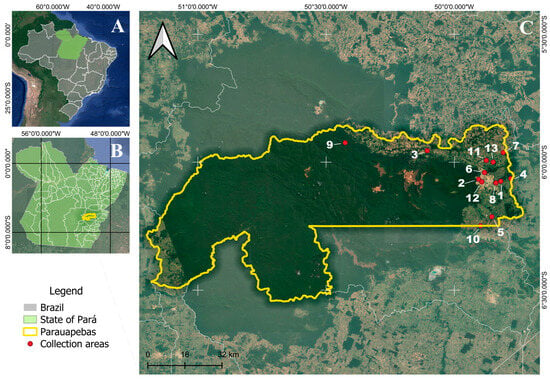
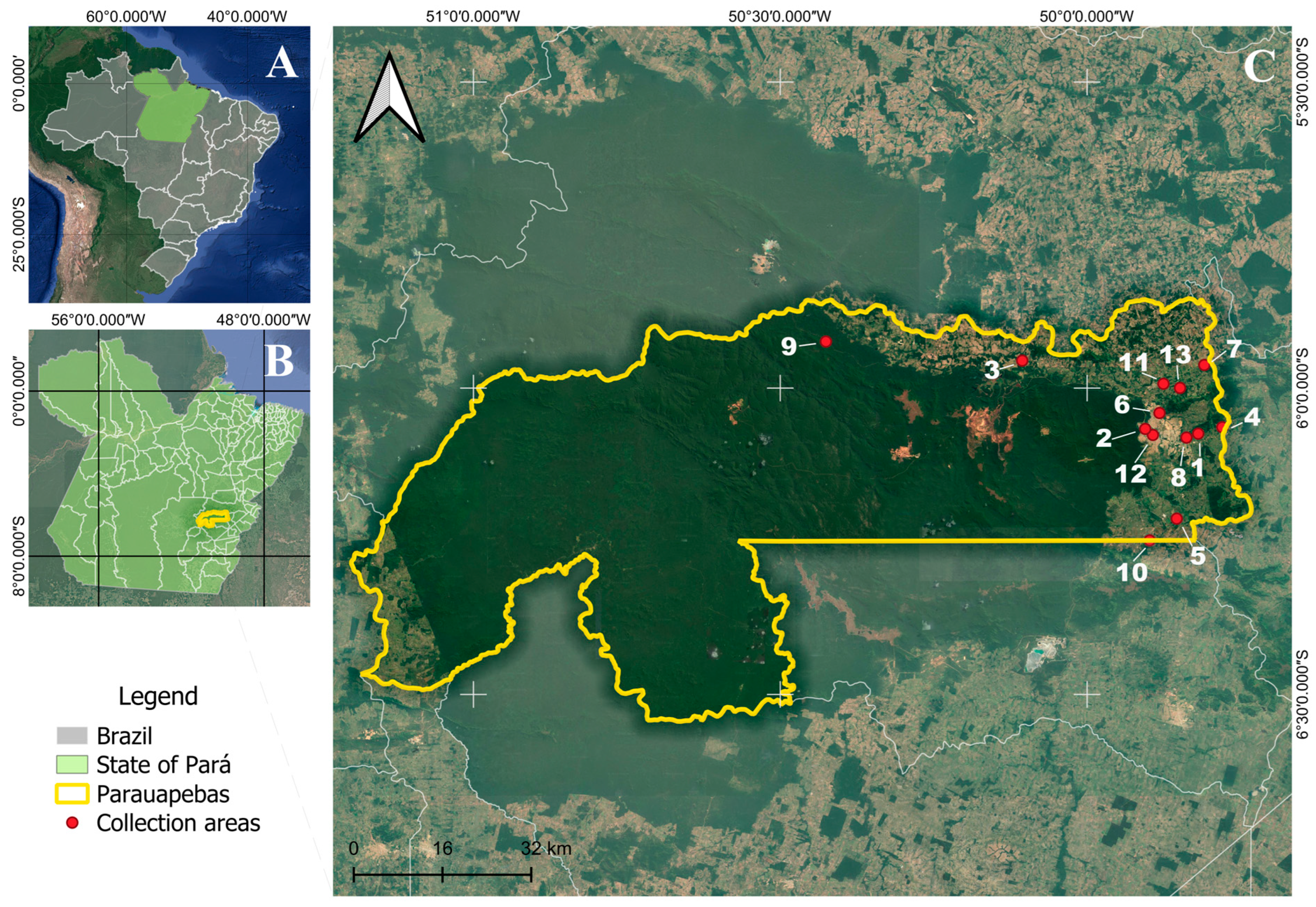
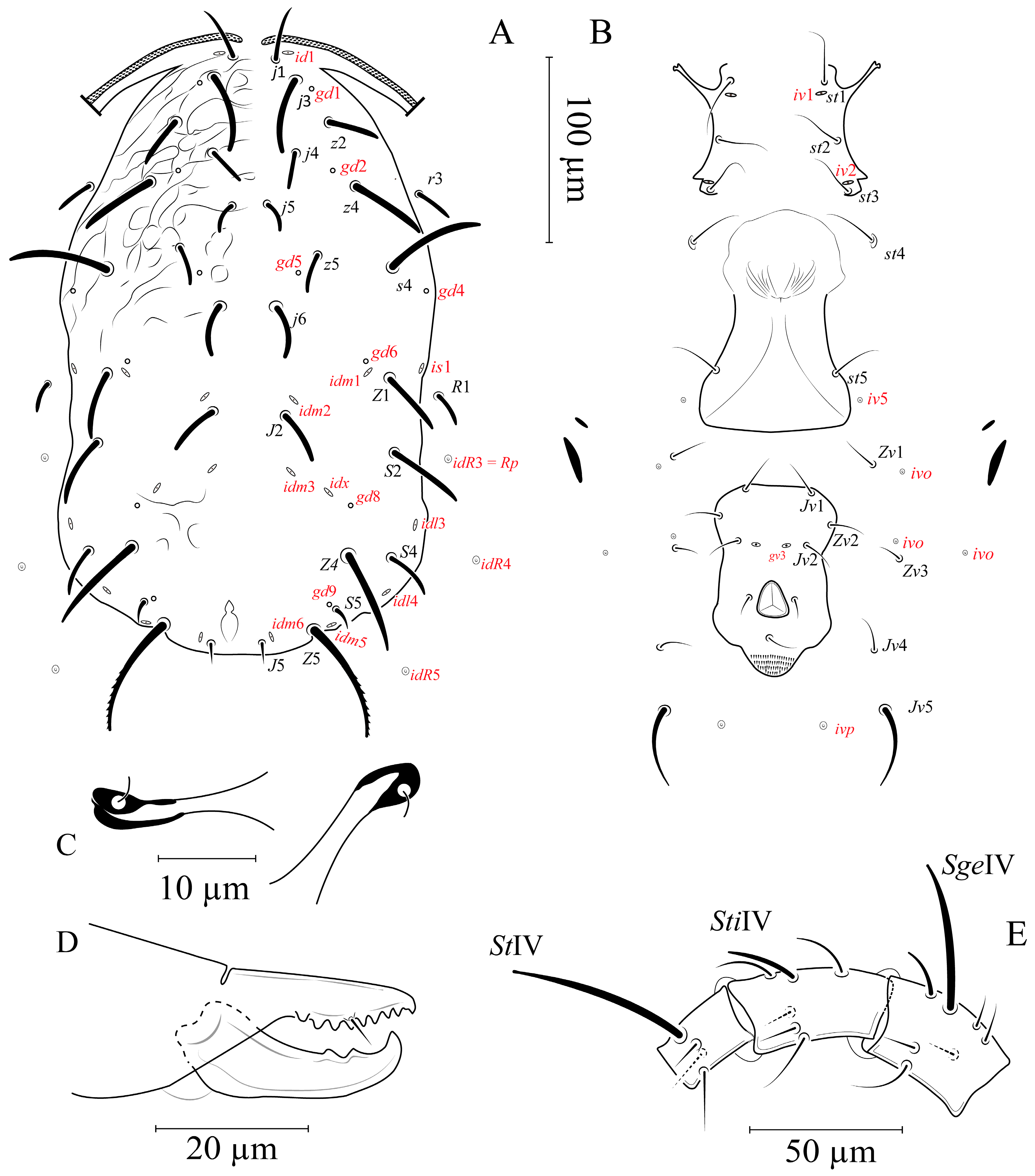
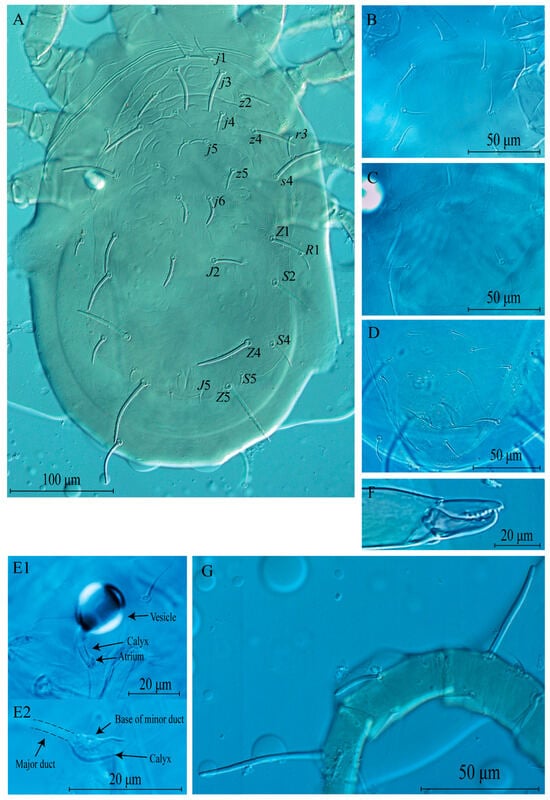
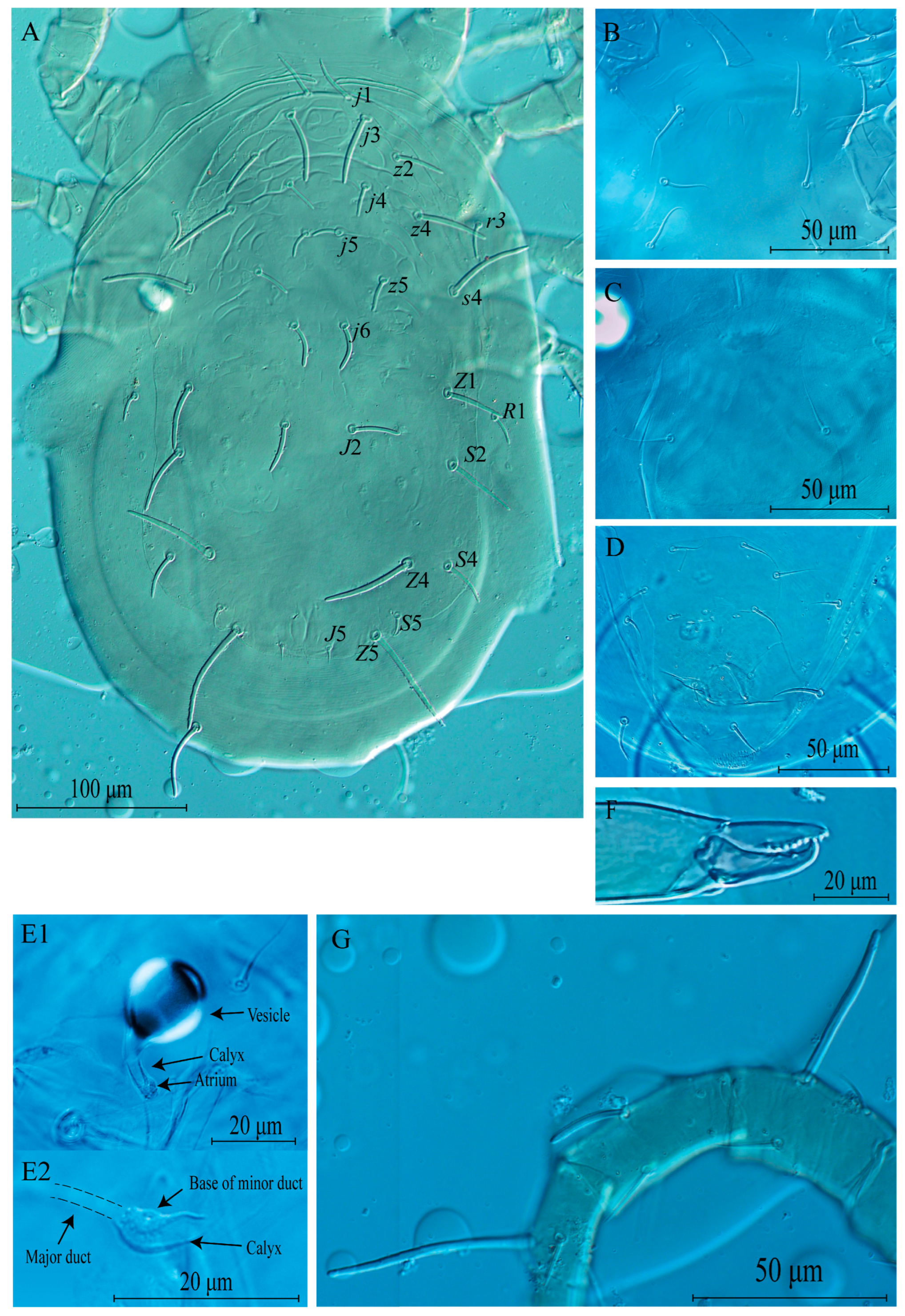
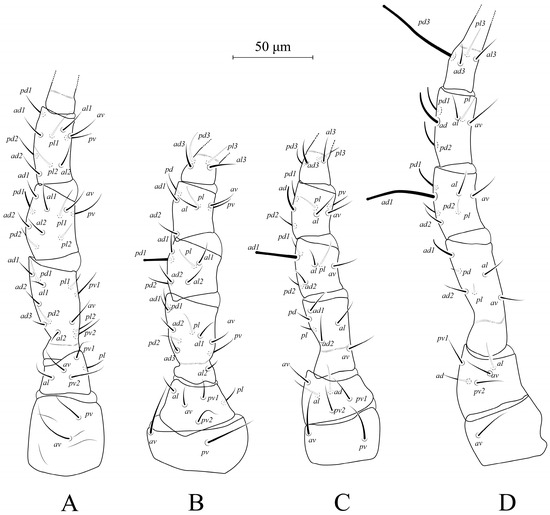
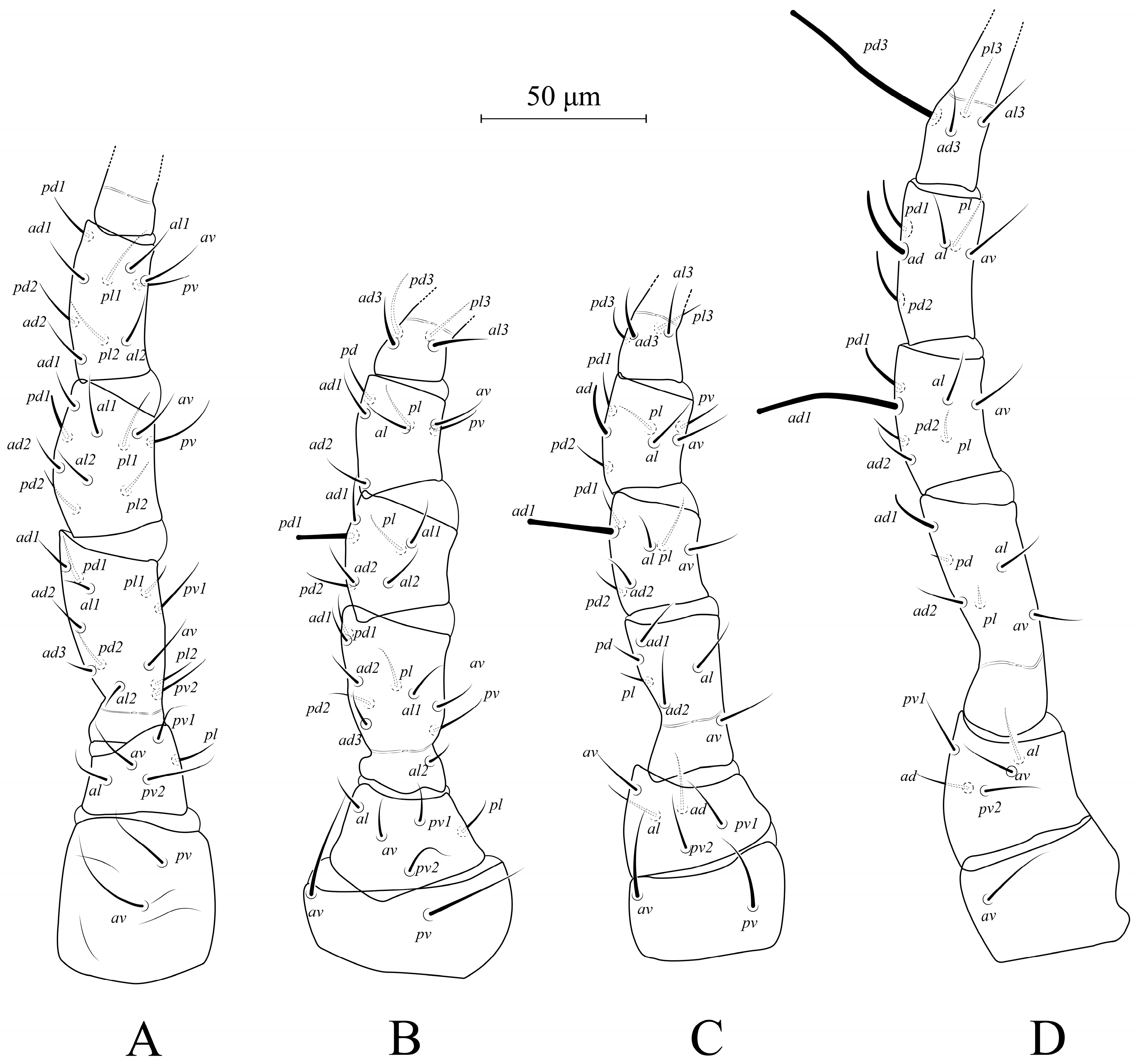
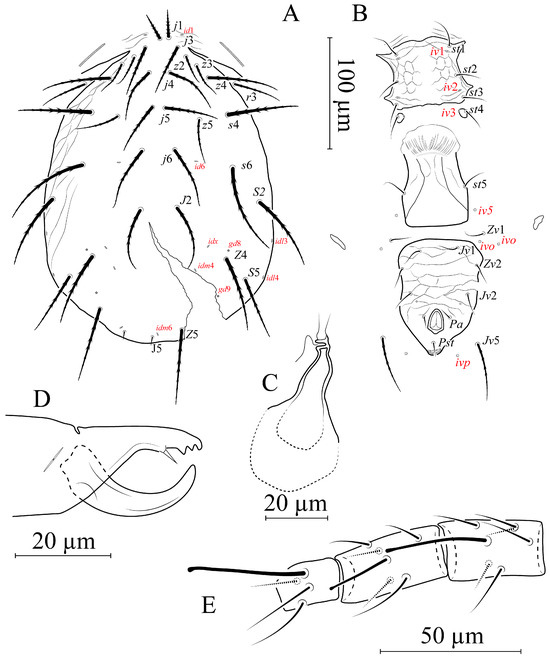
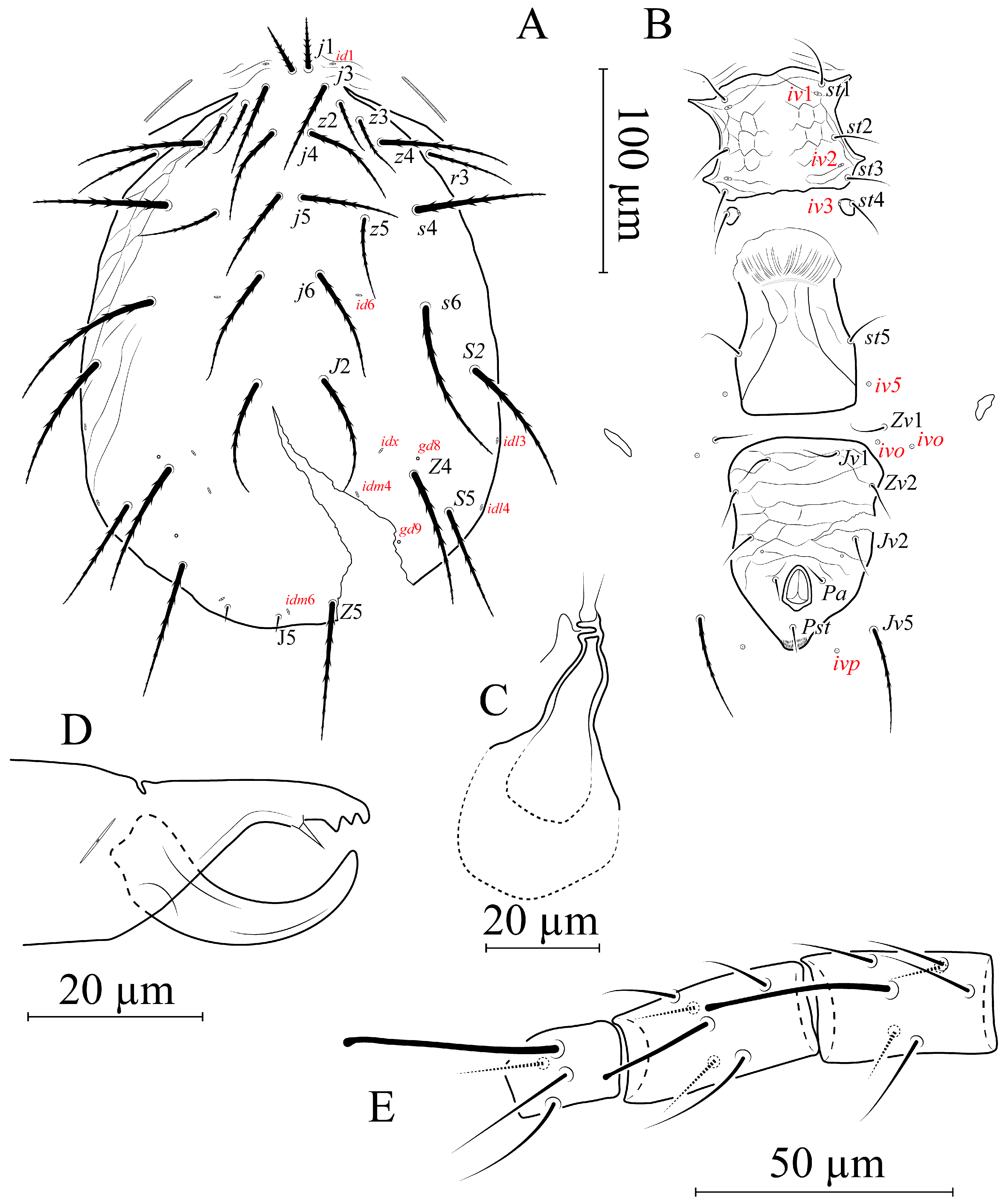

Disclaimer/Publisher’s Note: The statements, opinions and data contained in all publications are solely those of the individual author(s) and contributor(s) and not of MDPI and/or the editor(s). MDPI and/or the editor(s) disclaim responsibility for any injury to people or property resulting from any ideas, methods, instructions or products referred to in the content. |
© 2026 by the authors. Licensee MDPI, Basel, Switzerland. This article is an open access article distributed under the terms and conditions of the Creative Commons Attribution (CC BY) license.