


Abstract
Troglonectes is an endemic cavefish genus of Nemacheilidae, mainly distributed in Guangxi and Guizhou, China. In April 2025, ten specimens of Troglonectes were collected from a subterranean stream of a Liujiang River tributary in Jinchengjiang District, Hechi City, Guangxi. Based on morphological comparisons and molecular phylogenetic analyses using mitochondrial Cyt b and COI genes, these specimens were identified as two new species, namely Troglonectes bottazzii sp. nov. and Troglonectes chenlixini sp. nov. Troglonectes bottazzii sp. nov. can be distinguished from congeners by having scales posterior to the dorsal fin origin, 9–10 branched dorsal fin rays, 12–13 branched pectoral fin rays, and 14 branched caudal fin rays. Troglonectes chenlixini sp. nov. is characterized by 12 branched caudal fin rays. Phylogenetically, the two new species form reciprocally monophyletic lineages with strong support, and their genetic distances meet the interspecific divergence level of Nemacheilidae. The two new species live in sympatry in the same cave waterbody, which is rare among cave loaches. Their stable morphological differences imply niche differentiation in their microhabitat and feeding ecology, which may reduce interspecific competition and likely contributes to reproductive isolation. This discovery enriches the diversity of Troglonectes and represents a valuable case and promising system for future investigations of sympatric distribution and adaptive evolution of cave-dwelling fishes.
1. Introduction
Troglonectes Zhang, Zhao and Tang, 2016 (genus abbreviation T.) is an endemic genus of Nemacheilidae distributed in Guangxi and Guizhou Provinces, China [1]. This genus was established based on the type species Oreonectes furcocaudalis Zhu and Cao, 1987. Concurrently, the following species were transferred into Troglonectes: Oreonectes acridorsalis Lan, 2013; O. barbatus Gan, 2013; O. elongatus Tang, Zhao and Zhang, 2012; O. macrolepis Huang, Du, Chen and Yang, 2009; O. microphthalmus Du, Chen and Yang, 2008; and O. translucens Zhang, Zhao and Zhang, 2006 [1]. The typical diagnostic characteristics defining Troglonectes include a long and laterally compressed caudal peduncle, with adipose crests along both the dorsal and ventral sides, and a forked caudal fin [1]. Subsequent taxonomic studies have continuously adjusted the systematic position of some species and described new taxa, greatly enriching the species diversity of Troglonectes. Li [2] transferred species from Triplophysa (genus abbreviation Tr.), namely Tr. dongganensis Yang, 2013; Tr. huanjiangensis Yang, Wu and Lan, 2011 (synonym of O. elongatus); Tr. longibarbatus (Chen, Yang, Sket and Aljancic, 1998) (synonym of Paracobitis posterodarsalus Li, Ran and Chen, 2006); Tr. jiarongensis Lin, Li and Song, 2012; Tr. lihuensis Wu, Yang and Lan, 2012; and Tr. lingyunensis (Liao, Wang & Luo, 1997), as well as Oreonectes daqikongensis Deng, Wen, Xiao & Zhou, 2016 (synonym of Paracobitis maolanensis Li, Ran and Chen, 2006); O. donglanensis Wu, 2013; and O. duanensis Lan, 2013, into the genus Troglonectes based on their morphological character. Subsequently, O. retreodorsalis Lan, Yang and Chen, 1995 and O. shuilongensis Deng, Wen, Xiao and Zhou, 2016 were transferred into Troglonectes, while T. canlinensis Li et al., 2023 and T. hechiensis Zhao, Liu, Du and Luo, 2021 were newly described members of this genus based on their morphological character and molecular data [3,4,5,6]. However, due to their high morphological similarity and convergent adaptation to cave environments, the taxonomy and phylogenetic relationships of this genus remain controversial and incompletely resolved.
Until now, 13 species of Troglonectes have been recorded from Guangxi and Guizhou Provinces, China, namely T. barbatus, T. canlinensis, T. furcocaudalis, T. hechiensis, T. huanjiangensis (synonym of T. dongganensis, T. elongatus, and T. jiarongensis), T. longibarbatus, T. maolanensis (T. daqikongensis), T. macrolepis, T. microphthalmus, T. translucens (synonym of T. donglanensis and T. duanensis), T. lihuensis, T. retrodorsalis, and T. shuilongensis [2,6,7]. In April 2025, ten specimens of Troglonectes were collected from a cave from a tributary of Liujiang River in Damo Village, Bagong Town, Jinchengjiang County, Hechi City, Guangxi Zhuang Autonomous Region, China. Morphological and molecular analyses confirmed that these specimens represent two previously undescribed members of the genus, which are described herein and compared with all known congeners. In the present paper, we formally describe two new sympatric species and discuss their morphological differentiation, phylogenetic relationships, and potential niche partitioning.
2. Materials and Methods
2.1. Specimen Collection and Preservation
Field sampling procedures adhered to the Guide to Collection, Preservation, Identification, and Information Share of Animal Specimens [8] and the Implementation Rules of Fisheries Law of the People’s Republic of China. All animal care and experimental protocols fully complied with the welfare and ethical requirements specified in the national standard GB/T 35892-2018, jointly issued by the General Administration of Quality Supervision, Inspection and Quarantine of the People’s Republic of China and Standardization Administration of the People’s Republic of China (Beijing, China). Specimens were euthanized immediately upon collection by an overdose of anesthetic clove oil to minimize suffering. The right-side pelvic fins of six individuals (three individuals each for Troglonectes bottazzi sp. nov. and T. chenlixini sp. nov.) were removed and preserved in 99% ethanol for molecular analyses, and five individuals for each species were stored in 10% formalin for morphological comparisons. These specimens were deposited in the Kunming Natural History Museum of Zoology, Kunming Institute of Zoology (KIZ), Chinese Academy of Sciences (CAS).
2.2. Phylogenetic Analysis
Genomic DNA was extracted from ethanol-preserved fin tissues using a commercial DNA extraction kit (Sangon Biotech (Shanghai) Co., Ltd., Shanghai, China). The partial sequences of the mitochondrial cytochrome b gene (Cyt b) and cytochrome c oxidase subunit I (COI) genes were amplified using specific primer pairs: for Cyt b, F14724 (5′-GACTTGAAAAACCACCGTTG-3′) and R15915 (5′-CTCCGATCTCCGGATTACAAGAC-3′) [9], and for COI, Fish F1 (5′-TCAACCAACCACAAAGACATTGGCAC-3′) and FISH R1 (5′-TAGACTTCTGGGTGGCCAAAGAATCA-3′) [10]. All amplified products were subsequently sequenced by Sangon Biotech (Shanghai) Co., Ltd., China, and submitted to GenBank (accession nos. for T. bottazzii sp. nov.: PZ269991–PZ 269993 for Cyt b, PZ247825–PZ 247827 for COI; for T. chenlixini sp. nov.: PZ241069–PZ 241071 for Cyt b, PZ239997–PZ 239999 for COI). To infer the phylogenetic placement of Troglonectes bottazzii sp. nov. and T. chenlixini sp. nov., 25 complete mitochondrial genomes and 28 Cyt b sequences representing species of Troglonectes and two Paranemachilus species, P. genilepis Zhu, 1983 and P. jinxiensis (Zhu, Du and Chen, 2009), as an outgroup, were retrieved from GenBank. Sequence alignment was performed in MEGA v. 11.0 [11] using the MUSCLE algorithm [12] with default parameters. For phylogenetic reconstruction, the concatenated dataset was divided into two main gene partitions (Cyt b and COI). Each protein-coding gene was further partitioned by codon position (1st, 2nd, and 3rd position). The optimal nucleotide substitution model and partitioning scheme were determined under the AICc criterion, using PartionFinder v. 2.1.1, with the best-fit model identified as GTR+I+G for all partitions. Phylogenetic relationships were reconstructed using both maximum-likelihood (ML) and Bayesian inference (BI) approaches, implemented through the CIPRES Science Gateway [13]. The ML analysis employed a rapid bootstrapping strategy with 1000 bootstrap iterations. The BI analysis was conducted in MrBayes v. 3.2.7a [14] with two independent runs of four Markov chains initiated from a random tree. The chains were run for five million generations and sampled every 100 generations, with the first 25% of sampled trees discarded as burn-in. The remaining trees were used to create a consensus tree and estimate Bayesian posterior probabilities (BPPs). The constructed phylogenetic trees were visualized and edited in FigTree v. 1.4.4 [15].
2.3. Morphological Examination
Meristic counts, morphometric measurements, and cephalic lateral line system features were assessed following the protocols outlined by Kottelat [16]. All measurements were taken from the left side of each specimen using digital vernier calipers to the nearest 0.1 mm. All measurements were recorded, with data processed and analyzed in Microsoft Excel.
3. Results
3.1. Genetic Evidence from Phylogenetic Analysis
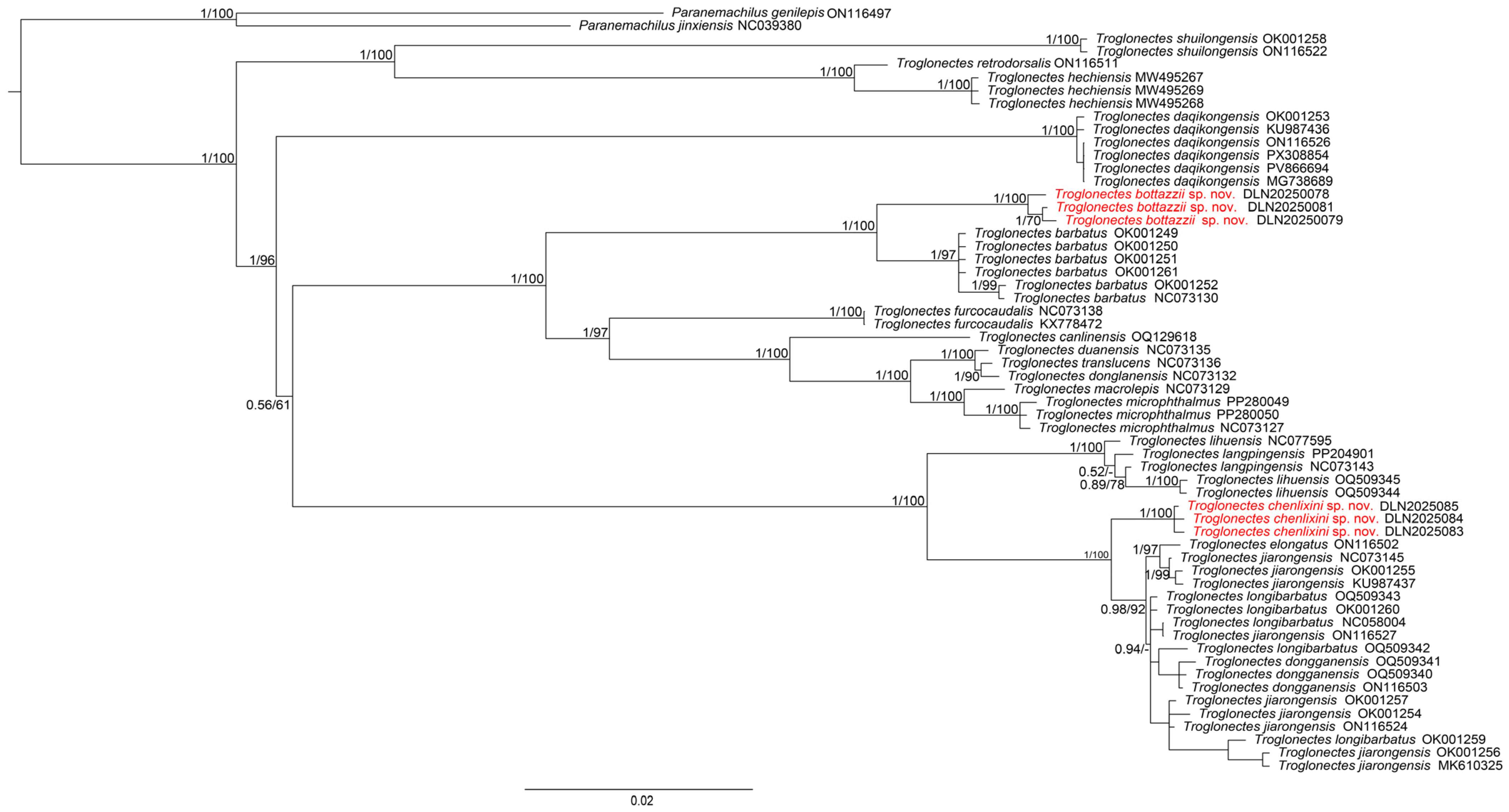
The BI and ML analyses produced fully congruent topologies. The BI tree is presented here with ML bootstrap value annotations at the nodes. BI and ML analyses of the phylogenetic tree yielded a well-resolved and consistent topology and confirmed the validity of the new species with high nodal support (posterior probability = 1; bootstrap support = 100). Species of Troglonectes were resolved as a monophyletic group, positioned as the sister lineage to the clade containing Parnemachilus. Within the genus, T. bottazzii sp. nov. was resolved as the sister taxon to T. barbatus, and T. chenlixini sp. nov. was resolved as the sister taxon to the clade containing T. dongganensis, T. jiarongensis, T. longibarbatus, and T. elongatus (Figure 1). The phylogenetic results indicate that the two new species are genetically distinct and deeply divergent within Troglonectes, consistent with their clear morphological differences despite their sympatric distribution. No obvious geographic clustering was observed within the genus, suggesting frequent independent colonization of karst caves.
Figure 1.
A Bayesian phylogram of Troglonectes based on a concatenated dataset of mitochondrial cytochrome c oxidase subunit I (COI) and cytochrome b (Cyt b) sequences. Numbers on branches represent BPPs from BI and bootstrap supports from ML. The scientific names of the two novel species are highlighted in red.
The uncorrected p-distance analysis based on Cyt b sequences further supported species-level distinction, with genetic divergences between T. bottazzii sp. nov. and the 19 congeners ranging from 2.33% (for T. barbatus) to 11.51% (for T. jiarongensis) and those between T. chenlixini sp. nov. and the 19 congeners ranging from 0.96% (for T. dongganensis) to 11.54% (for T. barbatus) (Table 1). For reference, the intraspecific uncorrected p-distances reported within nemacheilids include 0.17 between T. translucens and T. donglanensis and 0.05 between Tr. longliensis and Tr. sanduensis [17]. The p-distances between the two new taxa and their congeners were compared against the documented interspecific divergence range of Nemacheilidae.
Table 1.
Uncorrected p-distances (%) between species of Troglonectes based on mitochondrial Cyt b gene.
3.2. Troglonectes bottazzii sp. nov. Zhou, Liu & Du
Holotype. KIZ2024010633, 70.3 mm standard length (SL), a cave at Damo Village, Bagong Town, Jinchengjiang County, Hechi City, Guangxi Zhuang Autonomous Region, China; Dagouhe, a tributary of the Liujiang River system of Pearl River Basin; 24.7627° N, 107.8459° E, collected by J.J. Zhou on 15 April 2025.
Paratypes. KIZ2024010634–10637, four specimens, 42.8–67.6 mm SL, same data as holotype.
Diagnosis. Troglonectes bottazzii sp. nov. is assigned to the genus Troglonectes based on a phylogenetic analysis and morphological traits. Morphologically, T. bottazzii sp. nov. can be distinguished from all other species of Troglonectes by the following combination of characteristics: caudal fin forked; scales present on the body posterior to the origin of the dorsal fin; 14 branched caudal fin rays; a big mouth; and markedly reduced, weakly developed barbels.
Description. All morphometric and meristic data are given in Table 2. Dorsal fin with three unbranched and nine or ten branched rays; anal fin with two unbranched and six branched rays; pectoral fin with one unbranched and 12 or 13 branched rays; pelvic fin with one unbranched and seven branched rays; caudal fin with two unbranched and 14 branched rays; 0–3 outer and 15–17 inner gill rakers on the first gill arch.
Table 2.
Morphometric and meristic data of Troglonectes bottazzii sp. nov. and T. chenlixini sp. nov. Range, mean and standard deviation (mean ± SD) included.
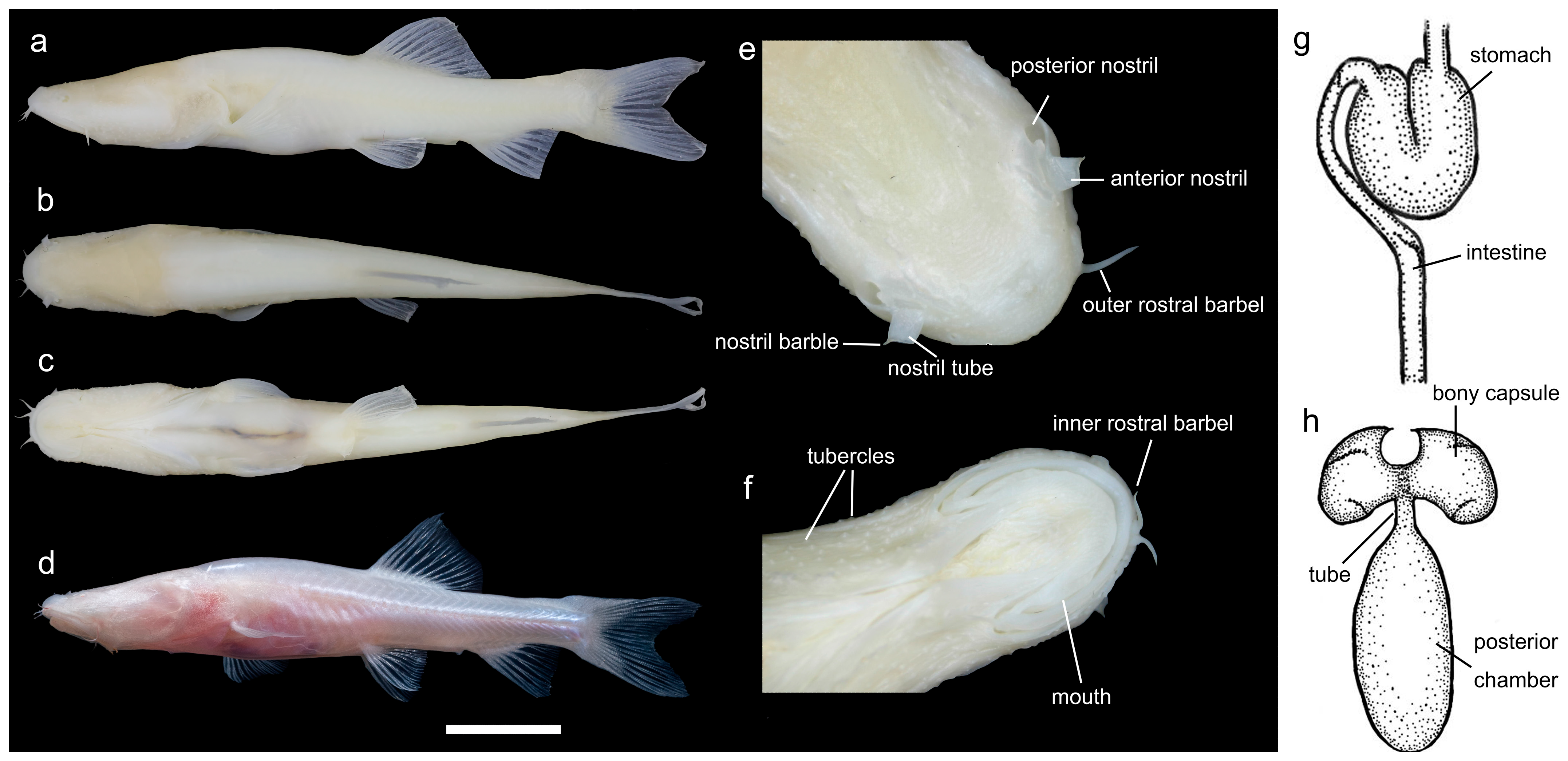
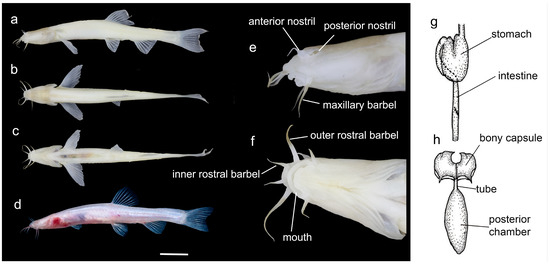
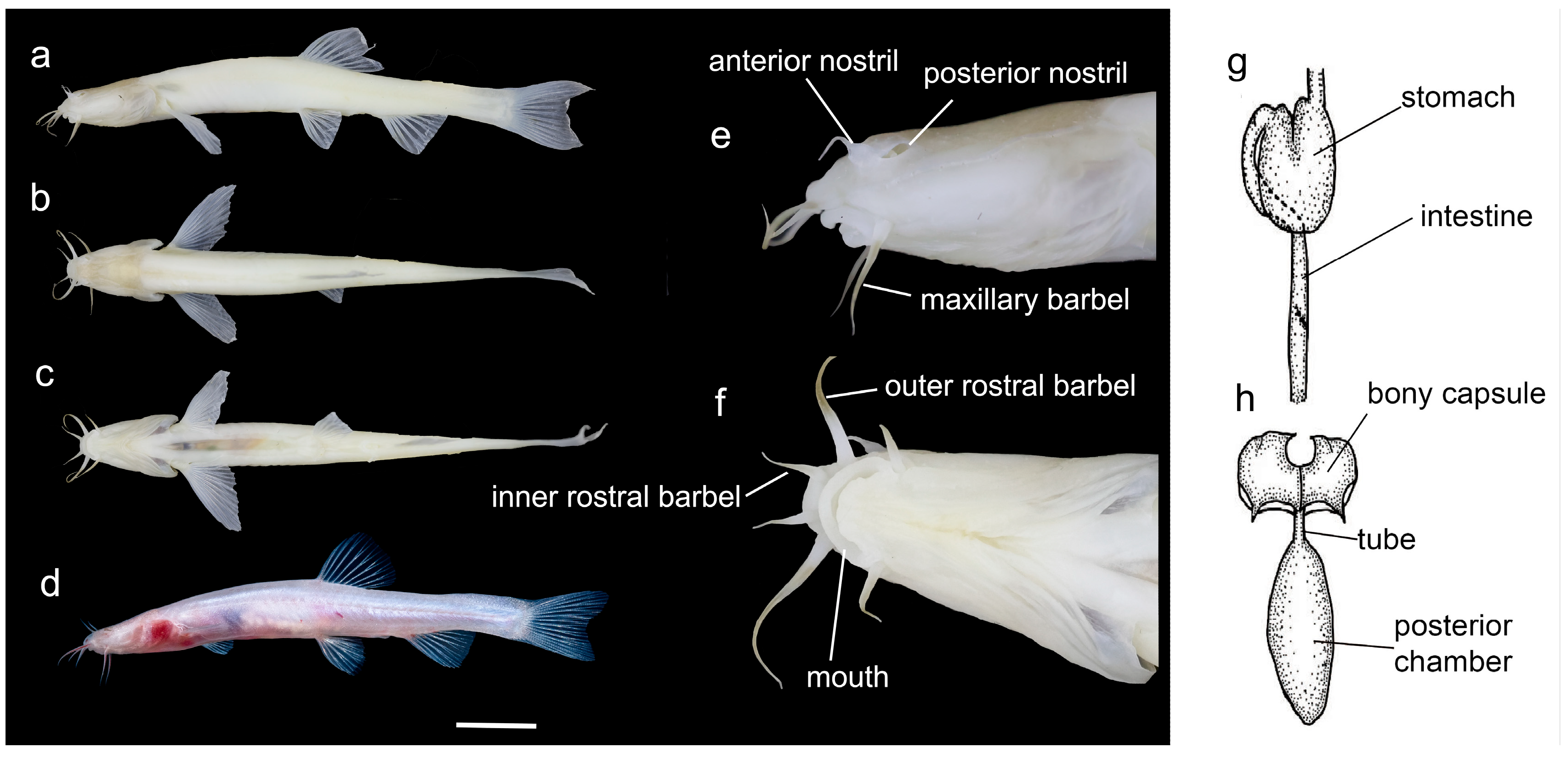
Body robust and compressed, greatest body depth anterior to dorsal fin origin. Head depressed, lateral head length longer than its width, wider than deep. Snout blunt. Mouth inferior, horseshoe-shaped, width smaller than its depth (Figure 2f). Upper and lower lips with small furrows. Eye absence. Anterior and posterior nostrils adjacent, base of anterior nostril tube-shaped, tip elongated to barbel-like structure, nostril barbel shorter than tube height (Figure 2e). Three pairs of barbels; inner rostral barbel shortest; outer rostral barbel and maxillary barbel length 102–181% and 187–352% of inner rostral barbel length, respectively.
Figure 2.
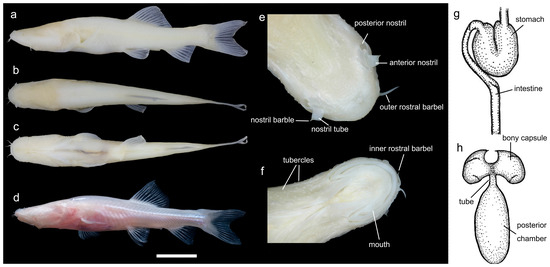
Morphological characteristics of Troglonectes bottazzii sp. nov.: (a) lateral view; (b) dorsal view; (c) ventral view; (d) living photo; (e) dorsal of head; (f) ventral of head; (g) stomach and intestine; (h) anterior and posterior chambers. Scale = 1 cm.
Distal margin of dorsal fin truncates, origin posterior or opposite to pelvic fin origin, predorsal length of 55.3–60.4% SL. Pectoral fin length 77.0–86.2% of distance between pectoral fin origin and pelvic fin origin. Pre-pelvic length 54.8–58.6% SL, tip of pelvic fin far away from anus. Anus with close-set anal fin base. Caudal fin forked. Upper and lower edges of caudal peduncle with caudal adipose keels; upper keel extending from tip of dorsal fin to midpoint of caudal fin, deepest at caudal fin base, nearly equal to depth of caudal peduncle; lower keel extending from tip of anal fin to anterior one-fifth of caudal fin. Caudal peduncle length 1.3–1.8 times its depth (contains caudal adipose keels). Scales presented on body posterior to origin of dorsal fin. Lateral line incomplete, with one to four pores after opercula open. Cephalic lateral line system with 11–12 + 4–6 infraorbital pores, seven or eight supraorbital canal pores, 2 + 2 supratemporal canal pores, and 10–12 preoperculomandibular canal pores.
Stomach U-shaped; intestine straight, leading directly to anus (Figure 2g). Anterior chamber covered by dumbbell-shaped bony capsule, posterior chamber developed (Figure 2h).
Sexual dimorphism. Series of temporal tubercles present on cheeks in nuptial male individuals, absent in females (Figure 2f).
Coloration. In live specimens, body is generally translucent milky white with complete loss of body surface pigmentation. Myomeres are clearly visible. Opercula and abdomen pink, stomach and intestine visible from outside. Fins are hyaline. In formalin-preserved specimens, body color turns pale grey. Without color pattern. Fin membrane hyaline (Figure 2a–d). When Troglonectes bottazzii sp. nov. is reared in environments with visible light, melanin pigmentation develops on its body surface.
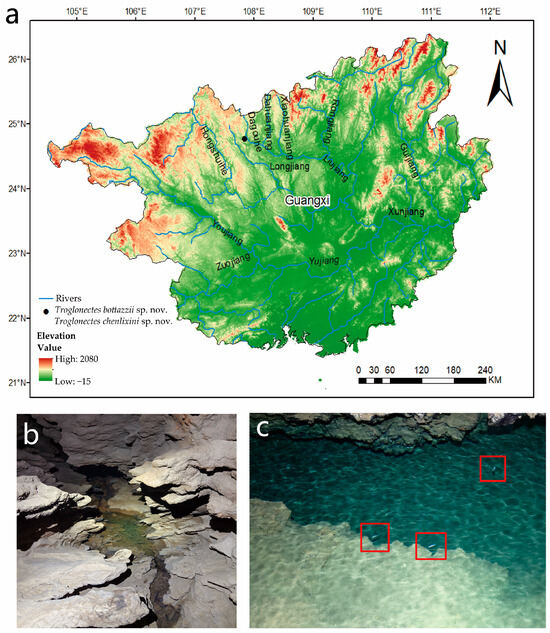
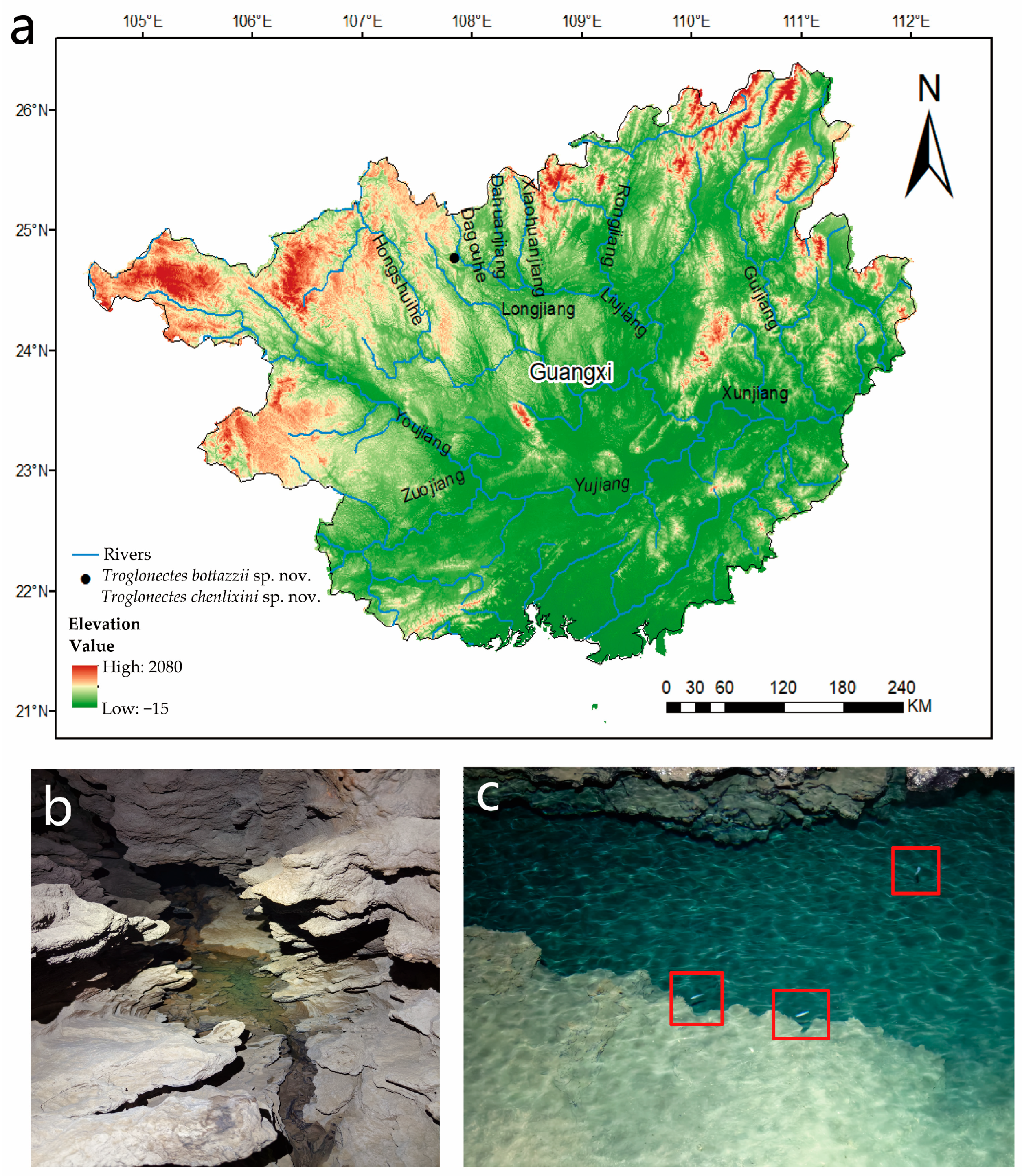
Distribution and habitat. Currently known from a cave at Damo Village, Bagong Town, Jinchengjiang County, Hechi City (24.7627° N, 107.8459° E), Guangxi Zhuang Autonomous Region, China; Dagouhe, a tributary of the Liujiang River system of Pearl River Basin (Figure 3a). This species inhabits a small subterranean river; water discharge is low, forming small puddles with water depth of approximately 0.3–2.0 m in the dry season (Figure 3b,c). Troglonectes chenlixini sp. nov. presents in the same subterranean river.
Figure 3.
(a) Distribution of Troglonectes bottazzii sp. nov. and T. chenlixini sp. nov. in Guangxi, China; (b,c) habitat photo of type locality at time of collection, with individuals indicated by red boxes.
Etymology. The specific epithet “bottazzii” is derived from the surname of Jean Bottazzi, a world-renowned cave explorer. This name is proposed in sincere recognition of his outstanding contributions to the discovery and investigation of karst caves in China. We suggest the Chinese common name for this new species to be “波氏洞鳅” (bō shì dòng qiū).
Remarks. The new species can be distinguished from other cogenetic species by the following combination of characteristics: 12 or 13 branched pectoral fin rays (vs. 10–12 in other cogenetic species), caudal fin forked (vs. emarginated in T. hechiensis, T. retrodorsalis and T. shuilongensis), scales presented on the body posterior to the origin of the dorsal fin (vs. whole-body scaled in T. canlinensis, T. hechiensis, T. macrolepis, and T. retrodorsalis and scaleless in T. barbatus, T. huanjiangensis, T. lihuensis, T. longibarbatus, T. maolanensis, T. microphthalmus, T. shuilongensis, and T. translucens), eyes absent (vs. present in T. canlinensis, T. furcocaudalis, T. hechiensis, T. macrolepis, T. microphthalmus, and T. retrodorsalis).
3.3. Troglonectes chenlixini sp. nov. Zhou, Liu & Du
Holotype. KIZ2024010638, 55.6 mm SL, a cave at Damo Village, Bagong Town, Jinchengjiang County, Hechi City, Guangxi Zhuang Autonomous Region, China; Dagouhe, a tributary of the Liujiang River system of Pearl River Basin; 24.7627° N, 107.8459° E, collected by J.J. Zhou on 15 April 2025.
Paratypes. KIZ2024010639–10642, four specimens, 40.9–50.5 mm SL, same data as holotype.
Diagnosis. Troglonectes chenlixini sp. nov. is assigned to the genus Troglonectes based on a phylogenetic analysis and morphological traits. Morphologically, T. chenlixini sp. nov. can be distinguished from all other species of Troglonectes by its 12 branched caudal fin rays. The counts of branched caudal fin rays (14 in T. bottazzii vs. 12 in T. chenlixini) are non-overlapping and diagnostic when combined with body squamation and barbel development, clearly distinguishing the two new species from each other and all other congeners.
Description. All morphometric and meristic data are given in Table 2. Dorsal fin with three unbranched and eight branched rays; anal fin with two unbranched and six branched rays; pectoral fin with one unbranched and 11 branched rays; pelvic fin with one unbranched and six branched rays; caudal fin with two unbranched and 12 branched rays. Outer gill raker absence and 14 inner gill rakers on the first gill arch.
Body slim and compressed, greatest body depth anterior to dorsal fin origin. Head depressed, lateral head length longer than its width, wider than deep. Snout blunt. Mouth inferior, width longer than its depth (Figure 4e). Upper and lower lips with small furrows. Eye absence. Anterior and posterior nostrils adjacent, base of anterior nostril tube-shaped, tip elongated to barbel-like structure, nostril barbel longer than tube height (Figure 4f). Three pairs of barbels; inner rostral barbel shortest; outer rostral barbel and maxillary barbel length 165–339% and 187–311% of inner rostral barbel length, respectively.
Figure 4.
Morphological characteristics of Troglonectes chenlixini sp. nov.: (a) lateral view; (b) dorsal view; (c) ventral view; (d) living photo; (e) lateral of head; (f) ventral of head; (g) stomach and intestine; (h) anterior and posterior chambers. Scale = 1 cm.
Distal margin of dorsal fin truncates, origin anterior or opposite to pelvic fin origin, predorsal length of 51.6–56.1% SL. Pectoral fin length 64.5–80.2% of distance between pectoral fin origin and pelvic fin origin. Pre-pelvic length 53.5–56.2% SL, tip of pelvic fin exceeding anus. Anus with close-set anal fin base. Caudal fin forked. Upper and lower edges of caudal peduncle with caudal adipose keels; upper keel extending from tip of dorsal fin to midpoint of caudal fin, deepest at caudal fin base, nearly equal to depth of caudal peduncle; lower keel extending from tip of anal fin to anterior one-fifth of caudal fin. Caudal peduncle length 1.7–2.6 times its depth (contains caudal adipose keels). Whole body scaleless. Lateral line incomplete, with one to three pores after opercula open. Cephalic lateral line system with 8–12 + 2–3 infraorbital pores, four to seven supraorbital canal pores, 2 + 2 supratemporal canal pores, 6–10 preperculomandibular canal pores.
Stomach U-shaped; intestine straight, leading directly to anus. Anterior chamber covered by dumbbell-shaped bony capsule, posterior chamber developed (Figure 4g,h).
Sexual dimorphism. Without clear sexual dimorphism.
Coloration. In live specimens, body is generally translucent milky white with complete loss of body surface pigmentation. Myomeres are clearly visible. Opercula and abdomen pink, stomach and intestine visible from outside. Fins are hyaline. In formalin-preserved specimens, body color turns pale grey. Without color pattern. Fin membrane hyaline.
Distribution and habitat. Same as for T. bottazzii sp. nov.
Etymology. The specific epithet, “chenlixini”, is named in honor of Mr. Chen Lixin, in recognition of his great contributions to cave exploration and popular science. He was the first to conduct systematic surveys of the Dashiwei Tiankeng and founded the first cave exploration club in Guangxi, inspiring a large number of enthusiasts to engage in subterranean investigation. The epithet is a masculine patronymic formation, conforming to the masculine grammatical gender of the genus Troglonectes. We suggest the Chinese common name for this new species to be “陈氏洞鳅” (chén shì dòng qiū).
Remarks. Troglonectes chenlixini sp. nov. can be distinguished from other cogenetic species by its 12 branched caudal fin rays (vs. more than 13 in other cogenetic species) and the following combination of characteristics: caudal fin forked (vs. emarginated in T. hechiensis, T. retrodorsalis and T. shuilongensis), lateral line incomplete (vs. absent in T. barbatus and T. lihuensis, complete in T. maolanensis), scaleless (vs. scaled in T. bottazzii sp. nov., T. canlinensis, T. furcocaudalis, T. hechiensis, T. macrolepis, and T. retrodorsalis).
4. Discussion
The two new species described herein, Troglonectes bottazzii sp. nov. and T. chenlixini sp. nov., occur in sympatry within the same subterranean stream of the Liujiang River Basin, Hechi City, Guangxi, China. Such congeneric sympatry is extremely rare among cave loaches of the family Nemacheilidae, especially in the genus Troglonectes, most species of which are distributed allopatrically in isolated karst caves [1,2,5,6]. The coexistence of these two closely related species in a single, closed cave environment provides new insights into sympatric speciation and adaptive divergence in cave-dwelling fishes.
Despite sharing a suite of troglomorphic adaptations, including eye loss, depigmentation, translucent bodies, elongated caudal peduncles with well-developed adipose crests, and forked caudal fins, the two new species exhibit stable and distinct morphological differentiation related to ecological function. Troglonectes bottazzii sp. nov. possesses scales posterior to the dorsal fin; more branched rays in the dorsal (9–10), pectoral (12–13), and caudal (14) fins; a more robust body; a big mouth; and markedly reduced, weakly developed barbels. In contrast, T. chenlixini sp. nov. is entirely scaleless, with fewer branched dorsal (8), pectoral (11), and caudal (12) fin rays; a slenderer body; and well-developed barbels. This striking divergence in barbel development likely reflects distinct sensory and feeding strategies, raising intriguing questions about potential compensatory adaptations in other chemosensory or mechanosensory structures (e.g., taste buds on the lips, specialized epidermal receptors, or enhanced lateral line function) that may offset the reduced tactile and gustatory capabilities associated with shortened barbels. Collectively, these differences strongly suggest ecological niche partitioning in microhabitat use, swimming performance, and feeding ecology, which reduces interspecific competition and enables stable coexistence [18,19,20].
Phylogenetic analyses based on mitochondrial Cyt b and COI genes revealed that the two sympatric new species are distantly related and form reciprocally monophyletic lineages with strong nodal support (PP = 1, BS = 100). The uncorrected genetic distances are well within the range of interspecific divergence commonly observed in Nemacheilidae, which implies the potential presence of reproductive isolation [4,6]. Although they occur in sympatry, their distant phylogenetic relationship indicates that their syntropic distribution did not arise through sympatric speciation. Instead, their similar cave-adapted forms likely originated via independent colonization and parallel evolution. We cannot exclude alternative scenarios such as historical allopatric divergence followed by secondary contact after cave connectivity, which warrants further testing with nuclear genomic data. Taken together, the morphological distinctiveness, genetic divergence, and sympatric distribution validate the specific status of the two new taxa and highlight that karst subterranean waters are not only “hotspots” of biodiversity but also natural laboratories for studying the parallel adaptation and adaptive evolution of cave fishes [21,22].
Author Contributions
Conceptualization: L.-N.D.; Data curation: M.-H.G.; Funding acquisition: J.-J.Z., L.-X.W., L.-N.D. and Q.S.; Investigation: J.-J.Z. and Y.-W.L.; Software: L.-N.D. and M.-H.G.; Visualization: L.-N.D.; Supervision: L.-N.D.; Writing—original draft: L.-N.D. and J.-J.Z.; Writing—review and editing: L.-N.D. All authors have read and agreed to the published version of the manuscript.
Funding
This research was funded by the National Natural Science Foundation of China (32560121), Investigation on Fishery Resources and Habitats in the Pearl River Basin (ZJZX-10), Karst Landship National Park of Southwest China comprehensive scientific investigation project, Small Grants Program for New Records and Rediscoveries of Rare Species initiated by Tencent Foundation and Shan Shui Conservation Center, and Guangxi Natural Science Foundation Project (2026GXNSFAA00641124).
Data Availability Statement
The molecular sequences obtained herein have been submitted to NCBI, and all remaining measurement data are provided in the text.
Acknowledgments
We are grateful to Li-Xin Chen and Hong-Ying Wu from Geological Society of China for providing detailed species distribution information. We thank E Zhang from Institute of Hydrobiology, Chinese Academy of Sciences, for providing investigation funding. We greatly thank Zhuo-Ni Chen and Xu-Xun Chen for teaching us the protocols of specimen measurement, preparing the distribution map using ArcGIS software version 10.8 (Esri, Redlands, CA, USA), and depositing the sequence data in GenBank.
Conflicts of Interest
Li-Na Du is employed by Guangxi Normal University, Hao-Ming Gu is employed by Guangxi Daguishan Crocodile Lizard National Reserve, Ye-Wei Liu graduated from Guangxi University, Jia-Jun Zhou is employed by Zhejiang Forest Survey Planning and Design Co., Ltd. and Zhejiang Forest Resource Monitoring Center, Long-Xiang Wang is employed by Guangxi Forest Inventory & Planning Institute, and Qiu Shen is employed by Hangzhou Yuanxiang Wildness Conservation Center. No financial or non-financial competing interests exist for any author. The funders had no role in the design of the study; in the collection, analysis, or interpretation of data; in the writing of the manuscript; or in the decision to publish the results.
References
- Zhang, C.G.; Zhao, Y.H. Species Diversity and Distribution of Inland Fishes in China; Science Press: Beijing, China, 2016; pp. 127–151. (In Chinese) [Google Scholar]
- Li, X.J. Nemacheilidae Cavefishes of China—Taxonomy, Adaption and Zoogeography. Master’s Thesis, Shanghai Ocean University, Shanghai, China, 2018. (In Chinese) [Google Scholar]
- Deng, H.Q.; Xiao, N.; Hou, X.F.; Zhou, J. A new species of the genus Oreonectes (Cypriniformes: Nemacheilidae) from Guizhou, China. Zootaxa 2016, 4132, 143–150. [Google Scholar] [CrossRef] [Scilit]
- Luo, T.; Yang, Q.; Wu, L.; Wang, Y.L.; Zhou, J.J.; Deng, H.Q.; Xiao, N.; Zhou, J. Phylogenetic relationships of Nemacheilidae cavefish (Heminoemacheilus, Oreonectes, Yunnanilus, Paranemachilus, and Troglonectes) revealed by analysis of mitochondrial genome and seven nuclear genes. Zool. Res. 2023, 44, 693–697. [Google Scholar] [CrossRef] [Scilit]
- Zhao, L.X.; Liu, J.H.; Du, L.N.; Luo, F.G. A new loach species of Troglonectes (Teleostei: Nemacheilidae) from Guangxi, China. Zool. Res. 2021, 42, 423–427. [Google Scholar] [CrossRef] [Scilit] [PubMed]
- Li, S.J.; Ge, J.K.; Bao, C.Y.; Du, L.N.; Luo, F.G.; Zou, T.X. Troglonectes canlinensis sp. nov. (Teleostei: Nemacheilidae), a new troglomorphic loach from Guangxi, China. Animals 2023, 13, 1712. [Google Scholar] [CrossRef] [Scilit] [PubMed]
- Wang, Y.L. Systematic Taxonomy of the Genus Oreonectes and Troglonectes. Master’s Thesis, Guizhou Normal University, Guiyang, China, 2022. (In Chinese) [Google Scholar]
- Xue, D.Y. Guide to Collection, Preservation, Identification and Information Sharing of Animal Specimens; China Standards Press: Beijing, China, 2010. [Google Scholar]
- Xiao, W.H.; Zhang, Y.P.; Liu, H.Z. Molecular systematics of Xenocyprinae (Teleostei: Cyprinidae), taxonomy, biogeography, and coevolution of a special group restricted in East Asia. Mol. Phylogenet. Evol. 2001, 18, 163–173. [Google Scholar] [CrossRef] [Scilit] [PubMed]
- Ward, R.D.; Zemlak, T.S.; Innes, B.H.; Last, P.R.; Hebert, P.D.N. DNA barcoding Australia’s fish species. Philos. Trans. R. Soc. B 2005, 360, 1847–1857. [Google Scholar] [CrossRef] [Scilit] [PubMed]
- Tamura, K.; Stecher, G.; Kumar, S. Mega11: Molecular evolutionary genetics analysis version 11. Mol. Biol. Evol. 2021, 38, 3022–3027. [Google Scholar] [CrossRef] [Scilit] [PubMed]
- Edgar, R.C. MUSCLE: Multiple sequence alignment with high accuracy and high throughput. Nucleic Acids Res. 2004, 32, 1792–1797. [Google Scholar] [CrossRef] [Scilit] [PubMed]
- Miller, M.A.; Pfeiffer, W.; Schwartz, T. Creating the CIPRES Science Gateway for inference of large phylogenetic trees. In Proceedings of the Gateway Computing Environments Workshop, New Orleans, LA, USA, 14 November 2010; pp. 1–8. [Google Scholar] [CrossRef] [Scilit]
- Ronquist, F.; Teslenko, M.; van der Mark, P.; Ayres, D.L.; Darling, A.; Höhna, S.; Larget, B.; Liu, L.; Suchard, M.A.; Huelsenbeck, J.P. MrBayes 3.2: Efficient Bayesian phylogenetic inference and model choice across a large model space. Syst. Biol. 2012, 61, 539–542. [Google Scholar] [CrossRef] [Scilit] [PubMed]
- Rambaut, A. FigTree, Version 1.4.4; University of Edinburgh: Edinburgh, UK, 2018. Available online: http://tree.bio.ed.ac.uk/software/figtree (accessed on 6 June 2026).
- Kottelat, M. Indochinese Nemacheilines: A Revision of Nemacheiline Loaches (Pisces, Cypriniformes) of Thailand, Burma, Laos, Cambodia and Southern Vietnam; Pfeil Verlag: München, Germany, 1990; 262p. [Google Scholar]
- Deng, S.Q.; Wang, X.B.; Zhang, E. Triplophysa qini, a new stygobitic species of loach (Teleostei: Nemacheilidae) from the upper Chang-Jiang Basin in Chongqing, southwest China. Ichthyol. Explor. Freshw. 2022, 1178, 1–11. [Google Scholar] [CrossRef]
- Knudsen, R.; Siwertsson, A.; Præbel, K.; Adams, C.E.; Amundsen, P.A. Discrete foraging niches promote ecological, phenotypic, and genetic divergence in sympatric European whitefish (Coregonus lavaretus). Evol. Ecol. 2012, 26, 1049–1066. [Google Scholar] [CrossRef] [Scilit]
- Chesson, P. Mechanisms of maintenance of species diversity. Annu. Rev. Ecol. Syst. 2000, 31, 343–366. [Google Scholar] [CrossRef] [Scilit]
- Soares, D.; Niemiller, M.L. Extreme adaptation in caves. Anat. Rec. 2020, 303, 15–23. [Google Scholar] [CrossRef] [Scilit] [PubMed]
- Juan, C.; Guzik, M.T.; Jaume, D.; Cooper, S.J.B. Evolution in caves: Darwin’s ‘wrecks of ancient life’ in the molecular era. Mol. Ecol. 2010, 19, 3865–3880. [Google Scholar] [CrossRef] [Scilit] [PubMed]
- Protas, M.; Trontelj, P.; Borowsky, R.; Wilkens, H. Regressive evolution of eye structure in cavefish: Molecular mechanisms and evolutionary implications. Biol. J. Linn. Soc. 2007, 92, 411–424. [Google Scholar] [CrossRef] [Scilit]

Disclaimer/Publisher’s Note: The statements, opinions and data contained in all publications are solely those of the individual author(s) and contributor(s) and not of MDPI and/or the editor(s). MDPI and/or the editor(s) disclaim responsibility for any injury to people or property resulting from any ideas, methods, instructions or products referred to in the content. |
© 2026 by the authors. Licensee MDPI, Basel, Switzerland. This article is an open access article distributed under the terms and conditions of the Creative Commons Attribution (CC BY) license.