


Abstract
Gymnodiptychus Herzenstein, 1892, a genus of the subfamily Schizopygopsinae, currently comprises three valid species: Gymnodiptychus dybowskii, Gymnodiptychus pachycheilus, and Gymnodiptychus integrigymnatus. Previous molecular phylogenetic studies have suggested that the genus is not monophyletic, but the taxonomic status of Gymnodiptychus integrigymnatus has not been comprehensively reassessed. In this study, we conducted an integrative taxonomic investigation of Gymnodiptychus based on mitochondrial genome data, combined with morphological and osteological evidence. Phylogenetic analyses using the concatenated sequences of 13 mitochondrial protein-coding genes and two ribosomal RNA genes recovered Gymnodiptychus as non-monophyletic. Gymnodiptychus dybowskii and Gymnodiptychus pachycheilus formed a monophyletic clade sister to Diptychus, whereas Gymnodiptychus integrigymnatus formed an independent lineage sister to Schizopygopsis. Genetic distance analyses further revealed substantial divergence between Gymnodiptychus integrigymnatus and other members of Gymnodiptychus. Morphological and osteological comparisons demonstrated that Gymnodiptychus integrigymnatus differs markedly from the other two species, Gymnodiptychus dybowskii and Gymnodiptychus pachycheilus, in lacking pectoral girdle scales, possessing extremely reduced maxillary barbels, having a terminal mouth, and lacking the supraorbital bone. Based on this combined evidence, we establish the new genus Gaoligongia gen. nov. for Gymnodiptychus integrigymnatus Mo, 1989, which is herein reassigned as Gaoligongia integrigymnata (Mo, 1989), comb. nov. We also provide a revised diagnosis of Gymnodiptychus and a key to the genera of Schizopygopsinae.
1. Introduction
Mountain barbels or snow barbels are the common term used to refer to a group of cyprinid fishes endemic to the Asian highlands. Their shared diagnostic character is the presence of anal scales, i.e., a row of enlarged specialized scales arranged on each side of the anus and anal-fin base [1]. In early taxonomic systems, these fishes were collectively assigned to the subfamily Schizothoracinae McClelland, 1842 within the family Cyprinidae Rafinesque, 1815 based on shared morphological traits such as the anal scales [1,2]. Subsequent molecular phylogenetic studies, however, divided the genera formerly included in Schizothoracinae into two distinct subfamilies: Schizothorax Heckel, 1838 and its close relatives were retained within Schizothoracinae, whereas Schizopygopsis Steindachner, 1866 and its allied genera were transferred to Schizopygopsinae Mirza, 1991 [3,4].
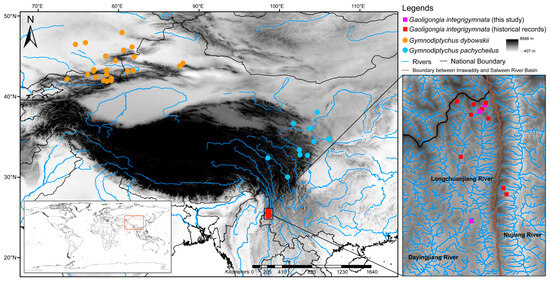
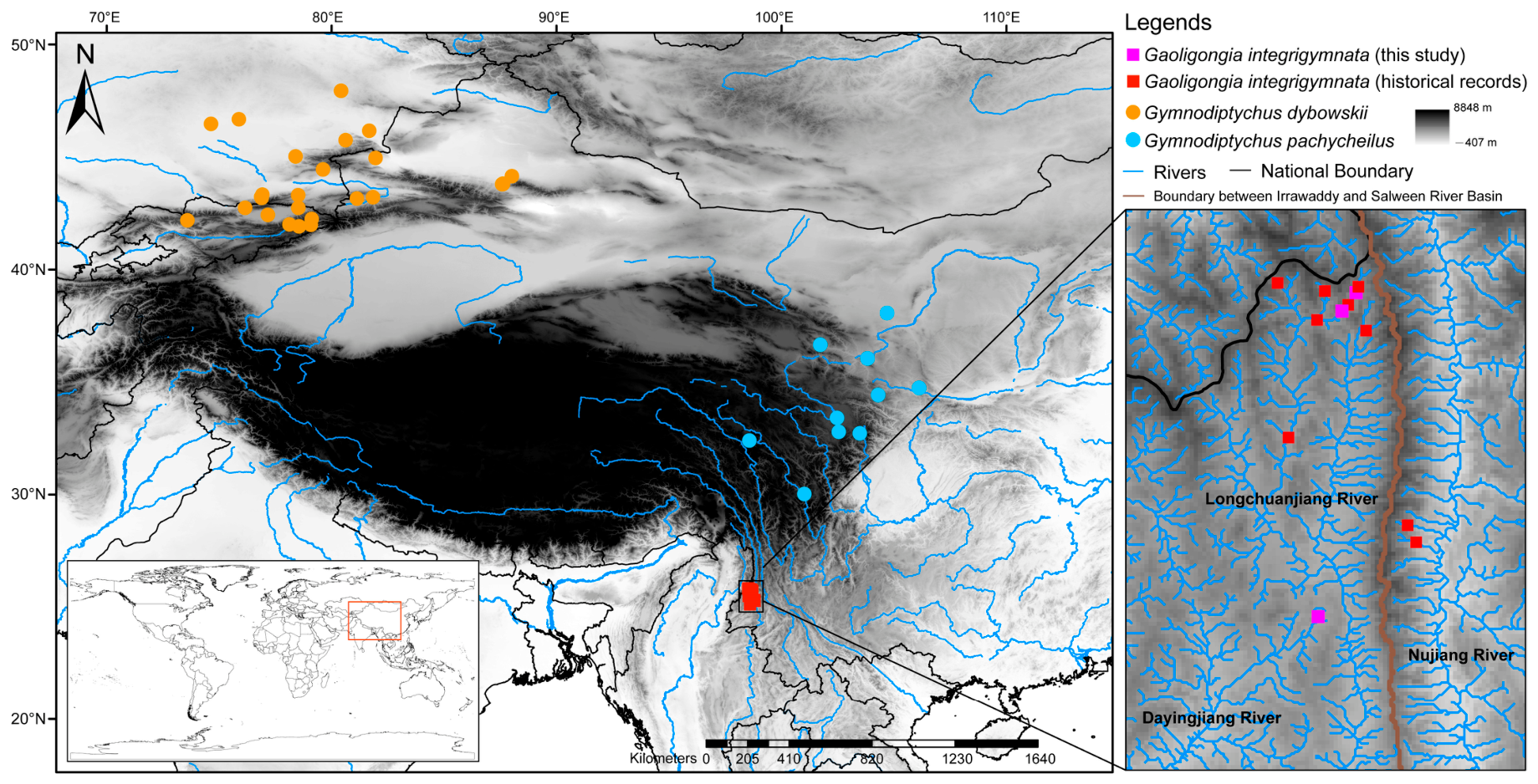
At present, Schizopygopsinae comprises five valid genera: Diptychus Steindachner, 1866, Gymnodiptychus Herzenstein, 1892, Oxygymnocypris Tsao, 1964, Ptychobarbus Steindachner, 1866, and Schizopygopsis. Among them, Gymnodiptychus currently contains three valid species [5]: the type species Gymnodiptychus dybowskii (Kessler, 1874), distributed in Central Asia (Kazakhstan and Kyrgyzstan) and Xinjiang Uyghur Autonomous Region of China; Gymnodiptychus pachycheilus Herzenstein, 1892, distributed in the upper reaches of the Yangtze and Yellow rivers in China; and Gymnodiptychus integrigymnatus Mo, 1989, as an endemic species in Gaoligong Mountain, distributed in the Irrawaddy River basin (upper Longchuanjiang and Dayingjiang rivers), as well as the upper Nujiang River drainage in Yunnan Province, China (Figure 1).
Figure 1.
Distribution records of Gaoligongia integrigymnata, Gymnodiptychus dybowskii, and Gymnodiptychus pachycheilus.
The distribution of Gymnodiptychus species is disjunct: Gymnodiptychus dybowskii is distributed in Central Asia, Xinjiang, and the northwestern Qinghai–Tibet Plateau, Gymnodiptychus pachycheilus occurs in the upper reaches of the Yangtze and Yellow Rivers in the eastern part of the Qinghai–Tibet Plateau, whereas Gymnodiptychus integrigymnatus is restricted to the Gaoligong Mountains region on the southwestern margin of the Qinghai–Tibet Plateau. Such distributional differences may indicate potential taxonomic problems within the group. Early morphological studies based on 41 osteological and external morphological characters supported the monophyly of Gymnodiptychus and suggested a close relationship with Ptychobarbus [6]. With the increasing application of molecular phylogenetics, however, the monophyly of the genus has been repeatedly questioned. He et al. [7], based on phylogenetic analyses of the Cyt b gene, were the first to reveal the non-monophyly of Gymnodiptychus. In that study, Gymnodiptychus integrigymnatus was recovered as more closely related to Schizopygopsis, whereas Gymnodiptychus dybowskii and Gymnodiptychus pachycheilus formed a monophyletic group closely related to Diptychus. Subsequent studies by Yang et al. [8], based on Cyt b and D-loop sequences, and Yang et al. [3], based on three nuclear and three mitochondrial genes, recovered results consistent with those of He et al. [7]. Therefore, the monophyly of Gymnodiptychus and the taxonomic status of Gymnodiptychus integrigymnatus require re-evaluation.
In the present study, we addressed the uncertain monophyly of Gymnodiptychus using an integrative approach combining phylogenetic, morphological, and osteological analyses. Based on mitochondrial genome data, we reassessed the phylogenetic positions of the three currently recognized species of Gymnodiptychus and established a new genus, Gaoligongia gen. nov., to accommodate Gymnodiptychus integrigymnatus, for which a comprehensive redescription is provided. This study offers new insights into the phylogenetic relationships within Schizopygopsinae and provides a taxonomic foundation for understanding the evolutionary mechanisms of this specialized high-altitude adaptive group.
2. Materials and Methods
2.1. Specimen Collection and Examination
A total of 15 specimens of Gaoligongia integrigymnata were collected from tributaries of the upper Longchuanjiang River in Mingguang and Jietou Town, Tengchong City, Yunnan Province, China, and from the Nandi River, an upper tributary of the Dayingjiang River in Beihai Town, Tengchong City (Figure 1). Fish were euthanized with an overdose of clove oil anesthetic, after which the right pectoral fin was removed and preserved in 95% ethanol for molecular analyses. Specimens were subsequently fixed in 10% formalin and later transferred to 75% ethanol for long-term preservation in the Kunming Natural History Museum of Zoology, Kunming Institute of Zoology (KIZ), Chinese Academy of Sciences, Kunming, Yunnan, China. To facilitate comparative morphological examinations, newly collected specimens of Gaoligongia integrigymnata, together with additional museum specimens of the species deposited in KIZ, were examined. Representative specimens of the remaining genera of Schizopygopsinae housed in KIZ were also examined to assess intergeneric morphological variation and diagnostic characters. In addition, morphological characters of some taxa for which specimens were unavailable were obtained from the literature. Terminology for morphological descriptions of schizopygopsine fishes mainly follows Chen & Chen [6]. No statistical analyses of morphometric data were conducted in this study, as the taxonomic conclusions were based primarily on discrete morphological, osteological, and molecular phylogenetic characters used for generic diagnosis and comparison.
2.2. Micro-CT Scanning
Micro-CT scanning of cranial osteological structures was conducted at Shanghai University. Specimens examined included three individuals of Gaoligongia integrigymnata (KIZGLGS05279, KIZGLGS05281, KIZGLGS05282), one individual of Gymnodiptychus dybowskii (KIZ2023000028), and two individuals of Gymnodiptychus pachycheilus (KIZ1982003653, KIZ1982003654). Specimens were scanned using a North Star Imaging system (maximum voltage 225 kV) (North Star Imaging Inc., Rogers, MN, USA) under the following parameters: 110 kV voltage, 80 μA current, 1080 projections, and a resolution range of 17–27 μm per pixel. The scanned images and associated data were processed using VG Studio Max v2.1 software as previously reported [9,10]. Descriptions of cranial osteological characters followed Zhao et al. [11] and Chen & Chen [6].
2.3. Mitochondrial Genome Sequencing, Assembly, and Annotation
One specimen of Gaoligongia integrigymnata was selected for mitochondrial genome sequencing. Total genomic DNA was extracted using the FastPure Cell/Tissue DNA Isolation Mini Kit-BOX (Vazyme Biotech Co., Ltd., Nanjing, China) following the manufacturer’s protocol. The extracted DNA was sequenced by Personalbio Biotechnology Co., Ltd. (Shanghai, China) on the Illumina NovaSeq platform with 2 × 150 bp paired-end reads. The mitochondrial genome was assembled using MitoZ 3.6 [12] with default parameters and subsequently annotated using the online platform MitoAnnotator v2026.06 [13].
2.4. Phylogenetic Analyses and Genetic Distances
For the phylogenetic analysis, we first ensured comprehensive representation of genera and species within Schizopygopsinae and Schizothoracinae. To this end, we downloaded nearly all available mitochondrial genome sequences for these two subfamilies from GenBank. We then conducted representative sampling of the remaining cyprinid subfamilies, generally including two representative species from each subfamily. Finally, a total of 61 mitochondrial genomes of Cyprinidae downloaded from NCBI, together with the newly generated mitochondrial genome in this study, were included as ingroup taxa (Table 1). In addition, two mitochondrial genomes of Psilorhynchidae downloaded from NCBI were selected as outgroups. Thirteen protein-coding genes (PCGs) and two ribosomal RNA genes were included in the analyses. Sequence alignment was conducted separately for each gene using MAFFT v7.505 [14,15] implemented in PhyloSuite v2 [16]. Terminal stop codons of all PCGs were manually removed prior to concatenation, and poorly aligned regions were trimmed using trimAl v1.2 [17]. The concatenated dataset was initially partitioned into 41 data blocks, corresponding to the three codon positions of each of the 13 PCGs (39 partitions) and the two ribosomal RNA genes (2 partitions). The optimal partitioning scheme and substitution models were selected using PartitionFinder v2.1.1 [18] under the corrected Akaike Information Criterion (AICc) using the greedy search. Maximum likelihood (ML) analyses were performed using IQ-TREE v2.2.0 [19], with nodal support assessed by 5000 ultrafast bootstrap replicates [20]. Bayesian inference (BI) analyses were conducted in MrBayes v3.2.7 using two independent runs with four Monte Carlo Markov chains for 10,000,000 generations [21]. Convergence was assessed in Tracer v1.7.1 [22], and all effective sample size (ESS) values exceeded 200. Phylogenetic trees were visualized and edited using iTOL v7.2 [23]. Pairwise genetic distances were calculated in MEGA X v10.2.2 based on the concatenated sequences of the 13 mitochondrial protein-coding genes using the Kimura two-parameter (K2P) model with 1000 bootstrap replicas [24,25]. The K2P model was selected because it accounts for different rates of transitions and transversions and has been widely used in taxonomic and systematic studies of fishes, facilitating comparisons with previously published studies.
Table 1.
Taxa included in the phylogenetic analyses, with GenBank accession numbers, localities and drainage systems. An asterisk indicates that the data were obtained from this study.
2.5. Distribution Mapping
Distribution localities of Gaoligongia integrigymnata, Gymnodiptychus dybowskii, and Gymnodiptychus pachycheilus were compiled from specimens collected in this study and historical records, including examined specimens deposited in the Kunming Institute of Zoology (KIZ), published records (e.g., [1,2]), and occurrence records downloaded from the Global Biodiversity Information Facility (GBIF.org; https://doi.org/10.15468/dl.zehuab, accessed on 25 May 2026). Duplicate records and records lacking reliable locality information were excluded prior to analysis. Distribution maps were generated using ArcMap v10.8 (ESRI, Redlands, California, USA) and the basemap was from the Resource and Environmental Science Data Platform, https://www.resdc.cn/ (accessed on 26 May 2026).
3. Results
3.1. Systematic Account
Family Cyprinidae Rafinesque, 1815
Subfamily Schizopygopsinae Mirza, 1991
Genus Gaoligongia gen. nov.
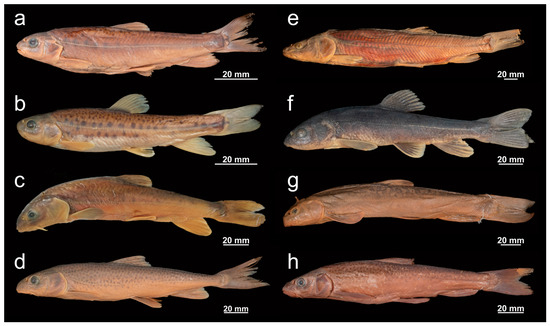
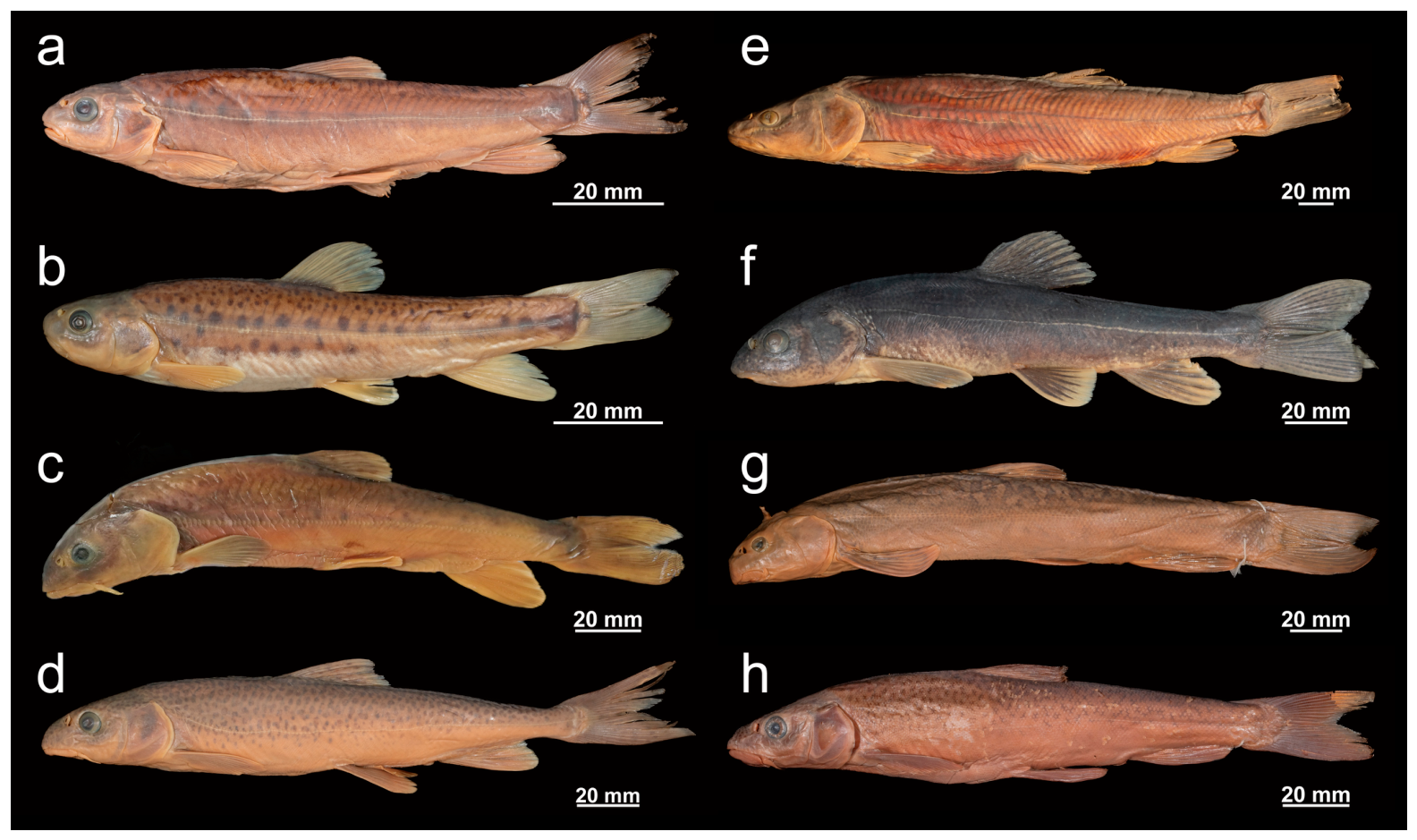
Figure 2.
Lateral views of specimens: (a) Gaoligongia integrigymnata, KIZ1978001384, syntype, 96.2 mm SL, Mingguang Town, Tengchong, Yunnan, China; (b) Gaoligongia integrigymnata, KIZ2003009632, 97.8 mm SL, Tengchong, Yunnan, China; (c) Gymnodiptychus dybowskii, KIZ2023000028, 162.4 mm SL, Yili, Xinjiang, China; (d) Gymnodiptychus pachycheilus, KIZ1982002122, 171.3 mm SL, Hongyuan, Sichuan, China; (e) Oxygymnocypris stewartii, KIZ2023000027, 305.4 mm SL, Lhasa, Xizang, China; (f) Schizopygopsis malacanthus, KIZ2009003260, 171.4 mm SL, Daocheng, Sichuan, China; (g) Diptychus maculatus, KIZ2023000024, 205.4 mm SL, locality unknown; (h) Ptychobarbus conirostris, KIZ1974000329, 160.7 mm SL, Xizang, China.
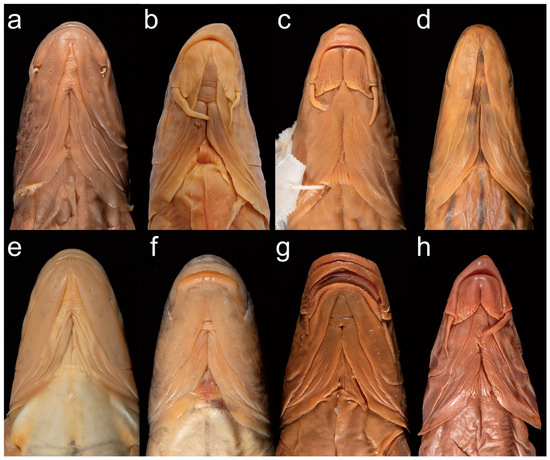
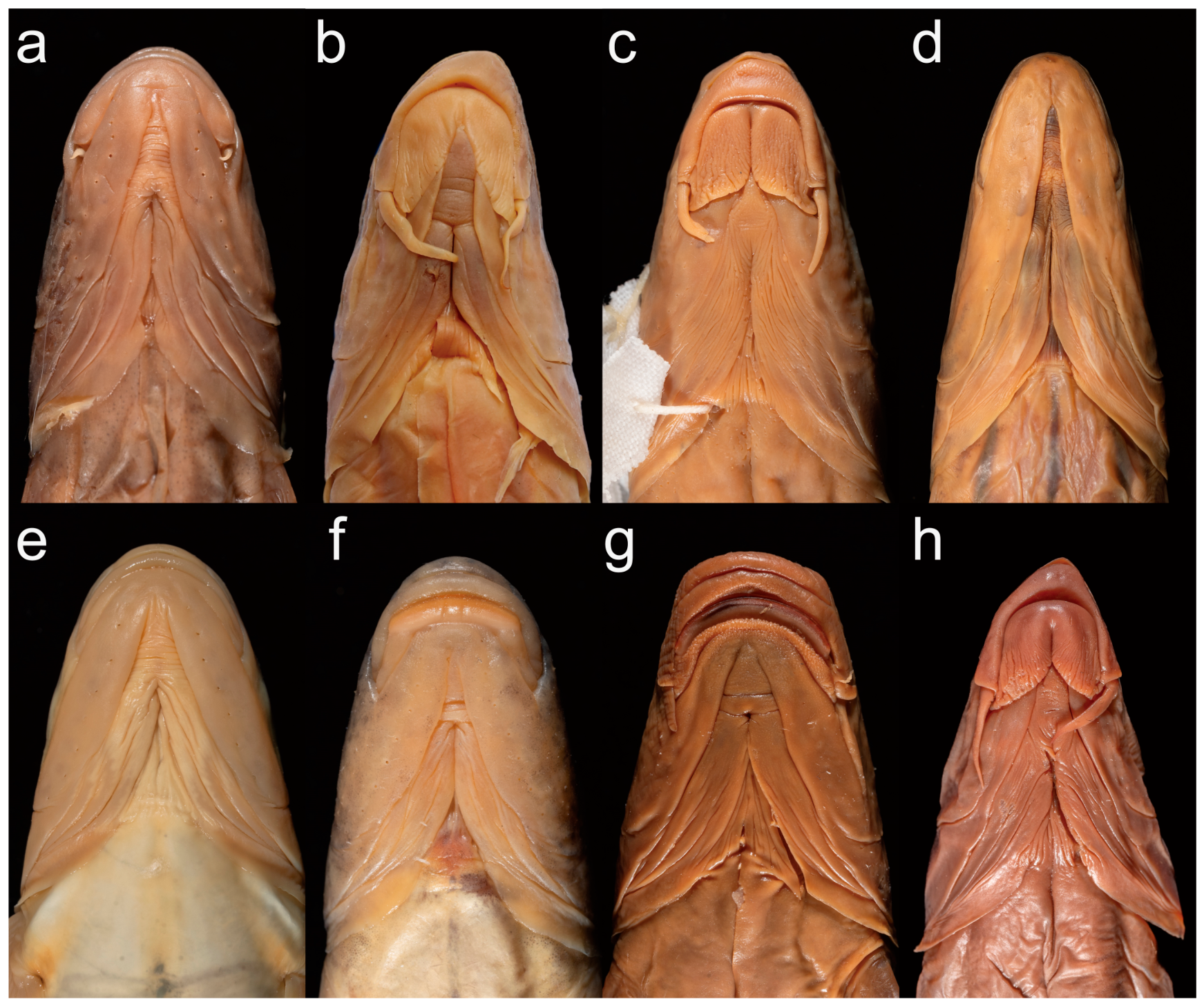
Figure 3.
Ventral views of the head: (a) Gaoligongia integrigymnata, KIZ1978001384, syntype, 96.2 mm SL, Mingguang Town, Tengchong, Yunnan, China; (b) Gymnodiptychus dybowskii, KIZ2023000028, 162.4 mm SL, Yili, Xinjiang, China; (c) Gymnodiptychus pachycheilus, KIZ1982002122, 171.3 mm SL, Hongyuan, Sichuan, China; (d) Oxygymnocypris stewartii, KIZ2023000027, 305.4 mm SL, Lhasa, Xizang, China; (e) Schizopygopsis firmispinata, KIZ2009003608, 167.4 mm SL, Shangri-La, Yunnan, China; (f) Schizopygopsis malacanthus, KIZ2009003260, 171.4 mm SL, Daocheng, Sichuan, China; (g) Diptychus maculatus, KIZ2023000024, 205.4 mm SL, locality unknown; (h) Ptychobarbus conirostris, KIZ1974000329, 160.7 mm SL, Xizang, China.
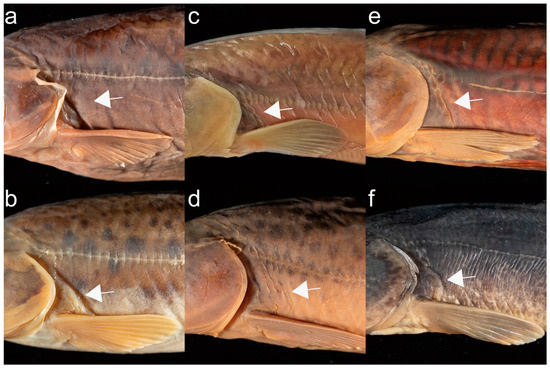
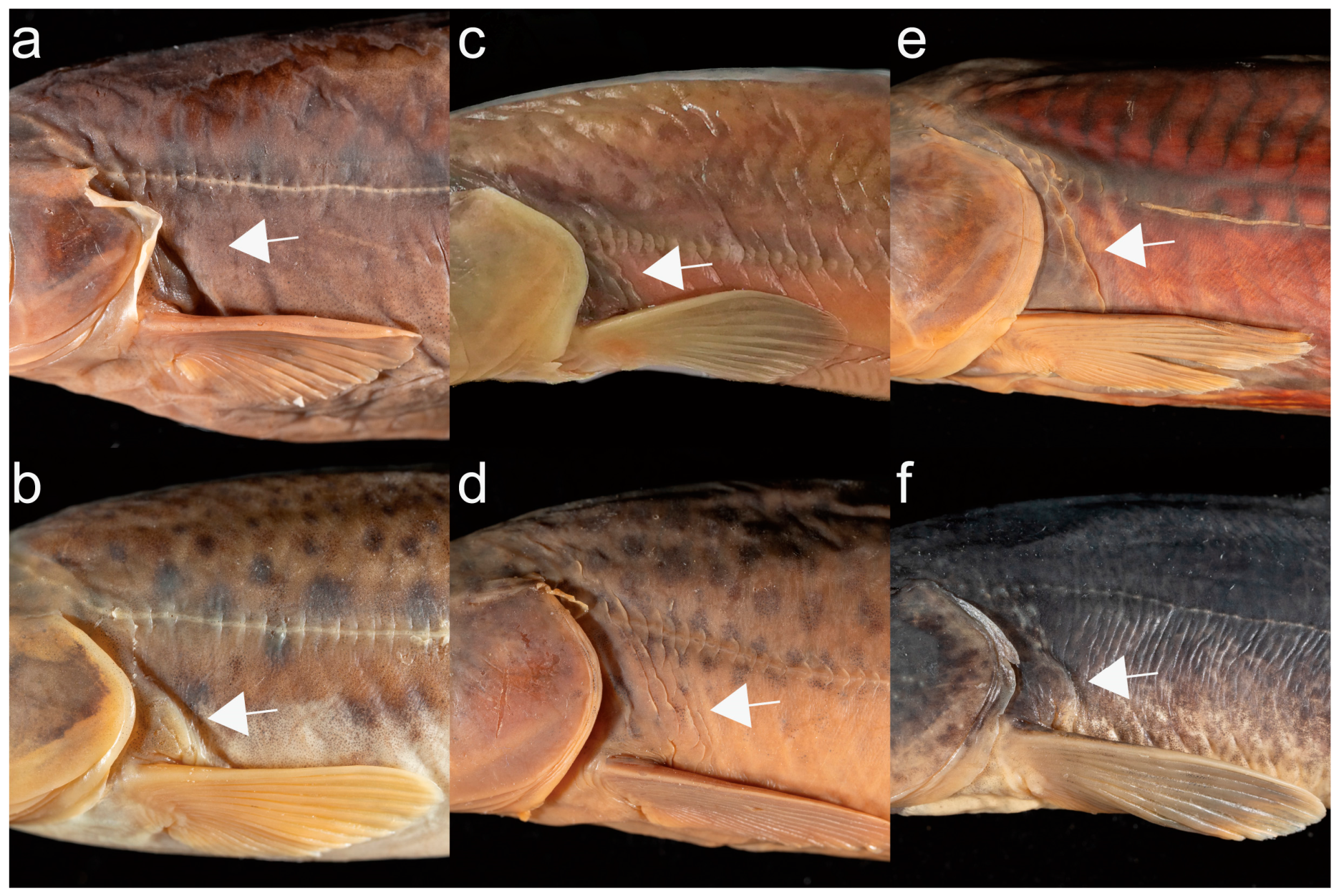
Figure 4.
Squamation in the pectoral girdle region: (a) Gaoligongia integrigymnata, KIZ1978001384, syntype, 96.2 mm SL, Mingguang Town, Tengchong, Yunnan, China; (b) Gaoligongia integrigymnata, KIZ2003009632, 97.8 mm SL, Tengchong, Yunnan, China; (c) Gymnodiptychus dybowskii, KIZ2023000028, 162.4 mm SL, Yili, Xinjiang, China; (d) Gymnodiptychus pachycheilus, KIZ1982002117, 161.9 mm SL, Hongyuan, Sichuan, China; (e) Oxygymnocypris stewartii, KIZ2023000027, 305.4 mm SL, Lhasa, Xizang, China; (f) Schizopygopsis malacanthus, KIZ2009003260, 171.4 mm SL, Daocheng, Sichuan, China. The arrow indicates the position of the pectoral girdle.
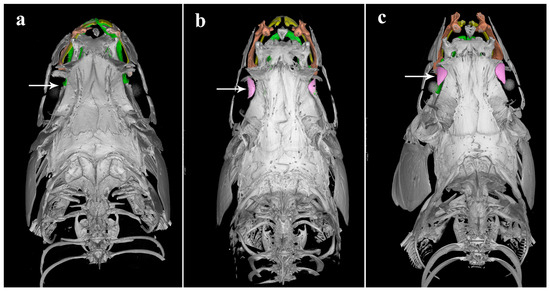
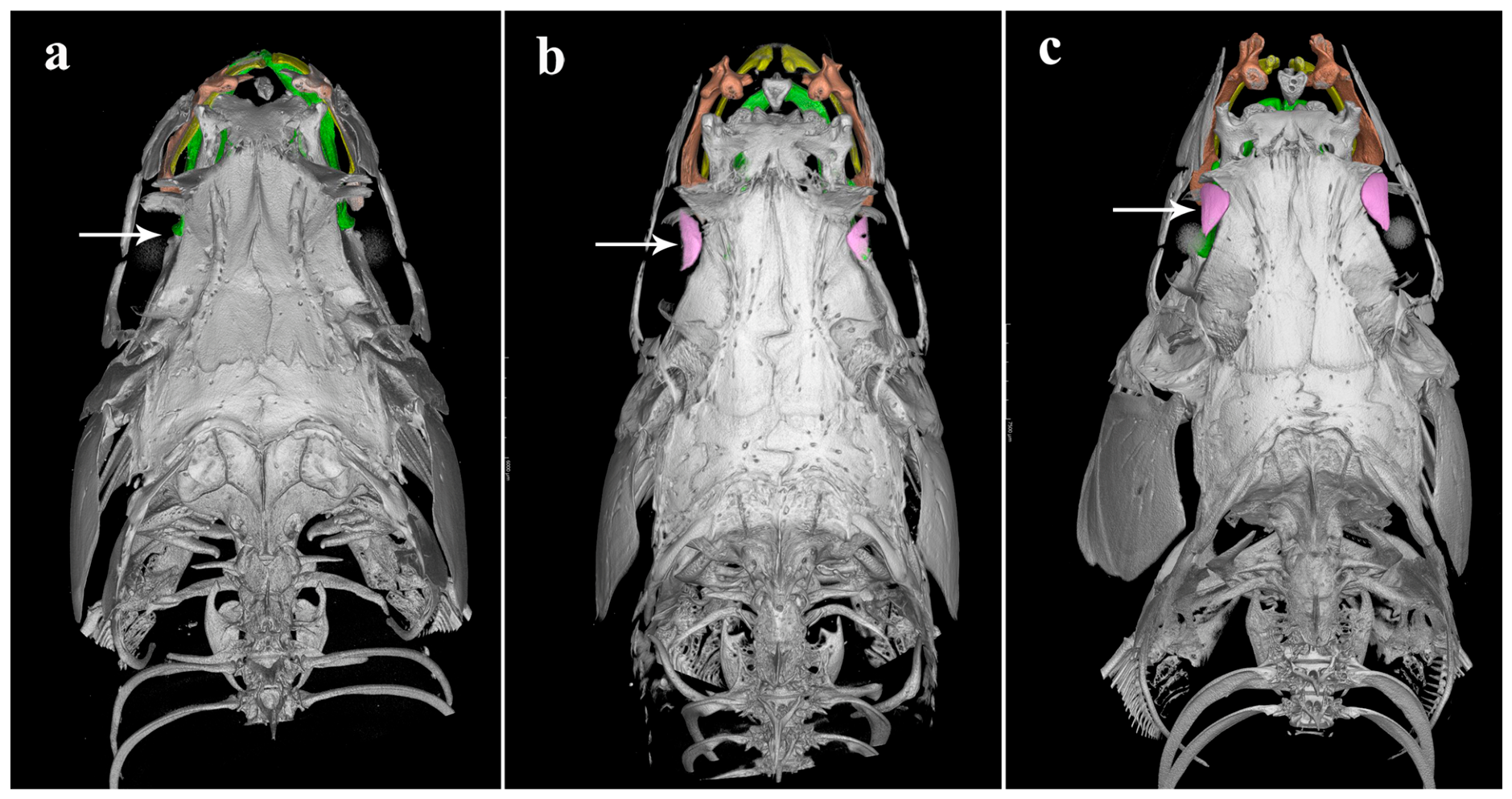
Figure 5.
Dorsal views of cranial osteology reconstructed from micro-CT scans. Dentary, premaxilla, maxilla, and supraorbital are highlighted in green, yellow, brown, and pink, respectively. Arrows indicate the supraorbital bone. (a) Gaoligongia integrigymnata, KIZ05282, 119.1 mm SL, Tengchong, Yunnan, China; (b) Gymnodiptychus dybowskii, KIZ2023000028, 162.4 mm SL, Yili, Xinjiang, China; (c) Gymnodiptychus pachycheilus, KIZ1982003654, 196.3 mm SL, Shiqu, Sichuan, China.
Type species. Gymnodiptychus integrigymnatus Mo, 1989.
Diagnosis. Gaoligongia gen. nov. can be distinguished from other genera of Schizopygopsinae by the following combination of characters: (1) pectoral girdle scales absent (vs. pectoral girdle scales present in Diptychus, Ptychobarbus, Oxygymnocypris, Schizopygopsis and Gymnodiptychus); (2) one pair of extremely reduced barbels, with barbel length less than 25% of eye diameter (vs. barbels absent in Schizopygopsis and Oxygymnocypris; one pair of well-developed barbels equal to or longer than eye diameter in Diptychus, Ptychobarbus, and Gymnodiptychus); (3) mouth terminal (share with Oxygymnocypris vs. inferior in Diptychus, Ptychobarbus, and Gymnodiptychus; inferior or subterminal in Schizopygopsis); (4) anterior margin of lower jaw without a sharp keratinized cutting edge (vs. anterior margin of lower jaw with a sharp keratinized cutting edge in Diptychus; anterior margin of lower jaw with or without a sharp keratinized cutting edge in Schizopygopsis); and (5) supraorbital bone absent (vs. supraorbital bone present in Diptychus, Ptychobarbus, Oxygymnocypris, Schizopygopsis and Gymnodiptychus).
Description. Body elongate, with the anterior portion cylindrical and the posterior portion slightly compressed laterally; dorsal profile elevated and abdomen rounded. Snout rounded and blunt. Mouth terminal, with an arcuate gape. Anterior margin of lower jaw slightly keratinized but not forming a sharp edge. Lower lip weakly developed, divided into two narrow lateral fleshy lobe on both sides of the lower jaw, weakly connected anteriorly. Posterior groove of lower lip interrupted, restricted to the corners of the mouth. One pair of maxillary barbels present, extremely reduced with barbel length less than 25% of eye diameter. Lateral line complete, with only a few anterior lateral-line scales exposed externally, usually less than 20, whereas the remaining lateral-line scales are embedded beneath the skin. Pectoral girdle scales absent. Axillary scales present at the base of pelvic fin. Two rows of anal scales present. Remaining body entirely naked. Dorsal fin iii,8; last unbranched dorsal-fin ray soft and smooth; dorsal-fin origin anterior to pelvic-fin origin. Anal fin iii,5. Two rows of pharyngeal teethw ith pointed and slightly hooked tips and spoon-shaped grinding surfaces; dentition 3.4–4.3. Supraorbital bone absent. Air bladder two-chambered. Body sides densely covered with dark brown spots.
Distribution. This genus is distributed in the upper Longchuanjiang River and upper Dayingjiang River (Irrawaddy River basin) on the western slope of the Gaoligong Mountains, as well as in the Nujiang River drainage on the eastern slope of the Gaoligong Mountains in Yunnan Province, China (Figure 1).
Etymology. Gaoligongia is named after the Gaoligong Mountains, a major mountain range in the Hengduan Mountains region of southwestern China, which represents the known distribution area of this genus. The suffix -ia is a commonly used feminine Latin ending for generic names in zoological nomenclature. The name refers to the endemic occurrence of this lineage in the Gaoligong Mountains region. We propose the Chinese common name “高黎贡鱼属” (Gāo Lí Gòng Yú Shǔ) for this new genus and the Chinese name “全裸高黎贡鱼” (Quán Luǒ Gāo Lí Gòng Yú) for the type species Gaoligongia integrigymnata.
Species included. Gaoligongia integrigymnata (Mo, 1989), comb. nov. (type species).
Remarks. Gaoligongia integrigymnata was originally mentioned in 1981 by Cao et al. [26] as Gymnodiptychus integrigymnatus, with the species name attributed to Shunyou Huang. However, the name was not accompanied by a formal diagnosis and therefore constitutes a nomen nudum under Articles 13.1.1 and 13.1.2 of the International Code of Zoological Nomenclature (ICZN). Subsequently, Mo provided the first available description of the species in 1989 [27], although the authorship was still attributed therein to Huang in Cao et al. [26]. Huang later redescribed the species as Gymnodiptychus integrigymnatus in The Fishes of the Hengduan Mountains Region in 1998 [28]. Yang et al. [29] clarified the nomenclatural history of the taxon and demonstrated that the correct authorship should be Gymnodiptychus integrigymnatus Mo, 1989. They further recognized 13 syntypes deposited in KIZ based on the material examined by Mo [27]. The present study transfers this species to the new genus Gaoligongia gen. nov. based on both molecular phylogenetic and morphological evidence. This new genus is established in accordance with the provisions of Articles 13 and 16 of the International Code of Zoological Nomenclature (ICZN). The species-group name integrigymnatus is herein treated as an adjectival epithet; accordingly, its ending is modified to agree with the feminine gender of the generic name Gaoligongia, resulting in the new combination Gaoligongia integrigymnata (Mo, 1989), comb. nov.
The present study also records Gaoligongia integrigymnata from the Nandi River, an upper tributary of the Dayingjiang River in Tengchong City, Yunnan Province, for the first time, thereby extending the known distribution of the species (Figure 1).
The transfer of Gymnodiptychus integrigymnatus to the new genus Gaoligongia alters the original diagnostic concept of Gymnodiptychus. Consequently, a revised diagnosis and description of Gymnodiptychus are provided below based on the remaining two valid species, Gymnodiptychus dybowskii and Gymnodiptychus pachycheilus.
Genus Gymnodiptychus Herzenstein, 1892
Gymnodiptychus Herzenstein, 1892: 225. Type species: Diptychus dybowskii Kessler, 1874.
Diagnosis. Gymnodiptychus can be distinguished from Gaoligongia gen. nov. by having well-developed maxillary barbels, equal to or longer than eye diameter (vs. extremely reduced maxillary barbels, barbel length less than 25% of eye diameter), an inferior mouth (vs. terminal), supraorbital bones present (vs. absent), and pectoral girdle scales present (vs. absent).
Gymnodiptychus can be further distinguished from other genera of Schizopygopsinae by the following combination of characters: one pair of barbels present (vs. barbels absent in Schizopygopsis and Oxygymnocypris); body largely naked except for lateral-line scales, pectoral girdle scales, anal scales, and axillary pelvic scales (vs. body completely covered with scales on the dorsum and flanks in Diptychus and Ptychobarbus); and anterior margin of lower jaw without a sharp keratinized cutting edge (vs. anterior margin of lower jaw with a sharp keratinized cutting edge in Diptychus; anterior margin of lower jaw with or without a sharp keratinized cutting edge in Schizopygopsis).
Description. Body elongate, anterior portion cylindrical and posterior portion slightly compressed laterally. Mouth inferior, with a horseshoe-shaped gape. Anterior margin of lower jaw lacking a keratinized edge. Lower lip well developed, divided into two lateral fleshy lobes connected anteriorly, smooth and lacking papillae on the surface; posterior groove of lower lip continuous or interrupted. One pair of maxillary barbels present, longer than eye diameter. Lateral line complete, comprising more than 80 scales. Several irregular rows of scales present on the pectoral girdle; axillary scales present at pelvic-fin base; two rows of anal scales present; remaining body naked. Dorsal fin iii,8; last unbranched ray soft and smooth. Anal fin iii,5. Two rows of pharyngeal teeth with slightly hooked tips and spoon-shaped grinding surfaces; dentition 3.4–4.3. Supraorbital bone present. Air bladder two-chambered. Body with numerous spots.
Distribution. This genus is distributed in the upper reaches of the Yangtze and Yellow rivers and Xinjiang Uyghur Autonomous Region in China, as well as in Central Asia (Kazakhstan and Kyrgyzstan) (Figure 1).
Etymology. “Gymno-” comes from the Greek word “gymnós”, meaning naked or bare; “diptychus” refers to the genus Diptychus in which the type species was originally placed. The generic name refers to the reduction of body scales in species of this genus, with the body largely naked except for the lateral-line scales and several specialized scale patches. The generic name in Chinese is “裸重唇鱼属” (Luǒ Chóng Chún Yú Shǔ).
Species included. Gymnodiptychus dybowskii (Kessler, 1874); Gymnodiptychus pachycheilus Herzenstein, 1892.
3.2. Molecular Phylogenetic Analyses
In this study, the mitochondrial genome of Gaoligongia integrigymnata was newly sequenced and assembled as a complete circular molecule with a total length of 17,160 bp. The overall A+T content was 60.0%. The mitogenome contained the full complement of 37 mitochondrial genes, including 13 protein-coding genes (PCGs), 22 transfer RNA genes (tRNAs), and 2 ribosomal RNA genes (rRNAs), together with a control region, indicating a complete mitochondrial genome assembly. The assembled mitochondrial genome sequence and its annotation have been deposited in GenBank under accession number PZ456618.
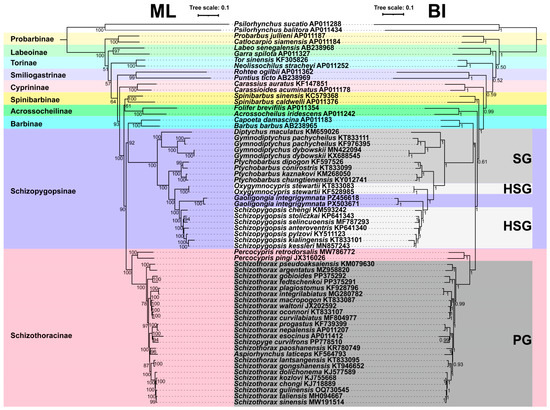
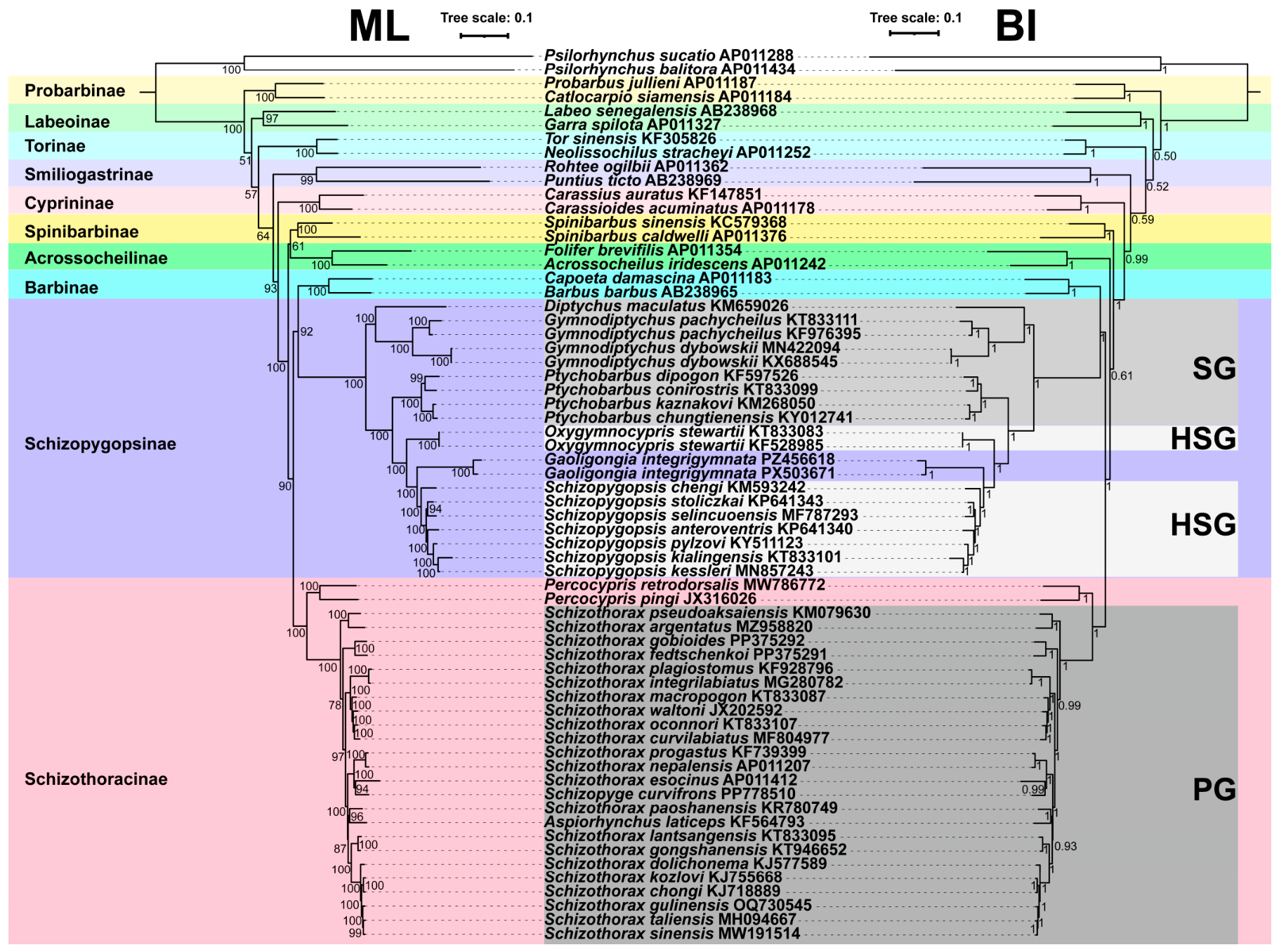
Based on the concatenated dataset of 13 mitochondrial protein-coding genes and two ribosomal RNA genes (14,000 bp in total), phylogenetic analyses were conducted using two sequences from Psilorhynchidae as outgroups and 62 sequences from Cyprinidae as ingroups, including 20 sequences representing 16 species of Schizopygopsinae (Table 1). The optimal partitioning scheme selected by PartitionFinder merged the 41 initial data blocks into 22 partitions (Table A1). Among these, 20 partitions were assigned the GTR+I+G model, whereas one partition was assigned the SYM+I+G model and one partition the HKY+I+G model. Maximum likelihood (ML) and Bayesian inference (BI) trees were reconstructed separately (Figure 6). The topologies of the ML and BI trees were largely congruent. All species of Schizopygopsinae formed a well-supported monophyletic group, which was recovered as sister to Barbinae (maximum-likelihood bootstrap values, BP = 92, Bayesian posterior probabilities, PP = 1); this larger clade was in turn sister to Schizothoracinae (BP = 90, PP = 1). Within Schizopygopsinae, all genera were recovered as monophyletic. Within Gymnodiptychus, the type species Gymnodiptychus dybowskii and Gymnodiptychus pachycheilus formed a clade sister to Diptychus (BP = 100, PP = 1). Within the new genus Gaoligongia, Gaoligongia integrigymnata formed an independent lineage sister to Schizopygopsis (BP = 100, PP = 1).
Figure 6.
Maximum likelihood (left) and Bayesian inference (right) phylogenetic trees reconstructed from the concatenated sequences of 13 mitochondrial protein-coding genes and two ribosomal RNA genes. Taxa representing the Primitive Grade (PG), Specialized Grade (SG), and Highly Specialized Grade (HSG) are indicated by different shades of gray.
We further calculated genetic distances based on the concatenated sequences of the 13 protein-coding genes for all schizopygopsine taxa included in the phylogenetic analyses (Table 2). Within Schizopygopsinae, the average genetic distances among previously recognized genera range from 10.8% to 18.7%. In contrast, the genetic distances between Gaoligongia gen. nov. and the remaining genera range from 12.4% to 20.3%, encompassing and in some cases exceeding the range observed among currently recognized genera. The average genetic distance between Gaoligongia gen. nov. and Gymnodiptychus was 20.1%.
Table 2.
Average genetic distances among genera of Schizopygopsinae based on the K2P model. Values are presented as mean ± SD. Values in parentheses indicate average interspecific genetic distances within genera.
3.3. Key to the Genera of the Subfamily Schizopygopsinae
1a. Dorsum and flanks completely covered with scales ...................................................2
1b. Dorsum and flanks largely naked, scales absent over most of body .........................3
2a. Lower jaw with a sharp keratinized cutting edge .........................................Diptychus
2b. Lower jaw without a sharp keratinized cutting edge .............................Ptychobarbus
3a. Barbels absent ..................................................................................................................4
3b. One pair of barbels present ............................................................................................5
4a. Pelvic-fin origin at or posterior to vertical through dorsal-fin origin, snout not elongate.....................................................................................................................Schizopygopsis
4b. Pelvic-fin origin anterior to vertical through dorsal-fin origin, snout pointed and elongate..................................................................................................................Oxygymnocypris
5a. Pectoral girdle scales present, mouth inferior, supraorbital bone present....................................................................................................................Gymnodiptychus
5b. Pectoral girdle scales absent, mouth terminal, supraorbital bone absent..............................................................................................................Gaoligongia gen. nov.
4. Discussion
In previous studies, Gaoligongia integrigymnata was assigned to Gymnodiptychus primarily because it shares two diagnostic features with that genus: the body is largely naked except for the anal scales and axillary pelvic scales, with only a few scales occasionally present near the pectoral girdle region, and a single pair of maxillary barbels is present (see the keys in [1,27,28,30]). However, the squamation and the length of the barbels also represent the most conspicuous differences between Gaoligongia gen. nov. and Gymnodiptychus. Species of Gymnodiptychus possess several irregular rows of pectoral girdle scales, whereas pectoral girdle scales are completely absent in Gaoligongia gen. nov (Figure 4). In addition, the maxillary barbels of Gaoligongia gen. nov. are extremely reduced and much shorter than the eye diameter, whereas those of Gymnodiptychus are well developed, robust, and distinctly longer than the eye diameter (Figure 3). Apart from these differences, Gaoligongia gen. nov. can be readily distinguished from Gymnodiptychus by its terminal mouth (vs. inferior mouth) (Figure 2) and weakly developed lower-lip lobes (vs. well-developed lower-lip lobes) (Figure 3). Considerable differences in body size are also evident between the two genera. Based on the specimens examined in the present study (see Comparative materials), together with historical records [1,8,27,28,30], adults of Gaoligongia gen. nov. appear to attain a maximum standard length of approximately 129.0 mm and are usually less than 100 mm SL. In contrast, Gymnodiptychus pachycheilus may reach up to 580.0 mm SL, whereas Gymnodiptychus dybowskii can attain 295.0 mm SL [1,2,30]. Based on available field observations and collection records, species of Gaoligongia typically inhabit small headwater streams in mountainous areas, whereas species of Gymnodiptychus are generally associated with larger rivers and lakes. The relatively restricted habitat space and potentially lower food resource availability in headwater environments may have contributed to the smaller body size of Gaoligongia, although this hypothesis requires further ecological investigation. Osteologically, Gaoligongia gen. nov. can be directly distinguished from Gymnodiptychus by the absence of the supraorbital bone (vs. supraorbital bone present) (Figure 5). Collectively, these morphological and osteological differences, together with the phylogenetic evidence presented herein, strongly support the recognition of Gaoligongia as a distinct genus.
The intergeneric relationships within Schizopygopsinae recovered in the present study (Figure 6), as well as the relationships among Schizopygopsinae and other cyprinid subfamilies, are largely congruent with those reported in previous studies (e.g., [3,7,8,31]). This consistency is likely attributable to the widespread use of mitochondrial gene sequences in these analyses. Nevertheless, phylogenetic inference based solely on mitochondrial genomes has inherent limitations, including the potential effects of introgression, incomplete lineage sorting, and mito-nuclear discordance. These issues may be particularly relevant in Schizopygopsinae and related schizothoracine fishes, many of which have undergone polyploidization during their evolutionary history. Future studies incorporating nuclear markers and genome-scale datasets will therefore be essential for further testing the phylogenetic placement of Gaoligongia gen. nov.
Cao et al. [26] divided Schizothoracinae sensu lato (including both Schizothoracinae and Schizopygopsinae as recognized in the present study) into three specialization grades. The Primitive Grade (PG) is characterized by scales covering the entire body or being only partially reduced, three rows of pharyngeal teeth, and two pairs of barbels (occasionally one pair in some genera), and includes Schizothorax, Aspiorhynchus Kessler, 1879, and Schizopyge Heckel, 1847. The Specialized Grade (SG) is characterized by partial or complete scale reduction, two rows of pharyngeal teeth, and one pair of barbels, and includes Diptychus, Ptychobarbus, and Gymnodiptychus. The Highly Specialized Grade (HSG) is characterized by complete scale reduction, two rows of pharyngeal teeth (or one row in some genera), and absence of barbels, and includes Schizopygopsis and Oxygymnocypris. When interpreted in light of the phylogenetic results presented here, the PG taxa form a monophyletic lineage corresponding to Schizothoracinae (Figure 6). Within this lineage, Aspiorhynchus and Schizopyge are nested within Schizothorax. In addition, Percocypris Chu, 1935, a genus only recently assigned to Schizothoracinae [3], possesses scales covering the entire body, three rows of pharyngeal teeth, and two pairs of barbels, and therefore conforms well to the morphological characteristics of the PG. Consequently, Schizothoracinae as currently recognized appears to consist entirely of PG taxa.
In contrast, both SG and HSG taxa are placed within Schizopygopsinae (Figure 6). Phylogenetically, the SG taxa are divided into two distinct lineages. One lineage comprises Diptychus and Gymnodiptychus, whereas the other is represented by Ptychobarbus, which forms the basal branch of a larger clade containing Gaoligongia gen. nov., Oxygymnocypris, and Schizopygopsis. Within Schizopygopsinae, there is an overall trend from SG forms at the base toward increasingly specialized HSG forms in more derived positions. Notably, Gaoligongia gen. nov. exhibits a unique combination of characters. It retains several features typical of SG taxa, including the presence of a pair of maxillary barbels, although these are extremely reduced, and two rows of pharyngeal teeth with a dentition formula of 3.4–4.3. At the same time, it exhibits characters approaching those of HSG taxa, including a more extensive reduction of body scales and the complete loss of pectoral girdle scales. Consequently, Gaoligongia gen. nov. appears to represent an intermediate morphological condition between the Specialized Grade and the Highly Specialized Grade, providing important insights into the evolutionary transition between these two stages.
The evolutionary history and specialization processes of Schizopygopsinae, together with those of the closely related Barbinae and Schizothoracinae, remain highly significant topics for future research. Although substantial progress has been made in recent years (e.g., [32,33,34]), many aspects of the diversification, adaptation, and evolutionary history of these remarkable highland fishes remain poorly understood and warrant further investigation. The restriction of Gaoligongia to the Gaoligong Mountains region, together with its distinct phylogenetic position within Schizopygopsinae, suggests a potentially unique evolutionary history. As a biodiversity hotspot and a major watershed separating the Irrawaddy and Nujiang river systems, the Gaoligong Mountains may have promoted both the diversification and long-term persistence of endemic freshwater fish lineages. However, the historical processes responsible for the origin and isolation of Gaoligongia remain unclear. Future studies incorporating divergence-time estimation and historical biogeographic analyses will be necessary to evaluate the potential influence of regional geological events, including the uplift and drainage reorganization associated with the Qinghai–Tibet Plateau.
5. Comparative Materials
Gaoligongia integrigymnata: China: Irrawaddy River basin: KIZ1976001224–1228, KIZ1978001383–1390, syntype, 13 ex., 73.2–106.6 mm SL, Mingguang Town, Tengchong, Yunnan, 1976 and 1978; KIZ200309627, KIZ200309629–634, KIZ200309639–640, 9 ex., 67.7–99.1 mm SL, Zizhi, Tengchong, Yunnan, 28 September 2003; KIZ2020001544–1552, 9 ex., 31.9–76.8 mm SL, upper Jietou River, Datang Village, Jietou Town, Tengchong, Baoshan, Yunnan, 28 July 2020; KIZ2020000656–0660, 5 ex., 29.7–56.7 mm SL, Kongshu River, Mingguang Town, Tengchong, Baoshan, Yunnan, 26 July 2020; KIZ05282, 1 ex., 119.1 mm SL, Qushi, Tengchong, Baoshan, Yunnan, April 2006; KIZGLGS05279–282, 4 ex., 101.9–122.1 mm SL, Qushi, Tengchong, Baoshan, Yunnan, April 2006; KIZ2025005178, 1 ex., 103.8 mm SL, Nandi River, Beihai Town, Tengchong, Baoshan, Yunnan, 6 January 2026; Nujiang River basin: KIZ200310741–771, 30 ex., 40.6–99.4 mm SL, Manggang River, Baihualing, Baoshan, Yunnan, 7 October 2003; KIZGLGS07378, 1 ex., 119.0 mm SL, Zaotang River, Baihualing, Baoshan, Yunnan, April 2006; KIZGLGS05229–231, 3 ex., 98.9–124.7 mm SL, Manggang River, Baihualing, Baoshan, Yunnan, 25 April 2004; KIZGLGS07358–363, 6 ex., 79.2–110.7 mm SL, Manggang River, Baihualing, Baoshan, Yunnan, April 2006.
Gymnodiptychus dybowskii: China: KIZ2023000028, 1 ex., 162.4 mm SL, Yili, Xinjiang, 2006.
Gymnodiptychus pachycheilus: China: KIZ1982003653–3654, 2 ex., 176.4–196.3 mm SL, Juewu Monastery, Shiqu County, Sichuan, 8 September 1982; KIZ2010000268, 1 ex., 79.3 mm SL, locality unknown, 28 January 2010; KIZ1982002115–2133, 19 ex., 73.7–214.9 mm SL, Hongyuan County, Sichuan, 1982.
Ptychobarbus conirostris: China: KIZ1974000329, 1 ex., 160.7 mm SL, Shiquan River, Xizang, July 1974.
Schizopygopsis firmispinata: China: KIZ2009003608–3609, 2 ex., 74.2–167.4 mm SL, Jinsha River, Tuoding, Shangri-La, Yunnan, 19 September 2009.
Schizopygopsis malacanthus: China: KIZ2009003257–3271, 15 ex., 121.8–183.0 mm SL, Mudaocheng River, Daocheng County, Sichuan, 15 September 2009.
Diptychus maculatus: China: KIZ2023000024, KIZ2023000018, KIZ2023000022, 3 ex., 182.8–232.8 mm SL, locality and date unknown.
Oxygymnocypris stewartii: China: KIZ2023000027, 1 ex., 305.4 mm SL, Lhasa, Xizang, 2015.
Author Contributions
Conceptualization, S.-W.L., D.-K.H. and X.-Y.C.; Methodology, C.-X.L., Y.H., D.-K.H. and X.-Y.C.; Software, C.-X.L. and Y.H.; Formal analysis, C.-X.L., L.-L.X. and Y.H.; Investigation, C.-X.L., S.-W.L., L.-L.X. and Y.H.; Resources, C.-X.L., S.-W.L., Y.H., D.-K.H. and X.-Y.C.; Data curation, C.-X.L. and L.-L.X.; Writing—original draft, C.-X.L., S.-W.L. and L.-L.X.; Writing—review & editing, C.-X.L., S.-W.L., D.-K.H. and X.-Y.C.; Visualization, C.-X.L., L.-L.X. and Y.H.; Supervision, X.-Y.C.; Funding acquisition, X.-Y.C. All authors have read and agreed to the published version of the manuscript.
Funding
This research was funded by the Second Tibetan Plateau Scientific Expedition and Research Program (2024QZKK0200), the National Key R&D Program of China (2022YFC2602500), the Ministry of Science and Technology of the People’s Republic of China (2021FY100200), and the International Partnership Program of Chinese Academy of Sciences (E1ZK251).
Data Availability Statement
The mitochondrial genome sequenced in this study is available in GenBank under accession number PZ456618.
Acknowledgments
We are very grateful to Sansan Shuai from Shanghai University for the help in performing MicroCT, and to Rui Min from the Kunming Institute of Zoology, Chinese Academy of Sciences, for the help in examining specimens.
Conflicts of Interest
The authors declare no conflicts of interest.
Appendix A
Table A1.
Partitioning scheme and best-fit substitution models selected by PartitionFinder for the mitochondrial dataset used in phylogenetic analyses. Codons 1–3 indicate the first, second, and third codon positions of protein-coding genes, respectively.
References
- Chen, Y.; Cao, W. Schizothoracinae. In Fauna Sinica Osteichthyes Cypriniformes III; Yue, P., Ed.; Science Press: Beijing, China, 2000. [Google Scholar]
- Cao, W. Schizothoracinae. In Cyprinid Fishes of China Volume 1; Wu, X., Ed.; Shanghai Science & Technology Press: Shanghai, China, 1964; pp. 137–197. [Google Scholar]
- Yang, L.; Sado, T.; Vincent Hirt, M.; Pasco-Viel, E.; Arunachalam, M.; Li, J.; Wang, X.; Freyhof, J.; Saitoh, K.; Simons, A.M.; et al. Phylogeny and Polyploidy: Resolving the Classification of Cyprinine Fishes (Teleostei: Cypriniformes). Mol. Phylogenet. Evol. 2015, 85, 97–116. [Google Scholar] [CrossRef] [Scilit] [PubMed]
- Tan, M.; Armbruster, J.W. Phylogenetic Classification of Extant Genera of Fishes of the Order Cypriniformes (Teleostei: Ostariophysi). Zootaxa 2018, 4476, 6–39. [Google Scholar] [CrossRef] [Scilit] [PubMed]
- Fricke, R.; Eschmeyer, W.N.; Van der Laan, R. Eschmeter’s Catalog of Fishes: Genera, Species, References. Available online: http://researcharchive.calacademy.org/research/ichthyology/catalog/fishcatmain.asp (accessed on 3 April 2026).
- Chen, Z.; Chen, Y. Phylogeny of the Specialized Schizothoracine Fishes (Teleostei: Cypriniformes: Cyprinidae). Zool. Stud. 2001, 40, 147–157. [Google Scholar]
- He, D.; Chen, Y.; Chen, Y.; Chen, Z. Molecular Phylogeny of the Specialized Schizothoracine Fishes (Teleostei: Cyprinidae), with Their Implications for the Uplift of the Qinghai-Tibetan Plateau. Chin. Sci. Bull. 2004, 49, 39–48. [Google Scholar] [CrossRef]
- Yang, J.; Chen, X.; Yang, J. Molecular and Morphological Analysis of Endangered Species Gymnodiptychus integrigymnatus (Teleostei: Cyprinidae). Environ. Biol. Fish. 2010, 88, 189–199. [Google Scholar] [CrossRef] [Scilit]
- He, Y.; Berra, T.M.; Wedd, D. A Microtomographic Osteology of the Supraoccipital Hook of Nurseryfish, Kurtus gulliveri (Perciformes: Kurtidae). Copeia 2016, 104, 897–906. [Google Scholar] [CrossRef] [Scilit]
- He, Y.; Chen, X.; Xiao, T.; Yang, J. Three-Dimensional Morphology of the Sinocyclocheilus hyalinus (Cypriniformes: Cyprinidae) Horn Based on Synchrotron X-Ray Microtomography. Zool. Res. 2013, 34, E128–E134. [Google Scholar]
- Zhao, H.; Chen, Y.; Hu, S.; Xiao, L.; Zhu, L. Comparative Study on the Skeletal System of Schizothorax kozlovi and Schizothorax grahami. J. Anhui Agric. Univ. 2011, 39, 13848–13853, 13873. [Google Scholar]
- Meng, G.; Li, Y.; Yang, C.; Liu, S. MitoZ: A Toolkit for Animal Mitochondrial Genome Assembly, Annotation and Visualization. Nucleic Acids Res. 2019, 47, e63. [Google Scholar] [CrossRef] [Scilit] [PubMed]
- Zhu, T.; Sato, Y.; Sado, T.; Miya, M.; Iwasaki, W. MitoFish, MitoAnnotator, and MiFish Pipeline: Updates in 10 Years. Mol. Biol. Evol. 2023, 40, msad035. [Google Scholar] [CrossRef] [Scilit] [PubMed]
- Katoh, K.; Standley, D.M. MAFFT Multiple Sequence Alignment Software Version 7: Improvements in Performance and Usability. Mol. Biol. Evol. 2013, 30, 772–780. [Google Scholar] [CrossRef] [Scilit] [PubMed]
- Katoh, K.; Misawa, K.; Kuma, K.; Miyata, T. MAFFT: A Novel Method for Rapid Multiple Sequence Alignment Based on Fast Fourier Transform. Nucleic Acids Res. 2002, 30, 3059–3066. [Google Scholar] [CrossRef] [Scilit] [PubMed]
- Zhao, D.; Ye, T.; Gao, F.; Jakovlić, I.; La, Q.; Tong, Y.; Liu, X.; Song, R.; Liu, F.; Lian, Z.; et al. PhyloSuite v2: The Development of an All-in-one, Efficient and Visualization-oriented Suite for Molecular Dating Analysis and Other Advanced Features. iMeta 2025, 4, e70095. [Google Scholar] [CrossRef] [Scilit] [PubMed]
- Capella-Gutiérrez, S.; Silla-Martínez, J.M.; Gabaldón, T. trimAl: A Tool for Automated Alignment Trimming in Large-Scale Phylogenetic Analyses. Bioinformatics 2009, 25, 1972–1973. [Google Scholar] [CrossRef] [Scilit] [PubMed]
- Lanfear, R.; Frandsen, P.B.; Wright, A.M.; Senfeld, T.; Calcott, B. PartitionFinder 2: New Methods for Selecting Partitioned Models of Evolution for Molecular and Morphological Phylogenetic Analyses. Mol. Biol. Evol. 2016, 34, 772–773. [Google Scholar] [CrossRef] [Scilit] [PubMed]
- Minh, B.Q.; Schmidt, H.A.; Chernomor, O.; Schrempf, D.; Woodhams, M.D.; Von Haeseler, A.; Lanfear, R. IQ-TREE 2: New Models and Efficient Methods for Phylogenetic Inference in the Genomic Era. Mol. Biol. Evol. 2020, 37, 1530–1534. [Google Scholar] [CrossRef] [Scilit] [PubMed]
- Minh, B.Q.; Nguyen, M.A.T.; Von Haeseler, A. Ultrafast Approximation for Phylogenetic Bootstrap. Mol. Biol. Evol. 2013, 30, 1188–1195. [Google Scholar] [CrossRef] [Scilit] [PubMed]
- Ronquist, F.; Teslenko, M.; Van Der Mark, P.; Ayres, D.L.; Darling, A.; Höhna, S.; Larget, B.; Liu, L.; Suchard, M.A.; Huelsenbeck, J.P. MrBayes 3.2: Efficient Bayesian Phylogenetic Inference and Model Choice Across a Large Model Space. Syst. Biol. 2012, 61, 539–542. [Google Scholar] [CrossRef] [Scilit] [PubMed]
- Rambaut, A.; Drummond, A.J.; Xie, D.; Baele, G.; Suchard, M.A. Posterior Summarization in Bayesian Phylogenetics Using Tracer 1.7. Syst. Biol. 2018, 67, 901–904. [Google Scholar] [CrossRef] [Scilit] [PubMed]
- Letunic, I.; Bork, P. Interactive Tree of Life (iTOL) v6: Recent Updates to the Phylogenetic Tree Display and Annotation Tool. Nucleic Acids Res. 2024, 52, W78–W82. [Google Scholar] [CrossRef] [Scilit] [PubMed]
- Kimura, M. A Simple Method for Estimating Evolutionary Rates of Base Substitutions through Comparative Studies of Nucleotide Sequences. J. Mol. Evol. 1980, 16, 111–120. [Google Scholar] [CrossRef] [Scilit] [PubMed]
- Kumar, S.; Stecher, G.; Li, M.; Knyaz, C.; Tamura, K. MEGA X: Molecular Evolutionary Genetics Analysis across Computing Platforms. Mol. Biol. Evol. 2018, 35, 1547–1549. [Google Scholar] [CrossRef] [Scilit] [PubMed]
- Cao, W.; Chen, Y.; Wu, Y.; Zhu, S. Origin and Evolution of Schizothoracinae Fishes in Relation to the Upheaval of the Qinghai-Xizang Plateau. In Collection in Studies on the Period, Amplitude and Type of the Uplift of the Qinghai-Xizang Plateau; The Team of the Comprehensive Scientific Expedition to the Qinghai-Xizang Plateau, Chinese Academy of Sciences, Ed.; Science Press: Beijing, China, 1981; pp. 118–130. [Google Scholar]
- Mo, T. Schizothoracinae. In The fishes of Yunnan. Part I; Chu, X., Chen, Y., Eds.; Science Press: Beijing, China, 1989; pp. 286–321. [Google Scholar]
- Chen, Y.; Huang, S. Schizothoracinae. In The Fishes of the Hengduan Mountains Region; Chen, Y., Ed.; Science Press: Beijing, China, 1998; pp. 183–245. [Google Scholar]
- Yang, J.; Chen, X.; Yang, J. Clarification of the Nomenclatural Status of Gymnodiptychus integrigymnatus (Cypriniformes, Cyprinidae). Zootaxa 2008, 1897, 67–68. [Google Scholar] [CrossRef] [Scilit]
- Wu, Y.; Wu, C. The Fishes of the Qinghai-Xizang Plateau; Sichuan Publishing House of Science & Technology: Chengdu, China, 1992. [Google Scholar]
- Li, Y.; Luo, Y.; Lv, Y.; Ou, Y.; Zhang, R.; Zhang, R. A Novel Mitochondrial Genome Resource for the Endemic Fish Gymnodiptychus integrigymnatus and Insights into the Phylogenetic Relationships of Schizothoracinae. Biology 2025, 14, 1760. [Google Scholar] [CrossRef] [Scilit] [PubMed]
- Tang, Y.; Li, C.; Wanghe, K.; Feng, C.; Tong, C.; Tian, F.; Zhao, K. Convergent Evolution Misled Taxonomy in Schizothoracine Fishes (Cypriniformes: Cyprinidae). Mol. Phylogenet. Evol. 2019, 134, 323–337. [Google Scholar] [CrossRef] [Scilit] [PubMed]
- Li, X.; Wang, M.; Zou, M.; Guan, X.; Xu, S.; Chen, W.; Wang, C.; Chen, Y.; He, S.; Guo, B. Recent and Recurrent Autopolyploidization Fueled Diversification of Snow Carp on the Tibetan Plateau. Mol. Biol. Evol. 2024, 41, msae221. [Google Scholar] [CrossRef] [Scilit] [PubMed]
- Xie, C.; Ma, Z.; Zhou, C.; Ma, K.; Wang, H.; Wu, J.; Zhou, Y.; Lu, Y.; Ji, D.; Gu, X.; et al. Chromosomal Fusions Trigger Rediploidization of Autopolyploid Genomes. Nature 2026, 654, 706–713. [Google Scholar] [CrossRef] [Scilit] [PubMed]

Disclaimer/Publisher’s Note: The statements, opinions and data contained in all publications are solely those of the individual author(s) and contributor(s) and not of MDPI and/or the editor(s). MDPI and/or the editor(s) disclaim responsibility for any injury to people or property resulting from any ideas, methods, instructions or products referred to in the content. |
© 2026 by the authors. Licensee MDPI, Basel, Switzerland. This article is an open access article distributed under the terms and conditions of the Creative Commons Attribution (CC BY) license.