


Abstract
Calcium niobate ceramics were synthesized by the solid-state reaction of seashell-derived CaCO3 and Nb2O5 at a molar ratio of 4:1 over the temperature range of 800–1200 °C for 8 h. This work provides a correlated structural, morphological, and thermophysical characterization of the resulting calcium niobate phases. X-ray diffraction coupled with Rietveld refinement revealed a temperature-dependent phase transformation from a CaNb2O6-rich composition at lower synthesis temperatures to a Ca4Nb2O9-rich material at higher temperatures. At 1200 °C, Ca4Nb2O9 was obtained as the predominant phase (96.16 ± 1.81%), with only a minor Ca2Nb2O7 contribution. This phase evolution was accompanied by an increase in the Ca4Nb2O9 crystallite size from 39.49 ± 0.19 nm at 1000 °C to 50.38 ± 0.24 nm at 1200 °C. SEM analysis showed a concurrent morphological transformation from agglomerated and irregular particles to well-defined elongated and platelet-like particles, indicating enhanced crystallization and grain growth. Thermophysical properties were determined using open photoacoustic cell and laser-flash techniques. Thermal diffusivity ranged from 1.86 to 3.12 × 10⁻⁷ m2 s−1, heat capacity from 0.79 to 1.30 × 10⁴ JK−1 m−3, thermal conductivity from 0.15 to 0.41 Wm−1 K−1, and thermal effusivity from 0.36 to 0.73 kWs1/2 m−2 K−1. The combined results establish a clear synthesis–structure–property relationship and identify the Ca4Nb2O9-rich ceramic obtained at 1200 °C as a promising low-thermal-conductivity material. The use of seashell waste additionally provides a renewable calcium precursor for the synthesis.
1. Introduction
Calcium niobate ceramics are best known for their dielectric [1,2,3], piezoelectric [4,5,6], and luminescent [7,8,9] properties, making them suitable candidates for applications in advanced technologies such as 5G wireless communication. These compounds belong to the CaO–Nb2O5 system, and their most common thermodynamically stable phases correspond to CaNb2O6, Ca2Nb2O7, Ca3Nb2O8, and Ca4Nb2O9 [10].
Conventionally, calcium niobate ceramics are synthesized via solid-state reaction between calcium carbonate (CaCO3) and niobium pentoxide (Nb2O5) at temperatures above 800 °C, typically using highly pure, commercially available precursor powders for optical-electronic applications [3,4,5,6,7,8,9,10]. However, a more sustainable route for its synthesis was first reported by Kamkum et al. [11], demonstrating the feasibility of using chicken eggshell waste as an alternative source of CaCO3 to produce calcium niobate ceramics. Ca4Nb2O9 and CaNb2O6 could be successfully synthesized without any residual precursors, achieving dielectric properties comparable to those of conventionally synthesized calcium niobate [1,11]. Alternatively, Alves et al. [12] developed an eco-friendly biphasic calcium niobate (Ca4Nb2O9/Ca2Nb2O7) using seashell waste as a low-cost alternative source of calcium.
Seashell waste is a highly pure natural source of calcium carbonate with a composition as high as 95% [13]. This type of solid waste is commonly improperly discarded in landfills or the sea, leading to environmental issues such as disease-vector proliferation and seabed erosion [13,14]. This is of significant concern in countries with high seafood consumption, such as Brazil, where approximately 13,000 tons of seashell waste are generated annually and there is a lack of waste management [15,16,17]. Some recent research has pointed out the possibilities of tackling this problem by repurposing this material in the production of concrete [14,18], polypropylene composites [19], fireproofing material [20], and dielectric ceramics [12]. However, a better understanding of their properties after synthesis is required to guarantee industrial standards.
In the case of calcium niobate ceramics, distinct structural differences have been reported when two different high-calcium-carbonate waste sources are used. While single-phase calcium niobate was achieved by Kamkum et al. [1,11] using chicken eggshell waste, Alves et al. [12] reported a biphasic calcium niobate (Ca4Nb2O9/Ca2Nb2O7) under the same synthesis conditions. This indicates that the phase transformation from aragonite to calcite before calcium carbonate decomposition may have influenced the synthesis kinetics, promoting the formation of one phase over the other. However, no study has yet systematically investigated the phase transformations occurring during the solid-state synthesis of seashell waste-derived calcium niobate ceramics. Also, biphasic calcium niobate ceramics are rarely found in the literature, revealing a gap to be investigated towards their characterization, once the combination of two different phases may improve overall performance as seen in some composites [21,22,23].
Although calcium niobate ceramics are characterized by their dielectric properties for wireless communication [1,2,3,4], Passalini et al. [24] demonstrated that calcium niobate from dolomitic marble waste also exhibits low thermal diffusivity and thermal conductivity, thereby qualifying its application as a thermal insulator. Its structural analysis revealed a complex multiphase ceramic composed of CaNb2O6, Ca2Nb2O7, MgNb2O6, and CaMg0.33Nb0.67O3, which was classified as a ceramic composite [24]. Similarly, Soares et al. [25] synthesized calcium niobate from lime mud waste using a 4:1 CaCO3/Nb2O5 formulation and obtained a Ca4Nb2O9-rich triphasic ceramic at 1100 °C, comprising Ca4Nb2O9 (74.6%), Ca2Nb2O7 (15.2%), and CaNb2O6 (10.2%). The study also reported room temperature thermal diffusivity (7.8 × 10⁻⁶ m2 s−1), volumetric heat capacity (0.953 × 10⁶ Jm−3 K−1), thermal conductivity (7.4 Wm−1 K−1), and thermal effusivity (2666 Ws1/2 m−2 K−1), highlighting the limited but growing thermophysical data for waste-derived calcium niobate ceramics.
Despite increasing interest in calcium niobate ceramics, the relationships among synthesis temperature, phase evolution, microstructure, and thermophysical behavior remain insufficiently understood, particularly for multiphase compositions. Detailed structural characterization is needed to clarify the formation and stabilization of calcium niobate phases and to establish how these transformations affect crystallite development, particle morphology, and thermal transport properties.
In this study, seashell waste is used as an alternative calcium carbonate precursor for the synthesis of calcium niobate ceramics. Building on previously reported preliminary results [12], the present work investigates samples synthesized at 800–1200 °C using X-ray diffraction with Rietveld refinement, scanning electron microscopy, and thermophysical measurements. The resulting data establish temperature-dependent phase fractions, crystallite sizes, morphological transformations, and thermal properties, thereby clarifying the synthesis–structure–property relationship of calcium niobate ceramics. These findings provide a basis for future assessment of calcium niobate as a low-thermal-conductivity ceramic and for subsequent studies addressing the economic and environmental feasibility of waste-derived precursors.
2. Materials and Methods
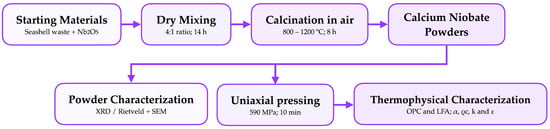
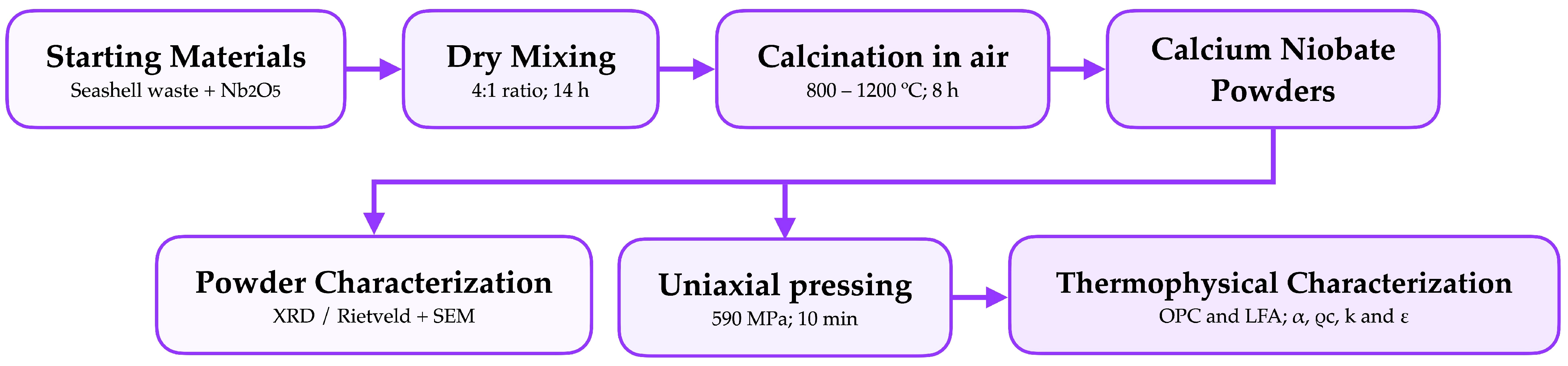
Figure 1 displays the experimental design of this study. The synthesis of seashell waste-derived calcium niobate was conducted through a solid-state reaction between seashell waste powder, as a source of calcium carbonate in the form of aragonite, and high-purity commercial niobium pentoxide, Nb2O5 (99.9%, Sigma-Aldrich, St. Louis, MO, USA), at a weight ratio of 4:1. A Perna-perna seashell waste sample was collected from commercial activities in southeastern Brazil. The seashell waste sample was cleaned to remove organic matter, dry ground into a powder (<325 mesh; <44 μm), and chemically analyzed by X-ray fluorescence spectrometry (XRF) using an Axios Max spectrometer (Malvern Panalytical B.V., Almelo, The Netherlands). The analysis yielded 54.653 wt.% CaO equivalent and 43.905 wt.% loss on ignition, indicating a calcium-rich and carbonate-rich precursor.
Figure 1.
Simplified experimental workflow for the synthesis and characterization of calcium niobate powders derived from seashell waste.
The starting formulation, consisting of seashell waste powder (CaCO3) and as-received Nb2O5 at a 4:1 mass ratio, was dry mixed using a cylindrical laboratory mixer for 14 h to promote uniform mixing before calcination, following procedures reported previously by Kamkum et al. [1,11], Passaline et al. [24], and Soares et al. [25]. The powder mixture was calcinated at 800 °C, 900 °C, 1000 °C, 1100 °C, and 1200 °C, for 8 h in a muffle furnace under an air atmosphere. The synthesized calcium niobate (CN) powders were analyzed via X-ray powder diffraction (XRD) using an X’Pert Pro X-ray diffractometer (PANalytical B.V., Almelo, The Netherlands) with Cu Kα1 radiation (λ = 0.1540560 nm) in Bragg–Brentano geometry, with a 2θ range from 15° to 60°. This angular interval was selected to include the principal diffraction reflections of the calcium niobate phases investigated. The diffraction peaks were identified by their JCPDS–ICDD patterns. Rietveld refinements were obtained through the software FullProf Suite (FullProf4Mac_v330). The average crystallite size was estimated from the Scherrer equation using the software PCrystalX (version 1.0, 2026). The powder morphology was observed using a scanning electron microscope (Shimadzu model SSX-550, Kyoto, Japan) in secondary electron mode.
For thermophysical characterization, the as-synthesized calcium niobate powders were uniaxially pressed at approximately 590 MPa for 10 min using a 13 mm diameter die. The resulting pellet thicknesses ranged from 200 to 310 μm. No sintering treatment was applied after pressing. Therefore, the measured thermophysical properties reflect the effective behavior of as-pressed powder compacts.
Thermal diffusivity was experimentally determined from the photoacoustic technique with an open photoacoustic cell (OPC). The specific heat capacity (ρc) was determined using Laser Flash Analysis (LFA). Thermal conductivity was determined according to Equation (1), where k is the thermal conductivity, α is the thermal diffusivity, and ρc is the specific heat capacity. Thermal effusivity () was calculated as described by Equation (2) [26,27]. The experimental measurements of thermal diffusivity and specific heat capacity were repeated three times in each sample to improve accuracy.
3. Results and Discussion
3.1. Structural Analysis
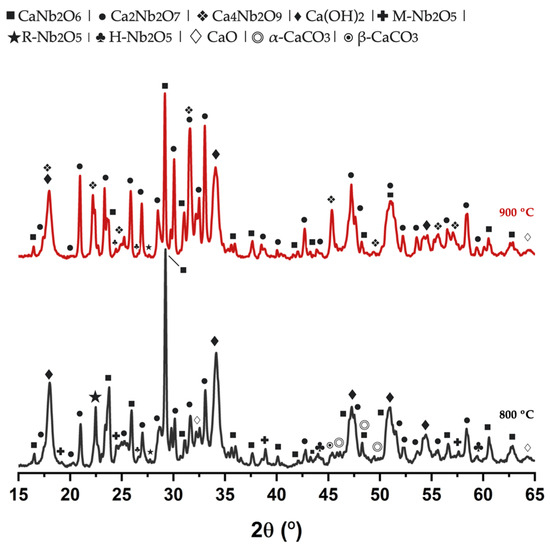
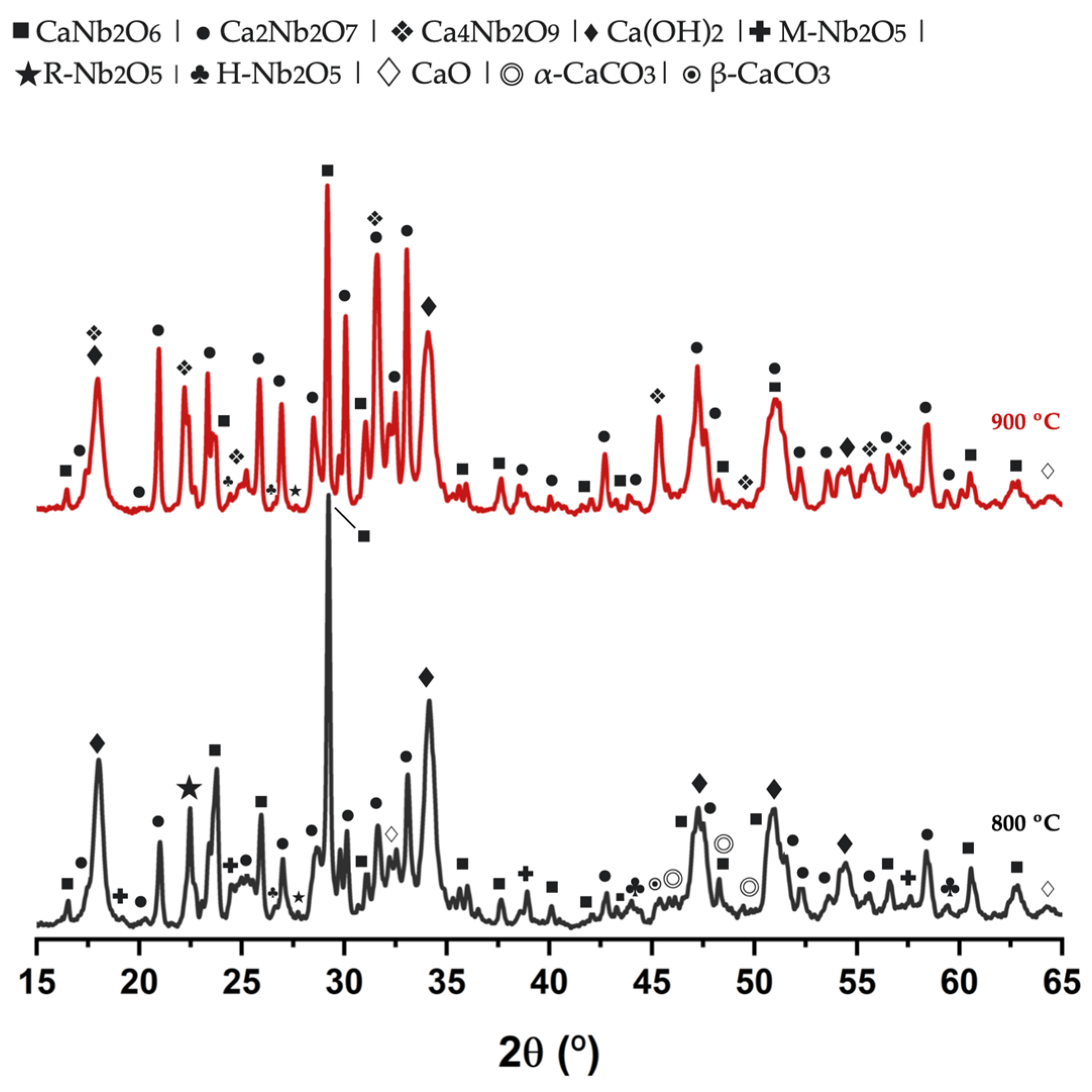
Figure 2 presents the XRD patterns of the calcium niobate ceramic calcined at 800 °C and 900 °C. Two distinct phases of calcium niobate were indexed at 800 °C: CaNb2O6 (01–071-2406) and Ca2Nb2O7 (PDF: 01–074-0390). The highest-intensity peak located at 29.19° is attributed to CaNb2O6. The target phase of the formulation, Ca4Nb2O9, was not identified. At these lower temperatures, the synthesis was not sufficient to produce a ceramic entirely composed of calcium niobate phases, as traces of unreacted seashell waste and Nb2O5 were detected. The presence of CaCO3 and CaO indicates the decomposition of aragonite into calcite, followed by the formation of CaO. Calcium oxide can react with water and form Ca(OH)2 (PDF: 01–072-0156). Nb2O5 high-temperature polymorphs were also detected in the XRD at 800 °C, i.e., M-Nb2O5 (PDF: 01–072-1484) and R-Nb2O5 (PDF: 01–074-0312).
Figure 2.
XRD patterns of seashell waste-derived CN ceramic calcined at 800 °C and 900 °C.
At 900 °C, Ca4Nb2O9 (PDF: 01–070-5420) was first detected. It was observed that most of the peaks associated with Ca4Nb2O9 appear conjoined or overlapping with peaks of other calcium-based phases, such as Ca(OH)2 and CaO. Although the highest-intensity peak at 900 °C still corresponds to the CaNb2O6 phase, an increase in the intensity of peaks associated with the Ca2Nb2O7 phase was noted. No traces of seashell waste were identified, either in the form of aragonite or calcite at 900 °C. Traces of the Nb2O5 were still detectable at 900 °C.
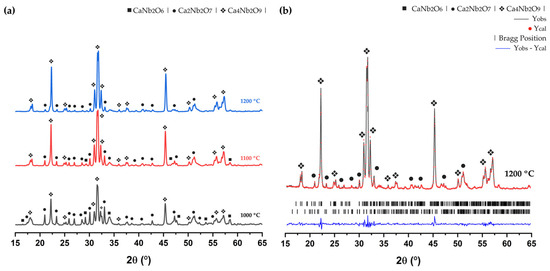
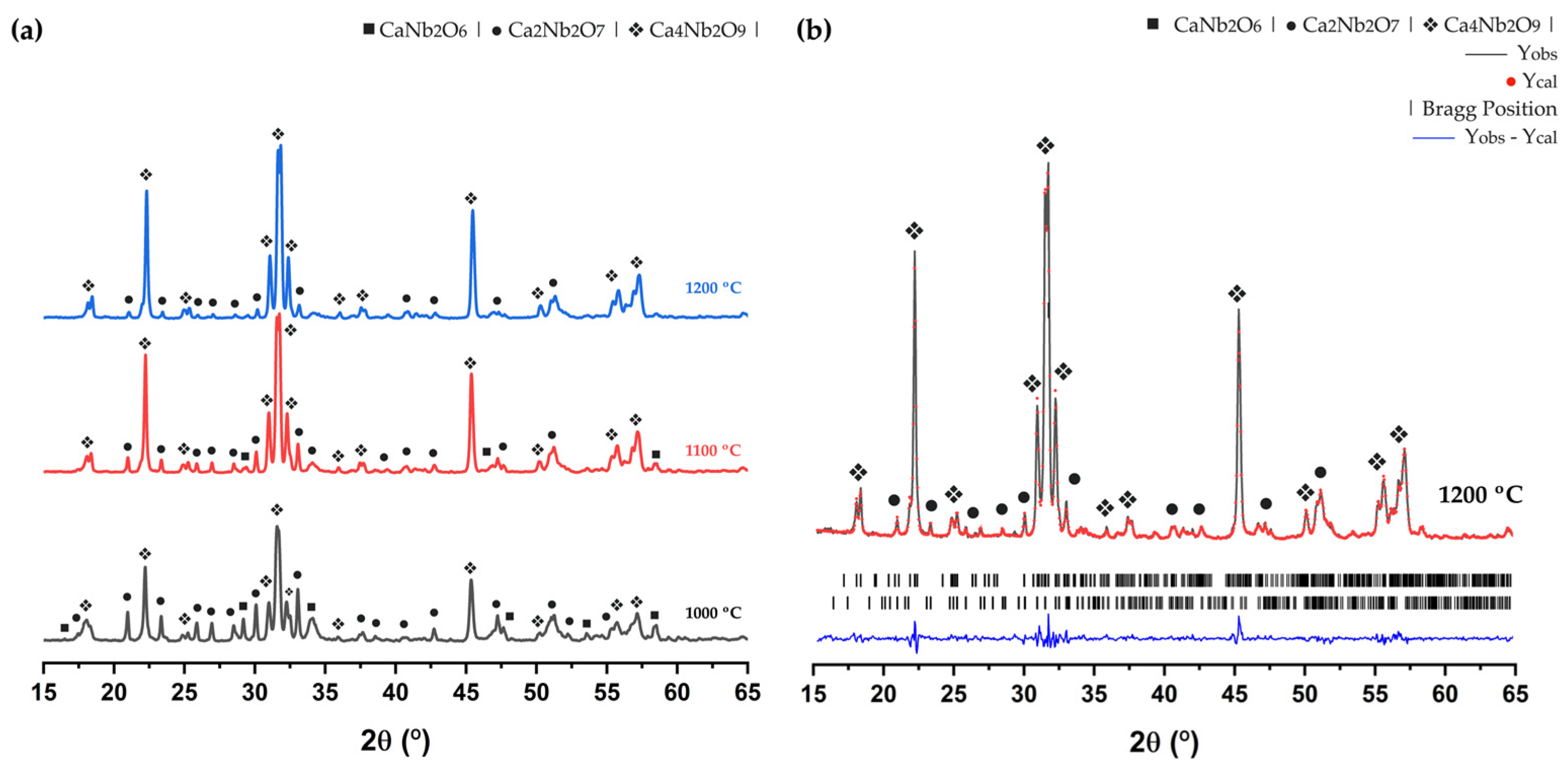
XRD patterns for the samples synthesized between 1000 °C and 1200 °C are shown in Figure 3. In this temperature range, it was found that the raw materials (CaCO3 + Nb2O5) underwent a complete transformation into calcium niobate. A triphasic calcium niobate-based ceramic (CaNb2O6/Ca2Nb2O7/Ca4Nb2O9) was obtained at 1000 °C and 1100 °C, contrasting with the single-phase calcium niobate ceramic findings reported by Kamkum et al. [1,11]. Our results align with other waste-derived calcium niobates recently reported by Passalini et al. [24] and Soares et al. [25], demonstrating that the solid-state synthesis of calcium niobate is complex and multiple synthesis paths may take place during solid-state reaction.
Figure 3.
(a) Vertically offset experimental XRD patterns of seashell-waste-derived calcium niobate powders synthesized at 1000, 1100, and 1200 °C. (b) Rietveld refinement of the experimental XRD pattern, exemplified by the sample synthesized at 1200 °C.
At 1100 °C, the peak intensity associated with the CaNb2O6 phase was significantly reduced, though the calcium niobate ceramic retained its triphasic structural characteristics, as observed at 1000 °C. The highest-intensity peak at 1100 °C is attributed to the Ca4Nb2O9 phase, and more peaks related to this phase were identified. This qualitatively suggests that Ca4Nb2O9 predominates in the sample. Indeed, the characteristic peaks of Ca2Nb2O7 decreased in both intensity and number compared to the diffractogram of the powder synthesized at 1000 °C.
At 1200 °C (Figure 3), a biphasic calcium niobate powder sample was obtained, consisting of the Ca2Nb2O7 and Ca4Nb2O9 phases. At this stage, there is a suggestion of Ca4Nb2O9 dominance, as indicated by the absence of the CaNb2O6 phase and the decrease in the intensity of the peaks associated with Ca2Nb2O7. This corroborates the findings previously reported by Alves et al. [12].
3.2. Rietveld Analysis
The Rietveld analysis of the samples synthesized between 1000 °C and 1200 °C, which are composed entirely of calcium niobate phases. Figure 3b illustrates the Rietveld analysis for the sample synthesized at 1200 °C. The data is summarized in Table 1.
Table 1.
Rietveld refinement results for calcium niobate powders synthesized at 1000, 1100, and 1200 °C, including phase fractions, average crystallite sizes, and goodness-of-fit values (χ2).
Rietveld refinements revealed a pronounced temperature-dependent evolution of the crystalline phase. All diffraction patterns were satisfactorily fitted using a modified Lorentzian-2 function to describe the peak profiles. The refinements indicate that Ca4Nb2O9 is the thermodynamically favored phase at higher treatment temperatures.
For the sample synthesized at 1000 °C, the orthorhombic CaNb2O6 phase was predominant, accounting for 59.44 ± 14.49 wt.%, whereas monoclinic Ca4Nb2O9 represented only 29.91 ± 3.82 wt.%. A minor Ca2Nb2O7 phase was also detected (10.65 ± 1.40 wt.%). This multiphase composition indicates incomplete reaction at 1000 °C. Upon increasing the temperature to 1100 °C, the fraction of Ca4Nb2O9 increased substantially to 73.15 ± 2.76 wt.%, accompanied by a decrease in CaNb2O6 to 17.67 ± 3.34 wt.%. The Ca2Nb2O7 content remained relatively low (9.17 ± 0.51 wt.%). At 1200 °C, the material became nearly single-phase, with Ca4Nb2O9 accounting for 96.16 ± 1.81 wt.% and only 3.84 ± 0.27 wt.% of Ca2Nb2O7 remaining. No CaNb2O6 was detected at this temperature. These results demonstrate that increasing the calcination temperature promotes the reaction of intermediate and secondary niobate phases, particularly CaNb2O6, leading to the formation of phase-pure Ca4Nb2O9.
The refined lattice parameters of monoclinic Ca4Nb2O9 showed only small variations with temperature, indicating that its crystal structure was preserved during phase development. Its average crystallite size increased from 39.49 ± 0.19 nm at 1000 °C to 48.85 ± 0.24 nm at 1100 °C and 50.38 ± 0.24 nm at 1200 °C. The Ca2Nb2O7 crystallite size remained within approximately 51–60 nm, whereas CaNb2O6 exhibited much smaller crystallites, around 17 nm, when present. The refined lattice parameters are displayed in Table 2.
Table 2.
Refined lattice parameters of the calcium niobate phases synthesized at different temperatures. ND stands for “not detected by Rietveld refinement”.
The goodness-of-fit values were χ2 = 7.72, 3.45, and 3.35 for the samples treated at 1000, 1100, and 1200 °C, respectively. The lower χ2 values for the 1100 and 1200 °C samples indicate improved agreement between the calculated and observed diffraction profiles. The comparatively higher χ2 value at 1000 °C may be associated with its more complex multiphase composition and possible microstructural effects not fully captured by the refinement model.
The XRD and Rietveld results indicate that the starting CaCO3 and Nb2O5 precursors were consumed at synthesis temperatures of 1000 °C and above. However, consumption of the starting materials does not imply immediate formation of single-phase Ca4Nb2O9. Instead, the results support a proposed temperature-dependent reaction pathway within the CaO–Nb2O5 system. Initially, CaCO3 decomposes to CaO and CO2, after which CaO reacts with Nb2O5 to form orthorhombic CaNb2O6. With increasing temperature and diffusion of additional CaO, CaNb2O6 is progressively converted into monoclinic Ca2Nb2O7 and subsequently into Ca4Nb2O9, according to the following:
CaCO3 → CaO + CO2
CaO + Nb2O5 → CaNb2O6
CaNb2O6 + CaO → Ca2Nb2O7
Ca2Nb2O7 + 2CaO → Ca4Nb2O9
This pathway is consistent with the Rietveld results of the present study, in which CaNb2O6 decreased from 59.44% at 1000 °C to an undetectable level at 1200 °C, while Ca4Nb2O9 increased from 29.91% to 96.16%. The minor Ca2Nb2O7 fraction behaved as a transient intermediate phase. Similar structural evolution has been reported in previous studies for Ca-rich lime-mud-derived formulations [25]. The literature also shows that the final phase composition depends on precursor composition: Kamkum et al. [1,11] obtained single-phase CaNb2O6 under CaO-poor conditions and single-phase Ca4Nb2O9 from a Ca-rich formulation, whereas Passalini et al. [24] found that Mg-containing waste stabilized a more complex multiphase ceramic. Therefore, the proposed pathway should be interpreted as composition- and processing-dependent.
3.3. Morphological Analysis
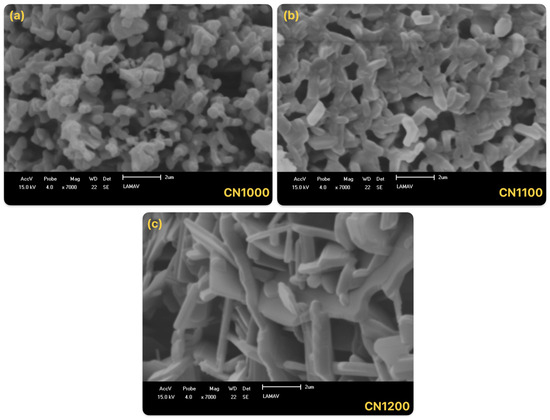
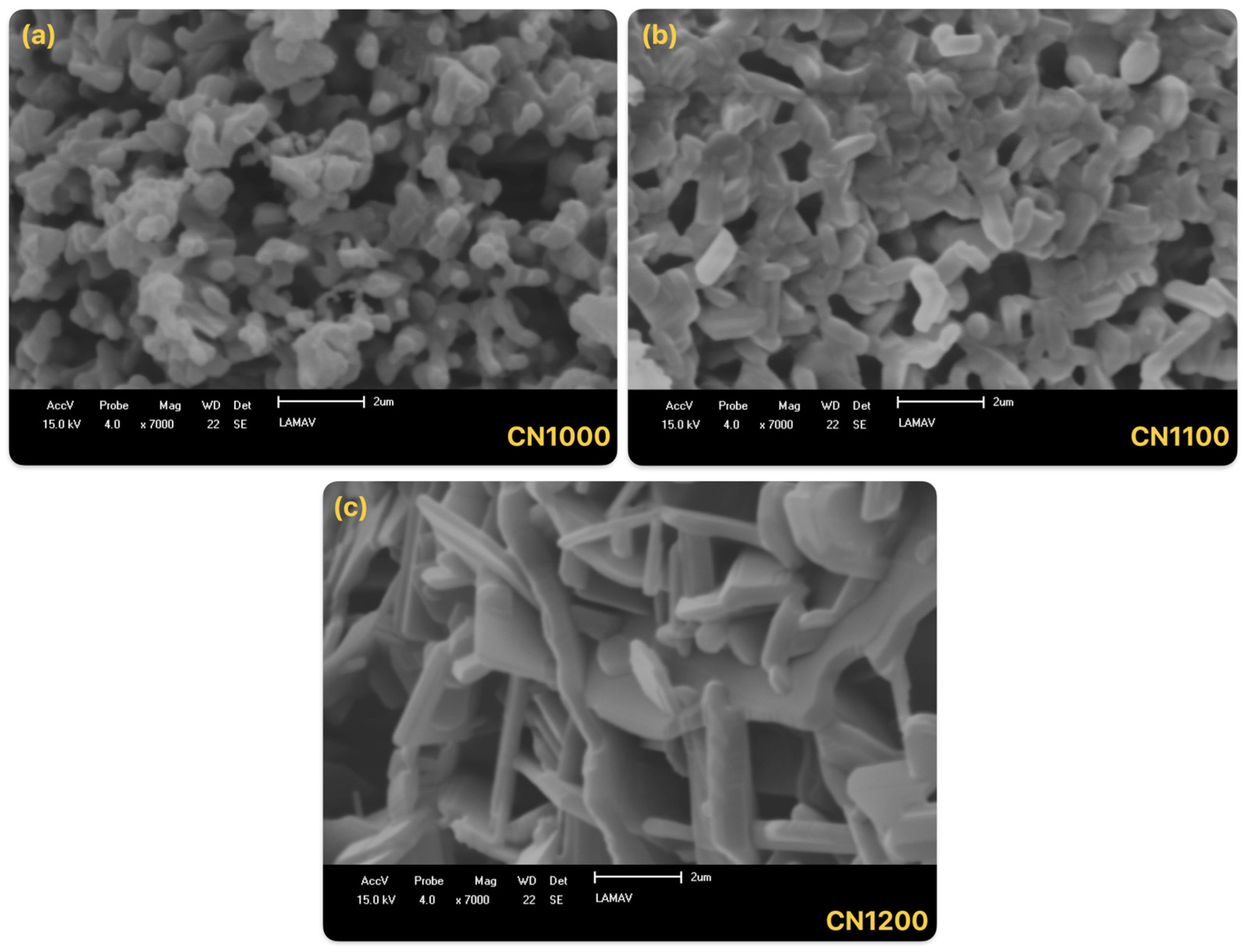
The morphological evolution of calcium niobate powders synthesized at 1000, 1100, and 1200 °C is shown in Figure 4a–c. The SEM micrographs reveal a clear temperature-dependent transformation in particle morphology, reflecting the progression of the solid-state reaction and the development of the Ca4Nb2O9 phase.
Figure 4.
SEM micrographs of calcium niobate powders synthesized at: (a) 1000 °C, (b) 1100 °C, and (c) 1200 °C, acquired at 7000× magnification.
At 1000 °C (Figure 4a), the powder consists of agglomerated particles with irregular shapes and a relatively fine granular appearance. The agglomerates exhibit an open, heterogeneous microstructure, suggesting that the reaction remains incomplete. This observation is consistent with the Rietveld refinement, which identified CaNb2O6 as the major phase, while Ca4Nb2O9 was present as a secondary phase. This morphological feature is consistent with that reported for CaNb2O6 powders by [28].
At 1100 °C (Figure 4b), the particles become more clearly defined and develop elongated, plate-like morphologies. The agglomerates remain porous; however, the increased particle definition indicates enhanced diffusion, crystallization, and grain growth. This morphological modification agrees with the marked increase in Ca4Nb2O9 content, accompanied by a substantial reduction in the CaNb2O6 phase. The initially polyhedral particles become more elongated, exhibiting a rod-like morphology similar to that reported for Ca2Nb2O7 by [29].
At 1200 °C (Figure 4c), the microstructure is characterized by larger, well-developed, elongated, and platelet-like particles that are densely intergrown. The more pronounced faceting and increased particle dimensions indicate intensified crystallite growth and morphological coarsening at the highest synthesis temperature. This morphology is associated with the near-complete formation of Ca4Nb2O9.
Therefore, the SEM results corroborate the phase evolution observed by XRD, demonstrating that increasing the synthesis temperature promotes the conversion of CaNb2O6 and Ca2Nb2O7 into the stable Ca4Nb2O9 phase.
3.4. Thermophysical Properties Analysis
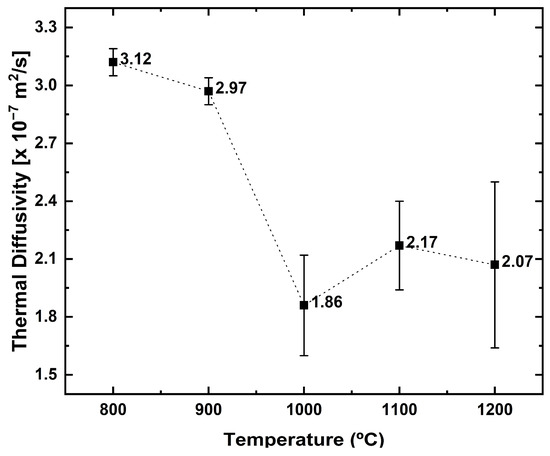
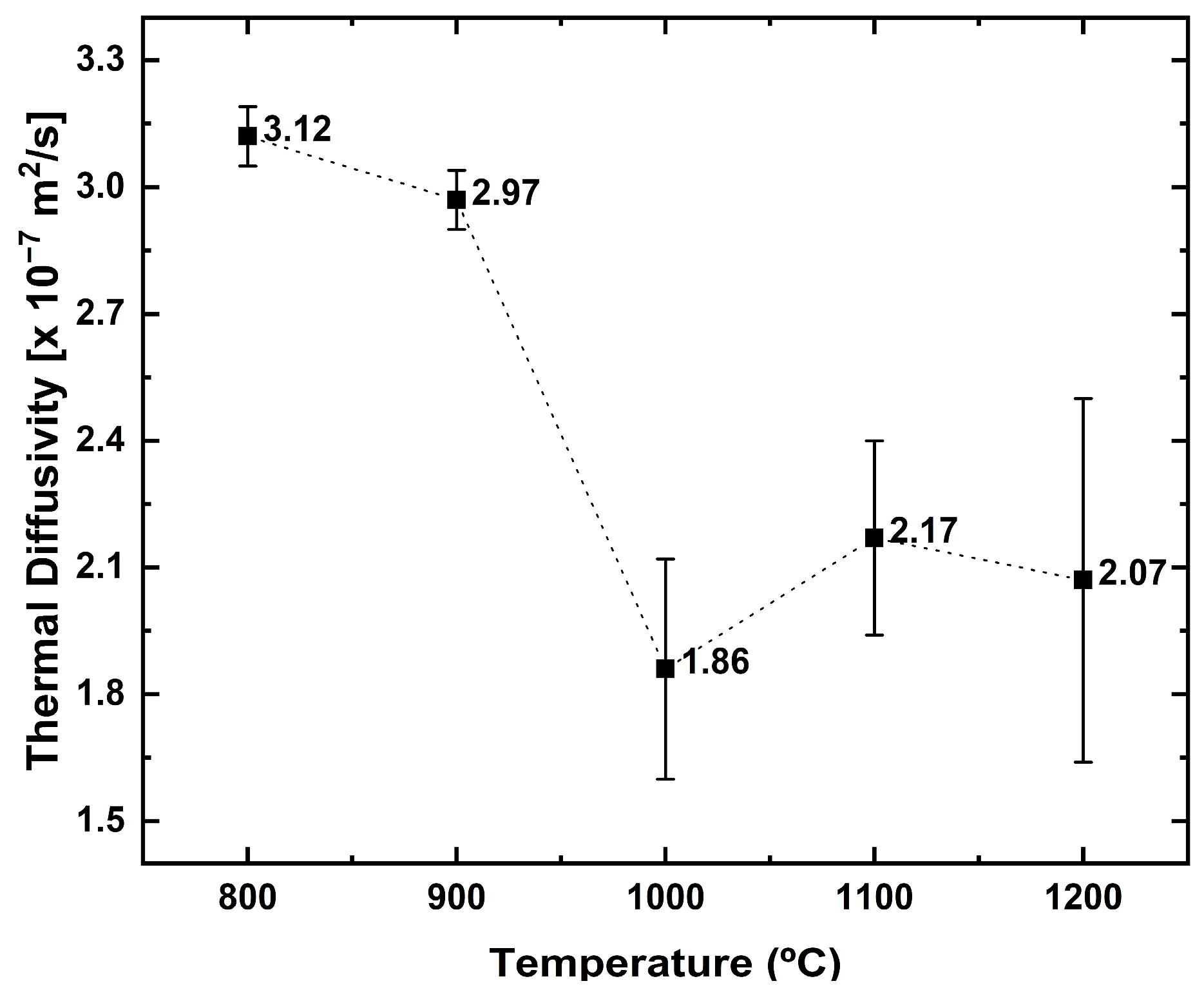
The thermal diffusivity obtained by the OPC technique indicated that the calcium niobate powders synthesized between 800 and 1200 °C were highly insulating, with values on the order of 10−7 m2/s. Its behavior as the synthesis temperature increases is shown in Figure 5. The highest thermal diffusivity was observed at 800 °C: 3.12 ± 0.07 × 10⁻⁷ m2/s. The presence of precursor phases may have enabled heat propagation. Thermal diffusivity decreased as calcium carbonate and niobium pentoxide transformed into calcium niobate, reaching a plateau at around 1.86 ± 0.26 × 10⁻⁷ m2/s at 1000 °C, when calcium niobate phases (CaNb2O6, Ca2Nb2O7, and Ca4Nb2O9) stabilize within the structure. Although the thermal diffusivity of calcium niobate ceramics has not been previously documented, the values obtained in this study (~10−7 m2/s) are consistent with those reported for other complex oxide ceramics, such as perovskite-structured titanates and zirconates, which are commonly engineered for thermal insulation applications. This agreement with literature values validates the reliability of the photoacoustic cell method used in our measurements [30].
Figure 5.
Thermal diffusivity of seashell waste-derived calcium niobate ceramic.
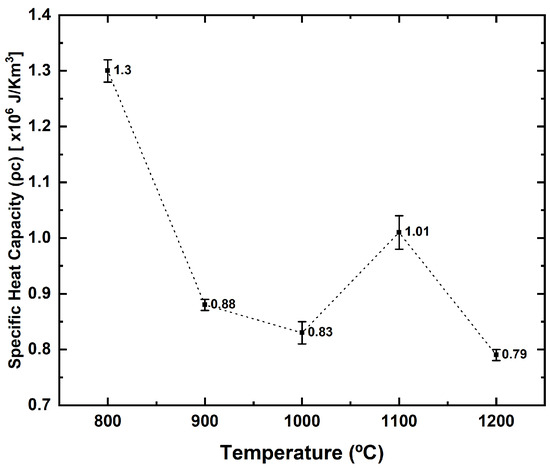
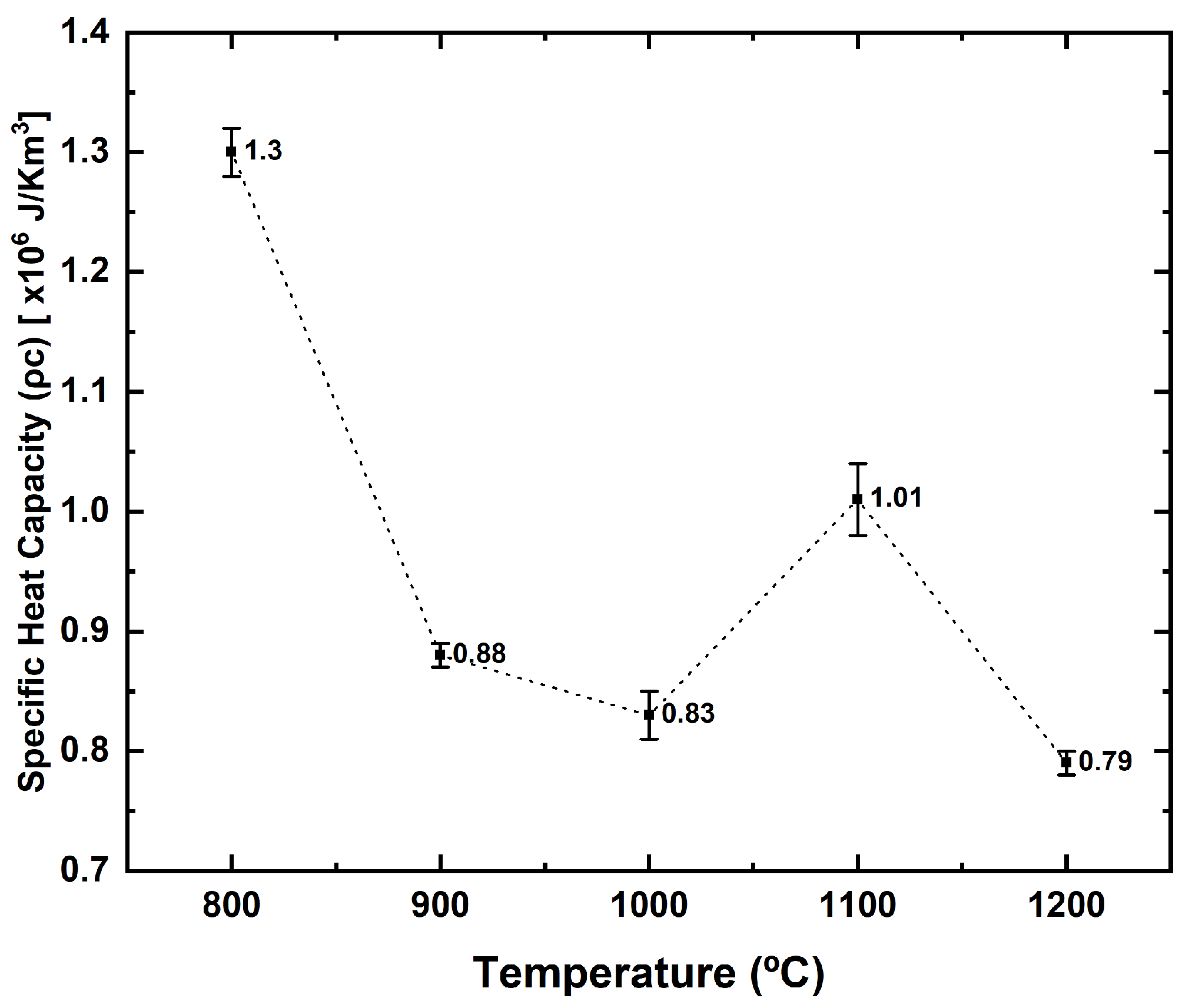
The specific heat capacity behavior of calcium niobate powders synthesized between 800 and 1200 °C is shown in Figure 6. It varied from 0.79 ± 0.01 × 10⁶ J/K·m3 to 1.30 ± 0.02 × 10⁶ J/K·m3. The specific heat capacity decreased as the synthesis temperature increased to 1000 °C, likely due to phase transformations. The primary changes noticed were the establishment of calcium niobate phases, mainly CaNb2O6 and Ca2Nb2O7; the complete transformation of seashell waste into CaO/Ca(OH)2; and the polymorphic transformations of Nb2O5. As the synthesis temperature increased up to 1200 °C, followed by the stabilization of the calcium-rich niobate phase, Ca4Nb2O9, specific heat capacity values oscillated between 0.88 ± 0.01 × 10⁶ J/K·m3 (900 °C) and 1.30 ± 0.02 × 10⁶ J/K·m3 (1200 °C), forming plateau-like behavior, as seen in Figure 6.
Figure 6.
Specific heat capacity of seashell waste-derived calcium niobate ceramic.
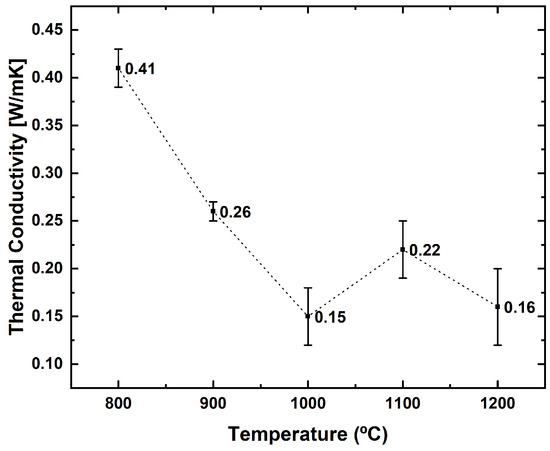
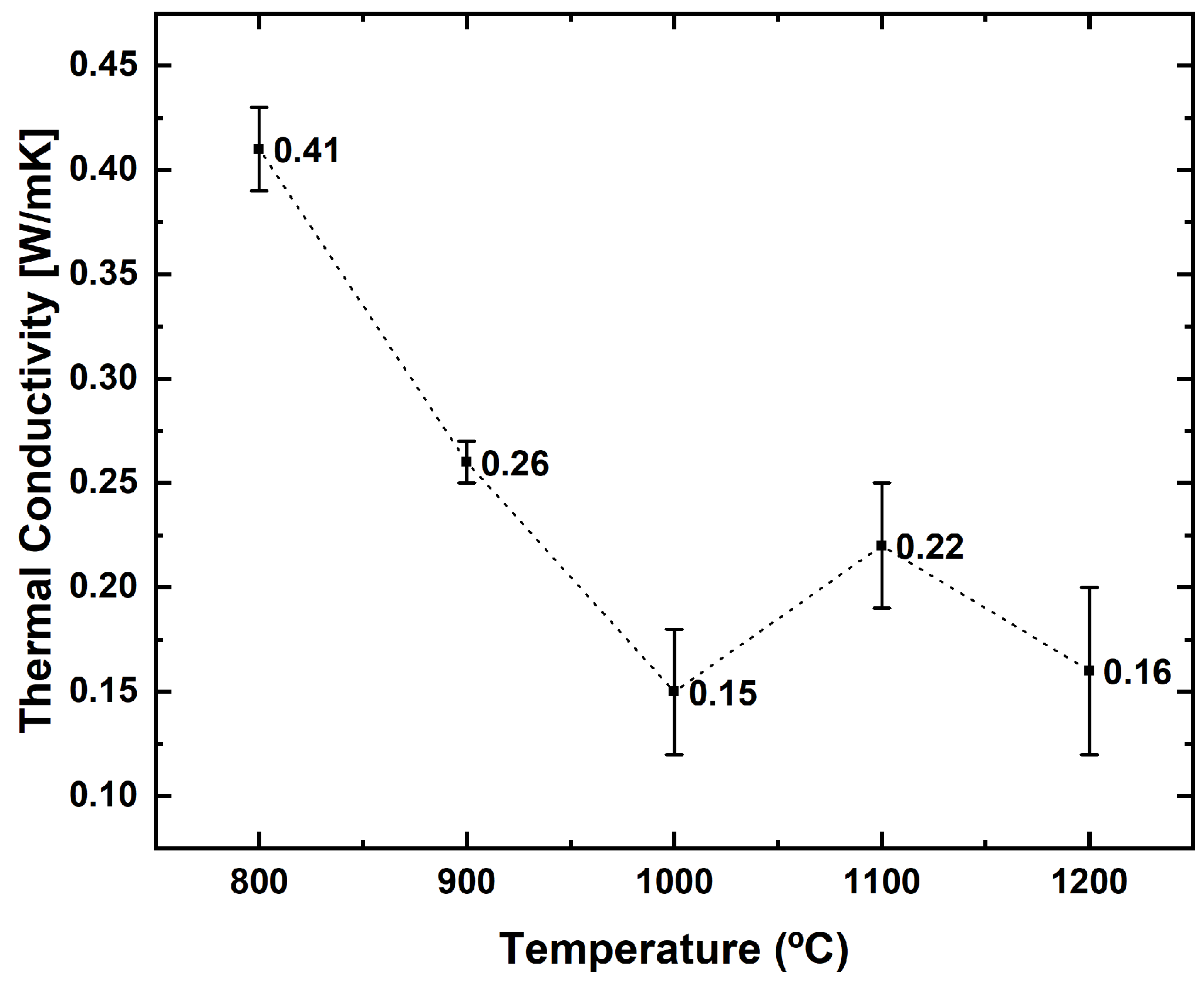
The thermal conductivity of calcium niobate ceramics synthesized between 800 and 1200 °C was calculated using Equation (1). It followed the same trend as thermal diffusivity and specific heat capacity, as shown in Figure 7. The most conductive sample was synthesized at 800 °C (0.41 ± 0.02 W/m·K), while the least conductive sample was synthesized at 1000 °C (0.15 ± 0.03 W/m·K), corresponding to a triphasic calcium niobate ceramic (CaNb2O6/Ca2Nb2O7/Ca4Nb2O9). These experimental values are lower compared to the calculated values reported by [31] for single-phase Ca2Nb2O7. According to Clarke’s and Cahill’s models, k = 1.43 W/m·K and k = 1.57 W/m·K were estimated, respectively [31]. This suggests that the presence of multiple calcium niobate phases enhances phonon scattering through increased phase boundaries, thereby reducing thermal transport [32].
Figure 7.
Thermal conductivity of seashell waste-derived calcium niobate ceramic.
The variation in thermal conductivity can be interpreted in terms of the structural evolution revealed by Rietveld refinement. At 1000 °C, the sample was composed predominantly of CaNb2O6, together with Ca4Nb2O9 and Ca2Nb2O7. Increasing the synthesis temperature promoted the formation of Ca4Nb2O9. This phase transformation was accompanied by an increase in the Ca4Nb2O9 crystallite size. In contrast, the refined lattice parameters of Ca4Nb2O9 changed only slightly between 1000 and 1200 °C. Therefore, the present results do not provide direct evidence of lattice strain or defect-induced phonon scattering as reported.
The effective thermal conductivity of the as-pressed compacts may instead reflect the combined effects of phase assemblage, crystallite size, particle morphology, interparticle interfaces, and compact density. The relative stabilization of the Ca4Nb2O9-rich phase above 1000 °C is consistent with the comparatively small variation in thermal properties at higher synthesis temperatures. However, further microstrain refinement, porosity characterization, and sintering studies would be required to isolate the individual contribution of structural defects and lattice strain to thermal transport.
Seashell waste-derived calcium niobate shows promising potential as a thermal insulator when compared to typical insulating ceramics such as alumina (33 W/m·K) [33], zirconia (2.9 W/m·K) [33], and calcium silicate (0.456–0.527 W/m·K) [34], being lower than the minimum high-temperature thermal conductivity of approximately 1.13 W m−1 K−1 reported for Y4Al2O9, a complex oxide proposed for thermal-barrier applications [35]. Nevertheless, this comparison is primarily contextual because the present measurements were performed at room temperature on unsintered, as-pressed compacts. The suitability of seashell waste-derived calcium niobate as efficient thermal insulation provides a compelling alternative to traditional materials. Further research could investigate its application-specific advantages and explore optimization techniques to enhance its insulating properties.
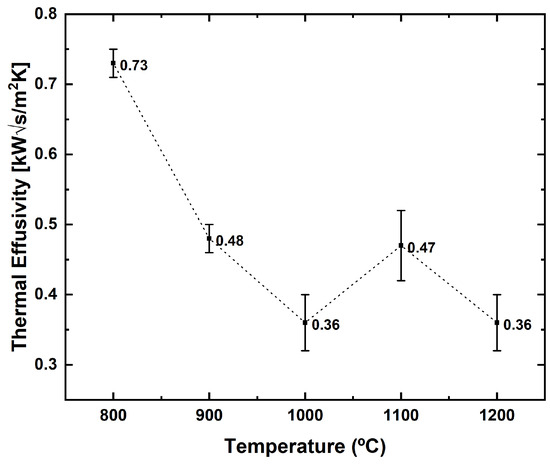
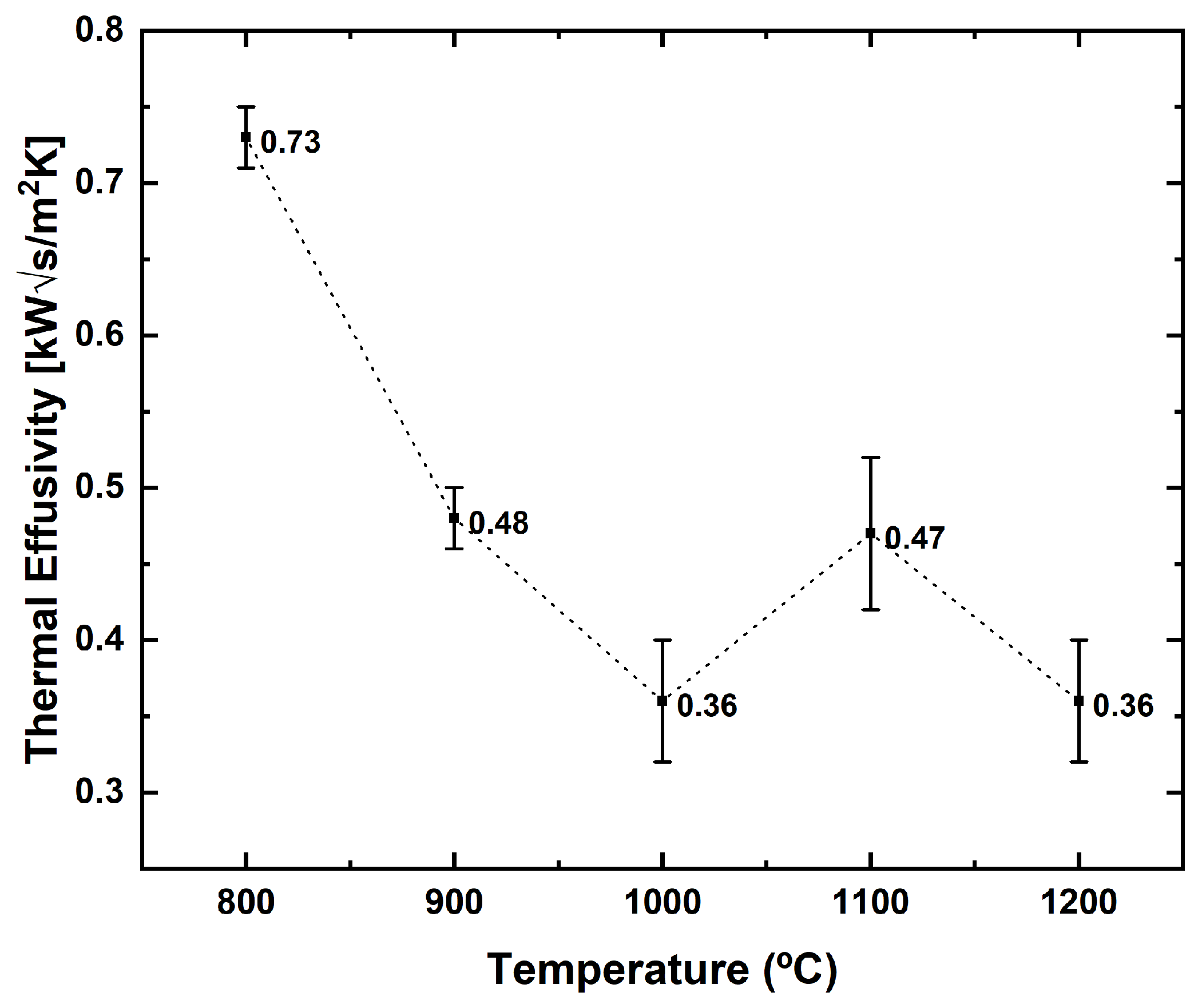
Thermal effusivity, which quantifies a material’s capacity to exchange heat with its surroundings when in direct contact with another component, was determined using Equation (2). Its behavior (Figure 8) was similar to that observed for the other thermal properties. The highest thermal effusivity value found was 0.73 ± 0.02 kW√s/m2·K (800 °C). Thermal effusivity exhibited apparent stabilization during the stabilization of calcium niobate structures, oscillating between 0.36 ± 0.04 kW√s/m2·K (1000 °C/1200 °C) and 0.47 ± 0.05 kW√s/m2·K (1100 °C). The variations in thermal effusivity observed are attributed to phase transformations, as described earlier.
Figure 8.
Thermal effusivity of seashell waste-derived calcium niobate ceramic.
The progressive stabilization of the Ca4Nb2O9-rich phase between 1000 and 1200 °C coincided with comparatively modest variations in the thermophysical properties within this temperature interval. A similar sensitivity of phase balance and microstructure to thermal treatment has been observed in other functional oxide ceramics. Kulyk et al. [36] demonstrated that increasing the sintering temperature modified the tetragonal, monoclinic, and cubic phase fractions of yttria-stabilized zirconia and promoted grain growth, consequently affecting its material properties. These results support the broader relationship between synthesis temperature, phase evolution, and structure–property behavior in complex oxide ceramics.
As shown in Table 3, the thermophysical properties of the seashell-derived calcium niobate powders are comparable to those reported by Passalini et al. [24] for a calcium niobate–magnesium niobate composite. The present samples exhibited thermal diffusivities of 1.86–3.12 × 10⁻⁷ m2 s−1 and thermal conductivities of 0.15–0.41 W m−1 K−1, overlapping partly with the values of 1.73–2.15 × 10⁻⁷ m2 s−1 and 0.12–0.16 W m−1 K−1 reported for the composite ceramic. The volumetric heat capacity values were also of the same order of magnitude. In contrast, Soares et al. [25] reported substantially higher thermal diffusivity (7.8 × 10⁻⁶ m2 s−1), thermal conductivity (7.4 W m−1 K−1), and thermal effusivity (2.666 kW s1/2 m−2 K−1) for a triphasic calcium niobate ceramic derived from lime mud waste. These differences are expected because the materials differ in phase assemblage, crystallite size, compact density, and specimen-preparation conditions. Therefore, the present results should be interpreted as the effective thermophysical properties of as-pressed calcium niobate powder compacts, while the comparison confirms that their thermal behavior is within the range reported for related calcium-niobate-based materials. Due to these thermophysical properties, seashell-derived calcium niobates emerge as promising candidates for thermal-barrier components in high-temperature furnace interiors [37].
Table 3.
Comparison of room temperature thermophysical properties of the present seashell-derived calcium niobate powders with related calcium-niobate-based ceramics previously reported.
4. Conclusions
This study demonstrates that calcium niobate-based ceramics can be synthesized from seashell waste as a sustainable calcium carbonate precursor and exhibit promising thermophysical and structural characteristics for thermal-insulation applications. The measured thermal diffusivity, specific heat capacity, thermal conductivity, and thermal effusivity showed a consistent trend with increasing synthesis temperature and became comparatively stable from 1000 °C onwards. This thermal stability is consistent with the progressive stabilization of the calcium niobate phase assemblage. Rietveld refinement confirmed that increasing the synthesis temperature promotes the conversion of secondary calcium niobate phases into nearly single-phase Ca4Nb2O9 at 1200 °C. The phase evolution was characterized by the progressive consumption of CaNb2O6 and Ca2Nb2O7 and the formation of Ca4Nb2O9 as the dominant phase. SEM analysis further revealed a temperature-induced morphological evolution from irregular agglomerates at lower temperatures to well-defined elongated and platelet-like particles at higher temperatures, indicating enhanced crystallization and grain growth. The biphasic Ca4Nb2O9/Ca2Nb2O7 and triphasic CaNb2O6/Ca2Nb2O7/Ca4Nb2O9 compositions did not cause substantial differences in the measured thermal properties, suggesting comparable thermal behavior among the phases under the conditions investigated. Overall, synthesis temperatures between 1000 and 1200 °C are suitable for producing calcium niobate ceramics with stable thermal properties, while the use of seashell-derived precursors supports circular-economy principles and valorizes biogenic waste.
Author Contributions
Conceptualization, J.N.F.d.H.; methodology, A.E.A., T.C.C., P.L.B., R.d.T.F.J.; formal analysis, A.E.A., T.C.C., P.L.B., R.d.T.F.J.; investigation, A.E.A., J.N.F.d.H.; resources, J.N.F.d.H.; data curation, A.E.A.; writing—original draft preparation, A.E.A.; writing—review and editing, J.N.F.d.H.; supervision, J.N.F.d.H.; project administration, J.N.F.d.H.; funding acquisition, J.N.F.d.H. All authors have read and agreed to the published version of the manuscript.
Funding
This work was supported by the Coordination for the Improvement of Higher Education Personnel (CAPES)—Brazil [Finance Code—001], National Council for Scientific and Technological Development—CNPq (Grant No. 306147/2023-8), and Foundation for Research Support of the State of Rio de Janeiro—FAPERJ (Grant No. E-26/201.137/2022).
Data Availability Statement
The data presented in this research are available in this manuscript.
Acknowledgments
The authors gratefully acknowledge CAPES, CNPq, and FAPERJ for their financial support. The authors also thank LCFIS/CCT/UENF for its support with the XRD and thermophysical analyses.
Conflicts of Interest
The authors declare no conflicts of interest.
References
- Kamkum, P.; Vittayakorn, W.; Seeharaj, P.; Woramongkolchai, S.; Muanghlua, R.; Vittayakorn, N. Utilization of eggshell as a low-cost precursor for synthesizing calcium niobate ceramic. Green Mater. 2018, 6, 108–116. [Google Scholar] [CrossRef] [Scilit]
- Liu, X.; Xie, X.; Zhai, Y.; Wang, L. Improve dielectric properties of lamellar calcium niobate ceramics by spark plasma sintering. IOP Conf. Ser. Mater. Sci. Eng. 2020, 729, 012011. [Google Scholar] [CrossRef] [Scilit]
- Najjari, H.; Vali, R. Lattice vibration and dielectric properties of CaNb2O6. Solid State Commun. 2023, 373–374, 115340. [Google Scholar] [CrossRef] [Scilit]
- Sivagnanapalani, P.; Sahoo, B.; Panda, P.K. Calcium niobate based piezo-resistive materials for high temperature sensor application. Ceram. Int. 2018, 44, 20348–20353. [Google Scholar] [CrossRef] [Scilit]
- Lu, Z.; Lou, L.; Du, P.; Li, W. Ferroelectric domains and luminescent properties of Pr3+-doped Ca2Nb2O7 ceramics. J. Am. Ceram. Soc. 2020, 103, 3748–3756. [Google Scholar] [CrossRef] [Scilit]
- Luo, X.; Yan, Z.; Luo, H.; Zhou, X.; Li, B.; Zhang, M.; Zhang, D. Greatly improved piezoelectricity and thermal stability of (Na, Sm) co-doped CaBi2Nb2O9 ceramics. Adv. Powder Mater. 2023, 2, 100116. [Google Scholar] [CrossRef] [Scilit]
- Zhang, P.; Li, N.; Wei, Z.; Wang, Z.; Gou, M.; Zhao, L.; Chen, W.; Qiang, Q. Crystal structure, photoluminescence and afterglow properties of red-emitting phosphors Ca4Nb2O9:Pr3+ for AC-LEDs. New J. Chem. 2021, 45, 66–75. [Google Scholar] [CrossRef] [Scilit]
- Wei, Z.; Chen, W.; Wang, Z.; Li, N.; Zhang, P.; Zhang, M.; Zhao, L.; Qiang, Q. High-temperature persistent luminescence and visual dual-emitting optical temperature sensing in self-activated CaNb2O6:Tb3+ phosphor. J. Am. Ceram. Soc. 2021, 104, 1750–1759. [Google Scholar] [CrossRef] [Scilit]
- Duman, U.; Aycibin, M.; Özdemir, Ö.F. The electronic, structural, and optical properties of CaNb2O6 compound: Theoretical study. Phys. Status Solidi B 2021, 258, 2100416. [Google Scholar] [CrossRef] [Scilit]
- Pilarek, B.; Pelczarska, A.J.; Szczygieł, I. Phase equilibria in the CaO–Nb2O5 system up to 1600 °C: New experimental results. Ceram. Int. 2019, 45, 1562–1568. [Google Scholar] [CrossRef] [Scilit]
- Kamkum, P.; Atiwongsangthong, N.; Muanghlua, R.; Vittayakorn, N. Application of chicken eggshell waste as a starting material for synthesizing calcium niobate (Ca4Nb2O9) powder. Ceram. Int. 2015, 41, S69–S75. [Google Scholar] [CrossRef] [Scilit]
- Alves, A.E.; Bernardo, P.L.; Holanda, J.N.F. Preliminary investigation on the feasibility of obtaining nano-sized calcium niobate derived from seashell bio-waste. Mater. Lett. 2023, 353, 135295. [Google Scholar] [CrossRef] [Scilit]
- Minther Singh, A.A.M.; Franco, P.A.; Azhagesan, N.; Sharun, V. Exploring seashell and rice husk waste for lightweight hybrid biocomposites: Synthesis, microstructure, and mechanical performance. Biomass Convers. Biorefin. 2024, 14, 30161–30170. [Google Scholar] [CrossRef] [Scilit]
- Mo, K.H.; Alengaram, U.J.; Jumaat, M.Z.; Lee, S.C.; Goh, W.I.; Yuen, C.W. Recycling of seashell waste in concrete: A review. Constr. Build. Mater. 2018, 162, 751–764. [Google Scholar] [CrossRef] [Scilit]
- Valenti, W.C.; Barros, H.P.; Moraes-Valenti, P.; Bueno, G.W.; Cavalli, R.O. Aquaculture in Brazil: Past, present and future. Aquac. Rep. 2021, 19, 100611. [Google Scholar] [CrossRef] [Scilit]
- Lima, G.F.; Lopes, R.L. Impactos ambientais dos resíduos gerados na pesca artesanal de moluscos bivalves no distrito de Patané/Arez-RN. Holos 2016, 4, 206–216. [Google Scholar] [CrossRef] [Scilit]
- Caroscio, L.; Pascale, B.D.; Tataranni, P.; Chiavetta, C.; Lantieri, C.; Bonoli, A. Preliminary study on the application of waste bivalve shells as biofiller for the production of asphalt concrete. Clean. Eng. Technol. 2024, 20, 100743. [Google Scholar] [CrossRef] [Scilit]
- Bamigboye, G.O.; Nworgu, A.T.; Odetoyan, A.O.; Kareem, M.; Enabulele, D.O.; Bassey, D.E. Sustainable use of seashells as binder in concrete production: Prospects and challenges. J. Build. Eng. 2021, 34, 101864. [Google Scholar] [CrossRef] [Scilit]
- Cangiotti, J.; Scatto, M.; Araya-Hermosilla, E.; Micheletti, C.; Crivellari, D.; Balloni, A.; Pucci, A.; Benedetti, A. Valorization of seashell waste in polypropylene composites: An accessible solution to overcome marine landfilling. Eur. Polym. J. 2022, 162, 110877. [Google Scholar] [CrossRef] [Scilit]
- Peceño, B.; Alonso-Fariñas, B.; Vilches, L.F.; Leiva, C. Study of seashell waste recycling in fireproofing material: Technical, environmental, and economic assessment. Sci. Total Environ. 2021, 790, 148102. [Google Scholar] [CrossRef] [Scilit] [PubMed]
- Wang, B.; Zhou, Z.; Huang, M.; Chen, X.; Wang, F.; Zhu, K.; Yan, K. Effects of wide multiphase coexistence on the piezoelectricity of (K, Na)NbO3-based ceramics with superior temperature stability. Ceram. Int. 2024, in press. [Google Scholar] [CrossRef] [Scilit]
- Zhao, D.; Gao, Y.; Yang, L.; Chen, Y.; Wang, Y.; Zheng, Q.; Lam, K.H.; Lin, D. Critical roles of multiphase coexistence in boosting piezo-catalytic activity of BaTiO3-based piezoelectric ceramics. Ceram. Int. 2024, 50, 2350–2362. [Google Scholar] [CrossRef] [Scilit]
- Jia, P.; Zheng, Z.; Li, Y.; Li, Z.; Liu, T.; Wang, Y. Achieving enhanced piezoelectric performance of KNN-based ceramics: Decisive role of multi-phase coexistence induced by lattice distortion. J. Alloys Compd. 2023, 930, 167416. [Google Scholar] [CrossRef] [Scilit]
- Passalini, P.G.S.; Alves, A.E.; Cordeiro, T.C.; Faria, R.T., Jr.; Holanda, J.N.F. The valorization of marble waste to synthesize a novel calcium niobate–magnesium niobate composite and investigation of its thermophysical properties. Processes 2025, 13, 1014. [Google Scholar] [CrossRef] [Scilit]
- Soares, J.P.; Faria, R.d.T., Jr.; Holanda, J.N.F. Synthesis and Thermophysical Properties of a Novel Triphasic Calcium Niobate Ceramic Derived from Lime Mud Waste. Peer Rev. 2026, 8, 139–159. [Google Scholar] [CrossRef] [Scilit]
- Mota, L.; Toledo, R.; Machado, F.A.L.; Holanda, J.N.F.; Vargas, H.; Faria, R.T., Jr. Thermal characterisation of red clay from the Northern Region of Rio de Janeiro State, Brazil using an open photoacoustic cell in relation to structural changes on firing. Appl. Clay Sci. 2008, 42, 168–174. [Google Scholar] [CrossRef] [Scilit]
- Marín, E.; Marín-Antuña, J.; Díaz-Arencibia, P. On the wave treatment of the conduction of heat in photothermal experiments with solids. Eur. J. Phys. 2002, 23, 523–532. [Google Scholar] [CrossRef] [Scilit]
- Liou, Y.C.; Weng, M.-H.; Shiue, C.-Y. CaNb2O6 ceramics prepared by a reaction-sintering process. Mater. Sci. Eng. B 2006, 133, 14–19. [Google Scholar] [CrossRef] [Scilit]
- Zhang, J.C.; Liu, Y.J.; Yan, X.; Zhang, H.D.; Zhang, J.; Wang, X.; Han, W.P.; Long, Y.Z.; Sun, X.Y. Multicolor tuning in room-temperature self-activated Ca2Nb2O7 submicroplates by lanthanide doping. ChemPhysChem 2017, 18, 1166–1171. [Google Scholar] [CrossRef] [Scilit] [PubMed]
- Tachibana, M.; Bourgeois, C.; Mori, T. Thermal conductivity of lead zirconate titanate PbZr1−xTixO3. Appl. Phys. Express 2023, 16, 101002. [Google Scholar] [CrossRef] [Scilit]
- Yang, J.; Zhao, M.; Shahid, M.; Feng, J.; Wan, C.; Pan, W. Electronic structure, anisotropic elastic and thermal properties of monoclinic Ca2Nb2O7. Ceram. Int. 2016, 42, 9426–9432. [Google Scholar] [CrossRef] [Scilit]
- Yang, J.; Qian, X.; Pan, W.; Yang, R.; Li, Z.; Han, Y.; Zhao, M.; Huang, M.; Wan, C. Diffused lattice vibration and ultralow thermal conductivity in the binary Ln–Nb–O oxide system. Adv. Mater. 2019, 31, 1808222. [Google Scholar] [CrossRef] [Scilit] [PubMed]
- Uhlířová, T.; Pabst, W. Phase mixture modeling of the grain size dependence of Young’s modulus and thermal conductivity of alumina and zirconia ceramics. J. Eur. Ceram. Soc. 2020, 40, 3181–3190. [Google Scholar] [CrossRef] [Scilit]
- Leite, F.H.G.; Almeida, T.F.; Faria, R.T., Jr.; Holanda, J.N.F. Synthesis and characterization of calcium silicate insulating material using avian eggshell waste. Ceram. Int. 2017, 43, 4674–4679. [Google Scholar] [CrossRef] [Scilit]
- Zhou, Y.; Lu, X.; Xiang, H.; Feng, Z. Preparation, mechanical, and thermal properties of a promising thermal barrier material: Y4Al2O9. J. Adv. Ceram. 2015, 4, 94–102. [Google Scholar] [CrossRef] [Scilit]
- Kulyk, V.; Duriagina, Z.; Vasyliv, B.; Kovbasiuk, T.; Lyutyy, P.; Vira, V.; Vavrukh, V. Effect of sintering temperature on crack growth resistance characteristics of yttria-stabilized zirconia. Acta Phys. Pol. A 2022, 141, 323–327. [Google Scholar] [CrossRef] [Scilit]
- Bernard, B.; Quet, A.; Bianchi, L.; Joulia, A.; Malié, A.; Schick, V.; Rémy, B. Thermal insulation properties of YSZ coatings: Suspension plasma spraying (SPS) versus electron beam physical vapor deposition (EB-PVD) and atmospheric plasma spraying (APS). Surf. Coat. Technol. 2017, 318, 122–128. [Google Scholar] [CrossRef] [Scilit]

Disclaimer/Publisher’s Note: The statements, opinions and data contained in all publications are solely those of the individual author(s) and contributor(s) and not of MDPI and/or the editor(s). MDPI and/or the editor(s) disclaim responsibility for any injury to people or property resulting from any ideas, methods, instructions or products referred to in the content. |
© 2026 by the authors. Licensee MDPI, Basel, Switzerland. This article is an open access article distributed under the terms and conditions of the Creative Commons Attribution (CC BY) license.