


Abstract
Metallurgical coal operations are a significant but poorly constrained source of methane (CH4) in Canada. We present a multi-instrument analysis of 63 methane plume detections at Fording River Operations, British Columbia (January 2022–March 2026), using the Airborne Visible/Infrared Imaging Spectrometer—Next Generation (AVIRIS-NG; n = 39), the Earth Surface Mineral Dust Source Investigation (EMIT; n = 4) and Tanager-1 (n = 20). Of these, 41 plumes (65%) were quantified, with retrieved emission rates of 34–3622 kg CH4 h−1; 54% exceeded the 500 kg h−1 super-emitter threshold. Because 73% of detections fall in September and no detections are available for 2023, results characterize the late-summer overpass window and should not be extrapolated seasonally without further coverage. The central finding is a systematic, asymmetric wind-speed disagreement between two numerical weather prediction (NWP) products that maps onto the Integrated Mass Enhancement (IME) quantification outcome. A univariate logistic regression identifies HRRR wind speed as a significant predictor of quantification success (OR = 0.29 per m s−1, 95% CI [0.15, 0.56], p < 0.001; AUC = 0.80; 5-fold cross-validated AUC = 0.79 ± 0.20, fold range 0.45–1.00). Cross-validation against ERA5-Land shows that HRRR exceeds ERA5 by a mean of +0.86 m s−1 (+43%) for unquantified events but shows near-zero disagreement for quantified events (–0.09 m s−1, –6%). A sensitivity analysis restricted to HRRR-forced retrievals (EMIT + Tanager-1, n = 24) confirms the finding is not an artefact of mixed wind data sources (OR = 0.28, AUC = 0.83, p = 0.018).
1. Introduction
Coal mining is a major anthropogenic source of methane (CH4), contributing approximately 7–12% of global CH4 emissions (~40 Tg yr−1) [1,2]. Despite their climate significance, methane emissions from coal operations remain poorly constrained due to reliance on engineering-based estimates rather than direct measurements [3]. Advances in imaging spectrometry now enable high-resolution detection and quantification of methane plumes from space [4,5]. AVIRIS-NG, EMIT, and Tanager-1 have demonstrated quantification capability across oil and gas infrastructure [6,7], though performance in complex mountain terrain remains less characterized. Recent global analyses have identified strong methane point sources at mining sites [8], yet facility-scale characterization remains limited for major metallurgical coal operations, including those in the Elk Valley, British Columbia.
Satellite-based quantification commonly relies on the Integrated Mass Enhancement (IME) framework, which converts plume-integrated methane enhancements into emission rates using wind speed as a key parameter [9]. While widely applied, IME-based estimates are highly sensitive to wind-field uncertainty, particularly when derived from numerical weather prediction (NWP) products. In complex terrain, near-surface flows may deviate substantially from modelled winds due to valley channeling and boundary-layer decoupling, potentially introducing systematic bias in emission estimates. Previous studies report conflicting relationships between wind speed and quantification performance. Some suggest higher wind speeds improve plume detectability and flux stability [10], while others identify wind uncertainty as the dominant source of error in methane retrievals [11]. Therefore, the validity of IME assumptions under terrain-driven flow conditions remains an open question.
In this study, we present a multi-instrument analysis of methane plume detections at Fording River Operations in Canada’s Elk Valley using observations from AVIRIS-NG, EMIT and Tanager-1 between January 2022 and March 2026. We (1) characterize the magnitude and variability of methane emissions across instruments under opportunistic, predominantly late-summer overpass conditions; (2) quantify the relationship between NWP wind speed and IME quantification success using a univariate logistic regression supplemented by a multivariate sensitivity analysis; and (3) cross-validate HRRR winds against ERA5-Land to characterize the magnitude and asymmetry of NWP wind disagreement and identify candidate physical regimes (e.g., terrain channeling and boundary-layer decoupling) that the present dataset can and cannot adjudicate.
2. Materials and Methods
2.1. Study Area
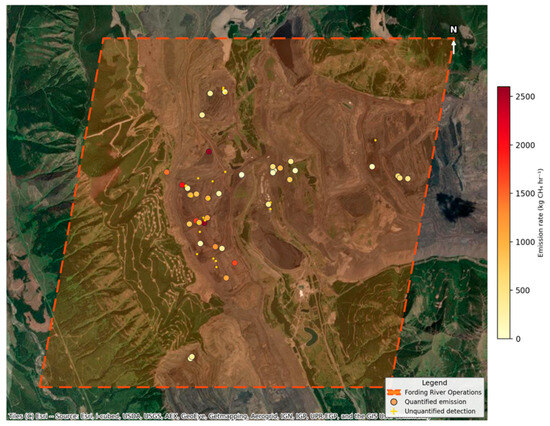
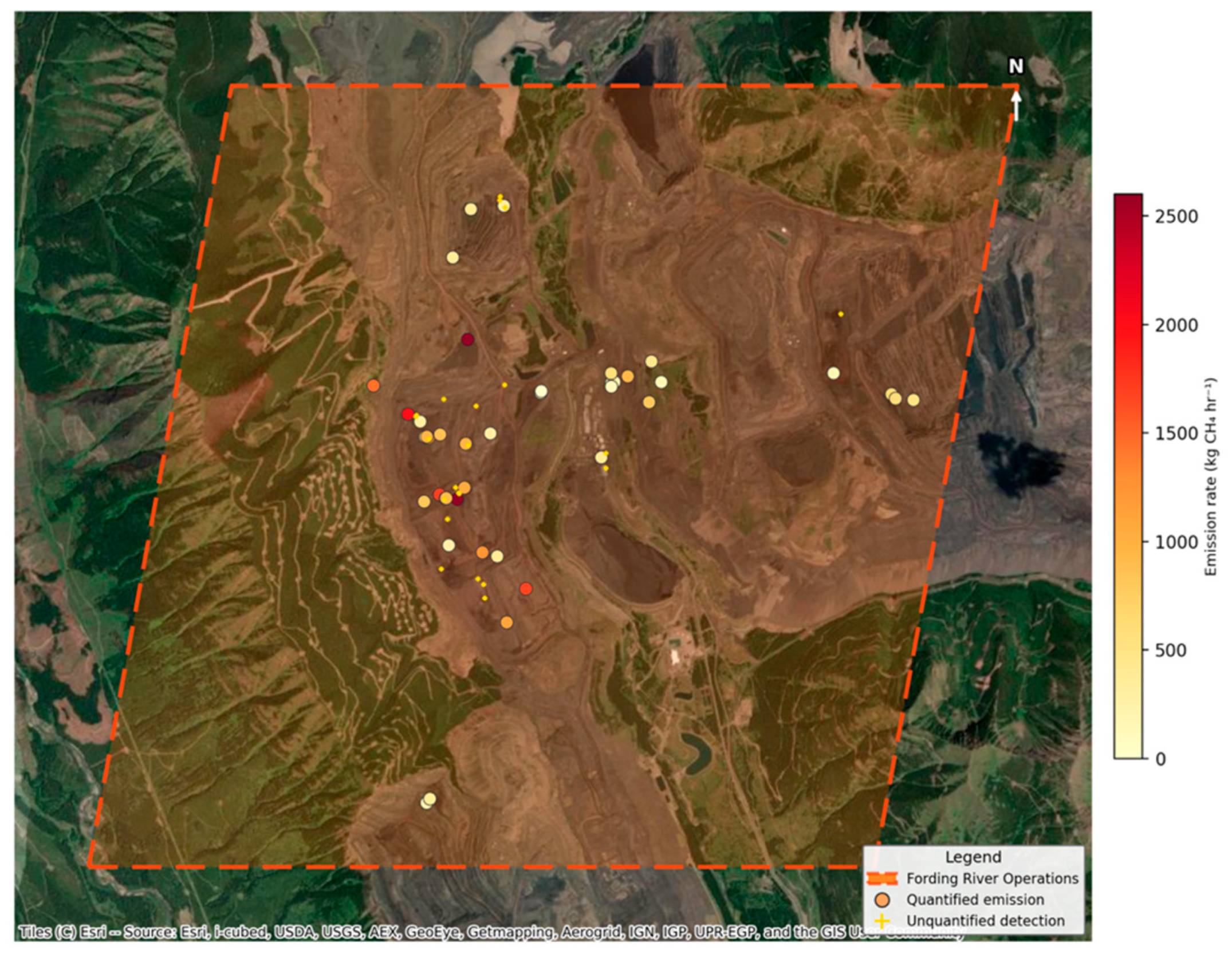
Fording River Operations occupies the Elk Valley of the Canadian Rocky Mountains, approximately 25 km northwest of Sparwood, British Columbia (~50.18° N, 114.90° W; elevation 1400–1800 m a.s.l.; Figure 1). It is one of five open-pit metallurgical coal mines in the Elk Valley Complex operated by Teck Coal Limited until 2024, together producing approximately 24–27 Mt of steelmaking coal per year at peak capacity. Methane emissions arise from coal-seam degasification, overburden desorption, and ventilation-related processes [12,13]. The CH4 is predominantly thermogenic in origin. Unlike longwall underground mining, open-pit operations produce both episodic high-flux bursts during blasting and more diffuse, continuous degasification, creating a heterogeneous plume field that challenges satellite quantification.
Figure 1.
Study area: Fording River Operations, Elk Valley, BC, Canada (~50.18° N, 114.90° W).
The Elk Valley is a glacially carved, north–south-trending trough approximately 10–15 km wide, flanked by peaks exceeding 2500 m. This geometry drives strong katabatic, anabatic, and along-valley flows that frequently decouple from synoptic-scale wind patterns during daytime overpass windows, producing near-surface wind regimes poorly resolved by HRRR (3 km grid) or ERA5 (9 km grid). This terrain-induced NWP uncertainty forms the mechanistic basis for the wind bias examined in Section 3.
2.2. Emission-Rate Retrieval
ERA5-Land hourly wind data (0.1° × 0.1°; u and v at 10 m a.g.l.) were extracted from the Copernicus Climate Data Store at the mine centroid for each overpass timestamp (±1 h), and scalar wind speed was computed as √(u2 + v2). All 63 events were matched to ERA5-Land values to produce a paired ERA5-HRRR comparison dataset. Annual facility-level CH4 emissions under the ECCC GHGRP were obtained from the ECCC Open Data Portal, with Fording River Operations identified by NAICS code 212114. Annual totals (t yr−1) were converted to continuous equivalent rates (kg h−1) by dividing by 8760 h yr−1, serving as a regulatory baseline.
We retrieved all CH4 plume detections for Fording River Operations from the Carbon Mapper public API (api.carbonmapper.org (accessed on 12 March 2026)) using a bounding box of 50.05–50.35° N, 115.10–114.65° W, spanning January 2022 to March 2026. The query returned 63 detection events from three instruments: AVIRIS-NG (Jet Propulsion Laboratory (NASA), Pasadena, CA, USA) (n = 39; ~3 m GSD; wind from airborne in situ anemometry [4]), EMIT (Jet Propulsion Laboratory (NASA), Pasadena, CA, USA) (n = 4; 60 m GSD [14]), and Tanager-1 (Planet Labs, San Francisco, CA, USA) (n = 20; 30 m GSD), with HRRR (~3 km) winds used for EMIT and Tanager-1. Observations are unevenly distributed across time: no detections were recorded in 2023, and 73% of all observations fall in September alone, reflecting cloud and schedule-dependent overpass conditions rather than systematic monitoring.
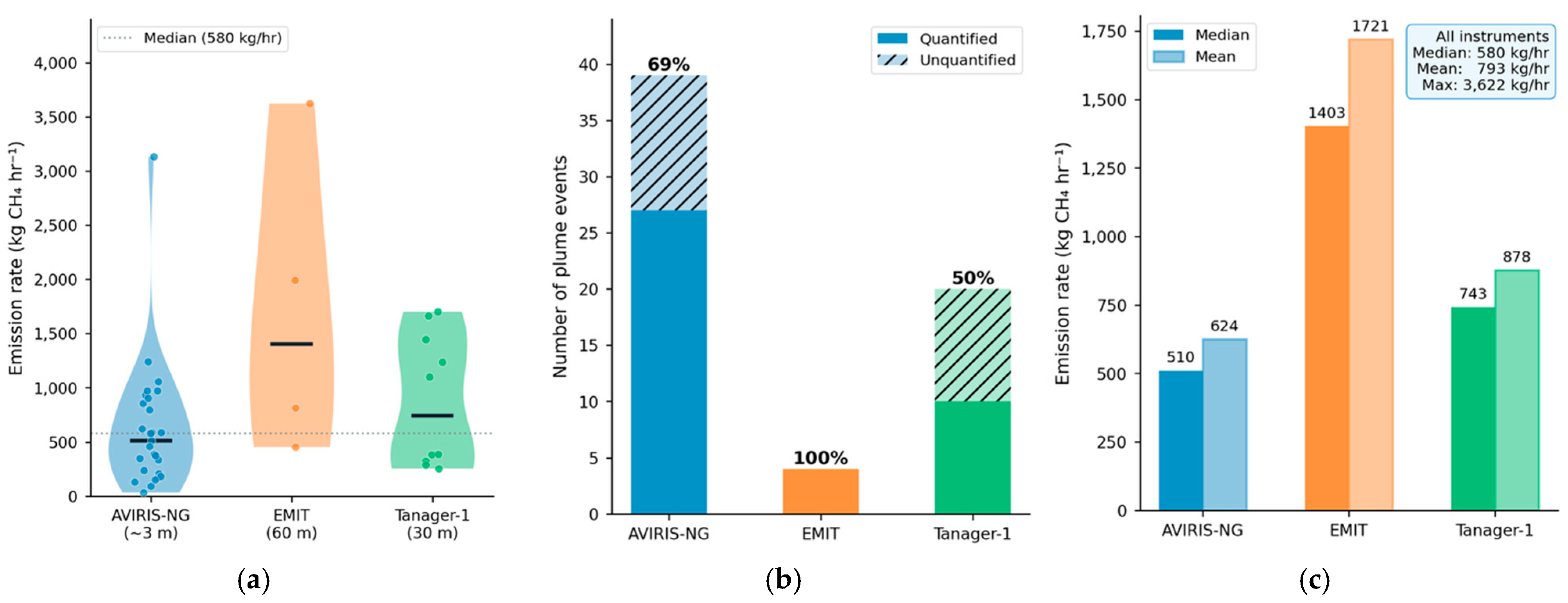
Emission rates were estimated by Carbon Mapper using the Integrated Mass Enhancement (IME) method: Q = CIME × u/L, where CIME is the plume mass loading (kg), u is the effective wind speed (m s−1), and L is the effective plume length (m). Plumes lacking a retrieved emission rate (n = 22) were classified as detected but unquantified and retained for wind analysis but excluded from emission statistics in Figure 2.
Figure 2.
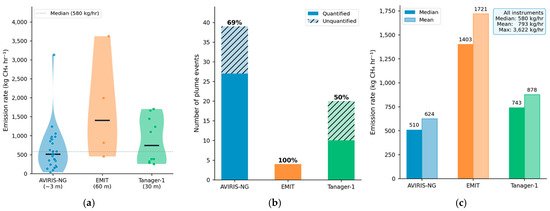
Carbon Mapper multi-instrument CH4 emission estimates: (a) Emission distribution by instrument. (b) Quantification rate by instrument. (c) Median and mean emission rates.
Emission distributions were characterized by median, mean, IQR, and 95th percentiles by instrument; Kruskal–Wallis tests assessed inter-instrument differences (α = 0.05). The quantification outcome was modelled as a function of HRRR wind speed, instrument type (AVIRIS-NG as reference), and normalized observation year using logistic regression; odds ratios were computed as exp (β∧) with 95% CIs from 5000 bootstrap resamples. Model fit was assessed using McFadden’s pseudo-R2, Nagelkerke R2, the Hosmer–Lemeshow goodness-of-fit test (10 decile groups) and 5-fold stratified cross-validation. ERA5–HRRR agreement was assessed using Pearson’s r, RMSE, and mean bias, stratified by 1 m s−1 wind bins. All analyses were implemented in Python 3.
Wind-speed data sources differ by instrument. For AVIRIS-NG, wind speeds are derived from co-located airborne in situ anemometry recorded during each flight campaign. For EMIT and Tanager-1, HRRR-modelled wind speeds (~3 km grid) [15] are used, as no co-located measurements are available. This difference means that the instrument predictor in the logistic regression (Section 3.2) is partially confounded by wind data quality: AVIRIS-NG’s directly measured winds may yield more accurate IME flux estimates than NWP-based winds, independent of any instrumental sensitivity difference.
3. Results
3.1. Detection and Quantification Overview
A total of 63 methane plume detections were identified under opportunistic observational conditions (Table 1). Of these, 41 (65%) were successfully quantified, with emission rates ranging from 33.6 to 3621.9 kg CH4 h−1. The distribution is strongly right-skewed; AVIRIS-NG IQR was 221–882 kg h−1, and Tanager-1 IQR was 338–1393 kg h−1. EMIT’s wide IQR (723–2401 kg h−1) reflects both high variability and the instability of quartile estimates at n = 4. The remaining 22 plumes were detected but not quantified and are retained for subsequent wind analysis. Quantification success rates also vary: EMIT achieves 100% (4/4), AVIRIS-NG achieves 69% (27/39), and Tanager-1 achieves 50% (10/20).
Table 1.
Multi-instrument plume detection and emission statistics (2022–2026).
Emission rates differed substantially across instruments (Table 1). EMIT recorded the highest median (1403 kg h−1) of approximately 2.75× the AVIRIS-NG median (510 kg h−1), with Tanager-1 intermediate at 743 kg h−1. A Kruskal–Wallis test across all three instruments yielded H = 4.68 and p = 0.096, not reaching significance at α = 0.05. The EMIT subgroup (n = 4) is insufficient for stable non-parametric inference; all four EMIT observations occurred in summer months (June–August), introducing a seasonal confound that precludes instrument-specific emission-rate comparisons. A pairwise test restricted to the two adequately sampled instruments (AVIRIS-NG vs. Tanager-1) also yielded a non-significant result (H = 1.87, p = 0.17). Inter-instrument differences in the median emission rate are therefore treated as descriptive rather than inferential. Tanager-1’s lower quantification rate (50% vs. 69% for AVIRIS-NG) likely reflects a higher median HRRR wind speed at the time of overpass (3.2 vs. 1.9 m s−1) rather than any instrumental limitation.
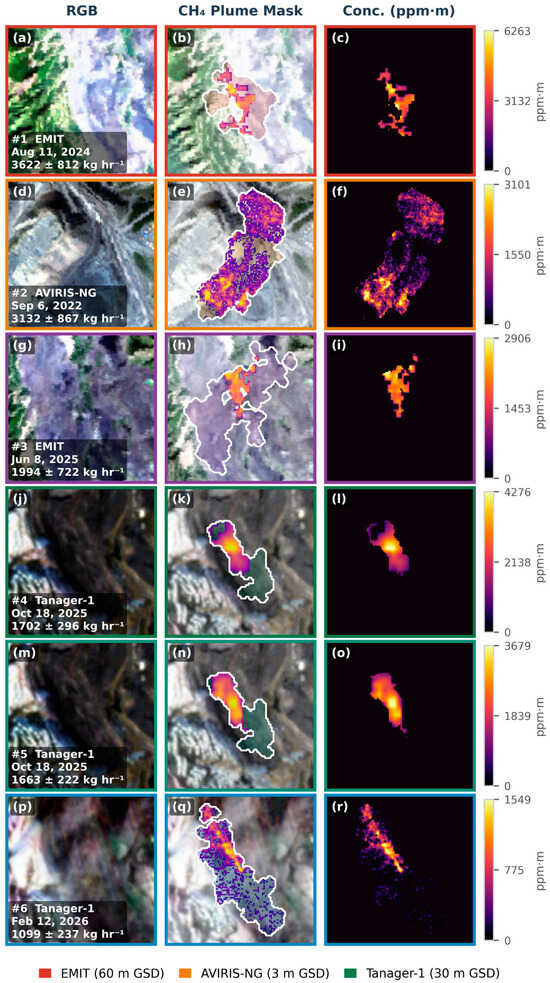
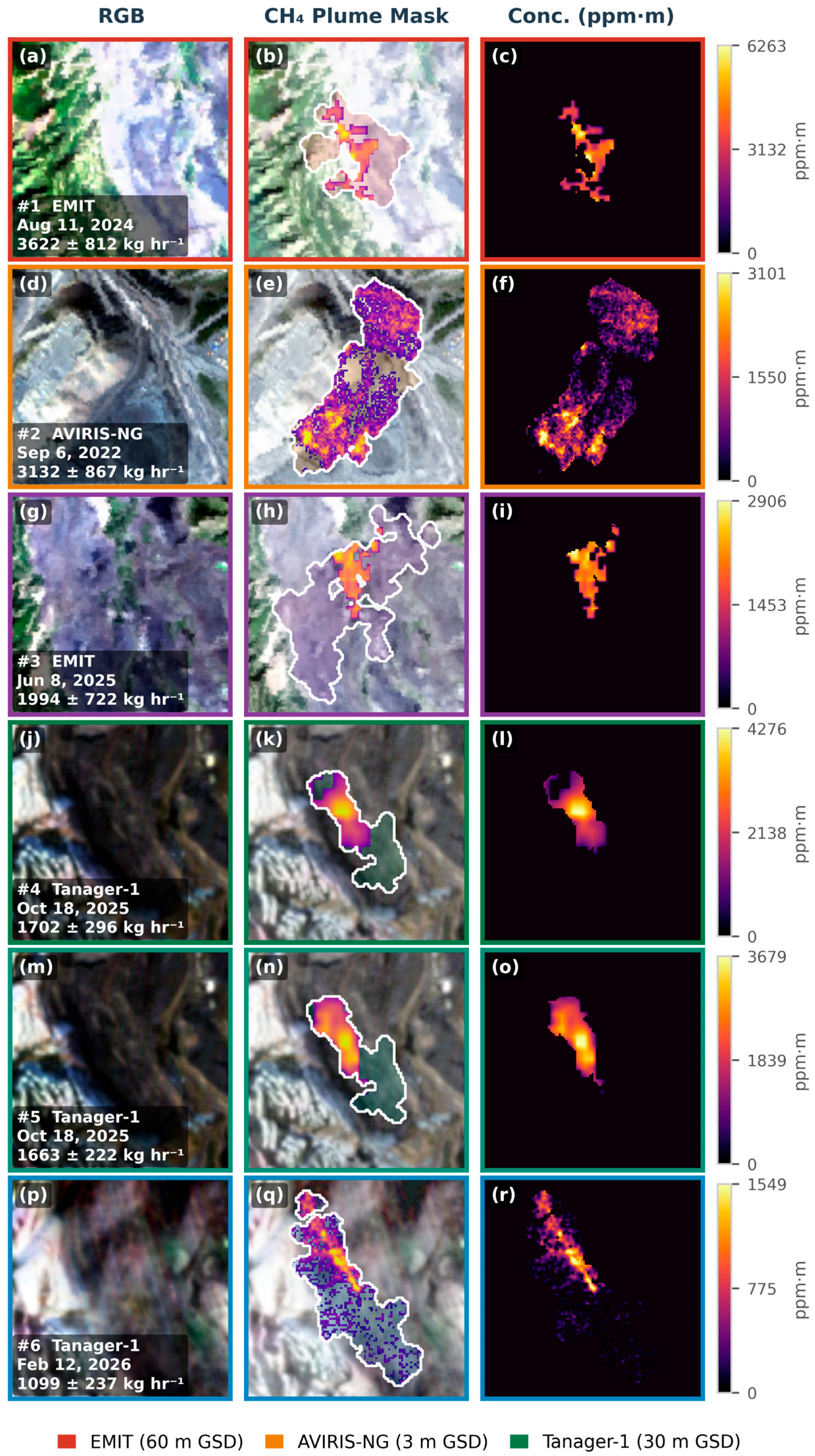
Applying the 500 kg CH4 h−1 threshold used by Duren et al. [16] to define “large emitters” in their survey of 272,000 km2 of California infrastructure, 22 of 41 quantified events (54%) at Fording River qualify as large emitters. Within this group, the six highest-magnitude events exceeding 1000 kg h−1 account for approximately 43% of the total emission mass across all quantified detections. This highlights the disproportionate contribution of extreme events, consistent with observations in oil-and-gas literature [17,18]. These six events are listed in Table 2. We note that the per-event 1-σ uncertainties reported by Carbon Mapper are large relative to the medians (for example, 3132 ± 867 kg h−1, with a relative uncertainty of ~28%, and 1994 ± 722 kg h−1, with a relative uncertainty of ~36%); these random-error envelopes are in addition to the systematic wind-driven uncertainty discussed in Section 3.3 and Section 4, and any facility-level inference should propagate both terms.
Table 2.
Six largest instantaneous CH4 emission events at Fording River Operations.
The peak detection of 3622 kg CH4 h−1 on 11 August 2024 is equivalent to approximately 87 t CH4 day−1 or ~2591 t CO2-eq. day−1 at GWP100 = 29.8 [12] if sustained over 24 h. While a single overpass cannot confirm emission duration, the event magnitude being 2.8× the GHGRP annual mean rate is consistent with a blasting or large-scale overburden removal episode producing an acute degasification pulse; confirmation of blasting vs. continuous degasification attribution would require operator activity logs and high-frequency anemometry, neither of which is available for this site, and the HRRR hourly mean cannot resolve gust dynamics on blasting timescales. At the reported HRRR wind of 1.46 m s−1, IME’s steady-state advection assumption is stressed; the 3622 kg h−1 figure is therefore best read as an upper bound on the instantaneous rate, with stagnant air-column buildup as a plausible secondary contributor that we cannot exclude without independent mass-balance validation. Representative plume imagery for all six peak events is shown in Figure 3.
Figure 3.
Representative CH4 plume imagery from EMIT, AVIRIS-NG, and Tanager-1 at Fording River Operations. (a) Column 1: contrast-stretched true-colour RGB. (b) Column 2: CH4 concentration overlay (plasma colormap) masked to plume boundary. (c) Column 3: CH4 column concentration (ppm m). Rows show the six largest quantified events.
3.2. Wind Speed and Quantification Success
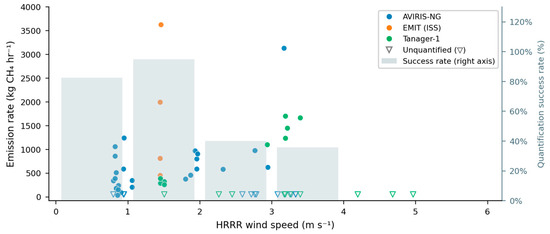
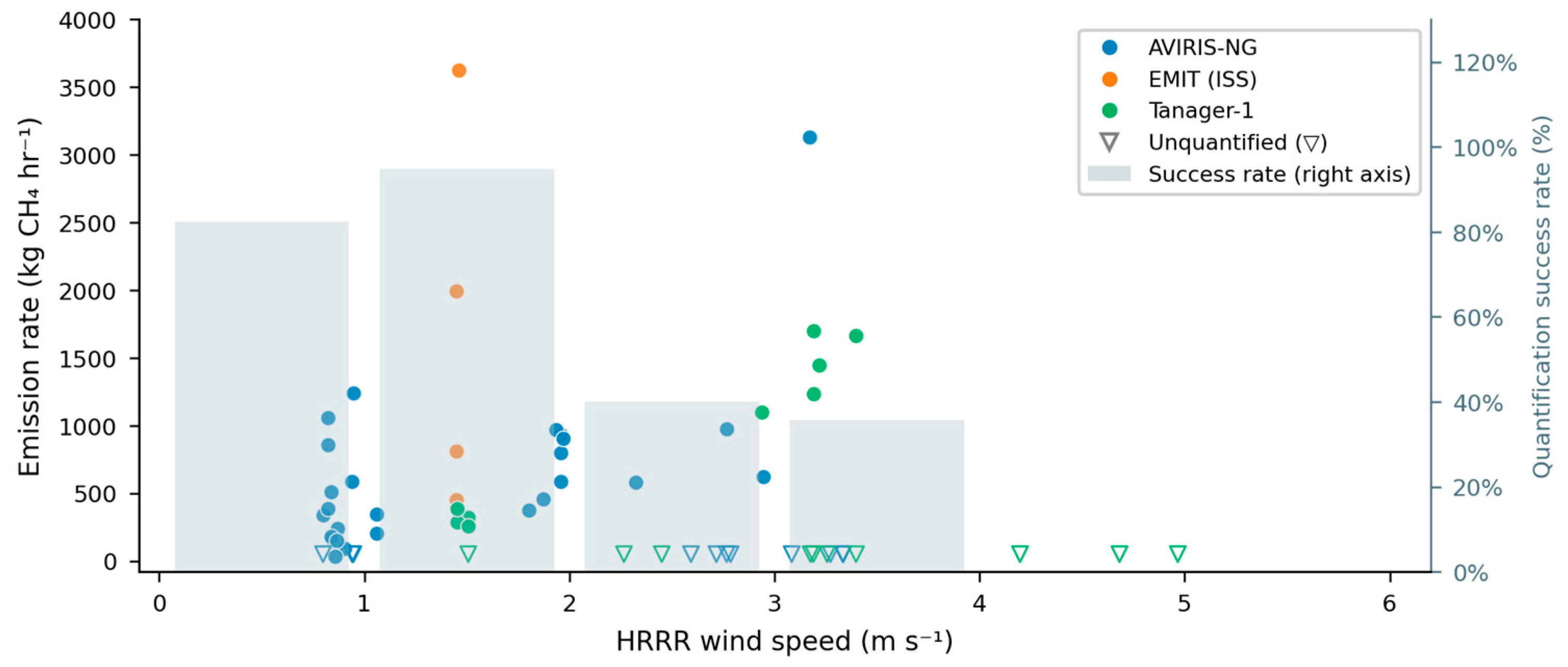
Quantification success depends strongly on HRRR-modelled wind speed (Figure 4). Success rates exceed 80% below 2 m s−1 and decline to ~40% above 2 m s−1. The inverse relationship is more consistent with HRRR overestimating near-surface wind in complex terrain (so observations are mis-classified as windy) than with a breakdown of the IME flux formula itself. Logistic regression is fitted as follows:
Figure 4.
CH4 emission rate vs. HRRR wind speed at time of overpass. Filled circles = quantified events (coloured by instrument); open triangles (▽) = unquantified plumes. Shaded bands show quantification success rate per 1 m s−1 wind bin (right axis).
Two logistic-regression models were fit to the binary quantification outcome (1 = quantified, 0 = unquantified). The primary model is univariate, using HRRR wind speed alone, in line with the rule of thumb of ≥10 events per predictor for our sample of n = 63 (41 successes, 22 failures). A secondary multivariate model adds instrument type (AVIRIS-NG as reference; EMIT and Tanager-1 as binary indicators) and a normalized observation year and is reported as a sensitivity check rather than an independent inference.
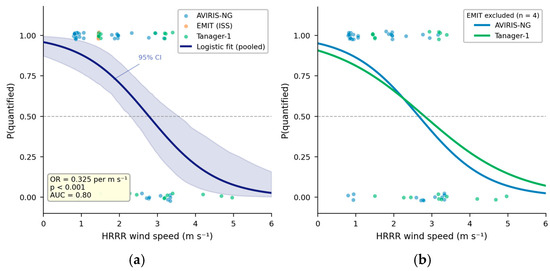
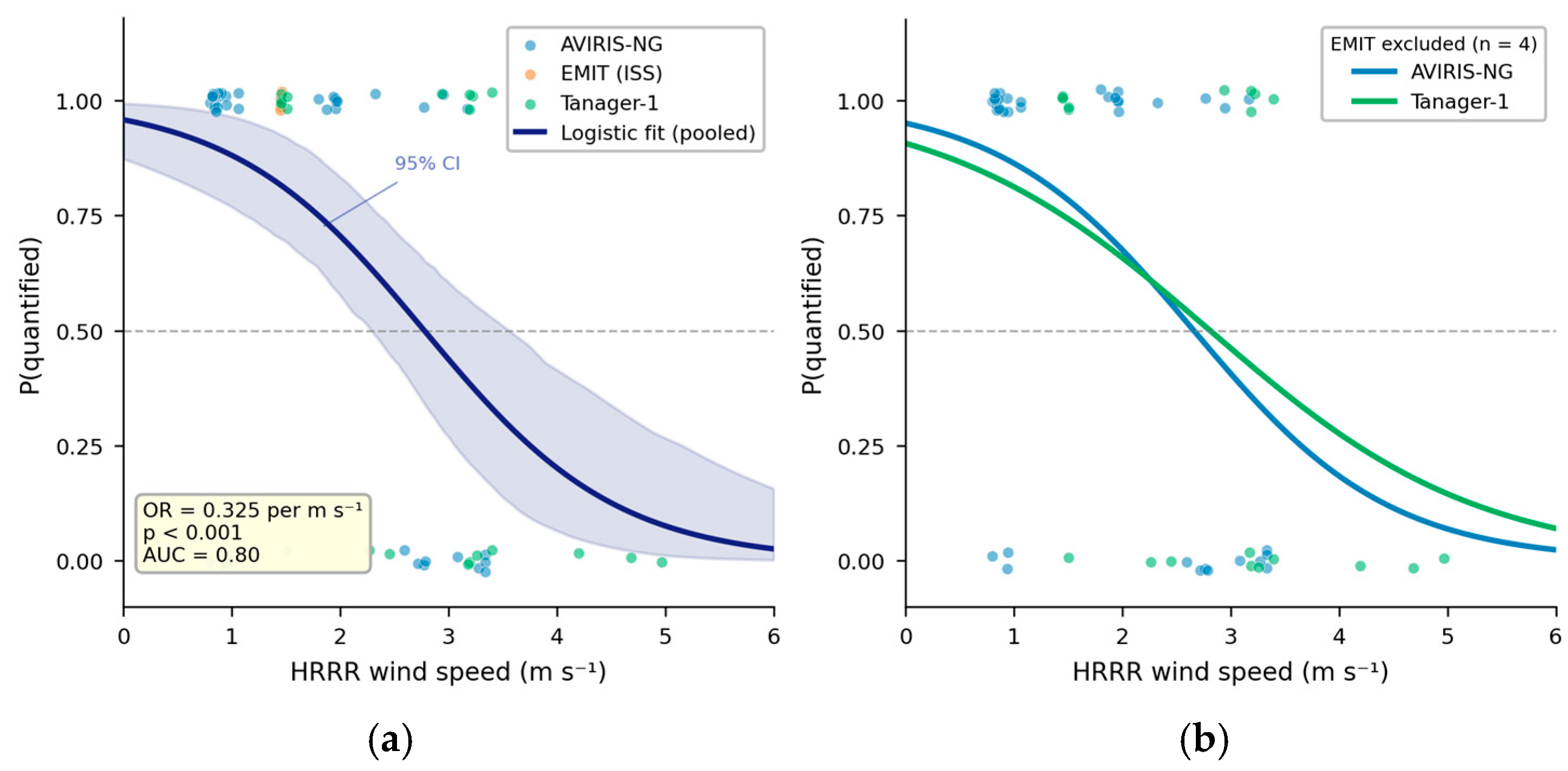
In the univariate model, each additional 1 m s−1 of HRRR-modelled wind reduces the odds of quantification by approximately 70% (OR = 0.29 per m s−1, 95% CI [0.15, 0.56], p < 0.001; AUC = 0.80; Figure 5a). In the multivariate model, the wind coefficient is essentially unchanged (OR = 0.30, 95% CI [0.15, 0.59], p < 0.001) and remains the only statistically significant predictor; neither instrument type nor observation year is significant once wind is controlled for. The EMIT-indicator coefficient could not be finitely estimated because all four EMIT plumes were quantified (quasi-complete separation) and is reported as non-informative; the Tanager-1 indicator (p = 0.85) and the observation-year term (p = 0.81) are both non-significant. The AVIRIS-NG vs. HRRR-forced wind-source distinction (Section 2.2) further means the instrument term partially confounds sensor sensitivity with wind-data quality, so the multivariate coefficients should not be over-interpreted; the univariate result is the more conservative inference and is the one we carry forward.
Figure 5.
Logistic regression of quantification success against HRRR wind speed. (a) Pooled fit across all instruments. (b) Per instrument fits (AVIRIS-NG and Tanager-1 only).
Five-fold stratified cross-validation gives a mean AUC of 0.79 (SD = 0.20; fold AUCs 0.45, 0.67, 0.89, 0.95, 1.00; median 0.81). The wide spread is consistent with a small, class-imbalanced dataset: the median fold matches the in-sample AUC, but the worst fold (AUC = 0.45, marginally below chance) indicates moderate generalization, with variability expected, given the small sample size. Calibration diagnostics (McFadden pseudo-R2 = 0.23, Nagelkerke R2 = 0.36, Hosmer–Lemeshow χ2(8) = 12.4, p = 0.133) indicate no detected miscalibration, but at n = 63, these tests are underpowered and should be read as the absence of a detected problem rather than positive evidence of calibration.
Significance is reported at the conventional α = 0.05 threshold. The wind-speed effect exceeds this by more than two orders of magnitude in both models (p < 0.001) and survives Bonferroni correction across the three multivariate predictors (α = 0.0167); the result is therefore robust to multiple-comparison concerns at this sample size.
The concentration of 73% of observations in September raises the possibility that September-specific atmospheric conditions could independently suppress quantification. The HRRR-forced subset analysis (Table 3) controls for AVIRIS-NG’s earlier-deployment confound but cannot fully isolate this seasonal effect. The underlying physical mechanism (NWP overestimation of near-surface wind in valley terrain) is not season-specific and is expected to operate year-round at this site [10,11]; verification awaits winter and spring overpass coverage.
Table 3.
Quantification success on wind speed: primary model and three sensitivity specifications.
3.3. Cross-Validation with ERA5
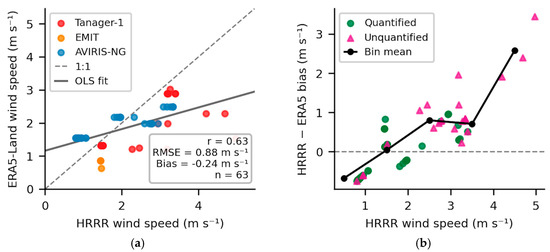
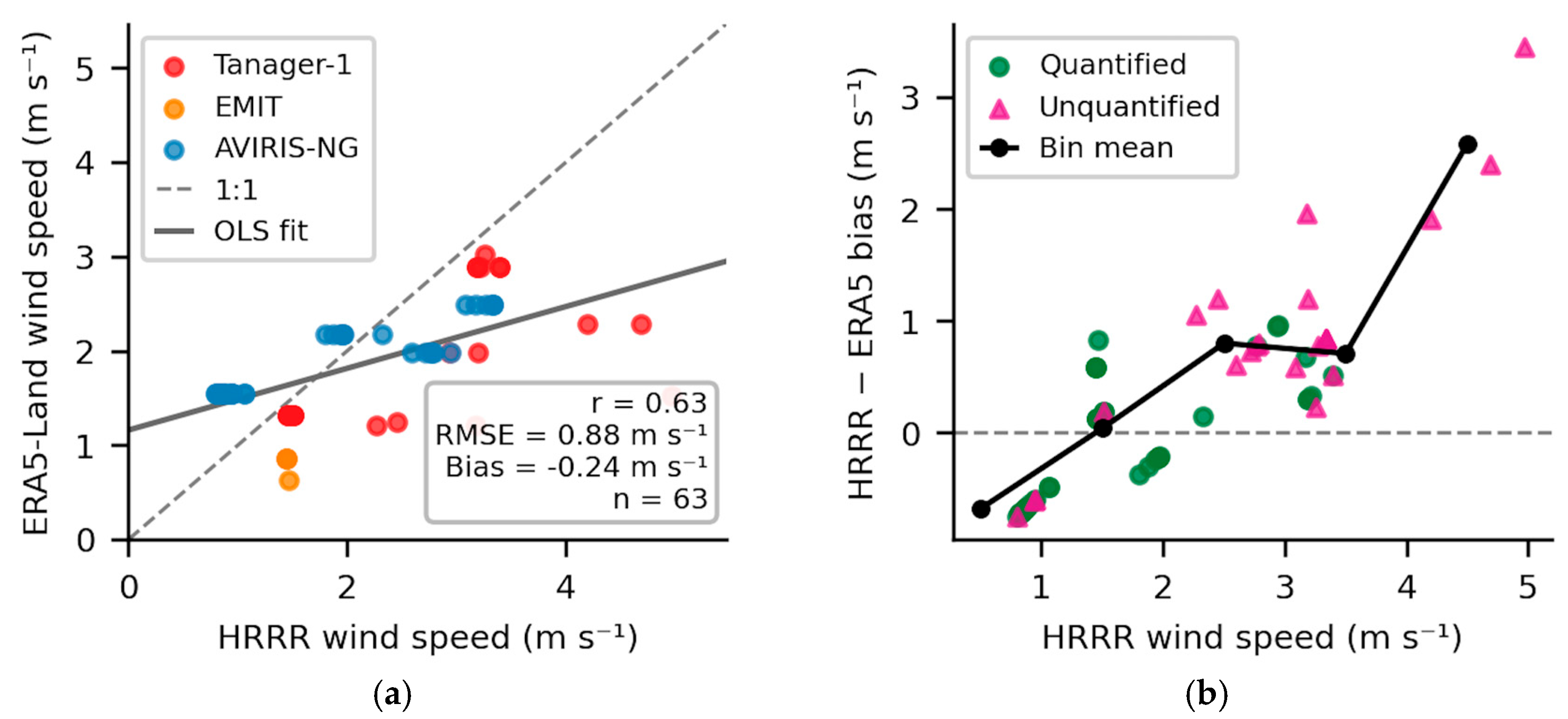
ERA5 and HRRR wind speeds show moderate overall agreement (Pearson r = 0.63, RMSE = 0.88 m s−1; Figure 6). However, the disagreement differs markedly by quantification outcome. For quantified events, the mean ERA5-HRRR difference is small (−0.09 m s−1). For unquantified events, HRRR reports substantially higher wind speeds than ERA5 (HRRR: 2.86 m s−1; ERA5: 2.00 m s−1; mean difference +0.86 m s−1, a 43% excess of HRRR over ERA5). ERA5-Land at 9 km grid resolution is not the ground truth in a 10–15 km wide valley; the disagreement quantified here is a model–model comparison, not a model–observation comparison. The direction of the actual error (HRRR overestimation, ERA5 underestimation, or some combination) cannot be resolved without co-located surface anemometry, which is not currently available for this site. The operational conclusion is unchanged in either case: NWP wind uncertainty in this terrain is large enough to dominate IME flux retrievals, and site-specific anemometry should be deployed before IME estimates are used for regulatory inventory.
Figure 6.
ERA5 vs. HRRR wind-speed comparison: (a) scatterplot of ERA5 against HRRR at all overpass times. (b) HRRR–ERA5 bias as a function of HRRR wind speed.
The overall OLS regression (ERA5 = 0.327 × HRRR + 0.56 m s−1; R2 = 0.40) confirms a multiplicative underestimation bias that grows with wind speed rather than a fixed offset. Stratification by wind regime (Table 4) reveals that relative flux uncertainty (RMSE/ū) peaks at 44% in the low-wind regime (<2 m s−1, n = 36) and reaches 58% in the rare high-wind regime (>4 m s−1, n = 3), with the mid-range regime (2–4 m s−1, n = 24) showing the lowest relative uncertainty, at 28%.
Table 4.
ERA5-Land and HRRR wind-speed comparison by quantification outcome and wind regime.
This asymmetric disagreement supports the interpretation that when HRRR assigns moderate wind speeds (2–4 m s−1) to an Elk Valley scene, actual near-surface winds are substantially calmer, consistent with valley-decoupled flow beneath the mountain-ridge boundary layer.
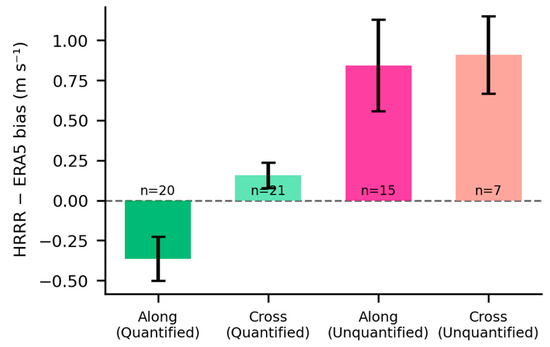
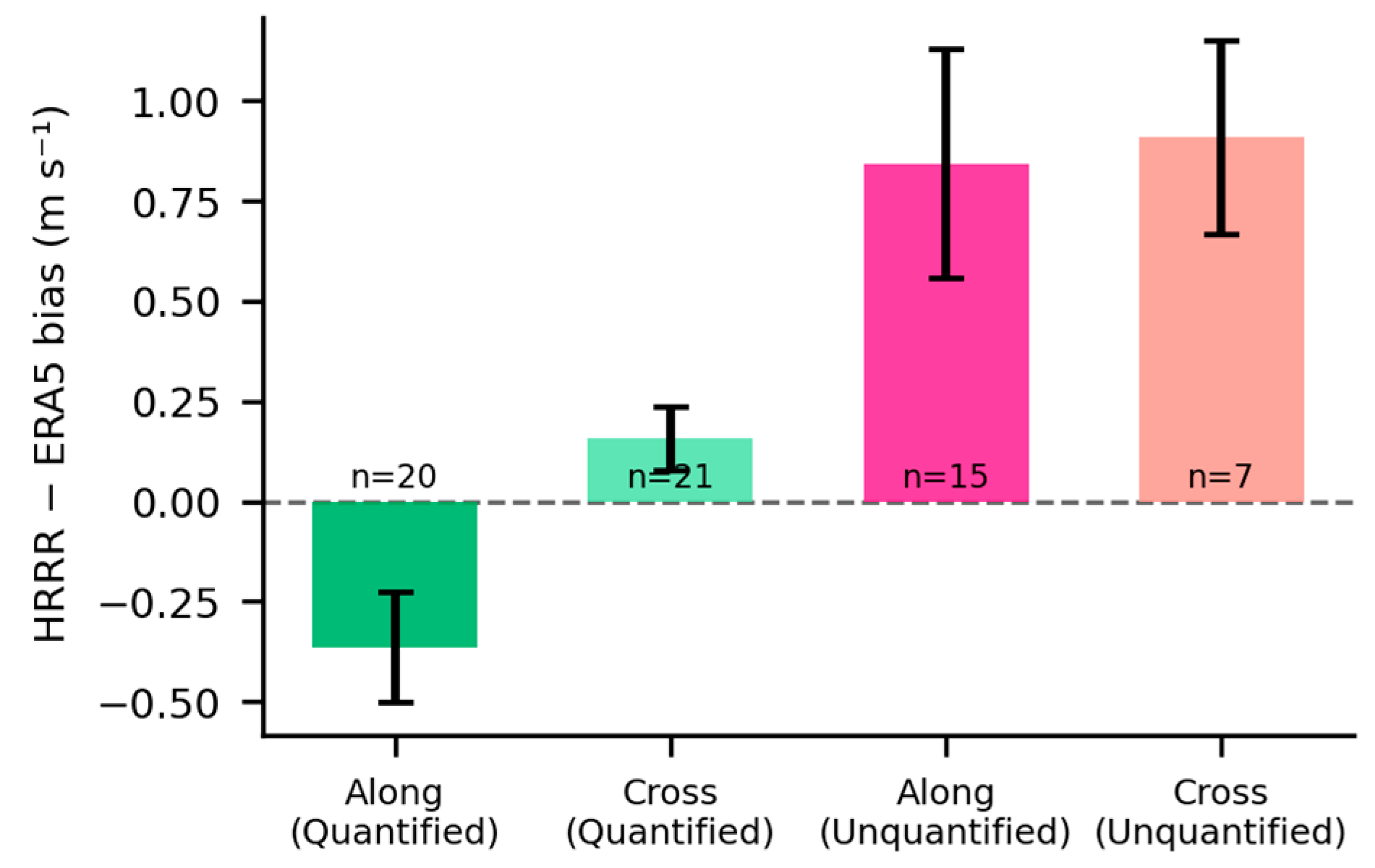
Stratifying the HRRR–ERA5 bias by wind direction (Figure 7) shows that HRRR overestimation is consistently elevated for unquantified events across both along-valley (HRRR − ERA5 = +0.85 m s−1) and cross-valley (+0.90 m s−1) flow regimes, whereas quantified events show near-zero or negative bias in both regimes. The HRRR overestimation for unquantified events appears similar across along-valley and cross-valley directions, suggesting that HRRR overestimation is not explained by along-valley terrain channeling alone and may instead reflect a broader atmospheric decoupling regime (e.g., stable boundary-layer conditions) under which HRRR overestimates surface wind across all directions. This remains a hypothesis, as boundary-layer stability data were not available for this study.
Figure 7.
HRRR–ERA5 wind-speed bias by flow regime and quantification outcome.
4. Discussion
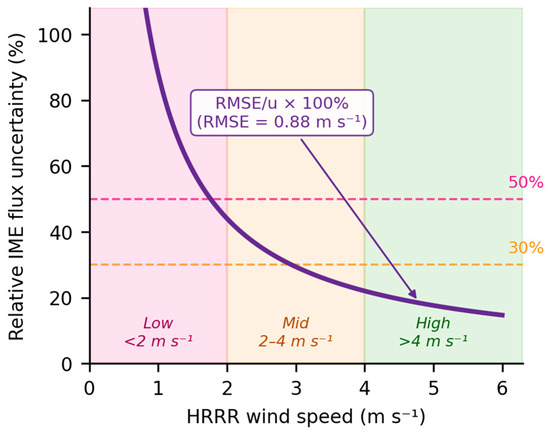
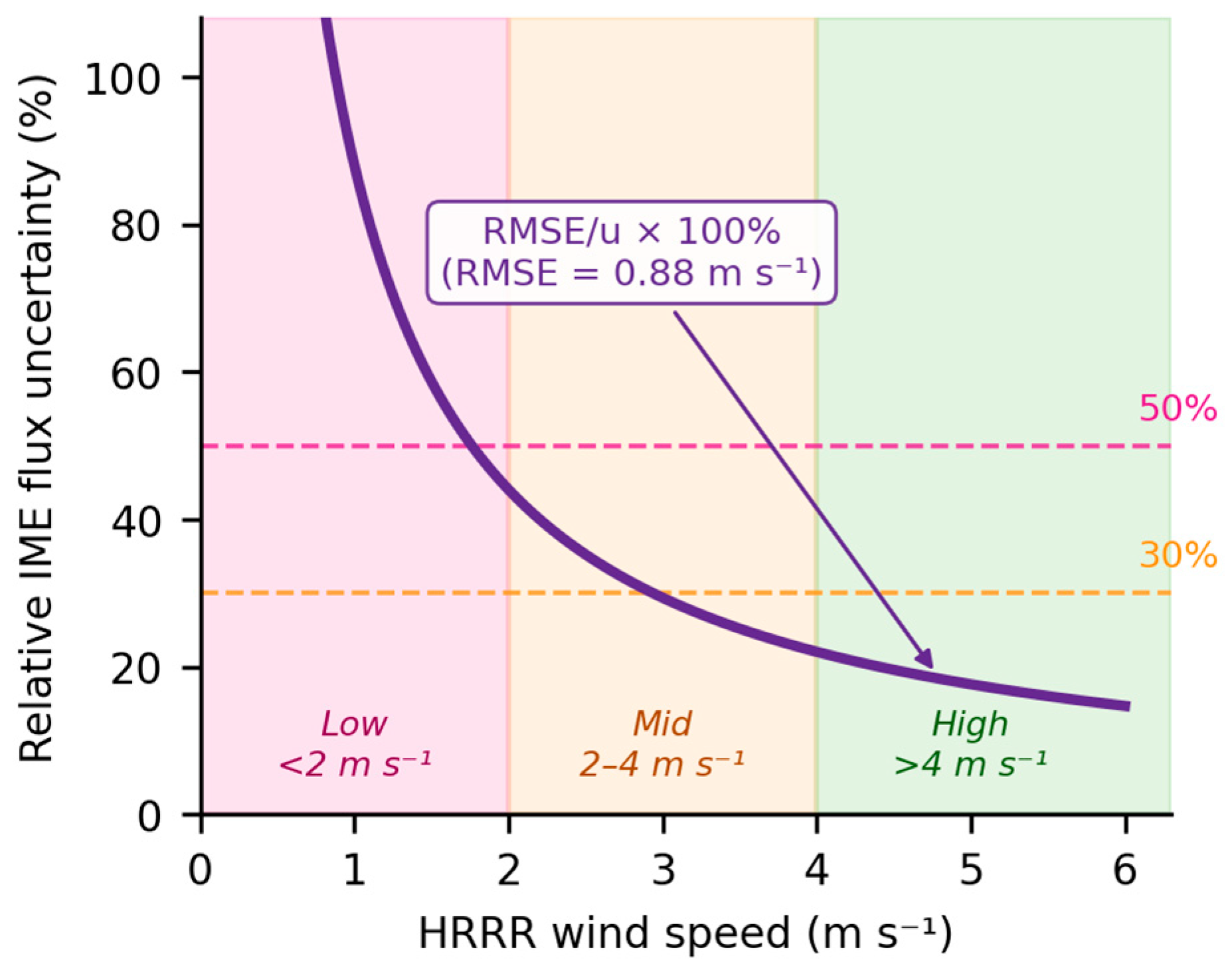
The HRRR–ERA5 disagreement (mean HRRR–ERA5 = +0.24 m s−1; OLS slope 0.33 m s−1 per m s−1) has direct implications for IME flux uncertainty. Because Q = IME · U_eff/L, a wind error (Δu) produces a fractional flux error (ΔQ/Q = Δu/u); at a typical HRRR wind of 3 m s−1, the +0.24 m s−1 bias corresponds to ~8% systematic flux error, and the multiplicative slope implies this fraction grows with wind speed. The scatter (RMSE = 0.88 m s−1, R2 = 0.40) is larger than the mean bias: relative flux uncertainty from wind alone reaches ~44% at low wind (<2 m s−1) and ~28% mid-range (2–4 m s−1, Figure 8). Propagating this in quadrature with plume-length uncertainty (10–20% from plume-mask retrieval) and column enhancement uncertainty (10–30% matched-filter precision) yields total relative flux uncertainties ranging from ~30% under good conditions to ~60% in low-wind or irregular-plume regimes, consistent with the >60% relative uncertainties Carbon Mapper reported for the September 2022 AVIRIS-NG campaign at a mean wind of 0.94 m s−1.
Figure 8.
Relative IME flux uncertainty from wind input alone as a function of HRRR wind speed.
Two mechanisms our dataset does not directly diagnose plausibly co-drive both the NWP error and the IME assumption breakdown. Boundary-layer stability is one: stable, decoupled conditions can simultaneously inflate modelled near-surface winds and violate the steady-state advection assumed by IME; integration of stability indices would strengthen mechanistic attribution in future work. Sensor resolution is the second: at AVIRIS-NG’s 3-m GSD, turbulent dilution under high wind can drop the per-pixel methane concentration below the matched-filter threshold and cause sub-pixel retrieval failure, whereas EMIT’s 60 m GSD spatially averages across the plume and preserves column-integrated mass, effectively acting as a low-pass filter [14,19]. A 100% retrieval rate from a coarse-resolution instrument therefore reflects spatial averaging, not superior quantification fidelity.
Excluding the 22 unquantified plumes from the facility mean biases it upward because the unquantified events necessarily emit at non-zero magnitude (matched-filter detection above background was the inclusion criterion). Imputing them at half the quantified mean reduces the all-event mean by ~18%; at one-fifth, by ~28%. Satellite super-emitter inventories should therefore report the quantification rate alongside the facility mean. Both models converge on the same operational implication: at HRRR-forecast wind speeds above approximately 3 m s−1, the expected yield of IME-quantifiable plumes drops below 50%, and overpass-window scheduling should be wind-aware. The threshold is empirical and site- and product-specific and should not be transferred to other facilities without local logistic-regression validation.
Satellite overpasses were opportunistic rather than systematic, being contingent on cloud-free conditions and instrument scheduling. No observations were available for calendar year 2023. Of 63 plume observations, 46 (73%) fall in September alone and 51 (81%) in the autumn season (September–November), reflecting preferentially clear conditions during late-summer overpass windows. This seasonal concentration means the dataset may systematically under-represent winter and spring emissions, when degasification dynamics under frozen overburden may differ from summer conditions. The 19 unique overpass sessions across 4 years average approximately 5–6 sessions per full year of active coverage, limiting the statistical basis for year-over-year trend analysis. The dataset terminates in March 2026, coinciding with Teck Resources’ divestiture of Fording River Operations to Glencore (completed February 2026). Whether the change of operator introduces modifications to mining practice, ventilation management, or emissions reporting cannot be assessed from the present data; post-acquisition emission trends remain an open research question.
5. Conclusions
This study characterizes methane super-emitter activity at a major metallurgical coal operation in complex terrain. Across 63 multi-instrument detections (2022–2026), emissions were episodic and heavy-tailed (54% exceeding 500 kg CH4 hr−1), constrained to a late-summer observational window (73% September; no 2023 coverage). The central finding is an asymmetric HRRR–ERA5 wind disagreement that maps onto the IME quantification outcome: HRRR exceeds ERA5 by +0.86 m s−1 for events that fail quantification and shows near-zero disagreement for those that succeed. The asymmetry appears similar across along-valley and cross-valley flow regimes, consistent with a broader atmospheric decoupling regime rather than along-valley channeling alone and is robust to a HRRR-forced subset analysis (OR = 0.28, p = 0.018). Without co-located anemometry, the absolute direction of bias cannot be resolved, but in either case, NWP wind uncertainty places a ~28–44% accuracy floor on IME flux retrieval at this site. Seasonal and inter-annual extrapolation beyond the observed window is not warranted without further coverage.
Future monitoring at complex-terrain industrial sites should (1) deploy co-located sonic anemometers or TDLAS systems for site-specific wind validation; (2) prefer mesoscale wind products (≤3 km) over coarse reanalysis while documenting that mesoscale products, themselves, remain subject to terrain-driven error; (3) apply exclusion-bias correction or report the quantification rate alongside facility-level emission means; and (4) schedule overpasses preferentially at forecast wind speeds below 3 m s−1 until per-site thresholds are established. Beyond satellite-only approaches, integration of underground ventilation-shaft measurements, stable-isotope fingerprinting (δ13C–CH4) to discriminate thermogenic seam gas from post-blast degasification, inverse dispersion modelling constrained by ground-level sensors, and operator-aligned activity logs would substantially improve source attribution and provide the ground-truth validation required to advance from observational to regulatory-grade emission assessment.
Author Contributions
Writing—original draft preparation, K.J.H., Y.C., S.A., R.B., J.L. and S.Y.; Supervision, S.A., R.B., J.L. and S.Y. All authors have read and agreed to the published version of the manuscript.
Funding
This research received no external funding.
Data Availability Statement
All methane plume detections used in this study are publicly available via the Carbon Mapper API (api.carbonmapper.org (accessed on 12 March 2026)). HRRR forecast wind data are available from NOAA (https://rapidrefresh.noaa.gov/hrrr/ (accessed on 12 March 2026)). ERA5-Land reanalysis data are available from the Copernicus Climate Data Store (cds.climate.copernicus.eu (accessed on 12 March 2026)). Annual facility-level CH4 emissions are available from the ECCC Open Data Portal (open.canada.ca (accessed on 12 March 2026)). All Python analysis scripts and intermediate processed datasets used to generate the figures and statistical results reported in this paper are available from the corresponding author upon reasonable request and will be deposited in a public repository at the time of publication.
Conflicts of Interest
The authors declare no conflicts of interest.
Abbreviations
The following abbreviations are used in this manuscript:
| AVIRIS-NG | Airborne Visible/Infrared Imaging Spectrometer—Next Generation |
| CH4 | Methane |
| CI | Confidence interval |
| ECCC | Environment and Climate Change Canada |
| EDGAR | Emissions Database for Global Atmospheric Research |
| EMIT | Earth Surface Mineral Dust Source Investigation |
| ERA5 | ECMWF Reanalysis v5 |
| GHG | Greenhouse gas |
| GHGRP | Greenhouse Gas Reporting Program |
| GSD | Ground sampling distance |
| GWP | Global warming potential |
| HRRR | High-Resolution Rapid Refresh |
| IME | Integrated Mass Enhancement |
| IQR | Interquartile range |
| ISS | International Space Station |
| NAICS | North American Industry Classification System |
| NWP | Numerical weather prediction |
| OR | Odds ratio |
| O&G | Oil and Gas |
| ppb | Parts per billion |
| ppm·m | Parts per million-metre (column concentration) |
| QA | Quality assurance |
| RMSE | Root-mean-square error |
| TDLAS | Tunable Diode Laser Absorption Spectroscopy |
| VAM | Ventilation air methane |
| XCH4 | Column-averaged dry-air mole fraction of CH4 |
References
- Saunois, M.; Stavert, A.R.; Poulter, B.; Bousquet, P.; Canadell, J.G.; Jackson, R.B.; Raymond, P.A.; Dlugokencky, E.J.; Houweling, S.; Patra, P.K.; et al. The Global Methane Budget 2000–2017. Earth Syst. Sci. Data 2020, 12, 1561–1623. [Google Scholar] [CrossRef] [Scilit]
- International Energy Agency (IEA). Global Methane Tracker 2023; IEA: Paris, France, 2023; Available online: https://www.iea.org/reports/global-methane-tracker-2023 (accessed on 12 March 2026).
- Environment and Climate Change Canada (ECCC). Greenhouse Gas Reporting Program (GHGRP): Facility Greenhouse Gas Data 2023; ECCC: Gatineau, QC, Canada, 2024; Available online: https://www.canada.ca/en/environment-climate-change/services/climate-change/greenhouse-gas-emissions/facility-reporting.html (accessed on 12 March 2026).
- Thorpe, A.K.; Frankenberg, C.; Thompson, D.R.; Duren, R.M.; Aubrey, A.D.; Bue, B.D.; Green, R.O.; Gerilowski, K.; Krings, T.; Borchardt, J.; et al. Airborne DOAS retrievals of methane, carbon dioxide, and water vapor concentrations at high spatial resolution: Application to AVIRIS-NG. Atmos. Meas. Tech. 2017, 10, 3833–3850. [Google Scholar] [CrossRef] [Scilit]
- Cusworth, D.H.; Jacob, D.J.; Varon, D.J.; Chan Miller, C.; Liu, X.; Chance, K.; Thorpe, A.K.; Duren, R.M.; Miller, C.E.; Thompson, D.R.; et al. Potential of next-generation imaging spectrometers to detect and quantify methane point sources from space. Atmos. Meas. Tech. 2019, 12, 5655–5668. [Google Scholar] [CrossRef] [Scilit]
- Johnson, M.R.; Tyner, D.R.; Conley, S.; Schwietzke, S.; Zavala-Araiza, D. Comparisons of Airborne Measurements and Inventory Estimates of Methane Emissions in the Alberta Upstream Oil and Gas Sector. Environ. Sci. Technol. 2017, 51, 13008–13017. [Google Scholar] [CrossRef] [Scilit] [PubMed]
- MacKay, K.; Lavoie, M.; Bourlon, E.; Atherton, E.; O’Connell, E.; Baillie, J.; Fougere, C.; Johnson, M. Methane emissions from upstream oil and gas production in Canada are underestimated. Sci. Rep. 2021, 11, 8041. [Google Scholar] [CrossRef] [Scilit] [PubMed]
- Cusworth, D.H.; Thorpe, A.K.; Miller, C.E.; Ayasse, A.K.; Jiorle, R.; Duren, R.M.; Dennison, P.E.; Frankenberg, C.; Green, R.O.; Nassar, R.; et al. Strong methane point sources contribute to a strong supersaturation of mining sites globally. Nat. Commun. 2023, 14, 7732. [Google Scholar] [CrossRef] [Scilit]
- Jacob, D.J.; Varon, D.J.; Cusworth, D.H.; Dennison, P.E.; Frankenberg, C.; Gautam, R.; Guanter, L.; Kelley, J.; McKeever, J.; Ott, L.E.; et al. Quantifying methane emissions from the global scale down to point sources using satellite observations of atmospheric methane. Atmos. Chem. Phys. 2022, 22, 9617–9646. [Google Scholar] [CrossRef] [Scilit]
- Jongaramrungruang, S.; Frankenberg, C.; Matheou, G.; Thorpe, A.K.; Thompson, D.R.; Kuai, L.; Duren, R.M. Towards accurate methane point-source quantification from high-resolution 2-D plume imagery. Atmos. Meas. Tech. 2019, 12, 6667–6681. [Google Scholar] [CrossRef] [Scilit]
- Varon, D.J.; Jacob, D.J.; McKeever, J.; Jervis, D.; Durak, B.O.A.; Xia, Y.; Huang, Y. Quantifying methane point sources from fine-scale satellite observations of atmospheric methane plumes. Atmos. Meas. Tech. 2018, 11, 5673–5686. [Google Scholar] [CrossRef] [Scilit]
- IPCC. Climate Change 2021: The Physical Science Basis. Contribution of Working Group I to the Sixth Assessment Report of the Intergovernmental Panel on Climate Change; Masson-Delmotte, V., Zhai, P., Pirani, A., Connors, S.L., Péan, C., Kattsov, V., Adalberth, K., Anagnostiou, G., Braconnot, P., Collins, W.D., et al., Eds.; Cambridge University Press: Cambridge, UK, 2021. [Google Scholar] [CrossRef] [Scilit]
- Karacan, C.Ö.; Ruiz, F.A.; Cotè, M.; Phipps, S. Coal mine methane: A review of capture and utilization practices. Int. J. Coal Geol. 2011, 86, 121–156. [Google Scholar] [CrossRef] [Scilit]
- Thorpe, A.K.; Green, R.O.; Duren, R.M.; Chapman, J.W.; Elder, C.D.; Eastwood, M.L.; Fahlen, J.E.; Hochberg, E.J.; Kochendorfer, J.; Noeske, O.; et al. Attribution of individual methane and carbon dioxide emission sources using EMIT observations from the International Space Station. Sci. Adv. 2023, 9, eadh2391. [Google Scholar] [CrossRef] [Scilit] [PubMed]
- Benjamin, S.G.; Weygandt, S.S.; Brown, J.M.; Hu, M.; Alexander, C.R.; Smirnova, T.G.; Olson, J.B.; James, E.P.; Dowell, D.C.; Grell, G.A.; et al. A North American hourly assimilation and model forecast cycle: The Rapid Refresh. Mon. Weather Rev. 2016, 144, 1669–1694. [Google Scholar] [CrossRef] [Scilit]
- Duren, R.M.; Thorpe, A.K.; Foster, K.T.; Rafiq, T.; Hopkins, F.M.; Yadav, V.; Bue, B.D.; Thompson, D.R.; Conley, S.; Colombi, N.K.; et al. California’s methane super-emitters. Nature 2019, 575, 180–184. [Google Scholar] [CrossRef] [Scilit] [PubMed]
- Irakulis-Loitxate, I.; Guanter, L.; Liu, Y.-N.; Varon, D.J.; Maasakkers, J.D.; Zhang, Y.; Chulakadabba, A.; Wofsy, S.C.; Thorpe, A.K.; Duren, R.M.; et al. Satellite-based survey of extreme methane emissions in the Permian basin. Sci. Adv. 2021, 7, eabf4507. [Google Scholar] [CrossRef] [Scilit] [PubMed]
- Frankenberg, C.; Thorpe, A.K.; Thompson, D.R.; Hulley, G.; Kort, E.A.; Vance, N.; Borchardt, J.; Krings, T.; Gerilowski, K.; Sweeney, C.; et al. Airborne methane remote measurements reveal heavy-tail flux distribution in Four Corners region. Proc. Natl. Acad. Sci. USA 2016, 113, 9734–9739. [Google Scholar] [CrossRef] [Scilit] [PubMed]
- Jongaramrungruang, S.; Matheou, G.; Thorpe, A.K.; Zeng, Z.-C.; Frankenberg, C. Remote-sensing of methane plumes: Instrument tradeoff analysis for detecting and quantifying local sources at global scale. Atmos. Meas. Tech. 2021, 14, 7999–8017. [Google Scholar] [CrossRef] [Scilit]

Disclaimer/Publisher’s Note: The statements, opinions and data contained in all publications are solely those of the individual author(s) and contributor(s) and not of MDPI and/or the editor(s). MDPI and/or the editor(s) disclaim responsibility for any injury to people or property resulting from any ideas, methods, instructions or products referred to in the content. |
© 2026 by the authors. Licensee MDPI, Basel, Switzerland. This article is an open access article distributed under the terms and conditions of the Creative Commons Attribution (CC BY) license.