
Article

Lateritic Contribution to Enhancing the Grade of Iron Ore from Serra Leste Deposit in Carajás Mineral Province, Brazil

by
Rayara do Socorro Souza da Silva
1,2,*,
Marcondes Lima da Costa
1 and
Pabllo Henrique Costa dos Santos
3
1
Institute of Geosciences, Federal University of Pará, Belém 66075-110, PA, Brazil
2
Senai Innovation Institute for Mineral Technologies, Belém 66035-080, PA, Brazil
3
Institute of Technology, Federal University of Pará, Belém 66075-110, PA, Brazil
*
Author to whom correspondence should be addressed.
Mining 2026, 6(2), 34; https://doi.org/10.3390/mining6020034
Submission received: 27 March 2026 / Revised: 18 May 2026 / Accepted: 18 May 2026 / Published: 21 May 2026
(This article belongs to the Topic Mining Innovation—2nd Edition)

Abstract

The Carajás Province, located in the southeastern Amazon, hosts some of the world’s largest high-grade iron deposits. Despite their economic importance, the processes linking lateritic weathering and iron enrichment remain incompletely understood. This study investigates the role of lateritic weathering in the evolution of the Serra Leste iron deposit through the characterization of a weathering profile and its parent rocks using drill-core samples. Analytical methods included X-ray diffraction (XRD), optical microscopy, scanning electron microscopy coupled with energy-dispersive spectroscopy (SEM-EDS), whole-rock geochemistry, and Mössbauer spectroscopy. Jaspilites weathered into ferruginous saprolite while preserving relic banding and mineral textures. Magnetite alteration produced pseudomorphic hematite with dissolution cavities progressively infilled by goethite, indicating iron remobilization during weathering. Weathering of chloritites generated clayey saprolite enriched in kaolinite and iron oxyhydroxides, with gibbsite occurring in more advanced stages. The uppermost horizon consists of a ferroaluminous duricrust composed of massive, spherulitic, and brecciated iron oxyhydroxides associated with gibbsite. Up-profile geochemical trends are marked by decreasing SiO2 and increasing Fe2O3. The mineralogical, textural, and geochemical relationships indicate that the ferroaluminous duricrust was developed through contributions from both ferruginous and clayey saprolitic systems, particularly from the latter. These results support the interpretation that lateritic weathering played an important role in iron redistribution and supergene enrichment within the Serra Leste deposit, consistent with mature Amazonian lateritic systems.

1. Introduction

High-grade hematite deposits are mostly associated with banded iron formations (BIFs) that have undergone geological processes, normally deep tropical weathering (lateritization), leading to iron enrichment [1]. Major regions hosting these deposits include Carajás and the Iron Quadrangle in Brazil, Hamersley in Western Australia, and significant occurrences in Africa and India [2,3]. In Carajás, these deposits are specifically found in three main areas—Serra Norte, Serra Sul, and Serra Leste—all of which are currently operational.
The transformation of the proto-ore, BIF, into high-grade hematite ore is driven by both weathering [4,5,6,7,8] and hydrothermal processes [1,9,10,11,12] depending on the specific section of the deposit under examination. Lateritic weathering has been prevalent in the Amazon since the end of the Mesozoic era, with one of its most notable occurrences in the Carajás region. This area is extensively covered by lateritic formations, typical of tropical and paleotropical continental regions [13,14,15]. The process of BIF enrichment to form iron ore through lateritization has been documented worldwide [14,16,17,18,19]. In the Hamersley Province (Western Australia), weathering has driven martite–goethite and martite microplate hematite transitions. This has resulted in a weathering profile that includes, from bottom to top: an iron ore retaining the original BIF texture, a goethite-dominated horizon, and an upper hematite-rich duricrust [20]. In India, BIF weathering resulted in the formation of friable hematite ore, followed by extensive goethitization [21]. In Guinea, saprolites 10 to 30 m thick are overlain by a 1 m thick lateritic duricrust [22]. In the Mbalam iron ore district, southern Cameroon (Congo Craton), weathering profiles developed over itabirite comprise a saprolitic horizon preserving relict BIF structures, overlain by friable hematite ore and goethite-bearing zones, with locally indurated ferruginous horizons occurring toward the top of the profile [23]. In the Iron Quadrangle (Brazil), BIF lateritization forms thick profiles with numerous horizons, culminating in lateritic duricrusts [24,25].
The Carajás iron deposits are associated with jaspilites along the Carajás mountain range (Serra Norte, Serra Sul, and Serra Leste). The first local investigations into the formation of iron ore from BIF enrichment were carried out by [3], who indicated the leaching of silica and modification of the iron content from 36–45% in the proto-ore to 64–68% in the ore, due to lateritization. Recent studies in Serra Norte and the S11D iron deposit (Serra Sul) show that saprolite extends down to 450 m, with lateritic duricrusts extensively covering the landscape [26,27].
The Serra Leste deposit and mine are located in the municipality of Curionópolis, state of Pará. Numerous studies have been dedicated to the origin of Carajás iron deposits [4,5,6,7,8,9,10,11,12], particularly in Serra Norte and Serra Sul, where deep lateritic weathering profiles and supergene enrichment processes have been extensively documented [26,27]. However, Serra Leste remains comparatively less studied, especially regarding the mineralogical and geochemical evolution of its weathering profile and its relationship with lateritic iron enrichment processes. In addition, the contribution of ferruginous and clay-rich weathering systems to the development of ferroaluminous duricrusts in Serra Leste is still poorly constrained. This research aims to characterize these mineralogical and geochemical transformations, integrating X-ray diffraction (XRD), optical microscopy, scanning electron microscopy coupled with energy-dispersive spectroscopy (SEM-EDS), whole-rock geochemistry, and Mössbauer spectroscopy, in order to clarify how Serra Leste fits into the broader Cenozoic evolution of Carajás. This study also evaluates the role of lateritic weathering in iron redistribution and supergene enrichment within the deposit. The results contribute to the understanding of lateritic iron enrichment processes in Carajás and provide geological information that may support mineral exploration and decision making related to ore quality variability and deleterious components in mining operations.

2. Geological Setting

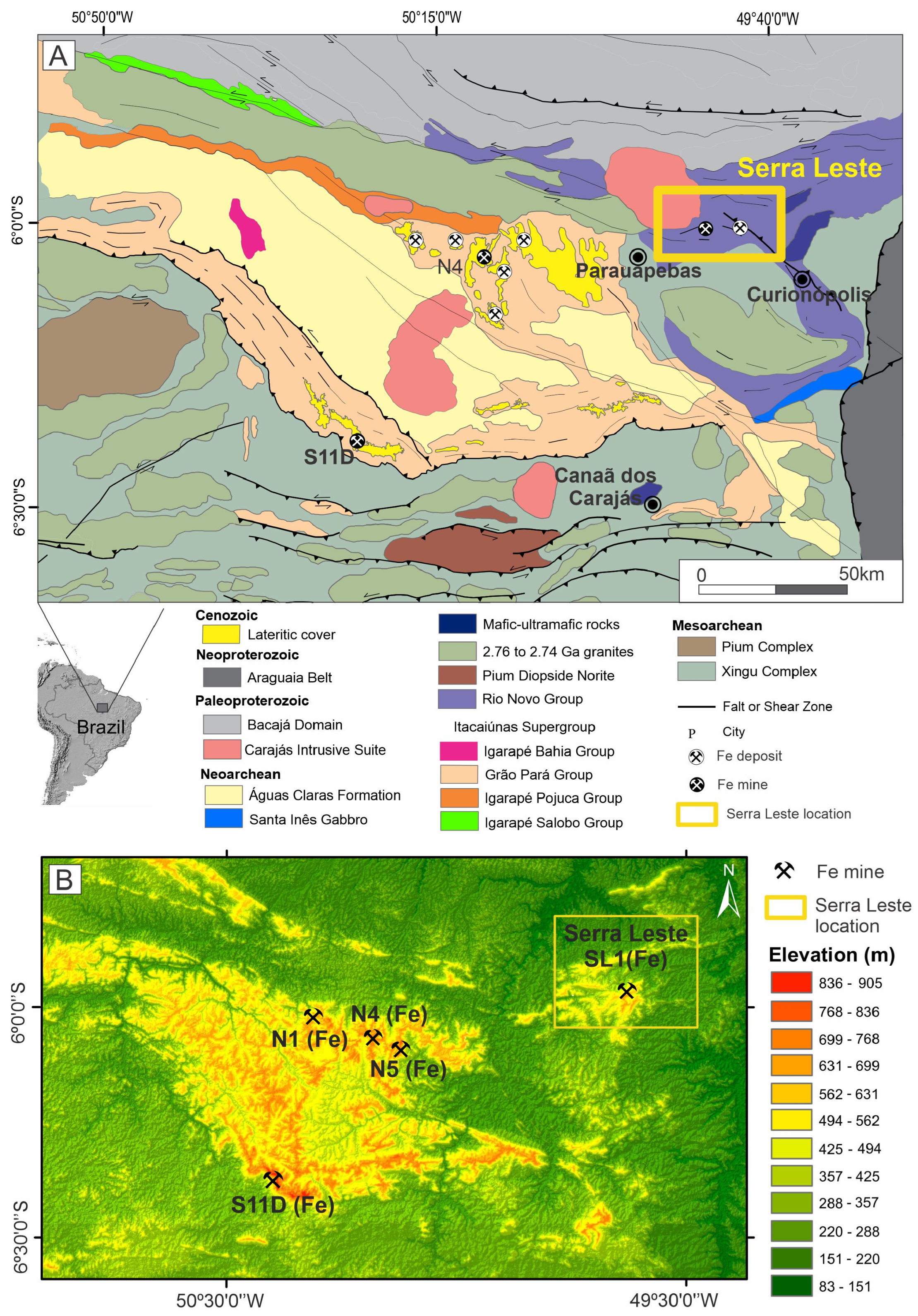
The Carajás Mineral Province, in the southeastern part of the Amazon Craton, includes two distinct tectonic domains. The Mesoarchean Rio Maria Domain is located to the south, and the Neoarchean Carajás Domain is to the north [28,29]. The investigated profiles are situated within the Carajás Domain, which comprises tonalite–trondhjemite–granodiorite terrains of the Xingu Complex, locally migmatized, and granites of the Pium Complex (~2.8 Ga). Also found are layers of mafic to intermediate volcanic rocks from the Itacaiúnas Supergroup (2.73–2.84 Ga) and sedimentary sequences from the Águas Claras Formation (2.64–2.68 Ga) [30], as shown in Figure 1A.
The Itacaiúnas Supergroup comprises mafic to intermediate metavolcanic sequences hosting significant iron deposits, in addition to copper, gold, and manganese mineralizations [26,30,31,32]. The Grão-Pará Group (~2.76 Ga) represents the principal volcano-sedimentary sequence of the Carajás Basin and is distinguished by extensive mafic-dominated volcanism [30,31]. It consists of two distinct paleovolcanic sequences separated by the BIF of the Carajás Formation. The lower sequence (Parauapebas Formation) includes mafic volcanic rocks interspersed with felsic volcanics and shows evidence of possible hydrothermal alterations. The upper sequence (Igarapé Cigarra Formation) comprises basic volcanic rocks along with intercalations of tuffs, clastic, and chemical sediments [9,33,34,35].
The Carajás Formation consists of jaspilites defined by one-centimeter-thick bands of iron oxide alternating with chert. These jaspilites typically have an average thickness of 200 to 250 m in the Serra Norte and exceed 300 m in the Serra Sul, intersected by mafic dikes and sills [35]. The BIFs of Carajás were likely deposited on shallow, stable platforms under wave influence, with a minimum deposition age of 2740 ± 8 Ma [9,31]. Chloritites are commonly associated with hydrothermally altered mafic metavolcanic rocks, where intense chloritization produced chlorite-rich lithologies. Metavolcanic mafic sequences and BIFs host large volumes of soft hematite with lenses of hard hematite exploited in the Carajás Mineral Province [8,11,27,36,37].
Figure 1. (A) Geological map of the Carajás Mineral Province (modified from [38,39]), showing the locations of the main iron ore deposits and mines. (B) A digital elevation model of Serra dos Carajás, based on data from the Shuttle Radar Topography Mission (SRTM) provided by the USGS Earth Explorer (https://earthexplorer.usgs.gov/, accessed on 16 March 2020).
Mining 06 00034 g001
The Carajás landscape comprises large plateaus, 600 to 900 m above sea level, surrounded by gently rolling plains at 100 to 250 m (ref. [26], Figure 1B). These plateaus are capped by ferruginous duricrusts, whose oldest profiles developed around 70 Ma, according to isotopic and cosmogenic dating reported by [6,26].

3. Materials and Methods

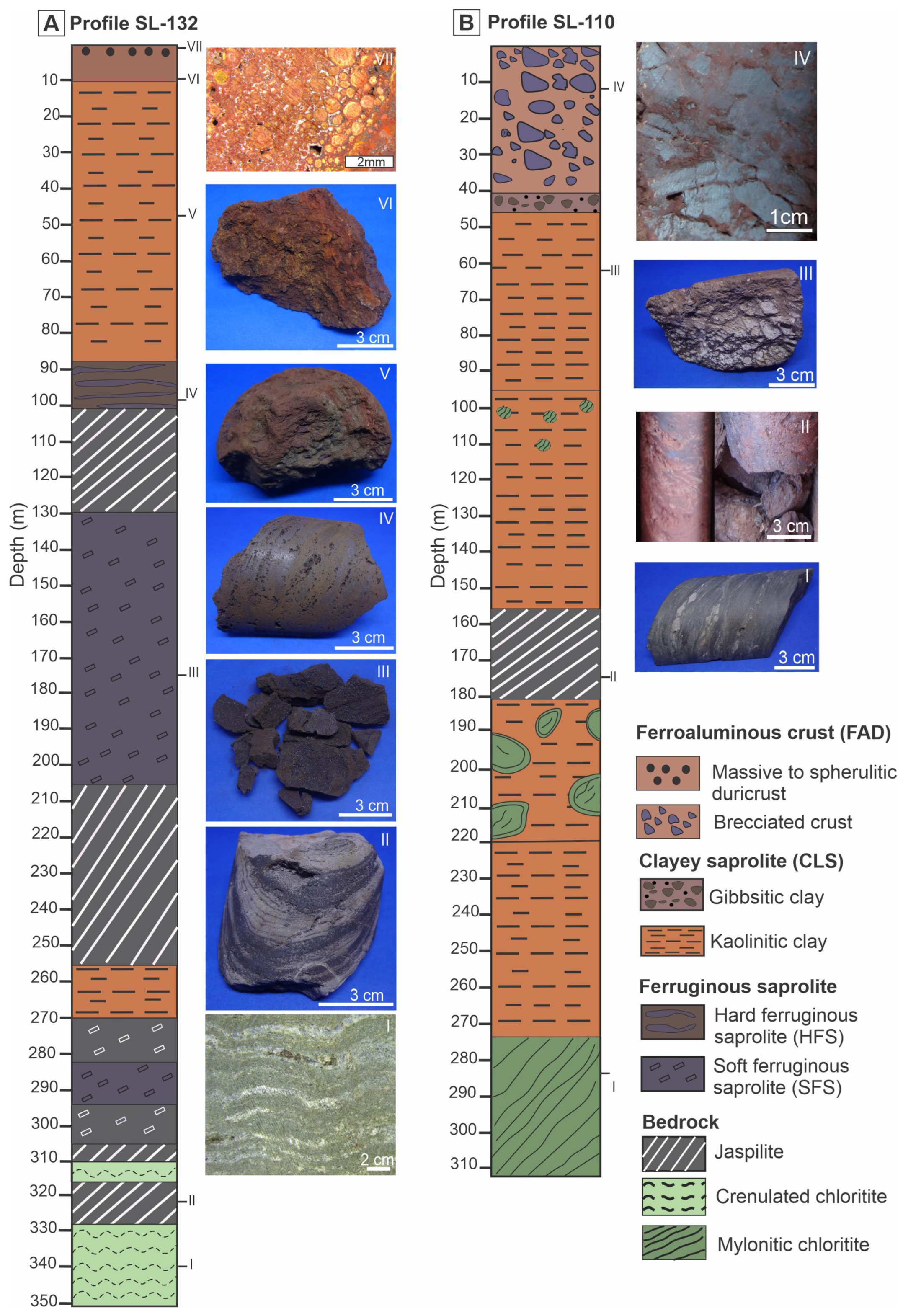
This study was conducted using 36 samples obtained from two boreholes drilled at the Serra Leste deposit, provided by Vale S.A, the company holding mining rights in the area. Borehole SL-110, which is 309 m deep and oriented at 86° north, was drilled at the current pit location. On the other hand, borehole SL-132, with a depth of 351 m and a vertical orientation, is situated 600 m northwest of SL-110 (Figure 2). Samples were selected to represent the main lithological and weathering horizons identified along the profiles, including jaspilite, ferruginous saprolite, clayey saprolite, and ferroaluminous duricrust. The selection aimed to capture the mineralogical and geochemical variability associated with lateritic weathering and iron enrichment processes.
Textural analyses were performed at the Mineralogy, Geochemistry, and Applications Laboratory (LAMIGA) using a LEICA DM 2700 P optical microscope equipped for both transmitted and reflected light, coupled with a LEICA MC 170 HD camera (Leica Microsystems, Wetzlar, Germany). Furthermore, images were acquired at the Microanalysis Laboratory using scanning electron microscopy (SEM) with a Zeiss SIGMA-VP scanning electron microscope (SEM) (ZEISS Group, Oberkochen, Germany), through secondary and backscattered electron imaging, assisted by an IXRF Sedona-SD energy-dispersive spectrometer (EDS) (IXRF Systems, Inc., Austin, TX, USA). The operating conditions were: electron beam current = 80 μA, constant accelerating voltage = 20 kV, working distance = 8.5 mm, and counting time for elemental analysis = 30 s. These procedures were carried out on fragments up to 1 cm long extracted from raw samples, and on polished thin sections, both mounted on double-sided adhesive tape attached to a glass slide and coated with gold for 1.5 min in an automatic sputter coater (Emitech K550X model) (Quorum Technologies, East Sussex, UK) in order to make them electrically conductive.
The mineralogical composition was determined at the Mineral Characterization Laboratory (LCM) using X-ray diffraction (XRD) employing the powder method. XRD analysis was performed on a Panalytical Empyrean diffractometer equipped with a ceramic X-ray tube and Co anode (Kα1 = 1.78901 Å), featuring a long fine focus, Kβ Fe filter, and a PIXcel3D-Medpix3 1 × 1 detector in scanning mode (Malvern Panalytical, Worcestershire, UK). Operating parameters included a voltage of 40 kV, a current of 35 mA, a step size of 0.0260° 2θ, a sweep from 3° to 94° 2θ, and a time per step of 30.6 s. The instrument was set up with a 1/4° divergent slit, a 1/2° anti-scatter slit, and a 10 mm mask. Data acquisition utilized X’Pert 3.0 Data Collector Software 3.0, followed by processing with X’Pert HighScore Plus 3.0.
Mössbauer spectroscopy analyses were conducted at the LAMIGA for detailed characterization of the iron oxyhydroxides, using the WissEl equipment from Wissenschaftliche Elektronik GmbH (Wissenschaftliche Elektronik GmbH, Deutschland, Germany). Measurements were taken at room temperature in constant acceleration mode, utilizing a nominal 50 mCi 57Co source embedded in a Rh matrix. Spectra were acquired within a velocity range of about ±10 mm/s, employing a 512-channel analyzer. Velocity calibration was based on α-Fe at room temperature. The obtained spectra were processed and refined using WinNormos 7 running on IgorPro 7 software. The fitting procedure was based on a least-squares method, using a combination of Lorentzian doublets and sextets to resolve the spectral components. Hyperfine parameters (isomer shift, quadrupole splitting, and magnetic hyperfine field) were allowed to vary within physically constrained ranges consistent with iron oxides and oxyhydroxides reported in the literature. Phase assignments were made based on these hyperfine parameters by comparison with reference values for hematite and goethite.
Chemical analyses of 20 selected samples, including major, minor, trace, and rare earth elements (REEs), were carried out at ALS laboratories in Peru. Major elements were determined by inductively coupled plasma atomic emission spectrometry (ICP-AES) following four-acid digestion (ME-4ACD81 and ME-ICP06). Base metals (Ag, Cd, Co, Cu, Li, Mo, Ni, Pb, Sc, and Zn) were determined using the same ICP-AES analytical procedure after four-acid digestion (ME-4ACD81). Trace and rare earth elements were analyzed by inductively coupled plasma mass spectrometry (ICP-MS) following lithium borate fusion (ME-MS81 and ME-MS42). Total concentrations were determined using the ALS TOT-ICP06 analytical procedure. Loss on ignition (LOI) was determined gravimetrically after calcination at 1000 °C (OA-GRA05). Total carbon and sulfur contents were quantified using a LECO analyzer (C-IR07 and S-IR08; LECO Corporation, St. Joseph, MC, USA).
Analytical quality control included the use of certified reference materials and analytical blanks, following standard ALS protocols for geological materials. Detection limits are reported in the analytical tables and values below detection limits are indicated by the symbol “<”. Cluster analysis was performed using OriginPro 9.0. The analysis was based on the geochemical data presented in the Section 4. All variables were standardized using z-score normalization. Hierarchical agglomerative clustering was applied using Euclidean distance.

4. Results

4.1. The Lateritic Succession

The investigated profiles comprise the parent rocks (chloritites and jaspilites), as well as a series of horizons that include ferruginous saprolite, clayey saprolite, and ferroaluminous duricrust. The weathering horizons are interlayered with chloritites and jaspilites (Figure 2).
  • Mineralogical Succession and Texture Evolution
Chloritites are typically foliated, partially mylonitic, and crenulated. In addition to chlorite, they contain quartz and accessory opaque minerals (Figure 2A-I,B-I). Jaspilites alternate with chloritites. They consist of bands of quartz and iron minerals. They have a compact structure, and some areas look brecciated because of the quartz filling up microfractures (Figure 2A-II,B-II).
In the ferruginous saprolite, a mass primarily composed of hematite (with subordinate goethite) prevails. This saprolite can appear either friable (soft ferruginous saprolite) or more consolidated (hard ferruginous saprolite), with these variations most clearly observed in profile SL-110. Soft ferruginous saprolite (SFS) is the most common type of ferruginous saprolite, characterized by a gray color and a powdery appearance, consisting of an aggregate of microporous, centimetric hematite fragments that are internally massive or platy. Quartz and traces of magnetite are present as subordinate phases (Figure 2A-III).
The hard ferruginous saprolite (HFS) exhibits a microporous appearance and high tenacity. In profile SL-132, it displays centimetric brown bands formed of hematite and goethite, alternating with dark gray laminae composed only of hematite without goethite (Figure 2A-IV). In profile SL-110, transitional textures can be observed between jaspilite and HFS at depths of 155 to 180 m. Transitional textures between HFS and SFS are observed in profile SL-132 from 270 to 305 m deep. Relic blocks of jaspilite occur in both types of ferruginous saprolite (HFS and SFS).
The clayey saprolite (CLS) consists of a reddish-brown mass composed of kaolinite, muscovite, quartz, and accessory hematite (Figure 2B-III). Relic chloritite blocks can be found in this horizon, particularly prominent in profile SL-132 (Figure 2B). At the bottom of the CLS, there is a clay matrix made up of kaolinite, gibbsite, hematite, and muscovite, with hematite and kaolinite veins (Figure 2A-V). At the top, the clayey matrix locally embeds gibbsite nodules. The CLS locally includes ferruginous zones equivalent to the soft ferruginous saprolite and hard ferruginous saprolite.
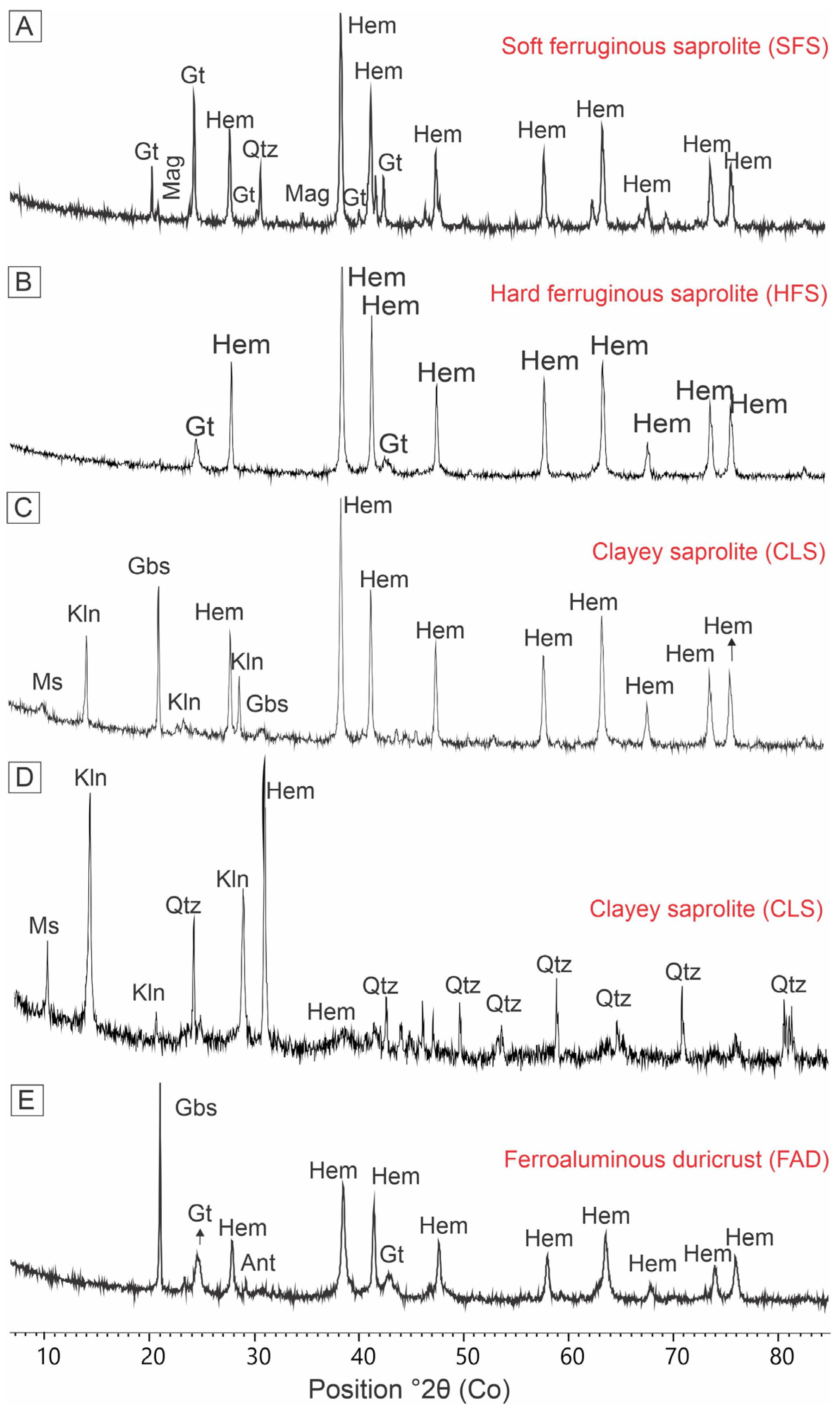
The ferroaluminous Duricrust (FAD) at the top of the profiles consists of hematite, gibbsite, goethite, and accessory anatase. The FAD mostly exhibits a reddish-brown color with ochre patches and a cavernous appearance. In profile SL-132, the FAD is massive at the bottom (Figure 2A-VI), transitioning to spherulitic upwards (Figure 2A-VII). In profile SL-110, the FAD comprises a brecciated aggregate of elongated hematite fragments coated with goethite (Figure 2B-IV). The mineralogical composition of all horizons (HFS, SFS, CLS, and FAD) is presented in Figure 3A–E.

4.2. Micromorphology

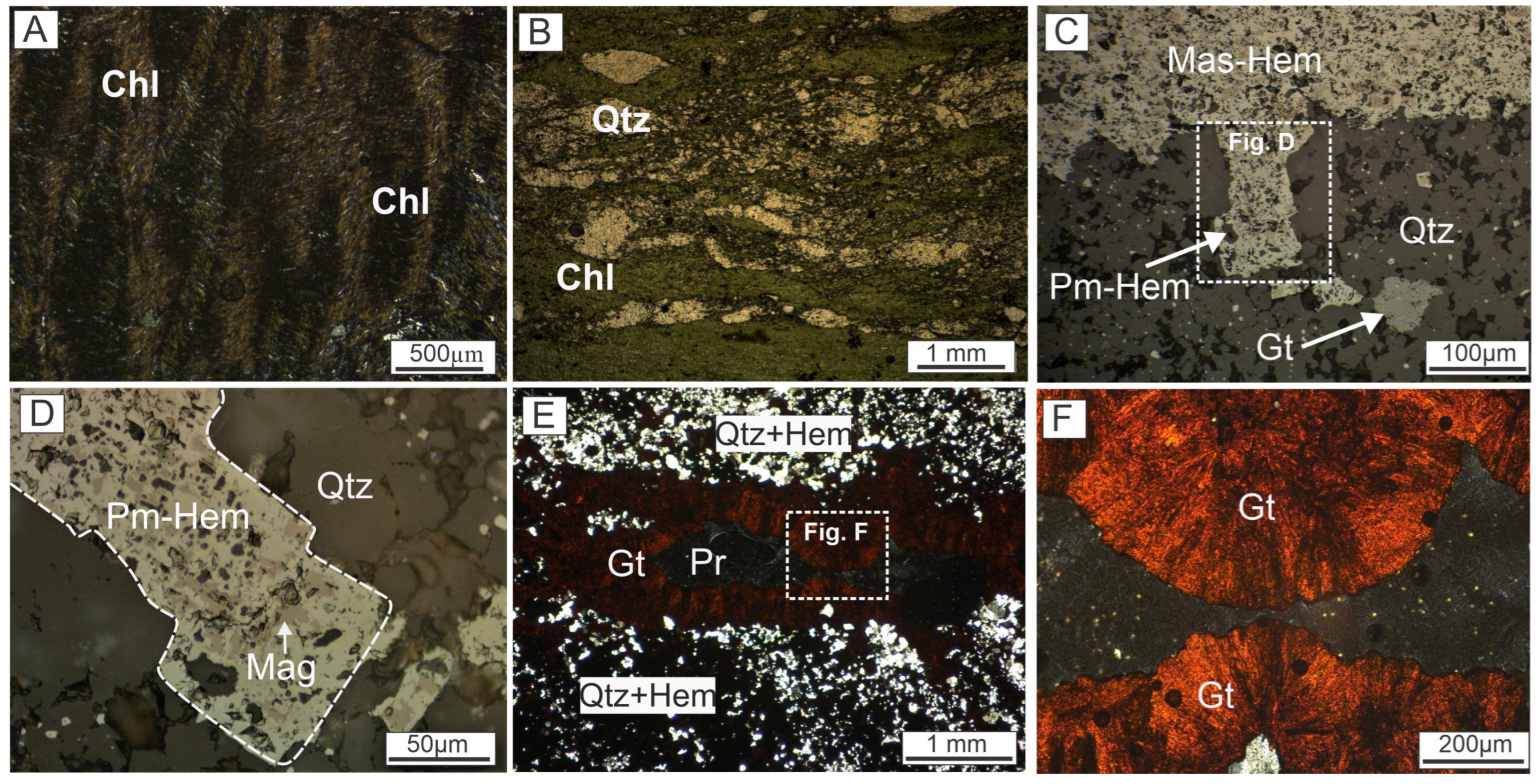
Chloritites exhibit a smooth crenulation cleavage (Figure 4A), based on the classification by [40]. In addition to the predominant crenulation, chloritites show localized mylonitization, with plastic deformation evident in quartz porphyroclasts and anastomosing chlorite (Figure 4B). Quartz veinlets are both discordant and concordant with the foliation planes. In jaspilites, hematite appears as a cryptocrystalline mass or as pseudomorphic euhedral crystals (Figure 4C). Magnetite is found as a relic within pseudomorphic hematite (Figure 4D). Goethite is observed as a coating or infilling of cavities and fissures (Figure 4E,F).
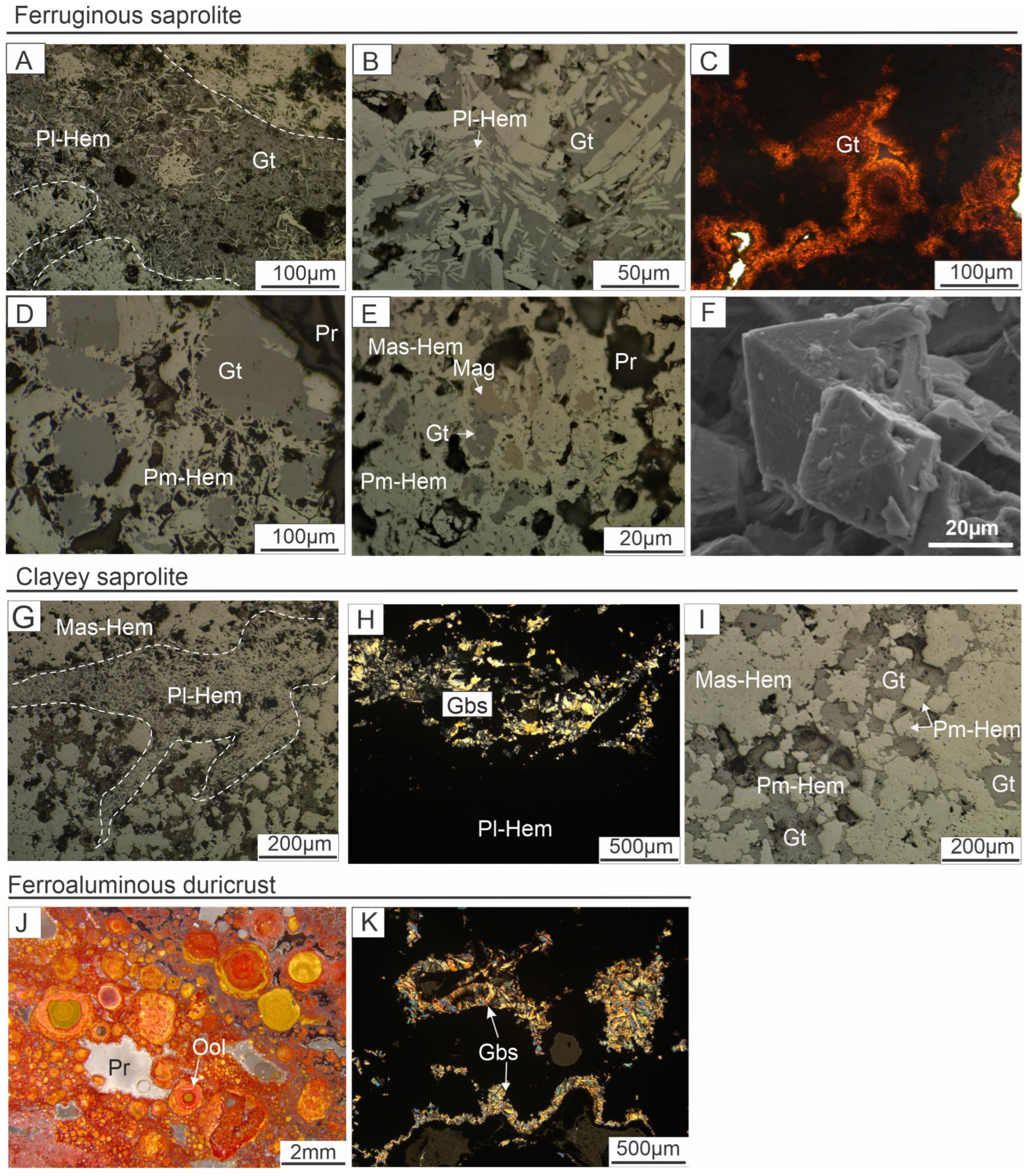
The ferruginous saprolite shows soft and hard hematite texturally similar to those in jaspilites. This similarity can be seen in the continuous association between massive hematite and pseudomorphic hematite. Additionally, microplaty hematite is present in ferruginous saprolite. In the hard ferruginous saprolite, hematite appears as euhedral platy crystals, up to 0.15 mm in diameter, arranged without a preferential direction (Figure 5A,B). In the same sections, some cavities are partially infilled with colloform goethite (Figure 5C). In the soft ferruginous saprolite, goethite often partially replaces hematite crystals or infills pore spaces (Figure 5D). This matrix, composed of hematite and goethite, also contains magnetite relics (Figure 5E,F).
In the clayey saprolite, microplaty hematite often invades the matrix composed of massive and octahedral hematite crystals (Figure 5G). In some areas, microplaty hematite is found alongside well-developed gibbsite crystals within microfractures (Figure 5H). Goethite frequently cements the interstitial spaces between octahedral hematite crystals (Figure 5I) and coats the walls of cavities in the form of fibroradial crystals.

4.3. Relative Abundance of Iron-Bearing Minerals

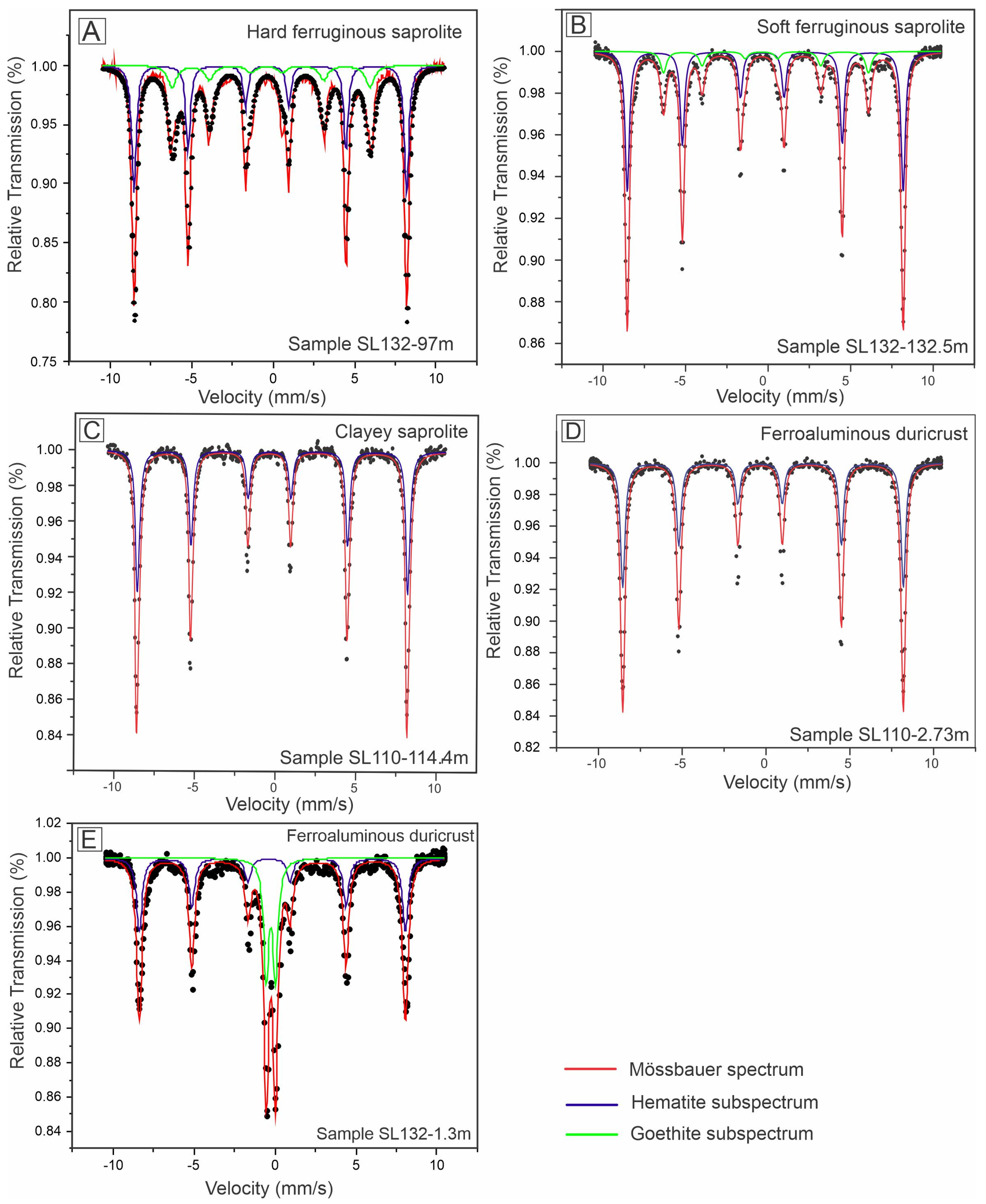
Room-temperature Mössbauer spectra were used to determine the relative abundance of iron minerals in the hard ferruginous saprolite, soft ferruginous saprolite, clayey saprolite, and ferroaluminous duricrust. Quantification was based on the relative areas of the subspectra, which represent the individual contributions of each mineral phase. Overall, three patterns were observed: one sextet, two sextets, and a sextet plus doublet (Figure 6A–E). The more pronounced sextets (with higher intensity hyperfine fields) were identified as hematite, while the more compact sextets and the doublet were indicative of goethite.
In the hard ferruginous saprolite, the relative spectral areas indicate hematite as the dominant phase (61.8%), with goethite accounting for 38.7%. This dominance is further enhanced in the soft ferruginous saprolite, where hematite reaches 79.7% and goethite decreases to 20.2%. In the clayey saprolite, only the hematite sextet was identified. A similar pattern is observed in the ferroaluminous duricrust samples, although minor goethite contributions occur locally. Overall, the combined XRD and Mössbauer data indicate that hematite is the prevailing iron phase throughout the profile, while goethite, when present, consistently occurs in subordinate proportions (Table 1).

4.4. Chemical Composition Changing Along the Profile

4.4.1. Major Elements

The average chemical composition of the Serra Leste profiles demonstrates that the contents of major elements (Fe2O3, SiO2, Al2O3, TiO2, MnO, and P2O5) are consistent with the mineralogical composition previously outlined. Variations delineate the bedrock and each overlying horizon (Table 2 and Table 3).
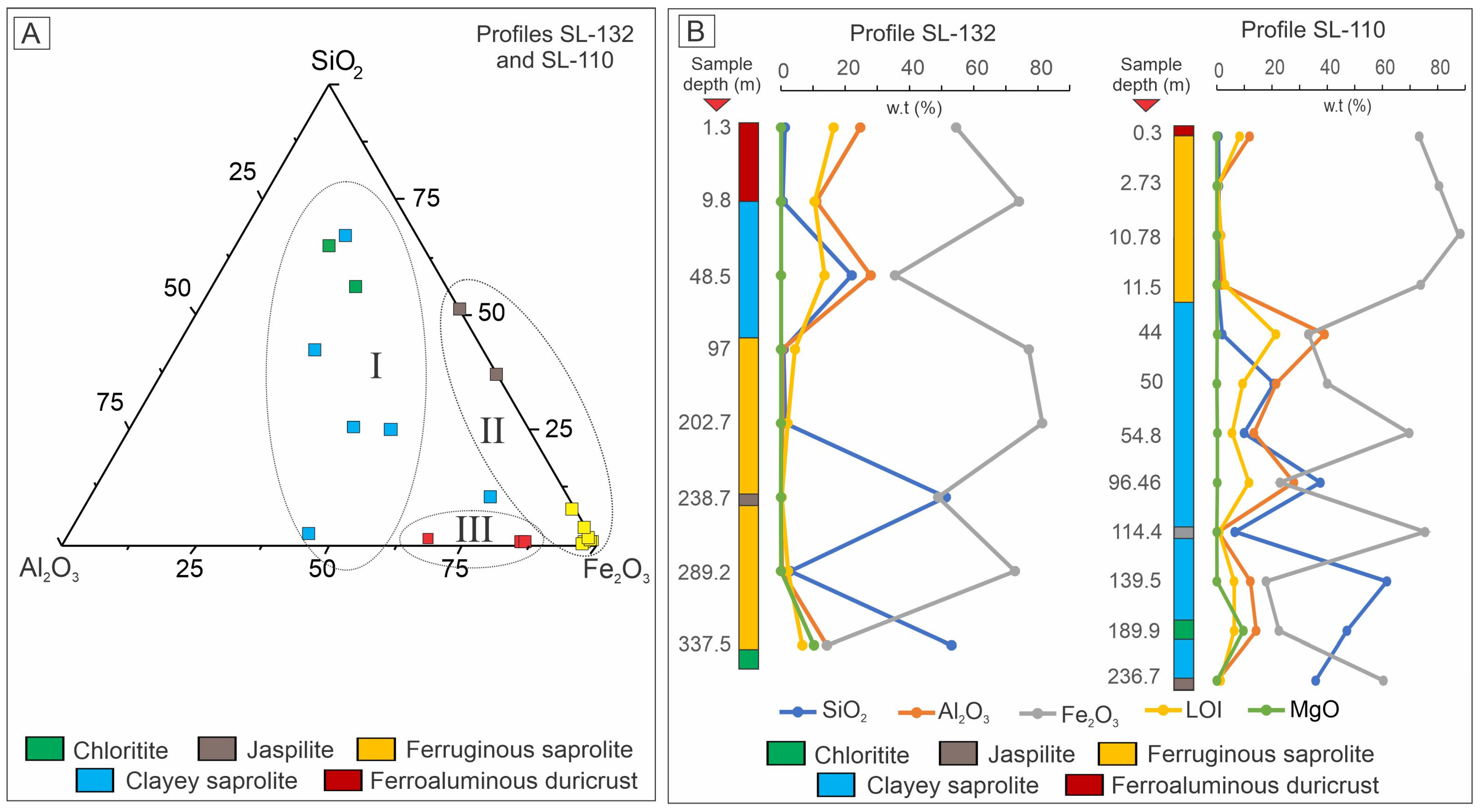
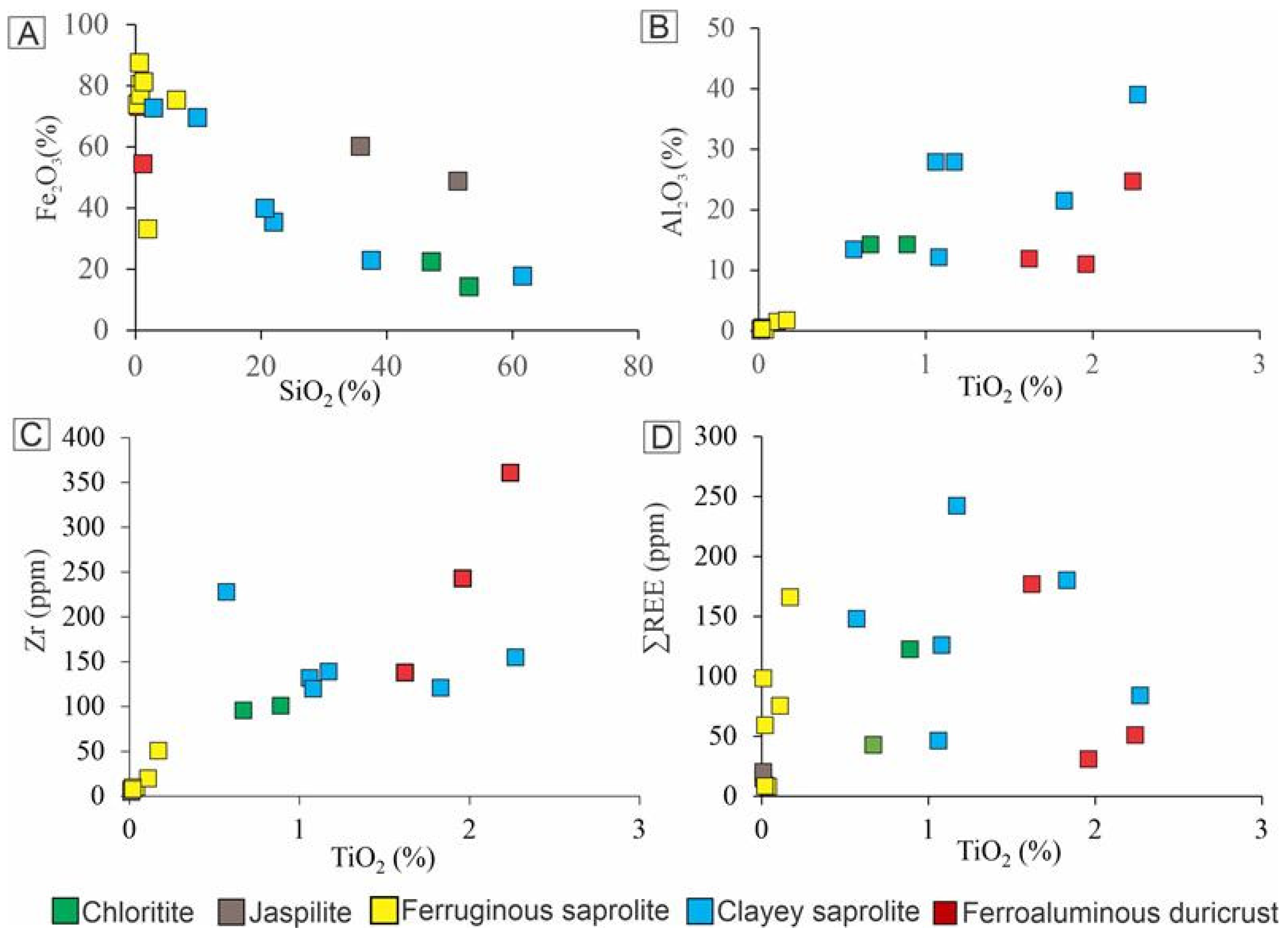
The bedrock exhibits the highest SiO2 content across the entire profile, with values ranging from 47.1% to 53.1% in chloritites and from 35.8% to 51.3% in jaspilites. In the ferruginous saprolite, SiO2 contents are significantly lower than in the bedrock, ranging from 0.67% to 6.53% in profile SL-110 and from 0.79% to 2.88% in profile SL-132 (Figure 7A). The clayey saprolite shows greater heterogeneity in SiO2 distribution, with contents generally much lower than the substrate across most samples in both profiles (ranging from 0.37% to 37.5%), with one sample notably containing 61.6% SiO2. In the ferroaluminous duricrusts of both profiles, SiO2 contents range from 0.57% to 9.8% considering both profiles.
The Fe2O3 content varies significantly between the two major bedrocks. In chloritites, the Fe2O3 content ranges from 14.3% to 22.5%, while in jaspilite, it ranges from 48.9% to 60.3% (Figure 7A). Contrasting iron contents are also observed in the two types of saprolite. The ferruginous saprolite exhibits Fe2O3 contents consistently above 75.4% in profile SL-110 and above 72.8% in profile SL-132. In contrast, the clayey saprolite shows lower Fe2O3 content, varying from 17.8% to 73.9%.
Al2O3 contents are 14.25% in the chloritites of both holes. These values are somewhat similar to those found in the clayey saprolite, which ranges from 12.15% to 39% in hole 110 and shows a value of 35.5% in the only sample analyzed from this horizon in hole 132 (Figure 7A). Conversely, the Al2O3 contents are 0.16% and 0.07% in the jaspilites of profiles SL-110 and SL-132, respectively, closely aligning with the levels found in ferruginous saprolite (0.12% to 0.56% in profile SL-110 and 0.31% to 0.43% in profile SL-132).
The relative distributions of SiO2, Al2O3, and Fe2O3 contents allowed the samples to be grouped in three fields matching previously described horizons (Figure 7B). In field I, the samples primarily consist of chloritite and clayey saprolite. Their distribution corresponds to variations in relative SiO2 content, with intermediate levels of Fe2O3 and Al2O3. One sample from this group exhibits very low SiO2 values but high Al2O3 levels, indicating local bauxite formation within the clayey saprolite. This observation also supports the genetic relationship between chloritite and clayey saprolite. Field II includes samples of jaspilite and ferruginous saprolite, characterized by low Al2O3 content. Field III is represented by the ferroaluminous duricrust.
The distribution of TiO2 is similar to that of Fe2O3 and Al2O3, as it also highlights the resemblance between jaspilites or chloritites and specific horizons. The TiO2 contents are comparable in chloritite (0.67% and 0.89%) and clayey saprolite (1.08% to 2.27%) and are also similar between jaspilite (<0.01% to 0.01%) and ferruginous saprolite (<0.01% to 0.11%). In the ferroaluminous duricrust, TiO2 content ranges from 1.62% to 2.24%, closely resembling the levels found in clayey saprolite.
The contents of MnO, MgO, CaO, K2O, and P2O5 are below the UCC contents in both chloritite and jaspilite. These levels are even lower in ferruginous and clayey saprolite and in the ferroaluminous duricrust, often falling below the detection limit. Conversely, the loss on ignition is significantly higher in clayey saprolite (5.52–21.4%) and the ferroaluminous duricrust (8.27–16.4%) compared to chloritite (6.31–6.65%), jaspilite (0.23–1.36%), and ferruginous saprolite (0.41–4.35%).
The similarity in the vertical distribution of Al2O3 and LOI values, along with high SiO2 contents, reflects the formation of kaolinite in the clayey horizon (Figure 7B). However, in certain sections, such as at 9.8 m depth in profile SL-132 and at 44 m in SL-110, Al2O3 and LOI are much higher than SiO2 due to the domain of gibbsite. This underscores the contribution of aluminum-rich parent rocks, particularly chloritites, to the development of the studied profiles. Minor variations in analytical totals, including values slightly below or above 100%, may be related to the combination of different analytical procedures and digestion methods applied to major, trace, and volatile components.

4.4.2. Trace Elements

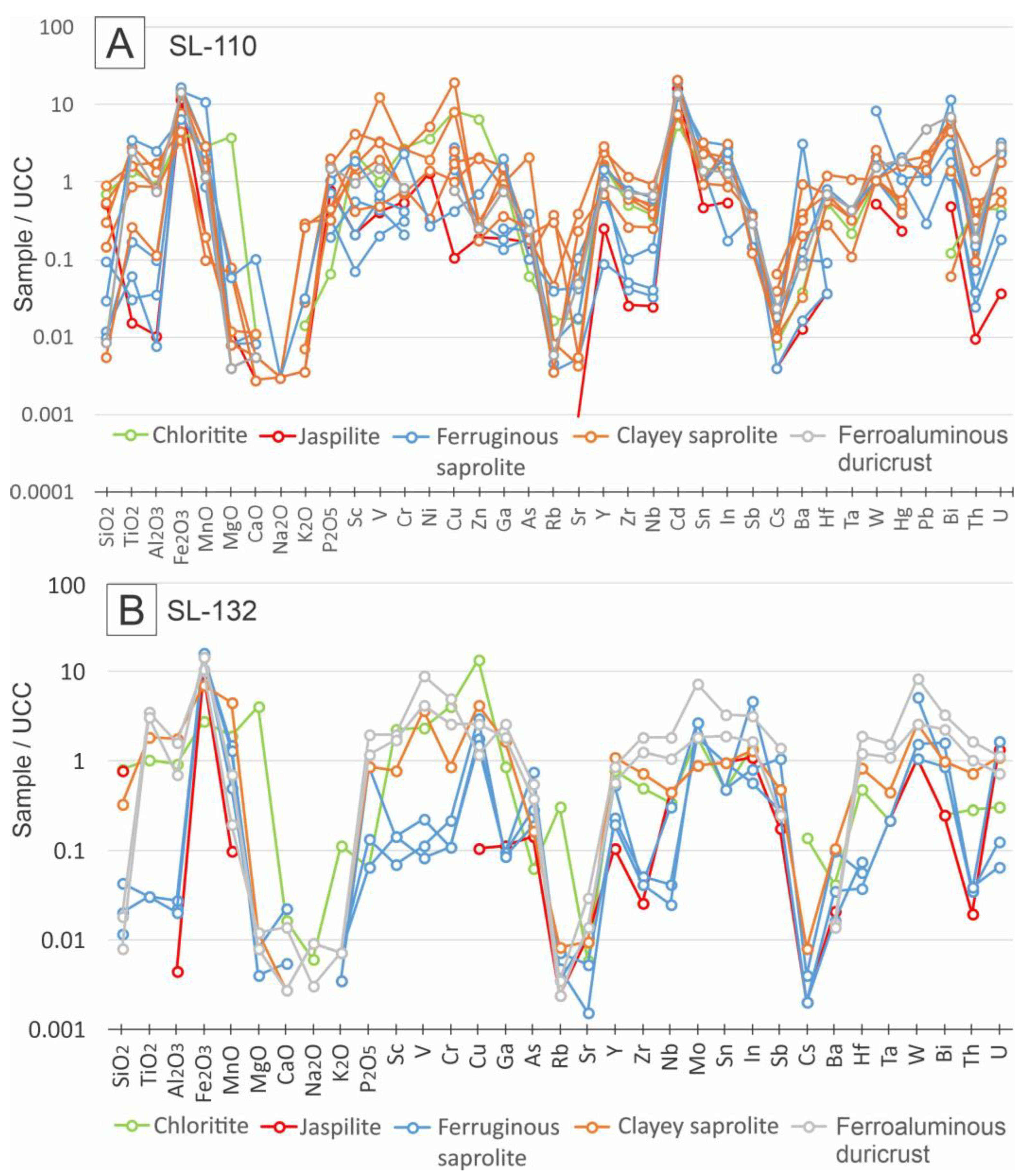
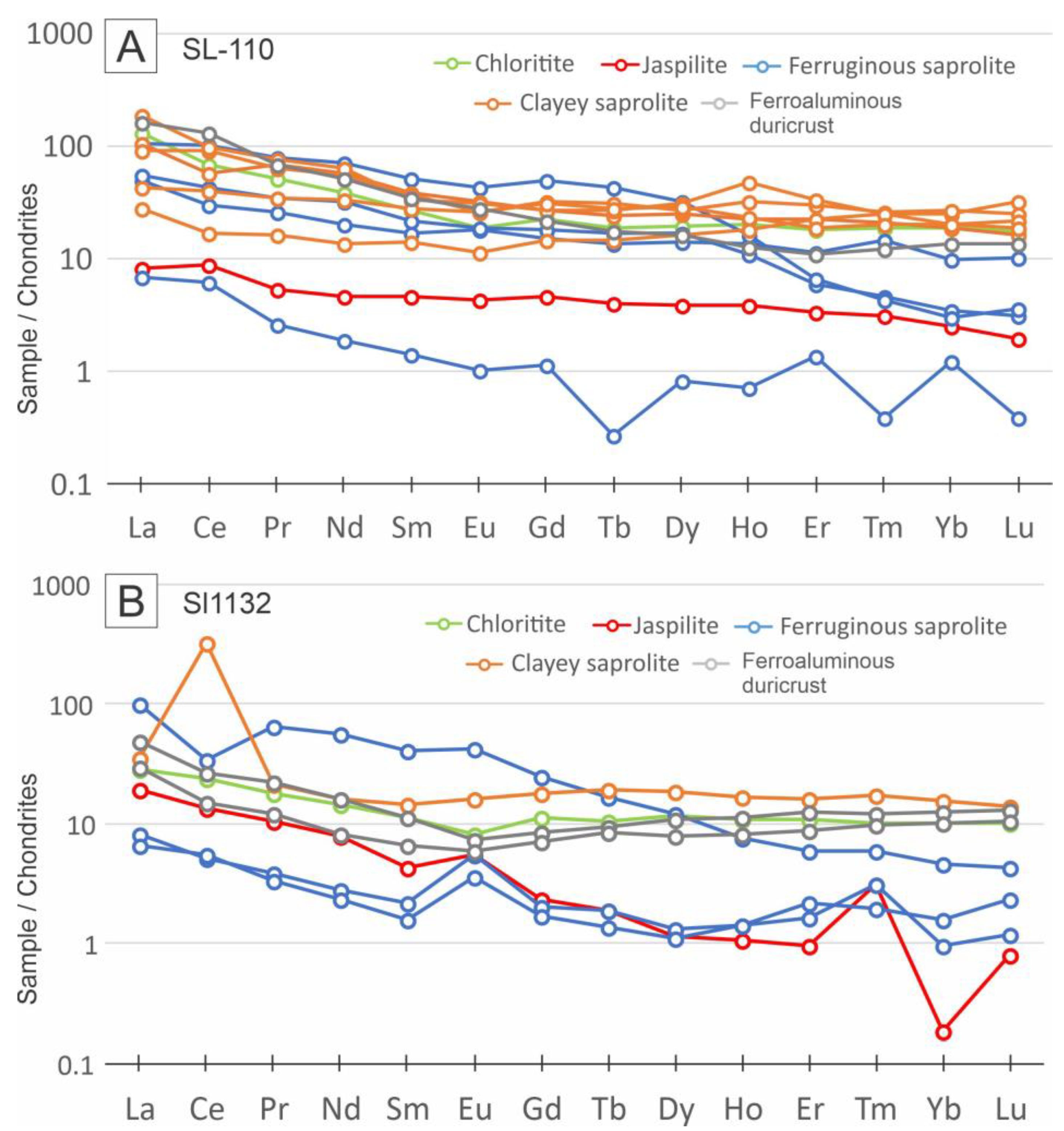
The trace elements that presented concentrations above the detection limit in most of the analyzed samples include Sc, V, Cr, Ni, Cu, Zn, Ga, Zr, Y, Cd, Sn, In, Ba, Bi, Th, U, and REE, whose concentrations ranged from below to above the UCC values [41] (Table 2 and Table 3). Their distribution will be described using normalization to the chemical composition of the UCC and, for REE, to the average chemical composition of the chondrite meteorite (Figure 8A,B). The purpose is not to establish enrichment or depletion relative to the reference compositions, but rather to evaluate similarities and differences in the normalized distribution patterns among the investigated horizons and between these horizons and their parent rocks.
Ferruginous saprolite and clayey saprolite display similar trace element distribution patterns relative to the UCC (Figure 8A,B). In both horizons, Cu, Y, Cd, Sn, In, Hg, Pb, Bi, and U occur at concentrations above the UCC values. Some differences are also observed: Mo presents concentrations above the UCC only in ferruginous saprolite, whereas Sc, V, Cr, and Ni occur above the UCC only in clayey saprolite. In addition, both saprolitic horizons exhibit similar distribution patterns to jaspilite. Conversely, they may show values either above or below those observed in chloritite, depending on the element considered.
Overall, the trace element distribution pattern of the ferroaluminous duricrust relative to the UCC more closely resembles that of the clayey saprolite than that of the ferruginous saprolite, particularly for Sc, V, Cr, and Ni. However, the distribution patterns are very contrasting between profiles. In SL-110, most elements occur at concentrations above the UCC, including Sc, V, Cr, Cu, Cd, Ga, Zr, Nb, Mo, Sn, In, Sb, Hf, Ta, Bi, Th, and U. In contrast, in SL-132, only Sc, V, Cd, Sn, In, Hg, Pb, Bi, and U present concentrations above the UCC.
The REE distribution patterns normalized to the chondrite of [42] reveal a strong similarity between the horizons in both profiles, with a few exceptions (Figure 9A,B). In general, REE concentrations are higher than those found in chondrite. Bedrock samples display an enrichment of light REE compared to the heavy ones, which is more pronounced in jaspilites (La/Lu N average = 14.27) than in chloritites (La/Lu N average = 5.16).
The enrichment of light REE relative to heavy REE is observed in the overlying horizons, more pronounced in the ferruginous saprolite (La/Lun average = 16.99 in SL-110 and 10.97 in SL-132) than in the clayey saprolite (La/Lun = 4.85 in SL-110 and 2.55 in SL-132). The ferroaluminous duricrust displays significant variation between the two profiles (La/Lun average = 12.18 in SL-110 and 3.25 in SL-132). Thus, REE data exhibit minimal fractionation between the investigated horizons, resulting in an approximately horizontal pattern. Nonetheless, a subtle similarity is evident between jaspilite and ferruginous saprolite, both showing greater enrichment of light REE relative to heavy REE, as well as between chloritite and clayey saprolite, where this enrichment pattern is less pronounced.
The jaspilite sample from profile SL-132 shows a notable positive europium anomaly (Eu/Eu* = 1.67), as do three samples of ferruginous saprolite (Eu/Eu* = 1.33, 2.23, and 2.61), which contrasts with the overall pattern observed in the profile. Additionally, one of the clayey saprolite samples displays a positive cerium anomaly (Ce/Ce* = 10.71), as shown in Figure 9B.

5. Discussion

5.1. Mineralogical and Textural Transformations in Iron-Bearing Minerals

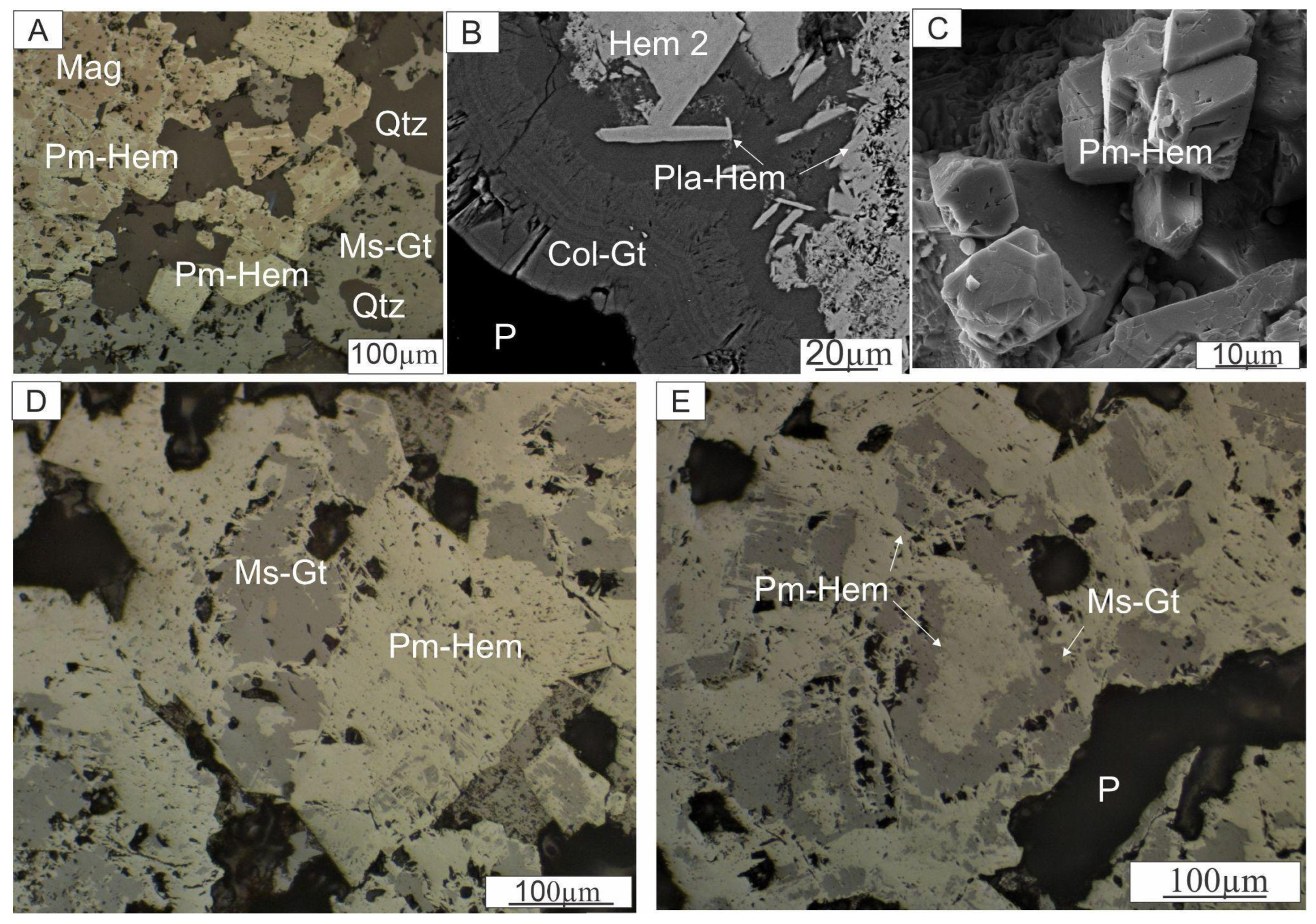
The mineral paragenesis in the Serra Leste profiles enabled the interpretation of the succession of iron-bearing phases. The jaspilites represent the parent rock, where iron occurs as magnetite and both massive, pseudomorphic, and platy hematite. The octahedral forms observed within the jaspilites are relict, representing magnetite crystals preserved from the BIF protolith, containing magnetite cores that gradually transform into pseudomorphic hematite at the edges. This conversion indicates an initial stage of weathering, where only magnetite was affected, and the quartz grains remained undissolved. The platy form reflects a more accelerated stage of magnetite replacement by hematite (Figure 10A), where the octahedral parting planes facilitate oxygen diffusion along preferred directions, causing iron to migrate and form hematite lamellae (Figure 10A, Equation (1)) [16,43,44,45].
The ferruginous saprolite inherits massive, pseudomorphic and platy hematite from the jaspilites, in turn with no magnetite relics. Cavities left by quartz dissolution become progressively abundant, partially infilled by colloform goethite (Figure 10B). Microcavities found in pseudomorphic hematite within the ferruginous saprolite (Figure 10C) indicate it was also partially dissolved, creating a microporosity also infilled by massive goethite (Figure 10D). Thus, as the dissolution process advances, goethite replaces hematite from the edges inward (Figure 10E). This transformation typically occurs in two stages. First, hematite is reductively dissolved, releasing Fe2+ that becomes soluble in organic complexes (Equation (2)). Next, Fe2+ is re-oxidized, leading to the formation of goethite (Equation (3)) [45].
2 Fe 3 O 4   ( mag )   + 1 2   O 2   ( dis )     3 Fe 2 O 3   ( hem )
4 Fe 2 O 3   ( hem ) + CH 3 COOH   ( aq ) + 16 H + ( aq ) 8 Fe + 2   ( aq )   +   2 CO 2   ( dis )   +   10 H 2 O   ( liq )
2 Fe 2 +   ( aq ) + 0.5 O 2   ( dis ) + 4 OH   ( aq )     2 FeOOH   ( gt )   +   H 2 O

5.2. Geochemical Fractionation

These samples follow a pattern of decreasing SiO2 and increasing Fe2O3, reflecting the formation of ferruginous saprolite from jaspilite through a classic weathering process (e.g., [13,14,15]). A similar pattern was verified in other lateritic profiles of Carajás at least partially derived from chloritites or related rocks, referred to as mafic rocks in S11D deposit or substratum relicts in Serra Norte deposit [27,37]. Considering vertical variation, the significant decrease in SiO2 content upwards indicates the dissolution of quartz and leaching of silica in the jaspilites, attributed to hydrolysis and silica mobilization during lateritic weathering processes (e.g., [46]). In contrast, chloritites exhibit a less intense decrease in SiO2 levels since kaolinite, one of their final products, retains some silica. Despite the overall decrease in both cases, marked compositional variations occur due to profile heterogeneity, including preserved portions of chloritite within the ferruginous saprolite and relict chloritite in the clayey saprolite. The ferroaluminous duricrust exhibits an intermediate composition between the two groups, suggesting contributions from both weathering systems.
Iron, originally derived from magnetite and hematite in jaspilite, remains within the system due to the high stability of hematite in the supergene environment (e.g., [47,48]). Consequently, iron concentrates in the forms of hematite and goethite while silica is leached, leading to an increase in Fe2O3 concentrations from the bottom to the top as jaspilite transforms into ferruginous saprolite. For chloritites, iron mainly originates from chlorite, which is associated with quartz, and its concentration also increases towards the clayey saprolite due to its retention as iron oxyhydroxides.
The SiO2 and Fe2O3 contents exhibit the negative correlation typically found in lateritic profiles (Figure 11A), in response to the leaching of SiO2 and the relative concentration of Fe2O3 (e.g., [49]). Conversely, TiO2 and Al2O3 show a positive correlation (Figure 11B), as both are considered immobile in lateritic environment. Aluminum is present as kaolinite and gibbsite, and TiO2 as anatase. TiO2 and Zr exhibit an even stronger positive correlation (Figure 11C), due to their low mobility, with TiO2 in the form of newly formed anatase and Zr as resistate zircon [50,51,52]. While the possible presence of rutile as a resistate could also explain the immobility of TiO2, XRD analysis identified only anatase.
REE shows no correlation with TiO2 (Figure 11D), contrasting with the behavior reported for most lateritic profiles, in which zircon tends to be the primary carrier of REE and concentrates upward along with anatase (e.g., [53,54]). This suggests that in the Serra Leste profile, there are REE-bearing minerals other than zircon.
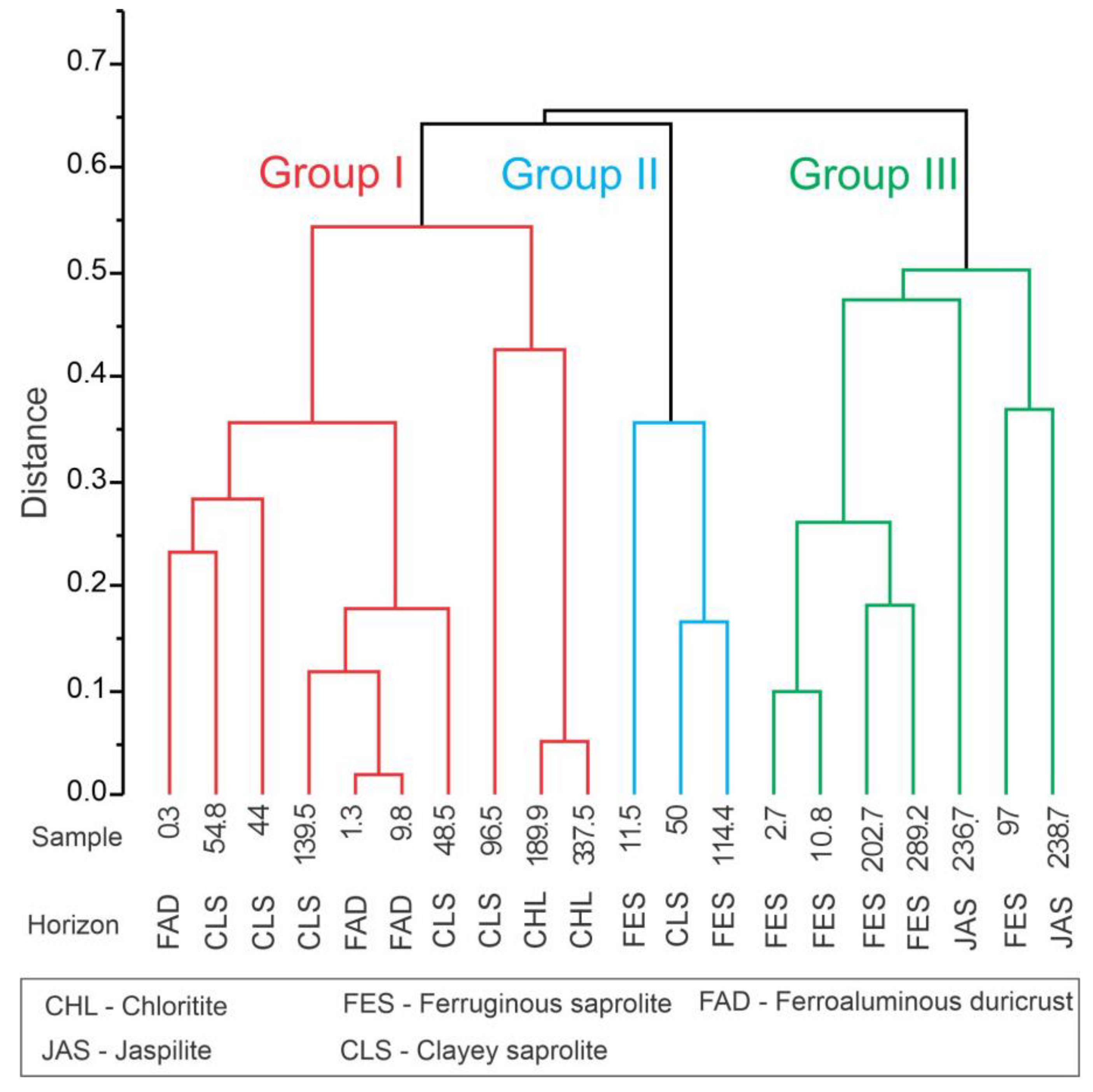
The cluster analysis of samples from the Serra Leste profile, based on their whole multi-element chemical composition, including major and trace elements (Table 2 and Table 3), underscores the genetic affinity between horizons (Figure 12). The analysis identifies three main groups: Group I predominantly includes samples of chloritite, clayey saprolite, and ferroaluminous duricrust, while Groups II and III comprise jaspilites and ferruginous saprolite. This pattern supports the mineralogical and textural data indicating an association between the ferruginous saprolite and jaspilites. In contrast, the clayey saprolite and ferroaluminous duricrust show a stronger association with chloritites, resembling the bauxite profiles formed from mafic rocks in the N5 and N4 areas of Carajás [37,55].

5.3. Evidence for the Lateritic Origin of Serra Leste Iron Ore

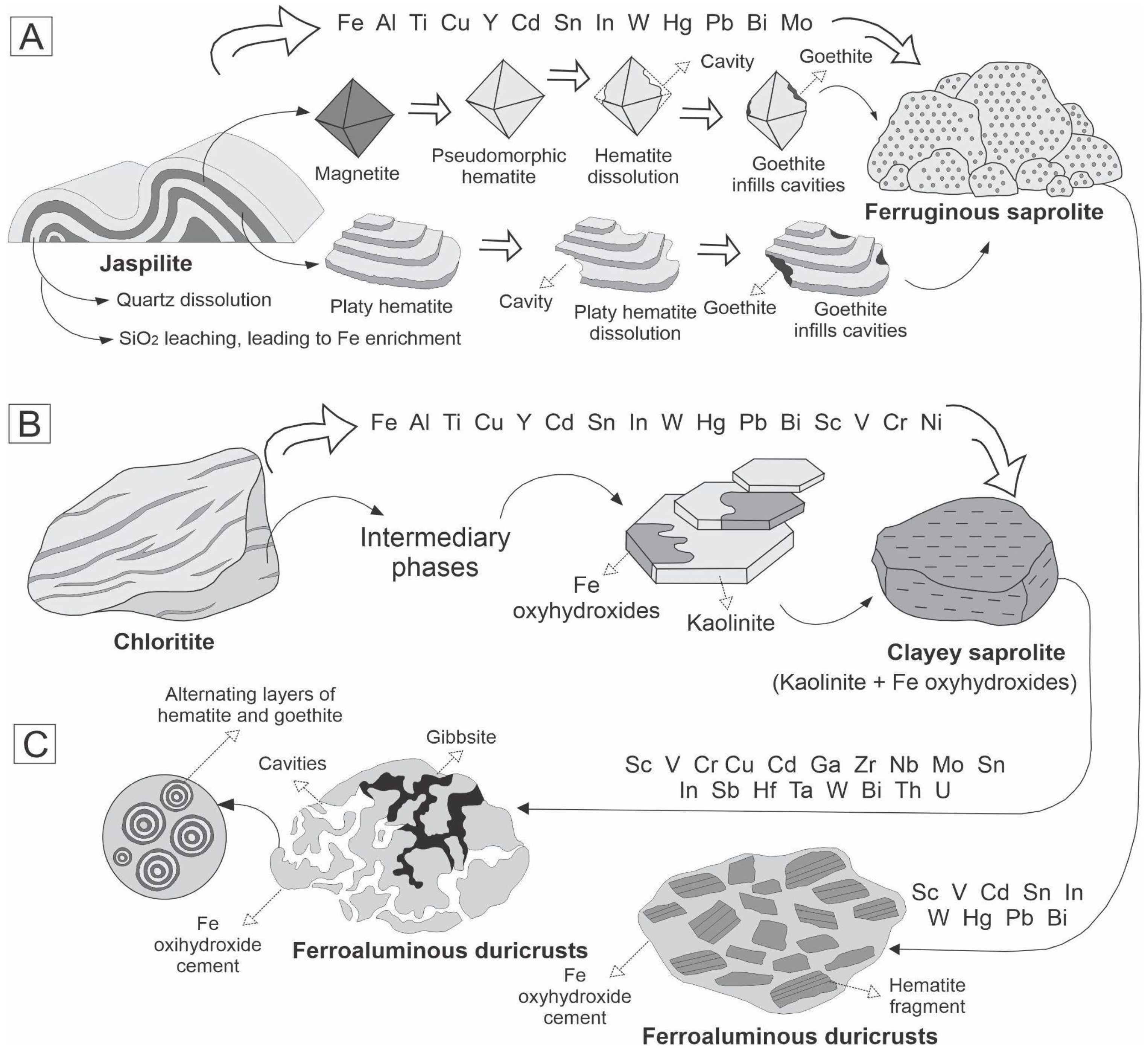
Under humid tropical conditions, interlayered jaspilite and chloritite underwent simultaneous lateritization (Figure 13). In the jaspilites, silica was leached out following quartz dissolution within the chert bands, as indicated by dissolution cavities (Figure 4C–F) and corroborated by reduction in SiO2 content from the bottom (jaspilite) toward the top of the profile. Magnetite from jaspilites was converted into hematite, as demonstrated by the presence of octahedral (pseudomorphic) hematite in the soft ferruginous saprolite associated with platy hematite (Figure 13A).
The continuity of lateritization led to hematite dissolution, forming cavities, followed by reprecipitation of iron as oxyhydroxides later converted to goethite, resulting in the infilling of cavities in the hematite bands and in chert bands of the jaspilites by goethite (e.g., [16]). The detection of quartz in the soft ferruginous saprolite by XRD demonstrates that its dissolution within chert bands was incomplete.
The described lateritic process resulted in the formation of a ferruginous saprolite horizons that is economically important for mining and jaspilites served as proto-ore, which, upon weathering, produced the high-grade iron ore, as previously observed in the Serra Norte and Serra Sul iron deposits [27,37]. This saprolitic iron ore is not the same massive, compact hypogene iron ore described in other Carajás deposits [8,11,36]. Supergene and hypogene interpretations for iron ore in Carajás are not contradictory, but rather refer to different ore types in distinct geological contexts.
Conversely, chloritites underwent hydrolysis reactions, decomposing the dominant chlorite plates and producing intermediate clay minerals and kaolinite as a more evolved product (Figure 13B). Those intermediate phases were not identified, but their participation is interpreted because chlorite is not able to form kaolinite directly, but the formation of intermediate phases, as vermiculite and interstratified chlorite/vermiculite, can make this transition possible [56]. Kaolinite as the only clay mineral suggests the high intensity of weathering even in the saprolite. The iron released from chlorite weathering and intermediate phases accumulated to form goethite, as demonstrated by the iron-rich film covering and cementing kaolinite platy crystals (e.g., [57]).
As demonstrated, the primary product of chlorite weathering is clayey saprolite. The alternation between ferruginous saprolite and clayey saprolite along the investigated profiles suggests intercalation between chloritite and jaspilite as parent rocks.
The ferroaluminous duricrusts of the Serra Leste profile were crucial for preserving the underlying laterite/supergene ore, as they acted as a protective layer against erosion while remaining sufficiently permeable to meteoric water, which leached the underlying jaspilite, leading to residual enrichment of iron oxides. The composition and texture of the ferroaluminous duricrusts indicate formation through repeated dissolution and reprecipitation of iron-bearing minerals. This process is evidenced by the alternation of goethite and hematite layers forming spherulites, as well as by the cementation of duricrust fragments by goethite. Thus, the formation of goethite infillings and cements in the saprolite and ferroaluminous duricrusts, respectively, is an additional evidence of supergene mineralogical evolution, in addition to gibbsite (e.g., [23]).
Goethite evolves relics of microplaty hematite and poorly preserved relics of octahedron faces. The presence of aluminum into the system is linked to its retention as kaolinite, locally converted into gibbsite, as demonstrated by gibbsite infilling cavities of the ferroaluminous duricrust. Exceeding aluminum was incorporated by goethite (e.g., [24]). This supports the contribution of the clayey saprolite as precursor of the ferroaluminous duricrust. But the participation of the ferruginous saprolite is also considerable, mainly in the brecciated ferroaluminous duricrust, in which hematite fragments are cemented by iron oxyhydroxides (Figure 13).
Regarding the precursor of the ferroaluminous duricrust, depending on the level of erosional truncation of the profile, there will be a more intense contribution from the jaspilite–ferroaluminous saprolite system or from the chloritite–clayey saprolite system. The first case was found in the SL-132 and SL-110 profiles, exhibiting Al-goethite-bearing spherulites and gibbsite infilling in cavities. The second one is found in the SL-110 profile, with brecciated fragments of compact hematite cemented by iron oxyhydroxides (Figure 13C).
Trace element distribution and multivariate chemical analysis shows more similarity between the ferroaluminous duricrust and the chloritites, confirming the predominance of chloritite–clayey saprolite contribution to its formation. When more related to the clayey saprolite, the ferroaluminous duricrust tends to be enriched in a wider group of trace elements (Figure 13), compared to those derived from the ferruginous saprolite, because chloritites comprise a more diversified chemical composition compared to jaspilites. The contrast between the ferroaluminous duricrust, as well as the association of jaspilite–ferruginous saprolite and chloritite–clayey saprolite, is confirmed by the REE patterns.
The Serra Leste profiles exhibit mineralogical and geochemical compatibility with other laterite profiles in Carajás, particularly those of Serra Norte and Serra Sul [27,38]. This suggests that they were formed from the same lateritization events, which began in the Paleocene–Eocene and continued intermittently during the Cenozoic [6,13]. These profiles constitute a set of deep weathering profiles of the Carajás Surface, which have been subjected to extremely low erosion rates for tens of millions of years [26], making them relict profiles comparable to weathering profiles in other regions, such as the Iron Quadrangle and the Hamersley Province in Western Australia [17].

6. Conclusions

This study documents the contribution of lateritic processes to the formation of the Serra Leste iron ore deposit in Carajás. Interlayered jaspilites and chloritites were subjected to weathering. In jaspilites, dissolution of chert bands promoted silica leaching and resulted in the formation of ferruginous saprolite, which is currently exploited as iron ore, whereas chloritites were transformed into clayey saprolite.
The ferruginous saprolite and the clayey saprolite are capped by a ferroaluminous duricrust derived from both the jaspilite–ferruginous saprolite and chloritite–clayey saprolite systems, predominantly from the latter.
In the jaspilites and ferruginous saprolite, lateritic features include pseudomorphic replacement of magnetite by hematite and the development of dissolution cavities. In the ferroaluminous duricrust, these features include cavity infilling by goethite, gibbsite formation, and spherulitic textures. In the ferruginous saprolite, clayey saprolite, and ferroaluminous duricrust, primary parent rock structures are locally preserved.
The Serra Leste profiles represent an important record of lateritization in the Carajás Mineral Province. The iron ore (ferruginous saprolite) exhibits mineralogical, textural, and geochemical characteristics comparable to those reported for lateritic iron deposits worldwide, including examples from the Iron Quadrangle, Australia, India, and South Africa, particularly with respect to supergene iron enrichment and the development of ferruginous saprolite under tropical weathering conditions.

Author Contributions

Conceptualization, R.d.S.S.d.S. and M.L.d.C.; methodology, R.d.S.S.d.S. and P.H.C.d.S.; formal analysis, R.d.S.S.d.S. and P.H.C.d.S.; investigation, R.d.S.S.d.S.; resources, M.L.d.C.; writing—original draft preparation, R.d.S.S.d.S.; writing—review and editing, M.L.d.C.; supervision, M.L.d.C.; project administration, M.L.d.C.; funding acquisition, M.L.d.C. All authors have read and agreed to the published version of the manuscript.

Funding

This research was funded by the Brazilian National Council for Scientific and Technological Development (CNPq), grant numbers 304967/2022-0 and 442871/2018-0, and the APC was funded by Mining-MDPI.

Data Availability Statement

Data available on request due to legal restrictions.

Acknowledgments

The authors express their gratitude to Vale S.A. for supplying the samples for this research; to Luiz Cláudio Costa for his logistical support in the field; to the Coordination for the Improvement of Higher Education Personnel (CAPES) for awarding a master’s scholarship to the first author; and to the Postgraduate Program in Geology and Geochemistry at the Federal University of Pará (UFPA) for providing the analytical facilities; to CNPq for financial support.

Conflicts of Interest

The authors declare no conflicts of interest.

References

  1. Dalstra, H.; Guedes, S. Giant hydrothermal hematite deposits with Mg-Fe metasomatism: A comparison of the Carajás, Hamersley, and other iron ores. Econ. Geol. 2004, 99, 1793–1800. [Google Scholar] [CrossRef]
  2. Beukes, N.J.; Gutzmer, J.; Mukhopadhyay, J. The geology and genesis of high grade hematite ore deposits. Appl. Earth Sci. 2003, 112, B18–B215. [Google Scholar] [CrossRef]
  3. Gidey, T.; Hagos, M.; Konka, B.; Gebremicale, A. Genesis and characteristics of lateritic iron deposit in Mai-Kuhli area, western Tigray, northern Ethiopia. J. Afr. Earth Sci. 2020, 172, 104005. [Google Scholar] [CrossRef]
  4. Tolbert, G.E.; Tremaine, J.W.; Melcher, G.C.; Gomes, C.B. The recently discovered Serra dos Carajás iron deposits, Northern Brazil. Econ. Geol. 1971, 7, 985–994. [Google Scholar] [CrossRef]
  5. Beisiegel, V.R. Distrito Ferrífero da Serra de Carajás. In Província Mineral de Carajás—Pará: Depósitos de Ferro, Manganês, Cobre, ouro, Níquel e Bauxite; Bernardelli, A.L., Ed.; Anexo aos Anais; 1º Simpósio de Geologia da Amazônia: Belém, Brasil, 1982; pp. 21–46. [Google Scholar]
  6. Vasconcelos, P.M.P.; Rene, P.R.; Brimhall, G.H.; Becker, T.A. Direct dating of weathering phenomena by 40Ar/39Ar and K-Ar analysis of supergene K-Mn oxides. Geochim. Cosmochim. Acta 1994, 58, 1635–1665. [Google Scholar]
  7. Costa, M.L.; Araújo, E.S. Caracterização mineralógica e geoquímica multi-elementar de crostas ferruginosas lateríticas tipo minérios de ferro em Carajás. Geociências 1997, 16, 55–86. [Google Scholar]
  8. Rosière, C.A.; Chemale Junior, F. Brazilian iron formations and their geological setting. Rev. Bras. Geociênc. 2000, 30, 274–278. [Google Scholar] [CrossRef]
  9. Lindenmayer, Z.G.; Laux, J.H.; Teixeira, J.B.G. Considerações sobre a origem das Formações Ferríferas da Formação Carajás, Serra dos Carajás. Rev. Bras. Geociênc. 2001, 31, 21–28. [Google Scholar] [CrossRef]
  10. Lobato, L.M.; Silva, R.C.F.; Rosière, C.A.; Zucchetti, M.; Baars, F.J.; Pimentel, M.; Rios, F.J.; Seoane, J.C.S.; Monteiro, A.M. Hydrothermal origin for the iron mineralization, Carajás Province, Pará State, Brazil. In Proceedings of the Iron Ore Conference; Australasian Institute of Mining and Metallurgy: Perth, Australia, 2005; pp. 99–110. [Google Scholar]
  11. Figueiredo e Silva, R.C.; Hagemann, S.; Lobato, L.M.; Rosière, C.A.; Banks, D.A.; Davidson, G.J.; Vennemann, T.; Hergt, J. Hydrothermal fluid processes and evolution of the giant Serra Norte jaspilite-hosted iron ore deposits, Carajás Mineral Province, Brazil. Econ. Geol. 2013, 108, 739–779. [Google Scholar] [CrossRef]
  12. Figueiredo e Silva, R.C.; Lobato, L.M.; Zucchetti, M.; Hagemann, S.; Vennemann, T. Geotectonic signature and hydrothermal alteration of metabasalts under- and overlying the giant Serra Norte iron deposits, Carajás Mineral Province. Ore Geol. Rev. 2020, 120, 103407. [Google Scholar] [CrossRef]
  13. Costa, M.L. Aspectos geológicos dos lateritos da Amazônia. Rev. Bras. Geociênc. 1991, 21, 146–160. [Google Scholar] [CrossRef]
  14. Freyssinet, P.H.; Butt, C.R.M.; Morris, R.C.; Piantone, P. Ore-forming processes related to lateritic weathering. Econ. Geol. 2005, 100, 681–722. [Google Scholar]
  15. Costa, M.L. Introdução ao intemperismo laterítico e à lateritização. In Prospecção Geoquímica; Licht, O.A.B., Silva, C.R.S., Melo, C.S.B., Eds.; Sociedade Brasileira de Geoquímica (SBGq): Rio de Janeiro, Brazil, 2007; pp. 299–344. [Google Scholar]
  16. Morris, R.C. Genetic modeling for banded iron-formation of the Hamersley Group, Western Australia. In Iron-Formation: Facts and Problems; Trendall, A.F., Morris, R.C., Eds.; Elsevier: Amsterdam, The Netherlands, 1985; pp. 471–490. [Google Scholar]
  17. Spier, C.A.; Vasconcelos, P.M.; Oliveira, S.M.B. 40Ar/39Ar geochronological constraints on the evolution of lateritic iron deposits in the Quadrilátero Ferrífero, Minas Gerais, Brazil. Chem. Geol. 2006, 234, 79–104. [Google Scholar] [CrossRef]
  18. Ramanaidou, E.R.; Morris, R.C. Comparison of supergene mimetic and supergene lateritic iron ore deposits. Appl. Earth Sci. 2010, 119, 35–39. [Google Scholar] [CrossRef]
  19. Ramanaidou, E.R.; Morris, R.C.; Horwitz, R.C. Channel iron deposits of the Hamersley Province, Western Australia. Aust. J. Earth Sci. 2003, 50, 669–690. [Google Scholar] [CrossRef]
  20. Morris, R.C.; Ramanaidou, E.R. Genesis of the channel iron deposits (CID) of the Pilbara region, Western Australia. Aust. J. Earth Sci. 2007, 54, 733–756. [Google Scholar] [CrossRef]
  21. Mukhopadhyay, J.; Gutzmer, J.; Beukes, N.J.; Hayashi, K.I. Stratabound magnetite deposits from the eastern outcrop belt of the Archaean iron ore group, Singhbhum craton, India. Appl. Earth Sci. 2008, 117, 175–186. [Google Scholar] [CrossRef]
  22. Cope, I.L.; Wilkinson, J.J.; Boyce, A.J.; Chapman, J.B.; Herrington, R.J.; Harris, C.J. Genesis of the Pic de Fon iron oxide deposit, Simandou Range, Republic of Guinea, West Africa. Rev. Econ. Geol. 2008, 15, 197–222. [Google Scholar]
  23. Ngiamte, G.L.; Green, E.C.R.; Okunlola, O.A.; Maas, R.; Suh, C.E. A supergene-hydrothermal origin of the itabirite-hosted high-grade iron ores in the Mbarga prospect, Mbalam iron ore district, southern Cameroon, Congo Craton. J. Geochem. Explor. 2024, 264, 107517. [Google Scholar] [CrossRef]
  24. Ramanaidou, E.R. Genesis of lateritic iron ore from banded iron-formation in the Capanema mine (Minas Gerais, Brazil). Aust. J. Earth Sci. 2009, 56, 605–620. [Google Scholar] [CrossRef]
  25. Spier, C.A.; Levett, A.; Rosière, C.A. Geochemistry of canga (ferricrete) and evolution of the weathering profile developed on itabirite and iron ore in the Quadrilátero Ferrífero, Minas Gerais, Brazil. Miner. Depos. 2019, 54, 983–1010. [Google Scholar] [CrossRef]
  26. Monteiro, H.S.; Vasconcelos, P.M.P.; Farley, K.A.; Lopes, C.A.M. Age and evolution of diachronous erosion surfaces in the Amazon: Combining (U-Th)/He and cosmogenic 3He records. Geochim. Cosmochim. Acta 2018, 229, 162–183. [Google Scholar] [CrossRef]
  27. Silva, A.C.S.; Costa, M.L. Genesis of the “soft” iron ore at S11D deposit, Carajás, Amazon region, Brazil. Braz. J. Geol. 2020, 50, e20180128. [Google Scholar] [CrossRef]
  28. Araújo, O.J.B.; Maia, R.G.; João, X.S.J.; Costa, J.B.S. A mega-estruturação arqueana da folha Serra dos Carajás. In Proceedings of the 7th Latin American Geological Congress; SBG/DNPM: Belém, Brazil, 1988; Volume 1, pp. 324–328. [Google Scholar]
  29. Feio, G.R.L.; Dall’Agnol, R.; Dantas, E.L.; Macambira, M.J.B.; Santos, J.O.S.; Althoff, F.J.; Soares, J.E.B. Archean granitoid magmatism in the Canaã dos Carajás area: Implications for crustal evolution of the Carajás Province, Amazonian Craton, Brazil. Precambrian Res. 2013, 227, 157–185. [Google Scholar] [CrossRef]
  30. Machado, N.; Lindenmayer, Z.; Krogh, T.E.; Lindenmayer, D. U-Pb geochronology of Archean magmatism and basement reactivation in the Carajás area, Amazon Shield, Brazil. Precambrian Res. 1991, 49, 329–354. [Google Scholar] [CrossRef]
  31. Trendall, A.F.; Basei, M.A.S.; Laeter, J.R.; Nelson, D.R. SHRIMP zircon U-Pb constraints on the age of the Carajás Formation, Grão Pará Group, Amazon Craton. J. S. Am. Earth Sci. 1998, 11, 265–277. [Google Scholar] [CrossRef]
  32. Grainger, C.J.; Groves, D.I.; Tallarico, F.H.B.; Fletcher, I.R. Metallogenesis of the Carajás Mineral Province, Southern Amazon Craton, Brazil: Varying styles of Archean through Paleoproterozoic to Neoproterozoic base- and precious-metal mineralisation. Ore Geol. Rev. 2008, 33, 451–489. [Google Scholar] [CrossRef]
  33. Beisiegel, V.R.; Bernardelli, A.L.; Drummond, N.F.; Ruff, A.W.; Tremaine, J.W. Geologia e recursos minerais da Serra dos Carajás. Rev. Bras. Geociênc. 1973, 3, 215–242. [Google Scholar]
  34. Meirelles, M.R.; Dardenne, M.A. Vulcanismo basáltico de afinidade shoshonítica e ambiente de arco arqueano, Grupo Grão-Pará, Serra dos Carajás, Pará. Rev. Bras. Geociênc. 1991, 21, 41–50. [Google Scholar] [CrossRef]
  35. Macambira, J.B.; Schrank, A. Químio-estratigrafia e evolução dos jaspilitos da Formação Carajás (PA). Rev. Bras. Geociênc. 2002, 32, 567–577. [Google Scholar] [CrossRef][Green Version]
  36. Rosière, C.A.; Baars, F.J.; Seoane, J.C.S.; Monteiro, A.M.; Lobato, L.M.; Pimentel, M.; Rios, F.J.; Zucchetti, M. Structure and iron mineralisation of the Carajás Province. Appl. Earth Sci. 2006, 115, 126–133. [Google Scholar] [CrossRef]
  37. Negrão, L.B.A.; Costa, M.L. Mineralogy and geochemistry of a bauxite-bearing lateritic profile supporting the identification of its parent rocks in the domain of the huge Carajás iron deposits, Brazil. J. S. Am. Earth Sci. 2021, 108, 103164. [Google Scholar] [CrossRef]
  38. Vasquez, M.L.; Carvalho, J.M.A.; Sousa, C.S.; Ricci, P.S.F.; Macambira, E.M.B.; Costa, L.T.R. Mapa Geológico do Pará em SIG; Geological Survey of Brazil (CPRM): Brasília, Brazil, 2008. [Google Scholar]
  39. Moreto, C.P.N.; Monteiro, L.V.S.; Xavier, R.P.; Creaser, S.A.; DuFrane, C.C.; Tassinari, G.; Sato, K.; Kemp, A.I.S.; Amaral, W.S. Neoarchean and Paleoproterozoic iron oxide-copper-gold events at the Sossego deposit, Carajás Province, Brazil: Re-Os and U-Pb geochronological evidence. Econ. Geol. 2015, 110, 809–835. [Google Scholar] [CrossRef]
  40. Passchier, C.W.; Trouw, R.A.J. Microtectonics, 2nd ed.; Springer: New York, NY, USA, 1996. [Google Scholar]
  41. Rudnick, R.L.; Gao, S. The composition of the continental crust. In Treatise on Geochemistry, 2nd ed.; Holland, H.D., Turekian, K.K., Eds.; Elsevier: Oxford, UK, 2014; Volume 4, pp. 1–51. [Google Scholar]
  42. Evensen, N.M.; Hamilton, P.J.; O’Nions, R.K. Rare-earth abundances in chondritic meteorites. Geochim. Cosmochim. Acta 1978, 42, 1199–1212. [Google Scholar]
  43. Davis, B.L.; Rapp, G.; Walawender, M.J. Fabric and structural characteristics of the martitization process. Am. J. Sci. 1968, 266, 482–496. [Google Scholar] [CrossRef]
  44. Craig, J.R.; Vaughan, D.J. Ore Microscopy and Ore Petrography; John Wiley & Sons: New York, NY, USA, 1994. [Google Scholar]
  45. Vasconcelos, P.M.P.; Reich, M.; Shuster, D.L. The paleoclimatic signatures of supergene metal deposits. Elements 2015, 11, 317–322. [Google Scholar] [CrossRef]
  46. Monsels, D.A.; Van Bergen, M.J. Bauxite formation on Proterozoic bedrock of Suriname. J. Geochem. Explor. 2017, 180, 71–90. [Google Scholar] [CrossRef]
  47. Kelepertsis, A.E. Mineralogy and geochemistry of the Pliocene iron-rich laterite in the Vatera area, Lesvos Island, Greece, and its genesis. Chin. J. Geochem. 2002, 21, 193–205. [Google Scholar] [CrossRef]
  48. Horbe, A.M.C.; Anand, R.R. Bauxite on igneous rocks from Amazonia and southwestern Australia: Implications for weathering processes. J. Geochem. Explor. 2011, 111, 1–12. [Google Scholar] [CrossRef]
  49. Diko, L.; Vervoort, A.; Vergauwen, I. Geostatistical modelling of lateritic bauxite orebodies in Suriname: Effect of the vertical dimension. J. Geochem. Explor. 2001, 73, 131–153. [Google Scholar] [CrossRef]
  50. Henderson, P. Rare Earth Element Geochemistry; Elsevier: Amsterdam, The Netherlands, 1984. [Google Scholar]
  51. Linnen, R.L.; Samson, I.M.; Breaks, F.W. (Eds.) Rare-Element Geochemistry and Mineral Deposits; Geological Association of Canada: Ottawa, ON, Canada, 2005. [Google Scholar]
  52. Zamanian, H.; Ahmadnejad, F.; Zarasvandi, A. Mineralogical and geochemical investigations of the Mombi bauxite deposit, Zagros Mountains, Iran. Chem. Erde Geochem. 2015, 76, 13–37. [Google Scholar] [CrossRef]
  53. Calagari, A.S.; Abedini, A. Geochemical investigations on Permo-Triassic bauxite horizon at Kanisheeteh, east of Bukan, West Azerbaijan, Iran. J. Geochem. Explor. 2007, 94, 1–18. [Google Scholar] [CrossRef]
  54. Santos, P.H.S.; Costa, M.L. Mineralogy, geochemistry and parent rock of Décio bauxite-bearing lateritic profile (Rondon do Pará, Eastern Amazon). Braz. J. Geol. 2021, 51, e20210037. [Google Scholar] [CrossRef]
  55. Costa, M.L.; Lemos, V.P.; Villas, R.N.N. The bauxite of Carajás Mineral Province. In Brazilian Bauxites; Carvalho, A., Boulange, B., Melfi, A.J., Lucas, Y., Eds.; Universidade de São Paulo (USP): São Paulo, Brazil; ORSTOM: Paris, France, 1997; p. 331. [Google Scholar]
  56. Murakami, T.; Isobe, H.; Sato, T.; Ohnuki, T. Weathering of chlorite in a quartz-chlorite schist: 1. Mineralogical and chemical changes. Clays Clay Miner. 1996, 44, 244–256. [Google Scholar] [CrossRef]
  57. Apandiar, F.; Eggleton, R.A. Weathering of chlorite: II. Reactions and products in microsystems controlled by solution avenues. Clays Clay Miner. 2002, 50, 699–709. [Google Scholar] [CrossRef]
Figure 2. Profiles obtained from drilling at Serra Leste along with images of selected samples from each horizon. (A) Profile SL-132, including bedrock (I and II); ferruginous saprolite (III and IV); clayey saprolite (V); massive ferroaluminous duricrust (VI); and spherulitic ferroaluminous duricrust (VII). (B) Profile SL-110, featuring bedrock (I); ferruginous saprolite (II); clayey saprolite (III); and brecciated ferroaluminous duricrust (IV).
Mining 06 00034 g002
Figure 3. X-ray diffraction (XRD) patterns of the main weathering horizons from profiles SL-110 and SL-132. (A) Soft ferruginous saprolite (SFS); (B) hard ferruginous saprolite (HFS); (C,D) clayey saprolite (CLS); and (E) ferroaluminous duricrust (FAD). Abbreviations: Mag (magnetite), Hem (hematite), Gt (goethite), Gbs (gibbsite), Kln (kaolinite), Qtz (quartz), Ms (muscovite), and Ant (anatase).
Mining 06 00034 g003
Figure 4. Textural aspects of the bedrock. Chloritite: smooth crenulation cleavage in chloritite (A); mylonitized chloritite (B). Jaspilite: massive hematite and aggregates of euhedral crystals of pseudomorphic hematite in the contact between hematite band and chert band (C). Magnetite relics within pseudomorphic hematite (D); goethite fringes infilling cavities (E); and fibroradial goethite coating cavity (F). Illumination: transmitted light (A,B,E,F) and reflected light (C,D). Abbreviations: Chl (chlorite); Qtz (quartz); Mag (magnetite); Hem (hematite); Mas-Hem (massive hematite); Pm-Hem (pseudomorphic hematite); Gt (goethite); Pr (pore).
Mining 06 00034 g004
Figure 5. Ferruginous saprolite: Goethite matrix (outlined by dotted lines) embedding microplaty hematite (A); platy hematite crystals (B); colloform goethite infilling cavities in the hard ferruginous saprolite (C); goethite partially infilling cavities within hematite micromass (D); hematite crystals with relics of magnetite, both associated with goethite (E); relic magnetite crystals (F). Clayey saprolite: zones of microplaty hematite (highlighted by dotted lines) within the massive hematite micromass (G); cluster of gibbsite crystals associated with microplaty hematite in fissures (H); pseudomorphic hematite crystals cemented by goethite (I). Ferroaluminous duricrust: oolites formed of iron oxyhydroxides (J); gibbsite crystals infilling pore spaces and fissures (K). Abbreviations: Mag (magnetite); Hem (hematite); Mas-Hem (massive hematite); Pm-Hem (pseudomorphic hematite); Pl-Hem (microplaty hematite); Gt (goethite); Gbs (gibbsite); Pr (pore); Ool (oolite). Optical microscope illumination: Reflected light (A,B,D,E,G,I) and transmitted light (C,H,J,K). Scanning electron microscopy image (F).
Mining 06 00034 g005
Figure 6. Room-temperature Mössbauer spectra of hematite and goethite in selected samples from the Serra Leste profiles: Hard ferruginous saprolite (A), soft ferruginous saprolite (B), clayey saprolite (C), ferroaluminous duricrust (D,E).
Mining 06 00034 g006
Figure 7. Vertical distribution of selected major elements and loss on ignition in profiles SL-110 and SL132. (A) Al2O3-SiO2-Fe2O3 ternary diagram illustrating the chemical variations across the horizons of the Serra Leste weathering profile and (B) showing the distribution of the samples into three groups (I, II, and III).
Mining 06 00034 g007
Figure 8. Distribution patterns of trace elements in profiles SL-110 (A) and SL-132 (B), both normalized to the chemical composition of the upper continental crust (UCC) as defined by [41].
Mining 06 00034 g008
Figure 9. Distribution patterns of rare earth elements in profiles SL-110 (A) and SL-132 (B), both normalized to the chondrite average composition as defined by [42].
Mining 06 00034 g009
Figure 10. Ferruginous saprolite: Transformation of magnetite to pseudomorphic hematite, cavity infilling with goethite 2, and iron oxidation in magnetite forming hematite (A). Cavity infilling with colloform goethite (B). Pseudomorphic hematite octahedron with dissolution cavities (C). Infilling cavities in pseudomorphic hematite by goethite (D). Replacement of hematite by goethite along its edges (E). Abbreviations: Mag (magnetite); Pl-Hem (microplaty hematite); Pm-Hem (pseudomorphic hematite); Qtz (quartz); Ms-Gt (massive goethite); Col-Gt (colloform goethite); P (pore).
Mining 06 00034 g010
Figure 11. Scatter diagrams of concentrations of selected pairs of chemical elements in the Serra Leste laterite profile: SiO2 × Fe2O3 (A); TiO2 × Al2O3 (B); TiO2 × Zr (C); e TiO2 × REE (D).
Mining 06 00034 g011
Figure 12. Geochemical similarity groups for samples from profiles SL-110 and SL-132, highlighting the affinity between clayey saprolite and chloritites, and between ferruginous saprolite and jaspilites. Cluster generation from the chemical composition in Table 2 and Table 3.
Mining 06 00034 g012
Figure 13. Mineralogical, textural, and geochemical transformations identified in the Serra Leste deposit as evidence of lateritic evolution and iron enrichment. (A) Jaspilite transformation into soft ferruginous saprolite, highlighting the transition magnetite–hematite–goethite. (B) Chloritite transformation into clayey saprolite. (C) Ferroaluminous duricrust derived from the clayey saprolite (left) and ferruginous saprolite (right).
Mining 06 00034 g013
Table 1. Parameters obtained from Mössbauer spectroscopy in selected samples from the Serra Leste profile. Is (isomeric shift); Qs (quadrupole splitting); Bhf (hyperfine field); RSA (relative subspectrum area). HFS (hard ferruginous saprolite), SFS (soft ferruginous saprolite), CLS (clayey saprolite), FAD (ferroaluminous duricrust).
SampleMineralogyIs (mm/s−1)Qs (mm/s−1)Bhf (T)RSA (%)
HFS (sample SL132-97 m)Hematite−0.320.2151.8161.8
Goethite−0.330.2837.6038.7
SFS (sample SL132-132.5 m)Hematite−0.320.2051.879.7
Goethite−0.330.2838.4920.2
CLS (sample SL110-114.4 m)Hematite−0.320.2152.02100
FAD (sample SL110-2.73 m)Hematite−0.320.2051.86100
FAD (sample SL132-1.3 m)Hematite−0.320.2250.961.1
Goethite−0.320.57-38.8
Table 2. Chemical composition of selected samples in each horizon of profile SL-110. CHL (chloritite); FES (ferruginous saprolite); CLS (clayey saprolite); FAD (ferroaluminous duricrust); UCC (chemical composition of the Earth’s upper continental crust according to [41]).
JASCHLFESCLSFADUCC
Depth (m)236.7189.9114.42.710.811.5139.596.554.850.044.00.3
(Wt%)
SiO235.847.16.530.790.670.3761.637.59.8920.61.980.5766.6
TiO20.010.890.020.040.110.171.081.060.571.832.271.620.64
Al2O30.1614.250.560.121.531.7612.1527.913.4521.53911.915.4
Fe2O360.322.575.480.587.673.917.822.969.74033.273.35.04
MnO0.020.291.110.090.30.30.020.010.190.160.250.120.1
MgO0.039.620.020.010.020.010.030.160.20.020.150.012.48
CaO0.010.040.040.020.030.020.040.010.020.020.370.023.59
Na2O<0.01<0.01<0.01<0.01<0.010.01<0.010.010.01<0.010.01<0.013.27
K2O0.010.04<0.01<0.01<0.010.010.020.830.740.080.09<0.012.8
P2O50.120.010.030.050.110.310.070.050.070.250.160.230.15
SrO<0.01<0.01<0.01<0.01<0.010.01<0.01<0.01<0.010.01<0.01<0.01-
LOI1.366.310.880.411.42.996.2611.655.529.3821.48.27-
Total97.82101.0684.8582.0491.7979.8999.24>102.00100.4293.9598.9296.07-
C0.030.010.060.010.010.060.060.070.020.040.160.13-
S0.010.010.010.010.010.020.010.020.010.020.070.050.062
(ppm)
Li<1040<10<10<10<10<1010<10<10<10<1024
Sc332813631231759271414
V401004320584812403301903206715197
Cr512502030407024423176662208092
Co<145100<1<1<119<1<1<1<1<117.3
Ni62171<1<1<1<195253166813<147
Cu3234795742712295505029122228
Zn13437<21219122117145140481767
Ga3.220.34.52.43.36.416.62614.627.935.613.617.5
Ge<5<51012711<5<5<5<5<5<51.4
As0.80.31.10.91.91.210.40.510.90.51.24.8
Se<0.2<0.2<0.2<0.2<0.2<0.20.6<0.2<0.2<0.2<0.2<0.20.09
Rb<0.21.40.70.30.40.30.732.925.73.93.40.584
Sr0.35.55.71.734.176.11.41.818.7129.513.616.1320
Y5.434.222.21.913.614.836.433.55261.831.120.421
Zr51018102051120132228121155138193
Nb0.34.50.40.51.73.16.25.611.14.87.58.312
Mo<1<11<111<1<1<1<1111.1
Ag<0.5<0.50.5<0.50.5<0.5<0.5<0.5<0.5<0.5<0.5<0.50.05
Cd1.50.51.21.91.81.9<0.5<0.50.70.7<0.51.30.09
Sn1373522752232.1
Sb<0.05<0.050.060.150.160.15<0.05<0.05<0.050.050.160.120.4
Te0.010.020.010.030.030.050.050.070.060.02<0.20.03-
Cs0.020.040.060.020.060.050.050.330.20.060.090.124.9
Ba8.224199510.562.3131.521.32482116098254628
Hf0.22.80.20.20.51.53.13.66.53.64.43.85.3
Ta<0.10.2<0.1<0.1<0.10.10.30.310.30.40.40.9
W12162422523231.9
Re<0.0010.001<0.001<0.001<0.001<0.001<0.0010.0010.001<0.001<0.0010.001<0.001
Hg0.0120.0240.0550.020.0550.0830.0260.0210.030.0910.1060.0950.05
Tl<0.02<0.020.08<0.02<0.02<0.02<0.02<0.02<0.020.030.03<0.020.9
Pb<2<25<22025<2<23936188417
Bi0.080.020.30.21.891.010.230.011.040.740.521.140.16
Th0.14.610.260.40.793.453.595.9114.851.031.632.0510.5
U0.11.220.511.058.94.931.582.086.87.076.468.132.7
La232.111.91.713.726.225.36.822.545.410.539.931
Ce5.64419.2427.765.336.910.85963.425.384.663
Pr0.514.882.530.253.347.666.711.576.077.253.396.717.1
Nd2.2189.70.915.234.127.46.425.929.915.623.927
Sm0.714.192.620.223.367.845.952.175.765.194.375.394.7
Eu0.251.081.070.061.12.471.90.661.51.831.531.611
Gd0.964.523.050.233.6710.15.473.036.685.486.314.484
Tb0.150.70.510.010.631.570.910.551.1311.050.650.7
Dy15.023.630.214.258.066.364.136.817.797.244.163.9
Ho0.221.130.770.040.630.931.281.041.812.691.330.730.83
Er0.553.041.920.2311.13.83.684.915.633.161.832.3
Tm0.080.480.370.010.120.110.540.630.670.640.510.310.3
Yb0.423.051.610.20.580.493.074.084.513.393.282.211.96
Lu0.050.440.260.010.080.090.420.810.630.550.470.340.31
∑LREE11.27104.2547.027.1364.4143.57104.1628.4120.73152.9760.69162.11133.8
∑HREE3.4318.3812.120.9410.9622.4521.8517.9527.1527.1723.3514.7114.3
∑REE14.7122.6359.148.0775.36166.02126.0146.35147.88180.1484.04176.86148.1
Eu/Eu*0.930.761.160.820.970.861.010.790.741.050.90.98-
Ce/Ce*1.22 0.720.751.240.901.020.62 0.721.110.720.941.08 -
Table 3. Chemical composition of selected samples in each horizon of profile SL-132. CHL (chloritite); FES (ferruginous saprolite); CLS (clayey saprolite); FAD (ferroaluminous duricrust); UCC (chemical composition of the Earth’s upper continental crust according to [41]).
JASCHLFESCLSFADUCC
Depth (m)238.7337.597.0202.7289.248.51.39.8
(Wt%)
SiO251.353.10.791.342.88221.210.5366.6
TiO2<0.010.67<0.010.020.021.172.241.960.64
Al2O30.0714.250.350.430.3127.924.71115.4
Fe2O348.914.377.181.372.835.554.574.15.04
MnO0.010.190.150.050.130.450.020.070.1
MgO<0.0110.250.010.020.020.030.030.022.48
CaO<0.010.060.02<0.010.080.010.050.013.59
Na2O<0.010.02<0.01<0.01<0.010.030.010.033.27
K2O0.010.320.010.020.020.020.020.022.8
P2O5<0.010.010.130.010.020.130.30.180.15
SrO<0.01<0.01<0.01<0.01<0.01<0.01<0.01<0.01-
LOI0.236.654.352.072.1913.5516.410.5-
Total100.5299.8782.9185.2678.5100.8199.5498.45-
C0.030.020.020.050.060.040.220.21-
S<0.010.050.01<0.010.02<0.010.070.090.062
(ppm)
Li<1050<10<10<10<10<10<1024
Sc<13222111282414
V<52252281135187441697
Cr<103801010208046024092
Co<162<1<1<1<1<1<117.3
Ni<19452<1<126<1247
Cu3379504284120337228
Zn<2584150<2<250<21367
Ga2151.71.71.529.245.232.317.5
Ge<5<566<5<5<5<51.4
As0.70.33.61.40.90.82.71.84.8
Se<0.2<0.20.2<0.2<0.2<0.2<0.20.50.09
Rb0.2260.30.40.60.70.30.284
Sr3.51.93.60.51.73.19.54.5320
Y2.216.611.14.94.123.518.31221
Zr5968108139361243193
Nb5.54.13.70.50.35.52212.712
Mo123231821.1
Ag<0.5<0.5<0.5<0.5<0.5<0.5<0.5<0.50.05
Cd<0.50.6<0.5<0.5<0.5<0.5<0.5<0.50.09
Sn211212742.1
Sb0.07<0.050.110.110.430.190.570.10.4
Te<0.2<0.20.2<0.2<0.2<0.2<0.20.5-
Cs0.010.680.010.010.020.04<0.01<0.014.9
Ba13.326.222.510.561.866.29.68.7628
Hf<0.22.60.20.40.34.5106.55.3
Ta0.20.20.2<0.1<0.10.41.410.9
W22321051651.9
Re<0.0010.001<0.001<0.001<0.001<0.001<0.001<0.001<0.001
Hg<0.0050.0250.0060.010.041<0.0050.1840.0460.05
Tl<0.020.040.05<0.020.020.09<0.02<0.020.9
Pb<2155<2<2<2352<217
Bi0.040.040.260.140.140.160.530.360.16
Th0.213.050.370.370.417.617.610.910.5
U3.60.834.510.340.182.953.131.952.7
La4.76.924.621.68.6127.131
Ce8.614.921.83.33.520517.19.663
Pr1.021.756.210.370.322.032.121.167.1
Nd3.76.926.11.31.17.57.53.927
Sm0.671.716.180.340.242.241.721.014.7
Eu0.320.472.420.320.210.920.420.341
Gd0.472.285.060.420.353.661.731.424
Tb0.070.390.620.070.050.720.350.310.7
Dy0.292.993.040.330.284.622.711.973.9
Ho0.060.610.430.080.080.950.630.460.83
Er0.161.820.970.270.362.622.091.442.3
Tm0.080.260.150.080.050.440.310.250.3
Yb0.031.660.760.160.262.572.071.681.96
Lu0.020.260.110.030.060.350.330.270.31
∑LREE19.0132.6387.317.636.97226.2940.8623.11133.8
∑HREE1.1810.2711.141.441.4915.9310.227.814.3
∑REE20.1942.998.459.078.46242.2251.0830.91148.1
Eu/Eu*1.670.731.332.612.230.990.740.88-
Ce/Ce*0.850.940.390.811.05 10.710.710.69-
Disclaimer/Publisher’s Note: The statements, opinions and data contained in all publications are solely those of the individual author(s) and contributor(s) and not of MDPI and/or the editor(s). MDPI and/or the editor(s) disclaim responsibility for any injury to people or property resulting from any ideas, methods, instructions or products referred to in the content.