


Abstract
Background: Rheumatoid arthritis (RA) is a chronic autoimmune disease characterized by systemic inflammation, synovial hyperplasia, and progressive joint destruction. Periodontitis, a chronic inflammatory disease affecting the supporting structures of teeth, has been increasingly recognized as a potential contributor to RA pathogenesis. Evidence suggests that both conditions share common immunological mechanisms and microbial triggers. This review summarizes the data linking RA with periodontitis, with particular focus on shared pathogenic pathways, microbial triggers, immune system alterations, and clinical relevance. Methods: Experimental, epidemiological, and clinical studies were evaluated to explore biological and clinical links between periodontitis and RA. Special emphasis was placed on the mucosal origins of RA, bacterial-mediated citrullination, autoantibody formation, and the role of the complement system. Results: Available epidemiological data indicate that individuals with RA present higher prevalence and greater severity of periodontitis. Periodontal pathogens, such as Porphyromonas gingivalis and Aggregatibacter actinomycetemcomitans, contribute to immune dysregulation through citrullination, and subsequent production of anti-citrullinated protein antibodies (ACPAs), a hallmark of RA. Both diseases are characterized by chronic, uncontrolled inflammation, amplified by complement activation and neutrophil hyperactivity. Clinical evidence suggests that non-surgical periodontal therapy may reduce systemic inflammatory markers and improve RA disease activity. Conclusions: The relationship between RA and periodontitis appears to be bidirectional and the recognition of this interaction supports closer collaboration between rheumatologists and dental professionals. Future studies are required to clarify causality and determine whether management strategies can influence patient outcomes.
1. Introduction
Rheumatoid arthritis (RA) is a systemic, autoimmune, chronic disorder marked by inflammation and hyperplasia of the synovial lining in diarthrodial joints [1]. Evidence suggests that autoimmunity in RA may originate at mucosal sites, including the oral cavity, lungs, and gastrointestinal tract [1]. Environmental risk factors, such as cigarette smoking or genetic predisposition may trigger the oral cavity, inflammation (e.g., periodontitis) [1]. The interaction between tissue inflammation and local bacterial dysbiosis is believed to contribute to the initiation of the autoimmune reaction in RA, particularly the development of anticitrullinated protein autoantibodies (ACPAs), that represent the serological hallmark of RA [2]. Recent studies continue to support the concept of a bidirectional relationship between RA and periodontitis, emphasizing shared inflammatory and microbial pathways [3,4].
When inadequately controlled, RA may cause progressive deterioration of joint structures, resulting in functional impairment, diminished overall health and wellness and increased mortality—largely driven by a higher risk of cardiovascular events [2].
RA is a complex, multifactorial disease whose exact etiology remains incompletely understood. Evidence supports that it is a complex interaction between genetic susceptibility, environmental triggers, and hormonal influences [1]. Periodontitis is a chronic inflammatory disease affecting supporting tissues of the teeth. It develops in response to dysbiotic subgingival biofilms and is characterized by progressive loss of clinical attachment and alveolar bone [5]. Although gingival inflammation is triggered by bacterial plaque accumulation, the diagnosis of periodontitis relies primarily on destruction of the supporting periodontal tissues, displayed as clinical attachment loss (CAL) and radiographically detected alveolar bone degradation, periodontal pockets formation and bleeding of the gums [5].
Although periodontitis and RA have traditionally been considered separate entities, recent research suggests that they share common pathogenic mechanisms, including deregulated immune responses and specific pathogenic microbiota. Certain bacterial populations have been found in both diseases, raising the possibility of shared pathogenic mechanisms [6]. Recent microbiome-based investigations have further highlighted the role of periodontal dysbiosis in modulating systemic immune response associated with RA [7]. This overlap has prompted investigation into whether periodontal disease (PD) may contribute to initiation or amplification of autoimmune responses in RA.
Among microorganisms’ studies, Porphyromonas gingivalis (P. gingivalis) and Aggregatibacter actinomycetemcomitans (AA) have received particular attention [8]. These pathogens are though to contribute to the link between RA and periodontitis, as individuals with RA consistently demonstrate a higher prevalence and severity of PD [2,6,8,9].
Periodontitis and autoimmune RA, although historically regarded by some researchers as unrelated conditions, have in recent years been increasingly recognized as potentially interconnected through shared pathogenic pathways [6]. Both diseases are driven by chronic inflammation and involve interdependent relationship between host immunity and pathogenic microbes. Several immunological mechanisms and microbiological findings suggest overlapping etiologies, including deregulated immune responses and common bacterial species present in the oral microbiota of periodontitis patients and the synovial fluid of RA patients [6,10].
The biological connection between these conditions is largely attributed to immune-mediated mechanisms, and particularly protein citrullination. This post-translational modification has been strongly associated with the generation of ACPAs, which play a central role in RA pathogenesis. Periodontal pathogens may contribute to this process by promoting an environment that favors loss of immune tolerance [2,8,11].
P. gingivalis produces a bacterial peptidylarginine deiminase (PPAD) enzyme capable of citrullinating host proteins, potentially altering immune tolerance and promoting autoantibody production [2,8]. Similarly, AA has been shown to induce neutrophil hypercitrullination through leukotoxin A, leading to extracellular release of citrullinated proteins and further immune activation [8,12].
Clinical findings support the biological plausibility of this interaction. Individuals with RA are frequently presented with more extensive periodontal destruction compared to controls [8]. In some studies, periodontal severity has been associated with higher RA disease activity scores, suggesting that systemic and oral inflammation may influence one another [6,8,13]. However, the directionality of this relationship remains uncertain as longitudinal data are still limited.
RA is a common chronic inflammatory disease that leads to progressive joint damage, disability and increased cardiovascular risk. Periodontitis is also highly prevalent worldwide and remains one of the main causes of tooth loss in adults. Since both conditions are characterized by persistent inflammation and immune dysregulation, understanding whether PD contributes to the development or progression of RA is clinically important. Although many studies have explored this association, uncertainties remain regarding causality and the clinical impact of periodontal treatment on RA outcomes. Therefore, a focused narrative review summarizing current evidence and highlighting unresolved questions is justified.
The objective of this narrative review is to summarize current evidence on the biological and clinical relationship between RA and periodontitis. Specifically, this review aims to: describe shared pathogenic mechanisms including bacterial-induced citrullination and complement activation, examine epidemiological and clinical evidence linking the two conditions, and discuss the potential implication for interdisciplinary patient management.
2. Materials and Methods
A search was conducted in the following electronic databases from 1 January 1999 to 31 December 2025: PubMed/MEDLINE, Scopus, Web of Science. Supplementary searches were performed in PubMed Central (PMC) and publisher platforms (Wiley Online Library, SpringerLink, Elsevier/ScienceDirect) and in gray literature sources such as ResearchGate for preprints and theses. To identify further studies the reference lists of included articles and relevant reviews were carefully searched by hand.
We included experimental, observational and interventional studies investigating the association between RA and PD, along with mechanistic and microbiological studies that inform the shared-pathogenesis hypothesis. Eligible studies were: peer-reviewed articles and preprints reporting original data in humans or relevant animal/in vitro models, published in English. Reviews and case reports with fewer than 5 cases, conference abstracts without full text, and non-scientific webpages were excluded.
Search strings combined terms for RA and PD (examples): (“rheumatoid arthritis” OR “RA”) AND (“periodontitis” OR “periodontal disease” OR “periodontal”) AND (Porphyromonas OR “Aggregatibacter actinomycetemcomitans” OR citrullination).
All retrieved records were imported into a reference manager (Mendeley) and deduplicated.
The literature search was conducted by two authors independently. Studies were screened based on titles and abstracts, followed by full-text assessment for eligibility. Disagreements were resolved through discussion. As this was a narrative review, no formal quality assessment tool was applied. However, priority was given to systematic reviews, meta-analyses, well-designed clinical studies and experimental studies that clearly explained the biological mechanisms involved.
3. Results
3.1. Oral Manifestations of Rheumatoid Arthritis
A number of oral and maxillofacial manifestations have been described in patients with RA, reflecting both the systemic inflammatory burden of the disease and the side effects of its treatment [14]. Among the most well-recognized associations is the co-occurrence of Sjögren’s syndrome, an autoimmune condition in which lymphocytic infiltration of exocrine glands causes xerostomia (dry mouth) and keratoconjunctivitis sicca (dry eyes) [14,15]. Xerostomia contributes to a higher risk of dental caries, oral candidiasis, dysgeusia, and difficulties with mastication and swallowing.
In addition to articular involvement, RA is associated with a range of oral and maxillofacial manifestations. Autoimmune conditions with oral features, such as systemic lupus erythematosus (SLE), may coexist in patients with RA and present as mucosal ulcerations, erythema, or lichenoid lesions [14]. Temporomandibular joint disorders (TMJ) involvement has also been described with imaging studies demonstrating condylar erosion, surface flattering or anterior disk displacement [14,16]. Clinically affected individuals may report joint discomfort, crepitus, or restricted mandibular movement.
Pharmacological management of RA can further influence oral health status. Long-term administration of disease-modifying antirheumatic drugs (DMARDs) and biologic agents has been associated with mucosal complications and increased susceptibility to infection. Methotrexate, for instance, may induce ora mucositis or ulceration, particularly when folate supplementation is insufficient [14,17]. Similarly, biologic therapies targeting tumor necrosis factor-alpha (TNF-α) have been linked to opportunistic infections, including reactivation of herpes simplex virus and oral candidiasis [18].
Periodontal involvement remains one of the most frequently reported oral findings in RA. Both RA and periodontitis are characterized by chronic immune-mediated inflammation, and sustained periodontal infection may contribute to systemic inflammatory burden [18]. Elevated circulating levels of pro-inflammatory mediators such as IL-1β, TNF-α, IL-6 and CRP have been proposed as potential biological links between the two conditions [19]. Consistent with this hypothesis, several studies have documented increased gingival bleeding, deeper probing depths, and greater attachment loss in RA patients compared with healthy controls [20]. While smoking is a significant shared risk factor, it does not entirely explain these findings, as non-smoking RA patients also show substantial periodontal tissue damage [20,21].
Considering these complex oral health implications, it is advisable that RA patients receive regular dental and periodontal evaluations as part of comprehensive care. Coordinated management involving rheumatologists, dentists, and periodontists can help prevent oral complications, support overall systemic health and potentially decrease the inflammatory load associated with RA.
3.2. Autoimmune Reaction and Citrullination
A defining feature of RA is the presence of anti-citrullinated protein antibodies and rheumatoid factor (RF), both of which are closely associated with disease progression and joint destruction [22]. These autoantibodies recognize modified self-proteins within synovial joint tissues and contribute to the formation of immune complexes. Subsequent activation of dendritic cells and macrophages promotes the release of pro-inflammatory cytokines and matrix-degrading enzymes, perpetuating local and systemic inflammation [22,23]. Genetic susceptibility also contributes to the development of both rheumatoid arthritis and periodontitis. Polymorphisms within the HLA-DRB1 shared epitope are strongly associated with RA, while genetic variations affecting inflammatory mediators, such as interleukin-1, have been linked to increased susceptibility to periodontal disease. Emerging evidence suggests that overlapping genetic risk factors may partly explain the co-occurrence of these two chronic inflammatory conditions [24,25,26,27].
Citrullination represents a key biomechanical process in RA, involving the enzymatic conversion of arginine residues into citrulline by PAD enzymes, resulting in structural modifications that may trigger autoimmune recognition [28]. This biochemical alteration changes protein structure and charge, potentially exposing neoepitopes capable of triggering immune recognition [28,29]. In RA, increased PAD activity and accumulation of citrullinated proteins have been documented not only in synovial fluid but also at mucosal surfaces, with PAD2 and PAD4 considered particularly relevant in disease development [29,30]. The presence of citrullinated antigens at extra-articular sites has strengthened the hypothesis that autoimmunity may begin outside the joint.
Among oral microorganisms, P. gingivalis is distinctive for expressing its own bacterial PPAD, an enzyme capable of directly citrullinating host proteins [8,20]. Unlike human PAD enzyme, PPAD activity does not strictly depend on the same regulatory mechanisms, which may facilitate the generation of atypical citrullinated antigens. This has led to the suggestion that infection with P. gingivalis could initiate or amplify ACPA production in predisposed individuals [20,31]. Although a causal relationship remains under investigation, this mechanism represents one of the most biologically plausible links between periodontal infection and RA [20].
A distinct pathway has been described for AA. Through the action of leukotoxin A (LtxA), this bacterium can induce neutrophil hypercitrullination, resulting in the extracellular release of large quantities of modified proteins [8,32]. This process resembles neutrophil extracellular trap (NET) formation. NETosis, a specialized form of inflammatory cell death, releases DNA, histones and citrullinated proteins, potentially broadening the spectrum of autoantigens recognized by ACPAs [22,33].
Taken together, the interplay between bacterial virulence factors, host PAD activation, and dysregulated immune responses supports that mucosal citrullination, particularly in the oral cavity, may contribute to the early stages of systemic autoimmunity in genetically susceptible individuals [2,28,34]. Nevertheless, the temporal sequence of these events and their precise contribution to disease initiation remain the areas of ongoing investigation.
3.3. Citrullination and P. gingivalis
The oral cavity has increasingly been considered a potential extra-articular site involved in the early stages of autoimmune activation in RA. Within the complex oral microbiome, P. gingivalis has attracted particular interest because it expresses a unique bacterial PPAD. This enzyme converts arginine residues in host proteins into citrulline, altering their structural and electrostatic properties [8,20,28]. Such modifications may generate neoantigens capable of breaking immune tolerance and promoting the formation of ACPAs, which are highly specific for RA [8,11]. Emerging evidence continues to reinforce the central role of citrullination in linking mucosal inflammation with systemic autoimmunity in RA [35].
In humans, citrullination is normally mediated by a family of PAD enzymes (PAD1–PAD6), with PAD2 and PAD4 most strongly implicated in RA pathogenesis [29,36]. These host enzymes require elevated intracellular calcium levels and are typically activated during inflammatory cell-death processes, including apoptosis and neutrophil extracellular trap formation (NETosis). In contrast, PPAD produced by P. gingivalis functions under physiological calcium conditions and is capable of citrullinating extracellular substrates within the periodontal environment [28,37]. Recent experimental and translational studies further support the contribution of P. gingivalis-mediated citrullination to systemic immune activation [7]. This distinction suggests that bacterial-mediated citrullination may occur in settings where host PAD activity would otherwise be limited.
Structural differences between PPAD and human PAD enzymes further enhance their immunological relevance. PPAD preferentially targets C-terminal arginine residues, generating epitopes not commonly produced by endogenous PADs [28,38]. Moreover, P. gingivalis secretes gingipains (RgpA, RgpB, and Kgp), proteases that cleave host proteins and expose arginine residues, thereby increasing substrate citrullination [20,39]. The coordinated action of gingipains and PPAD may therefore amplify the pool of modified proteins within periodontal tissues.
Animal studies provide additional support for this proposed mechanism. In genetically susceptible murine models, oral infection with P. gingivalis has been associated with systemic inflammation, ACPA production, and exacerbating of erosive arthritis [8,40]. Observational human studies have similarly reported correlations between elevated anti-P. gingivalis antibody titers and increased RA risk, even after adjustment for smoking and other confounding factors [20,41]. While these findings do not establish causality, they strengthen the biological plausibility of a periodontal contribution to RA-related autoimmunity.
Overall, the evidence aligns with the mucosal origin’s hypothesis, which proposes that immune tolerance may first be disrupted at mucosal surfaces before clinically evident joint disease develops [2,20,28,42]. Nevertheless, the temporal relationship between periodontal infection and RA onset remains incompletely defined, and further longitudinal investigation is warranted.
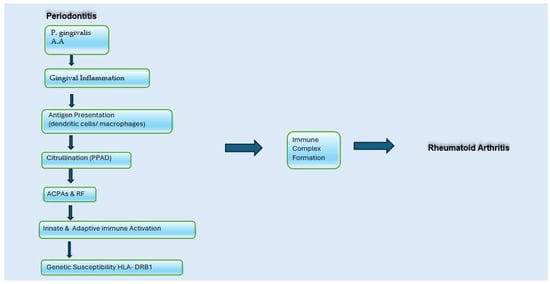
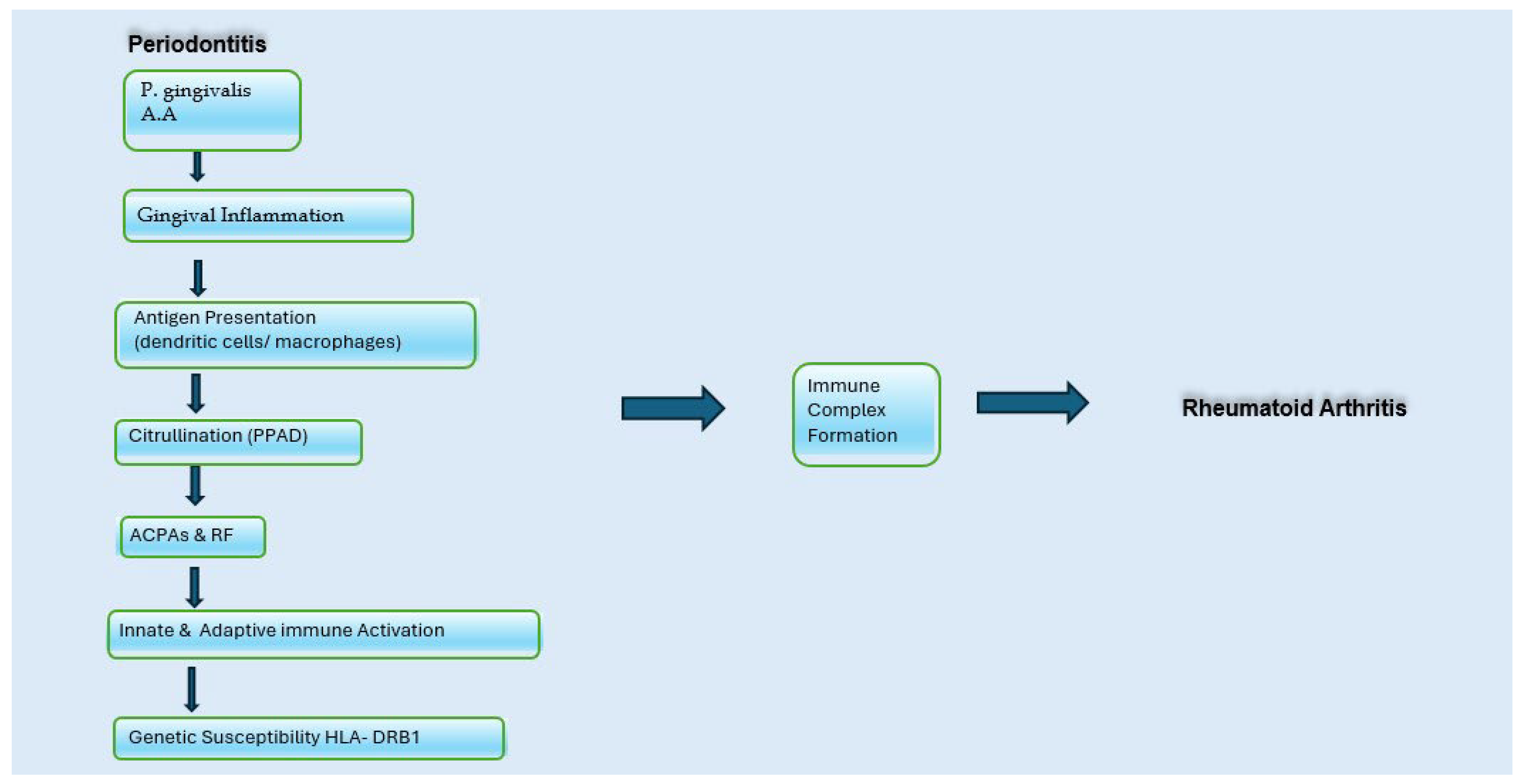
A schematic representation of the proposed mechanisms linking periodontitis and rheumatoid arthritis is presented in Figure 1.
Figure 1.
Schematic representation of the proposed mechanisms linking periodontitis and rheumatoid arthritis.
3.4. Clinical and Epidemiological Evidence Linking Rheumatoid Arthritis and Periodontitis
A substantial body of epidemiological research supports an association between RA and PD [43]. Observational studies and meta-analyses consistently report higher prevalence and greater severity of periodontitis among individuals with RA compared to systemically health controls, even after adjustment for shared risk factors such as smoking [43,44]. More recent cohort and case-control studies have confirmed these findings, reporting significantly increased prevalence of periodontitis among RA patients [45,46]. Although these data suggest a bidirectional relationship, the strength and direction of causality continue to be debated.
Clinical studies have shown that individuals with long-standing, active RA often exhibit deeper periodontal pockets, greater clinical attachment loss, and higher bleeding on probing (BOP) compared to people without RA [43]. Additionally, periodontitis has been linked to increased RA disease activity, as indicated by higher disease activity score-28 (DAS28) values, elevated erythrocyte sedimentation rate (ESR), and raised C-reactive protein (CRP) levels [43,47].
Research suggests that periodontal treatment may positively influence RA activity. Several intervention studies report that non-surgical periodontal therapy (NSPT), such as scaling and root planning, can lower systemic inflammatory markers (including CRP and IL-6) and, in certain cases, modestly improve RA clinical scores [43,48]. Recent clinical trials and systemic reviews further support the potential beneficial effects of periodontal therapy of RA disease activity [48,49].
The extend and duration of these benefits vary across studies, and the precise mechanisms driving the clinical improvements are still under investigation.
Smoking, a major shared environmental risk factor for both RA and periodontitis, may affect these associations. However, evidence from non-smoking RA patients also indicates increased prevalence and severity of periodontitis, suggesting that relationship between RA and PD is not solely due to shared risk behaviors [20,50].
Longitudinal studies remain limited, and it is not yet fully understood whether periodontitis precedes RA onset, accelerates its progression, or primarily results from systemic inflammation and the effects of immunosuppressive therapy. However, the mucosal origins hypothesis provides a plausible model, proposing that periodontal inflammation and bacterial dysbiosis has been proposed as a potential contributor to autoimmune processes that later manifest as RA [2,20,28,51].
The convergence of immune dysregulation shared microbial triggers (e.g., P. gingivalis and AA), and systemic inflammatory burden reinforces the rationale for integrated oral–rheumatologic care. Given the potential reciprocal impact of RA and PD on disease severity and quality of life, routine periodontal evaluation and treatment may be considered in the comprehensive intervention of RA patients [43,52].
4. Discussion
4.1. Immune System and Complement Pathway in Periodontitis and Rheumatoid Arthritis
The immune system defends the host against microbial pathogens and is generally categorized into innate and adaptive components. Although these branches are often described separately, they function in a coordinated manner: the innate immune system provides the immediate defense, whereas the adaptive immune response develops over several days through the clonal expansion of antigen-specific T and B lymphocytes [53].
A key link between innate and adaptive immunity is the complement system, a complex assembly of serum- and membrane-associated proteins that enhances pathogen elimination through opsonization, chemotaxis and direct microbial lysis [54,55]. The complement cascade can be initiated via three primary pathways:
- Classical pathway—activated by antigen–antibody complexes.
- Lectin pathway—triggered by mannose-binding lectin binds to microbial surfaces.
- Alternative pathway—constitutively active at low levels, amplifying responses to pathogens.
Upon activation, complement components undergo proteolytic cleavage, generating fragments with distinct biological functions. Larger fragments, such as C3b, bind covalently to microbial surfaces and facilitate opsonization, thereby enhancing phagocytosis by neutrophils and macrophages. Smaller fragments, including C3a and C5a, act as potent chemo attractants and promote local inflammation [55,56]. Terminal pathway activation leads to assembly of the membrane attack complex (C5b-9), which can disrupt bacterial membranes [55].
4.2. The Dual Role of Complement in Maintaining Health and Promoting Disease
Although essential for host defense, complement activation must be tightly regulated, excessive or uncontrolled activation can contribute to tissue injury rather than protection [54]. This dual nature has been described as a “double-edged” phenomenon, particularly relevant in chronic inflammatory and autoimmune disease. Genetic predisposition, aging, and persistent immune stimulation may shift complement activity toward a pathogenic role, thereby sustaining inflammatory cascades in conditions such as RA [54,57].
In RA, complement-derived mediators including C3a and C5a are involved in the recruitment of neutrophils and monocytes into synovial tissue, amplify cytokine production, and contribute to cartilage and bone degradation. Similar dysregulation has been observed in periodontal tissues, suggesting that complement-mediated mechanisms may contribute to inflammatory amplification in both environments. Experimental models show that inhibition of C5a–C5a receptor signaling may reduce joint inflammation and damage [58].
In periodontitis, the bacterial immune evasion may contribute to systemic circulation, sustaining low-grade inflammation that may exacerbate RA [58]. Contemporary research increasingly supports an integrated model in which oral and systemic inflammation are closely interconnected [59].
4.3. Systemic Effects and Interconnection
Periodontal inflammation has been associated with elevated systemic levels of CRP, IL-6, and other acute phase reactants that are also implicated in RA disease activity [5]. Elevated reactive oxygen species (ROS) from overactive neutrophils contribute to oxidative tissue damage both locally in the periodontium and in distant sites such as the synovium.
Recent studies indicate that periodontal therapy may influence complement activation and systemic inflammatory responses. In a randomized clinical trial, non-surgical periodontal treatment in patients with RA led to significant reduction in serum C3 and C4 levels, along with improvements in both periodontal health measures and RA disease activity scores [60].
However, not all interventional studies have demonstrated consistent improvement in RA activity following periodontal therapy. Differences in study design, sample size, follow-up duration, and disease severity may influence outcomes.
Therefore, while current findings are encouraging, the therapeutic impact of periodontal treatment on RA requires further confirmation through larger and well-controlled trials.
This review has limitations adherent to narrative designs. Although a structured search strategy was applied, study selection and interpretation were not conducted using formal systemic review methodology. Additionally, many available studies are observational in nature, limiting conclusion regarding causality. Heterogeneity in periodontal assessment methods and RA activity measures further complicate direct comparison of findings. Future longitudinal and interventional studies are needed to clarify temporal relationships and therapeutic impact.
5. Conclusions
The reviewed evidence underscores a complex two-way relationship between RA and periodontitis, driven by chronic inflammation, autoimmunity, and microbial imbalance. Individuals with RA show various oral manifestations, including dry mouth and mucosal lesions. Temporomandibular disorders (TMD), and PD, which are influenced by both systemic disease activity and long-term treatment, dysregulated complement activation and bacterial-induced citrullination, particularly by P. gingivalis and AA, offer mechanistic explanations linking local oral inflammation to systemic autoimmune responses.
Coordinated management involving rheumatologists, dentists and periodontologists may help reduce oral complications and potentially attenuate systemic inflammatory burden in patients with RA. Periodontal therapy should not be viewed solely as a local intervention but rather as part of a broader strategy aimed at modulating chronic inflammation.
Future research should focus on elucidating the precise molecular pathways linking oral and systemic inflammation, as well as the role of the microbiome and host genetics in disease progression. Longitudinal and interventional studies are also needed to determine whether targeted periodontal therapy can modify the course of rheumatoid arthritis.
While current evidence supports a biologically plausible connection between mucosal inflammation and RA pathogenesis, further longitudinal and interventional studies are needed to determine the extent to which integrated oral—rheumatologic care can influence long-term clinical outcomes.
Author Contributions
Conceptualization, M.S., M.T., V.Z., N.S., E.-N.E.-N.; methodology, M.S., M.T., V.Z., N.S., E.-N.E.-N.; investigation, M.S., M.T., V.Z., N.S., E.-N.E.-N.; writing—original draft preparation, M.S., M.T., V.Z., N.S., E.-N.E.-N.; writing—review and editing, M.S., M.T., V.Z., N.S., E.-N.E.-N.; visualization, M.S., M.T., V.Z., N.S., E.-N.E.-N.; supervision, M.S., M.T., V.Z., N.S., E.-N.E.-N.; project administration, V.Z., N.S., E.-N.E.-N. All authors have read and agreed to the published version of the manuscript.
Funding
This research received no external funding.
Institutional Review Board Statement
Not applicable.
Informed Consent Statement
Not applicable.
Data Availability Statement
The original contributions presented in this study are included in the article. Further inquiries can be directed to the corresponding author.
Conflicts of Interest
The authors declare no conflicts of interest.
References
- Rodríguez-Lozano, B.; González-Febles, J.; Garnier-Rodríguez, J.L.; Dadlani, S.; Bustabad-Reyes, S.; Sanz, M.; Sánchez-Alonso, F.; Sánchez-Piedra, C.; González-Dávila, E.; Díaz-González, F. Association between severity of periodontitis and clinical activity in rheumatoid arthritis patients: A case-control study. Arthritis Res. Ther. 2019, 21, 27. [Google Scholar] [CrossRef] [Scilit]
- Mustufvi, Z.; Twigg, J.; Kerry, J.; Chesterman, J.; Pavitt, S.; Tugnait, A.; Mankia, K. Does periodontal treatment improve rheumatoid arthritis disease activity? A systematic review. Rheumatol. Adv. Pract. 2022, 6, rkac061. [Google Scholar] [CrossRef] [Scilit] [PubMed]
- Lopez-Oliva, I.; Chapple, I.L.; Paropkari, A.; Saraswat, S.; Sharma, P.; Serban, S.; de Pablo, P.; Raza, K.; Filer, A.; Dietrich, T.; et al. Dysbiosis-Mediated Inflammation: A Pathophysiological Link Between Rheumatoid Arthritis and Periodontitis. J. Clin. Periodontol. 2026, 53, 466–477. [Google Scholar] [CrossRef] [Scilit] [PubMed]
- Sinha, A.; Kamath, D.G.; Shenoy, N. Joint and oral health: The overlooked connection between rheumatoid arthritis and periodontitis (Review). World Acad. Sci. J. 2025, 7, 119. [Google Scholar] [CrossRef] [Scilit]
- Papapanou, P.N.; Sanz, M.; Buduneli, N.; Dietrich, T.; Feres, M.; Fine, D.H.; Flemmig, T.F.; Garcia, R.; Giannobile, W.V.; Graziani, F.; et al. Periodontitis: Consensus report of workgroup 2 of the 2017 World Workshop on the Classification of Periodontal and Peri-Implant Diseases and Conditions. J. Periodontol. 2018, 89, S173–S182. [Google Scholar] [CrossRef] [Scilit]
- Cheng, Z.; Meade, J.; Mankia, K.; Emery, P.; Devine, D.A. Periodontal disease and periodontal bacteria as triggers for rheumatoid arthritis. Best Pract. Res. Clin. Rheumatol. 2017, 31, 19–30. [Google Scholar] [CrossRef] [Scilit]
- Hashimoto, H.; Nonoyama, T.; Takami, Y.; Hashimoto, S.; Shimazaki, Y. Periodontitis and Oral Bacteria Related to Rheumatoid Arthritis: A Case-Control Study. Int. Dent. J. 2025, 75, 103856. [Google Scholar] [CrossRef] [Scilit] [PubMed]
- Koziel, J.; Mydel, P.; Potempa, J. The link between periodontal disease and rheumatoid arthritis: An updated review topical collection on rheumatoid arthritis. Curr. Rheumatol. Rep. 2014, 16, 408. [Google Scholar] [CrossRef] [Scilit] [PubMed]
- Mikuls, T.R.; Payne, J.B.; Deane, K.D.; Thiele, G.M. Autoimmunity of the lung and oral mucosa in a multisystem inflammatory disease: The spark that lights the fire in rheumatoid arthritis? J. Allergy Clin. Immunol. 2016, 137, 28–34. [Google Scholar] [CrossRef] [Scilit]
- Potempa, J.; Mydel, P.; Koziel, J. The case for periodontitis in the pathogenesis of rheumatoid arthritis. Nat. Rev. Rheumatol. 2017, 13, 606–620. [Google Scholar] [CrossRef] [Scilit]
- Rosenstein, E.D.; Greenwald, R.A.; Kushner, L.J.; Weissmann, G. Hypothesis: The humoral immune response to oral bacteria provides a stimulus for the development of rheumatoid arthritis. Inflammation 2004, 28, 311–318. [Google Scholar] [CrossRef] [Scilit] [PubMed]
- Konig, M.F.; Paracha, A.S.; Moni, M.; Bingham, C.O.; Andrade, F. Defining the role of Porphyromonas gingivalis peptidylarginine deiminase (PPAD) in rheumatoid arthritis through the study of PPAD biology. Ann. Rheum. Dis. 2015, 74, 2054–2061. [Google Scholar] [CrossRef] [Scilit]
- Chou, Y.Y.; Lai, K.L.; Chen, D.Y.; Lin, C.H.; Chen, H.H. Rheumatoid arthritis risk associated with periodontitis exposure: A nationwide, population-based cohort study. PLoS ONE 2015, 10, e0139693. [Google Scholar] [CrossRef] [Scilit]
- Gofur, N.R.P.; Handono, K.; Nurdiana, N.; Kalim, H. Periodontal comparison on systemic lupus erythematosus patients and healthy subjects: A cross-sectional study. Pesqui. Bras. Odontopediatr. Clin. Integr. 2021, 21, e0006. [Google Scholar] [CrossRef] [Scilit]
- Fox, R.I. Sjögren’s syndrome. Lancet 2005, 366, 321–331. [Google Scholar] [CrossRef] [Scilit]
- Aliko, A.; Ciancaglini, R.; Alushi, A.; Tafaj, A.; Ruci, D. Temporomandibular joint involvement in rheumatoid arthritis, systemic lupus erythematosus and systemic sclerosis. Int. J. Oral Maxillofac. Surg. 2011, 40, 704–709. [Google Scholar] [CrossRef] [Scilit]
- Scully, C.; Sonis, S.; Diz, P.D. Oral mucositis. Oral Dis. 2006, 12, 229–241. [Google Scholar] [CrossRef] [Scilit]
- Peacock, M.E.; Arce, R.M.; Cutler, C.W. Periodontal and other oral manifestations of immunodeficiency diseases. Oral Dis. 2017, 23, 866–888. [Google Scholar] [CrossRef] [Scilit] [PubMed]
- Payne, J.B.; Golub, L.M.; Thiele, G.M.; Mikuls, T.R. The Link Between Periodontitis and Rheumatoid Arthritis: A Periodontist’s Perspective. Curr. Oral Health Rep. 2015, 2, 20–29. [Google Scholar] [CrossRef] [Scilit]
- Bingham, C.O.; Moni, M. Periodontal disease and rheumatoid arthritis: The evidence accumulates for complex pathobiologic interactions. Curr. Opin. Rheumatol. 2013, 25, 345–353. [Google Scholar] [CrossRef] [Scilit] [PubMed]
- Mikuls, T.R.; Payne, J.B.; Yu, F.; Thiele, G.M.; Reynolds, R.J.; Cannon, G.W.; Markt, J.; McGowan, D.; Kerr, G.S.; Redman, R.S.; et al. Periodontitis and Porphyromonas gingivalis in patients with rheumatoid arthritis. Arthritis Rheumatol. 2014, 66, 1090–1100. [Google Scholar] [CrossRef] [Scilit]
- Koziel, J.; Potempa, J. Pros and cons of causative association between periodontitis and rheumatoid arthritis. Periodontol. 2000 2022, 89, 83–98. [Google Scholar] [CrossRef] [Scilit] [PubMed]
- Alivernini, S.; Tolusso, B.; Ferraccioli, G.; Gremese, E.; Kurowska-Stolarska, M.; McInnes, I.B. Driving chronicity in rheumatoid arthritis: Perpetuating role of myeloid cells. Clin. Exp. Immunol. 2018, 193, 13–23. [Google Scholar] [CrossRef] [Scilit]
- Marotte, H.; Farge, P.; Gaudin, P.; Alexandre, C.; Mougin, B.; Miossec, P. The association between periodontal disease and joint destruction in rheumatoid arthritis extends the link between the HLA-DR shared epitope and severity of bone destruction. Ann. Rheum. Dis. 2006, 65, 905–909. [Google Scholar] [CrossRef] [Scilit]
- Schulz, S.; Pütz, N.; Jurianz, E.; Schaller, H.G.; Reichert, S.; Huck, O. Are There Any Common Genetic Risk Markers for Rheumatoid Arthritis and Periodontal Diseases? A Case-Control Study. Mediat. Inflamm. 2019, 2019, 2907062. [Google Scholar] [CrossRef] [Scilit]
- Oliveira, S.R.; de Arruda, J.A.A.; Schneider, A.H.; Bemquerer, L.M.; de Souza, R.M.S.; Barbim, P.; de Mattos-Pereira, G.H.; Calderaro, D.C.; Machado, C.C.; Alves, S.F.; et al. Neutrophil extracellular traps in rheumatoid arthritis and periodontitis: Contribution of PADI4 gene polymorphisms. J. Clin. Periodontol. 2024, 51, 452–463. [Google Scholar] [CrossRef] [Scilit]
- Schulz, S.; Zimmer, P.; Pütz, N.; Jurianz, E.; Schaller, H.G.; Reichert, S. rs2476601 in PTPN22 gene in rheumatoid arthritis and periodontitis—A possible interface? J. Transl. Med. 2020, 18, 389. [Google Scholar] [CrossRef] [Scilit]
- Gazitt, T.; Lood, C.; Elkon, K.B. Citrullination in Rheumatoid Arthritis—A Process Promoted by Neutrophil Lysis? Rambam Maimonides Med. J. 2016, 7, e0027. [Google Scholar] [CrossRef] [Scilit] [PubMed]
- Ciesielski, O.; Biesiekierska, M.; Panthu, B.; Soszyński, M.; Pirola, L.; Balcerczyk, A. Citrullination in the pathology of inflammatory and autoimmune disorders: Recent advances and future perspectives. Cell. Mol. Life Sci. 2022, 79, 94. [Google Scholar] [CrossRef] [Scilit] [PubMed]
- Wegner, N.; Lundberg, K.; Kinloch, A.; Fisher, B.; Malmström, V.; Feldmann, M.; Venables, P.J. Autoimmunity to specific citrullinated proteins gives the first clues to the etiology of rheumatoid arthritis. Immunol. Rev. 2010, 233, 34–54. [Google Scholar] [CrossRef] [Scilit]
- Olsen, I.; Singhrao, S.K.; Potempa, J. Citrullination as a plausible link to periodontitis, rheumatoid arthritis, atherosclerosis and Alzheimer’s disease. J. Oral Microbiol. 2018, 10, 1487742. [Google Scholar] [CrossRef] [Scilit] [PubMed]
- Konig, M.F.; Abusleme, L.; Reinholdt, J.; Palmer, R.J.; Teles, R.P.; Sampson, K.; Rosen, A.; Nigrovic, P.A.; Sokolove, J.; Giles, J.T.; et al. Aggregatibacter actinomycetemcomitans-induced hypercitrullination links periodontal infection to autoimmunity in rheumatoid arthritis. Sci. Transl. Med. 2016, 8, 369ra176. [Google Scholar] [CrossRef] [Scilit]
- Khandpur, R.; Carmona-Rivera, C.; Vivekanandan-Giri, A.; Gizinski, A.; Yalavarthi, S.; Knight, J.S.; Friday, S.; Li, S.; Patel, R.M.; Subramanian, V.; et al. NETs are a source of citrullinated autoantigens and stimulate inflammatory responses in rheumatoid arthritis. Sci. Transl. Med. 2013, 5, 178ra40. [Google Scholar] [CrossRef] [Scilit] [PubMed]
- Holers, V.M.; Demoruelle, M.K.; Kuhn, K.A.; Buckner, J.H.; Robinson, W.H.; Okamoto, Y.; Norris, J.M.; Deane, K.D. Rheumatoid arthritis and the mucosal origins hypothesis: Protection turns to destruction. Nat. Rev. Rheumatol. 2018, 14, 542–557. [Google Scholar] [CrossRef] [Scilit]
- Zhao, W.; Liu, C.; Cui, X.; Chen, Q. Immunological landscape of periodontitis and rheumatoid arthritis and their molecular crosstalk. Eur. J. Med. Res. 2025, 30, 124. [Google Scholar] [CrossRef] [Scilit]
- Vossenaar, E.R.; Zendman, A.J.W.; Van Venrooij, W.J.; Pruijn, G.J.M. PAD, a growing family of citrullinating enzymes: Genes, features and involvement in disease. BioEssays 2003, 25, 1106–1118. [Google Scholar] [CrossRef] [Scilit]
- Mcgraw, W.T.; Potempa, J.; Farley, D.; Travis, J. Purification, Characterization, and Sequence Analysis of a Potential Virulence Factor from Porphyromonas gingivalis, Peptidylarginine Deiminase. Infect. Immun. 1999, 67, 3248–3256. [Google Scholar] [CrossRef] [Scilit]
- Goulas, T.; Mizgalska, D.; Garcia-Ferrer, I.; Kantyka, T.; Guevara, T.; Szmigielski, B.; Sroka, A.; Millán, C.; Usón, I.; Veillard, F.; et al. Structure and mechanism of a bacterial host-protein citrullinating virulence factor, Porphyromonas gingivalis peptidylarginine deiminase. Sci. Rep. 2015, 5, 11969. [Google Scholar] [CrossRef] [Scilit]
- Guo, Y.; Nguyen, K.A.; Potempa, J. Dichotomy of gingipains action as virulence factors: From cleaving substrates with the precision of a surgeon’s knife to a meat chopper-like brutal degradation of proteins. Periodontol. 2000 2010, 54, 15–44. [Google Scholar] [CrossRef] [Scilit]
- Maresz, K.J.; Hellvard, A.; Sroka, A.; Adamowicz, K.; Bielecka, E.; Koziel, J.; Gawron, K.; Mizgalska, D.; Marcinska, K.A.; Benedyk, M.; et al. Porphyromonas gingivalis Facilitates the Development and Progression of Destructive Arthritis through Its Unique Bacterial Peptidylarginine Deiminase (PAD). PLoS Pathog. 2013, 9, e1003627. [Google Scholar] [CrossRef] [Scilit] [PubMed]
- Hitchon, C.A.; Chandad, F.; Ferucci, E.D.; Willemze, A.; Ioan-Facsinay, A.; van der Woude, D.; Markland, J.; Robinson, D.; Elias, B.; Newkirk, M.; et al. Antibodies to Porphyromonas gingivalis are associated with anticitrullinated protein antibodies in patients with rheumatoid arthritis and their relatives. J. Rheumatol. 2010, 37, 1105–1112. [Google Scholar] [CrossRef] [Scilit] [PubMed]
- Demoruelle, M.K.; Weisman, M.H.; Simonian, P.L.; Lynch, D.A.; Sachs, P.B.; Pedraza, I.F.; Harrington, A.R.; Kolfenbach, J.R.; Striebich, C.C.; Pham, Q.N.; et al. Airways abnormalities and rheumatoid arthritis-related autoantibodies in subjects without arthritis: Early injury or initiating site of autoimmunity? Arthritis Rheum. 2012, 64, 1756–1761. [Google Scholar] [CrossRef] [Scilit]
- Wiernik, E.; Renuy, A.; Kab, S.; Steg, P.G.; Goldberg, M.; Zins, M.; Caligiuri, G.; Bouchard, P.; Carra, M.C. Prevalence of self-reported severe periodontitis: Data from the population-based CONSTANCES cohort. J. Clin. Periodontol. 2024, 51, 884–894. [Google Scholar] [CrossRef] [Scilit]
- Fuggle, N.R.; Smith, T.O.; Kaul, A.; Sofat, N. Hand to mouth: A systematic review and meta-analysis of the association between rheumatoid arthritis and periodontitis. Front. Immunol. 2016, 7, 80. [Google Scholar] [CrossRef] [Scilit]
- Bonilla, M.; Raya-Álvarez, E.; Bravo, M.; Rosel, E.; Mesa, F. Periodontitis, Dyslipidemia and Rheumatoid Arthritis: An Additive Model of Cardiovascular Risk. J. Clin. Med. 2025, 14, 6722. [Google Scholar] [CrossRef] [Scilit]
- Phogat, D.R.; Ali, D.A.; Dull, D.S.; Ali, D.H.; Trikala, D.N.; Shah, D.S. Association Between Rheumatoid Arthritis and Periodontitis: Stage Specific Treatment Protocol and Standardised Collaborative Model Between Dentistry and Rheumatoid Arthritis: A Case Control Study. J. Contemp. Clin. Pract. 2026, 12, 372–383. [Google Scholar] [CrossRef]
- Kaur, S.; White, S.; Bartold, P.M. Periodontal disease and rheumatoid arthritis: A systematic review. J. Dent. Res. 2013, 92, 399–408. [Google Scholar] [CrossRef] [Scilit]
- Silva, D.S.; de Vries, C.; Rovisco, J.; Serra, S.; Kaminska, M.; Mydel, P.; Lundberg, K.; da Silva, J.A.P.; Baptista, I.P. The impact of periodontitis and periodontal treatment on rheumatoid arthritis outcomes: An exploratory clinical trial. Rheumatology 2025, 64, 1679–1688. [Google Scholar] [CrossRef] [Scilit] [PubMed]
- Silva, D.S.; de Vries, C.; Lundberg, K.; Baptista, I.P.; da Silva, J.A.P.; Kaminska, M.; Mydel, P. The Impact of Periodontal Treatment on Rheumatoid Arthritis Outcomes: The Microbial Link. Rheumato 2026, 6, 2. [Google Scholar] [CrossRef] [Scilit]
- Potikuri, D.; Dannana, K.C.; Kanchinadam, S.; Agrawal, S.; Kancharla, A.; Rajasekhar, L.; Pothuraju, S.; Gumdal, N. Periodontal disease is significantly higher in non-smoking treatment naive rheumatoid arthritis patients: Results from a case-control study. Ann. Rheum. Dis. 2012, 71, 1541–1544. [Google Scholar] [CrossRef] [Scilit] [PubMed]
- Demoruelle, M.K.; Deane, K.D.; Holers, V.M. When and where does inflammation begin in rheumatoid arthritis? Curr. Opin. Rheumatol. 2014, 26, 64–71. [Google Scholar] [CrossRef] [Scilit] [PubMed]
- Pischon, N.; Pischon, T.; Kröger, J.; Gülmez, E.; Kleber, B.; Bernimoulin, J.; Landau, H.; Brinkmann, P.; Schlattmann, P.; Zernicke, J.; et al. Association Among Rheumatoid Arthritis, Oral Hygiene, and Periodontitis. J. Periodontol. 2008, 79, 979–986. [Google Scholar] [CrossRef] [Scilit] [PubMed]
- Chaplin, D.D. 1. Overview of the human immune response. J. Allergy Clin. Immunol. 2006, 117, S430–S435. [Google Scholar] [CrossRef] [Scilit]
- Bardhan, M.; Kaushik, R. Physiology, Complement Cascade; StatPearls: Bethesda, MD, USA, 2023. Available online: https://www.ncbi.nlm.nih.gov/books/NBK551511/ (accessed on 30 March 2026).
- Janeway, C.A., Jr.; Travers, P.; Walport, M.; Shlomchik, M.J. The Complement System and Innate Immunity. 2001. Available online: https://www.ncbi.nlm.nih.gov/books/NBK27100/ (accessed on 30 March 2026).
- Merle, N.S.; Church, S.E.; Fremeaux-Bacchi, V.; Roumenina, L.T. Complement System Part I—Molecular Mechanisms of Activation and Regulation. Front. Immunol. 2015, 6, 262. [Google Scholar] [CrossRef] [Scilit]
- Ricklin, D.; Reis, E.S.; Lambris, J.D. Complement in disease: A defence system turning offensive. Nat. Rev. Nephrol. 2016, 12, 383–401. [Google Scholar] [CrossRef] [Scilit]
- Hajishengallis, G.; Maekawa, T.; Abe, T.; Hajishengallis, E.; Lambris, J.D. Complement involvement in periodontitis: Molecular mechanisms and rational therapeutic approaches. Adv. Exp. Med. Biol. 2015, 865, 57. [Google Scholar] [CrossRef] [Scilit]
- Maciel, D.S.; De, N.; Salgado, S.; Alves Pena, F. A interface artrite reumatoide e periodontite: Implicações para o conhecimento e a atuação do Cirurgião-Dentista. Res. Soc. Dev. 2025, 14, e10214949607. [Google Scholar] [CrossRef] [Scilit]
- Araújo, V.M.A.; Melo, I.M.; Lima, V. Relationship between Periodontitis and Rheumatoid Arthritis: Review of the Literature. Mediat. Inflamm. 2015, 2015, 259074. [Google Scholar] [CrossRef] [Scilit]
Disclaimer/Publisher’s Note: The statements, opinions and data contained in all publications are solely those of the individual author(s) and contributor(s) and not of MDPI and/or the editor(s). MDPI and/or the editor(s) disclaim responsibility for any injury to people or property resulting from any ideas, methods, instructions or products referred to in the content. |
© 2026 by the authors. Licensee MDPI, Basel, Switzerland. This article is an open access article distributed under the terms and conditions of the Creative Commons Attribution (CC BY) license.