


Abstract
Background/Objectives: This study describes demographic and clinical characteristics and treatment patterns (including sequencing) in patients with chronic lymphocytic leukemia (CLL) in Spain. Methods: A retrospective, multicenter, cross-sectional study analyzed 1128 adults with CLL receiving treatment in Spain (2022–2023), using two IQVIA databases. Descriptive statistics were applied. Results: Overall, 71.2% of patients were aged >65 years, 59.9% were male, and 86.1% had an ECOG performance status of 0–1. Common comorbidities included diabetes (25.3%) and cardiac dysfunction/atrial fibrillation (23.1%). More than 98% were tested for del(17p)/TP53 and IGHV mutation status. Covalent BTK inhibitors (cBTKis) predominated across treatment lines (first line: 81%; second: 67%; ≥third: 53%), with ibrutinib most frequent in every line (52%, 46%, and 26%, respectively). Venetoclax-based regimens ranked second (first: 15%; second: 30%; ≥third: 45%). In the first line, cBTKi use was highest among patients with del(17p)/TP53 mutations (92.5%). In the second line, 75% of prior cBTKi users switched to venetoclax-based therapy, while 85% without prior cBTKi received it. Disease progression and adverse effects were the main reasons for cBTKi discontinuation. Conclusions: In Spain, cBTKis predominate in CLL management. Findings indicate high uptake of genetic testing and treatment patterns broadly consistent with contemporary guidelines and highlight the importance of personalised strategies that consider high-risk genetic markers and patient comorbidities.
1. Introduction
Chronic lymphocytic leukemia (CLL) is one of the most common types of leukemia in Western Countries [1]. Its incidence has been increasing, with an estimated 100,000 new cases worldwide in 2019, representing more than a 150% increase since 1990 [2]. In Spain, the incidence of CLL is 4.2 cases per 100,000 inhabitants annually [3]. The median age at diagnosis is 70 years, with a male-to-female ratio of 1.7:1 [4]. Most patients with CLL are diagnosed incidentally due to unexplained lymphocytosis and are typically asymptomatic. Approximately 75% do not require CLL-specific treatment at diagnosis [4]. The need for initial treatment is based on recommendations defined by the International Workshop on CLL (iwCLL2018) criteria [5].
Cytogenetic abnormalities and gene mutations are critical prognostic markers in CLL. Around 80% of CLL patients exhibit at least one of four common chromosomal alterations: deletion of chromosome 13q14.3 [del(13q)], deletion of chromosome 11q22.3 [del(11q)], deletion of chromosome 17p13 [del(17p)], which often involves mutation of the TP53 gene, or trisomy 12 [1]. Before the introduction of oral targeted agents, patients with del(13q) typically had a favorable prognosis, with longer median overall survival (OS) [6]; while del(11q) and del(17p) were associated with shorter time to first treatment and poorer survival outcomes [7]. Trisomy 12 is linked to an intermediate prognosis in terms of survival [8].
Additional adverse prognostic factors include unmutated immunoglobulin heavy chain variable region gene (IGHV) genes and complex karyotype, which also predict shorter treatment-free intervals and overall survival [7]. Despite advances in molecular and cytogenetic profiling, the Rai and Binet clinical staging system, which classifies CLL based on the number of affected lymphoid areas, organomegalies, and cytopenias, remains a valuable and cost-effective tool for integrating prognostic information [5].
In recent years, the treatment landscape for CLL has undergone significant transformation with the emergence of novel targeted therapies, with improved efficacy and safety profiles, such as covalent Bruton’s tyrosine kinase inhibitors (cBTKis) [1] and B-cell lymphoma 2 inhibitors (BCL2is) [9], as well as non-covalent BTKis, such as pirtobrutinib [10]. These advancements, coupled with updates in clinical guidelines [11,12], underscore the need for real-world evidence (RWE) studies to assess how these novel strategies are being implemented in clinical practice. However, data on contemporary treatment patterns in Spain remain scarce. This study aims to describe the clinical management and treatment sequences of CLL patients in Spain, with a particular focus on BTKi treatments, and to characterize the demographic and clinical characteristics of the study population.
2. Materials and Methods
2.1. Study Design
A non-interventional, multicenter, cross-sectional, retrospective study was conducted using two real-world datasets.
2.2. Data Source
This study was based on patient samples available in two databases administered by IQVIA: Oncology Dynamics™ and Oncology Advantage™. Oncology Dynamics™ is a population-based cohort, updated quarterly, that includes drug-treated patients with a cancer diagnosis from various countries. This database was used for first- and second-line CLL patients, representing a population based on natural prevalence. Oncology Advantage™, on the other hand, collects data on CLL patients in the third line or beyond, on a quarterly basis, describing a low-prevalence population that is underrepresented in Oncology Dynamics™. It should be noted that patients who have completed a previous line of therapy but have not yet initiated a subsequent line are not captured in either database, as only patients receiving active pharmacological treatment at the time of data collection are included.
Both datasets were built using the same methodology, with the key difference being that Oncology Advantage™ includes data on all historical lines of treatment for each patient, while Oncology Dynamics™ only contains information about the most recent treatment line and the one immediately preceding it. Data collection for both databases was performed through standardized questionnaires completed by hematologists during routine medical visits, reflecting real-world clinical practice in Spain. Patient-level data collected included demographics, medical history, and disease management. Participating hematologists are enrolled in the IQVIA physician panel on a voluntary basis; once enrolled, each physician is required to report a predefined number of the first consecutive patients personally treated during the reporting period, thereby limiting case-selection bias. A maximum of three physicians per hospital is allowed in order to avoid clustering effects and patient duplication, and only fully qualified specialists (residents excluded) may contribute. The panel composition is defined to reflect the distribution of drug-treating specialists and includes both public (92%) and private (8%) centers, as well as university (68%) and non-university (32%) hospitals.
The study protocol was reviewed and approved by the Ethics Committee of Hospital Clínic de Barcelona, Spain (Register Number: HCB/2023/0629).
2.3. Settings
Eligible participants were patients aged 18 years or older, diagnosed with CLL, and receiving pharmacological therapy in hematology units in Spain, reported to the relevant databases between 1 October 2022 and 30 September 2023. Patients included in clinical trials and reported to the databases were also included in the statistical analysis.
2.4. Study Participants and Sample Size
All 1128 drug-treated CLL patients who were reported to the databases and met the inclusion criteria were included in this study. Eight of these patients were enrolled in clinical trials, all in first-line treatment.
Data from 1043 CLL patients receiving first- or second-line therapy were extracted from IQVIA-Oncology Dynamics™, reported by 63 hospitals across 14 regions of Spain.
Data from 85 patients on third-line or later treatment were obtained from IQVIA-Oncology Advantage™, reported by 28 sites across 4 regions.
2.5. Variables
The data collection plan included variables available in the databases at the time of data extraction, covering demographic information such as age group and gender, as well as clinical characteristics including functional level assessed by the ECOG scale, CLL clinical stage according to the Rai and Binet classification, and genetic alterations such as 11q deletion, 13q deletion, 17p deletion, trisomy 12, and mutations in TP53, IGHV, BTK C481S, and PLCG2. This study also recorded pre-defined comorbidities such as atrial fibrillation (AF), cardiac dysfunction (defined as any other heart disease besides atrial fibrillation; no further breakdown by cardiac subtype was available), chronic obstructive pulmonary disease (COPD), diabetes, hepatic dysfunction, renal dysfunction, and thrombocytopenia. Additionally, detailed treatment information was collected, encompassing pharmacological treatments and all treatment lines, including current as well as prior lines. Treatment duration, time to next treatment, reasons for discontinuation, and pre-defined side effects were analyzed only for treatment lines already ended. Patients classified as frail were also identified and analyzed; frailty was based on age (≥70 years), ECOG score (≥2), and at least one of the following comorbidities: cardiac dysfunction, atrial fibrillation, and/or renal dysfunction.
2.6. Statistical Methods
Pharmacological treatments and patient clinical characteristics were described separately for each line-treatment cohort using sample sizes and proportions. Treatment sequences were described for the second-line cohort (first-to-second line sequence) and the third-line cohort (first-to-third line sequence). All analyses were performed using SAS software (version 7.1; SAS Institute Inc., Cary, NC, USA). Descriptive statistics were applied, including means (standard deviation, SD), medians (interquartile ranges, IQR), and frequencies (proportions), as appropriate. As this was a purely descriptive study, no formal statistical comparisons were performed and potential confounders were not accounted for. All findings should be interpreted as numerical trends rather than statistically tested associations. Given the cross-sectional design and the absence of individual-level longitudinal follow-up, inferential or time-to-event analyses (e.g., multivariable or Cox regression) were neither prespecified nor feasible and were therefore not performed.
3. Results
3.1. Demographic and Clinical Characteristics
The analysis included 1128 patients with CLL. At the time of data collection, 742 patients (65.8%) were receiving first-line treatment, 301 patients (26.7%) second-line treatment, and 85 patients (7.5%) third-line or subsequent treatments (Table 1).
Table 1.
Patient characteristics by line of therapy (first, second or ≥third-line).
The majority of patients were over 65 years old (n = 803; 71.2%), male (n = 676; 59.9%), and had an ECOG performance status of 0–1 (n = 971; 86.1%). They were evenly distributed among Binet stages A (37.3%), B (28.3%), and C (34.4%). Over 98% of patients had been tested at some point during the course of the disease for del(17p)/TP53 and IGHV mutations. However, testing confirmed to have been performed before first-line initiation could be documented in 480 of 742 first-line patients (64.7%) for del(17p)/TP53 (Section 3.4); for the remaining patients, the timing of testing relative to treatment start could not be confirmed from the databases. Diabetes was the most common comorbidity, observed in 285 (25.3%) patients, followed by cardiac dysfunction and/or atrial fibrillation in 261 patients (23.1%) (Table 1).
3.2. Therapeutic Approach by Treatment Line
The most common drugs in first-, second-, and third-line treatment and beyond, either alone or in combination, were covalent BTK inhibitors (cBTKis) (81%, 67%, and 53%, respectively) followed by venetoclax (15%, 30%, and 45%). Ibrutinib was the most commonly used drug in every line (52%, 46%, and 26%, respectively). The distribution by individual regimen is shown in Table S1.
3.3. Treatments by Patient Profile
In the first line of treatment, over 50% of patients receiving venetoclax combinations (with ibrutinib or obinutuzumab) were younger than 65 years old, compared to less than 30% of patients treated with cBTKi in the same age group. Notably, all patients receiving chlorambucil-based regimens were older than 65 years. This trend continued in the second line, where patients receiving venetoclax, either alone or in combination with rituximab, tended to be younger than those on cBTKi (Table S2).
In the first line, a numerically higher proportion of patients receiving acalabrutinib had a history of cardiac dysfunction (23%) or atrial fibrillation (17%) prior to starting acalabrutinib, compared with those on ibrutinib or BCL2i treatments. This prevalence increased in the second line, with patients treated with acalabrutinib and zanubrutinib showing a numerically higher percentage of prior cardiac dysfunction and atrial fibrillation (18–32%) compared to those receiving other therapies (Table S2).
Among the 57 patients classified as frail (27 in first line, 19 in second line and 11 in third line), the percentage of use of cBTKis was similar to the overall sample across all treatment lines (74%, 63%, and 55%, respectively). However, the percentage of venetoclax-based treatments was numerically lower (4%, 16%, and 36%, respectively) compared to the overall sample.
3.4. Treatment in First Line According to Risk Factors
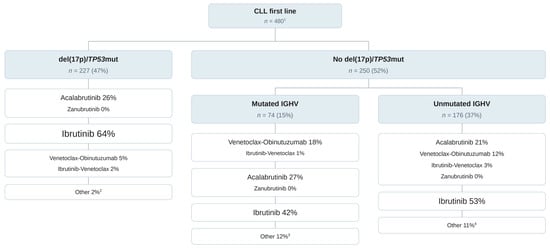
Of the 742 patients who received first-line therapy, 480 (64.7%) were confirmed to have undergone del(17p) and/or TP53 mutation testing prior to treatment initiation. Within this tested population (n = 480), 227 patients (47.3%) were positive for at least one alteration and 253 (52.7%) were negative. Among the 480 tested patients, 74 (15.4%) had mutated IGHV without del(17p)/TP53, 176 (36.7%) had unmutated IGHV without del(17p)/TP53, and the remaining 3 patients had pending or unavailable IGHV results (Figure 1).
Figure 1.
Treatments used in the first line according to risk factors (patients who were confirmed to be tested before starting current therapy). 1 The figure shows first-line treatments received at data collection in patients with confirmed testing before treatment was started (480 patients out of 742 in first line). Treatments are organized as per GELLC guidelines (September 2023) [13]. It highlights the percentage of patients with each alteration and their treatments. There were 3 patients without del(17p) or TP53 mutation with IGHV test results not available. Treatment percentages are shown relative to the total number of patients within each specific mutation/risk group. 2 CLBO 1%, BR <1%, CIT <1% 3 BR 5%, FCR 3%, CLBO 3%, other 2%, VR 1%, 4 clinical trial 3%, CLBO 2%, BR 2%, Other 2%, CIT 1%, venetoclax 1%, FCR 1%, VR 1% del: deletion; mut: mutation; IGHV: immunoglobulin heavy chain; CLBO: chlorambucil–obinutuzumab; BR: bendamustine–rituximab; CIT: other chemoimmunotherapy regimens (not classified as FCR, BR, or CLBO); FCR: fludarabine–cyclophosphamide–rituximab; VR: venetoclax–rituximab.
The most frequently prescribed drugs, alone or in combination, across all patient subpopulations in the first line were cBTKi. They were administered to 92.5% of patients with del(17p) and/or TP53 mutations (64% ibrutinib and 26% acalabrutinib), 70.3% of patients without these mutations and with mutated IGHV (ibrutinib 42%, acalabrutinib 27%), and 76.7% of patients without del(17p) or TP53 mutations and with unmutated IGHV (ibrutinib 53%, acalabrutinib 21%) (Figure 1).
Venetoclax, alone or in combination, was the second most common treatment in the first line. Its use was highest among patients with mutated IGHV and without del(17p) or TP53 mutations (19.0%), followed by those with unmutated IGHV and without del(17p) or TP53 mutations (15%). In contrast, only 7% of patients with del(17p) and/or TP53 mutations received venetoclax-based therapy (Figure 1).
3.5. Sequence of Treatments
3.5.1. From First to Second Line
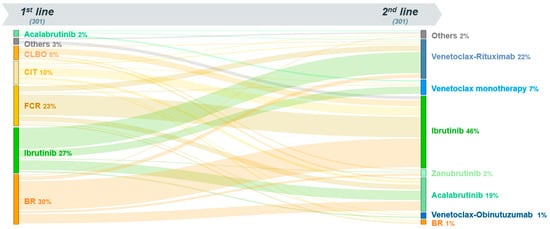
Among patients on second-line therapy (n = 301), the most common prior first-line treatment had been chemoimmunotherapy (CIT; 68%), mainly bendamustine–rituximab (BR; 30%) and fludarabine–cyclophosphamide–rituximab (FCR; 23%), followed by cBTKi (29%).
Among patients who had received cBTKi in the first line (n = 87), most transitioned in the second line to venetoclax-based treatments (75%) or a different cBTKi (24%). Of the 21 patients who switched to another cBTKi, 19 (90.5%) did so due to intolerance and 2 due to disease progression; nearly all of them moved from ibrutinib to acalabrutinib (n = 20).
Among patients who had not received cBTKi in the first line (n = 214), most received it in the second line (85%) (Figure 2).
Figure 2.
Treatment sequence from first to second line—all patients currently on second line. The figure illustrates the percentage distribution for each separate treatment line. BR: bendamustine and rituximab; CLBO: chlorambucil and obinutuzumab; CIT: other chemoimmunotherapy regimens including rituximab, obinutuzumab, or ofatumumab (not classified as FCR, BR, or CLBO); FCR: fludarabine, cyclophosphamide, and rituximab.
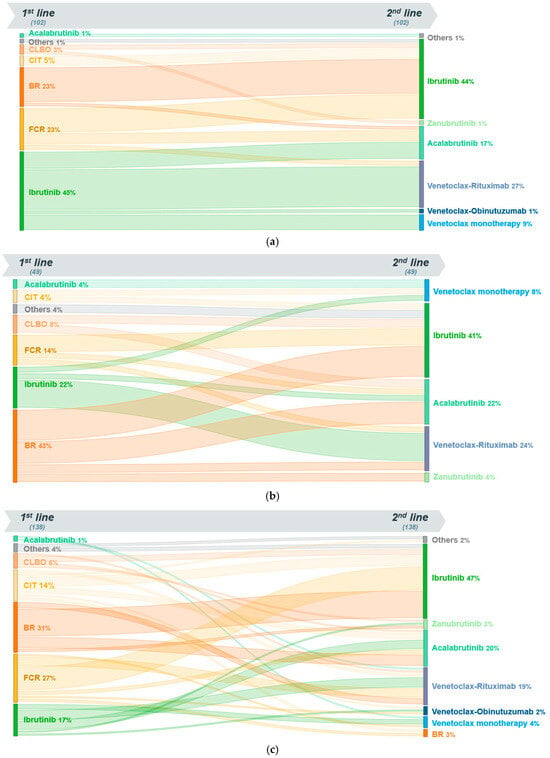
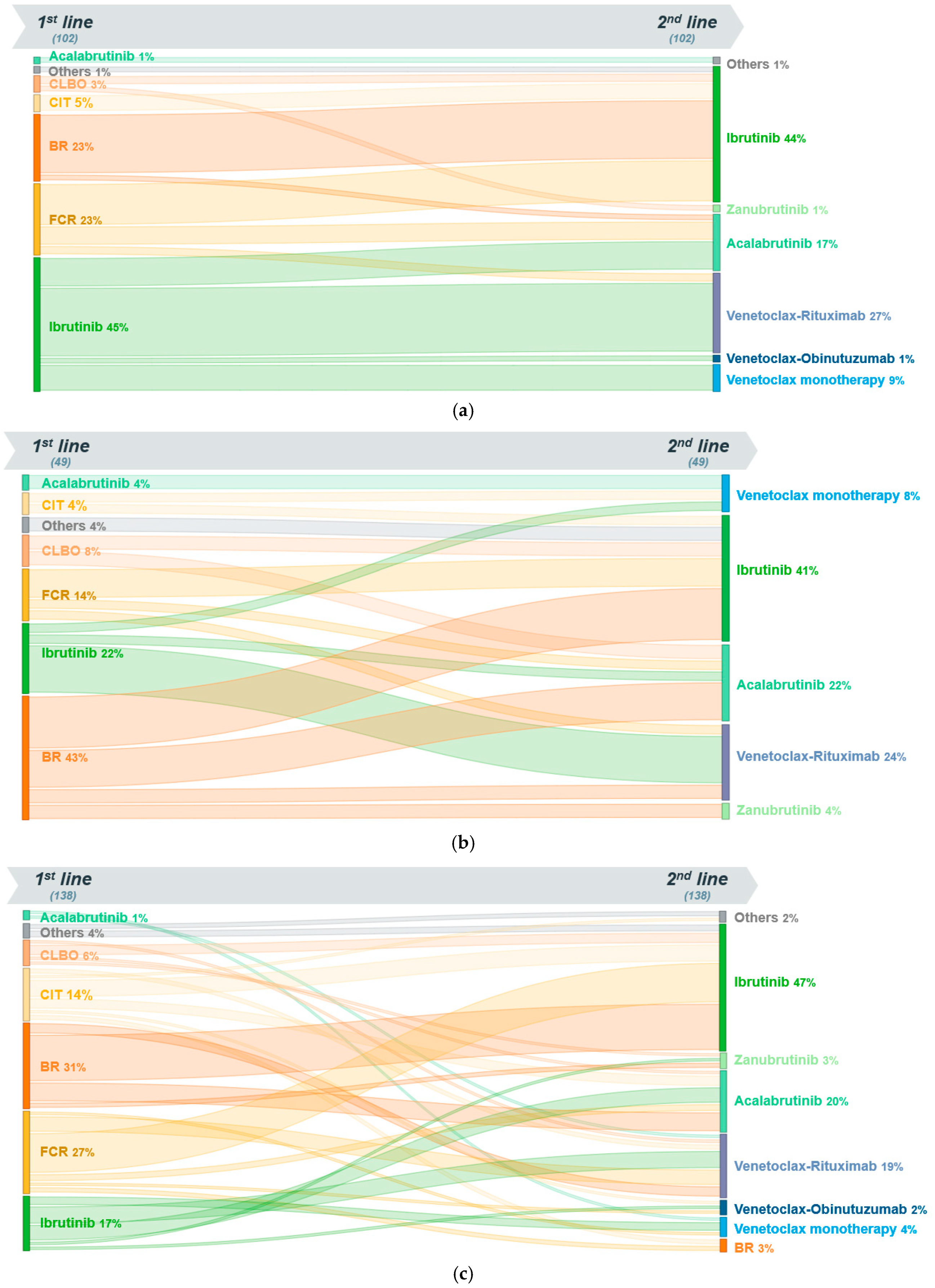
Looking specifically according to risk factors, in patients with del(17p)/mutTP53, the most common therapy changes from one line to the next were from ibrutinib to venetoclax–rituximab (n = 26; 25.5%), BR to ibrutinib (n = 22; 21.6%), and FCR to ibrutinib (n = 15; 14.7%) (Figure 3a).
Figure 3.
Treatment sequence from first to second line by risk group—patients currently on second line: (a) patients with del(17p) and/or TP53 mutation; (b) patients without del(17p) and/or TP53 mutation and IGHV-mutated; (c) patients without del(17p) and/or TP53 mutation and IGHV-unmutated. The figure illustrates the percentage distribution for each separate treatment line. BR: bendamustine and rituximab; CLBO: chlorambucil and obinutuzumab; CIT: other chemoimmunotherapy regimens including rituximab, obinutuzumab, or ofatumumab (not classified as FCR, BR, or CLBO); FCR: fludarabine, cyclophosphamide, and rituximab.
Similarly, in patients without del(17p)/mutTP53 and mutated IGHV, the most frequent changes were from BR to ibrutinib (n = 10; 20.4%), ibrutinib to venetoclax–rituximab (n = 9; 18.4%), BR to acalabrutinib (n = 7; 14.3%), and FCR to ibrutinib (n = 5; 10.2%) (Figure 3b).
In patients without del(17p)/mutTP53 and unmutated IGHV, the most common transitions were BR to ibrutinib (n = 26; 18.8%) and FCR to ibrutinib (n = 22; 15.9%) (Figure 3c).
3.5.2. From Second to Third Line
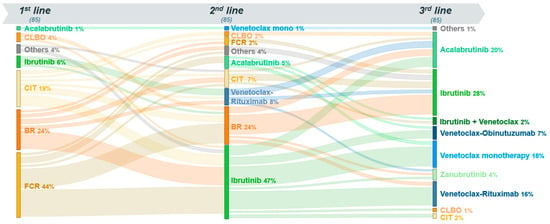
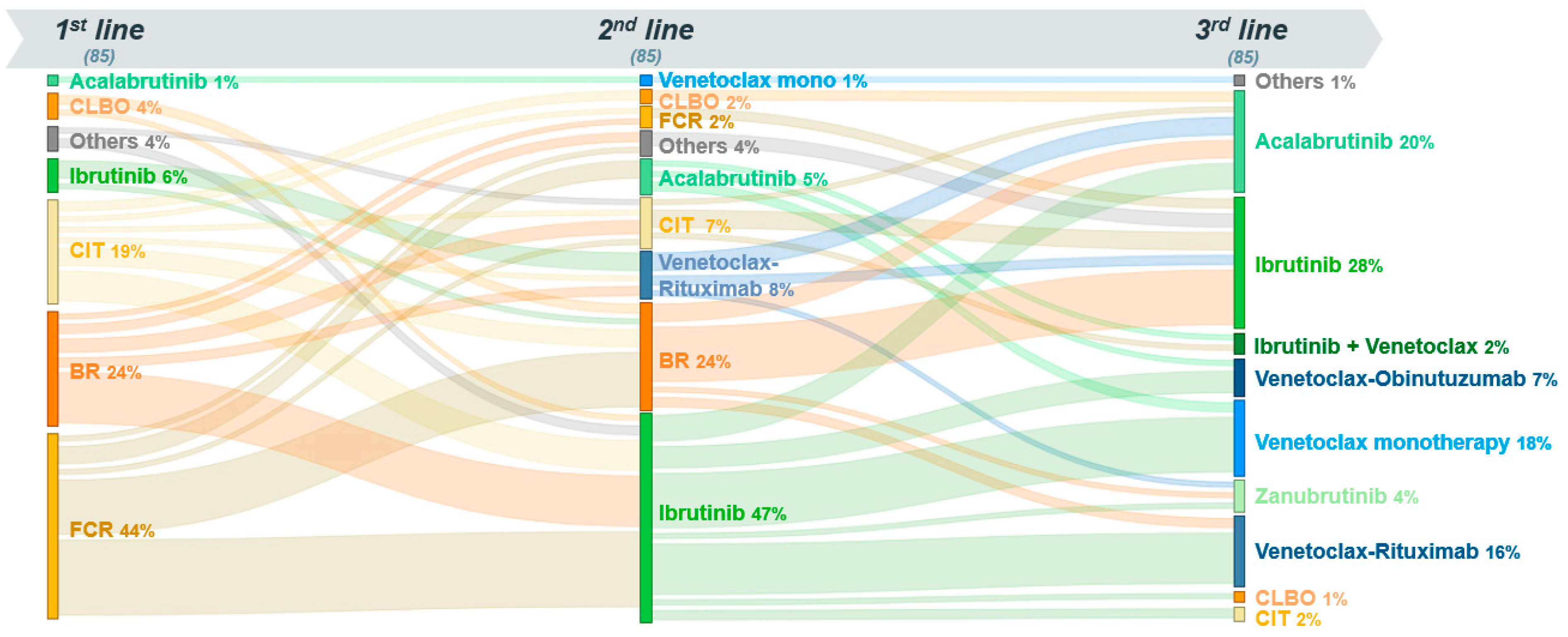
In third-line treatment, most patients who had received cBTKis in the second line (n = 44) were treated with venetoclax-based therapies (77.3%), evenly split between monotherapy and combinations, while 18.2% (n = 8) received another cBTKi, again because of intolerance to the prior one (six transitioned from ibrutinib to acalabrutinib, one patient from ibrutinib to zanubrutinib, and another one from acalabrutinib to ibrutinib + venetoclax) (Figure 4).
Figure 4.
Treatment sequence from first to third line—patients currently on ≥third line. The figure illustrates the percentage distribution for each separate treatment line. BR: bendamustine and rituximab; CLBO: chlorambucil and obinutuzumab; CIT: other chemoimmunotherapy regimens including rituximab, obinutuzumab, or ofatumumab (not classified as FCR, BR, or CLBO); FCR: fludarabine, cyclophosphamide, and rituximab.
Of the 35 patients in the third line and beyond who had not received cBTKis in the first or second line, 97% received them in the third line.
3.5.3. From First to Third Line
Considering the entire treatment sequence from first to third line, the most common pattern was to start with CIT, primarily FCR or BR, followed in the second line by a cBTKi, most commonly ibrutinib, or by BR if it had not been used previously. After progression, in third line and beyond, the treatment of choice was a cBTKi if it had not been used previously or a venetoclax-based combination if they had previously received a cBTKi. The most frequent sequence was FCR–BR–ibrutinib (n = 11; 12.9%) (Figure 4).
Notably, in the third line and beyond, the use of cBTKis was more evenly distributed between ibrutinib and acalabrutinib, with ibrutinib being frequently used in patients previously treated with BR, while acalabrutinib was more commonly chosen for those who had received venetoclax-based regimens or prior ibrutinib.
Among patients with del(17p)/mutTP53, the most prescribed sequence was FCR–ibrutinib–venetoclax (n = 5; 20.8%), followed by ibrutinib–venetoclax/rituximab–acalabrutinib (Table S3a).
In the subpopulation without del(17p)/mutTP53, the most frequent treatment sequences were BR–ibrutinib–venetoclax/rituximab and FCR–BR–ibrutinib (15.4% in both cases) (Table S3b).
3.6. Reasons for cBTKi Treatment Discontinuation and Side Effects
Among patients currently receiving second-line treatment, 87 out of 301 (28.9%) had stopped cBTKi in the first line, primarily due to disease progression in 49 patients (56.3%) or toxicity in 33 patients (37.9%) (Table S4).
Similarly, among patients currently in the third line and beyond, 52 out of 85 (61.2%) had stopped cBTKis in any prior line. Of these, 40 patients (76.9%) discontinued mainly due to progression, 5 patients (9.6%) due to side effects, and another 5 patients (9.6%) completed their prescribed course (Table S4).
Overall, the top 5 pre-defined side effects reported as reasons for stopping prior cBTKi therapies were nausea and/or vomiting (n = 5; 13.2%), asthenia (n = 5; 13.2%), diarrhoea (n = 4; 10.5%), cardiac dysfunction (excluding heart failure, left ventricular failure, myocardial infarction or QT prolongation) (n = 4; 10.5%), and heart failure (n = 4; 10.5%). In both groups, more than one reason for treatment discontinuation was reported for some patients.
3.7. Treatment Duration
In the first line, cBTKi had a median (range) treatment duration (TD) of 20.5 months (0.3–96.7; n = 84) and a time to next treatment (TTNT) of 24.8 months (0.7–103.2). CIT had a median TD of 5.8 months (0.1–42.8) and a TTNT of 47.5 months (1.1–161.0). In the second line, the median TD with cBTKi was 26.5 months (6.0–92.6; n = 42), with a TTNT of 27.8 months (6.0–93.5). With CIT, median TD was 6.0 months (3.5–18.6) and TTNT was 23.5 months (0.2–73.9).
4. Discussion
This database study describes the demographic and clinical characteristics, treatment management, and sequencing patterns of 1128 patients with CLL undergoing various lines of treatment between 1 October 2022 and 30 September 2023 in Spain. This represents one of the largest cohorts of CLL patients analyzed in Spain to date and provides a more recent perspective compared to previous studies [14,15].
The study population shares several characteristics of patients typically seen in routine clinical practice, although some differences were also observed. With 71% of patients over 65 years old and 60% male, these figures are consistent with the SRealCLL study (a recent Spanish real-world study of CLL) [14]. The proportion of patients with Binet stage B–C (53%) was similar to the IBRORS study (a retrospective analysis of ibrutinib-treated patients in routine setting) [15]. However, the percentage of patients with ECOG 0–1 was lower than in IBRORS, and notably, the prevalence of cardiovascular comorbidities was lower than anticipated (23% vs. >40% in IBRORS and SRealCLL) [14,15].
The high testing rate of over 97% for del(17p)/mutTP53 and IGHV mutation status reflects strong adherence to guideline recommendations for molecular testing and aligns with the rates reported in IBRORS [15].
The fact that this study included only patients receiving pharmacological treatment is likely to have introduced a selection bias towards higher-risk cases. This may partly explain why the proportion of del(17p)/mutTP53 among first-line patients with testing confirmed before treatment initiation (47.3%) exceeds the proportion generally reported in unselected, newly diagnosed CLL populations [1,4]. These figures should therefore be interpreted as reflecting a treated, cross-sectionally sampled population rather than the true prevalence of high-risk genetics at CLL diagnosis. Use of cBTKis was predominant in this sample, followed by venetoclax-based combinations. Ibrutinib, the first approved cBTKi, was the most commonly used therapy, reflecting its prior guideline recommendations and strong positioning in clinical practice after receiving marketing authorization by the EMA in 2014 and obtaining reimbursement in Spain in 2016 [11,13,16,17]. While CIT was historically common in first-line treatments, its use has now become rare, highlighting the evolution of CLL management. Likewise, the high use of bendamustine–rituximab (BR) in the second line among patients previously treated with CIT probably reflects treatment decisions made before ibrutinib’s approval, rather than current guidelines [11,12,13]. The high prevalence of comorbidities, particularly diabetes and cardiac comorbidities across the different lines of treatment, adds complexity to treatment decisions and highlights the need for treatments with a manageable tolerability profile that minimize adverse events and include fewer drug interactions [11].
The second-generation cBTKis, acalabrutinib and zanubrutinib, are now the preferred first-line options over ibrutinib monotherapy for patients with del(17p)/mutTP53, according to the GELLC guidelines [11]. This shift in preference is largely due to more frequent cardiovascular adverse reactions associated with ibrutinib, and it appears to be reflected in the observed 26% usage of acalabrutinib among these patients in our sample, potentially influenced by its earlier availability in Spain compared to zanubrutinib. Currently, acalabrutinib and zanubrutinib are approved in Spain, with reimbursement since the end of 2021 and 2023, respectively.
Ibrutinib monotherapy has also been displaced in guidelines for patients without del(17p)/mutTP53. In these patients, venetoclax–obinutuzumab was frequently used in our study, particularly in those with mutated IGHV (18%). The uptake of ibrutinib–venetoclax (2%), despite being a recommended treatment by clinical guidelines, appears lower than expected, possibly due to its very recent marketing authorization in 2023 [18].
While therapeutic decisions in the first line are guided by the molecular profile, in the second line, prior treatments and adverse events play a key role. Nevertheless, the GELLC guidelines emphasize the importance of considering additional factors such as drug–drug interactions, patient preference, and logistical aspects, and state that both continuous BTKi and finite BCL2i therapy are valid options that should be evaluated on a case-by-case basis [11].
Until new treatments become available, changing the mode of action may be considered a viable treatment option, as evidenced by our second-line sample, where 75% of patients who received cBTKi in the first line were treated with a venetoclax-based regimen in the second line, while 85% of patients who did not receive cBTKi in the first line were treated with it in the second line. This approach is considered despite the lack of randomized clinical trials providing solid scientific evidence for venetoclax-based regimens in the post-BTKi setting. Nonetheless, switching to another BTKi is becoming an increasingly important strategy in cases of intolerance, as supported by recent guidelines [11]. In our sample, 56% of patients who received a cBTKi in the first line discontinued it due to disease progression and 38% due to side effects, with 24% switching to another cBTKi in the second line and 18.2% in the third line and beyond. The adverse events most frequently reported as reasons for discontinuing cBTKi were gastrointestinal (nausea/vomiting, diarrhoea) and cardiac in nature (cardiac dysfunction and heart failure), consistent with the known safety profile of covalent BTKis.
Unlike continuous cBTKi therapy, venetoclax-based regimens are administered for a fixed duration (12 months in combination with obinutuzumab and 24 months with rituximab). Consequently, completion of a venetoclax-based regimen could reflect planned end of treatment rather than discontinuation due to failure or intolerance, which should be considered when interpreting the apparent discontinuation rates across treatment classes.
In third line, sequencing patterns showed that patients receiving ibrutinib had typically transitioned from prior BR, while those on acalabrutinib had previously received VR. These patterns are descriptive and may reflect historical sequencing practices as well as drug availability and reimbursement during the study period, rather than any single determinant.
It is also important to note that as patients move into later lines of therapy, overall performance status tends to worsen, with an increasing proportion presenting with ECOG 2. This trend highlights the need to prioritize therapies with more favorable safety profiles for patients in poorer general condition in the second line and beyond.
As first-line cBTKi use rises, the importance of exhausting BTK pathway inhibition before changing to a different target could be an alternative approach. Current scientific evidence supports the use of non-covalent BTK inhibitors after cBTKi in venetoclax-naive patients, as recommended by the NCCN guidelines and the recent EMA approval in April 2025 for pirtobrutinib for R/R patients previously exposed to BTKi [19]. Clinicians seem to prefer second-generation cBTKis for those with cardiac dysfunction or atrial fibrillation. Conversely, venetoclax-based regimens seem less common in older and/or frail patients, probably due to safety concerns and their more complex administration. In addition, patient preference, logistical aspects, and toxicity risk factors such as renal impairment or tumor lysis syndrome should be taken into account when considering finite venetoclax-based regimens. Notably, in the MURANO trial, venetoclax-based therapy showed reduced efficacy in patients with high-risk genomic features such as unmutated IGHV, del(17p) and/or TP53 mutation vs. no deletion/mutation [20].
When venetoclax-based treatments were approved in the R/R setting based on this trial [20], only 3% of patients had received a prior BCRi (either a BTKi or PI3Ki), which does not reflect current clinical practice. Despite this, these data highlight the use of venetoclax-rituximab (VR) in the second line, mainly in patients previously treated with ibrutinib. These patterns underscore the tendency to switch mechanisms of action upon relapse/refractoriness during the study period, due to the then lack of available therapies based on solid scientific evidence that could extend the benefit of BTK pathway inhibition [21,22,23].
Treatment patterns also appeared to vary by patient profile. A numerically higher proportion of elderly and frail patients received cBTKis compared to venetoclax-based treatments, and acalabrutinib appears to be preferred for patients with cardiac comorbidities. Consistent with the different cardiovascular safety profiles of covalent BTKis, a numerically higher proportion of patients receiving a second-generation cBTKi (acalabrutinib or zanubrutinib) had pre-existing cardiac dysfunction or atrial fibrillation compared with ibrutinib, across the first and second lines (Table S2), suggesting that pre-existing cardiovascular comorbidity may have been considered in the choice of individual cBTKi.
Although TTNT appeared numerically longer with CIT than with cBTKis in the first line, this may reflect lower-risk biological features among the former, in contrast to higher-risk characteristics in the latter, who may have had greater therapeutic urgency leading to shorter TTNT. This study’s strengths include its large sample size, broad site distribution, and recent data, offering an up-to-date perspective on CLL treatment patterns in Spain. However, limitations include potential selection bias, incomplete data capture, and inaccuracies inherent to commercial databases, which are not routinely source-verified, warranting cautious interpretation. Hypertension was included as a side effect, but not as a comorbidity, which represents a potential misclassification bias. Additionally, findings reflect practices before recent guideline updates, which may limit direct applicability. It is also important to note that patients not on active treatment at data collection, i.e., those between therapy lines, were not captured; this may have led to underestimation of TTNT and treatment durations by excluding those with more indolent disease. Furthermore, individuals receiving time-limited regimens who had completed therapy, or those who discontinued treatment due to intolerance and had not yet initiated a subsequent line, may also be underrepresented. As a result, the study population may overrepresent patients with more aggressive disease biology, such as those with del(17p) or TP53 mutations, who typically require continuous treatment and transition more rapidly between lines. Because both databases capture only patients receiving active pharmacological treatment at the time of data collection, patients who had completed therapy, achieved prolonged remission, or did not require subsequent treatment could not be retrieved from the data source; this is an inherent structural feature of the databases rather than an analytical choice, and the observed sequencing patterns may therefore not fully reflect the true distribution of treatment transitions in the overall CLL population. This particularly affects fixed-duration venetoclax-based regimens, which may therefore be underrepresented relative to continuous cBTKi therapy. As the data derive from a physician-reported panel rather than a population-based registry, the sample may not be fully representative of all CLL care settings in Spain, and findings should be interpreted as reflecting practice in the participating centers rather than the entire national population. Frailty was defined operationally as the coexistence of age ≥ 70 years, ECOG ≥ 2, and at least one cardiovascular or renal comorbidity, based on the variables available in the databases and agreed a priori; this simplified definition does not correspond to validated CLL-specific comorbidity indices or geriatric assessment tools (e.g., CIRS-G or comprehensive geriatric assessment) and, by requiring all three conditions simultaneously, it is likely to underestimate the true prevalence of frailty. Although the types of adverse events leading to discontinuation were recorded, the databases did not capture their grade or severity, nor were these events source-verified; therefore, the clinical intensity of the toxicities driving cBTKi discontinuation could not be characterized. In addition, because of the cross-sectional design, the databases captured cardiovascular comorbidities as pre-existing conditions but did not record the incidence of atrial fibrillation or other cardiovascular events arising during treatment. Still, this study provides a valuable benchmark for assessing evolving treatment strategies.
Future research should prioritize optimizing treatment sequencing, rather than being solely guided by prior therapies. Exploring novel approaches, such as non-covalent BTK inhibitors, degraders, CAR-T, bispecific antibodies, and combination regimens, will be key to improving CLL outcomes.
5. Conclusions
This study provides an overview of the demographic and clinical characteristics, treatment management, and sequencing patterns in CLL patients in Spain. The findings highlight the predominance of cBTKis, particularly ibrutinib (especially among patients with del(17p)/TP53 mutations), which is likely to reflect prior guidelines, and they underscore the importance of genetic testing in guiding therapy. Disease progression and toxicity are the main reasons for cBTKi discontinuation, underscoring the need for effective and tolerable options in pre-treated patients. A notable trend of switching cBTKis, especially after intolerance, was observed. The observed treatment and sequencing patterns are descriptive and should be interpreted with caution, as they may also reflect drug availability and reimbursement timing, the calendar period of data collection, physician preference, and patient characteristics not fully captured by the databases, rather than guideline adherence alone. Despite these limitations, these findings offer a valuable, current picture of real-world cBTKi sequencing practices in CLL patients in Spain. As new guidelines shape treatment patterns and new drugs with different mechanisms of action become available, understanding these shifts will be key to optimizing sequencing strategies, improving patient outcomes, and planning the sequencing strategy from the outset.
Supplementary Materials
The following supporting information can be downloaded at: https://www.mdpi.com/article/10.3390/hemato7040037/s1, Table S1: Treatment used per line of treatment; Table S2a: Treatment by patient profile in first line; Table S2b: Treatment by patient profile in second line; Table S2c: Treatment by patient profile in ≥third line; Table S3a: Treatment algorithm from first to third line of CLL patients with del(17p) and/or TP53 mutated; Table S3b: Treatment algorithm from first to third line of CLL patients without del(17p) and/or TP53 mutated; Table S4: Reasons for cBTKi treatment discontinuation.
Author Contributions
Conceptualization, J.-Á.H.-R., L.Y.S.S., L.E.-B., R.V., S.D.-C. and A.M.; methodology, J.-Á.H.-R., L.Y.S.S., L.E.-B., R.V., S.D.-C. and A.M.; data curation, L.E.-B., R.V., S.D.-C. and A.M.; formal analysis, L.E.-B.; investigation, J.-Á.H.-R., L.Y.S.S., F.d.l.C.V., R.C.M., L.E.-B., R.V., S.D.-C. and A.M.; writing—original draft preparation, J.-Á.H.-R., L.Y.S.S., L.E.-B. and A.M.; writing—review and editing, J.-Á.H.-R., L.Y.S.S., F.d.l.C.V., R.C.M., L.E.-B., R.V. and S.D.-C.; supervision, L.E.-B., R.V., S.D.-C. and A.M.; project administration, A.M.; funding acquisition, A.M. All authors have read and agreed to the published version of the manuscript.
Funding
This research was funded by Eli Lilly and Company. The APC was funded by Eli Lilly and Company.
Institutional Review Board Statement
The study was conducted in accordance with the Declaration of Helsinki and approved by the Ethics Committee of Hospital Clínic de Barcelona, Spain (protocol code HCB/2023/0629).
Informed Consent Statement
Not applicable. This study used anonymized data from a commercial real-world database (IQVIA Oncology Dynamics™ and IQVIA Oncology Advantage™). No individual patient consent was required.
Data Availability Statement
The datasets analyzed during the current study are available from the corresponding author on reasonable request. The anonymized data include patient demographics, tumoral diagnosis characterization, and treatment details related to CLL treatment patterns from IQVIA Oncology Dynamics™ and IQVIA Oncology Advantage™. Due to privacy and ethical restrictions, the data are not publicly available.
Acknowledgments
The authors thank IQVIA for providing the data and conducting the statistical analyses, which were funded by Eli Lilly and Company. During the preparation of this manuscript, the authors used Microsoft Copilot (Microsoft Corporation, Redmond, WA, USA) for the purposes of language editing and grammar revision. The authors have reviewed and edited the output and take full responsibility for the content of this publication.
Conflicts of Interest
J.-Á.H.-R. declares consulting fees from AbbVie, Amgen, AstraZeneca, BeiGene, BMS/Celgene, Celltrion, EUSA Pharma, Gilead, Johnson & Johnson, Lilly, Menarini Stemline, Roche, Rovi, Sandoz Novartis, Sanofi, and Takeda; payment or honoraria for lectures or speakers’ bureaus from AbbVie, Amgen, AstraZeneca, BeiGene, BMS/Celgene, Gilead, GSK, Johnson & Johnson, Lilly, MSD, Roche, and Takeda; grants or research support from BMS/Celgene, Johnson & Johnson, and Sanofi; support for attending meetings and/or travel from AbbVie, Amgen, AstraZeneca, BeiGene, Johnson & Johnson, and Novartis; and participation on advisory boards for AbbVie, AstraZeneca, BeiGene, GSK, Johnson & Johnson, Lilly, and Sanofi. L.Y.S.S. declares grants or contracts from Johnson & Johnson (paid to her research institute) and BeiGene; consulting fees from AbbVie, AstraZeneca, Johnson & Johnson, and Lilly; payment or honoraria for lectures from AbbVie, AstraZeneca, BeiGene, Johnson & Johnson, Lilly, and Pfizer; support for attending meetings and/or travel from AbbVie, AstraZeneca, BeiGene, Johnson & Johnson, Lilly, and Pfizer; participation on an advisory board for Johnson & Johnson; and unpaid leadership roles as a board member of the Spanish Society of Hematology and Hemotherapy (SEHH) and vice-president of the GELLC. F.d.l.C.V. declares support from Lilly for the present manuscript; payment or honoraria for lectures from AbbVie, AstraZeneca, BeOne, Johnson & Johnson, and Lilly; support for attending meetings and/or travel from BeOne and Johnson & Johnson; and participation on an advisory board for BeOne. R.C.M. declares consulting fees and payment or honoraria for lectures from AbbVie, AstraZeneca, BeOne, Genmab, Gilead, Johnson & Johnson, and Lilly, and support for attending meetings and/or travel from AbbVie, AstraZeneca, BeOne, Gilead, Johnson & Johnson, and Lilly. L.E.-B., R.V., A.M. and S.D.-C. are employees and minor shareholders of Eli Lilly and Company. The funder participated in the design of the study; in the collection, analyses, and interpretation of data; in the writing of the manuscript; and in the decision to publish the results.
Abbreviations
The following abbreviations are used in this manuscript:
| AF | Atrial fibrillation |
| BCL2i | B-cell lymphoma 2 inhibitors |
| BCRi | B-cell receptor inhibitor |
| BR | Bendamustine–rituximab |
| BTK | Bruton tyrosine kinase |
| BTKi | Bruton tyrosine kinase inhibitor |
| CAR-T | Chimeric antigen receptor T-cell |
| cBTKi | Covalent Bruton tyrosine kinase inhibitor |
| CIT | Chemoimmunotherapy |
| CLBO | Chlorambucil–obinutuzumab |
| CLL | Chronic lymphocytic leukemia |
| COPD | Chronic obstructive pulmonary disease |
| ECOG | Eastern Cooperative Oncology Group |
| EMA | European Medicines Agency |
| FCR | Fludarabine–cyclophosphamide–rituximab |
| GELLC | Grupo Español de Leucemia Linfocítica Crónica |
| IGHV | Immunoglobulin heavy chain variable region gene |
| IQR | Interquartile range |
| iwCLL | International Workshop on Chronic Lymphocytic Leukemia |
| NCCN | National Comprehensive Cancer Network |
| OS | Overall survival |
| PI3Ki | Phosphoinositide 3-kinase inhibitor |
| R/R | Relapsed/refractory |
| RWE | Real-world evidence |
| SD | Standard deviation |
| TD | Treatment duration |
| TTNT | Time to next treatment |
| VR | Venetoclax–rituximab |
References
- Hallek, M.; Al-Sawaf, O. Chronic lymphocytic leukemia: 2022 update on diagnostic and therapeutic procedures. Am. J. Hematol. 2021, 96, 1679–1705. [Google Scholar] [CrossRef] [Scilit] [PubMed]
- Fedele, P.L.; Opat, S. Chronic Lymphocytic Leukemia: Time to Care for the Survivors. J. Clin. Oncol. 2024, 42, 2005–2011. [Google Scholar] [CrossRef] [Scilit] [PubMed]
- García-Marco, J.A.; Delgado, J.; Hernández-Rivas, J.A.; Ramírez Payer, Á.; Loscertales Pueyo, J.; Jarque, I.; Abrisqueta, P.; Giraldo, P.; Martínez, R.; Yáñez, L.; et al. Actualización de las guías nacionales de consenso del Grupo Español de Leucemia Linfocítica Crónica para el tratamiento y seguimiento de la leucemia linfocítica crónica. Med. Clin. 2017, 148, 381.e1–381.e9. [Google Scholar] [CrossRef] [Scilit] [PubMed]
- Shadman, M. Diagnosis and Treatment of Chronic Lymphocytic Leukemia: A Review. JAMA 2023, 329, 918–932. [Google Scholar] [CrossRef] [Scilit] [PubMed]
- Condoluci, A.; Terzi di Bergamo, L.; Langerbeins, P.; Hoechstetter, M.A.; Herling, C.D.; De Paoli, L.; Delgado, J.; Rabe, K.G.; Gentile, M.; Doubek, M.; et al. International prognostic score for asymptomatic early-stage chronic lymphocytic leukemia. Blood 2020, 135, 1859–1869. [Google Scholar] [CrossRef] [Scilit] [PubMed]
- Tse, E.; Kwong, Y.L.; Goh, Y.T.; Bee, P.C.; Ng, S.C.; Tan, D.; Caguioa, P.; Nghia, H.; Dumagay, T.; Norasetthada, L.; et al. Expert consensus on the management of chronic lymphocytic leukemia in Asia. Clin. Exp. Med. 2023, 23, 2895–2907. [Google Scholar] [CrossRef] [Scilit] [PubMed]
- Braish, J.; Cerchione, C.; Ferrajoli, A. An overview of prognostic markers in patients with CLL. Front. Oncol. 2024, 14, 1371057. [Google Scholar] [CrossRef] [Scilit] [PubMed]
- Autore, F.; Strati, P.; Laurenti, L.; Ferrajoli, A. Morphological, immunophenotypic, and genetic features of chronic lymphocytic leukemia with trisomy 12: A comprehensive review. Haematologica 2018, 103, 931–938. [Google Scholar] [CrossRef] [Scilit] [PubMed]
- Venclyxto. European Medicines Agency (EMA). Available online: https://www.ema.europa.eu/en/medicines/human/EPAR/venclyxto (accessed on 8 April 2025).
- ESMO. EMA Recommends Granting a Conditional Marketing Authorisation for Pirtobrutinib. Available online: https://www.esmo.org/oncology-news/ema-recommends-granting-a-conditional-marketing-authorisation-for-pirtobrutinib (accessed on 8 April 2025).
- Medina, Á.; Muntañola, A.; Crespo, M.; Ramírez, Á.; Hernández-Rivas, J.-Á.; Abrisqueta, P.; Alcoceba, M.; Delgado, J.; de la Serna, J.; Espinet, B.; et al. Guía para el diagnóstico y el tratamiento de la leucemia linfocítica crónica y el linfoma linfocítico de células pequeñas del Grupo Español de Leucemia Linfocítica Crónica (GELLC). Med. Clin. 2025, 164, 305–305.e17. [Google Scholar] [CrossRef] [Scilit] [PubMed]
- National Comprehensive Cancer Network. NCCN Clinical Practice Guidelines in Oncology: Chronic Lymphocytic Leukemia/Small Lymphocytic Lymphoma, version 3. 2025. Available online: https://www.nccn.org/guidelines/guidelines-detail?category=1&id=1478 (accessed on 28 April 2025).
- Loscertales, J.; Abrisqueta-Costa, P.; Gutierrez, A.; Hernández-Rivas, J.Á.; Andreu-Lapiedra, R.; Mora, A.; Leiva-Farré, C.; López-Roda, M.D.; Callejo-Mellén, Á.; Álvarez-García, E.; et al. Real-World Evidence on the Clinical Characteristics and Management of Patients with Chronic Lymphocytic Leukemia in Spain Using Natural Language Processing: The SRealCLL Study. Cancers 2023, 15, 4047. [Google Scholar] [CrossRef] [Scilit] [PubMed]
- Abrisqueta, P.; Loscertales, J.; Terol, M.J.; Ramírez Payer, Á.; Ortiz, M.; Pérez, I.; Cuellar-García, C.; Fernández de la Mata, M.; Rodríguez, A.; Lario, A.; et al. Real-World Characteristics and Outcome of Patients Treated With Single-Agent Ibrutinib for Chronic Lymphocytic Leukemia in Spain (IBRORS-LLC Study). Clin. Lymphoma Myeloma Leuk. 2021, 21, e985–e999. [Google Scholar] [CrossRef] [Scilit] [PubMed]
- European Commission. Annex I—Summary of Product Characteristics: IMBRUVICA (ibrutinib) 140 mg Hard Capsules. Available online: https://ec.europa.eu/health/documents/community-register/2014/20141021129815/anx_129815_en.pdf (accessed on 20 June 2025).
- Grupo Español de Leucemia Linfocítica Crónica (GELLC). Guía de Práctica Clínica para el Diagnóstico y Tratamiento de la Leucemia Linfocítica Crónica y el Linfoma Linfocítico de Células Pequeñas; GELLC: Madrid, Spain, 2024; ISBN 978-84-09-58591-5. Available online: https://www.gellc.es/wp-content/uploads/2026/02/Guia-GELLC-2024-1.pdf (accessed on 1 October 2026).
- European Medicines Agency. Imbruvica: EPAR—Public Assessment Report. EMA/CHMP/77244/2014, 2014. Available online: https://www.ema.europa.eu/en/documents/assessment-report/imbruvica-epar-public-assessment-report_en.pdf (accessed on 28 April 2025).
- European Medicines Agency. Imbruvica: EPAR—Product Information, 2024. Available online: https://www.ema.europa.eu/en/documents/product-information/imbruvica-epar-product-information_en.pdf (accessed on 28 April 2025).
- European Medicines Agency. Jaypirca: EPAR—Product Information, 2025. Available online: https://www.ema.europa.eu/en/documents/product-information/jaypirca-epar-product-information_en.pdf (accessed on 28 April 2025).
- Kater, A.P.; Harrup, R.; Kipps, T.J.; Eichhorst, B.; Owen, C.J.; Assouline, S.; Lamanna, N.; Robak, T.; de la Serna, J.; Jaeger, U.; et al. The MURANO study: Final analysis and retreatment/crossover substudy results of VenR for patients with relapsed/refractory CLL. Blood 2025, 145, 2733–2745. [Google Scholar] [CrossRef] [Scilit] [PubMed]
- Sharman, J.P.; Munir, T.; Grosicki, S.; Roeker, L.E.; Burke, J.M.; Chen, C.I.; Grzasko, N.; Follows, G.; Mátrai, Z.; Sanna, A.; et al. Phase III trial of pirtobrutinib versus idelalisib/rituximab or bendamustine/rituximab in covalent Bruton tyrosine kinase inhibitor-pretreated chronic lymphocytic leukemia/small lymphocytic lymphoma (BRUIN CLL-321). J. Clin. Oncol. 2025, 43, 2538–2549. [Google Scholar] [CrossRef] [Scilit] [PubMed]
- Jain, N.; Eyre, T.A.; Winfree, K.B.; Bhandari, N.R.; Khanal, M.; Sugihara, T.; Chen, Y.; Abada, P.; Patel, K. Real-world outcomes after discontinuation of covalent BTK inhibitor-based therapy in patients with chronic lymphocytic leukemia/small lymphocytic lymphoma. Leuk. Lymphoma 2025, 66, 1247–1259. [Google Scholar] [CrossRef] [Scilit] [PubMed]
- Mato, A.R.; Shah, N.N.; Jurczak, W.; Cheah, C.Y.; Pagel, J.M.; Woyach, J.A.; Fakhri, B.; Eyre, T.A.; Lamanna, N.; Patel, M.R.; et al. Pirtobrutinib in relapsed or refractory B-cell malignancies (BRUIN): A phase 1/2 study. Lancet 2021, 397, 892–901. [Google Scholar] [CrossRef] [Scilit] [PubMed]

Disclaimer/Publisher’s Note: The statements, opinions and data contained in all publications are solely those of the individual author(s) and contributor(s) and not of MDPI and/or the editor(s). MDPI and/or the editor(s) disclaim responsibility for any injury to people or property resulting from any ideas, methods, instructions or products referred to in the content. |
© 2026 by the authors. Licensee MDPI, Basel, Switzerland. This article is an open access article distributed under the terms and conditions of the Creative Commons Attribution (CC BY) license.