


Abstract
Background: Multiple myeloma (MM) is a hematological malignancy characterized by systemic inflammation and frequent renal involvement. The C-reactive protein-to-albumin ratio (CAR) has emerged as a potential inflammation-based biomarker; however, its clinical significance in MM remains incompletely understood. Methods: This retrospective single-center study included 62 patients with MM. Clinical and laboratory data at diagnosis were collected, and CAR was calculated as the ratio of CRP to serum albumin. Patients were stratified into low and high CAR groups based on the median value (0.13). Survival outcomes were assessed using the Kaplan–Meier method. Results: The mean age was 65.9 ± 9.9 years, and 54.8% of patients were male. Higher CAR levels were associated with shorter overall survival (123 vs. 89 months, p = 0.32) and progression-free survival (60 vs. 36 months, p = 0.16), although these differences did not reach statistical significance. An unexpected finding was that the requirement for dialysis was higher in the low-CAR group (21.2% vs. 3.4%, p = 0.04). Other clinical and laboratory parameters were comparable between groups. Conclusions: CAR may reflect systemic inflammatory status in patients with MM; however, its prognostic value for survival remains uncertain in this cohort. The observed findings, particularly regarding renal outcomes, should be interpreted with caution. Larger prospective studies are needed to clarify the clinical utility of CAR in MM.
1. Introduction
Multiple myeloma (MM) is a hematological malignancy characterized by the clonal proliferation of plasma cells within the bone marrow and remains an important cause of cancer-related morbidity and mortality worldwide [1]. The disease accounts for approximately 10% of hematologic malignancies and represents the second most common hematologic cancer after non-Hodgkin lymphoma [2]. Despite substantial therapeutic advances in recent decades, including proteasome inhibitors, immunomodulatory drugs, monoclonal antibodies, and cellular therapies, MM remains largely incurable for most patients because of disease relapse, clonal evolution, and treatment resistance [2]. The disease presents with a heterogeneous clinical spectrum including osteolytic bone disease, anemia, hypercalcemia, renal impairment, recurrent infections, and immunodeficiency, all of which contribute significantly to patient outcomes [3]. Current diagnostic and disease-defining criteria established by the International Myeloma Working Group emphasize the importance of integrating laboratory biomarkers into clinical evaluation, prognostic stratification, and therapeutic decision-making [4].
The prognosis of MM is highly variable and depends not only on tumor burden and cytogenetic abnormalities but also on host-related factors, comorbidities, nutritional status, and systemic inflammatory activity [5]. In recent years, increasing evidence has demonstrated that cancer-related inflammation plays a central role in tumor progression, angiogenesis, immune dysregulation, and resistance to therapy, thereby worsening survival outcomes [6]. These processes are mediated through complex interactions between malignant plasma cells and the bone marrow microenvironment, including cytokines, chemokines, stromal cells, and inflammatory signaling pathways [7]. Among these inflammatory mediators, interleukin-6 (IL-6) has been identified as one of the most important cytokines involved in MM pathophysiology because it promotes plasma cell proliferation, inhibits apoptosis, and contributes to treatment resistance [8]. Consequently, inflammation-based biomarkers have gained increasing attention as accessible, inexpensive, and reproducible prognostic indicators in oncology practice [9].
C-reactive protein (CRP) is a positive acute-phase reactant synthesized primarily by hepatocytes in response to IL-6 stimulation, whereas serum albumin reflects both nutritional status and the severity of systemic inflammation as a negative acute-phase protein [10]. Elevated CRP levels have been associated with increased tumor burden and inferior survival in several malignancies, while hypoalbuminemia has been linked to poor clinical outcomes and impaired physiological reserve. The CRP-to-albumin ratio (CAR) combines these two parameters into a single index that reflects both inflammatory burden and nutritional status, thereby potentially providing more comprehensive prognostic information than either marker alone [11].
Elevated CAR has been associated with poor prognosis in several solid tumors and hematological malignancies, demonstrating correlations with aggressive disease behavior, reduced treatment response, increased disease progression, and decreased survival [12]. Because renal impairment is a major determinant of prognosis in multiple myeloma, the International Myeloma Working Group has published recommendations for the diagnosis and management of myeloma-related renal impairment [13]. Recent studies have suggested that CAR may serve as a prognostic biomarker in MM, although available data remain limited and somewhat heterogeneous [14,15]. In addition, most previous studies have focused primarily on survival outcomes, while the relationship between CAR and renal involvement in MM has not been sufficiently investigated.
Renal impairment is one of the most clinically significant complications of MM and is reported in approximately 20–50% of newly diagnosed patients [16].
Importantly, renal dysfunction is associated with reduced treatment tolerance, impaired quality of life, and shorter overall survival. Mechanisms of myeloma-related kidney injury include excessive production of monoclonal free light chains causing direct tubular toxicity, formation of obstructive light chain casts with Tamm–Horsfall protein leading to cast nephropathy, activation of proinflammatory and profibrotic signaling pathways, hypercalcemia-induced renal vasoconstriction and perfusion defects, as well as deposition diseases such as light chain deposition disease (LCDD) and amyloidosis [17]. Evaluation and classification of renal dysfunction are recommended according to the KDIGO guidelines, which emphasize the prognostic impact of reduced glomerular filtration rate in systemic diseases [18].
Given the close interaction between systemic inflammation, organ dysfunction, and tumor biology, investigating inflammation-based markers such as CAR may provide additional clinical and prognostic insight in MM [7]. Identifying simple and cost-effective biomarkers derived from routine laboratory testing could improve early risk stratification, facilitate individualized patient management, and guide clinical decision-making [19].
The aim of this study was to evaluate the association between the CRP-to-albumin ratio, renal function parameters, and mortality in patients with multiple myeloma.
2. Materials and Methods
2.1. Study Design and Population
This retrospective, single-center observational study was conducted to investigate the relationship between the C-reactive protein-to-albumin ratio (CAR), renal function parameters, and mortality in patients diagnosed with multiple myeloma (MM). Patients who were diagnosed and followed in the hematology clinic between January 2018 and December 2024 were evaluated retrospectively. The diagnosis of MM was confirmed according to the International Myeloma Working Group (IMWG) diagnostic criteria [4].
The study protocol was conducted in accordance with the ethical principles of the Declaration of Helsinki and was approved by the local institutional ethics committee (Decision No: 2026/49) on 22 February 2026.
2.1.1. Inclusion Criteria
- Age ≥ 18 years;
- Confirmed diagnosis of multiple myeloma;
- Availability of serum CRP and albumin measurements at diagnosis;
- Accessible renal function laboratory data and follow-up information.
2.1.2. Exclusion Criteria
- Active infection at the time of evaluation;
- Chronic inflammatory or autoimmune disease;
- Presence of another active malignancy;
- Missing clinical or laboratory data.
A total of 62 patients met the study criteria and were included in the final analysis.
2.2. Data Collection
Demographic characteristics, laboratory findings, treatment-related variables, and clinical data were obtained retrospectively from electronic medical records and hospital databases. Recorded demographic and clinical variables included age, sex, presence of renal impairment, dialysis requirement, and survival status during follow-up.
The following laboratory parameters measured at the time of diagnosis were recorded:
- C-reactive protein (CRP, mg/L);
- Serum albumin (g/dL);
- Serum creatinine (mg/dL);
- Estimated glomerular filtration rate (eGFR, mL/min/1.73 m2);
- Hemoglobin (g/dL);
- Calcium (mg/dL);
- Platelet count (×103/µL);
- Beta-2 microglobulin (mg/L).
Renal function was evaluated according to Kidney Disease: Improving Global Outcomes (KDIGO) recommendations [18]. eGFR values were calculated using standard laboratory equations routinely used in clinical practice.
Treatment-related variables including autologous stem cell transplantation (ASCT) status and treatment regimens were also recorded when available.
2.2.1. Calculation of CRP-to-Albumin Ratio
The CRP-to-albumin ratio (CAR) was calculated using the following formula:
CAR was used as a marker of systemic inflammatory burden and physiological reserve.
Dialysis status referred to patients who were receiving renal replacement therapy at the time of diagnosis and did not include dialysis initiated later during follow-up or disease progression.
2.2.2. Study Endpoints
The primary endpoint of the study was overall survival (OS), defined as the time from diagnosis to death from any cause or last follow-up.
Secondary endpoints included progression-free survival (PFS) and the relationship between CAR and renal function parameters. PFS was defined as the time from diagnosis to disease progression, relapse, or death.
Patients were categorized into survivor and non-survivor groups according to follow-up records.
2.3. Statistical Analysis
Statistical analyses were performed using IBM SPSS Statistics version 25.0 (IBM Corp., Armonk, NY, USA) and MedCalc version 23.0.3 (MedCalc Software Ltd., Ostend, Belgium).
Descriptive statistics were expressed as mean ± standard deviation (SD) or median with interquartile range (25th–75th percentile) for continuous variables, and as frequency (n) and percentage (%) for categorical variables.
Because no universally accepted optimal cut-off value for CAR exists in MM, the median CAR value of the study cohort (0.13) was used to dichotomize patients into low CAR (≤0.13) and high CAR (>0.13) groups.
Comparisons of continuous variables between the two CAR groups were performed using Student’s t-test for normally distributed variables or the Mann–Whitney U test for non-normally distributed variables. Associations between categorical variables were evaluated using the Chi-square test or Fisher’s exact test when appropriate.
For survival analyses, the Kaplan–Meier method was used to estimate progression-free survival (PFS) and overall survival (OS) curves according to CAR status. Median survival times with 95% confidence intervals (CI) were calculated. Differences between survival curves were assessed using the log-rank test. Hazard ratios (HR) with 95% CI were calculated to estimate the effect of CAR on survival outcomes.
All statistical tests were two-sided, and a p-value < 0.05 was considered statistically significant.
3. Results
A total of 62 patients diagnosed with multiple myeloma (MM) were included in the study. Baseline demographic and clinical characteristics of the study population are summarized in Table 1.
Table 1.
Baseline Demographic, Clinical, and Treatment Characteristics of Patients with Multiple Myeloma (n = 62).
The mean age was 65.9 ± 9.9 years (range: 42–85 years), and there was a slight male predominance (54.8%, n = 34). Bone disease was present in 14.5% (n = 9) of patients, while renal failure at diagnosis was observed in 12.9% (n = 8). Similarly, 12.9% (n = 8) of patients required dialysis treatment during the disease course.
According to the International Staging System (ISS), 50% (n = 31) of patients were classified as stage I, 25.9% (n = 16) as stage II, and 24.2% (n = 15) as stage III disease. Myeloma subtype distribution demonstrated IgG myeloma as the most frequent subtype (59.7%, n = 37), followed by IgA myeloma (17.7%, n = 11), kappa light chain disease (11.3%, n = 7), and lambda light chain disease (11.3%, n = 7).
Treatment characteristics revealed that the majority of patients received bortezomib-based triplet regimens. VCD (bortezomib-cyclophosphamide-dexamethasone) was administered in 71% (n = 44) of patients, while VRD (bortezomib-lenalidomide-dexamethasone) and DRD (daratumumab-lenalidomide-dexamethasone) were used in 25.8% (n = 16) and 3.2% (n = 2) of patients, respectively. Autologous stem cell transplantation (ASCT) was performed in 58.1% (n = 36) of patients. Cytogenetic risk evaluation showed that 79% (n = 49) of patients were categorized as standard risk and 21% (n = 13) as high risk.
Maintenance therapy was administered in 33.9% (n = 21) of patients, most commonly lenalidomide-based therapy (76.2%). Evaluation of treatment response demonstrated that very good partial response (VGPR) was the most common response category, observed in 64.5% (n = 40) of patients, followed by complete response (CR) in 17.7% (n = 11). Partial response (PR), stable disease (SD), and progressive disease (PD) were observed in 3.2%, 3.2%, and 11.3% of patients, respectively. Disease progression developed in 54.8% (n = 34) of patients during follow-up, while 19.4% (n = 12) of patients died. The mean follow-up duration was 46.6 ± 34.5 months, and the mean progression-free survival (PFS) duration was 30.4 ± 25.1 months.
Laboratory characteristics of the study cohort are presented in Table 2.
Table 2.
Baseline Laboratory Parameters of Patients with Multiple Myeloma (n = 62).
The mean CRP level was 12.59 ± 23.03 mg/L, with a median value of 3.4 mg/L (range: 0.05–148 mg/L). Mean serum albumin level was 3.84 ± 0.59 g/dL, and the median CRP-to-albumin ratio (CAR) was 0.13 (range: 0.01–5.92). The mean CAR value was 0.50 ± 1.08.
Evaluation of renal function parameters demonstrated a mean serum creatinine level of 1.13 ± 1.16 mg/dL and a mean estimated glomerular filtration rate (eGFR) of 84.19 ± 29.08 mL/min/1.73 m2, indicating a broad distribution of renal function within the cohort. Hematologic and biochemical analyses revealed a mean hemoglobin level of 10.64 ± 2.02 g/dL, platelet count of 209,177 ± 82,154/mm3, beta-2 microglobulin level of 6.09 ± 8.83 mg/L, and calcium level of 8.96 ± 0.70 mg/dL. The mean neutrophil-to-lymphocyte ratio (NLR), another inflammation-related marker, was 2.41 ± 1.31.
Because no universally accepted CAR cut-off value exists in MM, the median CAR value of the study cohort (0.13) was used to classify patients into low CAR (≤0.13, n = 33) and high CAR (>0.13, n = 29) groups. Demographic and clinical characteristics according to CAR status are presented in Table 3.
Table 3.
Demographic and Clinical Characteristics According to CAR Groups.
The mean age was similar between the low and high CAR groups (67.3 ± 10.2 vs. 64.4 ± 9.6 years, p = 0.26). Sex distribution was also comparable, with male patients accounting for 54.5% and 55.2% of the low and high CAR groups, respectively (p = 0.96). No statistically significant differences were observed between CAR groups regarding bone disease, ISS stage, myeloma subtype, treatment regimen, ASCT status, cytogenetic risk, maintenance therapy administration, treatment response, post-transplant maintenance therapy, disease progression, or mortality (all p > 0.05).
Renal involvement according to CAR status demonstrated that renal failure was observed in 15.2% of patients in the low CAR group and 10.3% in the high CAR group (p = 0.71). Interestingly, dialysis requirement was significantly more frequent in the low CAR group compared with the high CAR group (21.2% vs. 3.4%, p = 0.04). This finding was unexpected and should be interpreted cautiously given the relatively limited sample size and retrospective design of the study.
Evaluation of treatment-related variables showed that ASCT was performed in 60.6% of patients in the low CAR group and 55.2% of patients in the high CAR group (p = 0.66). Cytogenetic high-risk disease tended to be more frequent among patients with elevated CAR values (26.4% vs. 15.2%), although the difference did not reach statistical significance (p = 0.23). Similarly, maintenance therapy use was numerically higher in the high CAR group (41.4% vs. 27.3%, p = 0.24).
Assessment of laboratory parameters according to CAR status is summarized in Table 4.
Table 4.
Laboratory Measurements According to CAR Groups.
Median serum creatinine levels were comparable between the low and high CAR groups [0.80 mg/dL (0.50–1.19) vs. 0.90 mg/dL (0.75–1.00), p = 0.35]. Likewise, no statistically significant differences were detected regarding platelet count, beta-2 microglobulin level, calcium level, hemoglobin level, or eGFR (all p > 0.05).
The mean eGFR values were 86.31 ± 20.92 mL/min/1.73 m2 in the low CAR group and 81.79 ± 27.17 mL/min/1.73 m2 in the high CAR group (p = 0.55). Although renal function parameters did not differ significantly between groups, the neutrophil-to-lymphocyte ratio (NLR) tended to be higher in the high CAR group (2.7 ± 1.4 vs. 2.2 ± 1.1, p = 0.10), suggesting increased systemic inflammatory activity among patients with elevated CAR values.
Survival analyses were performed using the Kaplan–Meier method and are summarized in Table 5 and Table 6.
Table 5.
Overall Survival According to CAR Groups.
Table 6.
Progression-Free Survival According to CAR Groups.
During follow-up, death occurred in 12 patients (19.35%). The mean overall survival (OS) for the entire cohort was 113 months (95% CI: 94–133 months), with an overall survival probability of 47%.
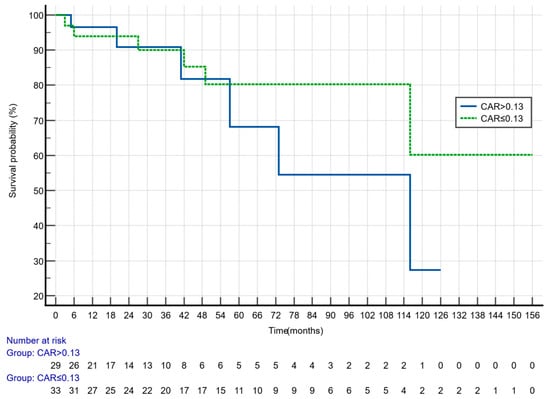
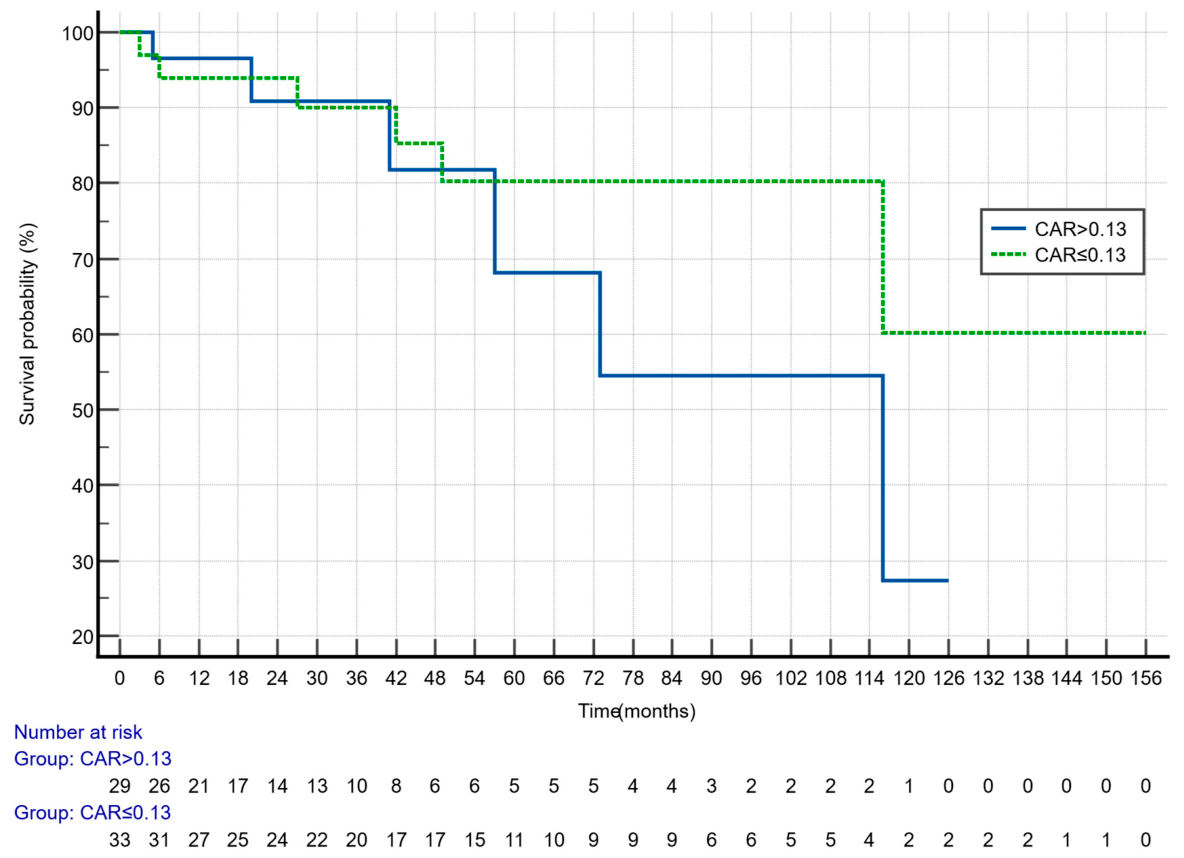
When stratified according to CAR status, patients with CAR > 0.13 had a shorter mean OS compared with patients with CAR ≤ 0.13 [89 months (95% CI: 66–112) vs. 123 months (95% CI: 100–146)]. Patients in the high CAR group also demonstrated a lower survival probability (27% vs. 60%). Although the difference in OS between groups was not statistically significant (log-rank p = 0.32), elevated CAR was associated with a 1.85-fold increased mortality risk (HR: 1.85, 95% CI: 0.55–6.17). Kaplan–Meier survival curves demonstrated an earlier decline in survival probability among patients with elevated CAR values (Figure 1).
Figure 1.
Overall Survival (OS) Probabilities Over Time According to CRP/Albumin Ratio (CAR) Group.
Kaplan–Meier curve showing overall survival (OS) probabilities over time according to CAR groups (low ≤ 0.13, high > 0.13). High CAR group shows earlier decline in OS.
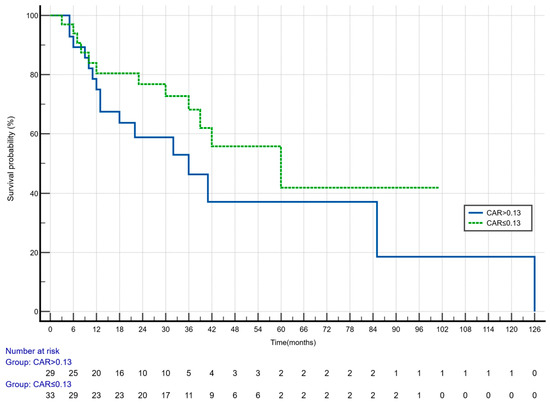
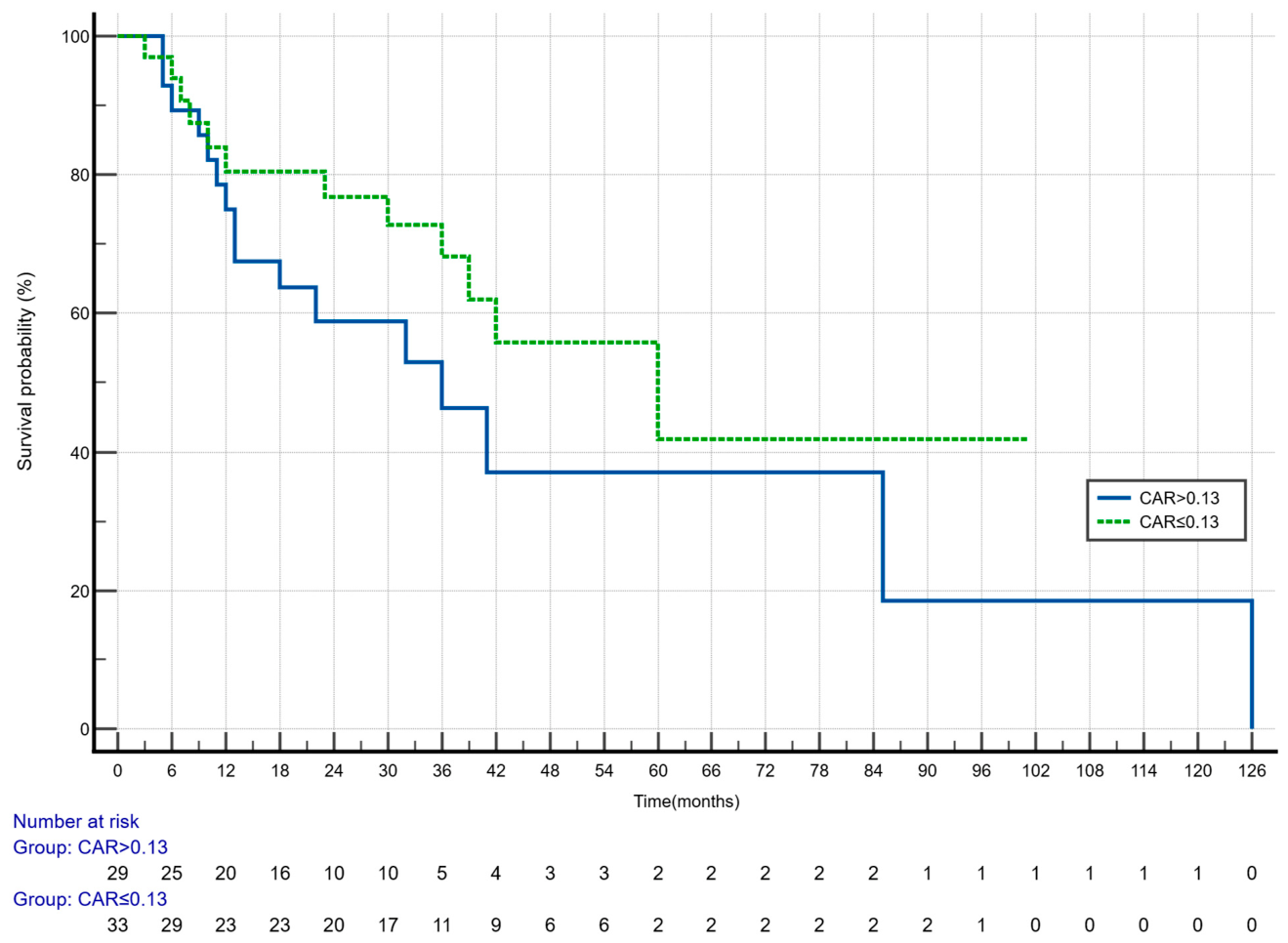
Progression-free survival analyses revealed similar findings. Disease progression developed in 45.16% (n = 28) of patients overall. Median PFS for the entire cohort was 42 months (95% CI: 32–126 months). Patients with CAR > 0.13 had shorter PFS compared with patients with CAR ≤ 0.13 [36 months (95% CI: 13–126) vs. 60 months (95% CI: 36–60)]. Furthermore, the progression rate was numerically higher in the high CAR group (55.17% vs. 36.36%). Elevated CAR was associated with a 1.73-fold increased progression risk (HR: 1.73, 95% CI: 0.80–3.76), although this difference was not statistically significant (log-rank p = 0.16). Kaplan–Meier curves demonstrated a trend toward earlier disease progression among patients with elevated CAR values (Figure 2).
Figure 2.
Progression-Free Survival (PFS) Probabilities Over Time According to CRP/Albumin Ratio (CAR) Groups.
Kaplan–Meier curve showing progression-free survival (PFS) probabilities over time according to CAR groups. High CAR group shows earlier progression compared to low CAR group.
Overall, patients with elevated CAR values demonstrated trends toward shorter overall survival, shorter progression-free survival, increased inflammatory activity, and increased progression risk. However, most demographic, clinical, and laboratory characteristics were comparable between CAR groups. These findings suggest that CAR may reflect systemic inflammatory burden rather than directly representing tumor burden or baseline clinical characteristics. Nevertheless, given the lack of statistical significance in survival analyses and the unexpected dialysis findings, these results should be interpreted cautiously and validated in larger prospective studies.
4. Discussion
In this retrospective observational study including 62 patients with multiple myeloma (MM), we investigated the relationship between the C-reactive protein-to-albumin ratio (CAR), renal function parameters, and survival outcomes. Our findings demonstrated that patients with elevated CAR values tended to have shorter overall survival (OS) and progression-free survival (PFS), higher inflammatory activity, and increased progression risk compared with patients with lower CAR values. Although these differences did not reach statistical significance, the observed trends support the potential association between systemic inflammation and adverse clinical outcomes in MM. In addition, an unexpected association between lower CAR values and higher dialysis requirement was observed, highlighting the complex relationship between inflammation and renal dysfunction in MM.
Multiple myeloma is characterized not only by malignant plasma cell proliferation but also by a highly active inflammatory bone marrow microenvironment. Interactions between plasma cells, stromal cells, cytokines, and immune mediators contribute to disease progression, angiogenesis, immune dysregulation, and resistance to therapy [6,7,8]. Among inflammatory mediators, interleukin-6 (IL-6) plays a particularly important role in MM biology by promoting plasma cell growth and survival [8]. CRP is synthesized in response to IL-6 stimulation, whereas albumin levels decrease during systemic inflammatory states [10]. Therefore, CAR may reflect both inflammatory burden and physiological reserve more comprehensively than either parameter alone.
Inflammation-based prognostic biomarkers have gained increasing attention in hematologic malignancies because they are inexpensive, reproducible, and easily accessible in routine clinical practice [9]. Elevated CAR has been associated with inferior survival outcomes in several solid tumors and hematologic malignancies [12,15,20,21]. In MM specifically, Chen et al. demonstrated that elevated CAR was independently associated with shorter OS and PFS in a large cohort study involving 321 patients [14]. Similarly, meta-analyses evaluating inflammation-based biomarkers across malignancies have consistently reported poorer survival outcomes in patients with elevated CAR values [15,20].
Consistent with previous literature, patients with CAR > 0.13 in our study demonstrated shorter mean OS (89 vs. 123 months) and shorter median PFS (36 vs. 60 months) compared with patients with lower CAR values. Furthermore, elevated CAR was associated with a 1.85-fold increase in mortality risk and a 1.73-fold increase in progression risk. Although these findings were not statistically significant, likely because of the relatively limited sample size, the observed trends are clinically notable and parallel previous reports suggesting that systemic inflammation may adversely affect disease progression and survival in MM [14,15].
Interestingly, most demographic and disease-related characteristics, including age, sex, ISS stage, myeloma subtype, treatment regimen, cytogenetic risk status, and ASCT application, were comparable between low and high CAR groups. These findings suggest that CAR may reflect systemic inflammatory activity relatively independently from baseline disease characteristics. Similarly, treatment response categories including CR, VGPR, PR, SD, and PD were not significantly different between groups. This observation may indicate that CAR is more closely associated with inflammatory status than with immediate treatment response patterns.
In our cohort, ASCT was performed in more than half of the patients, and the majority received modern bortezomib-based triplet regimens. Additionally, maintenance therapy was commonly administered, predominantly lenalidomide-based treatment. These findings reflect current contemporary treatment approaches in MM and increase the clinical relevance of the study population. Despite these modern therapeutic strategies, approximately half of the patients developed disease progression during follow-up, emphasizing the ongoing prognostic heterogeneity of MM and the need for additional biomarkers that may improve risk stratification.
Renal dysfunction remains one of the most important complications of MM and is strongly associated with increased morbidity and mortality [13,16]. Myeloma-related renal injury develops through multiple mechanisms including free light chain-mediated tubular toxicity, cast nephropathy, hypercalcemia-related renal vasoconstriction, inflammatory injury, and deposition diseases such as amyloidosis and light chain deposition disease [17]. In the present study, renal impairment and dialysis requirement were observed in approximately 13% of patients. However, no statistically significant association was observed between CAR and creatinine levels or eGFR values.
Unexpectedly, dialysis requirement was significantly more frequent in the low CAR group. This finding should be interpreted cautiously and may be related to the relatively limited sample size, retrospective design, and potential confounding factors. The relationship between systemic inflammation and renal dysfunction in MM is highly complex and may not always demonstrate a direct linear association. Furthermore, dialysis requirement in MM can be influenced by multiple factors including acute light chain burden, timing of diagnosis, supportive treatment measures, and reversibility of renal injury [13,17]. Therefore, larger prospective studies are required to clarify the relationship between CAR and renal outcomes in MM.
Evaluation of laboratory parameters demonstrated no statistically significant differences between CAR groups regarding creatinine, eGFR, hemoglobin, platelet count, beta2 microglobulin, or calcium levels. However, the neutrophil-to-lymphocyte ratio (NLR), another marker of systemic inflammation, tended to be higher in patients with elevated CAR values. This observation further supports the hypothesis that CAR primarily reflects inflammatory activity rather than direct tumor burden or isolated renal dysfunction.
Although CAR showed associations with trends toward shorter survival outcomes, statistical significance was not achieved in Kaplan–Meier analyses. These findings suggest that CAR alone may not be sufficient as a definitive prognostic marker in relatively small cohorts and may require integration with established prognostic systems such as ISS staging, cytogenetic risk classification, and additional inflammatory biomarkers. Future studies using multivariable Cox regression analyses and larger patient populations may better clarify the independent prognostic value of CAR and establish optimal cut-off thresholds for clinical use.
The present study has several limitations. First, the retrospective single-center design may introduce selection bias and limit generalizability. Second, the relatively small sample size may have reduced statistical power, particularly in subgroup and survival analyses. Third, serial CAR measurements during treatment were not available, preventing assessment of dynamic inflammatory changes over time. Finally, molecular and cytogenetic details were limited in some patients because of the retrospective nature of the study. Future prospective multicenter studies including larger and more clinically homogeneous cohorts with careful characterization of relevant comorbidities are warranted to validate the prognostic value of CAR and to determine its potential role in routine risk stratification of patients with multiple myeloma.
Despite these limitations, our study has important strengths. The study included detailed clinical, laboratory, treatment, transplantation, and survival data from a real-world MM cohort. In addition, both renal outcomes and survival analyses were evaluated simultaneously, providing a broader assessment of the potential clinical significance of CAR in MM.
5. Conclusions
In conclusion, the CRP-to-albumin ratio appears to reflect systemic inflammatory burden rather than serve as a definitive standalone prognostic marker in this cohort of patients with multiple myeloma. Elevated CAR values were associated with trends toward shorter overall survival and progression-free survival, while most baseline demographic and clinical characteristics remained comparable between groups. The unexpected association between lower CAR values and higher dialysis requirement further highlights the complex relationship between inflammation and renal dysfunction in MM. Overall, CAR may represent a simple, inexpensive, and clinically accessible complementary biomarker reflecting inflammatory activity in MM. However, larger prospective multicenter studies are needed to clarify its prognostic value and potential role in risk stratification and clinical decision-making.
Funding
This research did not receive any specific grant from funding agencies in the public, commercial, or not-for-profit sectors.
Institutional Review Board Statement
The study was conducted in accordance with the Declaration of Helsinki and approved by the Non-Interventional Clinical Research Ethics Committee of Ordu University (Approval No. 2026/49, approved on 22 February 2026).
Informed Consent Statement
Informed consent was waived due to the retrospective design of the study and the use of anonymized clinical data.
Data Availability Statement
The datasets generated and/or analyzed during the current study are available from the corresponding author on reasonable request, subject to institutional and ethical regulations.
Conflicts of Interest
The author declares that there are no conflicts of interest regarding the publication of this paper.
References
- Kyle, R.A.; Rajkumar, S.V. Multiple myeloma. N. Engl. J. Med. 2004, 351, 1860–1873. [Google Scholar] [PubMed]
- Rajkumar, S.V. Multiple myeloma: 2020 update on diagnosis, risk-stratification and management. Am. J. Hematol. 2020, 95, 548–567. [Google Scholar] [CrossRef] [Scilit] [PubMed]
- Kumar, S.K.; Callander, N.S.; Alsina, M.; Atanackovic, D.; Biermann, J.S.; Chandler, J.C.; Costello, C.; Faiman, M.; Fung, H.C.; Gasparetto, C.; et al. Multiple Myeloma, Version 3.2017, NCCN Clinical Practice Guidelines in Oncology. J. Natl. Compr. Cancer Netw. 2017, 15, 230–269. [Google Scholar] [CrossRef] [Scilit] [PubMed]
- Rajkumar, S.V.; Dimopoulos, M.A.; Palumbo, A.; Blade, J.; Merlini, G.; Mateos, M.-V.; Kumar, S.; Hillengass, J.; Kastritis, E.; Richardson, P.; et al. International Myeloma Working Group updated criteria for the diagnosis of multiple myeloma. Lancet Oncol. 2014, 15, e538–e548. [Google Scholar] [CrossRef] [Scilit] [PubMed]
- Greipp, P.R.; San Miguel, J.; Durie, B.G.; Crowley, J.J.; Barlogie, B.; Bladé, J.; Boccadoro, M.; Child, J.A.; Avet-Loiseau, H.; Kyle, R.A.; et al. International staging system for multiple myeloma. J. Clin. Oncol. 2005, 23, 3412–3420. [Google Scholar] [CrossRef] [Scilit] [PubMed]
- Hanahan, D.; Weinberg, R.A. Hallmarks of cancer: The next generation. Cell 2011, 144, 646–674. [Google Scholar] [CrossRef] [Scilit] [PubMed]
- Mantovani, A.; Allavena, P.; Sica, A.; Balkwill, F. Cancer-related inflammation. Nature 2008, 454, 436–444. [Google Scholar] [CrossRef] [Scilit] [PubMed]
- Klein, B.; Tarte, K.; Jourdan, M.; Mathouk, K.; Moreaux, J.; Jourdan, E.; Legouffe, E.; De Vos, J.; Rossic, J.F. Survival and proliferation factors of normal and malignant plasma cells. Int. J. Hematol. 2003, 78, 106–113. [Google Scholar] [CrossRef] [Scilit] [PubMed]
- Roxburgh, C.S.; McMillan, D.C. Cancer and systemic inflammation: Treat the tumour and treat the host. Br. J. Cancer. 2014, 110, 14091412. [Google Scholar] [CrossRef] [Scilit] [PubMed]
- Gabay, C.; Kushner, I. Acute-phase proteins and other systemic responses to inflammation. N. Engl. J. Med. 1999, 340, 448–454. [Google Scholar] [CrossRef] [Scilit] [PubMed]
- Martin, D.; Rödel, F.; Balermpas, P.; Winkelmann, R.; Fokas, E.; Rödel, C. C-reactive protein-to-albumin ratio as prognostic marker for anal squamous cell carcinoma treated with chemoradiotherapy. Front. Oncol. 2019, 9, 1200. [Google Scholar] [CrossRef] [Scilit] [PubMed]
- Kinoshita, A.; Onoda, H.; Imai, N.; Iwaku, A.; Oishi, M.; Tanaka, K.; Fushiya, N.; Koike, K.; Nishino, H.; Matsushima, M. The C-reactive protein/albumin ratio, a novel inflammation-based prognostic score, predicts outcomes in patients with hepatocellular carcinoma. Ann. Surg. Oncol. 2015, 22, 803–810. [Google Scholar] [CrossRef] [Scilit] [PubMed]
- Dimopoulos, M.A.; Sonneveld, P.; Leung, N.; Merlini, G.; Ludwig, H.; Kastritis, E.; Goldschmidt, H.; Joshua, D.; Orlowski, R.Z.; Powles, R.; et al. International Myeloma Working Group recommendations for the diagnosis and management of myeloma-related renal impairment. J. Clin. Oncol. 2016, 34, 1544–1557. [Google Scholar] [CrossRef] [Scilit] [PubMed]
- Chen, F.; Liu, X.; Lai, Z.; Xiang, Y.; Yang, C. Association between serum C-reactive protein-to-albumin ratio and the prognosis of patients with multiple myeloma. Indian J. Cancer 2025, 62, 337–344. [Google Scholar] [CrossRef] [Scilit] [PubMed]
- Xu, H.J.; Ma, Y.; Deng, F.; Ju, W.B.; Sun, X.Y.; Wang, H. The prognostic value of C-reactive protein/albumin ratio in human malignancies: An updated meta-analysis. OncoTargets Ther. 2017, 10, 3059–3070. [Google Scholar] [CrossRef] [Scilit] [PubMed]
- Utsu, Y.; Isono, Y.; Masuda, S.I.; Arai, H.; Shimoji, S.; Matsumoto, R.; Tsushima, T.; Tanaka, K.; Matsuo, K.; Kimeda, C.; et al. Time-dependent recovery of renal impairment in patients with newly diagnosed multiple myeloma. Ann. Hematol. 2025, 104, 573–579. [Google Scholar] [CrossRef] [Scilit] [PubMed]
- Leung, N.; Rajkumar, S.V. Multiple myeloma with acute light chain cast nephropathy. Blood Cancer J. 2023, 13, 46. [Google Scholar] [CrossRef] [Scilit] [PubMed]
- Kidney Disease: Improving Global Outcomes (KDIGO) CKD Work Group. KDIGO 2024 clinical practice guideline for the evaluation and management of chronic kidney disease. Kidney Int. 2024, 105, S117–S314. [PubMed]
- Sung, H.; Ferlay, J.; Siegel, R.L.; Laversanne, M.; Soerjomataram, I.; Jemal, A.; Bray, F. Global cancer statistics 2020: GLOBOCAN estimates of incidence and mortality worldwide for 36 cancers in 185 countries. CA Cancer J. Clin. 2021, 71, 209–249. [Google Scholar] [CrossRef] [Scilit] [PubMed]
- Dai, M.; Wu, W. Prognostic role of C-reactive protein to albumin ratio in cancer patients treated with immune checkpoint inhibitors: A meta-analysis. Front. Oncol. 2023, 13, 1148786. [Google Scholar] [CrossRef] [Scilit] [PubMed]
- Jung, J.; Lee, H.; Heo, J.Y.; Chang, M.H.; Lee, E.; Park, W.S.; Park, J.-H.; Eom, H.-S. High level of pre-treatment C-reactive protein to albumin ratio predicts inferior prognosis in diffuse large B-cell lymphoma. Sci. Rep. 2021, 11, 2674. [Google Scholar] [CrossRef] [Scilit] [PubMed]

Disclaimer/Publisher’s Note: The statements, opinions and data contained in all publications are solely those of the individual author(s) and contributor(s) and not of MDPI and/or the editor(s). MDPI and/or the editor(s) disclaim responsibility for any injury to people or property resulting from any ideas, methods, instructions or products referred to in the content. |
© 2026 by the author. Licensee MDPI, Basel, Switzerland. This article is an open access article distributed under the terms and conditions of the Creative Commons Attribution (CC BY) license.