


Abstract
Gastronomy is a factor in destination competitiveness; however, studies addressing the integrated role of gastronomic identity and perceived authenticity as determinants of tourist satisfaction remain insufficiently explored. This systematic review examines how both constructs jointly shape satisfaction in gastronomic tourism destinations. Following the PRISMA 2020 guidelines, a systematic literature search was conducted in Scopus and Web of Science using a Boolean search strategy based on four conceptual blocks. After applying eligibility criteria and assessing methodological quality using JBI protocols, 12 empirical articles published between 2017 and 2026 were selected. This relatively small corpus reflects the concept-driven focus of the review, which required the simultaneous presence of terms related to gastronomic identity, perceived authenticity, and experience satisfaction, thereby increasing the specificity of the search and reducing its sensitivity. It should therefore not be interpreted as an exhaustive representation of all research on gastronomic tourism. Findings reveal that gastronomic identity operates as a multidimensional cultural stimulus, while perceived authenticity (objective, constructive, and existential) plays a mediating or interpretive role in the relationship between culinary stimuli and satisfaction. Together, these constructs enhance tourist satisfaction and strengthen destination loyalty. Key gaps were identified, including geographic concentration in Europe and Asia, sampling biases, and the absence of hospitality as a moderating variable. The reviewed evidence suggests that both constructs function as interrelated determinants within the Stimulus-Organism-Response model, highlighting the need for destination managers to articulate local culinary heritage to maximize tourism competitiveness coherently.
1. Introduction
Food has evolved beyond a basic necessity to become a strategic element in destination promotion and regional competitiveness (Fernandes et al., 2024). The scale of this market is considerable: an estimated 2.5 billion people worldwide consume street food daily, underscoring the relevance of this segment for the Food and Agriculture Organization of the United Nations (FAO) (Cankül & Çıtak, 2025). In this context, gastronomy has established itself as the most attractive element of a destination, accounting for between 30% and 40% of total tourist expenditure (Thio et al., 2024).
The prominence of gastronomy is, in part, a direct response to cultural homogenization associated with globalization. Faced with the erosion of local referents, the consumption of endemic products helps recover a sense of identity, belonging, and security. From this perspective, gastronomy reflects national and regional culture, allowing a destination to be perceived as a territory with its own identity rather than a generic space (Bessière, 1998). Global competition compels tourism stakeholders to implement gastronomic experiences that create an authentic and differentiated offering capable of highlighting the cultural heritage of the place (Andronic & Untaru, 2025).
Gastronomic identity manifests through specific geographic and cultural stimuli, such as autochthonous local ingredients, condiments and spices, traditional recipes, cooking methods, and kitchen utensils (Almansouri et al., 2022; Fernandes et al., 2024; Mak et al., 2012; Shahrin & Hussin, 2023; Untari & Satria, 2022). In insular and coastal destinations, this identity is further represented by the freshness of marine products and their connection to ancestral fishing practices (Carral et al., 2020). Beyond its concrete manifestations, gastronomic identity strengthens the sense of belonging and place attachment, transforming sensory satisfaction into a process of deep cultural learning of high epistemic value for the traveler (Esparza et al., 2023).
To explain this process, the Theory of Planned Behavior (TPB) examines tourists’ prior intention to consume local foods based on their attitudes and subjective norms, while the Stimulus-Organism-Response (S-O-R) model helps understand the internal processing, existential authenticity, and affective responses that emerge once the tourist interacts with the destination (Hurdawaty et al., 2025). Contemporary tourists seek a place’s sensory and cultural identity, experiencing it through physical stimuli and emotional responses. This phenomenon has been conceptualized in the literature as the Food Aesthetic Experience (FAE), which integrates aroma, presentation, and environment to evoke pleasure and emotion (Sukthankar et al., 2025). Regardless of the destination, the success of gastronomic tourism depends not solely on logistics but on the visitor’s ability to perceive the experience as genuine and rooted in the place.
The concept of perceived authenticity has been theorized across three complementary dimensions: objective authenticity, grounded in the verifiable properties of cultural objects (MacCannell, 1973); constructive authenticity, understood as a social negotiation between tourist expectations and destination representations; and existential authenticity, which refers to the activation of a sense of genuine selfhood through touristic engagement (Wang, 1999). Rather than a fixed attribute of the object, perceived authenticity is thus a mental construction grounded in experience that defines the quality of the journey and consolidates the identity of the territory in the visitor’s mind (Esparza et al., 2023). When this perception of authenticity is satisfactory, the tourist develops a positive attitude toward the destination as a whole, increasing the likelihood of generating favorable word-of-mouth recommendations and intentions to revisit (Almeida & Moreno, 2018; Belly et al., 2025; Sthapit et al., 2020). The sensory and affective dimensions of food thus act as direct precursors of the traveler’s post-experience behavior.
Recent literature has continued to reinforce the relevance of gastronomic identity and related cultural attributes in tourism research, particularly regarding destination differentiation, sustainable development, and food-based visitor experiences. In this context, gastronomic identity has also been examined as a functional component of sustainable gastronomy in tourism destinations, while food events and gastronomic experiences have been linked to broader discussions on cultural identity and destination development (Moura et al., 2025; Paunić et al., 2024; Sánchez-Sánchez et al., 2025).
Despite growing academic interest in gastronomic tourism, two interrelated gaps persist in the literature. Theoretically, the integrated role of gastronomic identity and perceived authenticity as joint determinants of tourist satisfaction within a unified explanatory framework remains insufficiently explored. Most studies examine each construct in isolation, limiting understanding of their combined explanatory power. Methodologically, the existing evidence is concentrated in Europe and Asia, relies predominantly on cross-sectional quantitative designs, and lacks longitudinal and cross-cultural approaches capable of capturing the dynamic and context-dependent nature of gastronomic satisfaction, particularly in the post-pandemic context, where demand for memorable and culturally grounded experiences has intensified (Esponda et al., 2025a).
This systematic review addresses both gaps by synthesizing the available empirical evidence on how gastronomic identity and perceived authenticity jointly shape tourist satisfaction with the experience in gastronomic tourism destinations. The following research question guides the review: In gastronomic tourism destinations, what role do gastronomic identity and perceived authenticity play as determinants of tourist experience satisfaction? Consequently, the objective of this study is to integrate and critically examine empirical findings on these constructs within a unified explanatory framework, clarifying the mechanisms through which gastronomic identity and perceived authenticity influence tourist experience satisfaction and destination loyalty.
Rather than aiming to exhaustively cover all research on gastronomic tourism, this review adopts a concept-driven design focused on empirical studies that simultaneously examine the chain linking gastronomic identity, perceived authenticity, and tourist experience satisfaction within the S–O–R framework.
2. Methods
This systematic review was conducted in accordance with the PRISMA 2020 guidelines (Preferred Reporting Items for Systematic Reviews and Meta-Analyses) to ensure transparent and reproducible reporting of findings (Page et al., 2021). Application of these guidelines involved defining search terms, establishing inclusion and exclusion criteria, conducting a systematic selection process, and analyzing the retrieved documents. The review was registered in the Open Science Framework (OSF) under the DOI https://doi.org/10.17605/OSF.IO/YFSRC.
2.1. Search Strategy
The bibliographic search for this concept-driven systematic review was conducted in the Scopus and Web of Science databases. Records published up to 26 March 2026, were included. English-language terms were used, and a Boolean search strategy based on four conceptual blocks was employed, combining the blocks with the operator “AND” and the terms within each block with “OR”. To align the search string with the research question and the predefined conceptual chain linking gastronomic identity, perceived authenticity, and experience satisfaction, the blocks were grouped as follows: (1) gastronomic tourism, (2) gastronomic identity, (3) perceived authenticity, and (4) experience satisfaction.
The combination of the four blocks formed the following search string:
(“food touri*” OR “culinary touri*” OR “gastronomic touri*”) AND (“perceived authenticity” OR “food authenticity” OR “gastronomic authenticity” OR “culinary authenticity” OR “authentic food experience” OR “authentic gastronomic experience”) AND (“gastronomic identity” OR “culinary identity” OR “food identity” OR “gastronomic image” OR “culinary image”) AND (“tourist satisfaction” OR “travel satisfaction” OR “experience satisfaction” OR “gastronomy satisfaction” OR “satisfaction experience” OR “tourist experience” OR “gastronomic experience” OR “memorable experience” OR “memorable gastronomic experience”).
For conceptual block 3, both “gastronomic identity” and “gastronomic image” were included as search terms. Identity and image are recognized as distinct theoretical constructs: identity refers to the destination’s intrinsic cultural and culinary characteristics, whereas image reflects tourists’ perceptions of these characteristics. However, in several empirical studies, gastronomic identity has been operationalized through image-based indicators (for example, destination image related to local cuisine). To capture this body of work, image-related terms were considered as potential proxies for gastronomic identity within the search strategy.
For conceptual block 4, terms related to tourist experience and satisfaction were grouped. In contemporary tourism models, satisfaction is conceptualized as an outcome of the tourist experience rather than as a synonym for it. Accordingly, experience and satisfaction were not treated as interchangeable constructs; instead, the block was designed to identify studies that examined experiential outcomes of local gastronomy, including satisfaction, memorable experiences, and affective responses.
This overall conceptual grouping of the four blocks, together with the requirement to combine all four blocks, is acknowledged as having increased the specificity of the search while reducing its sensitivity and contributing to the restrictive nature of the search strategy.
In Scopus, the search was limited to English-language articles published from 2017 to 2026; document-type filters were applied to include only original research articles, excluding systematic reviews, meta-analyses, editorials, and conference abstracts. The time frame (2017–2026) was chosen to capture the period of growing empirical research on gastronomic experiences that evoke a unique sense of place. The same search string was used in Web of Science; however, no records were retrieved even after removing platform-specific filters and verifying Boolean connector compatibility. This result is interpreted as a limitation of the specific search design rather than as evidence of an absence of relevant literature in Web of Science. In Web of Science, preliminary broader searches were also tested by relaxing the simultaneous combination of the conceptual blocks. These broader configurations yielded a larger number of records but predominantly focused on agri-food production, gastronomic heritage and regional development, or on culinary professionals and experts, rather than on tourists’ perceived authenticity and satisfaction with gastronomic experiences. Because these records did not align with the predefined focus on tourists and on the identity–authenticity–satisfaction chain, the final search strategy was deliberately kept concept-driven and restrictively configured. Although searches were attempted in Scopus and Web of Science, the final corpus was retrieved exclusively from Scopus, which yielded 55 records.
2.2. Inclusion and Exclusion Criteria
Specific eligibility criteria were established in accordance with the PRISMA 2020 guidelines to ensure the reproducibility and methodological rigor of the study selection process for the research question. Table 1 presents the eligibility and exclusion criteria.
Table 1.
Inclusion, exclusion, and elimination criteria were used in the systematic review.
The review focused exclusively on original empirical research articles that aligned with the four blocks of the research question. Systematic reviews, conceptual documents, and other forms of gray literature were excluded because they do not provide primary empirical evidence for conducting a systematic assessment of the results.
The criteria were applied independently by two authors (PJ and RS), who examined the titles and abstracts of all 55 retrieved records and explicitly recorded the primary reason for exclusion for each excluded study. Discrepancies were to be resolved through iterative discussion and consensus; if agreement could not be reached, a third author (YM) served as a mediator to reach a final decision. However, no discrepancies were recorded at this stage.
2.3. PRISMA Diagram
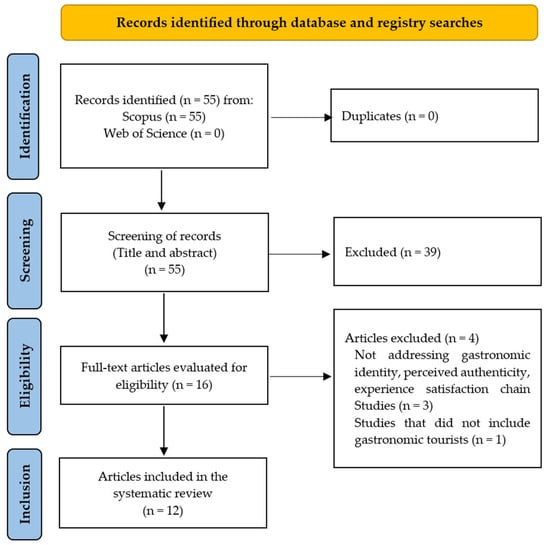
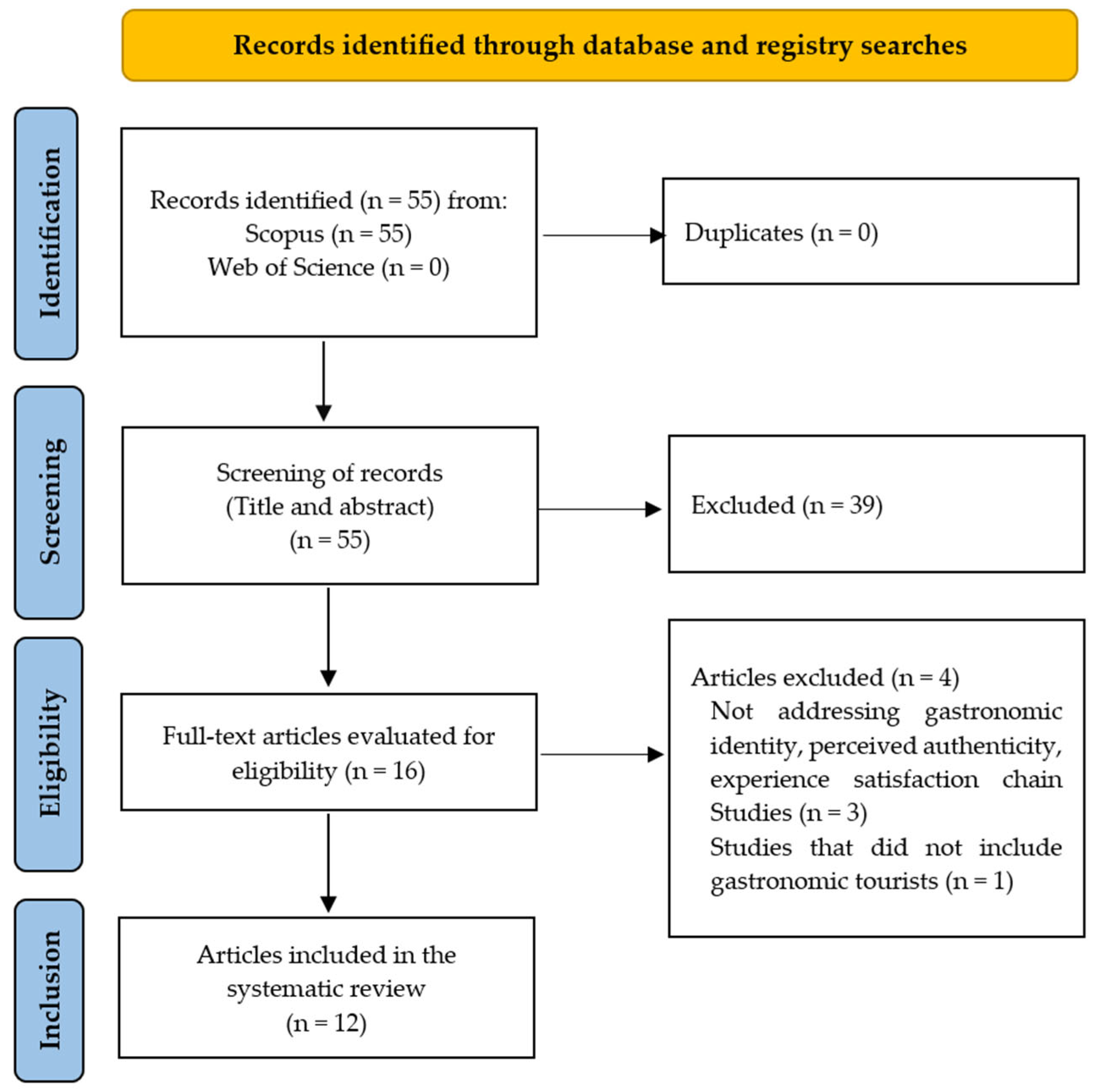
A summary of the study selection process and specific reasons for exclusion are presented in Figure 1.
Figure 1.
The PRISMA 2020 flowchart.
The selection process was conducted in four stages. In the Identification stage, the search retrieved 55 records in Scopus and 0 in Web of Science; no records were retrieved from Web of Science even after removing platform-specific filters and verifying Boolean connector compatibility. No duplicate documents were identified.
In the screening stage, titles and abstracts were reviewed, and 39 studies were excluded because they addressed other topics (tourism and promotion, n = 9; cultural heritage, n = 6; sustainability, n = 4; others, n = 21). Only 16 documents continued to the next stage.
During the eligibility stage, 16 articles were evaluated in full text; 4 studies were excluded: 3 for not addressing the gastronomic identity, perceived authenticity, and experience satisfaction chain simultaneously, and 1 because its subjects were not gastronomic tourists.
In the inclusion stage, 12 articles were selected for the systematic review.
2.4. Data Extraction
The data extraction process used a previously developed Microsoft Excel recording sheet aligned with the question and objective of this review. For each study, the following were collected: authors and year, country, research design, study population, and results on gastronomic identity, perceived authenticity, and their relationship to the satisfaction of gastronomic tourists’ experiences.
Extraction was performed independently by two reviewers (PJ and TD); any discrepancies were to be resolved through discussion and consensus. No discrepancies were recorded, and the final dataset was cross-validated for accuracy and consistency. The extracted data were cross-checked against the full texts to ensure internal consistency, and no discrepancies between the recorded variables and the original reports were identified.
2.5. Methodological Quality Assessment
The quality of the 12 selected studies was evaluated using the Joanna Briggs Institute (JBI) Manual for Evidence Synthesis (Aromataris & Munn, 2024).
Depending on the methodological design, three instruments were used: one for qualitative studies, one for quantitative studies, and one for mixed-methods studies.
2.5.1. Quantitative Studies
To evaluate the quantitative studies, the JBI checklist was used, comprising eight criteria: (1) clear definition of sample inclusion criteria; (2) detailed description of participants and study context; (3) valid and reliable measurement of independent variables; (4) use of objective and standardized criteria to measure the condition of interest; (5 and 6) identification of potential confounding factors and reported strategies for their control in the analysis; (7) valid and reliable measurement of outcomes; and (8) use of appropriate statistical analyses for the design and nature of the data, including, when applicable, PLS-SEM (Partial Least Squares Structural Equation Modeling) models and fsQCA (Fuzzy Set Qualitative Comparative Analysis). The joint assessment of these criteria ensures that the correlational and associational inferences analyzed possess the necessary technical rigor to support the review’s conclusions (Table 2).
Table 2.
Study, Type, JBI Score (%), and risk of bias of the quantitative studies (n = 10).
2.5.2. Qualitative Studies
To evaluate the study by Kim et al. (2020), the qualitative research checklist was used (Lockwood et al., 2024). This instrument assesses ten criteria: (1) congruence between the adopted philosophical perspective and the declared methodology; (2) congruence between the methodology and the research questions or objectives; (3) congruence between the methodology and the data collection methods; (4) congruence between the methodology and the representation and analysis of data; (5) congruence between the methodology and the interpretation of results; (6) an explicit statement of the researcher’s cultural or theoretical positioning; (7) reflexivity and the researcher’s influence on the interpretive process; (8) adequate representation of participants’ voices and perspectives; (9) a statement of ethical approval by a competent body; and (10) conclusions derived from the analysis and interpretation of data.
The study by Kim et al. (2020) earned a score of 8/10 (80%) on the criteria, thereby allowing its inclusion in this systematic review. Although the document has reporting omissions regarding the explicit statement of the authors’ theoretical position (criterion 6) and its reflexive impact on the research process (criterion 7), these gaps do not compromise the integrity of the collected data or the validity of the findings.
2.5.3. Mixed-Methods Studies
To evaluate the methodological quality of the study by Vijulie et al. (2025), the JBI critical appraisal approach for mixed-methods studies was adopted (Lizarondo et al., 2024). Because JBI does not have a specific checklist for mixed-methods primary studies, its recommendations were followed to apply the existing checklists for the quantitative and qualitative components, in line with each study’s design. This procedure enabled a systematic assessment of internal validity, risk of bias, and the adequacy of the design and analysis for each component, while maintaining consistency with JBI’s methodological standards. The following outlines the 11 criteria that comprise the checklist for mixed-methods studies: (1) relevance of the mixed-methods design to the research questions; (2) appropriateness of the quantitative design; (3) appropriateness of the qualitative design; (4) effective integration of qualitative and quantitative components; (5) adequacy of quantitative data analysis; (6) adequacy of qualitative data analysis; (7) support for quantitative findings by the data; (8) support for qualitative findings by the data; (9) clarity in the justification for the use of mixed methods; (10) justification of conclusions; and (11) overall assessment. After applying this protocol, the study achieved a score of 11/11 (100%) across all criteria, confirming its high methodological integrity for inclusion in this systematic review.
The quality assessment was conducted independently by two authors (PJ and RS) trained in JBI protocols; each criterion was coded according to the standardized instrument’s instructions. Methodological quality was not used as an exclusion criterion but rather as a factor that contextualized the certainty of evidence and the weighting of findings in the final synthesis. Discrepancies were to be resolved by consensus; no inter-reviewer discrepancies were recorded.
To summarize the methodological quality of the included studies, a JBI score was calculated for each article. The score was obtained by dividing the number of fulfilled criteria by the total number of criteria in the corresponding checklist and expressing it as both a ratio (for example, 7 out of 8 for quantitative studies with eight criteria, 8 out of 10 for qualitative studies, or 11 out of 11 for mixed-methods studies) and a percentage (e.g., 87.5%, 80%, or 100%). Because the Joanna Briggs Institute does not provide an official scoring system or predefined risk-of-bias categories for its critical appraisal tools, a practical classification was adopted and applied consistently across quantitative, qualitative, and mixed-methods designs. Studies that met at least 75% of the applicable criteria were categorized as having a “low risk of bias”; those fulfilling between 50% and 74% of the criteria were classified as having a “moderate risk”; and studies that met fewer than 50% were considered to have a “high risk.” In this review, all selected studies met at least 80% of the relevant criteria and were classified as having a low risk of bias.
3. Results
This systematic review included 12 articles. Table 3 summarizes the characteristics of the included studies.
Table 3.
Date, country, research design, and study population of articles included in the systematic review (n = 12).
Among the 12 reviewed studies, the diversity of analytical strategies used in gastronomic tourism is evident. The majority of the articles (Belly et al., 2025; Cankül & Çıtak, 2025; Chen et al., 2024; Dias & Posheliuznaia, 2025; Eck et al., 2026; Hurdawaty et al., 2025; Li et al., 2025; Mohammad et al., 2022) employed explanatory quantitative designs (PLS-SEM, SEM, or variants). Some studies used fuzzy clustering (Martín et al., 2020) and fuzzy sets (Badu et al., 2022). One study used mixed methods (Vijulie et al., 2025), and only one was a qualitative study (Kim et al., 2020).
Findings from PLS-SEM and SEM generally show relationships among perceived authenticity, experiential value, gastronomic destination attributes, destination image, satisfaction, and revisit intention. Local gastronomy serves as a cognitive stimulus that shapes perceptions of the destination and generates responses that influence tourist satisfaction and future behavior.
Studies on fuzzy clustering and fuzzy sets demonstrate that the relationship between gastronomy and tourist experience is not uniform. This relationship varies by visitor profile. Personal traits can lead to similar outcomes of delight (an evolution of satisfaction), loyalty, or future intention, suggesting that there is no single causal pathway toward satisfaction, although a common explanatory structure exists.
Qualitative studies explain how tourists understand authenticity and gastronomic identity in specific contexts. Gastronomic experiences generate cultural connection among tourists, symbolic validation of the destination (the relationship among heritage narrative, consumption context, and the cuisine offered), and knowledge accumulation.
To present the main findings on Gastronomic Identity (GI), Perceived Authenticity (PA), and Experience Satisfaction (ES), the content of each study was analyzed and synthesized (Table 4).
Table 4.
Study, country, and identified findings (GI, PA, ES) of the studies included in the review.
3.1. Gastronomic Identity: Central Element of the Destination
Gastronomic identity was recognized across the reviewed studies as a multidimensional construct configured by four interacting components: historical heritage and ethnic fusion (Dias & Posheliuznaia, 2025; Eck et al., 2026), preparation practices and techniques (Chen et al., 2024; Li et al., 2025), ecological resources and endemic ingredients (Belly et al., 2025; Dias & Posheliuznaia, 2025), and shared communal traditions (Cankül & Çıtak, 2025; Mohammad et al., 2022). Across the studies, this construct was found to operate not as a static cultural attribute but as an active mechanism through which tourist engagement was initiated, satisfaction was generated, and long-term behavioral commitment was consolidated.
Three studies converged in documenting gastronomic identity as a structuring force in urban and heritage-embedded settings, yet diverged in the pathway through which identity reached the tourist. Emblematic dishes were found to serve as recognized destination symbols, with consumption directly predicting satisfaction through prior cognitive knowledge (Martín et al., 2020). Satisfaction and loyalty were produced through coherence between local cuisine and sense of place, a complementary but structurally distinct mechanism (Eck et al., 2026). Cantonese culinary culture was found to propel satisfaction toward gastronomic delight, understood as a higher-order affective response beyond satisfaction when experiential expectations were exceeded (Li et al., 2025). These cases indicated that heritage-embedded gastronomic identity amplified its effect on satisfaction outcomes as cultural depth and experiential coherence increased.
A second cluster positioned gastronomic identity as a mediator between cultural knowledge and immersive experience. Satisfaction was found to be contingent on the convergence between expectations constructed through museum exhibitions and the subsequent gastronomic encounter, a cognitive coherence mechanism (Kim et al., 2020). In a complementary but affectively oriented context, experiential value (the emotional and sensory fusion of tasting and cultural learning) was identified as the pathway through which identity transformed positive attitudes into memorable experiences (Mohammad et al., 2022). These findings indicated that the bridge between gastronomic identity and satisfaction was constructed through either cognitive or emotional pathways, depending on the destination context.
A third cluster documented gastronomic identity as a strategic instrument for loyalty and destination differentiation. Local marine gastronomy was found to activate satisfaction and dual behavioral loyalty, revisit intention, and active destination recommendation (Belly et al., 2025). Structurally equivalent outcomes were documented at an urban heritage market, where the combination of local products and authentic atmosphere produced visitor satisfaction and return intentions (Vijulie et al., 2025). At a broader scale, traditional regional cuisine was identified as the primary vehicle for destination identity construction and visitor loyalty (Dias & Posheliuznaia, 2025), while street food authenticity was found to activate nostalgia, reinforce destination attitudes, and strengthen future behavioral intentions (Cankül & Çıtak, 2025). These four cases (spanning island, urban market, regional, and metropolitan settings) consistently supported gastronomic identity as a differentiating mechanism capable of translating cultural heritage into sustained tourist engagement (Belly et al., 2025; Cankül & Çıtak, 2025; Dias & Posheliuznaia, 2025; Vijulie et al., 2025).
3.2. Objective Authenticity: Satisfaction Through Ingredients and Flavors
Objective authenticity was operationalized across the reviewed studies as the most directly verifiable dimension of the gastronomic experience, anchored in the physical properties of the dish, local ingredients, unaltered preparation techniques, product freshness, and the sensory qualities derived from them. This dimension was found to generate satisfaction through direct sensory contact rather than through symbolic interpretation or emotional projection, distinguishing it from constructive and existential forms of authenticity.
Three studies converged in identifying ingredient origin and physical integrity as the primary trigger of satisfaction, yet diverged in the specific resource through which this mechanism operated. The perception of traditional raw materials, unique preparation methods, and distinctive local flavors was identified as the primary stimulus that generates memorable and satisfying experiences in the Indonesian context (Hurdawaty et al., 2025). The marine origin of locally sourced seafood prepared using traditional methods had a direct and significant impact on traveler satisfaction in an insular coastal context, establishing ecological provenance as the authenticating signal (Belly et al., 2025). Adherence to unaltered traditional recipes was identified as the structural anchor of the entire satisfaction model in a Russian regional context (Dias & Posheliuznaia, 2025). These findings indicated that the operationalization of objective authenticity must be adapted to the specific heritage typology of each destination (whether technical-cultural, ecological, or historical-continuity-based).
Two studies extended the explanatory scope of objective authenticity beyond satisfaction toward a superior affective state. Sensory components were grouped into food-sensation dimensions (taste, texture, and aroma) and culinary-preparation dimensions (cutting skills and ingredient selection). A direct and positive effect of these dimensions on tourist pleasure and satisfaction was confirmed within the Perceived Attributes of Gastronomy Tourism Destinations (PAGTD) scale (Chen et al., 2024). When the quality of these sensory attributes exceeded visitor expectations, satisfaction evolved into gastronomic delight, a superior emotional state that more strongly predicted revisit intention than conventional satisfaction alone (Li et al., 2025). This distinction indicated that beyond a satisfaction threshold, further enhancement of sensory integrity produced qualitatively different behavioral outcomes (Belly et al., 2025; Chen et al., 2024; Dias & Posheliuznaia, 2025; Hurdawaty et al., 2025; Li et al., 2025).
3.3. Constructive Authenticity: Satisfaction Through Environment and Atmosphere
Constructive authenticity was documented across the reviewed studies as the dimension through which the environment, ambiance, and spatial staging of the gastronomic space operated as active co-producers of tourist satisfaction. Satisfaction was found to emerge when prior cultural and sensory expectations encountered a spatial reality that confirmed or exceeded them. The four studies addressing this dimension converged on this central claim but diverged on the nature of the environmental mechanism required to produce that coherence.
The most consequential divergence was documented between two studies that reached opposing conclusions about what kind of environment generated constructive authenticity. In a gastronomic museum setting, satisfaction was found to depend on the thematic coherence between the heritage narrative constructed through exhibitions and the subsequent restaurant experience; any discrepancy between the institutionally scripted discourse and the lived gastronomic encounter diminished satisfaction (Kim et al., 2020). By contrast, at an urban food market, satisfaction was generated through spontaneous, unscripted atmospheric immersion (the visual, olfactory, and sensory qualities of the environment) in the absence of a designed heritage narrative (Vijulie et al., 2025). This divergence established that high-control scripted environments and low-control organic environments both generated constructive authenticity through mutually incompatible mechanisms, each requiring different management approaches.
Two additional studies converged in documenting the physical quality of the gastronomic space as a structural mediator of satisfaction. Perceived restaurant quality (operationalized as a clean environment, attractive interior design, and favorable location) was found to significantly influence tourist satisfaction and subsequent loyalty (Eck et al., 2026). The physical and social atmosphere of street food consumption was identified as an independent stimulus that directly shaped consumer attitudes toward the destination (Cankül & Çıtak, 2025). These findings reinforced the cross-context claim that spatial staging constituted a structural (not peripheral) component of constructive authenticity, whether in formal restaurant or informal open-air settings (Cankül & Çıtak, 2025; Eck et al., 2026; Kim et al., 2020; Vijulie et al., 2025).
3.4. Existential Authenticity: Satisfaction Through Emotion, Belonging, and Nostalgia
Existential authenticity was identified across the reviewed studies as the dimension through which satisfaction was generated by internal emotional processes (nostalgia, place attachment, relational well-being, and heritage appreciation) activated by the gastronomic encounter. Five studies addressed this dimension, converging on its emotional foundations but diverging in the specific mechanisms by which existential authenticity translated into satisfaction and loyalty.
Two studies converged in documenting emotional mediation as the pathway from gastronomic authenticity to loyalty, yet diverged in the affective mechanism involved. Authentic street food and atmosphere were found to evoke nostalgia (a temporally oriented emotional state), which in turn produced favorable destination attitudes and future behavioral intentions (Cankül & Çıtak, 2025). Food authenticity was found to generate place attachment (an emotional bond grounded in cultural identity recognition) that directly influenced both satisfaction and loyalty (Eck et al., 2026). While both mechanisms produced loyalty as a terminal outcome through emotional rather than cognitive pathways, nostalgia was retrospective in orientation whereas place attachment was relational and present-oriented, a distinction with direct implications for destination management strategies (Cankül & Çıtak, 2025; Eck et al., 2026).
The relational and social dimensions of existential authenticity were documented by two studies. Through fsQCA analysis, satisfaction was found to be constructed through the overcoming of food neophobia via social interaction, local hospitality, and tourism-induced well-being; hospitality emerged as the strongest single predictor of loyalty, surpassing authenticity and hedonism in combined configurations (Badu et al., 2022). In a structurally equivalent but experientially distinct context, satisfaction and positive attitude were found to be driven by emotional value (feeling happy and content) and interaction value (sharing stories and socializing with fellow travelers) (Mohammad et al., 2022). Where Badu et al. (2022) emphasized the host-tourist relational bond, Mohammad et al. (2022) emphasized the tourist-tourist bond, indicating that the relational field of existential authenticity extended both outward and inward within the gastronomic experience.
A third pathway was documented through fuzzy segmentation, which identified the most satisfied tourist typology as the existential foodie, a profile defined by active cultural identification with the destination’s culinary heritage and deep prior knowledge of emblematic dishes (Martín et al., 2020). Unlike the affective immediacy of nostalgia or the relational character of hospitality, this pathway operated through accumulated cultural capital that, once activated by the gastronomic encounter, generated a depth of satisfaction not accessible to tourists without that prior knowledge base. These five studies collectively established existential authenticity as the most heterogeneous dimension in the corpus, encompassing at least four structurally distinct satisfaction pathways whose differential activation depended on tourist profile, cultural background, and destination type (Badu et al., 2022; Cankül & Çıtak, 2025; Eck et al., 2026; Martín et al., 2020; Mohammad et al., 2022).
3.5. Experience Satisfaction as a Link to Loyalty and Destination Competitiveness
Experience satisfaction was documented across the corpus as the pivotal construct through which the outputs of gastronomic identity and perceived authenticity were converted into revisit intention, destination loyalty, and word-of-mouth recommendation. All 12 reviewed studies converged on treating satisfaction as a terminal outcome of the gastronomic experience, yet diverged on the structural pathway connecting the gastronomic stimulus to that outcome. Two distinct satisfaction-to-loyalty architectures were identified: one direct and one mediated.
A first cluster documented satisfaction as a direct and sufficient antecedent of loyalty across markedly different destination types. Perceived food authenticity and restaurant quality were found to jointly activate place attachment, which co-produced satisfaction and loyalty within a two-stage S-O-R chain (Eck et al., 2026). Satisfaction generated by authentic local cuisine was identified as the single factor with the greatest impact on revisit intention, an effect further amplified through destination branding (Dias & Posheliuznaia, 2025). The consumption of fresh local marine products was found to exceed visitor expectations and translate directly into revisit intention and active destination recommendation (Belly et al., 2025). Genuine sensory immersion at an urban heritage market was found to generate high visitor satisfaction and strong intentions to return (Vijulie et al., 2025). These four geographically and methodologically diverse cases converged on a single structural proposition: when gastronomic identity was coherently communicated and perceived authenticity positively confirmed, satisfaction was sufficient to produce loyalty without additional mediating variables.
A second cluster documented cases in which satisfaction alone was insufficient to generate loyalty, requiring mediating constructs to complete the behavioral chain. Three distinct mediation architectures were identified. First, food authenticity was found to drive revisit intention only through the sequential mediation of a memorable culinary tourism experience and destination image, thereby establishing satisfaction as a component of the memorable experience rather than an independent terminal outcome (Hurdawaty et al., 2025). Second, conventional satisfaction was found to evolve toward gastronomic delight when experiential expectations were exceeded across central and complementary destination attributes; this elevated affective state more strongly predicted revisit intention than basic satisfaction alone (Li et al., 2025). Third, the path from gastronomic authenticity to loyalty was found to operate through nostalgia and attitude as sequential mediators, embedding satisfaction within the attitude construct rather than as a separately observable outcome (Cankül & Çıtak, 2025).
At the measurement level, a gastronomic offering combining food culture, sensory dimensions, culinary preparation quality, service environment, and a favorable quality-to-price ratio was found to have a positive, direct, and significant effect on tourist pleasure and future behavioral intentions across the PAGTD scale (Chen et al., 2024). Satisfaction was found to be structurally conditioned by the coherence schemas between expectations constructed through prior institutional engagement and the actual gastronomic encounter (Kim et al., 2020). Highest satisfaction levels were documented among tourists with prior knowledge of emblematic dishes, evaluated across eight destination attributes (Martín et al., 2020). Taken together, these findings established that the satisfaction-to-loyalty relationship was structurally robust but context-sensitive: its strength and the sufficiency of satisfaction as a direct predictor of loyalty depended on the cultural depth of the tourist, the coherence between expectation and experience, and the comprehensiveness of the gastronomic offering (Badu et al., 2022; Belly et al., 2025; Cankül & Çıtak, 2025; Chen et al., 2024; Dias & Posheliuznaia, 2025; Eck et al., 2026; Hurdawaty et al., 2025; Kim et al., 2020; Li et al., 2025; Martín et al., 2020; Vijulie et al., 2025).
4. Discussion
The findings of this systematic review provide a coherent, empirically grounded answer to the research question: in gastronomic tourism destinations, gastronomic identity and perceived authenticity jointly serve as primary determinants of tourist experience satisfaction, each activating distinct yet complementary cognitive, sensory, and emotional pathways within the Stimulus-Organism-Response (S-O-R) framework. Across the 12 reviewed studies (spanning diverse geographic, cultural, and methodological contexts), gastronomic identity consistently functioned as the external stimulus initiating the tourist’s engagement with the destination, while perceived authenticity (whether objective, constructive, or existential) shaped the internal processing that transformed that encounter into a satisfying and memorable experience. Satisfaction, in turn, served as the pivotal mechanism linking the gastronomic encounter to enduring behavioral outcomes such as revisit intention and destination loyalty (Badu et al., 2022; Chen et al., 2024; Eck et al., 2026).
Importantly, the reviewed evidence suggests that neither construct operates in isolation. Gastronomic identity provides the cultural and sensory substance of the experience (through local ingredients, traditional preparation techniques, heritage narratives, and shared culinary practices) while perceived authenticity determines the degree to which the tourist internalizes that substance as genuine, meaningful, and congruent with their own identity and expectations (Cankül & Çıtak, 2025; Dias & Posheliuznaia, 2025; Kim et al., 2020). When both constructs are perceived positively and simultaneously, the reviewed studies consistently document higher levels of satisfaction, stronger place attachment, and greater propensity for loyalty, regardless of whether the tourist profile is domestic or international (Belly et al., 2025; Li et al., 2025; Vijulie et al., 2025), However, the reviewed literature also reveals that this relationship is not uniform: the cultural background of the tourist, the type of destination, and the dimension of authenticity activated introduce significant variability in outcomes, a heterogeneity that the following sections address in depth.
4.1. Divergences in Satisfaction According to Tourist Profile
Depending on the type of tourist, satisfaction with the gastronomic experience is evaluated according to different criteria. For the domestic or local tourist, satisfaction is intrinsically linked to place attachment and collective memory (Dias & Posheliuznaia, 2025). Gastronomic nostalgia (through the consumption of traditional foods) reinforces their own identity and sense of belonging (Cankül & Çıtak, 2025), such that a local tourist may rate an experience as highly satisfactory or exhibit loyalty not necessarily because of the dish’s objective quality, but as an act of validating their regional identity. In contrast, the international tourist lacks a prior emotional bond with the destination, which means that satisfaction with the gastronomic experience focuses on the evaluation of objective perceived authenticity (local ingredients, exotic flavor, traditional preparation) and on the value of novelty, associated with constructive authenticity (Eck et al., 2026; Hurdawaty et al., 2025).
These divergences are observed in a study conducted in Córdoba, Spain, where tourists of Lebanese origin were the most dissatisfied segment regarding local gastronomy (Martín et al., 2020). In contrast, Western tourists (American and British) evaluated the same dishes as exotic and highly authentic. This suggests that authenticity is not an objective attribute of the food, but a social and cultural construction of the tourist: deep and genuine knowledge of a culinary tradition generates a more demanding evaluation and, paradoxically, lower satisfaction. These divergent evaluations do not represent incompatible findings. Rather, they reflect the constructivist nature of authenticity itself: each tourist group constructs its perception from a culturally distinct frame of reference, whether anchored in sensory novelty, ethnic familiarity, or memorial resonance. In terms of the S-O-R model employed by Cankül and Çıtak (2025) the organism (the tourist’s internal processing) is modulated by the cultural profile of origin, producing heterogeneous behavioral responses to the same gastronomic stimulus.
4.2. Schema Discrepancy and Negotiated Authenticity in Gastronomy
The profile-based divergences discussed above point to a broader principle: authenticity is not evaluated in a vacuum, but against the cognitive schema the tourist brings to the experience. This becomes particularly evident in the case of schema discrepancy, documented by Kim et al. (2020) at the Kitchen Museum of Hangzhou; satisfaction depends on the tourist’s gastronomic experience aligning with the visual and educational expectations set by the museum’s exhibitions. Any divergence between the structured discourse of the heritage narrative and the lived experience at the table diminishes visitor satisfaction.
This finding connects with the problem of negotiated authenticity identified by Dias and Posheliuznaia (2025), who warn of the risk of staged authenticity: when culinary traditions are modified to meet the expectations of the Western tourist, the destination’s gastronomic identity erodes gradually. In the reviewed studies, this phenomenon manifests with greater intensity in destinations where gastronomy holds consolidated heritage value (such as the Urals region in Russia, with dishes like pelmeni and stroganina, or the historic district of Xi’an with its authentic cuisine), since in these contexts the discrepancy between the original culinary practice and its tourism-adapted version is more perceptible and penalized in satisfaction indices (Eck et al., 2026).
Although the focus of this review centers on gastronomic identity and perceived authenticity, evidence from the corpus consistently indicates that hospitality (understood as the warmth, friendliness, knowledge, and responsiveness of service staff) functions as a structural dimension of the gastronomic experience, conditioning tourist satisfaction. Badu et al. (2022) demonstrated, through fsQCA analysis, that hospitality is the most significant predictor of loyalty toward the gastronomic destination, surpassing even authenticity and hedonism when combined with social interaction and tourism-induced well-being. In the same direction, Eck et al. (2026) incorporate restaurant quality (including service dimensions) as an external stimulus within the S-O-R model to activate place attachment and overall tourist satisfaction.
The tension between food authenticity and service quality as predictors of satisfaction is addressed in the literature review by Dias and Posheliuznaia (2025), who contrast two reference studies: Zhang et al. (2019), who position authenticity as the central axis of the quality-satisfaction-loyalty chain, versus Anggara et al. (2023), who demonstrated in Bali, Indonesia, that service quality had the greatest impact on tourists’ experience and satisfaction, surpassing food authenticity. This tension is relevant because it introduces a relationship of substitution or complementarity between both variables: exceptional hospitality can compensate for moderate perceived authenticity, and conversely, a highly endemic food product may not generate satisfaction if the service is deficient.
Although the literature on hospitality in gastronomic tourism is extensive, a gap remains in understanding how hospitality interacts with gastronomic identity and perceived authenticity within integrated frameworks such as the S-O-R model. Future studies could incorporate hospitality as a moderating or mediating variable in models that simultaneously examine all three constructs, thereby identifying the conditions (destination type, tourist profile, type of authenticity) under which the relative weight of service surpasses or is surpassed by the identity and authenticity dimensions of gastronomy.
4.3. Cultural-Background Heterogeneity
The heterogeneity of findings (whereby some studies prioritize service over food, or emotions over price) suggests that the nationality of the sample introduces a systematic bias into results on satisfaction and loyalty. Studies conducted in China (Kim et al., 2020; Li et al., 2025) and in the Urals region of Russia (Dias & Posheliuznaia, 2025) obtain results from samples of local tourists, whose everyday expectations and consumption habits shape their evaluations. In turn, the loyalty results are limited to a sample composed exclusively of American tourists (Badu et al., 2022).
This nationality-driven variability provides the most plausible explanation for the two satisfaction-to-loyalty architectures documented in Section 3.5: the direct path tends to prevail in samples of culturally proximate tourists whose expectations are well calibrated to the destination, whereas the mediated path emerges when cultural distance requires additional cognitive or emotional processing before loyalty is consolidated. This was confirmed at Obor Market in Bucharest, where tourists’ cultural background (customs, values, and ethical frameworks) was found to affect satisfaction levels, with drastic variations among Austrian, German, and American tourists evaluating the same market space (Vijulie et al., 2025). This suggests that the constructs of identity, authenticity, and satisfaction are universal in their structure within the S-O-R model, but their statistical behavior is highly heterogeneous, because perceptions of authenticity are ethnocentric: other cultures are evaluated and judged from the perspective and values of the tourist’s own culture, such that what generates delight in a foreign tourist may provoke rejection in a tourist with a culturally related background.
4.4. Research Gaps
The analysis of the reviewed articles identified four systematic research gaps that are structurally related and collectively limit the explanatory reach of the current literature. The first concerns geographic bias: eleven of the twelve included studies are concentrated in Europe and Asia, leaving Africa, Latin America, and Oceania unrepresented. This absence is methodologically relevant because the explanatory models of satisfaction may operate differently in contexts shaped by ethnic, decolonial, or bioprospecting gastronomic roots, where cultural resistance to the commodification of heritage may moderate or reverse the documented relationships between perceived authenticity and satisfaction. As a consequence, the patterns identified in this review should be interpreted as reflecting contexts in which gastronomic tourism has been most frequently studied to date, rather than as globally generalizable evidence. Closely linked to this is a second gap: the absence of moderating variables related to the tourist profile. All quantitative studies model the relationships between authenticity, identity, and satisfaction without systematically incorporating food neophobia or neophilia, prior experience with local gastronomy, or primary versus secondary travel motivation as conditioning variables; Badu et al. (2022) remains the only study to address gastronomic personality traits in this corpus. A third gap concerns the exclusive reliance on cross-sectional designs, which prevents evaluating whether satisfaction and its behavioral loyalty outcomes are maintained, intensified, or diminished over time and with repeated visits. This limitation is especially significant given that it posits the evolution from satisfaction toward gastronomic delight as a cumulative process (Li et al., 2025). Finally, none of the twelve studies incorporates the influence of digital platforms (social media, review applications, or user-generated content) on the construction of perceived authenticity before and after the visit, despite robust evidence in the broader tourism literature that digitally formed expectations condition the perception of authenticity during the experience.
4.5. Perspectives and Future Research
The identified gaps point to a coherent future research agenda. Empirical studies are recommended in Latin American and Caribbean destinations to verify whether the gastronomic identity, authenticity, satisfaction, and loyalty chain documented in this review is reproduced, reversed, or transformed in contexts with cultural identities that resist tourist commodification; contexts such as Peru (internationally recognized for gastronomy grounded in biodiversity and pre-Hispanic roots) or Mexico (whose cuisine holds United Nations Educational, Scientific and Cultural Organization (UNESCO) Intangible Cultural Heritage status) represent natural laboratories for this type of research (Esparza et al., 2023; Esponda et al., 2025b). In parallel, future studies should integrate food neophobia/neophilia, level of prior gastronomic knowledge, and primary travel motivation as moderating variables in explanatory models of satisfaction, building on the direction initiated by Badu et al. (2022) through fsQCA analysis. To validate whether gastronomic satisfaction generates durable behavioral loyalty or whether the effect diminishes over time, panel designs with measurements at pre-visit, in-trip, and post-visit stages are required, with samples that include both first-time and recurring visitors. It is further recommended to develop models that integrate prior digital gastronomic image (formed through social media, review platforms, and user-generated content) as an antecedent of perceived authenticity, and to analyze how the discrepancy between the digital image and the lived experience affects satisfaction; this line connects directly with the schema discrepancy mechanism documented by Kim et al. (2020), transposed to the contemporary digital ecosystem. Finally, the findings on negotiated authenticity by Martín et al. (2020) and Dias and Posheliuznaia (2025) suggest that destinations with multicultural gastronomic origins require second-order authenticity models that capture both historical fidelity and cultural fusion, and that evaluate their differential impact on satisfaction according to the tourist’s cultural background.
5. Conclusions
The evidence synthesized across the 12 reviewed studies suggests that, within this concept-driven and geographically concentrated empirical corpus, gastronomic identity and perceived authenticity function as interrelated determinants within the S–O–R framework: gastronomic identity tends to serve as the cultural stimulus that initiates the tourist’s sensory and cognitive engagement with the destination, while the analyzed data suggest that perceived authenticity (across its objective, constructive, and existential dimensions) plays a mediating or interpretive role in the internal process that transforms that encounter into a satisfying and memorable experience. Together, both constructs are consistently associated with revisit intention and destination loyalty across the reviewed literature.
Within the scope of the reviewed studies, three theoretical contributions emerge from this review: (1) gastronomic identity functions as both a cultural expression and a strategic destination asset, and its components (local ingredients, traditional recipes, heritage narratives, and preparation techniques) tend to activate the tourist’s sense of belonging and place attachment when articulated coherently; (2) perceived authenticity operates as a dynamic, socially constructed evaluation rather than a fixed attribute, suggesting that those responsible for destination planning must actively manage the conditions under which tourists perceive gastronomic experiences as genuine and congruent with their expectations; (3) the evidence consistently indicates that satisfaction derived from gastronomic experiences generates behavioral outcomes (loyalty, word-of-mouth, and revisit intention) that extend beyond individual consumption and are positively associated with destination competitiveness.
From a practical standpoint, the findings suggest that destination management organizations in comparable settings should prioritize coherent, authentic articulation of local culinary heritage in their branding strategies, ensuring that the gastronomic offer reflects the territory’s genuine cultural identity for tourists from diverse cultural backgrounds. Ongoing training for service staff on the values, history, and preparation of local cuisine is an effective strategy for strengthening perceived authenticity and, consequently, tourist satisfaction.
Several limitations should be considered when interpreting the findings of this concept-driven systematic review. First, the geographic concentration of the included studies in China, Malaysia, and various European destinations limits the generalizability of the results to regions such as Latin America, Africa, and the Middle East, where gastronomic tourism is expanding but remains lightly studied. In our corpus, half of the empirical articles were conducted in only two Asian countries, indicating that the synthesized patterns are strongly influenced by specific cultural and regional contexts rather than being globally representative. Second, the concept-driven and highly specific search strategy, which required the simultaneous presence of terms related to gastronomic identity, perceived authenticity, and experience satisfaction in the search string, increased the review’s specificity but reduced its sensitivity. As a result, empirical studies that examined only part of this conceptual chain (for example, identity and authenticity without explicit satisfaction measures, or authenticity and satisfaction without a clearly articulated identity construct), or that employed alternative terminologies, may not have been retrieved or included. Consequently, the present synthesis should not be interpreted as an exhaustive representation of all empirical research on gastronomic tourism but rather as a focused examination of studies explicitly linking these three constructs.
Third, most quantitative studies relied on cross-sectional designs and convenience sampling, introducing potential common-method bias and limiting causal inference and the assessment of the temporal stability of satisfaction and loyalty outcomes. Finally, although several articles highlight the importance of hospitality and service quality, none of the models simultaneously integrate these dimensions with gastronomic identity and perceived authenticity within a unified explanatory framework such as the S–O–R model. Future research should address these limitations by conducting longitudinal and cross-cultural studies in under-represented regions, refining search strategies to capture partial segments of the identity–authenticity–satisfaction chain, and developing structural models that jointly examine gastronomic identity, perceived authenticity, hospitality, and experience satisfaction across diverse types of gastronomic destinations.
Author Contributions
Conceptualization, P.J.-A., T.A.D.-N. and Y.I.M.-A.; methodology, P.J.-A., T.A.D.-N. and R.S.; investigation, P.J.-A., R.S. and J.J.-H.; data curation, P.J.-A. and T.A.D.-N.; formal analysis, P.J.-A., T.A.D.-N. and R.S.; validation, T.A.D.-N., R.S., Y.I.M.-A. and J.S.-A.; visualization, P.J.-A.; writing—original draft preparation, P.J.-A.; writing—review and editing, P.J.-A., T.A.D.-N., R.S., J.J.-H., Y.I.M.-A. and J.S.-A.; supervision, Y.I.M.-A., R.S., J.J.-H. and J.S.-A.; project administration, Y.I.M.-A., R.S., J.J.-H. and J.S.-A. All authors have read and agreed to the published version of the manuscript.
Funding
This research was funded by the Secretaría de Ciencia, Humanidades, Tecnología e Innovación (SECIHTI), Mexico, fellowship No. 2153767, awarded to the first author for their studies.
Institutional Review Board Statement
Not applicable.
Informed Consent Statement
Not applicable.
Data Availability Statement
No new data were created in this study. Data sharing is not applicable to this article, as all data analyzed are derived from previously published studies included in this systematic review.
Acknowledgments
During the preparation of this manuscript, the authors used Perplexity AI (Perplexity AI, Inc.; version powered by Claude Sonnet 4.6, Anthropic; accessed in May 2026) for the purposes of translating the original text from Spanish to English and correcting grammar and spelling. All authors agreed to the use of Perplexity AI for these purposes and consented to its acknowledgment in this manuscript. The authors have reviewed and edited the output and take full responsibility for the content of this publication.
Conflicts of Interest
The authors declare no conflicts of interest.
Abbreviations
The following abbreviations are used in this manuscript:
| PRISMA | Preferred Reporting Items for Systematic Reviews and Meta-Analyses |
| JBI | Joanna Briggs Institute |
| PLS-SEM | Partial Least Squares Structural Equation Modeling |
| fsQCA | fuzzy set Qualitative Comparative Analysis |
| SEM | Structural Equation Model |
| TOP-SIS | Technique for Order or Preference by Similarity to Idea Solution |
| EFA | Exploratory Factor Analysis |
| LISREL | LInear Structural RELations |
| GI | Gastronomic Identity |
| PA | Perceived Authenticity |
| ES | Experience Satisfaction |
| S-O-R | Stimulus-Organism-Response |
| TPB | Theory of Planned Behavior |
References
- Almansouri, M., Verkerk, R., Fogliano, V., & Luning, P. A. (2022). The heritage food concept and its authenticity risk factors—Validation by culinary professionals. International Journal of Gastronomy and Food Science, 28, 100523. [Google Scholar] [CrossRef] [Scilit]
- Almeida, A., & Moreno, S. (2018). Understanding tourism loyalty: Horizontal vs. destination loyalty. Tourism Management, 65, 245–255. [Google Scholar] [CrossRef] [Scilit]
- Andronic, E., & Untaru, E.-N. (2025). Assessment of Romania’s tourism competitiveness: A strategic analysis using the importance-performance (IPA) and competitive importance-performance analysis (CIPA) frameworks. Administrative Sciences, 15(9), 358. [Google Scholar] [CrossRef] [Scilit]
- Anggara, A. P., Lin, C.-W., Mao, T.-Y., & Susanto, E. (2023). Effects of food authenticity, food quality, and service quality on tourist satisfaction under multiple regression model during COVID-19. In The 4th international annual meeting on STEAM Education (IAMSTEM 2021) (AIP Conference Proceedings, Vol. 2569, Article 050005). AIP Publishing. [Google Scholar] [CrossRef] [Scilit]
- Aromataris, E., & Munn, Z. (2024). JBI manual for evidence synthesis (E. Aromataris, C. Lockwood, K. Porritt, B. Pilla, & Z. Jordan, Eds.). JBI. [Google Scholar] [CrossRef] [Scilit]
- Badu, F., Correia, A., & Kim, S. (2022). How do tourists’ memorable local gastronomy experiences and their personal gastronomic traits influence destination loyalty? A fuzzy set approach. Journal of Travel and Tourism Marketing, 39(5), 501–515. [Google Scholar] [CrossRef] [Scilit]
- Belly, T., Hanafiah, M. H., Awang Ali, Q. S., & Zahari, M. S. M. (2025). Ocean-Based gastronomic experience as a factor of tourists’ motivation and travel behaviour. Journal of Culinary Science and Technology, 23(6), 1514–1537. [Google Scholar] [CrossRef] [Scilit]
- Bessière, J. (1998). Local development and heritage: Traditional food and cuisine as tourist attractions in rural areas. Sociologia Ruralis, 38(1), 21–34. [Google Scholar] [CrossRef] [Scilit]
- Cankül, D., & Çıtak, B. (2025). The mediating role of nostalgia in the impact of street foods attributes on toward destination attitudes and behavioral intentions. Journal of Foodservice Business Research, 1–36. [Google Scholar] [CrossRef] [Scilit]
- Carral, E. V., del Río, M., & López, Z. (2020). Gastronomy and tourism: Socioeconomic and territorial implications in Santiago de Compostela-Galiza (NW Spain). International Journal of Environmental Research and Public Health, 17(17), 6173. [Google Scholar] [CrossRef] [Scilit] [PubMed]
- Chen, G., Xu, J., & Huang, S. (2024). Gastronomy tourism destinations: Developing a scale to measure tourists’ perceived attributes. Tourism Review, 81(1), 523–540. [Google Scholar] [CrossRef] [Scilit]
- Dias, A., & Posheliuznaia, A. (2025). The flavor of place: Examining the impact of authentic local cuisine on tourist satisfaction and destination loyalty. International Journal of Sociology of Agriculture and Food, 31(2), 1–27. [Google Scholar] [CrossRef]
- Eck, T., Zielinski, S., & Ahn, Y. J. (2026). Authenticity, restaurant quality, and place attachment: Evaluating authentic food tourism experiences. Sustainability, 18(4), 1957. [Google Scholar] [CrossRef] [Scilit]
- Esparza, R. M., Hernández, R. D., Longa, R. A., & Cárdenas, M. (2023). Gastronomy as an effect of visitor loyalty: The Peruvian (Lima) case. International Journal of Tourism Cities, 9(2), 362–376. [Google Scholar] [CrossRef] [Scilit]
- Esponda, J. A., Cervantes, R., Marroquín, J. M., Tapía de Aquino, J. M., & Madrigal, J. E. (2025a). La administración restaurantera en tiempos de crisis: Analisis de estrategias de resilencia y adaptación. Ciencia Latina Revista Científica Multidisciplinar, 9(2), 7620–7642. [Google Scholar] [CrossRef] [Scilit]
- Esponda, J. A., Rocha, F. J., Guinto, I., Pano, E., & Juárez, M. (2025b). Gastronomía mexicana y sociedad: Revisión sistemática de su estudio académico. Revista Veritas de Difusão Científica, 6(2), 1384–1417. [Google Scholar] [CrossRef] [Scilit]
- Fernandes, G. P., Costa, A., & Cerveira, R. (2024). Gastronomic identity and the role of the confraternities in the valorisation of local productos. The confraternity of bucho riano in the promotion of culture and inland tourism. European Countryside, 16(1), 151–167. [Google Scholar] [CrossRef] [Scilit]
- Hurdawaty, R., Dahana, W. D., & Farradia, Y. (2025). Understanding revisit intention in local culinary tourism: The mediating role of memorable culinary tourism experience and destination image. Tourism and Hospitality, 6(4), 184. [Google Scholar] [CrossRef] [Scilit]
- Kim, S., Park, E., & Xu, M. (2020). Beyond the authentic taste: The tourist experience at a food museum restaurant. Tourism Management Perspectives, 36, 100749. [Google Scholar] [CrossRef] [Scilit]
- Li, Z. X., Hu, Q. Z., & Liu, S. F. (2025). Gastronomy tourism destination image formation: Findings from PLS-SEM and fsQCA. Journal of Quality Assurance in Hospitality and Tourism, 1–20. [Google Scholar] [CrossRef] [Scilit]
- Lizarondo, L., Stern, C., Carrier, J., Godfrey, C., Rieger, K., Salmond, S., Apostolo, J., Kirkpatrick, P., & Loveday, H. (2024). Mixed methods systematic reviews. In JBI manual for evidence synthesis. JBI. [Google Scholar] [CrossRef] [Scilit]
- Lockwood, C., Porritt, K., Munn, Z., Rittenmeyer, L., Salmond, S., Bjerrum, M., Loveday, H., Carrier, J., & Stannard, D. (2024). Systematic reviews of qualitative evidence. In JBI manual for evidence synthesis. JBI. [Google Scholar] [CrossRef] [Scilit]
- MacCannell, D. (1973). Staged authenticity: Arrangements of social space in tourist settings. American Journal of Sociology, 79(3), 589–603. [Google Scholar] [CrossRef] [Scilit] [PubMed]
- Mak, A. H. N., Lumbers, M., Eves, A., & Chang, R. C. Y. (2012). Factors influencing tourist food consumption. International Journal of Hospitality Management, 31(3), 928–936. [Google Scholar] [CrossRef] [Scilit]
- Martín, J. C., Román, C., López-Guzmán Guzmán, T., & Moral-Cuadra, S. (2020). A fuzzy segmentation study of gastronomical experience. International Journal of Gastronomy and Food Science, 22, 100248. [Google Scholar] [CrossRef] [Scilit]
- Mohammad, N., Hanafiah, M. H., & Zahari, M. S. M. (2022). The influence of heritage food consumption and experiential value on Terengganu’s destination image and tourists’ behavioural intention. Journal of Heritage Tourism, 17(6), 685–701. [Google Scholar] [CrossRef] [Scilit]
- Moura, A. A., Mira, M. d. R., & Teixeira, A. R. (2025). The tourist gastronomic experience: Ties between young foodies’ motivation and destination development in Portugal. Tourism and Hospitality, 6(1), 7. [Google Scholar] [CrossRef] [Scilit]
- Page, M. J., McKenzie, J. E., Bossuyt, P. M., Boutron, I., Hoffmann, T. C., Mulrow, C. D., Shamseer, L., Tetzlaff, J. M., Akl, E. A., Brennan, S. E., Chou, R., Glanville, J., Grimshaw, J. M., Hróbjartsson, A., Lalu, M. M., Li, T., Loder, E. W., Mayo-Wilson, E., McDonald, S., … Moher, D. (2021). The PRISMA 2020 statement: An updated guideline for reporting systematic reviews. PLOS Medicine, 18(3), e1003583. [Google Scholar] [CrossRef] [PubMed]
- Paunić, M., Kalenjuk Pivarski, B., Tešanović, D., Novaković, D., Šmugović, S., Šarenac, N., Ivanović, V., Mlinarević, P., & Marjanović, J. (2024). Gastronomic identity factors in the function of sustainable gastronomy: A case study of tourist destinations in the Republic of Serbia and Bosnia and Herzegovina. Sustainability, 16(19), 8493. [Google Scholar] [CrossRef] [Scilit]
- Sánchez-Sánchez, M.-D., de Pablos-Heredero, C., & Montes-Botella, J. L. (2025). Contributions of sustainable tourist behavior in food events to the cultural identity of destinations. Tourism and Hospitality, 6(2), 93. [Google Scholar] [CrossRef] [Scilit]
- Shahrin, N., & Hussin, H. (2023). Negotiating food heritage authenticity in consumer culture. Tourism and Hospitality Management, 29(2), 27–37. [Google Scholar] [CrossRef] [Scilit]
- Sthapit, E., Piramanayagam, S., & Björk, P. (2020). Tourists’ motivations, emotions, and memorable local food experiences. Journal of Gastronomy and Tourism, 5(1), 17–32. [Google Scholar] [CrossRef] [Scilit]
- Sukthankar, S., Fernandes, R., Gaonkar, S., Korde, S., & Kerkar, S. (2025). Evaluating the antecedents of tourists’ behavioural intentions towards food preferences in Goa, India: The mediating role of food aesthetic experience. Tourism and Hospitality, 6(4), 159. [Google Scholar] [CrossRef] [Scilit]
- Thio, S., Kristanti, M., & Sondak, M. R. (2024). The role of food consumption value and attitude toward food on behavioral intention: Culinary tourist behavior in Indonesia. Cogent Business and Management, 11(1), 2371985. [Google Scholar] [CrossRef] [Scilit]
- Untari, D. T., & Satria, B. (2022). Exploring conventional models of purchase intention: “Betawi Ora” restourants in Bekasi. International Journal of Professional Business Review, 7(4), e0586. [Google Scholar] [CrossRef] [Scilit]
- Vijulie, I., Vânău, G., Preda, M., & Taloș, A. M. (2025). The role of food markets in urban sustainable tourism: A case study from Bucharest (Romania). Sustainability, 17(13), 6217. [Google Scholar] [CrossRef] [Scilit]
- Wang, N. (1999). Rethinking authenticity in tourism experience. Annals of Tourism Research, 26(2), 349–370. [Google Scholar] [CrossRef] [Scilit]
- Zhang, T., Chen, J., & Hu, B. (2019). Authenticity, quality, and loyalty: Local food and sustainable tourism experience. Sustainability, 11(12), 3437. [Google Scholar] [CrossRef] [Scilit]

Disclaimer/Publisher’s Note: The statements, opinions and data contained in all publications are solely those of the individual author(s) and contributor(s) and not of MDPI and/or the editor(s). MDPI and/or the editor(s) disclaim responsibility for any injury to people or property resulting from any ideas, methods, instructions or products referred to in the content. |
© 2026 by the authors. Licensee MDPI, Basel, Switzerland. This article is an open access article distributed under the terms and conditions of the Creative Commons Attribution (CC BY) license.