


Abstract
This study aims to examine the impact of the COVID-19 pandemic on the hospitality sector in Greece during the COVID-19 period. To this end, questionnaires were distributed in 320 enterprises operating throughout Greece exclusively in the hospitality industry. Structural equation modeling (SEM) was employed for analyzing data. The results reveal a structured transmission pathway: Business Survival Anxiety and Psychological Distress intensify Financial Strain; financial pressure constrains Strategic Capability; and diminished strategic flexibility shapes firms’ evaluation of the crisis’s overall impact. Financial Strain emerges as the central mediating mechanism, bridging managerial perceptions and organisational outcomes. These findings confirm that crisis impact is embedded in firm-level dynamics, where psychological pressures, resource constraints, and strategic contraction interact systematically. Ultimately, the study shows that the severity of the pandemic was not assessed solely in terms of immediate revenue loss, but in relation to the erosion of strategic capacity—innovation, investment potential, and long-term competitiveness. Resilience in tourism therefore depends on the alignment between psychological stability, financial robustness, and strategic adaptability.
1. Introduction
The COVID-19 pandemic generated unprecedented disruption across the global tourism system, severely affecting hospitality enterprises through travel restrictions, prolonged uncertainty, and abrupt demand contraction (Shen et al., 2020; Ioannides & Gyimóthy, 2020; Gössling et al., 2020). Existing research has extensively documented these impacts at the macro level, including declines in tourism flows, employment, and revenues (Assaf & Scuderi, 2020; Hao et al., 2020; Farmaki et al., 2020; Abebe et al., 2020; Baum et al., 2020; Bas & Sivaprasad, 2020; Huang et al., 2020). However, comparatively limited attention has been paid to how pandemic-related pressures unfold within firms, particularly in terms of the internal mechanisms linking managerial perceptions, financial strain, and strategic capability under conditions of systemic disruption.
Most studies treat psychological, financial, and operational consequences as parallel outcomes of crisis conditions (Liu et al., 2016; Sigala, 2020; Yin & Ni, 2021). Yet crises are not experienced solely as external shocks; they propagate within organisations through managerial interpretations, emotional responses, and resource constraints. This perspective suggests that business survival anxiety, psychological distress, and health-related concerns may shape financial decision-making processes, influence resource allocation, and ultimately affect firms’ ability to sustain strategic activity. Despite this, empirical research has rarely modelled these interdependencies within a unified framework, leaving a gap in understanding how crisis pressures are transmitted across different organisational levels.
To address this gap, the present study investigates the multidimensional impact of COVID-19 on hospitality firms in Greece, a tourism-dependent economy particularly exposed to pandemic-related disruption (Gavriilidis & Metaxas, 2023, 2024). Greece provides a theoretically relevant context, as high dependence on tourism amplifies firm-level vulnerability to external shocks, making internal crisis transmission mechanisms more observable. Methodologically, the study employs exploratory and confirmatory factor analysis followed by structural equation modelling to test a multi-level framework linking personal-level anxieties to financial strain and strategic capability decline, and ultimately to the overall perceived impact of the crisis.
The study contributes to tourism crisis and resilience research in three ways. First, it advances existing literature by shifting the analytical focus from aggregate outcomes to intra-organisational processes, offering a structured explanation of how crisis pressures propagate within firms. Second, it integrates psychological and organisational dimensions within a unified model, demonstrating that managerial perceptions and emotional responses are embedded in firm-level financial and strategic outcomes. Third, it identifies financial strain as a key mediating mechanism connecting individual-level pressures to strategic capability decline, thereby refining theoretical understanding of how resource constraints shape organisational resilience. Rather than merely documenting crisis effects, the present study conceptualises how external shocks become internalised within tourism firms through a sequential process of threat perception, financial compression, and strategic capability erosion.
The remainder of the paper is structured as follows. The next section presents the theoretical background and literature review, followed by the methodology and empirical results. The final sections discuss the findings and outline theoretical and managerial implications.
2. Literature Review
2.1. Conceptual Approach to Pandemic
Pandemics are mostly considered to be epidemics of diseases that spread widely as a result of human-to-human transmission (Qiu et al., 2016, p. 3). However, most pandemics have the characteristics of zoonotic diseases, as they are initially transmitted from animals to humans (Jamison et al., 2017, p. 218). Many significant disease epidemics and pandemics have been recorded throughout history, such as the Spanish flu, Hong Kong flu, SARS, H7N9, and Ebola. The word “pandemic” comes from the Greek words “pan” and “demos-people” and is commonly used to describe a widespread epidemic of a communicable disease across an entire country or across one or more continents simultaneously. The term “pandemic” is not defined in many medical texts, but there are certain key characteristics of a pandemic, such as wide geographical spread, disease transmission, novelty, severity, high attack rates, explosiveness, minimal immunity in the population, infectivity, and transmissibility, which help us better understand the concept. Pandemic-related crises have been associated with enormous negative impacts on the health, economy, society, and security of national and global communities. They have also caused significant political and social unrest (Qiu et al., 2016, p. 3).
However, the internationally accepted definition of a pandemic, as found in the Dictionary of Epidemiology, refers to a pandemic as an epidemic that occurs worldwide or in a very large area, crosses international borders, and usually affects a large number of people. The classic definition, however, does not include anything about population immunity, virology, or disease severity. Based on this dictionary definition, it could be said that pandemics occur annually in each of the temperate southern and northern hemispheres, given that the definition of the term is so broad. Seasonal epidemics cross international borders and affect large numbers of people. However, seasonal epidemics are not considered pandemics.
2.2. Tourism and Pandemics
The tourism industry has been hit hard in recent years by a growing number of crises and disasters. Although various opinions have been expressed about crisis management in the tourism industry and the knowledge that exists about it, the COVID-19 pandemic is considered a crisis of unprecedented magnitude, especially in light of its global impact. The global tourism market is one of the most vulnerable sectors of the economy when it comes to crises, whether natural or man-made disasters. The recovery period is longer compared to other sectors of the economy, especially if a place is closely associated with a crisis or disaster (Varzakas & Metaxas, 2024, p. 291). Studies on the relationship between tourism and the emergence of pandemics conclude that the impact of a pandemic on tourism is irreversible. The tourism sector is linked to various other sectors, such as transport, health, construction, and communications, and therefore these sectors are negatively affected by negative trends in the tourism industry (Efthimiou, 2025, p. 122).
Given the vulnerability of tourism, it is wise for businesses to take measures before, during, and after a crisis in order to minimize the negative effects that accompany it (Aliperti et al., 2019; Chen et al., 2021; Faulkner, 2001; Pforr & Hosie, 2008; Ritchie, 2004; Ritchie et al., 2004; Yozcu & Cetin, 2019). The literature suggests a combination of risk management and forecasting, with the use of scenarios as a key element. The use of scenarios to predict the effects of various crises is a widely accepted method of planning for crises and disasters caused by economic, environmental, and natural causes (Prideaux et al., 2003).
2.3. Impact of COVID-19 on Tourism and Hospitality Industries (Previous Empirical Studies)
While the literature on COVID-19 in tourism is extensive, it remains fragmented across economic, psychological, and organisational dimensions. At first, a substantial body of empirical research documents the economic shock generated by the pandemic. Early studies illustrate pronounced disruptions in financial markets linked to tourism. Bakar et al. (2022), analysing hotel-industry stocks on the Kuala Lumpur Stock Exchange, identified sharp declines in share prices coinciding with mobility restrictions and collapsing demand. Macro-level analyses similarly show severe declines in tourism flows, revenues, and output. Cheng and Zetina (2021), using a decade of national indicators from Belize, observed that although early 2020 tourist arrivals initially remained stable, cascading international travel restrictions quickly undermined demand. Scenario-based input–output modelling by Kitamura et al. (2020) estimated tourism revenue losses of up to 65% and job losses of approximately 64% in Japan, reflecting the scale of the disruption. Large-scale secondary studies reinforce these patterns: Vayá et al. (2024) documented unprecedented contractions in tourism expenditure in Spain in 2020, while Pati et al. (2022) reported 14.5 million lost tourism-related jobs during the first pandemic year in India. These findings collectively underscore the systemic nature of the crisis and its capacity to destabilise entire tourism economies.
Another major theme concerns the vulnerability of tourism firms and business resilience. Numerous studies highlight the disproportionate impact on small and medium-sized enterprises (SMEs). Eppang et al. (2021), studying SMEs in Indonesia, found drastic reductions in revenue and severe liquidity pressures, with many businesses estimating survival horizons of only one to three months. Similar results emerged in Vietnam, where Van Huynh et al. (2021) documented that nearly 90% of local tourism firms experienced severe or very severe impacts. Case studies reveal comparable disruptions in destination-specific contexts: Yan (2023) reported a 26.9% decline in tourism revenues in Sanya, while Kristiana et al. (2021) found that prolonged inactivity in Indonesia forced tourism operators to shift into alternative employment to sustain livelihoods. In Thailand, Parks et al. (2020) observed that SMEs in destinations previously dependent on international tourism faced the deepest income losses, demonstrating how global travel dependence shapes vulnerability. Together, these findings contribute to a broader understanding of tourism resilience, illustrating how firm characteristics, market structure, and destination profiles mediated crisis exposure.
The pandemic also generated significant labour-market disruptions in tourism. Studies consistently report reductions in permanent staff, with Baum et al. (2020), Abebe et al. (2020), Bas and Sivaprasad (2020), and Huang et al. (2020) documenting widespread layoffs and workforce contraction across hospitality, food services, and travel-related businesses. Wage reductions further intensified employment precarity (Baum et al., 2020; Abebe et al., 2020), while recruitment activities were largely suspended (Nicola et al., 2020; Bas & Sivaprasad, 2020; Baum & Hai, 2020). These patterns reflect structural vulnerabilities related to seasonality, business volatility, and reliance on flexible labour—characteristics long recognised as inherent to tourism. As many workers are employed under temporary, seasonal, or informal arrangements, large segments of the workforce were disproportionately exposed to job insecurity. Likewise, Karunarathne et al. (2021) found that in Sri Lanka, temporary and cross-border workers were particularly vulnerable to job loss and wage delays, while liquidity shortages impeded firms’ ability to meet payroll obligations.
Beyond organisational and economic dimensions, the literature identifies substantial behavioural shifts among tourists driven by heightened risk perceptions. Jeczmyk et al. (2023), applying the theory of planned behaviour, found that pandemic-related fears shaped travel decisions among Polish tourists, leading to a preference for travelling with family members and selecting controlled accommodation environments. In China, Tsvetkova et al. (2023) observed increased demand for rural, ecological, and low-density tourism products, reflecting changing risk perceptions and a desire for safer environments. Xiang et al. (2021) noted a global tendency to avoid interpersonal contact and commercial interactions associated with China during the early stages of the pandemic, demonstrating how perceptions of contagion and stigma influence tourism behaviour. This stream of research highlights the interconnectedness of public-health concerns, consumer psychology, and tourism demand.
The literature also emphasises destination transformation and strategic adaptation. Systematic review evidence by Drammeh (2024) reveals that crisis management, disaster recovery, sustainability, and resilience constitute the dominant themes in COVID-19 tourism research. Case-study findings illustrate how destinations and businesses responded strategically. Yan (2023) found that the crisis accelerated digitalisation and long-term restructuring in Sanya, while Kristiana et al. (2021) identified adaptive livelihood strategies among tourism operators in Tanjung Puting. These transformations signal that the pandemic not only disrupted the tourism sector but also catalysed strategic rethinking and innovation, occasionally generating new pathways for resilience and sustainability.
Although the studies above illuminate macro- and meso-level impacts, the pandemic also produced significant micro-level consequences for employees, managers, and tourism professionals. Psychological impacts constitute a critical dimension of the crisis. Research by Liu et al. (2016), although predating COVID-19, is frequently referenced to illustrate pandemic-induced fears, including concerns about personal health, family safety, and employee wellbeing. Within the tourism context, Sigala (2020) documented heightened fear among employees and managers, coupled with intensified emotional strain and uncertainty. Yin and Ni (2021) similarly found that workers experienced anxiety regarding business viability, the possibility of business closure, and the risk of job loss. Financial stress was also pronounced, as individuals worried about meeting personal obligations amid income instability.
The crisis affected not only emotional wellbeing but also interpersonal dynamics and cognitive functioning. Sigala (2020) observed increased emotional fatigue in managing customer relationships and internal staff interactions, suggesting the presence of cumulative stress related to constant uncertainty and operational complexity. At a personal level, individuals also reported deteriorated emotional wellbeing in interactions with friends and family (Gavriilidis & Metaxas, 2023), indicating significant spillover effects. Pathak and Joshi (2021) identified additional cognitive impacts, including reduced confidence in decision-making, diminished logical reasoning, difficulty generating solutions to business problems, and challenges in performing routine tasks. These findings indicate that the pandemic impaired cognitive capacity and executive functioning, with implications for organisational effectiveness and service quality.
Complementing the international evidence, studies from the Greek context highlight similar patterns. Greece, as one of the world’s most tourism-dependent economies, experienced acute disruptions. Qualitative research by Kasiola and Metaxas (2023) showed that nearly 95% of museums in Greece and internationally closed during the early pandemic phase, resulting in economic, social, and cultural repercussions. Papanikos (2022) reported a severe decline in international tourism receipts across all quarters of 2020 compared with 2019, with the first signs of recovery emerging late in 2021. These studies confirm that the Greek tourism sector experienced both the immediate shock and the prolonged consequences of the pandemic. As it was mentioned before, Greece constitutes a theoretically informative setting because its high structural dependence on tourism magnifies crisis exposure, enabling clearer observation of how external shocks are translated into internal organisational strain.
2.4. Theoretical Positioning of the Study
To provide a coherent theoretical foundation for the proposed model, this study draws upon multiple complementary perspectives. First, crisis perception theory suggests that individuals interpret and respond to external shocks through cognitive and emotional processes, which shape organisational decision-making under uncertainty (Dionne et al., 2018; Norris et al., 2020). In this context, constructs such as business survival anxiety and psychological distress reflect perceived threat and emotional strain that influence managerial behaviour. Second, organizational resilience literature emphasizes the ability of firms to adapt and respond to disruption, highlighting the importance of flexibility, innovation, and recovery capacity (Urick, 2021; Prayag et al., 2024). However, resilience is not solely a function of managerial capability but is also contingent upon resource availability. Third, the resource-based view (RBV) and conservation of resources (COR) theory provide a structural explanation of how financial constraints affect organisational performance (Agrawal et al., 2025; Mao et al., 2021). Financial strain limits firms’ ability to mobilize and deploy strategic resources, thereby constraining adaptive capacity and are associated with a decline in strategic capability. Finally, research on psychological responses to crisis (Adamu et al., 2024; Dahmen, 2023) underscores the role of stress, uncertainty, and risk perception in shaping both individual and organisational outcomes. Integrating these perspectives, the present study conceptualises pandemic impact as a multi-level process linking managerial perceptions, resource constraints, and strategic outcomes.
2.5. Conceptual Framework of the Study Based on Literature Review
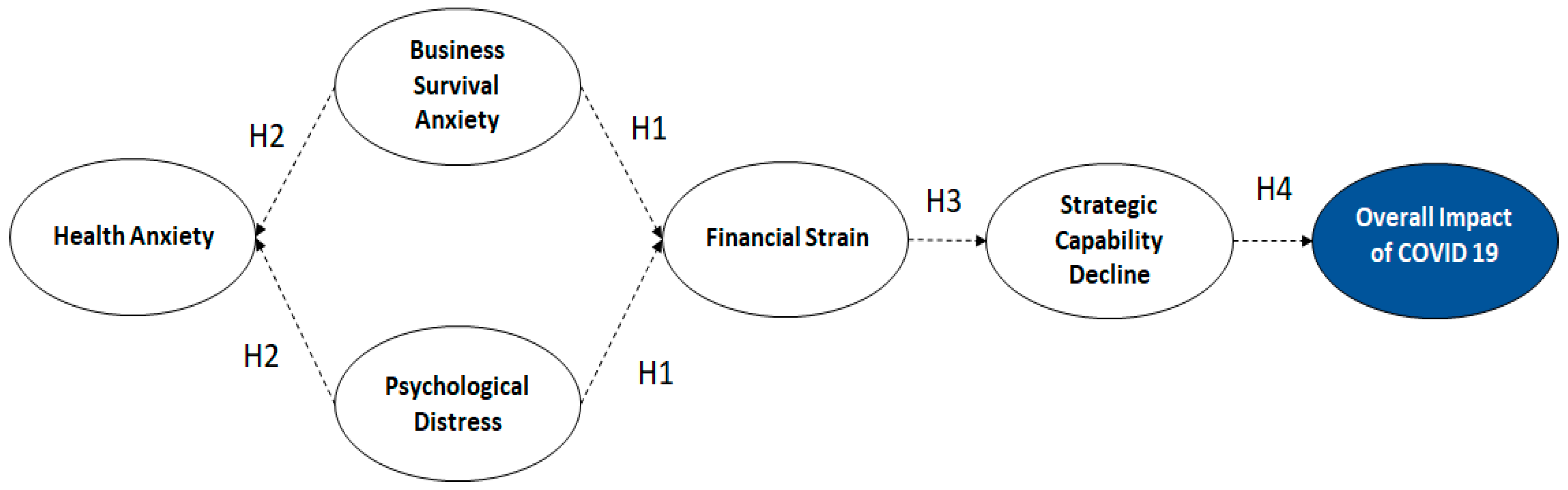
Prior research consistently demonstrates that the COVID-19 pandemic generated profound financial, organisational, and psychological disruptions across the tourism and hospitality sectors. While existing studies have extensively documented these effects, they have largely examined them in isolation. Less attention has been given to the mechanisms through which individual-level perceptions and emotional responses translate into firm-level structural consequences. To address this gap, the present study conceptualises pandemic impact as a multi-level transmission process linking managerial cognition, resource constraints, and strategic outcomes. Drawing on crisis perception theory, perceived threats during periods of extreme uncertainty shape managerial interpretations and behavioural responses. In this context, Business Survival Anxiety reflects concerns regarding the viability and continuity of the firm, while Psychological Distress captures broader emotional and cognitive strain experienced by decision-makers. These pressures are expected to influence how managers assess and manage financial resources. Consistent with conservation of resources theory, heightened anxiety and stress deplete cognitive and emotional resources, potentially impairing decision-making and intensifying perceptions of financial pressure. Therefore, it is expected that:
H1.
Business Survival Anxiety and Psychological Distress are positively associated with Financial Strain.
From a threat appraisal perspective, managers who perceive elevated business survival risk are more likely to anticipate cash shortages, postpone commitments, and interpret financial obligations as more burdensome. Under crisis conditions, perceived existential threat may therefore be associated with heightened financial strain.
In addition to financial concerns, crisis conditions also heighten perceptions of health-related risk. Psychological distress has been widely linked to increased risk sensitivity and heightened perception of threats, while survival-related concerns may amplify awareness of external uncertainties, including health risks affecting employees and operations. Within this context, Health Anxiety reflects perceived vulnerability related to personal, employee, and family health. Accordingly, it is proposed that
H2.
Business Survival Anxiety and Psychological Distress are positively associated with Health Anxiety.
In this case, Health Anxiety is conceptualised as a risk-perception response reflecting concerns about personal, family, and employee wellbeing during a pandemic. Rather than representing a direct financial mechanism, it captures the health-related uncertainty that accompanies broader psychological distress under crisis conditions. Furthermore, distress increases sensitivity to perceived health threats.
From a resource-based perspective, firm competitiveness depends on the availability and effective deployment of financial and strategic resources. Financial Strain, defined as the difficulty in meeting financial obligations and maintaining operational stability, constrains firms’ ability to invest, innovate, and expand. Reduced financial flexibility limits strategic decision-making and undermines adaptive capacity, resulting in a decline in organisational capabilities. Thus:
H3.
Financial Strain is positively associated with Strategic Capability Decline.
Finally, the extent to which firms perceive the overall impact of the pandemic is expected to depend on their ability to maintain strategic functionality. Strategic Capability Decline reflects the erosion of innovation capacity, investment potential, and market development. Rather than assessing crisis severity solely through immediate financial losses, firms evaluate impact based on the extent to which their long-term strategic position is compromised. Therefore:
H4.
Strategic Capability Decline is positively associated with the Overall Impact of COVID-19 on tourism enterprises.
Overall Impact of COVID-19 refers to the respondent’s overall managerial evaluation of the extent to which the pandemic adversely affected the firm’s performance, continuity, and strategic outlook.
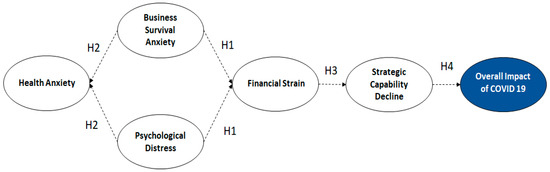
Taken together, the proposed model (see Figure 1) conceptualises pandemic impact as a sequential process in which psychological pressures are associated with financial strain, which in turn constrains strategic capability and shapes overall crisis perception. Given the cross-sectional nature of the data, these relationships are interpreted as theoretically grounded associations rather than causal effects.
Figure 1.
Conceptual framework of the study.
The proposed model is grounded in four complementary theoretical perspectives. First, crisis management theory (Dionne et al., 2018; Norris et al., 2020) views systemic shocks as events that disrupt organisational routines and require rapid strategic response. Second, threat appraisal and stress perspectives (Adamu et al., 2024; Dahmen, 2023) suggest that managers interpret crises through perceptions of risk, uncertainty, and survival threat, giving rise to psychological distress and anxiety. Third, the resource-based view (RBV) explains how financial strain constrains access to strategic resources, thereby limiting innovation, investment, and market adaptation (Agrawal et al., 2025; Mao et al., 2021). Finally, organizational resilience theory (Urick, 2021; Prayag et al., 2024) emphasizes the capacity of firms to absorb shocks, adapt operations, and preserve long-term viability. Integrating these perspectives, the present study conceptualises pandemic impact as a process linking psychological appraisal, resource pressure, and strategic capability decline. Accordingly, the hypothesised relationships reflect the interaction of cognitive, financial, and capability-based responses to crisis conditions.
3. Methods
3.1. Research Process and Sample
In the present study, a quantitative research approach was adopted, as it enables the systematic collection and statistical analysis of numerical data, facilitating the identification of relationships among variables (Malhotra & Birks, 2003, 2006). This approach is particularly suitable for the application of Structural Equation Modeling (SEM), which requires sufficiently large samples and structured measurement scales. The empirical data were collected during the first wave of the COVID-19 pandemic, between May and June 2020. The survey targeted firms operating within the Greek hospitality sector, including hotels, accommodation providers, and related tourism enterprises. Data were collected through a structured questionnaire distributed electronically via professional networks, industry contacts, and targeted outreach to tourism businesses. Each participating firm was requested to nominate one knowledgeable informant, preferably the owner or a senior manager, capable of evaluating the organisational impact of the pandemic.
A total of 320 valid responses were obtained, exceeding commonly accepted thresholds for multivariate analysis and SEM applications (Hair et al., 2017). A purposive sampling technique was employed, as the study specifically aimed to capture firms directly affected by the pandemic within the hospitality sector (Saunders et al., 2016). While this approach supports the relevance of the sample to the research objectives, it does not allow for strict statistical generalization. Therefore, the findings should be interpreted as indicative of patterns within the sector rather than fully representative of the entire Greek hospitality industry. In other words, given the study’s explanatory purpose, purposive sampling was employed to target firms directly exposed to pandemic disruption. Accordingly, the sample should not be interpreted as statistically representative of the full population of Greek hospitality firms. The sample exhibits diversity in terms of demographic and professional characteristics, including gender, age, educational level, organizational position, and work experience, thereby enhancing the robustness of the analysis (Table 1).
Table 1.
Sample characteristics.
3.2. Research Instrument
The study employed a structured questionnaire based on the instrument developed by Gavriilidis and Metaxas (2023), which itself was grounded in an extensive review of prior empirical research. Each measurement item was derived from established studies (see Appendix A), ensuring content validity. For the purposes of the present study, the instrument was carefully adapted to reflect the specific characteristics of the Greek hospitality sector and the contextual conditions of the COVID-19 pandemic. Minor wording adaptations were introduced to reflect the Greek hospitality context and pandemic-specific business conditions. The questionnaire consisted of two main sections. The first section captured firm-level impacts of the pandemic, including financial, operational, and strategic dimensions. The second section focused on individual-level effects, such as psychological distress, perceived health risks, and managerial concerns. In addition, a single-item measure was included to assess the overall perceived impact of COVID-19 on firm performance. All items were measured using a seven-point Likert scale ranging from 1 (“to a very small extent”) to 7 (“to a great extent”). A small-scale pilot test was conducted with a limited number of industry professionals to assess clarity and relevance, resulting in minor refinements to the questionnaire prior to the main survey. Prior to the main data collection, the questionnaire was reviewed for clarity and relevance by individuals familiar with the tourism sector, ensuring face validity and appropriateness of wording. The internal consistency of the constructs was assessed using Cronbach’s alpha. All values exceeded the acceptable threshold of 0.70, indicating satisfactory reliability and supporting the robustness of the measurement instrument (Hair et al., 2017).
3.3. Methods of Analysis
Data analysis was conducted using SPSS (version 25), JASP (v. 0.96), and the lavaan package in R, which is widely used for structural equation modelling (SEM) and related multivariate techniques. The empirical analysis followed a three-stage procedure. First, exploratory factor analysis (EFA) was performed to identify the underlying factor structure of the measurement items and to reduce them into meaningful latent constructs. Items with low factor loadings or cross-loadings were examined and excluded where necessary to improve construct clarity and reliability. Second, confirmatory factor analysis (CFA) was conducted to validate the measurement model derived from the EFA. Items were evaluated based on commonly accepted thresholds. In cases where loadings were marginally acceptable, items were retained based on theoretical relevance and their contribution to overall construct validity. The assessment included reliability (composite reliability), convergent validity (average variance extracted), and discriminant validity. Model fit was evaluated using multiple indices, including CFI, TLI, RMSEA, and SRMR, following established thresholds in the literature (Hu & Bentler, 1999). During this stage, one factor identified in the EFA was excluded from the final model due to insufficient psychometric properties, leading to a more parsimonious and theoretically consistent structure. In the third stage, covariance-based SEM was applied to test the hypothesised relationships among the latent constructs. Parameters were estimated using the maximum likelihood (ML) method. Given that all data were collected from a single source, potential common method bias was assessed using Harman’s single-factor test. The results indicated that no single factor accounted for the majority of the variance, suggesting that common method bias is unlikely to significantly affect the findings. Missing data were handled using listwise deletion.
4. Analysis
4.1. Exploratory Factor Analysis (EFA)
It should be noted that, given the cross-sectional nature of the data, the reported relationships should be interpreted as statistically significant associations rather than causal effects. Firstly, an exploratory factor analysis (EFA) was conducted to examine the underlying dimensional structure of the perceived impact of COVID-19 on hospitality firms. Prior to extraction, the suitability of the data for factor analysis was assessed. The Kaiser–Meyer–Olkin (KMO) measure of sampling adequacy was 0.912, indicating excellent adequacy according to conventional thresholds (Malhotra & Birks, 2003, 2006). Similarly, Bartlett’s Test of Sphericity was statistically significant at 0.000, revealing the suitability of the data for factor analysis (Saunders et al., 2016; Malhotra & Birks, 2006). The analysis yielded a six-factor solution (Table 2) with satisfactory conceptual coherence and acceptable psychometric properties. Together, the extracted factors capture distinct but interrelated dimensions of the pandemic’s impact, spanning organizational, strategic, financial, and psychological domains. Items with low loadings (approximately below 0.50), cross-loadings, or limited conceptual consistency were considered for removal during refinement. Harman’s single-factor test indicated that the first unrotated factor did not account for the majority of total variance, suggesting that common method bias is unlikely to be a serious concern.
Table 2.
Exploratory Factor Analysis Results (EFA).
EFA results reveal that the impact of COVID-19 on Greek hospitality firms extends beyond financial disruption to encompass strategic contraction, market deterioration, health-related anxiety, survival uncertainty, and significant psychological strain. These findings provide the empirical foundation for subsequent confirmatory factor analysis and structural modelling.
4.2. Confirmatory Factor Analysis (CFA)
A confirmatory factor analysis (CFA) was conducted to validate the measurement model prior to testing the structural relationships. CFA is a statistical technique used to test the hypothesized factor structure of a set of observed variables (Lance & Vandenberg, 2002). The CFA supported a five-factor structure representing Financial Strain, Strategic Capability Decline, Health Anxiety, Business Survival Anxiety, and Psychological Distress (see Table 3). Exploratory factor analysis initially yielded six factors. However, confirmatory factor analysis aimed to obtain a more parsimonious and psychometrically robust measurement structure. Constructs or items exhibiting weak standardized loadings, conceptual overlap, or limited reliability were removed, resulting in a five-construct model used in the final SEM analysis. Overall model fit was satisfactory and exceeded commonly accepted thresholds (Hair et al., 2017), indicating good correspondence between the proposed measurement structure and the observed data (CFI = 0.968; TLI = 0.959; NFI = 0.943; GFI = 0.929; RMSEA = 0.060; SRMR = 0.044). Furthermore, composite reliability (CR) in all cases was larger than 0.60, as stated by Fornell and Larcker (1981). Root mean square error of approximation (RMSEA), and standardized root mean square residual (SRMR) were less than 0.08 in both cases (0.060 and 0.044, respectively), following the criteria mentioned by Hooper et al. (2008). In the same length, convergent validity was established since average variance extracted (AVE) was greater than 0.5. Standardized loadings were strong across constructs, providing also evidence of convergent validity. Discriminant validity was also ensured since the roots of AVE were greater than the correlations among dimensions (Table 4).
Table 3.
CFA Results.
Table 4.
Discriminant validity.
CFA results provide strong evidence that the measurement model demonstrates good fit, high reliability, and satisfactory convergent validity across all constructs. This supports the adequacy of the measurement instrument and provides a sound basis for proceeding to the structural model estimation (SEM).
4.3. Structural Equation Modeling (SEM) Analysis
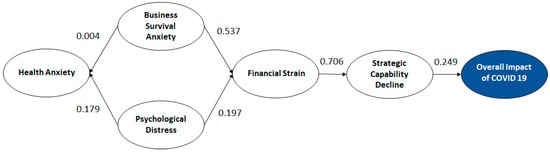
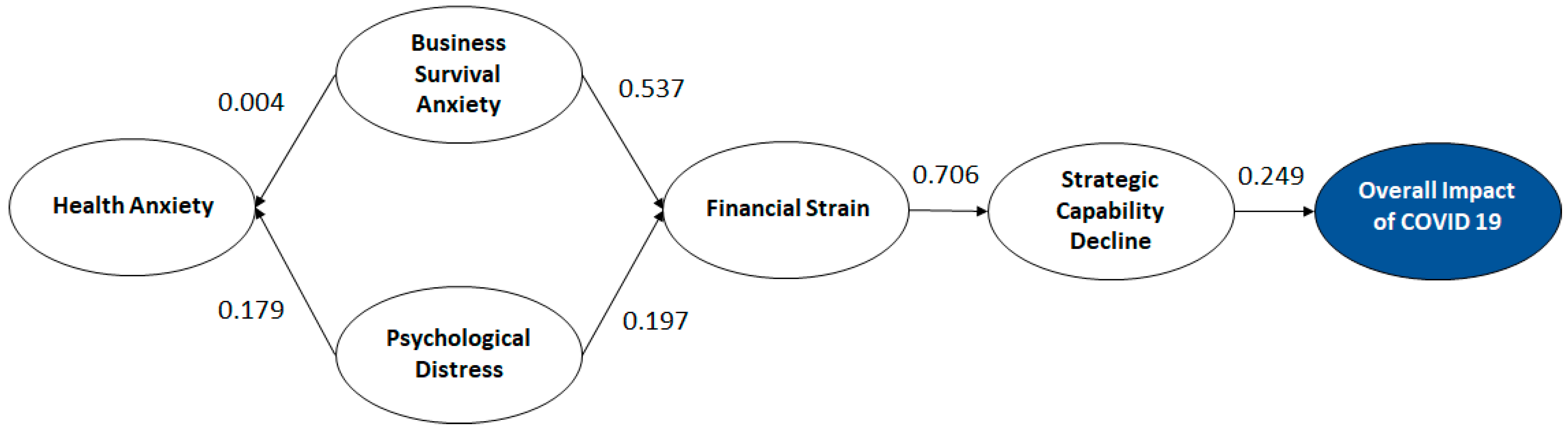
Following confirmation of the measurement model, the structural relationships among the latent constructs were examined using structural equation modelling (SEM). The structural model demonstrated satisfactory fit to the data, indicating that the proposed theoretical framework adequately captures the interrelationships among personal-level and firm-level impacts of COVID-19. Model fit indices met recommended thresholds (CFI = 0.961; TLI = 0.953; NFI = 0.932; GFI = 0.992; RMSEA = 0.061; SRMR = 0.056), supporting the overall adequacy of the structural specification (see Table 5 and Figure 2).
Table 5.
SEM Results (Hypotheses testing).
Figure 2.
Structural Model Results. CFI = 0.961, TLI = 0.953, NFI = 0.932, GFI = 0.992, RMSEA = 0.061, SRMR = 0.056. Statistically significant association  .
.
.
Firstly, the results indicate that both Business Survival Anxiety (β = 0.537, p < 0.001) and Psychological Distress (β = 0.197, p < 0.001) exert significant positive associations with Financial Strain, supporting H1. Business Survival Anxiety demonstrates a particularly strong relationship, suggesting that perceived threats to business viability are directly translated into heightened perceptions of liquidity pressure and operational financial difficulty. Psychological Distress also contributes, though to a lesser extent, indicating that emotional and cognitive strain among hospitality professionals may exacerbate financial vulnerability perceptions. Additionally, Psychological Distress significantly predicts Health Anxiety (β = 0.179, p < 0.001), whereas the effect of Business Survival Anxiety is negligible (β = 0.004). Despite statistical significance reported for the overall relationship, the substantive contribution appears primarily driven by psychological distress rather than survival-related anxiety. This suggests that emotional strain heightens perceived health vulnerability, reinforcing the interdependence between psychological and health-related concerns during crisis conditions.
Financial Strain exhibits a strong positive relationship with Strategic Capability Decline (β = 0.706, p < 0.001), confirming H3. This represents one of the most substantial relationships in the model. The result indicates that liquidity pressures and difficulty meeting financial obligations significantly constrain firms’ ability to innovate, invest, enter new markets, and maintain strategic flexibility. Financial instability thus emerges as a central mechanism through which the pandemic undermined long-term organisational adaptability. Finally, Strategic Capability Decline significantly predicts the Overall Impact of COVID-19 on Tourism Enterprises (β = 0.249, p < 0.001), supporting H4. Although the magnitude of the effect is moderate compared to earlier links in the model, it confirms that reductions in innovation capacity, expansion potential, and strategic agility play a decisive role in shaping the perceived overall severity of the pandemic’s impact.
The model therefore supports a mediated crisis mechanism in which psychological and survival-related anxieties indirectly influence firm-level outcomes through financial pressures and strategic contraction. Financial Strain emerges as the most influential mediating construct within the system, functioning as the critical transmission channel between individual-level stress and organisational-level impact. Although the proposed model is theoretically grounded, the findings should be interpreted with caution regarding directionality, and future longitudinal research is required to confirm causal relationships.
5. Discussion
The present study sought to examine the multidimensional impact of the COVID-19 pandemic on hospitality firms in Greece by integrating personal-level and firm-level consequences within a unified structural framework. One of the central findings of the study is the strong effect of Business Survival Anxiety and Psychological Distress on Financial Strain. This supports the argument that crises such as COVID-19 do not operate solely through objective market forces but are mediated through managerial perceptions and emotional responses. The strong association between survival-related anxiety and financial strain aligns with prior research documenting heightened uncertainty and existential threat among tourism SMEs (Eppang et al., 2021; Karunarathne et al., 2021). However, the present study advances this literature by empirically demonstrating how perceived survival threat becomes embedded within organisational financial processes. The effect of psychological distress on financial strain further suggests that cognitive and emotional overload may impair managerial judgment and adaptive decision-making. This finding resonates with studies highlighting emotional fatigue and stress among tourism professionals during the pandemic (Sigala, 2020; Yin & Ni, 2021), yet extends them by linking psychological burden directly to financial vulnerability at the firm level.
Financial Strain emerged as the most influential mediating construct in the structural model. Its strong effect on Strategic Capability Decline (β = 0.706) underscores the centrality of liquidity pressure in shaping organisational outcomes. This finding corroborates macro-level evidence indicating severe revenue losses and liquidity constraints across tourism sectors globally (Kitamura et al., 2020; Vayá et al., 2024). However, whereas prior studies primarily document aggregate financial losses, the present research demonstrates how financial strain constrains strategic flexibility at the firm level. In particular, the inability to complete investment programs, enter new markets, or develop new products reflects a contraction in strategic horizon and adaptive capacity. This aligns with the resilience literature suggesting that financial stability is a prerequisite for innovation and strategic renewal during crises (Drammeh, 2024). The Greek hospitality context thus mirrors international patterns, confirming that liquidity shortages impede not only short-term operations but also long-term competitiveness.
The finding that Strategic Capability Decline significantly predicts the overall perceived impact of COVID-19 indicates that firms interpret crisis severity not merely in financial terms, but in terms of lost future opportunity. This insight adds nuance to existing research, which often frames pandemic impact primarily through revenue or employment losses (Pati et al., 2022; Huang et al., 2020). In the Greek hospitality sector, the perceived depth of the crisis appears to be closely tied to diminished innovation capacity, expansion potential, and organisational adaptability. This suggests that the long-term strategic consequences of COVID-19 may outweigh its immediate financial effects in shaping managerial assessments of impact.
The relationship between Psychological Distress and Health Anxiety further confirms the interconnected nature of emotional and health-related concerns during pandemics. This is consistent with prior studies highlighting heightened risk perception and fear of contagion among tourism professionals and travelers (Tsvetkova et al., 2023; Jeczmyk et al., 2023). However, the negligible substantive effect of Business Survival Anxiety on Health Anxiety suggests that health-related fear operates somewhat independently from economic survival concerns. This distinction is theoretically important, as it indicates that while economic anxiety drives financial and strategic outcomes, health-related fear may function more as a psychological stressor than a direct organisational determinant.
Overall, the results suggest that the pandemic’s impact on hospitality firms in Greece should not be understood as a simple financial shock. Rather, it represents a cascading process beginning with psychological and survival-related anxiety, escalating into financial pressure, and culminating in strategic contraction. This layered mechanism reinforces the view that tourism crises are systemic phenomena requiring integrated managerial and policy responses that address both economic and human dimensions. In this context, the current study contributes to the growing body of international research on tourism resilience and crisis transmission mechanisms. Therefore, these findings may extend beyond the Greek context, particularly in tourism-dependent economies where firm-level vulnerability to external shocks is pronounced.
6. Theoretical Implications
This study advances tourism crisis scholarship by conceptualising pandemic impact as a multi-level transmission process linking managerial cognition to organisational outcomes. While prior research has predominantly focused on macro-level effects such as revenue loss, employment decline, and demand contraction (Assaf & Scuderi, 2020; Hao et al., 2020), as well as firm-level disruptions in isolation (Sigala, 2020), limited attention has been given to the internal mechanisms through which crisis pressures unfold within organisations. By modelling the sequential associations among survival anxiety, financial strain, and strategic capability decline, the present study shifts the analytical focus from outcomes to processes, offering a structured explanation of how crisis effects are transmitted across organisational levels. The findings contribute to crisis perception theory by empirically illustrating that perceived survival threat operates as an antecedent of organisational strain rather than merely a psychological outcome of crisis conditions. While previous studies have documented heightened uncertainty and anxiety among tourism professionals (Yin & Ni, 2021; Sigala, 2020), they have not explicitly linked these perceptions to firm-level financial constraints. The present study addresses this gap by demonstrating that Business Survival Anxiety is positively associated with Financial Strain, suggesting that managerial interpretations of existential risk are embedded in organisational resource dynamics.
In addition, the study refines tourism resilience theory by identifying financial strain as a central mechanism through which crisis pressures are associated with reduced adaptive capacity. Existing resilience literature emphasises flexibility, innovation, and recovery capabilities (Drammeh, 2024), yet often treats these as managerial or strategic attributes. The present findings suggest that such capabilities are contingent upon financial conditions, as liquidity constraints are associated with Strategic Capability Decline. This highlights the structural limits of resilience and reinforces resource-based and conservation-of-resources perspectives, according to which resource depletion constrains organisational response to external shocks. Furthermore, by linking Psychological Distress to both financial and strategic outcomes, the study contributes to organisational behaviour research in tourism by integrating emotional and structural dimensions of crisis impact. While prior studies have examined stress, burnout, and emotional fatigue in tourism contexts (Sigala, 2020), they have rarely connected these factors to organisational performance mechanisms. The findings suggest that psychological strain is not only an individual-level outcome but is associated with broader organisational constraints, thereby bridging micro-level and firm-level perspectives.
Finally, the differentiation between economic survival anxiety and health-related anxiety contributes to risk perception literature by clarifying distinct pathways of uncertainty. While prior research has highlighted heightened health-related risk perception during pandemics (Jeczmyk et al., 2023; Tsvetkova et al., 2023), the present study indicates that economic anxiety is more directly associated with organisational outcomes, whereas health anxiety operates primarily within the psychological domain. By providing firm-level evidence from a tourism-dependent economy, the study complements macro-level analyses and offers a micro-foundational perspective on how crisis effects propagate within tourism enterprises.
Overall, the key theoretical contribution of the study lies in reframing tourism crises not only as external demand or revenue shocks, but as internally transmitted organisational processes unfolding through cognitive, financial, and strategic layers.
7. Managerial Implications
The findings suggest that crisis impact within hospitality firms unfolds through interconnected psychological, financial, and strategic mechanisms, requiring coordinated managerial responses. At the organisational level, managers should treat survival anxiety and psychological distress as operational risk factors rather than purely individual reactions. Establishing regular internal briefings, clear role definitions, and structured decision-making protocols can help reduce uncertainty and prevent emotional pressure from affecting financial judgment. In addition, providing targeted support mechanisms—such as managerial coaching or workload redistribution—may help mitigate the cognitive overload observed during crisis conditions. Given the central role of financial strain, liquidity management should be approached proactively and strategically. Managers are advised to implement short-term cash flow monitoring systems, scenario-based financial planning (e.g., best-case and worst-case demand scenarios), and cost flexibility measures such as variable staffing arrangements or renegotiation of supplier contracts. At the same time, indiscriminate cost-cutting should be avoided. The findings indicate that eliminating investment in innovation, digital tools, or market development may weaken strategic capacity and limit recovery potential.
Finally, maintaining strategic capability under constraint emerges as a key determinant of how firms experience crisis impact. Managers should prioritise actions that preserve organisational adaptability, including the adoption of digital service delivery channels, diversification into new customer segments (e.g., domestic tourism), and continuous employee upskilling. From a policy perspective, these findings suggest that support measures should extend beyond short-term financial relief to include targeted programs that enhance firms’ innovation capacity, digital readiness, and strategic flexibility. Such interventions can strengthen the long-term resilience of the hospitality sector by enabling firms to sustain adaptive capacity under conditions of prolonged uncertainty.
8. Limitations and Future Research
This study should be interpreted in light of several limitations. First, the empirical analysis is confined to hospitality firms operating in Greece. While this context provides meaningful depth within a tourism-dependent economy, institutional and cultural factors may shape how crisis pressures unfold. Future cross-country research could examine whether the transmission mechanism identified here remains stable across different regulatory and economic environments. Therefore, while the study focuses on Greece, the proposed framework may be applicable to other tourism-dependent economies with similar structural characteristics, although contextual differences should be considered. Second, the cross-sectional design captures perceptions at a specific post-pandemic stage, limiting causal inference and dynamic interpretation. Longitudinal studies would allow for examination of how survival anxiety, financial strain, and strategic capability evolve over time, particularly as market conditions stabilize (Mandić et al., 2024). Additionally, longitudinal designs would allow for a more precise examination of potential causal pathways. Third, the reliance on self-reported data may introduce perceptual bias and common method variance, as all constructs were measured using a single survey instrument. Although a Harman’s single-factor test suggests that common method bias is unlikely to substantially affect the results, the use of subjective assessments remains a limitation. Future research could enhance robustness and external validity by integrating objective performance indicators (e.g., revenue change, occupancy rates) or archival financial data, thereby enabling data triangulation and reducing potential measurement bias. Finally, further extensions of the model could incorporate moderating and protective factors such as firm size, governance structure, digital readiness, entrepreneurial orientation, or network embeddedness. Examining how these variables buffer the relationship between financial strain and strategic capability decline would enhance theoretical understanding of organisational resilience under systemic shocks.
9. Conclusions
This study examined how the COVID-19 pandemic affected hospitality firms in Greece by modelling the internal mechanisms through which crisis pressures unfold. Rather than treating the pandemic as a purely economic shock, the findings demonstrate that its impact operates as a cascading process linking personal-level anxieties to financial strain and, subsequently, to strategic capability decline and overall perceived severity. The results reveal a structured transmission pathway: Business Survival Anxiety and Psychological Distress intensify Financial Strain; financial pressure constrains Strategic Capability; and diminished strategic flexibility shapes firms’ evaluation of the crisis’s overall impact. Financial Strain emerges as the central mediating mechanism, bridging managerial perceptions and organisational outcomes. These findings confirm that crisis impact is embedded in firm-level dynamics, where psychological pressures, resource constraints, and strategic contraction interact systematically. Ultimately, the study shows that the severity of the pandemic was not assessed solely in terms of immediate revenue loss, but in relation to the erosion of strategic capacity—innovation, investment potential, and long-term competitiveness. Resilience in tourism therefore depends on the alignment between psychological stability, financial robustness, and strategic adaptability. By conceptualizing pandemic impact as an integrated, multi-level process, this research provides a structured foundation for understanding how systemic shocks influence hospitality enterprises under conditions of prolonged uncertainty.
Author Contributions
Conceptualization, A.P. and T.M.; methodology, A.P. and G.G.; validation, A.P. and G.G.; investigation, A.P. and T.M.; data curation, G.G.; writing—original draft preparation, A.P., G.G. and T.M.; writing—review and editing, A.P., G.G. and T.M.; supervision, T.M.; project administration, T.M. All authors have read and agreed to the published version of the manuscript.
Funding
This research received no external funding.
Institutional Review Board Statement
Ethical review and approval were waived for this study due to get an exemption from the Ethics Committee for Research, University of Thessaly.
Informed Consent Statement
Informed consent was obtained from all subjects involved in the study.
Data Availability Statement
The original contributions presented in this study are included in the article. Further inquiries can be directed to the corresponding author.
Acknowledgments
During the preparation of this work, the authors used ChatGPT 5 in order to improve the readability and language of the manuscript. After using this tool, the author reviewed and edited the content as needed and takes full responsibility for the content of the published article.
Conflicts of Interest
The authors declare no conflicts of interest.
Appendix A
Table A1.
Items of the questionnaire.
References
- Abebe, G., Bundervoet, T., & Wieser, C. (2020). Monitoring COVID-19 impacts on firms in Ethiopia: Results from a high-frequency phone survey of firms (World Bank Report). World Bank. [Google Scholar]
- Adamu, A. A., Raza, S. H., & Mohamad, B. (2024). Organizational resilience: Unveiling the role of strategic internal crisis management on employee sensemaking and sensegiving. International Journal of Productivity and Performance Management, 73(7), 2068–2091. [Google Scholar] [CrossRef] [Scilit]
- Agrawal, R., Samadhiya, A., Banaitis, A., & Kumar, A. (2025). Entrepreneurial barriers in achieving sustainable business and cultivation of innovation: A resource-based view theory perspective. Management Decision, 63(4), 1207–1228. [Google Scholar] [CrossRef] [Scilit]
- Aliperti, G., Sandholz, S., Hagenlocher, M., Rizzi, F., Frey, M., & Garschagen, M. (2019). Tourism, crisis, disaster: An interdisciplinary approach. Annals of Tourism Research, 79, 102808. [Google Scholar] [CrossRef] [Scilit]
- Assaf, A., & Scuderi, R. (2020). COVID-19 and the recovery of the tourism industry. Tourism Economics, 26(5), 731–733. [Google Scholar] [CrossRef] [Scilit]
- Bakar, N. A., Rosbi, S., & Uzaki, K. (2022). Impact of coronavirus disease (COVID-19) towards hotel tourism industry. International Journal of Advanced Engineering Research and Science (IJAERS), 9(3), 43–50. [Google Scholar] [CrossRef] [Scilit]
- Bas, T., & Sivaprasad, S. (2020). The impact of the COVID-19 pandemic crisis on the travel and tourism sector: UK evidence. Available online: https://papers.ssrn.com/sol3/papers.cfm?abstract_id=3623404 (accessed on 18 January 2026).
- Baum, T., & Hai, N. T. T. (2020). Hospitality, tourism, human rights and the impact of COVID-19. International Journal of Contemporary Hospitality Management, 32(7), 2397–2407. [Google Scholar] [CrossRef] [Scilit]
- Baum, T., Mooney, S. K., Robinson, R. N., & Solnet, D. (2020). COVID-19’s impact on the hospitality workforce—New crisis or amplification of the norm? International Journal of Contemporary Hospitality Management, 32(9), 2813–2829. [Google Scholar] [CrossRef] [Scilit]
- Chen, S., Law, R., & Zhang, M. (2021). Review of research on tourism-related diseases. Asia Pacific Journal of Tourism Research, 26(1), 44–58. [Google Scholar] [CrossRef] [Scilit]
- Cheng, J., & Zetina, Z. (2021). A study to investigate the impact of the COVID-19 pandemic on tourist arrivals in Belize. Open Journal of Social Sciences, 9, 326–334. [Google Scholar]
- Dahmen, P. (2023). Organizational resilience as a key property of enterprise risk management in response to novel and severe crisis events. Risk Management and Insurance Review, 26(2), 203–245. [Google Scholar] [CrossRef] [Scilit]
- Dionne, S. D., Gooty, J., Yammarino, F. J., & Sayama, H. (2018). Decision making in crisis: A multilevel model of the interplay between cognitions and emotions. Organizational Psychology Review, 8(2–3), 95–124. [Google Scholar] [CrossRef] [Scilit]
- Drammeh, F. Y. (2024). Managing tourism during the COVID-19 pandemic. A systematic review of crisis management in the tourism industry. Cogent Social Sciences, 10(1), 2311955. [Google Scholar] [CrossRef] [Scilit]
- Efthimiou, S. G. (2025). The trends of tourism sector after COVID-19 period: A study of strategy and implications. Corporate & Business Strategy Review, 6(1), 119–133. [Google Scholar]
- Eppang, B. M., Som, A. P. M., Azinuddin, M., Rijal, S., & Ridwan, M. (2021). The impacts of the COVID-19 pandemic on the tourism economy in South Sulawesi, Indonesia. Psychology and Education Journal, 58(2), 2613–2624. [Google Scholar]
- Farmaki, A., Miguel, C., Drotarova, M. H., Aleksić, A., Časni, A. Č., & Efthymiadou, F. (2020). Impacts of COVID-19 on peer-to-peer accommodation platforms: Host perceptions and responses. International Journal of Hospitality Management, 91, 102663. [Google Scholar] [CrossRef] [Scilit]
- Faulkner, B. (2001). Towards a framework for tourism disaster management. Tourism Management, 22, 135–147. [Google Scholar] [CrossRef] [Scilit]
- Fornell, C., & Larcker, D. F. (1981). Evaluating structural equation models with unobservable variables and measurement error. Journal of Marketing Research, 18(1), 39–50. [Google Scholar] [CrossRef] [Scilit]
- Gavriilidis, G., & Metaxas, T. (2023). Measuring the impact of COVID-19 on tourism entrepreneurs and businesses in Greece: Some empirical evidence. The Journal of Developing Areas, 57(3), 293–314. [Google Scholar] [CrossRef] [Scilit]
- Gavriilidis, G., & Metaxas, T. (2024). The impact of COVID-19 on attitudes towards growth capacity of tourism firms: Evidence from Greece. Sustainability, 16(6), 2371. [Google Scholar] [CrossRef] [Scilit]
- Gössling, S., Scott, D., & Hall, C. M. (2020). Pandemics, tourism and global change: A rapid assessment of COVID-19. Journal of Sustainable Tourism, 29, 1–20. [Google Scholar] [CrossRef] [Scilit]
- Hair, J. F., Jr., Matthews, L. M., Matthews, R. L., & Sarstedt, M. (2017). PLS-SEM or CB-SEM: Updated guidelines on which method to use. International Journal of Multivariate Data Analysis, 1(2), 107–123. [Google Scholar] [CrossRef] [Scilit]
- Hall, C. M., Scott, D., & Gössling, S. (2020). Pandemics, transformations and tourism: Be careful what you wish for. Tourism Geographies, 22(3), 577–598. [Google Scholar] [CrossRef] [Scilit]
- Hao, F., Xiao, Q., & Chon, K. (2020). COVID-19 and China’s hotel industry: Impacts, a disaster management framework, and post-pandemic agenda. International Journal of Hospitality Management, 90, 102636. [Google Scholar] [CrossRef] [Scilit] [PubMed]
- Hooper, D., Coughlan, J., & Mullen, M. (2008). Evaluating model fit: A synthesis of the structural equation modelling literature. In 7th European conference on research methodology for business and management studies (Vol. 2008, No. 2, pp. 195–200). Academic Conferences Limited. [Google Scholar]
- Hu, L. T., & Bentler, P. M. (1999). Cutoff criteria for fit indexes in covariance structure analysis: Conventional criteria versus new alternatives. Structural Equation Modeling: A Multidisciplinary Journal, 6(1), 1–55. [Google Scholar] [CrossRef] [Scilit]
- Huang, A., Makridis, C., Baker, M., Medeiros, M., & Guo, Z. (2020). Understanding the impact of COVID-19 intervention policies on the hospitality labor market. International Journal of Hospitality Management, 91, 102660. [Google Scholar] [CrossRef] [Scilit] [PubMed]
- Ioannides, D., & Gyimóthy, S. (2020). The COVID-19 crisis as an opportunity for escaping the unsustainable global tourism path. Tourism Geographies, 22(3), 624–632. [Google Scholar] [CrossRef] [Scilit]
- Jamison, D. T., Gelband, H., Horton, S., Jha, P., Laxminarayan, R., Mock, C. N., & Nugent, R. (Eds.). (2017). Disease control priorities: Improving health and reducing poverty (3rd ed.). The International Bank for Reconstruction and Development/The World Bank. [Google Scholar]
- Jeczmyk, A., Uglis, J., Zawadka, J., Pietrzak-Zawadka, J., Wojcieszak-Zbierska, M. M., & Kozera-Kowalska, M. (2023). Impact of COVID-19 pandemic on tourist travel risk perception and travel behaviour: A Case study of Poland. International Journal of Environmental Research and Public Health, 20(8), 5545. [Google Scholar] [CrossRef] [Scilit]
- Karunarathne, A. C. I. D., Ranasinghe, J. P. R. C., Sammani, U. G. O., & Perera, K. J. T. (2021). Impact of the COVID-19 pandemic on tourism operations and resilience: Stakeholders’ perspective in Sri Lanka. Worldwide Hospitality and Tourism Themes, 13(3), 369–382. [Google Scholar] [CrossRef] [Scilit]
- Kasiola, A., & Metaxas, T. (2023). Studying COVID-19 impacts on culture: The case of public museums in Greece. Heritage, 6, 4671–4691. [Google Scholar] [CrossRef] [Scilit]
- Kitamura, Y., Karkour, S., Ichisugi, Y., & Itsubo, N. (2020). Evaluation of the economic, environmental, and social impacts of the COVID-19 pandemic on the Japanese tourism industry. Sustainability, 12(24), 10302. [Google Scholar] [CrossRef] [Scilit]
- Kristiana, Y., Pramono, R., & Brian, R. (2021). Adaptation strategy of tourism industry stakeholders during the COVID-19 pandemic: A case study in Indonesia. The Journal of Asian Finance, Economics and Business, 8(4), 213–223. [Google Scholar]
- Lance, C. E., & Vandenberg, R. J. (2002). Confirmatory factor analysis. In F. Drasgow, & N. Schmitt (Eds.), Measuring and analyzing behavior in organizations: Advances in measurement and data analysis (pp. 221–254). Wiley. [Google Scholar]
- Liu, B., Pennington-Gray, L., & Krieger, J. (2016). Tourism crisis management: Can the extended parallel process model be used to understand crisis responses in the cruise industry? Tourism Management, 55, 310–321. [Google Scholar] [CrossRef] [Scilit]
- Malhotra, N., & Birks, D. (2003). Marketing research: An applied approach (2nd European ed.). Pearson Education. [Google Scholar]
- Malhotra, N., & Birks, D. (2006). Marketing research: An applied approach (3rd European ed.). Pearson Education. [Google Scholar]
- Mandić, A., Walia, S. K., & Rasoolimanesh, S. M. (2024). Gen Z and the flight shame movement: Examining the intersection of emotions, biospheric values, and environmental travel behaviour in an Eastern society. Journal of Sustainable Tourism, 32(8), 1621–1643. [Google Scholar]
- Mao, Y., He, J., Morrison, A. M., & Andres Coca-Stefaniak, J. (2021). Effects of tourism CSR on employee psychological capital in the COVID-19 crisis: From the perspective of conservation of resources theory. Current Issues in Tourism, 24(19), 2716–2734. [Google Scholar]
- Nicola, M., Alsafi, Z., Sohrabi, C., Kerwan, A., Al-Jabir, A., Iosifidis, C., Agha, M., & Agha, R. (2020). The socio-economic implications of the coronavirus pandemic (COVID-19): A review. International Journal of Surgery (London, England), 78, 185–193. [Google Scholar] [CrossRef] [Scilit]
- Norris, J. I., Casa de Calvo, M. P., & Mather, R. D. (2020). Managing an existential threat: How a global crisis contaminates organizational decision-making. Management Decision, 58(10), 2117–2138. [Google Scholar] [CrossRef] [Scilit]
- Papanikos, G. T. (2022). The impact of the COVID-19 pandemic on Greek tourism-updates and comparisons. Athens Journal of Tourism, 9(1), 51–62. [Google Scholar] [CrossRef] [Scilit]
- Parks, T., Chatsuwan, M., & Pillai, S. (2020). Enduring the pandemic: Surveys of the impact of COVID-19 on the livelihoods of Thai people. The Asia Foundation. Available online: https://asiafoundation.org/wp-content/uploads/2020/09/Enduring-the-Pandemic-Covid-19-Impact-on-Thailand-Livlihoods-Sept-2020.pdf (accessed on 18 January 2026).
- Pathak, D., & Joshi, G. (2021). Impact of psychological capital and life satisfaction on organizational resilience during COVID-19: Indian tourism insights. Current Issues in Tourism, 24(17), 2398–2415. [Google Scholar] [CrossRef] [Scilit]
- Pati, M. R., Mohanty, J., & Agasty, M. P. (2022). Exploring the impact of COVID-19 on travel and tourism sector. IOSR Journal of Economics and Finance (IOSR-JEF), 13(6), 51–56. [Google Scholar]
- Pforr, C., & Hosie, P. J. (2008). Crisis management in tourism: Preparing for recovery. Journal of Travel & Tourism Marketing, 23(2–4), 249–264. [Google Scholar]
- Prayag, G., Jiang, Y., Chowdhury, M., Hossain, M. I., & Akter, N. (2024). Building dynamic capabilities and organizational resilience in tourism firms during COVID-19: A staged approach. Journal of Travel Research, 63(3), 713–740. [Google Scholar] [CrossRef] [Scilit]
- Prideaux, B., Laws, E., & Faulkner, B. (2003). Events in Indonesia: Exploring the limits to formal tourism trends forecasting methods in complex crisis situations. Tourism Management, 24(4), 475–487. [Google Scholar] [CrossRef] [Scilit]
- Qiu, W., Rutherford, S., Mao, A., & Chu, C. (2016). The pandemic and its impacts. Health, Culture and Society, 9–10. [Google Scholar] [CrossRef] [Scilit]
- Ritchie, B. W. (2004). Chaos, crises and disasters: A strategic approach to crisis management in the tourism industry. Tourism Management, 25(6), 669–683. [Google Scholar] [CrossRef] [Scilit]
- Ritchie, B. W., Dorrell, H., Miller, D., & Miller, G. A. (2004). Crisis communication and recovery for the tourism industry: Lessons from the 2001 foot and mouth disease outbreak in the United Kingdom. Journal of Travel & Tourism Marketing, 15(2–3), 199–216. [Google Scholar] [CrossRef] [Scilit]
- Saunders, M., Lewis, P., & Thornhill, A. (2016). Research methods for business students. Pearson. [Google Scholar]
- Sharma, A., & Nicolau, J. L. (2020). An open market valuation of the effects of COVID-19 on the travel and tourism industry. Annals of Tourism Research, 83, 102990. [Google Scholar] [CrossRef] [Scilit]
- Shen, H., Fu, M., Pan, H., Yu, Z., & Chen, Y. (2020). The impact of the COVID-19 pandemic on firm performance. Emerging Markets Finance and Trade, 56(10), 2213–2230. [Google Scholar] [CrossRef] [Scilit]
- Sigala, M. (2020). Tourism and COVID-19: Impacts and implications for advancing and resetting industry and research. Journal of Business Research, 117, 312–321. [Google Scholar] [CrossRef] [Scilit] [PubMed]
- Tsvetkova, L., Voropaeva, L., Beliakova, M., Yurieva, T., & Loktionova, Y. (2023). Navigating the new normal: The impact of COVID-19 on China’s tourism industry. International Journal of Sustainable Development and Planning, 18(10), 3097–3105. [Google Scholar] [CrossRef] [Scilit]
- Urick, M. J. (2021). Adaptability, resilience, and responding to crisis. In A manager’s guide to using the force: Leadership lessons from a galaxy far far away (pp. 79–86). Emerald Publishing Limited. [Google Scholar]
- Van Huynh, D., Truong, T. T. K., Duong, L. H., Nguyen, N. T., Dao, G. V. H., & Dao, C. N. (2021). The COVID-19 pandemic and its impacts on tourism business in a developing city: Insight from Vietnam. Economies, 9(4), 172. [Google Scholar] [CrossRef] [Scilit]
- Varzakas, I. P., & Metaxas, T. (2024). Pandemic and economy: An econometric analysis investigating the impact of COVID-19 on the global tourism market. Tourism and Hospitality, 5, 290–303. [Google Scholar] [CrossRef] [Scilit]
- Vayá, E., Garcia, J. R., Suriñach, J., & Pons, E. (2024). Effects of the COVID-19 tourism crisis on the Spanish economy. Tourism Economics, 30(4), 1021–1038. [Google Scholar] [CrossRef] [Scilit]
- Xiang, S., Rasool, S., Hang, Y., Javid, K., Javed, T., & Artene, A. E. (2021). The effect of COVID-19 pandemic on service sector sustainability and growth. Frontiers in Psychology, 12, 633597. [Google Scholar] [CrossRef] [Scilit]
- Xiong, H., Wu, Z., Hou, F., & Zhang, J. (2020). Which firm-specific characteristics affect the market reaction of Chinese listed companies to the COVID-19 pandemic? Emerging Markets Finance and Trade, 56(10), 2231–2242. [Google Scholar] [CrossRef] [Scilit]
- Yan, R. (2023). The analysis of the impact of COVID-19 on China’s tourism industry. In Proceedings of the 2nd international conference on business and policy studies. EWA Publishing. [Google Scholar] [CrossRef] [Scilit]
- Yin, J., & Ni, Y. (2021). COVID-19 event strength, psychological safety, and avoidance coping behaviors for employees in the tourism industry. Journal of Hospitality and Tourism Management, 47, 431–442. [Google Scholar] [CrossRef] [Scilit]
- Yozcu, O. K., & Cetin, G. (2019). A strategic approach to managing risk and crisis at tourist destinations. In N. Kozak, & M. Kozak (Eds.), Tourist destination management (pp. 273–287). Springer. [Google Scholar]

Disclaimer/Publisher’s Note: The statements, opinions and data contained in all publications are solely those of the individual author(s) and contributor(s) and not of MDPI and/or the editor(s). MDPI and/or the editor(s) disclaim responsibility for any injury to people or property resulting from any ideas, methods, instructions or products referred to in the content. |
© 2026 by the authors. Licensee MDPI, Basel, Switzerland. This article is an open access article distributed under the terms and conditions of the Creative Commons Attribution (CC BY) license.