
Article

Impact of Industry 4.0 Technologies on Employee-Centered Social Performance During Supply Chain Disruptions in the Hotel Industry

Division of Business and Hospitality Management, School of Professional Education and Executive Development, The Hong Kong Polytechnic University, Hong Kong
*
Author to whom correspondence should be addressed.
Tour. Hosp. 2026, 7(4), 102; https://doi.org/10.3390/tourhosp7040102
Submission received: 2 March 2026 / Revised: 31 March 2026 / Accepted: 2 April 2026 / Published: 5 April 2026

Abstract

This study examines how Industry 4.0 technology (I4T) impacts supply chain resilience (SCR) and employee-centered social performance (ESP) in hotels. It also explores SCR’s mediating effect and how hotel managers’ I4T knowledge moderates these relationships. Moreover, this work is grounded in the dynamic capabilities view (DCV) theory. The empirical analysis employed a quantitative survey methodology and utilized partial least squares structural equation modeling for data analysis. The results from a survey of 108 hotel managers in Hong Kong indicate that I4T adoption positively and significantly influences SCR and ESP. Additionally, SCR significantly affects ESP and mediates the relationship between I4T adoption and ESP. Meanwhile, hotel managers’ knowledge of I4T (well-informed vs. limited knowledge) has moderating effects on the relationships among I4T adoption, SCR, and ESP. This knowledge pushed up the impact of I4T adoption on ESP and SCR of hotels. These results provide valuable insights into I4T adoption in the hotel industry and its role in SCR and eventually ESP.

1. Introduction

Researchers have highlighted the significance of examining supply chain resilience (SCR) and sustainability, stressing the connection between the two, especially amid disruptions (Negri et al., 2021). The evaluation of social sustainability is effectively conducted through an analysis of social performance (SP), which serves as an imperative source of competitive advantage according to the resource-based view (Boruchowitch & Fritz, 2022). SP refers to a business’s approach to social responsibility, including its guiding principles, responsive actions, and policies, along with the programs and results related to its relationships (Wood, 1991). SP in organizations typically includes addressing employee needs, engaging with communities, and reporting to shareholders and stakeholders (Chen & Delmas, 2011).
Emphatically, employee-centered social performance (ESP) is a significant component of an organization’s overall SP. Employees, particularly those in the hotel industry, represent key stakeholders within organizations. Hotel staff are instrumental in delivering services and providing critical information to address guests’ needs. A hotel’s success and failure ultimately depend on them, given that employees are the greatest treasured resources in every hotel. Therefore, hotel employees’ social needs and well-being are of paramount importance.
Technology adoption has been a constantly important issue for the hotel industry. Following the first three industrial revolutions, the Fourth Industrial Revolution—Industry 4.0—represents a business environment where human and machine systems are connected through advanced or Industry 4.0 technology (I4T). I4T is characterized by technological innovations, such as artificial intelligence (AI), big data analytics (BDA), and Internet of Things (IoT) (Oláh et al., 2020). The combination of I4T is fueling a new revolution in the hospitality industry (Youssef & Zeqiri, 2022). Existing research has suggested that SCR can be enhanced by using I4T in disruptive situations (Frederico, 2021; Zhao et al., 2023). Furthermore, research indicates that I4T may exhibit synergistic effects with SCR (Zhao et al., 2023) and SP (Pervez et al., 2026). The implementation of I4T by hotels impacts employees, who subsequently influence successful adoption. As such, hotel managers should foster a positive relationship between the dynamic resources of I4T and employees. Despite growing interest in I4T in hospitality, existing studies tend to focus on either operational outcomes or employee-related consequences in isolation. Little is known about how I4T adoption simultaneously shapes SCR and ESP through underlying mechanisms and contextual boundary conditions in hotel settings. Therefore, understanding how I4T adoption influences SCR and how SCR subsequently affects ESP can provide valuable insights into the possible results of digitalization and social sustainability efforts within hotels.
Although SCR is important to a firm’s capability to cope with changes that arise from external conditions, little empirical research has examined how firms develop SCR (Sabahi & Parast, 2020). SCR has scarcely been investigated in the hotel industry. The hotel industry comprises tangible products and intangible services that require I4T knowledge and competencies for hotel managers to operate their businesses to meet the expectations of all related stakeholders—hotel guests, suppliers, employees, and shareholders—throughout the whole hotel supply chain system. SCR is contingent on managers’ capabilities for implementation and management, as well as on the adoption of I4T (Bianco et al., 2023). However, little research has been conducted on the moderating role of hotel managers’ knowledge of I4T in the relationship among I4T adoption, SCR, and employee performance. I4T adoption is budget-intensive and requires a future strategic direction from the hotel managers’ perspective. Therefore, the current phenomenon of these relationships in the hotel sector must be explored. This study addresses the research gap by aiming for the following: (1) investigating the relationships among I4T adoption, SCR, and ESP of hotels; (2) examining the mediating role of SCR between I4T adoption and hotel ESP; and (3) assessing the moderating effects of hotel managers’ knowledge level of I4T on the relationships among I4T adoption, SCR, and ESP in the context of disruptions.

2. Literature Review and Hypotheses Development

2.1. Industry 4.0 Technology (I4T)

I4Ts, including IoT, BDA, and artificial intelligence (AI), are widely recognized as key enablers of digital transformation and sustainable competitive advantage in service industries. These technologies facilitate real-time data exchange, intelligent decision-making, and process integration, thereby enhancing operational efficiency, service innovation, and strategic responsiveness (Shamim et al., 2017; Schwab, 2017; Gaiardelli et al., 2021). In hospitality settings, applications such as smart tracking systems, demand forecasting, and automated service processes allow hotels to manage customer flows effectively, optimize resource allocation, and improve service delivery (Pandya & Kumar, 2023; Tavitiyaman et al., 2021).
Despite its potential benefits, I4T adoption does not automatically lead to improved organizational performance. Empirical studies show mixed performance outcomes, suggesting that technological investments must be effectively integrated into organizational processes and capabilities (Melián-González & Bulchand-Gidumal, 2016; Schweikl & Obermaier, 2020). Moreover, hospitality research has largely emphasized customer-related outcomes, while employee-related implications—particularly during disruptive periods—remain underexplored (Zhang et al., 2022).

2.2. Dynamic Capability Theory (DCT)

Dynamic capability theory (DCT) extends the resource-based view by emphasizing firms’ abilities to integrate, reconfigure, and renew resources in response to rapidly changing environments (Teece et al., 1997; Eisenhardt & Martin, 2000). Dynamic capabilities enable organizations to adapt to uncertainty through innovation, organizational learning, and strategic flexibility (Teece, 2018). Consequently, DCT has been widely applied to examine organizational responses to disruptions, including supply chain shocks and crisis events.
In supply chain contexts, DCT provides a robust theoretical lens for understanding resilience development because it explains how firms sense disruptions, seize adaptive opportunities, and reconfigure operational processes (Chowdhury & Quaddus, 2017; Kähkönen et al., 2021). Given the increasing reliance on digital technologies for rapid adaptation, DCT is suitable for investigating how I4T adoption enhances hotels’ resilience during disruptions.

2.3. Employee-Centered Social Performance (ESP)

Hotel performance is a multidimensional construct encompassing economic, environmental, and social dimensions (Sainaghi et al., 2017). While prior research has focused on financial and customer-related outcomes, increasing attention has been directed toward social performance, particularly employee-related outcomes (Yu et al., 2022). ESP reflects organizational outcomes related to employee well-being, work–life balance, job security, health, and equitable treatment (Ezzaouia & Bulchand-Gidumal, 2023).
I4T adoption may enhance ESP by automating routine tasks, reducing excessive workloads, and enabling flexible work arrangements, thereby improving employees’ well-being and perceived organizational support (Melián-González & Bulchand-Gidumal, 2016). These benefits become salient during disruptions, when employees face heightened uncertainty and operational pressure. To this end, we propose the following hypothesis.
H1: 
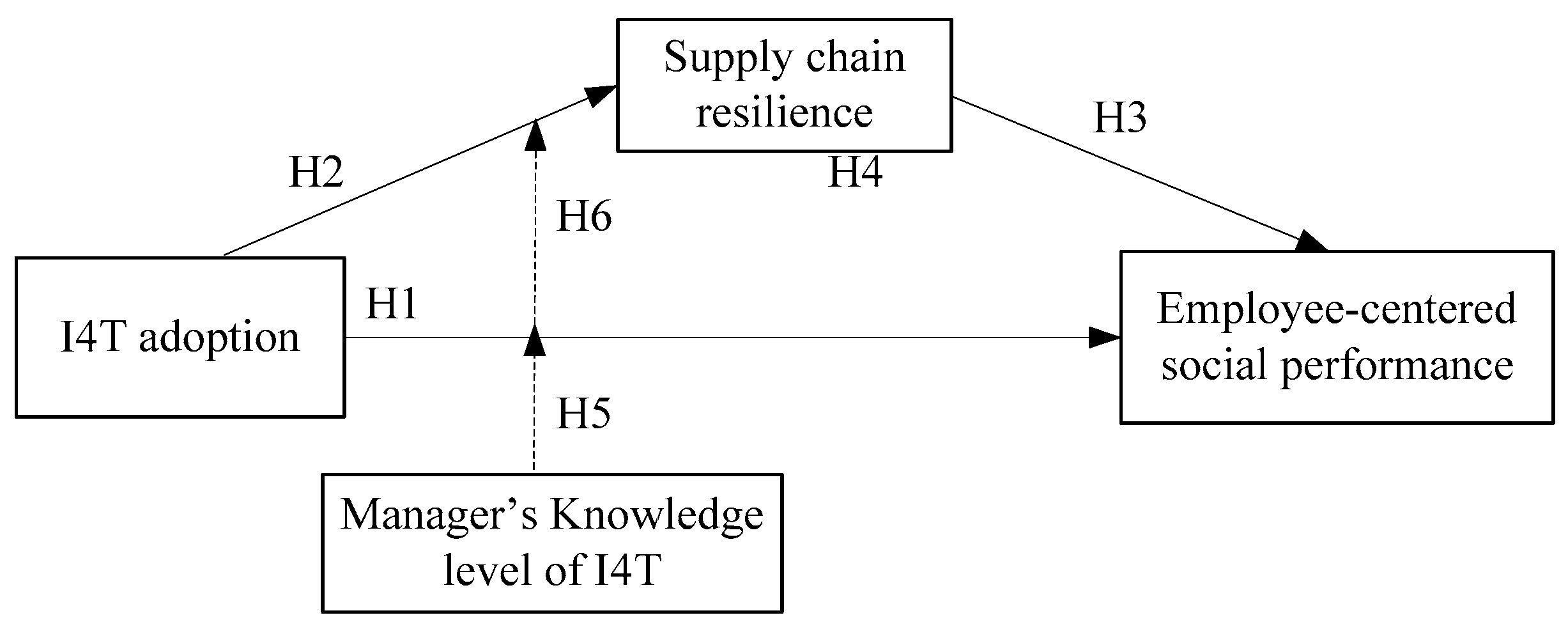
I4T adoption by a hotel positively affects the ESP of the hotel during disruptions.

2.4. Supply Chain Resilience (SCR)

SCR refers to a supply chain’s capability to anticipate, respond to, and recover from disruptions while maintaining or quickly restoring operational performance (Ivanov & Dolgui, 2020). Resilient supply chains rely on proactive decision-making, flexibility, and rapid reconfiguration, all of which depend on timely and accurate information processing (Pettit et al., 2019).
Research has consistently highlighted the role of digital technologies in strengthening SCR. Technologies such as IoT, BDA, and AI enhance supply chain visibility, coordination, and automation, thereby supporting rapid and effective responses to disruptions (Bag et al., 2021; Mandal & Dubey, 2020). From a dynamic capability perspective, technology-enabled sensing, learning, and reconfiguration mechanisms are central to resilience development (Frederico, 2021; Talwar et al., 2021). Therefore, the following hypothesis is proposed.
H2: 
I4T adoption by a hotel positively affects the hotel’s SCR during disruptions.
Beyond operational continuity, SCR contributes to long-term competitiveness and organizational performance through adaptive business model development (Edgeman & Wu, 2016; Shashi et al., 2020). In hospitality contexts, high levels of SCR may also enhance ESP by strengthening employees’ perceptions of organizational stability, adaptability, and support during crises (Nikookar & Yanadori, 2022; Wieland et al., 2023). Elshaer et al. (2026) explored the impact of AI on SCR and consequently improved the hotel’s competitive advantage; they suggested that hoteliers leverage AI-driven supply chain tools to navigate business uncertainty and sustain business competitive advantage. Therefore, the following hypotheses are proposed.
H3: 
A hotel’s SCR during disruptions positively affects the ESP of the hotel.
H4: 
A hotel’s SCR mediates the relationship between I4T adoption and the ESP of the hotel during disruptions.

2.5. Managers’ Knowledge Level

Managers play a critical role in dynamic capability development because they interpret environmental signals and orchestrate organizational responses (Sirmon & Hitt, 2009). In the context of digital transformation, hotel managers’ knowledge of I4T significantly influences technology integration effectiveness, employee acceptance, and strategic alignment (Hsu & Tseng, 2022).
Managers with high levels of technological and digital knowledge are effectively positioned to leverage I4T for learning, coordination, and supply chain reconfiguration, thereby strengthening SCR and improving employee-related outcomes (H.-L. Wei & Wang, 2010; S. Wei et al., 2024). Drawing on DCT, we propose the following moderation hypotheses.
H5: 
Hotel managers’ knowledge level of I4T moderates the relationship between I4T adoption and the ESP of the hotel during disruptions.
H6: 
Hotel managers’ knowledge level of I4T moderates the relationship between I4T adoption and the SCR of the hotel during disruptions.
Based on the above review, the research framework of this study is proposed in Figure 1.

3. Methodology

3.1. Data Collection

This exploratory study adopted a quantitative approach to examine I4T adoption in the hotel industry and its effect on hotel SCR and ESP. The target population is hotel managers in Hong Kong who are involved in the decision-making of SCM processes. Many hotels in Hong Kong rely heavily on imported goods and international market demand. As a result, hotels in Hong Kong are very vulnerable to supply chain disruptions, thus making them suitable for this study.
A reputable research firm was engaged to conduct the survey to reflect the target population of hotel executives in the region accurately. Moreover, this study maintained response quality by targeting hotels that had indicated an interest in digital initiatives and organizational adaptation in the questionnaire’s cover letter. A stratified sampling method was employed based on observable hotel characteristics (e.g., hotel affiliation and category). Using the company’s hotel database as the sampling frame, 150 hotels operating in Hong Kong were selected to ensure coverage across different market segments. The sample size was established according to guidelines set forth by Hair et al. (2022), which recommend at least 10 times the number of indicators for the construct with the highest indicator count. Accordingly, a target of 150 respondents was set, allowing for potential non-responses and incomplete questionnaires. Variations in I4T adoption and organizational responses to market turbulence were measured through the survey instrument.
Online questionnaires were distributed for data collection. The bilingual questionnaire (English and Chinese) items were created because the target samples were located in Hong Kong. The cover letters explained the study’s purpose and participant eligibility criteria. They also assured respondents of anonymity and confidentiality. Additionally, the researchers’ contact information was provided in case the respondents had any questions. The accuracy of words used was reviewed by academics in hospitality management. Before data collection, a pretest of the questionnaire was conducted to confirm the clarity of its design. A pilot test involving 30 samples demonstrated acceptable reliability for each construct. Data collection continued thereafter. Ultimately, 108 complete questionnaires were collected, yielding a response rate of 72%. This response rate is considered satisfactory for organizational-level survey research in the hospitality industry.

3.2. Measurement Development

The questionnaire instrument was designed based on the summary of the related literature. It had four sections. Section 1 asked about I4T adoption in hotels in general (Bianco et al., 2023). Three items regarding I4T implementation in the hotel were asked using a seven-point Likert-type scale ranging from 1 (not at all considering) to 7 (using it regularly) (Kamble et al., 2020).
Section 2 and Section 3 measure hotel SCR (three items) during supply chain disruptions based on Mandal and Dubey (2020) and the average ESP (four items) during the past three years based on Chen and Delmas (2011) and El Baz and Ruel (2024). The above items were measured using a seven-point Likert-type scale ranging from 1 (strongly disagree) to 7 (strongly agree). Section 4 includes the demographic profiles of the respondents, such as age, gender, position, and their knowledge level of I4T, with closed-ended questions.

3.3. Data Analysis

Several data analysis techniques were tested, including descriptive and confirmatory factor analysis and the partial least squares (PLS) approach to structural equation (SEM) modeling using SmartPLS 3.0 software. PLS-SEM is used for its value as a confirmatory multivariate approach that enables the simultaneous testing of hypotheses with many latent constructs. The mediating effect (i.e., H4) was assessed using the total effect value and the Sobel test (Sobel, 1982). The hypotheses related to moderation were examined using PLS multigroup analysis (PLS-MGA). Given that H5 and H6 involve a categorical potential moderator (i.e., manager’s knowledge level of I4T: well-informed vs. limited knowledge), PLS-MGA was used to test the hypothesis to identify differences in group-specific path coefficients (Hair et al., 2022).
Prior to PLS SEM analysis, the Mahalanobis Distance was employed to detect multivariate outliers. When setting a chi-square threshold at p < 0.001, no observations exceeded the critical Mahalanobis Distance. Therefore, no severe multivariate outliers exist in this case.

4. Results

Table 1 provides an overview of the characteristics of the respondents and the hotels. The respondents included managers (from junior to senior levels), directors, and (assistant) general managers of the selected hotels. The majority of hotel properties were four-star hotels, accounting for 50% of the total. The table also presents information on the affiliation of the hotels (51.9% were independent, and 48.1% were chain hotels). The respondents were categorized into well-informed (50.9%) and limited-knowledge (49.1%) groups regarding their knowledge level of I4T. The limited-knowledge group included managers who indicated that they had a rare or basic understanding of I4T. The well-informed group included managers who indicated they were very knowledgeable about I4T.

4.1. Measurement Model Analysis

Factor loading was measured to assess the reliability of all reflective constructs. The item measurements showed a good fit of indices, as shown in Table 2. The factor loadings for all items are considered satisfactory because they exceeded the threshold value of 0.70 (Hair et al., 2022). In addition, the Cronbach’s alpha and composite reliability (CR) values were greater than the threshold value of 0.7 (Cohen, 1988). Therefore, all items were reliable. The testing of convergent validity was also conducted. The average variance extracted (AVE) values were greater than 0.5, which is the threshold value recommended by Hair et al. (2022). Thus, the constructs’ convergent validity was established.
Furthermore, discriminant validity was evaluated using the Fornell–Larcker criterion. Table 3 shows that the square root of AVE for each variable (between 0.876 and 0.933) is greater than the correlations among the latent variables. This outcome demonstrates that the Fornell–Larcker criterion has been satisfied in this study. Therefore, discriminant validity was established (Fornell & Larcker, 1981). The values of the mean score (ranging from 5.116 to 5.65) and standard deviation (ranging from 1.02 to 1.34) are presented.
Once the measurement model shows acceptable reliability and strong convergent and discriminant validity, the structural model can then be evaluated to assess how effectively it explains the data and to examine the hypotheses.

4.2. Model Fit Assessment

Model fit was assessed using the standardized root mean square residual (SRMR) and the normed fit index (NFI), as recommended for PLS-SEM analysis. Although SmartPLS also reports RMS_theta, this index is applicable to reflective measurement models. Given that all constructs in the present study are specified as formative, RMS_theta is not considered a decisive indicator of model adequacy and is therefore interpreted with caution.
The NFI of the proposed model was 0.86, which is slightly below the conventional threshold of 0.90 commonly referenced in covariance-based SEM. However, given the predictive orientation of PLS-SEM, this value indicates an acceptable approximate fit. Model fit assessment in PLS-SEM is interpreted in conjunction with other evaluation criteria rather than as a strict goodness-of-fit test. The SRMR was 0.059, which is lower than the threshold value of 0.08. This result indicates a good model fit of the proposed structural model (Henseler et al., 2016).
A multicollinearity assessment was conducted as recommended by Kock (2015), and the variance inflation factor (VIF) scores for all constructs were calculated. Given that every score fell below the threshold of 3.3, the model did not suffer from common method bias according to this criterion.

4.3. Structural Model Assessment

The path coefficients and R2 are the essential measures when assessing the structural model (Henseler & Sarstedt, 2013). Table 4 presents the results. The model had an R2 value of 43.6% for SCR and 64.4% for ESP. According to Jack et al. (2001), bootstrapping is a useful tool for estimating structural models with small samples. The significance of the path coefficients is tested using the bootstrap method with 5000 subsamples. Notably, all three hypotheses were supported. Hence, I4T adoption by hotels positively influenced hotel SCR and ESP during disruptions. Furthermore, hotel SCR mediated the relationship between I4T adoption by hotels and hotel ESP during the disruptions.
The mediating effect is assessed using the indirect effect value and the Sobel test (Table 5) (Sobel, 1982). The Sobel test statistic value of the SCR mediating role was 6.212, which is greater than the critical value of 1.96. This value was significant at the 0.001 level, indicating the mediating effect of SCR on the relationship between I4T adoption and the ESP of the hotels in the context of disruptions. As a result, H4 was partially supported because the direct (β = 0.330, p < 0.001) and indirect (β = 0.365, p < 0.001) effects are significant. The effect of some I4T adoptions on employee-centered social performance is explained by SCR.

4.4. Moderating Role of Hotel Managers’ Knowledge Level of I4T

The moderating effect of hotel managers’ knowledge level of I4T on the relationships among I4T adoption, SCR, and ESP is summarized in Table 6. Regarding the relationships between I4T adoption and ESP (t-value = 2.377, p < 0.05), the difference between the well-informed group and the limited-knowledge group was significant, thus supporting H5. The impact of I4T adoption on ESP was stronger in the well-informed group (β = 0.510) than in the limited-knowledge group (β = 0.164). Meanwhile, hotel managers’ knowledge level of I4T did not have a significant moderating effect on the relationship between I4T adoption and SCR. As a result, H6 was not supported. In both groups, I4T adoption significantly enhanced SCR of the hotels in the context of disruptions.

5. Discussion and Implications

The new global reality has accelerated technology adoption and called for resilient supply chains. Amid these developments, I4T can help businesses achieve high efficiency. However, the benefits of I4T on social performance during disruptive events are unclear. Based on DCT, this research examined the role of I4T adoption on the SCR and ESP of hotels amid supply chain disruption. This study further tested the mediating effect of SCR on the relationship between I4T adoption and ESP. Additionally, the moderating effect of a manager’s knowledge level of I4T on the relationships between I4T adoption and SCR and between I4T and ESP was evaluated. The results are discussed below.
This empirical study of hotel firms in Hong Kong found that the adoption of I4T is a critical success factor in creating SCR and improving ESP by consolidating hotel organizations’ dynamic capabilities during disturbances. This work is consistent with the empirical study of Mandal and Dubey (2020) and Elshaer et al. (2026), who found that tourism information technology adoption contributes to the development of the SCR of hotel companies. I4T adoption can strengthen a hotel’s capabilities in the areas of operational workflow integration, cost saving, and workforce readiness. For instance, I4T helps check any lack of employees in certain departments, such as housekeeping or banquet job duties, during peak seasons. An ad hoc arrangement of part-time employees or an overtime arrangement can be implemented to address the staff shortage. Consequently, hotels can manage their employees and provide effective customer service.
The direct and positive influence of I4T adoption on the ESP of hotels during disturbances was also supported. This finding reveals that I4T directly contributes to a hotel’s social performance. In the post-COVID-19 period, many hotel teams continue to adopt advanced technology to manage and perform their work duties. For example, short videos of training workshops are created and sent to employees’ email and social media channels, such as WhatsApp and WeChat. Online meetings and procurement procedures are in place to ensure all records are up to date and support effective inventory systems. These solutions can increase morale and commitment to a good working environment among hotel employees. Seamless information transparency via I4T systems within and across hotel departments and properties allows employees to gather sufficient information and make effective decisions. Consequently, it can increase the level of ESP (Ezzaouia & Bulchand-Gidumal, 2023).
In addition, this study confirms the mediating role of SCR on the relationship between I4T adoption and hotel ESP. The results imply that although technology adoption is generally important for achieving enhanced performance during normal periods of business activity, SCR plays a key mediating role when hotel organizations aim for high ESP during disruptions. Although many hotels have implemented various I4T adoptions, hotel executives’ strategic direction of SCR is essential. This strategy can help hotel managers make prompt decisions and adjust their resources (e.g., employees) to address a specific business situation or uncertainty. For instance, a front office attendant can assist hotel guests with check-in requests using historical records and provide concierge services via AI-generated information (Wieland et al., 2023). Subsequently, it can maintain or increase ESP measures.
Hotel managers’ knowledge level of I4T moderates the relationship between I4T adoption by hotels and their ESP. Mentorship has been shown to support employees significantly in adopting new technologies within the hospitality sector (Wang & Wu, 2025). Managers’ strong knowledge of I4T positively shapes employees’ willingness to participate in digital transformation initiatives. This correlation highlights the crucial role that managers play in guiding staff to embrace and make the most of digital tools, which can enhance the ESP of organizations. Furthermore, hotel managers’ knowledge level of I4T does not moderate the relationship between I4T adoption and hotel SCR. Digitalization often involves conforming to predefined operational and/or managerial processes in digital systems that reflect best practices (Zhao et al., 2023). Therefore, the adoption of I4T in hotels is a critical success factor in creating SCR. This notion can be true for hotels regardless of their managers’ level of knowledge of I4T.

5.1. Theoretical and Practical Implications

This study offers theoretical and practical contributions in the hospitality area. For theoretical contributions, this study proposed and validated a research model based on DCT to examine the relationship among I4T adoption, SCR, and ESP in the context of disruptions in hotels. Although technology adoption is important for achieving enhanced hotel performance during normal periods of business activity, previous research indicated that such effects may not be certain (Campo et al., 2014). This uncertainty is pronounced for DCT’s strategic direction on I4T adoption amid disruptions given the risks posed by a sizable I4T investment and unprecedented market volatility. Many hotels are operated under chain and partnership affiliations. Therefore, the advantages of DCT, such as big data on customer profiles and suppliers and advanced AI and IoT technologies, can strengthen their competitive edge and resilience in an uncertain business environment. The empirical results contribute valuable insights to digitalization research and affirm the importance of integrating RBV and DCT with a people-centric perspective. Adapting DCT provides flexibility of employee rotations and diversified supplier networks. Hotel managers can search for and find suitable substitutes and products at acceptable costs and with suitable logistics arrangements. This research model can serve as a basis for relevant studies on I4T’s impact on resilience and social outcomes with a large scope and depth in the hotel industry.
Furthermore, SCR has a direct impact on ESP and plays a mediating role in the relationship between I4T adoption and ESP. The hotel executives’ strategic decision during business uncertainty can affect the effectiveness of I4T resources and ESP. Hotels with sufficient and effective I4T resources, particularly in IoT and big data, can continue to outperform employee service performance, meet customers’ expectations and service experience, and maintain a competitive advantage in the hotel sector (Elshaer et al., 2026).
Finally, this study investigated the moderating role of hotel managers’ knowledge level of I4T to explore the impact of I4T adoption on hotel performance. Accordingly, this study offered empirical evidence and an explanation of managers’ roles in the deployment of digital resources to achieve SCR and ESP. This contribution echoes the recent emphasis on managers’ digital leadership in the hospitality literature (Zhu et al., 2025). I4T-literate managers are well equipped to lead the integration of new practices into the processes needed to build the SCR. On the one hand, hotel managers with a strong sense of I4T knowledge and competencies can optimize the use of available resources, data, and technologies to propose and/or revise strategic plans and implement them effectively. On the other hand, hotel managers with limited knowledge of I4T may not be able to think critically and propose the best strategic decisions and plans. This shortcoming may harm business performance and resilience.
The managerial implications are presented. Hotel managers should review all hotel supply chain criteria when planning and integrating I4T adoption because it involves hard and soft hardware factors. Therefore, hotel managers should pay increased attention to I4T and emerging technologies for the enhancement of SCR, with a view to reaping improved social performance. Up-to-date I4T should be regularly maintained and upgraded so that information integration can be transparent with high security and safety control. Emerging AI tools and advanced technologies will play an important role in future product development and service enhancement. As such, hotels are advised to explore advanced technologies, such as robotics and smartness, to support service delivery by hotel employees and enhance hotel guests’ experience. Hotel managers should also continue updating their knowledge level of I4T and leveraging technological tools to navigate business resilience (Elshaer et al., 2026). These improvements can help hotel managers make strategic decisions about introducing new products and services to customers, optimize resources for desirable productivity, maintain employee social performance, and sustain business competitiveness in any business situation.

5.2. Limitations and Future Research

This explorative study has some limitations. First, I4T in this study included IoT, BDA, and AI, which are most often associated with Industry 4.0. The findings are most generalizable to hotels operating in contexts where digital transformation is salient rather than to hotels with minimal engagement in digital initiatives. Future studies can integrate different types of I4T in the research design to obtain specific insights into the contribution of I4T to SCR and ESP. Second, this study focused on the hotel industry in Hong Kong. Future studies can extend the scope to other relevant industries and in other regions. Furthermore, future studies can incorporate other dimensions of social performance to expand this area of research.

Author Contributions

Conceptualization, X.Z. and P.T.; methodology, X.Z. and P.T.; software, X.Z.; validation, X.Z.; formal analysis, X.Z.; investigation, X.Z.; resources, X.Z. and P.T.; data curation, X.Z. and P.T.; writing—original draft preparation, X.Z.; writing—review and editing, X.Z. and P.T.; project administration, X.Z.; funding acquisition, X.Z. and P.T. All authors have read and agreed to the published version of the manuscript.

Funding

This research was funded by a grant from the Research Grants Council of the Hong Kong Special Administrative Region, China (Project No.: UGC/FDS24/B10/23).

Institutional Review Board Statement

This study was conducted in accordance with the Declaration of Helsinki and approved by the Research Grants Council of the Hong Kong Special Administrative Region, China (protocol code Project No.: UGC/FDS24/B10/23 and date of approval 23 November 2021).

Informed Consent Statement

Informed consent was obtained from all subjects involved in this study.

Data Availability Statement

The data presented in this study are available upon request from the corresponding author due to privacy or ethical restrictions.

Acknowledgments

The work described in this paper was fully supported by a grant from the Research Grants Council of the Hong Kong Special Administrative Region, China (Project No.: UGC/FDS24/B10/23).

Conflicts of Interest

The authors declare no conflicts of interest.

References

  1. Bag, S., Telukdarie, A., Pretorius, J. C., & Gupta, S. (2021). Industry 4.0 and supply chain sustainability: Framework and future research directions. Benchmarking: An International Journal, 28(5), 1410–1450. [Google Scholar] [CrossRef] [Scilit]
  2. Bianco, D., Bueno, A., Godinho Filho, M., Latan, H., Ganga, G. M. D., Frank, A. G., & Jabbour, C. J. C. (2023). The role of industry 4.0 in developing resilience for manufacturing companies during COVID-19. International Journal of Production Economics, 256, 108728. [Google Scholar] [CrossRef] [Scilit]
  3. Boruchowitch, F., & Fritz, M. M. (2022). Who in the firm can create sustainable value and for whom? A single case-study on sustainable procurement and supply chain stakeholders. Journal of Cleaner Production, 363, 132619. [Google Scholar] [CrossRef] [Scilit]
  4. Campo, S., Díaz, A. M., & Yagüe, M. J. (2014). Hotel innovation and performance in times of crisis. International Journal of Contemporary Hospitality Management, 26(8), 1292–1311. [Google Scholar] [CrossRef] [Scilit]
  5. Chen, C. M., & Delmas, M. (2011). Measuring corporate social performance: An efficiency perspective. Production and Operations Management, 20(6), 789–804. [Google Scholar] [CrossRef] [Scilit]
  6. Chowdhury, M. M. H., & Quaddus, M. (2017). Supply chain resilience: Conceptualization and scale development using dynamic capability theory. International Journal of Production Economics, 188, 185–204. [Google Scholar] [CrossRef] [Scilit]
  7. Cohen, J. (1988). Statistical power analysis for the behavioral sciences. L. Erlbaum Associates. [Google Scholar]
  8. Edgeman, R., & Wu, Z. (2016). Supply chain criticality in sustainable and resilient enterprises. Journal of Modelling in Management, 11(4), 869–888. [Google Scholar] [CrossRef] [Scilit]
  9. Eisenhardt, K. M., & Martin, J. A. (2000). Dynamic capabilities: What are they? Strategic Management Journal, 21(10–11), 1105–1121. [Google Scholar] [CrossRef] [Scilit]
  10. El Baz, J., & Ruel, S. (2024). Achieving social performance through digitalization and supply chain resilience in the COVID-19 disruption era: An empirical examination based on a stakeholder dynamic capabilities view. Technological Forecasting & Social Change, 201, 123209. [Google Scholar]
  11. Elshaer, I. A., Azazz, A. M., Aljoghaiman, A., Mansor, M., Salama, M. A., & Fayyad, S. (2026). Artificial intelligence-driven supply chain agility and resilience: Pathways to competitive advantage in the hotel industry. Logistics, 10(1), 5. [Google Scholar] [CrossRef] [Scilit]
  12. Ezzaouia, I., & Bulchand-Gidumal, J. (2023). The impact of information technology adoption on hotel performance: Evidence from a developing country. Journal of Quality Assurance in Hospitality & Tourism, 24(5), 688–710. [Google Scholar]
  13. Fornell, C., & Larcker, D. G. (1981). Evaluating structural equation models with unobservable variables and measurement error. Journal of Marketing Research, 18(1), 39–50. [Google Scholar] [CrossRef] [Scilit]
  14. Frederico, G. F. (2021). Towards a supply chain 4.0 on the post-COVID-19 pandemic: A conceptual and strategic discussion for more resilient supply chains. Rajagiri Management Journal, 15(2), 94–104. [Google Scholar] [CrossRef] [Scilit]
  15. Gaiardelli, P., Pezzotta, G., Rondini, A., Romero, D., Jarrahi, F., Bertoni, M., Wiesner, S., Wuest, T., Larsson, T., Zaki, M., Jussen, P., Boucher, X., & Bigdeli, A. Z. (2021). Product-service systems evolution in the era of Industry 4.0. Service Business, 15, 177–207. [Google Scholar] [CrossRef] [Scilit]
  16. Hair, J. F., Hult, G. T. M., Ringle, C. M., & Sarstedt, M. (2022). A primer on partial least squares structural equation modeling (PLS-SEM) (3rd ed.). SAGE. [Google Scholar]
  17. Henseler, J., Hubona, G., & Ray, P. (2016). Using PLS path modeling in new technology research: Updated guidelines. Industrial Management + Data Systems, 116(1), 2–20. [Google Scholar] [CrossRef] [Scilit]
  18. Henseler, J., & Sarstedt, M. (2013). Goodness-of-fit indices for partial least squares path modeling. Computational Statistics, 28(2), 565–580. [Google Scholar] [CrossRef] [Scilit]
  19. Hsu, H., & Tseng, K. F. (2022). Facing the era of smartness: Constructing a framework of required technology competencies for hospitality practitioners. Journal of Hospitality and Tourism Technology, 13(3), 500–526. [Google Scholar] [CrossRef] [Scilit]
  20. Ivanov, D., & Dolgui, A. (2020). Viability of intertwined supply networks: Extending the supply chain resilience angles towards survivability. A position paper motivated by COVID-19 outbreak. International Journal of Production Research, 58(10), 2904–2915. [Google Scholar] [CrossRef] [Scilit]
  21. Jack, P. C. K., Russell, C. H. C., & Bert, B. (2001). Validation of trace-driven simulation models: Bootstrap tests. Management Science, 47(11), 1533–1538. [Google Scholar] [CrossRef] [Scilit]
  22. Kamble, S., Gunasekaran, A., & Dhone, N. C. (2020). Industry 4.0 and lean manufacturing practices for sustainable organisational performance in Indian manufacturing companies. International Journal of Production Research, 58(5), 1319–1337. [Google Scholar] [CrossRef] [Scilit]
  23. Kähkönen, A. K., Evangelista, P., Hallikas, J., Immonen, M., & Lintukangas, K. (2021). COVID-19 as a trigger for dynamic capability development and supply chain resilience improvement. International Journal of Production Research, 61(8), 2696–2715. [Google Scholar] [CrossRef] [Scilit]
  24. Kock, N. (2015). Common method bias in PLS-SEM: A full collinearity assessment approach. International Journal of e-Collaboration, 11(4), 1–10. [Google Scholar] [CrossRef] [Scilit]
  25. Mandal, S., & Dubey, R. K. (2020). Role of tourism IT adoption and risk management orientation on tourism agility and resilience: Impact on sustainable tourism supply chain performance. The International Journal of Tourism Research, 22(6), 800–813. [Google Scholar] [CrossRef] [Scilit]
  26. Melián-González, S., & Bulchand-Gidumal, J. (2016). A model that connects information technology and hotel performance. Tourism Management, 53, 30–37. [Google Scholar] [CrossRef] [Scilit]
  27. Negri, M., Cagno, E., Colicchia, C., & Sarkis, J. (2021). Integrating sustainability and resilience in the supply chain: A systematic literature review and a research agenda. Business Strategy and the Environment, 30(7), 2858–2886. [Google Scholar] [CrossRef] [Scilit]
  28. Nikookar, E., & Yanadori, Y. (2022). Preparing supply chain for the next disruption beyond COVID-19: Managerial antecedents of supply chain resilience. International Journal of Operations & Production Management, 42(1), 59–90. [Google Scholar]
  29. Oláh, J., Aburumman, N., Popp, J., Khan, M. A., Haddad, H., & Kitukutha, N. (2020). Impact of industry 4.0 on environmental sustainability. Sustainability, 12(11), 4674. [Google Scholar] [CrossRef] [Scilit]
  30. Pandya, D., & Kumar, G. (2023). Applying Industry 4.0 technologies for the sustainability of small service enterprises. Service Business, 17, 37–59. [Google Scholar] [CrossRef] [Scilit]
  31. Pervez, H., Saunila, M., Rantala, T., & Ukko, J. (2026). Navigating the sustainable Industry 4.0 transformation in supply chains: A systematic review and future research agenda. International Journal of Production Research, 64(1), 294–329. [Google Scholar] [CrossRef] [Scilit]
  32. Pettit, T. J., Croxton, K. L., & Fiksel, J. (2019). The evolution of resilience in supply chain management: A retrospective on ensuring supply chain resilience. Journal of Business Logistics, 40(1), 56–65. [Google Scholar] [CrossRef] [Scilit]
  33. Sabahi, S., & Parast, M. M. (2020). Firm innovation and supply chain resilience: A dynamic capability perspective. International Journal of Logistics Research and Applications, 23(3), 254–269. [Google Scholar] [CrossRef] [Scilit]
  34. Sainaghi, R., Phillips, P., & Zavarrone, E. (2017). Performance measurement in tourism firms: A content analytical meta-approach. Tourism Management, 59, 36–56. [Google Scholar] [CrossRef] [Scilit]
  35. Schwab, K. (2017). The fourth industrial revolution. Portfolio Penguin. [Google Scholar]
  36. Schweikl, S., & Obermaier, R. (2020). Lessons from three decades of IT productivity research: Towards a better understanding of IT-induced productivity effects. Management Review Quarterly, 70, 461–507. [Google Scholar] [CrossRef] [Scilit]
  37. Shamim, S., Cang, S., Yu, H., & Li, Y. (2017). Examining the feasibilities of Industry 4.0 for the hospitality sector with the lens of management practice. Energies, 10(4), 499. [Google Scholar] [CrossRef] [Scilit]
  38. Shashi, Centobelli, P., Cerchione, R., & Ertz, M. (2020). Managing supply chain resilience to pursue business and environmental strategies. Business Strategy and the Environment, 29(3), 1215–1246. [Google Scholar] [CrossRef] [Scilit]
  39. Sirmon, D. G., & Hitt, M. A. (2009). Contingencies within dynamic managerial capabilities: Interdependent effects of resource investment and deployment on firm performance. Strategic Management Journal, 30(13), 1375–1394. [Google Scholar] [CrossRef] [Scilit]
  40. Sobel, M. E. (1982). Asymptotic confidence intervals for indirect effects in structural equation models. Sociological Methodology, 13, 290–312. [Google Scholar] [CrossRef] [Scilit]
  41. Talwar, S., Kaur, P., Fosso Wamba, S., & Dhir, A. (2021). Big Data in operations and supply chain management: A systematic literature review and future research agenda. International Journal of Production Research, 59(11), 3509–3534. [Google Scholar] [CrossRef] [Scilit]
  42. Tavitiyaman, P., Qu, H., Tsang, W. S. L., & Lam, C. W. R. (2021). The influence of smart tourism applications on perceived destination image and behavioral intention: The moderating role of information search behavior. Journal of Hospitality and Tourism Management, 46, 476–487. [Google Scholar] [CrossRef] [Scilit]
  43. Teece, D. J. (2018). Business models and dynamic capabilities. Long Range Planning, 51(1), 40–49. [Google Scholar] [CrossRef] [Scilit]
  44. Teece, D. J., Pisano, G., & Shuen, A. (1997). Dynamic capabilities and strategic management. Strategic Management Journal, 18(7), 509–533. [Google Scholar]
  45. Wang, C.-H., & Wu, C.-L. (2025). Synergizing mentorship and mindfulness with innovation and digital transformation: A strategic framework for the restaurant industry. Journal of the Knowledge Economy, 16(2), 7722–7756. [Google Scholar]
  46. Wei, H.-L., & Wang, E. T. G. (2010). The strategic value of supply chain visibility: Increasing the ability to reconfigure. European Journal of Information Systems, 19(2), 238–249. [Google Scholar] [CrossRef] [Scilit]
  47. Wei, S., Liu, H., Chen, X., & Ke, W. (2024). How does supplier integration influence supply chain robustness and resilience? The moderating roles of information technology agility and managerial ties. Information & Management, 61(7), 104028. [Google Scholar] [CrossRef] [Scilit]
  48. Wieland, A., Stevenson, M., Melnyk, S. A., Davoudi, S., & Schultz, L. (2023). Thinking differently about supply chain resilience: What we can learn from social-ecological systems thinking. International Journal of Operations & Production Management, 43(1), 1–21. [Google Scholar] [CrossRef] [Scilit]
  49. Wood, D. J. (1991). Corporate social performance revisited. The Academy of Management Review, 16(4), 691–718. [Google Scholar]
  50. Youssef, A. B., & Zeqiri, A. (2022). Hospitality industry 4.0 and climate change. Circular Economy and Sustainability, 2(3), 1043–1063. [Google Scholar] [CrossRef] [Scilit] [PubMed]
  51. Yu, J., Lho, L. H., & Han, H. (2022). Corporate social responsibility (environment, product, diversity, employee, and community) and the hotel employees’ job performance: Exploring the role of the employment types. Corporate Social-Responsibility and Environmental Management, 29(5), 1825–1838. [Google Scholar]
  52. Zhang, X., Ouyang, S., & Tavitiyaman, P. (2022). Impact of COVID-19 pandemic on generation Z employees’ perception and behavioral intention toward advanced information technologies in hotels. Tourism and Hospitality, 3(2), 362–379. [Google Scholar] [CrossRef] [Scilit]
  53. Zhao, N., Hong, J., & Lau, K. H. (2023). Impact of supply chain digitalization on supply chain resilience and performance: A multi-mediation model. International Journal of Production Economics, 259, 108817. [Google Scholar] [CrossRef] [Scilit] [PubMed]
  54. Zhu, J., Luo, Y., & Wang, H. (2025). Digital leadership and employees’ innovative behavior in the hospitality industry: The role of digital self-efficacy and individual learning orientation. Current Psychology, 44(20), 16283–16297. [Google Scholar] [CrossRef] [Scilit]
Figure 1. Research framework (source: authors’ own work).
Tourismhosp 07 00102 g001
Table 1. Characteristics of respondents and workplace (source: authors’ own work).
Itemn%Itemn%
Gender Hotel affiliation
 Male 7872.2 Independent5651.9
 Female 3027.8 Chain5248.1
Age Hotel category
 18–25 years old 32.8 5-star3027.8
 25–35 years old4238.9 4-star5450.0
 36–45 years old5147.2 3-star2422.2
 Over 45 years old1211.1Department
Education  Front Office87.4
 Secondary school or below10.9 Sales & Marketing1312.0
 AD/HD1110.2 Housekeeping43.7
 Bachelor’s degree6257.4 Reservations65.6
 Master’s degree and above3431.5 F&B98.3
Current position  Events & Catering76.5
 Manager3330.5 Finance21.9
 Senior Manager1211.1 Human Resources10.9
 Director2321.3 Information Technology76.5
 Assistant General Manager3532.4 General Manager’s Office5147.2
 General Manager54.6Knowledge of I4T
Years of working in this field  Limited knowledge5349.1
 Less than 5 years 109.3 Well informed5550.9
 5–15 years8074.1
 15 years or more1816.7
Table 2. Confirmatory factor analysis of key constructs (source: authors’ own work).
ItemFactor LoadingCronbach’s AlphaAVECR
I4T adoption (I4T) 0.9740.8440.977
I4T1: Internet of Things 0.942
I4T2: Big data analytics0.906
I4T3: Artificial intelligence0.899
Supply chain resilience (SCR) 0.9050.8410.941
SCR1: My hotel can quickly restore the SC to its original functionality 0.940
SCR2: My hotel can quickly restore material flow0.908
SCR3: My hotel can adapt itself for responding in a positive manner to SC disruptions 0.903
Employee-centered social performance (ESP) 0.8980.7650.929
SP1: Better working conditions0.856
SP2: Better employment health0.848
SP3: Better labor relations0.895
SP4: Better employee morale0.900
AVE = Average variance extracted; CR = composite reliability.
Table 3. Discriminant validity testing of key constructs (Fornell–Larcker criterion) (source: authors’ own work).
ConstructMeanSDCorrelations and Square Root of AVE
I4TSCRESP
I4T5.161.340.933
SCR5.651.020.6640.890
ESP5.631.030.6950.7680.876
I4T = I4T adoption; SCR = supply chain resilience; ESP = employee-centered social performance. Diagonal = Square root of the average variance extracted.
Table 4. Structural equation model result (source: authors’ own work).
Path AnalysisStandardized Coefficient (t-Value)Hypothesis
I4T adoption → employee-centered social performance 0.330 (4.211) *H1: Supported
I4T adoption → supply chain resilience 0.664 (10.712) *H2: Supported
Supply chain resilience → employee-centered social performance 0.549 (7.625) *H3: Supported
R2 to employee-centered social performance0.644
R2 to supply chain resilience0.436
Standardized root mean square residual (SRMR)0.059
* p < 0.001.
Table 5. Mediating effect testing of supply chain resilience (source: authors’ own work).
RelationshipDirect EffectIndirect EffectSobel Test StatisticHypothesis
I4T adoption → SCR → ESP0.330 *0.365 *6.212 *H4: Partially supported
ESP = Employee-centered social performance; SCR = supply chain resilience. * p < 0.001.
Table 6. Moderating effect of manager’s knowledge level of I4T (source: authors’ own work).
Path AnalysisStandardized Coefficient (t-Value)t-StatisticHypothesis Testing
Well Informed (55)Limited Knowledge (53)
I4T adoption → ESP0.510 (4.533) **0.164 (1.757)2.377 *H5: Supported
I4T adoption → SCR0.721 (5.667) **0.581 (6.268) **0.892H6: Not supported
ESP = Employee-centered social performance; SCR = supply chain resilience. * p < 0.05; ** p < 0.001.
Disclaimer/Publisher’s Note: The statements, opinions and data contained in all publications are solely those of the individual author(s) and contributor(s) and not of MDPI and/or the editor(s). MDPI and/or the editor(s) disclaim responsibility for any injury to people or property resulting from any ideas, methods, instructions or products referred to in the content.