


Abstract
This study investigates how AI-driven personalization shapes traveler satisfaction in a post-adoption tourism context, with particular attention to the mechanisms and boundary conditions through which personalization is associated with experiential outcomes. Using an integrated post-adoption framework, the study conceptualizes AI-driven personalization as an experiential input influencing satisfaction through trust formation, perceived value, and individual readiness to engage with technology. Survey data were collected from 347 tourists with direct experience of AI-enabled tourism services in Kosovo. The relationships were analyzed using Partial Least Squares Structural Equation Modeling (PLS-SEM). The results show that AI-driven personalization is positively associated with traveler satisfaction. It enhances trust in AI-powered systems, and trust is positively associated with perceived value. Perceived value mediates the relationship between trust in AI-powered systems and traveler satisfaction, highlighting value appraisal as a central post-adoption mechanism. AI-driven personalization is also indirectly associated with traveler satisfaction through a sequential mechanism, in which trust precedes perceived value in the experiential evaluation process. Technology readiness moderates the relationship between perceived value and traveler satisfaction, indicating heterogeneous experiential responses to AI-enabled tourism services. The study contributes to tourism and hospitality research by demonstrating a sequential relational–evaluative mechanism through which AI-driven personalization is associated with traveler satisfaction, shifting the focus from adoption-based explanations toward post-adoption experiential pathways. It further clarifies the role of trust as a relational mechanism preceding value formation and identifies technology readiness as a boundary condition shaping satisfaction outcomes in an emerging destination context. The findings also offer practical guidance for designing AI-enabled services that strengthen trust, enhance value perceptions, and align personalization strategies with varying levels of traveler technology readiness.
1. Introduction
Artificial intelligence (AI) has become a central driver of digital transformation in the tourism and hospitality sector, reshaping how tourism services are designed, delivered, and experienced. AI-powered applications—including recommender systems, chatbots, automated customer support, and data-driven personalization tools—enable tourism providers to tailor offerings to individual traveler preferences. Through these applications, service providers can enhance operational efficiency, decision support, and experiential quality (Gursoy et al., 2019; Šakytė-Statnickė & Budrytė-Ausiejienė, 2025; I. Tussyadiah, 2020). In experience-centric industries such as tourism, personalization is widely recognized as a key determinant of traveler satisfaction, loyalty, and value co-creation (Chi & Qu, 2008; Pine & Gilmore, 1999). As AI-driven personalization becomes increasingly embedded in tourism ecosystems, understanding how travelers evaluate these personalized interactions—beyond initial technology adoption—has become a critical research challenge.
Although prior studies recognize the importance of personalization in shaping tourism experiences, existing empirical evidence provides limited insight into the extent to which AI-driven personalization is associated with traveler satisfaction in post-adoption contexts. Much of the existing tourism literature emphasizes traditional service personalization or examines AI primarily through adoption and acceptance lenses, rather than as a mechanism of experiential value creation (Gefen et al., 2003). Recent empirical research demonstrates that AI is primarily associated with adoption intentions and recommendation behavior (Baptista & Pereira, 2025); however, satisfaction outcomes are often treated as secondary or implicit. Bibliometric analyses further indicate that satisfaction-related constructs are less frequently examined in AI–tourism empirical models compared with behavioral intention variables (To & Yu, 2025). Consequently, the experiential implications of AI-driven personalization—particularly its association with traveler satisfaction—remain insufficiently understood. Existing studies have rarely integrated trust, perceived value, and technology readiness into a unified post-adoption framework explaining how AI-driven personalization relates to traveler satisfaction, representing a clear gap in the literature. Addressing this gap requires moving beyond adoption-focused perspectives toward post-adoption experiential evaluations of AI-enabled services.
Beyond direct effects, the literature offers limited insight into the experiential mechanisms through which AI-driven personalization is associated with traveler satisfaction. Acceptance-based frameworks such as the Technology Acceptance Model (TAM) have been widely applied to explain initial engagement with AI-enabled services, yet they provide only partial explanations of how travelers experience, evaluate, and derive satisfaction from AI-driven personalization (Davis, 1989; Gefen et al., 2003; Wüst & Bremser, 2025). In experience-centric service settings, satisfaction is shaped not only by functional evaluations but also by relational and value-based perceptions formed during service interactions. Although trust in AI systems and perceived value have been identified as important determinants of user responses to AI-enabled tourism services (Parasuraman & Colby, 2015; Baptista & Pereira, 2025), existing studies tend to examine these constructs in isolation, limiting understanding of how they jointly shape satisfaction outcomes. Trust reflects a relational evaluation of AI systems, whereas perceived value represents an evaluative appraisal of experiential benefits relative to costs. Prior research on AI-based service interactions and trust in artificial intelligence highlights the importance of trust-related evaluations and broader user appraisals, but stops short of testing their mediating roles within a unified framework (Wirtz et al., 2018; Glikson & Woolley, 2020). As a result, empirical evidence remains limited in explaining how these mechanisms jointly shape satisfaction in AI-enabled tourism contexts. This study addresses this gap by examining whether trust in AI systems and perceived value function as complementary and interrelated mechanisms through which AI-driven personalization is associated with traveler satisfaction through a sequential process involving trust and value evaluations. In doing so, the study clarifies how trust and perceived value operate as distinct yet complementary relational and evaluative mechanisms, jointly illuminating how travelers interpret and internalize AI-enabled personalized services.
While prior conceptual work suggests that trust and perceived value emerge at different stages of travelers’ evaluations of AI-enabled services, existing tourism research rarely integrates these constructs within a single post-adoption framework that captures their interrelated roles. Trust reflects travelers’ relational judgments toward AI systems, whereas perceived value represents a holistic appraisal of experiential benefits relative to costs (Gefen et al., 2003; Chi & Qu, 2008). Recent bibliometric and thematic reviews explicitly call for such mechanism-oriented approaches that move beyond net effects to clarify how experiential evaluations shape satisfaction in AI-enabled tourism contexts (To & Yu, 2025). However, empirical evidence testing such integrated mechanisms remains limited, particularly in emerging destinations. Accordingly, this study develops and tests a post-adoption experiential framework in which trust and perceived value operate as sequential relational and evaluative mechanisms linking AI-driven personalization to traveler satisfaction.
A further limitation concerns the limited consideration of individual-level boundary conditions, particularly technology readiness, in shaping traveler responses to AI-enabled tourism services. Technology readiness reflects an individual’s propensity to embrace new technologies and has been shown to influence technology-related beliefs and evaluations (Parasuraman, 2000; Parasuraman & Colby, 2015). Empirical evidence suggests that travelers’ responses to AI vary according to personal and situational factors, including familiarity with technology and perceived service risk (Wüst & Bremser, 2025). However, tourism studies rarely examine whether technology readiness shapes how perceived value is translated into satisfaction in AI-driven service encounters. This omission limits the understanding of why AI-driven personalization may generate heterogeneous satisfaction outcomes across traveler segments. Accordingly, this study examines whether technology readiness moderates the relationship between perceived value and traveler satisfaction.
These research gaps are particularly salient in emerging tourism destinations, where digital transformation is advancing rapidly but unevenly. Kosovo provides a relevant empirical context due to its expanding tourism sector and increasing adoption of digital and AI-enabled services. Recent statistics report steady growth in international tourist arrivals and overnight stays, underscoring the sector’s rising economic significance (KSA, 2025). In parallel, national tourism strategies emphasize digital innovation, personalized services, and smart tourism development as strategic priorities (MIET, 2024). Importantly, both tourism service providers and travelers exhibit heterogeneous levels of digital maturity and readiness to engage with AI-enabled services, creating variation in how personalization is experienced and evaluated. These conditions provide a suitable context for examining how AI-driven personalization, trust, perceived value, and technology readiness jointly shape traveler satisfaction. Studying these dynamics in a digitally heterogeneous emerging destination provides theoretically meaningful variation for boundary-condition analyses, strengthening the generalizability of AI-enabled tourism frameworks. Accordingly, this context enables testing the proposed framework in a setting where variation in digital readiness is theoretically meaningful (Veseli et al., 2025).
By addressing these gaps, this study contributes to the tourism and hospitality literature in four main ways. First, it extends prior research beyond adoption-focused perspectives by examining how AI-driven personalization relates to traveler satisfaction in post-adoption contexts. Second, it advances theoretical understanding by integrating trust and perceived value into a unified explanatory framework, with perceived value serving as the central mediating mechanism in the relationship between trust in AI systems and traveler satisfaction within a sequential process. Third, it incorporates technology readiness as a boundary condition, explaining how individual differences shape the relationship between perceived value and satisfaction. Fourth, by focusing on an emerging tourism destination, the study provides context-sensitive empirical evidence that complements findings from technologically advanced markets. The remainder of the paper is structured as follows: Section 2 reviews the relevant literature and develops the hypotheses, Section 3 outlines the methodology, Section 4 presents the results, Section 5 discusses the findings, and Section 6 concludes with implications, limitations, and directions for future research.
2. Literature Review
2.1. Theoretical Foundations and Model Positioning
This study draws on an integrated theoretical framework combining the Technology Acceptance Model, Experience Economy Theory, and Technology Readiness Theory to explain how AI-driven personalization relates to traveler satisfaction through post-adoption experiential mechanisms. The Technology Acceptance Model has been widely used to explain how individuals form cognitive evaluations of new technologies and decide whether to adopt them, emphasizing the roles of perceived usefulness and perceived ease of use (Davis, 1989). In tourism research, this framework has been widely applied to understand travelers’ engagement with digital platforms, including mobile applications, chatbots, and recommendation systems (I. Tussyadiah, 2020; Wüst & Bremser, 2025). However, recent reviews suggest that acceptance-based models provide limited explanatory power for post-adoption outcomes such as experiential value and satisfaction (To & Yu, 2025). Accordingly, moving beyond TAM in post-adoption contexts requires incorporating relational and experiential mechanisms that explain how users evaluate and derive value from technology-mediated interactions (Gefen et al., 2003; Pavlou, 2003).
Experience Economy Theory complements this perspective by emphasizing that value in tourism is increasingly derived from personalized, engaging, and memorable experiences rather than from functional service attributes alone (Pine & Gilmore, 1999). Within this view, digital technologies (particularly AI) act as enablers of experience co-creation by tailoring content, interactions, and services to individual travelers (Lopes et al., 2025). In smart tourism research, AI-enabled personalization is conceptualized as a core capability within technology-enabled service ecosystems that enhance contextual relevance, experiential engagement, and value co-creation (Gretzel et al., 2015). Together, these perspectives shift the focus from adoption-centered explanations toward an experience-oriented account of how AI-driven personalization is associated with traveler satisfaction through interrelated relational (trust-based) and evaluative (value-based) processes.
Despite their relevance, these theoretical perspectives have rarely been integrated into a unified framework that explains post-adoption experiential outcomes in AI-enabled tourism. Existing studies tend to examine trust, perceived value, or technology readiness in isolation, limiting understanding of how these mechanisms jointly shape satisfaction (To & Yu, 2025; Gursoy et al., 2019). Accordingly, the conceptual model proposed in this study positions AI-driven personalization as an experiential input that is associated with traveler satisfaction both directly and indirectly, with trust in AI systems and perceived value serving as distinct but interrelated explanatory mechanisms, where trust precedes perceived value in a sequential evaluation process, and technology readiness is incorporated as a boundary condition shaping the extent to which perceived value is translated into satisfaction outcomes.
2.2. AI–Driven Personalization and Traveler Satisfaction
AI-driven personalization refers to the use of data-driven algorithms to adapt recommendations, content, and service interactions to individual users based on preferences, behaviors, and contextual information (Florido-Benítez & del Alcázar Martínez, 2024). In tourism, AI-driven personalization manifests through customized itineraries, intelligent recommendation systems, chatbot-based travel assistants, and real-time service adjustments across the digital customer journey (Florido-Benítez & del Alcázar Martínez, 2025; Wüst & Bremser, 2025). These applications enable tourism providers to reduce information overload, increase service relevance, and enhance experiential quality (Makivić et al., 2024; Suanpang & Pothipassa, 2024).
From an experiential perspective, personalization is a central determinant of traveler satisfaction because it enhances relevance, convenience, and emotional engagement (Pine & Gilmore, 1999; Chi & Qu, 2008). Empirical studies show that personalized digital services improve satisfaction by aligning service offerings with travelers’ expectations and situational needs (Makivić et al., 2024; Suanpang & Pothipassa, 2024). Technology-mediated tourism experiences shape satisfaction by influencing travelers’ cognitive and affective appraisals of service encounters, including perceived engagement, presence, and experiential quality (I. P. Tussyadiah et al., 2020). Experimental evidence further demonstrates that AI-enabled personalization in booking and customer support contexts is positively associated with travelers’ evaluations of service experiences (Wüst & Bremser, 2025). Taken together, these findings suggest that AI-driven personalization functions not merely as a technological feature but as an experiential capability that shapes travelers’ cognitive and affective evaluations of tourism services.
However, despite these insights, recent bibliometric and systematic reviews indicate that traveler satisfaction has received comparatively less empirical attention in AI–tourism research than adoption-related outcomes, such as intention to use or recommendation behavior (To & Yu, 2025). This imbalance is particularly evident in emerging tourism destinations, where AI-driven services are increasingly deployed but remain underexplored from an experiential outcome perspective. As a result, there remains limited empirical evidence on whether and to what extent AI-driven personalization is associated with traveler satisfaction in tourism contexts. To address this gap, the following hypothesis is proposed:
H1:
AI-driven personalization is positively associated with traveler satisfaction.
2.3. Trust in AI-Powered Systems as a Mediating Mechanism
Trust is a psychological mechanism in technology-mediated service encounters, particularly when interactions are automated, and human involvement is limited (Gefen et al., 2003; Glikson & Woolley, 2020). Trust in AI systems reflects travelers’ confidence in the system’s competence, reliability, and benevolence when providing recommendations or support (Gefen et al., 2003). Prior research integrating trust with TAM demonstrates that trust reduces perceived risk and strengthens users’ willingness to rely on technology in online and automated environments (Pavlou, 2003). In tourism contexts, trust reduces perceived risk and uncertainty, thereby facilitating positive evaluations of digital service encounters (Chi & Qu, 2008; Suanpang & Pothipassa, 2024). Recent tourism studies further indicate that trust becomes more salient in AI-mediated services when personalization substitutes for human judgment, thereby increasing reliance on algorithmic decision-making (I. Tussyadiah, 2020; To & Yu, 2025).
AI-driven personalization has been shown to foster trust by delivering accurate, relevant, and contextually appropriate recommendations (Lopes et al., 2025). When travelers perceive that AI systems reflect their preferences and deliver consistent value, trust in the system is strengthened (Glikson & Woolley, 2020). Recent empirical studies demonstrate that personalized AI interactions are associated with higher levels of trust in travel-related services, particularly in contexts such as festivals, airlines, and hospitality settings (Lopes et al., 2025). Baptista and Pereira (2025) further report that trust plays a central role in shaping travelers’ responses to AI technologies in travel and transportation contexts.
Importantly, trust should be conceptually distinguished from perceived value. Trust reflects a relational evaluation of the system’s credibility and reliability, whereas perceived value reflects a comparative evaluation of benefits relative to costs. Nevertheless, trust functions as a precursor to value assessment, as travelers who trust AI systems are more likely to recognize the benefits of personalized services and evaluate them as valuable and worthwhile (Chi & Qu, 2008; Sweeney & Soutar, 2001). Empirical evidence supports a positive relationship between trust and perceived value in digital service environments, including tourism (Chi & Qu, 2008; Suanpang & Pothipassa, 2024). However, empirical research examining how trust contributes to perceived value as part of a broader explanatory mechanism linking AI-driven personalization to satisfaction remains limited in tourism research. Accordingly, the following hypotheses are proposed:
H2:
AI-driven personalization is positively associated with trust in AI-powered systems.
H3:
Trust in AI-powered systems is positively associated with perceived value.
Building on these relationships, trust and perceived value form an interrelated explanatory mechanism through which AI-driven personalization is associated with traveler satisfaction (Chi & Qu, 2008; To & Yu, 2025). Trust functions as a relational mechanism that shapes subsequent perceived value evaluations, which in turn are associated with traveler satisfaction within a sequential process. Perceived value represents travelers’ overall evaluation of the benefits received from a service relative to the costs incurred (Zeithaml, 1988). In tourism contexts, perceived value extends beyond functional benefits to encompass emotional, experiential, and social dimensions that are salient in personalized service encounters (Sweeney & Soutar, 2001; Pine & Gilmore, 1999).
Empirical studies indicate that AI-driven personalization is associated with higher levels of trust in digital tourism services by increasing perceptions of relevance, competence, and reliability (Lopes et al., 2025). When travelers perceive that AI-powered systems reflect their preferences and situational needs, trust strengthens, uncertainty declines, and confidence in algorithmic recommendations increases (Chi & Qu, 2008; Suanpang & Pothipassa, 2024). In turn, higher levels of trust are associated with stronger perceived value evaluations, as travelers are more likely to appraise personalized AI services as beneficial and worthwhile (Chi & Qu, 2008; Sweeney & Soutar, 2001; Makivić et al., 2024; Lopes et al., 2025).
Perceived value subsequently emerges as a determinant of traveler satisfaction, reflecting travelers’ holistic assessment of experiential outcomes in both traditional and AI-enabled tourism contexts (Chi & Qu, 2008; Hung et al., 2021). In AI-enabled environments, perceived value operates as a central post-adoption mechanism through which trust-based evaluations of AI systems are translated into satisfaction outcomes (Chi & Qu, 2008; To & Yu, 2025).
Despite this growing body of evidence, existing tourism studies have largely examined trust and perceived value as independent mediators rather than as interrelated components of a unified post-adoption evaluative process, thereby limiting understanding of how personalization-related evaluations jointly shape satisfaction outcomes (Chi & Qu, 2008; To & Yu, 2025). Accordingly, this study proposes:
H4:
Perceived value mediates the relationship between trust in AI-powered systems and traveler satisfaction.
In addition, AI-driven personalization is associated with traveler satisfaction indirectly through a sequential mechanism (AIP → TAI → PV → TS), reflecting the interrelated roles of trust and perceived value in post-adoption evaluation processes.
2.4. Technology Readiness as a Boundary Condition
Technology readiness reflects an individual’s predisposition to embrace and use new technologies and is shaped by traits such as optimism, innovativeness, discomfort, and insecurity (Parasuraman, 2000; Parasuraman & Colby, 2015). Unlike system-specific beliefs derived from the Technology Acceptance Model, technology readiness captures relatively stable individual differences that influence how users interpret and respond to technology-enabled services across contexts.
In AI-enabled tourism environments, travelers with higher levels of technology readiness are more likely to engage with personalized digital services, trust automated systems, and derive value from AI-driven interactions. Conversely, travelers with lower readiness may experience greater uncertainty or resistance, which can limit their ability to translate perceived service benefits into positive experiential outcomes.
This suggests that technology readiness does not directly determine satisfaction but instead functions as a boundary condition that shapes how perceived value is converted into satisfaction. Even when travelers perceive AI-enabled services as valuable, the extent to which this value translates into satisfaction depends on their readiness to engage with technology.
This perspective aligns with prior research that conceptualizes technology readiness as a moderating factor rather than an outcome of system-specific beliefs (Parasuraman, 2000; Parasuraman & Colby, 2015; Gursoy et al., 2019). However, this moderating role has rarely been examined in the context of AI-driven personalization in tourism, particularly within integrated post-adoption frameworks. Accordingly, the following hypothesis is proposed:
H5:
Technology readiness moderates the relationship between perceived value and traveler satisfaction, such that the relationship is stronger for travelers with higher technology readiness.
2.5. Conceptual Model of the Study
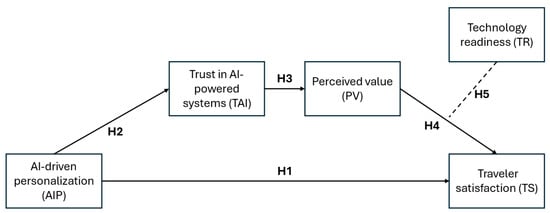
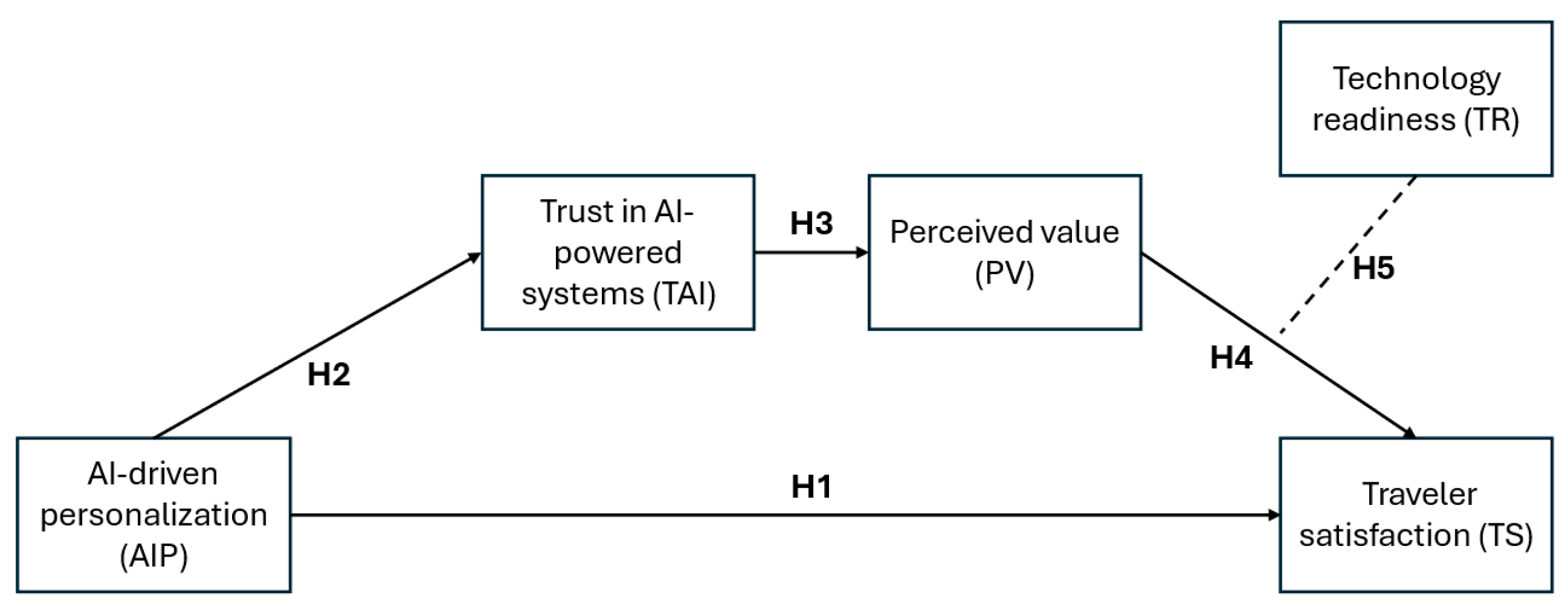
Building on the theoretical foundations and empirical evidence reviewed above, this study proposes an integrated conceptual model that explains how AI-driven personalization is associated with traveler satisfaction through multiple psychological and experiential mechanisms. The model specifies both direct and indirect effects, including trust in AI-powered systems and perceived value as mediating processes, and technology readiness as a boundary condition. By integrating constructs derived from the Technology Acceptance Model, Experience Economy Theory, and Technology Readiness Theory, the proposed framework provides a theoretically integrated representation of how AI-enabled personalization is associated with traveler evaluations and satisfaction outcomes in tourism contexts. The conceptual model is presented in Figure 1. Mediation is specified and tested as a sequential (serial) process, consistent with the theoretical positioning of trust and perceived value as distinct but interrelated mechanisms. This specification reflects the theoretical positioning of trust as a relational mechanism and perceived value as an evaluative mechanism, which operate as distinct but complementary processes that are theoretically positioned as sequential relational and evaluative stages in the post-adoption evaluation process. Technology readiness is modeled exclusively as a moderating boundary condition affecting the relationship between perceived value and traveler satisfaction.
Figure 1.
Conceptual model of AI-driven personalization and traveler satisfaction. Solid arrows represent hypothesized direct relationships among constructs (H1–H4). AI-driven personalization (AIP) is associated with traveler satisfaction (TS) both directly and indirectly through trust in AI-powered systems (TAI), which subsequently influences perceived value (PV) and, in turn, is associated with traveler satisfaction. The dashed arrow indicates the moderating role of technology readiness (TR) on the relationship between perceived value and traveler satisfaction (H5), such that the strength of this relationship varies depending on individuals’ level of technology readiness.
3. Methodology
3.1. Research Design and Study Context
This study adopted a quantitative, cross-sectional research design to examine the associations among AI-driven personalization, traveler satisfaction, and the psychological mechanisms proposed in the conceptual model. A survey-based approach was used to collect primary data from tourists with direct experience of AI-enabled tourism services, enabling systematic measurement of perceptions, evaluations, and behavioral responses.
The study followed a deductive research logic and drew on the Technology Acceptance Model, Experience Economy Theory, and Technology Readiness Theory to test the hypothesized relationships. Given the model’s complexity, which includes multiple mediation and moderation effects, Partial Least Squares Structural Equation Modeling (PLS-SEM) was selected as the primary analytical technique. PLS-SEM is well-suited for predictive research and theory extension involving latent constructs, as well as for the simultaneous estimation of direct, indirect, and moderating relationships (Hair et al., 2022; Henseler et al., 2016), and it has been widely applied in tourism and hospitality studies of digital and AI-enabled services.
The cross-sectional design does not permit causal inference or temporal ordering of effects; rather, it allows the examination of theoretically grounded associations, indirect effects, and conditional mechanisms among constructs. Accordingly, the findings should be interpreted as associational rather than causal, consistent with prior tourism and hospitality research on technology-enabled service experiences (Hair et al., 2022).
The study was conducted in Kosovo, an emerging tourism destination where digital transformation and adoption of AI-powered services are advancing but remain uneven across service providers. This setting provides a relevant empirical context for examining individual-level boundary conditions, as travelers are exposed to heterogeneous AI-enabled service environments that may shape how perceived value is translated into satisfaction depending on their level of technology readiness. By focusing on this context, the study extends AI–tourism research beyond technologically mature markets and enables examination of the proposed relationships under conditions of uneven digital development.
3.2. Sample and Data Collection
Data were collected between January and April 2025 through an online self-administered questionnaire, distributed in collaboration with major online travel agencies and hotels operating in Kosovo that actively use AI-powered digital tools. These service providers shared the survey link with their customers who had recently interacted with AI-enabled services. Participation was voluntary and anonymous, and all respondents were presented with an informed consent statement outlining the study’s purpose, confidentiality assurances, and their right to withdraw at any time. No personal identifiers or contact information were collected or shared with the researchers.
Given the nature of the data collection process, the study employed a non-probability convenience sampling approach through collaborating with hotels and online travel agencies. The survey was distributed to travelers with recent experience of AI-enabled services, ensuring relevance to the study context; however, the study does not claim statistical representativeness of the broader tourist population. The study deemed a minimum sample size of approximately 300 respondents sufficient for the planned multivariate analyses, in line with established guidelines for PLS-SEM. Following data screening and validation procedures, a total of 347 complete and usable responses were retained for analysis, exceeding recommended thresholds for robust estimation of complex structural models. During data screening, incomplete responses and cases exhibiting response patterns indicative of straight-lining or insufficient response variability were removed to ensure data quality. Because the survey was distributed through service providers that actively use AI-enabled tools, the sample primarily reflects travelers with recent exposure to AI-enabled service interactions.
The questionnaire captured both country of residence and nationality to describe the composition of the sample. This distinction was necessary due to the country’s diaspora population, whereby individuals holding Kosovo nationality often reside abroad and return as leisure or visiting friends and relatives’ tourists. Both variables were used exclusively for descriptive and contextual purposes to characterize the sample and support interpretation of travel patterns; they were not included as predictors, moderators, or grouping variables in the structural model.
3.3. Measurement Instrument
The measurement instrument was developed based on previously validated multi-item scales drawn from established literature in tourism, information systems, and service research. All constructs were operationalized using reflective indicators and measured on a seven-point Likert scale ranging from 1 (“strongly disagree”) to 7 (“strongly agree”), consistent with prior empirical studies examining AI-enabled and digital tourism services. All constructs were modeled reflectively, as the observed indicators were specified to capture manifestations of underlying latent variables rather than forming them.
All scale items were contextualized to reflect tourists’ interactions with AI-enabled services, such as personalized recommendations, AI-generated itineraries, automated customer support, and intelligent booking systems. Scale adaptation followed established procedures for applying validated instruments in new technological contexts, with item wording carefully adjusted to reflect AI-enabled tourism services while preserving the original theoretical meaning of each construct. This approach supports content validity while ensuring contextual relevance.
Before the main data collection, the questionnaire was subjected to a pre-testing procedure to ensure clarity, relevance, and contextual appropriateness. A small group of respondents with prior experience using AI-enabled tourism services reviewed the instrument and provided feedback on item wording, comprehension, and length. Minor adjustments were made to improve clarity and ensure that all items accurately reflected the context of AI-driven tourism services. This process helped enhance the content validity and readability of the measurement instrument.
AI-driven personalization (AIP) was measured using items adapted from Xu et al. (2010), capturing the extent to which AI systems deliver relevant, timely, and context-aware recommendations tailored to individual traveler preferences and needs. These items have been widely applied in studies of smart and personalized digital services and are particularly suitable for assessing AI-enabled tourism applications.
Trust in AI-powered systems (TAI) was operationalized using items adapted from Gefen et al. (2003), focusing on travelers’ perceptions of the AI system’s competence, reliability, and benevolence. The study adapted these items to reflect trust in algorithm-driven recommendations and automated service interactions rather than trust in human service providers, in line with recent AI–tourism studies.
Perceived value (PV) was measured using a multidimensional scale adapted from Sweeney and Soutar (2001), capturing both functional and emotional value dimensions relevant to tourism experiences. This approach aligns with Experience Economy Theory and reflects travelers’ overall assessment of benefits derived from AI-enabled services relative to the effort, cost, and potential risks involved.
Technology readiness (TR) was assessed using selected items from Parasuraman’s (2000) Technology Readiness Index, explicitly capturing its four underlying dimensions: optimism, innovativeness, discomfort, and insecurity. In this study, these items were specified as reflective indicators of an overall technology readiness construct, consistent with prior applied research that models technology readiness as a general predisposition toward technology use rather than as separate formative dimensions (Parasuraman & Colby, 2015; Gursoy et al., 2019).
Finally, traveler satisfaction (TS) was measured using items adapted from Chi and Qu (2008), capturing both cognitive and affective evaluations of the overall experience with AI-powered tourism services. This scale has been widely used in tourism research and is well-suited for assessing satisfaction outcomes in technology-mediated service encounters.
All measurement items, construct definitions, and original sources are provided in Appendix A. Before estimating the structural model, the study assessed the measurement model for reliability and validity following established PLS-SEM guidelines; the Results Section 4 reports these assessments.
3.4. Data Analysis Procedure
The study followed a systematic, multi-stage data analysis procedure consistent with established PLS-SEM guidelines (Hair et al., 2022). Given the use of self-reported survey data, procedural and statistical measures were applied to minimize potential common method bias. Procedurally, respondents were assured of anonymity and informed that there were no right or wrong answers. In addition, items were presented using neutral wording and organized to reduce evaluation apprehension and response bias. Statistically, collinearity diagnostics were examined using variance inflation factors (VIFs), with all values below the recommended threshold, indicating that common method variance was unlikely to bias the results. These procedures do not eliminate common method bias but suggest that it is unlikely to substantially affect the observed relationships. While these procedural and statistical remedies help reduce the risk of common method bias, they do not fully eliminate it, and the results should therefore be interpreted with appropriate caution.
The measurement model was evaluated following established PLS-SEM guidelines, focusing on internal consistency reliability, convergent validity, and discriminant validity. Reliability was assessed using Cronbach’s alpha and Composite Reliability, with all constructs exceeding the recommended threshold of 0.70. Convergent validity was confirmed through Average Variance Extracted (AVE) values above 0.50 and significant indicator loadings above 0.60. Discriminant validity was established using the Fornell–Larcker criterion and cross-loading analysis. These results supported the adequacy of the measurement model.
The structural model was assessed using bootstrapping with 5000 resamples. Path coefficients, t-values, and p-values were examined to test the hypothesized relationships. Explanatory power was evaluated using R2 values for endogenous constructs, while predictive relevance was assessed using Q2 values obtained through blindfolding. Model fit was examined using the SRMR index.
Mediation effects were tested using bootstrapped indirect effects with bias-corrected confidence intervals. Hypothesis H4 examined the mediating roles of perceived value in the relationship between trust in AI-powered systems and traveler satisfaction, consistent with the conceptual model specification. In line with the theoretical assumption that trust precedes value evaluation, mediation was specified and tested as a sequential (serial) process. Specifically, the indirect effect AIP → TAI → PV → TS was evaluated, reflecting the sequential mechanism through which AI-driven personalization is associated with traveler satisfaction. Moderation (H5) was tested for the perceived value–traveler satisfaction relationship using an interaction-term approach as the primary method. Multi-group analysis was additionally conducted as a robustness check by comparing high and low technology readiness groups. This combined approach enhances the robustness of moderation assessment while maintaining consistency in model estimation.
4. Results
4.1. Sample Characteristics
A total of 347 valid responses were obtained from domestic and international tourists who had interacted with AI-enabled tourism services in Kosovo. The sample comprised 198 male respondents (57%) and 149 female respondents (43%). The largest age group was 25–34 years old (27%), followed by respondents aged 45–54 years (22%) and 35–44 years (21%). Travelers aged 55 years and older accounted for 22% of the sample, while those aged 18–24 represented 8%. With respect to country of residence, the sample exhibited a strongly international profile. Only 3% of respondents reported residing in Kosovo, while substantial proportions resided in Albania (22%), Turkey (17%), Switzerland (13%), Germany (13%), the United Kingdom (13%), and the United States (11%), with an additional 8% residing in other countries. In contrast, the nationality distribution differed from the residence distribution. Respondents holding Kosovo nationality accounted for 18% of the sample, substantially exceeding the proportion of respondents residing in Kosovo. Albanian nationals represented the largest group (22%), followed by Turkish nationals (16%). Respondents with nationality from the United Kingdom (11%), Switzerland (9%), Germany (9%), the United States (9%), and other countries (6%) were also well represented. The observed difference between country of residence and nationality reflects Kosovo’s diaspora context, where many respondents reside abroad while retaining Kosovo nationality. Regarding travel behavior, 32% of respondents reported traveling for leisure or holiday purposes, 31% for business or work, and 27% to visit friends or family. Nearly half of the respondents (47%) reported visiting Kosovo more than three times, while 34% reported two to three visits and 19% were first-time visitors, indicating a substantial proportion of repeat travelers. With respect to travel party composition, 30% of respondents traveled solo, 29% traveled with family members, and 24% traveled as couples. Senior travelers accounted for 13% of the sample, while group travelers represented 4%. Digital literacy levels indicated moderate to high technological familiarity. Most respondents reported intermediate (49%) or advanced (36%) digital literacy, while 15% reported a beginner level. Table 1 summarizes the key demographic, travel-related, and technology-related characteristics of the sample.
Table 1.
Sample characteristics of respondents.
4.2. Measurement Model Results
The measurement model was assessed using PLS-SEM. Internal consistency reliability was evaluated using Cronbach’s alpha and composite reliability (CR). All constructs exceeded the recommended threshold of 0.70. Convergent validity was assessed using average variance extracted (AVE), and all constructs exceeded 0.50. Standardized outer loadings exceeded 0.60 for all indicators.
Discriminant validity was assessed using the heterotrait–monotrait ratio (HTMT). All HTMT values were below the conservative threshold of 0.85 (Appendix B). Taken together, these results support the adequacy of the measurement model for subsequent structural analysis. Table 2 reports reliability and convergent validity statistics. Appendix A reports the full set of indicator loadings. All constructs were specified as reflective measures, consistent with the measurement model described in Section 3.3.
Table 2.
Measurement model reliability and convergent validity.
4.3. Structural Model Results
After confirming the measurement model, the structural model was assessed using bootstrapping with 5000 resamples. Path coefficients (β), t-values, and p-values were examined for the hypothesized relationships.
AI-driven personalization (AIP) had a positive association with traveler satisfaction (TS) (β = 0.288, t = 4.56, p < 0.001), supporting H1. AIP was also positively associated with trust in AI-powered systems (TAI) (β = 0.384, t = 6.72, p < 0.001), supporting H2. TAI was positively associated with perceived value (PV) (β = 0.419, t = 7.08, p < 0.001), supporting H3. Perceived value (PV) was also positively associated with traveler satisfaction (TS), supporting its role as a key evaluative mechanism in the model. Direct-effect results are reported in Table 3.
Table 3.
Structural model direct effects and hypothesis testing (bootstrapping, 5000 resamples).
H4 was assessed through mediation testing and is reported in Section 4.4. The moderating role of technology readiness (TR) was assessed in Section 4.5 using two approaches. For completeness, Table 3 reports the interaction term PV × TR → TS from the structural model specification used for hypothesis testing (β = 0.174, t = 2.89, p = 0.004), which supported H5.
4.4. Mediation Analysis
Mediation effects were examined using bootstrapped indirect effects with bias-corrected 95% confidence intervals. Mediation was supported when the confidence interval did not include zero. Consistent with the conceptual framework, H4 focused on perceived value (PV) as the mediating mechanism linking trust in AI-powered systems (TAI) and traveler satisfaction (TS).
PV partially mediated the relationships between AIP and TS and between TAI and TS, supporting H4. All reported indirect effects were significant (p < 0.001). Table 4 reports the indirect effects, test statistics, and confidence intervals.
Table 4.
Mediation results (bootstrapped indirect effects; bias-corrected 95% CI).
The indirect path labeled AIP → PV → TS in Table 4 reflects the total indirect effect of AI-driven personalization on traveler satisfaction transmitted through the sequential mechanism AIP → TAI → PV → TS, rather than a direct structural path between AIP and PV.
4.5. Moderation Analysis
The moderating role of TR (H5) was assessed using two complementary approaches: (i) an interaction-term analysis and (ii) multi-group analysis (MGA). The interaction-term analysis showed a significant moderation effect of TR on the PV–TS relationship (β = 0.114, t = 2.96, p = 0.003), indicating that the PV–TS association strengthened as readiness increased (Table 5).
Table 5.
Moderation results (interaction-term analysis; bootstrapping, 5000 resamples).
The MGA, conducted by splitting the sample into low-TR and high-TR groups, showed that the PV → TS path was stronger in the high-TR group (β = 0.604) than in the low-TR group (β = 0.428), with a significant difference (Δβ = 0.176, p = 0.022) (Table 6). These results provide additional support for H5.
Table 6.
Multi-group analysis (MGA) for technology readiness.
Because the interaction-term approach estimates moderation within a single structural model, whereas MGA compares path coefficients across subgroups, coefficient magnitudes differ across approaches; however, the direction and statistical significance of the moderation effect remain consistent.
4.6. Predictive Relevance and Model Fit
Model fit and predictive performance were assessed using the standardized root mean square residual (SRMR), R2, and Q2. The SRMR value was 0.048, indicating a good model fit. The model explained variance in the endogenous constructs, including TS (R2 = 0.621), PV (R2 = 0.574), and TAI (R2 = 0.486). Q2 values obtained via blindfolding were positive for all endogenous constructs, indicating predictive relevance. In particular, TS (Q2 = 0.414) and PV (Q2 = 0.398) showed strong predictive relevance. Table 7 summarizes these indices.
Table 7.
Model fit and predictive relevance.
4.7. Summary of Results
Overall, the structural model supported the direct effects of AI-driven personalization on satisfaction and trust (H1–H2) and the effect of trust on perceived value (H3). Mediation testing supported perceived value as an explanatory mechanism linking trust in AI-powered systems to traveler satisfaction (H4). Moderation tests supported technology readiness as a boundary condition that strengthened the perceived value–satisfaction relationship (H5). Measurement quality, model fit, and predictive relevance indices supported the adequacy of the reported results.
4.8. Robustness Checks
Potential common method bias was assessed using full collinearity variance inflation factors (VIFs). All VIF values were below the recommended threshold of 3.3, indicating that common method bias was unlikely to substantially influence the results. Multicollinearity diagnostics for the structural model also indicated acceptable VIF levels across predictor constructs, suggesting that collinearity did not adversely affect path coefficient estimation.
5. Discussion
This study contributes to understanding how AIP relates to TS through interrelated relational, evaluative, and conditional mechanisms in an emerging tourism context. This section interprets the supported hypotheses by situating them within tourism, information systems, and service experience literature, with emphasis on the psychological processes and boundary conditions that shape travelers’ responses to AI-enabled services.
The direct positive association between AIP and TS (H1 supported) reinforces personalization as an experiential driver in contemporary tourism services. This finding is consistent with prior research showing that tailored digital interactions enhance relevance, reduce information overload, and improve perceived service quality (Makivić et al., 2024; Suanpang & Pothipassa, 2024). In experience-centric tourism settings, personalization enhances perceived relevance and reduces cognitive and decision-related friction, thereby contributing to more engaging and satisfactory service experiences. This pattern supports Experience Economy Theory by showing that personalization contributes to satisfaction through perceived relevance and engagement, not only through functional efficiency. In Experience Economy terms, AIP functions as an experiential input that is positively associated with TS.
The findings also show that AIP was positively associated with TAI (H2 supported), highlighting trust as a foundational mechanism in AI-mediated tourism experiences. This result aligns with research suggesting that personalization signals system competence, benevolence, and contextual intelligence, thereby strengthening confidence in algorithmic services (Glikson & Woolley, 2020; Lopes et al., 2025). In tourism, decision-making often involves perceived risk, uncertainty, and emotional investment, which makes trust particularly consequential. The AIP–TAI association suggests that trust develops not only from technical sophistication but also from the system’s ability to reflect individual preferences and situational needs. This interpretation is consistent with research on algorithmic trust and service automation, which emphasizes explainability cues, transparency signals, and perceived user control (I. P. Tussyadiah et al., 2020; Wirtz et al., 2018). It also aligns with AI-risk perspectives showing that opacity and privacy concerns can suppress trust unless mitigated through disclosure and reassurance mechanisms (Araujo et al., 2020; Pavlou, 2003).
TAI, in turn, was positively associated with PV (H3 supported), confirming trust as an antecedent of value formation in technology-mediated encounters. This finding corroborates prior tourism and service research that positions trust as a precursor to value assessments in digital environments (Chi & Qu, 2008). This finding suggests that travelers are more likely to judge AI-enabled services as beneficial and worthwhile when confidence in the system is established. Importantly, it also clarifies the conceptual distinction between trust and perceived value: trust reflects a relational judgment regarding the system’s reliability and benevolence, whereas perceived value reflects a holistic evaluation of experiential benefits relative to costs. In emerging service environments where service reliability may vary, trust in digital tools can provide a stabilizing reference point that supports positive value appraisals. In practical terms, higher trust is associated with higher perceived value because travelers interpret the benefits of AI-enabled services as more credible and less risky when the system is trusted (Gefen et al., 2003; Koo et al., 2024).
The mediation analyses clarify how AIP relates to TS through experiential appraisal. The findings show that PV mediated the relationship between trust in AI-powered systems (TAI) and traveler satisfaction (TS) (H4 supported), underscoring perceived value as the evaluative mechanism through which trust translates into satisfaction. In addition, the results indicate that AI-driven personalization is associated with traveler satisfaction indirectly through a sequential mechanism (AIP → TAI → PV → TS), in which trust precedes value evaluation in the post-adoption experiential process. These findings suggest that trust and subsequent value appraisal are associated with satisfaction as part of a relational–evaluative sequence, rather than through direct technological attributes alone. In Experience Economy terms, PV reflects experiential appraisal, while TS reflects the resulting experiential outcome. This interpretation contributes to extending Experience Economy Theory by showing how AI-enabled personalization is associated with satisfaction through value co-creation processes in technology-mediated contexts rather than through technological novelty alone. The findings also refine technology-centered perspectives in tourism by indicating that trust functions as a relational mechanism that precedes perceived value as an evaluative mechanism in post-adoption satisfaction. Taken together, the pattern of indirect associations indicates that AI-driven personalization is linked to traveler satisfaction through trust formation, which subsequently enhances perceived value and, in turn, relates to satisfaction within a sequential relational–evaluative pathway.
The moderating role of TR in the PV–TS relationship (H5 supported) further highlights heterogeneity in AI-enabled tourism experiences. Specifically, technology readiness conditions the extent to which perceived value is translated into satisfaction, rather than directly generating value or satisfaction outcomes. Travelers with higher readiness appear better able to internalize and utilize value derived from AI-enabled services, whereas lower-readiness travelers may experience greater difficulty in converting perceived benefits into satisfaction. This finding aligns with research that positions readiness as a boundary condition in digital service evaluations (Lim et al., 2024; Veseli et al., 2025). This pattern also suggests that the effectiveness of personalization depends not only on system quality but also on users’ ability to interpret, trust, and meaningfully engage with algorithmic outputs, which may vary across levels of prior experience and perceived risk tolerance.
Taken together, the findings offer four theoretical contributions to tourism and hospitality research. First, the study contributes to extending technology acceptance perspectives by shifting the analytical focus from adoption-related beliefs toward post-adoption experiential evaluation, demonstrating how AI-enabled personalization is associated with satisfaction outcomes beyond initial technology acceptance. Second, the study integrates relational and evaluative mechanisms by showing that trust in AI systems facilitates perceived value formation, which in turn relates to traveler satisfaction, thereby clarifying the interdependence between trust and value in technology-mediated tourism experiences. Third, the study conceptualizes technology readiness as a boundary condition that explains heterogeneity in experiential outcomes, highlighting that the translation of perceived value into satisfaction varies across individuals with different levels of readiness. Fourth, by focusing on an emerging tourism destination, the study contributes contextual insight by demonstrating how variability in digital maturity and user readiness influences the effectiveness of AI-driven personalization, extending prior findings beyond technologically advanced tourism markets.
From a managerial perspective, the findings suggest that investments in AI-driven personalization should prioritize trust-building and value-enhancing features rather than technological sophistication alone. Tourism operators and destination managers can use personalization to strengthen confidence in AI systems, which can amplify perceived value and traveler satisfaction. Consistent with the sequential mechanism identified in the model, managers should recognize that personalization contributes to satisfaction indirectly by strengthening trust, which in turn enhances perceived value. In practical terms, tourism providers can enhance trust by incorporating transparency cues, user control mechanisms, and reliability signals into AI-enabled services. Enhancing perceived value requires strengthening recommendation relevance, reducing search effort, and minimizing decision complexity, thereby improving the experiential quality of AI-enabled interactions and reinforcing users’ perception of service usefulness and efficiency. In addition, the moderating role of technology readiness suggests that service design should accommodate varying levels of user capability through adaptive interfaces, simplified interaction modes, and accessible support options.
At the same time, the findings should be interpreted with caution. The effectiveness of AI-driven personalization may vary across tourism contexts characterized by different levels of technological infrastructure, service standardization, and user familiarity with AI systems. In addition, while personalization enhances relevance and engagement, it may also raise concerns related to privacy, perceived intrusiveness, and algorithmic opacity, which can potentially limit trust formation and value perception. These considerations suggest that the relationship between personalization, trust, and value may not be uniform across contexts and user segments, highlighting the importance of balancing personalization benefits with transparency and user control.
Overall, the findings suggest that AI-enabled tourism services function as an integrated experiential system in which personalization is associated with trust formation and value appraisal, which together relate to traveler satisfaction, conditional on individual differences in technology readiness.
6. Conclusions
As AI becomes increasingly embedded in tourism service delivery, research must clarify how personalization translates into traveler satisfaction and through which mechanisms and boundary conditions this occurs. This study examined how AI-driven personalization shapes traveler satisfaction in tourism by considering its associations with key relational and evaluative mechanisms and the boundary conditions under which these relationships are interpreted and experienced by travelers. Drawing on an integrated framework combining the Technology Acceptance Model, Experience Economy Theory, and Technology Readiness Theory, the study provides empirical evidence that AI-enabled personalization functions as an experiential capability whose effectiveness depends on trust formation, perceived value, and individual readiness to engage with intelligent technologies. Rather than assuming parallel or independent mechanisms, the findings highlight a sequential post-adoption experiential process in which personalization is associated with traveler satisfaction through trust formation and subsequent value evaluation. By validating this integrated framework in an emerging tourism destination, the study extends AI–tourism research by explaining post-adoption experiential outcomes, not only adoption behavior.
The findings indicate that AI-driven personalization is associated with traveler satisfaction both directly and indirectly through trust in AI systems and subsequently perceived value, with perceived value serving as the primary evaluative mechanism linking trust to satisfaction. Specifically, perceived value mediates the relationship between trust in AI-powered systems and traveler satisfaction, while AI-driven personalization contributes to satisfaction indirectly only through the sequential chain AIP → TAI → PV → TS. Technology readiness further conditions the extent to which perceived value is translated into satisfaction, providing a coherent account of how AI-driven personalization relates to satisfaction through interrelated relational, evaluative, and conditional mechanisms.
This study makes several theoretical contributions to tourism and hospitality scholarship. First, it advances experience-oriented AI research by showing that AI-driven personalization relates to traveler satisfaction through post-adoption experiential mechanisms rather than through adoption intentions alone. This shifts the analytical lens beyond adoption-focused TAM explanations toward post-adoption experiential evaluation of AI-enabled services. Second, it clarifies value formation by demonstrating that perceived value mediates the relationship between trust in AI-powered systems and traveler satisfaction within a sequential relational–evaluative process. Third, it identifies technology readiness as a conditioning variable, indicating that individual predispositions shape the extent to which perceived value is translated into satisfaction. Fourth, by examining these relationships in an emerging tourism destination, the study provides contextual insight into how variability in digital maturity and user readiness influences the effectiveness of AI-driven personalization, extending AI–tourism research beyond technologically mature markets.
The findings yield actionable implications for tourism managers, destination management organizations, hospitality firms, and digital service providers. AI-driven personalization should emphasize relevance, contextual fit, and responsiveness to strengthen satisfaction and trust. Consistent with the sequential mechanism identified in this study, managers should recognize that personalization contributes to satisfaction indirectly by strengthening trust, which in turn enhances perceived value. To enhance perceived value, AI-enabled services should reduce search effort, improve recommendation relevance, minimize decision complexity, and reinforce reliability cues following trust formation. The moderating role of technology readiness suggests that service design should accommodate varying levels of user capability, for example, through adaptive interfaces, simplified interaction modes, and accessible support options. In addition, incorporating transparency cues, user control mechanisms, and optional human support can strengthen trust and facilitate more effective value-to-satisfaction translation across different user segments. Overall, effective AI implementation requires experiential sensitivity, not only technical capability.
Despite its contributions, this study has limitations. The cross-sectional design restricts inference about temporal dynamics. The reliance on self-reported data may introduce common method bias, although diagnostic tests suggest limited risk. The focus on a single-country context limits generalizability to destinations with different institutional or technological environments. In addition, the use of a non-probability sampling approach may overrepresent digitally engaged travelers, and the findings may vary across different AI applications or service contexts.
Future research can extend this work by using longitudinal or experimental designs to examine how trust, value, and readiness evolve with sustained AI use. Comparative studies across destinations with varying levels of digital maturity can test the boundary conditions of the proposed model. Future studies could also examine additional moderators, such as privacy concerns, algorithmic literacy, or explainability perceptions, and incorporate provider-side AI maturity as a contextual factor. Extending the model to include behavioral outcomes such as loyalty, advocacy, or willingness to pay may further clarify AI’s strategic value in tourism.
By demonstrating how AI-driven personalization relates to traveler satisfaction through a sequential relational–evaluative mechanism involving trust, perceived value, and the moderating role of technology readiness, this study provides a theoretically integrated and empirically grounded contribution to tourism and hospitality research. Overall, the study advances understanding of the experiential pathways through which AI-enabled personalization shapes tourism experiences and provides a foundation for future research on relational and evaluative mechanisms in digital service environments.
Author Contributions
Conceptualization, A.V. and A.B.; methodology, A.V. and D.B.; software, A.V.; validation, A.V. and A.B.; formal analysis, A.V.; investigation, A.V. and D.B.; resources, A.V.; data curation, A.V. and D.B.; writing—original draft preparation, A.V.; writing—review and editing, A.V. and A.B.; visualization, A.V.; supervision, A.V. and A.B.; project administration, A.V. All authors have read and agreed to the published version of the manuscript.
Funding
This research received no external funding.
Institutional Review Board Statement
The study was conducted in accordance with the Declaration of Helsinki and approved by the Research Ethics Committee of the University of Applied Sciences in Ferizaj, protocol code pro.no. 363/26, dated 26 February 2026.
Informed Consent Statement
Informed consent was obtained from all subjects involved in the study.
Data Availability Statement
The original contributions presented in this study are included in the article. Further inquiries can be directed to the corresponding author.
Conflicts of Interest
The authors declare no conflicts of interest.
Appendix A
Appendix A provides the full list of measurement items, corresponding constructs, and their original literature sources used for empirical analysis.
Table A1.
Measurement scales and sources.
Appendix B
Appendix B presents the HTMT values used to assess discriminant validity among the study constructs. All HTMT values are below the conservative threshold of 0.85, indicating satisfactory discriminant validity and confirming that the latent constructs are empirically distinct.
Table A2.
HTMT ratio matrix.
References
- Araujo, T., Helberger, N., Kruikemeier, S., & de Vreese, C. H. (2020). In AI we trust? Perceptions about automated decision-making by artificial intelligence. AI & Society, 35(3), 611–623. [Google Scholar] [CrossRef] [Scilit]
- Baptista, G., & Pereira, A. (2025). Understanding the determinants of adoption and intention to recommend AI technology in travel and transportation. Tourism and Hospitality, 6(2), 54. [Google Scholar] [CrossRef] [Scilit]
- Chi, C. G.-Q., & Qu, H. (2008). Examining the structural relationships of destination image, tourist satisfaction and destination loyalty: An integrated approach. Tourism Management, 29(4), 624–636. [Google Scholar] [CrossRef] [Scilit]
- Davis, F. D. (1989). Perceived usefulness, perceived ease of use, and user acceptance of information technology. MIS Quarterly, 13(3), 319–340. [Google Scholar] [CrossRef] [Scilit]
- Florido-Benítez, L., & del Alcázar Martínez, B. (2024). How artificial intelligence (AI) is powering new tourism marketing and the future agenda for smart tourist destinations. Electronics, 13(21), 4151. [Google Scholar] [CrossRef] [Scilit]
- Florido-Benítez, L., & del Alcázar Martínez, B. (2025). The disruptive use of artificial intelligence (AI) will considerably enhance the tourism and air transport industries. Electronics, 14(1), 16. [Google Scholar] [CrossRef] [Scilit]
- Gefen, D., Karahanna, E., & Straub, D. W. (2003). Trust and TAM in online shopping: An integrated model. MIS Quarterly, 27(1), 51–90. [Google Scholar] [CrossRef] [Scilit]
- Glikson, E., & Woolley, A. W. (2020). Human trust in artificial intelligence: Review of empirical research. Academy of Management Annals, 14(2), 627–660. [Google Scholar] [CrossRef] [Scilit]
- Gretzel, U., Sigala, M., Xiang, Z., & Koo, C. (2015). Smart tourism: Foundations and developments. Electronic Markets, 25(3), 179–188. [Google Scholar] [CrossRef] [Scilit]
- Gursoy, D., Chi, C. G.-Q., Lu, L., & Nunkoo, R. (2019). Consumers acceptance of artificially intelligent (AI) device use in service delivery. International Journal of Information Management, 49, 157–169. [Google Scholar] [CrossRef] [Scilit]
- Hair, J. F., Hult, G. T. M., Ringle, C. M., & Sarstedt, M. (2022). A primer on partial least squares structural equation modeling (PLS-SEM) (3rd ed.). Sage Publications. [Google Scholar]
- Henseler, J., Hubona, G., & Ray, P. A. (2016). Using PLS path modeling in new technology research: Updated guidelines. Industrial Management & Data Systems, 116(1), 2–20. [Google Scholar] [CrossRef] [Scilit]
- Hung, V. V., Dey, S. K., Vaculcikova, Z., & Anh, L. T. H. (2021). The influence of tourists’ experience on destination loyalty: A case study of Hue City, Vietnam. Sustainability, 13(16), 8889. [Google Scholar] [CrossRef] [Scilit]
- Koo, I., Zaman, U., Ha, H., & Nawaz, S. (2024). Assessing the interplay of trust dynamics, personalization, ethical AI practices, and tourist behavior in the adoption of AI-driven smart tourism technologies. Journal of Open Innovation: Technology, Market, and Complexity, 10(1), 100455. [Google Scholar] [CrossRef] [Scilit]
- Kosovo Agency of Statistics (KSA). (2025). Statistikat e hotelerise—Dhjetor 2024 [Hospitality statistics—December 2024]. Available online: https://askapi.rks-gov.net/Custom/abd24adf-6474-4dca-98f4-dcf3e578167b.pdf (accessed on 5 January 2025).
- Lim, W. M., Jasim, K. M., & Das, M. (2024). Augmented and virtual reality in hotels: Impact on tourist satisfaction and intention to stay and return. International Journal of Hospitality Management, 116, 103631. [Google Scholar] [CrossRef] [Scilit]
- Lopes, J. M., Massano-Cardoso, I., & Granadeiro, C. (2025). Festivals in age of AI: Smarter crowds, happier fans. Tourism and Hospitality, 6(1), 35. [Google Scholar] [CrossRef] [Scilit]
- Makivić, R., Vukolić, D., Veljović, S., Bolesnikov, M., Dávid, L. D., Ivanišević, A., Silić, M., & Gajić, T. (2024). AI impact on hotel guest satisfaction via tailor-made services: A case study of Serbia and Hungary. Information, 15(11), 700. [Google Scholar] [CrossRef] [Scilit]
- Ministry of Industry, Entrepreneurship, and Trade (MIET). (2024). Action plan 2024–2026 of the tourism strategy. Available online: https://kryeministri.rks-gov.net/wp-content/uploads/2024/07/Action-Plan-2024-2026.pdf (accessed on 9 January 2025).
- Parasuraman, A. (2000). Technology readiness index (TRI): A multiple-item scale to measure readiness to embrace new technologies. Journal of Service Research, 2(4), 307–320. [Google Scholar] [CrossRef] [Scilit]
- Parasuraman, A., & Colby, C. L. (2015). An updated and streamlined technology readiness index: TRI 2.0. Journal of Service Research, 18(1), 59–74. [Google Scholar] [CrossRef] [Scilit]
- Pavlou, P. A. (2003). Consumer acceptance of electronic commerce: Integrating trust and risk with the technology acceptance model. International Journal of Electronic Commerce, 7(3), 101–134. [Google Scholar] [CrossRef] [Scilit]
- Pine, B. J., & Gilmore, J. H. (1999). The experience economy: Work is theatre and every business a stage. Harvard Business Press. [Google Scholar]
- Suanpang, P., & Pothipassa, P. (2024). Integrating generative AI and IoT for sustainable smart tourism destinations. Sustainability, 16(17), 7435. [Google Scholar] [CrossRef] [Scilit]
- Sweeney, J. C., & Soutar, G. N. (2001). Consumer perceived value: The development of a multiple item scale. Journal of Retailing, 77(2), 203–220. [Google Scholar] [CrossRef] [Scilit]
- Šakytė-Statnickė, G., & Budrytė-Ausiejienė, L. (2025). Application of artificial intelligence in the tourism sector: Benefits and challenges of AI-based digital tools in tourism organizations of Lithuania, Latvia, and Sweden. Tourism and Hospitality, 6(2), 67. [Google Scholar] [CrossRef] [Scilit]
- To, W. M., & Yu, B. T. W. (2025). Artificial intelligence research in tourism and hospitality journals: Trends, emerging themes, and the rise of generative AI. Tourism and Hospitality, 6(2), 63. [Google Scholar] [CrossRef] [Scilit]
- Tussyadiah, I. (2020). A review of research into automation in tourism: Launching the annals of tourism research curated collection on artificial intelligence and robotics in tourism. Annals of Tourism Research, 81, 102883. [Google Scholar] [CrossRef] [Scilit]
- Tussyadiah, I. P., Wang, D., Jung, T. H., & Tom Dieck, M. C. (2020). Virtual reality, presence, and attitude change: Empirical evidence from tourism. Tourism Management, 66, 140–154. [Google Scholar] [CrossRef] [Scilit]
- Veseli, A., Hasanaj, P., & Bajraktari, A. (2025). Perceptions of organizational change readiness for sustainable digital transformation: Insights from learning management system projects in higher education institutions. Sustainability, 17, 619. [Google Scholar] [CrossRef] [Scilit]
- Wirtz, J., Patterson, P. G., Kunz, W. H., Gruber, T., Lu, V. N., Paluch, S., & Martins, A. (2018). Brave new world: Service robots in the frontline. Journal of Service Management, 29(5), 907–931. [Google Scholar] [CrossRef] [Scilit]
- Wüst, K., & Bremser, K. (2025). Artificial intelligence in tourism through chatbot support in the booking process—An experimental investigation. Tourism and Hospitality, 6(1), 36. [Google Scholar] [CrossRef] [Scilit]
- Xu, H., Teo, H. H., Tan, B. C. Y., & Agarwal, R. (2010). The role of push–pull technology in privacy calculus: The case of location-based services. Journal of Management Information Systems, 26(3), 135–173. [Google Scholar] [CrossRef] [Scilit]
- Zeithaml, V. A. (1988). Consumer perceptions of price, quality, and value: A means-end model and synthesis of evidence. Journal of Marketing, 52(3), 2–22. [Google Scholar] [CrossRef] [Scilit]

Disclaimer/Publisher’s Note: The statements, opinions and data contained in all publications are solely those of the individual author(s) and contributor(s) and not of MDPI and/or the editor(s). MDPI and/or the editor(s) disclaim responsibility for any injury to people or property resulting from any ideas, methods, instructions or products referred to in the content. |
© 2026 by the authors. Licensee MDPI, Basel, Switzerland. This article is an open access article distributed under the terms and conditions of the Creative Commons Attribution (CC BY) license.