


Abstract
The Meetings, Incentives, Conventions, and Exhibitions (MICE) sector has become a strategic driver of regional economic development, yet secondary cities often lack the structural, governance, and experiential capacities required for competitive MICE positioning. This study proposes and empirically validates a triangulated analytical framework that integrates structural readiness, stakeholder governance capacity, and tourist perceptions to capture systemic misalignments in emerging MICE destinations, going beyond conventional applied readiness assessments. This study evaluates the preparedness of Nakhon Si Thammarat, Thailand, to develop as a sustainable MICE destination using a triangulated mixed-methods design comprising (1) a city readiness assessment based on TCEB’s eight criteria, (2) a survey of 400 tourists and MICE visitors, and (3) in-depth interviews with 20 key stakeholders. The weighted assessment indicated a moderate overall readiness score (3.48/5), with strengths in environmental management, safety, supporting activities, and accommodation. However, MICE venue capacity and city image remained notably weak. Tourists consistently perceived high readiness across most areas, whereas stakeholders highlighted major systemic issues, including fragmented governance, inconsistent MICE service quality, limited capacity for large events, and inadequate transportation integration. Triangulating these viewpoints reveals three analytically distinct preparation gaps—structural, policy implementation, and experience expectations—demonstrating a fundamental misalignment between experiential appeal and institutional capabilities. This study conceptualizes preparedness as a relational outcome impacted by infrastructure, governance procedures, and market perceptions, adding to the MICE destination and governance literature. The methodology can be used to examine comparable misalignments in other emerging or secondary MICE destinations. The findings guide governance-driven MICE city development plans for sustainability and competitiveness.
1. Introduction
The Meetings, Incentives, Conventions, and Exhibitions (MICE) industry has become one of the most dynamic components of the global tourism and service economy, contributing significantly to business travel, urban development, and destination competitiveness (Aburumman, 2020; Calinao et al., 2023; S. Kim et al., 2024; Yao et al., 2024). Beyond its economic impacts, the industry enhances urban attractiveness by improving infrastructure, sanitation, and transportation systems, while stimulating local development through investments in facilities and public utilities (Her, 2008; Rahayu, 2017). As a high-value sector, MICE activities generate substantial economic returns by boosting local spending, attracting foreign investment, and increasing the global visibility of host destinations (Bernini et al., 2021; Rahayu, 2017). Moreover, the integration of MICE projects into broader urban development initiatives has been linked to enhanced public spaces and improved quality of life (Yaralioglu & Kara, 2025). MICE events also strengthen cultural and social capital by supporting cultural tourism and stimulating consumption in cultural and creative industries (Raabová et al., 2013). Several studies further highlight that MICE growth promotes entrepreneurship, job creation, and local economic resilience (Abdullah, 2018; Dalkrani et al., 2025; Her, 2008; Lau et al., 2005). Increasing attention has also been directed toward sustainable MICE practices, particularly environmental education and sustainable event development (Buathong & Lai, 2017).
Within Southeast Asia, Thailand has identified the MICE industry as a strategic economic driver due to its high foreign exchange earnings and capacity to attract high-spending visitors (Campiranon & Arcodia, 2007; Jotikasthira et al., 2016). Under Strategy 2 of the 20-Year National Strategic Plan (2018–2037), the Thai government emphasizes business tourism as a means to strengthen competitiveness, reduce social inequality, and encourage balanced regional development. Thailand’s MICE competitiveness is underpinned by its rich natural and cultural heritage, strong service quality, well-developed infrastructure, and extensive public–private cooperation (Sudharatna & Chetthamrongchai, 2018). Through the Thailand Convention and Exhibition Bureau (TCEB), national policy has expanded MICE city development to include lower-tier cities, fostering more inclusive economic opportunities (Syah et al., 2022). Nonetheless, development across Thailand remains uneven. Secondary cities often lack standardized MICE infrastructure, receive limited destination recognition, and face challenges related to service quality, safety, transportation, and product standards (Jurakanit & Taweepornpatomkul, 2019; Syah et al., 2022).
Recent studies identify Nakhon Si Thammarat as an emerging destination with unique cultural significance, rich religious heritage, and abundant natural resources (Praekpan et al., 2025; Seubsakulajinda et al., 2024). However, most existing research focuses on specific aspects such as general tourism attributes or service readiness, without offering a comprehensive assessment of the province’s MICE potential. Notably, few studies have applied standardized frameworks, including TCEB’s eight criteria, to evaluate structural and operational readiness for MICE development. This gap limits policymakers’ access to evidence-based insights and constrains the province’s strategic positioning in Thailand’s expanding MICE landscape. A further gap lies in methodological approaches. Prior studies in Thailand and other emerging MICE destinations tend to rely on single-method designs, for example, tourist surveys, stakeholder interviews, or document reviews. The lack of triangulated investigation limits the depth, reliability, and generalizability of findings, particularly in secondary cities where MICE development remains less mature. Integrating multiple data sources—readiness assessment, tourist perceptions, and stakeholder governance insights—offers a more robust, multi-dimensional understanding of the complexities shaping MICE destination advancement (Ogunkan & Akinpelu, 2025).
Despite these empirical and methodological limitations, key theoretical debates remain unresolved regarding how destination readiness should be conceptualized and assessed in MICE research, especially in emerging and secondary cities. Much of the existing literature implicitly equates readiness with the availability of physical infrastructure and service facilities, assuming that supply-side improvements will automatically translate into destination competitiveness. However, such linear assumptions overlook the relational and governance dimensions that shape how readiness is enacted in practice. In particular, a persistent tension exists between experiential readiness and governance capacity, as destinations with strong visitor appeal do not necessarily possess the institutional coordination, policy coherence, or strategic capability required to support competitive MICE development.
In response to these unresolved debates, this study conceptualizes readiness as a multi-dimensional and relational construct and proposes a triangulated analytical framework that integrates structural readiness, stakeholder governance capacity, and tourist perceptions. By empirically applying this framework to the case of Nakhon Si Thammarat, Thailand, this study seeks not only to evaluate destination potential but also to advance MICE destination theory beyond applied readiness assessment. Thus, this study offers a transferable conceptual lens for examining governance–experience misalignments in other emerging or secondary MICE destinations.
To address these theoretical and empirical gaps, this study evaluates Nakhon Si Thammarat’s potential and readiness to become a MICE city using a triangulated mixed-methods framework. Three complementary datasets are integrated: a city readiness assessment based on TCEB’s eight criteria (TCEB, 2020), a quantitative survey of tourists and MICE visitors, and in-depth interviews with key stakeholders. This integrated approach enhances methodological rigor and provides a holistic understanding of the province’s strengths, challenges, and development needs. The findings aim to provide evidence-based strategies to strengthen Nakhon Si Thammarat’s competitiveness and support its sustainable transition to become a regional MICE destination.
2. Conceptual Framework
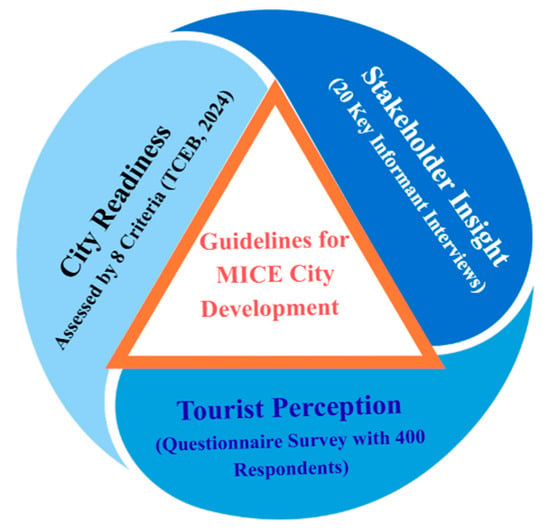
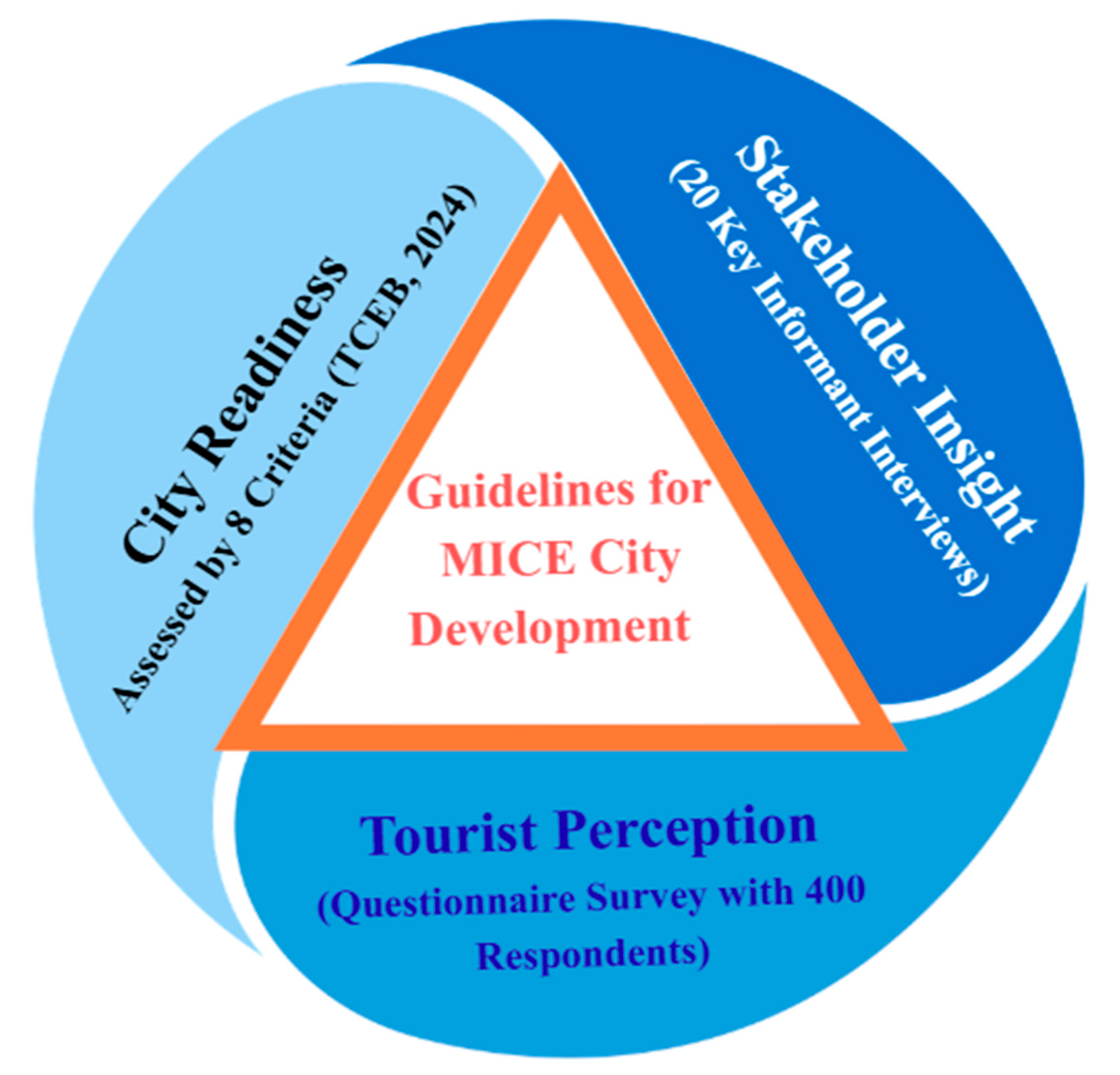
This study develops a triangulation-informed conceptual framework integrating City Readiness, Stakeholder Insights, and Tourist Perception (Figure 1). The framework is based on destination governance theory, which says that multi-actor coordination, institutional capacity, and policy coherence are all important for destination development. This is different from thinking of readiness as just a technical or infrastructural condition.
Figure 1.
Conceptual framework for MICE city development. City readiness is assessed based on the eight criteria of the Thailand Convention and Exhibition Bureau (TCEB, 2024).
Effective destination governance requires the involvement of multiple stakeholders, including local communities, governmental entities, and business sector participants (Zhang et al., 2022). Governance must embrace a holistic approach, acknowledging the interrelations across many sectors and stakeholders (Bono i Gispert & Anton Clavé, 2020; Luongo & Sepe, 2025).
Triangulation is widely recognized as a rigorous strategy for enhancing validity by integrating multiple sources of evidence, enabling the examination of complex phenomena across structural, behavioral, and perceptual dimensions (Marlina et al., 2024; Sciberras & Dingli, 2023). Within this framework, triangulation serves as an analytical strategy to capture the structural, governance, and experiential dimensions of readiness. City Readiness, assessed using TCEB’s eight criteria, reflects the destination’s structural and organizational capacity, as well as the institutional arrangements that enable or constrain MICE development. Stakeholder Insights captures governance dynamics by examining the roles, coordination capacity, and policy coherence among public and private actors, consistent with destination governance theory. Tourist Perception, informed by service-dominant logic, reflects how value is co-created through visitor experiences, service encounters, and perceived destination suitability for MICE activities.
Together, these dimensions form an integrated framework that conceptualizes MICE readiness as a relational and multi-dimensional construct rather than a static supply-side condition. City Readiness establishes the foundational institutional and infrastructural context, Stakeholder Insights explain governance processes that shape implementation feasibility, and Tourist Perception validates how readiness is translated into experiential value. The interaction among these components enables a more theoretically robust understanding of readiness gaps and provides a rigorous analytical basis for examining competitiveness challenges in emerging and secondary MICE destinations.
3. Materials and Methods
This study employed a mixed-methods design that integrated qualitative and quantitative approaches to ensure comprehensive and valid findings.
- Qualitative Research: In-depth interviews were conducted with key informants purposively selected from four major groups of stakeholders: (1) government executives; (2) relevant public agencies; (3) private tourism operators; (4) tourism network representatives in Nakhon Si Thammarat Province.
- Quantitative Research: A structured questionnaire survey was administered to travelers within the MICE (Meeting, Incentive, Convention, and Exhibition) industry, encompassing four business categories. The aim was to collect empirical data reflecting their perceptions of MICE-related potential and readiness.
3.1. Assessment of City Potential for MICE Development
The assessment of Nakhon Si Thammarat’s potential for development as a MICE city followed the evaluation framework of the Thailand Convention and Exhibition Bureau (TCEB, 2020), which comprises eight dimensions and thirty-two sub-indicators. These dimensions cover city accessibility, institutional support, additional activities, accommodation and facilities, venues, city image, safety, and marketing.
Each dimension carries a specific weight according to its relative significance. The evaluation employed the Weighted Sum Model (WSM), a well-established multi-criteria decision-making method. The WSM approach is recognized for its clarity and simplicity, facilitating decision-making and providing actionable insights for improvement (Patlins & Ribickis, 2023; Petasakis et al., 2015). The method evaluates each criterion based on weighted preferences to enhance precision and comparability (Hansun, 2019). The weighted score for each dimension () was calculated from the sub-criteria scores (32 indicators) as shown in Equation (1), and the overall city potential index () was derived from Equation (2).
Equations
- (1)
- Potential Level per Dimension
- = score for dimension j;
- = weight of sub-criterion i under dimension j;
- = rating score (1–5).
Note: The results are combined to obtain the average score for each dimension.
- (2)
- City Potential Level for MICE Development
- = overall potential level of the city for MICE development;
- = weight of dimension j;
- = score of dimension j (derived from Equation (1)).
Note: The results are combined to obtain the city’s overall potential score.
This method has been commonly applied in studies assessing the readiness of emerging MICE cities across Thailand under the TCEB framework (TCEB, 2020) (Table 1). It also aligns with international practices in developing destination competitiveness and tourism-readiness indices, where weighted components provide a coherent, integrated evaluation structure. Therefore, the WSM approach is considered appropriate, reliable, and widely accepted in research on policy formulation, regional development planning, and the assessment of MICE industry potential.
Table 1.
Evaluation criteria and assessment framework.
3.2. Tourist Perception Survey
This study examined MICE travelers visiting Nakhon Si Thammarat Province. The objective was to assess tourists’ perceptions of the province’s readiness to become a Meeting, Incentive, Convention, and Exhibition (MICE) City across eight dimensions (TCEB, 2020):
- Accessibility to the city or meeting venues;
- Support for event organization;
- Supplementary activities beyond meetings;
- Accommodation and facilities;
- Meeting venues and support facilities;
- City image and reputation;
- City safety;
- Risks affecting MICE activities.
The questionnaire underwent validation through the Index of Item–Objective Congruence (IOC), in which all items met the required standards, and reliability testing was conducted prior to field administration. The research project received ethical approval on 25 April 2025 (Approval Number: WUEC-25-135-01). Data collection was conducted in Nakhon Si Thammarat Province using accidental sampling over a three-month period (May–August 2025), yielding a total of 400 respondents. Descriptive statistics were used to summarize tourists’ perceptions of the province’s readiness to become a MICE city.
3.3. Key Informant Interviews
The key informants in this study were representatives from government and private-sector organizations involved in the MICE industry in Nakhon Si Thammarat Province, all of whom held responsibilities for managing and developing the province toward becoming a MICE city. A total of 20 key informants were selected using purposive sampling based on the following criteria:
- Having responsibilities related to the management of the MICE city initiative for at least three years;
- Having a minimum of one year of experience in MICE city project implementation;
- Having resided in Nakhon Si Thammarat Province for at least three years;
- Willingness to voluntarily participate in the study.
General information collected from key informants included their opinions on the province’s potential, readiness, challenges, and obstacles, as well as recommendations for developing Nakhon Si Thammarat into a MICE city.
The gathered data received qualitative analysis. Thematic analysis was employed to analyze and interpret the data through an iterative procedure (Attride-Stirling, 2001). Interview data from 20 key informants were transcribed and compiled into a single transcript. Additionally, practitioner viewpoints were integrated into the data analysis process to improve understanding of the data from an insider’s perspective. Codes were assigned and examined to eradicate duplicate categories. Furthermore, all concepts were reassessed until the iterative process was completed. Results were displayed in tables illustrating data on MICE destination preparedness and management strategies in Nakhon Si Thammarat Province.
4. Results
4.1. Assessment of Potential for Becoming a MICE City Based on TCEB Criteria
The assessment of potential to become a MICE city used the 2020 assessment criteria of the Thailand Convention and Exhibition Bureau (TCEB). The results across all eight dimensions, as shown in Table 2, are summarized below.
Table 2.
Weighted scores of sub-criteria by dimension (T1–T8).
The accessibility (T1) dimension scored 3.60, indicating that the city’s transportation systems and travel-related infrastructure are at a satisfactory level for accommodating visitor access. Support for MICE event organization (T2) also scored 3.60, reflecting adequate collaboration among relevant agencies; however, a stronger role for local organizations is needed to enhance the city’s MICE development capacity. Supplementary activities beyond meetings (T3) received a high score of 4.00, demonstrating that the city offers diverse, high-quality tourism activities, a key strength in attracting MICE events.
Accommodation and facilities (T4) scored 3.85, indicating a sufficient supply and quality of accommodation and services to support MICE participants. In contrast, the MICE venue dimension (T5) received the lowest score among the eight dimensions at 2.60. This reveals significant limitations in large-scale convention facilities, which may reduce the city’s competitiveness relative to other MICE destinations. City image and reputation (T6) scored 2.57, also a relatively low level, suggesting that the city is not yet widely recognized as a MICE destination and requires strategic branding and positioning. Safety and risk management (T7) scored 4.20, indicating high levels of confidence in safety measures, emergency preparedness, and risk management systems.
Finally, marketing and information accessibility (T8) achieved the highest score at 4.40, reflecting strong performance in communication, public relations, and the accessibility of MICE-related information.
In summary, Nakhon Si Thammarat Province demonstrated strengths in supplementary activities, safety, and marketing. In contrast, its main weaknesses lie in meeting venues and the city’s image, both of which require urgent improvement to enhance the province’s long-term potential as a sustainable MICE destination.
Overall Potential for Becoming a MICE City Based on TCEB Evaluation Criteria
The assessment of city potential across the eight MICE city criteria yielded an overall score of 3.48 out of 5, indicating that Nakhon Si Thammarat possessed a moderate to moderately high level of potential (see Table 3). The findings suggested that the province was capable of supporting MICE development to a certain extent. The highest-scoring dimensions were risk and environmental management (4.40) and safety (4.20), reflecting strong readiness in environmental management, risk reduction, and traveler safety, essential components of a resilient MICE destination. These were followed by supplementary activities (4.00) and accommodation and facilities (3.85), indicating that the city offered suitable attractions and supporting activities that enhanced the overall MICE experience. However, the assessment also identified significant limitations in meeting venues (2.60) and city image and reputation (2.57), the two lowest-scoring dimensions. Despite being critical factors influencing MICE destination decisions, both scored below the standard threshold, contributing to the relatively lower overall weighted score. These dimensions represented priority areas requiring urgent improvement to strengthen the city’s competitiveness within the MICE sector.
Table 3.
Potential level of Nakhon Si Thammarat Province as a MICE city.
When compared with the minimum threshold set by the Thailand Convention and Exhibition Bureau (TCEB), the results showed that Nakhon Si Thammarat had not yet met the overall standard for MICE city certification. The overall score of 3.48 fell slightly below the minimum requirement of 3.50. Although the gap was small, it highlighted the need for targeted improvements in certain key areas. Further examination of sub-criteria scores revealed that several components fell below TCEB’s minimum requirement of 3.00, specifically meeting venues (2.60) and city image and reputation (2.57). These weaknesses substantially reduced the overall potential score and posed key obstacles to achieving MICE city certification. Conversely, the dimensions of risk and environmental management, safety, and supplementary activities exceeded the benchmark by a wide margin, demonstrating notable strengths that could be leveraged to further advance the province’s MICE development. To meet TCEB’s certification requirements in the future, it is essential for Nakhon Si Thammarat to prioritize improvements in meeting venue quality and to strengthen city branding and visibility in a more concrete and strategic manner.
4.2. Tourist Perception of the Readiness of Nakhon Si Thammarat Province to Become a MICE City
4.2.1. General Information of Tourists
This study comprised 400 respondents whose demographic characteristics reflect a well-distributed and academically oriented sample. The gender composition was balanced, and most participants were within the productive working-age range of 31–50 years, suggesting that the insights were drawn from individuals with substantial professional engagement. A large majority held at least a bachelor’s degree, with notable representation from the education sector and government agencies commonly involved in tourism, policy implementation, and regional development. More than half of the respondents had less than five years of work experience. At the same time, a considerable proportion possessed long-term professional experience, indicating a mix of early-career and seasoned practitioners. Most respondents reported monthly incomes between THB 15,000 and 20,000. Regarding prior awareness, familiarity with MICE city assessments varied; 40% reported no prior knowledge, highlighting the need for enhanced public communication regarding MICE development frameworks.
4.2.2. Tourist Perception of the Readiness of Nakhon Si Thammarat Province
The descriptive results indicated consistently high levels of perceived readiness across all eight MICE dimensions, with mean scores ranging from 4.24 to 4.42 (very high) (see Table 4). Respondents rated transportation accessibility, institutional support, and supporting activities positively. Accommodation, MICE venues, and safety achieved some of the highest scores, reflecting strong capacity, service quality, and well-established safety management. City image and reputation were also viewed favorably, supported by respondents’ confidence in the province’s previous MICE experiences. Risk and environmental management received similarly strong evaluations, suggesting adequate preparedness and effective sustainability practices. Overall, these findings highlighted Nakhon Si Thammarat’s broad strengths across infrastructure, service systems, safety, and environmental governance, underscoring its strong potential to develop as a competitive MICE city.
Table 4.
Tourists’ perception levels of the readiness of Nakhon Si Thammarat Province.
4.3. Opinions from Government Agencies and Private-Sector Stakeholders
Based on in-depth interviews with 20 key informants, which explored their perspectives on the province’s potential, readiness, challenges, and obstacles, as well as their views on strategies for preparing Nakhon Si Thammarat Province to become a MICE city, the findings are summarized as follows (Table 5):
Table 5.
Opinions of key informants.
4.3.1. Potential of Nakhon Si Thammarat Province
Interview findings revealed that Nakhon Si Thammarat possessed outstanding foundational potential for development as a MICE city. The province demonstrated notable readiness in event venues, including capacity, exhibition spaces, and special-event locations, with an increasing number of venues meeting required standards. In addition, the province was enriched with a unique cultural identity, historical heritage, and diverse natural resources, all of which enhanced the experiential value for MICE participants and created clear differentiation from other destinations. The province’s overall climate and environmental conditions were also assessed as suitable for year-round activities.
4.3.2. Readiness to Become a MICE City
The province’s systemic readiness was acknowledged by key informants, who highlighted evident collaboration among government agencies, the private sector, academic institutions, and local entrepreneurs. Each group played an essential role in advancing MICE development within the city. Government agencies conducted regular inspections and monitoring to maintain safety standards for accommodation and event venues, while private operators continued to invest in technologies to enhance safety levels. Furthermore, the province had established city-level risk and disaster management plans, which, although not yet fully comprehensive, formed a critical foundation for systematic progress toward becoming a MICE city.
4.3.3. Challenges and Obstacles in Becoming a MICE City
Despite its strong potential and considerable readiness, the province still faced several critical gaps that hindered its progress toward becoming a fully developed MICE city. One major issue was the absence of clear service standards for MICE-related operations. Informants noted that “no conclusive information exists” regarding the number of hotels or resorts meeting required standards or the province’s official capacity to accommodate MICE participants. This lack of clarity prevented the province’s infrastructure potential from being fully translated into effective service capability. Additionally, the city’s risk-management system had yet to be fully integrated, a centralized database on operator capacity was lacking, and the number of specialized MICE professionals remained limited. These limitations required careful attention to ensure sustainable, well-coordinated development.
4.3.4. Guidelines for Preparing Nakhon Si Thammarat Toward Becoming a MICE City
Based on the information obtained, informants suggested that the province should develop a provincial-level MICE service standard framework aligned with TCEB guidelines to continuously enhance the quality of operators and event venues. They also recommended establishing a dedicated provincial MICE taskforce to integrate operations across government agencies, the private-sector, and academic institutions. Developing specialized MICE personnel through targeted training programs and collaborations with educational institutions was considered essential. Furthermore, informants emphasized the need to strengthen the province’s risk-management system to ensure greater comprehensiveness and integration. They also recommended developing a distinctive branding strategy, “Nakhon Si Thammarat MICE Experience,” that highlights the province’s cultural and natural identity to position Nakhon Si Thammarat more competitively in both national and international MICE markets. Together, these guidelines would enable the province to transform its existing potential into genuine readiness and support its sustainable progression toward becoming a fully developed MICE city.
4.4. Triangulated Findings
The triangulated analysis across the TCEB 8-criteria assessment, tourist perceptions, and key informant insights revealed a consistent pattern: Nakhon Si Thammarat demonstrated strong experiential and cultural strengths but lacked several structural, infrastructural, and governance components required for full MICE city readiness. While tourists expressed high satisfaction across nearly all dimensions, and the TCEB assessment acknowledged considerable progress in several areas, key informants offered a more critical, operationally grounded perspective, identifying gaps not fully captured by quantitative scores.
First, city accessibility appeared adequate from the tourists’ viewpoint and moderately positive in the TCEB assessment; however, stakeholders highlighted significant limitations, most notably the shortage of direct flights, insufficient public transportation, and the absence of an integrated mobility system. This suggested a functional–experiential gap: tourists perceived access as satisfactory, yet industry operators considered the current infrastructure insufficient to support large-scale MICE traffic.
Second, although government and private-sector support received strong scores in both the TCEB evaluation and tourist perceptions, key informants reported challenges related to inter-organizational coordination, fragmented policy execution, and limited continuity in strategic planning. This indicated a policy–implementation gap: formal support structures existed, but operational mechanisms remained weak, inconsistent, or siloed.
Third, in the dimensions of supporting activities, accommodation, city safety, and environmental management, triangulation showed strong convergence: all three data sources identified these as core strengths of Nakhon Si Thammarat. However, key informants cautioned that although these assets supported tourism in general, they had not yet been systematically adapted or packaged to meet MICE-specific expectations. This highlighted a general tourism–MICE specialization gap, underscoring the need for targeted product development tailored to corporate and professional event markets.
The most substantial divergence emerged in MICE venues and the city’s image and reputation. Although tourists and TCEB assessments offered moderate to high ratings, stakeholders unanimously identified these as the city’s most critical weaknesses. The absence of a modern, high-capacity convention center and insufficient branding as a MICE destination constituted structural barriers that prevented the province from competing with established MICE hubs. This revealed a strategic capacity gap: the city had cultural and experiential appeal but lacked the core facilities and international positioning essential to MICE competitiveness.
Overall, triangulation showed that tourists’ perceptions were overwhelmingly positive, emphasizing experiential strengths; the TCEB assessment recognized foundational readiness while identifying several structural gaps; and stakeholders exposed deeper systemic challenges in coordination, branding, infrastructure, and event-specific facility development. Collectively, these insights underscored that while Nakhon Si Thammarat was well-positioned as an emerging MICE destination, targeted strategic investment, policy integration, and infrastructure upgrades were essential to closing readiness gaps and achieving sustainable MICE city status.
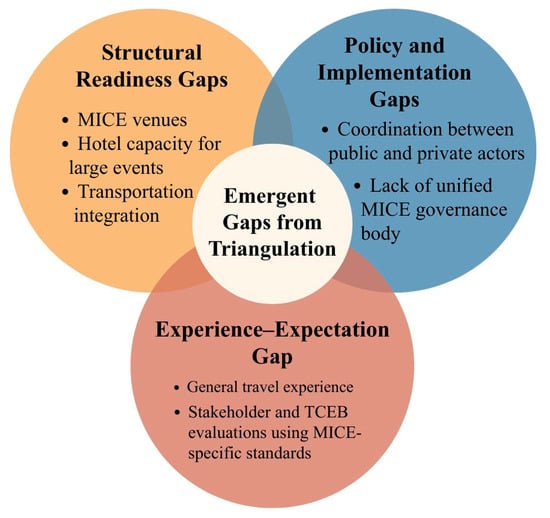
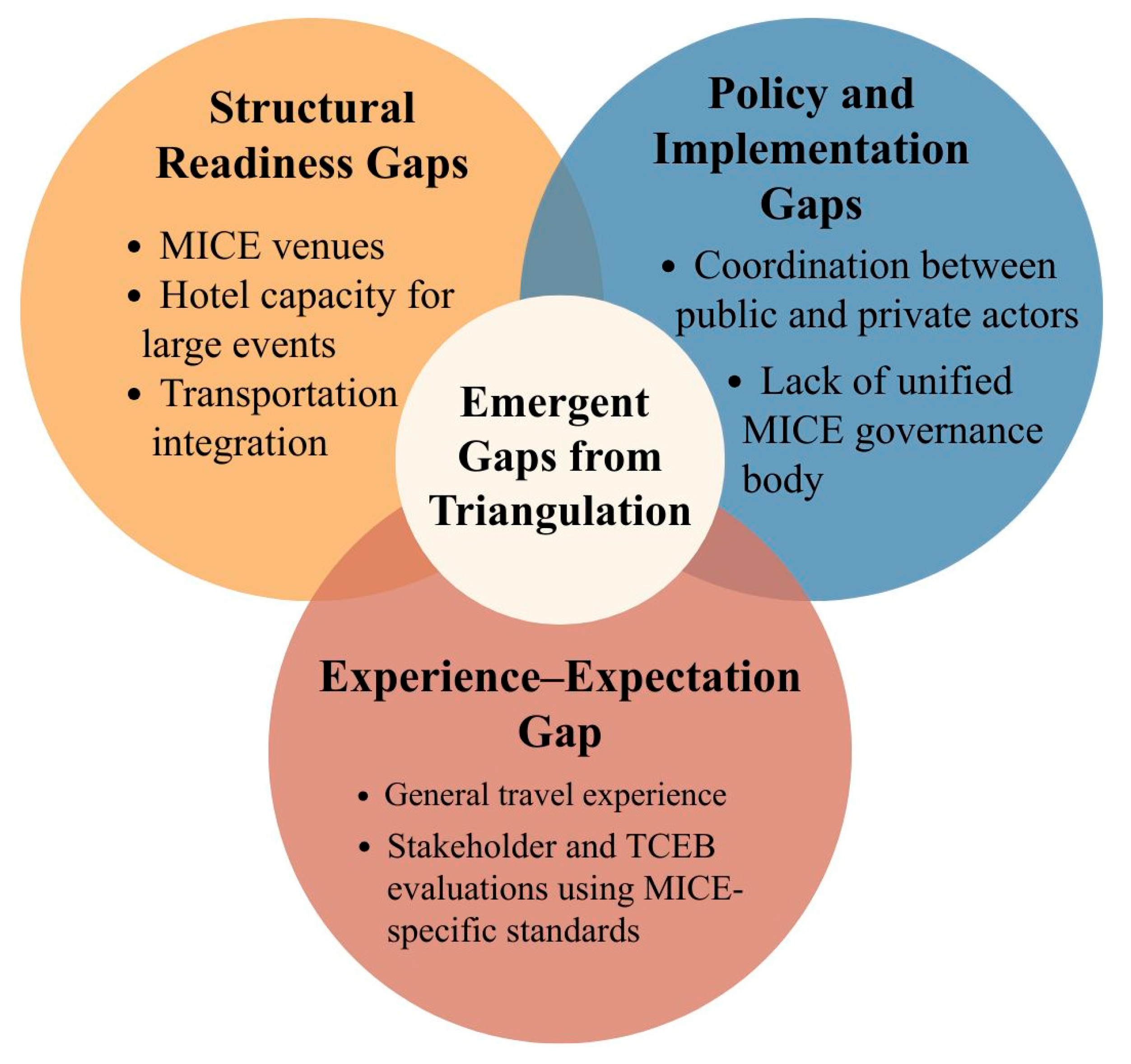
As shown in Table 6, three major categories of gaps were identified:
Table 6.
Triangulated evaluation of MICE city readiness across eight TCEB dimensions: assessment, tourist perception, and stakeholder insights.
- Structural Readiness Gaps: These involve core infrastructure needed for MICE operations, including:
- (1)
- MICE venue capacity;
- (2)
- Insufficient hotel rooms for large events;
- (3)
- Weak integration of transportation systems.
These gaps were strongly emphasized by TCEB and stakeholders but were least evident in tourist perceptions. - Policy and Implementation Gaps: These relate to weaknesses in institutional coordination and strategic management, such as:
- (1)
- Fragmented collaboration among public and private actors;
- (2)
- The absence of a unified MICE governance body;
- (3)
- Discontinuous long-term planning.
- Experience–Expectation Gaps: These stem from differing evaluation criteria:
- (1)
- Tourists assessed readiness based on general travel experiences;
- (2)
- Stakeholders and TCEB applied MICE-specific standards.
This mismatch created differing perceptions of actual readiness.
Overall, the findings indicated that Nakhon Si Thammarat is experientially strong but structurally underprepared. To progress toward competitive MICE city status, the province must prioritize improvements in venues, governance, branding, and integrated transport (Figure 2).
Figure 2.
Three major types of gaps emerging from triangulation.
5. Discussion
5.1. Potential and Readiness for Becoming a MICE City
The findings indicate suggest that Nakhon Si Thammarat’s readiness to become a MICE city cannot be adequately explained by physical infrastructure or experiential assets alone, but rather through the interaction among structural capacity, governance effectiveness, and perceived destination value. This interpretation aligns with emerging debates in MICE destination development that question linear assumptions equating resource endowment with competitiveness.
The triangulated results indicated that Nakhon Si Thammarat possessed a mix of structural strengths and systemic limitations that collectively shaped its progress toward becoming a competitive MICE destination. Consistent with prior studies, core components such as accessibility, venue facilities, and accommodation played central roles in influencing MICE destination selection. Adequate hotel infrastructure—ranging from luxury to budget options—and purpose-built event facilities were particularly important in attracting corporate travelers and hosting large-scale events (Gómez & Carrillo, 2023; Klinmalai & Kaewlai, 2024).
The results also highlighted the province’s strong experiential assets. Its cultural heritage, religious sites, and natural landscapes are aligned with the literature that emphasizes the value of unique cultural identity in enhancing destination attractiveness (Ciuffreda & Simonetti, 2024). High levels of tourist satisfaction in safety and environmental conditions reinforced the province’s experiential appeal. The growing importance of sustainability in MICE tourism—such as eco-friendly venues, environmental management, and green event standards—further underscores opportunities for differentiation (An et al., 2021; Chan, 2023).
However, competitiveness was not determined solely by resource endowments. Governance efficiency, stakeholder coordination, and long-term strategic direction played equally critical roles. Consistent with destination governance theory, effective MICE development required coherent governance structures and integrated decision-making pathways (Bregoli & Del Chiappa, 2013). Yet, Nakhon Si Thammarat demonstrated fragmented coordination, limited institutional integration, and a lack of a dedicated MICE governance body. This fragmentation impeded policy execution and made it difficult for the province to translate potential into operational readiness. As argued by Chaperon (2017); Erdmenger and Kagermeier (2021), strengthening local governance capacity and tailoring governance models to contextual needs were essential.
Clear structural readiness gaps also emerged. Deficits in MICE venue capacity, limited hotel scale for large events, and inadequate transportation integration reflected weaknesses in “hard” capabilities. International examples—such as Bilbao’s Euskalduna Palace—illustrated how modern, fully accessible convention facilities functioned as key anchors for successful MICE cities (Rodríguez-Zulaica & Ara, 2018). Likewise, high-quality event spaces, parking facilities, and F&B services had significant impacts on organizer and participant satisfaction (S. Kim et al., 2024).
Overall, the findings demonstrated that potential did not equateto readiness. While Nakhon Si Thammarat had abundant cultural and environmental resources, its governance, strategic coordination, and capability alignment required significant strengthening. For the province to become competitive in the MICE industry, it needed to address governance fragmentation, institutionalize MICE-specific standards, and upgrade both structural and experiential capacities. Aligning governance structures with capability development remained essential for achieving sustainable MICE status.
5.2. Developing a Sustainable MICE Destination
The importance of eco-friendly venues, accessibility, and inclusiveness (e.g., disabled access) has become increasingly recognized in global MICE standards (An et al., 2021). Sustainable MICE development requires balancing economic performance with social and environmental considerations, ensuring that benefits are extended to local communities (Chan, 2023). The triangulated findings suggested that Nakhon Si Thammarat required more than infrastructural expansion; it needed comprehensive reforms in governance, service quality, and destination marketing.
Green event practices, including waste reduction, energy and water conservation, and sustainable procurement, were essential components of long-term MICE viability (Chang & Chang, 2022; M. Kim et al., 2020). Technological readiness also played a significant role. Post-COVID-19 advancements, including hybrid event technologies, digital event management systems, and VR/AR tools, have become essential for modern MICE competitiveness (Hagen et al., 2025; Minohara et al., 2025; Sah et al., 2025; Tirtawati et al., 2024). Information and communication technologies further enhanced linkages between MICE events and local economic development (Lau et al., 2005).
Examples from established MICE destinations, such as Bali, showed that robust infrastructure must be complemented by technological and logistical upgrades (Tirtawati et al., 2024). For Nakhon Si Thammarat, policy and implementation gaps made sustainable development even more challenging. Integrated planning and policy coherence required establishing a dedicated MICE-focused entity, similar to a Destination Management Organization (DMO). Collaboration among government agencies, event organizers, educational institutions, and local communities was crucial for optimizing MICE potential (Rumerung et al., 2024).
Furthermore, the province needed to professionalize its service workforce, institutionalize MICE service standards, and develop specialized products tailored to corporate and business event markets. Japan’s updated MICE environmental guidelines, which incorporated carbon management and life-cycle assessment (LCA), offered useful benchmarks (Kitamura et al., 2020).
5.3. Triangulated Findings and Strategic Implications
Triangulation provided a multi-angle understanding of destination readiness by comparing quantitative assessment scores, tourist perceptions, and stakeholder insights (Heath, 2015; Sánchez-Gómez et al., 2016; Sciberras & Dingli, 2023). As shown in the triangulated findings, Nakhon Si Thammarat’s progress toward MICE readiness was shaped by interrelated structural, institutional, and experiential factors.
From the perspective of institutional theory, gaps in governance—such as fragmented coordination, inconsistent standards, and weak strategic integration—reflected misalignment among regulative structures (TCEB criteria), normative expectations (stakeholder responsibilities), and cognitive perceptions (tourist satisfaction). This institutional misalignment created implementation inertia, hindering the transformation of potential into operational capability.
Applying service-dominant logic (SDL), the findings suggested that value creation in MICE destinations depended on co-creation among multiple actors rather than on physical infrastructure alone. Tourists’ highly positive perceptions highlighted strong experiential value, whereas stakeholders emphasized the need to improve venue standards, develop human capital, and integrate systems. This divergence supported the existence of an experience–expectation gap.
From a destination-governance standpoint, structural readiness gaps—limited venue capacity, insufficient hotel scale for large events, and weak transport integration—underscored the importance of coordinated investment guided by a unified governance body. Effective MICE governance requires platforms for joint planning, shared decision-making, and continuous communication among government agencies, businesses, academia, and community groups.
The triangulated model pointed to three strategic priorities:
- Strengthening institutional alignment through the establishment of a dedicated MICE governance body;
- Enhancing service co-creation capabilities by professionalizing the workforce and standardizing service quality;
- Addressing structural bottlenecks through targeted investments in venues, transportation, and technology integration.
Addressing these interlinked gaps would enable Nakhon Si Thammarat to transition from a high-potential destination to a genuinely competitive and sustainable MICE city.
5.4. Guidelines for Developing Nakhon Si Thammarat into a MICE City
Based on the findings, the following strategic directions emphasize strengthening infrastructure, improving governance integration, standardizing service quality, developing human capital, promoting sustainability, and enhancing destination branding. Aligning the perspectives of TCEB, tourists, and stakeholders will help convert existing strengths into a more competitive and resilient MICE ecosystem.
5.4.1. Strengthen MICE Infrastructure and Venue Capacity
Hybrid events are a great idea for future MICE events because they blend in-person and virtual parts (Lekgau & Tichaawa, 2022; Singh & Deri, 2024). Nakhon Si Thammarat should prioritize improving MICE-specific infrastructure, particularly modern hotels and large-capacity meeting and convention spaces. This includes upgrading venue technology and improving mobility by better integrating local transportation. Investments in smart mobility and durable event infrastructure will support long-term competitiveness and environmental performance.
5.4.2. Establish a Unified MICE Governance Structure
The unitary board approach in mutual fund governance, characterized by a single board supervising all funds, has demonstrated efficacy in minimizing fees and enhancing stewardship (Kong & Tang, 2008). A comparable strategy may prove advantageous for the MICE sector, in which a central controlling authority oversees all events and activities to ensure uniformity and efficiency. The formation of councils or committees can improve information dissemination, capacity building, and collaboration on recovery. A single coordinating body, such as a Provincial MICE Development Office or MICE City Steering Committee, should be created to align policies, planning, and implementation across government agencies, private actors, and academic institutions. Clear goals, long-term planning, and coordinated decision-making processes can reduce fragmentation and ensure consistent progress.
5.4.3. Develop a Standard Framework for MICE Service Quality
The province should establish local MICE service standards aligned with TCEB guidelines to address quality inconsistencies identified by stakeholders. This includes certifying hotels, venues, and service providers; offering MICE-specific training; and implementing continuous quality-assurance systems. A centralized database of certified suppliers would enhance organizers’ confidence and strengthen the city’s competitiveness in event bidding. According to Taha and Nee Ng (2019); Tseng et al. (2017), it is necessary to conduct an exhaustive review of the current literature and frameworks to identify the essential characteristics of service quality relevant to the MICE business.
5.4.4. Enhance Human Capital and Build a Talent Pipeline
Developing a skilled workforce is vital for destination success. Human capital development requires on-the-job training, traditional or virtual classroom instruction, mentoring, and coaching (El-Ouali & Jellouli, 2024). The province should collaborate with universities, vocational institutions, and TCEB to provide MICE upskilling and reskilling programs. Creating a talent pipeline through student engagement, professional certification, and experiential learning will strengthen the service ecosystem and enhance value co-creation.
5.4.5. Strengthen Risk Management and Environmental Sustainability
Given the province’s exposure to natural disasters, event risk management and sustainability practices should be systematically integrated into local governance. This includes emergency response planning, climate-adaptation strategies, waste and energy management, and adherence to green event standards such as ISO 20121: Event sustainability management systems (ISO, 2012). Embedding sustainability into operations aligns with global tourism standards and en hances resilience.
5.4.6. Build a Distinct MICE Destination Brand
A strong identity, such as “Nakhon MICE Experience,” can leverage the province’s cultural, religious, and natural assets to create a unique value proposition. Integrated marketing efforts, targeted promotions, and cooperation with neighboring destinations can strengthen regional positioning. Branding should highlight authenticity, safety, sustainability, and rich experiential offerings.
5.4.7. Develop an Integrated Digital Information and Intelligence System
According to Karnauhov et al. (2025), big data and AI technologies are essential for handling large volumes of data and providing actionable insights, thereby maintaining the competitiveness of the MICE industry. To address information gaps, the province should establish a public MICE information platform containing data on venues, hotels, service providers, transportation, events, and sustainability certifications. A coordinated data system will improve monitoring, planning, event bidding, and evidence-based policymaking.
6. Conclusions and Recommendations
6.1. Conclusions
This study offers a comprehensive evaluation of Nakhon Si Thammarat’s preparedness to develop as a MICE city by triangulating structural assessments, visitor perceptions, and stakeholder insights. The province exhibits robust experiential assets, especially in accommodation quality, safety, environmental conditions, and destination identity. The findings enhance theoretical understanding of MICE readiness as a relational condition shaped by the interplay between experiential appeal and institutional governance capacity.
This study enhances MICE destination research by demonstrating that triangulated analysis uncovers enduring discrepancies between visitor perception and governance capacity, hence questioning linear assumptions that correlate pleasant tourist experiences with destination preparedness. The suggested three-dimensional framework (readiness–governance–perception) provides a theory-driven method for analyzing readiness beyond simple infrastructure evaluations. Despite being empirically grounded in a single example, this study’s findings are applicable to other emergent and secondary MICE destinations that have significant experiential allure but face limited institutional coordination. The framework offers a versatile analytical perspective that may be tailored to various situations by adjusting readiness indicators, stakeholder arrangements, and perception metrics to suit local circumstances.
The findings indicate a strategic necessity to transition from supply-driven to governance-driven MICE development models, underscoring the importance of institutional coordination, service standardization, and capacity alignment. This study demonstrates that converting experience potential into competitive MICE positioning requires both infrastructure investment and ongoing governance reform, offering theoretical and practical insights relevant beyond the Thai context.
6.2. Recommendations
6.2.1. Strengthening Structural MICE Infrastructure
While the province demonstrates strong potential in accommodations and related facilities, structural gaps remain a major barrier, particularly the shortage of large-scale meeting venues, international-standard convention centers, and an integrated intra-city transportation system capable of supporting medium- to large-scale MICE events. It is essential to accelerate the development of new event venues, upgrade technology and safety systems, and improve transport networks to ensure seamless mobility for participants. These improvements will significantly enhance the city’s competitiveness within Thailand and across the ASEAN region.
6.2.2. Establishing Integrated MICE Governance Mechanisms
A key weakness lies in the policy–implementation gap, evident in fragmented operations across public agencies, private enterprises, and academic institutions, as well as the absence of a dedicated body to coordinate MICE development. The province should establish a MICE Coordination Body, such as a Provincial MICE governance body or MICE Committee, to integrate information, policy, planning, marketing, and bidding processes under a unified strategic direction. Additionally, developing short-, medium-, and long-term MICE policies will help ensure continuity and reduce redundancy across relevant agencies.
6.2.3. Professionalization and Service Quality Enhancement
Qualitative data indicate a clear service-quality gap. Although tourists evaluate services positively, MICE services require greater specialization and standardized procedures. The province must therefore establish a Provincial MICE Service Standard Framework covering venue standards, event organizers, equipment providers, and sustainable event guidelines (Green MICE). Workforce development should be accelerated through professional training, co-designed curricula with universities, and the creation of a Young MICE Talent Program to cultivate a skilled labor force capable of meeting international market demands.
6.2.4. Integrated Risk and Environmental Management
Although the province has strong environmental and safety fundamentals, its risk-management system remains incomplete, particularly regarding natural disasters such as floods and storms, and waste generated by MICE events. The province should strengthen safety systems and develop a comprehensive risk-management plan, including tools such as a MICE Safety Index, an Early Warning System, and Green Event Guidelines. These measures will improve stakeholder confidence and align with global trends in sustainable event management, which are increasingly required by contemporary organizers.
6.2.5. Developing a Distinctive MICE Identity and Experience
Nakhon Si Thammarat’s cultural heritage, spirituality, and natural resources provide a strong foundation for developing a unique MICE identity. The province should create a “Nakhon Sri Thammarat MICE Experience” brand that integrates local wisdom, cultural arts, and community ways of life with modern MICE infrastructure. This may include immersive cultural programs, spiritual tourism formats (Spiritual MICE), or community-based MICE experiences. Such models help bridge the experience–expectation gap between general tourism perceptions and MICE-specific evaluation criteria, allowing the province to differentiate itself from other destinations and enhance global competitiveness.
7. Limitations and Suggestions for Future Research
This study has some limitations. First, the readiness evaluation was based on the TCEB framework, which is widely used in Thailand but may not fully reflect Thailand’s competitiveness in the global MICE market. For example, it did not include any comparable indicators from other MICE cities worldwide. Second, tourists’ perceptions were based on their general travel experiences rather than on their involvement in MICE events. These variables could lead to an overestimation of experiential preparedness and a bias in the measurement. Lastly, this study presents a cross-sectional picture of readiness; MICE development is constantly evolving, so future research should use longitudinal or multi-city comparative designs to examine how MICE development changes over time and how external factors such as policy changes, economic conditions, and new technologies affect it.
Future studies could advance theoretical progress by broadening the proposed framework beyond a single case. Comparative analyses of emergent or secondary MICE destinations would improve analytical generality, while longitudinal evaluations might document the evolution of preparation in response to changes in governance and policy. Furthermore, model-testing methodologies may be used to experimentally corroborate the interrelationships among structural readiness, governance capacity, and experiential perception, thereby advancing cumulative theory development in MICE destination research.
Author Contributions
Conceptualization and methodology, S.K., O.C., K.K., and A.S.; formal analysis, S.K. and O.C.; investigation and resources, S.K.; writing—original draft preparation, O.C.; writing—review and editing, O.C. and Y.N.K.; visualization, O.C.; supervision, O.C., K.K., and A.S.; project administration, S.K. All authors have read and agreed to the published version of the manuscript.
Funding
The APC was funded by Walailak University.
Institutional Review Board Statement
The study was conducted in accordance with the Declaration of Helsinki and was approved by the Ethics Committee of Walailak University (WUEC-25-135-01 on 21 April 2025).
Informed Consent Statement
Informed consent was obtained from all subjects involved in the study.
Data Availability Statement
The original contributions presented in this study are included in the article. Further inquiries can be directed to the corresponding author.
Acknowledgments
We would like to convey our heartfelt appreciation to tourism and MICE entrepreneurs, together with tourists engaged in MICE-related activities in Nakhon Si Thammarat Province, for their invaluable collaboration and participation in the interviews and survey. Their insights and experiences yielded critical data for our investigation. We express our gratitude to the Human Research Ethics Committee for their consideration and approval of this research effort.
Conflicts of Interest
The authors declare no conflicts of interest.
References
- Abdullah, I. A. (2018). The effect of shared leadership on business performance: A study of the mice industry in Jakarta. European Research Studies Journal, 21(3), 446–456. [Google Scholar]
- Aburumman, A. A. (2020). COVID-19 impact and survival strategy in business tourism market: The example of the UAE MICE industry. Humanities and Social Sciences Communications, 7(1), 141. [Google Scholar] [CrossRef] [Scilit]
- An, J., Kim, H., & Hur, D. (2021). Keeping the competitive edge of a convention and exhibition center in MICE environment: Identification of event attributes for long-run success. Sustainability, 13(9), 5030. [Google Scholar] [CrossRef] [Scilit]
- Attride-Stirling, J. (2001). Thematic networks: An analytic tool for qualitative research. Qualitative Research, 1(3), 385–405. [Google Scholar] [CrossRef] [Scilit]
- Bernini, C., Emili, S., & Medei, R. (2021). The spatial agglomeration of the MICE industry. International Journal of Tourism Research, 23(5), 770–780. [Google Scholar] [CrossRef] [Scilit]
- Bono i Gispert, O., & Anton Clavé, S. (2020). Dimensions and models of tourism governance in a tourism system: The experience of Catalonia. Journal of Destination Marketing and Management, 17, 100465. [Google Scholar] [CrossRef] [Scilit]
- Bregoli, I., & Del Chiappa, G. (2013). Coordinating relationships among destination stakeholders: Evidence from edinburgh (UK). Tourism Analysis, 18(2), 145–155. [Google Scholar] [CrossRef] [Scilit]
- Buathong, K., & Lai, P. C. (2017). Perceived attributes of event sustainability in the MICE industry in Thailand: A viewpoint from governmental, academic, venue and practitioner. Sustainability, 9(7), 1151. [Google Scholar] [CrossRef] [Scilit]
- Calinao, R. J. G., Dulay, C. A. M., Llamas, J. P. N. M., & Sajul, S. N. D. (2023). The impacts of the emerging popularity of cosplay events in the Philippines. Asia-Pacific Journal of Innovation in Hospitality and Tourism, 12(3), 37–63. [Google Scholar]
- Campiranon, K., & Arcodia, C. (2007). Market segmentation in time of crisis: A case study of the MICE sector in Thailand. Journal of Travel and Tourism Marketing, 23(2–4), 151–161. [Google Scholar] [CrossRef] [Scilit]
- Chan, J. K. L. (2023). Sustainable rural tourism practices from the local tourism stakeholders’ perspectives. Global Business and Finance Review, 28(3), 136–149. [Google Scholar] [CrossRef] [Scilit]
- Chang, I. Y., & Chang, W. Y. (2022). Study of the construction in environmental protection of mice (meetings, incentives, conventions, exhibitions) evaluation indicators based on AHP. Journal of Environmental Protection and Ecology, 23(6), 2534–2540. [Google Scholar]
- Chaperon, S. (2017). Tourism industry responses to public-private partnership arrangements for destination management organisations in small island economies: A case study of Jersey, Channel Islands. International Journal of Tourism Policy, 7(1), 23. [Google Scholar] [CrossRef] [Scilit]
- Ciuffreda, R., & Simonetti, B. (2024). Leveraging regional assets for MICE tourism. Worldwide Hospitality and Tourism Themes, 16(4), 457–463. [Google Scholar] [CrossRef] [Scilit]
- Dalkrani, V., Salepaki, A., & Kourkouridis, D. (2025). The contribution of conference tourism to the local economy. The case of thessaloniki. In Innovation and creativity in tourism, business and social sciences. Springer Proceedings in Business and Economics. Springer. [Google Scholar]
- El-Ouali, A., & Jellouli, T. (2024). Training and development as effective strategies for human resource development in moroccan companies. In Innovative recruitment and retention for employee empowerment (pp. 329–357). IGI Global Scientific Publishing. [Google Scholar] [CrossRef] [Scilit]
- Erdmenger, E., & Kagermeier, A. (2021). Participatory destination governance and other pipe dreams a study of what a host community actually wants—And what it doesn’t. Berichte Geographie und Landeskunde, 94(3), 225–245. [Google Scholar] [CrossRef] [Scilit]
- Gómez, A. G. C., & Carrillo, G. A. O. (2023, June 8–9). Impact of gastronomic events on the reactivation of MICE tourism in Bogotá. International Conference on Tourism Research, Paphos, Cyprus. [Google Scholar]
- Hagen, D., Hasche, E., & Creutzburg, R. (2025, February 2–6). Interactive digital posters motivated by VFX and 360-degree video technology: Enhancing MICE experiences in a German Leisure Region. IS and T International Symposium on Electronic Imaging Science and Technology, Burlingame, CA, USA. [Google Scholar]
- Hansun, S. (2019). UMN Bulletin: User interest based information application. International Journal of Advanced Trends in Computer Science and Engineering, 8(5), 2178–2183. [Google Scholar] [CrossRef] [Scilit]
- Heath, L. (2015). Triangulation: Methodology. In International encyclopedia of the social & behavioral sciences: Second edition (pp. 639–644). Elsevier. [Google Scholar] [CrossRef] [Scilit]
- Her, K. (2008). Building a better MICE industry. Taiwan Review, 58(3), 56–61. [Google Scholar]
- International Organization for Standardization. (2012). Event sustainability management systems—Requirements with guidance for use (ISO 20121:2012). ISO.
- Jotikasthira, N., Bhutibhunthu, S., & Chuaychoo, I. (2016). Competency-based hiring as a tool to improve the thai meeting and convention industry: A sales executive perspective. In Impact assessment in tourism economics (pp. 141–156). Springer. [Google Scholar] [CrossRef] [Scilit]
- Jurakanit, K., & Taweepornpatomkul, S. (2019). Potential development of the MICE industry in Hat Yai District, Songkhla Province. e-Review of Tourism Research, 16(1), 15–37. [Google Scholar]
- Karnauhov, A., Kozhubaev, Y., Ilin, A., & Ivanov, V. (2025, May 28–30). Intelligent management of business processes in the energy, oil and gas industries of Russia. 2025 28th International Conference on Soft Computing and Measurements, SCM 2025, St. Petersburg, Russia. [Google Scholar]
- Kim, M., Moon, H., Chu, M., & Yoon, Y. (2020). A study on the complementary direction of guidelines for developing green conventions in Korea: Using comparative analysis among domestic and overseas cases. Sustainability, 12(8), 3383. [Google Scholar] [CrossRef] [Scilit]
- Kim, S., Williady, A., Wang, J., & Kim, H. S. (2024). A mixed-method approach to grounded theory regarding the MICE industry at busan exhibition & convention center. Tourism and Hospitality, 5(4), 1012–1027. [Google Scholar] [CrossRef] [Scilit]
- Kitamura, Y., Karkour, S., Ichisugi, Y., & Itsubo, N. (2020). Carbon footprint evaluation of the business event sector in Japan. Sustainability, 12(12), 5001. [Google Scholar] [CrossRef] [Scilit]
- Klinmalai, S., & Kaewlai, P. (2024). Assessment and selection criteria for MICE destinations and convention centers in Thailand. Journal of Architectural/Planning Research and Studies, 21(2), 245–262. [Google Scholar] [CrossRef] [Scilit]
- Kong, S. X., & Tang, D. Y. (2008). Unitary boards and mutual fund governance. Journal of Financial Research, 31(3), 193–224. [Google Scholar] [CrossRef] [Scilit]
- Lau, C. K. H., Milne, S., & Johnston, C. S. (2005). MICE, ICT and local economic development: The case of te kahurangi, New Zealand. Journal of Convention and Event Tourism, 7(1), 61–75. [Google Scholar] [CrossRef] [Scilit]
- Lekgau, R. J., & Tichaawa, T. M. (2022). Exploring the use of virtual and hybrid events for MICE sector resilience: The case of South Africa. African Journal of Hospitality, Tourism and Leisure, 11(4), 1579–1594. [Google Scholar] [CrossRef]
- Luongo, S., & Sepe, F. (2025). Strategic destination governance: Best practices for the MICE sector. Palgrave Macmillan Cham. [Google Scholar] [CrossRef] [Scilit]
- Marlina, E., Purwaningsih, M., Siagian, A. H. A. M., Hakim, S. A., & Maryati, I. (2024). Ensuring trustworthiness in qualitative research: The role of triangulation techniques. In Qualitative research methods for dissertation research (pp. 347–375). IGI Global Scientific Publishing. [Google Scholar] [CrossRef] [Scilit]
- Minohara, K., Muguruma, T., Tanizaki, Y., Gotoda, N., Lee, S., Aburatani, T., Yaegashi, R., & Kometani, Y. (2025). A simulation-based decision support system for MICE event design and implementation in blended reality. In Human interface and the management of information (pp. 191–206). Lecture Notes in Computer Science. Springer Nature. [Google Scholar]
- Ogunkan, D. V., & Akinpelu, O. P. (2025). Methodology mayhem in urban planning research: A call for methodological triangulation. Quality and Quantity. [Google Scholar] [CrossRef] [Scilit]
- Patlins, A., & Ribickis, L. (2023, October 9–10). The evaluation of cooperation between universities. 2023 IEEE 64th Annual International Scientific Conference on Power and Electrical Engineering of Riga Technical University, RTUCON 2023—Proceedings, Riga, Latvia. [Google Scholar]
- Petasakis, I., Theodosiou, T., Kazanidis, I., & Valsamidis, S. (2015). Multicriteria analysis of e-learning courses. International Journal of Data Analysis Techniques and Strategies, 7(2), 203. [Google Scholar] [CrossRef] [Scilit]
- Praekpan, B., Ruangsri, P. S. T., & Buamuang, P. V. P. (2025). The policy and promotion on pagoda pilgrimage to enhance buddhist tourism of phra borommathat chedi, Nakhon Si Thammarat. Journal of Buddhist Anthropology, 10(3), 486–498. [Google Scholar]
- Raabová, T., Merta, P., & Tichá, A. (2013). Potential methods for measuring the economic impacts of cultural tourism. In The Routledge handbook of cultural tourism (pp. 100–109). Routledge. [Google Scholar] [CrossRef] [Scilit]
- Rahayu, S. (2017, November 8–9). Economic effects of tourism development in south sumatra on the communities around tourism regions. 30th International Business Information Management Association Conference, IBIMA 2017—Vision 2020: Sustainable Economic Development, Innovation Management, and Global Growth, Madrid, Spain. [Google Scholar]
- Rodríguez-Zulaica, A., & Ara, A. F. V. (2018). Measuring accessibility in MICE venues: The case of the euskalduna conference centre (Bilbao, Spain). In Accessibility, inclusion, and diversity in critical event studies (pp. 209–217). Routledge. [Google Scholar] [CrossRef] [Scilit]
- Rumerung, J., Mundung, D., Manopo, M., & Rumimper, G. (2024). Optimizing the potential of meeting, incentive, conference, and exhibition destinations through a creative economic development model: A local government study. Journal of Governance and Regulation, 13(4), 155–166. [Google Scholar] [CrossRef] [Scilit]
- Sah, N. F. M., Zamzuri, N. H., Situmorang, R., Choirisa, S. F., Rosnan, H., Hanafiah, M. H., & Piboonrungroj, P. (2025). The meeting, incentive, convention, exhibition (MICE) industry’s adaptive strategies due to pandemic in Malaysia. Journal of Sustainability Science and Management, 20(4), 678–691. [Google Scholar] [CrossRef] [Scilit]
- Sánchez-Gómez, M. C., Iglesias-Rodríguez, A., & Martín-García, A. V. (2016, November 2–4). Methodological triangulation as a research strategy in educational innovation processes: Case study of the blearning methodology in the university context. 4th International Conference on Technological Ecosystems for Enhancing Multiculturality, Salamanca, Spain. [Google Scholar]
- Sciberras, M., & Dingli, A. (2023). Research analysis—Triangulation approach. In Investigating AI readiness in the maltese public administration (Vol. 568, pp. 31–32). Lecture Notes in Networks and Systems. Springer. [Google Scholar] [CrossRef] [Scilit]
- Seubsakulajinda, V., Khemakhunasai, P., & Sirisatidkit, P. (2024). Multidimensional meanings and ritual practice of Phra That Nakhon through the literary realm of legends and chronicle of Phra That Nakhon Si Thammarat1. Journal of Thai Studies, 20(2), e269757. [Google Scholar] [CrossRef] [Scilit]
- Singh, A., & Deri, M. N. (2024). Exploring the use of virtual and hybrid events for mice sector: Trends and opportunities. In New technologies in virtual and hybrid events (pp. 47–70). IGI Global Scientific Publishing. [Google Scholar] [CrossRef] [Scilit]
- Sudharatna, Y., & Chetthamrongchai, P. (2018). The opportunities and strengths of Thailand’s MICE industry. In Issues and trends in interdisciplinary behavior and social science—Proceedings of the 6th international congress on interdisciplinary behavior and social sciences, ICIBSoS 2017. CRC Press. [Google Scholar]
- Syah, A. M., Li, L. Y., Syukur, M., Adhitra, A., & Rosman, A. (2022). Business capabilities in thailand’s lower-tier cities: Importance-performance analysis. International Journal of Professional Business Review, 7(6), e0900. [Google Scholar] [CrossRef] [Scilit]
- Taha, A. Z., & Nee Ng, C. Y. (2019). Service quality and gastronomy. In The Routledge handbook of gastronomic tourism (pp. 125–133). Routledge. [Google Scholar] [CrossRef] [Scilit]
- Thailand Convention and Exhibition Bureau (TCEB). (2020). Thailand MICE industry overview. TCEB. [Google Scholar]
- Thailand Convention and Exhibition Bureau (TCEB). (2024). Criteria for evaluating cities to become MICE. TCEB. [Google Scholar]
- Tirtawati, D. P., Sunarta, I. N., Mananda, I. G. P. B. S., & Wiranatha, A. S. (2024). Unveiling potentials and overcoming obstacles: Exploring the feasibility of green-hybrid conference management post-COVID-19 in Bali. Jurnal Kajian Bali, 14(1), 118–146. [Google Scholar] [CrossRef] [Scilit]
- Tseng, C. L., Chiu, P. H., Chu, K. K., & Lee, C. H. (2017). Understanding the influence factors of service quality in the convention and exhibition industry. Journal of Quality, 24(6), 431–451. [Google Scholar] [CrossRef]
- Yao, J., Wang, L., Pang, Q., & Fang, M. (2024). Coupling coordination and spatial analyses of the MICE and tourism industries: Do they fit well? Current Issues in Tourism, 27(17), 2783–2796. [Google Scholar] [CrossRef] [Scilit]
- Yaralioglu, I., & Kara, C. (2025). Sustainable urban design approach for public spaces using an analytical hierarchy process (AHP). Land, 14(1), 19. [Google Scholar] [CrossRef] [Scilit]
- Zhang, T., Chen, Y., Wei, M., & Dai, M. (2022). How to promote residents’ collaboration in destination governance: A framework of destination internal marketing. Journal of Destination Marketing and Management, 24, 100710. [Google Scholar] [CrossRef] [Scilit]

Disclaimer/Publisher’s Note: The statements, opinions and data contained in all publications are solely those of the individual author(s) and contributor(s) and not of MDPI and/or the editor(s). MDPI and/or the editor(s) disclaim responsibility for any injury to people or property resulting from any ideas, methods, instructions or products referred to in the content. |
© 2026 by the authors. Licensee MDPI, Basel, Switzerland. This article is an open access article distributed under the terms and conditions of the Creative Commons Attribution (CC BY) license.