
Article

Tourism Competitiveness and Cultural Resources in the EU: Travel and Tourism Development Index-Based Analysis

by
Vanda Maráková
* and
Branislav Očkaik
Department of Tourism, Matej Bel University, 974 01 Banská Bystrica, Slovakia
*
Author to whom correspondence should be addressed.
Tour. Hosp. 2026, 7(2), 32; https://doi.org/10.3390/tourhosp7020032
Submission received: 19 December 2025 / Revised: 17 January 2026 / Accepted: 23 January 2026 / Published: 28 January 2026
(This article belongs to the Special Issue Tourism Event and Management)

Abstract

Cultural heritage is central to tourism competitiveness, yet its role as a competitive asset remains unclear in many heritage-rich destinations. This paper uses the Travel and Tourism Development Index (TTDI) as a proxy framework to examine cultural resource intensity and indicators associated with event-related activation capacity in relation to tourism performance across EU member states. Through cluster analysis, we identify cultural resource profiles, and via regression-based normalization, we evaluate tourism performance while controlling for population size and cultural intensity. Within the TTDI, cultural activation is captured indirectly through indicators which capture the intensity and structural capacity of cultural assets relevant for tourism performance, treating events as channels that transform cultural endowments into measurable tourism outcomes. This method allows the identification of systematic patterns of relative over- and under-performance. The findings reveal a competitiveness paradox: destinations with abundant cultural assets lead in absolute tourism volumes, but those with more modest cultural stocks often exceed expectations once scale is considered. Some destinations with fewer yet more effectively used cultural resources perform above expectations, suggesting that observed competitiveness is more closely associated with the effective activation of cultural assets than on sheer cultural richness. The paper also shows that regression-based normalization is methodologically valuable for exposing structural competitiveness differences that per capita indicators can obscure.

1. Introduction

Cultural tourism is an important part of the tourism industry and has been recognized as one of the main components of destination competitiveness in Europe. Heritage, culture, events, and creative industries contribute to tourism and create a favorable impression of destinations (Richards, 2000; Ritchie & Crouch, 2003). In established tourism markets, cultural attractions have been identified as strategic assets. However, there is still little consistency in empirical research on the relationship between cultural attractions and tourism performance (Patuelli et al., 2016; Yang et al., 2019; Mariani & Guizzardi, 2020). Therefore, having cultural resources does not automatically provide a competitive advantage.
Research has shown that competitiveness is also dependent on the activation of cultural resources through institutional coordination, infrastructure, events, and cultural mediation (Daskalopoulou & Petrou, 2009; García-Almeida & Gartner, 2021; Ziakas, 2023). Therefore, it is possible for two destinations with the same level of cultural resources to have vastly different levels of tourism performance, depending on the governance structure, history, and development strategy of each destination (Mior Shariffuddin et al., 2023).
The Travel and Tourism Competitiveness Index (TTCI), developed by the World Economic Forum, was one of the most commonly used tools for assessing these types of differences in a cross-country context (Kayar & Kozak, 2010; Maráková, 2021). Nowadays, Travel and Tourism Development Index (TTDI) is deployed for these purposes. The index includes a “Cultural Resources” sub-index to measure cultural heritage, creative cities, events, and digital cultural demand. The index has been extensively used in comparative studies, although the results of TTCI/TTDI-based studies are often limited to providing insights into the correlation between the level of cultural resources and realized tourism performance. For this reason, the study draws on the internal Cultural Resources dimension of the TTDI rather than the composite index, allowing a more fine-grained examination of cultural resource components than is possible using an aggregated measure.
One of the primary issues of tourism studies is the common practice of using per capita normalization to account for population size differences. Normalization is often performed to allow for comparison of large and small destinations, but normalization can be problematic if not performed properly (Kratochvíl & Havlíček, 2024). If the normalization ratio violates the proportional scaling assumption, then per capita measures will lead to biased comparisons, favoring smaller populations and reducing the variability in tourism demand or cultural consumption in larger destinations. Previous critiques of comparative tourism studies have emphasized the potential for systematic distortion in the ranking of destinations based on the use of ratio variables, and spurious relationships may occur when ratio variables are used without adequate theoretical justification (Uslaner, 1976; Bollen & Ward, 1979). This is especially relevant in tourism since visitors are not drawn from resident populations.
In response to previous criticisms, researchers have started to apply regression and efficiency-based benchmarking techniques to analyze the conversion of resources into tourism outcomes. Instead of analyzing destinations relative to each other, regression techniques were used to analyze how well each destination performs relative to its resource endowment (Cracolici et al., 2008; Herrero-Prieto & Gómez-Vega, 2017). In this context, regression residuals are interpreted as deviations from expected tourism performance given a destination’s cultural resource endowment and population size, allowing for comparative diagnostics. Results show large discrepancies in how efficiently cultural resources are converted into tourism outcomes (Gómez-Vega et al., 2022; Vašaničová et al., 2021). However, the existing literature has neglected the fact that scale effects are embedded in composite indicators used to evaluate the effectiveness of destinations in converting cultural resources into tourism outcomes.
Contribution of the present study is threefold. Conceptually, this study adopts a reconceptualized framework of tourism competitiveness that shifts the emphasis from the mere possession of cultural assets to their strategic activation and utilization. Methodologically, the study transfers the regression-based normalization approach proposed by Kratochvíl and Havlíček (2024) into tourism research, applying it to comparative benchmarking of cultural resources and tourism performance. Empirically, the study identifies systematic patterns of relative overperformance/underperformance of tourist destinations and indicates that when there are similar levels of cultural stock within the same country, the level of effectiveness in activating those cultural resources may result in significant differences in terms of tourism outcomes.
Against this background, the present study addresses the following research questions:
-
Q1: How are cultural resources structurally distributed across EU member states, and can meaningful typologies of cultural capacity be identified?
-
Q2: Does a higher stock of cultural resources translate into superior tourism performance once population scale is explicitly controlled for?
-
Q3: How does the choice of normalization method (per capita versus regression-based) affect the assessment of tourism competitiveness across culturally heterogeneous destinations?

2. Literature Review

Tourism competitiveness is a dynamic construct that has been refined through diverse theoretical and empirical approaches, reflecting the inherently multidimensional nature of tourism systems (Cronjé & du Plessis, 2020; Ritchie & Crouch, 2003; Dwyer & Kim, 2003; Medina-Muñoz et al., 2013). The early integrated models, especially the Ritchie–Crouch model, conceptualized competitiveness as the result of interactions between natural/cultural resources, enabling infrastructures, policy environments, and the capability to manage a destination (Cronjé & du Plessis, 2020). In addition, within this view, competitiveness was explicitly related to a destination’s capability to reconcile economic performance with environmental integrity and cultural sustainability (Hassan, 2000); hence, it is not simply based upon the asset base of a destination.
Although the Ritchie–Crouch model has had a profound impact on the study of tourism competitiveness, the concept itself remains a highly debated topic. There is still a high degree of theoretical pluralism and conceptual fragmentation in the literature regarding competitiveness. No single model can account for competitive outcomes across different contexts (Cronjé & du Plessis, 2020). For example, there remain ongoing debates concerning the significance of resource endowments, governance structures, market demand, and institutional environments (Mior Shariffuddin et al., 2023). Therefore, competitiveness is increasingly viewed as a dynamic process. It is not simply a matter of what destinations possess, but how they mobilize, organize, and transform their resources into differentiated tourism experiences (Denicolai et al., 2010; Saffu et al., 2008; Sauvage, 2023; Vargas-Hernández, 2012). This shift towards viewing competitiveness as a dynamic process is particularly evident in cultural tourism research, where researchers emphasize the strategic deployment of tangible and intangible cultural assets through management, interpretation, and product design (García-Almeida & Gartner, 2021; Mardhiyah et al., 2025).
In the context of cultural tourism research, concepts such as cultural value activation, heritage activation, and knowledge-based utilization are used to explain why destinations with similar cultural capital produce markedly different tourism outcomes (Ruan et al., 2025; Daskalopoulou & Petrou, 2009; Mammadova & Abdullayev, 2025). These contributions have challenged static, resource-based views of competitiveness by demonstrating that cultural endowment alone cannot explain performance. Rather, competitive advantage emerges from the institutional, organizational, and symbolic mechanisms that enable cultural resources to be transformed into experiences that resonate with tourists.
Concurrently, a body of empirical literature exists that seeks to operationalize tourism competitiveness through various quantitative and semi-quantitative measurement frameworks. These frameworks vary in terms of scope and intent. Some of the frameworks examine efficiency and productivity, examining how destinations convert input resources into tourism output (Abad & Kongmanwatana, 2015). Other frameworks rely upon macro-level demand-side indicators, such as tourist satisfaction and loyalty, that are typically assessed using large-scale surveys (Štumpf et al., 2018). Multi-criteria decision-making techniques, including PROMETHEE and GAIA, have been applied to comparatively assess a limited number of destinations along multiple dimensions (Lopes et al., 2018). This body of work reflects the methodological maturity of the field, as well as its persistent fragmentation, particularly regarding indicator selection, scale, and interpretive validity.
Therefore, in comparative tourism research, benchmarking has developed primarily as a diagnostic tool, as opposed to an explanatory one (Anderson & Morrissey, 2006; Assaf & Dwyer, 2013; Croes & Kubickova, 2013). Benchmarking serves to identify relative positions, performance gaps, and structural asymmetries between destinations, rather than to elucidate causality between determinants and outcomes. This framework underlies the broad use of composite indices, most notably the Travel and Tourism Competitiveness Index (TTCI) and its successor, the Travel and Tourism Development Index (TTDI), which were both produced by the World Economic Forum.
The TTCI/TTDI frameworks are standardized, multidimensional platforms for cross-country benchmarking (Maráková, 2021). These frameworks combine indicators covering regulatory environments, infrastructure, natural/cultural resources, and environmental management (Purwono et al., 2024; Kayar & Kozak, 2010; Rasethuntsa & Perks, 2022). Their appeal stems from the transparent construction of the frameworks, public availability of data, and long-term consistency of data collection, which collectively enable comparative analysis of heterogeneous national contexts. Thus, a considerable amount of research has adopted TTCI/TTDI-based data for purposes of clustering, pillar-level decomposition, and cross-sectional comparisons (Allahverdi et al., 2025; Jovanović et al., 2014; Nazmfar et al., 2019; Qazi, 2024; Uyar et al., 2023)
Empirical studies illustrate the analytical flexibility of these indices. European destinations have been clustered according to TTCI pillars (Gabor et al., 2012), specific drivers such as ICT have been isolated (Petrović et al., 2016, output-oriented measures of competitiveness have been examined (Maráková et al., 2016), and competitiveness gaps between Central and Eastern European countries and more mature markets have been benchmarked (Krstić et al., 2016). However, despite their methodological diversity, these studies share a common limitation. TTCI and TTDI are typically treated as static representations of competitiveness (Nunes et al., 2025). Little attention is paid to how aggregation rules, indicator composition, or scale effects shape observed rankings and cluster structures (Korol & Krul, 2020; Mihalic & Aramberri, 2015).
This critique aligns with a broader methodological debate surrounding composite indices. Scholars have highlighted that aggregation and weighting procedures embed normative assumptions that can significantly influence results, particularly when heterogeneous indicators combine objective statistics with perception-based survey data (Gómez-Vega & Picazo-Tadeo, 2019). Empirical evaluations further show that changes in TTCI/TTDI scores often exhibit weak alignment with core tourism performance indicators, raising concerns about their reliability as proxies for realized competitiveness (Kunst & Ivandić, 2021). As a result, TTCI/TTDI-based analyses tend to capture co-movement among indicators rather than underlying causal mechanisms, limiting their suitability for policy inference despite their usefulness for descriptive benchmarking (Pérez León et al., 2021).
Within these composite frameworks, cultural resources are explicitly recognized as contributors to destination image and experiential value (Dugulan et al., 2010; Jovanović et al., 2015). Empirical research generally supports the strategic relevance of cultural heritage, with several studies finding that cultural and natural resources exert stronger influences on international tourism growth than infrastructure alone (Joshi et al., 2016). UNESCO World Heritage Site designation has also been associated with increases in arrivals and receipts in some contexts (Bacsi & Tóth, 2019; Kutlu et al., 2024). Yet this evidence is far from uniform.
Considerable research shows that heritage designation has mixed, weak, or context-dependent effects. Meta-analyses and regional studies find that World Heritage inscription does not reliably increase tourism and can even harm destinations with mature markets or limited management capacity (Ivanunik et al., 2021; Mariani & Guizzardi, 2020; Patuelli et al., 2016; Tan et al., 2024; Yang et al., 2019). This highlights the gap between cultural endowment and its effective use, and that heritage status alone does not ensure competitive advantage.
This distinction becomes particularly salient in the context of events. Event tourism research consistently conceptualizes events not as primary drivers of competitiveness, but as catalysts or mediators that amplify processes already present within destinations (Liu, 2014; Ziakas, 2023). Events function by accelerating image formation, mobilizing stakeholders, and concentrating attention, rather than by creating sustained demand independently. Consequently, destinations embedded within more developed and diverse cultural ecosystems are better positioned to appropriate long-term value from events than those relying on isolated, one-off spectacles (Ďaďo et al., 2020; Richards, 2000; Ziakas & Boukas, 2013).
Empirical studies caution that cultural resources and event infrastructure require complementary conditions such as governance coordination, marketing capacity, and digital visibility, to generate measurable tourism outcomes (Bacsi et al., 2023; Li et al., 2022). Evaluative research further shows that many destinations endowed with heritage assets struggle to convert them into compelling visitor experiences without adequate interpretation and integration into broader tourism strategies (Laing et al., 2014). The same pattern is evident in mega-event research, where post-event underutilisation of infrastructure is common when legacy planning is weak or disconnected from local cultural systems (Hartman & Zandberg, 2015; Preuss, 2007; Solberg & Preuss, 2007).
Against this background, methodological choices in comparative tourism analysis become particularly consequential. Per capita normalization remains widely used to adjust for population differences in cross-country comparisons. However, recent methodological work demonstrates that such normalization is not neutral. Kratochvíl and Havlíček (2024) show that per capita ratios are valid only under restrictive assumptions of proportional scaling be-tween population and the variable of interest; assumptions rarely met in tourism demand or cultural consumption. When violated, per capita measures systematically bias comparisons by overestimating performance in small countries and underestimating it in larger ones, distorting rankings and masking structural differences.
The authors find that their results align with long-standing critiques of ratio variables in tourism development, including denominator-driven bias and spurious associations when used without a clear conceptual basis (Bollen & Ward, 1979; Uslaner, 1976). In tourism, an added complication is that international tourists are not part of local populations, and factors such as population density, territorial size, and climate further hinder interpretation. Nevertheless, per capita indicators remain widely used, constraining deeper comparative benchmarking.
As a result of the constraints associated with using per capita indicators for tourism development, a number of researchers in cultural tourism have employed regression- and efficiency-based benchmarking techniques. Instead of assessing destination performance based on the ratio of one dimension of tourism performance to another, these studies compare destination performance against what would be expected based upon their input or “resource” characteristics. In this context, two-stage models involving frontier estimation followed by regression analysis have been used to assess how well destinations convert cultural resources into tourism activity (Cracolici et al., 2008; Herrero-Prieto & Gómez-Vega, 2017). Applications at both the regional and national levels illustrate that having many cultural resources does not guarantee high performance and that there is significant variation in efficiency even among destinations with large numbers of cultural resources (Figueroa et al., 2018; Gómez-Vega et al., 2022).
Regression-based benchmarking has likewise been utilized in frameworks associated with the TTCI. For instance, Vašaničová et al. (2021) employ quantile regression to investigate the relationship between the TTCI’s cultural resources component and competitive-ness outcomes, while recognizing that regression should be viewed as a comparative rather than a causal technique. However, this literature has generally inherited the same limitations as composite indices, with little attention paid to scale effects and aggregation bias.
Regression residual–based benchmarking offers a conceptually robust alternative to per capita normalization by modeling expected performance as a function of structural conditions and interpreting deviations as relative performance. In line with its established use across the social sciences, including education, public health, and country-level development analysis (Wang & Jamison, 1998; Gerring et al., 2013; Horn & Lee, 2016); this approach assesses performance relative to structurally expected outcomes rather than absolute levels. Residuals capture systematic gaps between observed and expected outcomes given initial conditions, allowing over- and under-performance to be interpreted as conditional efficiency rather than a scale-driven advantage.
The existing literature shows that regression-based benchmarking is a viable alternative to per capita normalization for cultural tourism analysis, but it has seldom been applied to composite indicators such as the TTDI to correct scale-related bias. This gap motivates the methodological approach of the present study.
To identify patterns of relative over- and under-performance across European Union Member States in terms of the realization of cultural potential, the study employs regression-based benchmarking to evaluate tourism outcomes as a function of population scale using an operationalization of cultural resources, which is the element of the TTDI framework. As is consistent with the benchmarking tradition, the goal is diagnostic rather than causal: to provide insight into differences in realizing cultural potential while acknowledging the interpretative limitations of composite indices (Cernat & Gourdon, 2012).

3. Materials and Methods

3.1. Research Design and Analytical Framework

This study uses a quantitative cross-sectional research design in order to investigate the level of cultural resources in association with tourism performance throughout the member states of the European Union. This study uses the Travel and Tourism Development Index (TTDI) in its theoretical framework and examines structural differences between destinations rather than temporal differences. Although there have been increasing numbers of studies recently that use multiple years of panel data to examine trends over time (e.g., Kutlu et al., 2024), a cross-sectional approach is appropriate for examining how the present levels of cultural intensity relate to the present levels of tourism performance in countries with relatively stable macroeconomic environments. The goal of the study is not to demonstrate causation but to identify comparative trends amongst a common spatial dataset.
The primary research question is to determine the extent to which structural cultural resources differ among the member states of the European Union in terms of tourism performance. Using theoretical frameworks that conceptualize cultural capital, infrastructure, and policy as enablers of cultural engagement and event-based activity, the study proposes that countries with greater cultural endowments will experience better tourism performance when controlling for population size. Therefore, cultural resources are treated as structural conditions associated with observed tourism outcomes through cultural programming, creative participation, and event-based activity.

3.2. Data Sources and Variables

The data set considers all 27 member states of the European Union. Analysis builds on Travel and Tourism Development Index (TTDI), an index published by The World Economic Forum. TTDI is a composite, multi-pillar framework to assess the structural conditions and enabling environment for the sustainable development of the travel and tourism sector across economies. The framework consists of 102 individual indicators aggregated into 17 pillars and 5 dimensions. The study analyses the second edition of the TTDI, published in 2024, which accounts for the latest available data from the previous edition until the end of 2023. EU-wide descriptive statistics of the TTDI cultural resource indicators in their original units are provided in Appendix B.
The study focuses on one of the 17 pillars—the Cultural Resources sub-pillar (TTDI.D/13). The pillar aggregates five indices: World Heritage Sites, Intangible Cultural Heritage, Stadium Capacity, Digital Demand, and UNESCO Creative Cities. In this study, these are understood as structural cultural tourism capacity. WEF’s methodology is explained in Table 1.
To illustrate tourism activity, the study uses statistics of realized tourism performance outcomes (i.e., indicators) published by Eurostat until 2023. These are the dependent variables upon destination. Precisely, the study uses international arrivals at tourist accommodations (tour_occ_arnat) (Eurostat, 2025a), nights spent by non-residents (tour_occ_ninat) (Eurostat, 2025c), and travel receipts from the balance of payments (bop_c6_q) (Eurostat, 2025b). Since balance payments are published quarterly, these were aggregated to produce annual values. All variables used for computations are z-standardized so that they may be compared on equivalent scales. While z-standardization improves cross-country comparability across heterogeneous indicators, it also means results are interpreted in relative rather than unit-based terms. For analytical clarity, the tourism performance indicators are denoted by the variable labels X1–X3 throughout the empirical analysis. These variables were taken as proxy measurements for realized tourism performance, which cultural resources may influence but do not exclusively determine. They are explained in Table 2 below.

3.3. PCA, Cluster Analysis, and Regression-Based Benchmarking

Principal Components Analysis (PCA) was applied to the five indicators of cultural intensity. The first principal component accounted for most of the variance in the cultural indicators and was retained as a composite indicator of Cultural Intensity. Additionally, k-means cluster analysis was applied to the same indicators to portray the diversity in cultural intensity across countries. The PCA and clustering techniques provide a descriptive and exploratory function and are not directly entered into the regression equations.
The principal component analysis of the five TTDI Cultural Resources indicators revealed a highly coherent latent structure. The overall Kaiser–Meyer–Olkin measure confirmed excellent sampling adequacy (KMO = 0.837), while Bartlett’s test of sphericity (χ2(10) = 134.79, p < 10−23) indicated that the correlation matrix was suitable for factor extraction.
As shown in Table 3, the first principal component (PC1) explained 79.35% of the total variance, with second subsequent component (PC2) contributing around 13.00%; meanwhile, the majority of the other components are below 5%. Therefore, we retained PC1 and PC2. While the proportion of explained variance justifies the retention of PC1 and PC2, their substantive interpretation relies on the PCA loadings reported in Table 4. The two clusters from k-means clustering based on PCA scores were determined by k-means clustering, which is a type of cluster analysis that partitions data into groups based on centroids. A k = 2 cluster solution was selected due to the strong dominance of PC1, and a relatively symmetrical variance structure in the lower-dimensional component space, providing a simple and parsimonious classification along the spectrum of cultural capacity.
One major methodological issue in comparing cross-country tourism volume is the dependency of tourism volumes on the size of the population of each country. Countries with large populations will have much higher absolute volumes of tourists because of the sheer size of the population, while countries with smaller populations will appear to have lower per capita volumes of tourism, both because of the smaller denominator and because the effect of size on the numerator is likely to be underestimated. Both raw and per capita measures of tourism volume thus create structural biases. In response to recent methodological developments made by Kratochvíl and Havlíček (2024), this study employs a regression-based normalization technique to treat the size of the population as an explanatory variable, rather than a divisor.
Tourism volume has been modeled as a function of population size and cultural resources through the application of log–log regression models of the following type:
ln Y i = α + β 1 ln ( population ) + β 2 ln cultural   resources + ε i
where Yi represents the number of international arrivals, nights spent, or travel receipts in country i. The logarithm was used to address non-linear scaling issues. Population size is intended to capture the scale factor while cultural resources represent the potential for tourism. The residual term εi represents the difference between actual and expected tourism performance. Positive residuals reflect the existence of positive structural surprises (over-performance); negative residuals reflect the presence of negative structural surprises (under-performance). Since the models are estimated in logarithms, the residuals are interpretable as multiplicative deviations from expected values.
Diagnostics of the residuals were used in this study as part of the process to confirm that they could be validly used as the basis for comparative benchmarking of the models developed in the study. Model diagnostics were specifically targeted at those aspects of the residuals that are relevant to residual-based comparisons versus those which are relevant to estimating coefficients. Tests are evaluated at the 5% significance level. They are presented in Table 5 below. The explanatory power of the models was found to be moderate (adjusted R2 between 0.61 and 0.72), which is typical of the specification of parsimonious cross-country models.
The skewness for all the per capita indicators for each of the tourism outcomes is high, at least 1.32 up to 3.03. The skewness for the per capita Indicators also shows an approximately linear relationship with the logarithm of the population size (Spearman ρ = −0.35 to −0.40). These findings provide evidence that per capita indicators tend to systematically over-penalize larger countries while exaggerating the apparent success of smaller ones.
On the other hand, the skewness of the regression residuals for each of the tourism outcomes is much less extreme (ranging from 0.01 to 0.98) and shows nearly no relationship with the population size (Spearman ρ = −0.04 to 0.02). Thus, the computation might have effectively accounted for the scale effects related to the population size, leading to residuals that are much closer to being normally distributed and are therefore better suited for cross-country benchmarking purposes.
Finally, influence diagnostics provided additional evidence for the robustness of the benchmarking framework. The Breusch–Pagan tests do not reject the null hypothesis of homoskedasticity for any of the specifications, and the maximum Cook’s Distances (ranging from 0.15 to 0.23) indicated the existence of some degree of influence for a few countries. However, this was expected given the nature of cross-country tourism data. Additionally, the values for Cook’s Distance did not indicate that any one country had undue influence over the regression results or the resultant rankings based on the residuals. This supported the idea that the regression residuals represent indicators of relative tourism performance given the country’s population size and cultural endowments, but not as efficiency or causal measures. All analyses were conducted utilizing R (Version 4.3.3).

4. Results

4.1. Structure of Cultural Resources and Typology of EU Destinations

The following analysis addresses Research Question 1 by examining the structural distribution of cultural resources across EU member states using PCA and cluster analysis.
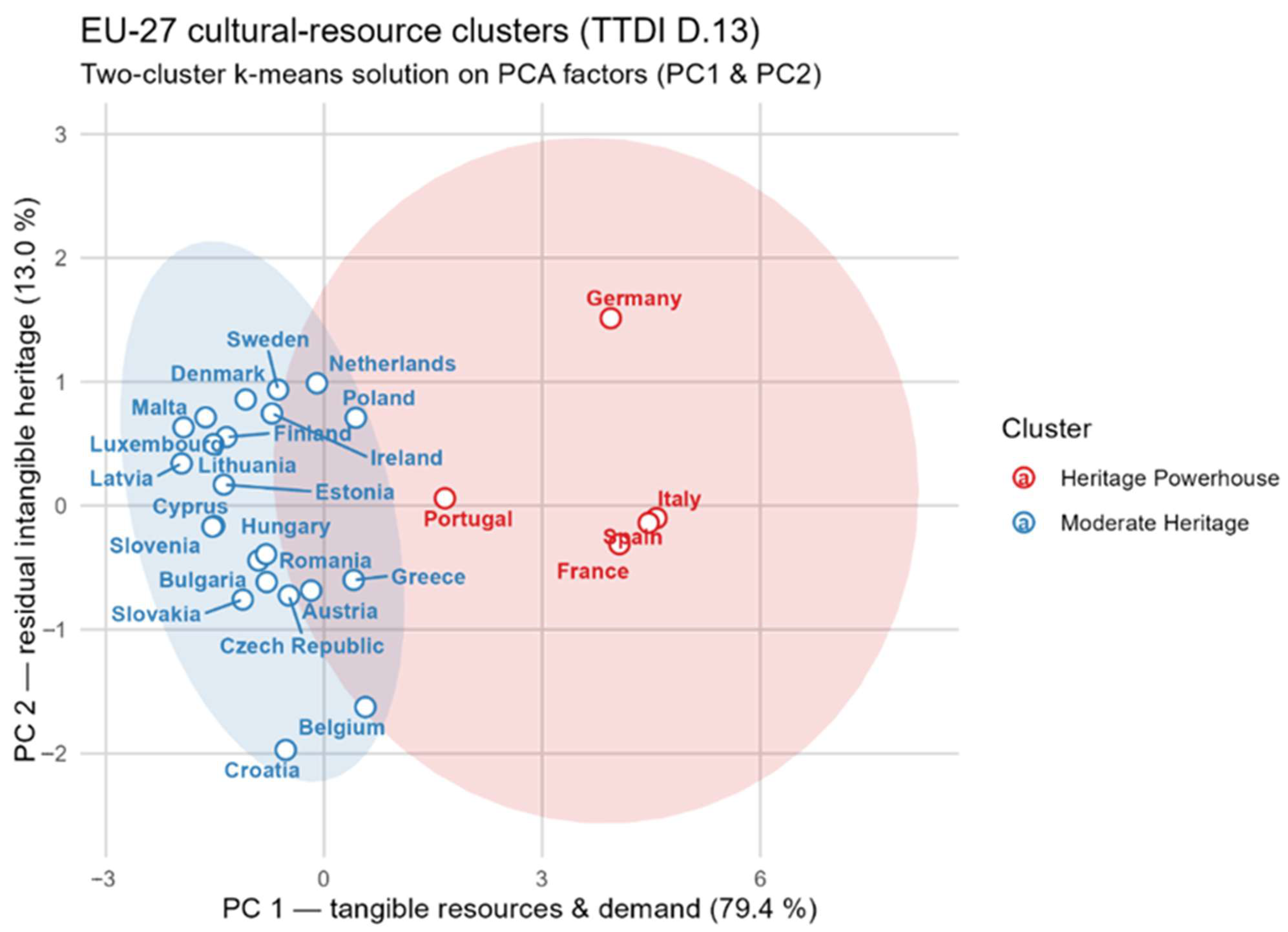
To uncover structural similarities among EU member states, a k-means cluster analysis was performed on the standardized TTDI Cultural Resources indicators. The algorithm identified two stable groups (Table 6) that best represented the distribution of cultural endowment. This simple partition already reveals a divide within Europe’s tourism landscape. One small group of cultural giants versus a larger circle of moderate performers.
Cluster 1 (Heritage Powerhouses) brings together Western and Southern European destinations (Germany, France, Italy, Spain, and Portugal). They lead the EU by a wide margin, averaging 6.44 Heritage Sites and 6.60 Creative Cities. Equally notable is their strong Stadium score (5.64), which reflects substantial infrastructure for hosting major events, from concerts and festivals to international sports competitions. Their high Digital Demand (5.81) indicates strong online interest in cultural and entertainment content, reinforcing global visibility.
Cluster 2 (Moderate Heritage) gathers most Central, Eastern, and Northern European countries. Their average values remain modest across all five indicators. Only 2.56 World Heritage Sites, 3.53 Intangible Heritage elements, and fewer than two Creative Cities per country. These destinations hold moderate cultural assets, yet much of their potential is either underpromoted or insufficiently connected to international tourism flows. Their comparatively low Stadium score (1.58) indicates a limited capacity to host large cultural or sports events, while the low Digital Demand score (1.93) suggests weak online interest in cultural or other tourism-related content, events included.
The biplot (Figure 1) visualizes the distribution of EU member states across the first two principal components of the TTDI Cultural Resources indicators. The first axis (PC1, 79.4% of variance) represents a gradient of cultural intensity, dominated by tangible cultural resources. The second axis (PC2, 13.0%) distinguishes countries with relatively stronger intangible heritage traditions from those emphasizing material and institutional assets. Two clusters emerge. A compact group of Heritage Powerhouses (Germany, France, Italy, Spain, Portugal) occupying the positive side of PC1, and a broader set of Moderate-Heritage destinations form the lower-intensity group. The configuration highlights Europe’s cultural hierarchy, where Western and Southern nations combine rich heritage and creative capacity, while Central and Northern members show more balanced but less internationally visible cultural profiles.

4.2. Tourism Performance: Absolute and per Capita Methodology

Tourism performance data amplify this distinction. Table 7, Table 8 and Table 9 summarize tourism performance across the two clusters under three alternative normalization procedures: absolute totals, per capita ratios, and regression-based residuals. In absolute terms, the Heritage Powerhouse cluster (Cluster 1), comprising Western and Southern European destinations, dominates the EU tourism landscape. In 2023, these countries received on average 49.0 million foreign arrivals, 162.00 million overnight stays, and generated approximately EUR 52.6 billion in travel receipts. By contrast, the Moderate-Heritage cluster (Cluster 2) averaged only 7.0 million arrivals and EUR 7.8 billion in receipts. These gaps largely reflect differences in population size, market capacity, and the maturity of cultural infrastructure.
When tourism indicators are expressed per capita, the hierarchy partially reverses. The moderate-heritage destinations outperform the powerhouses in all three measures, registering 1.34 arrivals per inhabitant, 1711 overnight stays per inhabitant, and EUR 1500.00 in receipts per inhabitant. This indicates that smaller and medium-sized EU members, despite limited absolute volumes, generate relatively higher tourism intensity. Generally said, they accommodate more visitors and earn more revenue relative to their population base.

4.3. Tourism Performance: Regression-Based Methodology

This subsection addresses Research Question 2 by examining whether tourism performance deviates from structural expectations once population size and cultural resources are explicitly accounted for through regression-based normalization.
As discussed earlier, per capita ratios can distort cross-country comparisons if the underlying relationship between tourism outcomes and population size is non-proportional. Following the argument of Kratochvíl and Havlíček (2024), a regression-based normalization was applied. The resulting values are shown in Table 6.
Values of cluster 1 (Heritage Powerhouses) display negative residuals, suggesting modest under-performance relative to their cultural and demographic potential. Cluster 2 (Moderate Heritage) shows residual values slightly above zero across all indicators, meaning these countries attract marginally more visitors and revenue than predicted by their cultural endowment and population.

4.4. Tourism Performance: Comparison of the Methodologies Used

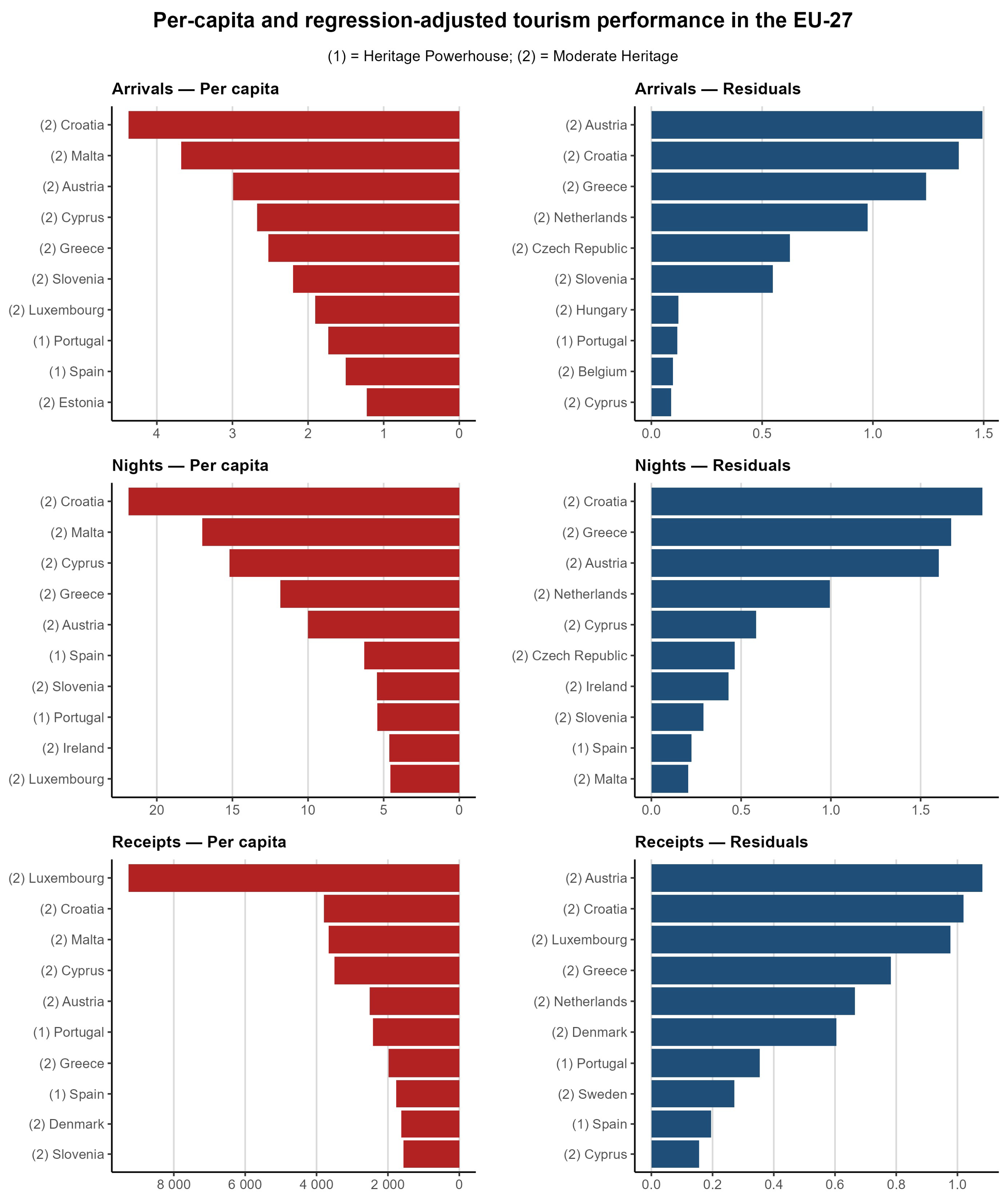
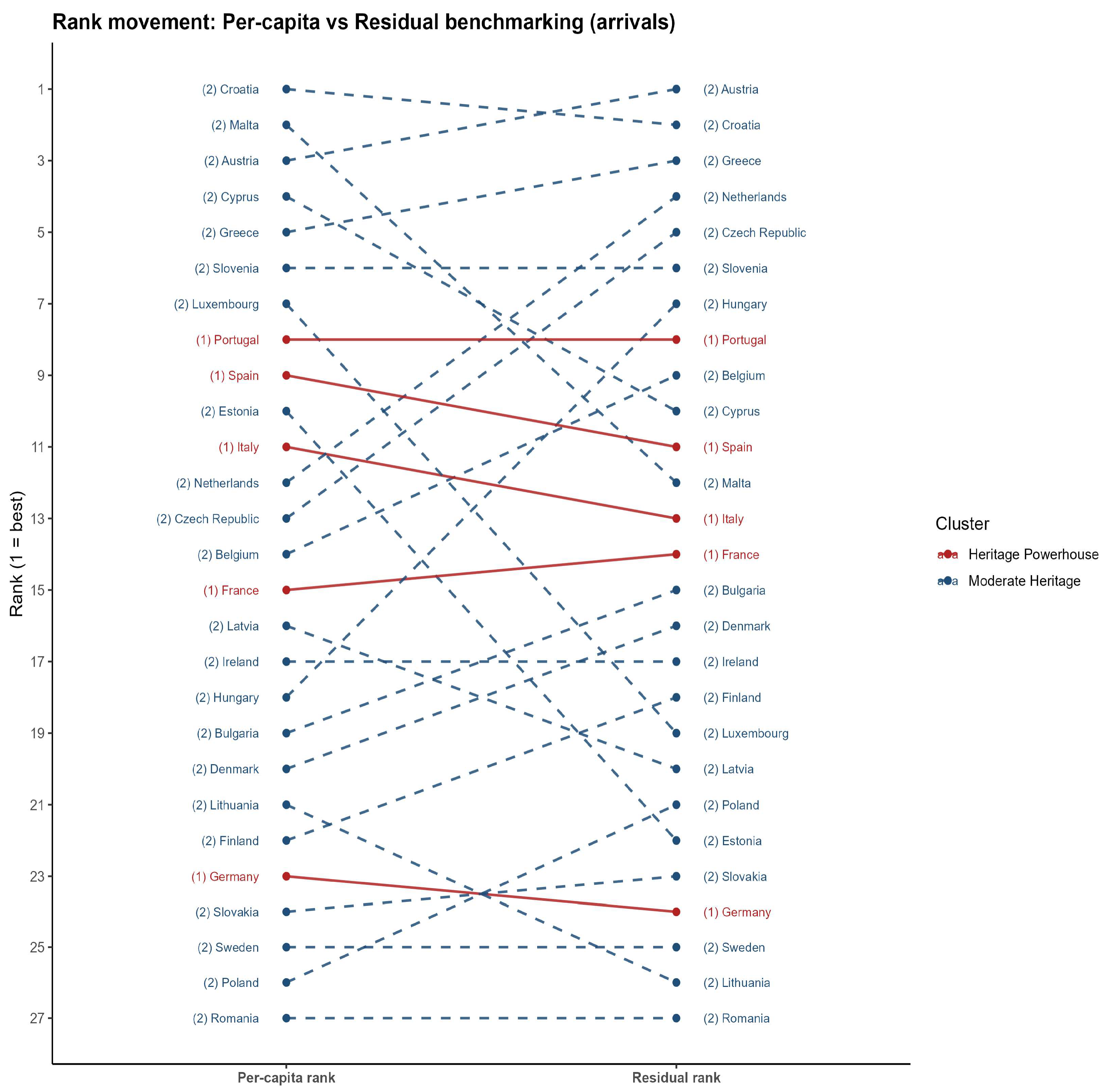
The comparisons between the per capita ratio and regression-based ranking methods illustrate a comparison of the top-performing countries for select variables (Figure 2), with the Spearman rank correlation between the per capita and regression-based rankings ranging between ρ = 0.75 and ρ = 0.79 (p < 0.001). As such, while the two methods appear to be producing very similar country orders based upon tourist performance, there is an imperfect correlation between the two. The difference between the two rankings illustrates that per capita ratios and regression-based scaling do not produce equivalent measures of tourist performance.
There is a moderate amount of systematic re-ordering of the countries when comparing per capita and regression-based rankings for the selected variables once population size and cultural resources have been factored into each method’s results. The results are found in Appendix A.
The disproportionate effect of the normalization choices on the relative position of small and medium size economies is illustrated in Figure 3, which compares the displacement of rank positions as a result of the shift from per capita to regression-based benchmarking. The relatively large range (dispersion) between rank changes in moderately culturally endowed destinations, when compared to the more stable ranking of the culturally rich systems, shows how the choice of normalization can affect the comparative standing of less culturally endowed tourism economies.
Per capita vs. regression-based normalization across all three tourism performance indicators—international arrivals, nights spent in tourist accommodations, travel receipts reveal a similar pattern. Figure 2 presents the top ten countries under the regression-based framework and contrasts their relative positions. Per capita measures generate relatively stronger results for small and medium-sized destinations than regression-based measures; however, many destinations exhibit improved rankings under the regression-based framework. This suggests that scale effects are important in evaluating relative destination performance. Additionally, while large heritage-rich systems show little difference between the two methods used to measure their performance, there is greater disparity among the other destination types than the larger heritage-rich systems. Furthermore, the differences are more pronounced when accommodation-based indicators such as nights spent are compared, while less distortion occurs with monetary indicators such as receipts.
Collectively, the per capita and alternative normalization techniques answer RQ3 by demonstrating systematic differences in assessing relative tourist destination performance using per capita ratios versus regression-based benchmarks.
Results from residual-based methodologies provide particularly insightful information on relative tourism performance conditional on structural capacity (cultural resources). Those destinations that exceeded structural expectations are not necessarily those with the largest cultural asset base, but rather those where tourism performance appears more closely aligned with indicators commonly associated with cultural infrastructure, such as event-related infrastructure and digital visibility.
The three normalization approaches showcase different interpretations of tourism performance. Absolute measures reflect scale and historical accumulation, and per capita ratios might systematically privilege small populations, while regression-based residuals enable examination of relative performance conditional on structural capacity. The latter observations suggest that several moderate-heritage destinations outperform expectations despite limited cultural stocks, whereas heritage-rich destinations appear to exhibit patterns consistent with diminishing returns to additional cultural endowment. While the total EU tourism competitiveness ranking is largely unaffected, the size and direction of rank shifts points at the fact that population-based normalization has a material impact on how comparative assessments are made. This distinction is critical for making sense of competitiveness within a large, diverse tourism space such as the European Union.

5. Discussion

This study examined whether there, according to values of TTDI, is a single competitive asset in Europe’s cultural resources or separate structural forms of cultural capacity. With respect to Research Question 1, the study found that cultural resources in EU member countries are interconnected but have significant differences across each country. Instead of being reduced to a single common latent factor, this study shows that cultural capacity is formed along a primary axis of structuring related to tangible heritage, creative capacity and demand for culture. The secondary dimension of differentiation is related to intangible heritage. The structure of cultural capacity in European tourism is therefore more complex than earlier studies based on TTCI- and TTDI (e.g., Gabor et al., 2012) that treated cultural resources as multiple dimensions within each individual resource type. The concentration of symbolic authority and global visibility among the top tier of destinations also matches other research that has identified enduring hierarchies in European tourism (Krstić et al., 2016). Overall, this study demonstrates that the cultural capacity of European tourism is inequitably distributed and structurally centralized.
With respect to Research Question 2, the second issue that is related to the first issue is whether increased cultural stock leads to better tourism performance after adjusting for differences in population size and cultural intensity. Although the heritage-rich destinations still dominate in absolute tourism volume, the regression adjusted results show diminishing marginal returns to increasing levels of cultural resources. These results support other empirical studies that have shown that the designation of cultural heritage sites does not always lead to an increase in tourist demand (Patuelli et al., 2016; Yang et al., 2019; Mariani & Guizzardi, 2020); however, these results are at odds with earlier research that associated cultural abundance with tourism growth in a linear fashion (Joshi et al., 2016). A number of destinations with relatively lower cultural stocks have achieved higher-than-expected tourism outcomes. It is possible that some of the research that portrayed smaller destinations as having an inherent competitive advantage (Kayar & Kozak, 2010; Krstić et al., 2016) has done so because of scale-based distortion rather than an actual underlying competitive advantage.
With respect to Research Question 3, these findings raise the methodological issue of how different normalization approaches affect comparative assessments of tourism competitiveness. The comparison between per capita indicators and regression-based benchmarks demonstrated that per capita measures consistently favor smaller population sizes, and that there is compression of variation among larger tourism systems. This result is similar to those found in long-standing critiques of ratio-based indicators in cross-national research (Uslaner, 1976; Bollen & Ward, 1979) and provides direct support for recent methodological research that has demonstrated that proportionate scaling assumptions are not met in most tourism applications (Kratochvíl & Havlíček, 2024). Regression-based benchmarking, by comparison, evaluates destinations upon expected performance based upon their demographic and cultural characteristics; therefore, regression-based benchmarking produces a more differentiated and structurally consistent picture of relative competitiveness.
From a theoretical perspective, the findings are consistent with criticisms of the Resource Based View (RBV) when applied to established tourism destinations. The findings are consistent with the arguments of Cucculelli and Goffi (2016) and Li et al. (2022) that the competitive advantage of tourism destinations is increasingly dependent on how cultural assets are combined and leveraged rather than simply accumulating cultural assets. Therefore, the relative out-performance of destinations with relatively modest amounts of cultural resources can be seen as a reflection of greater strategic flexibility and not necessarily greater resource endowments.
In the context of interpreting the role of cultural activation and event-based mechanisms, it is important to recognize that these are inferred rather than directly measured processes. For example, indicators such as stadium capacity and digital cultural demand provide insight into a destination’s ability to activate its cultural resources; however, they do not measure the quality of events, governance, or the long-term legacies of events. Therefore, the relationship between relative performance and these indicators is consistent with earlier research that conceptualizes events as contingent catalysts and not as autonomous drivers of competitiveness (Ziakas & Boukas, 2013; Ziakas, 2023). Other factors including proximity to major source markets, pricing structures, transportation access and hotel accommodations, may also contribute to observed residual variance and cannot be isolated using the current study design.

6. Conclusions

The present study revisits cultural tourism competitiveness within the EU by differentiating between a destination’s cultural endowment (cultural resources) and its relative cultural tourism performance considering structural constraints. The findings suggest that a destination’s competitive position is determined not only by the magnitude of the cultural resources available; but also, by the effectiveness of a destination in converting cultural resources into cultural tourism products, relative to a destination’s population size and its ability to develop and utilize cultural resources. Culturally rich heritage destinations will continue to dominate in an absolute sense; however, their adjusted performance appears to have diminishing returns based on the increasing amount of cultural capital. In contrast, destinations with relatively moderate amounts of cultural capital may realize outcomes that exceed their structural potential. In addition, from a methodological standpoint, the findings indicate that using per capita metrics to evaluate cultural tourism performance can mask relative performance; however, using regression-based benchmarks to evaluate comparative performance can be used as a more structural metric of comparative evaluation.

7. Limitations

7.1. Data-Related Limitations

This study uses the Travel and Tourism Development Index (TTDI) and it measures through its indicators and aggregation an idea of cultural resources and tourism development that reflects one particular model of these concepts. There was no direct measurement of events; the study approximates the impact of event related issues by using cultural resource indicators, a measure of how many seats there are in stadiums, and digital cultural demand, which is a measure of the ability to fill those seats rather than how well the event is run or governed.

7.2. Methodological Limitations

Since this study is cross-sectional it cannot identify changes over time that exist in the relationship among cultural resources, event-related capabilities, and tourism performance. While regression residuals indicate comparative performance based on population and cultural density, they also absorb unmeasured variables that include price, access to the destination, types of accommodations, and distance to the origin market.

7.3. Conceptual Limitations

This study adopted a diagnostic approach rather than a causal approach. The impact of cultural activation and event-related impacts were inferred from what the researchers found rather than being tested directly and should be viewed with caution.

Author Contributions

Conceptualization, V.M. and B.O.; methodology, V.M. and B.O.; software, B.O.; validation, V.M.; formal analysis, V.M.; investigation, V.M. and B.O.; resources, B.O.; data curation, B.O.; writing—original draft preparation, B.O.; writing—review and editing, V.M.; visualization, B.O.; supervision, V.M.; project administration, B.O.; funding acquisition, V.M. All authors have read and agreed to the published version of the manuscript.

Funding

This research was funded by the Scientific Grant Agency of the Ministry of Education, Science, Research and Sport of the Slovak Republic VEGA, under Grant number 1/0360/23 “Tourism of the New generation—responsible and competitive development of tourism destinations in Slovakia in the post-COVID era”.

Institutional Review Board Statement

Not applicable.

Informed Consent Statement

Not applicable.

Data Availability Statement

The original contributions presented in this study are included in the article. Further inquiries can be directed to the corresponding authors.

Conflicts of Interest

The authors declare no conflicts of interest.

Abbreviations

The following abbreviations are used in this manuscript:
TTDITravel and Tourism Development Index
TTCITravel and Tourism Competitiveness Index
EUEuropean Union
PCAPrincipal Component Analysis
PCPrincipal Component
CACluster Analysis

Appendix A

Table A1. Arrivals—Rank difference between per capita and regression-based methodology.
CountryClusterArrivals
per Capita
Arrivals
Residuals
Rank
per Capita
Rank
Residuals
Rank
Difference
Estonia21.2225−0.5221102212
Luxembourg21.9038−0.399971912
Hungary20.57160.1227187−11
Malta23.6761−0.029721210
Czech Republic20.88280.6247135−8
Netherlands21.13990.9755124−8
Cyprus22.67340.08874106
Belgium20.79020.0975149−5
Lithuania20.4793−0.754621265
Poland20.1925−0.46002621−5
Bulgaria20.5617−0.16651915−4
Denmark20.5596−0.19772016−4
Finland20.4602−0.32792218−4
Latvia20.7376−0.444916204
Austria22.98891.493831−2
Greece22.52321.240153−2
Italy11.1505−0.126411132
Spain11.50030.02339112
Croatia24.37661.3882121
France10.7823−0.13001514−1
Germany10.4176−0.606723241
Slovakia20.3725−0.59932423−1
Ireland20.7276−0.277217170
Portugal11.73080.1175880
Romania20.1104−0.946327270
Slovenia22.19750.5479660
Sweden20.2434−0.730525250
Table A2. Nights—Rank difference between per capita and regression-based methodology.
CountryClusterNights
per Capita
Nights
Residuals
Rank
per Capita
Rank
Residuals
Rank
Difference
Estonia22.4680−1.0449142511
Luxembourg24.5585−0.7852102111
Czech Republic22.15760.4634166−10
Malta216.98520.20602108
Netherlands23.31830.9946124−8
Poland20.4628−0.59592619−7
Hungary21.47650.00942015−5
Italy13.9694−0.107011165
Portugal15.41500.04248135
Sweden21.48080.01161914−5
Lithuania21.0506−1.110022264
Bulgaria22.25720.13091512−3
Finland21.0338−0.60472320−3
Latvia21.3690−0.977121243
Slovakia20.8695−0.84562522−3
Spain16.27750.2229693
Austria29.99731.601053−2
Cyprus215.20240.5835352
Denmark22.47400.19271311−2
Greece211.82131.670742−2
Ireland24.62160.430497−2
Belgium21.8390−0.17091817−1
France12.0266−0.347017181
Germany10.9670−0.91832423−1
Slovenia25.44780.2901781
Croatia221.88011.8436110
Romania20.2344−1.186727270
Table A3. Receipts—Rank difference between per capita and regression-based methodology.
CountryClusterReceipts
per Capita
Receipts
Residuals
Rank
per Capita
Rank
Residuals
Rank
Difference
Estonia22.4680−1.0449142511
Malta23655.9291−0.211531714
Estonia21008.1383−0.9176132613
Poland2378.1820−0.04162516−9
Sweden2868.15110.2707168−8
Czech Republic2664.02040.06102013−7
Netherlands21080.60670.6650125−7
Cyprus23501.27070.15574106
Hungary2759.28070.12941711−6
Italy1876.0924−0.395015216
Romania2260.9508−0.40192722−5
Slovenia21560.5780−0.039910155
Austria22508.13531.081251−4
Latvia2626.6569−0.877521254
Denmark21628.59660.604396−3
Greece21977.43760.782274−3
Bulgaria2592.4119−0.37762220−2
Luxembourg29273.48140.9770132
Belgium2701.1107−0.230418191
Finland2675.5967−0.22511918−1
Germany1421.0013−0.65222423−1
Ireland21324.31740.099811121
Lithuania2550.2788−0.874223241
Portugal12417.12620.3539671
Slovakia2272.6389−1.185026271
Spain11769.24950.1951891
Croatia23790.80811.0196220
France1964.56780.034814140

Appendix B

Table A4. Descriptive statistics of TTDI cultural resource indicators.
CountryNumber of World Heritage Cultural SitesOral and Intangible Cultural HeritageNumber of Large Sport StadiumsCultural and Entertainment Tourism Digital DemandNumber of UNESCO Creative Cities
Mean3.28 ± 1.863.98 ± 1.822.33 ± 1.852.65 ± 1.762.90 ± 1.95
Table A5. Cluster-level descriptive statistics of TTDI cultural resource indicators.
CountryNumber of World Heritage Cultural SitesOral and Intangible Cultural HeritageNumber of Large Sport StadiumsCultural and Entertainment Tourism Digital DemandNumber of UNESCO Creative Cities
16.44 ± 1.255.96 ± 1.495.64 ± 1.745.81 ± 1.496.60 ± 0.60
22.56 ± 1.033.53 ± 1.591.58 ± 0.701.93 ± 0.692.06 ± 0.81

References

  1. Abad, A., & Kongmanwatana, P. (2015). Comparison of destination competitiveness ranking in the European union using a non-parametric approach. Tourism Economics, 21(2), 267–281. [Google Scholar] [CrossRef]
  2. Allahverdi, M., Akandere, G., & Varol, F. (2025). Evaluation of the competitiveness and performance of destinations through clustering method within the scope of the travel and tourism development index. International Journal of Tourism Research, 27(5), e70122. [Google Scholar] [CrossRef]
  3. Anderson, E., & Morrissey, O. (2006). A statistical approach to identifying poorly performing countries. The Journal of Development Studies, 42(3), 469–489. [Google Scholar] [CrossRef]
  4. Assaf, A., & Dwyer, L. (2013). Benchmarking international tourism destinations. Tourism Economics, 19, 1233–1247. [Google Scholar] [CrossRef]
  5. Bacsi, Z., & Tóth, É. (2019). Word heritage sites as soft tourism destinations—Their impacts on international arrivals and tourism receipts. Bulletin of Geography Socio-Economic Series, 45(45), 25–44. [Google Scholar] [CrossRef]
  6. Bacsi, Z., Yasin, A. S., & Bánhegyi, G. (2023). Tourism competitiveness in Eastern Africa: RCA and TTCI. Heritage, 6(9), 5997–6015. [Google Scholar] [CrossRef]
  7. Bollen, K. A., & Ward, S. (1979). Ratio variables in aggregate data analysis: Their uses, problems, and alternatives. Sociological Methods & Research, 7(4), 431–450. [Google Scholar] [CrossRef]
  8. Cernat, L., & Gourdon, J. (2012). Paths to success: Benchmarking cross-country sustainable tourism. Tourism Management, 33(5), 1044–1056. [Google Scholar] [CrossRef]
  9. Cracolici, M. F., Nijkamp, P., & Rietveld, P. (2008). Assessment of tourism competitiveness by analysing destination efficiency. Tourism Economics, 14(2), 325–342. [Google Scholar] [CrossRef]
  10. Croes, R., & Kubickova, M. (2013). From potential to ability to compete: Towards a performance-based tourism competitiveness index. Journal of Destination Marketing & Management, 2(3), 146–154. [Google Scholar] [CrossRef]
  11. Cronjé, D. F., & du Plessis, E. (2020). A review on tourism destination competitiveness. Journal of Hospitality and Tourism Management, 45, 256–265. [Google Scholar] [CrossRef]
  12. Cucculelli, M., & Goffi, G. (2016). Does sustainability enhance tourism destination competitiveness? Evidence from italian destinations of excellence. Journal of Cleaner Production, 111, 370–382. [Google Scholar] [CrossRef]
  13. Daskalopoulou, I., & Petrou, A. (2009). Urban tourism competitiveness: Networks and the regional asset base. Urban Studies, 46(4), 779–801. [Google Scholar] [CrossRef]
  14. Denicolai, S., Cioccarelli, G., & Zucchella, A. (2010). Resource-based local development and networked core-competencies for tourism excellence. Tourism Management, 31(2), 260–266. [Google Scholar] [CrossRef]
  15. Dugulan, D., Virgil, B., & Popescu, I. C. (2010). Cultural heritage, natural resources and competitiveness of the travel and tourism industry in central and eastern European countries. Annales Universitatis Apulensis Series Oeconomica, 2(12), 742–748. [Google Scholar] [CrossRef]
  16. Dwyer, L., & Kim, C. (2003). Destination competitiveness: Determinants and indicators. Current Issues in Tourism, 6(5), 369–414. [Google Scholar] [CrossRef]
  17. Ďaďo, J., Maráková, V., Táborecká-Petrovičová, J., & Rajić, T. (2020). Modelling the determinants of festival visitors’ behavioural intentions. E a M: Ekonomie a Management, 23(2), 173–190. [Google Scholar] [CrossRef]
  18. Eurostat. (2025a). Arrivals at tourist accommodation establishments. Available online: https://ec.europa.eu/eurostat/databrowser/view/TOUR_OCC_ARNAT/default/table (accessed on 2 October 2025).
  19. Eurostat. (2025b). Balance of payments by country—Quarterly data (BPM6). Available online: https://ec.europa.eu/eurostat/databrowser/view/bop_c6_q__custom_17629061/default/table (accessed on 2 October 2025).
  20. Eurostat. (2025c). Nights spent at tourist accommodation establishments. Available online: https://ec.europa.eu/eurostat/databrowser/view/TOUR_OCC_NINAT/default/table (accessed on 2 October 2025).
  21. Figueroa, V., Herrero, L. C., Báez, A., & Gómez, M. (2018). Analysing how cultural factors influence the efficiency of tourist destinations in Chile. International Journal of Tourism Research, 20(1), 11–24. [Google Scholar] [CrossRef]
  22. Gabor, M. R., Conţiu, L. C., & Oltean, F. D. (2012). A comparative analysis regarding european tourism competitiveness: Emerging versus developed markets. Procedia Economics and Finance, 3, 361–366. [Google Scholar] [CrossRef]
  23. García-Almeida, D. J., & Gartner, W. C. (2021). A model of competitiveness in intangible cultural heritage tourism destinations from the knowledge-based view. Acta Turistica, 33(1), 7–37. [Google Scholar] [CrossRef]
  24. Gerring, J., Thacker, S. C., Enikolopov, R., Arévalo, J., & Maguire, M. (2013). Assessing health system performance: A model-based approach. Social Science & Medicine, 93, 21–28. [Google Scholar] [CrossRef]
  25. Gómez-Vega, M., Herrero-Prieto, L. C., & López, M. V. (2022). Clustering and country destination performance at a global scale: Determining factors of tourism competitiveness. Tourism Economics, 28(6), 1605–1625. [Google Scholar] [CrossRef]
  26. Gómez-Vega, M., & Picazo-Tadeo, A. J. (2019). Ranking world tourist destinations with a composite indicator of competitiveness: To weigh or not to weigh? Tourism Management, 72, 281–291. [Google Scholar] [CrossRef]
  27. Hartman, S., & Zandberg, T. (2015). The future of mega sport events: Examining the “Dutch Approach” to legacy planning. Journal of Tourism Futures, 1(2), 108–116. [Google Scholar] [CrossRef][Green Version]
  28. Hassan, S. S. (2000). Determinants of market competitiveness in an environmentally sustainable tourism industry. Journal of Travel Research, 38(3), 239–245. [Google Scholar] [CrossRef]
  29. Herrero-Prieto, L. C., & Gómez-Vega, M. (2017). Cultural resources as a factor in cultural tourism attraction: Technical efficiency estimation of regional destinations in Spain. Tourism Economics, 23(2), 260–280. [Google Scholar] [CrossRef]
  30. Horn, A. S., & Lee, G. (2016). The reliability and validity of using regression residuals to measure institutional effectiveness in promoting degree completion. Research in Higher Education, 57(4), 469–496. [Google Scholar] [CrossRef]
  31. Ivanunik, V., Krul, H., & Bryk, S. (2021). Assessment of the impact and interrelation of UNESCO world heritage on the tourism attractiveness of the country. Studies of the Industrial Geography Commission of the Polish Geographical Society, 35(3), 186–204. [Google Scholar] [CrossRef]
  32. Joshi, O., Poudyal, N. C., & Larson, L. R. (2016). The influence of sociopolitical, natural, and cultural factors on international tourism growth: A cross-country panel analysis. Environment Development and Sustainability, 19(3), 825–838. [Google Scholar] [CrossRef]
  33. Jovanović, S., Đekić, S., & Ilić, I. (2015). Analysis of cultural resources of southeast european countries as a factor of tourism competitiveness. Economic Themes, 53(2), 230–246. [Google Scholar] [CrossRef]
  34. Jovanović, S., Janković, V., & Krstić, B. (2014). Homogeneity analysis of south-eastern European countries according to tourism competitiveness performances. Economic Research—Ekonomska Istraživanja, 27(1), 207–220. [Google Scholar] [CrossRef][Green Version]
  35. Kayar, Ç. H., & Kozak, N. (2010). Measuring destination competitiveness: An application of the travel and tourism competitiveness index (2007). Journal of Hospitality Marketing & Management, 19(3), 203–216. [Google Scholar] [CrossRef]
  36. Korol, O., & Krul, V. (2020). Classification of countries of destination by gross and relative values of international (inbound) tourism and its factors. Studies of the Industrial Geography Commission of the Polish Geographical Society, 34, 130–149. [Google Scholar] [CrossRef]
  37. Kratochvíl, L., & Havlíček, J. (2024). The fallacy of global comparisons based on per capita measures. Royal Society Open Science, 11, 230832. [Google Scholar] [CrossRef] [PubMed]
  38. Krstić, B., Radivojević, V., & Stanišić, T. (2016). Determinants of CEE countries’ tourism competitiveness: A benchmarking study. Management: Journal of Sustainable Business and Management Solutions in Emerging Economies, 21(80), 11–22. [Google Scholar] [CrossRef]
  39. Kunst, I., & Ivandić, N. (2021). The viability of the travel and tourism competitiveness index as a reliable measure of destination competitiveness: The case of the Mediterranean region. European Journal of Tourism Research, 27, 2704. [Google Scholar] [CrossRef]
  40. Kutlu, D., Zanbak, M., Soycan, S., Kasalak, M. A., & Çimen, Z. A. (2024). The influence of world heritage sites on tourism dynamics in the EU 27 nations. Sustainability, 16(20), 9090. [Google Scholar] [CrossRef]
  41. Laing, J., Wheeler, F., Reeves, K., & Frost, W. (2014). Assessing the experiential value of heritage assets: A case study of a Chinese heritage precinct, Bendigo, Australia. Tourism Management, 40, 180–192. [Google Scholar] [CrossRef]
  42. Li, X., Abbas, J., Dongling, W., Baig, N. U. A., & Zhang, R. (2022). From cultural tourism to social entrepreneurship: Role of social value creation for environmental sustainability. Frontiers in Psychology, 13, 925768. [Google Scholar] [CrossRef]
  43. Liu, Y.-D. (2014). Cultural events and cultural tourism development: Lessons from the European capitals of culture. European Planning Studies, 22(3), 498–514. [Google Scholar] [CrossRef]
  44. Lopes, A. P. F., Muñoz, M. M., & Alarcón-Urbistondo, P. (2018). Regional tourism competitiveness using the PROMETHEE approach. Annals of Tourism Research, 73, 1–13. [Google Scholar] [CrossRef]
  45. Mammadova, E., & Abdullayev, A. (2025). The role of cultural heritage in tourism competitiveness. Porta Universorum, 1(5), 64–72. [Google Scholar] [CrossRef]
  46. Maráková, V. (2021). Competitiveness of Slovakia as a destination in the international tourism market. In Competitiveness and economic development in Europe: Prospects and challenges (pp. 247–257). Taylor and Francis Inc. [Google Scholar]
  47. Maráková, V., Dyr, T., & Wolak-Tuzimek, A. (2016). Factors of tourism’s competitiveness in European union countries. E+M Ekonomie a Management, 19(3), 92–109. [Google Scholar] [CrossRef]
  48. Mardhiyah, A., Badaruddin, B., & Safrin, F. A. (2025). Activating culture for innovation: A resource-based framework for cultural tourism development in Indonesia. International Review of Management and Marketing, 15(6), 269–275. [Google Scholar] [CrossRef]
  49. Mariani, M. M., & Guizzardi, A. (2020). Does designation as a UNESCO world heritage site influence tourist evaluation of a local destination? Journal of Travel Research, 59(1), 22–36. [Google Scholar] [CrossRef]
  50. Medina-Muñoz, D. R., Medina-Muñoz, R. D., & Chim-Miki, A. F. (2013). Tourism competitiveness assessment: The current status of research in Spain and China. Tourism Economics, 19(2), 297–318. [Google Scholar] [CrossRef]
  51. Mihalic, T., & Aramberri, J. (2015). Myths of top tourism countries, tourism contribution and competitiveness. Tourism Review, 70(4), 276–288. [Google Scholar] [CrossRef]
  52. Mior Shariffuddin, N. S., Azinuddin, M., Hanafiah, M. H., & Wan Mohd Zain, W. M. A. (2023). A comprehensive review on tourism destination competitiveness (TDC) literature. Competitiveness Review, 33(4), 787–819. [Google Scholar] [CrossRef]
  53. Nazmfar, H., Eshghei, A., Alavi, S., & Pourmoradian, S. (2019). Analysis of travel and tourism competitiveness index in middle-east countries. Asia Pacific Journal of Tourism Research, 24(6), 501–513. [Google Scholar] [CrossRef]
  54. Nunes, A., Alves, J., & Vaz, L. (2025). Strategic drivers of global tourism development: A logistic regression approach to the Travel & Tourism Development Index (TTDI). In A. Abreu, J. V. Carvalho, D. Liberato, & R. A. Castanho (Eds.), Advances in tourism, technology and systems (pp. 11–25). Springer Nature. [Google Scholar] [CrossRef]
  55. Patuelli, R., Mussoni, M., & Candela, G. (2016). The effects of world heritage sites on domestic tourism: A spatial interaction model for Italy. In R. Patuelli, & G. Arbia (Eds.), Spatial econometric interaction modelling (pp. 281–315). Springer International Publishing. [Google Scholar] [CrossRef]
  56. Petrović, J., Milićević, S., & Djeri, L. (2016). The information and communications technology as a factor of destination competitiveness in transition countries in European Union. Tourism Economics, 23(6), 1353–1361. [Google Scholar] [CrossRef]
  57. Pérez León, V. E., Pérez, F., Contreras Rubio, I., & Guerrero, F. M. (2021). An approach to the travel and tourism competitiveness index in the Caribbean region. International Journal of Tourism Research, 23(3), 346–362. [Google Scholar] [CrossRef]
  58. Preuss, H. (2007). The conceptualisation and measurement of mega sport event legacies. Journal of Sport & Tourism, 12(3–4), 207–228. [Google Scholar] [CrossRef]
  59. Purwono, R., Esquivias, M. A., Sugiharti, L., & Rojas, O. (2024). Tourism destination performance and competitiveness: The impact on revenues, jobs, the economy, and growth. Journal of Tourism and Services, 15(28), 161–187. [Google Scholar] [CrossRef]
  60. Qazi, A. (2024). Exploring the interdependent drivers of tourism competitiveness: Insights from the travel and tourism development index. Competitiveness Review, 35(6), 1000–1022. [Google Scholar] [CrossRef]
  61. Rasethuntsa, B. C., & Perks, S. (2022). Travel and tourism policies and enabling conditions: An analysis of strategies in Mauritius and Egypt. Turyzm/Tourism, 32(1), 159–183. [Google Scholar] [CrossRef]
  62. Richards, G. (2000). The European cultural capital event: Strategic weapon in the cultural arms race? International Journal of Cultural Policy, 6(2), 159–181. [Google Scholar] [CrossRef]
  63. Ritchie, J. R. B., & Crouch, G. I. (2003). The competitive destination: A sustainable tourism perspective. CABI Publishing. [Google Scholar]
  64. Ruan, W.-Q., Wang, M.-Y., & Zhang, S.-N. (2025). Configuring creativity: Promoting cultural inheritance-based innovation in heritage tourism destinations. Journal of Travel Research. [Google Scholar] [CrossRef]
  65. Saffu, K., Apori, S. O., Elijah-Mensah, A., & Ahumatah, J. (2008). The contribution of human capital and resource-based view to small- and medium-sized tourism venture performance in Ghana. International Journal of Emerging Markets, 3(3), 268–284. [Google Scholar] [CrossRef]
  66. Sauvage, E. (2023). Potential of selected cultural assets for sustainable tourism development in France. American Journal of Arts Social and Humanity Studies, 1(1), 38–44. [Google Scholar] [CrossRef]
  67. Solberg, H. A., & Preuss, H. (2007). Major sport events and long-term tourism impacts. Journal of Sport Management, 21(2), 213–234. [Google Scholar] [CrossRef]
  68. Štumpf, P., Vojtko, V., & Valtrová, B. (2018). Satisfaction of European tourists—Benchmarking of EU countries. Global Business Finance Review, 23(1), 1–14. [Google Scholar] [CrossRef]
  69. Tan, N., Anwar, S., & Jiang, W. (2024). The impact of cultural heritage listing on regional tourism development in China. International Journal of Tourism Research, 26(4), 1. [Google Scholar] [CrossRef]
  70. Uslaner, E. M. (1976). The pitfalls of per capita. American Journal of Political Science, 20(1), 125–133. [Google Scholar] [CrossRef]
  71. Uyar, A., Kuzey, C., Koseoglu, M. A., & Karaman, A. S. (2023). Travel and tourism competitiveness index and the tourism sector development. Tourism Economics, 29(4), 1005–1031. [Google Scholar] [CrossRef]
  72. Vargas-Hernández, J. G. (2012). Sustainable cultural and heritage tourism in regional development of southern Jalisco. World Journal of Entrepreneurship Management and Sustainable Development, 8(2/3), 146–161. [Google Scholar] [CrossRef]
  73. Vašaničová, P., Jenčová, S., Gavurová, B., & Bačík, R. (2021). Cultural and natural resources as determinants of travel and tourism competitiveness. Transformations in Business & Economics, 20(3), 300–316. [Google Scholar]
  74. Wang, J., & Jamison, D. T. (1998). Regression residuals as performance measures: An assessment of robustness in the context of country-level data. UCLA Center for Pacific Rim Studies. Available online: https://eric.ed.gov/?id=ED422364 (accessed on 5 October 2025).
  75. World Economic Forum. (2024). Travel & tourism development index 2024. World Economic Forum. Available online: https://www3.weforum.org/docs/WEF_Travel_and_Tourism_Development_Index_2024.pdf (accessed on 2 October 2025).
  76. Yang, Y., Xue, L., & Jones, T. E. (2019). Tourism-enhancing effect of world heritage sites: Panacea or placebo? A meta-analysis. Annals of Tourism Research, 75, 29–41. [Google Scholar] [CrossRef]
  77. Ziakas, V. (2023). Leveraging sport events for tourism development: The event portfolio perspective. Journal of Global Sport Management, 8(1), 43–72. [Google Scholar] [CrossRef]
  78. Ziakas, V., & Boukas, N. (2013). Post-event leverage and Olympic legacy: A strategic framework for the development of sport and cultural tourism in post-Olympic Athens. Athens Journal of Sports, 1(2), 87–101. [Google Scholar] [CrossRef]
Figure 1. PCA Bi-Plot clustering solution.
Tourismhosp 07 00032 g001
Figure 2. Comparison of ranking of top 10 performing countries using two different methodological approaches.
Tourismhosp 07 00032 g002
Figure 3. Rank re-ordering: per capita versus regression-based benchmarking (international arrivals).
Tourismhosp 07 00032 g003
Table 1. Descriptions and sources of indices 1.
IndexDescriptionSource
13.01 Number of World Heritage cultural sitesThe total number of UNESCO-designated cultural properties located within each country, reflecting internationally recognized tangible cultural heritage assets (2023).UNESCO World Heritage Centre
13.02 Oral and intangible cultural heritageThe number of nationally recognized oral and intangible cultural heritage practices inscribed under UNESCO conventions, capturing the diversity and vitality of living cultural expressions (2023).UNESCO Intangible Cultural Heritage
13.03 Number of large sports stadiumsThe number of large sports stadiums with a seating capacity exceeding 20,000, reflecting a country’s ability to host major sports and entertainment events (2023).Worldofstadiums.com
13.04 Cultural and entertainment tourism Digital DemandMeasurement using an index of online search interest related to cultural attractions, heritage sites, events, gastronomy, and entertainment activities, serving as a proxy for international interest in cultural tourism offerings (2020, 2021, 2022 moving average)Bloom Consulting and D2 Digital Demand © data, market leader search engines across the world (mobile and desktop)
3.05 Number of UNESCO Creative CitiesThe number of cities within each country that are members of UNESCO’s Creative Cities Network, capturing the institutionalized integration of cultural and creative industries into urban development strategies.UNESCO Creative Cities Network
Table 2. Definition and measurement of tourism performance variables used in the analysis.
IndicatorVariableDefinition
Foreign arrivals at tourist accommodationX1Total number of non-resident arrivals at tourist accommodation establishments (annual count; persons)
Nights spent at tourist accommodationX2Total number of nights spent by non-residents at tourist accommodation establishments (annual count; persons)
Balance of payment—Travel Receipts (credit)X3Total international travel receipts recorded in the balance of payments (annual value; euros)
Table 3. Principal Component Analysis—Variance.
Standard DeviationProportion of VarianceCumulative Proportion
1.99190.79350.7935
0.80650.13010.9236
0.47520.04520.9688
0.31900.02040.9891
0.23340.01091.0000
Table 4. Principal Component Analysis—Loadings.
IndexPC1PC2
Tangible Cultural Heritage0.482−0.017
Intangible Cultural Heritage0.335−0.919
Stadium0.4760.261
Digital Demand0.4750.200
Creative Cities0.4510.216
Table 5. Model Adequacy for Benchmarking.
ClusterX1X2X3
N272727
Adjusted R20.720.610.72
AICc62.0075.4058.01
Skewness (per capita indicator)1.321.843.03
Skewness (regression residuals)0.980.620.01
Spearman ρ (per capita, log population)−0.38−0.35−0.40
Spearman ρ (residuals, log population)0.02−0.040.01
Breusch–Pagan p-value0.290.580.30
Max Cook’s D0.160.150.23
Table 6. TTDI Pillar D.13—Cultural Resources (Cluster Score Averages).
ClusterCultural Heritage SitesIntangible HeritageStadiumsDigital DemandCreative Cities
16.445.965.645.816.60
22.563.531.581.932.06
Table 7. Tourism Performance Indicators in 2023 (Cluster averages)—absolute measures.
ClusterAbsolute Measures
X1X2X3
149,268,851.40162,346,765.4052,606,600,000.00
27,133,524.5025,676,228.417,843,600,000.00
Table 8. Tourism Performance Indicators in 2023 (cluster averages)—per capita.
ClusterAdjusted—Per Capita
X1X2X3
11.121289.611115.69
21.341711.751499.74
Table 9. Tourism Performance Indicators in 2023 (cluster averages)—controlled for population size and cultural resources.
ClusterAdjusted—Residuals
X1X2X3
1−0.1444−0.2214−0.0927
20.03280.05030.0211
Disclaimer/Publisher’s Note: The statements, opinions and data contained in all publications are solely those of the individual author(s) and contributor(s) and not of MDPI and/or the editor(s). MDPI and/or the editor(s) disclaim responsibility for any injury to people or property resulting from any ideas, methods, instructions or products referred to in the content.