


Abstract
This study examines how different dimensions of the regional digital environment are associated with productivity in the food-service sector across Russian regions. Using regional panel data, the study distinguishes among digital infrastructure, digital platform adoption, online consumption, and advanced digital technologies to examine whether these associations vary across regions with different levels of sectoral productivity. Digital infrastructure is consistently associated with higher food-service productivity, with stronger associations observed in lower-productivity regions, suggesting that digital connectivity may be particularly relevant to regional disparities in service-sector development. Digital platform adoption also demonstrates generally positive associations with productivity across the productivity distribution, highlighting the growing importance of digitally enabled service delivery and platform-based business models in food services. In contrast, online consumption has limited contemporaneous associations with productivity but shows a stronger positive association in higher-productivity regions, suggesting that the relationship between digital consumer demand and productivity may depend on existing regional capabilities. Advanced digitalization, captured through a PCA-based index of AI, IoT, big data, and cloud technologies, is negatively associated with productivity, potentially reflecting adjustment costs and the complementary organizational and managerial capabilities required for effective adoption.
1. Introduction
Digital technologies are reshaping service industries by lowering transaction costs, expanding market access, and changing how firms organize production and serve customers (Goldfarb & Tucker, 2019). Food-service firms are particularly exposed to this transformation because ordering, payment, delivery, customer engagement, and day-to-day operations increasingly depend on connectivity and data. Food-service production is also labor-intensive and locally oriented. Its productivity therefore depends on how effectively firms coordinate demand, staffing, logistics, and service delivery. In Russia, the use of digital platforms and online purchasing has expanded rapidly, while the broader digital environment remains unevenly distributed across regions (Zemtsov, 2025; Zemtsov et al., 2022). The regional digital environment is therefore a potentially important determinant of food-service productivity, although its contribution may depend on the types of technologies adopted and the regional context in which firms operate.
The food-service industry provides a particularly relevant context for examining the productivity implications of digitalization. Unlike highly automated manufacturing industries, food-service activities remain relatively labor-intensive and involve frequent, direct interactions with customers, while simultaneously incorporating a growing range of digital technologies into their operations. Digitalization in this sector extends beyond the adoption of basic digital infrastructure and includes online ordering and delivery platforms, digital payment systems, customer-facing applications, data-driven demand management, and advanced technologies such as artificial intelligence, cloud computing, and the Internet of Things. These technologies can affect productivity through multiple channels, including reducing transaction and coordination costs, improving demand forecasting, enhancing resource allocation, and optimizing labor and inventory management. At the same time, the benefits of advanced digital technologies may depend on firms’ organizational capabilities, workforce skills, and ability to adapt existing business processes. This makes the food-service industry an informative setting for examining whether different dimensions of digitalization translate into productivity gains and whether their effects vary with the level of technological development. Furthermore, given the importance of food-service activities for employment, consumer services, and regional economic activity, understanding the productivity implications of digitalization in this sector has relevant implications for both business strategy and regional digitalization policy.
Digitalization is not a homogeneous process. It comprises digital infrastructure, digital platforms, online consumption, and advanced digitalization, which operate through different economic channels. Basic connectivity reduces information friction and broadens access to customers and suppliers (Goldfarb & Tucker, 2019). Digital platforms reduce transaction costs and expand demand, although commissions and congestion can also compress margins (M. Chen et al., 2022; Feldman et al., 2023). Online consumption creates new sales and information channels (Wang et al., 2021), but converting online demand into productivity gains requires logistics, digital skills, and managerial capacity. Advanced digitalization encompasses artificial intelligence (AI), the Internet of Things (IoT), big data analytics, and cloud computing. These technologies can improve forecasting, coordination, and automation, yet they also require complementary investments and may generate short-run adjustment costs (Brynjolfsson et al., 2021). Because these channels differ in their direction, timing, and dependence on local capabilities, a single aggregate digitalization index can conceal substantial heterogeneity in productivity effects. Whether these differences are visible at the regional and sectoral levels remains an open empirical question.
Most existing studies examine digitalization at the firm or general-economy level, often using one composite indicator rather than separating the functions of digital technology. Evidence specific to food-service firms has grown. However, this work tends to concentrate on platform design, delivery markets, and point-of-service technology (M. Chen et al., 2022; Feldman et al., 2023; W. Lee et al., 2024; Peng et al., 2024). Relatively little evidence links multiple distinct dimensions of the regional digital environment to sector-level productivity. Even less research examines whether these effects vary across the productivity distribution. Russia provides a useful setting for this question because regional digital divides persist in income, skills, internet diffusion, and technology adoption. Such divides are well documented (Fan et al., 2025; Gladkova & Ragnedda, 2020; Grishchenko, 2020). Regional productivity levels also differ considerably. These conditions raise the possibility that the same digital investment generates different productivity returns across regions. Such differences matter for policy because regions with weak connectivity may require different interventions than regions with stronger digital capabilities but lower online demand.
This study therefore examines how four dimensions of the regional digital environment are associated with food-service industry productivity across Russian regions. We construct a panel for 85 Russian regions, covering basic digitalization and advanced digitalization indicators. Productivity is measured as the logarithm of gross value added (GVA) per worker in the food-service industry. Digital infrastructure is proxied by the regional broadband usage rate, digital platform usage by platform adoption among regional organizations, and online consumption by consumer adoption of online purchasing. Advanced digitalization is captured by a principal component analysis (PCA) index based on the adoption of cloud computing, big data, IoT, and AI technologies. We estimate panel models with region fixed effects and introduce contemporaneous, one-year, and two-year lags. We examine each dimension separately because their economic functions and measurement requirements differ. We then use quantile regressions to examine whether the estimated effects differ across low-, median-, and high-productivity regions.
2. Literature Review
Digitalization is a multidimensional process composed of technologically and functionally distinct elements. As Goldfarb and Tucker (2019) argue, digital technologies reduce the costs of search, replication, transportation, tracking, and verification, yet these cost reductions operate through different economic channels. In the food-service industry, digitalization can be usefully decomposed into four dimensions: digital infrastructure, digital platforms, online consumption, and advanced digitalization. Advanced digitalization encompasses artificial intelligence (AI), the Internet of Things (IoT), big data analytics, and cloud computing. Because each dimension operates through distinct mechanisms and is supported by a different body of evidence, aggregate indices may conceal substantial heterogeneity in productivity effects. This review therefore examines the four dimensions in turn before discussing the regional conditions under which their effects may materialize.
2.1. Digitalization and Productivity in the Food-Service Industry
A large body of evidence documents the productivity-enhancing role of basic digital connectivity. Broadband and high-speed internet reduce information frictions, broaden market access, and facilitate the adoption of skill-biased technologies. Exploiting a national policy reform in China, S. Chen et al. (2020) find that high-speed internet significantly increases firm productivity and wages, with stronger effects in skill-intensive industries and among more educated workers. Using a difference-in-differences design, Hjort and Poulsen (2019) show that the arrival of fast internet in Africa increased employment rates and average incomes. These gains were driven in part by higher firm-level productivity, firm entry, and exporting. At the regional level, Giannini et al. (2023) report a positive association between firms’ broadband adoption and regional total factor productivity in Italy. Aldashev and Batkeyev (2021) similarly show that broadband infrastructure supports economic growth in rural areas.
These benefits are, however, unevenly distributed across space. Across Europe, de Clercq et al. (2023) identify a persistent urban–rural digital divide, showing that the effects of high-speed broadband coverage on regional growth are stronger where complementary economic conditions are present. Meng et al. (2023) similarly show that digital-city competitiveness is positively associated with total factor productivity in China’s commercial circulation industry, implying that connectivity may generate productivity gains through its interaction with broader regional capabilities. For the food-service sector, basic digital infrastructure can therefore be regarded as a foundational enabling condition, with its productivity effects likely to be most visible where connectivity constraints remain binding.
Digital platforms constitute a second, market-oriented dimension of digitalization. Platforms reduce transaction costs and lower barriers to market entry. They also connect firms to customers, suppliers, and information in ways that were previously unavailable (Goldfarb & Tucker, 2019). A growing body of empirical work links platform-based capabilities to improved firm performance. Jun et al. (2022) find that digital platform capability, together with improvisation capability and organizational readiness, is associated with enhanced innovation performance. Rajala and Hautala-Kankaanpää (2023) show that platform-based digital connectivity is positively associated with small and medium-sized enterprise (SME) performance, particularly under conditions of environmental turbulence. Y. Yang et al. (2023) find a positive relationship between digital platform use, enterprise digital transformation, and performance in cross-border e-commerce.
In food services, platform effects operate chiefly through online food-delivery ecosystems. These ecosystems expand customer reach and order volume but also introduce commissions and operational congestion. M. Chen et al. (2022) demonstrate that delivery platforms can either support or disadvantage restaurants, depending on how delivery demand overlaps with dine-in demand. Feldman et al. (2023) show that platform commission contracts and congestion can erode restaurant margins. Niu et al. (2021) find that the profitability of platform cooperation depends on logistics arrangements and online demand potential. At the point of service, Tan and Netessine (2020) find that tabletop technology raises check size and reduces meal duration. Overall, platform adoption is generally associated with broader market access and improved performance, although the magnitude of these effects depends on contractual and operational conditions.
2.2. Advanced Digitalization, Regional Heterogeneity, and Research Gaps
E-commerce and online consumption represent the demand-side dimension of digitalization. Existing evidence indicates that e-commerce adoption is associated with improved firm performance by expanding payment, marketing, delivery, and customer-engagement channels. Ballerini et al. (2023) show that commitment and platform adoption contribute to SME e-commerce performance through e-commerce affordances. Hussain et al. (2022) report that e-commerce adoption is positively associated with SME performance, with this relationship strengthened by entrepreneurial competencies. Gao et al. (2023) find that e-commerce and digital-marketing adoption are associated with improved financial and sustainability performance among micro, small, and medium-sized enterprises (MSMEs) during the COVID-19 pandemic. Orji et al. (2022) link e-commerce adoption to firm performance during a health pandemic, conditional on firms’ pandemic response strategies. On the demand side, online reviews and ratings serve as informational signals that are associated with higher restaurant profitability, particularly for weaker brands (Wang et al., 2021). These findings suggest that online consumption can expand demand, but its translation into productivity depends on complementary logistics, digital skills, and managerial capacity.
A further dimension comprises advanced digitalization, which encompasses AI, IoT, big data analytics, and cloud computing. Its productivity implications are considerably more ambiguous. Within hospitality and food services, digital transformation is associated with both performance gains and adjustment costs. Its benefits are uneven across technologies and firms (W. Lee et al., 2024; Peng et al., 2024). On the one hand, these technologies can automate operations, improve forecasting and coordination, and raise efficiency. C. H. Yang (2022) finds that AI-related patents are positively associated with firm productivity and employment in Taiwan. Czarnitzki et al. (2023) report positive associations between AI adoption and firm-level productivity in Germany. Zhai and Liu (2023) show that AI innovation is positively associated with total factor productivity among Chinese listed firms. Big data analytics capability is similarly associated with enhanced competitive performance through dynamic and operational capabilities (Mikalef et al., 2020). AI assimilation is also associated with improved firm performance through organizational and customer agility (Wamba, 2022).
On the other hand, these technologies require substantial complementary investments and organizational restructuring. Such investments can generate short-run adjustment costs and depress measured productivity before the benefits materialize. Brynjolfsson et al. (2019, 2021) formalize this dynamic as the productivity J-curve. In this view, general-purpose technologies demand intangible complementary investments that are often poorly measured, producing a temporary slowdown followed by later gains. Guo et al. (2023) provide empirical support for this digitalization paradox: digital transformation can reduce firm performance when managerial myopia prevails. Gebauer et al. (2020) identify the growth paths that firms must follow to overcome the paradox. Critically, the direction of these effects depends on complementary capabilities. Dynamic managerial capabilities shape whether firms can translate digital transformation into performance (Heubeck, 2023), and absorptive capacity mediates the relationship between digital capacity and innovation performance (Kastelli et al., 2024). The productivity effects of advanced digitalization are therefore theoretically ambiguous.
A final theme concerns the heterogeneity of digitalization effects across regions and productivity levels. Digital inequalities persist along the dimensions of income, skills, age, and urban–rural residence, even where access has converged (Gladkova & Ragnedda, 2020; Grishchenko, 2020). Fan et al. (2025) show that the digital economy can either widen or narrow regional disparities, depending on regions’ capacity to absorb digital technologies. Russian regional studies document persistent interregional divides in internet diffusion, online commerce, and, more recently, AI adoption (Zemtsov, 2025; Zemtsov et al., 2022). This heterogeneity implies that the marginal productivity returns to digitalization are unlikely to be constant across contexts. Chang et al. (2020) find evidence of convergence in digital technology adoption across countries. At the same time, Traşcă et al. (2019) show that less digitally developed Central and Eastern European economies face difficulties in achieving such convergence, suggesting that catch-up is conditional on complementary capabilities. Together, this literature suggests that the productivity effects of digitalization depend on regional capabilities and may vary systematically across the productivity distribution.
Taken together, the literature reveals two limitations that motivate the present study. First, digitalization is often summarized through a single aggregate index. Consequently, the distinct productivity implications of infrastructure, platforms, consumption, and advanced digitalization are not simultaneously distinguished. Second, little evidence examines how these effects vary across the productivity distribution in the food-service sector. These two gaps motivate the five hypotheses that we develop below in Section 3.
3. Hypothesis Development
Taken together, the literature supports the expectation that digitalization affects food-service productivity through distinct, context-dependent channels. Basic infrastructure, digital platforms, and online consumption are generally expected to enhance productivity, whereas the effect of advanced digitalization is theoretically ambiguous because its returns depend on complementary capabilities. Since these mechanisms are also conditioned by regional digital capabilities, their effects are expected to vary across the productivity distribution. We formalize these expectations in H1 through H5.
Digital infrastructure is the most fundamental dimension of the regional digital environment. It relaxes connectivity constraints and reduces the information frictions that limit market access, customer discovery, and operational efficiency. Broadband adoption is consistently associated with higher firm productivity and worker wages (S. Chen et al., 2020). It is also associated with higher regional total factor productivity (Giannini et al., 2023; Meng et al., 2023). Fast internet access further increases employment and average incomes through firm entry, productivity gains, and exporting (Hjort & Poulsen, 2019). In the food-service industry, ordering, payment, delivery, and customer engagement increasingly depend on connectivity. Greater broadband penetration should therefore enable restaurants to reach a wider customer base and coordinate their operations more efficiently, thereby increasing sector-level productivity. We therefore propose:
H1.
Regional digital infrastructure development (proxied by broadband usage rate) is positively associated with food-service industry productivity.
Digital platforms constitute a market-enabling dimension that lowers transaction costs, reduces search friction, and broadens access to customers through two-sided matching. Platform-based connectivity is generally associated with improved firm performance (Jun et al., 2022; Rajala & Hautala-Kankaanpää, 2023; Y. Yang et al., 2023). In the food-service industry, delivery platforms expand demand, although commissions and congestion may introduce frictions that compress profit margins (M. Chen et al., 2022; Feldman et al., 2023). On balance, the market-access and demand-expansion benefits of platform participation are expected to outweigh these costs at the sector level. We therefore propose:
H2.
The prevalence of digital platforms among regional organizations is positively associated with food-service industry productivity.
Online consumption captures the demand-side dimension of the regional digital environment. E-commerce adoption is associated with higher firm performance by expanding sales, payment, and customer-engagement channels (Ballerini et al., 2023; Gao et al., 2023; Hussain et al., 2022). Online reviews generate demand signals that increase restaurant profitability, particularly for weaker brands (Wang et al., 2021). Nevertheless, converting online demand into productivity gains requires complementary logistics, digital skills, and managerial capacity. The contemporaneous effect may therefore be limited, with the benefits emerging only after a lag. We therefore propose:
H3.
Greater consumer adoption of online purchasing is positively associated with food-service industry productivity.
Unlike basic digital infrastructure and digital platforms, advanced digital technologies such as AI, IoT, big data analytics, and cloud computing require substantial complementary investments and organizational capabilities. Their adoption may improve efficiency and automation, but it may also generate short-term adjustment costs and necessitate organizational restructuring. This tension is central to the productivity J-curve and the broader digitalization paradox. General-purpose technologies may temporarily depress measured productivity while intangible complementary investments accumulate, with productivity gains emerging only later (Brynjolfsson et al., 2019, 2021; Gebauer et al., 2020; Guo et al., 2023). In labor-intensive service settings such as food services, these adjustment costs, including workforce reallocation, process redesign, and data-infrastructure development, may be particularly salient in the short run.
Therefore, the productivity effects of advanced digital technologies may depend on firms’ technological, managerial, and human-capital capabilities. AI adoption yields performance gains primarily when sufficient investment and complementary capabilities are in place (Y. S. Lee et al., 2022; Li & Liu, 2026). Its simultaneous automation and augmentation effects can also create organizational tensions (Raisch & Krakowski, 2021). Firms that lack the absorptive capacity and dynamic managerial capabilities needed to integrate these technologies may face adjustment and coordination costs. These costs can outweigh short-run efficiency gains (Heubeck, 2023; Kastelli et al., 2024). Accordingly, the direction of the relationship between advanced digital technology adoption and food-service productivity remains theoretically ambiguous. We therefore propose:
H4.
The relationship between advanced digital technology adoption and food-service industry productivity is theoretically ambiguous.
The relationship between the regional digital environment and regional productivity may differ according to the existing productivity level of the food-service industry. Regions with higher and lower productivity may differ in their digital capabilities, organizational capacity, and ability to exploit digital technologies. Persistent disparities in income, skills, and digital literacy may therefore reduce the returns to digital investment. The same digital investment is unlikely to generate identical returns across regions (Fan et al., 2025; Gladkova & Ragnedda, 2020; Grishchenko, 2020).
In lower-productivity regions, basic digital infrastructure may generate larger marginal benefits by relaxing fundamental connectivity constraints. This pattern is consistent with the logic of catch-up and diminishing marginal returns (Chang et al., 2020; Traşcă et al., 2019). In contrast, higher-productivity regions may be better positioned to translate online consumption into productivity gains because they possess the complementary capabilities required to exploit it. Therefore, the productivity effects of the regional digital environment are expected to vary across the productivity distribution. Accordingly, we propose:
H5.
The relationship between the regional digital environment and food-service productivity varies across productivity levels.
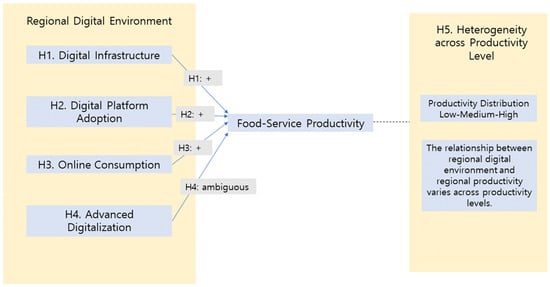
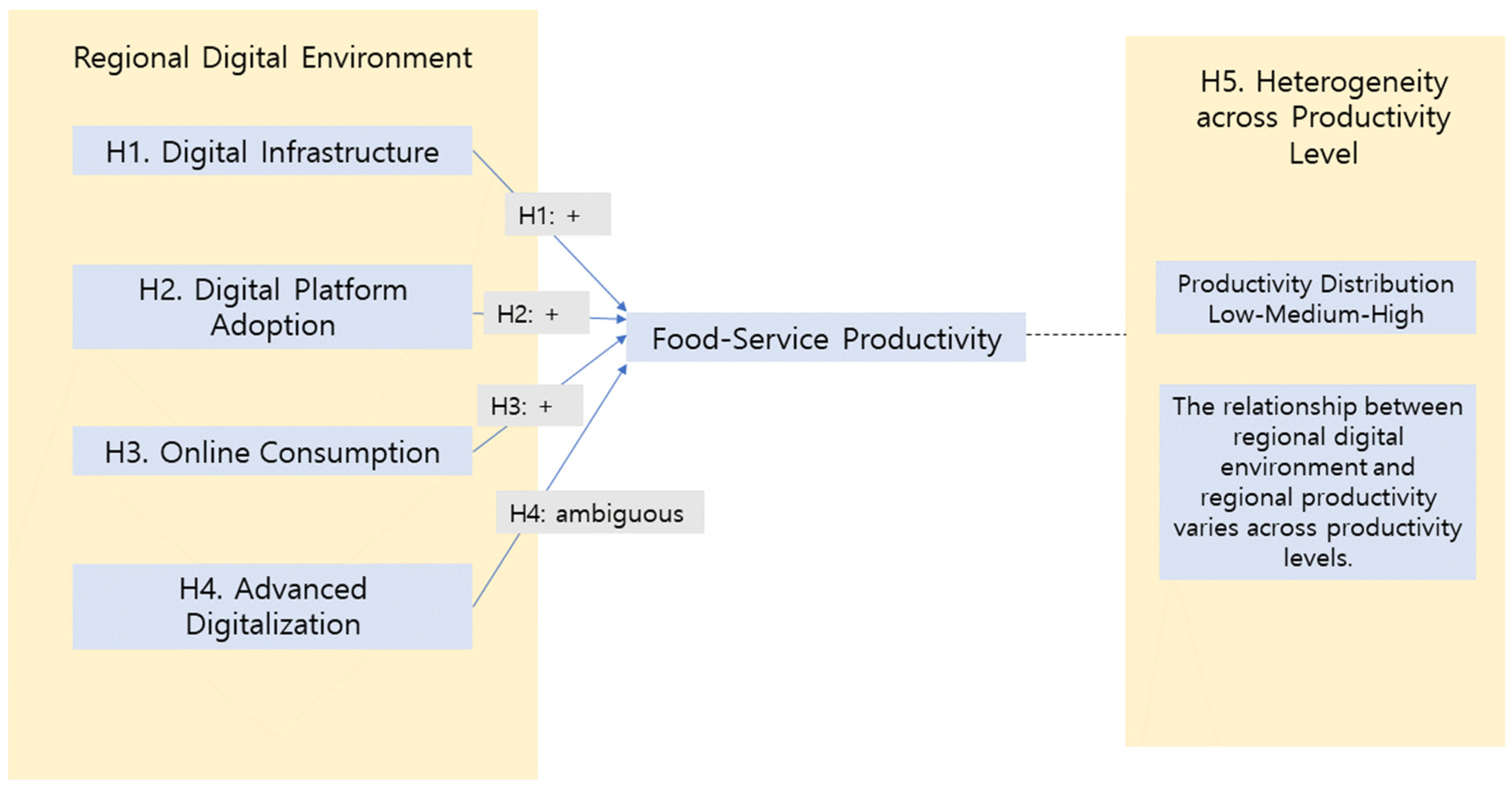
Figure 1 depicts a conceptual model illustrating the proposed relationships.
Figure 1.
Proposed conceptual model of the relationship between the regional digital environment and food-service productivity. Note: Arrows indicate hypothesized associations, not causal relationships.
4. Data and Methodology
To examine the relationship between regional digitalization and food-service industry productivity1, we constructed the panel data covering the period 2017 (2021)–20242 for 85 Russian regions3. The data used in this study were obtained from the Federal State Statistics Service (Rosstat). All regional-level indicators used in the analysis are available in the Rosstat statistical publication “Socio-Economic Indicators of the Subjects of the Russian Federation” (“Coциaльнo-экoнoмичecкиe пoкaзaтeли пo cyбъeктaм Poccийcкoй Φeдepaции”), which provides annual statistical information for individual federal subjects of the Russian Federation. The dataset includes the regional economic, labor, capital, and digitalization indicators used in this study. The relevant indicators can be accessed by selecting the corresponding statistical table, region, and year in the Rosstat regional statistics database. Regional Gross Value Added (GVA) data were obtained from the Rosstat National Accounts database, including tables on Gross Regional Product (GRP) and Gross Value Added by economic activity. Our empirical model is specified by following Equation (1):
where is the logarithm of gross value added per worker in the food-service industry in region i and year t4. serves as a proxy for the regional digitalization environment and K = 0, 1, and 2 correspond to the contemporaneous, one-year lag, and two-year lag specifications, respectively. Depending on the model specification, Digital may represent one of four dimensions of digitalization: digital infrastructure, digital platforms, digital consumption, and advanced digitalization. Because these digitalization measures are highly correlated with one another, we do not include all four measures simultaneously in a single model. Instead, each dimension is introduced separately to assess its individual association with food-service industry productivity. For the advanced digitalization measure, we construct a composite index using principal component analysis (PCA) based on the regional adoption rates of cloud computing, big data, IoT, and AI technologies, thereby reducing multicollinearity among these closely related indicators. Hereafter, the term “PCA” refers to the PCA-based advanced digitalization index constructed from the growth rates of AI, IoT, big data, and cloud computing. To mitigate potential reverse causality between digitalization and food-service productivity, we additionally employ lagged specifications for the digitalization variables. Specifically, in addition to the contemporaneous specification, we include one-year and two-year lags of digitalization. Using lagged digitalization measures helps reduce the possibility that current productivity outcomes influence the contemporaneous level of digitalization, while also allowing for potential delayed effects of digitalization on productivity. These lagged specifications therefore provide a more robust assessment of the relationship while mitigating concerns about reverse causality.
Following the Cobb–Douglas production function framework, we additionally control for fixed capital investment and the number of workers in the food-service sector5. We also include GRP per capita growth to account for differences in overall economic growth conditions across regions. Finally, region fixed effects are incorporated to control for unobserved regional characteristics. Detailed descriptions of the variables and summary statistics are presented in Table 1 and Table 2.
Table 1.
Description of Variables.
Table 2.
Summary Statistics.
The empirical specification is formulated as a level model in which the dependent variable is the logarithm of food-service productivity, measured as GVA per worker, while the key digitalization variables are expressed as annual growth rates. This specification is intended to examine whether changes in the intensity of regional digitalization are associated with subsequent differences in the level of food-service productivity, rather than to model productivity growth directly. The use of growth rates for digitalization variables captures changes in the pace of digitalization while the dependent variable remains in levels, allowing the analysis to examine whether changes in regional digitalization are associated with productivity levels. The specification is therefore a mixed level–growth specification rather than a model expressed entirely in levels or entirely in growth rates.
We further employ quantile regression to estimate whether the association between digitalization and productivity varies across the productivity distribution, following Equation (2):
where .
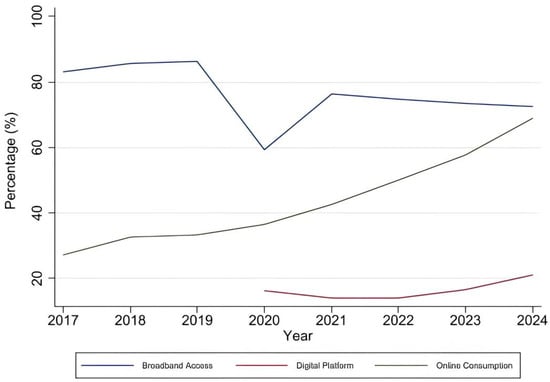
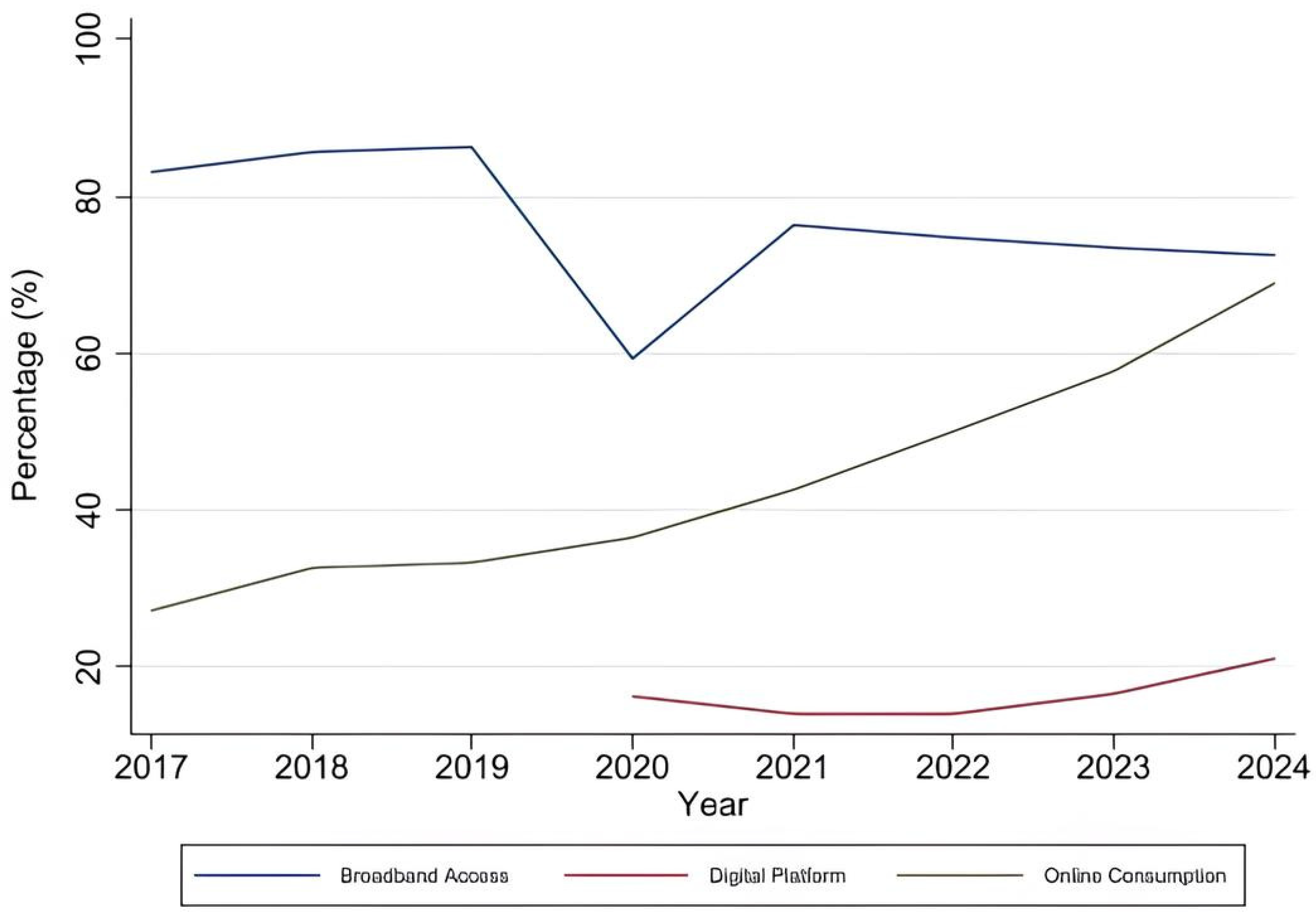
Figure 2 illustrates the evolution of Russia’s basic digital environment at both the national and federal-district levels over 2017–2024. At the national level, broadband usage remained relatively high but declined from approximately 83% in 2017 to 73% in 2024, with a particularly sharp decrease around 2020. In contrast, digital platform usage increased substantially from around 16% in 2020 to 21% in 2024, while online consumption expanded continuously from approximately 28% in 2017 to nearly 70% in 2024. The regional panels in Figure A1 reveal considerable disparities in the initial levels and trajectories of digitalization across federal districts. The Central Federal District generally maintained the highest level of broadband usage, while the North Caucasian Federal District consistently exhibited relatively lower levels of digital infrastructure. Broadband access also declined in several districts during and after 2019–2020, although partial recovery was observed thereafter. Meanwhile, online consumption increased steadily across most federal districts, with particularly strong growth in the Southern, Ural, and North Caucasian districts. Digital platform usage remained comparatively lower than that of the other indicators but showed gradual improvement in most regions toward the end of the period. Overall, the figure suggests convergence in digital utilization alongside persistent disparities in digital infrastructure, indicating that regional differences in the digital environment are multidimensional rather than uniformly reflected across all indicators.
Figure 2.
Trend of Basic Digital Environments in Russia.
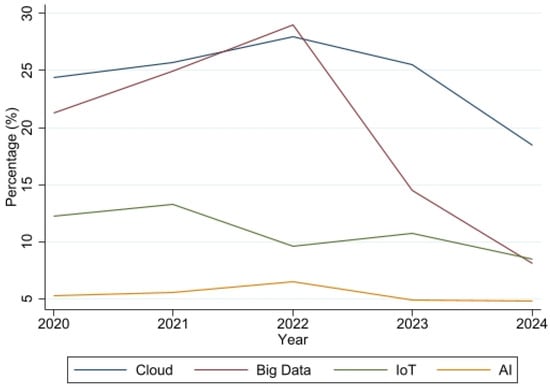
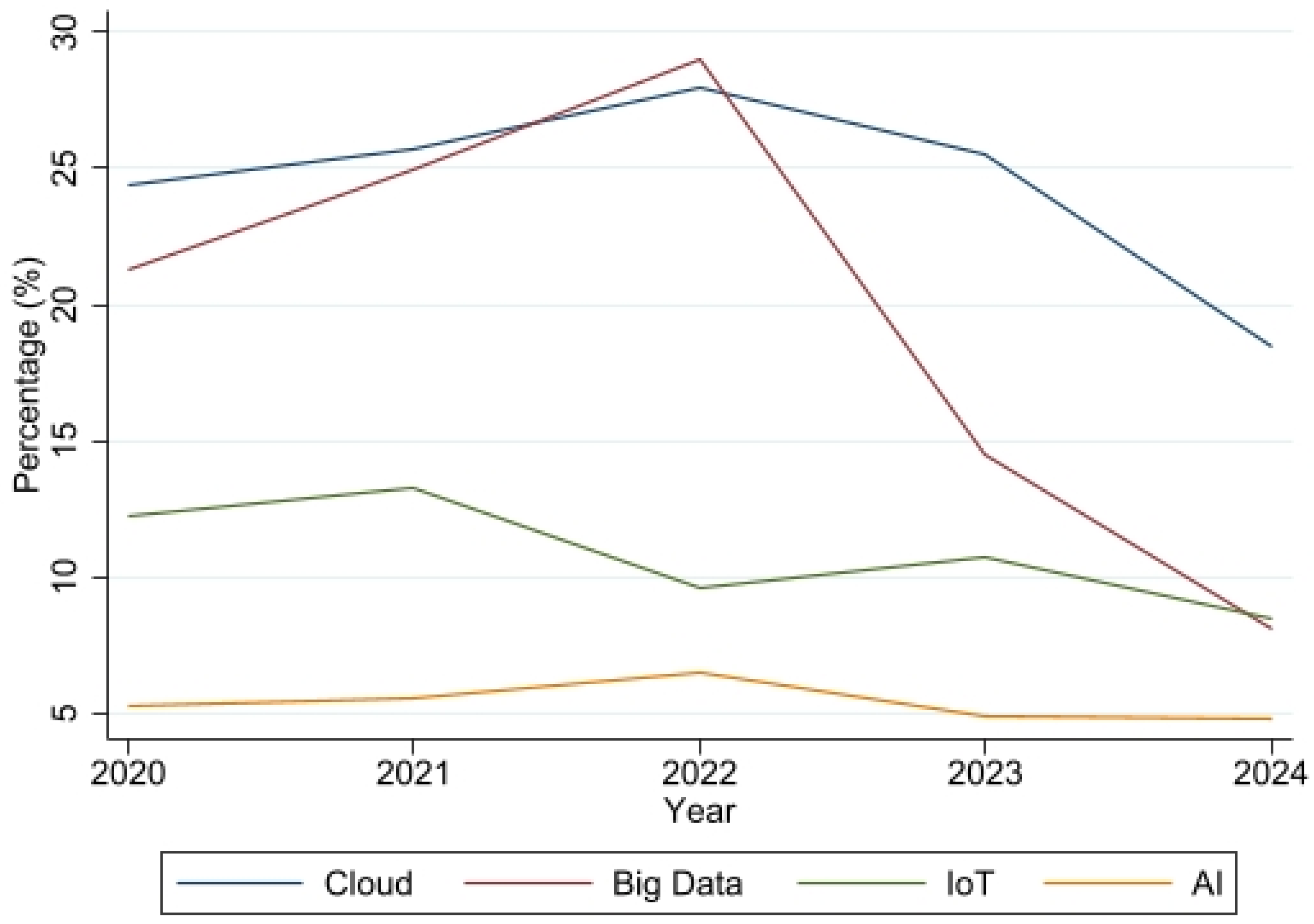
Figure 3 presents the annual shares of Cloud, Big Data, IoT, and AI adoption from 2020 to 2024, revealing clear fluctuations over the period. In 2020, Cloud (24.5%) and Big Data (21.5%) accounted for the largest shares, while IoT and AI had relatively lower shares. In 2021, all four categories showed modest increases. A peak emerged in 2022, with Cloud and Big Data reaching 28.0% and 29.5%, respectively, while IoT and AI declined. In 2023, Big Data declined sharply to 14.5%, accompanied by a slight reduction in Cloud, while IoT and AI remained relatively stable. By 2024, the shares of all four technologies had declined notably, with Cloud at 19.0% and Big Data at 8.5%, indicating a substantial reduction in reported adoption across these technologies.
Figure 3.
Trend of Advanced Digital Environments in Russia.
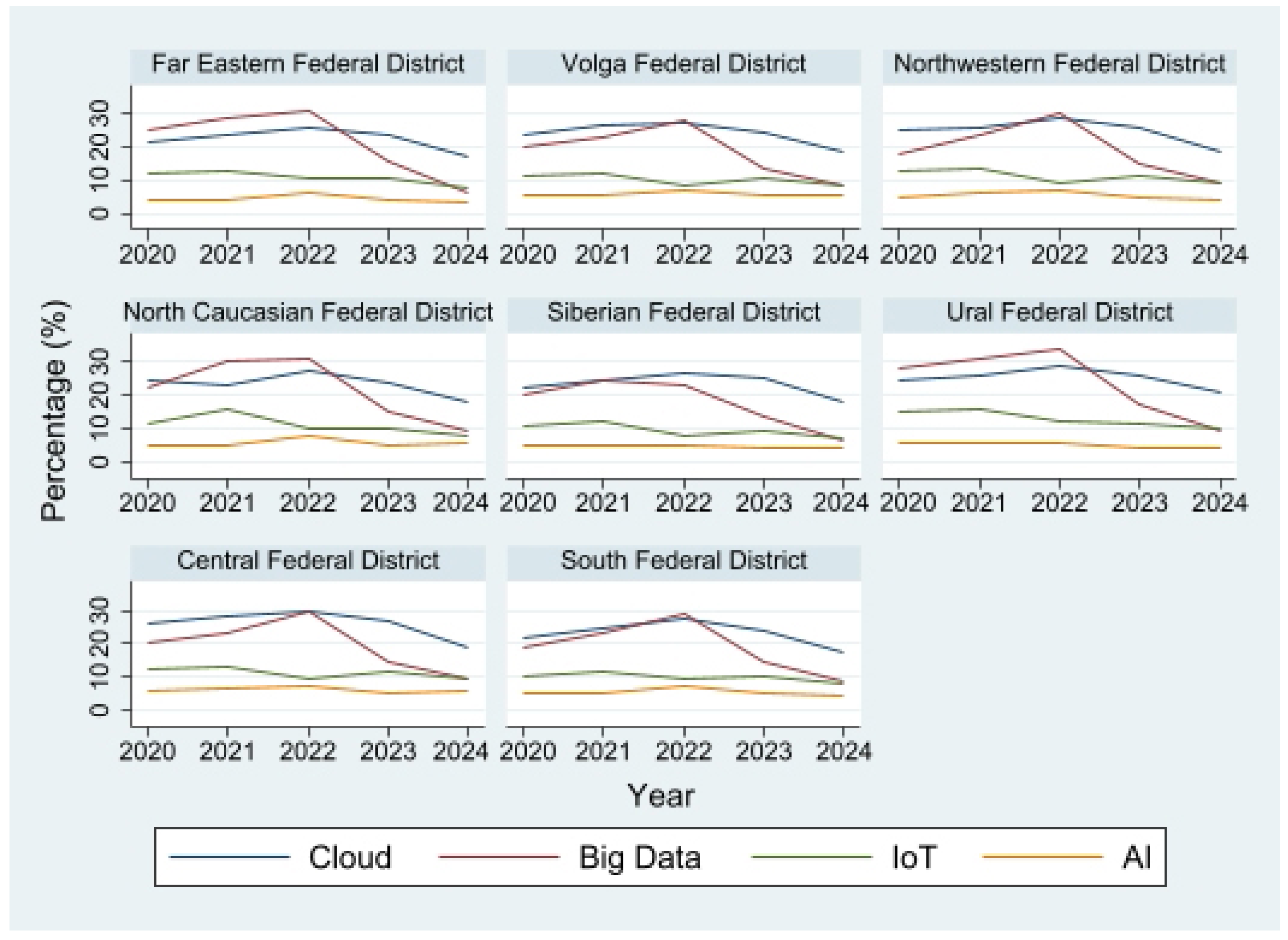
At the regional level, Figure A2 shows that the Central, Volga, and Northwestern Federal Districts maintained relatively stable shares throughout the period. Conversely, the Far Eastern and Siberian districts showed higher shares in the later years, while the Ural and Southern districts exhibited mixed trends, and the North Caucasian district remained relatively stable. Overall, the national pattern of an initial increase followed by a decline, together with persistent regional disparities, indicates that the trajectory of advanced digitalization varied considerably across regions.
5. Empirical Analysis
As presented in Table 3, the regression results consistently indicate a positive and statistically significant association between regional digital infrastructure development and food-service industry productivity. The coefficient on current digital infrastructure growth is positive and significant across all specifications, ranging from 0.00122 to 0.00512. In economic terms, these estimates imply that a 1% increase in the growth rate of the share of organizations using broadband internet access is associated with a 0.122–0.512% higher level of food-service productivity, holding other factors constant. Thus, the estimated association is not only statistically significant but also economically meaningful. Moreover, the inclusion of lagged terms reveals that the association persists over time. In particular, both the one-year and two-year lags of digital infrastructure growth remain positive and statistically significant in the distributed-lag specifications, suggesting that higher levels of prior digital infrastructure growth are associated with higher subsequent productivity levels beyond the contemporaneous period. The cumulative coefficients become larger as additional lags are incorporated, indicating that the association between digitalization and productivity may extend over multiple periods. The relationship between digital infrastructure and food-service productivity persists after controlling for broader regional economic conditions. Therefore, H1 is supported.
Table 3.
The Effect of Digital Infrastructure on Food Service Sector’s Productivity.
The results in Table 4 indicate that the use of digital platforms among regional organizations is generally positively associated with food-service sector productivity, although the magnitude and statistical significance of the association vary across specifications. The coefficient on current digital platform growth is positive in all models, ranging from 0.00170 to 0.00350, and is statistically significant in five of the six specifications, with the exception of Model (4). In economic terms, the estimated coefficients imply that a 1% increase in the growth rate of the share of organizations using digital platforms is associated with approximately a 0.17% to 0.35% higher level of food-service productivity, holding other factors constant. The lagged associations are also generally positive, with the one-year lag becoming statistically significant in Models (2) and (5), while the two-year lag is positive and marginally statistically significant in Model (3). This pattern suggests that the association between digital platform adoption and productivity may extend beyond the contemporaneous period. Overall, the results provide moderate evidence of a positive association between greater adoption of digital platforms and food-service productivity, with some indication of a delayed association, although the less consistent significance compared with digital infrastructure suggests that the relationship between digital platform adoption and productivity is more specification-dependent. Overall, the empirical results provide moderate support for H2.
Table 4.
The Effect of Digital Platforms among Regional Organizations on Food Service Sector’s Productivity.
Table 5 presents the relationship between online consumption and food-service sector productivity. In contrast to digital infrastructure and digital platform adoption, the coefficient on current online consumption growth is generally small and statistically insignificant in the baseline specifications, although it becomes positive and significant in specifications incorporating two-year lags. Specifically, the coefficient on grw_consumption increases from −0.000065 in Model (1) and 0.000707 in Model (2) to 0.00222 * in Model (3), while the corresponding estimates in Models (4)–(6) show a similar pattern, becoming positive and significant at 0.00188 in Model (6). In economic terms, the estimates in Models (3) and (6) imply that a 1% increase in the growth rate of online consumption is associated with approximately 0.22% and 0.19% higher levels of food-service productivity, respectively, holding other factors constant. However, neither the one-year nor the two-year lagged coefficients are statistically significant, indicating limited evidence of persistent or delayed associations between online consumption and productivity. The results provide limited and relatively weak evidence of a positive association between online consumption and food-service sector productivity, with a statistically significant positive association appearing only in specifications incorporating longer lags. Accordingly, H3 receives limited support from the empirical results.
Table 5.
The Effect of Online Consumption on Food Service Sector’s Productivity.
Table 6 examines the relationship between the advanced digital environment, measured using a principal component analysis (PCA) index, and food-service sector productivity. In contrast to the positive associations observed for basic digital infrastructure and digital platforms, the PCA-based measure exhibits a negative and statistically significant coefficient across all six specifications, ranging from −0.0300 to −0.0848. In economic terms, a one-standard-deviation increase in the PCA-based advanced digitalization index (SD = 1.456) is associated with approximately a 4.3% to 11.6% lower level of food-service productivity, holding other factors constant. The negative coefficient remains statistically significant after incorporating one- and two-year lags, with both L.pca and L2.pca also consistently negative and statistically significant, suggesting that greater adoption of advanced digital technologies is associated with lower measured levels of productivity in the food-service sector during the study period. The persistence of the negative coefficients across alternative lag specifications indicates that this finding is not driven solely by contemporaneous associations. Overall, the results do not support H4.
Table 6.
The Effect of Advanced Digital Environments on Food Service Sector’s Productivity.
The negative association between advanced digitalization and food-service productivity may reflect the specific stage of development of the Russian food-service sector. Unlike basic digital connectivity and digital platforms, which can facilitate customer reach, transactions, and demand expansion, advanced technologies such as AI, big data, cloud computing, and IoT are primarily associated with operational efficiency, coordination, forecasting, and automation. In a market where food-service demand remains relatively constrained and unevenly distributed across regions, the productivity-related benefits associated with these technologies may therefore not translate into higher sector-level output or productivity in the short run. In other words, advanced digitalization may be associated with greater efficiency in existing operations without necessarily generating additional customers or substantially expanding market demand.
Moreover, the adoption of advanced digital technologies may initially require organizational restructuring, investment, and the reallocation of labor and other resources. In labor-intensive food-service operations, these adjustment costs may temporarily outweigh the productivity-related benefits associated with technological adoption. The relatively short observation period may also limit the ability to capture longer-term productivity-related outcomes associated with such technologies. Thus, the negative coefficients should not necessarily be interpreted as evidence that advanced digitalization is associated with lower productivity in the long run. Rather, they may indicate that advanced digitalization in the Russian food-service sector is currently functioning more as a technology for operational transformation and efficiency restructuring than as a mechanism associated with market expansion and output growth. This interpretation also helps explain why market-enabling forms of digitalization, such as internet connectivity and digital platforms, exhibit more favorable associations with productivity in the empirical results.
A supplementary West-versus-East analysis (Table A1) shows generally no statistically significant West–East regional differences in the estimated associations. As an additional robustness check, we control for major common shocks during the study period using a 2020 COVID-19 dummy and a post-2022 dummy rather than including a full set of year fixed effects. Given the relatively short temporal coverage of the data, particularly for the digitalization variables, a full set of year fixed effects would absorb a substantial portion of the temporal variation in digitalization and leave the estimation primarily dependent on within-year cross-regional variation. The two shock controls are therefore introduced to account for major common external conditions while preserving greater variation in the digitalization variables. The results are reported in Table A2. For the specifications using platform adoption and the PCA-based advanced digitalization measure, which are available for only four years (2021–2024), the post-2022 dummy captures three of the four years and consequently leaves limited temporal variation for estimation. These specifications are therefore provided primarily as supplementary evidence and should be interpreted with caution.
The negative association between advanced digitalization and food-service productivity should also be considered in the broader geopolitical and economic context of Russia during the study period. The post-2022 period was characterized by substantial changes in international trade conditions, technology availability, and supply chains, which may have affected firms’ ability to implement and effectively utilize advanced digital technologies. To examine whether the negative association can be accounted for solely by these broader changes, we include a post-2022 dummy in an additional robustness specification. As reported in Table A2, the coefficient on the PCA-based advanced digitalization measure remains negative and statistically significant after controlling for the common post-2022 period. Nevertheless, the dummy does not separately identify the contributions of sanctions, foreign technology-provider exits, or supply-chain disruptions. Therefore, the negative coefficient should not be attributed solely to adjustment costs; rather, it may reflect the combined influence of technological adjustment requirements and the broader economic and geopolitical conditions during the observation period.
The quantile regression results reveal substantial heterogeneity in the associations between the regional digital environment and productivity across the productivity distribution (see Table 7). At the 25th percentile of productivity, growth in digital infrastructure has a positive and statistically significant association with productivity (β = 0.00256), while this association becomes statistically insignificant at the 75th percentile (β ≈ −0.00003). In contrast, digital platform development has a positive and highly significant association with productivity across all three quantiles, with the coefficient remaining relatively stable from the 25th percentile (0.00361) to the median (0.00430) and the 75th percentile (0.00434). This suggests that digital platforms may be associated with higher productivity levels across a relatively broad range of regions, regardless of their initial productivity level. The association with digital consumption is more heterogeneous: it is negative and significant at the 25th percentile (−0.000482), insignificant at the median (0.000462), and positive and highly significant at the 75th percentile (0.000874).
Table 7.
Heterogeneity Check: Quantile Regressions.
The PCA-based measure of the overall digital environment is consistently negative and statistically significant at all three quantiles, although its magnitude is broadly similar across the productivity distribution (−0.0729, −0.0679, and −0.0673, respectively). This indicates that the negative association captured by the composite digitalization measure is not concentrated in a particular part of the productivity distribution. Overall, the quantile estimates provide evidence that the associations between digitalization and productivity vary across regions. In particular, infrastructure appears to be more relevant for lower-productivity regions, whereas digital consumption shows a stronger positive association with productivity among higher-productivity regions. Meanwhile, digital platforms exhibit a comparatively stable positive relationship with productivity throughout the distribution. These findings support the hypothesis that the association between the regional digital environment and productivity varies according to the existing productivity level.
The negative association between advanced digitalization and food-service productivity has important implications for both interpretation and policy. The finding should not be interpreted as evidence that advanced digital technologies inherently reduce productivity. Rather, it may be consistent with the substantial complementary capabilities and adjustment processes required for their effective adoption. Technologies such as cloud computing, big data analytics, IoT, and AI require not only digital infrastructure but also skilled workers, data-management capabilities, organizational adaptation, and complementary investments. During the transition period, these requirements may be associated with adjustment costs and learning processes that temporarily offset potential productivity-related benefits. Because the PCA-based measure combines several advanced digital technologies, its negative coefficient may therefore capture some of the short-run costs associated with digital transformation alongside potential longer-term productivity-related outcomes. However, the present study does not directly measure adjustment costs or complementary organizational capabilities, and this interpretation should therefore be regarded as a possible explanation rather than a directly tested mechanism.
This finding also suggests that regional digitalization policies should move beyond promoting the adoption of advanced technologies alone. Policy support may need to address the complementary conditions required to translate technological adoption into favorable productivity-related outcomes, including digital skills development, managerial and organizational capabilities, data-management capacity, and support for firms adapting their business processes to new technologies. In the food-service sector, such measures could include targeted training in digital technologies, support for small firms in integrating digital systems into existing operations, and programs that facilitate the development of complementary digital and managerial capabilities. The results therefore suggest that the relationship between advanced digitalization and productivity may depend not only on the extent of technology adoption but also on the capacity of regional firms to effectively integrate these technologies into their production and service processes.
The heterogeneous associations across productivity quantiles may reflect differences in the productivity-related relevance of digital technologies and the complementary capabilities required to integrate digitalization into regional production and service processes. In lower-productivity regions, improvements in basic digital infrastructure are associated with higher productivity, which may reflect the greater importance of addressing connectivity constraints where digital infrastructure remains relatively less developed. However, the association is not statistically significant at the median quantile and is close to zero at the upper quantile, suggesting that the association between further infrastructure development and productivity may become less pronounced in higher-productivity regions where basic digital connectivity is already more developed. Therefore, the results provide evidence of heterogeneous associations across productivity levels, but they do not provide sufficient evidence to characterize this pattern as a systematic catch-up mechanism.
In contrast, higher-productivity regions may be better positioned to utilize digital consumption and advanced digital applications because they possess stronger organizational, technological, and managerial capabilities. Digital consumption may therefore show a stronger positive association with productivity when firms have sufficient complementary capabilities to integrate online demand into more efficient business models, logistics, and service delivery. Digital platforms, meanwhile, show a relatively stable positive association with productivity across the productivity distribution, suggesting that their relationship with productivity is relatively consistent across regions, regardless of their initial productivity level. Overall, H5 is supported.
6. Discussions
The findings of this study are broadly consistent with, but also extend, the existing literature on digitalization and productivity. First, the positive association between digital infrastructure and food-service productivity is consistent with previous evidence that broadband and high-speed internet access are associated with higher firm productivity, employment, and regional economic performance (S. Chen et al., 2020; Hjort & Poulsen, 2019; Giannini et al., 2023). The present study extends this literature by showing that the productivity-related association of digital infrastructure is also relevant in the food-service sector, where connectivity is increasingly associated with customer access, online ordering, digital payments, and operational coordination. Moreover, the heterogeneous results across productivity levels suggest that the association between infrastructure and productivity is not uniform across regions.
Second, the positive association between digital platform adoption and productivity is in line with studies linking platform capabilities and digital connectivity to higher levels of firm performance (Jun et al., 2022; Rajala & Hautala-Kankaanpää, 2023). The finding is also consistent with research on food-delivery platforms showing that digital platforms are associated with broader customer access and higher order volumes. However, previous studies have emphasized that commissions, congestion, and contractual arrangements may limit some of these potential benefits (M. Chen et al., 2022; Feldman et al., 2023). Our results suggest that, at the regional food-service industry level, the overall association between platform adoption and productivity remains positive despite these potential costs. Thus, the findings complement firm-level evidence by indicating that the overall productivity relationship may remain positive when platform participation is considered at the regional food-service sector level.
Third, the relatively weak and heterogeneous association between online consumption and productivity provides a more nuanced picture than the generally positive relationships reported in the e-commerce literature (Ballerini et al., 2023; Gao et al., 2023; Hussain et al., 2022). While previous studies largely focus on firm-level performance and report positive associations associated with expanded sales and customer-engagement channels, our results indicate that greater online consumption is not necessarily associated with higher sector-level productivity in the contemporaneous period. This difference may partly reflect the distinction between firm-level performance and regional industry-level productivity, as well as the potential importance of complementary logistics, digital skills, and managerial capabilities. The results therefore extend the existing literature by suggesting that the relationship between online consumption and productivity may depend on the broader regional context.
Finally, the negative association between the PCA-based measure of advanced digitalization and food-service productivity contrasts with studies reporting positive associations between AI, big data, and other advanced digital technologies and productivity (C. H. Yang, 2022; Czarnitzki et al., 2023; Zhai & Liu, 2023). At the same time, the finding is consistent with the literature emphasizing the productivity J-curve and the potential short-run adjustment costs associated with digital transformation (Brynjolfsson et al., 2019, 2021; Gebauer et al., 2020; Guo et al., 2023). This difference may reflect the relatively short observation period available for the advanced digitalization indicators and the regional, sector-level nature of our analysis. Importantly, the present study does not directly test adjustment costs or complementary capabilities, so this interpretation should be regarded as a possible explanation rather than a directly tested mechanism.
On the other hand, the negative and statistically significant coefficient on the labor input variable warrants further consideration. In a conventional production-function framework, labor is generally expected to have a positive association with output. However, the dependent variable in this study is food-service productivity, measured as GVA per worker, rather than total output. Consequently, an increase in labor input does not necessarily imply higher productivity per worker if the corresponding increase in GVA is proportionally smaller. The negative coefficient may therefore partly reflect the scaling relationship between labor input and the productivity measure, rather than indicating that labor input itself is associated with lower total production. Accordingly, the negative labor coefficient should not be interpreted as evidence of a negative causal effect of labor on production. Rather, it should be understood in the context of the productivity-based dependent variable and the indirect measurement of sector-specific labor input.
Overall, the findings support the view that digitalization is not a homogeneous source of productivity gains. Rather, the productivity implications differ across technological dimensions and regional productivity levels. By examining digital infrastructure, platforms, online consumption, and advanced digitalization separately within a common regional framework, this study extends previous research that has often focused on individual technologies or aggregate measures of digitalization. The results therefore highlight the importance of distinguishing between different stages and dimensions of digital transformation when evaluating its productivity implications in the food-service sector.
7. Conclusions and Implications
This study examined how different dimensions of the regional digital environment are associated with food-service industry productivity across Russian regions. Rather than treating digitalization as a homogeneous phenomenon, the study distinguished between basic digital infrastructure, digital platform adoption, online consumption, and advanced digital technologies. The empirical results show that the associations between these different dimensions of digitalization and food-service productivity are not uniform. Overall, the findings suggest that the relationship between digitalization and productivity may depend on the specific function of digital technologies and the conditions under which they are adopted.
Overall, the findings reveal substantial heterogeneity in the associations between different dimensions of digitalization and productivity. Digital infrastructure is consistently and positively associated with food-service productivity, with particularly pronounced associations among lower-productivity regions. Digital platform adoption shows a generally positive association with productivity across productivity levels, which may be consistent with its role in supporting market access and transaction and operational efficiency. In contrast, online consumption exhibits weak contemporaneous associations with productivity but shows a stronger positive association among higher-productivity regions, where firms may possess stronger complementary capabilities. Finally, the PCA-based measure of advanced digital technologies is negatively associated with productivity across specifications and quantiles. This finding may reflect the substantial adjustment costs, organizational restructuring, and complementary investments required for the effective adoption of AI, IoT, big data, and cloud technologies. Thus, the negative association may be consistent with a transitional stage of digital transformation rather than necessarily indicating adverse long-run productivity outcomes.
These findings have several important implications. First, digitalization policies should prioritize basic digital infrastructure in lower-productivity regions, where improved connectivity is more strongly associated with higher productivity and may support regional convergence. Second, policymakers should support digital platforms and related ecosystems, including digital ordering, payment, delivery, and market-access systems, particularly for small and medium-sized food-service businesses. Third, expanding online consumption should be accompanied by investments in complementary capabilities, such as digital skills, logistics, and managerial capacity, as increased digital demand alone may not necessarily be associated with higher productivity. Finally, the negative association between advanced digitalization and productivity highlights the need to move beyond a technology-adoption-only approach. The adoption of AI, IoT, big data, and cloud technologies should be supported by workforce training, organizational adaptation, and technical assistance to address short-run adjustment costs and support favorable longer-term productivity outcomes. Overall, effective digitalization policy should progress from strengthening basic digital foundations to facilitating platform-based market access and developing the capabilities required to effectively integrate advanced digital technologies.
On the other hand, this study has several limitations. First, the dependent variable is based on Section I of OKVED2, which combines accommodation and food service activities. Because a separate regional output measure exclusively covering food-service activities is not consistently available for all regions and years, the estimated productivity measure may include accommodation-related activities and should therefore be interpreted with this sectoral limitation in mind. Second, the labor and capital inputs used in the analysis are indirectly constructed at the regional level rather than measured specifically for food-service firms, which may not fully capture sector-specific differences in labor and capital intensity. Third, food-service productivity may be influenced by factors beyond digitalization, including managerial capabilities, investment, competition, consumer demand, and broader macroeconomic conditions. Although regional fixed effects and control variables are included, unobserved time-varying factors and potential reverse causality may remain; therefore, the estimated relationships should be interpreted as associations rather than as evidence of definitive causal relationships. Fourth, the advanced digitalization indicators are available only for 2021–2024, limiting the ability to examine longer-term relationships and adjustment processes. Finally, the analysis is based on Russian regions, and the institutional, economic, and technological characteristics of Russia may limit the generalizability of the findings to other countries. Future research could address these limitations by using more narrowly defined sectoral data and firm-level measures of labor, capital, and technology adoption; extending the observation period as longer digitalization data become available; directly measuring complementary organizational capabilities and adjustment processes; and employing stronger identification strategies, such as natural experiments or instrumental-variable approaches.
Author Contributions
Conceptualization, H.-S.L. and A.V.L.; methodology, H.-S.L.; software, H.-S.L. and X.L.; validation, X.L., R.R.S. and V.A.B.; formal analysis, H.-S.L. and X.L.; investigation, H.-S.L., V.I.N. and S.U.C.; resources, H.-S.L., A.V.L., V.A.B. and R.R.S.; data curation, X.L.; writing—original draft preparation, H.-S.L. and X.L.; writing—review and editing, A.V.L. and V.I.N.; visualization, H.-S.L.; supervision, A.V.L., R.R.S. and V.A.B.; project administration, S.U.C. and V.I.N.; funding acquisition, H.-S.L., V.I.N. and S.U.C. All authors have read and agreed to the published version of the manuscript.
Funding
This research was funded by Russian Science Foundation, grant number 25-28-03162.
Institutional Review Board Statement
Not applicable.
Informed Consent Statement
Not applicable.
Data Availability Statement
The raw data supporting the conclusions of this article will be made available by the authors on request.
Conflicts of Interest
The authors declare no conflicts of interest.
Appendix A
Here, the West is defined as a dummy variable that takes a value of 1 for the Central Federal District and Northwestern Federal District and 0 otherwise. Despite substantial disparities in the level of digitalization across Russian regions, as shown in Figure A1 and Figure A2, the association between digitalization and food-service productivity does not necessarily vary proportionally across regions. One possible explanation is that differences in the level of digitalization do not necessarily translate into differences in the productivity-related association of digital technologies. Although the Central and Northwestern Federal Districts generally have higher levels of digitalization, firms in less-digitalized regions may exhibit similar productivity associations with incremental improvements, because the productivity-related relevance of basic digital adoption may be greater at lower levels of digital development. In addition, common technologies, business practices, and market mechanisms may be associated with broadly similar productivity outcomes across regions once digital technologies become sufficiently accessible. Thus, regional disparities in digital readiness may coexist with relatively similar associations between further digitalization and productivity.
Table A1.
Heterogeneity Check: West vs. East.
Figure A1.
Trend of Basic Digital Environments in Russian Federal Districts.
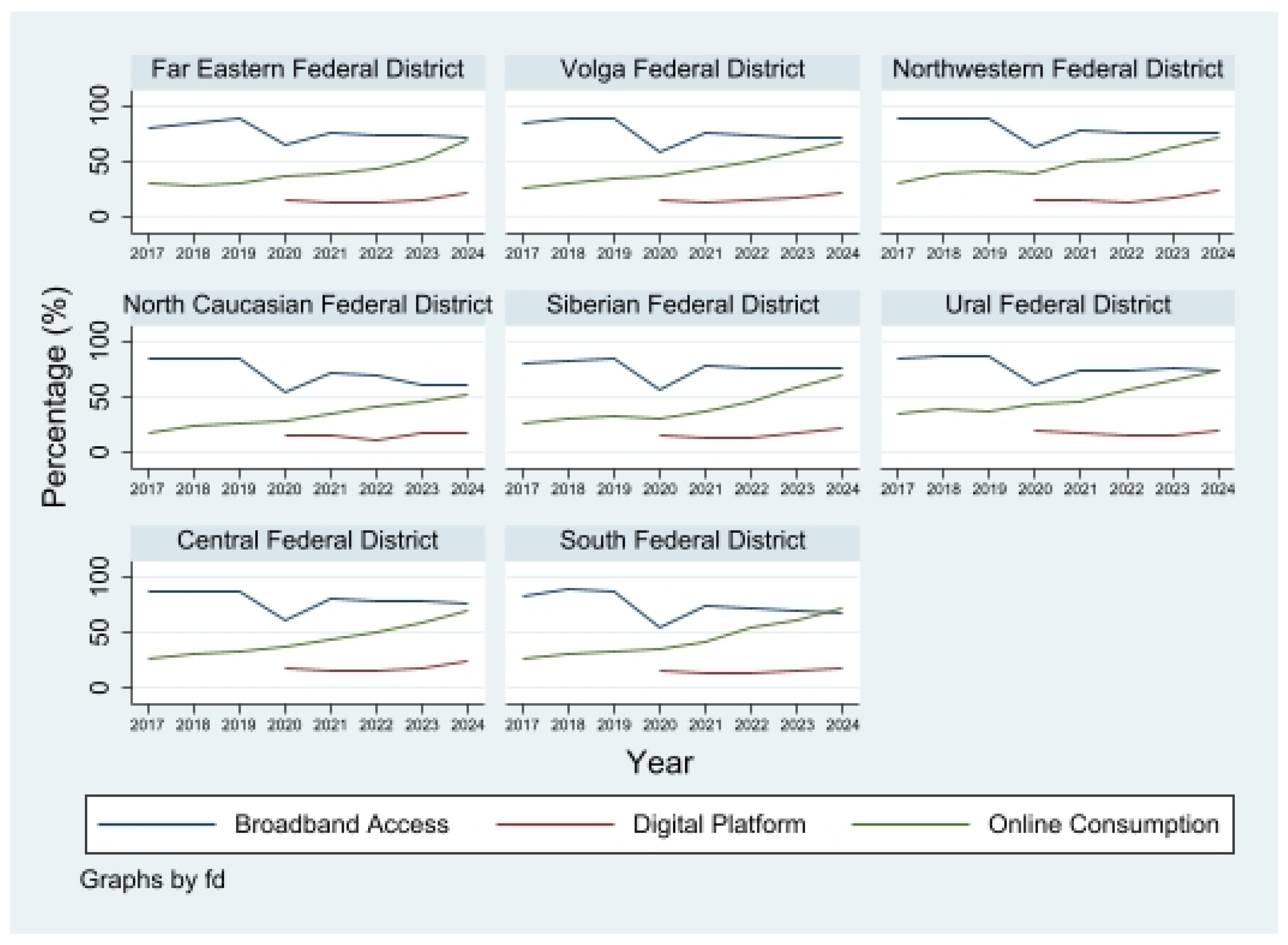
Table A2.
Models Controlling for COVID-19 and Post-2022 Common Shocks.
Figure A2.
Trend of Advanced Digital Environments in Russian Federal Districts.
Notes
| 1 | All statistical analyses were conducted using Stata/SE 17.0. Regional fixed-effects panel regressions were estimated using the ‘xtreg’ command with region fixed effects and standard errors clustered at the regional level. Lagged specifications were employed to examine the relationship between prior-period digitalization and subsequent productivity. Quantile regressions were used to assess whether the relationship between digitalization and productivity varies across different points of the regional productivity distribution. Principal component analysis (PCA) was conducted to construct the advanced digitalization index from the four technology indicators—artificial intelligence, Internet of Things, big data, and cloud computing. All data transformations, descriptive statistics, regression analyses, and robustness checks were performed in Stata/SE 17.0. |
| 2 | The observation period varies across digitalization measures because the availability of the underlying regional data differs by indicator. The general digitalization variables, including digital infrastructure, digital platform adoption, and online consumption, are available annually from 2017 to 2024. In contrast, the four advanced digitalization indicators—artificial intelligence (AI), Internet of Things (IoT), big data, and cloud computing—and the platform variable are available only from 2021 to 2024. Accordingly, the notation “2017 (2021)–2024” refers to the variable-specific observation periods: 2017–2024 for the general digitalization measures and 2021–2024 for the advanced digitalization measures and platform variable. As a result, the effective sample size differs across empirical specifications depending on the availability of the underlying digitalization indicators. The reduced sample size may limit statistical power and increase the uncertainty of the estimated coefficients in the advanced-digitalization models. Therefore, differences in coefficient magnitude or statistical significance across models with different sample sizes should be interpreted with caution and should not be attributed solely to differences in the underlying relationships between digitalization and productivity. |
| 3 | The analysis covers all 85 federal subjects included in the Rosstat regional statistics database during the study period. Thus, the sample does not represent a selected subset of Russian regions based on economic, geographic, or other substantive criteria. Rather, the study uses the full set of 85 federal subjects for which consistent regional statistics are available. Differences in the number of observations across empirical specifications are attributable to the varying temporal availability of specific digitalization indicators, rather than to the exclusion of particular regions from the sample. |
| 4 | Food-service GVA is measured using OKVED2 Section I, Activities of Hotels and Catering Enterprises. A limitation of this classification is that it includes accommodation activities in addition to food-service activities. However, we retain this broader category because hotels also encompass food and beverage (F&B) services, making Section I a reasonable and comprehensive proxy for the broader food-service sector. |
| 5 | As sector-specific labor and capital data are unavailable at the regional level, we approximate food-service labor and capital inputs by multiplying total regional labor and fixed capital investment by the food-service sector’s share of regional GVA. This allocation approach provides a sector-specific proxy that is consistent with the relative economic weight of the food-service sector within each region. Because separate regional data on food-service labor and capital are not consistently available, we use regional totals and the food-service sector’s share of regional GVA to approximate these inputs. This approach may introduce measurement error and a potential mechanical relationship with the productivity measure, which also incorporates GVA. However, alternative specifications based on directly observed food-service labor and capital inputs cannot be estimated because the required regional data are unavailable. The results should therefore be interpreted in light of this data limitation. |
References
- Aldashev, A., & Batkeyev, B. (2021). Broadband infrastructure and economic growth in rural areas. Information Economics and Policy, 57, 100936. [Google Scholar] [CrossRef] [Scilit]
- Ballerini, J., Herhausen, D., & Ferraris, A. (2023). How commitment and platform adoption drive the e-commerce performance of SMEs: A mixed-method inquiry into e-commerce affordances. International Journal of Information Management, 72, 102649. [Google Scholar] [CrossRef] [Scilit]
- Brynjolfsson, E., Rock, D., & Syverson, C. (2019). Artificial intelligence and the modern productivity paradox: A clash of expectations and statistics. In A. Agrawal, J. Gans, & A. Goldfarb (Eds.), The economics of artificial intelligence: An agenda (pp. 23–60). University of Chicago Press. [Google Scholar] [CrossRef] [Scilit]
- Brynjolfsson, E., Rock, D., & Syverson, C. (2021). The productivity J-curve: How intangibles complement general purpose technologies. American Economic Journal: Macroeconomics, 13(1), 333–372. [Google Scholar] [CrossRef] [Scilit]
- Chang, Y. S., Jeon, S., & Shamba, K. (2020). Speed of catch-up and digital divide: Convergence analysis of mobile cellular, internet, and fixed broadband for 44 African countries. Journal of Global Information Technology Management, 23(3), 217–234. [Google Scholar] [CrossRef] [Scilit]
- Chen, M., Hu, M., & Wang, J. (2022). Food delivery service and restaurant: Friend or foe? Management Science, 68(9), 6539–6551. [Google Scholar] [CrossRef] [Scilit]
- Chen, S., Liu, W., & Song, H. (2020). Broadband internet, firm performance, and worker welfare: Evidence and mechanism. Economic Inquiry, 58(3), 1146–1166. [Google Scholar] [CrossRef] [Scilit]
- Czarnitzki, D., Fernández, G. P., & Rammer, C. (2023). Artificial intelligence and firm-level productivity. Journal of Economic Behavior & Organization, 211, 188–205. [Google Scholar] [CrossRef] [Scilit]
- de Clercq, M., D’Haese, M., & Buysse, J. (2023). Economic growth and broadband access: The European urban-rural digital divide. Telecommunications Policy, 47(6), 102579. [Google Scholar] [CrossRef] [Scilit]
- Fan, X., Ding, G., Long, S., Dong, Y., & Yan, J. (2025). Digital divide or dividend? Exploring the impact of digital economy on regional gaps of high-quality economic development in China using relational data model. International Review of Economics & Finance, 101, 104222, (Correction in 2025, International Review of Economics & Finance, 102, 104260). [Google Scholar] [CrossRef] [Scilit]
- Feldman, P., Frazelle, A. E., & Swinney, R. (2023). Managing relationships between restaurants and food delivery platforms: Conflict, contracts, and coordination. Management Science, 69(2), 812–823. [Google Scholar] [CrossRef] [Scilit]
- Gao, J., Siddik, A. B., Khawar Abbas, S., Hamayun, M., Masukujjaman, M., & Alam, S. S. (2023). Impact of e-commerce and digital marketing adoption on the financial and sustainability performance of MSMEs during the COVID-19 pandemic: An empirical study. Sustainability, 15(2), 1594. [Google Scholar] [CrossRef] [Scilit]
- Gebauer, H., Fleisch, E., Lamprecht, C., & Wortmann, F. (2020). Growth paths for overcoming the digitalization paradox. Business Horizons, 63(3), 313–323. [Google Scholar] [CrossRef] [Scilit]
- Giannini, M., Martini, B., & Fiorelli, C. (2023). How does firms’ broadband adoption affect regional TFP in Italy? Economia Politica, 40(3), 1025–1050. [Google Scholar] [CrossRef] [Scilit] [PubMed]
- Gladkova, A., & Ragnedda, M. (2020). Exploring digital inequalities in Russia: An interregional comparative analysis. Online Information Review, 44(4), 767–786. [Google Scholar] [CrossRef] [Scilit]
- Goldfarb, A., & Tucker, C. (2019). Digital economics. Journal of Economic Literature, 57(1), 3–43. [Google Scholar] [CrossRef] [Scilit]
- Grishchenko, N. (2020). The gap not only closes: Resistance and reverse shifts in the digital divide in Russia. Telecommunications Policy, 44(8), 102004. [Google Scholar] [CrossRef] [Scilit]
- Guo, X., Li, M., Wang, Y., & Mardani, A. (2023). Does digital transformation improve the firm’s performance? From the perspective of digitalization paradox and managerial myopia. Journal of Business Research, 163, 113868. [Google Scholar] [CrossRef] [Scilit]
- Heubeck, T. (2023). Managerial capabilities as facilitators of digital transformation? Dynamic managerial capabilities as antecedents to digital business model transformation and firm performance. Digital Business, 3(1), 100053. [Google Scholar] [CrossRef] [Scilit]
- Hjort, J., & Poulsen, J. (2019). The arrival of fast internet and employment in Africa. American Economic Review, 109(3), 1032–1079. [Google Scholar] [CrossRef] [Scilit]
- Hussain, A., Akbar, M., Shahzad, A., Poulova, P., Akbar, A., & Hassan, R. (2022). E-commerce and SME performance: The moderating influence of entrepreneurial competencies. Administrative Sciences, 12(1), 13. [Google Scholar] [CrossRef] [Scilit]
- Jun, W., Nasir, M. H., Yousaf, Z., Khattak, A., Yasir, M., Javed, A., & Shirazi, S. H. (2022). Innovation performance in digital economy: Does digital platform capability, improvisation capability and organizational readiness really matter? European Journal of Innovation Management, 25(5), 1309–1327. [Google Scholar] [CrossRef] [Scilit]
- Kastelli, I., Dimas, P., Stamopoulos, D., & Tsakanikas, A. (2024). Linking digital capacity to innovation performance: The mediating role of absorptive capacity. Journal of the Knowledge Economy, 15(1), 238–272. [Google Scholar] [CrossRef] [Scilit] [PubMed]
- Lee, W., Jang, S. S., & Kim, H. S. (2024). The effect of digital transformation: Boosting productivity in the restaurant industry. International Journal of Hospitality Management, 123, 103896. [Google Scholar] [CrossRef] [Scilit]
- Lee, Y. S., Kim, T., Choi, S., & Kim, W. (2022). When does AI pay off? AI-adoption intensity, complementary investments, and R&D strategy. Technovation, 118, 102590. [Google Scholar] [CrossRef] [Scilit]
- Li, J., & Liu, H. (2026). Role of complementary capabilities in artificial intelligence adoption and productivity: Firm-level evidence from Canada. Canadian Public Policy, 52(S1), 36–57. [Google Scholar] [CrossRef] [Scilit]
- Meng, T., Yu, D., Ye, L., Yahya, M. H., & Zariyawati, M. A. (2023). Impact of digital city competitiveness on total factor productivity in the commercial circulation industry: Evidence from China’s emerging first-tier cities. Humanities and Social Sciences Communications, 10(1), 927. [Google Scholar] [CrossRef] [Scilit]
- Mikalef, P., Krogstie, J., Pappas, I. O., & Pavlou, P. (2020). Exploring the relationship between big data analytics capability and competitive performance: The mediating roles of dynamic and operational capabilities. Information & Management, 57(2), 103169. [Google Scholar] [CrossRef] [Scilit]
- Niu, B., Li, Q., Mu, Z., Chen, L., & Ji, P. (2021). Platform logistics or self-logistics? Restaurants’ cooperation with online food-delivery platform considering profitability and sustainability. International Journal of Production Economics, 234, 108064. [Google Scholar] [CrossRef] [Scilit]
- Orji, I. J., Ojadi, F., & Okwara, U. K. (2022). The nexus between e-commerce adoption in a health pandemic and firm performance: The role of pandemic response strategies. Journal of Business Research, 145, 616–635. [Google Scholar] [CrossRef] [Scilit]
- Peng, X., Zhu, J., Lee, S., Zhou, D., Song, W., & Ying, T. (2024). Digital transformation in the hospitality industry: A bibliometric review from 2000 to 2023. International Journal of Hospitality Management, 120, 103761. [Google Scholar] [CrossRef] [Scilit]
- Raisch, S., & Krakowski, S. (2021). Artificial intelligence and management: The automation–augmentation paradox. Academy of Management Review, 46(1), 192–210. [Google Scholar] [CrossRef] [Scilit]
- Rajala, A., & Hautala-Kankaanpää, T. (2023). Exploring the effects of SMEs’ platform-based digital connectivity on firm performance–the moderating role of environmental turbulence. Journal of Business & Industrial Marketing, 38(13), 15–30. [Google Scholar] [CrossRef] [Scilit]
- Tan, T. F., & Netessine, S. (2020). At your service on the table: Impact of tabletop technology on restaurant performance. Management Science, 66(10), 4496–4515. [Google Scholar] [CrossRef] [Scilit]
- Trașcă, D. L., Ștefan, G. M., Sahlian, D. N., Hoinaru, R., & Șerban-Oprescu, G. L. (2019). Digitalization and business activity: The struggle to catch up in CEE countries. Sustainability, 11(8), 2204. [Google Scholar] [CrossRef] [Scilit]
- Wamba, S. F. (2022). Impact of artificial intelligence assimilation on firm performance: The mediating effects of organizational agility and customer agility. International Journal of Information Management, 67, 102544. [Google Scholar] [CrossRef] [Scilit]
- Wang, Y., Kim, J., & Kim, J. (2021). The financial impact of online customer reviews in the restaurant industry: A moderating effect of brand equity. International Journal of Hospitality Management, 95, 102895. [Google Scholar] [CrossRef] [Scilit]
- Yang, C. H. (2022). How artificial intelligence technology affects productivity and employment: Firm-level evidence from Taiwan. Research Policy, 51(6), 104536. [Google Scholar] [CrossRef] [Scilit]
- Yang, Y., Chen, N., & Chen, H. (2023). The digital platform, enterprise digital transformation, and enterprise performance of cross-border e-commerce—From the perspective of digital transformation and data elements. Journal of Theoretical and Applied Electronic Commerce Research, 18(2), 777–794. [Google Scholar] [CrossRef] [Scilit]
- Zemtsov, S. P. (2025). Tsifrovoe neravenstvo i regional’noe razvitie v Rossii v usloviyakh rasprostraneniya tekhnologiy iskusstvennogo intellekta [Digital inequality and regional development in Russia in the context of the spread of artificial intelligence technologies]. Journal of the New Economic Association, 2(67), 225–233. [Google Scholar] [CrossRef] [Scilit]
- Zemtsov, S. P., Demidova, K. V., & Kichaev, D. Y. (2022). Internet diffusion and interregional digital divide in Russia: Trends, factors, and the influence of the pandemic. Baltic Region, 14(4), 57–78. [Google Scholar] [CrossRef] [Scilit]
- Zhai, S., & Liu, Z. (2023). Artificial intelligence technology innovation and firm productivity: Evidence from China. Finance Research Letters, 58, 104437. [Google Scholar] [CrossRef] [Scilit]

Disclaimer/Publisher’s Note: The statements, opinions and data contained in all publications are solely those of the individual author(s) and contributor(s) and not of MDPI and/or the editor(s). MDPI and/or the editor(s) disclaim responsibility for any injury to people or property resulting from any ideas, methods, instructions or products referred to in the content. |
© 2026 by the authors. Licensee MDPI, Basel, Switzerland. This article is an open access article distributed under the terms and conditions of the Creative Commons Attribution (CC BY) license.