


Abstract
Many modern urban parks have free-ranging animals. This helps with the ex situ conservation of species and raises empathy and awareness. However, these populations, which receive food and medical treatment, can exceed expected densities and require management. Estimating population size is the first step. In this study, we used the capture–marking–recapture method to estimate the population size of free-ranging Dasyprocta sp. at the Emílio Goeldi Zoobotanical Park. Captures were conducted between October 2024 and December 2025. Each individual was weighed, measured, sexed and microchipped. We estimated population size using the Rcapture package and selected the best-fitting model using the Akaike information criterion (AIC). Size structure data showed that only two young animals were captured, and medical data recorded only two deaths during the study period. Due to closure, high population density and low birth and death proportions, we used closed population models. A total of 123 captures were made, including 94 markings and 28 recaptures. The estimated population size was 201 individuals, corresponding to a density of 37.2 ind/ha. This greatly exceeds previously reported densities for agoutis, and suggests an ecological imbalance in the study area. These findings provide an important baseline for monitoring and managing this population.
1. Introduction
Botanic gardens and zoos fulfill many roles, including ex situ conservation, research, and visitor education and recreation. They generate information that is essential for the well-being of the species they maintain and for raising scientific and conservation awareness in the general public.
These spaces often host free-living biodiversity including mammals, birds, reptiles, and other taxa that inhabit the areas surrounding the enclosures [1,2]. Because they attract the public, who usually enjoy interacting with them, these free-ranging animals contribute significantly to raising public interest in nature conservation.
However, the living conditions of these animals in urban environments are not well-understood and can be beneficial or harmful to their own species or other species with which they interact [3]. The potential of species to adapt to these conditions may vary. Constant supplemental feeding and veterinary care in managed environments reduce energy and disease constraints, which can lead to increased individual survival rates that promote greater longevity and population growth [4,5,6]. Although this process is conceptually understood, most of the studies on free-ranging animals in botanical gardens and zoos are related to richness and habitat use, and studies focusing on population size estimates and monitoring are scarce.
Estimating abundance and density is one of the most important steps in monitoring and managing animal populations [7], including the free-ranging animals in zoobotanical gardens in urban areas. These estimates provide the basis for developing management strategies tailored to each case [8]. The capture–mark–recapture method is one of the various methods that have been developed to estimate animal abundance. It is widely used for several reasons, including its high effectiveness when the right model is chosen and the main assumptions are met [9]. In managed areas such as zoobotanical parks, this method is useful because, in addition to estimating the population, marking the animals allows for further monitoring and traceability.
A closed population is one for which it is assumed that there are no changes in population size during the sampling period [10]. Although it is difficult to meet all the assumptions for closed populations, the estimates can still be unbiased, even if they are less precise, when changes are only due to births and deaths [11]. Estimates of abundance in closed populations can be made using models that account for different sources of variation in capture probability. These sources include temporal variation, behavioral responses, individual heterogeneity, and the absence of variation (null model). The best fit can be determined using a model selection framework [12].
The model must also account for the probability of detecting individuals. Even in controlled areas, detectability can vary among individuals depending on behavior, spatial use, and responses to the presence of observers or sampling devices. Failing to account for heterogeneity in detectability can lead to over- or underestimation of population size [13].
The Emílio Goeldi Zoobotanical Park (PZB) is home to a variety of free-ranging bird, reptile, and mammal species, including agoutis. Previous studies at the park have documented three species of Dasyprocta: Dasyprocta leporina Lichtenstein, 1823; Dasyprocta prymnolopha Wagler, 1832; and a species designated as Dasyprocta sp., which was believed to be a hybrid; however, the study does not describe the differences between species [14,15]. An ongoing study using integrative taxonomy (morphological and molecular data) confirmed that these specimens belong to a single Dasyprocta species, whose identity remains uncertain. Hybrid forms were not detected in this study. The last agouti survey in the PZB was conducted in 2000, and estimated a population size of 111 individuals, with a density of 20 ind/ha (equivalent to 2000 animals/km2). This density is much higher than that observed in natural populations. However, there has been no follow-up or monitoring of this population since then. As a result, the current population size is unknown, hindering proper management.
The genus Dasyprocta belongs to the family Dasyproctidae, which includes medium-sized caviomorph rodents and is subdivided into two genera [16]. These rodents have a slender body with long, thin limbs, and their weight ranges from 1.5 to 6 kg [17]. They are typically diurnal but can adapt to nocturnal or crepuscular activity patterns. They occur in tropical forests, savannas, caatingas, and anthropized areas [17,18]. Their diet is described as being omnivorous [19]. They are widely distributed throughout the Neotropical region, ranging from Mexico to Argentina. Although the genus is the most diverse in the Dasyproctidae family, there is disagreement regarding the number of species, ranging from 10 [17] to 13 [20].
Agouti population density varies widely across their range, from 1 to 63 individuals/km2 [21], depending on factors such as location, environmental characteristics, and seasonality. Long-term studies highlight this variability. Jorge and Peres [22] recorded seasonal differences, with higher densities during the dry season and lower densities during the rainy season. Extremely low densities have been associated with intense hunting pressure [23].
In contrast, exceptionally high densities have been recorded in scenarios of ecological imbalance [24]. Although agoutis play a fundamental ecological role as seed dispersers [25], high population densities can negatively impact forest dynamics. In such cases, agoutis may predominantly act as seed predators, compromising plant recruitment [24,26].
Observed behaviors of agoutis in the PZB, such as bite marks on tree trunks and evidence of predation on unusual food items for the species, suggest that its population size and density remain high. Given this scenario and the need to provide information to support species management in the park, this study aims to estimate the number of agoutis in the Emílio Goeldi Zoobotanical Park and to assess the possible effects of a high density of this species in the area.
2. Materials and Methods
2.1. Study Site
The study was conducted at the Emílio Goeldi Zoobotanical Park (PZB) in the city of Belém, Pará, Brazil (−1.453359, −48.476638). Founded in 1895, the PZB is an area that was previously occupied and had few remaining trees. Following its establishment, the forest was replanted. It is isolated from other green areas in the Belém metropolitan region, located 2 km away from the nearest area. The park covers approximately 5.4 hectares. The area is fenced, preventing domestic animals from entering and wild animals from leaving [27,28].
2.2. Capture, Mark and Recapture
Captures took place between October 2024 and December 2025, with a total sampling effort of eight days. Specific dates can be found in the Appendix A. Trapping was carried out in one of the PZB enclosures, which provided all necessary support for the procedures. The enclosure has two distinct restricted compartments, allowing the door to be closed from a distance using a rope. This capture method was chosen because the PZB experiences intense movement of people, including visitors and staff responsible for plant and animal care and cleaning. This increases the risk of accidents with physical or pitfall traps, and camera traps would be ineffective due to the high probability of capturing images of people.
The captures allowed for the collection of data on parameters such as weight (g), body and tail length (cm), sex, and tagging of agoutis with microchips. The animals were lured to the desired location using food bait. The food items used were the same as those offered in the supplemental diet, including sweet potatoes, bananas, apples, pumpkin, and carrots. They were placed approximately 30 min before starting the captures to attract as many animals as possible to the site.
Once the agoutis were confined in the enclosure, they were physically restrained using a hoop net trap, followed by collection of the desired data and tagging of the animals. The process took between 5 and 10 min. Tagging was performed using STERF microchips (1.4 × 8 mm), operating at a frequency of 134.2 kHz and conforming to the FDX-B standard, which follows Brazilian animal identification standards [29,30]. To record any recaptures, a Global-Scan microchip reader (Global-Ident, Vitré, France) was used. The entire process of capture and physical restraint happened without anesthesia, and was carried out with the assistance of the PZB team, including a veterinarian, a biologist, and animal handlers. All precautions were taken to ensure that the procedures were minimally invasive.
2.3. Data Analyses
A binary matrix was constructed to represent the capture history of each individual for each sampling occasion. In this matrix, 0 indicated that an individual was not captured and 1 indicated that an individual was captured on that occasion, with columns representing capture occasions and rows representing individuals.
The agouti population was treated and analyzed as a closed system due to the well-defined and enclosed area of the PZB, which eliminates the possibility of immigration and emigration, and the short sampling period, which limits the number of births and deaths. Since population changes could occur during the study period, the number of animals that died during the period was monitored, and the proportion of juveniles among the captured animals was recorded to confirm whether such changes could be considered negligible.
To estimate abundance, R software (R version 4.5.2) [31] was used via the RStudio (version 4.5.2) interface [32] and the Rcapture package [33]. Various log-linear models were fitted to account for different types of variation in capture probability, including the null model (M0), models with a temporal effect (Mt), a behavioral model (Mb), and models with individual heterogeneity (Mh). Combined models were also fitted, such as Mth, which allows for differences in catchability among individuals over time, and Mbh, which allows for differences in detection patterns among individuals and in the behavioral response of individuals after first capture [34].
The most appropriate model was selected based on the Akaike Information Criterion (AIC) [35], with the final abundance estimate derived from the model with the lowest AIC value. Models with a ΔAIC less than 2 relative to the best model and no error messages were considered suitable for the data. Because more than one model met this criterion, a model-averaged estimate was used for population size. For this estimate, the relative weights of each model were calculated using the qpcR package [36].
To estimate population density in the PZB, the classic density formula was used, in which density (D) is defined as population abundance (N) divided by the size of the sampled area in hectares (ha), resulting in the formula D = N/A.
Sexual dimorphism and population structure were assessed to characterize the current state of the population. To assess sexual dimorphism, morphometric variation (total length and weight), was analyzed using Student’s t-test. This parametric test was chosen based on the sample size (N = 46 males and N = 48 females), the continuous nature of the data, and prior verification of normality assumptions. The significance level was set at 5%. The analyses were conducted using the midpoints of the size and weight classes, based on the frequency distributions obtained in the field. All analyses were performed using RStudio [32]. Size distribution was described using a simple graphic visualization. Based on the experience of park fauna managers regarding the size at which animals reach sexual maturity, we classified individuals weighing less than 2.0 kg as young.
3. Results
3.1. Captures
Captures were conducted between October 2024 and December 2025 (Appendix A). A total of 123 captures were made, of which 94 were tagged and 28 were recaptured. An average of 15 individuals was captured on each sampling day, which was treated as an occasion in the construction of the models. Of the 94 tagged individuals, 24 (25.5%) were recaptured at least once.
The vast majority of the individuals captured match the description of D. leporina. In this group, the head and upper portion of the body are mottled in an olive tone, the lower back portion of the body (rump and flanks) is orange or orange-yellow, and all four limbs are brown or black. An ongoing study is examining morphological traits in greater depth, such as fur color, body and tail length, and weight, as well as molecular traits.
3.2. Population Estimates
Among the capture–recapture models tested on data from the agouti population in the PZB, four models that converged and fit the data well had a ΔAIC value of less than 2 (Table 1). Likelihood confidence intervals could be calculated only for the M0 and Mh Chao models. For the Mh Darroch and Mb models, confidence intervals could not be estimated because of convergence issues or instability.
Table 1.
Estimates of population abundance and density obtained using capture–recapture models.
Models with a ΔAIC greater than 2 do not indicate statistical support. Models that issued warning flags are considered less reliable because of possible problems with their fit to the data. One example is the Mt models, which account for temporal variation.
The estimated average population abundance was 201 individuals. Considering all models with ΔAIC below 2, the estimated abundance ranges from 177.7 to 217.1 individuals, indicating consistent estimates despite uncertainty regarding the most appropriate model.
Given the PZB’s total area of 5.4 hectares, the estimated population densities vary by model. The M0 model yielded a density of 37.1 ind/ha (95% CI: 28.3–50.8 ind/ha), while the Mh Chao model showed a slightly higher density of 38.5 ind/ha (95% CI: 28.8–54.5 ind/ha). The averaged model produced an intermediate density of 37.2 ind/ha. In all cases, the densities are consistent across models.
3.3. Population Structure
In total, 48 females and 46 males were captured. Two captured individuals had not reached sexual maturity (2.13% of the total population), and three captured females were possibly pregnant (6.25% of the total number of females). Table 2 presents descriptive statistics for the morphometric measurements of all captured individuals. Length and weight were recorded for all specimens; however, tail length was recorded for only 65 individuals. Appendix A contains a table with general information on all individuals captured at the PZB.
Table 2.
Measurements of total length, tail length, and weight of Dasyprocta individuals captured at the Emílio Goeldi Zoobotanical Park.
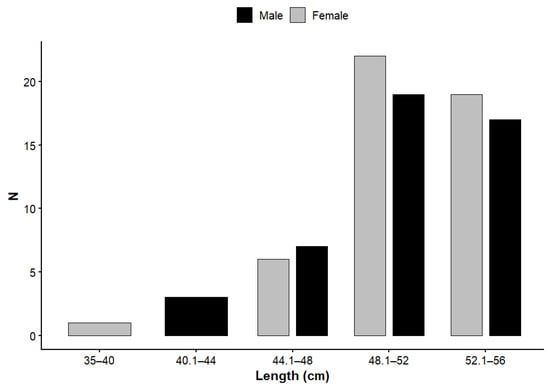
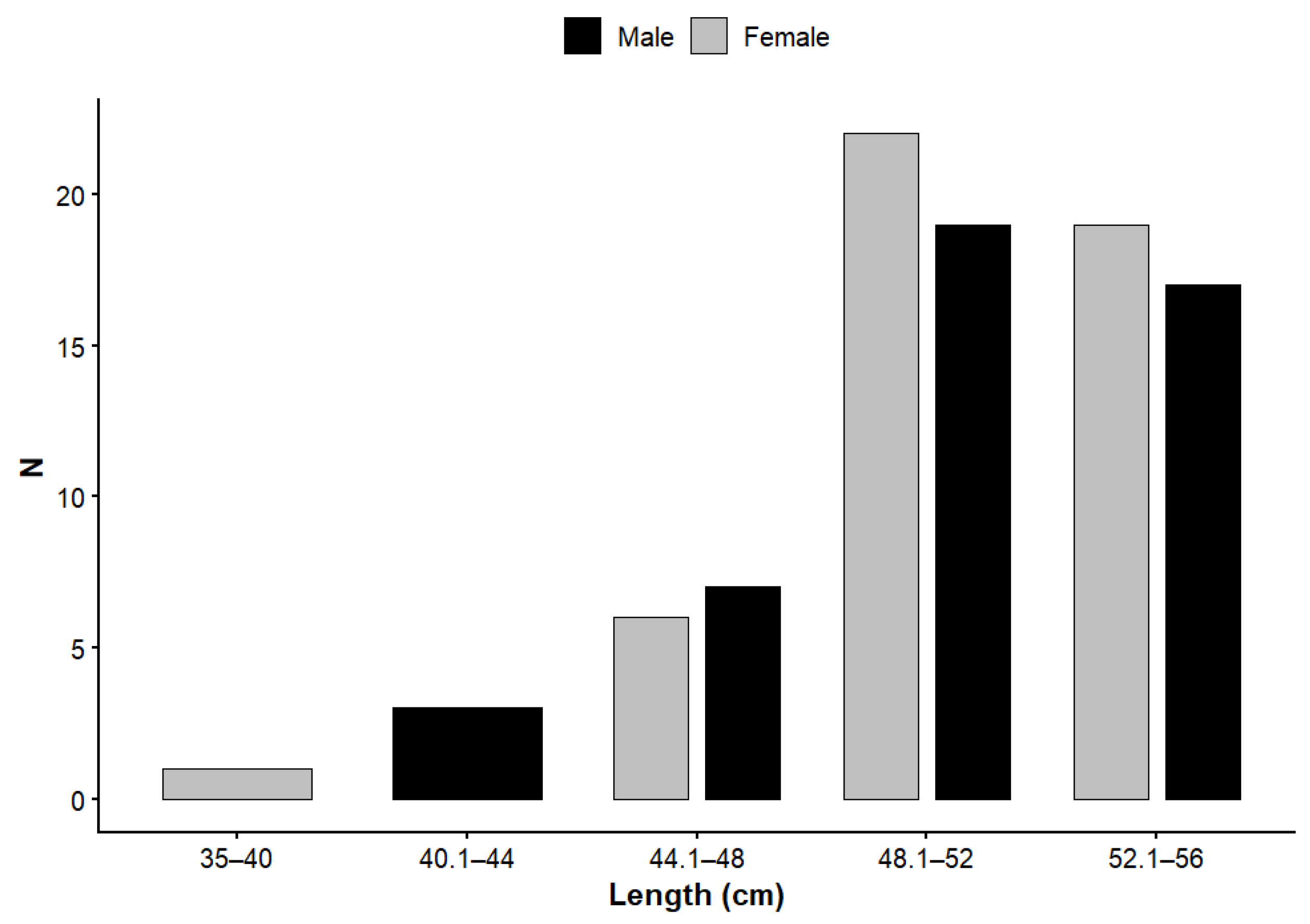
Analysis of individual lengths revealed no significant difference between males and females (p = 0.44; Table 3). The size-class distribution (Figure 1) shows that most individuals of both sexes were concentrated in classes between 48.1 and 56 cm, which represented the peak for both sexes. Although females had a slightly higher mean length, the overlap in the ranges of variation indicates no clear sexual dimorphism in this trait. Only two of the females and no males weighed less than 2.0 kg and were classified as juveniles. The medical veterinary team reported only two deaths during the entire study period. The specimens were preserved for a future necropsy by the PZB veterinary team.
Table 3.
Total length and weight measurements of female and male Dasyprocta individuals captured in Emílio Goeldi Zoobotanical Park.
Figure 1.
Length distribution (cm) among female (grey, N = 48) and male (black, N = 46) Dasyprocta individuals captured in Emílio Goeldi Zoobotanical Park.
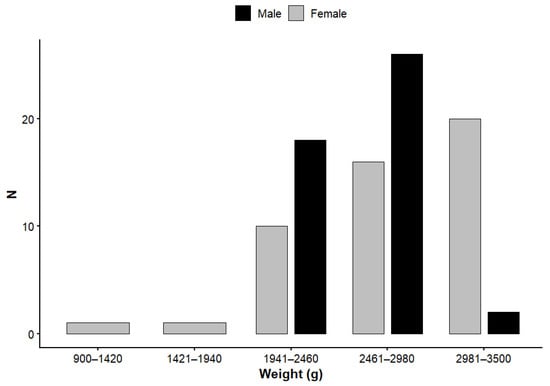
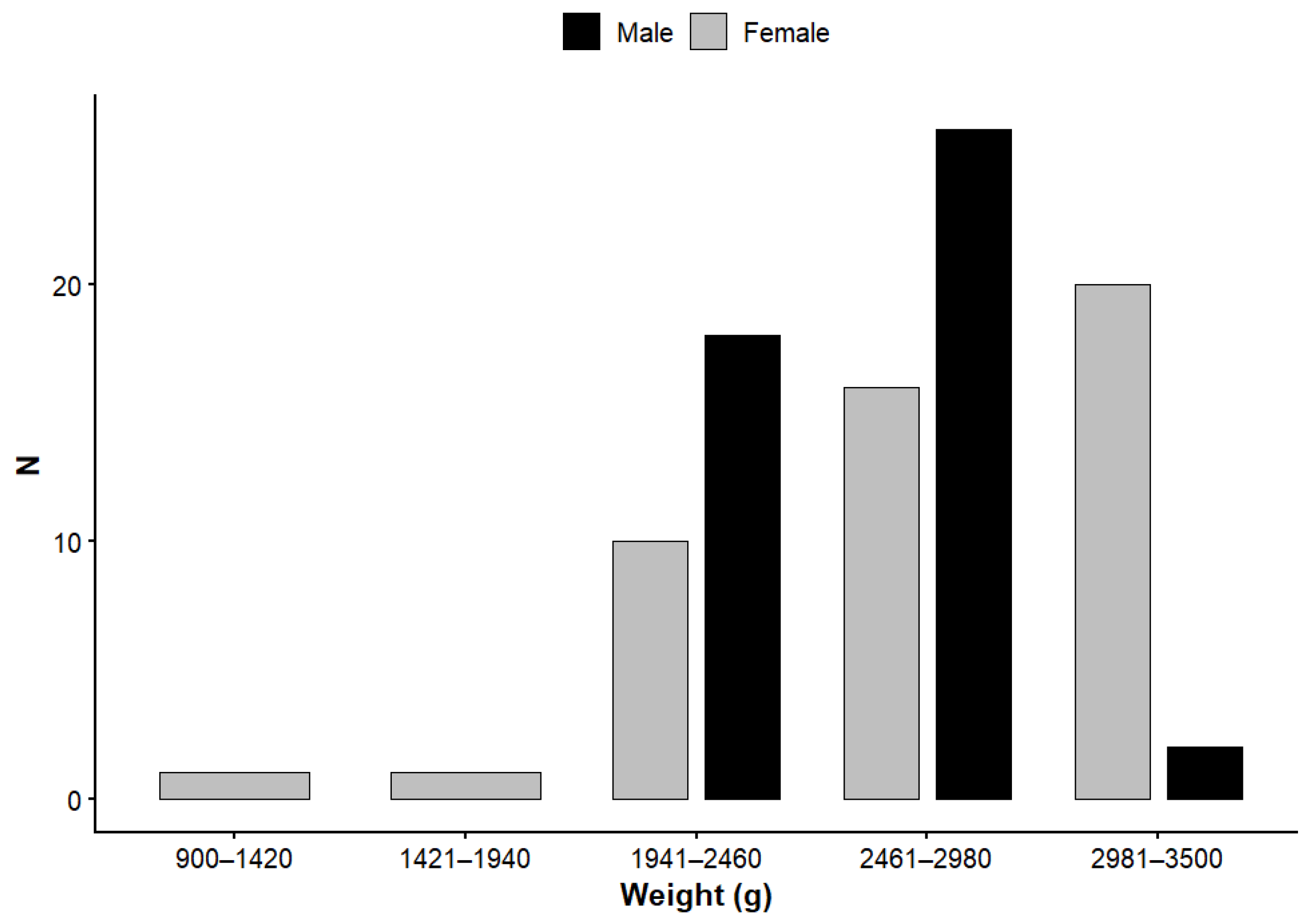
There was a significant difference in body weight between the sexes (p = 0.023; Table 3). Females were significantly heavier (2774.7 ± 580 g) than males (2539.6 ± 320 g). The distribution by weight class (Figure 2) shows that males were concentrated primarily in the 1941–2460 g (N = 18) and 2461–2980 g (N = 26) classes, while females showed a more dispersed distribution, occurring in all sampled classes, including individuals in the lower classes (N = 1 in each) and a marked concentration in the upper class of 2981–3500 g (N = 20).
Figure 2.
Weight distribution (g) among female and male Dasyprocta individuals captured in Emílio Goeldi Zoobotanical Park.
4. Discussion
The decision to analyze the PZB population using closed population models was based on assumptions consistent with the park’s conditions. The study area is an isolated urban park within a well-defined urban matrix of buildings and roads, with no nearby forest fragments. This setting acts as a barrier that prevents the immigration and emigration of agoutis. In addition, the birth and death rates during the sampling period can be considered negligible, since only two deaths were recorded by the veterinary team and only two juveniles were captured during the study. Despite the relatively extended study period, the primary assumptions for using closed population models were met.
Among the models tested, selection using the Akaike Information Criterion (AIC) indicated that the null model (M0) had the lowest AIC value. This model assumes that capture probability is constant over time and homogeneous across individuals. Other models, such as Mh Chao (LB), Mh Darroch, and Mb, also had ΔAIC values of less than 2, indicating that they were well-supported by the data and similarly parsimonious. These results suggest that the agouti population in the PZB may exhibit variation in capture probability among individuals and in behavioral responses, such as space use and reactions to traps.
Heterogeneity is recognized as a common feature in capture–mark–recapture studies of mammals [37]. These effects may have resulted from the abundant food sources in the park, including food supplementation provided by the animal care team, anthropogenic food (bread, popcorn, and other items offered by visitors), and predation on seeds and seedlings, which may have made the bait less attractive as an incentive to enter the trap. Additionally, these effects may be related to behavioral heterogeneity among individuals, such that after the first capture, those that were hungrier or more confident (trap-happy) were more likely to be attracted to the traps, whereas other individuals developed an aversion to the trapping setting (trap-shy), a common trait among small mammals and rodents [38,39]. However, it is not possible at this stage to know whether the capture method biased the age or health of the captured animals. Our results suggest that the trapping method used may have influenced the estimates obtained and contributed to the wide confidence interval, because only a few animals were captured each day. However, because this is an urban park with a constant flow of visitors, the choice of trapping method was constrained by the park’s specific conditions, making it impossible to use mobile or pitfall traps. The use of a baited enclosure may have led to learning in some agoutis, altering their catchability.
Furthermore, if territoriality exists among the animals living there, the fact that all captures were made in a single enclosure may have favored access for individuals that regularly visit that area. The overlap in habitat and resource use caused by high density results in similar activity patterns among individuals and, consequently, variability in the detection of heterogeneity [40]. McKinney [41] and Lowry et al. [42] observed that individuals living in urban environments exhibit lower neophobia and greater tolerance toward humans. The lack of support for models that account for temporality (Mt) indicates that catchability remained relatively constant during the sampling period, suggesting stability and consistency in the sampling effort [34].
The average model estimated the population size of agoutis in the PZB to be 201 individuals, resulting in a density of 37.2 individuals per hectare. This value is considerably higher than those of other agouti populations in similar environments or in the wild, as described in the literature. It is nearly ten times higher than other reported values and approximately double the figure found two decades ago. This result suggests a high population saturation of agoutis in the PZB area, given its spatial limitations, which may lead to intensified negative ecological processes and effects.
Agouti densities vary widely depending on their environment, ranging from 0.40 to 0.64 individuals/ha [21] (Table 4). In natural environments, agouti populations tend to have lower densities due to environmental pressures such as heterogeneous resource distribution, habitat availability, presence of predators, and hunting [43]. Studies conducted under natural conditions have reported densities ranging from 0.034 individuals/ha to 0.26 individuals/ha [44,45].
Table 4.
Comparison of the estimated density of Dasyprocta in Emílio Goeldi Zoobotanical Park with other studies.
In contrast, in small areas such as urban parks, islands, or geographically constrained environments, agouti populations tend to have significantly higher densities [22,45]. Studies conducted in similar environments report densities of 0.7 individuals/ha [24], 1.17 individuals/ha [45], and 4.2 individuals/ha [46]. These findings may indicate that spatially limited environments can sustain disproportionately high numbers of individuals, often in conjunction with an abundant supply of anthropogenic resources and the absence of predators [46].
However, high density does not mean that a population is healthy or living in ideal conditions for the species. In the long term, increased density in confined populations can intensify preexisting interactions, such as competition for shelter and food, and increase pathogen transmission [47]. At the PZB, episodes of agonistic behavior among agoutis were observed, along with individuals bearing bodily wounds and pathogens. The team also reported frequent territorial behavior exhibited by the animals. This context is associated with density-dependent processes, in which population growth and behavior are regulated by the size of the population itself [47,48,49].
Density-dependent effects are observed both in the population and in the environment in which it occurs. These effects may be linked to the low number of juveniles recorded, as studies on small rodents have shown the impact of high density on demographic aspects, including a significant reduction in breeding females and recruitment compared with stable populations [49]. Similar patterns have been observed in several species of large herbivorous mammals, including significant differences in juvenile survival rates, reinforcing the sensitivity of reproductive processes and younger age classes to major ecological processes [48,50,51,52].
In the long term, this decline in recruitment could trigger a trophic cascade, resulting in the loss of other species. This effect, known as top-down control, has been documented in various locations. Terborgh et al. [53], in a study conducted on the islands of Lake Guri, Venezuela, documented ecological collapse caused by the absence of predators, in which herbivore density increased 10- to 100-fold, resulting in a drastic reduction in recruitment and a loss of plant and animal diversity. A similar effect was observed by Martin et al. [54] in their research on the Haida Gwaii Islands, Canada, where environmental simplification caused by high deer densities affected invertebrate and bird communities. Over the long term, ecological networks are disrupted, and the environment becomes prone to collapse [55].
The sexual dimorphism observed in body weight is consistent with expectations [54]. However, the proportion of pregnant females during the collections (N = 3, 6.25%) was much lower than that reported by Santos [46], who found that 26.32% of females were pregnant. Santos [46] also suggests that this figure may have been underestimated because only females in an advanced stage of pregnancy were recorded.
There was also a difference between the average body weight of the population recorded in this study and that reported in the literature for this group. In this study, agouti body weights ranged from 2046 to 3490 g, with a mean of 2709 ± 381.8 g, whereas Silvius and Fragoso [21] reported weights ranging from 2 to 5 kg for Dasyprocta leporina, and Patton et al. [17] reported a range of 2 to 6 kg for the genus Dasyprocta. Differences in weight and size can be related to population density, as body size and growth rates may be influenced by high population density [49], under which individuals tend to have smaller-than-usual body size.
Agoutis act as seed dispersers, mainly because of their hoarding habit, which involves burying seeds and food resources, thereby contributing to seed dispersal and increasing the likelihood of germination [56]. However, in high-density environments, agoutis can play the opposite role and act as seed predators, reducing the recruitment capacity of the flora [57,58,59]. In addition to acting as seed predators, agoutis also feed on cotyledons, leaves, flowers, and invertebrates [21]. Santos [46], in an urban park in Campinas, São Paulo, observed that high agouti density negatively affected the regeneration capacity of Hymenaea courbaril (jatobá), where only a small portion of seeds or seedlings escaped predation. Though beyond the scope of this study, evidence of excessive destruction of seedlings at the PZB has led to the need to protect new plantings with fences.
Despite the limitations encountered during the study, particularly regarding the trapping method and the relatively wide confidence intervals of the estimates, the overall results consistently indicate a high agouti population density in the PZB. The magnitude of the estimated values and the ecological characteristics discussed reinforce the finding that population density is considerably above the system’s equilibrium. Thus, the results of this study provide a relevant scientific basis to support population management actions by the park staff, enabling well-founded interventions for the species’ well-being, the maintenance of the park’s ecological integrity, and population control.
5. Further Research
Since this is an initial study of the agouti population at the PZB, the results obtained provide an important foundation for understanding this population’s abundance and the general characteristics of this population. At the same time, the data collected must be considered an initial step that raises many questions for future investigation. For example, since the captures were concentrated in just one enclosure, it is important to investigate other places and evaluate whether the change has some effect on the population size estimate. Also, it is unclear whether the small proportion of young and pregnant individuals was due to these animals, who are theoretically more vulnerable, avoiding competition with others for the bait and consequently avoiding the trap. In other words, we need to understand whether trap-shy and trap-happy individuals consistently belong to certain groups, as this could bias the sampled population structure. Given the significant number of individuals included in the sample and the possibility of follow-up, future studies aiming at assessing the population’s health status would also be of great relevance. The investigation of clinical and biometric parameters, combined with an assessment of the prevalence of infectious agents, could provide important information about the health status of individuals and possible influences on population dynamics. It could contribute to an understanding of the conditions necessary for population maintenance and inform long-term management and monitoring strategies. Additionally, the best options for managing this population must be tested. The management team’s preferred option is to exchange animals with other institutions, for which tagging is particularly relevant. However, it is necessary to test the effectiveness of this option, because there are limits on sending animals to other institutions, especially because the agouti is not a species of special interest for conservation—it is not threatened with extinction, for example. One option would be to reduce the amount of supplemental food, but this solution would probably take longer to produce results.
On the other hand, it would also be necessary to estimate the recreational pressure and the contribution of other food sources provided by visitors to the agouti population. Currently, it is impossible to determine how many people feed the animals or what impact this has on population parameters. Nor can we determine the effects of the noise made by the public. Perhaps educational efforts need to be reinforced to minimize these impacts.
There is also a need to deepen our understanding of the other ecological consequences of this overpopulation. Although the available data do not allow us to characterize a scenario of ecosystem collapse, there is reported evidence of the impact of large numbers of animals, especially on plants.
Lastly, future research that integrates data will be able to assess ecological effects over time, and may help clarify the population’s recruitment and reproductive dynamics and allow for a more consistent assessment of its structure.
6. Conclusions
This study shows that the environmental conditions of the PZB favor the establishment of a high-density agouti population, primarily due to limited space, the absence of natural predators, and the continuous availability of supplementary food. The estimated high density suggests a potential ecological imbalance that may affect the park’s plant and animal communities. Despite the constraints associated with the study area and the wide confidence intervals of some abundance estimates, this work provides important baseline information on agouti population dynamics in the PZB. Overall, the findings highlight the need for continuous population monitoring and management strategies that are technically sound, ethically justified, and ecologically grounded to restore ecological balance and support the long-term conservation of biodiversity in this urban protected area.
As a management recommendation, transferring individuals to other institutions or suitable areas may be considered as an initial strategy to reduce potential effects associated with overabundance. This measure is preceded by the identification and tagging of individuals and by consistent evidence that the population exhibits high abundance levels, allowing for management decisions to be based on population data and on monitoring population dynamics over time. However, exploring other control options is necessary to produce a more permanent solution.
Author Contributions
Conceptualization, L.S.d.S., A.L.K.M.A. and V.G.N.G.K.; methodology, L.S.d.S., A.L.K.M.A., V.G.N.G.K. and T.A.d.F.; software, L.S.d.S. and A.L.K.M.A.; formal analysis, L.S.d.S. and A.L.K.M.A.; investigation, L.S.d.S., A.L.K.M.A., V.G.N.G.K. and T.A.d.F.; resources, L.S.d.S., A.L.K.M.A. and T.A.d.F.; data curation, L.S.d.S.; writing—original draft preparation, L.S.d.S.; writing—review and editing, L.S.d.S., A.L.K.M.A., V.G.N.G.K. and T.A.d.F.; visualization, L.S.d.S.; supervision, A.L.K.M.A. and V.G.N.G.K.; project administration, L.S.d.S., A.L.K.M.A., V.G.N.G.K. and T.A.d.F.; funding acquisition, L.S.d.S. and A.L.K.M.A. All authors have read and agreed to the published version of the manuscript.
Funding
This research was funded by Coordenação de Aperfeiçoamento de Pessoal de Nível Superior (CAPES), grant number 88887.951260/2024-00 and 88881.510254/2020-1, aid 805/2020. The funder granted the master’s grant and the microchips.
Institutional Review Board Statement
The animal study protocol was approved by the Ethics Committee of Museu Paraense Emílio Goeldi protocol code CONCEA/MCTI/0204192026SQUISA/000000/2026, date 26 June 2025.
Data Availability Statement
All relevant data regarding the research are in Appendix A. If there is any question regarding methodology, analysis or of any kind, please contact the authors.
Acknowledgments
We thank Eduardo, Messias, and the entire PZB/MPEG team for their participation and assistance with all the captures. We would also like to thank the editor, Anastasija Milenkovic, and the two anonymous reviewers for their comments and suggestions.
Conflicts of Interest
Author Vanessa Gabrielle Nobrega Gomes Koroiva is researcher fellow of the Empresa Paraibana de Pesquisa, Extensão Rural e Regularização Fundiária. The remaining authors declare that the research was conducted in the absence of any commercial or financial relationships that could be construed as a potential conflict of interest.
Appendix A
Table A1.
General Information on Specimens of the Genus Dasyprocta captured on the Emílio Goeldi Museum.
References
- Baur, B. Basel Zoo and Its Native Biodiversity between the Enclosures: A New Strategy of Cooperation with Academic Institutions. Int. Zoo Yearb. 2011, 45, 48–54. [Google Scholar] [CrossRef] [Scilit]
- Elwell, E.; Leeson, C.; Vaglio, S. The Effects of a Zoo Environment on Free-Living, Native Small Mammal Species. Zoo Biol. 2021, 40, 263–272. [Google Scholar] [CrossRef] [Scilit]
- Gilbert, N.A.; Clare, J.D.J.; Stenglein, J.L.; Zuckerberg, B. Abundance Estimation of Unmarked Animals Based on Camera-Trap Data. Conserv. Biol. 2021, 35, 88–100. [Google Scholar] [CrossRef] [Scilit]
- Cole, F.R.; Batzli, G.O. Influence of Supplemental Feeding on a Vole Population. J. Mammal. 1978, 59, 809–819. [Google Scholar] [CrossRef] [Scilit]
- Milner, J.M.; Van Beest, F.M.; Schmidt, K.T.; Brook, R.K.; Storaas, T. To Feed or Not to Feed? Evidence of the Intended and Unintended Effects of Feeding Wild Ungulates. J. Wildl. Manag. 2014, 78, 1322–1334. [Google Scholar] [CrossRef] [Scilit]
- Newey, S.; Allison, P.; Thirgood, S.; Smith, A.A.; Graham, I.M. Population and Individual Level Effects of Over-winter Supplementary Feeding Mountain Hares. J. Zool. 2010, 282, 214–220. [Google Scholar] [CrossRef] [Scilit]
- Nascimento, Y.; Júnior, L.S.S.; dos Santos, M.S.; Dias, C.P.; Caldas, E.M. A importância das atividades de monitoramento da fauna. Divers. J. 2022, 7, 2431–2444. [Google Scholar] [CrossRef] [Scilit]
- Ferreguetti, A.; Tomas, W.; Bergallo, H. de Abundância e Densidade de Mamíferos de Médio e Grande Porte Na Reserva Natural Vale. In Floresta Atlântica de Tabuleiro: Diversidade e Endemismos na Reserva Natural Vale; EDITORA RONA: Belo Horizonte, Brazil, 2016; pp. 453–467. ISBN 978-85-62805-63-9. [Google Scholar]
- Henderson, P.A. Absolute Population Estimates Using Capture–Recapture Experiments. In Southwood’s Ecological Methods; Henderson, P.A., Ed.; Oxford University Press: Oxford, UK, 2021; ISBN 978-0-19-886227-7. [Google Scholar]
- White, G.C.; Burnham, K.P. Program MARK: Survival Estimation from Populations of Marked Animals. Bird Study 1999, 46, S120–S139. [Google Scholar] [CrossRef] [Scilit]
- Kendall, W.L. ROBUSTNESS OF CLOSED CAPTURE–RECAPTURE METHODS TO VIOLATIONS OF THE CLOSURE ASSUMPTION. Ecology 1999, 80, 2517–2525. [Google Scholar] [CrossRef] [Scilit]
- Burnham, K.P.; Anderson, D.R.; Anderson, D.R. Model Selection and Multimodel Inference: A Practical Information-Theoretic Approach, 2nd ed.; [4. printing]; Springer: New York, NY, USA, 2010; ISBN 978-0-387-95364-9. [Google Scholar]
- Nichols, J.; Williams, B. Monitoring for Conservation. Trends Ecol. Evol. 2006, 21, 668–673. [Google Scholar] [CrossRef] [Scilit]
- Silva, Í.L.; Silva, R.O. Observações Do Comportamento Alimentar Dos Dasyprocta Leporina e D. Prymnolopha No Parque Zoobotânico Do Museu Paraense Emílio Goeldi. 2000. Available online: https://repositorio.museu-goeldi.br/items/f3078ecc-4a57-4fd9-b59a-7f4008235e08 (accessed on 8 September 2024).
- Ayres, Á.R.; Silva, R.O. OBSERVAÇÃO DOS ASPECTOS REPRODUTIVOS DOS D. LEPORINA; D. PRYMNOLOPHA E D. SP. (CUTIAS) DO PARQUE ZOOBOT ÂNICO DO MUSEU PARENSE EMÍLIO GOELDI. 2000. Available online: https://repositorio.museu-goeldi.br/server/api/core/bitstreams/eb424328-a685-4221-8b27-a66add14c51e/content (accessed on 7 September 2024).
- Wilson, D.E.; Thomas, E.; Lacher, J.; Mittermeier, R.A. Dasyproctidae. In Handbook of the Mammals of the World—Volume 6 Lagomorphs and Rodents I; Lynx Edicions: Barcelona, Spain, 2016; pp. 440–461. [Google Scholar]
- Patton, J.L.; Pardiñas, U.F.J.; D’Elía, G. Mammals of South America, Volume 2: Rodents; University of Chicago Press: Chicago, IL, USA, 2015; ISBN 978-0-226-16957-6. [Google Scholar]
- Souza, L.M. Padrão de Atividade da Jaguatirica (Leopardus pardalis), Cutia (Dasyprocta leporina) e Paca (Cuniculus paca) no sul da Amazônia Brasileira. 2010. Available online: https://repositorio.unesp.br/server/api/core/bitstreams/748256ad-5074-44f3-a1d4-ab2c1d58e31f/content (accessed on 8 September 2024).
- John, E.N.; Jones, K.R. Evaluation of Unconventional Supplements to the Diet of Intensively Reared Agouti (Dasyprocta Leporina) in Trinidad, West Indies. Vet. Sci. 2020, 7, 108. [Google Scholar] [CrossRef] [Scilit]
- Teta, P.; Reyes-Amaya, N. Uncovering Species Boundaries through Qualitative and Quantitative Morphology in the Genus Dasyprocta (Rodentia, Caviomorpha), with Emphasis in D. Punctata and D. Variegata. J. Mammal. 2021, 102, 1548–1563. [Google Scholar] [CrossRef] [Scilit]
- Silvius, K.M.; Fragoso, J.M.V. Red-rumped Agouti (Dasyprocta Leporina) Home Range Use in an Amazonian Forest: Implications for the Aggregated Distribution of Forest Trees. Biotropica 2003, 35, 74–83. [Google Scholar] [CrossRef] [Scilit]
- Jorge, M.S.P.; Peres, C.A. Population Density and Home Range Size of Red-Rumped Agoutis (Dasyprocta Leporina) Within and Outside a Natural Brazil Nut Stand in Southeastern Amazonia. Biotropica 2005, 37, 317–321. [Google Scholar] [CrossRef] [Scilit]
- Silva, J.; Pereira-Ribeiro, J.; Ferreguetti, A. Densidade Populacional da Cutia Dasyprocta Leporina Linnaeus, 1758 Na Reserva Biológica de Duas Bocas, Cariacica, ES, Brasil; FAESA: Vitória, Spain, 2017; Volume 1, p. 158. [Google Scholar]
- Haji-Junior, J.Y. Estimativas Populacionais para os Mamíferos Introduzidos na Ilha Anchieta. Trabalho de Conclusão de Curso (Bacharelado—Ecologia); Universidade Estadual Paulista: Rio Claro, Brazil, 2019. [Google Scholar]
- Galetti, M.; Bovendorp, R.S.; Guevara, R. Defaunation of Large Mammals Leads to an Increase in Seed Predation in the Atlantic Forests. Glob. Ecol. Conserv. 2015, 3, 824–830. [Google Scholar] [CrossRef] [Scilit]
- Smythe, N. The Natural History of the Central American Agouti (Dasyprocta punctata). Smithson. Contrib. Zool. 1978, 257, 1–52. [Google Scholar] [CrossRef] [Scilit]
- Ferreira, L.V.; Parolin, P.; Muñoz, S.H.; Chaves, P.P. O EFEITO DA FRAGMENTAÇÃO E ISOLAMENTO FLORESTAL DAS ÁREAS VERDES DA REGIÃO METROPOLITANA DE BELÉM. Available online: https://www.anchietano.unisinos.br/publicacoes/botanica/volumes/063/14.pdf (accessed on 8 September 2024).
- Soares, A.C.L.; Lobo, M.A.A. As Ameaças do Crescimento Urbano de Belém à Conservação do Parque Zoobotânico do Museu Paraense Emílio Goeldi. In Proceedings of the III Encontro Nacional de Arquitetos sobre Preservação do Patrimônio Edificado, Salvador, Brazil, 8–11 June 2008. [Google Scholar]
- ABNT NBR 14766:2019; Identificação de Animais por Radiofrequência—Estrutura do Código. Associação Brasileira de Normas Técnicas: Rio de Janeiro, Brazil, 2019.
- ISO 11784:2024; Radio Frequency Identification of Animals—Code Structure. 3rd ed. International Organization for Standardization: Geneva, Switzerland, 2024.
- R Core Team. R: A Language and Environment for Statistical Computing, R version: 5.4.2; R Foundation for Statistical Computing: Vienna, Austria, 2020.
- Posit Team. RStudio: Integrated Development Environment for R; Posit Software, PBC: Boston, MA, USA, 2025. [Google Scholar]
- Baillargeon, S.; Rivest, L.-P. Rcapture: Loglinear Models for Capture-Recapture in R. Available online: https://www.jstatsoft.org/article/view/v019i05 (accessed on 15 November 2024).
- Otis, D.L.; Burnham, K.P.; White, G.C.; Anderson, D.R. Statistical Inference from Capture Data on Closed Animal Populations. Wildl. Monogr. 1978, 62, 3–135. [Google Scholar]
- Akaike, H. A New Look at the Statistical Model Identification. IEEE Trans. Autom. Control 1974, 19, 716–723. [Google Scholar] [CrossRef] [Scilit]
- Spiess, A.-N. qpcR: Modelling and Analysis of Real-Time PCR Data. 2025. Available online: https://cran.rstudio.com/web/packages/qpcR/qpcR.pdf (accessed on 31 July 2026).
- Zhang, Y.; Lyles, R.H. New Capture–Recapture Models of Behavioral Response for Estimating the Size of a Closed Animal Population. J. Agric. Biol. Environ. Stat. 2025. [Google Scholar] [CrossRef] [Scilit]
- Nichols, J.D.; Pollock, K.H. Estimation Methodology in Contemporary Small Mammal Capture-Recapture Studies. J. Mammal. 1983, 64, 253–260. [Google Scholar] [CrossRef] [Scilit]
- Stryjek, R.; Kalinowski, A.; Parsons, M.H. Unbiased Sampling for Rodents and Other Small Mammals: How to Overcome Neophobia Through Use of an Electronic-Triggered Live Trap—A Preliminary Test. Front. Ecol. Evol. 2019, 7, 11. [Google Scholar] [CrossRef] [Scilit]
- Efford, M.G.; Dawson, D.K.; Borchers, D.L. Population Density Estimated from Locations of Individuals on a Passive Detector Array. Ecology 2009, 90, 2676–2682. [Google Scholar] [CrossRef] [Scilit]
- McKinney, M.L. Urbanization as a Major Cause of Biotic Homogenization. Urbanization 2006, 127, 247–260. [Google Scholar] [CrossRef] [Scilit]
- Lowry, H.; Lill, A.; Wong, B.B.M. Behavioural Responses of Wildlife to Urban Environments. Biol. Rev. 2013, 88, 537–549. [Google Scholar] [CrossRef] [Scilit]
- Cullen, L.; Bodmer, E.R.; Valladares-Padua, C. Ecological Consequences of Hunting in Atlantic Forest Patches, São Paulo, Brazil. Oryx 2001, 35, 137–144. [Google Scholar] [CrossRef] [Scilit]
- Bernardo, C.S.S. Abundância, Densidade e Tamanho Populacional de Aves e Mamíferos Cinegéticos no Parque Estadual Ilha do Cardoso, SP, Brasil. Mestrado em Ecologia de Agroecossistemas; Universidade de São Paulo: Piracicaba, Brazil, 2004. [Google Scholar]
- Jorge, M.L.S.P. Effects of Forest Fragmentation on Two Sister Genera of Amazonian Rodents (Myoprocta acouchy and Dasyprocta leporina). Biol. Conserv. 2008, 141, 617–623. [Google Scholar] [CrossRef] [Scilit]
- Santos, E.F. Ecologia da Cutia Dasyprocta leporina (Linnaeus, 1758) em um Fragmento Florestal Urbano em Campinas-SP (Rodentia: Dasyproctidae). Ph.D. Thesis, Universidade Estadual Paulista, Rio Claro, Brazil, 2005. [Google Scholar]
- Fowler, C.W. A Review of Density Dependence in Populations of Large Mammals. Curr. Mammal. 1987, 401–441. [Google Scholar] [CrossRef] [Scilit]
- Bonenfant, C.; Gaillard, J.; Coulson, T.; Festa-Bianchet, M.; Loison, A.; Garel, M.; Loe, L.E.; Blanchard, P.; Pettorelli, N.; Owen-Smith, N.; et al. Chapter 5 Empirical Evidence of Density-Dependence in Populations of Large Herbivores. In Advances in Ecological Research; Elsevier: Amsterdam, The Netherlands, 2009; Volume 41, pp. 313–357. ISBN 978-0-12-374925-3. [Google Scholar]
- Agrell, J.; Erlinge, S.; Nelson, J.; Nilsson, C.; Persson, I. Delayed Density-Dependence in a Small-Rodent Population. Proc. R. Soc. B Biol. Sci. 1995, 262, 65–70. [Google Scholar] [CrossRef] [Scilit]
- Gaillard, J.-M.; Festa-Bianchet, M.; Yoccoz, N.G. Population Dynamics of Large Herbivores: Variable Recruitment with Constant Adult Survival. Trends Ecol. Evol. 1998, 13, 58–63. [Google Scholar] [CrossRef] [Scilit]
- Liu, W.; Deng, K. Population Dynamics of Wild Mongolian Gerbils: Quadratic Temperature Effects on Survival and Density-Dependent Effects on Recruitment. Diversity 2022, 14, 586. [Google Scholar] [CrossRef] [Scilit]
- Riecke, T.V.; Lohman, M.G.; Sedinger, B.S.; Arnold, T.W.; Feldheim, C.L.; Koons, D.N.; Rohwer, F.C.; Schaub, M.; Williams, P.J.; Sedinger, J.S. Density-dependence Produces Spurious Relationships among Demographic Parameters in a Harvested Species. J. Anim. Ecol. 2022, 91, 2261–2272. [Google Scholar] [CrossRef] [Scilit]
- Terborgh, J.; Lopez, L.; Nuñez, P.; Rao, M.; Shahabuddin, G.; Orihuela, G.; Riveros, M.; Ascanio, R.; Adler, G.H.; Lambert, T.D.; et al. Ecological Meltdown in Predator-Free Forest Fragments. Science 2001, 294, 1923–1926. [Google Scholar] [CrossRef] [Scilit]
- Martin, J.L.; Stockton, S.A.; Allombert, S.; Gaston, A.J. Top-down and Bottom-up Consequences of Unchecked Ungulate Browsing on Plant and Animal Diversity in Temperate Forests: Lessons from a Deer Introduction. Biol. Invasions 2010, 12, 353–371. [Google Scholar] [CrossRef] [Scilit]
- Hernández-Castellano, C.; Valladares, D.N.; Calleja, J.A.; Serrano, E.; Consortium, I.; Perea, R. Overabundant Populations of Large Wild Herbivores Disrupt Plant–Pollinator Networks in a Mediterranean Ecosystem. Plant Biol. 2025, 27, 1047–1057. [Google Scholar] [CrossRef] [Scilit]
- Zucaratto, R. Os Frutos que as Cutias Comiam: Recrutamento da Palmeira Astrocaryum Aculeatissimum na Ausência de Seu Principal Dispersor de Sementes. Master’s Thesis, Universidade Federal Rural do Rio de Janeiro, Seropédica, Brazil, 2013. [Google Scholar]
- Fleury, M.H. Interações Ecológicas Entre Plantas e Animais: Implicações Para a Conservação e Restauração de uma Ilha Pluvial Atlântica. Ph.D. Thesis, Universidade de São Paulo, Piracicaba, Brazil, 2009. [Google Scholar][Green Version]
- Heithaus, E.R. Seed Predation by Rodents on Three Ant-Dispersed Plants. Ecology 1981, 62, 136–145. [Google Scholar] [CrossRef] [Scilit]
- Moura, R.C.D. Frugivoria em Jaqueiras (Artocarpus heterophyllus Lam.) no Parque Nacional da Tijuca (RJ) e a Importância das Cutias Reintroduzidas na Dispersão e Predação de suas Sementes. Master’s Thesis, Universidade Federal Rural do Rio de Janeiro, Seropédica, Brazil, 2015. [Google Scholar]

Disclaimer/Publisher’s Note: The statements, opinions and data contained in all publications are solely those of the individual author(s) and contributor(s) and not of MDPI and/or the editor(s). MDPI and/or the editor(s) disclaim responsibility for any injury to people or property resulting from any ideas, methods, instructions or products referred to in the content. |
© 2026 by the authors. Licensee MDPI, Basel, Switzerland. This article is an open access article distributed under the terms and conditions of the Creative Commons Attribution (CC BY) license.