


Abstract
Intensive snake husbandry requires evidence-based approaches to environmental management and animal welfare. This study characterized substrate use in six juvenile South American rattlesnakes (Crotalus durissus) by comparing a familiar substrate (corrugated cardboard) with four novel substrates (Sand, Gravel, Dry leaves, and Sphagnum) during diurnal and nocturnal periods. Behaviour was continuously recorded over 288 h, and the proportion of time spent in five body-contact categories, ranging from 100% to 0% contact with the novel substrate, was analyzed using Beta Generalized Linear Mixed Models (GLMMs). The familiar cardboard area (category E; 0% contact with the novel substrate) accounted for the largest proportion of total observation time. However, a complementary analysis comparing No contact (category E) with Any contact (categories A–D combined) revealed no significant overall difference between contact categories. Instead, a significant Contact × Substrate interaction indicated substrate-specific patterns of contact, with Any contact accounting for a greater proportion of time on Sand and Sphagnum, whereas No contact was more prevalent on Gravel and Dry leaves. No significant effect of experimental period was detected. These findings indicate that juvenile rattlesnakes displayed different patterns of contact with novel substrates while continuing to use the familiar area within the enclosure, suggesting that substrate characteristics and familiarity may both contribute to patterns of substrate use. From a husbandry perspective, these results highlight the value of considering familiarity alongside the physical properties of substrates when designing environmental complexity for captive rattlesnakes. Behavioural assessment of substrate contact may therefore provide a useful approach for characterizing how juvenile snakes interact with different environmental substrates and informing husbandry practices.
1. Introduction
The intensive husbandry of snakes in a vivarium is fundamental to advancing scientific research, encompassing the production of antivenom and pharmaceutical bioactives, alongside studies on physiology, reproduction, and conservation [1]. Within this context, optimizing management practices is vital to safeguard animal welfare, which directly modulates individual health and overall production parameters, such as venom quality and yield [1,2,3].
Among the various components of captive environments, the substrate serves as a pivotal structural and functional element of the habitat [4,5,6]. Beyond providing mechanical support, it acts as a form of environmental enrichment by offering sensory stimuli that facilitate species-specific behaviors, including burrowing, exploration, and thermoregulation [7,8,9,10]. Accumulating evidence indicates that environmental complexity correlates positively with behavioral indicators of enhanced welfare, such as increased exploratory activity and greater use of enriched zones during choice tests [9,10,11,12]. Conversely, simplified substrates, such as corrugated cardboard or uniform paper, can restrict these essential expressions; for example, juvenile rattlesnakes (Crotalus horridus) exhibit significantly more efficient odor-trailing behavior on natural substrates like sand and leaf litter than on homogeneous surfaces [13].
Although historically underexplored in reptiles, environmental enrichment has gained increasing traction as studies reveal that simplified captive conditions can impair behavioral expression, cognitive performance, and overall health [14,15]. In snakes, the absence of suitable substrates or adequate space restricts natural repertoires and elevates stress levels, whereas complex substrates foster greater environmental interaction and enhance performance in behavioral tasks [12,16,17,18,19]. Moreover, physical interaction with the habitat, particularly the extent and nature of body contact with the substrate, is critical for locomotion, postural stability, and thermoregulation, highlighting the intrinsic functional importance of substrate characteristics [20,21,22].
To evaluate substrate use and suitability, experimental designs that simultaneously expose animals to different environmental conditions can provide useful insights into how individuals interact with available substrates [23,24,25]. Within such designs, measures such as dwelling time and body contact can be used to quantify patterns of space and substrate use, providing behavioural indicators of how animals interact with different environmental conditions [26,27]. Previous research suggests that snakes may alter their use of environmental features when exposed to enriched or structurally complex conditions [10,12], highlighting the potential value of controlled behavioural assessments for informing evidence-based husbandry.
Beyond dwelling time, the specific modalities of physical interaction with a substrate offer deeper insights into its suitability. In snakes, the proportion of body contact with the substrate can reflect mechanical support, physical comfort, and heat-exchange efficiency, providing a complementary postural metric to interpret spatial utilization [11,28,29]. Despite its clear relevance, the integration of temporal (time-based) and postural (contact-based) measures remains largely underexplored, particularly within intensive husbandry frameworks [10,17].
In juvenile snakes, behavioural responses to novel environments may be influenced by ontogenetic vulnerability and early life experiences. Neonatal rattlesnakes are highly susceptible to predation and may exhibit pronounced responses to novel stimuli as an adaptive risk-minimization strategy [30]. In the genus Crotalus, this early developmental period may also involve maternal attendance, with females typically remaining with their offspring for several days post-birth until the completion of the first neonatal ecdysis [31]. This early maternal association may contribute to behavioural development and environmental exploration in neonates [32]. However, because the juveniles in the present study were separated from their mothers immediately after birth, and no maternally reared control group was included, the extent to which early maternal separation may have influenced their responses to novel substrates cannot be determined [33,34]. Consequently, investigating how early separated juveniles interact with novel substrates may contribute to understanding both their behavioural ecology and the implications of early rearing conditions for captive management.
Characterizing substrate use in snakes can contribute to our understanding of behavioural ecology while also informing captive management and animal welfare practices [35]. Identifying how snakes interact with different substrates may help guide husbandry decisions, although behavioural responses alone may not fully determine substrate suitability or its effects on physiological health and welfare [1,36]. In this context, the present study evaluated substrate choices and patterns of contact in juvenile South American rattlesnakes by quantifying the proportion of time spent in different body contact categories across familiar and novel substrates.
2. Materials and Methods
2.1. Animals, Housing, and Maintenance
Six juvenile rattlesnakes (Crotalus durissus) were used, comprising three males and three females, sourced from the colony of the Laboratory of Ecology and Evolution at the Instituto Butantan, Brazil. The juvenile snakes used in this study were separated from their mothers immediately after birth and prior to their first neonatal ecdysis (shedding), which typically occurs between 6 and 10 days post-parturition in the genus Crotalus [31,34]. The animals were housed individually in lockable plastic enclosures measuring 65 cm in length, 44.5 cm in width, and 24.5 cm in height (a volume of 42 L).
The snakes were maintained in a climate-controlled room with temperatures ranging from 21 to 25 °C and a relative humidity of approximately 60%. Both variables were monitored daily using a thermo-hygrometer (Incoterm™). The light–dark cycle was set to 12 h (06:00–18:00 light; 18:00–06:00 dark). Snakes were fed pre-euthanized rodents (Mus musculus) every 15 days, in accordance with Brazilian animal welfare standards. Fresh water was provided ad libitum in plastic containers of approximately 300 mL.
2.2. Experimental Protocol
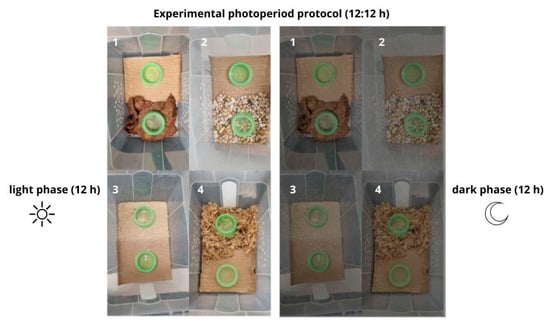
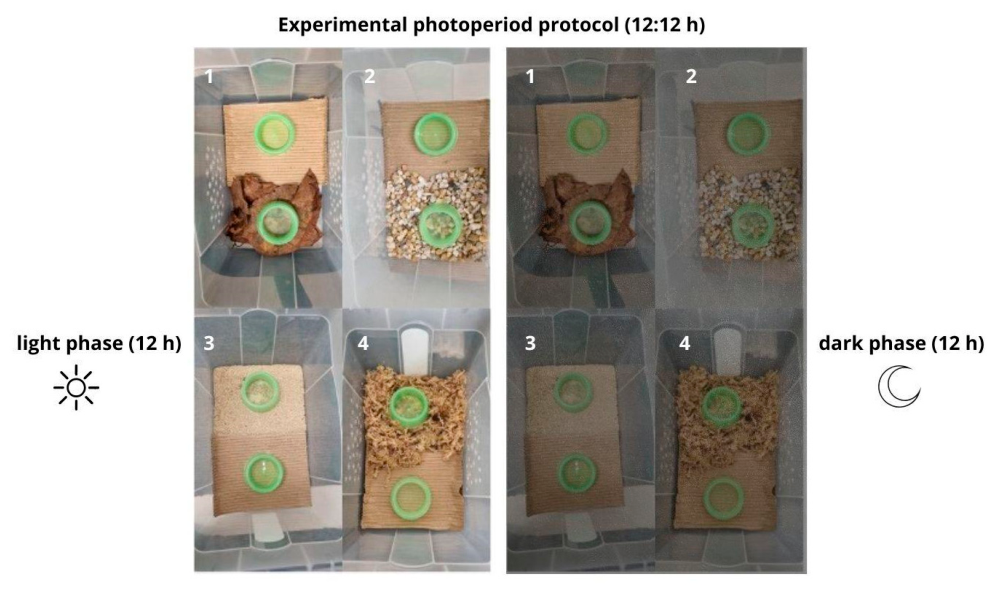
The animals were individually subjected to four substrate-use trials, each involving exposure to a familiar cardboard area and a novel substrate. In all trials, the enclosure was divided into two equal sections: one containing only the familiar cardboard substrate and the other containing cardboard combined with an additional substrate type. The novel substrates tested were: (1) dry leaves, (2) gravel, (3) sand, and (4) sphagnum (Figure 1). Each substrate treatment was evaluated during two distinct periods: diurnal (06:00–18:00) and nocturnal (18:00–06:00), resulting in eight experimental conditions.
Figure 1.
Photographic representation of the four substrate-use treatments used in the study. In each trial, enclosures were divided into two equal sections: one containing only the familiar cardboard substrate and the other containing cardboard combined with one of the following novel substrates: (1) dry leaves, (2) gravel, (3) sand, and (4) sphagnum. Each treatment was evaluated during both diurnal (light) and nocturnal (dark) periods.
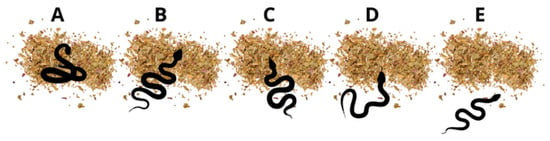
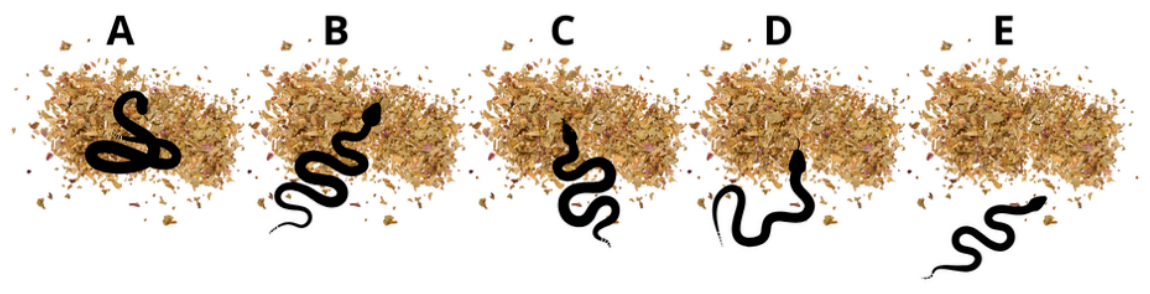
To monitor snake behavior, four closed-circuit cameras were installed, each directed at an individual enclosure, allowing for continuous recording of each animal under its respective treatment and period [37,38]. The time spent on each substrate was quantified as the total duration in seconds for each combination of substrate type and body contact category, defined by body position and the proportion of the body in contact with the substrate. Body contact categories were defined as follows: (A) 100% of the body in contact with the substrate; (B) two-thirds of the body; (C) one-third of the body; (D) head only; and (E) 0% of the body in contact (Figure 2). Quantification was performed using the Behavioral Observation Research Interactive Software (BORIS).
Figure 2.
Schematic representation of the body contact categories used to classify snake–substrate interactions, based on the proportion of the body in contact with the substrate: (A) 100%; (B) two-thirds; (C) one-third; (D) head only; and (E) no contact.
Each experimental trial lasted 6 h (21,600 s), corresponding to either the diurnal or nocturnal phase. Each individual was subjected to 8 trials (4 substrate treatments × 2 periods), resulting in a total observation time of 48 h per animal. Across all individuals, the total sampling effort amounted to 288 h of behavioral observations. For each treatment–period combination, the total observation time was standardized at 21,600 s, ensuring equal sampling effort across treatments and individuals.
To minimize potential positional effects, the side of the enclosure containing the novel substrate was randomly assigned and varied among trials. The cardboard substrate was replaced between trials, and the enclosures were cleaned and disinfected between trials to minimize the accumulation and carry-over of potential olfactory cues. Because cardboard was the familiar substrate in the home enclosures, familiarity with this material may nevertheless have influenced substrate use during the trials. Although cleaning and disinfection were performed between trials to reduce the accumulation of deposited chemical cues, the experimental design does not allow us to completely exclude the presence of residual chemical cues or other carry-over effects as potential influences on substrate use.
2.3. Statistical Analysis
Data normality was assessed using the Shapiro–Wilk and Anderson–Darling tests, implemented through the nortest 1.0-4 package [39] in R. Generalized Linear Mixed Models (GLMMs) were fitted to evaluate the effects of substrate type and period on behavioral responses. To identify the most appropriate error distribution, alternative model structures were compared using different distributions (Gaussian, Gamma, Beta, and log-Gaussian) [40,41]. The Beta distribution was selected as the best-fitting model based on Akaike’s Information Criterion (AIC = −1202.1), which was substantially lower than alternative distributions (ΔAIC > 1150). Models were thus fitted using the glmmTMB 1.1.14 package with a Beta family distribution and a logit link function, which is specifically designed for proportional data bounded between 0 and 1 [42]. The model was fitted using the proportion of time spent in each body contact category as the response variable, calculated for each individual, substrate, and period combination. To accommodate the requirements of the Beta distribution, which does not accept exact 0 or 1 values, proportions equal to 0 or 1 were adjusted using the transformation (p × (n − 1) + 0.5)/n, where p is the observed proportion and n is the number of categories contributing to the corresponding proportion estimate.
Two complementary GLMMs were performed. First, a detailed model included substrate type (sand, gravel, dry leaves, and sphagnum), body contact proportion categories (A, B, C, D, and E), and their interaction as fixed effects, while period (diurnal versus nocturnal) was also included as a fixed factor. Individual identity was incorporated as a random effect to account for repeated measures across observation days.
Second, to examine overall substrate contact, a complementary GLMM was fitted comparing category E (0% body contact with the novel substrate) against categories A–D combined (any contact with the novel substrate). In this revised model, the binary variable “Contact” (No_contact vs. Any_contact) replaced the five-level categorical variable, while retaining the same fixed effects (substrate type, period, and their interaction) and random effect structure (individual identity). This analysis provided a complementary test of the distribution of time between no contact and any contact with the novel substrates, irrespective of the degree of body contact. The initial model therefore allowed for detailed comparisons among the five body contact categories, whereas the complementary analysis provided a broader assessment of substrate use by distinguishing between no contact and any contact with the novel substrates.
Model diagnostics were performed using the DHARMa 0.5.0 package [43,44], including tests for uniformity, dispersion, and outliers. The Variance Inflation Factor (VIF) was used to assess multicollinearity among predictors. For both models, the significance of fixed effects and their interactions was assessed using Type II Wald χ2 tests. When significant effects were detected, estimated marginal means and post hoc pairwise comparisons were obtained using the emmeans package [45], with Tukey adjustment for multiple comparisons. For the second model, estimated marginal means were also used to compare No contact and Any contact within each substrate, allowing the direction of substrate-specific differences to be examined [45]. The random effect of individual identity was included to account for repeated measures, and its variance was estimated to assess individual-level behavioural variation. All statistical analyses were conducted in the R environment (version 4.5.0) [46], adopting a significance level of 0.05. Figures were produced using the ggplot2 4.0.3 package.
3. Results
3.1. Overall Time Spent in Each Body Contact Category
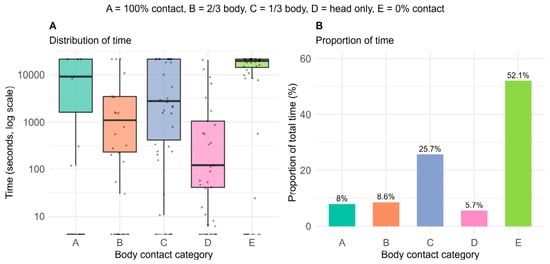
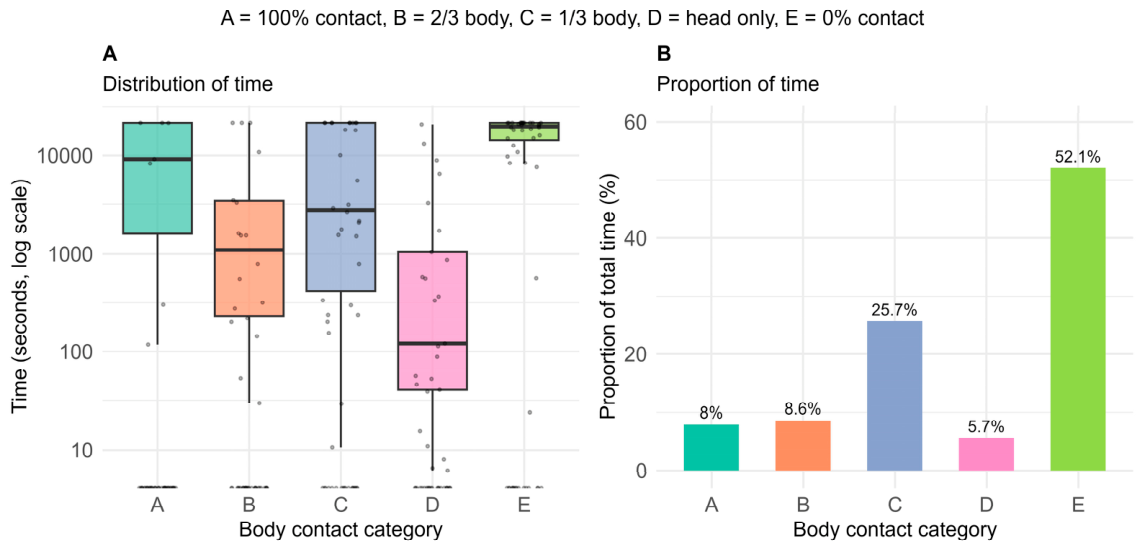
The analysis of time allocation across body contact categories revealed a clear pattern of substrate use (Figure 3). The distribution of individual observation times (Figure 3A) showed that category A (100% body contact) had the highest median values (~10,000 s per observation), indicating that when snakes engaged in full body contact with the substrate, they tended to do so for extended periods. Category B (two-thirds body contact) showed intermediate median values (~5000 s), followed by category C (one-third body contact; ~4000 s) and category D (head only; ~3000 s). Interestingly, category E (0% body contact, i.e., remaining exclusively on the familiar cardboard area) showed the lowest median values (~2000 s per observation), suggesting that time spent on the cardboard area occurred in shorter individual bouts.
Figure 3.
Overall time spent in each body contact category. (A) Boxplot showing the distribution of time (log scale) spent in each body contact category (A–E) across all substrates combined. The boxes represent the interquartile range, the horizontal line indicates the median, and the whiskers show the range of the data. Individual data points are overlaid as jittered dots to illustrate the full distribution of observations. (B) Bar plot showing the proportion of total time (%) spent in each body contact category (A–E). Values above the bars indicate the percentage of total observation time accounted for by each category. Categories: A = 100% contact, B = 2/3 body, C = 1/3 body, D = head only, E = 0% contact.
Despite the shorter individual durations, category E accounted for the highest proportion of total observation time, representing 52.1% of all recorded time (Figure 3B). Category C was the second most frequent category, with 25.7% of the total time. The remaining categories showed substantially lower proportions: category B represented 8.6%, category A represented 8.0%, and category D (head only) represented the smallest proportion at 5.7% (Figure 3B).
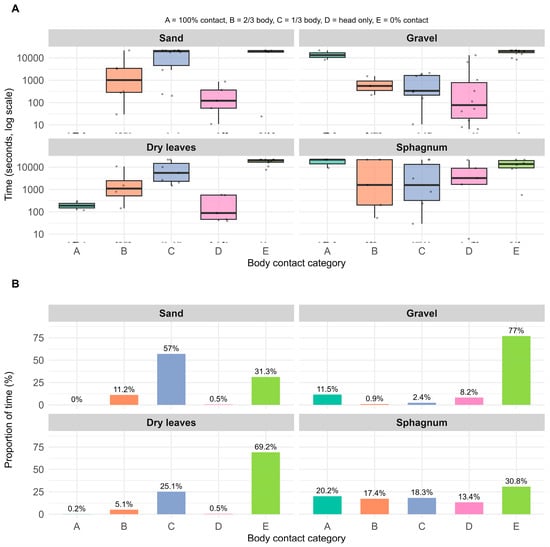
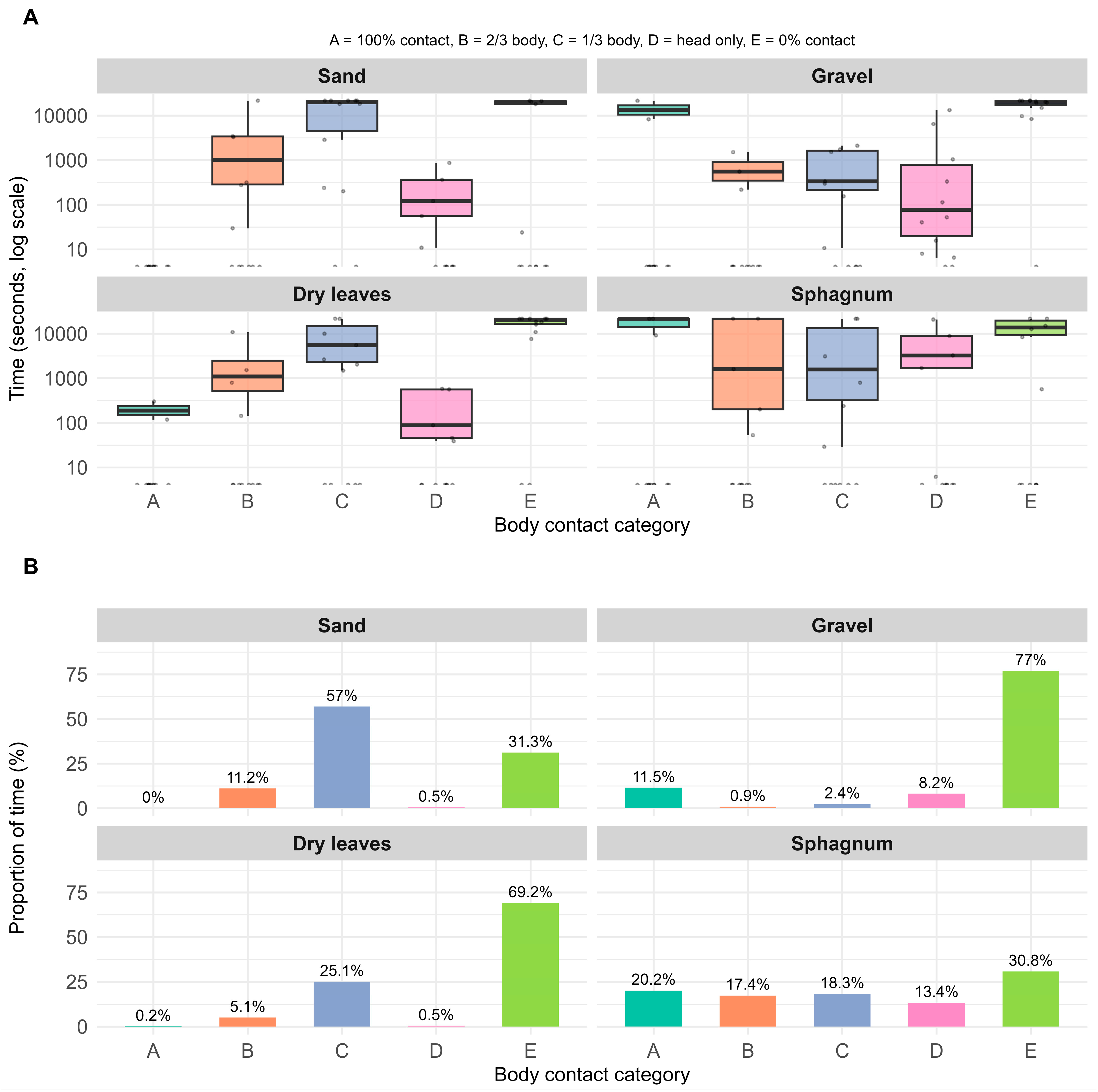
When examined separately by substrate type, time allocation revealed marked variation in body contact patterns (Figure 4). The distribution of individual observation times (Figure 4A) showed variation in the median duration of each body contact category among substrate types. Category E (0% body contact, i.e., remaining on the familiar cardboard area) showed the highest median values for Gravel, Dry leaves, and Sphagnum, whereas category C (one-third body contact) showed the highest median values for Sand. Categories A (100% body contact), B (two-thirds body contact), and D (head only) generally presented lower median values across substrates.
Figure 4.
Time spent in each body contact category by substrate. (A) Boxplots showing the distribution of time (log scale) for each body contact category (A–E) across the four substrate types (Sand, Gravel, Dry leaves, Sphagnum). The boxes represent the interquartile range, the horizontal line indicates the median, and the whiskers show the range of the data. Individual data points are overlaid as jittered dots to illustrate the full distribution of observations. (B) Bar plots showing the proportion of total time (%) spent in each body contact category (A–E) for each substrate type, with values above the bars indicating the percentage of total observation time accounted for by each category. Categories: A = 100% contact, B = 2/3 body, C = 1/3 body, D = head only, E = 0% contact.
The proportion of total time spent in each category (Figure 4B) varied among substrate types. Category E represented the highest proportion of time for Gravel (76.99%), Dry leaves (69.15%), and Sphagnum (30.79%), whereas category C was the most frequent category for Sand (57.01%), followed by category E (31.27%). Category C was also the second most frequent category for Dry leaves (25.06%). For Sphagnum, categories A (20.18%), B (17.38%), C (18.28%), and D (13.37%) showed more balanced proportions. For Gravel, after category E, all other categories represented less than 12% each, with category A at 11.52%, D at 8.21%, C at 2.39%, and B at 0.89%.
3.2. GLMM Analysis of Body Contact Patterns
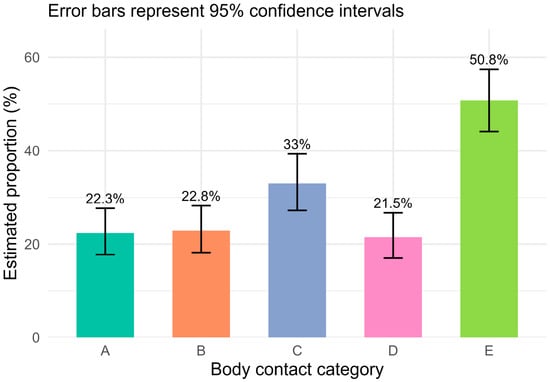
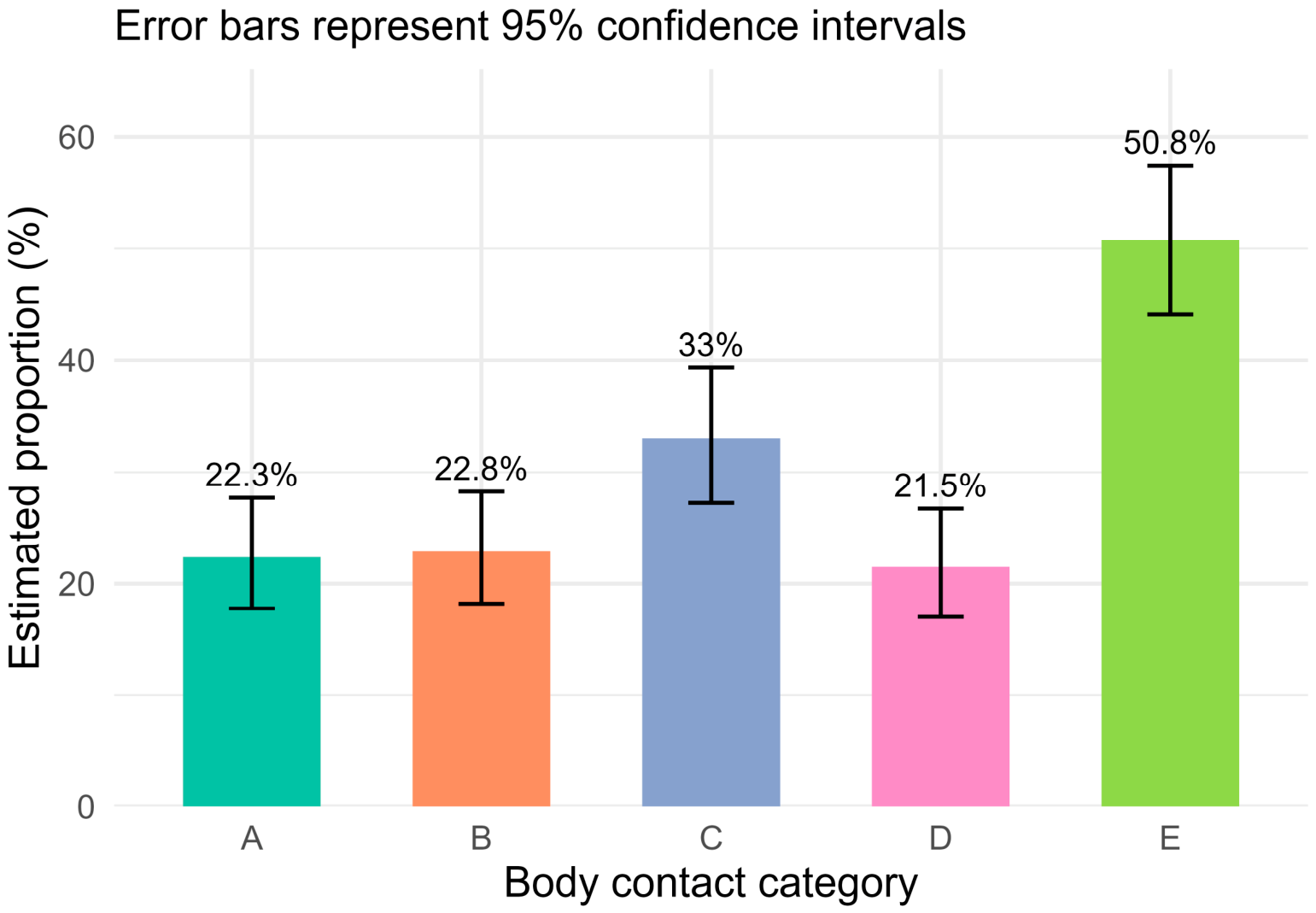
Snakes interacted with the different substrate types in distinct ways, exhibiting varying proportions of body contact with the surface. The Beta regression model revealed differences in the estimated proportions of time allocated among body contact categories. Category E (0% body contact with the novel substrate) accounted for 50.8% of the total observation time (95% CI: 44.1–57.4%), which was significantly higher than category A (100% body contact; 22.3%; 95% CI: 17.8–27.7%; odds ratio = 0.279; p < 0.001), category B (two-thirds body contact; 22.8%; 95% CI: 18.2–28.3%; odds ratio = 0.287; p < 0.001), category C (one-third body contact; 33.0%; 95% CI: 27.2–39.3%; odds ratio = 0.477; p = 0.001), and category D (head only; 21.5%; 95% CI: 17.0–26.7%; odds ratio = 0.265; p < 0.001). No other body contact categories differed significantly from category A: category B (p = 0.999), category C (p = 0.054), and category D (p = 0.999).
The interaction between substrate type and body contact category was not significant (all interaction terms p > 0.05; Figure 5), indicating that the relative distribution of time among the body contact categories did not differ significantly among substrates. Across substrate treatments, the model estimated that snakes spent approximately 44–52% of their time in category E (0% contact with the novel substrate). This lack of interaction suggests that the overall patterns of contact were broadly similar across substrate treatments, although the raw proportions showed some variation in the distribution of individual categories. While the raw proportions (Figure 3B) reflect the observed distribution of time, the GLMM-estimated proportions (Figure 5) are model-based marginal estimates that control for individual variation, substrate type, and period. The estimated proportions from the GLMM are not constrained to sum to 100%, as each category is estimated independently. Overall, both approaches identified category E (cardboard only) as the category with the highest proportion of time, although the estimated proportions provide the basis for statistical comparisons. No significant effect of period (diurnal vs. nocturnal) was detected (p = 0.916), and the estimated variance associated with individual identity was close to zero (σ2 = 1.18 × 10⁻¹⁰).
Figure 5.
Estimated proportions from the five-category GLMM. Bar plot showing the estimated marginal proportion of time spent in each body contact category (A–E) from the beta regression model. Error bars represent 95% confidence intervals. Estimated proportions are model-derived marginal means and are not constrained to sum to 100%, because the beta GLMM provides a category-specific marginal mean for each level of body contact category and does not impose a compositional sum-to-one constraint across categories, while accounting for individual variation, substrate type, and period. The corresponding raw observed proportions are shown in Figure 3B.
When comparing No contact (E) with Any contact (A–D), the revised GLMM showed no significant overall difference between the two contact categories (OR = 1.068, 95% CI: 0.797–1.433, p = 0.659). However, a significant Contact × Substrate interaction was detected (χ2 = 27.44, df = 3, p < 0.001), indicating that the relative allocation of time between No contact and Any contact varied according to substrate type (Table 1). Estimated marginal means showed that snakes spent a greater proportion of time in Any contact than in No contact on Sand (58.8% vs. 41.2%; OR = 0.491, 95% CI: 0.273–0.882, p = 0.017) and Sphagnum (58.9% vs. 41.1%; OR = 0.486, 95% CI: 0.270–0.873, p = 0.016). Conversely, No contact accounted for a greater proportion of time than Any contact on Gravel (62.2% vs. 37.8%; OR = 2.701, 95% CI: 1.493–4.885, p = 0.001) and Dry leaves (58.7% vs. 41.3%; OR = 2.025, 95% CI: 1.127–3.638, p = 0.018). Thus, although there was no overall difference between No contact and Any contact, the significant interaction indicated that their relative allocation varied according to substrate type. No significant effect of period was detected (p = 1.000), and the estimated variance associated with individual identity was negligible (σ2 = 4.91 × 10⁻¹¹).
Table 1.
Summary of the GLMM comparing No contact (E) and Any contact (A–D). Estimated marginal proportions, odds ratios (ORs), and 95% confidence intervals (CIs) are shown for contact type overall and for the Contact × Substrate interaction. The model was fitted using a Beta distribution with a logit link and individual identity as a random effect. ORs represent the odds of No contact relative to Any contact within each substrate. OR < 1 indicates greater odds of Any contact, whereas OR > 1 indicates greater odds of No contact. The Contact × Substrate interaction was significant (χ2 = 27.44, df = 3, p < 0.001).
4. Discussion
The present study aimed to characterize patterns of substrate use in juvenile South American rattlesnakes by quantifying the proportion of time spent in different body contact categories across familiar and novel substrates. Overall, category E (0% body contact with the novel substrate, corresponding to remaining exclusively on the familiar cardboard area) accounted for the largest proportion of total observation time. The complementary analysis comparing No contact (category E) with Any contact (categories A–D combined) revealed no significant overall difference between the two contact categories. Instead, the significant Contact × Substrate interaction indicated that the relative allocation of time between No contact and Any contact differed among substrates, with Any contact exceeding No contact on Sand and Sphagnum, whereas No contact was more prevalent on Gravel and Dry leaves. Thus, the results suggest that patterns of substrate use varied according to the substrate presented, rather than showing a consistent pattern of reduced contact with novel substrates.
The distinction between total time and individual observation duration is particularly informative: category E accounted for the largest proportion of total observation time despite having the shortest median duration of individual observations, whereas categories involving greater body contact generally contributed less to total time but included longer individual observations. This pattern indicates that the overall contribution of a behavioural category to total observation time was not determined solely by the duration of individual observations. The predominance of category E is compatible with the possibility that novelty influenced substrate use. Neophobia has been described as an adaptive response to unfamiliar stimuli and is well-documented in squamate reptiles [47,48,49], potentially being particularly relevant in juvenile rattlesnakes, who experience high predation risk during early ontogeny [50,51]. The relatively prominent partial-contact categories, particularly category C on Sand (57.01% of total observation time), may likewise be consistent with different degrees of interaction with unfamiliar substrates, as described in other reptiles [52,53,54,55,56], although the present data cannot establish whether such patterns represent cautious exploration, assessment of substrate properties, or another behavioural process [57]. At the same time, the predominance of category E does not necessarily indicate reduced use of novel substrates: the familiar cardboard area may have functioned as a safe refuge, providing a familiar and structurally stable location that could be used alongside interaction with novel substrates.
This interpretation is consistent with the natural history of juvenile rattlesnakes, who tend to maintain restricted activity ranges and use structurally stable shelters and microhabitats that provide protection and favorable environmental conditions [28,58,59,60,61]. Juvenile crotalids may also favour stable cover over loose or structurally heterogeneous substrates [51,62], potentially making the flat and homogeneous cardboard area a functionally distinct space within the experimental enclosure. In natural settings, rattlesnakes use heterogeneous environments containing vegetation, rocks, soil, litter, burrows, and other structural features that provide opportunities for shelter, movement, thermoregulation, and predator avoidance [28,58,59,60,61]. Juvenile rattlesnakes may be particularly dependent on suitable microhabitats because of their small body size and vulnerability to predators [50,51]. Microhabitat use in this context involves interactions among environmental accessibility, physical stability, protection, and thermal conditions, and juvenile pitvipers have been associated with protected and structurally defined microhabitats, including vegetation, burrows, rocks, and other forms of cover [51,59,60,61,62].
The use of the familiar cardboard area may therefore be compatible with the importance of stable and predictable surfaces during early ontogeny, while the continued interaction with the experimental substrates indicates that juveniles were capable of incorporating materials with different physical characteristics into their immediate environment. Thus, the experimental responses may reflect the behavioural flexibility required to negotiate heterogeneous microhabitats rather than reflecting a simple response to a particular substrate type. Accordingly, novelty-related caution and the use of a familiar area as a safe refuge may represent complementary processes contributing to substrate use, rather than mutually exclusive explanations.
The substrate-specific differences observed in the present study are biologically relevant because sand, gravel, dry leaves, and sphagnum differ markedly in particle size, surface structure, stability, compressibility, and resistance to movement. Such characteristics can influence locomotion and body posture in terrestrial animals [22], while substrate type has also been shown to affect behavioural responses such as scent-trailing in snakes [13]. In rattlesnakes, the different patterns of body contact may therefore reflect how juveniles interacted with the particular physical properties of each material. In particular, the greater proportion of time spent in contact with Sand and Sphagnum, compared with No contact, contrasts with the greater allocation of time without contact observed on Gravel and Dry leaves. These patterns suggest that substrate use may involve different modes of physical interaction according to the characteristics of the material, rather than representing a simple response to novelty alone. More broadly, this finding reinforces the importance of considering the physical properties of substrates when evaluating environmental complexity in captive snakes.
Early life experiences may also influence behavioural responses to novel environmental conditions in reptiles [32,34]. In some rattlesnakes, post-birth maternal attendance contributes to offspring development and affiliative behaviours [31,34]. Although all juveniles in the present study underwent identical early maternal separation—precluding direct evaluations of rearing history—their combined use of familiar and novel substrates raises relevant questions for captive management. Future comparative studies examining different rearing conditions could clarify whether early maternal interaction modulates environmental exploration and substrate use in young rattlesnakes.
The absence of a detectable effect of the experimental period is also relevant to the behavioural ecology of C. durissus. Rattlesnakes show diel and seasonal variation in activity, thermoregulation, and microhabitat use [28,58,59,60,61]. Under the controlled conditions of the present experiment, however, the overall allocation of time among contact categories did not differ detectably between the diurnal and nocturnal periods.
This suggests that the broad pattern of interaction with the experimental substrates was maintained across the two observation periods, despite the pronounced temporal variation that can characterize rattlesnake activity under natural conditions. The consistency of substrate use across experimental periods therefore suggests that the behavioural responses to the materials were not strongly dependent on the diurnal or nocturnal phase under the conditions tested.
From a captive-management perspective, these findings are relevant because substrates are not merely passive flooring materials. They contribute to enclosure complexity and can influence locomotion, posture, sensory stimulation, environmental exploration, and opportunities for species-typical behaviour [4,6,7,14,17,18,19]. Studies of captive reptiles have shown that environmental enrichment and habitat modification can alter behavioural patterns and provide opportunities for more diverse interactions with the enclosure [8,9,10]. The present findings extend this perspective by showing that juvenile rattlesnakes interacted differently with alternative substrates and that the degree of physical engagement varied according to the material provided. In particular, the substantial interaction with Sand and Sphagnum demonstrates that novel substrates can provide opportunities for physical engagement even when a familiar substrate remains available. This suggests that environmental complexity in captive rattlesnakes should be considered not simply in terms of adding naturalistic materials, but in terms of the behavioural opportunities and forms of interaction that different substrates provide.
These findings are also relevant to the welfare-oriented management of captive snakes. Behavioural responses are an important component of welfare assessment because they provide information about how animals interact with and respond to features of their captive environment [6,7,8,9,10,11,12]. In the present study, the coexistence of substantial use of the familiar cardboard area with continued interaction with novel substrates suggests that familiarity and environmental complexity can provide complementary elements of the captive environment: a familiar substrate may offer a stable and predictable area, while alternative substrates can provide opportunities for investigation and physical interaction.
This perspective is consistent with approaches to enrichment that emphasize opportunities for behavioural choice and species-appropriate interaction rather than the simple presence of naturalistic materials [6,7,14,15]. Thus, familiar and novel substrates need not be viewed as mutually exclusive components of enclosure design; instead, their combination may provide a broader range of environmental opportunities for juvenile rattlesnakes.
This perspective may be particularly relevant in captive venomous-snake management, where environmental provision must also be compatible with routine husbandry and venom-production programmes [1]. The present results do not suggest that cardboard should replace naturalistic substrates, but rather that substrate selection can benefit from considering familiarity, physical characteristics, and the behavioural responses elicited by each material. Providing a familiar substrate alongside alternative materials may allow animals to interact with environmental complexity while retaining access to a predictable area within the enclosure. Such an approach could be particularly useful when introducing new substrates during early ontogeny and may provide a practical framework for integrating environmental enrichment with the husbandry requirements of venomous snakes [1,4,8,9,10,14,15].
Finally, the behavioural patterns observed in the present study provide a useful starting point for considering individual variation in substrate use. Individual behavioural phenotypes can influence ecological decisions and responses to environmental conditions [63], and personality-related differences have been documented in snakes [64]. Although the models attributed little residual variation to individual identity, this finding should be interpreted as a description of the variation captured under the present experimental conditions rather than as evidence that juvenile rattlesnakes are behaviorally homogeneous.
These findings should be interpreted with caution. An important limitation of the experimental design is that it does not allow us to fully distinguish whether the observed use of the cardboard area was related to familiarity with the material, its physical properties, olfactory cues, or differences in structural complexity between the experimental conditions. Although the cardboard substrate was replaced and the enclosures were cleaned and disinfected between trials, and the position of the novel substrate was randomly assigned among trials, these measures cannot completely exclude the presence of residual chemical cues or other carry-over effects. Moreover, because cardboard was the familiar substrate in the home enclosures, familiarity with this material may have contributed to the observed pattern of use. Thus, the present experimental design does not allow for the relative contribution of familiarity, substrate properties, olfactory cues, and structural complexity to be disentangled.
Another limitation is that microclimatic conditions at the substrate level were not directly measured. Although ambient relative humidity was maintained at approximately 60% and the substrates were replaced daily, the different substrate types differed substantially in their water-holding properties and may therefore have generated different micro-humidity conditions. Daily substrate replacement reduced the possibility of progressive changes in substrate moisture resulting from prolonged exposure or animal-derived inputs, but it does not exclude differences in substrate-level microclimate among treatments. Such differences could potentially have influenced substrate use independently of the other substrate characteristics considered here. Because substrate-level humidity was not quantified, we cannot determine whether microclimatic variation contributed to the behavioural responses observed. Future studies should incorporate measurements of substrate-level temperature and humidity to better separate responses to substrate characteristics from responses to associated microclimatic conditions.
A further limitation concerns the early separation of the juveniles from their mothers. All individuals were separated immediately after birth, before their first ecdysis, and our study therefore cannot disentangle species-typical juvenile responses from potential effects associated with early maternal separation. Consequently, any relationship between early rearing history and responses to novel substrates should be regarded as a hypothesis for future investigation rather than as a demonstrated effect. Additionally, the study was limited to six individuals (three males and three females). While the repeated-measures design yielded multiple observations per snake, the small sample size inherently restricts statistical power and the generalizability of these findings. For this reason, sex was not included as a predictor in the GLMMs, as three individuals per sex were insufficient for a robust assessment of sex-related differences. Similarly, although the estimated variance associated with individual identity was close to zero, this estimate should not be interpreted as evidence that individual behavioural variation is negligible, given the small number of individuals available to estimate between-individual variability. Accordingly, the present results should be considered exploratory and preliminary rather than definitive. Future studies should include larger cohorts, experimentally compare different rearing histories, and investigate responses to novel substrates across ontogenetic stages and ecological contexts. Experimental designs in which substrate properties, familiarity, structural complexity, olfactory cues, and position can be independently controlled would be particularly valuable for determining the factors underlying substrate use. Incorporating additional behavioural, physiological, and health-related measures would further strengthen the assessment of substrate suitability and its potential implications for captive welfare. Long-term studies are also needed to determine whether sustained exposure to specific substrates is associated with changes in health, stress physiology, or venom production.
5. Conclusions
In conclusion, juvenile rattlesnakes exhibited substrate-specific patterns of physical contact and space use, combining the use of a familiar cardboard area with variable levels of interaction with novel materials. Rather than demonstrating an absolute preference or avoidance, their behavioural responses varied depending on the physical characteristics of the substrate provided. From a practical perspective, these preliminary findings suggest that both familiarity and the physical properties of substrates should be considered when designing enriched environments for captive snakes. Assessing body contact and spatial allocation offers a useful, non-invasive approach to inform husbandry practices, though further studies with larger sample sizes are required to confirm these trends across different developmental stages and management contexts.
Author Contributions
Conceptualization, M.P. and C.S.P.; methodology, M.P., C.S.d.A. and C.S.P.; software, M.P., C.S.d.A., S.M.d.A.-S., B.M.d.C.B., G.P. and C.S.P.; validation, M.P., C.S.d.A., S.M.d.A.-S., B.M.d.C.B., G.P. and C.S.P.; formal analysis, M.P., C.S.d.A., S.M.d.A.-S., and C.S.P.; investigation, M.P., C.S.d.A., S.M.d.A.-S., B.M.d.C.B., G.P. and C.S.P.; resources, M.P., C.S.d.A., S.M.d.A.-S., B.M.d.C.B., G.P. and C.S.P.; data curation C.S.d.A., S.M.d.A.-S., and C.S.P.; writing—original draft preparation, M.P., C.S.d.A., S.M.d.A.-S., and C.S.P.; writing—review and editing, M.P., C.S.d.A., S.M.d.A.-S., B.M.d.C.B., G.P. and C.S.P.; visualization, M.P., C.S.d.A., S.M.d.A.-S., B.M.d.C.B., G.P. and C.S.P.; supervision, M.P. and C.S.P.; project administration, M.P. and C.S.P. All authors have read and agreed to the published version of the manuscript.
Funding
This research received no external funding.
Institutional Review Board Statement
This study was conducted in accordance with ethical principles for the use of animals in research. The experimental protocol was approved by the Animal Ethics Committee of the Instituto Butantan (CEUAIB) under protocol number 5214021224.
Data Availability Statement
Data is available at: Pissarelli, Matheus; Azevedo, Cristiano; Santos, Selma; Batista, Bruno; Polidoro, Gabriel; Pizzutto, Cristiane (2026), “Substrate use in juvenile rattlesnakes, Crotalus durissus inferred from body contact and dwelling time”, Mendeley Data, V1, doi: 10.17632/887wht5m5w.1.
Conflicts of Interest
The authors declare no conflicts of interest.
References
- Grego, K.F.; Vieira, S.E.M.; Vidueiros, J.P.; Serapicos, E.D.O.; Barbarini, C.C.; Silveira, G.P.M.D.; Rodrigues, F.D.S.; Alves, L.D.C.F.; Stuginski, D.R.; Rameh-de-Albuquerque, L.C.; et al. Maintenance of Venomous Snakes in Captivity for Venom Production at Butantan Institute from 1908 to the Present: A Scoping History. J. Venom. Anim. Toxins Incl. Trop. Dis. 2021, 27, e20200068. [Google Scholar] [CrossRef] [Scilit]
- Hussain, J.; Roychoudhury, R.; Haque, A.; Saharia, J.; Das, V.; Das, S. Role of Animal Welfare on Production Sustainability. Acta Sci. Agric. 2024, 8, 9–11. [Google Scholar]
- Nkatekho, B. Animal Welfare Policies and Their Effect on Livestock Productivity and Trade. Int. J. Livest. Policy 2024, 3, 27–40. [Google Scholar] [CrossRef] [Scilit]
- De Vosjoli, P. Designing Environments for Captive Amphibians and Reptiles. Vet. Clin. N. Am. Exot. Anim. Pract. 1999, 2, 43–68. [Google Scholar] [CrossRef] [Scilit]
- Zhu, B.; Zhang, H.; Liu, D.; Lu, Y.; Wang, F. Importance of Substrate on Welfare in Swimming Crab (Portunus trituberculatus) Culture: A Territorial Behavior Perspective. Aquac. Rep. 2022, 24, 101113. [Google Scholar] [CrossRef] [Scilit]
- de Azevedo, C.S.; Cipreste, C.F.; Pizzutto, C.S.; Young, R.J. Review of the Effects of Enclosure Complexity and Design on the Behaviour and Physiology of Zoo Animals. Animals 2023, 13, 1277. [Google Scholar] [CrossRef] [Scilit]
- Wells, D.L. Sensory Stimulation as Environmental Enrichment for Captive Animals: A Review. Appl. Anim. Behav. Sci. 2009, 118, 1–11. [Google Scholar] [CrossRef] [Scilit]
- Bashaw, M.J.; Gibson, M.D.; Schowe, D.M.; Kucher, A.S. Does Enrichment Improve Reptile Welfare? Leopard Geckos (Eublepharis macularius) Respond to Five Types of Environmental Enrichment. Appl. Anim. Behav. Sci. 2016, 184, 150–160. [Google Scholar] [CrossRef] [Scilit]
- Spain, M.; Fuller, G.; Allard, S. Effects of Habitat Modifications on Behavioral Indicators of Welfare for Madagascar Giant Hognose Snakes (Leioheterodon madagascariensis). Anim. Behav. Cogn. 2020, 7, 70–81. [Google Scholar] [CrossRef] [Scilit]
- Hoehfurtner, T.; Wilkinson, A.; Nagabaskaran, G.; Burman, O.H.P. Does the Provision of Environmental Enrichment Affect the Behaviour and Welfare of Captive Snakes? Appl. Anim. Behav. Sci. 2021, 239, 105324. [Google Scholar] [CrossRef] [Scilit]
- Cargill, B.; Benato, L.; Rooney, N. A Survey Exploring the Impact of Housing and Husbandry on Pet Snake Welfare. Anim. Welf. 2022, 31, 193–208. [Google Scholar] [CrossRef] [Scilit]
- Nagabaskaran, G.; Burman, O.H.P.; Hoehfurtner, T.; Wilkinson, A. Environmental Enrichment Impacts Discrimination between Familiar and Unfamiliar Human Odours in Snakes (Pantherophis guttata). Appl. Anim. Behav. Sci. 2021, 237, 105278. [Google Scholar] [CrossRef] [Scilit]
- Howey, C.A.F.; Snyder, E.M. Substrate Type Affects Scent-Trailing Behavior of Newborn Timber Rattlesnakes (Crotalus horridus). Copeia 2020, 108, 229–236. [Google Scholar] [CrossRef] [Scilit]
- de Azevedo, C.S.; Cipreste, C.F.; Young, R.J. Environmental Enrichment: A GAP Analysis. Appl. Anim. Behav. Sci. 2007, 102, 329–343. [Google Scholar] [CrossRef] [Scilit]
- Bachetti, É.D.S.; Viol, L.Y.; Viana-Junior, A.B.; Young, R.J.; De Azevedo, C.S. Global Overview of Environmental Enrichment Studies: What Has Been Done and Future Directions. Animals 2024, 14, 1613. [Google Scholar] [CrossRef] [Scilit]
- Van Waeyenberge, J.; Aerts, J.; Hellebuyck, T.; Pasmans, F.; Martel, A. Stress bij in het wild en in gevangenschap levende slangen: Kwantificatie, gevolgen en het belang van management. Vlaams Diergeneeskd. Tijdschr. 2018, 87, 69–75. [Google Scholar] [CrossRef] [Scilit]
- Warwick, C.; Arena, P.; Steedman, C. Spatial Considerations for Captive Snakes. J. Vet. Behav. 2019, 30, 37–48. [Google Scholar] [CrossRef] [Scilit]
- Smith, A.; Rose, P.; Mettke-Hofmann, C. Effects of Enclosure Complexity and Design on Behaviour and Physiology in Captive Animals. Animals 2024, 14, 2028. [Google Scholar] [CrossRef] [Scilit]
- Hutchings, J.; Crane, M. Recent Scientific Insight into the Spatial Needs of Captive Snakes. Int. J. Zool. 2025, 2025, 3548045. [Google Scholar] [CrossRef] [Scilit]
- Vivas, G.L.; Robles, C.I.; Halloy, M. Substrate Use and Its Effect on Body Temperature in Two Syntopic Liolaemus Lizards in Northwestern Argentina. Bull. Acad. Herpetol. 2019, 33, 69–80. [Google Scholar] [CrossRef] [Scilit]
- Le Ray, D.; Guayasamin, M. How Does the Central Nervous System for Posture and Locomotion Cope with Damage-Induced Neural Asymmetry? Front Syst. Neurosci. 2022, 16, 828532. [Google Scholar] [CrossRef] [Scilit]
- Clifton, G.; Stark, A.Y.; Li, C.; Gravish, N. The Bumpy Road Ahead: The Role of Substrate Roughness on Animal Walking and a Proposed Comparative Metric. J. Exp. Biol. 2023, 226, jeb245261. [Google Scholar] [CrossRef] [Scilit]
- Galhardo, L.; Almeida, O.; Oliveira, R.F. Preference for the Presence of Substrate in Male Cichlid Fish: Effects of Social Dominance and Context. Appl. Anim. Behav. Sci. 2009, 120, 224–230. [Google Scholar] [CrossRef] [Scilit]
- Vogt, M.A.; Geiger, L.M.J.; Härtel, T.; Follert, P.; Palme, R.; Chourbaji, S. Evaluation of Potential Sustainable Bedding Substrates Focusing on Preference, Behavior, and Stress Physiology in Rats—A Pilot Study. Animals 2021, 11, 1375. [Google Scholar] [CrossRef] [Scilit]
- Youlatos, D.; Pylarinos, D.; Karantanis, N.E.; Rychlik, L. Locomotion, Postures, and Substrate Use in Captive Southern Pygmy Slow Lorises (Strepsirrhini, Primates): Implications for Conservation. Animals 2025, 15, 1576. [Google Scholar] [CrossRef] [Scilit]
- Pfefferle, D.; Talbot, S.R.; Kahnau, P.; Cassidy, L.C.; Brockhausen, R.R.; Jaap, A.; Deikun, V.; Yurt, P.; Gail, A.; Treue, S.; et al. Advancing Preference Testing in Humans and Animals. Behav. Res. Methods 2025, 57, 193. [Google Scholar] [CrossRef] [Scilit]
- Turner, J.T.; Whittaker, A.L.; McLelland, D.J.; Hanson, S.L.; Fernandez, E.J. Preference Test Design in Applied Animal Settings: A Scoping Review. Appl. Anim. Behav. Sci. 2025, 282, 106476. [Google Scholar] [CrossRef] [Scilit]
- Tozetti, A.M.; Martins, M. Habitat Use by the South-American Rattlesnake (Crotalus durissus) in South-eastern Brazil. J. Nat. Hist. 2008, 42, 1435–1444. [Google Scholar] [CrossRef] [Scilit]
- Figueroa-Huitrón, R.; Pérez-Mendoza, H.A.; Díaz de la Vega-Pérez, A.H.; Méndez-De la Cruz, F.R.; Ochoa-Ochoa, L.M. The Effect of Thermal Gradient Design on the Evaluation of Thermoregulation in Snakes. Herpetol. J. 2019, 29, 138–145. [Google Scholar] [CrossRef] [Scilit]
- Glaudas, X.; Winne, C.T.; Fedewa, L.A. Ontogeny of Anti-Predator Behavioral Habituation in Cottonmouths (Agkistrodon piscivorus). Ethology 2006, 112, 608–615. [Google Scholar] [CrossRef] [Scilit]
- Greene, H.W.; May, P.G.; Hoss, S.K.; Schuett, G.W. Parental Behavior by Vipers. In Biology of the Vipers; Schuett, G.W., Höggren, M., Douglas, M.E., Greene, H.W., Eds.; Eagle Mountain Publishing: Eagle Mountain, UT, USA, 2002; pp. 179–206. [Google Scholar]
- Munch, K.L.; Noble, D.W.A.; Botterill-James, T.; Koolhof, I.S.; Halliwell, B.; Wapstra, E.; While, G.M. Maternal Effects Impact Decision-Making in a Viviparous Lizard. Biol. Lett. 2018, 14, 20170556. [Google Scholar] [CrossRef] [Scilit]
- Amarello, M.; Smith, J.; Slone, J. Family Values: Maternal Care in Rattlesnakes Is More than Mere Attendance. Nat. Preced. 2011. [Google Scholar] [CrossRef] [Scilit]
- Hoss, S.K.; Deutschman, D.H.; Booth, W.; Clark, R.W. Post-Birth Separation Affects the Affiliative Behaviour of Kin in a Pitviper with Maternal Attendance. Biol. J. Linn. Soc. 2015, 116, 637–648. [Google Scholar] [CrossRef] [Scilit]
- Gond, P.G.; Kumar, M.; Unawane, A.; Sunagar, K. Hiss and Tell: What Influences Venom Yields of India’s Big Four Snakes? PLoS Negl. Trop. Dis. 2025, 19, e0013676. [Google Scholar] [CrossRef] [Scilit]
- Claunch, N.M.; Holding, M.L.; Escallón, C.; Vernasco, B.; Moore, I.T.; Taylor, E.N. Good Vibrations: Assessing the Stability of Snake Venom Composition after Researcher-Induced Disturbance in the Laboratory. Toxicon 2017, 133, 127–135. [Google Scholar] [CrossRef] [Scilit]
- Altmann, J. Observational Study of Behavior: Sampling Methods. Behaviour 1974, 49, 227–266. [Google Scholar] [CrossRef] [Scilit]
- Martin, P.; Bateson, M. Measuring Behaviour: An Introductory Guide, 4th ed.; Cambridge University Press: Cambridge, UK, 2021. [Google Scholar]
- Gross, J.; Ligges, U. Nortest: Tests for Normality. R Package Version 1.0-4. 2015. Available online: https://CRAN.R-project.org/package=nortest (accessed on 13 August 2026).
- Abdo, D.A.; El-Saeed, A.R.; Abdelmegaly, A.A. Evaluating Fit of Some Survival Analysis Models with Application and Simulation. Egypt. Stat. J. 2024, 68, 86–103. [Google Scholar] [CrossRef] [Scilit]
- Burnham, K.P.; Anderson, D.R. Model Selection and Multimodel Inference: A Practical Information-Theoretic Approach, 2nd ed.; Springer: New York, NY, USA, 2002. [Google Scholar]
- Brooks, M.E.; Kristensen, K.; van Benthem, K.J.; Magnusson, A.; Berg, C.W.; Nielsen, A.; Skaug, H.J.; Mächler, M.; Bolker, B.M. glmmTMB Balances Speed and Flexibility Among Packages for Zero-Inflated Generalized Linear Mixed Modeling. R J. 2017, 9, 378–400. [Google Scholar] [CrossRef] [Scilit]
- Hartig, F. DHARMa: Residual Diagnostics for Hierarchical (Multi-Level/Mixed) Regression Models. R Package Version 0.4.6. 2022. Available online: https://CRAN.R-project.org/package=DHARMa (accessed on 13 August 2026).
- Lüdecke, D.; Ben-Shachar, M.S.; Patil, I.; Waggoner, P.; Makowski, D. Performance: An R Package for Assessment, Comparison and Testing of Statistical Models. J. Open Source Softw. 2021, 6, 3139. [Google Scholar] [CrossRef] [Scilit]
- Lenth, R.V. emmeans: Estimated Marginal Means, aka Least-Squares Means. R Package Version 1.8.9. 2023. Available online: https://CRAN.R-project.org/package=emmeans (accessed on 6 May 2024).
- R Core Team. R: A Language and Environment for Statistical Computing; R Foundation for Statistical Computing: Vienna, Austria, 2024; Available online: https://www.R-project.org/ (accessed on 13 August 2026).
- Crane, A.L.; Brown, G.E.; Chivers, D.P.; Ferrari, M.C.O. An Ecological Framework of Neophobia: From Cells to Organisms to Populations. Biol. Rev. 2020, 95, 218–231. [Google Scholar] [CrossRef] [Scilit]
- De Meester, G.; Baeckens, S. Reinstating Reptiles: From Clueless Creatures to Esteemed Models of Cognitive Biology. Behaviour 2021, 158, 1057–1076. [Google Scholar] [CrossRef] [Scilit]
- Szabo, B.; Ringler, E. Fear of the New? Geckos Hesitate to Attack Novel Prey, Feed near Objects and Enter a Novel Space. Anim. Cogn. 2023, 26, 537–549. [Google Scholar] [CrossRef] [Scilit]
- Almeida-Santos, S.M.; Antoniazzi, M.M.; Augusto, O.; Jared, C. Predation by the Opossum Didelphis marsupialis on the Rattlesnake Crotalus durissus. Herpetol. Rev. 2000, 31, 101. [Google Scholar]
- Howarth, C.R.; Bishop, C.A.; Larsen, K.W. Microhabitat and Stopover Site Selection by Juvenile Western Rattlesnakes (Crotalus oreganus). Front. Amphib. Reptile Sci. 2023, 1, 1251161. [Google Scholar] [CrossRef] [Scilit]
- Burghardt, G.M. Environmental Enrichment and Cognitive Complexity in Reptiles and Amphibians: Concepts, Review, and Implications for Captive Populations. Appl. Anim. Behav. Sci. 2013, 147, 286–298. [Google Scholar] [CrossRef] [Scilit]
- Warwick, C.; Grant, R.; Steedman, C.; Howell, T.J.; Arena, P.C.; Lambiris, A.J.L.; Nash, A.-E.; Jessop, M.; Pilny, A.; Amarello, M.; et al. Getting It Straight: Accommodating Rectilinear Behavior in Captive Snakes—A Review of Recommendations and Their Evidence Base. Animals 2021, 11, 1459. [Google Scholar] [CrossRef] [Scilit]
- Lillywhite, H.B. How Snakes Work: Structure, Function, and Behavior of the World’s Snakes; Oxford University Press: New York, NY, USA, 2014. [Google Scholar]
- Burghardt, G.M. Of Iguanas and Dinosaurs: Social Behavior and Communication in Neonate Reptiles. Am. Zool. 1977, 17, 177–190. [Google Scholar] [CrossRef] [Scilit]
- Herzog, H.A.; Bowers, B.B.; Burghardt, G.M. Development of Antipredator Responses in Snakes: IV. Interspecific and Intraspecific Differences in Habituation of Defensive Behavior. Dev. Psychobiol. 1989, 22, 489–508. [Google Scholar] [CrossRef] [Scilit]
- Lima, S.L.; Dill, L.M. Behavioral Decisions Made under the Risk of Predation: A Review and Prospectus. Can. J. Zool. 1990, 68, 619–640. [Google Scholar] [CrossRef] [Scilit]
- Pucca, M.B.; Bernarde, P.S.; Rocha, A.M.; Viana, P.F.; Farias, R.E.S.; Cerni, F.A.; Oliveira, I.S.; Ferreira, I.G.; Sandri, E.A.; Sachett, J.; et al. Crotalus durissus ruruima: Current Knowledge on Natural History, Medical Importance, and Clinical Toxinology. Front. Immunol. 2021, 12, 659515. [Google Scholar] [CrossRef] [Scilit]
- Gomes, C.; Almeida-Santos, S.M. Microhabitat Use by Species of the Genera Bothrops and Crotalus (Viperidae) in Semi-Extensive Captivity. J. Venom. Anim. Toxins Incl. Trop. Dis. 2012, 18, 393–398. [Google Scholar] [CrossRef] [Scilit]
- Fiorillo, B.F.; Tozetti, A.M.; Martins, M. Habitat Use by Five Species of Sympatric Pitvipers (Bothrops, Crotalus) in a Brazilian Savannah. Herpetol. J. 2020, 30, 154–162. [Google Scholar]
- Raya-García, E.; Arteaga-Tinoco, I. Rural Occupancy in a Montane Burrowing Snake: The Importance of Thermal and Habitat Resources during the Rainy Season. Biologia 2024, 79, 2071–2078. [Google Scholar] [CrossRef] [Scilit]
- Ramirez-Arce, D. Habitat Use and Age Structure of the Fer-de-Lance (Bothrops asper, Viperidae) in Braulio Carrillo National Park, Costa Rica. Herpetol. J. 2021, 31, 46–54. [Google Scholar] [CrossRef] [Scilit]
- Wolf, M.; Weissing, F.J. Animal Personalities: Consequences for Ecology and Evolution. Trends Ecol. Evol. 2012, 27, 452–461. [Google Scholar] [CrossRef] [Scilit]
- Skinner, M.; Brown, S.; Kumpan, L.T.; Miller, N. Snake Personality: Differential Effects of Development and Social Experience. Behav. Ecol. Sociobiol. 2022, 76, 135. [Google Scholar] [CrossRef] [Scilit]

Disclaimer/Publisher’s Note: The statements, opinions and data contained in all publications are solely those of the individual author(s) and contributor(s) and not of MDPI and/or the editor(s). MDPI and/or the editor(s) disclaim responsibility for any injury to people or property resulting from any ideas, methods, instructions or products referred to in the content. |
© 2026 by the authors. Licensee MDPI, Basel, Switzerland. This article is an open access article distributed under the terms and conditions of the Creative Commons Attribution (CC BY) license.