


Abstract
For species extirpated from the wild, ex situ breeding programs are essential for providing the individuals necessary for re-establishing wild populations through reintroductions. However, repeated exposure to humans under managed care may reduce wariness and alter behavioral responses in ways that are maladaptive after release. Although some pre-release behaviors reflect natural responses essential for survival and reproduction, others may result from habituation to humans and increase the risk of conflict, recapture, or mortality following translocation. These risks underscore the need for behavioral assessments to help identify appropriate candidates for release. However, because the assessments themselves require some exposure to humans, pilot studies are needed to determine whether the methods are feasible and reliably capture meaningful individual variation. Here, a standardized behavioral assay was tested to quantify tolerance of ex situ red wolves (Canis rufus) to humans. A pilot study was conducted by staff at the North Carolina Zoo in which repeated observations on 23 red wolves were used during routine husbandry activities to measure three commonly used indices of human tolerance: flight initiation distance, behavioral response to human entry/approach to enclosures, and willingness to consume prey in the presence of humans. Using a multivariate framework, two distinct profiles, human-avoidant and human-tolerant, were identified, in which older red wolves were more likely to exhibit human-tolerant profiles, suggesting an age-related association, consistent with cumulative habituation. These results demonstrate that behavioral profiles can be developed from observations made during routine husbandry activities, requiring no additional handling or invasive testing protocols. This study outlines how the tool can be used for release-candidate screening and adapted for use across facilities participating in the red wolf ex situ breeding program.
1. Introduction
Reintroductions and translocations are central to modern conservation science, particularly as populations continue to decline or disappear despite in situ protection. The International Union for Conservation of Nature (IUCN) considers the use of translocations as purposeful movements of organisms for conservation benefit [1]. This includes reintroductions and reinforcements of fauna and flora within their historical ranges, as well as introductions outside historical ranges under specific circumstances [1]. When implemented alongside threat mitigation (e.g., habitat restoration, persecution reduction, invasive species control), reintroductions can restore extirpated populations, restore ecological interactions, and contribute to broader restoration goals [2,3].
The fates of translocated animals are not determined solely by habitat suitability or post-release management, but also by how individuals behave when confronted with novel conditions, predators, conspecifics, and unfamiliar resource distributions. Research on conservation translocations identifies animal behavior as one of the most frequent practical challenges encountered by practitioners, shaping outcomes through behavioral effects on movement, settlement, foraging, risk-taking, social integration, and reproduction [4]. Behavioral phenotypes can differ consistently across individuals (e.g., along shyness–boldness and exploration–avoidance axes) and these differences can translate into variation in exposure to predation, willingness to use refugia, propensity to disperse, and likelihood of integrating into social groups, all of which are key pathways linking individual decisions to survival and population growth [5,6].
Empirically, behavioral traits measured in ex situ-housed animals (hereafter pre-release behaviors) have predicted animal performance following translocations (hereafter post-release behaviors) in some systems. For example, boldness assessed in captivity predicted early mortality in swift fox (Vulpes velox) [7] and Tasmanian devil (Sarcophilus harrisii) release programs [8]. Multivariate personality tests have also been successfully applied to predict post-release outcomes in a number of species, including Blanding’s turtles (Emydoidea blandingii) [9], Eastern quolls (Dasyurus viverrinus) [10], and European mink (Mustela lutreola) [11]. Together, these findings motivate conservationists to treat behavior not as an ancillary consideration, but as a core feature that can be measured and managed to determine whether individuals can be released to improve establishment and long-term viability following their releases.
The red wolf (Canis rufus) is one of the most endangered canid species globally. Following its extirpation from the wild in 1980, its recovery has relied on an ex situ breeding program founded with 14 individuals captured from the last known wild population. Individuals in the breeding program are managed to support a reintroduced population in northeastern North Carolina, managed by the U.S. Fish and Wildlife Service (USFWS) [12]. However, anthropogenic mortality [13,14,15] resulting in pack disbandment [16] and hybridization with coyotes [17] has culminated in fewer than ~30 individuals in the wild as of 2026, leaving too few breeding adults to sustain population growth without continued supplementation. As a result, the USFWS Red Wolf Recovery Program is dependent on the release of adults from the ex situ breeding program to maintain the small, reintroduced population in North Carolina [18]). This management strategy elevates the importance of release-candidate selection because each adult release represents a substantial demographic and genetic contribution relative to the current wild population size [19].
At present, release decisions are primarily guided by demographic and genetic criteria (e.g., age, sex, genetic representation of the founders), despite evidence that behavioral profiles can strongly influence post-release outcomes. A persistent management challenge with adult releases is habituation, defined here as a learned reduction in responsiveness, particularly vigilance and avoidance, to repeated, non-threatening human stimuli over time [20,21,22,23]. Habituation to humans and human-modified environments can increase the likelihood of using anthropogenic resources and space (e.g., residential areas, road corridors) and thereby elevate risks of conflict, vehicle collision, illegal killing, and management removal or recapture [13,14,15,16]. Alternatively, habituated red wolves may be recaptured and returned to human care, which results in little to no contribution to the wild population and can erode public tolerance for continued releases.
In a program using adult animals to supplement the wild population [18], habituation of red wolves to humans has direct implications for effective population size and recovery efficiency. These constraints underscore the need for a standardized, quantitative behavioral assessment that can be used to identify individuals most likely to maintain wariness and avoidance of humans during post-release while successfully persisting and reproducing.
Despite the importance of maintaining wariness toward humans by animals considered for release, the USFWS Red Wolf Recovery Program currently lacks a standardized, low-burden method for quantifying individual variation in human avoidance under ex situ management [18]. To address this gap, an exploratory feasibility study was conducted to determine whether behavioral observations collected during routine husbandry could be combined to characterize variation in human avoidance among ex situ red wolves. Specifically, the study evaluated whether these observations revealed distinct behavioral profiles and whether profile membership was associated with age, sex, or housing condition.
2. Methods
2.1. Study Group
Behavioral data were collected from ex situ red wolves (female, n = 14; male, n = 9) from February through December 2025 at the North Carolina Zoo, Asheboro, North Carolina, USA. This facility maintains 10 identical habitats to manage red wolves for the purposes of release, away from the public view and isolated in the woods (“back pens” hereon, n = 21), and one enclosure in the zoo near guest walkways (“guest view” here; Supplementary Table S1). Back pen habitats are roughly 5000 square feet, rectangular in shape. A 10-foot-wide keeper hallway runs along the middle, with 5 pens on each side, separated by a 2-foot double fence. Each pen maintains 2 den boxes, one food shelter, and several trees, bushes and logs. The guest view habitat is approximately 3000 square feet, circular in shape. It maintains one den and similar furniture and substrate items as found in the back pens, along with a shallow pool near the guest overlook. Guests are able to stand 2 feet from the overlook fence, with an additional 10-foot buffer of the pool. Though guests have a clear view into the habitat, multiple structures (logs, trees, bushes) allow the red wolves to hide.
Red wolves observed in this study were housed singly, as breeding pairs and/or within family groups (Supplementary Table S1). All red wolves experienced similar direct interactions with humans, housing, and feeding throughout their lifetimes. Husbandry practices minimized human interaction, apart from one handling event every other year for veterinary care.
2.2. Data Collection
Behavioral observations were collected opportunistically before morning routine husbandry activities (total observation days, n = 131).
Three metrics were used to assess behaviors associated with human tolerance. First, flight initiation distance (FID), defined as the distance at which individuals flee from an approaching human [24,25,26], was quantified. Decreased FID can indicate a reduction in vigilance. The farthest point of visual distance for the test subjects was chosen for all enclosures (38.9–46.0 yards, depending upon the pen). During testing, staff members measured their distances from enclosures using range finders, walked at a normal pace towards red wolves, and stopped recording the moment wolves were observed to move away. Because these were brief, event-based assessments embedded within routine husbandry rather than timed observation sessions, assessment duration was not recorded.
Second, we scored escape behavior in the form of red wolf response to human entry into an enclosure, focusing on “hiding behavior”. Less habituated red wolves were expected to move into a den, seeking a visual barrier between the human and the wolf, i.e., “hide”, rather than remaining visible. Upon entering the pen, observers scored either “den entry” or “no den entry”. Third, because feeding can indicate reduced vigilance and perceived risk [24], eating prey items while humans were within visible range was included as an additional measure of human tolerance. Observers scored “yes” or “no” if the red wolf was observed to consume prey when within visual proximity. When combined, these metrics may identify behavioral profiles of ex situ red wolves that could inform reintroduction decisions.
Observations were not conducted according to a predetermined schedule, fixed sampling interval, or standardized number of assessments per wolf. While FID and den entry data were collected during each observation session, feeding refusal was only captured during visits which included feeding service (Supplementary Table S2 for the checklist used during observations).
2.3. Data Analyses
All analyses were done in R Studio 2026.05.0 [27]. Because individual red wolves contributed multiple observations (min = 3, max = 11, mean = 5.32), behavior was summarized by individual ID. For each red wolf, the mean FID was calculated across trials (total FID observations, n = 130). The proportion of scored trials in which den entry occurred (n = 128) and refusal to consume prey (n = 88) was calculated for each individual red wolf. For scoring these two terms, “1” represents the human-avoidant response; thus, higher values for mean flight initiation distance, den-entry proportion, and feeding-refusal proportion consistently represented greater human avoidance. These proportions were retained as numeric variables and were not dichotomized. Wolves missing one or more of the three measures during the study period or observed less than 3 times were excluded from the analysis. Principal component analyses (PCAs) were used to explore covariation among behavioral traits [28] using the package FactoMineR [29]. Variables were standardized to unit variance before analysis because flight initiation distance and the two behavioral proportions were measured on different scales. The first two principal component dimensions were retained for visualization and exploratory clustering. While all three response variables could be collected during a single observation, they were treated as separate indicators because they quantified responses to human presence in distinct behavioral and motivational contexts. The PCA was used to quantify their shared covariance and determine whether they collectively represented an underlying behavioral dimension. Repeated observations were summarized at the individual level, such that each wolf contributed one value for each behavioral measure and remained the independent unit of analysis.
Wolves were classified into temperament categories using k-means clustering (k = 2; random seed set for reproducibility) on each wolf’s scores on the first two PCA dimensions. We then summarized the mean trait values for each cluster to interpret differences between clusters. Labels were then assigned to clusters based on an a priori behavioral profile. The cluster characterized by higher FID and higher probabilities of den entry and feeding refusal was labeled “Human-Avoidant”, whereas the alternative cluster was labeled “Human-Tolerant”.
To test whether the two personality categories differed in their multivariate habituation profiles, a permutational multivariate analysis of variance (PERMANOVA) was conducted on individuals’ PCA scores. Each red wolf’s coordinates were then extracted on the first two PCA dimensions (PC1–PC2), and these coordinates were treated as the response matrix. The adonis2 function in the vegan package [30] was then used to test for differences in group centroids between personality type categories, using Euclidean distance (appropriate for ordination coordinates) and permutation-based significance testing. The resulting pseudo-F statistic and permutation p-value quantify whether the multivariate position of individuals in PCA space differs between personality groups. A dispersion test was conducted using the betadisper procedure in the vegan package to assess homogeneity of multivariate dispersion among groups; comparable within-group variability supports interpreting PERMANOVA results primarily as differences in group centroid location.
Individual-level habituation scores were analyzed across housing conditions (off-guest view pens vs. guest view), sex (male vs. female), and age (continuous) because habituation was quantified at the individual level. Using logistic regression with the lme4 package [31], variation in responses was tested to determine whether it was better explained by additional variables. The Aikake Information Criterion (AIC) was used to conduct our model selection process, comparing models including the individual terms of interest, interactions between the terms, single term models, and the null model. The best-fit model was the one with the lowest AIC score and carrying the highest cumulative model weight [32,33,34]. Collinearity was tested in the full models, using the check.collinearity function in the “performance” package [35]. For the final model, odds ratios (ORs) were obtained using exponentiated regression coefficients and the 95% confidence intervals (CIs).
3. Results
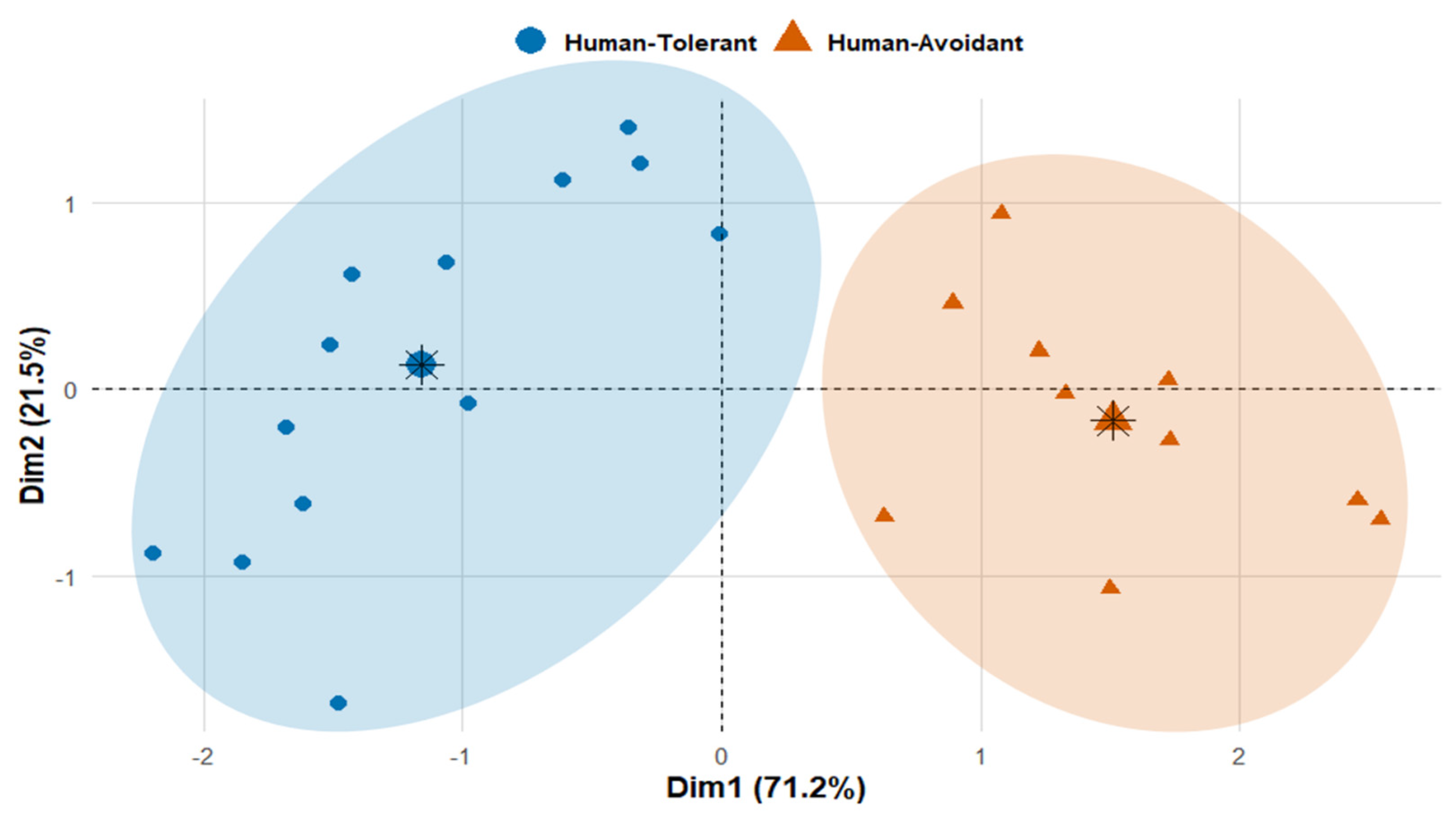
Principal component analysis (PCA) of the three individual-level temperament indices yielded a low-dimensional structure in which the first two components explained 71.20% and 21.54% of the total variance (cumulative 92.75%; eigenvalues 2.14 and 0.65, respectively). PC1 captured shared covariation across all three measures, with strong positive correlations for FID (r = 0.83), den-entry proportion (r = 0.93), and feeding-refusal proportion (r = 0.77); consistent with this, contributions to PC1 were highest for the den entry when approached (40.66%), followed by FID (31.86%) and feeding refusal (27.48%). Thus, higher PC1 scores represented greater human avoidance, characterized by responding to approaching humans at greater distances, more frequently entering the den, and more frequently refusing prey in the presence of humans. PC2 was driven primarily by feeding refusal (contribution 59.53%; r = 0.62) and, secondarily, FID (contribution 39.91%; r = −0.51), while response contributed minimally to PC2 (0.56%; r = −0.06).
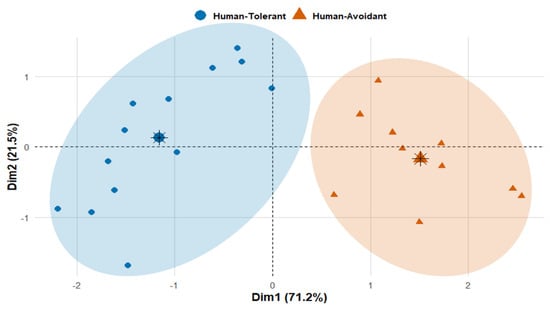
Exploratory k-means clustering applied to individual scores on PC1–PC2 yielded two temperament clusters (human-avoidant, n = 10, and human-tolerant = 13, Figure 1, Table 1). Wolves assigned to the human-avoidant profile had a greater mean flight initiation distance than human-tolerant wolves (74.3 ± 19.5 versus 32.4 ± 10.1 yards), entered the den during a greater proportion of scored approach trials (0.80 ± 0.17 versus 0.14 ± 0.20), and refused prey during a greater proportion of scored feeding trials conducted in the presence of humans (0.93 ± 0.16 versus 0.51 ± 0.39). Thus, all three behavioral measures differed in the expected direction, although feeding-refusal responses were more variable within the human-tolerant profile.
Figure 1.
Principal component analysis of red wolf behavioral indices and exploratory behavioral profiles. Individual red wolves are projected onto the first two principal components (PC1 = 71.20% of total variance; PC2 = 21.54%). Points represent individual wolves (n = 23) and are colored according to exploratory k-means cluster assignment (k = 2: human-avoidant and human-tolerant). Black asterisks indicate the centroids of the two profiles in PCA space. Higher PC1 scores correspond to greater flight initiation distance and higher proportions of den entry and feeding refusal in the presence of humans, collectively indicating greater human avoidance. Dim. 1 = PC1; Dim. 2 = PC2.
Table 1.
Descriptive summaries of individual-level temperament indices of ex situ red wolves by temperament group. Values are reported as mean ± SD for flight initiation distance (FID; yards), the proportion of scored approach trials in which the wolf entered the den, and the proportion of scored feeding trials in which the wolf did not consume prey while a human remained within visual range. Higher values for all three indices indicate greater human avoidance. Profile labels were assigned following exploratory k-means clustering of individual scores on the first two principal component dimensions.
To test differences between group positions in PCA space, a PERMANOVA was conducted on Euclidean distances of the first two principal component scores. Group membership explained a substantial proportion of variation in PCA coordinates (R2 = 0.637), with significant centroid separation between groups (pseudo-F = 36.88, p = 0.001). Because PERMANOVA can be sensitive to differences in within-group dispersion, homogeneity of dispersions was tested and did not differ between groups (permutation test: pseudo-F = 1.76, p = 0.193), indicating that the observed group separation reflects differences in centroid location rather than unequal within-group spread.
Individual age was found to significantly affect temperament (estimate = −0.41, std. error = 0.2, p = 0.03), whereas habitat and sex were weaker predictors in our candidate models (ΔAICc ≥ 4.47, AICc weights ≤ 0.07). For each one-unit increase in age, the odds of being classified as human-avoidant decreased by approximately 34% (OR = 0.66, 95% CI 0.42–0.91).
4. Discussion
This pilot study demonstrated that a simple habituation assessment, embedded within routine husbandry, can identify behavioral variation for human tolerance among ex situ red wolves. Practically, this study indicates that candidate-relevant temperament signatures, specifically related to human tolerance, can be derived within daily animal management routines. Upon validation against post-release outcomes, this tool may be used when selecting appropriate release animals.
This analysis supports the interpretation of a common underlying axis of human tolerance among the identified metrics. PC1 captured shared covariation across all three indices, with strong correlations for distances from which red wolves react to humans approaching their enclosures (FID), the likelihood of retreating into the den when approached, and the likelihood of refusing prey while humans remained nearby. This alignment is consistent with the expectation that wolves that treat humans as higher-risk stimuli should both initiate avoidance at greater distances, preferentially seeking visual barriers (den entry), while also suppressing feeding behavior in the presence of humans. PC2 was driven more by feeding-refusal proportion and secondarily by FID, with den-entry proportion contributing minimally. This dimension may therefore reflect context-specific variation in how wolves balance feeding motivation and avoidance rather than a second general axis of human tolerance. Such responses are likely influenced by tradeoffs between perceived risk and reward [36]. Retaining a multivariate framework, rather than relying on a single measure, may therefore be advantageous because different behavioral responses can provide complementary information about human avoidance.
A significant negative association was detected between age and human-avoidant profile assignment, with the odds of classification as human-avoidant decreasing with each additional year of age. This is consistent with a plausible habituation or learning process for red wolves exposed to human-managed settings over long periods. Repeated exposure to predictable husbandry cues, even under protocols designed to limit interaction, may gradually reduce perceived risk and increase tolerance over time [20,23,37]). Alternatively, yet not mutually exclusively, this pattern could reflect selective processes when living under human management. Highly avoidant individuals might show different health, breeding, or management trajectories that shape which animals are available for repeated sampling as animals age [38,39]. In either case, the observed effect of age reinforces the practical importance of assessing habituation rather than assuming uniform “wild type” wariness among managed candidates.
The absence of support for the effect of red wolf sex and facility housing conditions in our candidate models should be interpreted cautiously, given the small sample and uneven representation of housing types. Still, our findings indicate that, within the North Carolina Zoo management regime, individual variation explained habituated profiles better than broad demographic categories. That is consistent with the broader animal personality literature in which differences among individuals often persist even under shared environments, and these differences can meaningfully affect post-release outcomes when animals encounter novel risks [5,40,41].
A limitation of sampling should be noted: because observations were collected opportunistically, sampling intervals, observation contexts, and the number of assessments were not standardized across wolves. Session duration was also not recorded. Future applications should use a defined sampling schedule and record contextual variables and assessment duration to evaluate repeatability and improve comparability among individuals and facilities.
For conservation translocations, the key challenge is not simply showing that behavior matters, but developing practical, reliable assessments that can be embedded in routine husbandry and inform release decisions [4,42]. This assessment was designed as a quick, low-burden screening tool, leveraging opportunistic husbandry activities that already occur during daily care. The resulting multivariate classification suggests that these routine interactions contain sufficient information to identify where individual red wolves fall along a human tolerance gradient, supporting the feasibility of collecting behavioral information relevant for using managed-breeding programs to support reintroductions. At the same time, this approach should be treated as an operational proxy rather than a definitive personality measure: it requires future validation to establish (i) test–retest reliability across contexts and time, (ii) correspondence with broader personality profiles (e.g., boldness/neophobia, exploration via further testing), and (iii) predictive links to post-release outcomes.
These findings lay the groundwork for developing a practical tool for assessing habituation in ex situ-housed red wolves. The tool only requires measuring a small set of animal behaviors collected during routine husbandry activities. Traditional PCA analysis can then be used with behavioral data to produce a multivariate behavioral structure, allowing individuals to be differentiated into human-avoidant and human-tolerant profiles with strong centroid separation in temperament space. The observed age effect further highlights that habituation risk is not static across the managed population and underscores the need for ongoing behavioral screening. This approach also provides a framework for adaptive management in captivity. For example, if red wolves exhibit increasingly tolerant profiles, managers could apply targeted interventions (e.g., minimizing predictable feeding cues associated with humans, modifying servicing routines, increasing use of visual barriers, or adjusting timing and locations of prey provisioning) and then quantify changes within individual temperaments over subsequent assessments. In this way, the tool can support both selection and refinement: identifying high-risk candidates and evaluating husbandry changes intended to preserve or restore appropriate wariness. Further refinement can be accomplished through standardizing contextual covariates, replicating across institutions, and validating against post-release performance. With these steps, this approach could become a scalable behavioral decision-support tool that strengthens both welfare-focused management in captivity and the effectiveness of red wolf recovery efforts.
Supplementary Materials
The following supporting information can be downloaded at: https://www.mdpi.com/article/10.3390/jzbg7030034/s1, Supplementary Table S1: Demographic and housing characteristics of red wolf subjects included in the study. 23 red wolves were observed either in a back pen or on guest view at the North Carolina Zoo, Asheboro, North Carolina, USA. The wolves are housed in different types of social groupings and six individuals changed social grouping during the study as noted. Wolves observed in the study ranged in age from 1 through 13 (mean = 4.9). Supplementary Table S2: Example check list for data collection during observation sessions.
Author Contributions
Conceptualization, E.C.L., J.W.H., J.B.N. and J.K.Y.; methodology, E.C.L., J.K.Y. and C.M.; formal analysis, E.C.L.; investigation, N.J.J., E.H., R.P., A.J. and C.M.; data curation, E.C.L.; writing—original draft preparation, E.C.L.; writing—review and editing, E.C.L., J.W.H., J.B.N., C.M., N.J.J., E.H., R.P., A.J. and J.K.Y.; project administration, E.C.L. All authors have read and agreed to the published version of the manuscript.
Funding
This research received no external funding.
Institutional Review Board Statement
The animal study protocol was approved by the North Carolina Zoo Research Review Committee as well as AZA’s Red Wolf SAFE Program.
Data Availability Statement
The raw data supporting the conclusions of this article will be made available by the authors on request.
Conflicts of Interest
The authors declare no conflict of interest.
References
- IUCN/SSC Guidelines for Reintroductions and Other Conservation Translocations. In Gland: IUCN Species Survival Commission; IUCN: Gland, Switzerland, 2013.
- Seddon, P.J.; Armstrong, D.P.; Maloney, R.F. Developing the Science of Reintroduction Biology. Conserv. Biol. 2007, 21, 303–312. [Google Scholar] [CrossRef] [Scilit]
- Armstrong, D.P.; Seddon, P.J. Directions in Reintroduction Biology. Trends Ecol. Evol. 2008, 23, 20–25. [Google Scholar] [CrossRef] [Scilit] [PubMed]
- Berger-Tal, O.; Blumstein, D.T.; Swaisgood, R.R. Conservation Translocations: A Review of Common Difficulties and Promising Directions. Anim. Conserv. 2020, 23, 121–131. [Google Scholar] [CrossRef] [Scilit]
- Réale, D.; Reader, S.M.; Sol, D.; McDougall, P.T.; Dingemanse, N.J. Integrating Animal Temperament within Ecology and Evolution. Biol. Rev. 2007, 82, 291–318. [Google Scholar] [CrossRef] [Scilit] [PubMed]
- De Azevedo, C.S.; Young, R.J. Animal Personality and Conservation: Basics for Inspiring New Research. Animals 2021, 11, 1019. [Google Scholar] [CrossRef] [Scilit] [PubMed]
- Bremner-Harrison, S.; Prodohl, P.A.; Elwood, R.W. Behavioural Trait Assessment as a Release Criterion: Boldness Predicts Early Death in a Reintroduction Programme of Captive-Bred Swift Fox (Vulpes velox). Anim. Conserv. Forum 2004, 7, 313–320. [Google Scholar] [CrossRef] [Scilit]
- Sinn, D.L.; Cawthen, L.; Jones, S.M.; Pukk, C.; Jones, M.E. Boldness towards Novelty and Translocation Success in Captive-raised, Orphaned Tasmanian Devils. Zoo Biol. 2014, 33, 36–48. [Google Scholar] [CrossRef] [Scilit] [PubMed]
- Allard, S.; Fuller, G.; Torgerson-White, L.; Starking, M.D.; Yoder-Nowak, T. Personality in Zoo-Hatched Blanding’s Turtles Affects Behavior and Survival after Reintroduction into the Wild. Front. Psychol. 2019, 10, 2324. [Google Scholar] [CrossRef] [Scilit] [PubMed]
- Wilson, B.A.; Evans, M.J.; Gordon, I.J.; Banks, S.C.; Batson, W.G.; Wimpenny, C.; Newport, J.; Manning, A.D. Personality and Plasticity Predict Postrelease Performance in a Reintroduced Mesopredator. Anim. Behav. 2022, 187, 177–189. [Google Scholar] [CrossRef] [Scilit]
- Haage, M.; Maran, T.; Bergvall, U.A.; Elmhagen, B.; Angerbjörn, A. The Influence of Spatiotemporal Conditions and Personality on Survival in Reintroductions–Evolutionary Implications. Oecologia 2017, 183, 45–56. [Google Scholar] [CrossRef] [Scilit] [PubMed]
- Bartel, R.A.; Rabon, D.R. Re-Introduction and Recovery of the Red Wolf in the Southeastern USA. In Global Re-introduction Perspectives: 2013—Further Case Studies from Around the Globe; IUCN/SSC Re-introduction Specialist Group & Environment Agency-ABU DHABI: Abu Dhabi, United Arab Emirates, 2013; p. 107. [Google Scholar]
- Sparkman, A.M.; Waits, L.P.; Murray, D.L. Social and Demographic Effects of Anthropogenic Mortality: A Test of the Compensatory Mortality Hypothesis in the Red Wolf. PLoS ONE 2011, 6, e20868. [Google Scholar] [CrossRef] [Scilit] [PubMed]
- Hinton, J.W.; Brzeski, K.E.; Rabon, D.R.; Chamberlain, M.J. Effects of Anthropogenic Mortality on Critically Endangered Red Wolf Canis Rufus Breeding Pairs: Implications for Red Wolf Recovery. Oryx 2017, 51, 174–181. [Google Scholar] [CrossRef] [Scilit]
- Agan, S.W.; Treves, A.; Willey, L.L. Estimating Poaching Risk for the Critically Endangered Wild Red Wolf (Canis Rufus). PLoS ONE 2021, 16, e0244261. [Google Scholar] [CrossRef] [Scilit] [PubMed]
- Hinton, J.W.; White, G.C.; Rabon, D.R., Jr.; Chamberlain, M.J. Survival and Population Size Estimates of the Red Wolf. J. Wildl. Manag. 2017, 81, 417–428. [Google Scholar] [CrossRef] [Scilit]
- Hinton, J.W.; Gittleman, J.L.; Van Manen, F.T.; Chamberlain, M.J. Size-assortative Choice and Mate Availability Influences Hybridization between Red Wolves (Canis Rufus) and Coyotes (Canis Latrans). Ecol. Evol. 2018, 8, 3927–3940. [Google Scholar] [CrossRef] [Scilit] [PubMed]
- Association of Zoos and Aquariums SAFE American Red Wolf Program Plan 2024–2029; Association of Zoos and Aquariums: Silver Spring, MD, USA, 2024.
- Hedrick, P.W.; Fredrickson, R.J. Captive Breeding and the Reintroduction of Mexican and Red Wolves. Mol. Ecol. 2008, 17, 344–350. [Google Scholar] [CrossRef] [Scilit] [PubMed]
- Lima, S.L.; Dill, L.M. Behavioral Decisions Made under the Risk of Predation: A Review and Prospectus. Can. J. Zool. 1990, 68, 619–640. [Google Scholar] [CrossRef] [Scilit]
- Jennions, M.D.; Backwell, P.R.; Murai, M.; Christy, J.H. Hiding Behaviour in Fiddler Crabs: How Long Should Prey Hide in Response to a Potential Predator? Anim. Behav. 2003, 66, 251–257. [Google Scholar] [CrossRef] [Scilit]
- Bejder, L.; Samuels, A.M.Y.; Whitehead, H.; Finn, H.; Allen, S. Impact Assessment Research: Use and Misuse of Habituation, Sensitisation and Tolerance in Describing Wildlife Responses to Anthropogenic Stimuli. Mar. Ecol. Prog. Ser. 2009, 395, 177–185. [Google Scholar] [CrossRef] [Scilit]
- Blumstein, D.T. Habituation and Sensitization: New Thoughts about Old Ideas. Anim. Behav. 2016, 120, 255–262. [Google Scholar] [CrossRef] [Scilit]
- Runyan, A.M.; Blumstein, D.T. Do individual differences influence flight initiation distance? J. Wildl. Manag. 2004, 68, 1124–1129. [Google Scholar] [CrossRef] [Scilit]
- Stankowich, T.; Blumstein, D.T. Fear in Animals: A Meta-Analysis and Review of Risk Assessment. Proc. R. Soc. B Biol. Sci. 2005, 272, 2627–2634. [Google Scholar] [CrossRef] [Scilit] [PubMed]
- Young, J.K.; Mahe, M.; Breck, S. Evaluating Behavioral Syndromes in Coyotes (Canis latrans). J. Ethol. 2015, 33, 137–144. [Google Scholar] [CrossRef] [Scilit]
- Posit team RStudio. Integrated Development Environment for R, version 2026.05.0; Posit Software; PBC: Boston, MA, USA, 2026. [Google Scholar]
- Carter, A.J.; Feeney, W.E.; Marshall, H.H.; Cowlishaw, G.; Heinsohn, R. Animal Personality: What Are Behavioural Ecologists Measuring? Biol. Rev. 2013, 88, 465–475. [Google Scholar] [CrossRef] [Scilit] [PubMed]
- Josse, S.L.; Husson, F. FactoMineR: A Package for Multivariate Analysis. J. Stat. Softw. 2008, 25, 1–18. [Google Scholar] [CrossRef] [Scilit]
- Oksanen, J.; Blanchet, F.G.; Kindt, R.; Legendre, P.; Minchin, P.R.; O’hara, R.B.; Simpson, G.L.; Solymos, P.; Stevens, M.H.H.; Wagner, H. Package ‘Vegan’. Community Ecol. Package Version 2013, 2, 1–295. [Google Scholar]
- Bates, D. Fitting Linear Mixed Models in R. R News 2005, 5, 27–30. [Google Scholar] [CrossRef] [Scilit]
- Schwarz, G. Estimating the Dimension of a Model. Ann. Stat. 1978, 6, 461–464. [Google Scholar] [CrossRef] [Scilit]
- Johnson, J.B.; Omland, K.S. Model Selection in Ecology and Evolution. Trends Ecol. Evol. 2004, 19, 101–108. [Google Scholar] [CrossRef] [Scilit] [PubMed]
- Link, W.A.; Barker, R.J. Model Weights and the Foundations of Multimodel Inference. Ecology 2006, 87, 2626–2635. [Google Scholar] [CrossRef] [Scilit]
- Lüdecke, D.; Ben-Shachar, M.; Patil, I.; Waggoner, P.; Makowski, D. Performance: An R Package for Assessment, Comparison and Testing of Statistical Models. JOSS 2021, 6, 3139. [Google Scholar] [CrossRef] [Scilit]
- Dissegna, A.; Turatto, M.; Chiandetti, C. Context-Specific Habituation: A Review. Animals 2021, 11, 1767. [Google Scholar] [CrossRef] [Scilit] [PubMed]
- Grissom, N.; Bhatnagar, S. Habituation to Repeated Stress: Get Used to It. Neurobiol. Learn. Mem. 2009, 92, 215–224. [Google Scholar] [CrossRef] [Scilit] [PubMed]
- Sherwen, S.L.; Hemsworth, P.H. The Visitor Effect on Zoo Animals: Implications and Opportunities for Zoo Animal Welfare. Animals 2019, 9, 366. [Google Scholar] [CrossRef] [Scilit] [PubMed]
- Lynch, E.C.; Kendall, C.J. Linking Management Practices with Survival to Improve Outcomes for a Red Wolf Population. J. Wildl. Manag. 2023, 87, e22392. [Google Scholar] [CrossRef] [Scilit]
- Dall, S.R.X.; Houston, A.I.; McNamara, J.M. The Behavioural Ecology of Personality: Consistent Individual Differences from an Adaptive Perspective. Ecol. Lett. 2004, 7, 734–739. [Google Scholar] [CrossRef] [Scilit]
- Bell, A.M.; Hankison, S.J.; Laskowski, K.L. The Repeatability of Behaviour: A Meta-Analysis. Anim. Behav. 2009, 77, 771–783. [Google Scholar] [CrossRef] [Scilit] [PubMed]
- Batson, W.G.; Gordon, I.J.; Fletcher, D.B.; Manning, A.D. REVIEW: Translocation Tactics: A Framework to Support the IUCN Guidelines for Wildlife Translocations and Improve the Quality of Applied Methods. J. Appl. Ecol. 2015, 52, 1598–1607. [Google Scholar] [CrossRef] [Scilit]

Disclaimer/Publisher’s Note: The statements, opinions and data contained in all publications are solely those of the individual author(s) and contributor(s) and not of MDPI and/or the editor(s). MDPI and/or the editor(s) disclaim responsibility for any injury to people or property resulting from any ideas, methods, instructions or products referred to in the content. |
© 2026 by the authors. Licensee MDPI, Basel, Switzerland. This article is an open access article distributed under the terms and conditions of the Creative Commons Attribution (CC BY) license.