


Abstract
Background: Problematic gaming has been linked to reduced well-being, but associations between student life satisfaction and gaming-related risk among students remain relatively untested. This pilot cross-sectional study applied the Japanese version of the Gaming Disorder Scale for Adolescents (GADIS-A) on an exploratory basis to a university student sample to examine gaming-related risk classifications and their associations with gaming time and student life satisfaction. Methods: In December 2021, 320 university students in Aichi, Japan, completed an anonymous online survey including the Japanese GADIS-A and five student life satisfaction items. Participants were classified using operational criteria based on the previous GADIS-A scoring framework: gaming disorder (GD), elevated symptoms, and problem frequency. Prevalence estimates were based on the full sample, whereas logistic regression analyses were restricted to current gamers (gaming time > 0 h; n = 244). Results: In the full sample, 35 students (10.9%) met the operational criteria for GD, and 106 (33.1%) had elevated symptoms. Among current gamers, longer gaming time was associated with increased incidence of GD, elevated symptoms, and problem frequency. Conversely, better student life satisfaction was associated with decreased incidence of GD. Conclusions: These results indicate that student life satisfaction may help explain gaming-related risk among university students. Follow-up longitudinal and psychometric studies are required.
1. Introduction
In recent years, video gaming on computers, smartphones, and other digital devices has become increasingly prevalent in all age groups. Although gaming is now a typical leisure activity for many young people, excessive or poorly controlled gaming may lead to functional impairment and mental health problems. This has been described as problematic gaming and, when more severe, as Internet gaming disorder (IGD) or gaming disorder (GD) [1,2]. Recent studies suggest that pandemic-related lifestyle changes have intensified gaming-related problems. Thus, during the COVID-19 pandemic, IGD was associated with anxiety and depression among university students [3], and a large Japanese survey found that probable IGD and problematic Internet use increased when compared with pre-pandemic levels [4]. Taken together, studies in populations of university students have correlated problematic gaming and related forms of excessive Internet use with poorer psychosocial functioning, including reduced happiness, greater loneliness, higher social anxiety, depression, stress, and poorer sleep quality [5,6]. These findings indicate that gaming-related problems in university students could reflect broader difficulties in psychological adjustment and well-being. However, social and environmental context is also relevant to gaming-related risk. Previous studies have noted that problematic gaming and GD are associated with reduced offline social interaction, loneliness, social anxiety, lower perceived social support, and poorer relationship adjustment [7,8]. Furthermore, in a survey of 13,413 Japanese elementary school children in the 4th to 6th year of study (mean age, 10.5 years), pathological gaming was associated with unhealthy lifestyle patterns, irritability, and poorer school and family environments [9]. Gaming frequency and increased regular Internet use have also been consistently associated with higher levels of problematic gaming symptoms. Adolescent research further suggests that gaming-related risk is associated with not only greater behavioral exposure, such as longer Internet use, but also difficulties in emotional and cognitive self-regulation, including maladaptive metacognition and limited recognition of negative emotions [10]. However, less is known about how and which aspects of everyday university life relate to gaming-related risk, particularly among students who do not meet the full GD criteria but nevertheless show elevated gaming-related symptoms. This question is important because problematic gaming exists on a continuum rather than as a strictly dichotomous condition. Some students show elevated symptoms while only infrequently reporting gaming-related problems, suggesting heterogeneity in gaming-related symptom and problem-frequency profiles. Identifying modifiable correlates of such risk may support earlier screening and campus-based prevention efforts.
The World Health Organization included GD in the International Classification of Diseases, 11th Revision (ICD-11), and the Diagnostic and Statistical Manual of Mental Disorders, Fifth Edition (DSM-5) included IGD as a condition for further study [1,11]. However, controversy remains regarding symptom definitions, assessment methods, and screening thresholds [12,13,14]. The prevalence of GD varies across regions and populations, and university students are particularly vulnerable because of their greater autonomy and increased opportunities for online engagement [15,16,17,18,19,20]. In addition, intervention research suggests that improvements in life satisfaction accompany symptom reduction in gaming-related problems, highlighting life satisfaction as a potentially modifiable factor relevant to prevention and early support [21]. In this context, examining student life satisfaction may provide a more contextually relevant perspective on gaming-related risk in university settings. Hence the present study, based on the Gaming Disorder Scale for Adolescents (GADIS-A), was designed to examine the association between gaming-related problems and student life satisfaction in a Japanese university student population. At the time the present study was designed, the availability and validation status of Japanese-language gaming-disorder screening instruments applicable to young adults was still evolving. The GAMES test was published in 2021, and the Japanese version of the Ten-Item Internet Gaming Disorder Test (IGDT-10) was subsequently validated against clinical diagnosis in 2022 [22,23]. The GADIS-A was selected because a linguistically validated Japanese version was available at the time of the study and because it assesses both gaming-related symptoms and functional consequences relevant to academic and interpersonal life. However, because the instrument was originally validated in adolescents, its application to university students in the present study was exploratory. Subsequent validation studies of adapted GADIS-A versions among young adults in Taiwan and Vietnam have reported favorable psychometric properties [24,25], providing some support for its applicability beyond adolescence. Nevertheless, validation specifically in Japanese university students remains necessary.
Rather than constructing a three-tier mutually exclusive continuum, we examined overlapping GADIS-A-based binary classifications. Criterion A identified participants with elevated symptom scores regardless of problem frequency, criterion B identified those with elevated problem frequency regardless of symptom score, and participants meeting both criteria were classified as meeting the operational criteria for GD. Thus, the criterion A-based elevated symptoms group included participants who also met the operational criteria for GD and was examined as an exploratory symptom-based classification rather than as an established subthreshold diagnostic category. These classifications were examined to identify factors associated with different dimensions of gaming-related risk. We hypothesized that longer gaming time and lower student life satisfaction would be associated with greater gaming-related risk, including the elevated symptoms classification, which was examined for its potential relevance to early identification and support.
2. Materials and Methods
2.1. Participants and Procedures
In December 2021, 320 first- to fourth-year students in the Faculty of Education and Psychology at Nihon Fukushi University (171 males and 149 females, accounting for 28% of all students enrolled in the faculty) completed an anonymous online questionnaire using Google Forms (Supplementary File S1). The questionnaire included the 10 items of the GADIS-A, an ICD-11-oriented screening instrument for gaming disorder. We also incorporated additional items related to changes in gaming time before and after the school closure caused by the COVID-19 pandemic in February 2020, and five questions regarding satisfaction with student life. All students attending the relevant lectures were invited to participate regardless of whether they played online or offline games at that time. We explained the purpose of this study in person and distributed QR codes and URLs for online responses at the beginning or end of the lectures. Participants viewed an online information sheet and indicated their informed consent by selecting “I agree” before proceeding to the questionnaire. Responses were collected anonymously, and participants could discontinue the survey at any point prior to submission. Students were instructed to enter only their answers to the questions, with no personal information other than year of study and gender. Researchers did not know which students participated in the survey because it was an anonymous questionnaire, and the submission time was unlimited. Therefore, participation results could not be related to course grading. The questionnaire could be completed within a few minutes as a one-time survey, and no other surveys were conducted simultaneously. The analytic sample comprised 320 survey respondents, and of those, 76 students reported zero gaming time. For the primary analyses examining associations between gaming time or composite student life satisfaction score and dependence/problem outcomes, we excluded students with zero gaming time and analyzed only those participants with no missing data on the key variables (gender, gaming time, and student life satisfaction). This cross-sectional online survey examined associations between gaming-risk categories and student life outcomes; therefore, directionality could not be inferred.
2.2. Informed Consent
In this study, informed consent for participation in the anonymous survey was obtained from all subjects. Consent was obtained by checking the box “I have read and fully understand the explanation of this research. I agree to participate”. The Ethical Consideration Statement presented at the beginning of the online questionnaire was also explained orally, with the option to discontinue the survey before submission. Participants were informed that the findings could be presented at academic conferences or published in academic journals, and that anonymized data could also be used in future studies with broader participant groups. The study was approved by the Ethical Review Committee of Nihon Fukushi University (protocol code #21-021002 and date of approval 1 December 2021).
2.3. Measurements
2.3.1. Gaming Time
The following questions, developed by the authors, were used to investigate gaming time:
- On average, how much time have you spent on the Internet every day during the last month? (<1 h, 1–2 h, 2–3 h, 3–4 h, 4–5 h, ≥5 h)
- On average, how much time per day in the past month have you spent playing Internet games, including smartphone games? (I don’t play online games, <1 h, 1–2 h, 2–3 h, 3–4 h, 4–5 h, ≥5 h)
- Compared with before the school closure during the COVID-19 pandemic (before February 2020), how would you describe the amount of time you spent on the Internet each day? (increased, stayed the same, decreased)
- On average over the last month, how much time per day have you spent playing offline games without Internet access? (I don’t play offline games, <1 h, 1–2 h, 2–3 h, 3–4 h, 4–5 h, ≥5 h)
- Have you increased the amount of time you spend playing games (including both Internet and offline games) per day compared with before the school closure during the COVID-19 pandemic (before February 2020)? (I don’t play games, increased, stayed the same, decreased)
Gaming time was then assessed from the self-reported results as average daily time spent playing Internet games (including smartphone games) over the past month and categorized as none (zero), <1 h, 1–2 h, 2–3 h, 3–4 h, 4–5 h, or ≥5 h. For the primary analyses, we excluded students who reported zero gaming time (n = 76) and restricted the analytic sample to current gamers (gaming time > 0 h; n = 244). The seven categories of gaming time were converted into an interval scale ranging from 0 to 6 points. Separate binary logistic regression models were fitted for each outcome: (a) dependence/non-dependence based on the GD diagnostic criteria, (b) elevated symptoms based on the Q1–Q9-focused criterion, and (c) gaming-related problem frequency based on the Q10-focused criterion. Odds ratios (ORs) with 95% confidence intervals (CIs) were reported. Because gaming time referred to the past month, whereas the GADIS-A assessed gaming-related symptoms over the past 12 months, participants reporting zero gaming time during the past month could still have experienced gaming-related symptoms earlier within the GADIS-A assessment period.
2.3.2. GADIS-A
In this study, gaming-related problems were assessed using a Japanese version of the GADIS-A, which was established through a linguistic validation procedure (forward translation and back-translation) after acquiring consent from the original authors [26,27]. In the present sample, internal consistency was high (Cronbach’s α = 0.875 for the nine symptom items Q1–Q9; α = 0.885 when the problem frequency item Q10 was included). A detailed item description is provided in Section 3 and File S1.
To address concerns about the overdiagnosis of IGD in the DSM-5, the GADIS-A includes questions about the severity and frequency of gaming problems. A score of at least 2 on the final item is required to fulfill the time criterion. As shown in File S1, the GADIS-A is composed of nine symptom statements with five Likert-type scale response options plus one additional question regarding the frequency of symptoms with four response options. The participants were asked to indicate how strongly they agreed with the given statements when considered over the last 12 months (strongly disagree = 0, somewhat disagree = 1, partially agree/partially disagree = 2, somewhat agree = 3, strongly agree = 4). The final question (No. 10) asks about the frequency of the described problems, conflicts, or difficulties resulting from gaming behavior over the last 12 months (not at all = 0, only on single days = 1, for longer periods = 2, nearly daily = 3). The GADIS-A was validated in Germany with an online survey with 819 frequent gamers aged 10–17 years and a respective caregiver. Criterion validity was examined by assessing gaming behavior, emotional dysregulation, and academic performance [28]. The total score is calculated by summing the responses for the first nine items, leading to a possible maximum score of 36. We adopted the criterion of a cutoff score of ≥13 to align with the cutoff score of 12.5 points in the original version. Although the GADIS-A was originally validated in adolescents aged 10–17 years, its items address domains that are also relevant to university students, including interpersonal relationships, academic/work functioning, and health-related consequences. We therefore applied the Japanese version exploratorily in this university student sample, while recognizing that its psychometric validity and optimal cutoff values have not been established specifically for this age group. The instrument has also been used in Japanese government funded research including young adults aged 18–29 years [29].
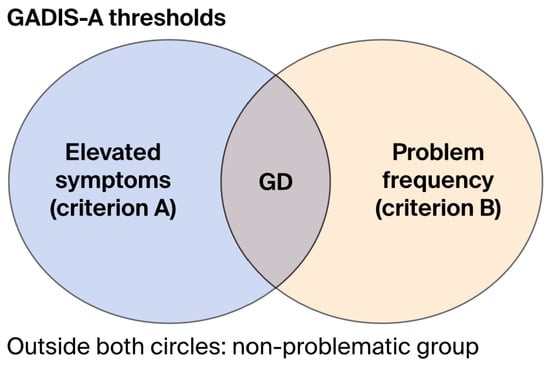
Three overlapping binary classifications were derived from the GADIS-A responses as follows:
- GD: participants meeting both criteria A and B (Q1–Q9 ≥ 13 and Q10 ≥ 2);
- Elevated symptoms: participants meeting criterion A, regardless of criterion B;
- Problem frequency: participants meeting criterion B, regardless of criterion A.
These classifications were not mutually exclusive; participants meeting the operational criteria for GD were necessarily included in both the elevated symptoms and problem frequency classifications (Figure 1). Because this broad, symptom-based classification differs from the “hazardous gaming” category described in prior work [28],which is based on a specific combination of factor scores and problem frequency, we use the term “elevated symptoms” descriptively to refer to individuals with high symptom scores defined independently of problem frequency. This term is not intended to represent an established diagnostic or subthreshold category.
Figure 1.
Schematic of the thresholds used to classify gaming-related risk based on GADIS-A. Criterion A was defined as elevated gaming-related symptoms based on the GADIS-A symptom items, whereas criterion B was defined as elevated problem frequency. Students meeting both criteria were classified as meeting the operational criteria for gaming disorder (GD). Students meeting criterion A, regardless of criterion B status, were included in the elevated symptoms group, and students meeting criterion B, regardless of criterion A status, were included in the problem frequency group. Students meeting neither criterion were classified as the non-problematic group.
2.3.3. Life Satisfaction as a University Student
The respondents were also asked to answer the following five questions about their satisfaction with university life on a five-point scale: strongly agree, agree, neither agree nor disagree, disagree, and strongly disagree. These are original questionnaire items developed by the authors. The question items were labeled LS-1 to LS-5 in the tables.
- I am satisfied with my university life.
- My studies are planned well (e.g., reports, web lectures, in-person lectures).
- I am actively involved in campus clubs and organizations.
- I have good relationships with professors, club coaches, etc.
- I engage in good extracurricular activities (e.g., part-time job, volunteer activities) and relationships outside of campus.
Student life satisfaction was assessed using five single items covering conceptually distinct domains (overall life satisfaction, study planning, club participation, faculty relationship, and extracurricular engagement). Since these items were intended to reflect related but relatively independent aspects of student life rather than a unidimensional construct, high internal consistency was not expected; Cronbach’s α was reported for transparency. In regression analyses, we examined both the individual items and a composite score (sum of the five items). Principal component analysis showed that all items loaded at ≥0.40 on the first principal component (eigenvalue = 1.887; explained variance ratio = 37.74%; Table S2). Therefore, the composite score was used as an exploratory summary measure, while primary interpretive emphasis was placed on the domain-specific findings.
2.4. Statistical Analysis
All statistical analyses were conducted using IBM SPSS Statistics for Windows (Version 31.0; IBM, Armonk, NY, USA). Based on the original GADIS-A scoring scheme, criterion A was defined as a total score of ≥ 13 on items Q1–Q9, and criterion B as a score of ≥2 on Q10, reflecting problem frequency. Using these criteria, three overlapping binary classifications were derived: GD (meeting both criteria A and B), elevated symptoms (meeting criterion A, regardless of criterion B), and problem frequency (meeting criterion B, regardless of criterion A). Chi-square tests were used to examine associations between categorical variables and GADIS-A-based group membership. We then conducted multivariable binary logistic regression analyses to examine the associations of gender, gaming time, and student life variables with three binary outcomes derived from the GADIS-A framework: GD, criterion A, and criterion B. In the models including the composite student life satisfaction score, gender, gaming time, and the composite score were entered simultaneously as explanatory variables. In the models examining individual student life domains, gender, gaming time, and the five individual student life domains were entered simultaneously. General daily Internet use and year of study were not included as covariates in these models. Separate models were estimated for each outcome. Multicollinearity among predictors was assessed using variance inflation factors (VIFs). Descriptive statistics for all questionnaire items, including means, standard deviations, skewness, kurtosis, and observed ranges, are presented in Table S4.
3. Results
3.1. Measurement Properties
Internal consistency of the GADIS-A symptom-related items was high, whereas internal consistency across the five student life satisfaction items was low. In the analytic sample restricted to current gamers (gaming time > 0 h; n = 244), internal consistency of the GADIS-A remained high (Cronbach’s α = 0.849 for Q1–Q9; α = 0.862 for Q1–Q10). In contrast, internal consistency across the five student life satisfaction items was low (Cronbach’s α = 0.531), as expected since these items represent distinct domains rather than a single construct. Inter-item correlations were generally small and the correlation between club participation and study planning was not statistically significant.
3.2. Prevalence of Gaming Behavior
This study involved 320 students from the Faculty of Education and Psychology of Nihon Fukushi University, which accounted for 28% of all students in the faculty. Table 1 shows a breakdown of the participants by year of study and gender. Chi-square tests for gender and year of study revealed no significant associations (χ2(3) = 0.873, p = 0.832, V = 0.052).
Table 1.
Characteristics of all participants (N = 320).
Regarding overall Internet use, 44.1% of the participants reported using the Internet for more than 5 h per day. This measure reflected broad Internet use, including activities such as video streaming, social media, online lectures, and online communication, and was not limited to gaming. While this trend reflects an adaptive response to pandemic-related restrictions, a relatively high percentage of students (10.9%) reported online gaming lasting for >5 h a day (Table 2).
Table 2.
Frequencies of items related to student life (N = 320).
For the Student Life Satisfaction Scale, responses of “strongly agree” and “agree” were grouped as “agree”, while “disagree” and “strongly disagree” were grouped as “disagree” (Table 2). Nearly 60% (58.1%) of the students indicated that they were satisfied with their college life. In addition, 57.8% of the students said that their studies were well planned, 35.3% that they actively participated in club activities on campus, 52.8% that they had good relationships with their professors and club advisers, and 68.4% felt that their extracurricular activities (e.g., part-time employment, volunteer work) and friendships were fulfilling.
Of 320 students, 35 (10.9%) met the GADIS-A scores for GD. Significantly more individuals met criterion A (106 of 320) than both criteria A and B (n = 35; z = 5.897, p < 0.001). We then examined the factors related to video gaming behavior that affected student well-being. The elevated symptoms group was defined as participants who met criterion A irrespective of criterion B status (n = 106), thereby also including participants who met the GD criteria in this group. Of these 106 participants, 10 reported zero gaming time during the past month. This apparent discrepancy may reflect the different reference periods of the measures: gaming time was assessed for the past month, whereas the GADIS-A assessed gaming-related symptoms over the past 12 months. Thus, some participants may have reported symptoms related to gaming earlier in the 12-month period despite reporting no gaming during the preceding month. Participants who did not meet criterion A comprised the comparison group (n = 214). A chi-square test conducted to examine the relationship between dependency (elevated symptoms group vs. low symptoms group) and gender revealed a significant association (χ2 = 17.079, p < 0.001, φ = 0.231). Residual analysis indicated that males were significantly more likely to be in the elevated symptoms group (p < 0.01). In contrast, females were significantly more likely to be in the low symptoms group (p < 0.01, Table 3). The male-to-female disparity in gaming dependence thus aligned with previous studies [16,30], suggesting the need for targeted interventions for male students. Although comparisons were made among year of study groups that experienced temporary school closures at different times due to the COVID-19 pandemic, no significant differences by year of study were observed. As an exploratory analysis in the full sample (N = 320), correlations between gaming time and student life variables were also examined. Longer gaming time was significantly associated with poorer study planning, lower club participation, and lower composite student life satisfaction score; these results are presented in Supplementary Table S5.
Table 3.
Frequency of GADIS-A diagnostic criterion A (Q1–Q9 ≥ 13). (N = 320).
3.3. Associated Factors of Gaming Disorder and Elevated Symptoms Group: A Logistic Regression Analysis
The following analysis was restricted to students who reported some gaming (i.e., gaming time > 0 h; n = 244). Prior to analysis, daily gaming time was converted to an interval scale ranging from 1 to 6 points. We used logistic regression to examine associated factors of three operational gaming-risk outcomes derived from the GADIS-A framework among current gamers: GD status, defined as meeting both of the GADIS-A criteria (35 cases); symptom-defined status, based on Q1–Q9 scores (≥13 vs. ≤12; 96 cases); and frequency-defined status, based on Q10 problem frequency (≥2 vs. ≤1; 42 cases). To evaluate overall student well-being, we first modeled Student Life Satisfaction Scale as a total score. To examine different aspects of gaming-related problems, separate binary logistic regression analyses were then performed for three binary classifications (Table 4). The analyses were multivariable, with gender, gaming time, and composite student life satisfaction score entered simultaneously as explanatory variables. We report ORs with 95% CIs. Because multiple outcomes were examined, we interpreted the results with reference to multiplicity and emphasized effect sizes and consistency of patterns across models.
Table 4.
Associated factors of game dependence (logistic regression analysis) (N = 244; gamers-only).
In models including student life satisfaction as a total score, longer gaming time was associated with a greater likelihood of meeting the GD diagnostic criteria (OR = 1.34, 95% CI: 1.08–1.66), elevated symptoms (OR = 1.36, 95% CI: 1.15–1.61), and problem frequency (OR = 1.24, 95% CI: 1.02–1.52). Higher composite student life satisfaction score was associated with a reduced likelihood of meeting the GD diagnostic criteria (OR = 0.85, 95% CI: 0.76–0.96) and elevated symptoms (OR = 0.86, 95% CI: 0.79–0.94) but was not significantly associated with problem frequency (OR = 0.91, 95% CI: 0.82–1.00). Because the five items had limited internal coherence, the composite result should be interpreted as a supplementary summary indicator. Gender was not associated with the operational criteria for GD or problem frequency but was associated with lower odds of elevated symptoms among female participants (OR = 0.52, 95% CI: 0.29–0.93), indicating a higher likelihood of elevated gaming-related symptoms among male participants. No other statistically significant gender associations were observed across the gaming-risk outcomes examined in the present analyses. These findings highlight the importance of considering gaming duration, gender, and life satisfaction when assessing the risk of gaming-related conditions, with particular attention to the need for interventions that address these factors. In the full sample (N = 320), when gaming participation (0 h vs. > 0 h) was used as the dependent variable, gender was significantly associated with current gaming participation, whereas the composite student life satisfaction score was not significantly associated with current gaming participation (Table S3). This supplementary analysis addressed factors associated with current gaming participation rather than gaming-related risk and was conducted as an exploratory analysis to provide preliminary information for future studies including both current gamers and students reporting no recent gaming.
Table 5 shows the results of multivariable binary logistic regression analyses in which gender, gaming time, and the five individual student life domains were entered simultaneously as explanatory variables.
Table 5.
Associated factors of game dependence (logistic regression analysis with detailed factors) (N = 244; gamers-only).
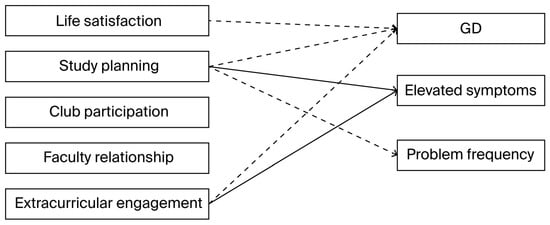
Higher extracurricular engagement was significantly associated with lower odds of elevated symptoms (OR = 0.68, p = 0.008), and greater study planning was also significantly associated with lower odds of elevated symptoms (OR = 0.69, p = 0.009). The corresponding associations with GD and problem frequency were not statistically significant, although the point estimates were generally below 1.0. Life satisfaction, club participation, and faculty relationships were not significantly associated with any of the three outcomes. Overall, these exploratory item-level analyses suggest that associations with gaming-related outcomes may differ across domains of student life and should be interpreted cautiously in view of the multiple comparisons performed. These domain-specific associations are summarized graphically in Figure 2. No substantial multicollinearity was observed among the predictors; VIF values for the five student life variables ranged from 1.125 to 1.260.
Figure 2.
Overview of associations between student life domains and GADIS-A-based gaming-related outcomes among current gamers. Solid lines indicate statistically significant associations (p < 0.05). Dashed lines indicate associations with p values between 0.05 and 0.10; these are shown descriptively and are not interpreted as statistically significant. No line indicates p ≥ 0.10. The p-values indicate the significance levels of the regression coefficients (B). Results are based on the multivariable logistic regression analyses shown in Table 5.
4. Discussion
4.1. Results
The present study presents evidence that gaming-related risk among university students is associated with both gaming time and several aspects of student life satisfaction. Lower satisfaction with study planning and extracurricular engagement, in particular, appeared to be more clearly associated with gaming-related risk than initially expected. These findings indicate that problematic gaming in university students should be understood not only in terms of gaming time, but also in relation to students’ academic, social, and personal well-being.
Previous research has shown that GD is present in a small but non-negligible proportion of university students. For example, a large-scale survey of college students reported that approximately one in 20 students met criteria for GD [31]. Reduced life satisfaction and limited engagement in meaningful offline activities may be relevant to problematic gaming, because gaming can function for some as an avoidance coping strategy [32]. However, at the same time, gaming and online activities can also provide enjoyment, social connection, and temporary stress relief. Therefore, gaming-related problems should be evaluated carefully, considering both the potential benefits and risks.
Importantly, 39.3% of students who played video games scored ≥13 on the GADIS-A symptom items, including students who did not meet the problem-frequency criterion. We therefore examined a broader symptom-based group, referred to here as the elevated symptoms group, in addition to students meeting the full operational criteria for GD. This additional classification was intended to identify students with elevated gaming-related symptoms, regardless of whether they met the problem-frequency criterion. One possible explanation for this result is that self-reported problem frequency may not fully capture the extent to which gaming interferes with daily life. In self-administered questionnaires, students may have limited awareness of any functional impairment or may underreport the frequency of gaming-related problems. Thus, meeting the criterion A cutoff may provide a useful screening-relevant indicator of elevated gaming-related symptoms, even in the absence of criterion B. This broader classification may be particularly relevant in university settings, where gaming-related difficulties may be evident before any significant functional impairment is recognized or reported.
Maladaptive cognition related to Internet gaming (MCIG) refers to distorted gaming-related beliefs, such as overvaluing gaming rewards, rigid gaming-related rules, reliance on gaming for self-esteem, and the use of gaming for social acceptance. A large study conducted in Hong Kong indicated that understanding the relationships among gaming engagement, gaming history, MCIG, and GD may help guide preventive interventions [33]. This perspective also supports the need to focus not only on gaming time, but also on the cognitive and behavioral patterns underlying gaming-related problems. Qualitative approaches, such as open-ended responses or face-to-face interviews, may therefore help clarify how students perceive their gaming behavior and related difficulties.
Recent validation and adaptation studies have generally supported the two-factor structure of the GADIS-A, consisting of Negative Consequences (Factor 1) and Cognitive-Behavioral Symptoms (Factor 2), and have reported favorable psychometric properties. The original development study [28] found that the items were best represented by two correlated factors, and subsequent language validations, including Persian and Dutch/Flemish versions, have demonstrated adequate model fit and evidence of reliability and validity [28,34,35,36]. Psychometric work on the parent-report version has also replicated this two-factor structure. However, the field has not yet agreed on a single universally accepted diagnostic algorithm. Several studies [28,34,35] have therefore adopted the original proposed classification scheme for probable GD, which combines subscale thresholds with a time or frequency criterion. When the original hazardous gaming criterion proposed by [28] was applied to our sample, only two of the 320 participants met that specific threshold. This category is distinct from the “elevated symptoms” classification used in the present analyses. The small number of participants who met the original hazardous gaming criterion may be partly explained by the moderate positive correlation between Factor 1 and Factor 2 scores in our sample (r = 0.512, p < 0.001, 95% CI [0.413, 0.599]), making the specific factor-score pattern required for the original hazardous gaming category relatively uncommon.
In the present study, the criterion A-based elevated symptoms group was used as an exploratory symptom-based classification rather than as a novel diagnostic or subthreshold category. This approach allowed us to examine whether students with elevated gaming-related symptoms might represent a screening-relevant group even when they did not meet the full operational criteria for GD. Classifying students according to criterion A provided a broader symptom-based group that included both students meeting the full operational criteria for GD and those who did not meet criterion B for problem frequency. This group should not be interpreted as equivalent to GD or as an established subthreshold diagnostic category. This distinction is particularly important because functional impairment is a central component of ICD-11 gaming disorder, and previous research has demonstrated impairment across multiple domains of functioning among individuals with gaming disorder [11]. Rather, it was examined exploratorily to assess its potential relevance for screening and early support in university settings.
4.2. Limitations of This Study
This study has several limitations. First, it was conducted within a single faculty at one university, which limits the generalizability of the findings to other student populations. For example, students in the Faculty of Education and Psychology may differ from those in other disciplines in ways that are relevant to both gaming behavior and student life satisfaction, including attitudes toward mental health, help-seeking, academic demands, and extracurricular engagement. Our findings therefore require confirmation in more diverse samples across multiple universities and fields of study. In addition, because participation was voluntary, self-selection bias cannot be excluded. Second, the cross-sectional design does not allow causal or directional inferences. The observed associations reflect bidirectional or reciprocal relationships, and longitudinal studies are thus needed to clarify temporal ordering. Third, the Japanese version of the GADIS-A has not been psychometrically validated specifically in Japanese university students. Although a linguistically validated Japanese version is available and the GADIS-A has been used in Japanese research including young adults [29], this does not establish its validity or optimal cutoff values in an emerging-adult university population. Moreover, Items 1 and 2 include references to parental regulation, which may be less applicable to some university students, particularly those living independently. Although these items did not show lower endorsement than the other symptom items in our sample (Tables S1 and S4), age-related differences in item interpretation cannot be excluded. Future studies should therefore evaluate its psychometric performance and compare it with other validated gaming-disorder screening instruments in Japanese university students. Fourth, the student life measure consisted of several single-item domains, which limited reliability assessment at the individual-domain level. Although these items were constructed for this pilot study such that they covered a range of student activities and were thus intended to capture distinct aspects of student life rather than a single latent construct, this measurement approach remains a methodological limitation. The modest internal consistency of the composite score also indicates that it should be interpreted cautiously. In addition, no formal correction for multiple comparisons was applied to the exploratory item-level analyses; therefore, these findings should be considered preliminary and interpreted with caution pending replication. Accordingly, the domain-specific findings may be more informative than the composite score alone. Future studies should adopt more psychometrically robust measures. Fifth, because all variables were assessed by self-report, the results may have been affected by recall bias, social desirability, and limited self-recognition of gaming-related difficulties. In addition, a small number of participants reported zero gaming time during the past month while meeting the criterion A threshold. This may reflect gaming experiences earlier within the 12-month GADIS-A assessment period, but inconsistent or inaccurate self-reporting of gaming time cannot be excluded. Finally, although GADIS-A-based categorical classifications may be useful for exploratory screening-related interpretation, dichotomization of symptom scores may reduce information and statistical power. Future studies should examine continuous GADIS-A symptom scores and further evaluate the psychometric properties and optimal cutoff values of the Japanese GADIS-A in university student samples.
4.3. Implications for Future Research
The relationship between university life satisfaction and problematic gaming is likely to be complex and bidirectional. Because the present study was cross-sectional in design, the observed associations do not establish directionality; however, they may help identify domains of student well-being associated with elevated gaming-related risk that could inform campus screening and support. Previous research suggests that the direction and magnitude of this relationship may differ according to individual circumstances, psychological characteristics, and social contexts. One possibility is that reduced university life satisfaction contributes to problematic gaming as a result of escapism and diminished offline social engagement [33,37,38]. Conversely, excessive gaming may occupy substantial time and mental energy, thereby undermining academic responsibilities, social relationships, and extracurricular engagement, which may thus, in turn, reduce satisfaction with university life. Although direct evidence remains limited, these potential factors could be mutually reinforcing over time. Future research should therefore consider internal factors, such as coping styles and psychological needs, as well as external factors, such as academic demands and social environments. In the present study, extracurricular engagement and study planning revealed the clearest associations within the elevated symptoms group among the five university life domains examined. For students in the elevated symptoms group, it may thus be particularly important to assess the impact of gaming on sleep, diet, class attendance, and longer-term outcomes such as graduation and employment. In addition, future studies should also distinguish between different types and characteristics of games, including the degree of social interaction, competitive or cooperative elements, cognitive demands, and violent content, to examine whether these features are differentially associated with gaming-related risk and student well-being. Finally, future studies should investigate the extent to which gaming-related risk is associated with neurodevelopmental characteristics and psychiatric symptoms, including neurodevelopmental disorders and depressive symptoms.
5. Conclusions
In conclusion, this pilot cross-sectional study describes a set of GADIS-A-based gaming-related risk classifications among Japanese university students and examines their associations with gaming time and selected aspects of student life satisfaction. Longer gaming time was found to be consistently associated with a higher likelihood of gaming-related risk classifications, whereas higher study planning and extracurricular engagement were associated with lower odds of elevated symptoms. These findings suggest that both gaming behavior and the broader aspects of student life may be relevant when identifying and supporting students with elevated gaming-related symptoms. However, the findings do not establish causal relationships or validate the Japanese GADIS-A as a diagnostic instrument. Larger, longitudinal, and psychometrically focused studies are therefore now needed to clarify the clinical and screening implications of these findings.
Supplementary Materials
The following supporting information can be downloaded at: https://www.mdpi.com/article/10.3390/psychiatryint7050201/s1, File S1. Survey Questionnaire; Table S1. GADIS-A criterion A items by operational group (mean [SD]; % endorsement ≥ 3); Table S2. Principal component analysis results for the five student life satisfaction items; Table S3. Gender and student life satisfaction among students with vs. without online gaming; Table S4. Descriptive statistics for all questionnaire items in sequential order; Table S5. Correlations between daily gaming time and student life satisfaction items in the full sample (N = 320).
Author Contributions
Conceptualization, S.O., C.Y. and S.S. (Satoshi Sumi); methodology, S.O., C.Y. and R.N.; software, S.O. and C.Y.; validation, S.O., C.Y., S.S. (Satoshi Suyama) and S.S. (Satoshi Sumi); formal analysis, S.O., C.Y., S.S. (Satoshi Suyama) and S.S. (Satoshi Sumi); investigation, S.O. and R.N.; resources, S.O., C.Y. and S.S. (Satoshi Sumi); data curation, S.O., C.Y. and S.S. (Satoshi Suyama); writing—original draft preparation, S.O. and C.Y.; writing—review and editing, S.O., C.Y., S.S. (Satoshi Suyama), R.N. and S.S. (Satoshi Sumi); visualization, S.O. and C.Y.; supervision, S.O., C.Y. and S.S. (Satoshi Sumi); project administration, S.O. All authors have read and agreed to the published version of the manuscript.
Funding
This research received no external funding.
Institutional Review Board Statement
The study was conducted in accordance with the Declaration of Helsinki, and approved by the Ethical Review Committee of Nihon Fukushi University (protocol code #21-021002 and date of approval 1 December 2021).
Informed Consent Statement
Informed consent was obtained from all subjects involved in the study.
Data Availability Statement
The data presented in this study are openly available in [Mendeley Data] at [https://doi.org/10.17632/wmz2hnrkt4.1].
Acknowledgments
The authors are deeply grateful to Christopher M. Sinton for his generous support, valuable comments, and helpful suggestions during the revision of this manuscript.
Conflicts of Interest
The authors declare no conflicts of interest.
Abbreviations
The following abbreviations are used in this manuscript:
| CI | Confidence Interval |
| COVID-19 | Coronavirus 2019 |
| DSM-5 | Diagnostic and Statistical Manual of Mental Disorders, Fifth Edition |
| GADIS-A | Gaming Disorder Scale for Adolescents |
| GD | Gaming Disorder |
| ICD-11 | International Classification of Diseases, 11th Revision |
| IGD | Internet Gaming Disorder |
| MCIG | Maladaptive cognition related to Internet gaming |
| OR | Odds Ratio |
| PCA | Principal Component Analysis |
| ROC | Receiver Operating Characteristic |
| SD | Standard Deviation |
| SE | Standard Error |
| SPSS | Statistical Package for the Social Sciences (IBM SPSS Statistics) |
| R2 | Coefficient of Determination |
References
- Aarseth, E.; Bean, A.M.; Boonen, H.; Colder Carras, M.; Coulson, M.; Das, D.; Deleuze, J.; Dunkels, E.; Edman, J.; Ferguson, C.J.; et al. Scholars’ open debate paper on the World Health Organization ICD-11 Gaming Disorder proposal. J. Behav. Addctn. 2017, 6, 267–270. [Google Scholar] [CrossRef] [Scilit] [PubMed]
- Liu, F.; Deng, H.; Zhang, Q.; Fang, Q.; Liu, B.; Yang, D.; Tian, X.; Wang, X. Symptoms of internet gaming disorder among male college students in Nanchong, China. BMC Psychiatry 2022, 22, 142. [Google Scholar] [CrossRef] [Scilit] [PubMed]
- Idris, M.F.; Saini, S.M.; Sharip, S.; Idris, N.F.; Ab Aziz, N.F. Association between Internet gaming disorder and anxiety and depression among university students during the COVID-19 pandemic. Healthcare 2023, 11, 1103. [Google Scholar] [CrossRef] [Scilit] [PubMed]
- Oka, T.; Hamamura, T.; Miyake, Y.; Kobayashi, N.; Honjo, M.; Kawato, M.; Kubo, T.; Chiba, T. Prevalence and risk factors of internet gaming disorder and problematic internet use before and during the COVID-19 pandemic: A large online survey of Japanese adults. J. Psychiatr. Res. 2021, 142, 218–225. [Google Scholar] [CrossRef] [Scilit] [PubMed]
- Kaya, F.; Bayzan, Ş.; Bhais, A.Z.B.; Gün, A. Lonely, Anxious, and Unhappy: The Psychosocial Toll of Digital Game Addiction in University Students. Int. J. Ment. Health Addctn. 2025, 24, 3510–3535. [Google Scholar] [CrossRef] [Scilit]
- Stanković, M.; Nešić, M. Association of internet addiction with depression, anxiety, stress, and the quality of sleep: Mediation analysis approach in Serbian medical students. Curr. Res. Behav. Sci. 2022, 3, 100071. [Google Scholar] [CrossRef] [Scilit]
- Byeon, H. Impact of video game addiction on social interaction: An observational review examining loneliness, social anxiety, and social activity. World J. Psychiatry 2025, 15, 110653. [Google Scholar] [CrossRef] [Scilit] [PubMed]
- Yu, Y.; Peng, L.; Mo, P.K.H.; Yang, X.; Cai, Y.; Ma, L.; She, R.; Lau, J.T.F. Association between relationship adaptation and Internet gaming disorder among first-year secondary school students in China: Mediation effects via social support and loneliness. Addctv. Behav. 2022, 125, 107166. [Google Scholar] [CrossRef] [Scilit] [PubMed]
- Yamada, M.; Sekine, M.; Tatsue, T. Pathological gaming and its association with lifestyle, irritability, and school and family environments among Japanese elementary school children. J. Epidemiol. 2023, 33, 335–341. [Google Scholar] [CrossRef] [Scilit] [PubMed]
- Aydin, O.; Guclu, M.; Unal-Aydin, P.; Spada, M.M. Metacognitions and emotion recognition in Internet Gaming Disorder among adolescents. Addict. Behav. Rep. 2020, 12, 100296. [Google Scholar] [CrossRef] [Scilit] [PubMed]
- Yen, J.Y.; Higuchi, S.; Lin, P.Y.; Lin, P.C.; Chou, W.P.; Ko, C.H. Functional impairment, insight, and comparison between criteria for gaming disorder in the International Classification of Diseases, 11 Edition and internet gaming disorder in Diagnostic and Statistical Manual of Mental Disorders, Fifth Edition. J. Behav. Addctn. 2022, 11, 1012–1023. [Google Scholar] [CrossRef] [Scilit] [PubMed]
- Borges, G.; Orozco, R.; Benjet, C.; Mart Inez, K.; Contreras, E.V.; P Erez, A.; Cedr Es, A.; Uribe, P.; Couder, M.; Gutierrez-Garcia, R.U.A.; et al. (Internet) Gaming Disorder in DSM-5 and ICD-11: A Case of the Glass Half Empty or Half Full: (Internet) Le trouble du jeu dans le DSM-5 et la CIM-11: Un cas de verre a moitie vide et a moitie plein. Can. J. Psychiatry 2021, 66, 477–484. [Google Scholar] [CrossRef] [Scilit] [PubMed]
- Darvesh, N.; Radhakrishnan, A.; Lachance, C.C.; Nincic, V.; Sharpe, J.P.; Ghassemi, M.; Straus, S.E.; Tricco, A.C. Exploring the prevalence of gaming disorder and Internet gaming disorder: A rapid scoping review. Syst. Rev. 2020, 9, 68. [Google Scholar] [CrossRef] [Scilit] [PubMed]
- King, D.L.; Chamberlain, S.R.; Carragher, N.; Billieux, J.; Stein, D.; Mueller, K.; Potenza, M.N.; Rumpf, H.J.; Saunders, J.; Starcevic, V.; et al. Screening and assessment tools for gaming disorder: A comprehensive systematic review. Clin. Psychol. Rev. 2020, 77, 101831. [Google Scholar] [CrossRef] [Scilit] [PubMed]
- Gao, Y.X.; Wang, J.Y.; Dong, G.H. The prevalence and possible risk factors of internet gaming disorder among adolescents and young adults: Systematic reviews and meta-analyses. J. Psychiatr. Res. 2022, 154, 35–43. [Google Scholar] [CrossRef] [Scilit] [PubMed]
- Stevens, M.W.; Dorstyn, D.; Delfabbro, P.H.; King, D.L. Global prevalence of gaming disorder: A systematic review and meta-analysis. Aust. N. Z. J. Psychiatry 2021, 55, 553–568. [Google Scholar] [CrossRef] [Scilit] [PubMed]
- Sussman, C.J.; Harper, J.M.; Stahl, J.L.; Weigle, P. Internet and Video Game Addictions: Diagnosis, Epidemiology, and Neurobiology. Child Adolesc. Psychiatr. Clin. N. Am. 2018, 27, 307–326. [Google Scholar] [CrossRef] [Scilit] [PubMed]
- Tang, C.S.; Koh, Y.W.; Gan, Y. Addiction to Internet Use, Online Gaming, and Online Social Networking Among Young Adults in China, Singapore, and the United States. Asia Pac. J. Public Health 2017, 29, 673–682. [Google Scholar] [CrossRef] [Scilit] [PubMed]
- Raouf, S.Y.A.; Gabr, H.M.; Al-Wutayd, O.; Al-Batanony, M.A. Video game disorder and mental well-being among university students: A cross-sectional study. Pan Afr. Med. J. 2022, 41, 89. [Google Scholar] [CrossRef] [Scilit] [PubMed]
- Koga, Y. An investigation of the actual situation and related factors of game dependence among college students: Focusing on dif-ferences from SNS dependence and gambling dependence. Bull. Grad. Sch. Psychol. Fac. Psychol. Chukyo Univ. 2022, 1–10. (In Japanese). Available online: https://chukyo-u.repo.nii.ac.jp/records/18679 (accessed on 26 August 2026).
- Muller, K.W.; Dreier, M.; Beutel, M.E.; Ruckes, C.; Batra, A.; Mann, K.; Musalek, M.; Wolfling, K. The impact of life satisfaction in the treatment of gaming disorder and other internet use disorders: Results from a randomized controlled trial. J. Behav. Addctn. 2023, 12, 159–167. [Google Scholar] [CrossRef] [Scilit] [PubMed]
- Higuchi, S.; Osaki, Y.; Kinjo, A.; Mihara, S.; Maezono, M.; Kitayuguchi, T.; Matsuzaki, T.; Nakayama, H.; Rumpf, H.J.; Saunders, J.B. Development and validation of a nine-item short screening test for ICD-11 gaming disorder (GAMES test) and estimation of the prevalence in the general young population. J. Behav. Addctn. 2021, 10, 263–280. [Google Scholar] [CrossRef] [Scilit] [PubMed]
- Mihara, S.; Osaki, Y.; Kinjo, A.; Matsuzaki, T.; Nakayama, H.; Kitayuguchi, T.; Harada, T.; Higuchi, S. Validation of the Ten-Item Internet Gaming Disorder Test (IGDT-10) based on the clinical diagnosis of IGD in Japan. J. Behav. Addctn. 2022, 11, 1024–1034. [Google Scholar] [CrossRef] [Scilit] [PubMed]
- Wu, T.Y.; Huang, S.W.; Chen, J.S.; Kamolthip, R.; Kukreti, S.; Strong, C.; Pontes, H.M.; Lin, I.C.; Lin, C.Y.; Potenza, M.N.; et al. Translation and Validation of the Gaming Disorder Test and Gaming Disorder Scale for Adolescents into Chinese for Taiwanese Young Adults. Compr. Psychiatry 2023, 124, 152396. [Google Scholar] [CrossRef] [Scilit] [PubMed]
- Ruckwongpatr, K.; Lee, Y.H.; Tran, N.D.; Pham, L.A.; Griffiths, M.D.; Pakpour, A.H.; Lin, C.K.; Huang, Y.T.; Chen, J.S.; Lei, S.M.; et al. The gaming disorder test and gaming disorder scale for adolescents: Translation and validation among Vietnamese young adults. Psicol. Reflex. Crit. 2024, 37, 43. [Google Scholar] [CrossRef] [Scilit] [PubMed]
- Sumi, S. Challenges in the diagnosis of gaming disorder. Jpn. J. Psychiatry 2018, 26, 367–370. (In Japanese). Available online: https://cir.nii.ac.jp/crid/1521417755629650816 (accessed on 26 August 2026).
- Takano, A.; Tokushige, M.; Ono, K.; Asaoka, H.; Miyamoto, Y.; Tateno, M. Development of the gaming disorder screening scales by self or parental ratings: Linguistic validation of the Japanese versions. Nihon Arukoru Yakubutsu Igakkai Zasshi 2022, 57, 90–108. [Google Scholar]
- Paschke, K.; Austermann, M.I.; Thomasius, R. Assessing ICD-11 Gaming Disorder in Adolescent Gamers: Development and Validation of the Gaming Disorder Scale for Adolescents (GADIS-A). J. Clin. Med. 2020, 9, 993. [Google Scholar] [CrossRef] [Scilit] [PubMed]
- Takano, A. Survey of the Actual Status of Gaming Disorder: Survey of Treatment Facilities in Japan. In Research on the Establishment of Diagnostic and Treatment Methods for Gaming Disorder; FY2022 Health, Labour and Welfare Sciences Research Grant, Comprehensive Research Project on Disability Policy; Research Report No. 202218008A; Ministry of Health, Labor and Welfare: Tokyo, Japan, 2023. [Google Scholar]
- Kim, H.S.; Son, G.; Roh, E.B.; Ahn, W.Y.; Kim, J.; Shin, S.H.; Chey, J.; Choi, K.H. Prevalence of gaming disorders: A meta-analysis. Addctv. Behav. 2022, 126, 107183. [Google Scholar] [CrossRef] [Scilit] [PubMed]
- Ohayon, M.M.; Roberts, L. Internet gaming disorder and comorbidities among campus-dwelling U.S. university students. Psychiatry Res. 2021, 302, 114043. [Google Scholar] [CrossRef] [Scilit] [PubMed]
- Kardefelt-Winther, D. The moderating role of psychosocial well-being on the relationship between escapism and excessive online gaming. Comput. Hum. Behav. 2014, 38, 68–74. [Google Scholar] [CrossRef] [Scilit]
- Wang, X.; Liu, Y.; Chu, H.K.; Wong, S.Y.; Yang, X. Relationships of internet gaming engagement, history, and maladaptive cognitions and adolescent internet gaming disorder: A cross-sectional study. PLoS ONE 2023, 18, e0290955. [Google Scholar] [CrossRef] [Scilit] [PubMed]
- Mazaherizadeh, A.; Taherifar, Z.; Farahani, H. Psychometric properties of the Farsi version of the gaming disorder scale for adolescents (GADIS-A). BMC Psychol. 2022, 10, 195. [Google Scholar] [CrossRef] [Scilit] [PubMed]
- Tham, S.M.; Ellithorpe, M.E.; Meshi, D. Real-world social support but not in-game social support is related to reduced depression and anxiety associated with problematic gaming. Addict. Behav. 2020, 106, 106377. [Google Scholar] [CrossRef] [Scilit] [PubMed]
- Melodia, F.; Canale, N.; Griffiths, M.D. The role of avoidance coping and escape motives in problematic online gaming: A systematic literature review. Int. J. Ment. Health Addctn. 2022, 20, 996–1022. [Google Scholar] [CrossRef] [Scilit]
- Grosemans, E.; De Cock, R.; Bradt, L.; Boonen, H.; Soenens, B. Psychometric Validation of the Gaming Disorder Scale for Adolescents (GADIS-A) in Dutch Among Flemish Adolescents. Psychol. Belg. 2025, 65, 189–201. [Google Scholar] [CrossRef] [Scilit] [PubMed]
- Paschke, K.; Austermann, M.I.; Thomasius, R. International Classification of Diseases-11-Based External Assessment of Social Media Use Disorder in Adolescents: Development and Validation of the Social Media Use Disorder Scale for Parents. Cyberpsychol. Behav. Soc. Netw. 2022, 25, 518–526. [Google Scholar] [CrossRef] [Scilit] [PubMed]

Disclaimer/Publisher’s Note: The statements, opinions and data contained in all publications are solely those of the individual author(s) and contributor(s) and not of MDPI and/or the editor(s). MDPI and/or the editor(s) disclaim responsibility for any injury to people or property resulting from any ideas, methods, instructions or products referred to in the content. |
© 2026 by the authors. Licensee MDPI, Basel, Switzerland. This article is an open access article distributed under the terms and conditions of the Creative Commons Attribution (CC BY) license.