


Abstract
The news media in Gulf countries are among the most important institutions shaping the public’s understanding of climate action. This study aims to explore the longitudinal developments, thematic framing, and sentiment tones of Omani English-language newspapers’ sustainability discourse during the period 2015–2025. The study applied a multi-stage computational method to analyze a deduplicated corpus of 709 news articles from two English-language dailies of Oman: Times of Oman and Oman Daily Observer for a time period from 2015 to 2025. Latent Dirichlet Allocation (LDA) topic modeling was used to group topics into five types of macro frames. Results show that the focus of the Omani media is very localized, and the dominant frames are “Corporate ESG, Business & Green Investment” and “Clean Energy Policy, Research & Institutional Governance”. Furthermore, a sentiment analysis of headlines using VADER showed clearly defined sentiment polarity; domestic economic transition headlines were characterized by high positive polarity, while global climate crisis headlines had a higher negative polarity. The study concludes that the press in Oman is in a strategic process of “nationalizing” the climate change issue, moving from the conventional disaster discourse to making sustainability a local opportunity for economic diversification, technological modernization, and national resilience.
1. Introduction
In the modern world, the journey towards sustainability and climate action has emerged as one of the most important socio-economic imperatives of the 21st century. Over the years, the news media have been a cornerstone in the public perception of complex issues regarding the environment, promoting some interpretations over others (Scheufele, 1999). In the context of global climate change communication, these media narratives have been used in the past to instill scientific uncertainty, environmental risk, natural disasters, and economic costs (Badullovich et al., 2020; Guenther et al., 2024). Science coverage often reinforced scientific discourse and disagreement (Schmid-Petri & Arlt, 2016; Stecula & Merkley, 2019) or used a disaster framing, which highlighted the vulnerability and ecological disasters to come (Guenther et al., 2021). In the wake of the growing crisis of climate change, however, there has been a gradual change toward more solution-oriented approaches in the media, with a focus on innovative technologies, sustainable development, and the economic advantages of collective efforts (Guenther et al., 2021; Stecula & Merkley, 2019). Important to note here is that this process is strongly shaped by the country context: In many countries, media systems “nationalize” climate change and turn globally relevant environmental issues into country-specific political agendas, governance frameworks, and development priorities (Lück et al., 2018; Vu et al., 2019).
This localization-strategic reframing process is especially noticeable in the Gulf Cooperation Council (GCC) and the wider Arab region. Climate change was, historically, a topic that was marginalized in the Arab media discourse, and it was perceived as one of the Western advanced powers’ foreign policy agendas that had little to do with the Arab world (Eskjær, 2017). Environmental policies were also occasionally seen as a threat to the rentier-state development model and economic stability in the region due to the structural dependence of this model on oil and gas revenues (Krane, 2020). But recent research suggests that the local media landscape has undergone something of a revolution in recent years. In recent years, the Arab and Gulf media have portrayed sustainability increasingly as a strategic opportunity for economic diversification, technological modernization, and geopolitical leadership, rather than as an external imposition or environmental cause (Hofheinz, 2025). The importance of sustainable development goals (SDGs) is also reflected in regional media attention in the Arab region, such as the transition to post-oil economies, entrepreneurship, and economic prosperity (Alsuhaibani et al., 2025; Hager et al., 2024). Similarly, national development visions, including Saudi Vision 2030 and the UAE’s net-zero commitments, highlight green infrastructure, renewable energy, and hydrogen technologies as key pathways to ensuring the UAE’s competitiveness in a decarbonizing world (Zumbraegel, 2025; Zumbraegel & Sons, 2024). Moreover, sustainability is a strong symbolic tool, which allows the Gulf states to project images of modernity and technological sophistication on the international level (Koch, 2022, 2024, 2025).
The Sultanate of Oman is an interesting case of this rapid discursive evolution. Over the last decade, Oman has been on a journey of sustainable development that has taken place in three stages. In the first phase, the vulnerability of hydrocarbon reliance was brought to the fore by economic shocks during the post-Paris Agreement period (2015–2018) that colored discussions of environmental issues as primarily fiscal rather than climate mitigation (Due-Gundersen & Owtram, 2022). As environmental awareness increased, policy implementation was still limited by the dependence on fossil fuel revenues, with a policy of balancing economic growth with basic protection of the environment.
The second phase (2019–2021) was a turning point, when sustainability was institutionalized with Oman Vision 2040. This all-encompassing approach shifted the focus of sustainability from a purely environmental issue to a multi-dimensional national priority that included dimensions of economic diversification, institutional modernization and human capital development (Al Balushi & Matriano, 2024; Nasirova, 2025). During the COVID-19 pandemic, the economic vulnerabilities revealed by the crisis have enabled Vision 2040 to successfully embed the principles of sustainability in public sector governance, healthcare and corporate activity, and ultimately put renewable energy and knowledge-based industries at the heart of Oman’s future (Al Balushi & Matriano, 2024; Nasirova, 2025).
Oman is now moving towards explicit decarbonization, with their formal declaration of 2022 as a milestone for their goal of reaching net-zero emissions by 2050 (Alrawahi et al., 2023). This commitment placed sustainability as a concrete policy target and set green hydrogen as the key driver for Oman’s decarbonization policy, becoming the nation’s biggest exporter of clean energy in the world (Ashraf et al., 2024). Therefore, the researcher finds it an interesting case to study the role of media framing in presenting the issues of sustainability to the general public.
Increasingly, in recent studies on media framing, communication scholars are turning to computational approaches that can work with large-scale, longitudinal digital media data sources (Jacobi et al., 2016; Maier et al., 2018; Puschmann & Scheffler, 2016). Therefore, to examine how this complicated, 10-year national shift is discursively constructed for the public in Omani newspapers, the computational approach was adapted for this study (Jacobi et al., 2016). In modern communication research, machine learning methods are becoming indispensable in extracting hidden patterns from large amounts of text, as a scalable solution to manual coding, which is still a very time-consuming task (Guo et al., 2016; Maier et al., 2018).
Therefore, this study finds that computational text analysis is a suitable method for analyzing large amounts of environmental reporting, as it can uncover hidden thematic structures and long-term discursive shifts (Puschmann & Scheffler, 2016). Specifically, Latent Dirichlet Allocation (LDA), an unsupervised machine learning technique that can discover topics from word co-occurrence without any predefined coding categories, has been a very successful technique for discovering thematic structures inductively (Blei et al., 2003; Jelodar et al., 2018; Maier et al., 2018). In previous studies, LDA has been effectively applied to frame analysis on the scale of the entire communication system, to map the main interpretive frameworks in the response of the media system to crises and disasters (Nawaz et al., 2025; Wang & Yin, 2022), and to trace the development of the public discourse over decades (Ambrosino et al., 2018; Jiang et al., 2025). Even though qualitative interpretation is essential for uncovering the intricate meaning, computational topic modeling offers a solid and dependable base to map the general framing patterns in large sets of texts (Kermani et al., 2023).
Keeping in view the context of the GCC and Oman, along with a methodological shift towards computational approaches, this study aims to fill the gap in the field of environmental communication literature about the GCC region by examining the discursive constructions of sustainability and climate change in Omani English-language print media. Further, this study is designed to explain the relationship between the Omani press and the national socio-economic agenda, and to provide insights into the national context of the global climate crisis as it is defined by the Omani press. By employing a computational text-mining approach on a decade of coverage (2015–2025), this study seeks to answer the following research questions:
RQ1: What are the dominant latent topics and macro frames used by Omani English-language newspapers to report on sustainability and climate change?
RQ2: How has the volume and salience of these sustainability macro frames evolved longitudinally between 2015 and 2025?
RQ3: To what extent does the Omani media agenda prioritize domestic sustainability initiatives over global climate crisis narratives?
RQ4: How does the sentiment polarity of news headlines vary across the identified macro frames, particularly between domestic and global scopes?
2. Literature Review
2.1. Media Framing of Climate Change and Sustainability
According to the theory of media framing, the news media influence the public discourse on issues by emphasizing some interpretations and de-emphasizing others (Entman, 1993; Scheufele, 1999). In climate change communication, framing has special significance because climate issues are scientific, have long-term consequences, and are often politicized (Badullovich et al., 2020; de Vreese, 2005; Schmid-Petri & Arlt, 2016). Climate change has been presented in media systems all over the world mainly as a story of scientific uncertainty, environmental risk, natural disaster, economic loss, and political blame (Badullovich et al., 2020; Guenther et al., 2024). Often, early climate coverage highlighted scientific uncertainty and debate, particularly in Western media, where journalistic principles of balance tended to privilege dissenting perspectives even if they were not shared by the majority of the scientific community (Stecula & Merkley, 2019; Schmid-Petri & Arlt, 2016). Disaster framing, on the other hand, discussed climate change in terms of extreme weather events, environmental degradation, and future catastrophes, and frequently highlighted vulnerability and risk (Guenther et al., 2021).
However, in the past few years, climate reporting has shifted from a crisis-focused mindset to a more solution-focused, opportunity-oriented approach (Stecula & Merkley, 2019; Khawaja et al., 2025). Research has found an increase in the use of frames related to sustainable development, technological innovations, economic returns, and collective efforts (Guenther et al., 2021; Stecula & Merkley, 2019). This media framing can promote climate consciousness and eco-friendly behaviors (Sheikh et al., 2025). However, the discursive aspects of climate remain highly context-dependent and country-specific (Vu et al., 2019; Badullovich et al., 2020). Climate change stories are largely converging at the global level, but they tend to be “nationalized” as environmental issues are connected to national agendas, governance systems, and domestic priorities (Lück et al., 2018; Vu et al., 2019). As a result, climate change is not only represented as an environmental issue but also as a narrative relevant to a particular area. This means that climate change is not just seen as an environmental issue but also as a story that is relatable to a certain area.
This is especially evident in the Gulf Cooperation Council (GCC) countries and throughout the Arab world (Hofheinz, 2025; Freeman, 2016). Climate change was also underrepresented in Arabic media and was often discussed as a broader issue on the international agenda rather than as a local reality (Eskjær, 2017). The information on climate reporting was in many cases provided by international news agencies, and news on climate governance was often perceived as an agenda driven from the North with little relevance for domestic economic agendas, especially in hydrocarbon-dependent countries, i.e., the GCC or Oman (Eskjær, 2017). Climate action sometimes appeared to threaten the development models and rentier-state structures, which are at the core of the economies of the Gulf countries (Krane, 2020).
2.2. Sustainability and Media Framing in the Arab Region
Recent scholarship on sustainability shows an important shift in narratives about Arabs and the Gulf. In an analysis of Arabic media coverage of sustainability, opportunities for renewable energy were prominently reported, notably the concept of green hydrogen, whilst fossil fuel industries continued to be a strategic part of the future were also reported strongly (Hofheinz, 2025). This change is supported by the wider regional sustainability coverage in the media. In general, the SDGs are being well covered by Arab media, with the Gulf nations focusing on economic development, environmental innovation, and development-oriented sustainability agendas (Alsuhaibani et al., 2025). Likewise, the examination of sustainability stories in the media of Middle Eastern and North African countries reveals that sustainability is often linked to economic development, entrepreneurship, and the implementation of a transition toward a post-oil economy, and investments in renewable energy resources (Hager et al., 2024). Often, environmental issues are expressed in economic terms, not as an ecological crisis.
This reframing has been further strengthened with the increasing visibility of national development visions. The call for sustainability communication has become more aligned with Saudi Vision 2030 and the UAE’s net zero goals, viewing climate action as a driver for economic transformation and knowledge-based development. Renewable energy, hydrogen technologies, smart cities, and green infrastructure are all pillars highlighted in regular Gulf media narratives as means of maintaining regional relevance in a decarbonizing global economy (Zumbraegel, 2025; Zumbraegel & Sons, 2024). In this discourse, sustainability does not mean growth-limiting but rather enabling long-term competitiveness and sustainability. Another aspect of media and political communication that has become a subject of interest to scholars is the use of symbolism as a means to promote sustainability. Koch (2022, 2024, 2025) suggests that sustainability has morphed into a very effective tool to tell a narrative about modernity, technological sophistication, and the post-oil transformation in the Gulf states.
These literature studies show that there is definite development of climate and sustainability frames in media coverage. The media in general uses science-based uncertainty and disaster-based narratives, whereas Gulf and Arab media have more recently introduced a variety of development-driven frames, where sustainability aspects are encompassed in a national and/or economic development agenda. The view of climate change as a policy imposed on the region has shifted to the idea of sustainability as a strategic path to economic diversification, technological development, and improved international competitiveness. This re-framing is in part due to the political economy of the Gulf region as well as the increasing inclusion of sustainability in long-term state development strategies, i.e., Oman Vision 2040.
2.3. The Nationalization of Sustainability Narratives in Oman (2015–2025)
Oman’s sustainability story has gone through three stages, shifting from a more fundamental approach to managing its resources to a more holistic and far-reaching decarbonization plan.
In the years 2015 to 2018 (Paris Agreement & Economic Shocks), the oil price volatility highlighted the fragility of the hydrocarbon economy and shifted the focus of the environmental debate to fiscal resilience and economic diversification (Due-Gundersen & Owtram, 2022). As environmental degradation kept mounting, the dependence on fossil fuels limited climate action to the level of baseline environmental security, and policymaking focused on balancing economic development with environmental security.
In the second major phase, the launch of Oman Vision 2040 raised the profile of sustainability as a key national development priority, which includes economic diversification and governance reform (Al Balushi & Matriano, 2024; Nasirova, 2025). These principles marked the fulfilment of long-standing diversification aspirations (Due-Gundersen & Owtram, 2022), and were embedded in the three strands of corporate governance, healthcare, and public-sector modernization (Al Ghafari et al., 2025; Al Lawati, 2022).
In another major shift, Oman’s 2022 commitment to net zero by 2050 highlighted the country’s clear decarbonization objectives (Alrawahi et al., 2023), with a particular focus on Green Hydrogen. The crux of this agenda was green hydrogen, which would be produced using solar and wind power, helping Oman to become a global exporter of clean energy (Ashraf et al., 2024). Recent scholarship has underscored the evolving nature of this nationalization approach, with developments in sustainable logistics, green finance, and hydrogen production centers playing a key role in the nation’s long-term resilience (Al-Shidhani & Hayyan, 2025; Sial et al., 2024; Al Balushi & Matriano, 2024). These shifts have also played a significant role in the nationalization of sustainability discourse in Omani media, including the Times of Oman and Oman Daily Observer.
2.4. Computational Methods in Media Studies
In recent years, communication researchers have been increasingly using computational machine learning methods to ensure analytical rigor as compared to manually coding large-scale, longitudinal digital news archives. These new computational methods are valuable for maintaining analytical rigor when manual coding is impractical (Matthes, 2009; Ittefaq et al., 2025; Jacobi et al., 2016; Guo et al., 2016; Maier et al., 2018). Latent thematic structures can be efficiently identified in large text corpora through computational text analysis (Puschmann & Scheffler, 2016).
Latent Dirichlet Allocation (LDA) is one of the most popular unsupervised topic-modeling algorithms that finds the topics or themes associated with words, without relying on a set of categories (Blei et al., 2003; Maier et al., 2018; Jelodar et al., 2018). The usefulness of LDA in journalism research has been demonstrated, e.g., by its application in the study of historical trends in media discourse (Jacobi et al., 2016; Puschmann & Scheffler, 2016).
Recent applications illustrate LDA’s high applicability for frame analysis; for example, in the coverage of COVID-19, interpretive frames of the coverage were identified (Wang & Yin, 2022), or in the reporting of floods, the frames of disasters were repeatedly found (Nawaz et al., 2025). LDA is very reliable in finding dominant media frames in large data sets, but qualitative interpretation is still needed for a nuanced meaning (Kermani et al., 2023). It is especially useful for the mapping of long-term developments over decades, such as educational modernization studies (Jiang et al., 2025) and economic discourse studies (Ambrosino et al., 2018). In the context of our study, the methodology of LDA is extremely robust, backed by the standardized best practices in preprocessing and interpretation (Maier et al., 2018; Hagg et al., 2022; Rieger et al., 2024), and can be used to analyze the evolution of sustainability framing over the last decade in Oman.
3. Materials and Methods
The study used a multi-stage approach involving the use of computational and qualitative text-mining techniques to analyze the framing and sentiment of Omani English-language newspapers on sustainability. The methodological process consists of five consecutive steps: data collection and deduplication, corpus preprocessing, topic modeling using Latent Dirichlet Allocation (LDA) and model selection validation, conceptualization of the frames, and sentiment analysis of headlines.
3.1. Phase 1: Data Collection and Deduplication
First, data were collected from the LexisNexis database. News articles from the two Omani national English-language newspapers (Times of Oman and Oman Daily Observer) for a period from 2015 to 2025 were extracted (N = 6249). The study used the following query to extract these articles.
HLEAD(sustainable! OR “climate change” OR “green economy” OR “circular economy” OR “renewable energy” OR “net zero” OR “energy transition” OR “environmental protection” OR “carbon neutral!”).
Further, a strict deduplication process was applied to remove text duplication from syndicated news agency content, reprints or minor editorial changes. This transformation of Article bodies was done via Term Frequency-Inverse Document Frequency (TF-IDF) feature extraction to vector space representation. The articles with a cosine similarity score above the predefined threshold of 0.20 (20% textual similarity) (Ittefaq et al., 2025) were excluded. Although this deduplication process resulted in a substantial reduction, it provided us with a very clean and unique analytical data set of n = 709 news articles. This substantial reduction reflects two defining structural features of the Omani media ecosystem: heavy reliance on syndicated wire services (e.g., Reuters, AP, and the Oman News Agency) for standardized international climate reporting, and the widespread, verbatim republishing of institutional rhetoric (i.e., Press Releases from Ministries, Environmental Authority Oman, Beah Oman, and Environment Society of Oman) across multiple outlets and editions.
Rather than losing analytical breadth, removing these redundant syndicated feeds was methodologically necessary to isolate original, locally produced journalism on sustainability and climate communication (Schofield et al., 2017). In the context of the present study, filtering out identical agency copy ensured that the subsequent Latent Dirichlet Allocation (LDA) topic modeling captured authentic domestic media framing, thereby offering a more accurate representation of how Omani media actively “nationalize” climate change and sustainability agendas (Lück et al., 2018; Vu et al., 2019).
3.2. Phase 2: Text Preprocessing and Corpus Refinement
In this phase, raw text data was preprocessed to transform the unstructured news text into a standardized computational corpus with the Natural Language Toolkit (NLTK) (Boumans & Trilling, 2016): implemented in Python (Version 3.14). The following operations were performed in the pre-processing workflow:
Case Normalization and Noise Removal: All text was converted to lowercase, and all non-alphabetic characters, numerical digits, punctuation, and special symbols were removed from the text with the help of regular expressions.
Tokenization and Stop-Word Filtering were used: Text streams were segmented into individual lexical units. Common English stop words were eliminated. A domain-specific custom stop-word dictionary was created to remove non-thematic lexical artefacts (transliterated patronymic prefixes like “al” and “bin”).
Lemmatization: NLTK’s WordNetLemmatizer was used to reduce words to their base dictionary forms (lemmatas), grouping word forms that share the same meaning (lemma) and have different inflections.
Frequency Thresholding: Ultra-infrequent terms that occur less than 5 times in the entire corpus were filtered out to minimize the noise from words in the vocabulary and to lessen the sparsity of the matrix.
3.3. Phase 3: Topic Modeling and Model Validation
To identify the underlying thematic structures in the data without any coding bias, an unsupervised generative probabilistic model called Latent Dirichlet Allocation (LDA) was used using the scikit-learn library. LDA assumes documents are finite mixtures over a fixed number of topics, with each topic being modeled as a multinomial distribution over the vocabulary words.
To find the optimal number of topics (K), candidate LDA models were evaluated. Initial exploratory testing included smaller models (K = 3 and K = 4); however, qualitative inspection revealed these produced overly broad, collapsed categories that failed to capture the distinct nuances of the corpus, a common limitation when K is set too low (Maier et al., 2018). Consequently, systematic evaluation was conducted for K = {5, 8, 10, 12, 15} (Table 1). The K = 5 solution emerged as the optimal model (lowest log-perplexity: 2341.34; highest UMass coherence: −43.72). While log-perplexity consistently worsened for K > 5, UMass coherence generally decreased, with a minor exception at K = 10 (−47.07), which performed slightly better than K = 8 (−48.70). Therefore, the K = 5 topic solution was the best (lowest log-perplexity score 2341.34; highest UMass coherence score −43.72) to achieve the most robust and semantically distinct framework for analysis (Table 1).
Table 1.
Evaluation of Latent Dirichlet Allocation (LDA) topic models.
To select the optimal number of topics, model performance was evaluated using Log-Perplexity and UMass Topic Coherence. Because the objective of this study was descriptive retrospective analysis of a closed corpus rather than predictive modeling for unseen data, the models were fitted to the entire Document-Term Matrix without a train/test split, and perplexity was calculated over the full dataset to assess the model’s goodness-of-fit for this specific corpus.
3.4. Phase 4: Frame Conceptualization and Scope Categorization
After optimizing the model, the most probable keywords were determined for every one of the 5 latent topics, and the top 15 keywords with the highest weights were selected. Using the inductive thematic framing approach, the computational results were synthesized qualitatively in five macro frames as follows: (1) Sustainable Tourism & Eco-Heritage; (2) Corporate ESG, Business & Green Investment; (3) Clean Energy Policy, Research & Institutional Governance; (4) Global Climate Crises & Foreign News; and (5) Macro-economic Projections & Policy Urgency (Table 2). To rigorously validate these frame conceptualizations, two senior professors in Arab Media and Communication independently evaluated a sample of latent topic keyword matrices and top-loading documents (Maier et al., 2018). Inter-rater agreement for topic-to-frame alignment was measured using Krippendorff’s alpha (α = 0.84), demonstrating high reliability (Landis & Koch, 1977). Any minor classification discrepancies were subsequently resolved through a peer-checking consensus discussion (Ittefaq et al., 2025; O’Connor & Joffe, 2020). These validated frames were then structured into two analytical scope domains: Domestic/Local Scope (Frames 1–3) and Global/Macro Scope (Frames 4–5) (Table 2) for the purposes of analyzing geographical and discursive divergences. Articles were assigned deterministically to a primary macro frame based on maximum posterior topic probability.
Table 2.
LDA topic modeling results: extracted keywords and conceptual macro frames.
3.5. Phase 5: Headline Sentiment Analysis and Longitudinal Tracking
Sentiment analysis was used to gauge the presentation of sustainability problems to the public by analyzing headlines from articles. Sentiment polarity was obtained by applying a lexicon and rule-based sentiment intensity algorithm, called Valence Aware Dictionary and sEntiment Reasoner (VADER), which is specifically designed for short-form text, such as news headlines (Hutto & Gilbert, 2014).
Sentiment polarity was assessed using the VADER lexicon’s compound score, which calculates a normalized sentiment metric ranging from −1.0 (extremely negative) to +1.0 (extremely positive). Following standard VADER threshold conventions (Hutto & Gilbert, 2014), headlines yielding a compound score were classified as Positive, scores were classified as Negative, and scores falling strictly between these bounds were classified as Neutral. Lastly, the mean compound sentiment scores were combined and statistically compared between the five macro frames and between the two Domains (Domestic and Global Scope). Mappings were performed on the longitudinal distributions to find changing thematic trends over the years.
4. Results
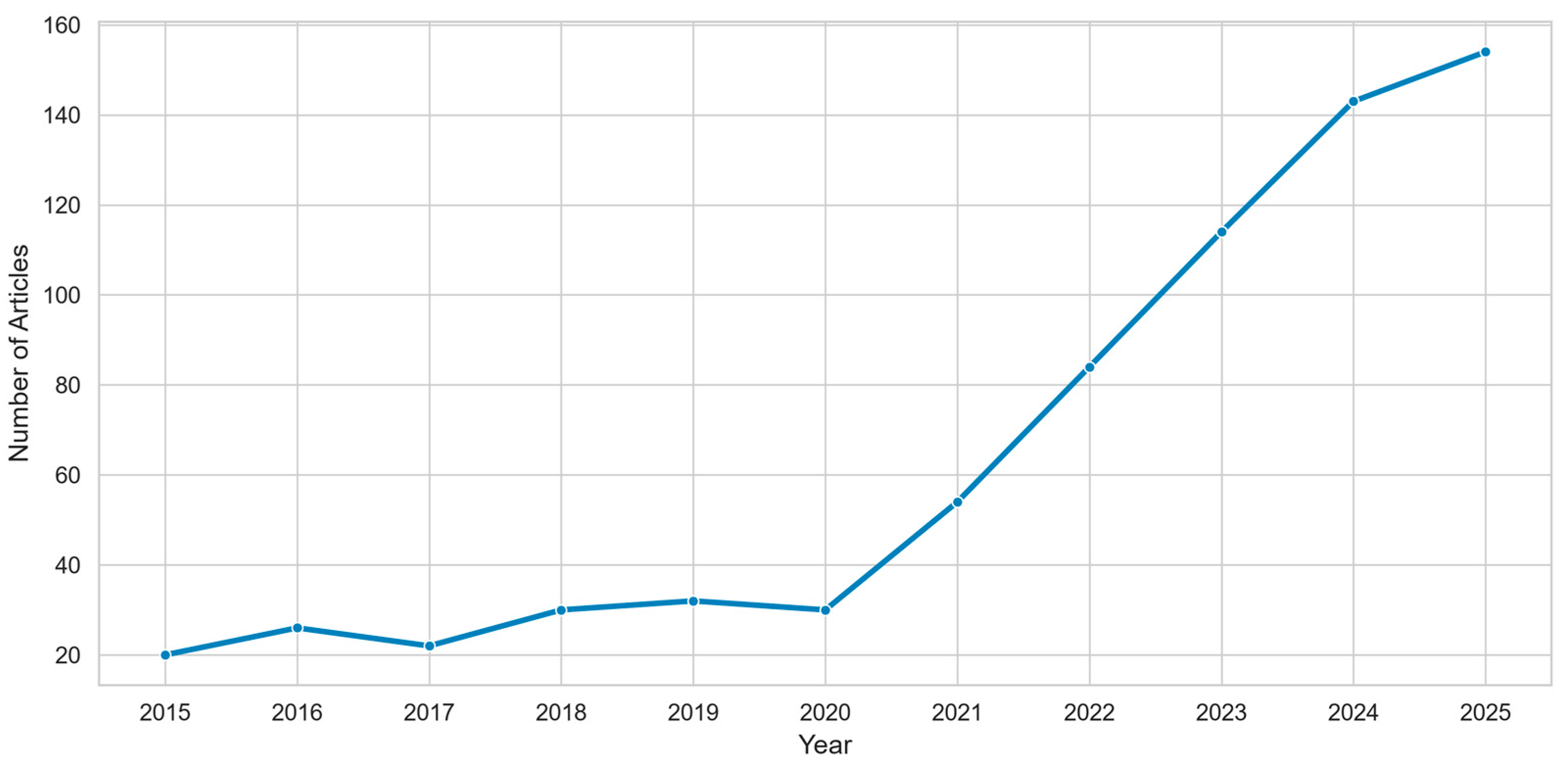
The descriptive statistics for the corpus of 709 articles analyzed on sustainability are presented in Table 3. The largest proportion of the corpus (68.7%) came from the newspaper, The Oman Daily Observer. At the national level, the coverage shows a clear positive trend over time, with the highest coverage in 2024–2025 (41.9% combined). A domestic economic focus is observed, and the two most prevalent macro frames are “Corporate ESG, Business and Green Investment” (30.6%) and “Clean Energy Policy, Research and Institutional Governance” (28.8%), as highlighted by frame analysis. Moreover, the sentiment analysis of the headlines reveals a positive (40.1%) and neutral (50.5%) media discourse with a fairly low negative (9.4%) valence.
Table 3.
Descriptives of data.
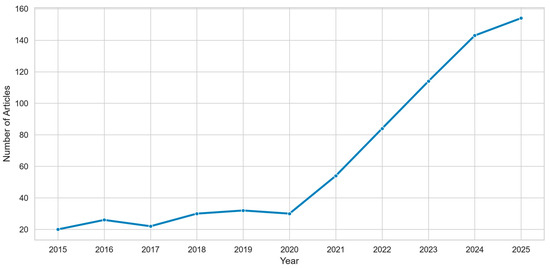
As illustrated in Figure 1, the volume of news coverage on sustainability is clearly a bipartite phenomenon, with a marked increase in volume between 2015 and 2025. The number of media articles remained relatively low (20–30 articles per year), with little increase between 2015 and 2020. The opposite is true from 2021; the discourse had a continuous, strong increase, reaching more than 150 articles by 2025. This exponential growth represents a paradigm shift in the way that the editorial agenda is shaped and reflects the increasing salience of sustainability and national green transition priorities in the Omani public discourse over the last five years, significantly after the launch of Oman Vision 2040.
Figure 1.
Volume of sustainability news coverage over time.
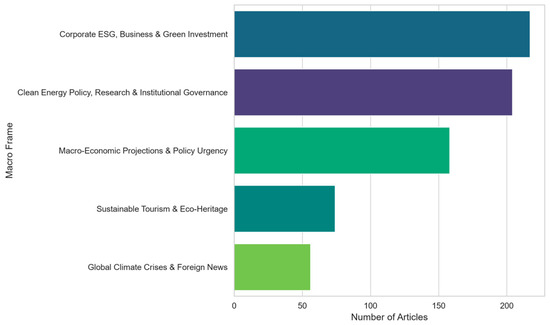
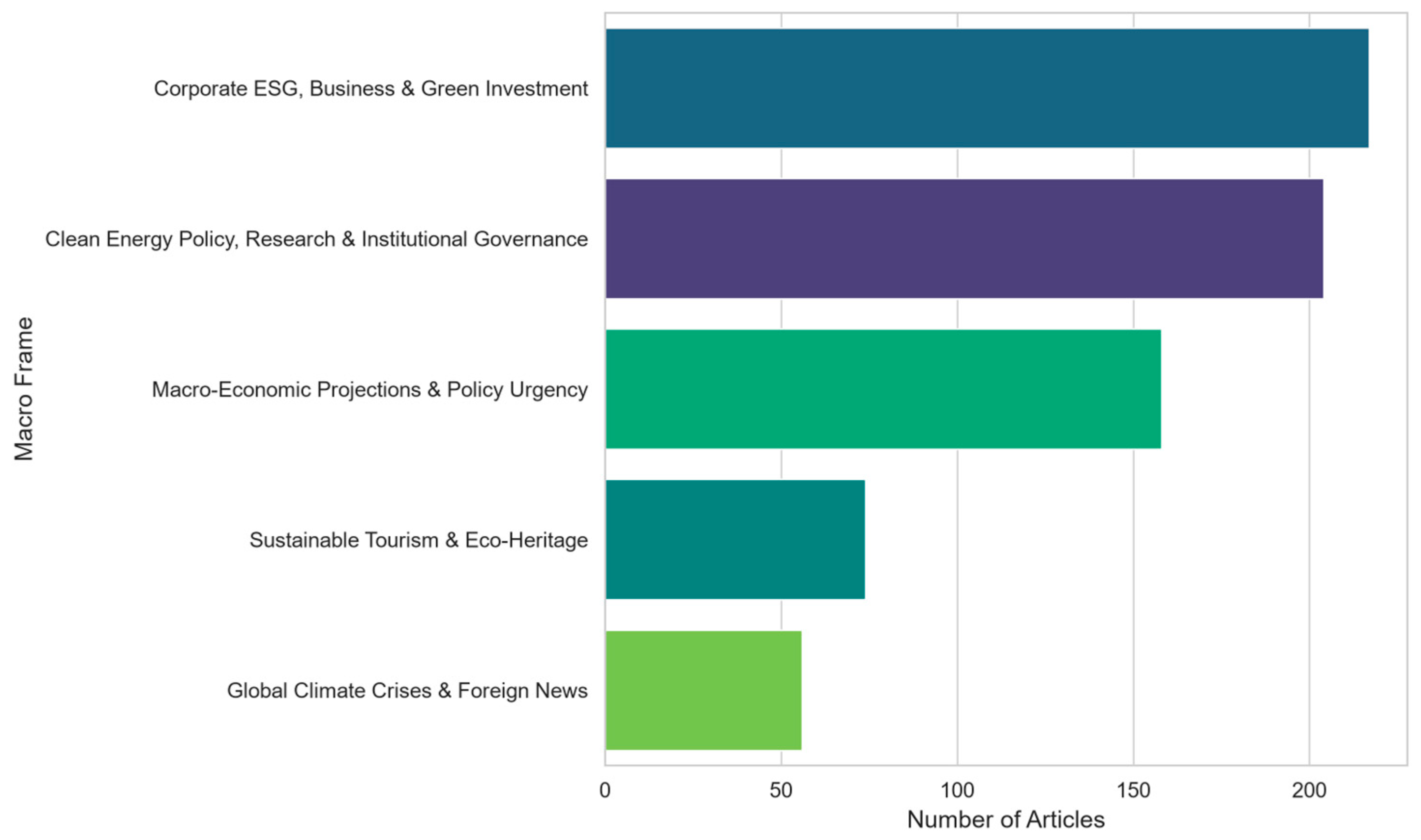
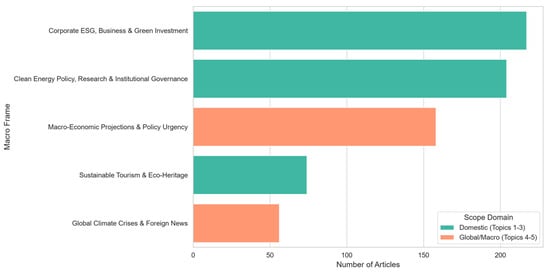
The thematic distribution of sustainability coverage is heavily skewed towards the economic and institutional environment in the country (Figure 2). The macro frames that most clearly stand out in the discourse are those related to the “Corporate ESG, Business & Green Investment” and “Clean Energy Policy, Research & Institutional Governance” themes, accounting for the vast majority of the articles analyzed. In contrast, the least salient frame is the “Global Climate Crises & Foreign News” frame. This lack of equality suggests a very localized agenda in journalism, where Omani media only pay attention to actionable, economically viable national transitions and policy initiatives and not to globalized climate change narratives.
Figure 2.
Distribution of dominant macro frames.
As shown in Figure 3, sustainability coverage is characterized by a strong geographic skew towards domestic sustainability discourses over global sustainability discourses. The frames of the domestic domain encompass more than 200 articles, and they are both related to “Corporate ESG” and “Clean Energy Policy”. On the other hand, global/macro topics, especially “Global Climate Crises & Foreign News,” gain considerably less editorial coverage. The split distribution reflects the strategic prioritization of the Omani press in emphasizing local, concrete sustainability actions (e.g., green investments, national governance) rather than a global climate crisis, thereby closely matching the national socio-economic transition goals reflected in media narratives.
Figure 3.
Coverage of frames by scope (domestic vs. global).
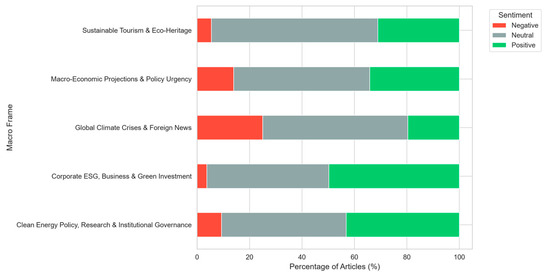
Figure 4 displays that sentiment for the headlines varies widely by the thematic frame. In the domestic paradigm, a high proportion of the framing is positive and constructive, with a prominent frame of “Corporate ESG, Business & Green Investment,” which is highly positive in polarity (~50%) and has little negative valence. On the contrary, “Global Climate Crises & Foreign News” has the maximum amount of negative sentiment (~30%) and the minimum positive sentiment. There is a significant amount of neutral framing in every category. This sentiment dichotomy suggests that the Omani media portrays local sustainability projects as positive economic opportunities, and global climate stories as risks and challenges.
Figure 4.
Headline sentiment distribution across macro frames.
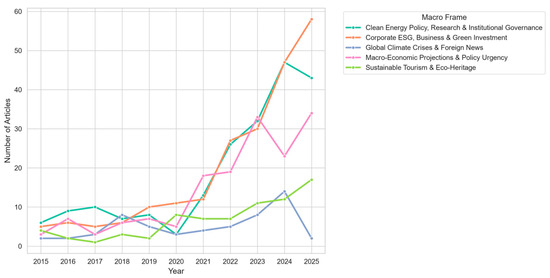
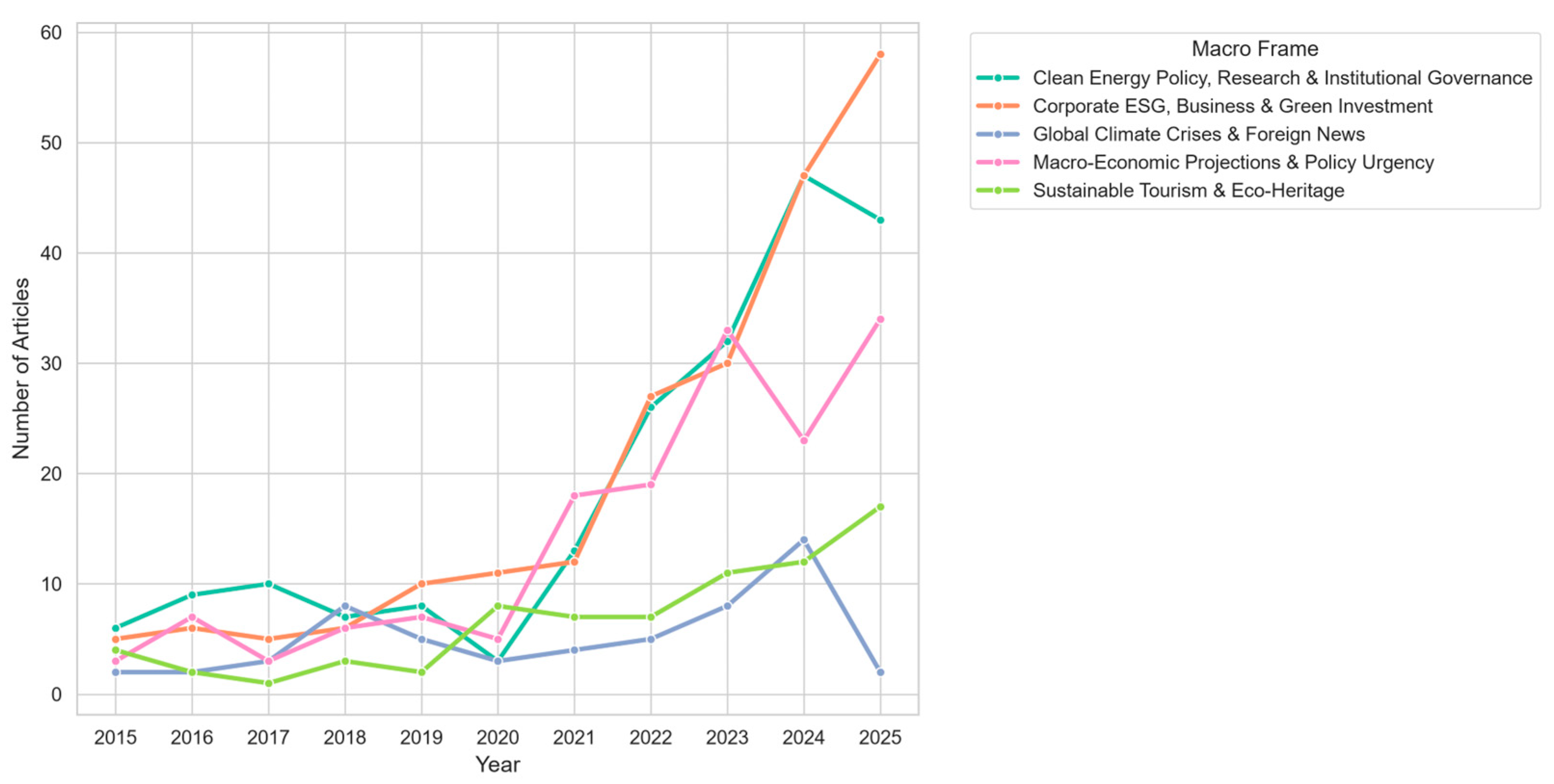
As illustrated in Figure 5, the sustainability coverage’s longitudinal trajectory demonstrates a prominent thematic split in 2021. All frames show low levels of coverage and have not grown since 2015, but the “Corporate ESG” and “Clean Energy Policy” frames’ increase in coverage is exponential after 2020. Interestingly, from 2025, “Corporate ESG” becomes the “market” discourse very quickly. On the other hand, the themes ‘Global Climate Crises’ and ‘Sustainable Tourism’ have been clearly sidelined all the time over the 10 years of this decade. This shift over time reflects a strategic change in journalism that has come to focus more on actionable economic changes within the country and institutional governance, rather than international climate discussion.
Figure 5.
Macro frames coverage over time.
5. Discussion
The main goal of this study was to analyze the discursive construction of sustainability and climate change in the Omani English-language press, in a context where the Omani economy is rapidly shifting from a hydrocarbon-based economy. This research, using a computational text-mining pipeline covering a decade of years (2015–2025), shows an extremely significant change over time in how media framing is constructed. The results show that Omani media have successfully “nationalized” the global climate discourse, moving it away from the classic risk discourse and focusing it on sustainability as a near and imminent local opportunity for economic diversification and institutional modernization (Lück et al., 2018; Vu et al., 2019).
5.1. The Nationalization of Sustainability Discourse (RQ1 & RQ3)
To answer RQ1 and RQ3, the computational topic modeling produced five macro frames, with a significant spatial and discursive focus on home economic projects (Table 2 and Table 3 and Figure 2). The overwhelming dominance of the “Corporate ESG, Business & Green Investment” and “Clean Energy Policy, Research & Institutional Governance” frames suggests that Omani journalism is more interested in the practicalities of policy that can be implemented at a local, rather than global, level.
The localized framing is noteworthy because it is a marked contrast to the historical framing in the Gulf Cooperation Council (GCC). Formerly, climate change was not at the top of the agenda in Arab media and was often portrayed as a foreign policy agenda or a possible threat to the economic model of the rentier states (Eskjær, 2017; Krane, 2020). The findings of this research, however, align with recent academic research that indicates that there has been a paradigm shift in the Middle East and North Africa (MENA) region, where sustainability is now firmly embedded in the post-oil economic development and entrepreneurship of the region (Hager et al., 2024). The Omani press is not associated with the scientific debates nor with the uncertainty frames that are often connected to early reports on climate change in Western countries (Schmid-Petri & Arlt, 2016; Stecula & Merkley, 2019), but rather closely with the official state development agenda (Alsuhaibani et al., 2025). The media system further promotes a narrative of decarbonization as a strategy for competitiveness, a global environmental cost that is not a cost to the economy (Zumbraegel, 2025; Zumbraegel & Sons, 2024). These results show that the media of Oman is prioritizing the state policies of sustainability and supporting state measures to promote sustainability awareness among the public of Oman.
5.2. Longitudinal Evolution and Policy Alignment (RQ2)
The findings of the longitudinal analysis (RQ2) support the view that media coverage of sustainability in Oman is directly stimulated by national policy milestones, and not global climate events (Figure 1). Media coverage did not change significantly from 2015 to 2020. This plateau is a result of the post-Paris Approach economic and oil market volatility and uncertainty in Oman, where environmental concerns were not high on the agenda, but rather were limited by a reliance on the hydrocarbon sector as a structural pillar of the economy (Due-Gundersen & Owtram, 2022).
Despite this, the exponential growth in sustainability coverage that began in 2021 is clearly linked to the process of institutionalization of Oman Vision 2040 that started around the same time. The general strategic framework introduced sustainability as a multi-dimensional goal, which includes governance and economic restructuring as documented in the literature (Al Balushi & Matriano, 2024; Nasirova, 2025). During this timeframe, media attention is also increasingly drawn to clean energy and corporate ESG in the media, reflecting the speed at which the clean energy vision and the ESG concept are being implemented in the public and private sectors in Oman (Al Ghafari et al., 2025; Al Lawati, 2022). Moreover, the high coverage in the coming years until 2025 reflects Oman’s 2022 pledge to achieve ‘Net Zero by 2050’ (Alrawahi et al., 2023) and the state’s ambitious transition to a green hydrogen economy (Ashraf et al., 2024). The press, in turn, reflects the media trajectory that links to the state priorities, which shows that the media has made the topics of sustainability a strong presence in the public agenda, as Oman turned sustainability into a measurable climate and economic goal (Alrawahi et al., 2023). These findings show that media framing supports the transitional phase of the economy of Oman. It highlights the media attention to sustainability over time in Oman.
5.3. Emotional Valence and Symbolic Deployment (RQ4)
The analysis of the news headline sentiment (RQ4) provides valuable nuance to the understanding of the presentation of these frames to the public. Media framing theory holds that the media influences the public interpretation because it emphasizes certain aspects of stories (Scheufele, 1999). They were overwhelmingly positive and constructive in terms of sentiment polarity, especially in the context of corporate green investments and clean energy. In contrast, negative sentiment was massively concentrated within the frame of “Global Climate Crises & Foreign News”, which followed the disaster-oriented and environmental risk narratives that are prevalent in global media more generally (Badullovich et al., 2020; Guenther et al., 2021).
The sentiment dichotomy indicates that the Omani Press is applying a solution-oriented journalism model (Guenther et al., 2021; Stecula & Merkley, 2019) in discussing issues related to the nation, and the green transition is being presented as a positive initiative. The same logic is seen in Koch’s (2022, 2024, 2025) notions of the symbolic practices of sustainability narratives being used to create images of modernity, technological sophistication, and visionary leadership by the Gulf states. The press tends to present domestic green energy policy as a positive option, thereby shifting the public discussion about climate anxiety to the international arena and allowing the government to pursue a dual strategy: to favor renewable energy technologies, it also needs to ensure that the fossil fuel industries remain relevant in the short term (Hofheinz, 2025).
6. Implications of Study
This study contributes to the body of knowledge in the field of sustainability and communication in a number of important ways. Most importantly, it applies media framing theory (Scheufele, 1999) to the mostly ignored field of Arab Gulf media communication, revealing the limitations of traditional, Euro-centric perspectives in framing climate communication in the GCC context. In transitional rentier states, the climate framing is essentially an economic- and development-oriented discourse. Moreover, the study confirms the usefulness of the concept of the ‘nationalization’ of issues (Lück et al., 2018), demonstrating that even what is presented as a very internationalized problem such as climate change is absorbed and made ‘local’ by domestic media in the form of policy narratives. The results provide important policy guidance for policymakers, environmental NGOs and corporate actors within the Gulf and MENA region. Environmental campaigns based on ecological crisis, moral urgency or disaster stories are likely to have a poor chance of achieving attention in the Omani media, as such approaches are not particularly supported in the country. The Gulf’s environmental efforts require a way to integrate stakeholders’ messages into the logic of the state’s development visions (e.g., Vision 2040), emphasizing technological innovation, employment generation, green investment, and national progress.
7. Limitations and Future Research
This study gives a holistic picture of sustainability framing in Oman, but certain limitations need to be taken into account. The first is that it is limited to English-language newspapers (Times of Oman and Oman Daily Observer). These are the main English-language publications for an international and multi-ethnic audience of businessmen and policymakers, but they do not necessarily capture the dynamics of an Arabic-language audience. English media in the Gulf tends to cater more to an international audience and may be more likely to popularize business jargon from across the globe than local Arabic dailies. Therefore, the findings of the study should not be generalized to the Arabic Omani media (i.e., Arabic dailies and Arabic National TV channels). Secondly, this study is based only on the text. Journalism is multimodal, and the three elements of photographic framing, infographics, and front-page layouts are excluded; therefore, the way journalists visually communicate these news stories to the public could not be fully understood. Finally, the computational techniques are very good at uncovering macro-level thematic structures, but they are not as sensitive to subtle journalistic devices like irony, implicit criticism, or subtle cultural metaphors Therefore, further studies are needed to fill these gaps by making a comparative study between Arabic newspapers and English newspapers in Oman and the GCC region to determine the possible linguistic differences in the way climate is framed. Furthermore, a wider range of platforms, such as social media (X/Twitter, local environmental forums, etc.), would give invaluable data on bottom-up reception and whether top-down, optimistic media narratives created by the press are accepted, challenged, or negotiated by the Omani public. Lastly, combining qualitative critical discourse analysis (CDA) with computational models can be utilized to explore the framing of sustainability narratives in Gulf media to get a more holistic picture.
Funding
This research received no external funding.
Institutional Review Board Statement
Not applicable.
Informed Consent Statement
Not applicable.
Data Availability Statement
The datasets and computational outputs (including Python code and scripts) are available from the corresponding author upon reasonable request.
Conflicts of Interest
The author declares no conflicts of interest.
References
- Al Balushi, A. K. A., & Matriano, M. T. (2024). Renewable energy investments impact on economic diversification and strategic growth: A review of literature in the context of Oman vision 2040. International Journal of Innovative Research in Engineering & Multidisciplinary Physical Sciences, 12(4), 231068. [Google Scholar] [CrossRef] [Scilit]
- Al Ghafari, M. A., Alawi, B. A., Jumaa, I. A., & Awaidy, S. A. (2025). Oman vision 2040: A transformative blueprint for a leading healthcare system with international standards. Healthcare, 13(22), 2911. [Google Scholar] [CrossRef] [Scilit] [PubMed]
- Al Lawati, H. A. (2022). Politically connected firms and forward-looking disclosure in the era of Oman vision 2040. Journal of Risk and Financial Management, 15(6), 233. [Google Scholar] [CrossRef] [Scilit]
- Alrawahi, I., Bathmanathan, V. A., Kaabi, S. A., & Alghalebi, S. (2023). Strategic commitment by sultanate of Oman towards 2050 net-zero emission: Current environmental initiatives and future needs. International Journal of Membrane Science and Technology, 10(2), 161–168. [Google Scholar] [CrossRef] [Scilit]
- Al-Shidhani, M. A., & Hayyan, M. (2025). Oman’s energy transition roadmap to net zero 2050. Energy Nexus, 19, 100493. [Google Scholar] [CrossRef] [Scilit]
- Alsuhaibani, M., Gaanoun, K., & Qamar, A. M. (2025). Artificial intelligence-driven insights into Arab media’s sustainable development goals coverage. PeerJ Computer Science, 11, e3071. [Google Scholar] [CrossRef] [Scilit] [PubMed]
- Ambrosino, A., Cedrini, M., Davis, J. B., Fiori, S., Guerzoni, M., & Nuccio, M. (2018). What topic modeling could reveal about the evolution of economics. Journal of Economic Methodology, 25(4), 329–348. [Google Scholar] [CrossRef] [Scilit]
- Ashraf, S. A., Rao, C. V., Khan, K., Mohatram, M., Ahmad, A., Jahan, S., & Ramya, C. (2024). Strategic route for impending green hydrogen energy in Oman. E3S Web of Conferences, 472, 01011. [Google Scholar] [CrossRef] [Scilit]
- Badullovich, N., Grant, W. J., & Colvin, R. M. (2020). Framing climate change for effective communication: A systematic map. Environmental Research Letters, 15(12), 123002. [Google Scholar] [CrossRef] [Scilit]
- Blei, D. M., Ng, A. Y., & Jordan, M. I. (2003). Latent Dirichlet allocation. Journal of Machine Learning Research 3, 993–1022. Available online: https://www.jmlr.org/papers/v3/blei03a.html (accessed on 20 June 2026).
- Boumans, J. W., & Trilling, D. (2016). Taking stock of the toolkit: An overview of relevant automated content analysis approaches and techniques for digital journalism scholars. Digital Journalism, 4(1), 8–23. [Google Scholar] [CrossRef] [Scilit]
- de Vreese, C. H. (2005). News framing: Theory and typology. Information Design Journal + Document Design, 13(1), 51–62. [Google Scholar] [CrossRef] [Scilit]
- Due-Gundersen, N., & Owtram, F. (2022). The foundation, development and future of the Omani rentier state: From the Dhofar war to vision 2040. Arabian Humanities, 16. [Google Scholar] [CrossRef] [Scilit]
- Entman, R. M. (1993). Framing: Toward clarification of a fractured paradigm. Journal of Communication, 43(4), 51–58. [Google Scholar] [CrossRef] [Scilit]
- Eskjær, M. F. (2017). Climate change communication in Middle East and Arab countries. In Oxford research encyclopedia of climate science. Oxford University Press. [Google Scholar] [CrossRef] [Scilit]
- Freeman, B. C. (2016). Protecting the gulf: Climate change coverage in GCC print media. Cogent Arts and Humanities, 3(1), 1212690. [Google Scholar] [CrossRef] [Scilit]
- Guenther, L., Brüggemann, M., & Elkobros, S. (2021). From global doom to sustainable solutions: International news magazines’ multimodal framing of our future with climate change. Journalism Studies, 23(1), 131–148. [Google Scholar] [CrossRef] [Scilit]
- Guenther, L., Jörges, S., Mahl, D., & Brüggemann, M. (2024). Framing as a bridging concept for climate change communication: A systematic review based on 25 years of literature. Communication Research, 51(4), 367–391. [Google Scholar] [CrossRef] [Scilit]
- Guo, L., Vargo, C. J., Pan, Z., Ding, W., & Ishwar, P. (2016). Big social data analytics in journalism and mass communication. Journalism & Mass Communication Quarterly, 93(2), 332–359. [Google Scholar] [CrossRef] [Scilit]
- Hager, M., Alzafari, K., & Rashid, L. (2024). Media narratives on (Ecological) sustainability: A topic modeling analysis of entrepreneurship news in the MENA region. PLoS Sustainability and Transformation, 3(5), e0000107. [Google Scholar] [CrossRef] [Scilit]
- Hagg, L. J., Merkouris, S. S., O’Dea, G. A., Francis, L. M., Greenwood, C. J., Fuller-Tyszkiewicz, M., Westrupp, E. M., Macdonald, J. A., & Youssef, G. J. (2022). Examining analytic practices in latent Dirichlet allocation within psychological science: Scoping review. Journal of Medical Internet Research, 24(11), e33166. [Google Scholar] [CrossRef] [Scilit] [PubMed]
- Hofheinz, A. (2025). Arabic media coverage of climate change and the green shift. Journal of Arabic and Islamic Studies, 25(1), 19–55. [Google Scholar] [CrossRef] [Scilit]
- Hutto, C., & Gilbert, E. (2014). VADER: A parsimonious rule-based model for sentiment analysis of social media text. Proceedings of the International AAAI Conference on Web and Social Media, 8(1), 216–225. [Google Scholar] [CrossRef] [Scilit]
- Ittefaq, M., Zain, A., Arif, R., Ala-Uddin, M., Ahmad, T., & Iqbal, A. (2025). Global news media coverage of artificial intelligence (AI): A comparative analysis of frames, sentiments, and trends across 12 countries. Telematics and Informatics, 96, 102223. [Google Scholar] [CrossRef] [Scilit]
- Jacobi, C., Van Atteveldt, W., & Welbers, K. (2016). Quantitative analysis of large amounts of journalistic texts using topic modelling. Digital Journalism, 4(1), 89–106. [Google Scholar] [CrossRef] [Scilit]
- Jelodar, H., Wang, Y., Yuan, C., Feng, X., Jiang, X., Li, Y., & Zhao, L. (2018). Latent Dirichlet allocation (LDA) and topic modeling: Models, applications, a survey. Multimedia Tools and Applications, 78(11), 15169–15211. [Google Scholar] [CrossRef] [Scilit]
- Jiang, C., Zhang, L., & Wang, Y. (2025). Integrating natural language processing techniques with LDA topic modeling: Deconstructing the evolution of media discourse on educational modernization ideology. Education and Information Technologies, 30(16), 23419–23466. [Google Scholar] [CrossRef] [Scilit]
- Kermani, H., Makou, A. B., Tafreshi, A., Ghodsi, A. M., Atashzar, A., & Nojoumi, A. (2023). Computational vs. qualitative: Analyzing different approaches in identifying networked frames during the Covid-19 crisis. International Journal of Social Research Methodology, 27(4), 401–415. [Google Scholar] [CrossRef] [Scilit] [PubMed]
- Khawaja, S., Aslam, S., Yousaf, M., Mahmood, N., Yaser, N., Raza, S. H., & Mahmood, T. (2025). Media, disasters, and the global south: Comparing global north and south media framing on Pakistan’s 2022 floods. Journalism and Media, 6(2), 70. [Google Scholar] [CrossRef] [Scilit]
- Koch, N. (2022). Sustainability spectacle and ‘post-oil’ greening initiatives. Environmental Politics, 32(4), 708–731. [Google Scholar] [CrossRef] [Scilit]
- Koch, N. (2024). Sustainability spectacle in the Gulf. Current History, 123(857), 330–335. [Google Scholar] [CrossRef] [Scilit]
- Koch, N. (2025). The symbolic power of sustainability: Gulf megaprojects and the case of expo city Dubai. Cambridge Journal of Regions Economy and Society, 18(2), 279–292. [Google Scholar] [CrossRef] [Scilit]
- Krane, J. (2020). Climate action versus inaction: Balancing the costs for gulf energy exporters. British Journal of Middle Eastern Studies, 47(1), 117–135. [Google Scholar] [CrossRef] [Scilit]
- Landis, J. R., & Koch, G. G. (1977). The measurement of observer agreement for categorical data. Biometrics, 33(1), 159–174. [Google Scholar] [CrossRef] [Scilit]
- Lück, J., Wessler, H., Wozniak, A., & Lycarião, D. (2018). Counterbalancing global media frames with nationally colored narratives: A comparative study of news narratives and news framing in the climate change coverage of five countries. Journalism, 19(12), 1635–1656. [Google Scholar] [CrossRef] [Scilit]
- Maier, D., Waldherr, A., Miltner, P., Wiedemann, G., Niekler, A., Keinert, A., Pfetsch, B., Heyer, G., Reber, U., Häussler, T., Schmid-Petri, H., & Adam, S. (2018). Applying LDA topic modeling in communication research: Toward a valid and reliable methodology. Communication Methods and Measures, 12(2–3), 93–118. [Google Scholar] [CrossRef] [Scilit]
- Matthes, J. (2009). What’s in a frame? A content analysis of media framing studies in the world’s leading communication journals, 1990-2005. Journalism & Mass Communication Quarterly, 86(2), 349–367. [Google Scholar] [CrossRef] [Scilit]
- Nasirova, N. (2025). “Vision 2040” strategy of the sultanate of Oman: A model of political modernization and sustainable development. The American Journal of Political Science Law and Criminology, 7(9), 23–26. [Google Scholar] [CrossRef] [Scilit]
- Nawaz, S., Siddiq, S., & Yaseen, M. (2025). Flooding narratives in Pakistan (2025): A latent Dirichlet allocation (LDA)-driven ecolinguistic analysis of dawn news coverage during the peak of the crisis. Journal of Arts and Linguistics Studies, 3(4), 5591–5628. [Google Scholar] [CrossRef] [Scilit]
- O’Connor, C., & Joffe, H. (2020). Intercoder reliability in qualitative research: Debates and practical guidelines. International Journal of Qualitative Methods, 19, 1–13. [Google Scholar] [CrossRef] [Scilit]
- Puschmann, C., & Scheffler, T. (2016). Topic modeling for media and communication research: A short primer. HIIG Discussion Paper Series No. 2016-05. Social Science Research Network. [Google Scholar] [CrossRef] [Scilit]
- Rieger, J., Jentsch, C., & Rahnenführer, J. (2024). LDAPrototype: A model selection algorithm to improve reliability of latent Dirichlet allocation. PeerJ Computer Science, 10, e2279. [Google Scholar] [CrossRef] [Scilit] [PubMed]
- Scheufele, D. A. (1999). Framing as a theory of media effects. Journal of Communication, 49(1), 103–122. [Google Scholar] [CrossRef]
- Schmid-Petri, H., & Arlt, D. (2016). Constructing an illusion of scientific uncertainty? Framing climate change in German and British print media. Communications, 41(3), 265–289. [Google Scholar] [CrossRef]
- Schofield, A., Magnusson, M., & Mimno, D. (2017, September 7–11). Quantifying the effects of text duplication on semantic models. 2017 Conference on Empirical Methods in Natural Language Processing (pp. 2737–2747), Copenhagen, Denmark. [Google Scholar] [CrossRef] [Scilit]
- Sheikh, A. A., Yousaf, M. F., Yousaf, M. F., Alshuaibi, M. S., Tariq, B., Durrani, S., Hameed, I., Raza, S. H., Yousaf, M., Yousaf, M., & Badawy, M. (2025). Modeling a value-attitude-behavior framework and personality traits: Examining consumers’ green purchase behavior for environmentally friendly technology products. Discover Sustainability, 6(1), 779. [Google Scholar] [CrossRef] [Scilit]
- Sial, N. R., Al-Abri, H., Qyyum, M. A., Al-Abri, R., & Al-Muhtaseb, A. H. (2024). Techno-economic assessment of green hydrogen production in unexploited landlocked northern-western region of Oman to realize national sustainable strategy. International Journal of Hydrogen Energy, 137, 892–904. [Google Scholar] [CrossRef] [Scilit]
- Stecula, D. A., & Merkley, E. (2019). Framing climate change: Economics, ideology, and uncertainty in American news media content from 1988 to 2014. Frontiers in Communication, 4(6), 1–15. [Google Scholar] [CrossRef] [Scilit]
- Vu, H. T., Liu, Y., & Tran, D. V. (2019). Nationalizing a global phenomenon: A study of how the press in 45 countries and territories portrays climate change. Global Environmental Change, 58, 101942. [Google Scholar] [CrossRef] [Scilit] [PubMed]
- Wang, C., & Yin, H. (2022). A framing analysis and regional comparison of newspaper media reports of COVID-19 in Shanghai: Based on the LDA topic model. Studies in Media and Communication, 10(2), 312. [Google Scholar] [CrossRef] [Scilit]
- Zumbraegel, T. (2025). The Technopolitics of Hydrogen: Arab Gulf States’ pursuit of Significance in a Climate-Constrained world. Geoforum, 158, 104168. [Google Scholar] [CrossRef] [Scilit]
- Zumbraegel, T., & Sons, S. (2024). Gulf aid goes green: Reflecting on the geopolitics of environmental sustainability assistance in Arab monarchies. Journal of Gulf Studies, 1(2), 145–167. [Google Scholar] [CrossRef] [Scilit]

Disclaimer/Publisher’s Note: The statements, opinions and data contained in all publications are solely those of the individual author(s) and contributor(s) and not of MDPI and/or the editor(s). MDPI and/or the editor(s) disclaim responsibility for any injury to people or property resulting from any ideas, methods, instructions or products referred to in the content. |
© 2026 by the author. Licensee MDPI, Basel, Switzerland. This article is an open access article distributed under the terms and conditions of the Creative Commons Attribution (CC BY) license.