


Abstract
This article presents and analyses an interview with Cristóbal Balenciaga published in ¡Hola! in 1954, previously absent from the academic corpus on the Spanish couturier. The interview constitutes a significant discovery that substantially expands the documentation available on the designer, who has traditionally been described as reluctant to engage with the media. The study situates the interview within a dual context: first, the business and geopolitical environment of postwar haute couture, shaped by tensions between Paris, Spain, and the American market; and second, the editorial context of ¡Hola! during the 1950s, marked by its rapid expansion and transnational circulation. Through a qualitative analysis combining historically grounded approaches based on primary sources, studies on the journalistic interview genre, and close textual reading, the article examines the narrative strategies employed by journalist José A. Irurozqui, the strategic choice of publication, and the content of Balenciaga’s statements. The findings demonstrate that the prominence given to the designer’s first-person voice, the journalist’s narrative framing, and ¡Hola!’s editorial positioning all contributed to consolidating a public image of the couturier and of his brands in Paris and Spain.
1. Introduction
Cristóbal Balenciaga (Getaria, 1895–Valencia, 1972) was one of the defining figures of twentieth-century haute couture. Trained in tailoring in San Sebastián, he founded his own business there in 1917. After establishing an aristocratic and bourgeois clientele (Arzalluz, 2010, p. 135), he opened couture houses in Madrid and Barcelona in 1933 and 1935, respectively, and made his debut on the Parisian haute couture scene in 1937 (Jouve & Demornex, 1989, pp. 20–33). From then on, he achieved international authority recognised even by his competitors: Christian Dior considered him the true leader of haute couture (Miller, 2017, p. 22), while Coco Chanel described him as the “only one I admire” (Brady, 1963). Yet this creative centrality contrasted with a limited public presence. Balenciaga maintained a distant relationship with the press and made discretion a defining feature of his public image.
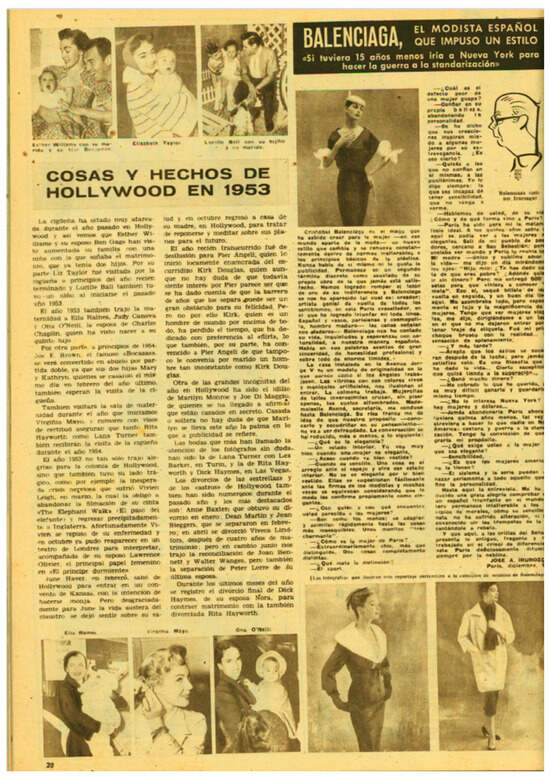
For decades, this reserve became a defining trait consolidated both by historiography and by the designer himself. Among the commonplaces that have fuelled the so-called “Balenciaga myth,” one of the most frequently repeated has been the conviction that he granted very few interviews (Balda, 2022). For many years, the specialised bibliography maintained that Balenciaga agreed to only a single interview throughout his professional career, published in The Times (Glynn, 1971); later, after years of uncritical repetition of that claim, the existence of a second interview, published in Paris Match (Merlin-Teysserre, 1968), was documented, thereby qualifying this notion of communicative exceptionalism (Balda, 2013, p. 29). Both were published after Balenciaga’s retirement from the fashion world1. The chronological distance between these interviews is itself revealing: the Paris Match piece appeared in 1968 and The Times interview in 1971, just three years later. The ¡Hola! interview presented in this article (Figure 1), published in 1954, predates both by fourteen years, making it—to the best of our knowledge—the earliest known interview with Balenciaga. This chronological priority further underscores its significance: the article constitutes the oldest documented testimony of Balenciaga’s voice in the press and the only known interview conducted in a question-and-answer format during his active career. In the other two interviews, Balenciaga’s statements were incorporated into journalistic narratives whose published form made the interviewer’s questions largely invisible. This distinction concerns the editorial presentation of the interview rather than its status as an interview, since journalistic interviewing encompasses different formats and degrees of visible interaction between interviewer and interviewee (Modell, 2025).
Figure 1.
The interview with Cristóbal Balenciaga published in ¡Hola!, 16 January 1954, p. 20. Courtesy of Biblioteca Nacional de España.
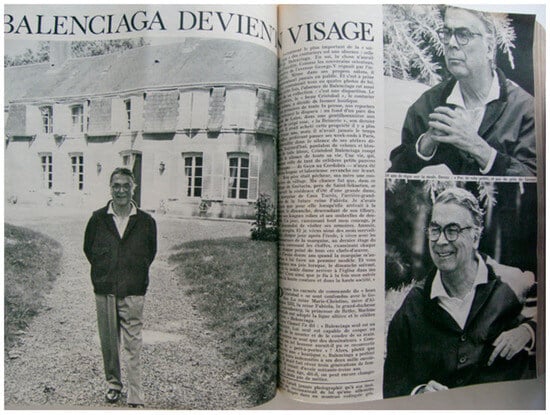
The first, published as a double-page spread in the French magazine (pp. 57–58), included three photographs of a smiling and approachable Balenciaga under the title “Balenciaga devient visage.” The headline itself emphasised the novelty of Balenciaga’s appearance in the press and, consequently, the exceptional value of his statements, while at the same time reinforcing his image as a figure who habitually shunned the media. The article also gave the couturier an opportunity to recount, in his own words, how his career in haute couture had actually begun (Figure 2).
Figure 2.
The interview with Cristóbal Balenciaga published in Paris Match, 10 August 1968, pp. 57–58. Courtesy of the Library of the University of Navarre.
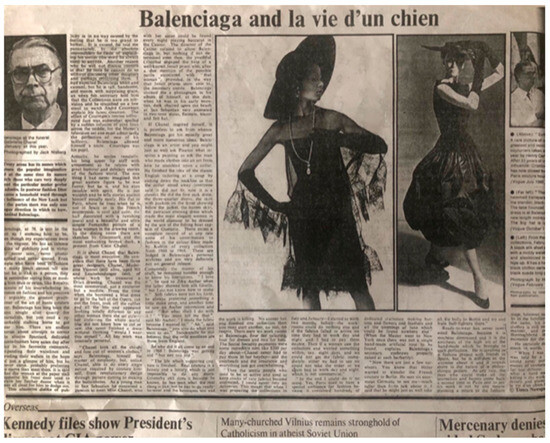
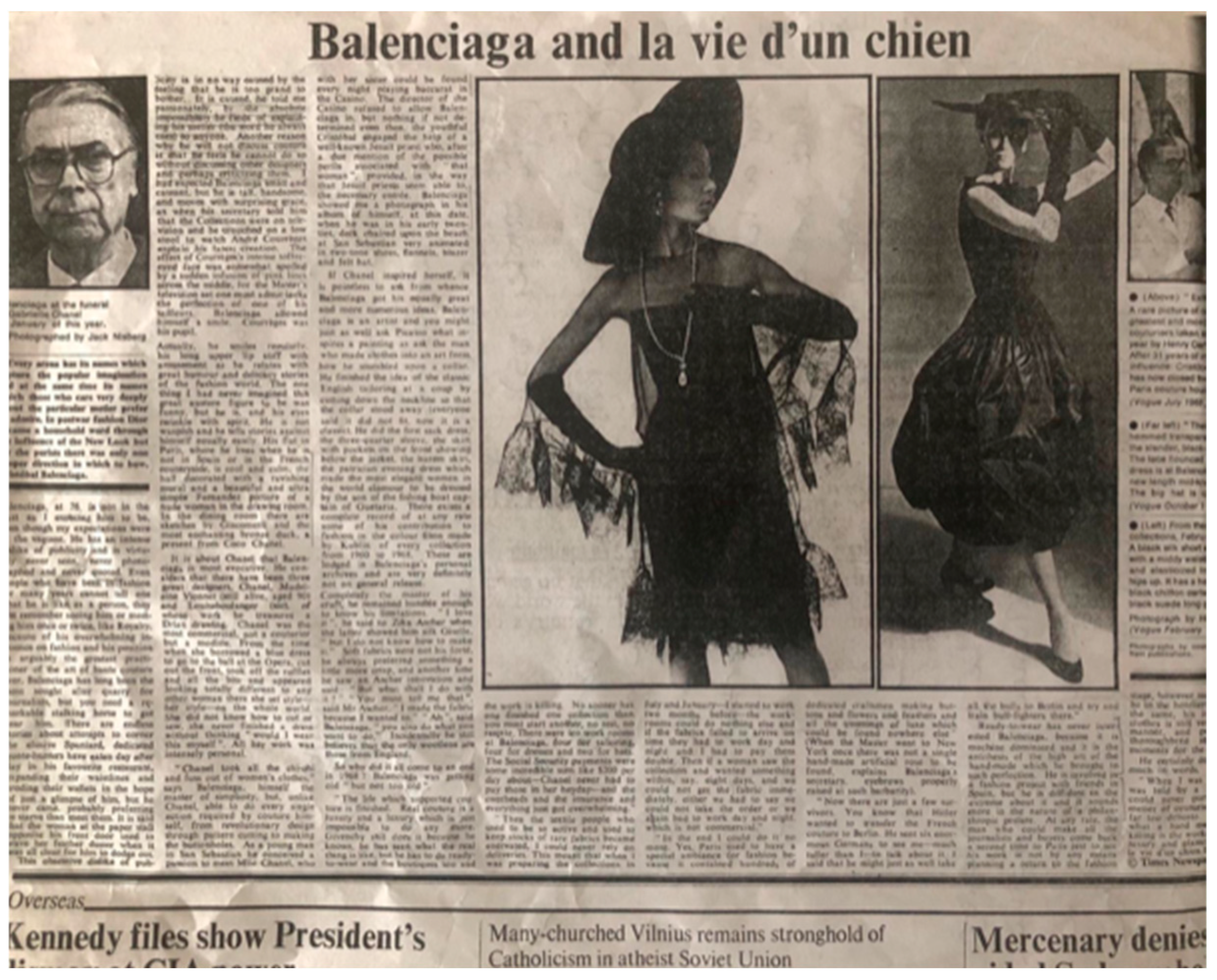
The second, more extensive in content and accompanied by a small contemporary photograph of Balenciaga and two photographs of his designs, was published three years later on the sixth page of the British newspaper under the French title “C’est la vie d’un chien,” placed in quotation marks and thus reproducing an expression used by Balenciaga himself in his statements. In them, the couturier conveyed a clear sense of weariness when discussing the reasons that had led him to leave the profession (Figure 3).
Figure 3.
The interview with Cristóbal Balenciaga published in The Times, 3 August 1971, p. 6. Courtesy of the Library of the University of Navarre.
The almost opposing tones of the two publications can be understood in light of the events that shaped Balenciaga’s professional life during the three years that separated them. The failure of a prêt-à-porter venture in San Sebastián, problems concerning perfume licensing in the United States and, above all, the protracted legal dispute with employees who were demanding that he reopen his business in Spain provide important context for the sense of disillusionment conveyed in his statements. This negative tone was expressively encapsulated in the headline chosen by the British newspaper.2
This article is framed within that process of revising and expanding the documentary corpus on the couturier by presenting this previously unknown interview, published in the Spanish magazine ¡Hola! on 16 January 1954 and conducted by journalist José Antonio Irurozqui (Appendix A and Figure 1).3 The interview appears on page 20 of the issue and is illustrated with a small caricature of Balenciaga himself, drawn by the interviewer, as well as three photographs of Balenciaga designs from his latest Autumn/Winter 1953 collection, which had been presented and made available for sale in the summer of that year. The discovery was made possible thanks to two conditions that have become paradigmatic in historical research today: on the one hand, the growing digitisation of archives, newspaper libraries, and documentary collections, which enables extensive, rapid, and cross-referenced searches; on the other, the intensification of collaborative dynamics among researchers from different generations and academic backgrounds.4
The visual choices surrounding the piece deserve brief comment. Unlike the Paris Match interview, which was accompanied by photographs of Balenciaga himself, the ¡Hola! piece includes no such images, which may suggest that permission to photograph or publish his likeness was not granted. The caricature drawn by Irurozqui could thus have served as a visual substitute, though whether this was agreed with the interviewee or was an independent editorial decision remains unknown. The front cover of that issue makes no reference to the interview, consistent both with the magazine’s photographic cover conventions—at that time, ¡Hola! devoted its cover to a single full-page photograph of a prominent public figure—and with Balenciaga’s known reluctance to be photographed. Both questions deserve further attention from researchers working on his visual self-presentation.
The aim of the article is not to provide an exhaustive comparison with the other two interviews, but rather to introduce this interview for the first time and examine it from two complementary perspectives. The first is journalistic, focusing on the magazine in which the interview appeared, its authorship, and the particular form in which the exchange was presented to readers. Neither the publication context nor the identity of the interviewer is incidental, especially in the case of Balenciaga, whose media presence and willingness to make public statements were exceptionally limited. Moreover, the interview’s question-and-answer structure makes the interaction between interviewer and interviewee substantially more visible than in the other two known interviews, in which Balenciaga’s statements are incorporated into journalistic narratives that largely conceal the interviewer’s questions (Balda, 2021). This does not, however, imply an absence of journalistic mediation. As Irurozqui himself acknowledges before introducing the exchange, “the conversation has been reduced, more or less, to the following,” explicitly revealing a process of selection and editorial reconstruction. Like any published interview, the text is therefore a mediated artefact, shaped by the interviewer’s selection of questions, follow-ups, omissions, sequencing, and subsequent editing.
Precisely because of the scarcity of Balenciaga’s public statements, the content of his responses acquires particular significance and constitutes the second focus of the analysis. The interview took place at the Paris headquarters of the House of Balenciaga at a time when the couturier was still fully active and firmly established as an internationally renowned figure. Unlike the other two interviews, this testimony therefore belongs to a period of creative and business expansion, which lends his statements particular historical and analytical value. Rather than a retrospective reflection or a discourse shaped by memory, it offers a testimony articulated from within the immediate context of Balenciaga’s professional practice, with all that this entails in terms of strategy, positioning, and professional self-awareness. The meaning and significance of his statements, however, cannot be fully understood without situating them within the specific circumstances in which they were made, both in relation to the workings of the haute couture business and to Balenciaga’s own career and professional position at the time of the interview.
From a methodological perspective, this article approaches the interview from a dual journalistic and communicative perspective, combining historical and media contextualisation with a close textual reading of its narrative and dialogic structure. To this end, it examines the context in which the interview was produced—the couturier’s business situation, the editorial landscape of fashion magazines in Spain, and the specific choice of ¡Hola!—as well as the authorship of the piece. The magazine is approached not merely as a container for journalistic content but as a medium whose editorial identity, imagined readership, visual conventions, and commercial positioning contribute to the meaning of the texts it publishes. This approach draws on recent magazine studies, which emphasise the magazine as a distinctive media form structured around particular relationships between editorial content, design, audiences, and communities of readers (Cardoso & Holmes, 2022). More broadly, the analysis draws on scholarship on the journalistic interview as a genre, magazine culture, fashion communication, and celebrity studies. In doing so, it explores both the linguistic and narrative strategies employed and the communicative dimension of fashion articulated through Balenciaga’s own voice.
2. The Context and Strategic Communication: The Balenciaga Brand at the Time of the Interview
The interview was conducted at the Paris headquarters of the Balenciaga house, at a moment when the couturier was still fully active and enjoying unquestionable international consolidation. Unlike the other two interviews, which were granted after his retirement, this testimony belongs to a context of creative and business expansion, lending his responses a particularly valuable historical and analytical density. It is therefore not a retrospective reflection or a discourse marked by a memorial tone, but rather a statement formulated from within the present of professional practice itself, with all that this implies in terms of strategy, positioning, and professional self-awareness.
Since the invention of the haute couture business in Paris in the mid-nineteenth century by the Englishman Charles Frederick Worth, couturiers not only sold made-to-measure garments to clients who visited their establishments, but also began to diversify their businesses through the commercialisation of their names—that is, of the label itself (Pouillard, 2021, pp. 11–42). In this way, they could also sell licences—reproduction rights for their designs—to prestigious stores around the world.
With the aim of facilitating the sale of licences, the Chambre Syndicale de la Couture Parisienne, the regulatory body of French haute couture, began in 1909 to organise a calendar through which different fashion houses presented their new creations to potential licence buyers, most of whom were American (Evans, 2013, pp. 32–33). Consequently, if a client desired a design from a prestigious Parisian couture house, it was no longer strictly necessary to travel to the French capital, as an authorised copy could probably be found in a department store in her own city. The indisputable authority of Parisian fashion in terms of innovation and quality consolidated this model, with the United States becoming its principal client during the interwar period (Pouillard, 2011, 2013).
After the Second World War, the emergence of new European fashion centres—Florence (and later Milan), as well as Barcelona and Madrid—must be understood in parallel with the reconfiguration of the economic and geopolitical alliances of the Western sphere. The agreements associated with the Marshall Plan in 1948 provided a major stimulus to the Italian fashion industry (Stanfill, 2014, pp. 8–16). In the Spanish case, the establishment of preferential relations with the United States through the Madrid Pacts of September 1953 functioned as a framework for international normalisation, gradual opening, and the expansion of commercial contacts (Piñeiro, 2006). Within the context of these negotiations, and with an eye on the Italian fashion market, which had already organised its first fashion show for American buyers, the Cooperativa de la Alta Costura Española (the equivalent body to the Chambre Syndicale de la Couture Parisienne, operating since 1940) began in 1952 to organise its own fashion shows targeting the same market (Rosés, 2020).
For professional American buyers and foreign visitors, Spain offered particularly competitive conditions, owing not only to its relatively low production costs and the availability of skilled labour, but also to the advantages derived from the exchange rate and the relative weakness of the peseta within a system of currency controls and exchange restrictions characteristic of early Francoism (Women’s Wear Daily, 1952, p. 3). Although the Spanish monetary system did not operate under a fully liberalised regime, the dollar nevertheless enjoyed considerable purchasing power in Spain, encouraging both consumer tourism and the purchase of high-quality artisanal products at comparatively advantageous prices. In this sense, the commercial appeal of Spanish haute couture for American intermediaries and department stores depended not only on its discourse of authenticity and its ability to capitalise on a culturally differentiated image, but also on a set of economic conditions that reinforced its competitive advantage over French haute couture.
The prestige of Spanish fashion in the United States in fact dates back to the years of the Second World War. In the context of a Paris occupied by the Nazis, and therefore unable to export to the American market, and of a neutral Spain, American buyers began to discover the quality and singularity of Spanish fashion. A feature published in Vogue in July 1941 documents this phenomenon; however, it is significant that the principal attraction was Cristóbal Balenciaga. Although the article mentions several Spanish couturiers, the visual narrative of the feature revolves exclusively around Balenciaga’s designs, whose origin—his Barcelona atelier—is explicitly highlighted by the magazine itself (Vogue, 1941, pp. 14–17). This leadership stemmed from the international recognition the couturier had consolidated since the presentation of his first collection in Paris in August 1937.
By the early 1950s, Cristóbal Balenciaga had established himself as one of the leading figures of Parisian fashion in the United States and enjoyed exceptional recognition in the American market. This prestige undoubtedly encouraged the growing interest of American buyers in the fashion promoted by the Cooperativa de la Alta Costura Española within the new international economic context. The specialised press emphasised the quality of Spanish fabrics—particularly wool—as well as the richness of their characteristic embroidery (Delane, 1952), while also reporting the praise expressed by American buyers attending the fashion shows organised by the Cooperativa (Women’s Wear Daily, 1953, p. 4). It should not be forgotten, however, that from an aesthetic standpoint, Spanish collections drew heavily on the innovations Balenciaga had introduced in his earlier collections, since these were precisely the designs the public desired because of their unquestionable prestige.
At the same time, the trade press noted that Parisian haute couture was beginning to lose relative ground to other centres such as Madrid and Florence: “while Paris remains the number one fashion mecca (…), the other style centres are coming in for a heavier play than in past seasons” (Engle, 1953). In this increasingly competitive context, it is hardly coincidental that Balenciaga, seeking to secure sales to international buyers, began requiring them to provide, as a guarantee, the equivalent value of two dresses (Perkins, 1953, p. 4). This measure signals not only that his Italian competitors, but also his fellow Spanish couturiers, were attracting his clients. One possible solution to offset this decline in sales might have been to join the presentations in Spain and market his fashion from there. Balenciaga maintained establishments in San Sebastián, Madrid, and Barcelona, where he operated under the EISA label. However, his membership in the Paris Chambre Syndicale obliged him to present his collections to licence buyers within the framework of the Paris fashion calendar and prevented him from competing against French fashion through his Spanish brand (Delane, 1952). In other words, in Spain Balenciaga could sell through EISA only to private clients; he was not allowed to sell licences.
It is within this context that the interview granted by Balenciaga and published in ¡Hola! on 16 January 1954, just days before the fashion shows organised by the Cooperativa in Madrid, must be situated (Women’s Wear Daily, 1954, p. 2). In this light, the choice of ¡Hola! may be interpreted as a particularly significant form of public intervention: a means of reinforcing his symbolic presence in Spain and in Spanish-speaking circuits without openly contravening the restrictions from the Chambre that conditioned his commercial activity. At the time, Spain had no leading fashion magazine comparable to Vogue or Harper’s Bazaar. The principal specialised publications had not survived the 1940s, and Telva would not emerge until the 1960s. ¡Hola!, however, founded in 1944, was already a publication primarily devoted to the society news of Spanish and international elites and celebrities, while also incorporating content on fashion and haute couture (Velasco, 2019, p. 24).
Moreover, the magazine already enjoyed considerable circulation in Latin America, making it for Balenciaga an additional means of promotion in countries from which a growing number of tourists were travelling to Spain. Although in the interview—whose content may today appear surprising or even difficult to interpret—he did not explicitly express dissatisfaction with the obstacles to receiving American buyers at his Spanish establishments, he nevertheless hinted at his unease regarding the indiscriminate copying of his designs, which was affecting his business.
3. The Message: Fashion and Balenciaga’s Thought
From the perspective of its content, the interview is especially illuminating, as Cristóbal Balenciaga sets out his conception of fashion in a direct and coherent manner through the published question-and-answer exchange. Throughout his statements, he defines elegance as “an inner state” (Irurozqui, 1954, p. 20) and emphasises that fashion alone does not guarantee elegance. He also insists on the importance of distinction—understood as the opposite of sport—and identifies as a mistake the tendency to rely solely on beauty at the expense of personality. For Balenciaga, true elegance requires self-confidence and sensibility, to the point of implicitly suggesting that his fashion was not intended for timid women, but rather for those with character and independent judgement. In this regard, he also criticises the homogenisation produced by mass production, which, in his view, ultimately destroys what defines individual personality.
These statements possess a high degree of conceptual density and make it possible to reconstruct Balenciaga’s conception of fashion as one in which elegance shifts away from its codification as a visual and transient phenomenon towards an ethical formulation grounded in the person—in the woman herself—and in a set of guiding principles.
First, the couturier shifts the value of style from the subject’s exteriority to his or her interiority, locating it within the sphere of moral discipline, self-control, and coherence between thought, attitude, and appearance. This conception is closely connected to the definition of dandyism as an ethics of distinction cultivated within the tradition of British male sartorial culture since the late eighteenth century (Baudelaire, 1863; Cheouene, 1993, pp. 31–39). From this perspective, elegance does not depend on adherence to trends or on the constant renewal of the wardrobe, but rather on a way of being in the world that precedes the object and is expressed through it without being exhausted by its material dimension. Such an approach reveals an implicit critique of the growing acceleration and spectacularisation of the fashion system. Balenciaga’s distrust of permanent novelty allows his conception of style to be interpreted as a form of resistance to the logic of fashion understood as consumption and to the progressive homogenisation of taste (Lipovetsky, 2009, pp. 132–138).
Secondly, Balenciaga introduces a fundamental distinction between beauty—understood as outward appearance—and personality, conceived as an inner quality. This differentiation was not, however, exclusive to the couturier. The tradition of French haute couture, of which Balenciaga was an heir, cultivated this idea during the period prior to the Second World War. In those decades, the most prestigious specialised magazines prioritised the artistic value of couturiers’ creations over other aspects, such as the beauty of the models. Fashion editors sought to ensure that photographers and illustrators faithfully represented the qualities of Parisian garments—their formal innovation, the quality of their fabrics, or the technical excellence of their execution—rather than turning the models themselves into the centre of visual attention (Angeletti & Oliva, 2006).
This conception, however, began to change in the early 1950s. At that time, the United States was vigorously promoting the industrial production of ready-to-wear fashion, inspired by the proposals of Parisian haute couture but marketed at more affordable prices in response to the growing demand of middle-class women. At the same time, fashion magazines began publishing innovative photographic editorials unprecedented within the sector, in which the visual and artistic language of photography acquired increasing prominence, progressively displacing the centrality of fashion design itself. Likewise, the physical attractiveness of models and the construction of idealised bodies began to prevail over the intrinsic qualities of the garments they wore (Koda & Yohannan, 2009, p. 68). Thus, as Balenciaga implicitly suggests in the interview, haute couture was gradually losing relevance in the face of the rise of industrial fashion production, and with it a particular conception of elegance associated with distinction, individuality, and the culture of dress also began to dissolve.
Thirdly, this ethical dimension of elegance in Balenciaga is inseparably linked to his professional origins in tailoring, which constituted both the starting point and the foundation of all his subsequent practice. When he states that “one must possess sensibility in order to be elegant” (Irurozqui, 1954, p. 20), he is not referring to a merely emotional quality, but rather to a form of perceptive intelligence: the capacity to discern proportions, balances, and forms. This sensibility refers directly to the technical knowledge of cutting and garment construction, which in his case forms the very basis of aesthetic value. As fashion historiography has emphasised, technique and materiality are not secondary elements, but essential components in the production of meaning through dress (Barnard, 2002, p. 79; Wilcox, 2007, pp. 12–27). From this perspective, the apparent simplicity of his designs does not result from formal reduction, but from structural complexity carried to an extreme degree of precision. Technical mastery not only makes form possible, but determines its value—hence statements such as “I have charged whatever I wished”—while its appreciation in turn requires an educated eye capable of recognising a complexity that does not manifest itself overtly.
It is within this context that Balenciaga’s almost obsessive attention to the perfection of the sleeve within his creative process can also be understood (Balda, 2013, p. 48). In the sleeve converge body, movement, and balance, to the extent that an imperfect resolution compromises the harmony of the entire ensemble. This extreme demand also reflects a sartorial ethic inherited from the nineteenth century, according to which perfection should not be ostentatiously displayed, but rather implicitly perceived (Cheouene, 1993, pp. 37–39, 42; Sherwood, 2007, pp. 74–81). Consistent with this technical foundation, innovation in Balenciaga is defined less by rupture than by continuous adjustment. In contrast to the logic of fashion understood as a permanent succession of novelties, the couturier developed a silent form of innovation grounded in continuity, gradual transformation, and the accumulation of subtle variations perceptible above all to the expert eye, as the specialised press of the period had already noted (Chavane, 1950). This mode of evolution, sustained through technical precision and constant refinement, underpins his prestige as a timeless creator.
Finally, the critique of standardisation runs explicitly throughout his discourse and allows this conception of elegance to be understood in broader terms. When he warns that “the system and serial production may seriously threaten everything that defines personality” (Irurozqui, 1954, p. 20), Balenciaga is not merely questioning the effects of mass production on dress, but pointing to a deeper problem, in line with analyses of standardisation and the diffusion of fashion in modernity (Crane, 1999). On the one hand, by asserting that women “are like little monkeys” (Irurozqui, 1954, p. 20), he refers—in the professional and linguistic sense of the expression—to the tendency towards rapid and uncritical imitation, a phenomenon repeatedly described as one of the central mechanisms in the circulation of fashion and one that contributes to dissolving individuality in favour of repetition. On the other hand, his critique points directly to the problem of copying and the appropriation of ideas, practices that undermined the work of creators who, like him, grounded their legitimacy in technical innovation and constant refinement. To reinforce this idea, the interview was published under the emphatic title “Balenciaga, the Spanish couturier who imposed a style.” The choice of the verb “impose”, which also carries a strong and categorical connotation in Spanish, underscores the couturier’s authority and well-established capacity for innovation. The text is also accompanied by three photographs of original Balenciaga designs that had been reproduced in some of the leading international fashion magazines and widely copied. These were, therefore, aesthetics that had already achieved considerable circulation. In this context, the inclusion of these images takes on particular significance: rather than merely illustrating the interview, they help to identify Balenciaga unequivocally as the creator of aesthetic proposals that, precisely because of their widespread circulation and imitation, could have become detached from their original authorship.
Read in this light, Balenciaga’s remarks about women “imitating little monkeys” acquire a more precise strategic dimension. His criticism is not directed at women as such, but at those who embrace standardisation and uncritical imitation, precisely the tendency he opposed throughout his career. By contrast, Balenciaga offered, particularly through EISA in Spain, a tailor-made alternative for women who did not imitate others but cultivated their own personality. These were, in essence, his actual and potential clients: women capable of the sensibility he considered a prerequisite for elegance. In this sense, the interview was not merely a defence of authorship in the abstract, but an appeal to a specific segment of clientele who would recognise themselves in this vision of individuality and exclusivity, and who would be in a position to act upon it. It is therefore significant that the interview appeared in ¡Hola! just days before the fashion shows organised by the Cooperativa de la Alta Costura Española in Madrid, at a moment when Balenciaga needed to reinforce his symbolic presence in Spain without openly competing through EISA against the restrictions imposed by the Chambre Syndicale. The interview thus functioned simultaneously as a statement of creative authority and as a targeted communicative intervention directed at the very audience most likely to seek out his designs.
Ultimately, Balenciaga points to the tensions between creativity, reproduction, and legitimacy that had accompanied the fashion system since the beginning of the twentieth century, but which were already manifesting themselves with particular intensity at the time of the interview. His opposition to standardisation does not constitute merely an aesthetic or moral judgement, but also an explicit defence of authorship, singularity, and the value of technical knowledge. Elegance thus emerges, above all, as a form of resistance simultaneously directed against the banalisation of taste and the delegitimisation of creative labour.
4. The Medium, the Author, and the Interview Genre
The weekly magazine ¡Hola! was first published on 2 September 1944 in Barcelona and has since appeared continuously in Spain (Rodríguez Laiz, 2025, p. 152). Its contents focused on light topics related to celebrities, short texts, and a central emphasis on photography. Although ¡Hola! was not the first publication devoted to covering such subjects, it was the magazine that consolidated this type of publication (Falcón, 1998). Its coverage regularly included news about royalty, aristocratic families, engagements, marriages, and the leading public figures of the day—social circles that also overlapped significantly with the clientele to which a couturier such as Balenciaga appealed. In this respect, there was an earlier precedent in Balenciaga’s own commercial history. One of the earliest known advertisements for his business, published in 1923 while he was working in San Sebastián, appeared in Royal. Revista Mensual Ilustrada, a Madrid-based magazine devoted primarily to news concerning the Spanish royal family and aristocracy (Balda, 2026). The choice of such a publication suggests that, from an early stage in his career, Balenciaga’s commercial communication was directed towards media whose readership coincided with the social milieu of his actual or potential clients. ¡Hola! represented a broader and more popular version of this media environment, combining coverage of royalty and aristocracy with that of celebrities and other prominent figures while reaching a much wider and more socially diverse readership. As Rodríguez Laiz explains, “while in countries such as Italy, Germany, or England readers tended to belong to the middle or lower-middle classes, in countries such as Spain this social categorisation broadened, and by the mid-1950s upper-bourgeois women could also be found purchasing magazines such as ¡Hola!” (2025, p. 82). This editorial positioning also places ¡Hola! within the broader tradition of lifestyle journalism, a field whose professional logic has historically differed from the norms associated with hard news and political journalism, particularly in its relationship with entertainment, consumption, personal life, and audience identification (Cheng & Avieson, 2026).
The evolution of ¡Hola! during the 1950s reveals a process of industrial consolidation and cultural expansion that accompanied the transformation of the Spanish postwar publishing market. As Rodríguez Laiz (2025, pp. 189–190) documents, the adoption of rotogravure printing in 1950 represented a decisive technical leap that improved the magazine’s visual quality and enabled its circulation to increase from around eight thousand to fourteen thousand copies, at a moment when readers already identified it as an entertaining weekly centred on royal families, film stars, and society gossip. Throughout the decade, the magazine continued to expand its circulation until it reached, according to archival press records, approximately 100,000 weekly copies, becoming one of the best-selling publications in Spain. By the 1950s, the magazine was already circulating transnationally through subscriptions and selective distribution in Latin American countries—especially Mexico, Cuba, Argentina, Venezuela, and Puerto Rico—thus anticipating its later global projection and the consolidation of an internationally oriented celebrity magazine model.
The local success of ¡Hola! and its already established transnational circulation eventually led the magazine, in 1988, to commit fully to internationalisation with the launch of its British edition. The first issue of Hello! appeared on 21 May of that year. Expansion continued with the launch of the Mexican edition in 2006. Today, the magazine has sixteen local editions. In addition to the editions already mentioned in Spain, the United Kingdom, and Mexico, it is also present in Argentina, Brazil, Canada, Chile, Colombia, the Philippines, the United States, Greece, Indonesia, Pakistan, Peru, Puerto Rico, Thailand, and Venezuela. According to corporate data from Grupo ¡Hola!, the magazine currently reaches 1,413,000 weekly readers, with a circulation of 178,894 copies and 8,976,509 monthly unique users across its digital ecosystem (Grupo ¡Hola!, 2026).
Interestingly, the author of the interview with Balenciaga, José Antonio Irurozqui, appears as the founder and first director of ¡Hola! magazine5. At the time, Irurozqui wrote a column devoted to coded rumours and gossip in the Barcelona evening newspaper La Prensa (1941–1979), which may be considered the precursor to the magazine. Many sources, however, identify another journalist, Antonio Sánchez Gómez (1911–1984), as the true founder and first director of ¡Hola!, since he was the one who developed and internationalised the publication, which remains today in the hands of his family. The confusion regarding the magazine’s original ownership may stem from the fact that, as Rodríguez Laiz explains, the idea for the publication emerged from conversations among Sánchez Gómez, Antonio de Armenteras, and Irurozqui himself, who apparently registered the title. Nevertheless, “despite appearing as the owner of the magazine title, exclusive ownership of the publication belonged entirely to Antonio Sánchez Gómez, and his rights over it were limited to a salary of one thousand pesetas per month and ten percent of the profits” (Rodríguez Laiz, 2025, p. 155).
José Antonio Irurozqui (Madrid, 1916–Barcelona, 1975) was not only a journalist and entrepreneur but also a writer and caricaturist. Alongside his journalistic work—including collaborations with La Prensa of Barcelona and El Mundo of Puerto Rico, as well as with ¡Hola! and La Vanguardia, among other publications—he developed an artistic and literary career that included the anthology Caricaturas de J. A. Irurozqui (Irurozqui, 1942) and the interview volume Quirófano abierto (Irurozqui, 1973), in addition to a biography of the Real Madrid president Santiago Bernabéu (Irurozqui, 1976). Irurozqui also made other notable contributions to the fashion world. Irurozqui suggested to the Regojo family, owners of the Galician textile company Confecciones Regojo, that they collaborate with Salvador Dalí in order to achieve greater international visibility. Dalí had already participated in various fashion-related projects in both Paris and the United States and was by then one of Spain’s most internationally renowned cultural figures. After introducing them, the encounter evolved into a lasting personal and professional relationship that culminated in a contract allowing Regojo to use the artist’s surname and signature to name both a fabric and a garment (Tejido Dalí and Camisa Dalí), while also incorporating Dalí’s image into the advertising campaign. This collaboration consolidated the strategy of presenting the shirt as an innovative and modern product (García Gómez, 2023, pp. 23–29).
Irurozqui’s profile as a society journalist, caricaturist, and interviewer—accustomed to working with public figures and constructing literary portraits—is key to understanding both the tone and the structure of the interview with Balenciaga.
5. The Interview: Narrative Strategies and Balenciaga’s Language
The interview opens with a gesture typical of the genre: the construction of a threshold of access. Irurozqui emphasises that Balenciaga “never speaks about himself nor does he like publicity” and that the journalist has managed to “break through the golden curtain of his indifference” (Irurozqui, 1954, p. 20). This strategy aligns with what Rubery (2007) identifies as the transgressive dimension of the nineteenth-century interview: the promise of penetrating the private sphere. The text thus presents itself as a privileged act of access, reinforcing both the authority of the journalist and the exceptional nature of the testimony.
This construction of Balenciaga’s public persona begins even before the body of the interview, through the headline and subheadline selected to frame the piece. The title, “Balenciaga, the Spanish couturier who imposed a style,” presents him not simply as a successful designer but as an authoritative creator capable of imposing an aesthetic language of his own. The verb “imposed” attributes agency, originality, and leadership to Balenciaga and anticipates the image of the exceptional creator developed throughout the article. The subheadline—“If I were fifteen years younger, I would go to New York to fight standardisation”—selects one of his most assertive statements and reinforces this characterisation by presenting him as an individual creator opposed to industrial homogenisation. Together, title and subheadline therefore perform an interpretive function: before Balenciaga’s own words are encountered, the magazine already frames him as a singular, authoritative, and uncompromising figure. This editorial framing contributes to the construction of the public persona that the rest of Irurozqui’s piece subsequently develops.
The article conforms to what Bak (2023) defines as literary journalism: information presented as narrative. Irurozqui does not merely inform; he constructs scenes (“The industrious beehive: tiny women with implausible waists glide silently across the carpeted floors”), employs metaphors (“as though angels were at work”), and creates a sensory atmosphere. This style not only humanises the interviewee but also situates the reader within the space of fashion, inside the house on Avenue George V, where the description conveys an atmosphere of intense and industrious activity.
The transcribed conversation reveals an interaction marked by the couturier’s shyness and self-restraint, traits that the journalist repeatedly emphasises: Balenciaga speaks “with accents of great sincerity (…) and above all enormous shyness” (Irurozqui, 1954, p. 20).
This framing coincides with Goffman’s (1959) conception of the interview as a carefully managed space of self-presentation. The interviewer highlights the couturier’s professional honesty and modesty, reinforcing the image of a creator who avoids media protagonism.
The question-and-answer exchange also reveals a preference for brief and direct questions designed to activate the interviewee’s voice, matched by concise responses that reveal more through tone than through length. Journalistic interviews, however, do not constitute a single and uniform genre. Their interactional norms vary according to their purpose, editorial setting, and the public role assigned to the interviewee. The adversarial characteristic of the accountability news interview, for example, differs markedly from celebrity-oriented interview formats, in which personalisation, congeniality, and the exploration of the interviewee’s public and private persona tend to play a greater role (Clayman & Heritage, 2002; Modell, 2025). In this respect, Irurozqui’s piece is closer to the celebrity-personality interview than to the accountability interview. Its brief and direct questions are designed primarily to elicit Balenciaga’s personality, professional philosophy, and self-presentation rather than to subject him to adversarial scrutiny. The minimal degree of pressure is therefore consistent with both the editorial style of ¡Hola! and the interactional conventions of this type of interview.
The significance of this interactional model is inseparable from the medium in which the interview appeared. Balenciaga granted the interview to ¡Hola!, a Spanish magazine oriented towards society reporting, celebrity culture, and socially prominent audiences. By contrast, the other two known interviews appeared in a French general-interest magazine and in a leading British newspaper of record. The differences between these editorial environments are relevant because interview formats and modes of self-presentation are shaped by the conventions, readerships, and expectations of the publications in which they appear. At the same time, all three interviews share an important feature: they were published in highly visible publications with substantial circulation within their respective markets. Balenciaga’s rare media appearances should therefore be understood not as marginal or incidental episodes, but as situated communicative interventions whose form and tone were partly conditioned by the medium through which they reached the public.
Confirming the framing already established by the headline, Balenciaga thus emerges as a “creator” and a “brilliant artist beyond all snobberies,” a humble man who is “never satisfied” with his own work and a moral figure whose “innate simplicity” and resistance to vanity are repeatedly emphasised by Irurozqui (1954, p. 20). Moreover, within the context of Francoist Spain, Balenciaga is presented as a universal Spaniard: “Spanish and Basque, Parisian and cosmopolitan” (Irurozqui, 1954, p. 20). This construction recalls what Marshall (2014) describes as the strategic management of celebrity: a carefully crafted public identity combining exceptional talent with modesty, national rootedness with international projection.
From the perspective of Balenciaga’s own voice, and unlike the later interviews, this piece allows him to speak more extensively. Celebrity journalism is particularly dependent on negotiated access between public figures, media organisations, and audiences. Recent scholarship emphasises that celebrity visibility emerges from relationships in which access, self-presentation, and journalistic mediation are continuously negotiated rather than simply granted or withheld (Hendrickx & Van den Bulck, 2025). This perspective is especially relevant in Balenciaga’s case. His habitual restriction of media access increased the symbolic value of those rare occasions on which he agreed to speak publicly. The question-and-answer presentation of his words—“One thing is the adjustment before the mirror, and another is that inner state” (Irurozqui, 1954, p. 20)—creates a stronger textual impression of immediacy and authenticity, a central feature of the celebrity interview subgenre (Meyers, 2009; Ferris, 2007). The designer articulates a coherent aesthetic philosophy: elegance as an inner condition, the defence of sensibility as the core of fashion, and criticism of American standardisation (Irurozqui, 1954, p. 20). These statements reveal a conception of design as both art and ethics, reinforcing Balenciaga’s image as a creator rather than merely a businessman.
The published exchange also reveals the limits imposed by the interviewer’s questioning. When Balenciaga describes the Parisian woman as “more chic than distinguished” and immediately adds that these are “two completely different things,” Irurozqui does not ask him to elaborate on a distinction that would appear central to the couturier’s conception of elegance. The omission is analytically significant: interviews do not merely provide access to an interviewee’s thought; the interviewer’s decisions about when to probe, expand, challenge, or move on shape the knowledge ultimately made available to readers. Recent work on journalistic questioning has emphasised precisely this mediating function, showing how the formulation and selection of questions can shape both the information elicited and the interviewer’s apparent neutrality (Cavalieri & Facchinetti, 2024; Croce, 2025).
Particular attention should be paid to one of his remarks about women: “They are like monkeys; they adapt and assimilate quickly. Very charming little monkeys.” The expression must be situated within its linguistic, professional, and cultural context, but this contextualisation does not remove the gendered and sexist implications of the comparison. From a contemporary perspective, the analogy is clearly derogatory, as it reduces women to imitative behaviour and frames them collectively through an animalising metaphor.
At the same time, the historical and professional context helps explain the specific semantic associations that may have informed Balenciaga’s choice of words. In French, singe and singer were commonly associated with imitation, and expressions such as faire le singe, singer quelqu’un, or copier comme un singe belonged to a long metaphorical tradition linking monkeys with mechanical or unoriginal imitation. This association had particular relevance in the field of fashion, where copying and the reproduction of designs were recurrent concerns. Given Balenciaga’s deep integration into the Parisian fashion system, it is plausible that his remark drew partly on this professional vocabulary of imitation.
Such contextualisation helps explain why the expression may not have been publicly challenged in 1954 in the way it would be today, but it should not be understood as eliminating its sexist dimension. The remark simultaneously reflects a professional concern with imitation and a historically gendered way of characterising women. Its significance therefore lies precisely in this intersection between professional language, gender assumptions, and changing social norms.
This example illustrates the importance of combining historical contextualisation with critical analysis. Rather than treating the phrase either as a timeless insult or as an expression whose problematic implications disappear within its original context, it is more productive to recognise both the semantic conventions available to Balenciaga and the gendered hierarchy embedded in the metaphor itself.
Read in light of studies on the interview as a media ritual (Couldry, 2003) and on celebrity culture (Marshall, 2014; Meyers, 2009; Ferris, 2007), the ¡Hola! piece emerges as a carefully calibrated device of visibility. The tension between Balenciaga’s well-known preference for privacy and the journalistic pursuit of access makes the interviews he granted particularly revealing. In this case, the interview cannot be understood as an isolated gesture, but rather as an intervention situated within a context of international competition, institutional restrictions, and the need to reinforce his presence in Spain and Latin America.
The choice of ¡Hola! as a platform was therefore far from accidental. The magazine combined a strong local presence with transnational circulation across Latin American countries, while addressing an audience composed of elites and upper-middle classes, many of whom were potential clients or cultural prescribers. The interview allowed Balenciaga to present himself simultaneously as a creator, a universal Spaniard, and a moral figure, reinforcing his public image without betraying his reserve. The cordial tone, the absence of confrontation, and the emphasis on the couturier’s shyness and simplicity all contribute to consolidating a myth later embraced and amplified by subsequent historiography (Pérez Álvarez, 2026).
6. Conclusions
The main conclusion of this study is that Balenciaga granted the 1954 interview with a clear purpose. Given his well-known reluctance to make public statements, his decision to speak at a moment when he was at the height of his creative and commercial influence is particularly significant. The interview appears primarily intended to reaffirm his authorship of a distinctive style whose widespread and often unauthorised reproduction had contributed to obscuring its origins. It thus reveals a couturier fully conscious of his creative authority and of the need to assert and defend it publicly.
The interview also makes a significant contribution to knowledge of Balenciaga on biographical, professional, and intellectual levels. It provides previously unknown information about his formative years, including his first experience of Paris and the decisive role of his mother; sheds new light on his position within the international haute couture system and provides further evidence for understanding his subsequent break with the Chambre Syndicale de la Couture in January 1956; and, above all, provides rare direct evidence of his ideas about creation, copying, elegance, and the transformation of fashion. It should therefore be regarded not simply as a biographical document but as a valuable primary source for understanding Balenciaga’s conception of his profession and his place within it.
The study also demonstrates the importance of editorial context in interpreting Balenciaga’s limited media appearances. His presence in ¡Hola! suggests a continuity with earlier choices of publications whose editorial identities and readerships intersected with the social milieu of his actual or potential clientele. The three known interviews further reveal that his public persona was articulated differently according to medium, moment, and purpose: assertive and professionally engaged in ¡Hola! in 1954, celebrated by Paris Match in 1968, and retrospective and disillusioned in The Times in 1971. Rather than contradictory portraits, they constitute historically situated expressions of different stages in his career.
The 1954 interview is particularly revealing because its question-and-answer structure allows Balenciaga’s voice to emerge more directly while remaining subject to journalistic mediation. Irurozqui’s portrayal of a reserved and modest yet professionally authoritative couturier contributed to shaping a public persona that would subsequently become central to Balenciaga historiography. The choice of ¡Hola!, with its combination of fashion, society, celebrity culture, and transnational circulation, likewise confirms the role of magazines as active agents in the construction and circulation of fashion identities.
Taken together, these findings establish the 1954 ¡Hola! interview as an important new primary source for Balenciaga studies, fashion history, and fashion theory. They also open a broader avenue for comparative research into how leading couturiers such as Christian Dior and Chanel used the press to negotiate authorship, creative authority, and public identity within the modern fashion system.
Author Contributions
Conceptualization, A.B. and Á.P.Á.; methodology, A.B. and Á.P.Á.; investigation, A.B. and Á.P.Á.; resources, A.B. and Á.P.Á.; writing—original draft preparation, A.B. and Á.P.Á.; writing—review and editing, A.B. and Á.P.Á.; visualization, A.B. and Á.P.Á.; supervision, A.B. and Á.P.Á.; project administration, A.B. and Á.P.Á. All authors have read and agreed to the published version of the manuscript.
Funding
This research received no external funding.
Institutional Review Board Statement
Not applicable.
Informed Consent Statement
Not applicable.
Data Availability Statement
No new data were created or analyzed in this study. Data sharing is not applicable to this article.
Conflicts of Interest
The authors declare no conflicts of interest.
Appendix A
Transcription of the Interview with Cristóbal Balenciaga Conducted by José A. Irurozqui and Published in ¡Hola! Magazine on 16 January 1954.
BALENCIAGA, THE SPANISH COUTURIER WHO IMPOSED A STYLE6
“If I were fifteen years younger, I would go to New York to fight standardisation”
Cristóbal Balenciaga is the magician who has succeeded in creating for women—in that separate world of fashion—a new style that changes and renews itself constantly while remaining faithful to the unalterable basic principles of plastic form. He never speaks about himself nor does he enjoy publicity. He remains discreetly in the background, almost frightened by his own work, with which he is never satisfied. We have managed to break through the golden curtain of his indifference, and Balenciaga has appeared before us exactly as he is: a creator, a brilliant artist beyond all snobberies, in this overwhelming Paris where he has managed to triumph through pure line. Spanish and Basque, Parisian and cosmopolitan, a mature man—his greying temples betray it—Balenciaga spoke to us naturally, in our Spanish manner, about his life, his concerns, and his hopes. In his words there were accents of great sincerity, professional honesty, and above all, enormous shyness.
The house established on Avenue George V is a model of originality in which it seems as though angels were at work. The display windows, with their vivid colours and artificial mannequins, enchant us as we enter. The industrious beehive: tiny women with implausible waists glide silently across the carpeted floors. Mademoiselle Renée, the secretary, leads me to Balenciaga. Her open laughter gives me the sense that our purpose—to know him and to probe his thoughts—will not be disappointed. The conversation may be reduced, more or less, to the following:
—What is elegance?
—An inner state. I can tell very well when a woman is elegant.
—Perhaps when she is well dressed?
—When she is simple. One thing is the adjustment before the mirror, and another is that inner state. One is not elegant merely because one is well dressed. Women are easily influenced by the names of couturiers, and they often make the mistake of believing that fashion itself makes them elegant.
—To whom, or to what, would you compare women?
—They are like monkeys; they adapt and assimilate even the most unattainable things very quickly. Very charming little monkeys.
—What is the Parisian woman like?
—Extraordinarily chic, more chic than distinguished. Two completely different things.
—What destroys distinction?
—The sport style.
—What is the worst flaw in a beautiful woman?
—To rely on her own beauty while neglecting personality.
—It has been said that your creations intimidate some women because of their extravagance. Is that true?
—Perhaps those who do not trust themselves, the timid ones. I always say this: any woman incapable of sensibility should not come to see me.
—Let us speak about you, about your life. How and in what way did you come to Paris?
—Paris has been for me both a goal and a source of happiness. At fifteen, I already knew that here one could see the most elegant women. I left my fishing village near San Sebastián because I longed to see the world, and Paris seemed to contain everything. My mother—the only sublime love of my life—looked me in the eyes one day and said: “My son, have you realised that you are poor? Where do you wish to go without money?” Yet she gave me five hundred pesetas so that I could come and discover “my goal.” Of course, I immediately bought a return ticket, and one fine day I arrived here. Everything astonished me, but especially the luxury and magnificence of the women. I must see elegant women, I told myself, heading towards a theatre where they would not allow me to enter because I lacked evening dress. It was my first abrupt confrontation with reality… a feeling of complete deflation.
And later?
—I admit that success followed after struggle, but it never truly satisfied me. It is a philosophy life has given me… a certain scepticism that perhaps tends towards self-improvement…
—Did you make a great deal of money?
—I have charged whatever I wished, but it is very difficult both to earn money and to keep it at the same time.
—Does New York not interest you? There are women and dollars there…
—I would never leave Paris now. If I were fifteen years younger, perhaps I would dare to do what no one has done in North America: couture and war against standardisation. I am convinced that I would achieve my purpose.
—What do you require of a woman in order for her to be elegant?
—Sensibility.
—Do American women lack it, then?
—The system and serial production may seriously threaten everything that defines personality.
Here ends the interview. It has given me great pleasure to discover that a Spaniard triumphant throughout the world remains unaltered in his moral principles, that his innate simplicity has suffered no change, nor has he been made vain by hearing the trumpets of fame sounding in his honour.
And that here, on the banks of the Seine, he represents what is ancient, fragrant, and renewed, forged in the crucible of contrasts, in this Paris forever deliciously softened by the mist.
(The photographs illustrating this feature belong to Balenciaga’s collection of designs.)
JOSÉ A. IRUROZQUI, Paris, December 1953.
Notes
| 1 | The transcriptions of both articles are included in Cristóbal Balenciaga Museoa (2020, pp. 34–39). |
| 2 | For further details on Balenciaga’s context during the period between the two interviews, see Balda (2021). |
| 3 | Before proceeding with the article, readers are encouraged to consult the transcript of the interview provided in Appendix A. The interview was originally published in Spanish; unless otherwise indicated, all English translations are by the authors. |
| 4 | In this case, news of the interview emerged through an exchange with Danny Cruz, a young researcher at the University of Murcia, during the II International Cristóbal Balenciaga Conference, organised by the museum in Getaria that bears the designer’s name. This transmission illustrates the extent to which research is built through cooperation. |
| 5 | According to the Anuario de la prensa española 1945–1946, the magazine was officially authorised on May 17, and its first registered owner was José Antonio Irurozqui Rivas (Dirección General de Prensa, 1946). |
| 6 | The interview was translated from Spanish into English with the assistance of an AI-based translation tool and subsequently checked and revised by the authors against the original Spanish text. |
References
- Angeletti, N., & Oliva, A. (2006). In Vogue. Rizzoli. [Google Scholar]
- Arzalluz, M. (2010). La forja del maestro. Nerea. [Google Scholar]
- Bak, J. S. (2023). Notes on the present and future research on world literary journalisms. Journalism and Media, 4, 984–1000. [Google Scholar] [CrossRef] [Scilit]
- Balda, A. (2013). Cristóbal Balenciaga. Una singular política de comunicación frente al avance del prét-a-porter [Doctoral dissertation, University of Navarra]. [Google Scholar]
- Balda, A. (2021). Balenciaga and la vie d’un chien. Fashion Theory, 25(6), 855–871. [Google Scholar] [CrossRef] [Scilit]
- Balda, A. (2022). Balenciaga: Addressing misconceptions concerning his fashion press policies. International Journal of Fashion Studies, 9(I), 67–86. [Google Scholar] [CrossRef] [Scilit]
- Balda, A. (2026). Wladzio d’Attainville and the House of Balenciaga (1924–1948). Costume, 60(1), 77–99. [Google Scholar] [CrossRef] [Scilit]
- Barnard, M. (2002). Fashion as communication. Routledge. [Google Scholar]
- Baudelaire, C. (1863). El pintor de la vida moderna. Flâneur. [Google Scholar]
- Brady, J. W. (1963, July 2). Conversation with Chanel. Women’s Wear Daily. p. 4.
- Cardoso, C. R., & Holmes, T. (Eds.). (2022). Transforming magazines: Rethinking the medium in the digital age. Cambridge Scholars Publishing. [Google Scholar]
- Cavalieri, S., & Facchinetti, R. (2024). Neutrality in news interviews: An open question. ESP Across Cultures, 21, 53–64. [Google Scholar]
- Chavane, A. (1950, October 23). The invisible man of Haute Couture. Elle.
- Cheng, L., & Avieson, B. (2026). The roles of lifestyle journalists: Normative role orientation, cognitive role orientation, and the role conception-performance gap. Journalism, 27(4), 1106–1125. [Google Scholar] [CrossRef] [Scilit]
- Cheouene, F. (1993). A history of men’s fashion. Flammarion. [Google Scholar]
- Clayman, S., & Heritage, J. (2002). The news interview: Journalists and public figures on the air. Cambridge University Press. [Google Scholar]
- Couldry, N. (2003). Media rituals: A critical approach. Routledge. [Google Scholar]
- Crane, D. (1999). Diffusion models and fashion: A reassessment. The ANNALS of the American Academy of Political and Social Science, 566(1), 13–24. [Google Scholar] [CrossRef] [Scilit]
- Cristóbal Balenciaga Museoa. (2020). Fashion and heritage Cristóbal. Cristóbal Balenciaga Foundation. [Google Scholar]
- Croce, M. (2025). Expert interviews, good questioning, and the epistemic duties of journalism. Episteme, 22(3), 668–687. [Google Scholar] [CrossRef] [Scilit]
- Delane, M. (1952, May 29). Spanish couture plans first group show. Women’s Wear Daily. p. 3.
- Dirección General de Prensa. (1946). Anuario de la prensa española 1945–1946. Dirección General de Prensa. [Google Scholar]
- Engle, F. (1953, July 15). Record U.S. turnout seen for Paris openings. Women’s Wear Daily. p. 1.
- Evans, C. (2013). The mechanical smile, modernism and the first fashion shows in France and America, 1900–1929. Yale University Press. [Google Scholar]
- Falcón, P. (1998). El imperio rosa: Poder e influencia de la prensa del corazón. CIMS. [Google Scholar]
- Ferris, K. (2007). The sociology of celebrity. Sociology Compass, 1(1), 371–384. [Google Scholar] [CrossRef] [Scilit]
- García Gómez, L. (2023). La camisa dalí. Museo del Traje. [Google Scholar]
- Glynn, P. (1971, August 3). Balenciaga and la vie d’un chien. The Times. p. 6.
- Goffman, E. (1959). The presentation of self in everyday life. Doubleday. [Google Scholar]
- Grupo ¡Hola! (2026). Formatos publicitarios premium. HOLA S.L. Available online: https://grupohola.com/soluciones/formatos-publicitarios-premium/ (accessed on 25 May 2026).
- Hendrickx, J., & Van den Bulck, H. (2025). Rumor has it: Epistemology of celebrity journalism in the Flemish digital media ecology. Journalism, 26(7), 1391–1410. [Google Scholar] [CrossRef] [Scilit]
- Irurozqui, J. A. (1942). Caricaturas de J. A. Irurozqui. Editorial Berenguer. [Google Scholar]
- Irurozqui, J. A. (1954, January 16). Balenciaga, el modista español que impuso un estilo. ¡Hola! p. 20.
- Irurozqui, J. A. (1973). Quirófano abierto. Planeta. [Google Scholar]
- Irurozqui, J. A. (1976). Bernabéu, campeón. Sedmay. [Google Scholar]
- Jouve, M. A., & Demornex, J. (1989). Balenciaga. Thames and Hudson. [Google Scholar]
- Koda, H., & Yohannan, K. (2009). Model as muse: Embodying fashion. Yale University Press. [Google Scholar]
- Lipovetsky, G. (2009). El imperio de lo efímero. Anagrama. [Google Scholar]
- Marshall, P. D. (2014). Celebrity and power: Fame in contemporary culture (2nd ed.). University of Minnesota Press. [Google Scholar]
- Merlin-Teysserre, V. (1968, August 10). Balenciaga devient visage. Paris Match. p. 57.
- Meyers, E. (2009). Can you handle my truth? Authenticity and the celebrity star image. The Journal of Popular Culture, 42(5), 890–907. [Google Scholar] [CrossRef] [Scilit]
- Miller, L. M. (2017). Balenciaga: Shaping fashion. V&A. [Google Scholar]
- Modell, M. (2025). From the political to the personal: Constructing politicians’ biographies in the Nick Robinson podcast ‘political thinking’. Journalism, 26(3), 581–599. [Google Scholar] [CrossRef] [Scilit]
- Perkins, B. J. (1953, July 27). Blame buyers from U.S. to couture prices. Women’s Wear Daily. pp. 1–4.
- Pérez Álvarez, Á. (2026). Obituaries and mythmaking: The media construction of Cristóbal Balenciaga’s legacy. Fashion Theory, 1–18. [Google Scholar] [CrossRef] [Scilit]
- Piñeiro, M. R. (2006). Los convenios hispano-norteamericanos de 1953. Historia Actual Online, 175–181. [Google Scholar] [CrossRef]
- Pouillard, V. (2011). Design piracy in the fashion industries of Paris and New York in the interwar years. Business History Review, 85(2), 319–344. [Google Scholar] [CrossRef] [Scilit]
- Pouillard, V. (2013). Fashion for all? The transatlantic fashion business and the development of a popular press culture during the interwar period. Journalism Studies, 14(5), 716–729. [Google Scholar]
- Pouillard, V. (2021). Paris to New York. The transatlantic fashion industry in the twentieth century. Harvard University Press. [Google Scholar]
- Rodríguez Laiz, J. (2025). Del papel couché al píxel: Ochenta años de la revista ¡HOLA! [Doctoral thesis, Universidad CEU San Pablo]. [Google Scholar]
- Rosés, S. (2020). La muerte de la alta costura española: Crónica de un final. Anuario del Departamento de Historia y Teoría del Arte (UAM), 32, 123–135. [Google Scholar] [CrossRef] [Scilit]
- Rubery, M. (2007). Wishing to be interviewed in Henry James’s the reverberator. The Henry James Review, 28(1), 57–72. [Google Scholar] [CrossRef] [Scilit]
- Sherwood, J. (2007). Savile row. In The master’s tailors of British bespoke. Thames & Hudson. [Google Scholar]
- Stanfill, S. (2014). The glamour of Italian fashion since 1945. V&A. [Google Scholar]
- Velasco, A. M. (2019). La moda en los medios de comunicación: De la prensa femenina tradicional a la política y los/as influencers. Prisma Social, 153–185. [Google Scholar]
- Vogue. (1941, July 15). In the near future. Vogue. pp. 14–17.
- Wilcox, C. (2007). The golden age of couture. V&A. [Google Scholar]
- Women’s Wear Daily. (1952, January 2). Spanish dressmakers plan trade group to aid export. Women’s Wear Daily. p. 3.
- Women’s Wear Daily. (1953, August 14). Spanish’ inspirational. Women’s Wear Daily. p. 4.
- Women’s Wear Daily. (1954, January 20). Today… in Madrid. Women’s Wear Daily. p. 2.
Disclaimer/Publisher’s Note: The statements, opinions and data contained in all publications are solely those of the individual author(s) and contributor(s) and not of MDPI and/or the editor(s). MDPI and/or the editor(s) disclaim responsibility for any injury to people or property resulting from any ideas, methods, instructions or products referred to in the content. |
© 2026 by the authors. Licensee MDPI, Basel, Switzerland. This article is an open access article distributed under the terms and conditions of the Creative Commons Attribution (CC BY) license.