


Abstract
This article examines how journalism is practised beyond institutional frameworks in the United Kingdom, using esports journalism as a case through which to explore professional identity, labour conditions, and journalistic authority. Drawing on a mixed-methods design, the study combines content analysis of UK mainstream media coverage, surveys of journalists, and eight semi-structured interviews with esports journalists. The findings reveal a substantial divergence between journalistic practice and professional recognition: participants routinely performed core journalistic functions while often rejecting the identity of ‘journalist’ and entering the field through informal pathways. Labour conditions were characterised by precarity, freelance work, and the blurring of editorial and commercial roles, while access to information was frequently mediated by industry stakeholders. Mainstream media engagement with esports remained limited, indicating the existence of a specialist journalism ecosystem operating largely outside established institutional structures. Esports journalism therefore provides a useful analytical case through which to understand processes of de-professionalisation, in which institutional boundaries weaken while journalistic work extends beyond established professional frameworks. The study argues that the growing separation between journalistic practice and professional recognition invites a reconsideration of how journalism is defined, organised, and legitimised within platform-based media environments.
1. Introduction
Journalism has historically relied upon relatively stable pathways into the profession, including formal training, newsroom employment, and institutional recognition (Deuze, 2005; Abbott, 1988; Freidson, 2001). Yet journalistic work is now undertaken beyond these traditional structures. In sectors such as esports, individuals routinely perform journalistic functions while entering through informal routes, working outside established news organisations, and often rejecting the label of journalist altogether. Understanding how professional identity, labour conditions, and journalistic authority are negotiated when journalism is practised beyond the institutional frameworks that have traditionally organised the profession has become an important concern for journalism studies. While these developments have been widely discussed in relation to digital journalism more broadly (Waisbord, 2013; Carlson, 2016; Nieborg & Poell, 2018), less is known about how they operate within emerging sectors that exist largely outside traditional newsroom structures. This article addresses that question through the case of esports journalism in the United Kingdom.
The emergence of informal routes into journalism cannot be understood in isolation from wider changes affecting the profession. Digital media environments have transformed the conditions under which journalism is produced, distributed, and consumed (Waisbord, 2013; Carlson, 2016). The rise of platform-based media has enabled multiple forms of participation, disrupting traditional business models and challenging institutional structures (Nieborg & Poell, 2018). The closure of more than 300 local newspapers since 2005 has reduced local reporting capacity and intensified concerns about democratic accountability (House of Commons Digital, Culture, Media and Sport Committee, 2023). While recent labour market data indicate fluctuations in levels of self-employment, longer-term trends point towards increasing fragmentation and flexibilisation of work (Office for National Statistics, 2025; Standing, 2011). Collectively, these developments have contributed to the emergence of decentralised and hybrid media environments in which professional boundaries are less clearly defined.
These developments are linked to the growth of creator labour, defined here as content production carried out independently or semi-independently of traditional media organisations and embedded within platform-based economies (Nieborg & Poell, 2018; Johnson & Woodcock, 2021). While this expansion has widened access to participation, it has also introduced instability and dependency on digital infrastructures. Within journalism, a tension between increased accessibility and weakened professional protections raises questions about how journalistic authority, standards, and accountability are maintained in the absence of institutional oversight.
This instability is reflected in journalism education. Universities across the UK are restructuring or closing courses in response to financial pressures, declining enrolments, and changing student demand (Office for Students, 2023). One example of this wider trend is the closure of the journalism programme at the University of Kent (University of Kent, 2024). Long recognised as a key training route into the profession, with established links to regional publishers including Newsquest titles in Kent and the South East, the programme functioned as a direct pipeline into local newsrooms. Its closure represents not only a reduction in educational provision but the weakening of an established pathway into journalism, particularly significant at a time when local news organisations are already facing economic and staffing pressures.
Declining enrolments in journalism programmes may not be a signal of reduced interest in news production, but instead reflect a growing uncertainty about what journalism is, who can legitimately claim the identity of journalist, and how journalistic careers are now established (Carlson, 2016). Alongside established routes into journalism, individuals are entering newswork through alternative routes, including blogging, content creation, and community participation (Harlow, 2024), suggesting a need to reconsider the extent to which journalism continues to operate as a meaningful professional identity.
These considerations are particularly visible within esports journalism. Despite global esports revenues exceeding $1.3–1.4 billion and a global audience of more than 500 million (Allied Market Research, 2023; Statista, 2023), mainstream media investment in the sector remains limited. In the absence of sustained coverage from established news organisations, reporting in the UK is produced largely by specialist outlets employing practitioners who have entered journalism through informal routes. Esports journalism therefore provides a useful case through which to examine the relationship between professional identity, labour conditions, and journalistic authority beyond traditional institutional settings and highlights a central tension within contemporary journalism: while journalistic practice is expanding into new sectors and platforms, the institutional structures through which journalism has historically been organised and recognised are contracting.
To explore these issues, the article draws on a mixed-methods study combining content analysis of UK mainstream media coverage of esports, survey data from journalists, and eight semi-structured interviews with practitioners working within esports journalism (Filotrani, 2023). Using esports journalism as an empirical case, it examines how professional identity, labour conditions, and journalistic authority are negotiated when journalistic work takes place beyond the institutional frameworks that have traditionally organised the profession.
2. Theoretical Background
2.1. Journalism as a Profession
Journalism has historically functioned as a semi-profession, defined by shared norms, occupational cultures, training pathways, and institutional gatekeeping rather than formal licensing (Deuze, 2005). Professional authority has been maintained through control over specialist knowledge, standards of practice, and mechanisms regulating entry into the occupation (Abbott, 1988; Freidson, 2001). These structures have provided journalism with a degree of occupational autonomy while establishing the boundaries through which individuals can legitimately claim professional status.
Abbott (1988) conceptualises professions as occupational groups that maintain jurisdiction over particular forms of expert work. Professional authority depends upon the ability to define and control specialised knowledge and to secure recognition from both institutions and the public. Similarly, Freidson (2001) argues that professionalism represents a distinct mode of organising work, characterised by autonomy, expertise, and self-regulation. Unlike professions such as medicine or law, however, journalism has never exercised complete occupational closure. Entry has remained relatively open, with professional legitimacy often derived from organisational affiliation and adherence to shared norms rather than formal certification (Deuze, 2005). Nevertheless, institutional structures have historically played an important role in defining professional identity, regulating practice, and maintaining authority over news production.
2.2. De-Professionalisation, Boundary Work and Occupational Change
The stability of these arrangements is being challenged by technological, economic, and organisational transformations. The expansion of digital publishing and platform-based media has lowered barriers to entry, enabling individuals to produce and distribute news content outside traditional institutional settings (Carlson, 2016). As a result, journalism is practised across a diverse range of organisational, independent, and platform-mediated environments (Waisbord, 2013).
These developments generate renewed debate regarding de-professionalisation. While the concept is frequently invoked within discussions of occupational change, its meaning remains contested. For Freidson (2001), de-professionalisation refers to the weakening of professional autonomy and the erosion of the institutional structures through which professions maintain authority. Splichal and Dahlgren (2016) argue that journalism faces growing challenges to its professional status as economic pressures, technological disruption, and changing patterns of media production weaken the mechanisms through which professional authority has been maintained.
De-professionalisation, however, involves more than the expansion of flexible labour or the growth of digital platforms. It also concerns the weakening of the norms, expertise, and ethical frameworks that underpin professional authority and differentiate professional work from other forms of activity (Heylen et al., 2020). From this perspective, claims to expertise and legitimacy become more difficult to sustain when formal training, accreditation, and shared standards exert less influence over who enters the field and how work is performed.
In this article, de-professionalisation is understood as the weakening of the institutional mechanisms that historically regulated entry, identity, expertise, and authority within journalism. This definition does not imply the disappearance of journalism as a practice. Rather, it highlights a growing divergence between the performance of journalistic work and the institutional mechanisms through which professional recognition and authority are conferred.
These developments can also be understood through the concept of boundary work (Carlson, 2016). Professions continually construct and defend distinctions between insiders and outsiders in order to maintain authority and legitimacy. Within journalism, such boundaries have been reinforced through employment within recognised news organisations, professional accreditation, editorial oversight, occupational norms, and institutions such as the National Council for the Training of Journalists (NCTJ), the Broadcast Journalism Training Council (BJTC), and journalist unions that issue press cards, one of the most visible forms of occupational recognition within journalism. As journalistic work expands beyond these organisational settings, however, professional boundaries become more porous. Individuals may perform journalistic functions without formal recognition while remaining excluded from the institutions through which professional legitimacy is established.
2.3. Hybrid Professionalism and Creator Economies
Not all scholars interpret these developments as evidence of professional decline, however. Noordegraaf (2007) argues that contemporary professions are not necessarily experiencing de-professionalisation but rather forms of hybridisation and professional reconfiguration. In complex organisational environments, professional work often becomes intertwined with managerial, commercial, and technological demands. Professionalism therefore adapts rather than disappears.
This perspective is particularly relevant to journalism. Digital transformation has not eliminated journalistic work but has altered the contexts within which it is produced. Journalists are often expected to combine reporting with audience engagement, social media management, branding, analytics, and content promotion. Professional roles therefore extend beyond traditional newsroom functions and become integrated within broader systems of digital media production.
Scholarship examining creator economies highlights the growing overlap between journalism, creator labour, and platform-based media production. Harlow (2024) argues that the distinction between journalists and content creators is blurred as both groups operate across the same platforms, compete for audience attention, and adopt similar production practices. Salamon et al. (2026) demonstrate how platform infrastructures reshape journalistic labour by embedding news production within systems governed by visibility, engagement metrics, and platform dependency.
Rather than existing as separate occupational categories, journalists and creators increasingly occupy overlapping positions within digital media ecosystems. Bélair-Gagnon et al. (2026) further argue that ‘platform work’ requires new competencies centred on adaptation, resilience, and continuous negotiation with technological systems and audience expectations. Creator economies complicate straightforward narratives of de-professionalisation. While some traditional forms of occupational control may be weakening, new forms of expertise, authority, and professional practice are simultaneously emerging.
2.4. Esports Journalism as a Site of Professional Transformation
These debates are particularly visible within esports journalism. The development of esports journalism can be traced from early video game coverage in computing magazines during the 1970s, through specialist gaming publications, to the emergence of dedicated esports outlets such as Esports Insider and Dot Esports (Perreault & Vos, 2019; Filotrani, 2023). This trajectory reflects the development of a distinct field of media production characterised by specialist audiences, platform-based distribution, and alternative entry routes into journalism. Unlike many established areas of news production, esports journalism has emerged largely outside traditional newsroom structures, with practitioners frequently entering through blogging, community participation, content creation, and other informal pathways (Perreault & Vos, 2019; Harlow, 2024; Filotrani, 2023).
The emergence of esports journalism is closely connected to the ambiguous institutional position occupied by esports itself. Existing research suggests that esports resists straightforward categorisation, occupying a space between sport, entertainment, technology, media, and business (Scott et al., 2021). Studies of media representation similarly demonstrate substantial variation in how esports is framed. Chiu (2025), for example, found that esports was frequently presented as an industry rather than a sporting activity, while Siuda et al. (2024) argue that attempts to evaluate esports through traditional sporting frameworks may obscure its distinctive characteristics. Rather than reflecting a settled field of practice, esports remains subject to competing interpretations regarding what it is and where it belongs institutionally.
These ambiguities have implications for journalism. Existing research suggests that esports coverage often relies upon specialist knowledge and collaboration between journalists, players, commentators, and other domain experts, indicating that authority within the field may derive from sources beyond conventional journalistic credentials (Torres-Toukoumidis et al., 2023). While esports scholarship has expanded considerably, relatively little attention has been paid to esports journalism as a profession. The literature has focused predominantly on streaming platforms, spectatorship, audience communities, communication practices, media framing, and commercial development (Taylor, 2015; Torres-Toukoumidis et al., 2023; Chiu, 2025). A small but growing body of work has begun to examine esports media practitioners, including questions of identity (Felczak, 2023), legitimacy through productive labour (Harris et al., 2022), and legitimacy within emerging media ecosystems such as esports podcasts (Sherrill et al., 2025). However, comparatively little attention has been given to esports journalism through the lens of de-professionalisation, professional identity, and journalistic labour, particularly within the UK context.
This absence is notable given the increasing importance of specialist media outlets in producing esports news and shaping public understandings of the sector. Esports journalism therefore provides a valuable site through which to examine broader debates concerning de-professionalisation, professional identity, and the changing organisation of journalistic work in platform-based media environments.
The research questions addressed here are informed by gaps in the existing literature and by insights from exploratory interviews with industry experts. While esports audiences have grown significantly, both academic research and industry reports suggest that mainstream media engagement with the sector in the UK remains limited.
Research Questions
- RQ1: How is journalism practised outside traditional institutional frameworks, and what forms does this practice take within platform-based environments?
- RQ2: How do individuals engaged in esports journalism construct and understand their professional identity in the absence of formal accreditation and institutional affiliation?
- RQ3: What are the implications of these practices for labour conditions, professional standards, and contemporary debates concerning journalistic de-professionalisation and professional reconfiguration?
3. Methods
This study adopts a convergent mixed-methods design (Creswell, 2022), combining content analysis, surveys, and semi-structured interviews to examine how professional journalism is being reconfigured within platformised media environments. Data were collected between 2019 and 2021 and analysed through an integrated process of triangulation. Using esports journalism as an empirical case, the study explores how journalistic work is performed across institutional, independent, and platform-based contexts, with particular attention to professional identity, labour conditions, and the shifting boundaries of journalistic authority. The combination of quantitative and qualitative methods enables both structural patterns and practitioner experiences to be examined, allowing findings from different datasets to be compared and interpreted in relation to the study’s research questions.
The study focuses on a single esports title and tournament: EA Sports’ FIFA Series and, more specifically, the ePremier League. This case was selected for three reasons. First, simulated football is more accessible to mainstream audiences than many other esports genres because football is widely understood in the UK and requires relatively little specialist knowledge to interpret. Second, football has historically drawn some of the largest television audiences in the UK (Ofcom, 2022), making a football-based esport an appropriate context through which to examine the relationship between established media practices and emerging forms of digital competition. Third, the ePremier League occupies a distinctive position at the intersection of traditional sport, digital gaming, and legacy media, involving major stakeholders including the Premier League, EA Sports, and Sky Sports. As a UK-based competition operating during the period of data collection (2019–2021), it provides an opportunity to examine how journalistic work is organised, represented, and understood across multiple media contexts.
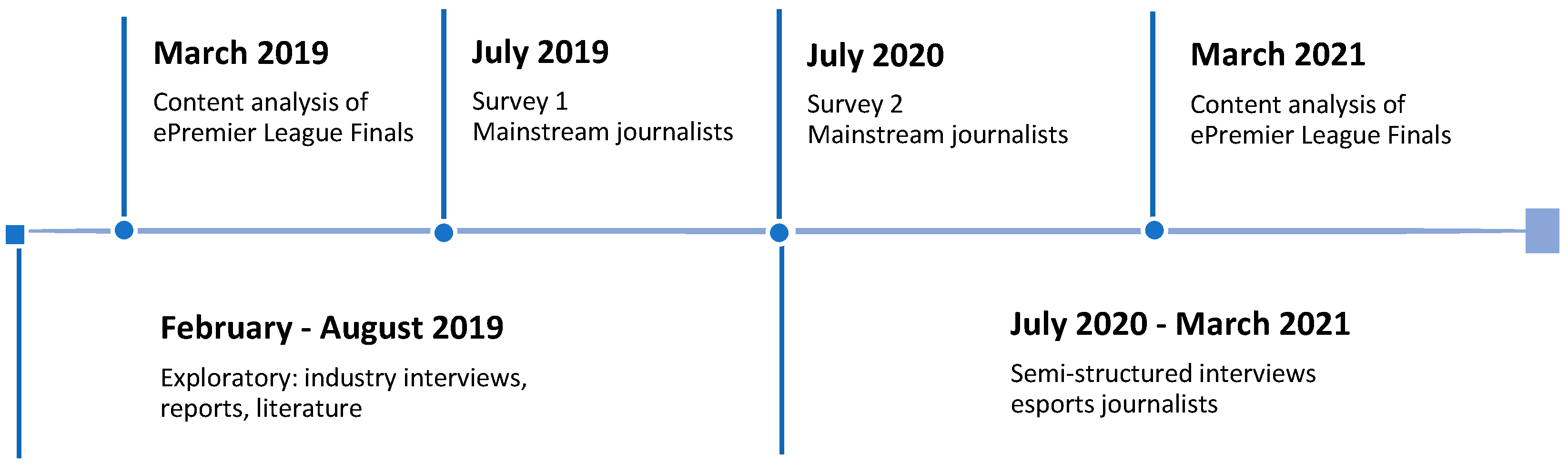
The project proceeded in four phases (Figure 1). An exploratory phase drew upon academic literature, industry reports, and interviews with industry experts to refine the research focus and identify key themes. The data collection incorporated three phases: content analysis, surveys, and semi-structured interviews.
Figure 1.
Timeline of Data Collection.
Each dataset was then analysed independently before a final stage of triangulation in which findings were compared and interpreted collectively. This design enables examination of journalism from multiple perspectives: institutional representations of esports within mainstream media, perceptions among journalists working in established news organisations, and the experiences of practitioners operating within esports media. The integration of these datasets strengthens analytical validity by allowing areas of convergence and divergence to be identified across different sources of evidence.
3.1. Content Analysis
Content analysis was employed to examine how esports was represented within UK mainstream media and how the ePremier League was positioned within a broader media ecosystem. As a systematic method of analysing communication (Krippendorff, 2019; Neuendorf, 2017), the method served three interconnected purposes: to assess the visibility of esports within mainstream journalism, to analyse the production and distribution of esports content across multiple media platforms, and to contextualise the experiences and perceptions reported by survey respondents and interview participants.
The analysis focused on mainstream newspaper and broadcaster websites identified through audience reach and market significance. The newspaper sample included the Metro, Daily Mail, Evening Standard, Daily Mirror, The Times, The Sun, The Telegraph, Daily Express, Daily Star, i, Financial Times, and The Guardian. The broadcaster sample comprised the BBC, ITV, Channel 4, Channel 5, Sky Sports, and BT Sport. The newspapers and broadcasters included in the content analysis were selected on the basis of audience reach using industry-standard readership and viewing data from the Publishers Audience Measurement Company (PAMCo, 2021) and the Broadcasters’ Audience Research Board (BARB, 2021). In total, 76 content items were collected and coded across the 2019 and 2021 tournament periods.
Coverage was monitored one day prior to the Finals, throughout the event, and one day following its conclusion. This generated a four-day analysis window for the 2019 Finals (27–30 March) and a six-day analysis window for the 2021 Finals (22–27 March). Searches were conducted using tournament-specific terms including “ePremier League”, “esports FIFA”, and related combinations, alongside searches of individual publisher websites.
Each item identified during the sampling period was manually coded using a structured coding schedule. Variables recorded included publication outlet, publication date, article type, byline attribution, content category, publication medium, article length, and the use of esports-related terminology.
3.2. Surveys of Mainstream Journalists
Two rounds of online surveys were conducted with journalists working for UK mainstream newspaper and broadcast organisations in 2019 and 2020. The surveys were designed to examine how journalists employed within established media organisations understood, categorised, and evaluated esports as an area of news coverage, thereby capturing institutional perspectives from journalists operating within mainstream news environments rather than the experiences of practitioners working with esports media, which were explored through the interviews. Participants were recruited through professional networks, LinkedIn, Twitter, direct email contact, and open social media distribution. A purposive sampling approach was adopted because no comprehensive sampling frame of UK journalists with knowledge of esports existed.
The 2019 survey generated 66 responses, while the 2020 survey generated 48 responses. Respondents represented a range of journalistic roles and organisational backgrounds, including newspaper, broadcast, sports, and general news journalism. The surveys did not collect personal demographic information such as age, gender, or ethnicity. Instead, they focused on respondents’ professional characteristics, including employment setting, publication medium, and area of journalistic practice, as these variables were considered most relevant to the study’s research questions. The surveys were not intended to produce statistically representative findings of the UK journalistic profession. Rather, they were designed to provide exploratory insight into how mainstream journalists perceived and positioned esports within existing editorial structures. Consequently, findings should be interpreted as indicative of attitudes within the sample rather than generalisable to the UK journalistic profession as a whole.
Core questions examined awareness of esports, perceptions of audience interest, editorial relevance, categorisation of esports content, and attitudes towards esports coverage. The surveys comprised a combination of closed-ended, Likert-scale, and open-ended questions. Quantitative responses were analysed using descriptive statistics, including frequencies and percentages, while responses to open-ended questions were reviewed thematically to provide additional context for the quantitative findings (Creswell, 2022).
3.3. Semi-Structured Interviews
The interview component comprised two stages: exploratory interviews with industry experts and semi-structured interviews with esports journalists. The exploratory phase consisted of four interviews with industry experts representing key areas of the esports sector: event management, broadcasting, football-esports integration, and journalism. Conducted during the early stages of the project, these interviews were used to refine the research design, identify emerging issues within the industry, and inform the development of the survey and interview instruments.
The primary qualitative dataset consisted of semi-structured interviews with esports journalists. Twenty journalists were invited to participate, of whom eight agreed to be interviewed. Participants were recruited through a combination of professional networks and snowball sampling, an approach considered appropriate given the relatively small and specialised nature of esports journalism in the UK. Interviewees represented a range of esports media organisations serving UK audiences, including dedicated esports publishers, specialist gaming outlets, and one participant working within a mainstream news organisation. The sample was designed to capture a range of perspectives across the UK esports journalism sector rather than to achieve statistical representativeness. Interviews examined career pathways, educational backgrounds, professional identities, working practices, relationships with mainstream media, perceptions of journalism, access to information, and the broader conditions under which esports journalism is produced.
Analysis was undertaken using NVivo and followed an iterative thematic coding approach. Initial open coding identified recurring concepts and patterns across the interview transcripts, which were subsequently grouped into broader thematic categories. Themes were refined through repeated comparison across the dataset to ensure analytical rigour (Maher et al., 2018).
3.4. Triangulation and Limitations
The study employed methodological triangulation by combining content analysis, surveys, and semi-structured interviews. Each method addressed a different dimension of the research problem and generated complementary forms of evidence. Content analysis examined how esports was represented and positioned within mainstream media coverage. Surveys captured the perceptions and attitudes of journalists working within mainstream news organisations, while interviews explored the experiences, identities, and working practices of journalists operating within esports media.
The research design was intended to be exploratory rather than representative. Several limitations should therefore be acknowledged. First, the interview sample was relatively small, consisting of eight participants drawn from a specialised area of journalism. While the sample included journalists from several major esports publishers and one mainstream media organisation, it cannot be considered representative of all esports journalists. The findings instead provide insight into a particular segment of the field during the period under investigation.
Second, the survey samples were obtained through purposive and voluntary participation rather than probability sampling. As a result, the findings cannot be generalised to the wider population of UK journalists. The survey data are best understood as indicative of attitudes and perceptions among participating journalists rather than representative measures of the profession as a whole.
Third, the study focused on a single esports title and competition: the ePremier League and EA Sports’ FIFA Series. This was a deliberate methodological choice intended to provide depth, consistency, and comparability across datasets. However, esports encompasses a diverse range of games, communities, and organisational structures, and caution should therefore be exercised when extending the findings to other esports genres or international contexts.
Finally, the study does not claim that developments observed within esports journalism are representative of journalism as a whole. Rather, esports journalism is treated as an analytical case through which broader debates concerning professional identity, platformisation, creator labour, and processes of de-professionalisation can be examined.
Ethical approval for this study was granted by London South Bank University. Written consent was obtained from all interview participants prior to data collection. Participants were informed of the study, their right to withdraw, and the intended use of the research findings. They were also given the option of remaining anonymous or being identified by name for subsequent publications. Participants cited by name in this article explicitly provided written consent for their identities to be disclosed. Signed consent forms are retained by the author in accordance with the University’s research governance procedures.
4. Results
4.1. Institutional Recognition and Mainstream Media Engagement
The content analysis and survey findings reveal a substantial disconnect between the growth of esports as a cultural and commercial phenomenon and its recognition within mainstream UK journalism. Despite increasing public visibility and industry investment, esports remains a marginal area of coverage for most mainstream news organisations and has not secured a stable position within established editorial structures.
Analysis of mainstream media content demonstrates that coverage of esports remains limited across both newspapers and broadcasters. Broadcasters produced approximately 50% more esports-related content than newspapers, although coverage was concentrated among a small number of organisations and remained negligible when compared with traditional sports coverage. Sky Sports produced the highest volume of general esports content, with approximately 12,500 items identified during the research period, followed by the BBC with approximately 9500 items. However, these figures remain modest when compared with football coverage, where Sky Sports alone hosted more than 21 million football-related items over a comparable period. These findings indicate that esports occupies a peripheral rather than established position within mainstream journalism.
Significant differences also emerged in how mainstream organisations approached esports coverage. Broadcasters focused predominantly on sports-simulated esports, particularly FIFA, while newspapers covered a broader range of titles. Across broadcaster websites, FIFA-related content accounted for approximately 83% of all esports coverage. This suggests that esports receives greatest editorial attention when it can be aligned with existing sporting frameworks and audiences rather than being treated as a distinct reporting beat.
The ePremier League provided an important test case because it combined the familiarity of Premier League football with competitive gaming. This made it reasonable to expect that, if any esports competition was likely to attract sustained mainstream journalistic attention, it would be one associated with one of the UK’s most commercially successful sporting brands. However, coverage remained limited, with only 15 articles published during the 2019 Finals and 22 during the 2021 Finals. No publisher produced more than single-digit coverage during either event, and more than half of the organisations covering the tournament in 2019 did not repeat their coverage in 2021. These findings suggest that even esports most closely aligned with traditional sport struggled to establish itself as a routine subject of mainstream journalism.
Survey findings indicate that this marginal position cannot be explained solely by a lack of awareness. Awareness of the term ‘esports’ among mainstream journalists increased from 78% in 2019 to 90% in 2020. However, greater awareness was not accompanied by greater editorial investment. Instead, the findings point towards uncertainty regarding how esports should be understood within existing newsroom structures.
This uncertainty was evident in both the content analysis and survey data. Publishers categorised esports content in a variety of ways, including sport, gaming, technology, entertainment, business, football, science, and market content. Similarly, survey respondents most commonly classified esports as sport (35.5%), followed by gaming (22%) and technology (19%). By contrast, esports journalists interviewed for this study rarely described their work as sports journalism. Instead, they most frequently framed esports journalism as business or entertainment journalism, reflecting the commercial structures and audience cultures of the sector. Notably, the only interview participant to categorise esports journalism as sport was the sole respondent employed by a mainstream publisher.
These findings suggest that esports is not simply under-represented within mainstream journalism but institutionally unsettled. Different organisations and practitioners understand the field through different professional lenses, resulting in competing definitions of what esports journalism is and where it belongs. This lack of categorical stability may help explain why awareness of esports has increased without producing a corresponding increase in dedicated coverage or specialist reporting.
A further discrepancy emerged between journalists’ perceptions of esports coverage and the reality of newsroom investment. Across the survey data, 37% of respondents believed that their organisation employed a dedicated esports journalist. Content analysis, however, identified only one dedicated esports journalist across the newspaper and broadcast organisations included in the sample.
Analysis of coverage surrounding the ePremier League Finals further illustrates the limited level of journalistic resource allocated to the sector. Across both tournament periods, only four named journalists were identified: two covering the Finals in 2019 and two in 2021. The majority of content published during both events was unattributed. In 2019, 53% of all coverage relating to the Finals was produced by a single journalist. However, only one of that journalist’s five articles (20%) contained original reporting in the form of interviews. The remaining content consisted primarily of match reports, tournament summaries, and event information. The pattern became even more pronounced in 2021, when only two of the 22 articles published across mainstream media outlets were attributed to named journalists. Consequently, fewer than 10% of articles covering the Finals in 2021 contained evidence of original reporting.
Taken together, these findings suggest that mainstream media engagement with esports is characterised by low levels of dedicated journalistic investment (see Table 1). While awareness of esports has increased among journalists, newsroom commitment in the form of specialist reporters, original reporting, and sustained coverage remains limited. The contrast between perceptions of newsroom investment and the empirical evidence of coverage points towards a broader process of institutional misrecognition. Esports is increasingly visible within journalism, yet it has not secured a stable position within newsroom structures or attracted the resources typically associated with established reporting beats. As a result, esports journalism continues to develop largely outside mainstream institutional structures, creating conditions in which alternative forms of journalistic labour and professional identity can emerge.
Table 1.
Indicators of Mainstream Media Investment in esports Journalism.
4.2. Professional Identity and Entry Pathways
A central finding of this study concerns the divergence between journalistic practice and professional identity within esports media. Although all interview participants engaged in activities conventionally associated with journalism—including reporting, interviewing, attending events, producing news content, and monitoring industry developments—only two participants identified themselves as journalists. Most preferred labels such as writer, editor, or content creator, while several expressed stronger identification with esports communities than with journalism as a profession.
This distinction was reflected in the pathways through which participants entered the sector. Most participants reported backgrounds in blogging or community-based content creation prior to securing paid work, and references to writers and bloggers were considerably more common than references to journalists. These findings suggest that professional legitimacy within esports journalism derives less from institutional affiliation and more from specialist knowledge, community participation, and audience engagement.
The educational and professional backgrounds of participants further distinguish esports journalism from mainstream journalism. Most of the participants reported having no formal journalism education, with most entering the sector without prior professional journalism experience. This contrasts sharply with established pathways into mainstream journalism. Newman (2016) found that 98% of new entrants held an undergraduate journalism degree and 36% possessed a Master’s qualification, while 87% had completed a period of industry work experience before entering the profession (Spilsbury, 2018).
Interview data indicate that many participants acquired journalistic skills through practical experience and self-directed learning rather than formal training. As Fitch explained, he entered esports journalism with “very limited writing and journalism experience” (Fitch, interview, 8 July 2020). Murray similarly described teaching himself basic reporting practices:
“I had to Google how to do transcription the first time I got an interview and for the first several years I was doing email interviews only because I didn’t know how to record a phone interview.”(Murray, interview, 3 December 2020).
Rather than progressing through established educational and occupational routes, participants frequently developed expertise through participation in gaming communities and the production of digital content. The educational, professional, and occupational backgrounds of the interview participants are summarised in Table 2. These accounts point towards alternative forms of professional socialisation in which knowledge is acquired through practice, participation, and community engagement.
Table 2.
Background Characteristics of esports Journalists.
The study also revealed important differences in how esports journalists understand the nature of their work. Several participants primarily described esports journalism as business journalism, reflecting the sector’s close relationship with sponsorship, investment, media rights, and commercial partnerships. Others framed their work as entertainment or news journalism. Only one participant—the sole interviewee employed by a mainstream publisher—identified esports journalism primarily as sport journalism.
This contrasts with the survey findings. Across the two survey waves, mainstream journalists most frequently categorised esports as sport (35.5%), followed by gaming (21.5%) and technology (19%). Only 4% classified esports as business journalism, while none selected entertainment as the primary category. These findings suggest that mainstream journalists and esports journalists often operate with fundamentally different understandings of what esports journalism is and where it belongs within existing editorial structures.
4.3. Labour Conditions and Hybrid Roles
The interview findings indicate that esports journalism is characterised by labour conditions more closely aligned with digital creator work than conventional newsroom employment. Participants consistently described a working environment marked by economic insecurity, freelance employment, and the need to undertake multiple roles simultaneously. Rather than occupying clearly defined journalistic positions within established organisations, many worked within small media businesses, independent outlets, or precarious freelance arrangements.
Low levels of pay emerged as a recurring concern. Participants frequently described esports journalism as difficult to sustain financially, particularly during the early stages of a career. Several explained that journalism functioned as a secondary source of income alongside other forms of work, while most participants identified low pay and the scarcity of full-time employment as significant barriers to career development. As Stubbs explained:
“If it wasn’t for me working for mainstream outlets which pay proper journalists’ rates, then I wouldn’t be able to do this full-time”(Stubbs, interview, 22 July 2020).
Participants also highlighted how economic constraints affected reporting practices. As Stubbs observed:
“[It’s] not just being paid to survive, but also having the money to get to events. Access remotely is quite difficult to get if you’re not necessarily top tier. If you haven’t been around for years and have got the contacts to email, then who trusts you? If you’re not in that elite group, then unfortunately, getting access to the players who ultimately the entire industry is driven around … they are where the stories are”(Stubbs, interview, 22 July 2020).
This suggests that financial insecurity affects more than individual livelihoods. Limited resources may also restrict opportunities to build professional networks, gain access to sources, and undertake forms of reporting that depend upon sustained industry engagement.
The findings also reveal limited engagement with formal mechanisms of professional representation. References to union membership, collective bargaining, professional accreditation, or industry-wide pay standards were largely absent from the interviews. Instead, support networks were more likely to emerge through personal contacts, online communities, and industry relationships rather than through organisations such as the National Union of Journalists.
A further finding concerns the overlap between editorial and commercial work. Almost all participants reported responsibilities extending beyond journalism to include marketing, social media management, sponsored content, audience development, event promotion, and public relations activities. Journalistic work was therefore frequently embedded within broader content production strategies rather than existing as a distinct occupational function. As Fitch explained:
“I work with writers to come up with ideas, as well as taking pitches and trying to develop them … ensuring that it’s the best for both parties, both [the publication] and the writer. Then there’s a little bit on events, when it comes to events promo, and writing our PRs and announcements”(Fitch, interview, 8 July 2020).
These overlapping responsibilities were reflected in the production of journalistic content. Participants frequently reported reliance on press releases, publisher announcements, and officially distributed information because limited resources constrained opportunities for independent reporting, travel, and source development. As one participant observed:
“A lot of the news is based on announcements because that’s what people have the time and resources to cover.”
4.4. Access, Autonomy and Information Control
A recurring theme across the interviews was the extent to which access to information within esports is controlled by commercial actors. Participants described an environment in which access to players, teams, tournaments, and industry stakeholders was frequently mediated by publishers, tournament organisers, and commercial partners. Attendance at events, opportunities to conduct interviews, and access to industry representatives often depended upon maintaining positive relationships with these organisations, creating a tension between journalistic independence and professional survival.
As Ashton explained:
“Publishers have refused to take questions from journalists because they didn’t like the fact that they leaked information, or they wrote something negative about them. And they’ve barred certain journalists from attending their events for whatever reason. And this, I feel, means that esports journalism is very much behind sports journalism with the type of stories we can write …”(Ashton, interview, 10 July 2020).
Participants also highlighted the implications of these relationships for investigative reporting. As Patterson observed:
“A lot of esports journalism now is just copy-and-paste press releases. And, as we know, press releases are generally just PR … which is fine, and I don’t think there’s any problem with esports journalism being positive about esports … But I think that there’s a lot of friendships going on that lead to some bad stuff … some shady stuff going on that doesn’t get addressed”(Patterson, interview, 4 December 2020).
Interviewees reported that media access was commonly organised through press officers and event managers, with interactions often taking place within tightly managed communication environments. Publishers frequently operated simultaneously as tournament organisers, rights holders, and information gatekeepers, limiting opportunities for independent source development and investigative work. Resource constraints further reinforced this pattern. Participants described a reliance on press releases, publisher announcements, and other forms of industry-generated information because limited budgets and small editorial teams restricted opportunities for sustained reporting. As one participant explained: “Most outlets don’t have the resources to spend weeks investigating something.”
Although participants identified issues within esports that warranted greater scrutiny—including governance, labour conditions, publisher influence, and audience measurement—few believed that the sector currently possessed the resources or institutional support necessary to sustain investigative journalism.
5. Discussion
5.1. De-Professionalisation and the Weakening of Occupational Boundaries
The findings provide evidence that many of the institutional mechanisms traditionally associated with professional journalism are weakened within esports media. Participants entered the field through informal routes, few possessed journalism qualifications, engagement with professional bodies was limited, and only 25% identified themselves as journalists despite routinely undertaking journalistic work. These findings support arguments that journalism is increasingly being practised beyond the institutional frameworks that historically regulated professional identity and authority.
These interpretations should be understood within the scope of the present study. The findings are drawn from a small sample of UK esports journalists and a single esports case, and therefore do not demonstrate that comparable processes occur across journalism more generally. Rather, they suggest that de-professionalisation provides a useful interpretive framework for understanding this particular sector while offering propositions for future comparative research.
This aligns with Freidson’s (2001) conception of de-professionalisation as the weakening of occupational autonomy and professional control. Professional status has traditionally been maintained through mechanisms such as specialised education, accreditation, professional associations, and shared standards of practice. Within esports journalism, however, these mechanisms appear considerably less influential. Journalistic work continues to be performed, but the institutional structures through which journalism has historically been recognised are less visible.
The findings also support concerns raised by Splichal and Dahlgren (2016), who argue that journalism’s professional authority is increasingly challenged by technological and economic transformations. The expansion of digital publishing and platform-based media has widened participation in news production while simultaneously weakening traditional forms of occupational closure. In the case of esports journalism, entry is determined less by professional credentials and more by community participation, subject expertise, and digital visibility.
The findings further suggest that these processes are shaped by the institutional ambiguity surrounding esports itself. As discussed by Chiu (2025) and Siuda et al. (2024), esports occupies an uncertain position between sport, entertainment, technology, and industry. Similar uncertainty was evident within the present study, where publishers, mainstream journalists, and esports journalists categorised esports in markedly different ways. The absence of a stable understanding of what esports is may help explain the absence of stable professional expectations regarding who should report on it and how that reporting should be organised.
Importantly, the findings suggest that de-professionalisation is not simply a labour-market phenomenon. Consistent with Heylen et al. (2020), the erosion of professional boundaries also affects the normative foundations of journalism. Limited engagement with formal journalism education, ethical frameworks, and professional organisations raises questions about how standards of accountability, verification, and public service are maintained when institutional forms of professional socialisation are absent.
5.2. Professional Identity in Creator-Oriented Media Environments
A particularly significant finding concerns the divergence between journalistic practice and journalistic identity. Although participants routinely engaged in reporting, interviewing, and news production, most preferred labels such as writer, editor, or content creator rather than journalist. This suggests that, within the organisational contexts examined, professional identity is becoming increasingly detached from the performance of journalistic work. However, this divergence should be interpreted as characteristic of the participants and organisational contexts examined rather than as representative of all specialist or digital journalism. Further comparative research is needed to establish the extent to which similar identity constructions are evident in other journalistic fields.
These findings resonate with recent scholarship on creator economies and platform labour. Harlow (2024) argues that the distinction between journalists and content creators is becoming increasingly blurred as both groups operate across the same platforms and engage in similar forms of audience-oriented production. The esports journalists interviewed here appear to occupy precisely this hybrid position. Their legitimacy derives not from institutional affiliation but from participation within gaming communities, subject expertise, and audience engagement. This emphasis reflects observations within esports scholarship that authority within the field is often derived from participation in esports communities rather than from formal institutional credentials (Torres-Toukoumidis et al., 2023). In this respect, esports journalists appear to gain legitimacy through proximity to the culture and industry they cover rather than through traditional markers of journalistic professionalism.
Similarly, Salamon et al. (2026) identify a broader transformation in which journalism operates within creator economies governed by visibility, engagement metrics, and platform infrastructures. The findings of this study suggest that esports journalism exemplifies this broader transformation. Participants did not necessarily reject journalism as a practice; rather, they rejected traditional occupational definitions of journalism that no longer reflected their working realities.
This helps explain one of the central paradoxes identified by the study. While journalism continues to expand as a practice, its value as a professional identity appears less certain. Individuals continue to perform journalistic functions, yet many no longer understand themselves through the occupational categories historically associated with those activities.
5.3. Hybrid Professionalism and the Reconfiguration of Journalistic Work
While the findings support aspects of de-professionalisation theory, they also suggest that narratives of professional decline are insufficient on their own. Participants frequently combined reporting with social media management, sponsorship activity, audience development, marketing, and community engagement. These hybrid roles challenge traditional distinctions between editorial and commercial work, but they do not necessarily indicate the disappearance of professionalism.
Here, Noordegraaf’s (2007) concept of hybrid professionalism offers a useful alternative interpretation. Rather than viewing professional change as a process of erosion, Noordegraaf argues that professional work increasingly adapts to organisational, commercial, and technological pressures. Professionalism becomes reconfigured rather than eliminated.
The esports journalists in this study appear to embody this form of hybrid professionalism. Their work combines journalistic, entrepreneurial, and creator-oriented functions within a single occupational role. While traditional newsroom structures are often absent, participants continue to produce news, cultivate sources, and provide information for specialist audiences. Professional expertise therefore persists, albeit in forms that differ from those associated with institutional journalism.
5.4. Platform Dependency, Access, and Journalistic Autonomy
The study also highlights the extent to which platform and industry dependencies shape contemporary journalistic practice. Participants described environments in which access to information was controlled by publishers and tournament organisers, while economic constraints encouraged reliance on official communications and press releases.
These conditions reinforce concerns regarding professional autonomy. Freidson (2001) identifies autonomy as one of the defining characteristics of professional work. Yet within esports journalism, access is frequently conditional and dependent upon maintaining relationships with the organisations being reported on. The resulting tensions between access and independence mirror wider concerns regarding platform governance and creator labour identified by Salamon et al. (2026). These findings demonstrate how platform dependency operated within the organisations included in this study. However, because the research focuses on a specific esports ecosystem, the extent to which similar dynamics characterise other specialist journalism sectors requires further investigation.
At the same time, the findings illustrate the adaptive strategies described by Bélair-Gagnon et al. (2026). Participants continually negotiated platform systems, audience expectations, and commercial relationships in order to sustain their work. Such forms of adaptation increasingly function as professional competencies in their own right. However, they also create environments in which journalistic independence is more difficult to sustain, particularly where investigative reporting requires resources and institutional support that many esports outlets lack.
5.5. Rethinking Journalism Beyond Institutional Recognition
The esports case suggests that debates concerning journalistic professionalism may be inseparable from broader questions of institutional legitimacy. Existing esports scholarship has highlighted uncertainty regarding how esports itself should be categorised and understood (Chiu, 2025; Siuda et al., 2024). The present findings indicate that this uncertainty extends beyond the activity being reported and into journalism itself. Competing understandings of esports as sport, entertainment, technology, or business were reflected not only in media coverage but also in how journalists understood their own work, influencing newsroom investment, professional identity, and the allocation of journalistic resources.
These findings suggest that questions of professional recognition cannot be separated from questions of classification. The difficulty of determining where esports belongs within existing cultural and institutional frameworks appears to shape where esports journalism belongs within newsroom structures and professional hierarchies. Recognition therefore becomes a question not only of who is considered a journalist, but also of how the subject being reported is understood and valued.
These findings provide an important counterpoint to those of Bélair-Gagnon et al. (2026). Their study found that journalists working in social media roles actively distinguished themselves from creators and influencers in order to preserve their professional legitimacy as journalists. By comparison, participants in the present study frequently performed journalistic work while rejecting or downplaying the identity of ‘journalist’. Together, these findings suggest that boundary work (Carlson, 2016) is not uniform across platform-based journalism but varies according to organisational context, professional trajectories, and the institutional recognition afforded to different forms of newswork.
In this respect, esports journalism provides a useful analytical lens through which broader transformations in journalism can be explored. While this study cannot determine the prevalence of these dynamics beyond the case examined, it suggests that questions of professional recognition are increasingly shaped by changing institutional arrangements, platform-based media environments, and the classification of new forms of journalistic work.
6. Conclusions
This study examined how journalism is practised beyond traditional institutional settings through the case of esports journalism in the United Kingdom. Drawing on content analysis, surveys of mainstream journalists, and interviews with esports journalists, it explored questions of professional identity, labour conditions, and journalistic authority within an emerging field of media work.
In relation to RQ1, the findings suggest that, within the UK esports journalism context examined, journalism is increasingly practised outside the institutional frameworks that have historically defined the profession. Esports coverage is produced largely by specialist publishers, freelancers, and community-based outlets rather than by mainstream news organisations. News production takes place within digitally networked environments characterised by platform dependency, direct audience engagement, and close relationships between journalists, creators, and industry stakeholders. Journalism therefore continues to be practised, but often beyond the organisational structures traditionally associated with professional newswork.
In relation to RQ2, the findings indicate, among the participants in this study, a divergence between journalistic practice and professional identity. Although participants routinely performed core journalistic functions, only a minority identified themselves as journalists. Most entered the field through informal pathways such as blogging, community participation, and content creation rather than through accredited journalism education or established newsroom routes. Professional legitimacy was therefore derived less from institutional recognition than from specialist expertise, audience engagement, and participation within esports communities.
In relation to RQ3, the findings suggest that the esports journalism sector examined here is characterised by labour conditions more commonly associated with creator economies than with traditional journalism. Participants frequently worked in freelance roles, combined editorial and commercial responsibilities, and operated within environments where access to information was controlled by publishers and tournament organisers. These conditions create challenges for journalistic autonomy and accountability while simultaneously reshaping the forms of journalism that become possible.
The study has several limitations. It focuses on a single esports title and a relatively small interview sample and therefore does not claim to represent all esports journalism or journalism more broadly. Rather, esports journalism is treated as an analytical case through which wider processes of professional change can be examined. Future research could build on this work through comparative studies involving mainstream journalists, esports journalists, and creator-led media practitioners. Such research would help establish whether the dynamics identified here are distinctive to esports journalism or indicative of broader transformations occurring across contemporary journalism.
Ultimately, the central challenge identified is how journalistic authority, professional identity, and standards of practice are maintained within increasingly decentralised and platform-based media environments. Esports journalism suggests that the future of journalism will not be defined by established institutions, but by the evolving relationship between professional practice, creator labour, platform governance, and audience communities. Understanding this relationship will be essential for explaining how professional identity, authority, and journalistic labour are being reconfigured in the platform age.
Funding
This research received no external funding.
Institutional Review Board Statement
The study was conducted in accordance with the Declaration of Helsinki, and approved by the Ethics Committee of London South Bank University School of Arts and Creative Industries (ETH1819-0062, 19 February 2019).
Informed Consent Statement
Informed consent was obtained from all subjects involved in the study.
Data Availability Statement
The data presented in this study are not publicly available. Although participants provided consent to be identified in published quotations, the underlying interview transcripts and survey data are not publicly shared because consent for unrestricted public release of the complete dataset was not obtained.
Conflicts of Interest
The author declare no conflicts of interest.
References
- Abbott, A. (1988). The system of professions: An essay on the division of expert labor. University of Chicago Press. [Google Scholar]
- Allied Market Research. (2023). Esports market size, share & industry trends analysis report. Available online: https://www.alliedmarketresearch.com/esports-market-A14210 (accessed on 30 March 2026).
- Bélair-Gagnon, V., Salamon, E., & Crawford, M. (2026). Coping as a competency: A typology of journalists and news creators work on platforms. Journalism. Advance online publication. [Google Scholar] [CrossRef] [Scilit]
- Broadcasters’ Audience Research Board. (2021, December). Monthly viewing summary. BARB. [Google Scholar]
- Carlson, M. (2016). Journalistic authority: Legitimating news in the digital era. Columbia University Press. [Google Scholar]
- Chiu, A. (2025). An industry or a sport: Media framing of esports development in Hong Kong. Social Transformations in Chinese Societies, 21(1), 97–108. [Google Scholar] [CrossRef] [Scilit]
- Creswell, J. W. (2022). A concise introduction to mixed methods research. Sage. [Google Scholar]
- Deuze, M. (2005). What is journalism? Professional identity and ideology of journalists reconsidered. Journalism, 6(4), 442–464. [Google Scholar] [CrossRef] [Scilit]
- Felczak, M. (2023). Systemic issues with narratives of identity: Toxicity and esports media professionals. Convergence: The International Journal of Research into New Media Technologies, 29(2), 400–416. [Google Scholar] [CrossRef] [Scilit]
- Filotrani, L. (2023). Mainstream media coverage (UK) of esports tournament the “ePremier League” finals 2019 and 2021: A mixed-methods study [Doctoral dissertation, London South Bank University]. [Google Scholar] [CrossRef]
- Freidson, E. (2001). Professionalism: The third logic. University of Chicago Press. [Google Scholar]
- Harlow, S. (Ed.). (2024). Content creators and journalists: Redefining news and credibility in the digital age. Knight Center for Journalism in the Americas, University of Texas at Austin; UNESCO. Available online: https://knightcenter.utexas.edu/wp-content/uploads/2024/10/Content-Creator-and-Journalists.pdf (accessed on 20 March 2026).
- Harris, B. C., Hansen, J., Can, O., Rahman, M. W. U., Foxman, M., Cote, A. C., & Fickle, T. (2022). Starting from scratch to looking really clean and professional: How students’ productive labor legitimizes collegiate esports. Critical Studies in Media Communication, 39(2), 141–153. [Google Scholar] [CrossRef] [Scilit]
- Heylen, F., Willems, E., & Beyers, J. (2020). Do professionals take over? Professionalisation and membership influence in civil society organisations. Voluntas: International Journal of Voluntary and Nonprofit Organizations, 31(6), 1226–1238. [Google Scholar] [CrossRef] [Scilit] [PubMed]
- House of Commons Digital, Culture, Media and Sport Committee. (2023). Sustainability of local journalism (Seventh Report of Session 2022–23, HC 153). Available online: https://publications.parliament.uk/pa/cm5803/cmselect/cmcumeds/153/report.html (accessed on 19 July 2026).
- Johnson, M. R., & Woodcock, J. (2021). Work, play, and precariousness: An overview of the labour ecosystem of esports. Media, Culture & Society, 43(8), 1447–1465. [Google Scholar] [CrossRef] [Scilit]
- Krippendorff, K. (2019). Content analysis: An introduction to its methodology (4th ed.). SAGE. [Google Scholar]
- Maher, C., Hadfield, M., Hutchings, M., & de Eyto, A. (2018). Ensuring rigor in qualitative data analysis: A design research approach to coding combining NVivo with traditional material methods. International Journal of Qualitative Methods, 17(1), 1–13. [Google Scholar] [CrossRef] [Scilit]
- Neuendorf, K. A. (2017). The content analysis guidebook (2nd ed.). SAGE. [Google Scholar]
- Newman, N. (2016). Reuters institute digital news report 2016. Reuters Institute for the Study of Journalism. [Google Scholar]
- Nieborg, D. B., & Poell, T. (2018). The platformization of cultural production: Theorizing the contingent cultural commodity. New Media & Society, 20(11), 4275–4292. [Google Scholar] [CrossRef] [Scilit]
- Noordegraaf, M. (2007). From “pure” to “hybrid” professionalism: Present-day professionalism in ambiguous public domains. Administration & Society, 39(6), 761–785. [Google Scholar] [CrossRef] [Scilit]
- Ofcom. (2022). Media nations UK 2022. Ofcom. [Google Scholar]
- Office for National Statistics. (2025). Labour market overview, UK: January 2025. Available online: https://www.ons.gov.uk/employmentandlabourmarket/peopleinwork/employmentandemployeetypes/bulletins/uklabourmarket/january2025 (accessed on 30 March 2026).
- Office for Students. (2023). Financial sustainability report 2023. Office for Students. Available online: https://www.officeforstudents.org.uk/ (accessed on 30 March 2026).
- Perreault, G., & Vos, T. P. (2019). Metajournalistic discourse on the rise of gaming journalism. New Media & Society, 22(1), 159–176. [Google Scholar] [CrossRef] [Scilit]
- Publishers Audience Measurement Company. (2021). PAMCo 4 bridge: PWC assured monthly global reach (MGR) 2020. PAMCo. [Google Scholar]
- Salamon, E., Bélair-Gagnon, V., & Crawford, M. (2026). Journalism and social media in creator economies: Evolving structures and labor. New Media & Society. Advance online publication. [Google Scholar] [CrossRef] [Scilit]
- Scott, M. J., Summerley, R., Besombes, N., Connolly, C., Gawrysiak, J., Halevi, T., Jenny, S. E., Miljanovic, M., Stange, M., Taipalus, T., & Williams, J. P. (2021). Foundations for esports curricula in higher education. In Proceedings of the 2021 working group reports on innovation and technology in computer science education (ITiCSE-WGR ‘21) (pp. 27–55). Association for Computing Machinery. [Google Scholar] [CrossRef] [Scilit]
- Sherrill, L. A., Broussard, R., Johnson, R., & Funk, M. (2025). Isomorphism and assemblage: Developing legitimacy in the esports podcast ecosystem. New Media & Society. Advance online publication. [Google Scholar] [CrossRef] [Scilit]
- Siuda, P., Jasny, M., Mańkowski, D., & Sitek, M. (2024). The problematic nature of evaluating esports’ “genuineness” using traditional sports’ criteria: In-depth interviews with traditional sports and electronic sports journalists. Leisure Studies, 43(2), 235–248. [Google Scholar] [CrossRef] [Scilit]
- Spilsbury, M. (2018). Journalists at work. National Council for the Training of Journalists. [Google Scholar]
- Splichal, S., & Dahlgren, P. (2016). Journalism between de-professionalisation and democratisation. European Journal of Communication, 31(1), 5–18. [Google Scholar] [CrossRef] [Scilit]
- Standing, G. (2011). The precariat: The new dangerous class. Bloomsbury Academic. [Google Scholar]
- Statista. (2023). Global esports audience size from 2020 to 2025. Available online: https://www.demandsage.com/esports-statistics/ (accessed on 30 March 2026).
- Taylor, T. L. (2015). Raising the stakes: E-sports and the professionalization of computer gaming. MIT Press. [Google Scholar]
- Torres-Toukoumidis, A., Marín-Gutiérrez, I., & Caldeiro Pedreira, M. C. (2023). Communication experts’ perspective on esports. In A. Torres-Toukoumidis (Ed.), Esports and the media: Challenges and expectations in a multi-screen society (pp. 104–112). Routledge. [Google Scholar] [CrossRef] [Scilit]
- University of Kent. (2024). Future plans for Kent. Available online: https://www.kent.ac.uk/news/statements/34743/future-plans-for-kent-2 (accessed on 30 March 2026).
- Waisbord, S. (2013). Reinventing professionalism: Journalism and news in global perspective. Polity Press. [Google Scholar]

Disclaimer/Publisher’s Note: The statements, opinions and data contained in all publications are solely those of the individual author(s) and contributor(s) and not of MDPI and/or the editor(s). MDPI and/or the editor(s) disclaim responsibility for any injury to people or property resulting from any ideas, methods, instructions or products referred to in the content. |
© 2026 by the author. Licensee MDPI, Basel, Switzerland. This article is an open access article distributed under the terms and conditions of the Creative Commons Attribution (CC BY) license.