
TikTok Influencers and Brand Communication in Türkiye: A Qualitative Study from a Corporate Communication Perspective



Abstract
1. Introduction
- RQ1. What communication advantages does TikTok offer to brands in terms of audience engagement, access to young audiences, and differences from traditional media?
- RQ2. What kinds of strategic contributions do TikTok influencers provide to institutions?
- RQ3. What platform-related and collaboration-related challenges do influencers encounter during TikTok brand partnerships?
- RQ4. How do brands evaluate and optimize the outcomes of TikTok influencer collaborations?
2. Materials and Methods
2.1. Participant Selection and Data Analysis
2.2. Limitations of the Study
2.3. Validity and Reliability
3. Results and Discussion
3.1. Strategic Contributions of TikTok Influencers to Brands
3.2. Main Challenges Encountered in Collaboration Processes
3.3. Benefits Brands Receive from TikTok Deals
4. Conclusions
Author Contributions
Funding
Institutional Review Board Statement
Informed Consent Statement
Data Availability Statement
Conflicts of Interest
References
- Akpınar, M. E. (2021). TikTok akımlarinin sosyal medyadaki eleştirisi: Twitter üzerinden yapilan eleştirilerin incelenmesi [The criticism of TikTok trends on social media: An examination of the criticism made through twitter]. 19 Mayıs Sosyal Bilimler Dergisi, 2(2), 363–381. [Google Scholar] [CrossRef]
- Anderson, K. E. (2020). Getting acquainted with social networks and apps: It is time to talk about TikTok. Library Hi Tech News, 37(4), 7–12. [Google Scholar] [CrossRef]
- Annabell, T., Bishop, S., & Goanta, C. (2025). You and TikTok are, and will remain at all times, independent contractors. Internet Policy Review, 14(3). [Google Scholar] [CrossRef]
- Arastaman, G., Öztürk Fidan, İ., & Fidan, T. (2018). Nitel araştırmada geçerlik ve güvenirlik: Kuramsal bir inceleme [Validity and reliability in qualitative research: A theoretical review]. Van Yüzüncü Yıl Üniversitesi Eğitim Fakültesi Dergisi, 15(1), 37–75. [Google Scholar] [CrossRef]
- Audrezet, A., de Kerviler, G., & Moulard, J. (2020). Authenticity under threat: When social media influencers need to go beyond self-presentation. Journal of Business Research, 117, 557–569. [Google Scholar] [CrossRef]
- Bahçecioğlu, E. H. (2023). Popüler kültür odağında sosyal medyada akım trafiği: TikTok örneği [Trend traffic on social media from the perspective of popular culture: The case of TikTok]. Etkileşim-Üsküdar Üniversitesi İletişim Fakültesi Akademik Dergisi, 6(12), 426–454. [Google Scholar] [CrossRef]
- Baltacı, A. (2019). Nitel araştırma süreci: Nitel bir araştırma nasıl yapılır? [The qualitative research process: How is qualitative research conducted?]. Ahi Evran Üniversitesi Sosyal Bilimler Enstitüsü Dergisi, 5(2), 368–388. [Google Scholar] [CrossRef]
- Barta, S., Belanche, D., Fernández, A., & Flavián, M. (2023). Influencer marketing on TikTok: The effectiveness of humor and followers’ hedonic experience. Journal of Retailing and Consumer Services, 70, 103149. [Google Scholar] [CrossRef]
- Batu, M., & Kayacan, Ş. (2023, May 5–7). Sosyal medya influencerlarının kurumsal algıya etkisi üzerine nitel bir çalışma: Trendyol influencerları [A qualitative study on the effect of social media influencers on corporate perception: The case of trendyol influencers]. 8th International Asian Congress on Contemporary Sciences, London, UK. Available online: https://www.researchgate.net/publication/393177384_Internet_Teknolojilerinin_Kumar_Faaliyetlerine_Etkisi_Cevrimici_Kumar_Uzerine_Bir_Arastirma (accessed on 25 July 2026).
- Bendaş, K. (2022). Dijitalleşen dünyada medyanın dönüşümü: Geleneksel medyadan yeni medyaya geçiş ve Türkiye’de internet haberciliği [The transformation of media in a digitalizing world: The transition from traditional media to new media and internet journalism in Türkiye]. Anasay, (22), 373–396. [Google Scholar] [CrossRef]
- Borchers, N. S. (2019). Social media influencers in strategic communication: A conceptual framework for strategic social media influencer communication. International Journal of Strategic Communication, 13(4), 261–277. [Google Scholar] [CrossRef]
- Böyük, M. (2025). User data and digital privacy: Privacy policies of social media platforms. The Turkish Online Journal of Design Art and Communication, 15(1), 225–239. [Google Scholar] [CrossRef]
- Cheng, Z., & Li, Y. (2024). Like, comment, and share on TikTok: Exploring the effect of sentiment and second-person view on the user engagement with TikTok news videos. Social Science Computer Review, 42(1), 201–223. [Google Scholar] [CrossRef]
- Chu, S. C., Deng, T., & Mundel, J. (2024). The impact of personalization on viral behavior intentions on TikTok: The role of perceived creativity, authenticity, and need for uniqueness. Journal of Marketing Communications, 30(1), 1–20. [Google Scholar] [CrossRef]
- Çakır, H. Ö. (2023). Influencer pazarlamasının satin alma davranışınaa etkisi: TikTok örneği [The effect of influencer marketing on purchase behavior: The case of TikTok]. Anasay, 24, 165–183. [Google Scholar] [CrossRef]
- DataReportal. (2026). Digital 2026: Turkey. Available online: https://datareportal.com/reports/digital-2026-turkey (accessed on 9 January 2026).
- De Veirman, M., Cauberghe, V., & Hudders, L. (2017). Marketing through Instagram influencers: The impact of number of followers and product divergence on brand attitude. Publication Cover International Journal of Advertising, 17, 798–828. [Google Scholar] [CrossRef]
- Duffy, B. E., & Meisner, C. (2023). Platform governance at the margins: Social media creators’ experiences with algorithmic (in)visibility. Media, Culture & Society, 45(2), 285–304. [Google Scholar]
- Erdoğmuş, R. E., & Çiçek, M. (2012). The impact of social media marketing on brand loyalty. Procedia-Social and Behavioral Sciences, 58, 1353–1360. [Google Scholar] [CrossRef]
- Filali-Boissy, D., Jouny-Rivier, E., & Perren, R. (2025). Co-creating content with brands: Insights from influencers’ perceptions. Journal of Consumer Behavior, 24(3), 1039–1060. [Google Scholar] [CrossRef]
- Florenthal, B. (2019). Young consumers’ motivational drivers of brand engagement behavior on social media sitesA synthesized U&G and TAM framework. Journal of Research in Interactive Marketing, 13(3), 351–391. [Google Scholar] [CrossRef]
- Haque, M. E., Shaik, S., & Borbely, Z. (2024). Leveraging social media for modern marketing: A comparative analysis of Instagram and TikTok. International Journal Multidisciplinary Business Management (IJMBM), 12(4), 33–50. [Google Scholar] [CrossRef]
- Influencity. (2023). TikTok statistics to know in 2023. Available online: https://influencity.com/resources/studies/TikTok-influencer-marketing-study-statistics/ (accessed on 12 March 2025).
- Izzo, D. (2020). The influencer next door is helping major corporations evade international laws: Why micro influencers pose a unique regulatory problem for consumer protection laws. Journal of International Business and Law, 20, 50. [Google Scholar]
- Janssen, H., & Rudeloff, C. (2024). Exploring the role of influencers in shaping employer brands: A comparative study of corporate and third-party influencers. Corporate Reputation Review, 28(1), 57–70. [Google Scholar] [CrossRef]
- Kaye, D. B., Chen, X., & Zeng, J. (2021). The co-evolution of two Chinese mobile short video apps: Parallel platformization of Douyin and TikTok. Mobile Media & Communication, 9(2), 229–253. [Google Scholar] [CrossRef]
- Kızılkaya, Z. Z. (2022). Gençlerin TikTok kullanımı ve doyumu üzerine nitel bir araştırma [A qualitative study on young people’s TikTok use and gratifications]. Anemon Muş Alparslan Üniversitesi Sosyal Bilimler Dergisi, 10(1), 231–247. [Google Scholar] [CrossRef]
- Lee, J., & Abidin, C. (2023). Introduction to the special issue of “TikTok and social movements”. Social Media+ Society, 9(1). [Google Scholar] [CrossRef]
- Li, H., & Leckenby, J. D. (2025). Reflecting on 25 years and forecasting the future: Shaping JIA as a leading authority on interactive advertising. Journal of Interactive Advertising, 25(4), 291–297. [Google Scholar] [CrossRef]
- Lim, W. M., Koay, K. Y., & Cheah, C. W. (2025). Commercialization of influencer content on social media: The roles of parasocial relationships and sponsorship disclosures. Journal of Strategic Marketing, 33(5), 658–684. [Google Scholar] [CrossRef]
- Liu, J., & Lee Jung, S. (2024). Social media influencers and followers’ loneliness: The mediating roles of parasocial relationship, sense of belonging, and social support. Online Media and Global Communication, 3(4), 607–630. [Google Scholar] [CrossRef]
- Liu, X., & Zheng, X. (2024). The persuasive power of social media influencers in brand credibility and purchase intention. Humanities and Social Sciences Communications, 11(1), 15. [Google Scholar] [CrossRef]
- Liyanaarachchi, G. P., Mifsud, M., & Viglia, G. (2024). Virtual influencers and data privacy: Introducing the multi-privacy paradox. Journal of Business Research, 176, 114584. [Google Scholar] [CrossRef]
- Lu, Z. (2021). Personalized marketing and recommendation systems on TikTok. Advances in Economics, Management and Political Sciences, 88, 46–50. [Google Scholar] [CrossRef]
- Martínez-Sanz, R., Durántez-Stolle, P., & Piñeiro-Naval, V. (2026). Credibility, authenticity and communication strategies of multiple sclerosis e-patients on social media. Journalism and Media, 7(1), 70. [Google Scholar] [CrossRef]
- McKenzie, C. (2025). Navigating influencer marketing compliance in 2025: How to automate campaign regulations. Impact.com. Available online: https://impact.com/influencer/navigating-influencer-marketing-compliance/ (accessed on 15 June 2026).
- Moffett, K. W., & Rice, L. (2024). TikTok and civic activities among young adults. Social Science Computer Review, 42(2), 535–553. [Google Scholar] [CrossRef]
- Montag, C., Yang, H., & Elhai, J. D. (2021). On the psychology of TikTok use: A first glimpse from empirical findings. Frontiers in Public Health, 9, 641673. [Google Scholar] [CrossRef] [PubMed]
- Nowell, L. S., Norris, J., White, D., & Moules, N. (2017). Thematic analysis: Striving to meet the trustworthiness criteria. International Journal of Qualitative Methods, 16(1), 1609406917733847. [Google Scholar] [CrossRef]
- Omar, B., & Dequan, W. (2020). Watch, share or create: The influence of personality traits and user motivation on TikTok mobile video usage. International Journal of Interactive Mobile Technologies, 14(4), 121–137. [Google Scholar] [CrossRef]
- Paşalı-Taşoğlu, N., & Koca, İ. (2022). Türkiye’de iletişimcilerin sosyal medyada üretilen içeriklere bakışınana dair bir öngörü: TikTok’a yönelik odak grup çalışması [A prediction of communication professionals’ perspectives on social media content in Türkiye: A focus group study on TikTok]. The Turkish Online Journal of Design Art and Communication, 12(3), 809–832. [Google Scholar] [CrossRef] [PubMed]
- Patton, M. Q. (2014). Qualitative research and evaluation methods. Sage Publications. ISBN 978-1-4129-7212-3. [Google Scholar]
- Rizomyliotis, I. L. (2024). TikTok short video marketing and Gen Z’s purchase intention: Evidence from the cosmetics industry in Singapore. Journal of Asia Business Studies, 18(4), 930–945. [Google Scholar] [CrossRef]
- Rosário, A. T., & Carmo Dias, J. (2023). Marketing strategies on social media platforms. International Journal of E-Business Research, 19(1), 1–25. [Google Scholar] [CrossRef]
- Sabrina, A. J., Fernando, Y., Mergeresa, F., Ikhsan, R. B., Wahyuni-Td, I. S., & Fernando, E. (2024). TikTok-social Media marketing practices and digital branding. In 2024 IEEE international conference on interdisciplinary approaches in technology and management for social innovation (IATMSI) (Vol. 2, pp. 1–5). IEEE. [Google Scholar] [CrossRef]
- Schellewald, A. (2021). Communicative forms on TikTok: Perspectives from digital ethnography. International Journal of Communication, 15, 21–21. [Google Scholar]
- Shahbaznezhad, H., Dolan, R., & Rashidirad, M. (2021). The role of social media content format and platform in users’ engagement behavior. Journal of Interactive Marketing, 53(1), 47–65. [Google Scholar] [CrossRef]
- Singer, M. F., Callendar, C., & Ma, X. (2023). Differences in perceived influencer authenticity: A comparison of Gen Z and Millennials’ definitions of influencer credibility. Online Media and Global Communication, 2(3), 351–378. [Google Scholar] [CrossRef]
- Singh, M. (2023). Cyberbullying in the 21st century: A rising threat to youth in digital age. International Journal of Indian Psychology, 11(3), 3273–3279. [Google Scholar] [CrossRef]
- Szakal, A. C., Brătucu, G., Ciobanu, E., Chitu, I., Mocanu, A., & Ialomițianu, G. (2024). Exploring influencing marketing—Consumer insights and creators’ perspectives. Sustainability, 16(5), 1845. [Google Scholar] [CrossRef]
- Şerbetçioğlu, N., & Ünlü, B. (2025). Küresel pazarın yeni oyuncuları: TikTok fenomenleri ve toplumsal değişim [The new players in the global market: TikTok influencers and social change]. TİRAD Tirebolu İletişim Fakültesi Akademik Dergisi, 2(1), 81–112. [Google Scholar]
- Tam, M. S. (2022). Türk TikTokerların içerik paylaşim pratikleri üzerine nicel bir araştirma [A quantitative study on the content-sharing practices of Turkish TikTokers]. TRT Akademi, 7(14), 182–211. [Google Scholar] [CrossRef]
- Ticaret Bakanlığı [Ministry of Trade]. (2021). Sosyal medya etkileyicileri tarafından yapılan ticari reklam ve haksız ticari uygulamalar hakkında kılavuz [Guideline on commercial advertising and unfair commercial practices by social media influencers]. Tüketicinin Korunması ve Piyasa Gözetimi Genel Müdürlüğü. Available online: https://tuketici.ticaret.gov.tr/duyurular/sosyal-medya-etkileyicileri-tarafindan-yapilan-ticari-reklam-ve-haksiz-ticari-uyg (accessed on 12 July 2026).
- Trendyol. (2023). Trendyol app campaign case study. TikTok for Business. Available online: https://ads.tiktok.com/business/en/inspiration/trendyol-app-campaign (accessed on 12 March 2025).
- Wahid, R., Karjaluoto, H., Taiminen, K., & Asiati, D. I. (2023). Becoming TikTok famous: Strategies for global brands to engage consumers in an emerging market. Journal of International Marketing, 31(1), 106–123. [Google Scholar] [CrossRef]
- Wei, T., & Wang, X. (2022). A historical review and theoretical mapping on short video studies 2005–2021. Online Media and Global Communication, 1(2), 247–286. [Google Scholar] [CrossRef]
- Yıldırım, A., & Şimşek, H. (2021). Sosyal bilimlerde nitel araştirma yöntemleri [Qualitative research methods in the social sciences]. Seçkin Publishing. ISBN 9789750269820. [Google Scholar]
- Zeng, C. (2023). Unveiling the impact of short videos: Consumption behavior and decision-making in the digital age. Highlights in Business Economics and Management, 21, 469–474. [Google Scholar] [CrossRef]



| Theme | Category | Code | Operational Definition |
|---|---|---|---|
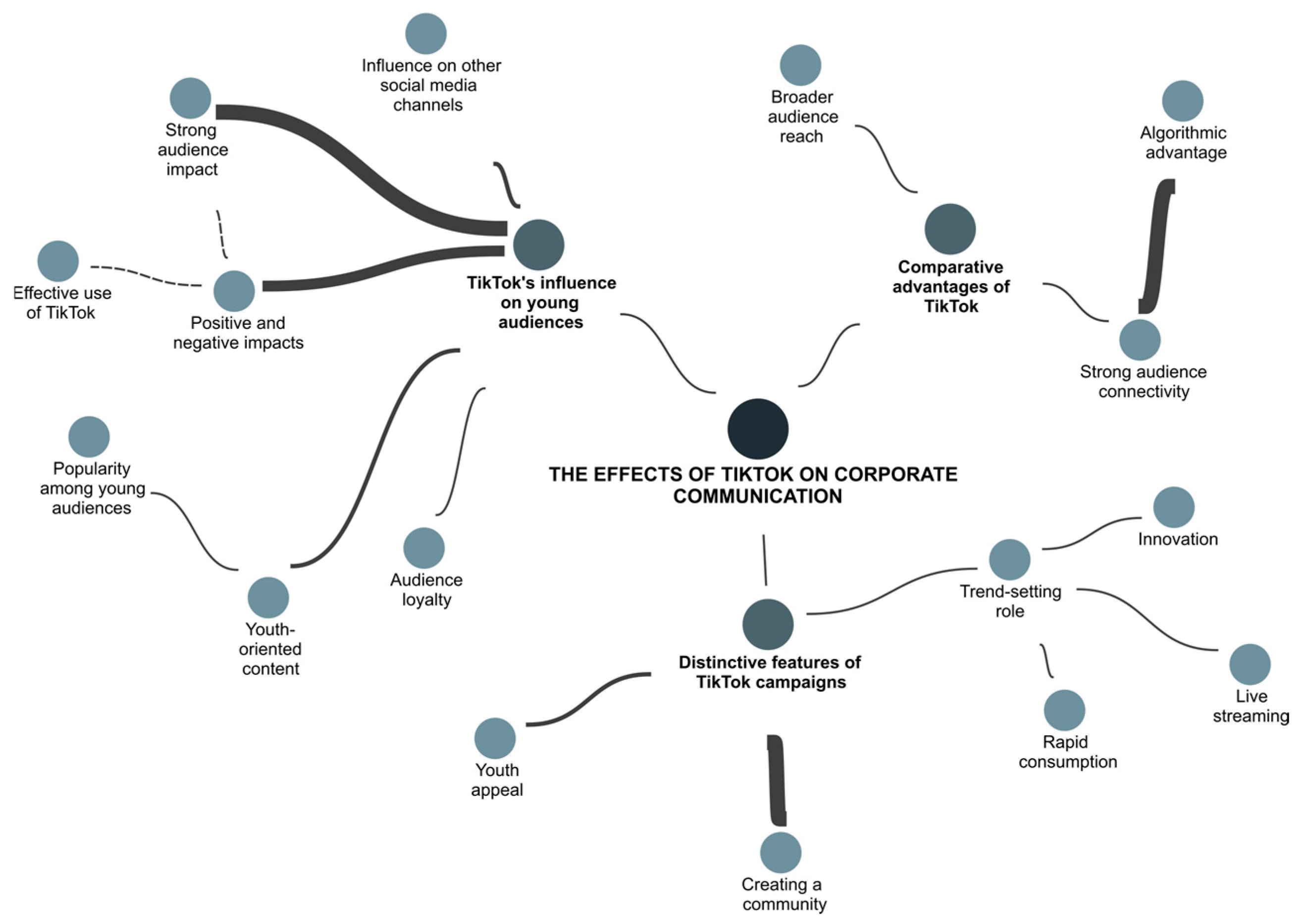
| Effects of TikTok on Corporate Communication | -TikTok’s Influence on Young Audiences | -Influence on Other Social Media Channels | -TikTok’s impact on trends across social media platforms. |
| -Strong Audience Impact | -TikTok’s strong influence on young audiences. | ||
| -Positive and Negative Impacts | -Beneficial and adverse effects of TikTok use. | ||
| -Youth-Oriented Content | -Content designed to appeal to young users. | ||
| -Audience Loyalty | -Sustained engagement and repeated platform use. | ||
| -Comparative Advantages of TikTok | -Broader Audience Reach | -Ability to reach large and diverse audiences. | |
| -Strong Audience Connectivity | -Close interaction between creators and audiences. | ||
| -Distinctive Features of TikTok Campaigns | -Youth Appeal | -High attractiveness for young audiences. | |
| -Creating a Community | -Fostering user participation and belonging. | ||
| -Trend-Setting Role | -Ability to create and spread new trends. | ||
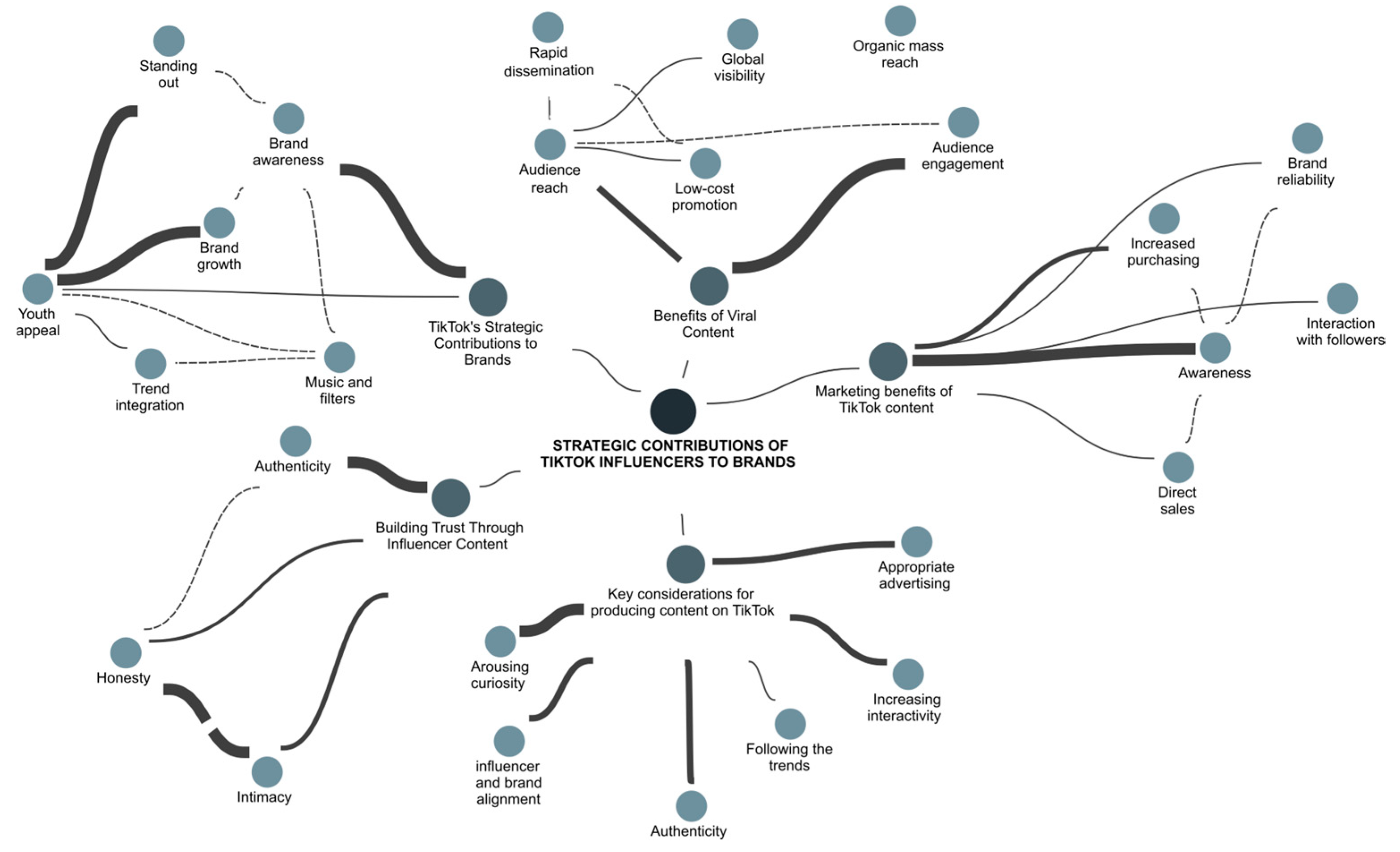
| Strategic contribution of TikTok influencers to | -TikTok’s Strategic Contributions to Brands | -Youth Appeal | -Ability to attract young audiences. |
| -Brand Awareness | -Increasing brand recognition. | ||
| -Benefits of Viral Content | -Audience Reach | -Expanding audience exposure. | |
| -Audience Engagement | -Encouraging audience interaction. | ||
| -Marketing Benefits of TikTok Content | -Increased Purchasing | -Encouraging purchase decisions. | |
| -Brand Reliability | -Strengthening brand credibility. | ||
| -Interaction with Followers | -Facilitating creator–audience communication. | ||
| -Awareness | -Increasing public awareness. | ||
| -Direct Sales | -Driving immediate sales. | ||
| -Key Considerations for Producing Content on TikTok | -Arousing Curiosity | -Stimulating audience curiosity. | |
| -Influencer and Brand Alignment | -Ensuring influencer–brand fit. | ||
| -Authenticity | -Presenting genuine content. | ||
| -Following the Trends | -Adapting to current trends. | ||
| -Increasing Interactivity | -Promoting active audience participation. | ||
| -Appropriate Advertising | -Delivering suitable promotional content. | ||
| -Building Trust Through Influencer Content | -Authenticity | -Demonstrating genuine communication. | |
| -Honesty | -Providing honest communication. | ||
| -Intimacy | -Creating a sense of closeness. | ||
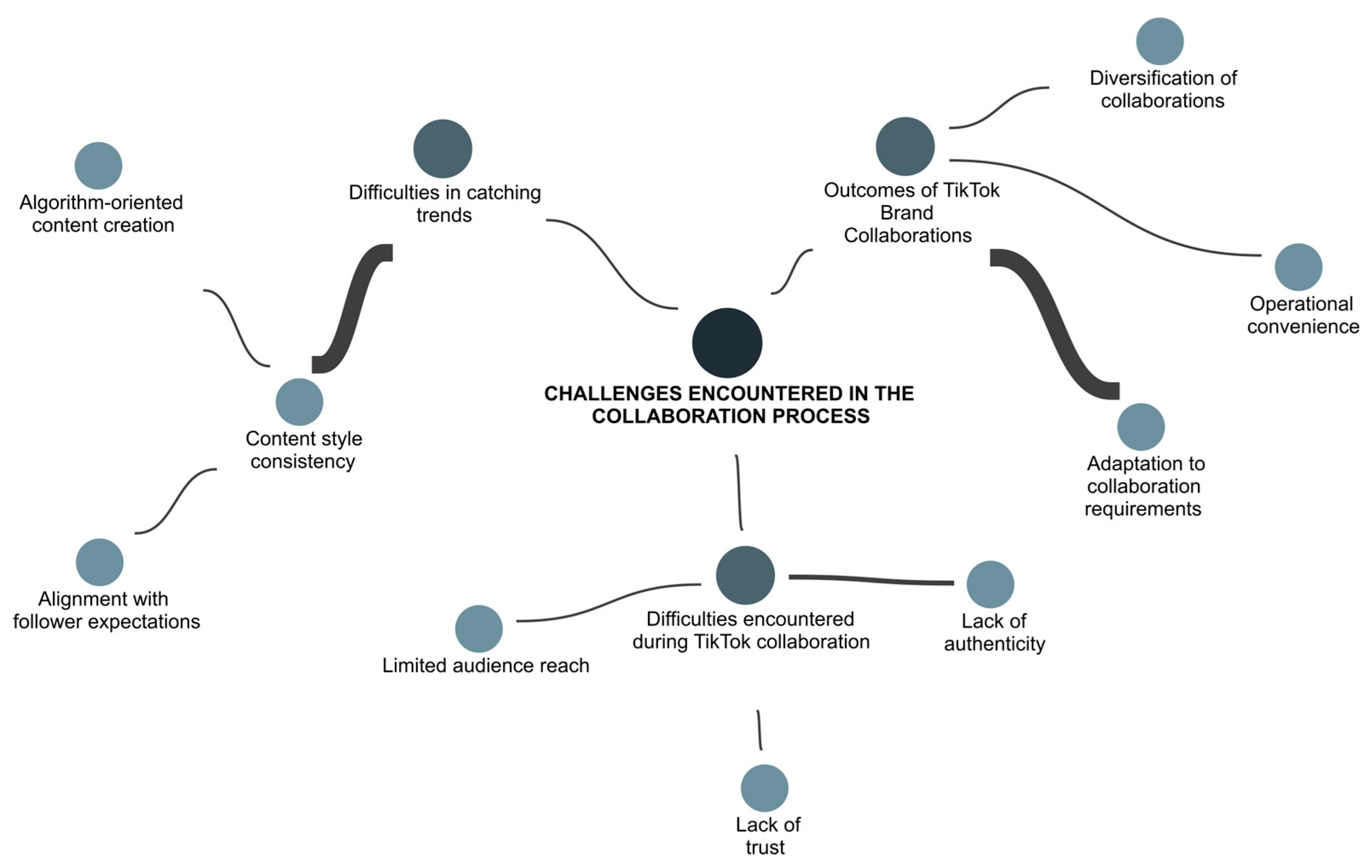
| Challenges Encountered in the Collaboration Process | -Difficulties in Catching Trends | -Content Style Consistency | -Maintaining a consistent content style. |
| -Difficulties Encountered During TikTok Collaboration | -Limited Audience Reach | -Reaching a limited target audience. | |
| -Lack of Trust | -Reduced audience trust. | ||
| -Lack of Authenticity | -Perceived absence of authenticity. | ||
| -Outcomes of TikTok Brand Collaborations | -Diversification of Collaborations | -Expanding collaboration opportunities. | |
| -Operational Convenience | -Simplifying collaboration processes. | ||
| -Adaptation to Collaboration Requirements | -Adjusting to brand expectations. | ||
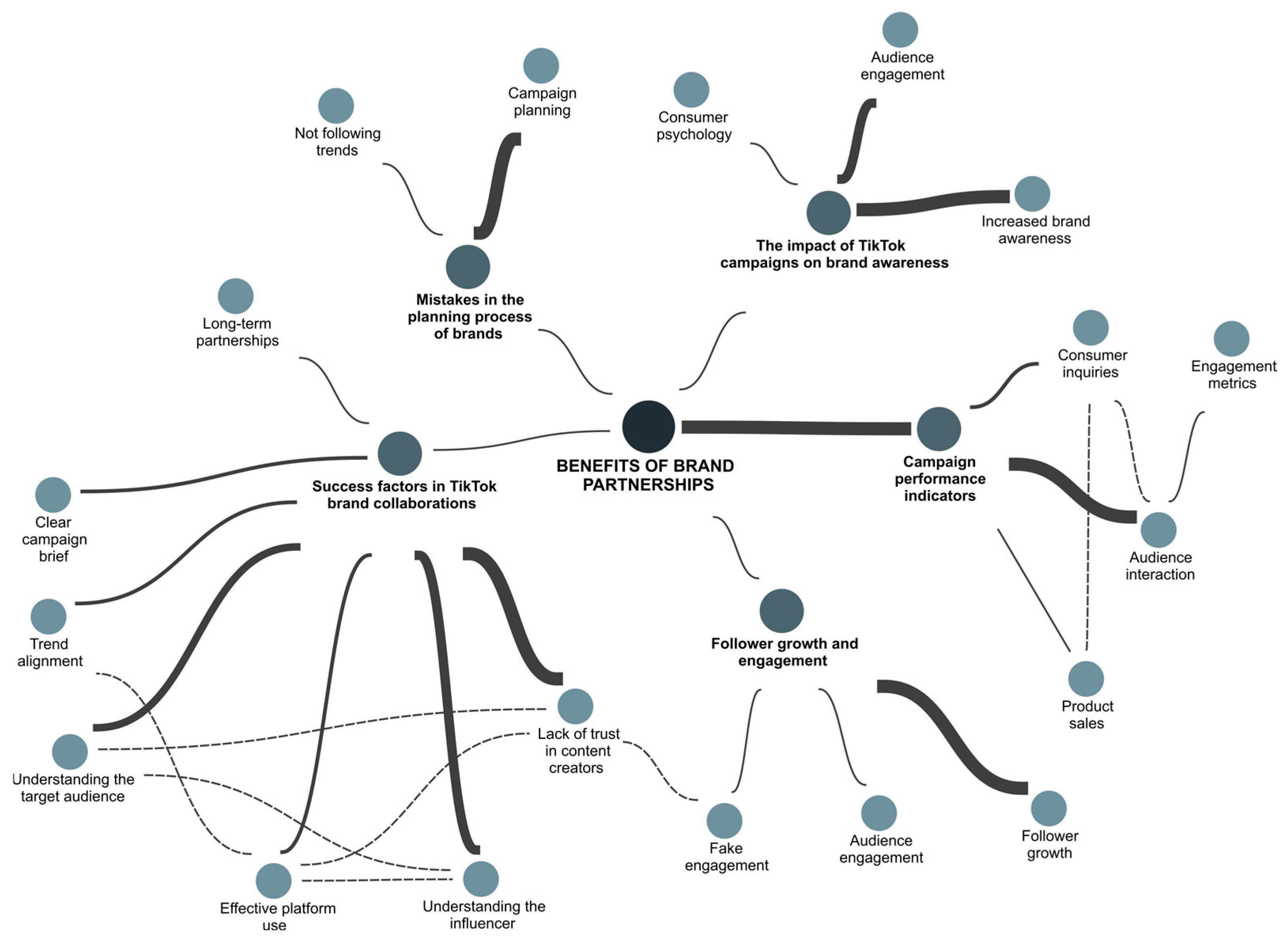
| Benefits of brand partnerships | -Success Factors in TikTok Brand Collaborations | -Long-Term Partnerships | -Building sustainable brand collaborations. |
| -Clear Campaign Brief | -Providing clear campaign guidelines. | ||
| -Trend Alignment | -Aligning with current trends. | ||
| -Understanding the Target Audience | -Knowing audience characteristics. | ||
| -Effective Platform Use | -Using TikTok features effectively. | ||
| -Understanding the Influencer | -Selecting suitable influencers. | ||
| -Lack of Trust in Content Creators | -Low confidence in creators. | ||
| -Mistakes in the Planning Process of Brands | -Not Following Trends | -Ignoring current trends. | |
| -Campaign Planning | -Inadequate campaign planning. | ||
| -The Impact of TikTok Campaigns on Brand Awareness | -Consumer Psychology | -Influencing consumer perceptions. | |
| -Audience Engagement | -Enhancing brand recognition. | ||
| -Increased Brand Awareness | -Growth in customer inquiries. | ||
| -Campaign Performance Indicators | -Consumer Inquiries | -Growth in customer inquiries. | |
| -Audience interaction | -Level of audience interaction. | ||
| -Follower Growth and Engagement | -Fake Engagement | -Artificial engagement activities. | |
| -Audience Engagement | -Active audience participation. | ||
| -Follower Growth | -Increase in follower numbers. |
| Participant | Age Range | Gender | Education Status | Occupation | Content Niche/Sector | Follower Group | Collaboration Experience |
|---|---|---|---|---|---|---|---|
| P1 | 27 | Male | College/ Faculty | YouTuber | Technology, information, and communication | Mid-tier influencer—109,600 | 100+ |
| P2 | 28 | Female | Graduate | Musician | Healthy living and daily life | Mid-tier influencer—216,300 | 15+ |
| P3 | 36 | Male | Graduate | Coach/YouTuber | Food and promotional content | Macro influencer—609,100 | 30+ |
| P4 | 21 | Female | Graduate | Digital Content Creator | Daily life | Mid-tier influencer—114,800 | 30+ |
| P5 | 26 | Female | High School | Digital Content Creator | Daily life and clothing promotion | Mid-tier influencer—330,300 | 30+ |
| P6 | 28 | Female | College/ Faculty | Digital Content Creator | Daily life | Nano influencer—5904 | 10+ |
| P7 | 29 | Male | Graduate | Media Worker | Current affairs | Micro influencer—18,300 | 30+ |
| P8 | 18 | Female | High School | Digital Content Creator | Daily life | Micro influencer—42,400 | 30+ |
| P9 | 34 | Male | Graduate | Digital Content Creator | Daily life | Macro influencer—611,500 | 30+ |
| P10 | 37 | Male | College/ Faculty | Digital Content Creator | Current information and daily life | Micro influencer—34,400 | 30+ |
| P11 | 24 | Male | College/ Faculty | Digital Content Creator | Local news, media, and advertising | Micro influencer—10,193 | 2 |
| P12 | 23 | Female | College/ Faculty | Dietitian | Nutrition, health, and dietetics | Nano influencer—6054 | 10+ |
| P13 | 27 | Male | High School | Social Media Specialist | Entertainment content | Nano influencer—5029 | 10+ |
| P14 | 26 | Female | Graduate | Human Resources Department | Daily life | Micro influencer—33,500 | 30+ |
| P15 | 21 | Male | High School | Waiter | Daily life | Mid-tier influencer—216,300 | 15+ |
Disclaimer/Publisher’s Note: The statements, opinions and data contained in all publications are solely those of the individual author(s) and contributor(s) and not of MDPI and/or the editor(s). MDPI and/or the editor(s) disclaim responsibility for any injury to people or property resulting from any ideas, methods, instructions or products referred to in the content. |
© 2026 by the authors. Licensee MDPI, Basel, Switzerland. This article is an open access article distributed under the terms and conditions of the Creative Commons Attribution (CC BY) license.
Share and Cite
Batu, M.; Büdün Aydın, E.; Yarar, A.E.; Çokdilli, E. TikTok Influencers and Brand Communication in Türkiye: A Qualitative Study from a Corporate Communication Perspective. Journal. Media 2026, 7, 156. https://doi.org/10.3390/journalmedia7030156
Batu M, Büdün Aydın E, Yarar AE, Çokdilli E. TikTok Influencers and Brand Communication in Türkiye: A Qualitative Study from a Corporate Communication Perspective. Journalism and Media. 2026; 7(3):156. https://doi.org/10.3390/journalmedia7030156
Chicago/Turabian StyleBatu, Mikail, Esra Büdün Aydın, Ali Erkam Yarar, and Esra Çokdilli. 2026. "TikTok Influencers and Brand Communication in Türkiye: A Qualitative Study from a Corporate Communication Perspective" Journalism and Media 7, no. 3: 156. https://doi.org/10.3390/journalmedia7030156
APA StyleBatu, M., Büdün Aydın, E., Yarar, A. E., & Çokdilli, E. (2026). TikTok Influencers and Brand Communication in Türkiye: A Qualitative Study from a Corporate Communication Perspective. Journalism and Media, 7(3), 156. https://doi.org/10.3390/journalmedia7030156