


Abstract
This study assesses the elasticity between integrated media performance and corporate reputation by examining the relationship between Media Output Score (MOS) and RepScore™ in the Portuguese telecommunications sector (Altice/MEO, NOS, and Vodafone) between 2021 and 2023. Adopting a longitudinal observational design, the analysis compares inter-annual variation in communication output with corresponding changes in stakeholder-based reputation. Media performance is operationalized through MOS as a composite indicator of visibility, favorability, readership, targeting, and social amplification, while corporate reputation is measured using third-party RepScore™ data. The findings indicate directional alignment between media output and corporate reputation; however, the magnitude of reputational adjustment appears substantially lower than the amplitude of media volatility. Across heterogeneous crisis contexts, including cybersecurity incidents and governance-related events, reputational scores exhibit incremental and comparatively stable evolution despite pronounced fluctuations in media performance. These results suggest that the relationship between media output and corporate reputation is characterized by constrained responsiveness at the annual level, consistent with a stock–flow interpretation in which communication signals operate as high-variance flows and reputation evolves as a path-dependent stock. By empirically illustrating this asymmetry, the study contributes to media influence research by identifying a structural boundary condition in the translation of media exposure into stakeholder evaluation. The findings further clarify the analytical distinction between output-level communication metrics and outcome-level reputational constructs in digital media environments.
1. Introduction
Media coverage plays a central role in shaping public knowledge and stakeholder perceptions of corporate actors. Since the development of agenda-setting theory (McCombs & Shaw, 1972), research has demonstrated that media salience influences the issues and organizations perceived as relevant by the public. Subsequent extensions, including second-level agenda-setting and priming, further suggest that media not only affect what audiences think about but also how they evaluate attributes associated with organizations (Carroll & McCombs, 2003). Within business contexts, these mechanisms have been shown to influence corporate image, legitimacy, and reputation.
Despite this well-established connection, the literature on media effects and corporate reputation remain only partially integrated. Media research typically focuses on communication outputs—such as exposure, salience, tone, and visibility—while reputation research emphasizes stakeholder-based perception metrics derived from evaluative judgments. As a result, although the relationship between media coverage and corporate reputation is widely acknowledged, the magnitude and temporal responsiveness of this relationship remain insufficiently specified, particularly in studies that consider multiple dimensions of media performance simultaneously.
This limitation becomes more pronounced in contemporary communication environments characterized by high media fragmentation, platform intermediation, and continuous information flows. In such contexts, media visibility is shaped not only by journalistic production but also by distribution dynamics, audience engagement, and amplification mechanisms. At the same time, corporate reputation reflects a more stable and cumulative form of stakeholder evaluation that evolves over time. Existing research has rarely examined how short-term variation in media output relates to longer-term adjustments in reputation, particularly using integrated performance indicators and longitudinal designs.
Accordingly, limited research has examined the relationship between multidimensional media performance and stakeholder-based corporate reputation in a longitudinal setting. In particular, the extent to which variation in media output translates into changes in accumulated reputational evaluations remains unclear. Addressing this gap requires a framework that accounts for differences in the temporal and structural properties of communication outputs and reputational outcomes.
The Portuguese telecommunications sector provides an appropriate empirical context to examine this relationship. The industry is characterized by high media visibility, regulatory scrutiny, and exposure to technological transformation and crisis events. These conditions generate substantial variation in media performance while allowing for the observation of corresponding dynamics in stakeholder-based reputation.
The central research question guiding this study is: To what extent does variation in media output correspond to adjustment in corporate reputation within a high-visibility industry?
Based on this research question, the study advances the following hypotheses:
H1.
Variations in media output are directionally associated with variations in corporate reputation.
H2.
The magnitude of variation in corporate reputation is lower than the magnitude of variation in media output.
H3.
Negative shocks in media output correspond to limited or attenuated changes in corporate reputation at the annual level.
H4.
Annual temporal aggregation attenuates observable responsiveness between media output and corporate reputation.
By examining annual Media Output Score (MOS) and RepScore™ values for major telecommunications operators between 2021 and 2023, this study makes three contributions. First, it extends research on integrated media performance by assessing its relationship with stakeholder-based reputation measures. Second, it provides empirical evidence on the strength and responsiveness of the connection between media output and corporate reputation in a longitudinal setting. Third, it advances the literature by identifying structural constraints in this relationship, showing that changes in media performance do not translate proportionally into changes in corporate reputation.
2. Theoretical Framework and Literature Review
2.1. Media Effects and Corporate Reputation
Research on media effects provides the foundation for understanding how communication influences stakeholder perceptions of organizations. Agenda-setting theory establishes that media salience shapes the relative importance attributed to issues and actors (McCombs & Shaw, 1972), while second-level agenda-setting and priming demonstrate that media also influence how attributes associated with those actors are evaluated (Carroll & McCombs, 2003). Within corporate contexts, these mechanisms have been shown to affect organizational image, legitimacy, and reputation (Deephouse, 2000; Kiousis et al., 2007).
Corporate reputation is commonly conceptualized as a multidimensional construct reflecting cumulative stakeholder evaluations of organizational performance, governance, social responsibility, and trustworthiness. It is often described as a form of reputational capital that develops over time and contributes to sustained competitive advantage (Rindova et al., 2005; Deephouse, 1997). Empirical research consistently finds that media visibility and favorability are associated with corporate reputation outcomes (Fombrun & Shanley, 1990; Wartick, 1992; Carroll & Deephouse, 2009; Carroll, 2011; Carroll & Deephouse, 2014; Zhang, 2018).
More recent research continues to emphasize the role of mediated communication in shaping organizational evaluations in digitally mediated environments, where stakeholders are exposed to multiple and often competing information streams (Topić, 2023). These contributions highlight the continued relevance of media exposure as a key antecedent of reputational dynamics while pointing to the increasing complexity of contemporary communication environments.
2.2. Media in Hybrid and Platform-Based Communication Environments
Contemporary media systems are increasingly characterized by hybridity, in which traditional journalism coexists with platform-based communication and user-generated content (Chadwick, 2017). In these environments, platform logics shape the production, distribution, and visibility of content, influencing how information about organizations reaches and engages audiences (van Dijck et al., 2018; Etter et al., 2019).
As a result, media effects are no longer linear but are mediated by algorithmic curation, engagement dynamics, and cross-platform amplification processes (Graf-Vlachy et al., 2020; Vogler & Eisenegger, 2021). Platform affordances—such as sharing, commenting, and ranking—introduce feedback loops that can intensify or dampen the visibility of corporate-related content (Klinger & Svensson, 2015).
Recent research on platform power further emphasizes the infrastructural role of digital platforms in shaping information visibility and access, highlighting how control over distribution and curation processes influences public attention and communication outcomes (Nieborg et al., 2024). In line with this, empirical evidence shows that platform-driven distribution and algorithmic curation significantly shape patterns of public attention, contributing to fragmented and uneven visibility dynamics across news environments (Nielsen et al., 2024; Nielsen & Fletcher, 2023; Kümpel, 2023).
2.3. Measuring Media Performance in Digital Contexts
The increasing complexity of media environments has exposed the limitations of single-dimensional indicators of communication performance. Traditional measures—such as media volume or tone—capture only partial aspects of media visibility and fail to account for distribution processes and audience interaction (Cherubini & Nielsen, 2016).
In response, recent approaches emphasize integrated measurement frameworks that combine multiple dimensions, including visibility, sentiment, reach, and engagement, in order to capture both the production of media content and its amplification through audience interaction (Lovejoy & Saxton, 2012; Klinger & Svensson, 2015).
Recent advances in strategic communication research further highlight the importance of holistic evaluation models that integrate output, outtake, and outcome measures, particularly in digitally networked environments (Macnamara, 2020; Zerfass et al., 2017; Topić, 2023). These approaches conceptualize communication performance as a systemic phenomenon shaped by both content characteristics and audience-driven amplification processes. At the same time, the growing complexity of communication environments—driven by technological change, geopolitical uncertainty, and evolving media systems—reinforces the need for more integrated and adaptive approaches to communication management (Zerfass et al., 2024).
Despite these developments, much empirical research continues to rely on isolated indicators, leaving open questions about how integrated media performance relates to broader organizational outcomes such as corporate reputation.
2.4. Gaps in Linking Media Performance and Corporate Reputation
Although the relationship between media coverage and corporate reputation is widely acknowledged, the two studies often operate at different levels of analysis. Media studies tend to focus on communication outputs—such as exposure, salience, and tone—while reputation research emphasizes aggregated stakeholder perceptions derived from evaluative judgments.
This separation has limited the ability of existing research to specify how variation in media performance translates into variation in reputational outcomes. In particular, relatively few studies adopt longitudinal designs that allow for the observation of temporal dynamics between media exposure and stakeholder evaluation.
Recent contributions have begun to address this disconnect by examining media–reputation relationships in more integrated and dynamic ways (Graf-Vlachy et al., 2020; Vogler & Eisenegger, 2021). However, important questions remain regarding the magnitude, responsiveness, and stability of this relationship. Specifically, the extent to which fluctuations in media output correspond to proportional changes in corporate reputation remains insufficiently understood.
2.5. Conceptualizing the Media–Reputation Relationship: A Flow–Stock Perspective
To address this limitation, this study introduces a conceptual distinction between media output and corporate reputation based on their structural and temporal properties.
Media output can be understood as a flow variable, representing a continuous stream of communication signals characterized by high sensitivity to events, crises, and fluctuations in news salience. By contrast, corporate reputation constitutes a stock variable, reflecting an accumulated evaluative construct that evolves over time through the aggregation of stakeholder perceptions.
This distinction implies that reputation is subject to path dependency and inertia, adjusting incrementally as new information is incorporated. Similar distinctions between flows and stocks have been widely applied in related fields to explain differences in responsiveness and accumulation processes (Dierickx & Cool, 1989). Recent research in corporate communication also emphasizes the cumulative and relatively stable nature of reputational evaluations, supporting the view that reputational change may be less responsive than short-term variation in media exposure (Vogler & Eisenegger, 2021; Topić, 2023).
From this perspective, the relationship between media output and corporate reputation can be conceptualized as a flow–stock dynamic, in which high-variance communication flows interact with lower-variance reputational stocks. This structural asymmetry suggests that changes in media output do not necessarily translate proportionally into changes in reputation.
Accordingly, this study introduces the concept of elasticity to describe the degree to which variation in media output corresponds to variation in corporate reputation. Given the cumulative and relatively stable nature of reputational evaluations, this elasticity is expected to be constrained. High volatility in media coverage may produce only limited adjustments in reputational stock, particularly when stakeholder evaluations are also shaped by direct experience, organizational performance, and institutional credibility.
2.6. Operationalizing Media Output and Corporate Reputation
To empirically examine this relationship, the study adopts a multidimensional approach to both media performance and corporate reputation.
Media output is operationalized through the Media Output Score (MOS), a composite indicator combining visibility, favorability, readership, targeting, and social amplification into a unified measure (Oliveira et al., 2024). This measure captures how organizations perform within the digital media environment by integrating both content production and its amplification across media channels.
Corporate reputation is measured using RepScore™, which reflects stakeholder-based evaluations across multiple dimensions and aligns with established approaches to reputation measurement. Distinguishing between media output and corporate reputation as output and outcome variables does not imply conceptual separation but rather clarifies their roles within a broader communication system.
3. Materials and Methods
3.1. Research Design
This study adopts a longitudinal observational design to examine the relationship between media output performance and corporate reputation in the Portuguese telecommunications sector between 2021 and 2023.
The objective of this study is not to establish causal inference but to conduct an exploratory assessment of the relative responsiveness (elasticity) between output-level media performance and outcome-level stakeholder evaluation. By comparing annual Media Output Score (MOS) values with corresponding annual RepScore™ values, the analysis examines whether volatility in communication flows corresponds proportionally to adjustment in reputational stock. The focus is therefore on magnitude and temporal responsiveness of variation rather than on statistical estimation of causal effects.
The telecommunications sector was selected due to its high media visibility, regulatory scrutiny, and exposure to heterogeneous crisis events, including cybersecurity incidents, governance-related investigations, and service disruptions. These conditions generate observable variation in media output, making the sector suitable for assessing responsiveness between media performance and corporate reputation.
The Portuguese context provides a controlled empirical setting characterized by broad and consistent media coverage availability, consistent reputation measurement through RepScore™, and a well-defined competitive landscape. This enables structured longitudinal comparison between communication output and stakeholder-based evaluation.
The selection of output-based metrics aligns with recent approaches in digital media analytics, which emphasize multidimensional measurement of visibility, sentiment, and engagement as key drivers of communication performance (Mcnamara, 2014).
The study focuses on structural relationships between observable variables. While qualitative methods such as executive interviews could provide interpretative insights, their inclusion would extend beyond the scope of assessing elasticity between communication output and reputational outcomes.
3.2. Media Output Score (MOS)
The Media Output Score (MOS) is an integrated composite metric designed to provide a systematic measurement of media coverage performance (Oliveira et al., 2024). MOS combines multiple output-level indicators into a single standardized score:
- Media visibility (volume and prominence)
- Media favorability (sentiment)
- Readership potential
- Media targeting relevance
- Social amplification (engagement metrics)
Media visibility, readership, targeting relevance, and social amplification are derived from structured media metadata and external data sources, following standardized approaches in digital media analytics. These dimensions capture complementary aspects of communication exposure, audience reach, and engagement within the media ecosystem.
Media favorability is operationalized through a hybrid content analysis approach combining large language model (LLM)-assisted classification and manual validation. Sentiment is initially generated using ChatGPT-based analysis of media content and subsequently reviewed to ensure contextual accuracy and consistency across sources. This approach enables scalable classification while preserving interpretative reliability in complex media narratives. Recent research supports the use of computational and AI-assisted methods for assessing sentiment and credibility in digital news environments (Boumans & Trilling, 2016).
The inclusion of social amplification and engagement dimensions in MOS is consistent with contemporary approaches to communication measurement, which emphasize the role of audience interaction in extending media influence beyond initial publication (Klinger & Svensson, 2015; Chadwick, 2013).
The metric was developed using a Design Science Research methodology and previously validated in the Portuguese telecommunications sector.
For the present study, MOS values were aggregated annually for each brand between 2021 and 2023. Aggregation ensures comparability with annual reputation measurements and allows assessment of inter-annual variation in communication performance.
Due to overlapping corporate and brand references in media coverage, Altice and MEO are operationalized jointly at the media level (Altice/MEO) for MOS calculation, consistent with prior application of the metric.
MOS operates analytically as a flow variable, capturing fluctuations in communication exposure and sentiment within the media system.
3.3. Corporate Reputation (RepScore™)
Corporate reputation is measured using RepScore™, a third-party stakeholder-based index published annually in Portugal and conceptually aligned with established multidimensional reputation measurement approaches.
RepScore™ is derived from survey-based stakeholder evaluations, incorporating perception-based data collected through structured questionnaires and reflects multidimensional evaluation across dimensions including:
- Trust
- Governance
- Performance
- Citizenship
- Leadership
Unlike MOS, RepScore™ is derived from survey-based stakeholder perceptions rather than media content analysis. It therefore represents an outcome-level construct and functions analytically as a stock variable, incorporating accumulated perceptions over time.
RepScore™ values for Altice, MEO, NOS, and Vodafone were collected for the years 2021, 2022, and 2023.
3.4. Data Structure and Analytical Approach
The dataset consists of annual MOS and RepScore™ values for major telecommunications operators over a three-year period.
The analysis proceeds in three stages:
- Descriptive comparison of annual values.
- Interpretative classification using established qualitative scales for MOS and RepScore™.
- Inter-annual variation analysis (Δ analysis) to assess magnitude of change across consecutive years.
The focus of the analysis is on evaluating:
- The directional correspondence between media output variation and reputational change.
- The temporal responsiveness of reputation to media volatility at the annual level.
Given the limited number of annual observations (n = 3 per entity), the study does not employ inferential statistical modeling. Instead, it adopts a structured longitudinal comparison approach suitable for exploratory elasticity assessment within bounded time-series data.
The findings should therefore be interpreted as analytically informative rather than statistically generalizable.
3.5. Qualitative Performance Categories for Interpretative Classification
To enhance interpretability, MOS and RepScore™ values are mapped onto qualitative performance categories using the interpretative scales established in prior MOS research.
MOS categories:
- -
- Excellent (>59)
- -
- Robust (30–58)
- -
- Moderate (0–29)
- -
- Vulnerable (−1 to −65)
- -
- Weak (<−66)
RepScore™ categories:
- -
- Excellent (>80)
- -
- Robust (70–79)
- -
- Moderate (60–69)
- -
- Vulnerable (40–59)
- -
- Weak (<39)
These classifications allow structured comparison of movement across evaluative thresholds, supporting assessment of reputational adjustment relative to media volatility.
3.6. Methodological Limitations
The study is subject to several methodological constraints:
- -
- Annual aggregation may smooth short-term media effects.
- -
- Limited time points restrict inferential statistical power.
- -
- Reputation is influenced by multiple determinants beyond media exposure.
- -
- Crisis response mechanisms may moderate translation of media shocks into reputational change.
These constraints are acknowledged in interpreting elasticity between communication flow and reputational stock.
4. Results
4.1. Descriptive Overview
Table 1 presents the annual Media Output Score (MOS) and RepScore™ values for the Portuguese telecommunications sector between 2021 and 2023. The data reveal substantial inter-annual variation in MOS values, contrasted with comparatively incremental and stable evolution in RepScore™.
Table 1.
Annual Media Output Score (MOS) and RepScore™ (2021–2023).
For Altice/MEO (aggregated at the media level), MOS increased from 12.72 in 2021 to 36.98 in 2022, before declining sharply to 1.78 in 2023. Over the same period, RepScore™ for Altice rose steadily from 67.3 to 69.8, while MEO’s reputation remained stable in 2021–2022 and increased to 77.2 in 2023.
NOS maintained high MOS values in 2021 (59.04) and 2022 (56.45), followed by a decline to 33.66 in 2023. Despite this contraction in media performance, RepScore™ increased gradually from 73.1 to 76.3 across the period.
Vodafone exhibited the most pronounced media fluctuation. MOS declined from 24.74 in 2021 to −4.14 in 2022—coinciding with a cybersecurity incident and intensified negative coverage—before recovering to 14.79 in 2023. RepScore™, however, increased incrementally from 74.3 to 76.5 during the same period.
These descriptive patterns indicate asymmetric amplitude of variation between media output and stakeholder-based reputation.
As specified in the MOS methodology, media favorability is incorporated through LLM-assisted and manually validated sentiment classification.
4.2. Interpretative Classification
To contextualize numerical variation and support interpretability, MOS and RepScore™ values are also mapped to qualitative classifications using the interpretative scales applied in the MOS framework as described in Section 3.5.
Table 2 presents the resulting interpretative classifications.
Table 2.
Interpretative Classification of MOS and RepScore™ (2021–2023).
The classification view reinforces the differential amplitude of adjustment observed in the numerical results. Most notably, Vodafone’s MOS shifts to Vulnerable in 2022 while its RepScore™ remains Robust, illustrating that negative media output shocks do not necessarily translate into reputational downgrade at the annual level.
4.3. Visual Comparison of Media and Reputation Trajectories
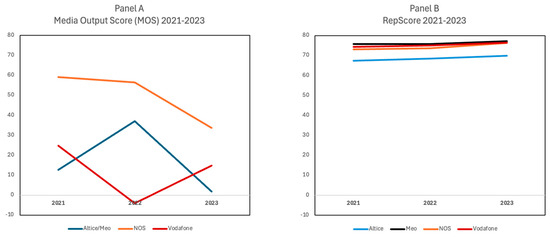
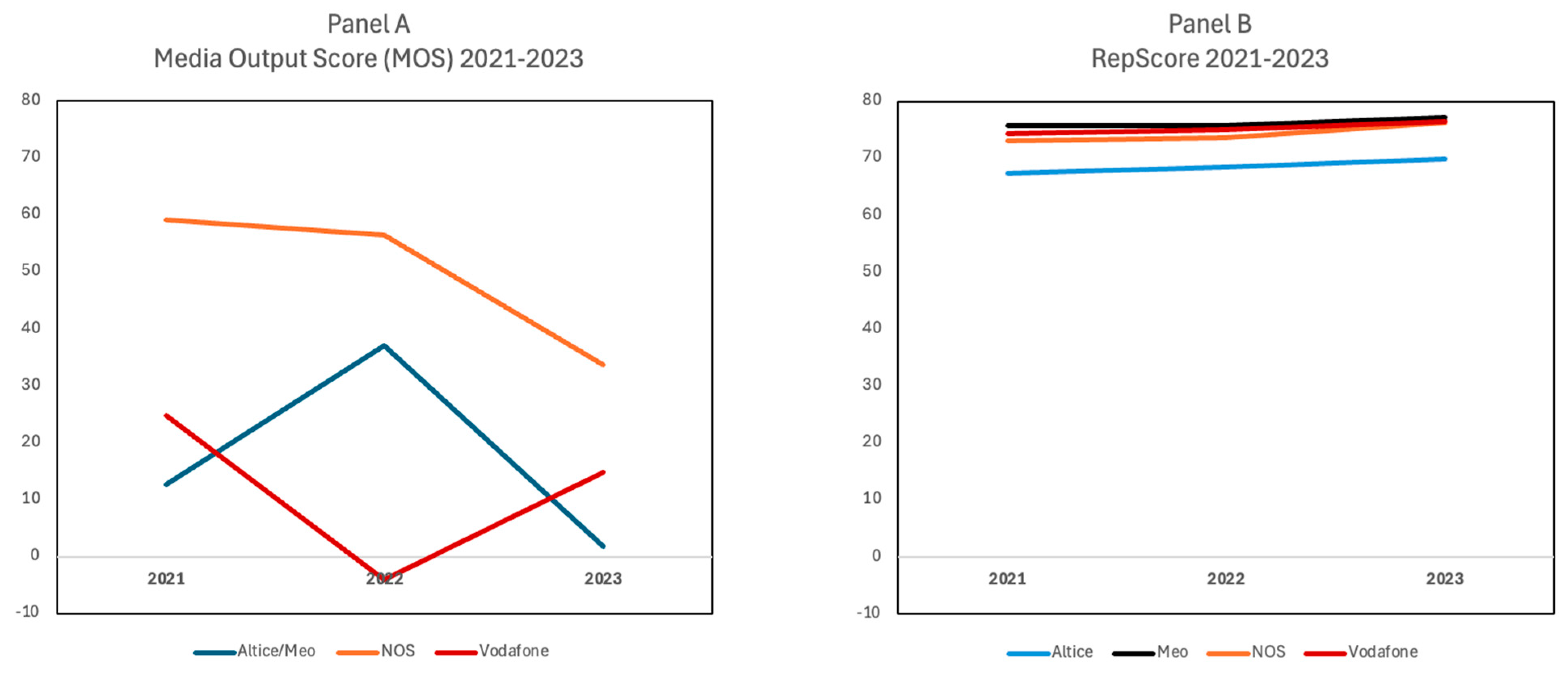
To further illustrate the volatility–stability contrast, Figure 1 presents annual trajectories for MOS and RepScore™ between 2021 and 2023.
Figure 1.
Media Output Volatility and Reputational Stability (2021–2023). (A) Annual Media Output Score (MOS). (B) Annual RepScore™.
Panel A shows pronounced inter-annual volatility in MOS values, with sharp amplitude shifts visible in Vodafone’s 2022 decline and Altice/MEO’s 2023 contraction. Panel B, by contrast, illustrates comparatively incremental adjustment in RepScore™ across all entities, with limited amplitude variation and consistent directional progression.
Although MOS and RepScore™ operate on different conceptual scales, their juxtaposition indicates asymmetric amplitude of adjustment consistent with flow–stock dynamics. Directional alignment between media output and reputation is observable across the period; however, the magnitude of reputational change remains substantially smaller than the amplitude of media volatility. This pattern suggests constrained and incremental responsiveness of reputational stock relative to communication flow at the annual level.
4.4. Inter-Annual Variation (Δ Analysis)
Year-over-year variation further reinforces this asymmetric amplitude of adjustment.
Between 2021 and 2022:
- -
- Altice/MEO ΔMOS: +24.26; Altice ΔRepScore: +1.1; MEO ΔRepScore: 0
- -
- NOS ΔMOS: −2.59; ΔRepScore: +0.5
- -
- Vodafone ΔMOS: −28.88; ΔRepScore: +0.8
Between 2022 and 2023:
- -
- Altice/MEO ΔMOS: −35.20; Altice ΔRepScore: +1.4; MEO ΔRepScore: +1.5
- -
- NOS ΔMOS: −22.79; ΔRepScore: +2.7
- -
- Vodafone ΔMOS: +18.93; ΔRepScore: +1.4
Across all transitions, substantial MOS fluctuations correspond to modest and consistently positive changes in RepScore™.
4.5. Volatility Contrast
The comparative range of variation underscores the differential amplitude of adjustment:
- -
- MOS range (2021–2023): −4.14 to 59.04
- -
- RepScore™ range (2021–2023): 67.3 to 77.2
Media output performance demonstrates high amplitude variation across years and entities. Corporate reputation, in contrast, evolves within a narrow band, indicating lower sensitivity to communication shocks at the annual level.
The magnitude of variation observed in MOS substantially exceeds the magnitude of change observed in RepScore™, indicating limited proportional adjustment of reputational stock relative to communication flow at the annual level.
5. Discussion
This study interprets the observed relationship between media output and corporate reputation through the stock–flow framework introduced in the theoretical section.
The findings demonstrate that while directional alignment between media coverage and corporate reputation is observable, the magnitude of reputational adjustment remains systematically constrained. This result extends prior research on media influence (Kiousis et al., 2007; Zhang, 2018), which generally assumes that media visibility and tone are reflected in stakeholder evaluation, by showing that such relationships are not proportional in magnitude.
These results are consistent with more recent research highlighting the complexity of media–reputation dynamics in digital environments (Graf-Vlachy et al., 2020; Vogler & Eisenegger, 2021). However, the present study goes further by identifying a structural asymmetry: media output exhibits high volatility, while corporate reputation adjusts incrementally. This suggests that media influence operates under bounded responsiveness conditions, particularly when assessed at aggregated temporal levels.
From an epistemological perspective, the study distinguishes between communication outputs and stakeholder perception constructs. Media metrics such as MOS capture system-level exposure dynamics, whereas reputation indices reflect aggregated stakeholder evaluations. Treating these constructs as equivalent risks conflating distinct levels of analysis and obscuring the mechanisms through which media influence operates.
The results are also consistent with research indicating that reputation formation is influenced by a broader set of organizational and experiential factors beyond mediated communication (Etter et al., 2019). These include service performance, governance quality, customer experience, and institutional credibility, all of which contribute to the inertia observed in reputational adjustment.
Empirically, the analysis shows that substantial inter-annual variation in media output corresponds to comparatively limited variation in stakeholder-based reputation. This includes pronounced negative shocks associated with the 2022 Vodafone cybersecurity incident, governance-related investigations involving Altice in 2022–2023, and episodic service disruption events across sector operators. Despite the heterogeneity and visibility of these events, reputational scores demonstrated incremental and comparatively stable movement. In the case of Vodafone’s 2022 cybersecurity incident, which produced a marked decline in MOS, corporate reputation remained within the “Robust” classification and continued to evolve incrementally in subsequent periods.
5.1. A Boundary Condition for Media Influence
The primary theoretical contribution of this study is the identification of a boundary condition in the relationship between media performance and corporate reputation.
Agenda-setting and priming theories posit that media salience and tone shape stakeholder perceptions. The present findings do not contradict this relationship; rather, they specify its limits. Media influence appears to operate within structurally constrained conditions, where changes in communication flow do not translate proportionally into changes in reputational stock.
This constraint can be understood through the stock–flow distinction: media output operates as a high-sensitivity flow variable, while corporate reputation functions as a path-dependent stock variable. The translation of media signals into reputational adjustment is therefore moderated by accumulation dynamics and by the presence of non-media determinants of reputation.
This interpretation also qualifies prior findings emphasizing recency effects in media influence (Zhang, 2018). While short-term dynamics may exhibit stronger responsiveness, the present results indicate that such effects are attenuated at annual resolution, where reputational measures reflect cumulative evaluation rather than immediate reaction.
By empirically demonstrating amplitude-constrained adjustment across heterogeneous crisis contexts, this study advances media influence theory by introducing a structural explanation for why media exposure does not produce proportional reputational change.
5.2. Implications for Media Measurement Theory
From a measurement perspective, the findings reinforce the importance of distinguishing between output-level and outcome-level constructs.
The Media Output Score (MOS) captures multidimensional communication performance by integrating visibility, sentiment, readership, and amplification. As such, it provides a sensitive indicator of exposure dynamics in digital media environments. However, MOS should not be interpreted as a proxy for corporate reputation.
Reputation indices such as RepScore™ reflect accumulated stakeholder evaluation shaped by governance, performance, customer experience, and institutional credibility. The results suggest that media output functions as an input signal within a broader reputational system rather than as a direct measure of reputational capital.
This distinction clarifies the role of integrated media metrics: they are effective for assessing communication performance, but their relationship with stakeholder outcomes must be interpreted within the structural constraints imposed by reputational accumulation processes.
5.3. Managerial Implications
For practitioners, the findings indicate that fluctuations in media performance should not be assumed to produce immediate or proportional changes in corporate reputation.
While MOS provides a sensitive indicator of communication shifts and crisis intensity, reputational resilience appears to depend on a broader set of organizational factors, including service performance, governance practices, customer trust, and institutional credibility.
The results also suggest that effective crisis response may moderate the translation of negative media exposure into reputational decline. Media performance should therefore be interpreted as one component within a broader reputational management system, rather than as a standalone indicator of stakeholder evaluation.
5.4. Limitations and Future Research
This study has several limitations that should be interpreted in relation to its analytical objective. The research design is based on three annual observations per entity, which limits the possibility of formal statistical estimation of elasticity and constrains inference to an exploratory assessment of relative responsiveness. However, this temporal aggregation is not incidental; it is aligned with the theoretical focus of the study. Corporate reputation, as measured by RepScore™, is inherently a low-frequency construct reflecting accumulated stakeholder evaluation. Accordingly, annual aggregation provides an appropriate level of analysis for examining the relationship between communication flow and reputational stock.
At the same time, annual aggregation may obscure short-term dynamics that could be observable at higher temporal resolution. Prior research suggests that media effects may exhibit stronger responsiveness in shorter time windows, particularly in relation to recency and attention cycles (Zhang, 2018). The present study does not aim to capture these short-term dynamics, but rather to assess whether such fluctuations translate into sustained reputational adjustment over time.
Corporate reputation is influenced by multiple determinants beyond media exposure, including service performance, governance quality, customer experience, and institutional trust. These factors may interact with media coverage by reinforcing or buffering the impact of communication signals, contributing to the observed attenuation of reputational responsiveness.
Future research should extend temporal horizons, incorporate higher-frequency reputation data where available, and explore multivariate frameworks integrating operational, experiential, and institutional drivers of reputational change. Comparative analysis across industries and media systems may further clarify whether the observed stock–flow dynamics represent a generalizable structural characteristic of media–reputation relationships.
5.5. Conclusions
This study advances understanding of media–reputation dynamics by demonstrating that the relationship between communication flow and accumulated reputational stock is structurally constrained.
Across heterogeneous crisis contexts—including cybersecurity incidents, governance-related investigations, and operational disruptions—media output exhibited substantial volatility, while stakeholder-based reputation adjusted incrementally and remained comparatively stable. This consistent pattern supports the interpretation that corporate reputation functions as an accumulated construct that incorporates communication signals gradually rather than proportionally.
By identifying an elasticity constraint between media performance and reputational change, this research refines media influence theory and clarifies the relationship between output-level communication metrics and outcome-level stakeholder evaluation. The findings contribute to a more precise understanding of the structural conditions under which media exposure translates into reputational capital in contemporary digital environments.
This distinction between short-term responsiveness and long-term adjustment represents an important direction for future research on media influence.
Funding
This research received no external funding.
Informed Consent Statement
Not applicable.
Data Availability Statement
Due to privacy concerns data cannot be shared.
Conflicts of Interest
The author declares no conflict of interest.
References
- Boumans, J. W., & Trilling, D. (2016). Taking stock of the toolkit: An overview of relevant automated content analysis approaches and techniques for digital journalism scholars. Digital Journalism, 4(1), 8–23. [Google Scholar] [CrossRef] [Scilit]
- Carroll, C. E. (2011). Corporate reputation and the news media: Agenda-setting within business news coverage in developed, emerging, and frontier markets. Routledge. [Google Scholar]
- Carroll, C. E., & Deephouse, D. L. (2009). The relationship between firms’ media favorability and public esteem. Public Relations Journal, 3(4), 123–137. [Google Scholar]
- Carroll, C. E., & Deephouse, D. L. (2014). The sociology of media and corporate reputation. In C. E. Carroll (Ed.), The Oxford handbook of corporate reputation (pp. 445–470). Oxford University Press. [Google Scholar]
- Carroll, C. E., & McCombs, M. (2003). Agenda-setting effects of business news on the public’s images and opinions about major corporations. Corporate Reputation Review, 6, 36–46. [Google Scholar] [CrossRef] [Scilit]
- Chadwick, A. (2013). The hybrid media system: Politics and power. Oxford University Press. [Google Scholar]
- Chadwick, A. (2017). The hybrid media system: Politics and power (2nd ed.). Oxford University Press. [Google Scholar]
- Cherubini, F., & Nielsen, R. K. (2016). Editorial analytics: How news media are developing and using audience data and metrics. Reuters Institute for the Study of Journalism. [Google Scholar]
- Deephouse, D. L. (1997). How do reputations affect corporate performance? The effect of financial and media reputations on performance. Corporate Reputation Review, 1(1), 68–72. [Google Scholar] [CrossRef] [Scilit]
- Deephouse, D. L. (2000). Media reputation as a strategic resource: An integration of mass communication and resource-based theories. Journal of Management, 26, 1091–1112. [Google Scholar] [CrossRef]
- Dierickx, I., & Cool, K. (1989). Asset stock accumulation and sustainability of competitive advantage. Management Science, 35(12), 1504–1511. [Google Scholar] [CrossRef] [Scilit]
- Etter, M., Ravasi, D., & Colleoni, E. (2019). Social media and the formation of organizational reputation. Academy of Management Review, 44(1), 28–52. [Google Scholar] [CrossRef] [Scilit]
- Fombrun, C. J., & Shanley, M. (1990). What’s in a name? Reputation building and corporate strategy. Academy of Management Journal, 33(2), 233–258. [Google Scholar] [CrossRef] [Scilit]
- Graf-Vlachy, L., Oliver, A. G., Banfield, R., König, A., & Bundy, J. (2020). Media coverage of firms: Background, integration, and directions for future research. Journal of Management, 46(1), 36–69. [Google Scholar] [CrossRef] [Scilit]
- Kiousis, S., Popescu, C., & Mitrook, M. (2007). Understanding influence on corporate reputation: An examination of public relations efforts, media coverage, public opinion, and financial performance from an agenda-building and agenda-setting perspective. Journal of Public Relations Research, 19(2), 147–165. [Google Scholar] [CrossRef] [Scilit]
- Klinger, U., & Svensson, J. (2015). The emergence of network media logic in political communication: A theoretical approach. New Media & Society, 17(8), 1241–1257. [Google Scholar] [CrossRef] [Scilit]
- Kümpel, A. S. (2023). News sharing and engagement in digital environments. Digital Journalism. [Google Scholar]
- Lovejoy, K., & Saxton, G. D. (2012). Information, community, and action: How nonprofit organizations use social media. Journal of Computer-Mediated Communication, 17(3), 337–353. [Google Scholar] [CrossRef] [Scilit]
- Macnamara, J. (2014). Emerging international standards for measurement and evaluation of public relations: A critical analysis. Public Relations Inquiry, 3(1), 7–29. [Google Scholar] [CrossRef] [Scilit]
- Macnamara, J. (2020). Embracing evaluation theory to overcome “stasis”: Informing standards, impact and methodology. Corporate Communications: An International Journal, 25(2), 339–354. [Google Scholar] [CrossRef] [Scilit]
- McCombs, M. E., & Shaw, D. L. (1972). The agenda-setting function of mass media. Public Opinion Quarterly, 36, 176–187. [Google Scholar] [CrossRef] [Scilit]
- Nieborg, D., Poell, T., Caplan, R., & van Dijck, J. (2024). Introduction to the special issue on locating and theorising platform power. Internet Policy Review, 13(2). [Google Scholar] [CrossRef] [Scilit]
- Nielsen, R. K., & Fletcher, R. (2023). Comparing the platformization of news media systems: A cross-country analysis. European Journal of Communication, 38(5), 484–499. [Google Scholar] [CrossRef] [Scilit]
- Nielsen, R. K., Newman, N., Fletcher, R., Eddy, K., Robertson, C. T., & Arguedas, A. R. (2024). Reuters institute digital news report 2024. Reuters Institute for the Study of Journalism. [Google Scholar]
- Oliveira, U., Trigo, M. R., & Soares, C. (2024). A new metric for measuring near real-time online media coverage: The Media Output Score (MOS). Journalism and Media, 5, 31–47. [Google Scholar] [CrossRef] [Scilit]
- Rindova, V. P., Williamson, I. O., Petkova, A. P., & Sever, J. M. (2005). Being good or being known: An empirical examination of the dimensions, antecedents, and consequences of organizational reputation. Academy of Management Journal, 48, 1033–1049. [Google Scholar] [CrossRef] [Scilit]
- Topić, M. (2023). Editorial 28.1: Are we truly listening? Corporate Communications: An International Journal, 28(1), 1–5. [Google Scholar] [CrossRef] [Scilit]
- van Dijck, J., Poell, T., & de Waal, M. (2018). The platform society: Public values in a connective world. Oxford University Press. [Google Scholar]
- Vogler, D., & Eisenegger, M. (2021). CSR communication, corporate reputation, and the role of the news media as an agenda-setter in the digital age. Business & Society, 60(8), 1957–1986. [Google Scholar] [CrossRef] [Scilit]
- Wartick, S. L. (1992). The relationship between intense media exposure and change in corporate reputation. Business & Society, 31(1), 33–49. [Google Scholar] [CrossRef] [Scilit]
- Zerfass, A., Buhmann, A., Laborde, C., Moreno, A., Romenti, S., & Tench, R. (2024). Managing tensions in corporate communications in the context of geopolitical crises, artificial intelligence, and managerial learning. EUPRERA/EACD. [Google Scholar]
- Zerfass, A., Verčič, D., & Volk, S. C. (2017). Communication evaluation and measurement: Skills, practices and utilization in European organizations. Corporate Communications: An International Journal, 22(1), 2–18. [Google Scholar] [CrossRef] [Scilit]
- Zhang, X. (2018). Developing a new measure of media reputation. Corporate Reputation Review, 21(2), 71–83. [Google Scholar] [CrossRef] [Scilit]

Disclaimer/Publisher’s Note: The statements, opinions and data contained in all publications are solely those of the individual author(s) and contributor(s) and not of MDPI and/or the editor(s). MDPI and/or the editor(s) disclaim responsibility for any injury to people or property resulting from any ideas, methods, instructions or products referred to in the content. |
© 2026 by the author. Licensee MDPI, Basel, Switzerland. This article is an open access article distributed under the terms and conditions of the Creative Commons Attribution (CC BY) license.