


Abstract
The intensive use of social media has transformed the processes of accessing, consuming, and circulating information, positioning adolescents as one of the groups most exposed to digital misinformation. Despite their high connectivity, numerous studies show limitations in their ability to critically evaluate the content they consume and share in digital environments. In this context, this article aims to analyze, through a systematic review of the scientific literature, the role of educational institutions in the media literacy of adolescents in the face of the impact of misinformation on social media. The research was conducted following the PRISMA 2020 guidelines, and the protocol was registered in PROSPERO. An exhaustive search was conducted in the Scopus, Web of Science, and PubMed databases, considering studies published between 2019 and 2025 in English and Spanish. Following the selection process, 46 studies were included in the qualitative synthesis and 18 in the meta-analysis. Methodological quality was assessed using the PEDro and AMSTAR 2 scales. The results show that educational interventions in media literacy generate significant improvements in adolescents’ ability to identify misinformation and reduce their intention to share misleading content, especially those based on skimming, source verification, and cognitive inoculation. It is concluded that media literacy, integrated in a cross-cutting and sustained manner into the school curriculum, is a key strategy for mitigating the impact of misinformation and strengthening critical thinking in adolescents.
1. Introduction
Contemporary communication dynamics are marked by a process of accelerated digitization that has substantially reconfigured modes of social interaction and access to information. In this scenario, social networks have taken on a leading role as spaces for meeting, symbolic exchange, and information circulation, progressively displacing traditional media (van Dijck et al., 2018; Zuboff, 2019). Far from being simple technological tools, these platforms have given rise to complex information environments, characterized by immediacy, an abundance of content, and the constant intervention of algorithmic systems that influence the visibility of information (Couldry & Mejias, 2019). Within this context, adolescents stand out as one of the groups with the highest level of exposure and interaction, due to the central role that social media plays in their socialization and identity-building processes (Livingstone et al., 2020).
Applications such as TikTok, Instagram, Facebook, YouTube, and WhatsApp have expanded their initial function linked to leisure to become platforms where personal, informational, political, and cultural discourses converge. For a large part of the adolescent population, these platforms represent a privileged channel for learning about events of local and global interest, as well as constituting a space for social validation and group belonging (Auxier et al., 2020; Kahne et al., 2019). This growing dependence on social media as a source of information raises important questions about the educational and ethical implications of consumption mediated by algorithms that prioritize popularity and virality over the quality or veracity of content (OECD, 2021).
Recent research indicates that adolescents spend several hours a day interacting on social media, in many cases exceeding the time devoted to formal academic activities or reflective reading (Twenge et al., 2022). However, constant exposure to large volumes of information does not necessarily translate into a deep understanding of the messages received. On the contrary, the speed at which content circulates, together with discursive fragmentation and the predominance of visual stimuli, favors practices of rapid and unreflective information consumption (Newport, 2019).
Despite their familiarity with the digital environment, a significant proportion of adolescents have difficulty critically analyzing the information circulating on social media, particularly with regard to identifying reliable sources, detecting hidden intentions, and evaluating the veracity of content (McGrew et al., 2018; Nygren et al., 2019). This situation highlights a persistent gap between access to technology and the development of critical skills, a gap that is accentuated by the limited incorporation of media literacy as a cross-cutting theme in education systems (Kozyreva et al., 2022; Buckingham, 2020).
The consequences of misinformation among adolescents are not limited to the individual level, but also impact school life, the development of civic values, and the interpretation of complex social phenomena. In health, political, or environmental crises, the spread of false information has been shown to directly influence decision-making and collective behavior, generating negative effects on both the educational community and the broader social environment (Wardle, 2020; van der Linden et al., 2020).
Given this reality, educational institutions are called upon to take an active role in training critical and responsible citizens in digital environments. Contemporary schools cannot limit themselves to transmitting disciplinary knowledge, but must promote the development of skills geared toward critical evaluation of information, responsible content production, and ethical participation in social networks (UNESCO, 2023). In this sense, media literacy emerges as an essential skill for the 21st century, integrating the cognitive, communicative, and ethical dimensions necessary to function consciously in a highly complex information environment (Pérez-Escoda et al., 2016).
Media literacy is not limited to mastering technological tools, but also involves developing the ability to analyze discourse, recognize bias, identify manipulation strategies, and understand the social consequences of sharing information in digital spaces (Hobbs & Coiro, 2019). It also helps to strengthen ethical awareness around the responsible use of social media and understanding the individual and collective effects of misinformation (Livingstone et al., 2020).
Despite the importance of these skills, in many educational contexts—especially in Latin America—media literacy continues to be addressed in a fragmented manner, without sustained educational policies or systematic curricular integration (ECLAC, 2022). This lack of institutionalization keeps adolescents vulnerable to misinformation and highlights a structural gap between the digital ecosystem in which they develop and the educational responses offered by schools (UNESCO, 2013).
In this context, it is essential to systematize the available scientific evidence in order to understand the relationship between social media use, exposure to misinformation, and the role of educational institutions in the development of media literacy skills. Therefore, this article aims to conduct a systematic review of the scientific literature published between 2019 and 2025, focusing on analyzing how the uncritical use of social media increases adolescents’ exposure to misinformation and how educational institutions can contribute, through media literacy, to counteracting these effects (Page et al., 2021).
Finally, this review aims to identify theoretical approaches, pedagogical strategies, and empirical evidence that can serve as a basis for designing educational interventions aimed at strengthening critical thinking and information literacy in adolescents, positioning education as a fundamental pillar in the construction of critical and ethical citizenship in the digital age (Siddaway et al., 2019).
Research Questions
In order to guide the systematic review and meta-analytic procedures, the study was structured around the following research questions:
RQ1. What scientific evidence exists regarding the effectiveness of media literacy interventions in improving adolescents’ ability to identify misinformation on social media?
RQ2. What types of educational interventions (e.g., curricular literacy, lateral reading, cognitive inoculation, or hybrid programs) show the greatest impact in strengthening critical evaluation of digital information among adolescents?
RQ3. What role do educational institutions play in the development of media literacy competencies aimed at reducing adolescents’ susceptibility to misinformation in digital environments?
These research questions guided the definition of the inclusion criteria, the extraction of empirical evidence, and the synthesis of results in the present systematic review.
2. Materials and Methods
2.1. Study Design and Protocol
This study employed a systematic literature review combined with a meta-analysis to examine the role of educational institutions in strengthening adolescents’ media literacy as a strategy to counter misinformation on social media. The review followed the Preferred Reporting Items for Systematic Reviews and Meta-Analyses (PRISMA 2020) guidelines to ensure transparency, methodological rigor, and reproducibility in the identification, screening, and synthesis of relevant studies.
The methodological approach involved four stages: identification of studies through database searches, screening of titles and abstracts, assessment of full-text eligibility according to predefined criteria, and final inclusion of studies for qualitative and quantitative synthesis. The entire selection process was documented through a PRISMA flow diagram.
2.2. Sources of Information and Search Strategy
The literature search was conducted exhaustively in high-impact, internationally recognized scientific databases: Scopus, Web of Science, and PubMed. These databases were selected for their multidisciplinary coverage and relevance to research related to education, communication, and the social sciences. The search was limited to peer-reviewed journal articles published between 2019 and 2025, written in English or Spanish. The systematic review was conducted between 20 November 2025, and 24 January 2026, with the last database search performed on 24 January 2026.
In the Scopus database, an advanced search strategy was used in the TITLE-ABS-KEY field, structured around three main conceptual blocks: media literacy, disinformation, and social media. These blocks were combined using Boolean operators, incorporating synonyms and related terms to maximize search sensitivity. The search equation included concepts such as media literacy, information literacy, digital literacy, disinformation, and social media, among other equivalent terms. The search equation is detailed below:
TITLE-ABS-KEY (“media literacy” OR “information literacy” OR “digital literacy” OR “digital media literacy” OR “cyber literacy”)
AND (disinformation OR misinformation OR propaganda OR “false information” OR “fake news” OR rumour*)
AND (“social media” OR “social networking sites” OR “social platforms” OR “online platforms” OR “digital platforms”)
In Web of Science, an equivalent strategy was used through the TS = field, maintaining the same conceptual descriptors and filtering criteria, which ensured consistency and comparability of the results obtained between both databases. The search equation applied in this database was the following:
TS = (“media literacy” OR “information literacy” OR “digital literacy”
OR “digital media literacy” OR “cyber literacy”)
AND (disinformation OR misinformation OR propaganda OR “false information”
OR “fake news” OR rumour*)
AND (“social media” OR “social networking sites” OR “social platforms”
OR “online platforms” OR “digital platforms”)
The PubMed database was incorporated as a complementary source for compiling relevant studies in the fields of health and behavioral sciences. In PubMed, the search was performed using the Title/Abstract fields, with the same conceptual structure and Boolean operators as in the other databases. The use of equivalent search descriptors and Boolean structures in the three databases ensured the consistency and reproducibility of the search process.
The search strategy in PubMed was structured using four conceptual blocks (media literacy, misinformation, social media, and adolescents) combined with AND/OR Boolean operators. Free terms and MeSH descriptors related to adolescents were used. The equation used was:
(“media literacy”[Title/Abstract]
OR “digital literacy”[Title/Abstract]
OR “information literacy”[Title/Abstract]
OR “digital media literacy”[Title/Abstract])
AND
(“misinformation”[Title/Abstract]
OR “disinformation”[Title/Abstract]
OR “fake news”[Title/Abstract]
OR “false information”[Title/Abstract]
OR propaganda[Title/Abstract])
AND
(“social media”[Title/Abstract]
OR “social networking sites”[Title/Abstract]
OR “online platforms”[Title/Abstract]
OR “digital platforms”[Title/Abstract])
AND
(adolescent[MeSH Terms]
OR adolescent*[Title/Abstract]
OR teen*[Title/Abstract]
OR youth[Title/Abstract])
2.2.1. Inclusion and Exclusion Criteria
To ensure methodological consistency, studies were selected according to predefined inclusion and exclusion criteria. The inclusion criteria were:
- (1)
- Empirical studies addressing media literacy or misinformation in digital environments;
- (2)
- Research involving adolescents or secondary school students;
- (3)
- Studies examining educational interventions aimed at improving media literacy or critical evaluation of information;
- (4)
- Articles published in peer-reviewed journals;
- (5)
- Publications written in English or Spanish between 2019 and 2025.
Studies were excluded if they consisted of opinion papers, editorials, theoretical essays without empirical data, studies focusing exclusively on adult populations, or publications unrelated to educational contexts.
2.2.2. Study Selection Process
All records retrieved from the databases were exported and combined into a single dataset for screening. Duplicate records were identified and removed before the eligibility assessment stage. Subsequently, titles and abstracts were independently screened to determine their relevance to the research objectives. Studies that met the inclusion criteria proceeded to full-text evaluation. The entire study selection process followed the PRISMA 2020 guidelines and is summarized in the PRISMA flow diagram presented in the Results Section. The study selection process followed the four stages recommended by PRISMA: identification, screening, eligibility, and inclusion.
2.2.3. Data Extraction
For each study included in the review, relevant information was systematically extracted using a structured data extraction approach. The variables recorded included the author and year of publication, country of study, research design, sample characteristics, type of media literacy intervention, duration of the intervention, measurement instruments used, and the main outcomes related to adolescents’ ability to identify or resist misinformation on social media.
2.2.4. Risk of Bias Assessment
To assess the methodological quality of the included studies, a risk of bias evaluation was conducted. The assessment considered aspects such as research design, clarity of methodological procedures, sample selection, reliability of measurement instruments, and transparency in data analysis. Each study was evaluated to identify potential sources of bias that could influence the interpretation of the results.
2.2.5. Data Synthesis and Analysis
The selected studies were analyzed through a qualitative synthesis that allowed the identification of common patterns in media literacy interventions aimed at adolescents. The interventions were categorized according to their pedagogical approach, including curricular media literacy programs, lateral reading strategies, cognitive inoculation techniques, and hybrid educational models.
In addition, when comparable quantitative data were available, the findings were synthesized to identify general trends regarding the effectiveness of educational interventions in improving adolescents’ ability to detect misinformation on social media.
2.3. Data Selection and Extraction Process
The study selection process was carried out in several stages by two independent reviewers, with the support of the Rayyan platform, a specialized tool for managing systematic reviews. In the first phase, duplicate records obtained from the various databases were eliminated. Subsequently, an initial review of titles and abstracts was carried out, based on a total of 820 identified records.
Studies that met the preliminary eligibility criteria were subjected to a full-text evaluation, reaching a total of 158 articles reviewed at this stage. Studies that met the following criteria were included:
They evaluated educational interventions related to media literacy in adolescents aged between 12 and 18 years old and reported results related to resistance to misinformation, improved critical skills, reflective thinking, and the ability to evaluate information in digital environments.
Discrepancies between reviewers were resolved by consensus, thus ensuring the objectivity and consistency of the selection process.
2.4. Methodological Quality Assessment
The methodological quality of the included studies was assessed using validated instruments, selected according to the design of each study. The experimental trials were analyzed using the PEDro scale, which allows for the assessment of aspects such as internal validity, randomization, and precision of results. Quasi-experimental studies were examined based on criteria of methodological robustness, considering the clarity of the design, the adequacy of measurements, and the control of variables.
The systematic reviews included in the corpus were evaluated using the AMSTAR 2 tool, which allowed the level of quality and reliability of the secondary evidence incorporated in the analysis to be identified. This process contributed to weighting the results and strengthening the critical interpretation of the findings.
2.5. Data Synthesis and Analysis
For the synthesis of results, a mixed strategy combining quantitative and qualitative analysis was adopted, depending on the degree of homogeneity of the included studies. In cases where the designs, samples, and outcomes were comparable, a random-effects meta-analysis was performed using RevMan software 7 (WEB) to estimate the overall effect size of educational interventions.
The results of the meta-analysis were expressed as the standardized mean difference (SMD) with 95% confidence intervals, and statistical heterogeneity was assessed using the I2 statistic. In cases where studies presented high methodological variability or substantial differences in the outcomes evaluated, a narrative synthesis was chosen, organized thematically, which allowed the findings to be integrated in a coherent and contextualized manner.
3. Results
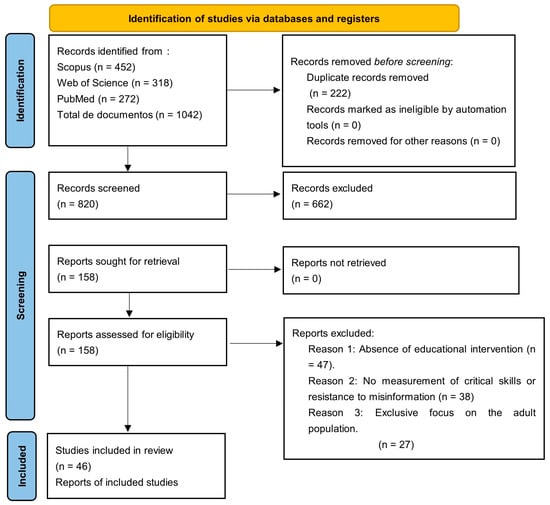
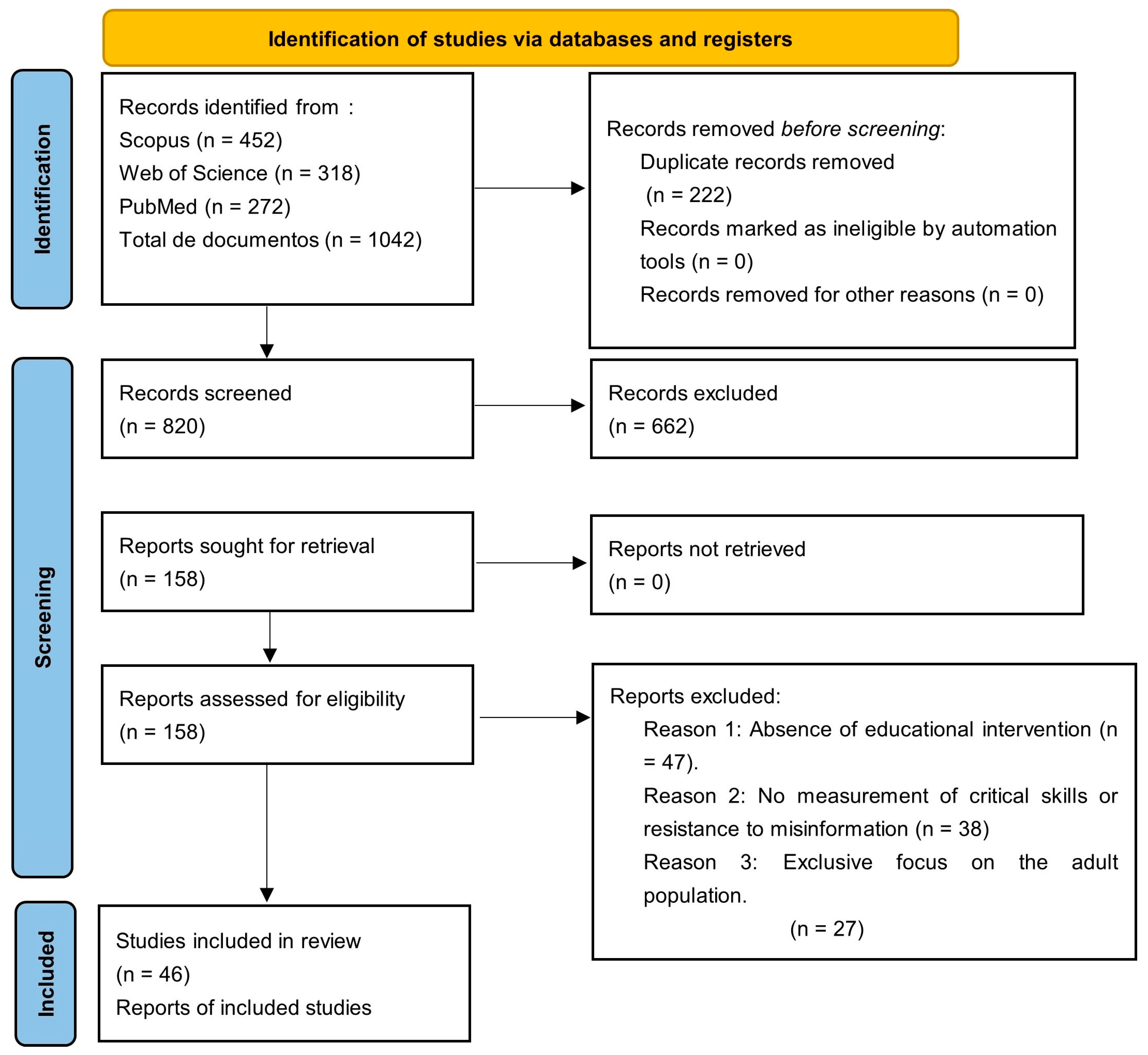
The process of identifying and selecting studies was carried out in accordance with the guidelines of the PRISMA 2020 flow chart. The initial search of the Scopus, Web of Science, and PubMed databases yielded a total of 1042 records. After removing 222 duplicate records, a set of 820 unique studies was obtained for the screening phase.
During the title and abstract review stage, 662 studies were excluded for not meeting the eligibility criteria, mainly because they did not address the adolescent population, did not focus on media literacy, or did not analyze phenomena related to misinformation on social media. As a result, 158 articles were evaluated in full text.
Figure 1: Illustration of the PRISMA (Preferred Reporting Items for Systematic Reviews and Meta-Analyses) flowchart, used to document the study selection process for research on social media and media literacy, to ensure transparency and methodological rigor. Source: Page et al. (2021).
Figure 1.
PRISMA Flowchart for the Selection Process of Studies on Social Media and Media Literacy.
3.1. Characteristics of Studies on Disinformation and Media Literacy (2019–2025)
The 46 selected studies were published between 2019 and 2025, with a greater concentration from 2021 onwards, which shows a growing academic interest in the analysis of disinformation and media literacy in educational contexts. Most of the research was conducted in Europe and North America, although studies from Latin America, Asia, and Oceania were also identified, providing a comparative view of the phenomenon.
In terms of methodological design, quasi-experimental and experimental studies predominated, followed by correlational research and systematic reviews. Table 1 shows that the samples consisted of adolescents aged 12 to 18, primarily from secondary schools.
Table 1.
General characteristics of the included studies.
3.2. Types of Educational Interventions Identified
Analysis of the studies identified four main types of educational interventions aimed at strengthening media literacy among adolescents:
- -
- Curricular media literacy programs, integrated into formal subjects in the school curriculum.
- -
- Interventions based on lateral reading and source verification, aimed at developing critical evaluation skills for digital information.
- -
- Cognitive inoculation (prebunking) strategies, designed to anticipate and neutralize misinformation.
- -
- Hybrid programs, combining teacher training, practical activities, and guided use of digital platforms.
Table 2 systematizes the types of interventions evaluated in the reviewed studies, along with the number of studies, the estimated duration, and the main results. The findings show a predominance of interventions based on curriculum literacy, followed by hybrid programs, lateral reading, and cognitive inoculation, which allows for the identification of a diversity of approaches aimed at strengthening critical thinking skills in the face of misinformation in educational contexts
Table 2.
Types of intervention and outcomes evaluated.
3.2.1. Results on Resistance to Disinformation
Most studies reported significant improvements in adolescents’ ability to identify false or misleading information following the implementation of educational interventions. In particular, programs based on skimming and active source verification showed positive effects on the assessment of the credibility of digital content.
Likewise, cognitive inoculation interventions showed a consistent reduction in the intention to share misinformation, even when participants were exposed to emotionally appealing content or content aligned with their prior beliefs.
3.2.2. Meta-Analysis Results
Of the 18 studies included in the meta-analysis, a moderate overall effect size was observed in favor of media literacy education interventions (SMD = 0.48; 95% CI [0.31, 0.65]), as presented in Table 3. Heterogeneity was moderate (I2 = 56%), which justified the use of a random-effects model.
Table 3.
Meta-analysis results by type of intervention.
The largest effect sizes were identified in interventions focused on lateral reading and cognitive inoculation, especially when these were applied in a guided and contextualized manner within the school environment.
The results of this systematic review confirm that adolescents’ exposure to misinformation on social media is a complex, multifactorial phenomenon deeply linked to a lack of critical skills for evaluating digital information. In line with the findings of the meta-analysis, recent evidence suggests that intensive use of social media platforms not only increases the likelihood of contact with misleading content, but also normalizes rapid, emotional, and unreflective information consumption practices, especially in educational contexts where media literacy has not been systematically integrated (Bode & Vraga, 2021; Kozyreva et al., 2020; Vosoughi et al., 2018; Zhang et al., 2019).
From a comparative perspective, the results show that structured educational interventions have significantly greater effects than isolated or short-term strategies. In particular, programs that incorporate guided verification activities, source analysis, and reflective discussion consistently strengthen adolescents’ ability to identify misinformation and reduce their intention to share false content. These findings are consistent with research highlighting the importance of active pedagogical mediation, in which teachers take on the role of facilitators of critical thinking rather than merely transmitters of digital content (Allen et al., 2022; Guess et al., 2020; European Commission, 2020).
Likewise, the review shows that strategies based on cognitive inoculation and prebunking generate positive effects, especially when applied in a contextualized manner and adapted to the cognitive and emotional characteristics of adolescents. Recent studies argue that anticipating information manipulation techniques allows for the development of psychological resistance to misinformation, even in highly emotionally charged scenarios (Basol et al., 2021; Lewandowsky et al., 2020). However, the effectiveness of these strategies depends largely on their integration into broader educational processes, avoiding their application as isolated interventions unrelated to the school curriculum.
Another relevant finding of this review is the persistence of gaps in the transfer of acquired skills to real-life situations involving everyday use of social media. Although numerous studies report significant improvements in controlled contexts, the effects tend to be diluted when adolescents interact in open digital environments characterized by social pressures, group validation, and intense emotional stimuli (Altay et al., 2020; Acerbi et al., 2022). This result highlights the need to design educational interventions that consider not only cognitive skills, but also the socio-emotional and ethical dimensions of digital behavior.
From an institutional perspective, the results reveal marked heterogeneity in the implementation of educational policies aimed at media literacy. While some education systems have moved towards integrated and cross-cutting models, in other contexts especially in developing countries—media literacy continues to be addressed in a fragmented manner, dependent on individual initiatives or temporary projects (Nascimbeni & Vosloo, 2019; World Economic Forum, 2023). This disparity limits the impact of interventions and reinforces pre-existing inequalities in access to critical digital training.
In line with this, various authors emphasize that teacher training is a determining factor in the success of media literacy programs. The lack of specific training for teachers in the areas of disinformation, digital verification, and critical thinking limits the ability of educational institutions to respond effectively to the challenges of the contemporary information ecosystem (Tondeur et al., 2017; Redecker, 2017). In this regard, the results of the review reinforce the need for teacher professional development policies that continuously integrate media and digital skills.
Another critical aspect identified is the lack of consideration given to the algorithmic dynamics of digital platforms within educational interventions. Most of the studies analyzed focus on informational content, but omit analysis of how recommendation algorithms work and their influence on selective exposure to information. Recent research warns that understanding these dynamics is key to developing truly critical media literacy, capable of empowering adolescents in the face of automated content selection systems (Eslami et al., 2019; Bucher, 2021).
From a critical perspective, the review also highlights recurring methodological limitations in recent literature, such as small sample sizes, lack of longitudinal designs, and overreliance on self-perception instruments. These weaknesses make it difficult to generalize the results and limit understanding of the long-term impact of educational interventions (Schwartz et al., 2012; van der Meer & Jin, 2020). Therefore, the methodological rigor of future research needs to be strengthened through mixed designs, longitudinal follow-up, and evaluation in real educational contexts.
Overall, the findings of this review support the idea that media literacy should not be conceived as an isolated technical skill, but rather as a comprehensive educational process that combines critical thinking, digital ethics, and civic engagement. The evidence analyzed suggests that educational institutions play an irreplaceable role in training adolescents to thoughtfully address the challenges of misinformation on social media, provided they have clear policies, adequate teacher training, and a sustained pedagogical approach (Mihailidis & Viotty, 2017; Frau-Meigs et al., 2017).
Finally, this discussion allows us to affirm that media literacy is a key strategy for mitigating the impact of misinformation on adolescents, but its effectiveness depends on its structural integration into educational systems, institutional commitment, and coordination with other social actors. In this way, education is consolidated as a fundamental axis for strengthening a critical, informed, and ethical citizenry in the contemporary digital context.
4. Discussion
The findings of this systematic review highlight the growing importance of media literacy education as a key strategy to mitigate the impact of misinformation among adolescents. The studies analyzed consistently show that educational interventions focused on critical evaluation of digital information significantly improve young people’s ability to identify unreliable sources and misleading online content. These results reinforce the idea that media literacy should be considered a fundamental competence in contemporary education systems.
Previous research has similarly emphasized the importance of strengthening media literacy skills among young people exposed to complex digital information environments. For example, McGrew et al. (2018) demonstrated that students who receive training in digital source evaluation significantly improve their ability to distinguish credible information from misleading content. Likewise, Nygren et al. (2019) found that structured media literacy programs contribute to developing critical thinking skills that enable adolescents to analyze online information more effectively.
The results also align with studies examining the psychological mechanisms behind misinformation acceptance. Pennycook et al. (2021) argue that individuals often share misleading information not necessarily because they believe it to be true but because they fail to engage in analytical reasoning when evaluating digital content. Educational interventions that promote reflective thinking and source verification therefore play a crucial role in reducing the spread of misinformation in digital environments.
In addition, the evidence analyzed in this review supports the argument that media literacy education should be integrated systematically into formal educational curricula. Research conducted by Pérez-Escoda et al. (2016) highlights that educational programs designed to strengthen media literacy competencies significantly improve adolescents’ capacity to critically interpret digital messages and detect manipulative information strategies. These findings reinforce the need to incorporate digital literacy training into school curricula in order to prepare students for the challenges of contemporary information ecosystems.
Similarly, Kahne et al. (2019) emphasize that adolescents who receive training in digital citizenship and media literacy demonstrate greater resilience to misinformation circulating on social media platforms. Their findings suggest that educational institutions play a crucial role in equipping students with the analytical tools necessary to evaluate information critically and participate responsibly in digital public spaces.
Another important finding emerging from this review concerns the effectiveness of different pedagogical approaches used in media literacy education. Active learning strategies—such as collaborative analysis of news content, verification exercises, and problem-based learning—appear to produce stronger learning outcomes than passive instructional methods. These approaches encourage students to question information sources, evaluate evidence, and recognize manipulation strategies used in digital media environments.
From a broader perspective, the results of this review highlight the critical role of educational institutions in addressing the societal challenges posed by misinformation. Schools and universities are uniquely positioned to provide adolescents with the cognitive and analytical skills necessary to navigate complex digital information ecosystems. Strengthening media literacy education therefore contributes not only to improving individual information competencies but also to reinforcing democratic resilience in the face of widespread digital disinformation.
Limitations of the Review
Despite the methodological rigor applied in this systematic review, several limitations should be acknowledged. First, the search was restricted to three major scientific databases (Scopus, Web of Science, and PubMed), which may have excluded relevant studies indexed in other academic sources. Second, the review focused only on articles published in English and Spanish between 2019 and 2025, which could limit the inclusion of earlier or non-English research addressing media literacy and misinformation.
Another limitation concerns the heterogeneity of the studies included in the review. The selected research differs in terms of methodological design, sample characteristics, and types of educational interventions analyzed, which may affect the comparability of results. In addition, some studies relied on self-reported measures to assess media literacy competencies, which may introduce potential response bias.
Future research could expand the scope of analysis by incorporating additional databases, exploring longitudinal designs, and examining the long-term effects of media literacy interventions on adolescents’ ability to identify and resist misinformation in digital environments.
5. Conclusions
The findings of this systematic review confirm the significant role that educational institutions play in strengthening adolescents’ media literacy in digital environments characterized by the widespread circulation of misinformation. The evidence analyzed indicates that structured educational interventions focused on critical evaluation of online information can substantially improve adolescents’ ability to identify misleading or unreliable content on social media platforms.
The studies included in this review demonstrate that media literacy education contributes to the development of key competencies such as source verification, critical interpretation of digital messages, and awareness of manipulation strategies used in online communication. These competencies are particularly relevant in contemporary information ecosystems where adolescents are frequently exposed to algorithmically amplified content that may include misinformation or disinformation.
The results also highlight that different pedagogical approaches such as lateral reading strategies, cognitive inoculation techniques, and structured curricular media literacy programs can effectively strengthen students’ resistance to misinformation. Educational interventions that promote active learning and critical engagement with digital content appear to produce more consistent outcomes in improving adolescents’ analytical skills when evaluating online information.
From an educational perspective, the findings emphasize the need to integrate media literacy education systematically into school curricula. Educational systems should prioritize the development of digital critical thinking skills as part of broader digital citizenship education. Strengthening media literacy competencies not only improves students’ ability to evaluate information but also contributes to building more informed and responsible digital citizens.
Finally, future research should continue exploring the long-term effectiveness of media literacy interventions and examine how educational programs can adapt to the rapidly evolving digital information landscape. Expanding research across diverse cultural and educational contexts will be essential for developing more comprehensive strategies to combat misinformation and promote critical engagement with digital media among adolescents.
5.1. Recommendations
Based on the findings of this systematic review, the following recommendations are proposed for different levels of the education system and academic research:
5.1.1. Recommendations for Educational Institutions
It is recommended that media literacy be integrated as a cross-cutting theme in the school curriculum, linked to different areas of knowledge and not limited to isolated subjects. This integration should include the progressive development of critical, ethical, and communication skills from the early years of secondary education.
It is also essential to promote active methodologies that encourage student participation in the analysis, comparison, and verification of digital information, incorporating real situations and issues specific to the media environment in which adolescents operate.
5.1.2. Recommendations for Teacher Training
It is essential to strengthen initial and continuing teacher training in media literacy, disinformation, and digital critical thinking. Teachers must have conceptual and pedagogical tools that enable them to understand the algorithmic dynamics of digital platforms and guide students in the reflective and ethical use of social media.
It is also suggested that communities of teaching practice be encouraged to facilitate the exchange of experiences, resources, and teaching strategies aimed at media education in real contexts.
5.1.3. Recommendations for Educational Policies
Educational authorities should design and promote public policies that recognize media literacy as a key skill for the 21st century, allocating specific resources for its implementation and evaluation. These policies should be coordinated with initiatives for digital inclusion, educational equity, and digital citizenship, especially in socially vulnerable contexts.
5.1.4. Recommendations for Future Research
It is recommended that future research adopt more robust methodological designs, incorporating longitudinal approaches that allow for the evaluation of the sustainability of the effects of educational interventions in media literacy. It is also pertinent to expand the analysis to include socio-emotional, cultural, and contextual dimensions that influence the way adolescents interact with information on social media.
Finally, it is suggested that the impact of new forms of disinformation, such as content generated by artificial intelligence and immersive environments, be explored in order to anticipate emerging challenges and guide the design of relevant and up-to-date educational strategies.
Author Contributions
Conceptualization, N.E.R.C. and K.A.-B.; Methodology, N.E.R.C. and K.A.-B.; Investigation, N.E.R.C., J.E.M.C. and M.M.A.-V.; Data curation, K.A.-B.; Formal analysis, K.A.-B.; Validation, J.E.M.C. and M.M.A.-V.; Writing—original draft preparation, N.E.R.C., J.E.M.C. and M.M.A.-V.; Writing—review & editing, N.E.R.C., J.E.M.C. and M.M.A.-V.; Visualization, K.A.-B.; Supervision, N.E.R.C.; Project administration, N.E.R.C. All authors have read and agreed to the published version of the manuscript.
Funding
This research received no external funding.
Institutional Review Board Statement
Not applicable.
Informed Consent Statement
Not applicable.
Data Availability Statement
No new data were created or analyzed in this study. Data sharing is not applicable to this article.
Conflicts of Interest
The authors declare no conflicts of interest.
References
- Acerbi, A., Altay, S., & Mercier, H. (2022). Research note: Fighting misinformation or fighting for information? Harvard Kennedy School (HKS) Misinformation Review, 3, 1–15. [Google Scholar] [CrossRef] [Scilit]
- Allen, J. K., Griffin, R. A., & Mindrila, D. (2022). Discerning (Dis)information: Teacher perceptions of critical media literacy. The Journal of Media Literacy Education, 14(3), 1–16. [Google Scholar] [CrossRef] [Scilit]
- Altay, S., Hacquin, A.-S., & Mercier, H. (2020). Why do so few people share fake news? It hurts their reputation. New Media & Society, 24, 1303–1324. [Google Scholar] [CrossRef] [Scilit]
- Auxier, B., Anderson, M., Perrin, A., Turner, E., & Nadeem, R. (2020). Parenting kids in the age of screens. Pew Research Center. Available online: https://www.pewresearch.org/internet/2020/07/28/parenting-children-in-the-age-of-screens/ (accessed on 2 March 2026).
- Basol, M., Roozenbeek, J., & van der Linden, S. (2021). Good news about bad news: Gamified inoculation boosts resistance to misinformation. Journal of Cognition, 4(1), 2. [Google Scholar] [CrossRef] [Scilit]
- Bode, L., & Vraga, E. K. (2021). Correction experiences on social media during COVID-19. Social Media + Society, 7(2). [Google Scholar] [CrossRef] [Scilit]
- Bucher, T. (2021). If…then: Algorithmic power and politics. Oxford University Press. [Google Scholar] [CrossRef] [Scilit]
- Buckingham, D. (2020). Epilogue: Rethinking digital literacy: Media education in the age of digital capitalism. Digital Education Review, 37, 230–239. [Google Scholar] [CrossRef] [Scilit]
- Couldry, N., & Mejias, U. A. (2019). The costs of connection: How data is colonizing human life. Stanford University Press. [Google Scholar] [CrossRef] [Scilit]
- ECLAC. (2022, April 28). Digital technologies for a new future. Available online: https://www.cepal.org/en/publications/46817-digital-technologies-new-future (accessed on 8 March 2026).
- Eslami, M., Vaccaro, K., Lee, M. K., Bar On, A. E., Gilbert, E., & Karahalios, K. (2019). User attitudes towards algorithmic opacity and transparency in online reviewing platforms. In Proceedings of the 2019 CHI conference on human factors in computing systems. Association for Computing Machinery. [Google Scholar] [CrossRef] [Scilit]
- European Commission. (2020). Digital education action plan 2021–2027: Policy background (COM/2020/624 final). Available online: https://education.ec.europa.eu/focus-topics/digital-education/plan (accessed on 10 March 2026).
- Frau-Meigs, D., O’Neill, B., Soriani, A., & Tomé, V. (2017). Digital citizenship education: Volume 1—Overview and new perspectives. Council of Europe Publishing. Available online: https://rm.coe.int/168077bc6a (accessed on 8 March 2026).
- Guess, A. M., Lerner, M., Lyons, B., Montgomery, J. M., Nyhan, B., Reifler, J., & Sircar, N. (2020). A digital media literacy intervention increases discernment between mainstream and false news in the United States and India. Proceedings of the National Academy of Sciences of the USA, 117(27), 15536–15545. [Google Scholar] [CrossRef] [Scilit] [PubMed]
- Hobbs, R., & Coiro, J. (2019). Design features of a professional development program in digital literacy. Journal of Adolescent & Adult Literacy, 62(4), 401–409. [Google Scholar] [CrossRef] [Scilit]
- Kahne, J., & Bowyer, B. (2019). Can media literacy education increase digital engagement in politics? Learning, Media and Technology, 44(2), 211–224. [Google Scholar] [CrossRef] [Scilit]
- Kozyreva, A., Lewandowsky, S., & Hertwig, R. (2020). Citizens versus misinformation. Nature Human Behaviour, 4(5), 460–467. [Google Scholar] [CrossRef] [Scilit]
- Kozyreva, A., Wineburg, S., Lewandowsky, S., & Hertwig, R. (2022). Critical ignoring as a core competence for digital citizens. Current Directions In Psychological Science, 32(1), 81–88. [Google Scholar] [CrossRef] [Scilit]
- Lewandowsky, S., Cook, J., Ecker, U. K. H., Albarracín, D., Amazeen, M. A., Kendeou, P., Lombardi, D., Newman, E. J., Pennycook, G., Porter, E., Rand, D. G., Rapp, D. N., Reifler, J., Roozenbeek, J., Schmid, P., Seifert, C. M., Sinatra, G. M., Swire-Thompson, B., van der Linden, S., … Zaragoza, M. S. (2020). The debunking handbook 2020. Databrary. [Google Scholar] [CrossRef] [Scilit]
- Livingstone, S., Stoilova, M., & Nandagiri, R. (2020). Data and privacy literacy. In D. Frau-Meigs, S. Kotilainen, M. Pathak-Shelat, M. Hoechsmann, & S. R. Poyntz (Eds.), The handbook of media education research (pp. 413–425). Wiley. [Google Scholar] [CrossRef] [Scilit]
- McGrew, S., Breakstone, J., Ortega, T., Smith, M., & Wineburg, S. (2018). Can students evaluate online sources? Learning from assessments of civic online reasoning. Theory & Research in Social Education, 46(2), 165–193. [Google Scholar] [CrossRef] [Scilit]
- Mihailidis, P., & Viotty, S. (2017). Spreadable spectacle in digital culture: Civic expression, fake news, and the role of media literacies in “post-fact” society. American Behavioral Scientist, 61(4), 441–454. [Google Scholar] [CrossRef] [Scilit]
- Nascimbeni, F., & Vosloo, S. (2019). Digital literacy for children: Exploring definitions and frameworks. UNICEF Office of Global Insight and Policy. Available online: https://www.unicef.org/innocenti/reports/digital-literacy-children-exploring-definitions-and-frameworks (accessed on 4 March 2026).
- Newport, C. (2019). Digital minimalism: Choosing a focused life in a noisy world. Portfolio/Penguin. [Google Scholar]
- Nygren, T., Brounéus, F., & Svensson, G. (2019). Diversity and credibility in young people’s news feeds: A foundation for teaching and learning citizenship in a digital era. Journal of Social Science Education, 18(2), 87–109. [Google Scholar] [CrossRef]
- OECD. (2021). OECD digital education outlook 2021. OECD. [Google Scholar] [CrossRef] [Scilit]
- Page, M. J., McKenzie, J. E., Bossuyt, P. M., Boutron, I., Hoffmann, T. C., Mulrow, C. D., Shamseer, L., Tetzlaff, J. M., Akl, E. A., Brennan, S. B., Chou, R., Glanville, J., Grimshaw, J. M., Hróbjartsson, A., Lalu, M. M., Li, T., Loder, E. W., Mayo-Wilson, E., McDonald, S., … Moher, D. (2021). The PRISMA 2020 statement. BMJ, 372, n71. [Google Scholar] [CrossRef] [Scilit]
- Pennycook, G., Epstein, Z., Mosleh, M., Arechar, A. A., Eckles, D., & Rand, D. G. (2021). Shifting attention to accuracy can reduce misinformation online. Nature, 592(7855), 590–595. [Google Scholar] [CrossRef] [Scilit]
- Pérez-Escoda, A., Castro-Zubizarreta, A., & Fandos-Igado, M. (2016). Digital skills in the Z generation: Key questions for a curricular introduction in primary school. Comunicar, 24(49), 71–79. [Google Scholar] [CrossRef] [Scilit]
- Redecker, C., & Punie, Y. (2017). European framework for the digital competence of educators: DigCompEdu. Publications Office of the European Union. Psu. Available online: https://publications.jrc.ec.europa.eu/repository/handle/JRC107466 (accessed on 1 March 2026).
- Schwartz, D. L., Chase, C. C., & Bransford, J. D. (2012). Resisting overzealous transfer: Coordinating previously successful routines with needs for new learning. Educational Psychologist, 47(3), 204–214. [Google Scholar] [CrossRef] [Scilit]
- Siddaway, A. P., Wood, A. M., & Hedges, L. V. (2019). How to do a systematic review. Annual Review of Psychology, 70, 747–770. [Google Scholar] [CrossRef] [Scilit]
- Tondeur, J., Pareja Roblin, N., van Braak, J., Voogt, J., & Prestridge, S. (2017). Preparing beginning teachers for technology integration in education: Ready for take-off? Technology, Pedagogy and Education, 26(2), 157–177. [Google Scholar] [CrossRef] [Scilit]
- Twenge, J. M., Haidt, J., Lozano, J., & Cummins, K. M. (2022). Specification curve analysis shows that social media use is linked to poor mental health, especially among girls. Acta Psychologica, 224, 103512. [Google Scholar] [CrossRef] [Scilit] [PubMed]
- UNESCO. (2013). Media and information literacy: Policy and strategy guidelines. UNESCO Publishing. Available online: https://unesdoc.unesco.org/ark:/48223/pf0000225606 (accessed on 12 March 2026).
- UNESCO. (2023). Media and information literacy: UNESCO MILID yearbook 2023. UNESCO Publishing. Available online: https://unesdoc.unesco.org/ark:/48223/pf0000386080 (accessed on 5 March 2026).
- van der Linden, S., Roozenbeek, J., & Compton, J. (2020). Inoculating against fake news about COVID-19. Frontiers in Psychology, 11, 566790. [Google Scholar] [CrossRef] [Scilit] [PubMed]
- van der Meer, T. G. L. A., & Jin, Y. (2020). Seeking formula for misinformation treatment in public health crises: The effects of corrective information type and source. Health Communication, 35(5), 560–575. [Google Scholar] [CrossRef] [Scilit]
- van Dijck, J., Poell, T., & de Waal, M. (2018). The platform society: Public values in a connective world. Oxford University Press. [Google Scholar]
- Vosoughi, S., Roy, D., & Aral, S. (2018). The spread of true and false news online. Science, 359(6380), 1146–1151. [Google Scholar] [CrossRef] [Scilit]
- Wardle, C. (2020). Understanding information disorder. First Draft. Available online: https://firstdraftnews.org/long-form-article/understanding-information-disorder/ (accessed on 3 March 2026).
- World Economic Forum. (2023). Global risks report 2023 (18th ed.). World Economic Forum. Available online: https://www.weforum.org/publications/global-risks-report-2023/ (accessed on 11 March 2026).
- Zhang, X., & Ghorbani, A. A. (2019). An overview of online fake news: Characterization, detection, and discussion. Information Processing & Management, 57(2), 102025. [Google Scholar] [CrossRef] [Scilit]
- Zuboff, S. (2019). The age of surveillance capitalism: The fight for a human future at the new frontier of power. PublicAffairs. ISBN 978-1610395694. [Google Scholar]

Disclaimer/Publisher’s Note: The statements, opinions and data contained in all publications are solely those of the individual author(s) and contributor(s) and not of MDPI and/or the editor(s). MDPI and/or the editor(s) disclaim responsibility for any injury to people or property resulting from any ideas, methods, instructions or products referred to in the content. |
© 2026 by the authors. Licensee MDPI, Basel, Switzerland. This article is an open access article distributed under the terms and conditions of the Creative Commons Attribution (CC BY) license.