5. Discussion
This study aimed to examine the relationship between public exposure to digital media coverage via news pages on social media platforms and online news websites of the civil war in Sudan, and levels of psychological immunity and post-traumatic stress disorder among a purposive sample of Sudanese individuals following war-related news. It also aimed to examine the mediating role of psychological immunity in the relationship between media exposure and public experience of post-traumatic stress disorder.
The results demonstrated a high level of exposure among the Sudanese respondents, both inside and outside Sudan, to news and content related to the civil war across various digital platforms, particularly news pages on social media. This underscores the current significance of social media for the public, and for youth in particular, as one of the most important forms of new media and the most closely followed by the respondents. These findings are consistent with previous studies (
Al Adwan et al., 2024,
2025;
Hassan et al., 2024).
These results, from another perspective, reflect the value of digital media platforms specifically, and how audiences assign them importance and priority in following the news. The services they provide, such as live streaming, reels, and video clips, enable individuals to post and follow events in real time and engage with them, thereby increasing trust in these platforms. This aligns with the study by
Ashour (
2020), which indicated that news pages on social media platforms ranked at the forefront of digital media sources from which respondents obtained information and news regarding crises and disasters. Furthermore, this finding confirms that the shift toward the digital environment is no longer merely an alternative to traditional media but has become the primary source of information for audiences, consistent with previous studies such as
Khalifa et al. (
2026),
Widdatallah (
2025), and
Fayez (
2022,
2024), which emphasized the centrality of digital platforms in meaning-making during crises.
Regarding the results of the psychological immunity scale, the means ranged between 3.27 and 3.60, with the dimension of positive thinking ranking first, whereas the dimension of persistence and mental toughness ranked last. This indicates that the Sudanese public possesses moderate levels of psychological immunity. This finding confirms that individuals have some psychological coping mechanisms, but they are insufficient to withstand the intense pressures resulting from continuous exposure to traumatic events. This result is consistent with the findings of
Sabon (
2024), which indicated that positive psychological factors may decline under the sustained pressure resulting from excessive exposure to crises.
Conversely, the results of the post-traumatic stress disorder (PTSD) scale indicated that the means ranged between 3.47 and 3.61, with the dimension of event arousal ranking first. This suggests that a significant percentage of the audience experiences heightened PTSD symptoms due to repeated exposure to violent and dramatic digital content associated with the civil war. These findings are consistent with those of
Garfin et al. (
2020), who noted that repeated exposure to tragic news through digital media is closely linked to increased levels of anxiety, depression, and post-traumatic stress disorder.
An additional factor that may help explain the elevated levels of PTSD symptoms—particularly hyperarousal—is the algorithmic nature of digital media platforms. In contemporary digital environments, exposure is not solely determined by user choice, but is significantly shaped by algorithmic curation systems that prioritize content based on engagement, emotional intensity, and prior user behavior. Such systems may contribute to the formation of “echo chambers,” where individuals are repeatedly exposed to similar narratives and emotionally charged content. In the context of war coverage, this may result in what can be described as “trauma loops,” whereby distressing images and narratives are continuously circulated and re-encountered by users across platforms.
This pattern of repeated and algorithmically amplified exposure may intensify emotional activation and sustain heightened states of alertness, offering a plausible explanation for the high levels of hyperarousal observed in the study sample. This perspective suggests that media exposure should not be understood solely as an individual behavior, but also as a structurally mediated process shaped by platform design and content prioritization mechanisms.
Furthermore, the results revealed a statistically significant negative correlation between the level of media exposure and psychological immunity, indicating that excessive consumption of digital news coverage diminishes individuals’ capacity for mental immunity. This explains the low emotional resistance among the Sudanese respondents in response to repeated traumatic events. This finding aligns with the explanatory model proposed by
Sabon (
2024) and
Garfin et al. (
2020), which posits that intensive media exposure to violent events weakens emotional regulation mechanisms and is associated with higher susceptibility to psychological burnout.
In the same vein, a negative correlation emerged between exposure to war news and the level of psychological immunity among the audience, alongside a statistically significant positive correlation between the level of media exposure and post-traumatic stress disorder (PTSD). This finding reinforces what has been reported in studies by
Garfin et al. (
2020),
Thompson et al. (
2019), and
Hall et al. (
2019), which found that digitally mediated traumatic content is related to elevated emotional arousal and physiological activity, thereby increasing the likelihood of developing PTSD symptoms. However, it differs from the study by
Ashour (
2020), which found a positive correlation between psychological immunity and information-seeking about the COVID-19 pandemic via social networks.
The relatively strong association observed between media exposure and PTSD symptoms may be explained by the nature of digital media environments, which facilitate repeated and often unfiltered exposure to emotionally intense and visually graphic content. Unlike traditional media, digital platforms enable continuous updates, user-generated content, and algorithmically amplified visibility, increasing the likelihood of repeated exposure to disturbing content. This high level of exposure, combined with the immediacy and immersive nature of digital content, may contribute to stronger emotional and cognitive responses, thereby explaining the magnitude of the observed effects. Although this study did not conduct platform-specific comparative analysis, the findings should be interpreted in light of the dominant role of social media platforms, particularly Facebook, as primary sources of exposure. These platforms are characterized by high levels of content circulation, interactivity, and algorithmic amplification, which may intensify exposure patterns compared to more traditional or structured news environments.
An important consideration in interpreting these findings relates to the potential long-term psychological implications of sustained exposure to conflict-related media content. Given that the conflict context examined in this study is ongoing, exposure to distressing information is not a one-time event but may occur continuously over extended periods. In this context, it is useful to distinguish between acute and chronic manifestations of PTSD symptoms. While acute responses may emerge following short-term or intense exposure to traumatic content, prolonged and repeated exposure—particularly within digitally mediated environments—may contribute to more persistent or chronic patterns of psychological distress.
Continuous digital immersion, facilitated by always-on media access and algorithmically driven content circulation, may sustain or even intensify these responses over time. This raises the possibility that the psychological effects observed in this study may not only reflect immediate reactions but could also indicate longer-term processes of stress accumulation.
The present findings can also be further interpreted through a cognitive–psychological lens, particularly in light of the framework proposed by
Clark and Ehlers (
2004), which emphasizes the role of maladaptive cognitive appraisals in the development and persistence of PTSD symptoms. In the context of digital media exposure, repeated engagement with distressing war-related content may reinforce negative cognitive schemas, such as heightened perceptions of threat and vulnerability.
Moreover, the results align with prior research highlighting the psychological risks associated with mediated exposure to conflict.
Feinstein (
2004) notes that even indirect exposure to war-related content can have significant psychological consequences, while
Frey (
2018) demonstrates that social media environments can intensify emotional engagement with traumatic events due to their real-time, immersive, and interactive nature.
Within this framework, the negative association between media exposure and psychological immunity observed in the current study may be interpreted as reflecting a gradual erosion of individuals’ cognitive and emotional coping resources under conditions of sustained exposure to distressing media content. At the same time, the positive association between exposure and PTSD symptoms supports the view that digitally mediated experiences of conflict can function as indirect stressors with measurable psychological effects.
These results confirm that events associated with crises and wars, and the human losses they entail, evoke significant empathy and engagement from the audience. Consequently, individuals’ psychological states are affected by the scenes of destruction and the victims they witness. In such cases, psychological immunity may be compromised, and vivid images and scenes are imprinted in their minds, making them difficult to forget, thereby eliciting a form of trauma-related distress tied to the occurrence of these events.
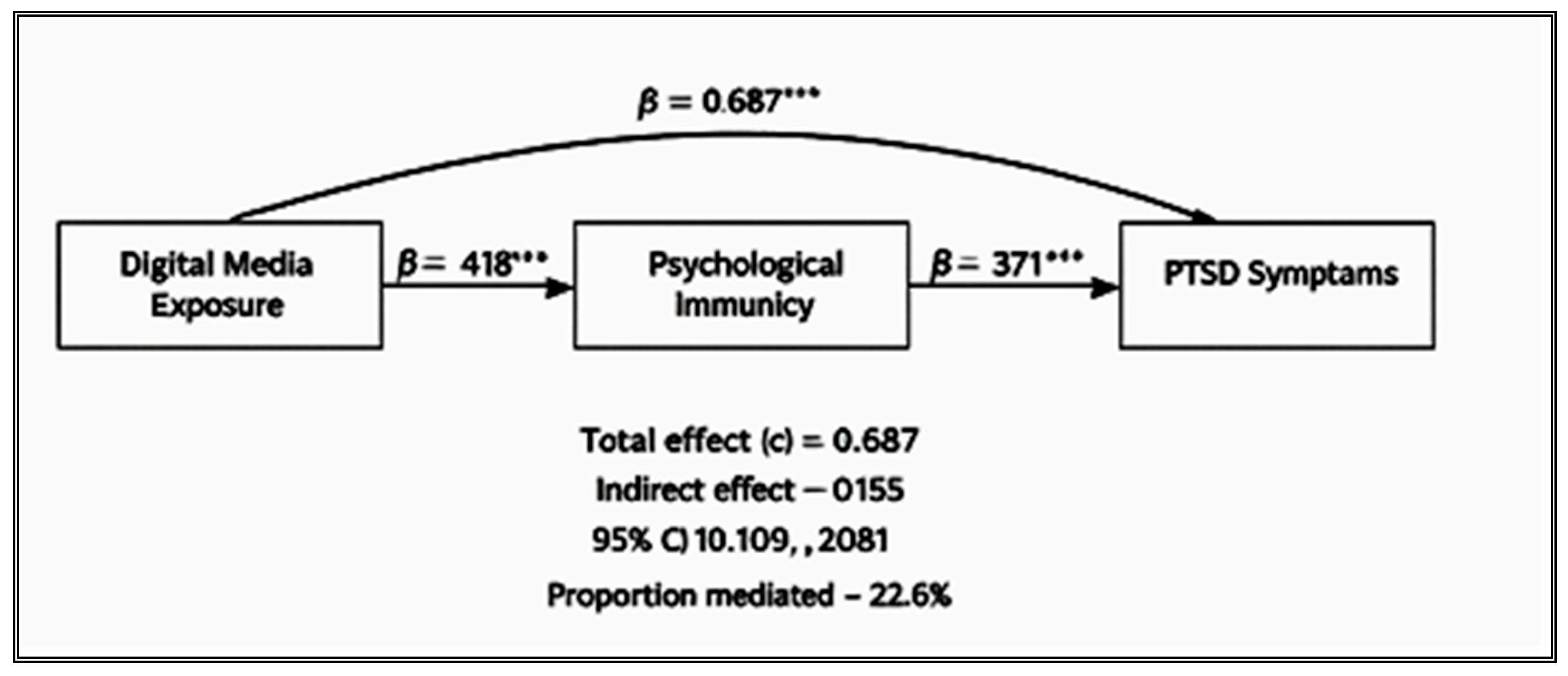
As for the results of the path analysis, they indicated that psychological immunity functions as a partial mediator between media exposure and post-traumatic stress disorder (PTSD). That is, it partially mitigates the negative impact of exposure but does not eliminate it. This finding highlights the protective role of psychological immunity as a coping mechanism that helps reduce the effects of media-induced trauma; however, its effectiveness remains limited in the context of a high influx of tragic content. This result aligns with the work of
Fletcher and Sarkar (
2013), who noted that psychological immunity is not a fixed trait but is influenced by the level of exposure to stress-inducing stimuli.
The findings of this study should also be interpreted in light of important contextual factors that were not explicitly included in the mediation model. In particular, variations in content type—such as the distinction between highly visual and text-based representations of conflict—may play a significant role in shaping psychological responses. Visual and graphic content, often amplified in digital environments, may produce stronger emotional engagement and contribute more directly to distress. Additionally, audience-related factors such as media trust and individual agency in selecting, interpreting, or avoiding content may influence the relationship between exposure and psychological outcomes. Similarly, platform-specific characteristics, including algorithmic curation and content prioritization, may affect both the frequency and nature of exposure.
The results also showed no statistically significant differences between males and females in levels of psychological immunity and post-traumatic stress disorder (PTSD), indicating that engagement with war-related content transcends traditional gender differences, particularly in the digital environment. This is consistent with the findings of
Hall et al. (
2019) and
Barthel (
2016), which indicated that gender differences in emotional responses to digital crises are not statistically significant.
However, significant differences emerged based on the variable of place of residence, favoring individuals residing outside Sudan in terms of psychological immunity, and favoring residents within Sudan regarding PTSD symptoms. This reflects the influence of the immediate living environment on either enhancing or undermining psychological stability. Additionally, the results revealed that the older age group (45 years and above) exhibited higher levels of psychological immunity, whereas the younger age group (18–29 years) displayed higher levels of PTSD, indicating the vulnerability of young people’s psychological balance due to their deep immersion in the digital media environment and continuous exposure to traumatic content.
Regarding the educational level, it was found that individuals with higher education (university degree holders) exhibited higher levels of psychological immunity, whereas post-traumatic stress disorder (PTSD) symptoms were higher among those with lower educational attainment. This indicates that media literacy and critical knowledge contribute to reducing susceptibility to traumatic content. The observed differences favoring younger and less-educated groups underscore the need for psychological media-awareness programs targeting these populations to build digital immunity against informational trauma. Although this study does not directly measure media literacy, the findings point toward its potential importance as a protective factor in digitally mediated conflict environments. Prior research suggests that individuals with higher levels of critical media engagement may be better equipped to interpret, contextualize, and emotionally regulate exposure to distressing content (
Alquaary et al., 2026). From this perspective, media literacy can be understood as a component of psychological immunity, as it may enhance individuals’ ability to critically process media messages, avoid overexposure, and reduce susceptibility to emotionally overwhelming content.
Overall, the results underscore the significant psychological impact of digital media on audiences in the modern era. They also support media theories suggesting that audience proximity to an event increases susceptibility to its content. Furthermore, the findings indicate that psychological immunity is a critical factor in explaining the relationship between media exposure and post-traumatic stress disorder (PTSD). It may contribute to the development of psychological and media-awareness strategies aimed at mitigating the negative psychological effects of following war coverage by promoting positive thinking, enhancing self-directed psychological coping mechanisms, and training individuals in critical evaluation of media content during times of crisis.
Also, the findings raise important critical questions regarding the role of journalism practices in shaping audience exposure to conflict-related content. In digitally mediated environments, the boundaries between informing the public and exposing audiences to potentially harmful material become increasingly blurred (
Al Adwan et al., 2023). The high levels of exposure observed in this study may reflect not only audience demand but also editorial decisions regarding what types of content are prioritized, framed, and circulated. These findings invite a more explicit consideration of journalism ethics in the context of war reporting. In particular, they raise the question of whether limits should be placed on the circulation of highly graphic or emotionally distressing content, especially when such content is widely shared via digital platforms without contextual framing or content warnings.
While visual documentation of conflict can serve important journalistic functions, including raising awareness and bearing witness, its unregulated dissemination may also contribute to cumulative psychological harm among audiences. This tension reflects a fundamental ethical dilemma in contemporary journalism: balancing the imperative to inform with the responsibility to minimize harm.
Moreover, the role of platform-driven dynamics should be considered in interpreting these findings. Digital platforms often prioritize content that generates high levels of engagement, which frequently includes emotionally intense or sensational material. This form of algorithmically amplified visibility may contribute to the repeated exposure of audiences to distressing content, potentially intensifying psychological responses.
From a practical perspective, these findings suggest the need for more responsible journalism practices in conflict reporting. This may include adopting trauma-sensitive reporting guidelines, providing contextual framing for distressing content, and implementing content warnings where appropriate. Editors and media organizations may also need to critically evaluate the extent to which the circulation of graphic material serves public interest versus contributing to audience harm.




 ,
,