
What Drives Effective AI Use in the Newsroom? Communication Barriers, Organizational Support, and Journalist Performance in China


Abstract
1. Introduction
2. Review of Literature
2.1. AI Adoption in Journalism: Theoretical Models and Influencing Factors
2.2. Challenges and Barriers in AI Adoption for Journalism
2.3. The Chinese Media Context
3. Hypotheses Development
3.1. Expectation Confirmation (EC)
3.2. Perceived Usefulness (PU)
3.3. Perceived Ease of Use (PEU)
3.4. Perceived Satisfaction (PS)
3.5. Digital Literacy (DL)
3.6. Personal Trust (PT)
3.7. Organizational Support (OS)
3.8. Communication Barriers (CBs)
3.9. Demographic Variables
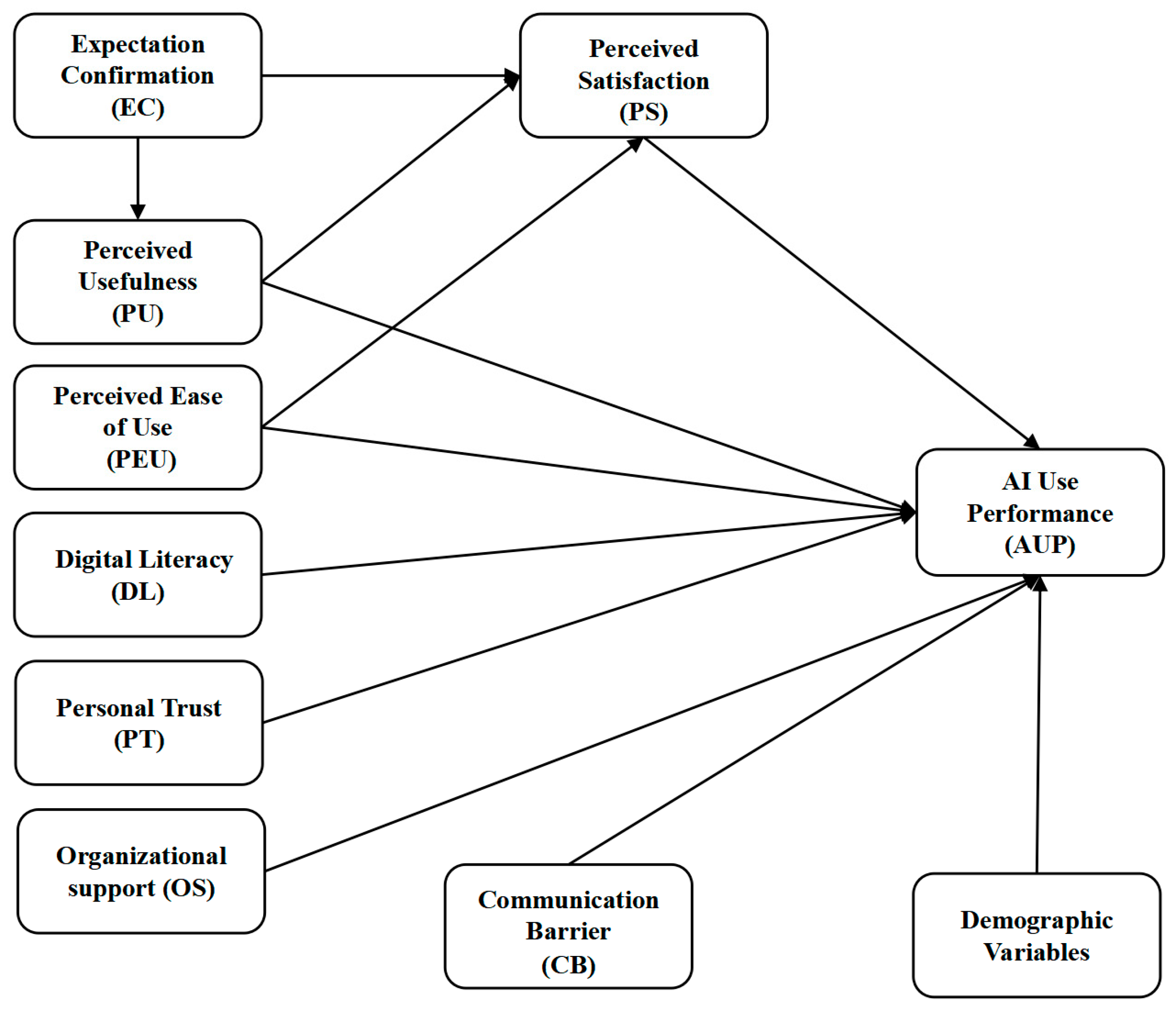
3.10. Conceptual Model
4. Materials and Method
4.1. Research Context and Sampling
4.2. Profile of Respondents
4.3. Research Instrument
4.4. Statistical Analysis
4.5. Common Method Bias (CMB)
5. Results
5.1. Assessing the Outer Measurement Model
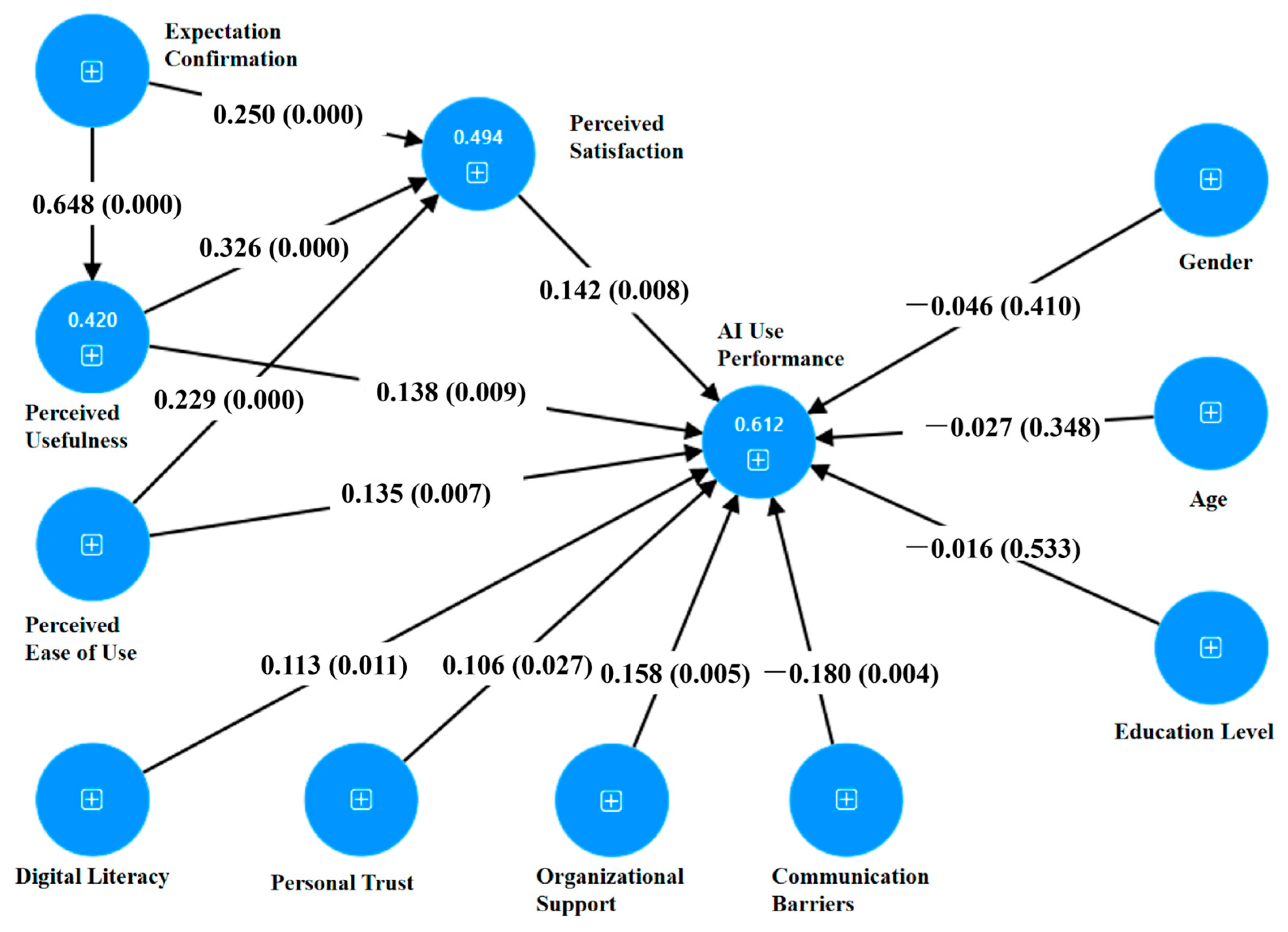
5.2. Inspecting the Inner Structural Model
5.3. Predictive Relevance and Effect Size
5.4. Artificial Neural Network (ANN) Analysis
6. Discussion, Conclusions, Implications, and Limitations
6.1. Discussion
6.2. Conclusions
6.3. Implications
6.3.1. Theoretical Implications
6.3.2. Practical Implications
6.4. Limitations and Future Directions
Author Contributions
Funding
Institutional Review Board Statement
Informed Consent Statement
Data Availability Statement
Acknowledgments
Conflicts of Interest
Abbreviations
| AI | Artificial Intelligence |
| AUP | AI Use Performance |
| TAM | Technology Acceptance Model |
| ECM | Expectation Confirmation Model |
| EC | Expectation Confirmation |
| PU | Perceived Usefulness |
| PEU | Perceived Ease of Use |
| PS | Perceived Satisfaction |
| DL | Digital Literacy |
| PT | Personal Trust |
| OS | Organizational Support |
| CBs | Communication Barriers |
| PLS-SEM | Partial Least Squares Structural Equation Modeling |
| ANN | Artificial Neural Network |
| RMSE | Root Mean Squared Error |
| AVE | Average Variance Extracted |
| CR | Composite Reliability |
| HTMT | Heterotrait–Monotrait Ratio |
| VIF | Variance Inflation Factor |
| CMB | Common Method Bias |
References
- Aldás-Manzano, J., Ruiz-Mafé, C., & Sanz-Blas, S. (2009). Exploring individual personality factors as drivers of M-shopping acceptance. Industrial Management & Data Systems, 109(6), 739–757. [Google Scholar] [CrossRef]
- Al-Rahmi, A. M., Shamsuddin, A., Alturki, U., Aldraiweesh, A., Yusof, F. M., Al-Rahmi, W. M., & Aljeraiwi, A. A. (2021). The influence of information system success and technology acceptance model on social media factors in education. Sustainability, 13(14), 7770. [Google Scholar] [CrossRef]
- Al-Sharafi, M. A., Al-Emran, M., Iranmanesh, M., Al-Qaysi, N., Iahad, N. A., & Arpaci, I. (2023). Understanding the impact of knowledge management factors on the sustainable use of AI-based chatbots for educational purposes using a hybrid SEM-ANN approach. Interactive Learning Environments, 31(10), 7491–7510. [Google Scholar] [CrossRef]
- Al-Sharafi, M. A., Mufadhal, M. E., Arshah, R. A., & Sahabudin, N. A. (2021). Acceptance of online social networks as technology-based education tools among higher institution students: Structural equation modeling approach. Scientia Iranica, 28(1), 136–144. [Google Scholar] [CrossRef]
- Alves, J. L., Nadae, J. D., & Carvalho, M. M. D. (2022). Knowledge management enablers and barriers: Exploring the moderating effect of communication barriers. International Journal of Managing Projects in Business, 15(7), 1091–1122. [Google Scholar] [CrossRef]
- Ateeq, A., Milhem, M., Alzoraiki, M., Dawwas, M. I., Ali, S. A., & Yahia Al Astal, A. (2024). The impact of AI as a mediator on effective communication: Enhancing interaction in the digital age. Frontiers in Human Dynamics, 6, 1467384. [Google Scholar] [CrossRef]
- Back, K. W., Bunker, S., & Dunnagan, C. B. (1972). Barriers to communication and measurement of semantic space. Sociometry, 35(3), 347–356. [Google Scholar] [CrossRef]
- Badghish, S., & Soomro, Y. A. (2024). Artificial intelligence adoption by SMEs to achieve sustainable business performance: Application of technology–organization–environment framework. Sustainability, 16(5), 1864. [Google Scholar] [CrossRef]
- Bakı, R., Bırgoren, B., & Aktepe, A. (2018). A meta analysis of factors affecting perceived usefulness and perceived ease of use in the adoption of e-learning systems. Turkish Online Journal of Distance Education, 19(4), 4–42. [Google Scholar] [CrossRef]
- Beckett, C. (2019). New powers, new responsibilities: A global survey of journalism and artificial intelligence. London School of Economics. [Google Scholar]
- Benson, C. E., Okolo, C. H., & Oke, O. (2025). Exploring the impact of AI on traditional journalism: Conceptualizing the future of news reporting and media integrity in an AI-driven world. International Journal of Advanced Multidisciplinary Research and Studies, 5, 2523–2529. [Google Scholar] [CrossRef]
- Bhagat, R., Chauhan, V., & Bhagat, P. (2023). Investigating the impact of artificial intelligence on consumer’s purchase intention in e-retailing. Foresight, 25(2), 249–263. [Google Scholar] [CrossRef]
- Bhattacherjee, A. (2001). Understanding information systems continuance: An expectation-confirmation model. MIS Quarterly, 25(3), 351–370. [Google Scholar] [CrossRef]
- Bunce, M. (2019). Management and resistance in the digital newsroom. Journalism, 20(7), 890–905. [Google Scholar] [CrossRef]
- Checkland, P. (1981). Systems thinking, systems practice. John Wiley & Sons. [Google Scholar]
- China Internet Network Information Center [CINIC]. (2025). The 56th statistical report on China’s internet development. CINIC. [Google Scholar]
- Choung, H., David, P., & Ross, A. (2023). Trust in AI and its role in the acceptance of AI technologies. International Journal of Human–Computer Interaction, 39(9), 1727–1739. [Google Scholar] [CrossRef]
- Cohen, J. (1992). A power primer. Psychological Bulletin, 112(1), 155–159. [Google Scholar] [CrossRef] [PubMed]
- Couch, L. L., Adams, J. M., & Jones, W. H. (1996). The assessment of trust orientation. Journal of Personality Assessment, 67(2), 305–323. [Google Scholar] [CrossRef]
- Covello, S., & Lei, J. (2010). A review of digital literacy assessment instruments. Syracuse University, School of Education. [Google Scholar]
- Cui, D., & Wu, F. (2021). The influence of media use on public perceptions of artificial intelligence in China: Evidence from an online survey. Information Development, 37(1), 45–57. [Google Scholar] [CrossRef]
- Davis, F. D. (1989). Perceived usefulness, perceived ease of use, and user acceptance of information technology. MIS Quarterly, 13(3), 319–340. [Google Scholar] [CrossRef]
- Davis, F. D., Bagozzi, R. P., & Warshaw, P. R. (1989). User acceptance of computer technology: A comparison of two theoretical models. Management Science, 35(8), 982–1003. [Google Scholar] [CrossRef]
- de-Lima-Santos, M. F., & Ceron, W. (2021). Artificial intelligence in news media: Current perceptions and future outlook. Journalism and Media, 3(1), 13–26. [Google Scholar] [CrossRef]
- Diakopoulos, N. (2019). Automating the news: How algorithms are rewriting the media. Harvard University Press. [Google Scholar] [CrossRef]
- Dierickx, L., Opdahl, A. L., Khan, S. A., Lindén, C. G., & Guerrero Rojas, D. C. (2024). A data-centric approach for ethical and trustworthy AI in journalism. Ethics and Information Technology, 26, 64. [Google Scholar] [CrossRef]
- Duan, Y., Edwards, J. S., & Dwivedi, Y. K. (2019). Artificial intelligence for decision making in the era of big data—Evolution, challenges and research agenda. International Journal of Information Management, 48, 63–71. [Google Scholar] [CrossRef]
- Eren, B. A. (2021). Determinants of customer satisfaction in chatbot use: Evidence from a banking application in Turkey. International Journal of Bank Marketing, 39(2), 294–311. [Google Scholar] [CrossRef]
- Faul, F., Erdfelder, E., Buchner, A., & Lang, A. G. (2009). Statistical power analyses using G*Power 3.1: Tests for correlation and regression analyses. Behavior Research Methods, 41(4), 1149–1160. [Google Scholar] [CrossRef] [PubMed]
- Fischer, T. (2025). The efficiency paradox: How AI affects journalist workflows and organizational dynamics [Master’s thesis, Aalto University]. [Google Scholar]
- Georgakakis, D. (2004). Was it really just ‘poor communication’? In A. Smith (Ed.), Politics and the European Commission: Actors, interdependence, legitimacy (pp. 119–133). Routledge. [Google Scholar]
- Goodhue, D. L., & Thompson, R. L. (1995). Task-technology fit and individual performance. MIS Quarterly, 19(2), 213–236. [Google Scholar] [CrossRef] [PubMed]
- Gupta, A., Yousaf, A., & Mishra, A. (2020). How pre-adoption expectancies shape post-adoption continuance intentions: An extended expectation-confirmation model. International Journal of Information Management, 52, 102094. [Google Scholar] [CrossRef]
- Hair, J. F., Risher, J. J., Sarstedt, M., & Ringle, C. M. (2019). When to use and how to report the results of PLS-SEM. European Business Review, 31(1), 2–24. [Google Scholar] [CrossRef]
- Haykin, S. S. (2001). Neural networks: A comprehensive foundation. Tsinghua University Press. [Google Scholar]
- Ivchyk, V. (2024). Overcoming barriers to artificial intelligence adoption. Three Seas Economic Journal, 5, 14–20. [Google Scholar] [CrossRef]
- Jamil, S. (2021). Artificial intelligence and journalistic practice: The crossroads of obstacles and opportunities for the Pakistani journalists. Journalism Practice, 15(9), 1400–1422. [Google Scholar] [CrossRef]
- Jamil, S. (2022). Stepping towards technological innovation in journalism: Barriers for the use of artificial intelligence and automation in developing newsrooms. Open Journal of Sociological Studies, 6(1), 27–34. [Google Scholar] [CrossRef]
- Ji, X., Kuai, J., & Zamith, R. (2024). Scrutinizing algorithms: Assessing journalistic role performance in Chinese news media’s coverage of artificial intelligence. Journalism Practice, 18(9), 2396–2413. [Google Scholar] [CrossRef]
- Johnson-George, C., & Swap, W. C. (1982). Measurement of specific interpersonal trust: Construction and validation of a scale to assess trust in a specific other. Journal of Personality and Social Psychology, 43(6), 1306. [Google Scholar] [CrossRef]
- Jones, B., Jones, R., & Luger, E. (2022). AI ‘everywhere and nowhere’: Addressing the AI intelligibility problem in public service journalism. Digital Journalism, 10(10), 1731–1755. [Google Scholar] [CrossRef]
- Kevin-Alerechi, E., Abutu, I., Oladunni, O., Osanyinro, E., Ojumah, O., & Ogundele, E. (2025). AI and the newsroom: Transforming journalism with intelligent systems. Journal of Artificial Intelligence, Machine Learning and Data Science, 3, 1930–1937. [Google Scholar] [CrossRef] [PubMed]
- Kline, R. B. (2023). Principles and practice of structural equation modeling (5th ed.). Guilford Publications. [Google Scholar]
- KPMG & University of Melbourne. (2025). Trust, attitudes and use of artificial intelligence: A global study 2025. KPMG International. [Google Scholar]
- Kurtessis, J. N., Eisenberger, R., Ford, M. T., Buffardi, L. C., Stewart, K. A., & Adis, C. S. (2017). Perceived organizational support: A meta-analytic evaluation of organizational support theory. Journal of Management, 43(6), 1854–1884. [Google Scholar] [CrossRef]
- Larrondo, A., Domingo, D., Erdal, I. J., Masip, P., & Van den Bulck, H. (2016). Opportunities and limitations of newsroom convergence: A comparative study on European public service broadcasting organisations. Journalism Studies, 17(3), 277–300. [Google Scholar] [CrossRef]
- Lau, A. J., Tan, G. W.-H., Loh, X.-M., Leong, L.-Y., Lee, V.-H., & Ooi, K.-B. (2021). On the way: Hailing a taxi with a smartphone? A hybrid SEM-neural network approach. Machine Learning with Applications, 4, 100034. [Google Scholar] [CrossRef]
- Lee, M. C. (2010). Explaining and predicting users’ continuance intention toward e-learning: An extension of the expectation–confirmation model. Computers & Education, 54(2), 506–516. [Google Scholar] [CrossRef]
- Lee, V.-H., Hew, J.-J., Leong, L.-Y., Tan, G. W.-H., & Ooi, K.-B. (2020). Wearable payment: A deep learning-based dual-stage SEM-ANN analysis. Expert Systems with Applications, 157, 113477. [Google Scholar] [CrossRef]
- Lew, S., Tan, G. W.-H., Loh, X.-M., Hew, J.-J., & Ooi, K.-B. (2020). The disruptive mobile wallet in the hospitality industry: An extended mobile technology acceptance model. Technology in Society, 63, 101430. [Google Scholar] [CrossRef]
- Lewis, S. C., & Westlund, O. (2015). Big data and journalism: Epistemology, expertise, economics, and ethics. Digital Journalism, 3(3), 447–466. [Google Scholar] [CrossRef]
- Li, C. Y., & Fang, Y. H. (2019). Predicting continuance intention toward mobile branded apps through satisfaction and attachment. Telematics and Informatics, 43, 101248. [Google Scholar] [CrossRef]
- Li, F., & Wang, H. (2025). Unveiling the mechanics of AI adoption in journalism: A multi-factorial exploration of expectation confirmation, knowledge management, and sustainable use. Journalism and Media, 6, 65. [Google Scholar] [CrossRef]
- Li, J., Li, S., Hu, J., Zhong, C., & Liu, P. (2022). Did the communication barriers during the lockdown reduce students’ satisfaction? Frontiers in Education, 6, 724112. [Google Scholar] [CrossRef]
- Lin, F., & Tong, J. (2022). Contested journalistic professionalism in China: Journalists’ discourses in a time of crisis. Journalism Studies, 23(15), 1919–1938. [Google Scholar] [CrossRef]
- MacKenzie, S. B., & Podsakoff, P. M. (2012). Common method bias in marketing: Causes, mechanisms, and procedural remedies. Journal of Retailing, 88(4), 542–555. [Google Scholar] [CrossRef]
- Mahony, S., & Chen, Q. (2025). Concerns about the role of artificial intelligence in journalism, and media manipulation. Journalism, 26(8), 1859–1877. [Google Scholar] [CrossRef]
- Martin, A., & Madigan, D. (Eds.). (2006). Digital literacies for learning. Facet Publishing. [Google Scholar]
- Melitski, J., Gavin, D., & Gavin, J. (2010). Technology adoption and organizational culture in public organizations. International Journal of Organization Theory & Behavior, 13(4), 546–568. [Google Scholar] [CrossRef]
- Méndez-Suárez, M., Monfort, A., & Hervas-Oliver, J. L. (2023). Are you adopting artificial intelligence products? Social-demographic factors to explain customer acceptance. European Research on Management and Business Economics, 29(3), 100223. [Google Scholar] [CrossRef]
- Mohaimen, M. A., Mahmud, I., Hassan, M. S., Amin, M. B., & Roy, S. K. (2025). Unveiling HRM dynamics through PLS model: The moderating roles of self-efficacy and organizational commitment in work engagement and talent turnover intention. Social Sciences & Humanities Open, 11, 101327. [Google Scholar] [CrossRef]
- Morosoli, S., Resendez, V., Naudts, L., Helberger, N., & de Vreese, C. (2025). “I Resist”: A study of individual attitudes towards generative AI in journalism and acts of resistance, risk perceptions, trust and credibility. Digital Journalism, 1–20. [Google Scholar] [CrossRef]
- Munoriyarwa, A. (2024). Unravelling socio-technological barriers to AI integration: A qualitative study of Southern African newsrooms. Emerging Media, 2(4), 474–498. [Google Scholar] [CrossRef]
- Munoriyarwa, A., Chiumbu, S., & Motsaathebe, G. (2023). Artificial intelligence practices in everyday news production: The case of South Africa’s mainstream newsrooms. Journalism Practice, 17(7), 1374–1392. [Google Scholar] [CrossRef]
- Ngoveni, M. (2025). Bridging the AI knowledge gap. The International Journal of Technologies in Learning, 32(2), 83–100. [Google Scholar] [CrossRef]
- Nguyen, D. M., Chiu, Y. T. H., & Le, H. D. (2021). Determinants of continuance intention towards banks’ chatbot services in Vietnam: A necessity for sustainable development. Sustainability, 13(14), 7625. [Google Scholar] [CrossRef]
- Nguyen, L. A. T., & Habók, A. (2024). Tools for assessing teacher digital literacy: A review. Journal of Computers in Education, 11, 305–346. [Google Scholar] [CrossRef]
- Nikou, S., De Reuver, M., & Mahboob Kanafi, M. (2022). Workplace literacy skills—How information and digital literacy affect adoption of digital technology. Journal of Documentation, 78(7), 371–391. [Google Scholar] [CrossRef]
- Nouraldeen, R. M. (2023). The impact of technology readiness and use perceptions on students’ adoption of artificial intelligence: The moderating role of gender. Development and Learning in Organizations, 37(3), 7–10. [Google Scholar] [CrossRef]
- Olan, F., Arakpogun, E. O., Suklan, J., Nakpodia, F., Damij, N., & Jayawickrama, U. (2022). Artificial intelligence and knowledge sharing: Contributing factors to organizational performance. Journal of Business Research, 145, 605–615. [Google Scholar] [CrossRef]
- Oliver, R. L. (1980). A cognitive model of the antecedents and consequences of satisfaction decisions. Journal of Marketing Research, 17(4), 460–469. [Google Scholar] [CrossRef]
- Ooi, K.-B., Lee, V.-H., Tan, G. W.-H., Hew, T.-S., & Hew, J.-J. (2018). Cloud computing in manufacturing: The next industrial revolution in Malaysia? Expert Systems with Applications, 93, 376–394. [Google Scholar] [CrossRef]
- Paluck, E. C., Green, L. W., Frankish, C. J., Fielding, D. W., & Haverkamp, B. (2003). Assessment of communication barriers in community pharmacies. Evaluation & the Health Professions, 26(4), 380–403. [Google Scholar] [CrossRef]
- Pérez, J. Q., Daradoumis, T., & Puig, J. M. M. (2020). Rediscovering the use of chatbots in education: A systematic literature review. Computer Applications in Engineering Education, 28(6), 1549–1565. [Google Scholar] [CrossRef]
- Pham, C. T., & Nguyet, T. T. T. (2023). Determinants of blockchain adoption in news media platforms: A perspective from the Vietnamese press industry. Heliyon, 9, e12345. [Google Scholar] [CrossRef]
- Rink, I. (2024). Communication barriers. In Handbook of accessible communication (pp. 33–68). Frank & Timme. [Google Scholar]
- Roy, S. K., Khatun, A., Akter, F., & Islam, S. (2025). Factors influencing online purchasing behaviour of female consumers in the post-pandemic period. International Journal of Institutional Economics, 17(2), 29–56. [Google Scholar] [CrossRef]
- Saadé, R. G. (2007). Dimensions of perceived usefulness: Toward enhanced assessment. Decision Sciences Journal of Innovative Education, 5(2), 289–310. [Google Scholar] [CrossRef]
- Sarji, N. A., & Aziz, A. A. (2025). The usefulness of Artificial Intelligence (AI) on the efficiency of news delivery towards journalists in Klang Valley. Journal of Media and Information Warfare, 18, 28–40. [Google Scholar] [CrossRef]
- Segars, A. H., & Grover, V. (1993). Re-examining perceived ease of use and usefulness: A confirmatory factor analysis. MIS Quarterly, 17(4), 517–525. [Google Scholar] [CrossRef]
- Shmueli, G., Sarstedt, M., Hair, J. F., Cheah, J.-H., Ting, H., Vaithilingam, S., & Ringle, C. M. (2019). Predictive model assessment in PLS-SEM: Guidelines for using PLSpredict. European Journal of Marketing, 53(11), 2322–2347. [Google Scholar] [CrossRef]
- Shore, L. M., & Tetrick, L. E. (1991). A construct validity study of the survey of perceived organizational support. Journal of Applied Psychology, 76(5), 637. [Google Scholar] [CrossRef]
- Singhal, A., Neveditsin, N., Tanveer, H., & Mago, V. (2024). Toward fairness, accountability, transparency, and ethics in AI for social media and health care: Scoping review. JMIR Medical Informatics, 12, e50048. [Google Scholar] [CrossRef]
- Sonni, A. F., Hafied, H., Irwanto, I., & Latuheru, R. (2024). Digital newsroom transformation: A systematic review of the impact of artificial intelligence on journalistic practices, news narratives, and ethical challenges. Journalism and Media, 5(4), 1554–1570. [Google Scholar] [CrossRef]
- Sterman, J. D. (2000). Business dynamics: Systems thinking and modeling for a complex world. McGraw-Hill. [Google Scholar]
- Stojanović, M., Radenković, M., Popović, S., Mitrović, S., & Bogdanović, Z. (2023). A readiness assessment framework for the adoption of 5G based smart-living services. Information Systems and e-Business Management, 21, 389–413. [Google Scholar] [CrossRef]
- Sun, M., Hu, W., & Wu, Y. (2024). Public perceptions and attitudes towards the application of artificial intelligence in journalism: From a China-based survey. Journalism Practice, 18(3), 548–570. [Google Scholar] [CrossRef]
- Syed, A. Z., Memon, Z. H., Khan, K., Hameed, I., & Nadeem, M. (2025). Examining the behavioral determinants of AI adoption in higher education: A focus on perceptional factors and demographic differences. Horizon, 33(2), 245–264. [Google Scholar] [CrossRef]
- Tan, G. W.-H., & Ooi, K.-B. (2018). Gender and age: Do they really moderate mobile tourism shopping behavior? Telematics and Informatics, 35(6), 1617–1642. [Google Scholar] [CrossRef]
- Tong, J. (2023). Disrupting Chinese journalism: Changing politics, economics, and journalistic practices of the legacy newspaper press. Routledge. [Google Scholar]
- Udo, G. J., Bagchi, K. K., & Kirs, P. J. (2010). An assessment of customers’ e-service quality perception, satisfaction and intention. International Journal of Information Management, 30(6), 481–492. [Google Scholar] [CrossRef]
- Venkatesh, V. (2022). Adoption and use of AI tools: A research agenda grounded in UTAUT. Annals of Operations Research, 308, 641–652. [Google Scholar] [CrossRef]
- Venkatesh, V., Morris, M. G., Davis, G. B., & Davis, F. D. (2003). User acceptance of information technology: Toward a unified view. MIS Quarterly, 27(3), 425–478. [Google Scholar] [CrossRef]
- Verma, D. (2024). Impact of artificial intelligence on journalism: A comprehensive review of AI in journalism. Journal of Communication and Management, 3(2), 150–156. [Google Scholar] [CrossRef]
- Visković, L., Đerić, E., & Luić, L. (2024). Assessment of the digital literacy influence on the adoption of AI-based tools. Media, Culture and Public Relations, 15(1), 1–13. [Google Scholar] [CrossRef]
- von Sikorski, C., & Hameleers, M. (2025). Disinformation in the age of artificial intelligence (AI): Implications for journalism and mass communication. Journalism & Mass Communication Quarterly, 102(4), 941–957. [Google Scholar] [CrossRef]
- Wang, H., & Meng, J. (2023). The de-professionalization of Chinese journalism. Chinese Journal of Communication, 16(1), 1–18. [Google Scholar] [CrossRef]
- Yan, M., Filieri, R., Raguseo, E., & Gorton, M. (2021). Mobile apps for healthy living: Factors influencing continuance intention for health apps. Technological Forecasting and Social Change, 166, 120644. [Google Scholar] [CrossRef]
- Yang, R., & Wibowo, S. (2022). User trust in artificial intelligence: A comprehensive conceptual framework. Electronic Markets, 32, 2053–2077. [Google Scholar] [CrossRef]
- Zhang, W., & Pérez Tornero, J. M. (2023). Introduction to AI journalism: Framework and ontology of the trans-domain field for integrating AI into journalism. Journal of Applied Journalism & Media Studies, 12(3), 333–353. [Google Scholar] [CrossRef]
- Zhang, W., Zhang, W., Wang, C., & Daim, T. U. (2022). What drives continuance intention of disruptive technological innovation? The case of e-business microcredit in China. Technology Analysis & Strategic Management, 34(8), 905–918. [Google Scholar] [CrossRef]


| Construct | Item | Indicator | Source |
|---|---|---|---|
| Expectation Confirmation (EC) | EC1 | My experience with AI tools in journalism was better than I expected | (Bhattacherjee, 2001) |
| EC2 | The functions provided by AI tools were better than I expected | ||
| EC3 | Overall, most of my expectations from using AI tools were confirmed | ||
| EC4 | The service level provided by AI tools was better than I expected | ||
| Perceived Usefulness (PU) | PU1 | Using AI tools improves my work performance in journalism | (Saadé, 2007) |
| PU2 | Using AI tools increases my productivity in journalistic tasks | ||
| PU3 | Using AI tools enhances the effectiveness of my work | ||
| PU4 | Using AI tools makes it easier to do my job | ||
| PU5 | Overall, I find AI tools useful in my journalistic practice | ||
| Perceived Ease of Use (PEU) | PEU1 | I find AI tools easy to use in my journalistic work | (Segars & Grover, 1993) |
| PEU2 | Learning to operate AI tools is easy for me | ||
| PEU3 | My interaction with AI tools is clear and understandable | ||
| Perceived Satisfaction (PS) | PS1 | I am satisfied with my overall experience of using AI tools in journalism | (Udo et al., 2010) |
| PS2 | I am pleased with the experience of using AI tools for my work | ||
| PS3 | My decision to use AI tools in journalism was a wise one | ||
| PS4 | Overall, I am satisfied with AI tools for my journalistic activities | ||
| Digital Literacy (DL) | DL1 | I am confident in my ability to use digital technologies effectively | (Covello & Lei, 2010; L. A. T. Nguyen & Habók, 2024) |
| DL2 | I can evaluate and critically assess digital information and tools | ||
| DL3 | I am able to learn new digital tools and platforms independently | ||
| DL4 | I understand how digital systems and algorithms work in general | ||
| Personal Trust (PT) | PT1 | I believe AI tools produce accurate and reliable outputs | (Johnson-George & Swap, 1982; Couch et al., 1996) |
| PT2 | I feel confident that AI tools will perform consistently | ||
| PT3 | I believe AI tools handle information fairly and without bias | ||
| PT4 | I can rely on AI tools to function as intended | ||
| Organizational Support (OS) | OS1 | My organization provides adequate training for using AI tools | (Shore & Tetrick, 1991; Kurtessis et al., 2017) |
| OS2 | My organization provides the resources needed to use AI tools effectively | ||
| OS3 | My organization encourages the use of AI tools in journalistic work | ||
| OS4 | My organization values my efforts to integrate AI into my work | ||
| OS5 | Technical assistance is available when I encounter problems with AI tools | ||
| OS6 | My organization’s leadership supports the adoption of AI technologies | ||
| Communication Barriers (CBs) | CB1 | There is a lack of clear information about the capabilities of AI tools in my organization | (Back et al., 1972; Paluck et al., 2003) |
| CB2 | Communication between journalists and AI developers is insufficient | ||
| CB3 | I often receive unclear or contradictory guidance about how to use AI tools | ||
| CB4 | There are limited channels to provide feedback about AI tools to technical teams | ||
| CB5 | Misunderstandings about AI’s role in the newsroom are common | ||
| CB6 | Information about updates or changes to AI tools is not communicated effectively | ||
| CB7 | There is a gap in understanding between editorial and technical staff regarding AI | ||
| AI Use Performance (AUP) | AUP1 | I can effectively use AI tools to accomplish my journalistic tasks | Adapted from (Venkatesh et al., 2003; Goodhue & Thompson, 1995) |
| AUP2 | AI tools help me produce higher quality journalistic outputs | ||
| AUP3 | I am able to integrate AI tools into my daily workflow efficiently | ||
| AUP4 | Using AI tools has improved my overall professional performance | ||
| AUP5 | I can use AI tools to make better editorial decisions | ||
| AUP6 | AI tools have enhanced my ability to meet deadlines and work demands |
| Full Collinearity Test | Full Collinearity Test with a Random Variable | |||
|---|---|---|---|---|
| PU | PS | AUP | Random Variable | |
| AUP | 2.455 | |||
| CB | 3.362 | 3.071 | ||
| DL | 2.119 | 2.068 | ||
| EC | 1.000 | 2.010 | 1.717 | |
| OS | 2.185 | 1.162 | ||
| PEU | 1.941 | 2.302 | 2.279 | |
| PS | 2.334 | 2.267 | ||
| PT | 1.577 | 1.586 | ||
| PU | 2.012 | 2.477 | 1.578 | |
| Constructs | Items | λ | α | CR | AVE |
|---|---|---|---|---|---|
| AI Use Performance (AUP) | AUP1 | 0.824 | 0.903 | 0.925 | 0.673 |
| AUP2 | 0.800 | ||||
| AUP3 | 0.826 | ||||
| AUP4 | 0.826 | ||||
| AUP5 | 0.811 | ||||
| AUP6 | 0.835 | ||||
| Communication Barriers (CBs) | CB1 | 0.806 | 0.902 | 0.923 | 0.631 |
| CB2 | 0.853 | ||||
| CB3 | 0.824 | ||||
| CB4 | 0.806 | ||||
| CB5 | 0.792 | ||||
| CB6 | 0.736 | ||||
| CB7 | 0.738 | ||||
| Digital Literacy (DL) | DL1 | 0.860 | 0.899 | 0.930 | 0.768 |
| DL2 | 0.891 | ||||
| DL3 | 0.892 | ||||
| DL4 | 0.861 | ||||
| Expectation Confirmation (EC) | EC1 | 0.884 | 0.900 | 0.930 | 0.769 |
| EC2 | 0.898 | ||||
| EC3 | 0.876 | ||||
| EC4 | 0.847 | ||||
| Organizational Support (OS) | OS1 | 0.866 | 0.915 | 0.935 | 0.706 |
| OS2 | 0.869 | ||||
| OS3 | 0.862 | ||||
| OS4 | 0.864 | ||||
| OS5 | 0.857 | ||||
| OS6 | 0.710 | ||||
| Perceived Ease of Use (PEU) | PEU1 | 0.905 | 0.886 | 0.930 | 0.815 |
| PEU2 | 0.900 | ||||
| PEU3 | 0.903 | ||||
| Perceived Satisfaction (PS) | PS1 | 0.883 | 0.898 | 0.929 | 0.765 |
| PS2 | 0.883 | ||||
| PS3 | 0.862 | ||||
| PS4 | 0.871 | ||||
| Personal Trust (PT) | PT1 | 0.842 | 0.846 | 0.896 | 0.684 |
| PT2 | 0.831 | ||||
| PT3 | 0.802 | ||||
| PT4 | 0.832 | ||||
| Perceived Usefulness (PU) | PU1 | 0.859 | 0.907 | 0.930 | 0.728 |
| PU2 | 0.862 | ||||
| PU3 | 0.856 | ||||
| PU4 | 0.854 | ||||
| PU5 | 0.835 |
| HTMTs | AUP | CB | DL | EC | OS | PEU | PS | PT | PU |
|---|---|---|---|---|---|---|---|---|---|
| AUP | |||||||||
| CB | 0.774 | ||||||||
| DL | 0.677 | 0.713 | |||||||
| EC | 0.712 | 0.794 | 0.673 | ||||||
| OS | 0.688 | 0.770 | 0.578 | 0.634 | |||||
| PEU | 0.711 | 0.788 | 0.654 | 0.707 | 0.632 | ||||
| PS | 0.715 | 0.739 | 0.705 | 0.673 | 0.663 | 0.663 | |||
| PT | 0.592 | 0.604 | 0.581 | 0.621 | 0.456 | 0.579 | 0.587 | ||
| PU | 0.718 | 0.790 | 0.663 | 0.718 | 0.695 | 0.703 | 0.698 | 0.510 |
| PLS Path | Original Sample (O) | T Statistics | p Values | BC-CIs | Remarks | |
|---|---|---|---|---|---|---|
| H1: EC -> PU *** | 0.648 | 15.431 | 0.000 | 0.559 | 0.720 | Significant |
| H2: EC -> PS *** | 0.250 | 4.705 | 0.000 | 0.147 | 0.354 | Significant |
| H3: PU -> PS *** | 0.326 | 5.950 | 0.000 | 0.217 | 0.431 | Significant |
| H4: PU -> AUP ** | 0.138 | 2.597 | 0.009 | 0.033 | 0.240 | Significant |
| H5: PEU -> PS *** | 0.229 | 5.336 | 0.000 | 0.146 | 0.313 | Significant |
| H6: PEU -> AUP ** | 0.135 | 2.711 | 0.007 | 0.039 | 0.235 | Significant |
| H7: PS -> AUP ** | 0.142 | 2.640 | 0.008 | 0.043 | 0.255 | Significant |
| H8: DL -> AUP * | 0.113 | 2.552 | 0.011 | 0.029 | 0.202 | Significant |
| H9: PT -> AUP * | 0.106 | 2.205 | 0.027 | 0.014 | 0.200 | Significant |
| H10: OS -> AUP ** | 0.158 | 2.841 | 0.005 | 0.060 | 0.275 | Significant |
| H11: CB -> AUP ** | −0.180 | 2.874 | 0.004 | −0.301 | −0.058 | Significant |
| H12: Gender -> AUP n.s. | −0.046 | 0.823 | 0.410 | −0.155 | 0.066 | Not significant |
| Age -> AUP n.s. | −0.027 | 0.938 | 0.348 | −0.083 | 0.030 | Not significant |
| Educational level -> AUP n.s. | −0.016 | 0.623 | 0.533 | −0.068 | 0.034 | Not significant |
| Effect Sizes | Explanatory Power | PLSpredict | ||||||
|---|---|---|---|---|---|---|---|---|
| Relations | f2 | Endogenous Construct | R2 | Indicator | PLS SEM RMSE | LM RMSE | Difference | Predictive Power |
| EC -> PU | 0.725 | AUP | 0.612 | AUP1 | 0.846 | 0.841 | 0.005 | Medium |
| EC -> PS | 0.061 | PS | 0.494 | AUP2 | 0.884 | 0.900 | −0.016 | |
| PEU -> PS | 0.053 | PU | 0.420 | AUP3 | 0.846 | 0.847 | −0.001 | |
| PEU -> AUP | 0.020 | AUP4 | 0.837 | 0.848 | −0.011 | |||
| PU -> PS | 0.104 | AUP5 | 0.889 | 0.908 | −0.019 | |||
| PU -> AUP | 0.020 | Predictive relevance | AUP6 | 0.835 | 0.843 | −0.008 | ||
| PS -> AUP | 0.022 | Q2 | ||||||
| DL -> AUP | 0.015 | AUP | 0.404 | |||||
| PT -> AUP | 0.018 | PS | 0.369 | |||||
| OS -> AUP | 0.028 | PU | 0.302 | |||||
| CB -> AUP | 0.025 | |||||||
| Neural Network | Model 1 | Model 2 | Model 3 | |||
|---|---|---|---|---|---|---|
| Input: PU, PEU, PS, DL, PT, OS, CB | Input: EC, PU, PEU | Input: EC | ||||
| Output: AUP | Output: PS | Output: PU | ||||
| Training | Testing | Training | Testing | Training | Testing | |
| ANN1 | 0.068 | 0.067 | 0.071 | 0.064 | 0.084 | 0.076 |
| ANN2 | 0.066 | 0.079 | 0.069 | 0.078 | 0.077 | 0.090 |
| ANN3 | 0.069 | 0.063 | 0.070 | 0.066 | 0.079 | 0.073 |
| ANN4 | 0.064 | 0.069 | 0.069 | 0.069 | 0.090 | 0.064 |
| ANN5 | 0.064 | 0.067 | 0.070 | 0.082 | 0.083 | 0.074 |
| ANN6 | 0.072 | 0.070 | 0.072 | 0.075 | 0.079 | 0.079 |
| ANN7 | 0.065 | 0.058 | 0.072 | 0.069 | 0.079 | 0.085 |
| ANN8 | 0.067 | 0.049 | 0.078 | 0.075 | 0.087 | 0.080 |
| ANN9 | 0.065 | 0.063 | 0.071 | 0.064 | 0.079 | 0.087 |
| ANN10 | 0.073 | 0.085 | 0.070 | 0.058 | 0.081 | 0.062 |
| Mean | 0.067 | 0.067 | 0.071 | 0.070 | 0.082 | 0.077 |
| SD | 0.003 | 0.010 | 0.003 | 0.007 | 0.004 | 0.009 |
| Neural Network | Model A (Output: AUP) | Model B (Output: PS) | Model C (Output: PU) | ||||||||
|---|---|---|---|---|---|---|---|---|---|---|---|
| PU | PEU | PS | DL | PT | OS | CB | EC | PU | PEU | EC | |
| ANN1 | 0.160 | 0.142 | 0.149 | 0.113 | 0.158 | 0.130 | 0.148 | 0.282 | 0.394 | 0.324 | 1.000 |
| ANN2 | 0.141 | 0.104 | 0.140 | 0.109 | 0.213 | 0.132 | 0.161 | 0.318 | 0.401 | 0.281 | 1.000 |
| ANN3 | 0.132 | 0.085 | 0.141 | 0.096 | 0.133 | 0.160 | 0.253 | 0.32 | 0.423 | 0.257 | 1.000 |
| ANN4 | 0.144 | 0.165 | 0.174 | 0.111 | 0.107 | 0.127 | 0.171 | 0.209 | 0.413 | 0.378 | 1.000 |
| ANN5 | 0.132 | 0.151 | 0.125 | 0.132 | 0.135 | 0.130 | 0.195 | 0.309 | 0.347 | 0.344 | 1.000 |
| ANN6 | 0.137 | 0.119 | 0.167 | 0.156 | 0.039 | 0.180 | 0.202 | 0.363 | 0.435 | 0.203 | 1.000 |
| ANN7 | 0.202 | 0.130 | 0.139 | 0.094 | 0.130 | 0.110 | 0.195 | 0.28 | 0.423 | 0.297 | 1.000 |
| ANN8 | 0.166 | 0.130 | 0.140 | 0.107 | 0.148 | 0.106 | 0.203 | 0.306 | 0.406 | 0.288 | 1.000 |
| ANN9 | 0.151 | 0.131 | 0.137 | 0.145 | 0.129 | 0.146 | 0.161 | 0.327 | 0.35 | 0.323 | 1.000 |
| ANN10 | 0.045 | 0.074 | 0.127 | 0.128 | 0.185 | 0.206 | 0.235 | 0.248 | 0.45 | 0.302 | 1.000 |
| Average relative importance | 0.141 | 0.123 | 0.144 | 0.119 | 0.138 | 0.143 | 0.192 | 0.296 | 0.404 | 0.299 | 1.000 |
| Normalized relative importance (%) | 75.89 | 66.82 | 76.65 | 63.59 | 72.42 | 74.76 | 100.0 | 93.30 | 100.0 | 92.30 | 100.0 |
| PLS Path | Path Coefficient | ANN Results: Normalized Relative Importance (%) | Ranking (PLS-SEM) [Based on Path Coefficient] | Ranking (ANN) [Based on Normalized Relative Importance (%)] | Remark |
|---|---|---|---|---|---|
| Model A: (Output AUP) | |||||
| PU -> AUP | 0.138 | 75.89 | 4 | 3 | Not match |
| PEU -> AUP | 0.135 | 66.82 | 5 | 6 | Not match |
| PS -> AUP | 0.142 | 76.65 | 3 | 2 | Not match |
| DL -> AUP | 0.113 | 63.59 | 6 | 7 | Not match |
| PT -> AUP | 0.106 | 72.42 | 7 | 5 | Not match |
| OS -> AUP | 0.158 | 74.76 | 2 | 4 | Not match |
| CB -> AUP | −0.180 | 100.00 | 1 | 1 | Match |
| Model B: (Output PS) | |||||
| EC -> PS | 0.250 | 93.30 | 2 | 2 | Match |
| PU -> PS | 0.326 | 100.00 | 1 | 1 | Match |
| PEU -> PS | 0.229 | 92.30 | 3 | 3 | Match |
| Model C: (Output PU) | |||||
| EC -> PU | 0.648 | 100.00 | 1 | 1 | Match |
Disclaimer/Publisher’s Note: The statements, opinions and data contained in all publications are solely those of the individual author(s) and contributor(s) and not of MDPI and/or the editor(s). MDPI and/or the editor(s) disclaim responsibility for any injury to people or property resulting from any ideas, methods, instructions or products referred to in the content. |
© 2026 by the authors. Licensee MDPI, Basel, Switzerland. This article is an open access article distributed under the terms and conditions of the Creative Commons Attribution (CC BY) license.
Share and Cite
Li, F.; Zhang, L.; Roy, S.K. What Drives Effective AI Use in the Newsroom? Communication Barriers, Organizational Support, and Journalist Performance in China. Journal. Media 2026, 7, 105. https://doi.org/10.3390/journalmedia7020105
Li F, Zhang L, Roy SK. What Drives Effective AI Use in the Newsroom? Communication Barriers, Organizational Support, and Journalist Performance in China. Journalism and Media. 2026; 7(2):105. https://doi.org/10.3390/journalmedia7020105
Chicago/Turabian StyleLi, Fangni, Lei Zhang, and Sanjoy Kumar Roy. 2026. "What Drives Effective AI Use in the Newsroom? Communication Barriers, Organizational Support, and Journalist Performance in China" Journalism and Media 7, no. 2: 105. https://doi.org/10.3390/journalmedia7020105
APA StyleLi, F., Zhang, L., & Roy, S. K. (2026). What Drives Effective AI Use in the Newsroom? Communication Barriers, Organizational Support, and Journalist Performance in China. Journalism and Media, 7(2), 105. https://doi.org/10.3390/journalmedia7020105