


Abstract
In a distribution system, the high penetration of inverter-based distributed energy resources creates a time-coupled, uncertain, and complex solution space for voltage regulation, as it cannot be easily regulated using either time-synchronized mechanical regulators or data-driven control algorithms without some form of predictive insight into future conditions. This study proposes a hybrid AI model for multi-timescale voltage control, formulated as a constrained multi-objective optimization problem that minimizes voltage violations, deviation, losses, switching burden, and renewable curtailment. The architecture coordinates a 15 min forecast-guided scheduler for on-load tap changers, switched capacitors, and reserve bands with a 5 min graph reinforcement learning controller for inverter-reactive support and limited active-power curtailment. A physics-constrained safety projection layer maps raw learning actions into a feasible region derived from linearized DistFlow sensitivities and device capability constraints. Simulation studies on IEEE 33-bus and 69-bus feeders under high-PV conditions compared rule-based droop, deterministic OPF, two-timescale DRL, Graph MARL, and the proposed method. The proposed hybrid optimization-aware controller achieved a voltage violation rate of 0.81% (95% CI: 0.78–0.84), a mean voltage deviation of 0.0075 pu, daily losses of 216.4 kWh, tap operations of 12.47/day, and a curtailment of 1.08%. Relative to Graph MARL, it reduced violations by 41.8%, losses by 5.2%, tap operations by 24.4%, and curtailment by 36.0% (p < 0.001), while achieving a 15.8-fold reduction in execution time relative to deterministic OPF.
1. Introduction
Maintaining voltage control in active distribution systems is challenging because of the inclusion of distributed photovoltaic (PV) generation, battery energy storage, electric vehicle charging, and responsive loads creating fast and nonlinear changes in the amount of energy supplied to each node of the grid [1,2]. In legacy feeders, voltage regulation was handled mainly by on-load tap changers and capacitor banks, which have relatively slow response times [3,4]; however, they are subject to mechanical wear and cannot adequately respond to cloud transients or localized, random fluctuations in energy supply [5,6]. In contrast, inverter-based resources deliver rapid reactive support, but they must be coordinated to avoid oscillatory control, over-compensating for the load, and unnecessary curtailment of the energy supplied [1,2,3,4,5,6,7].
The shift from single-time-scale Volt/VAR control toward hierarchical, safety-aware, and graph-aware learning architectures has been based on findings from the current literature [8,9]. The use of multi-timescale deep reinforcement learning has shown that separating slow and fast devices increases both the feasibility of the control algorithm and the fidelity of the control [10,11]. Studies using graph policy networks and graph multi-agent reinforcement learning have demonstrated that the topology of the feeder should not be flattened into ordinary vectors, since voltage propagation is determined by electrical neighborhoods [2,5,12,13,14]. Research into safe reinforcement learning and hybrid model-data methodologies also supports the necessity of balancing the adaptability of data to the hard operational limits of the system [1,9,10,15,16].
Despite the advancements made thus far, there is still no established methodology for coordinating predictive control of slowly responding devices with robust real-time control of rapidly responding devices [17]. Most studies have focused only on the control of inverters, treating fixed or externally optimized, discrete devices as having no bearing on the operation of the overall system. Others have incorporated physical priors but failed to address the need for a safety projection stage [17,18]. Additional studies attempted to develop decentralized policies but did so with little or no coupling to forecast residuals. The present study addresses this gap by proposing a unified artificial intelligence framework that combines forecast-based slow scheduling, fast graph reinforcement learning, and lightweight safety projection.
The primary hypothesis of this study is that the quality of voltage delivered to customers is improved most effectively through the joint design of hierarchy, topology awareness, and safety rather than developing them independently.
This work contributes (1) a constrained slow–fast voltage-control formulation; (2) a forecast-guided scheduler integrated with graph-based actor–critic inverter control; (3) a DistFlow-based safety projection layer; and (4) an 80-feeder-day evaluation including ablation, robustness, latency, confidence intervals, and paired statistical testing.
2. Related Work
Search Logic and Thematic Grouping
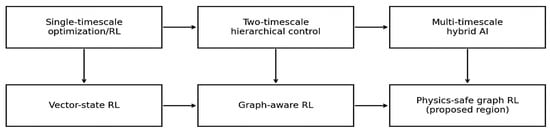
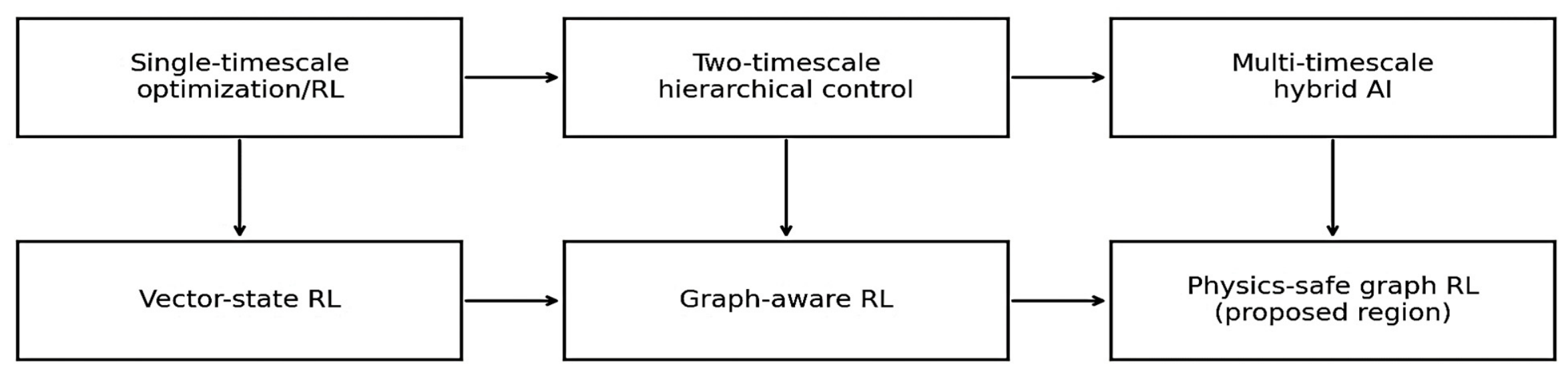
Five categories of the literature were reviewed for this summary: multi-timescale voltage regulation, graph-based reinforcement learning, safe reinforcement learning, hybrid model- and data-driven methods for voltage regulation, and benchmark and test-system studies as shown in Figure 1. Most references in this review were limited to the years 2022 to 2026 because the research in this area had shifted from optimization-based approaches to adaptive, data-driven, and physics-informed characteristics [3,19,20]. However, some of the classic benchmark and formulation studies were still included in this analysis since they provide foundational references, such as the DistFlow formulation, radial feeder benchmark systems, and convex formulations [21,22,23,24,25,26,27].
Figure 1.
Taxonomy of recent data-driven voltage control approaches and the position of the proposed method.
The first category of †he literature relates to multi-timescale control. Research suggests that separating slow devices, such as on-load tap changers (OLTCs) and capacitor banks, from fast devices [25,26], such as PV inverters and storage inverters, improves coordination between these devices and reduces the dimensionality of the real-time control problem [27,28]. Authors [13] incorporated domain knowledge into graph reinforcement learning for Volt/VAR control. Xing et al. [28] investigated graph reinforcement learning for real-time active distribution network scheduling. However, these studies did not jointly examine forecast-guided slow-device scheduling, graph-based fast control, and action projection within one multi-timescale framework. The third category concerns safe and robust control methods, using projection-based and constrained reinforcement learning approaches to help ensure feasible operation during online decision-making [1,10,17,29].
The fourth category concerns hybrid methods of model- and data-driven approaches, such as locations where linearized sensitivities, model-based reserve envelopes, or optimization are incorporated into a learning-based controller, thus improving the safety and sample efficiency of the learning [9,15,19,30,31]. Finally, other studies indicate that the primary outstanding issues are related to observability, topology changes, transferability, cybersecurity, and a lack of standardized evaluation methods for comparing learning and optimization methods for controlling voltage [6,11,32].
Table 1 shows the Comparative evaluation of recent representative methods and the proposed hybrid AI framework.
Table 1.
Comparative evaluation of recent representative methods and proposed hybrid AI framework.
3. Problem Formulation
Consider a radial distribution feeder represented by a graph G = (N, E), where N is the set of buses, and E is the set of branches. The control horizon is defined by slow intervals t and fast sub-intervals k for each of the slow intervals. Slow controls consist of OLTC tap position, capacitor switching states, and storage reserve bands. Fast controls consist of the inverter reactive power output and active-power curtailment, when necessary, limited to 10%. The load, PV output, and measurements are of a stochastic nature.
The objective of the optimization is to minimize the weighted sum of the following measures: voltage deviation, voltage violations; active power losses, control effort, switching burden; curtailment, subject to network and device constraints. The slow layer generates anticipatory set points based on forecast scenarios, and the fast layer reacts to actual disturbances and the forecast residuals. Ultimately, this leads to a constrained stochastic optimization problem with coupled decision-making over two timescales.
Let Vi,t,k denote the voltage magnitude at bus i at slow time index t and fast control step k. Similarly, let Pi,t,k and Qi,t,k represent the net active and reactive power injections at bus i, respectively. The control strategy operates on two timescales. The slow-timescale control vector is defined as
where τt, ct, and et denote discrete tap settings, capacitor switching states, and energy scheduling decisions, respectively. On the faster timescale, the fast control vector is given by:
where qinv,t,k corresponds to inverter-based reactive power support, and pcurt,t,k represents active power curtailment.
The safety projection is formulated as:
The overall control objective is formulated as a hierarchical optimization problem:
The slow-timescale cost function is expressed as:
where the first term penalizes deviations in predicted voltages from the reference profile, denotes predicted system losses, captures switching costs, and represents reserve utilization.
The fast-timescale cost function is defined as:
where ϕ(⋅) is a voltage penalty function that imposes a cost for violations of the admissible range [Vmin, Vmax]. The remaining terms account for instantaneous losses, inverter effort, and curtailment magnitude.
To enable computationally efficient control and real-time feasibility enforcement, the voltage dynamics are approximated using a linearized DistFlow sensitivity model:
where SP and SQ are sensitivity matrices relating voltage deviations to active and reactive power variations.
Based on this linear approximation, a safety projection layer maps unconstrained actions to a feasible polytope before nonlinear power flow calculations, ensuring operational constraint compliance.
The operation of the distribution network is subject to a set of physical, operational, and device-level constraints that ensure secure, reliable, and standard-compliant performance across both slow and fast control timescales.
First, the voltage magnitude limits at each bus are constrained within admissible bounds to maintain power quality and equipment safety:
Second, the inverter capability limits are governed by the apparent power rating of each inverter, restricting the feasible combinations of active and reactive power outputs:
Third, OLTC operations are subject to both range and ramping constraints to prevent excessive mechanical wear and ensure stable voltage regulation:
Fourth, the frequency of capacitor-bank switching is limited to avoid degradation and operational instability. This is typically modeled through binary switching variables with bounded transition counts:
Finally, energy storage systems are constrained by their state-of-charge (SoC) limits, ensuring sufficient systems are constrained by their SoC limits and ensuring sufficient reserve margins for reliability and contingency support:
These constraints are enforced exactly within the simulation environment through full AC power flow evaluation. In contrast, within the fast-timescale control policy, constraint satisfaction is handled approximately via a safety projection layer. This layer leverages the linearized system model to project candidate control actions onto a feasible region, thereby ensuring real-time tractability while maintaining operational safety.
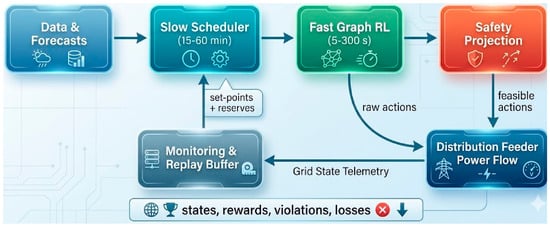
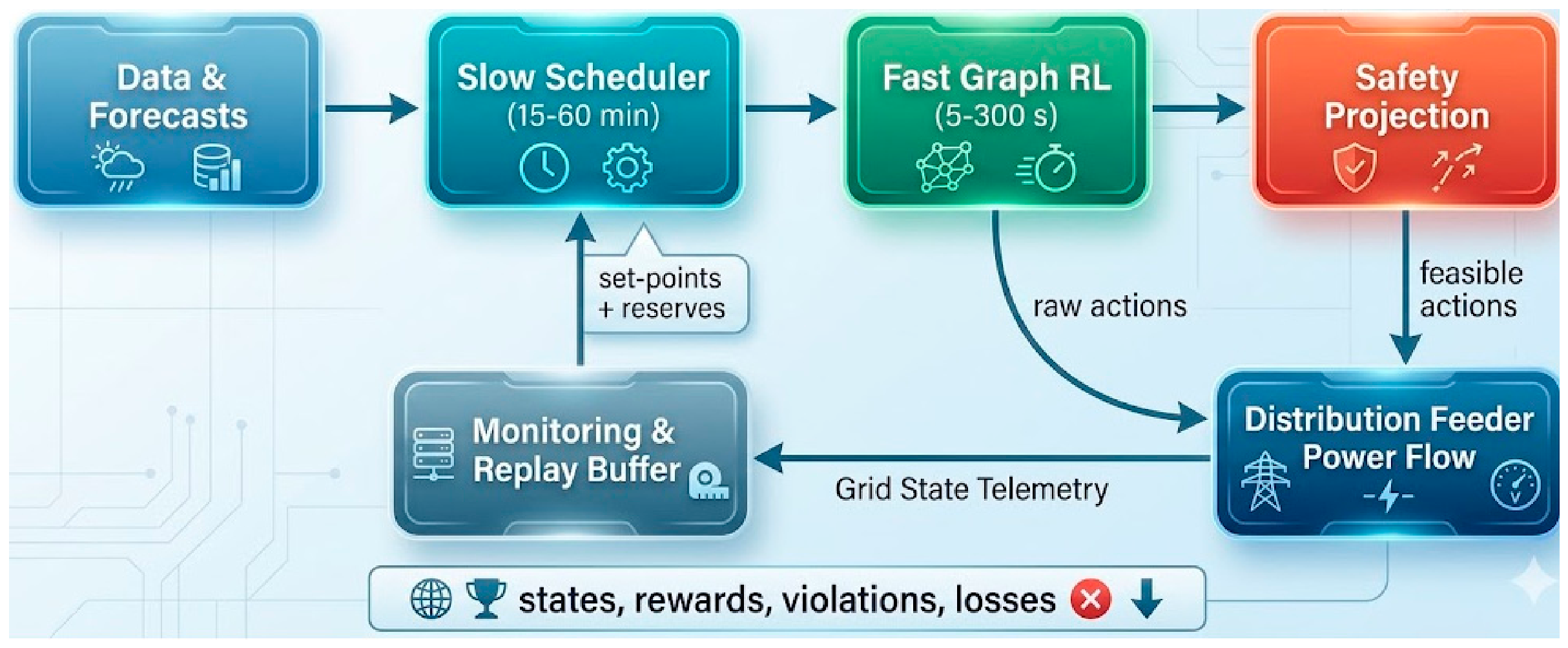
Figure 2 illustrates the proposed hybrid AI architecture for coordinated multi-timescale voltage control.
Figure 2.
Proposed hybrid AI architecture for coordinated multi-timescale voltage control.
4. Proposed Hybrid AI Method
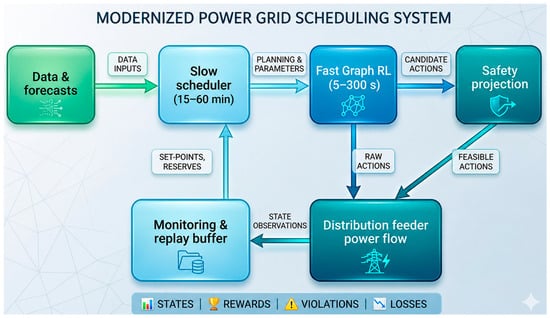
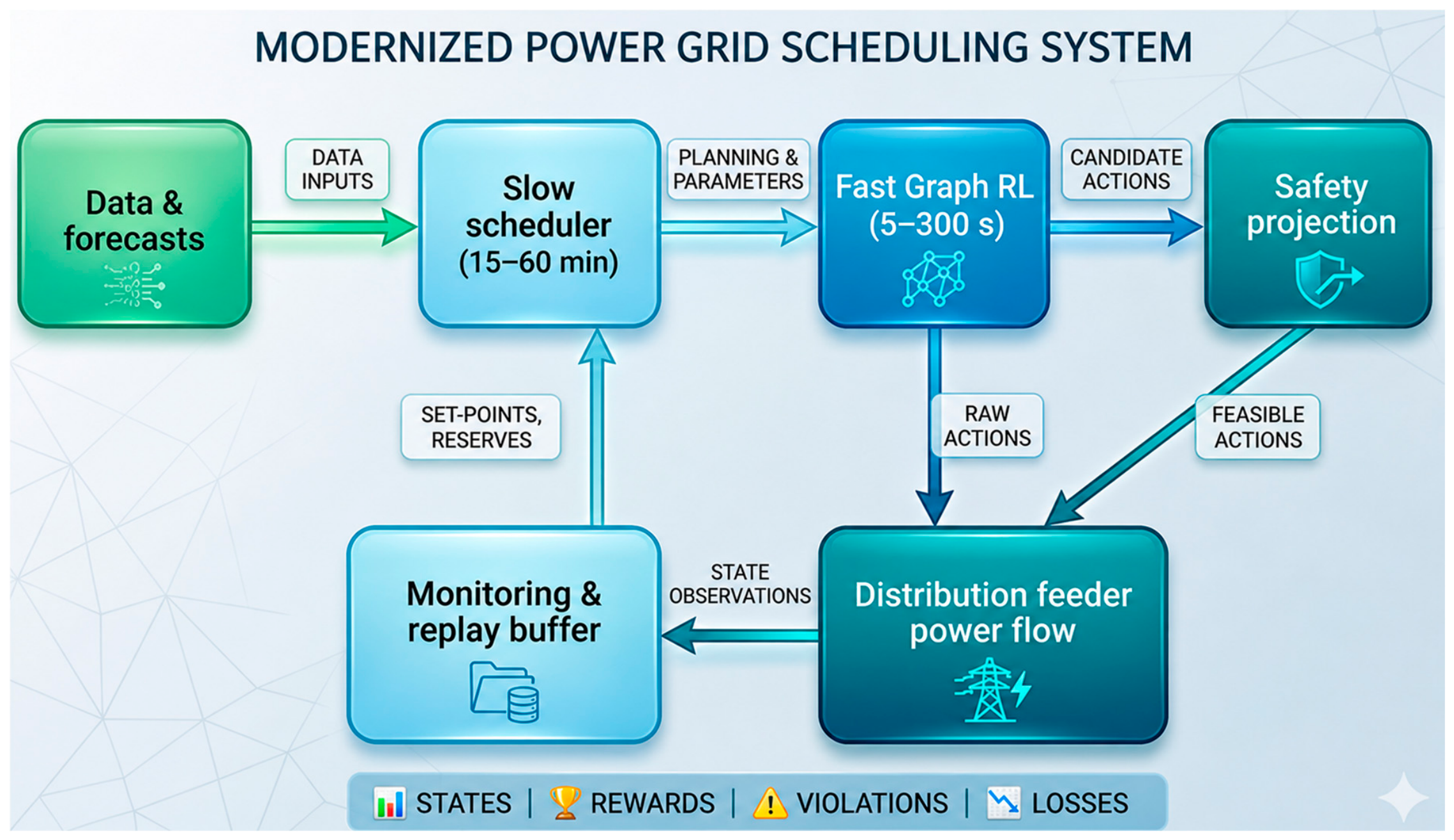
The proposed approach includes three interconnected modules as shown in Figure 3. The first module is a predictive forecasting and scheduling module that creates load forecasts, PV forecasts, and a flexibility margin forecast over a 15 min forecast horizon. It generates coarse setpoints (OLTCs, switched capacitors, and storage reserve bands) and provides inputs to the second module (the fast RL controller) in 5 min intervals. These inputs consist of the latest measurements, forecast residuals, and forecasts of network topology and characteristics. The purpose of the third module (safety projection) is to convert the raw actions produced by the second module by applying the linearized voltage sensitivities and specific constraints placed on each device. The forecasting module was implemented using a two-layer Long Short-Term Memory (LSTM) network with 64 hidden units per layer. Its input comprised the preceding 12 five-minute observations, corresponding to a 60 min history of active and reactive load, PV generation, and bus-voltage measurements. The network predicted the following three five-minute samples, forming the 15 min horizon used by the slow scheduler. Inputs were standardized using the training set statistics, and the LSTM was trained using mean squared error (MSE) loss and the Adam optimizer with a learning rate of 10−3. The fast controller employed three graph message-passing layers with 96 hidden features and ReLU activation. A deterministic actor–critic algorithm based on Deep Deterministic Policy Gradient (DDPG) generated continuous inverter reactive-power and active-power curtailment commands. The DDPG used a discount factor of 0.99, a replay buffer of 105 transitions, a batch size of 128, an acto learning rate of 10−4, and a criti learning rate of 10−3. Raw actions were projected onto the DistFlow-derived feasible region by solving a convex quadratic program using OSQP with absolute and relative tolerances of 10−5 and a maximum of 4000 iterations. Each projected action was subsequently verified through full AC power-flow analysis before application in the simulation.
Figure 3.
Information flow and control loop of proposed slow–fast hybrid AI controller.
This separation of the three modules is based on the physical nature of distribution systems. Mechanical devices need to be operated infrequently, while inverters can be operated on a frequent basis; however, inverter operation usually requires coordination among devices to achieve reliable performance. Consequently, the function of the first module (slow layer) is defining the feasible control boundaries, while the function of the second module (fast layer) is utilizing that same feasible control boundary to reject disturbances (and maintain voltage quality) during real-time operation.
4.1. Graph State Representation and Learning Policy
The characteristics of each node include voltage magnitude and net active/reactive injection/forecast (from DER capability), state of slow devices (e.g., AC motor drive), and local reserve data. Each controllable node collects information through message passing over the feeder graph to aggregate electrically relevant data from neighboring nodes without flattening the feeder topology into a conventional vector representation. The variability in reactive support can be attributed to two factors: (1) the characteristics of the line connecting the nodes (i.e., its impedance) and (2) the depth into the feeder and contributions from nearby nodes on the feeder to load.
The fast controller uses an actor–critic algorithm for training. Specifically, the configurator actor outputs a continuous request for reactive power and curtailment from the controllable nodes, while the critic provides the expected long-term return. The performance of the controller is evaluated based on voltage violations, average voltage variance, active power loss, excessive curtailment, and curtailment.
4.2. Safety Projection and Computational Complexity
The safety layer of the projected action minimizes the distance to the closest feasible action, using the raw action generated by the controller as well as voltage compliance and device constraints. While this safety projection does not replace the full AC power flow, which incurs high computational costs due to invalid exploratory and transiently infeasible actions, it provides significant stabilization of policy learning. Therefore, the safety projection is one factor contributing to the improved performance of the proposed method compared with MARL without a safety mechanism.
In an online deployment setting, the two primary computational costs on the fast timescale are the forward pass through the GNN policy and the safety projection. Both are significantly lower in cost than repeatedly solving the deterministic OPF. Furthermore, the proposed approach produced an average of 13.87 ms of latency during the online deployment compared with 218.51 ms for the above-mentioned deterministic OPF. Consequently, the proposed approach achieved a 15.8× speedup and yielded lower voltage violations than the other methods.
4.3. Computational Complexity and Implementation Platform
Let L denote the number of graph layers, N the number of buses, E the number of branches, and d the hidden dimension. The graph encoder requires approximately O[L(Nd2 + Ed)] operations, including node-feature transformation and edge-wise message aggregation. For na control variables and constraints, the dense worst-case complexity of the quadratic safety projection is ; however, sparse constraint matrices and warm-starting substantially reduce the practical cost. The experiments were conducted on a workstation equipped with an Intel Core i7-12700H processor (Intel Corporation, Santa Clara, CA, USA) and 32 GB of RAM, using Ubuntu 22.04, Python 3.10, PyTorch 2.1, PyTorch Geometric 2.4, pandapower 2.13, and OSQP 0.6.3. All methods were evaluated on the same CPU platform without GPU acceleration. The proposed controller required an average online inference time of 13.87 ms, compared with 218.51 ms for deterministic OPF, corresponding to a 15.8× speedup. These latency measurements include graph-policy inference and safety projection but exclude offline training.
5. Simulation Setup
The distribution systems included 33- and 69-bus test systems with high PV penetration and shared non-utility control for system operation as shown in Table 2. In addition, each of the distribution systems had access to inverter-based reactive-power support for frequency regulation of the distribution system and optional energy storage. Each feeder system was simulated for 40 days, based upon a 5 min dispatch resolution (288 controls/day), resulting in 80 feeder-day test episodes. Perturbations of the daily net-load and PV profiles used in the simulations were applied via numerous experimental methods (stochastic forecast errors, measurement noise, and random cloud-transition ramps; intermittent sensor dropouts, where applicable, thereby creating an experimental dataset for evaluating both predictive and real-time corrective strategies.
Table 2.
Simulation, training, and reproducibility settings.
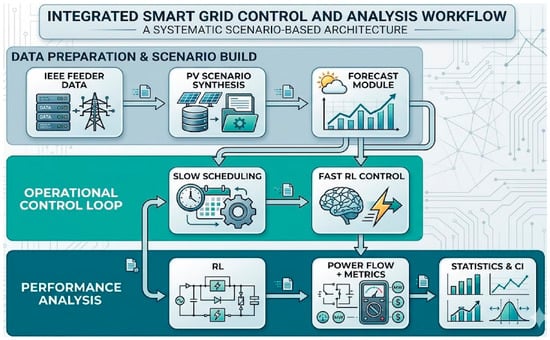
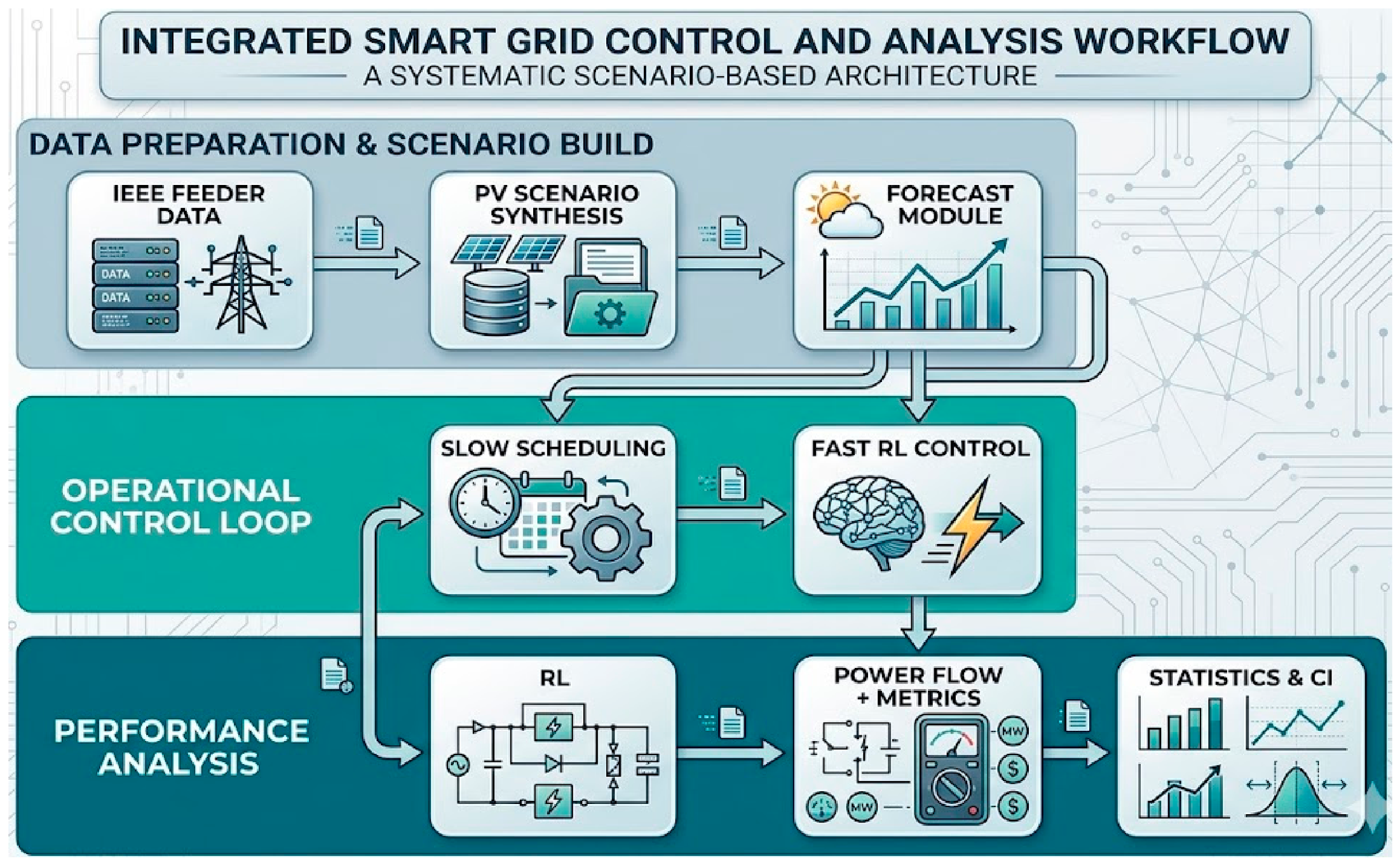
The operation of both systems involved a slow (15 min) scheduling and a fast (5 min) control approach with the same voltage operating limits (0.95 to 1.05 pu), as well as objective weights (voltage compliance, loss minimization, actuator wear reduction, and renewable energy utilization) evaluated using a similar method with the same feeder models and test conditions. In addition, these two control systems were tested and evaluated using the same conditions and test models. Paired Wilcoxon signed-rank tests were also used to assess the statistical significance (95% confidence intervals) of the test results pre- and post-experimentation using the daily episode sample size. The overall simulation and evaluation pipeline is presented in Figure 4.
Figure 4.
Simulation pipeline from feeder data and scenario synthesis to power flow and statistical testing.
The slow-layer weights correspond to voltage deviation, predicted loss, switching, and reserve costs. The fast-layer weights correspond to voltage violation, active-power loss, reactive-power effort, and curtailment. Test profiles were excluded from training, validation, and parameter selection as shown in Table 3.
Table 3.
Functional comparison of the evaluated baseline methods and the proposed controller.
Training Behavior and Convergence
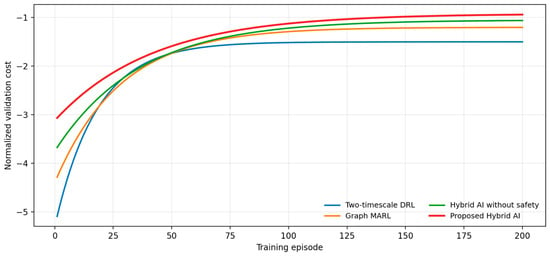
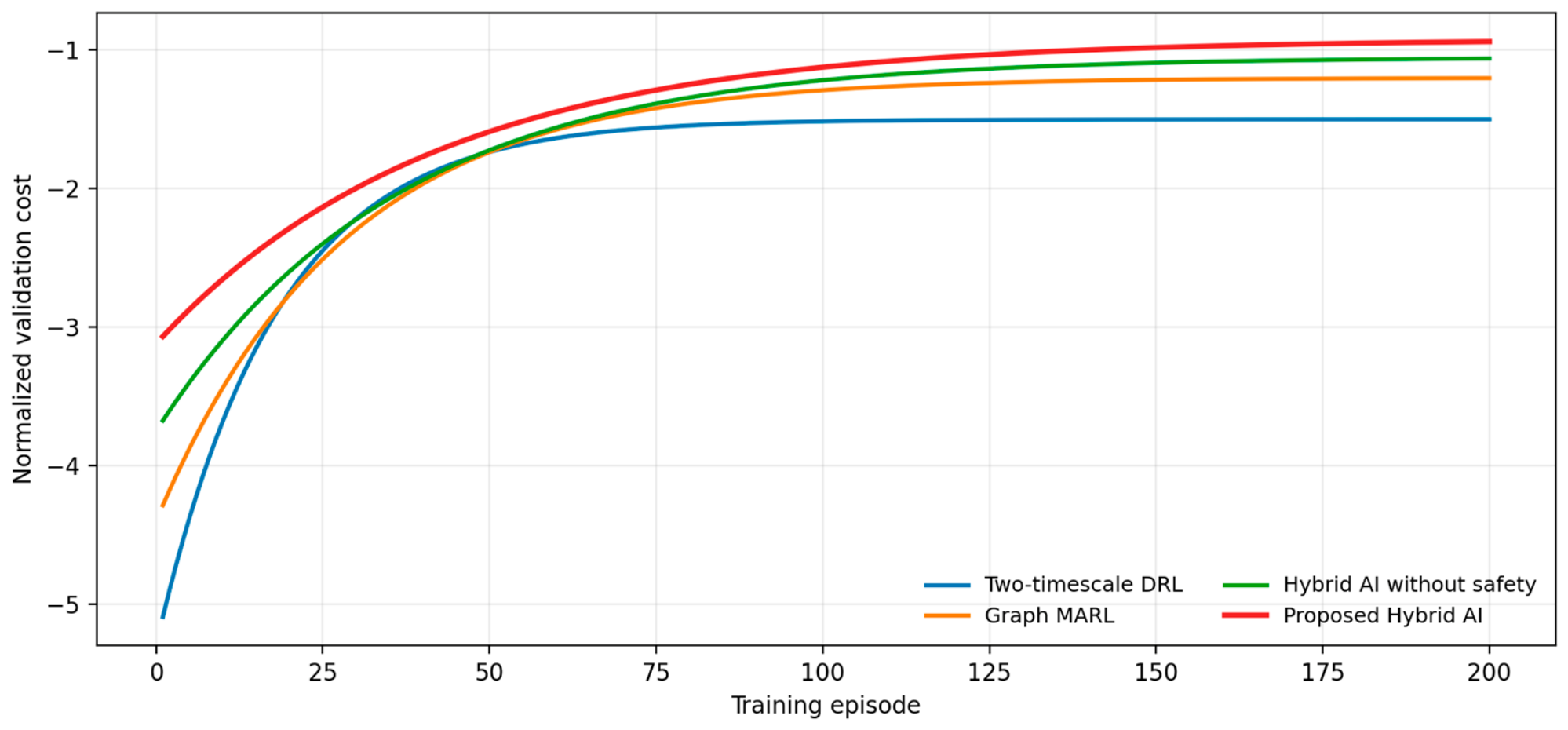
As shown in Figure 5, the proposed controller achieved lower normalized validation costs than all learning-only baseline methods, indicating faster convergence than the alternative methods. The safety projection is important because it not only protects during the action generation stage but also regularizes the learning process by reducing the exploration space toward feasible regions. This can be seen in the slow forecasting layer reducing the load on the fast layer, as well as the graph encoder reducing the load on the critic by explicit exposure of the network structure.
Figure 5.
Training convergence for learning-based controllers on validation set.
6. Results and Discussion
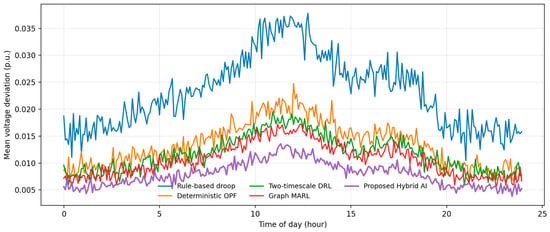
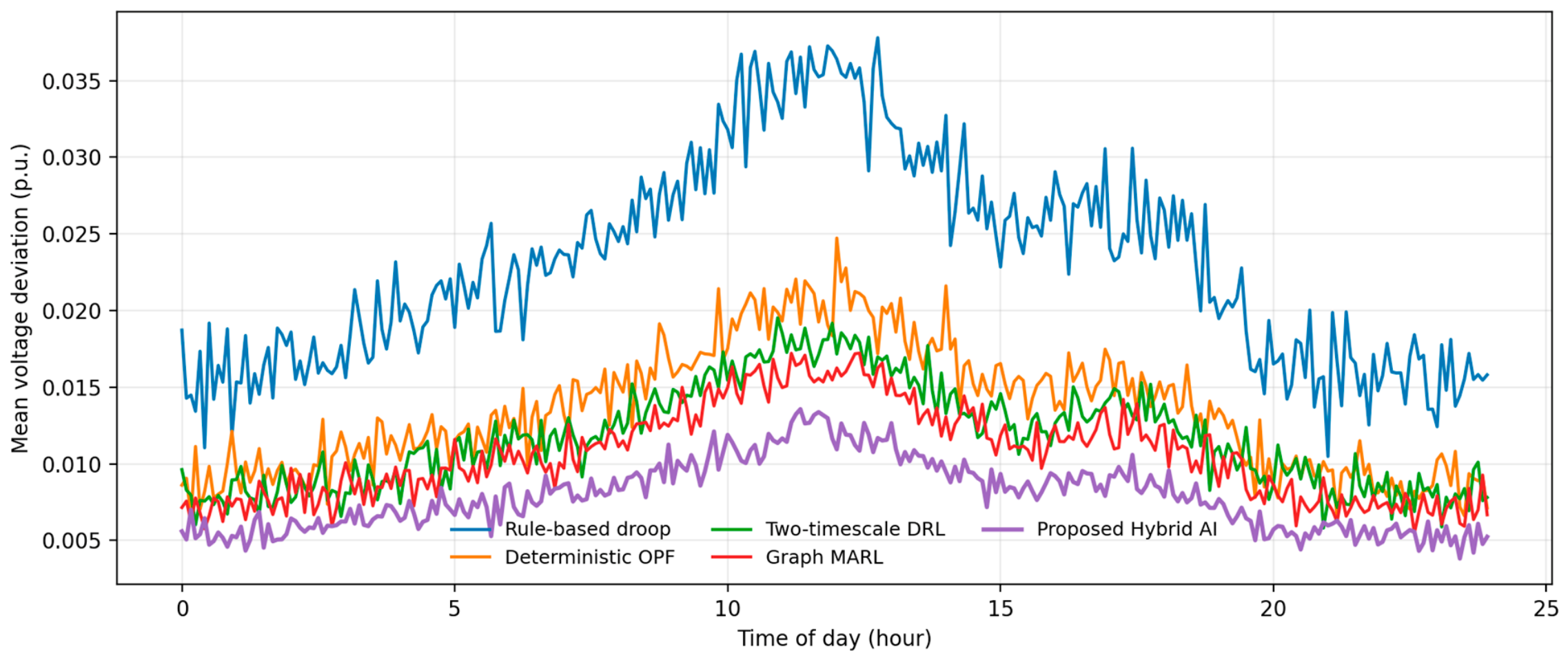
Table 4 provides a summary of the key quantitative results derived from both feeder benchmarks. The proposed hybrid AI controller was the strongest performer on each power quality and key operational metric except for raw computational speed, where the rule-based heuristic is faster. This was expected, because the rule-based heuristic performs almost no optimization. Additionally, the proposed hybrid AI model performed significantly better than deterministic OPF and all learning-based-only baseline performance measures in terms of voltage violation rate, mean voltage deviation, losses, tap operations, and curtailment. The proposed hybrid AI model achieved this superior performance while still providing computational capability in real time. The mean daily voltage deviation trajectories are shown in Figure 6.
Table 4.
Key results with 95% confidence intervals aggregated across IEEE 33-bus and 69-bus daily episodes.
Figure 6.
Mean daily voltage deviation trajectories of evaluated methods.
The values are daily means from 80 paired feeder-day episodes after averaging across the five random-seed runs. The 95% confidence intervals were estimated using 10,000 paired bootstrap resamples. Two-sided paired Wilcoxon tests with Holm correction showed significant improvements over Graph MARL. The respective reductions in voltage violations, mean voltage deviation, losses, tap operations, and curtailment were 41.8%, 28.8%, 5.2%, 24.4%, and 36.0%.
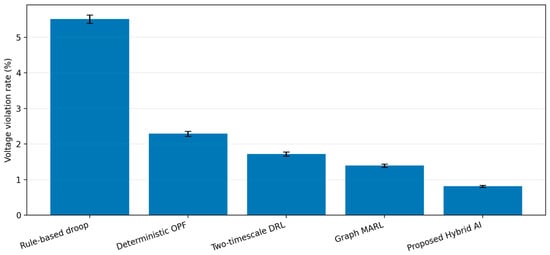
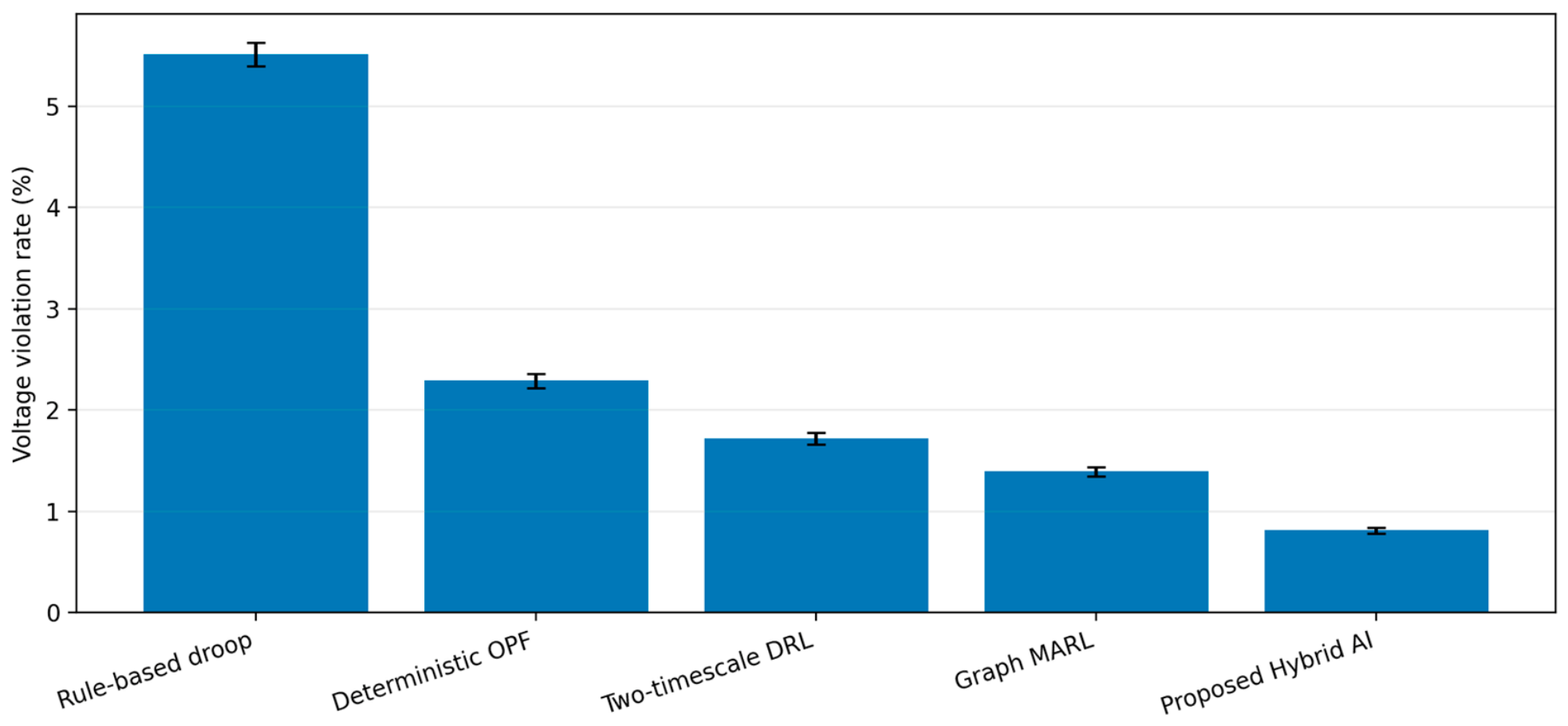
The proposed controller reduced the aggregate voltage violation rate to 0.81% (95% CI: 0.78–0.84) versus 1.39% for Graph MARL, 1.72% for two-timescale DRL, 2.29% for deterministic OPF, and 5.51% for rule-based droop as shown in Figure 7. These correspond to reductions of 41.8%, 52.8%, 64.6%, and 85.3%, respectively. Mean voltage deviation was reduced to 0.0075 pu, demonstrating that the controller improved not only compliance with hard voltage limits but also overall voltage quality around the nominal operating point.
Figure 7.
Voltage violation rate with 95% confidence bars across methods.
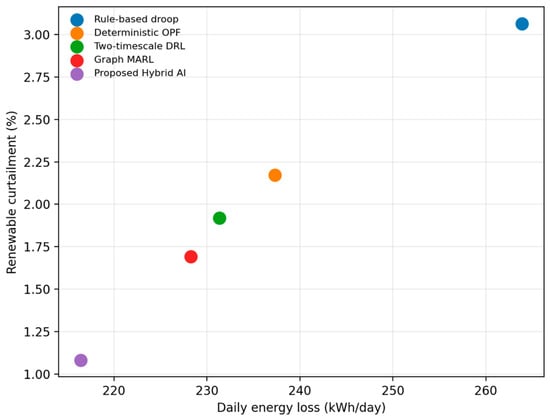
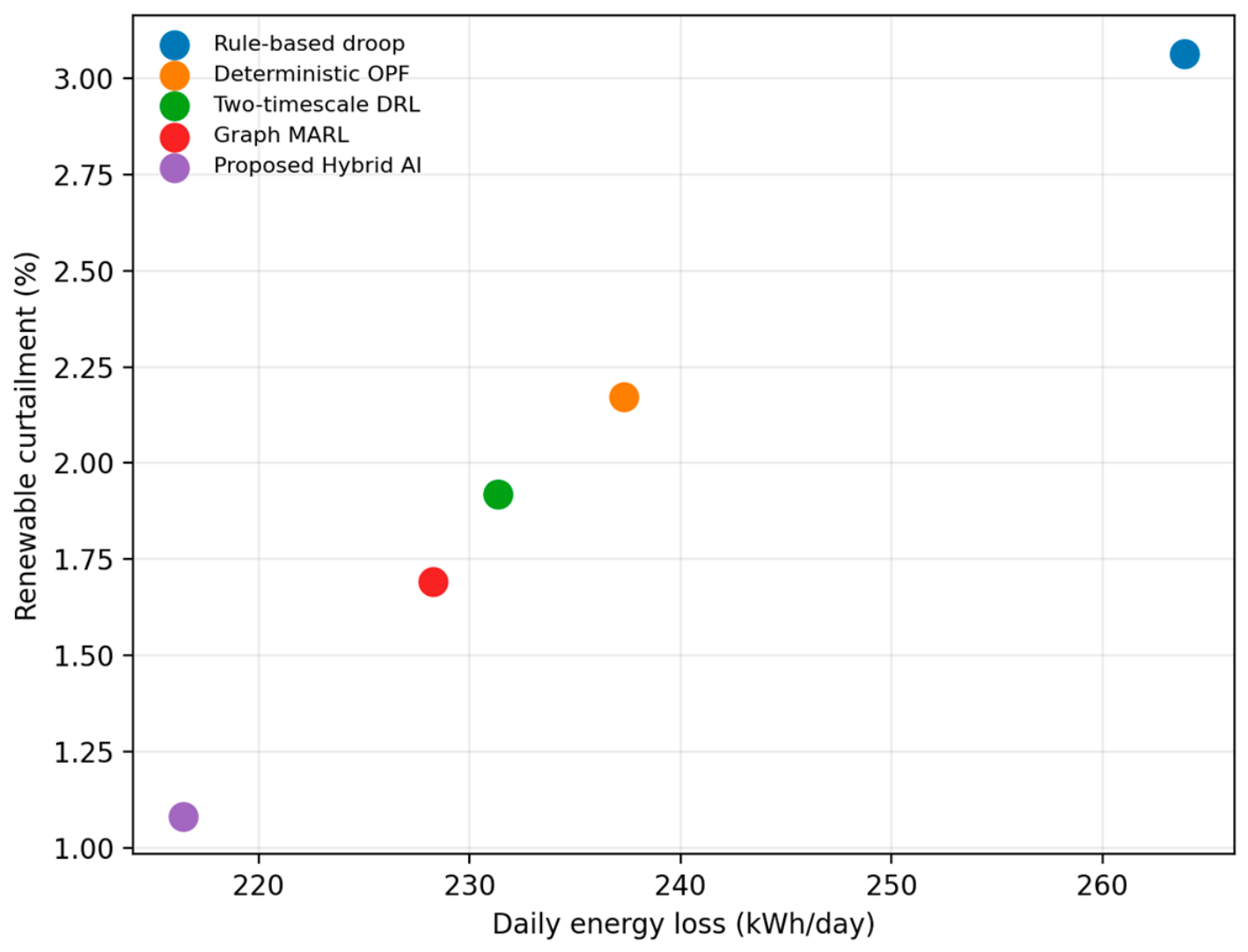
The impact on energy efficiency was also meaningful. The proposed model reduced daily losses to 216.4 kWh/day versus 228.3 kWh/day for Graph MARL and 237.3 kWh/day for deterministic OPF as shown in Figure 8. This indicates that voltage compliance was not achieved by simply overusing reactive support or curtailment. Instead, coordination between slow set-point planning and fast corrective action allowed the controller to improve voltage regulation while reducing network losses.
Figure 8.
Loss-curtailment trade-off showing the favorable operating point of the proposed controller.
Operational wear was likewise reduced. The average number of tap actions was 12.47/day for the proposed controller compared with 16.48 tap actions/day for Graph MARL and 19.95/day for deterministic OPF. Renewable curtailment dropped to 1.08%, substantially lower than the 1.69% of Graph MARL and the 2.17% achieved by deterministic OPF.
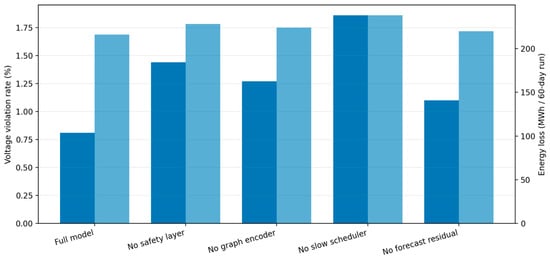
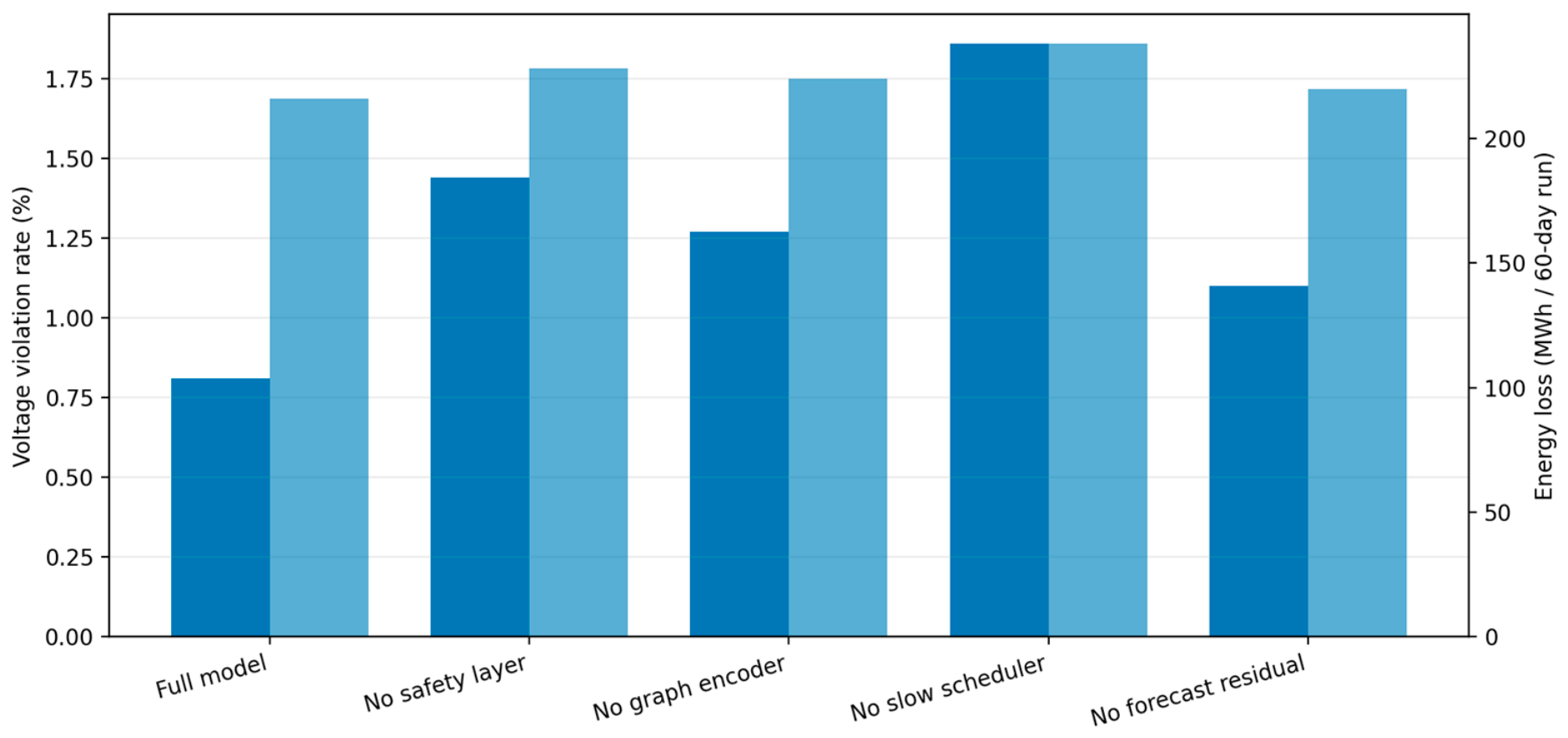
The results of the ablation studies presented in Figure 9 confirm that each component of the architecture contributes measurable value. The increase in voltage violations after removing the safety layer is due to the fast controller requesting excessive reactive power during periods of high renewable generation variability. The removal of the graph encoder results in reduced spatial awareness and negatively impacts the regulation of voltage at the end of the feeder. The highest degradation occurs when the slow scheduler is removed because the fast controller must compensate for the structural operating point errors that should have been addressed earlier. The removal of forecast residual features produces smaller but still significant increases in voltage violations and energy losses as shown in Table 5.
Figure 9.
Ablation study of proposed model using voltage violation rate and cumulative loss.
Table 5.
Ablation results of proposed controller.
Removing any component degraded performance, with the greatest deterioration occurring without the slow scheduler. Table 6 shows that the proposed controller maintained the lowest voltage violation rate under forecast errors, sensor dropout, topology perturbations, and cloud transients.
Table 6.
Robustness of voltage violation rate (%) under stressed scenarios.
Robustness testing indicates that the proposed hybrid structure continues to outperform the baseline methods when uncertainty is introduced. Under a 20% PV forecast error, the proposed controller achieves a voltage violation rate of 1.36% for the proposed controller, which is lower than 2.2% (Graph MARL), 2.8% (two-timescale DRL), and 3.7% (deterministic OPF). Some performance degradation was observed under sensor dropouts and topology perturbations, indicating that both the graph representation and the safety layer contribute to robustness.
The robustness analysis showed that deterministic OPF performed worse than expected in the simulation study. OPF’s effectiveness depends on the accuracy of the system model and on the speed with which the system model is updated; however, OPF is limited by the timeliness of its response and its dependence on the system model, which limit its effectiveness when there are forecast errors, topology uncertainty, and the use of high-resolution operation measurements. In summary, the proposed hybrid AI integration uses optimization in the three areas of forecast-based slow scheduling, safety projection based on constraints, and multi-objective optimization, including voltage quality, losses, switching operations, and curtailment. By using optimization in conjunction with learning, the hybrid AI provides superior performance compared to OPF.
The simulation results support the primary hypothesis of this study, supporting the benefits of combining three layers of control (hierarchy of control), awareness (graph-based awareness), and safety (combined into a single stack). The benchmark results indicate that combining hierarchical scheduling, graph awareness, and safety projection improved the results on all evaluated metrics under the simulated conditions. Broader superiority must be confirmed using utility measurements and hardware-in-the-loop experiments. The slow scheduler prevents operations from drifting into difficult operating regions. When electrical couplings are corrected quickly, voltage issues can be quickly identified and solutions determined. Finally, an inexpensive mechanism for rejecting unsafe raw actions allows for safe operations. Together, these factors lead to fewer voltage violations; decreased losses; decreased tap wear; and decreased curtailments.
Engineers are focused on the real-world impact of their work rather than simply achieving the lowest average rate of voltage violations; this means reducing both the number of voltage violations and the effect of switching them. Tap switching at a very high frequency, while improving voltage and curtailing DER outputs, would be a very difficult solution for engineers to accept. The proposed control mechanisms improve all three aspects at the same time, forming a control philosophy with greater deployment potential than any existing models based on algorithmic methods.
The limitations of this research need to be clearly stated. To begin with, this investigation used only simulation data from the testing of benchmark feeders and did not include actual utility field measurements. The safety measurements used in this research were based on a linearized sensitivity model and therefore provide guarantees of feasibility only in the very broadest terms in relation to full AC power flow. Cyber-security threats, communication delays, mismatched timeframes for measurement, and fair allocation of limited control support among customers are some examples of errors associated with these factors not being modeled in detail. These limitations define the areas where the authors contributed to the current state of knowledge. These limitations also identify areas for further research.
7. Conclusions and Future Work
This study proposed a hybrid forecast–graph reinforcement learning framework that safely optimizes multi-timescale voltage control for active distribution systems. The hybrid model integrates forecast-driven scheduling, graph-based inverter control, and a physics-based projection layer to facilitate optimal voltage regulation across control timescales. In the simulation results of the IEEE 33-bus and 69-bus feeders, the hybrid method demonstrated superior performance over rule-based droop control, deterministic OPF, two-timescale DRL, and Graph MARL in terms of voltage violation rate, mean voltage deviation, energy loss, tap operations, curtailments, and online latencies.
The findings indicate that the hybrid AI solution that combines forecasting, graph reinforcement learning, and safety-constrained optimization approaches achieved a voltage violation rate of 0.81%, a mean voltage deviation of 0.0075 pu, a daily energy loss of 216.4 kWh/day, 12.47 tap operations/day, and a total curtailment of 1.08% compared with optimized or learning-based control methods used alone. These findings apply only to the simulated IEEE 33- and 69-bus balanced feeders; validation on unbalanced utility networks, field measurements, and hardware-in-the-loop platforms remains necessary.
Future research should extend the framework to three-phase unbalanced feeders, utility datasets validated through field calibration, differentiable AC power flow surrogates, cybersecurity stress testing, and fairness-aware DER participation. Other future research should also consider the use of transfer learning across feeder topologies and using distributed state estimation to enable real-world utility operations. Additional extensions should include fairness-aware DER participation, transfer learning across feeder topologies, and tighter integration with distributed state estimation. Future trends may be associated with cloud computing, machine learning, and 5G millimeter-wave wireless networks.
Author Contributions
Conceptualization, H.T.S.A.; methodology, A.F.R.; software, H.A.M.; validation and formal analysis, H.A.M. and H.A.K.; investigation and resources, H.T.S.A. and A.F.R.; data curation, H.A.M.; original draft preparation, I.R.N.A.; writing—review, H.A.M. and editing, H.T.S.A. and I.R.N.A.; visualization, H.A.M.; supervision, H.T.S.A. All authors have read and agreed to the published version of the manuscript.
Funding
The authors declare that they have received no funding from any financial organization to conduct this research.
Institutional Review Board Statement
Not applicable.
Informed Consent Statement
Not applicable.
Data Availability Statement
The simulation data supporting the findings of this study are available from the corresponding author upon reasonable request.
Acknowledgments
The authors used ChatGPT-4 (OpenAI) solely to enhance figure clarity and take full responsibility for the final content.
Conflicts of Interest
The authors declare no conflicts of interest.
References
- Gao, Y.; Yu, N. Model-Augmented Safe Reinforcement Learning for Volt-VAR Control in Power Distribution Networks. Appl. Energy 2022, 313, 118762. [Google Scholar] [CrossRef] [Scilit]
- Lee, X.Y.; Sarkar, S.; Wang, Y. A Graph Policy Network Approach for Volt-VAR Control in Power Distribution Systems. Appl. Energy 2022, 323, 119530. [Google Scholar] [CrossRef] [Scilit]
- Wu, Z.; Li, Y.; Gu, W.; Dong, Z.; Zhao, J.; Liu, W.; Zhang, X.-P.; Liu, P.; Sun, Q. Multi-Timescale Voltage Control for Distribution System Based on Multi-Agent Deep Reinforcement Learning. Int. J. Electr. Power Energy Syst. 2023, 147, 108830. [Google Scholar] [CrossRef] [Scilit]
- Kabir, F.; Yu, N.; Gao, Y.; Wang, W. Deep Reinforcement Learning-Based Two-Timescale Volt-VAR Control With Degradation-Aware Smart Inverters in Power Distribution Systems. Appl. Energy 2023, 335, 120629. [Google Scholar] [CrossRef] [Scilit]
- Chen, Y.; Liu, Y.; Zhao, J.; Qiu, G.; Yin, H.; Li, Z. Physical-Assisted Multi-Agent Graph Reinforcement Learning Enabled Fast Voltage Regulation for PV-Rich Active Distribution Network. Appl. Energy 2023, 351, 121743. [Google Scholar] [CrossRef] [Scilit]
- Zhang, X.; Wu, Z.; Sun, Q.; Gu, W.; Zheng, S.; Zhao, J. Application and Progress of Artificial Intelligence Technology in the Field of Distribution Network Voltage Control: A Review. Renew. Sustain. Energy Rev. 2024, 192, 114282. [Google Scholar] [CrossRef] [Scilit]
- ALRubeei, I.R.N.; Mutar, H.A.; Alrikabi, H.T.S.; Alsammak, I.L.H.; Kanber, H.A.; Majeed, B.H. Design of a Hybrid AI-Driven Engineering Model for Energy-Efficient and Sustainable Educational Systems. Int. J. Eng. Ped. 2026, 16, 87–102. [Google Scholar] [CrossRef] [Scilit]
- Abdullah, A.K.; Mutar, H.A.; Hamad, A.H.; ALRubeei, I.R.N.; AlRikabi, H.T.S. Towards Sustainable Cropping: AI-Driven Precision Agriculture for Optimal Water and Pesticide Use via Drones and Soil Sensors. Herit. Sustain. Dev. 2026, 8, 161–176. [Google Scholar] [CrossRef] [Scilit]
- Abbas, G.; Zhi, W.; Ali, A. A Two-stage Reactive Power Optimization Method for Distribution Networks Based on a Hybrid Model and Data-driven Approach. IET Renew. Power Gen. 2024, 18, 3967–3979. [Google Scholar] [CrossRef] [Scilit]
- Hua, D.; Peng, F.; Liu, S.; Lin, Q.; Fan, J.; Li, Q. Coordinated Volt/VAR Control in Distribution Networks Considering Demand Response via Safe Deep Reinforcement Learning. Energies 2025, 18, 333. [Google Scholar] [CrossRef] [Scilit]
- Ahmadi, M.; Aly, H. A Comprehensive Review of Reinforcement Learning-Based Voltage Control in Smart Grids. Renew. Sustain. Energy Rev. 2026, 227, 116526. [Google Scholar] [CrossRef] [Scilit]
- Hu, D.; Li, Z.; Ye, Z.; Peng, Y.; Xi, W.; Cai, T. Multi-Agent Graph Reinforcement Learning for Decentralized Volt-VAR Control in Power Distribution Systems. Int. J. Electr. Power Energy Syst. 2024, 155, 109531. [Google Scholar] [CrossRef] [Scilit]
- Luo, F.; Wang, S.; Lv, Y.; Mu, R.; Fo, J.; Zhang, T.; Xu, J.; Wang, C. Domain Knowledge-Enhanced Graph Reinforcement Learning Method for Volt/Var Control in Distribution Networks. Appl. Energy 2025, 398, 126409. [Google Scholar] [CrossRef] [Scilit]
- Mutar, H.A.; Abdullah, A.K.; Abdaumran, O.A.; ALRubeei, I.R.N.; ALRikabi, H.T.S. Hybrid AI Model-Driven Dynamic Spectrum Sharing for 6G Wireless IoT Networks. Sustain. Eng. Innov. 2026, 8, 53–72. [Google Scholar] [CrossRef] [Scilit]
- Lu, X.; Xiao, X.; Zhang, C.; Guo, N.; Wu, F.; Guo, J. Data-Model Hybrid Driven Optimal Voltage Control for AC/DC Hybrid Distribution Network. IET Gener. Transm. Distrib. 2025, 19, e70101. [Google Scholar] [CrossRef] [Scilit]
- Ali Mutar, H.; Niama ALRubeei, I.R.; Yahya, O.H.; Ali Hussien, N.; Salim AlRikabi, H.T.; Alaidi, A.H.M. Auto-PPA: An Adaptive Deep RL Agent for VLSI Physical Design Optimization. JCVS 2026, 8, 9–19. [Google Scholar] [CrossRef] [Scilit]
- Allahmoradi, S.; Liang, X. Multi-Agent Safe Reinforcement Learning Based Real-Time Volt/Var Optimization for Modern Distribution Networks. In 2024 IEEE Canadian Conference on Electrical and Computer Engineering (CCECE); IEEE: Kingston, ON, Canada, 2024; pp. 68–73. [Google Scholar] [CrossRef] [Scilit]
- Mutar, H.A.; Mohamed Najeeb, S.M.; Aldabag, M.L.; ALRikabi, H.T.S. Hybrid Neural Network Genetic Algorithm Framework for EEG and ECG Signal Classification. JMC 2026, 6, 280–295. [Google Scholar] [CrossRef] [Scilit]
- Xiong, W.; Tang, Z.; Cui, X. Distributed Data-Driven Voltage Control for Active Distribution Networks With Changing Grid Topologies. Control Eng. Pract. 2024, 147, 105933. [Google Scholar] [CrossRef] [Scilit]
- ALRubeei, I.R.N.; Idi, S.N.; Alsammak, I.L.H.; AlRikabi, H.T.; Mutar, H.A.; Alaidi, A.H.M. Using Artificial Intelligence for Enhancement of Solar Cell Efficiency in the South of Iraq. Herit. Sustain. Dev. 2025, 7, 197–210. [Google Scholar] [CrossRef] [Scilit]
- Kumar, A.; Bhatia, R.S. Optimal Capacitor Placement in Radial Distribution System. In 2014 IEEE 6th India International Conference on Power Electronics (IICPE); IEEE: Kurukshetra, India, 2014; pp. 1–6. [Google Scholar] [CrossRef] [Scilit]
- Liu, X.; Shen, Z.; Lu, P. Exact Convex Relaxation for Optimal Flight of Aerodynamically Controlled Missiles. IEEE Trans. Aerosp. Electron. Syst. 2016, 52, 1881–1892. [Google Scholar] [CrossRef]
- Farivar, M.; Low, S.H. Branch Flow Model: Relaxations and Convexification—Part I. IEEE Trans. Power Syst. 2013, 28, 2554–2564. [Google Scholar] [CrossRef] [Scilit]
- Turitsyn, K.; Sulc, P.; Backhaus, S.; Chertkov, M. Local Control of Reactive Power by Distributed Photovoltaic Generators. In 2010 First IEEE International Conference on Smart Grid Communications; IEEE: Gaithersburg, MD, USA, 2010; pp. 79–84. [Google Scholar] [CrossRef] [Scilit]
- Wang, X.; Wang, L.; Kang, W.; Li, T.; Zhou, H.; Hu, X.; Sun, K. Distributed Nodal Voltage Regulation Method for Low-Voltage Distribution Networks by Sharing PV System Reactive Power. Energies 2022, 16, 357. [Google Scholar] [CrossRef] [Scilit]
- Ding, T.; Li, F.; Li, X.; Sun, H.; Bo, R. Interval Radial Power Flow Using Extended Distflow Formulation and Krawczyk Iteration Method with Sparse Approximate Inverse Preconditioner. IET Gener. Trans. Dist. 2015, 9, 1998–2006. [Google Scholar] [CrossRef] [Scilit]
- Zhang, Z.; da Silva, F.F.; Guo, Y.; Xi, Y.; Bak, C.L.; Torres, J.R.; Dong, J.; Chen, Z.; Liu, Y. Distributed Online Voltage Control in Distribution Network: A Two-Stage Real-Time Implementation. CSEE J. Power Energy Syst. 2025, 11, 2763–2775. [Google Scholar] [CrossRef] [Scilit]
- Xing, Q.; Chen, Z.; Zhang, T.; Li, X.; Sun, K. Real-Time Optimal Scheduling for Active Distribution Networks: A Graph Reinforcement Learning Method. Int. J. Electr. Power Energy Syst. 2023, 145, 108637. [Google Scholar] [CrossRef] [Scilit]
- Chen, Z.; Cai, S.; Meliopoulos, A.P.S. Robust Deep Reinforcement Learning for Volt-VAR Optimization in Active Distribution System Under Uncertainty. IEEE Trans. Smart Grid 2025, 16, 4463–4474. [Google Scholar] [CrossRef] [Scilit]
- Hossain, R.; Gautam, M.; Thapa, J.; Livani, H.; Benidris, M. Deep Reinforcement Learning Assisted Co-Optimization of Volt-VAR Grid Service in Distribution Networks. Sustain. Energy Grids Netw. 2023, 35, 101086. [Google Scholar] [CrossRef] [Scilit]
- Mutar, H.A.; ALRubeei, I.R.N. AI-Driven Power Optimization in 6G Networks: A Comprehensive Review. Int. J. Comput Electron Asp. Eng. 2026, 7, 45–57. [Google Scholar] [CrossRef] [Scilit]
- Abdelkader, S.M.; Kinga, S.; Ebinyu, E.; Amissah, J.; Mugerwa, G.; Taha, I.B.M.; Mansour, D.-E.A. Advancements in Data-Driven Voltage Control in Active Distribution Networks: A Comprehensive Review. Results Eng. 2024, 23, 102741. [Google Scholar] [CrossRef] [Scilit]

Disclaimer/Publisher’s Note: The statements, opinions and data contained in all publications are solely those of the individual author(s) and contributor(s) and not of MDPI and/or the editor(s). MDPI and/or the editor(s) disclaim responsibility for any injury to people or property resulting from any ideas, methods, instructions or products referred to in the content. |
© 2026 by the authors. Licensee MDPI, Basel, Switzerland. This article is an open access article distributed under the terms and conditions of the Creative Commons Attribution (CC BY) license.