


Abstract
Farming in remote rural regions is constrained by unreliable electricity and communication and by scarce water. This study presents the design and analytical feasibility assessment of an autonomous, sensor-based irrigation system supplied by harvested rainwater, intended for small farms. The system integrates rainwater harvesting, photovoltaic supply, environmental sensing, and irrigation control in a low-power Internet of Things architecture with three modules: a field data processor, a soil-moisture sensor unit, and a remote data management layer. Low-cost sensors track temperature, humidity, air pressure, soil moisture, and light, and data are transferred over WiFi or the Global System for Mobile Communications (GSM) network using the Message Queuing Telemetry Transport (MQTT) protocol to a remote hub built with Home Assistant, InfluxDB, Node-RED, Grafana, and Mosquitto. Zambretti-based weather indication supports irrigation decisions, while local firmware logic keeps the system operating when the cloud link is lost. Energy is saved by DeepSleep operation and by powering costly communication components only when needed. Analytical estimates indicate a theoretical battery-only endurance of approximately 114 days for the modeled soil-moisture sensor node. For ren plum trees, the required collection area is 78.65 m2 under ideal capture and 98.31 m2 at a collection coefficient of 0.80. When using a transfer pump as part of the backup irrigation system for a one-hectare apple orchard, the initial capital costs are estimated at 16,819.97€, including a 10% contingency reserve.
1. Introduction
Effective irrigation management is particularly important in agricultural areas where water, electricity, and communication infrastructure are limited. Fixed-schedule irrigation does not directly adapt watering decisions to changes in soil moisture or environmental conditions. Sensor-based systems overcome this limitation by combining soil and atmospheric measurements with embedded controllers, wireless communication, and automated valves or pumps. Sensor nodes for irrigation monitoring and control have been demonstrated experimentally, combining Internet of Things (IoT) communication with edge-, fog-, or cloud-based data processing [1,2,3,4].
Froiz-Míguez et al. presented an experimentally evaluated smart IoT irrigation architecture using LoRa and LoRaWAN sensor nodes and fog-based computing [1]. Di Gennaro et al. described a low-cost system supporting sustainable irrigation management in Mediterranean regions [2]. Benameur et al. presented an IoT fog irrigation platform with anomaly detection for environmental sensor data [3], while Zhang et al. integrated LoRa communication and edge computing to move irrigation decisions closer to the data sources [4].
Al-Mamun et al. developed a solar-powered ESP8266 irrigation node with soil and atmospheric moisture measurement and MQTT communication [5]. Ayat et al. experimentally validated a low-power irrigation platform with LoRa communication, soil and meteorological measurements, reference evapotranspiration, and a crop water stress index [6]. These studies show that irrigation can be supported without permanent network infrastructure using renewable energy, energy-efficient operation, and locally accessible sensor information; however, remote installations should also maintain basic control functions when the connection to the remote processing service is lost.
This study presents the design and feasibility assessment of a low-energy sensor-based irrigation system for small farms and isolated agricultural areas, combining rainwater collection, photovoltaic energy production, soil and atmospheric measurements, WiFi/GSM communication, MQTT-based data exchange, and local backup control. The system consists of a field processing unit (FPU), a soil-moisture unit (SMU), and a remote processing unit (RPU). In normal operation, the RPU processes the sensor measurements and generates an irrigation command that includes a rainfall indication derived from a Zambretti-based qualitative precipitation forecast; if remote communication is unavailable, the FPU continues operating on locally available soil-moisture and light information.
The main contributions of the study are: (1) integration of sensors, rainwater storage, photovoltaics, communication, and irrigation control within a modular architecture; (2) specification of local fallback logic conditional on valid soil-moisture and light information; and (3) a feasibility assessment covering sensor node power consumption, battery life, photovoltaic energy availability, fruit-tree water consumption, and the required rainwater-harvesting area, as well as a preliminary estimate of the capital costs for a separate scenario with backup irrigation of a one-hectare apple orchard.
2. Materials and Methods
2.1. System Architecture and Rainwater Path
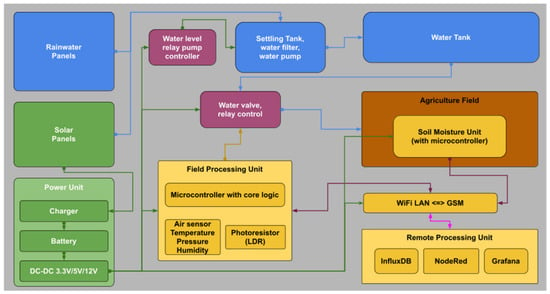
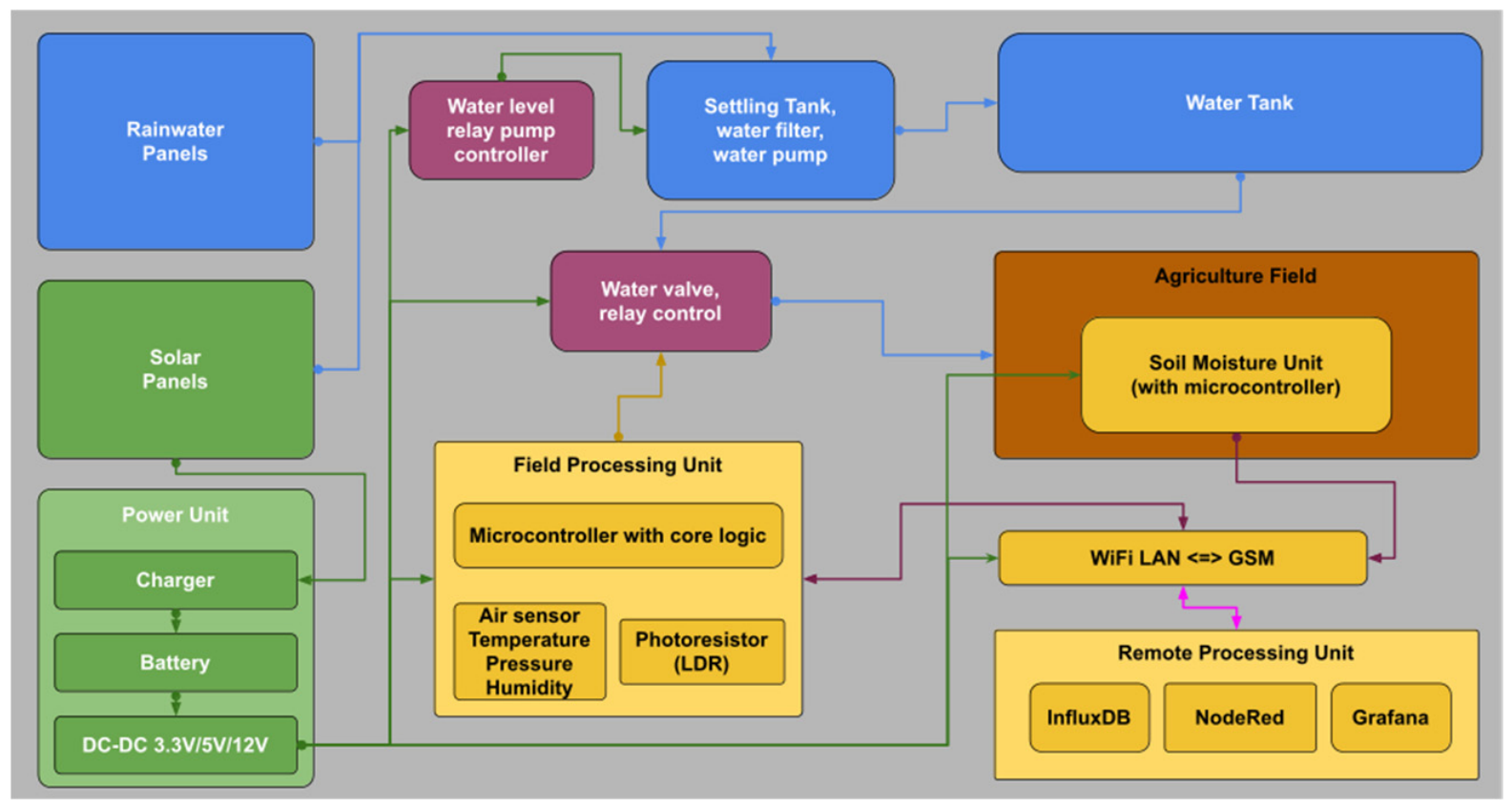
The proposed design consists of three interacting modules: a field processing unit (FPU), a soil-moisture unit (SMU), and a remote processing unit (RPU). The FPU and SMU are installed in the agricultural field and communicate through a local WiFi network, while a Global System for Mobile Communications (GSM) connection over the public mobile network provides access to the remotely located RPU. The architecture combines rainwater collection, photovoltaic energy supply, environmental sensing, data communication, irrigation control, and a fallback scenario (Figure 1).
Figure 1.
Overall system architecture showing integration of rainwater collection, solar power, field sensing, irrigation control, and remote processing. Blue denotes water transfer, green represents supply, yellow indicates control signals for valves, and burgundy/magenta signifies communication links. The color-coded blocks distinguish the functional subsystems.
The FPU performs atmospheric measurement, communication management, irrigation triggering, and backup control, while the SMU acquires soil-moisture data for the field network.
Rainwater collected from dedicated collection surfaces and photovoltaic panels enters a 60–70 L settling tank, where mesh filtration and sedimentation remove debris before a level-controlled pump transfers water to the main storage tank. The arrangement retains 10 L in the settling tank to support continued sedimentation. The stored water is supplied to the drip irrigation network through a controlled valve.
When using solar energy for charging and storage, powering batteries, field controllers, sensors, communication components, and valve electronics can be accomplished through DC-DC converters. During measurement and communication cycles, certain consumers are switched off by switching the power supply. In the one-hectare scenario, for which a separate cost estimate is provided, the transfer pump from the collector to the storage is powered by a photovoltaic system and a battery; its energy consumption is not included in the assessment of battery runtime for the sensor nodes.
2.2. Sensors and Field Hardware
The FPU and SMU are based on ESP8266 microcontrollers (Espressif Systems, Shanghai, China) [7]. The FPU includes a BME280 sensor (Bosch Sensortec GmbH, Reutlingen, Germany) [8] for air temperature, relative humidity, and barometric pressure measurement, with a photoresistor (LDR) for detecting ambient-light conditions. The SMU uses a capacitive soil-moisture probe, selected because it avoids the exposed metal electrodes responsible for corrosion. The BME280 is intended for installation in a ventilated radiation shield, away from walls, direct precipitation, and heat-emitting surfaces. The capacitive probe is placed in the root zone and distinguishes whether the measured moisture is above or below the target irrigation level. Since the available documentation does not include gravimetric calibration to volumetric water content, the probe output is treated as a relative soil-moisture indicator, and soil-specific calibration is required before quantitative interpretation [9].
The photoresistor qualitatively distinguishes the selected low-light irrigation period from daytime conditions, not a calibrated illuminance in lux. The main hardware elements and their roles are summarized in Table 1.
Table 1.
Main hardware and infrastructure elements of the proposed system.
2.3. Remote Software and Communications
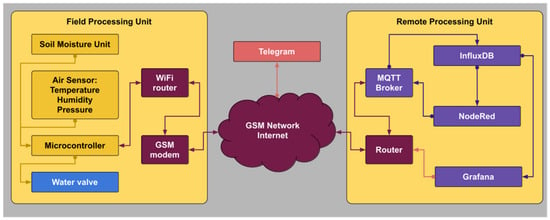
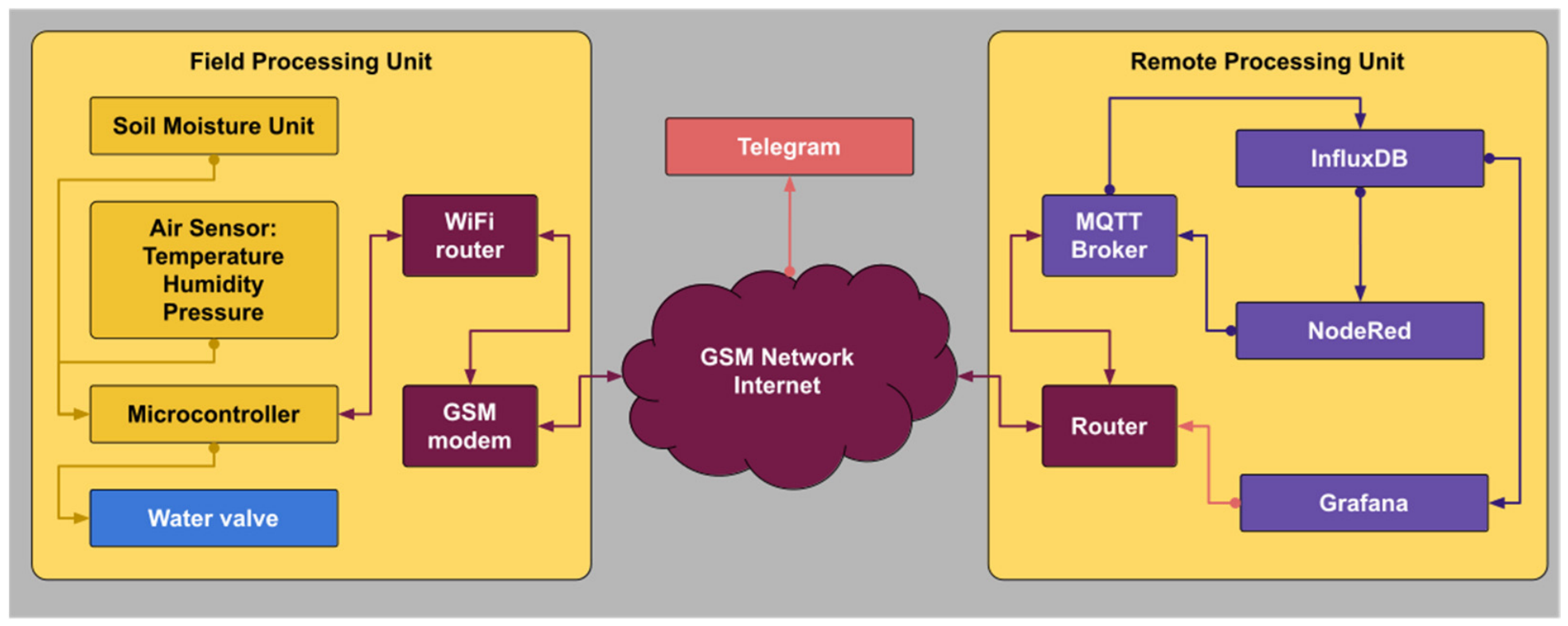
Field devices exchange measurements and control messages over the Message Queuing Telemetry Transport (MQTT) publish–subscribe protocol [10]; the ESP8266 controllers connect to the WiFi network, and the GSM modem provides a cellular backhaul to the RPU (Figure 2).
Figure 2.
Communication path between field devices and the remote processing unit through WiFi, GSM, MQTT, and the monitoring stack. The arrows indicate the direction of measurement, as well as control and service messages. A gold connection signifies signals from local devices, a burgundy connection signifies a network connection, a purple connection signifies a data exchange in the remote processing stack, and a salmon connection signifies a path to a dashboard or notifications. Colored blocks indicate the functions of individual components.
The RPU is implemented with Home Assistant and integrated services. Mosquitto acts as an MQTT broker, InfluxDB stores time-stamped sensor measurements, Node-RED implements data processing and irrigation decision logic, and Grafana provides visualization and historical review. The FPU transmits air temperature, relative humidity, atmospheric pressure, and ambient-light status, while the SMU provides soil-moisture status. The RPU processes the last valid measurements and issues the irrigation command to the FPU.
2.4. Irrigation Decision Logic
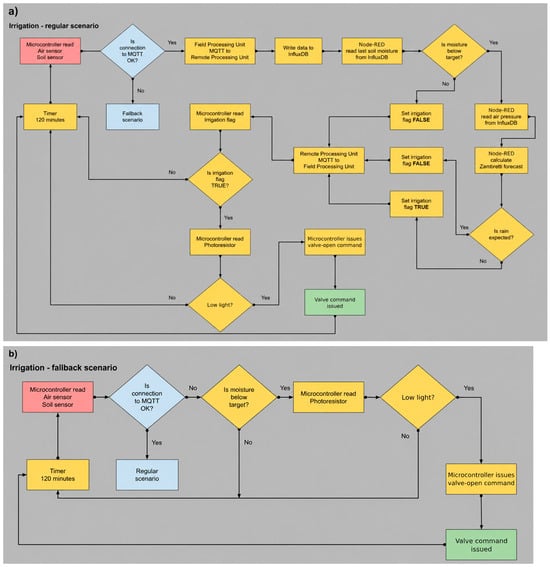
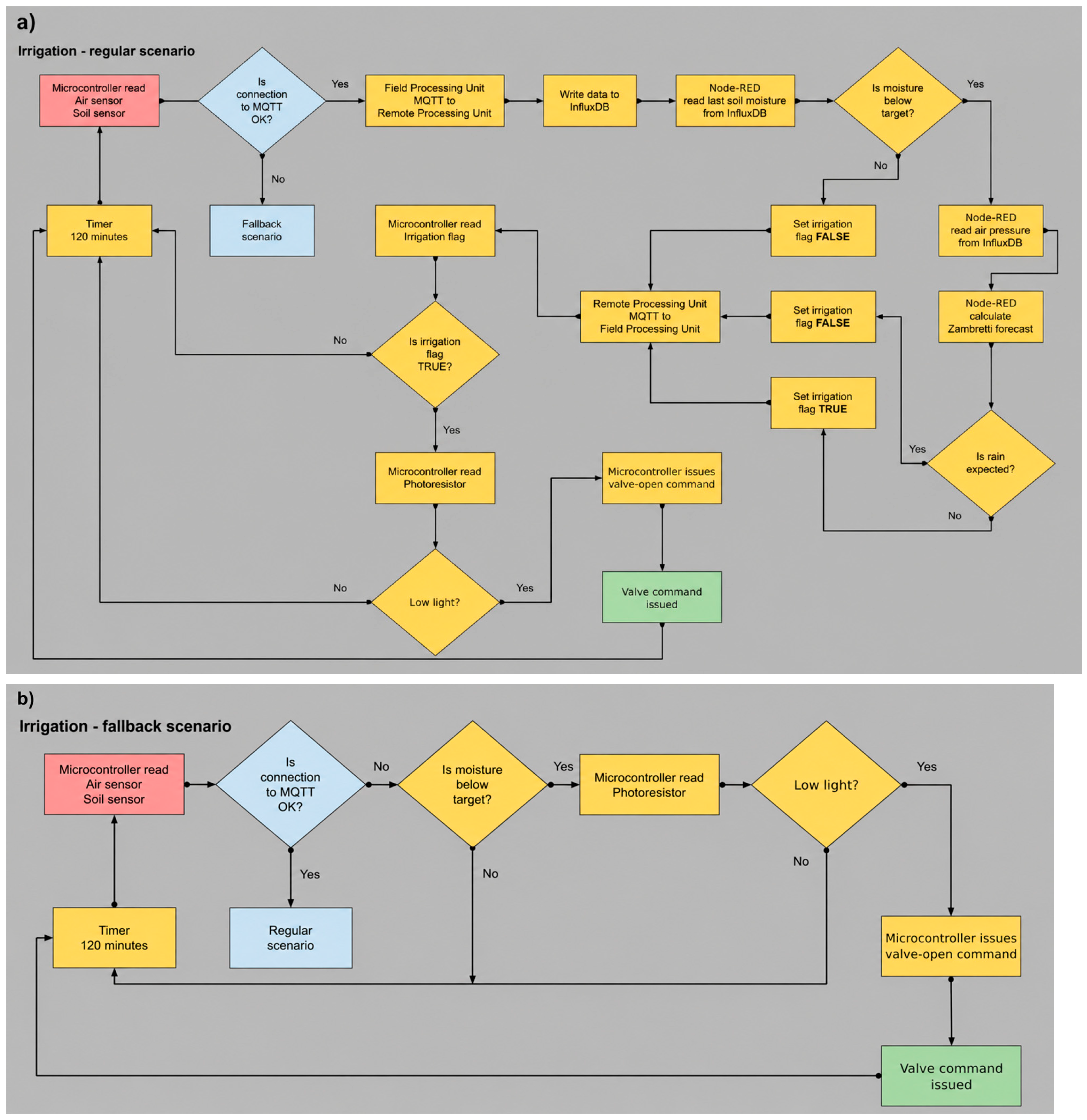
Irrigation decisions are evaluated periodically, with a representative duty cycle of 60 s of active operation followed by 7200 s of sleep (121 min in total). In normal operation, Node-RED combines the latest soil-moisture and atmospheric data with a Zambretti algorithm pressure forecast. If soil moisture is below target and rain is not indicated, the RPU returns TRUE; the FPU then checks the LDR and opens the valve only when the conditions permit watering (Figure 3a).
Figure 3.
Irrigation decision flow: (a) regular operation using remote processing and forecast logic; (b) fallback operation using local soil-moisture and light information. The black arrows indicate the direction of control flow, while the “Yes” and “No” labels represent decision outcomes. There are yellow shapes for irrigation-related decisions, blue shapes for communication checks, red rectangles for receiving sensor data, and green ones for sending commands to valves.
If MQTT communication fails, the FPU uses the most recent locally available SMU reading together with the LDR state; forecasting is then unavailable, so decision quality is reduced, but irrigation remains operational (Figure 3b).
In normal operation, the FPU and SMU transmit their measurements to the RPU, and Node-RED retrieves the latest soil-moisture and atmospheric-pressure values from InfluxDB. Let M denote the relative soil-moisture index, Mth the lower irrigation threshold, and URPU the binary remote irrigation request. The request can then be defined as
For the current prototype, Mth is a configurable commissioning parameter, selected from probe readings under representative dry and adequately moist soil conditions. If URPU = 1, irrigation can be requested; if URPU = 0, irrigation is suppressed.
After receiving a value of URPU = 1, the FPU evaluates the photoresistor signal. Let L denote a light-level variable, with lower values indicating lower illumination, and Lth the selected low-light threshold. The valve command is
The valve is activated when both conditions are met; the rainfall indication thus suppresses irrigation.
This fallback rule assumes that valid soil-moisture and light information remains available locally.
2.5. Forecast Logic and Energy-Saving Operation
The remote decision stage uses Zambretti mapping derived from atmospheric-pressure information [11]. Watering is suppressed by rain-related forecasts; since the barometric input provides only a short-term forecast, a dedicated two-hour rain flag would require an external source. Energy saving relies on DeepSleep and load switching: between measurement cycles, the FPU remains in a low-power timing state, while MOSFET switches can disconnect the GSM router and SMU; startup and readiness delays must be measured so components are powered only long enough to obtain valid data.
2.6. Energy-Balance Method
The device periodically switches between active and DeepSleep modes; the average current over one duty cycle is
The corresponding daily energy demand is
where Vload is the voltage at which the current is consumed; the usable battery energy and endurance are
Here Vbattery is the nominal battery voltage (V), Cbattery is the nominal capacity (Ah), and ηDC−DC = 0.85 is the assumed conversion efficiency; Ebattery is the usable load energy (Wh), Eday is in Wh/day, and Tbattery is the theoretical battery-only endurance in days.
All load-energy calculations use an assumed 5 V supply at the modeled load input.
2.7. Water-Demand and Rainwater-Collection Evaluation
FAO-56 [12] provides a framework for estimating crop evapotranspiration. The case study considers 10 apple and 10 plum trees as separate scenarios. The adopted daily irrigation-demand inputs are 12.0 and 14.3 L per tree. These values are treated as fixed design assumptions, not as measured crop water requirements. A 30-day period and a 10% design allowance give monthly design volumes of 3960 L for apple and 4719 L for plum. Monthly rainfall of 60 mm is used as an assumed scenario, and the coefficient c represents the fraction of rainfall over the collection surface.
Here A is the collection area in m2, Vdesign is the monthly design volume in liters, q is the daily irrigation demand in L per tree, n is the number of trees, Nd is the number of days, r is the design allowance, and P is monthly rainfall in mm. 1 mm of precipitation on 1 m2 corresponds to 1L of water. Ideally, c = 1; c = 0.80.
A separate indicative estimate of capital expenditures has been prepared for a one-hectare apple orchard containing 600 trees. A supplemental irrigation system consists of a control and power unit (FPU), four sensor management units (SMU), four drip irrigation zones, a 150 m2 rainwater harvesting facility with a canopy, a storage tank with a capacity of 35 m3, and a pump to transfer water between the collection vessel and the storage tank, equipped with an autonomous power supply. The figures represent target budget values and preliminary estimations, including a 10% contingency reserve. The calculations exclude costs for land, trees, specialized software development, ongoing communication fees, and Value Added Tax (VAT). The pricing scenario for a one-hectare area is distinct from the water consumption scenarios based on ten trees.
3. Results and Discussion
The reported values are analytical estimates based on the stated current-consumption data and duty cycle assumptions, not long-term reliability tests or field trials over a growing season.
3.1. Energy Requirements
Energy performance was estimated from reported current consumption and representative duty cycles for periodic sensing/telemetry, rainwater pumping, and irrigation (Table 2). The design case uses a 13,200 mAh, 3.7 V battery, 85% DC-DC efficiency, and a 12 V/8 A solar panel with six equivalent daytime hours; these calculations are not a long-duration endurance test. The calculated usable battery energy is 41.514 Wh. With the intermittent profile of 60 s of active operation and 7200 s of DeepSleep, the sensor node reaches an autonomy of about 114 days without charging; this refers to the sensor node only, not to the entire irrigation system. Interpreting the nominal photovoltaic power as an operating power of 96 W, six equivalent hours of full sunshine give a theoretical daily yield of 576 Wh before system losses; the actual yield depends on the solar resource, operating conditions, and system efficiency [13]. Within the periodic sensing and telemetry profile, the active phase accounts for approximately 19.3% of the daily load energy and DeepSleep for the remaining 80.7%. This endurance estimate applies only to the node modeling the sensor, not the entire one-hectare configuration.
Table 2.
Energy calculations for separate representative profiles at an assumed 5V load voltage.
3.2. Water-Demand, Collection-Area, and Indicative Cost Assessment
Table 3 presents the two fixed demand scenarios: with 60 mm of monthly rainfall, the ideal collection area is 66.00 m2 for apple and 78.65 m2 for plum, and a collection coefficient of 0.80 increases these areas to 82.50 and 98.31 m2, respectively.
Table 3.
Rainwater collection sizing for separate 10-tree scenarios over 30 days, assuming 60 mm monthly rainfall and a 10% design allowance.
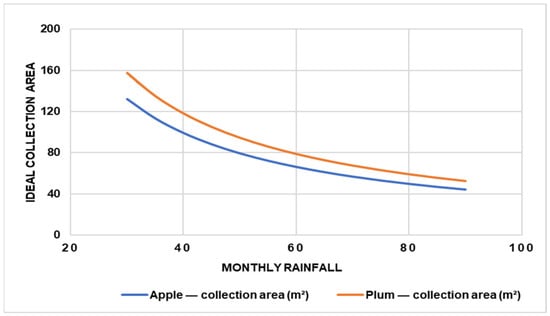
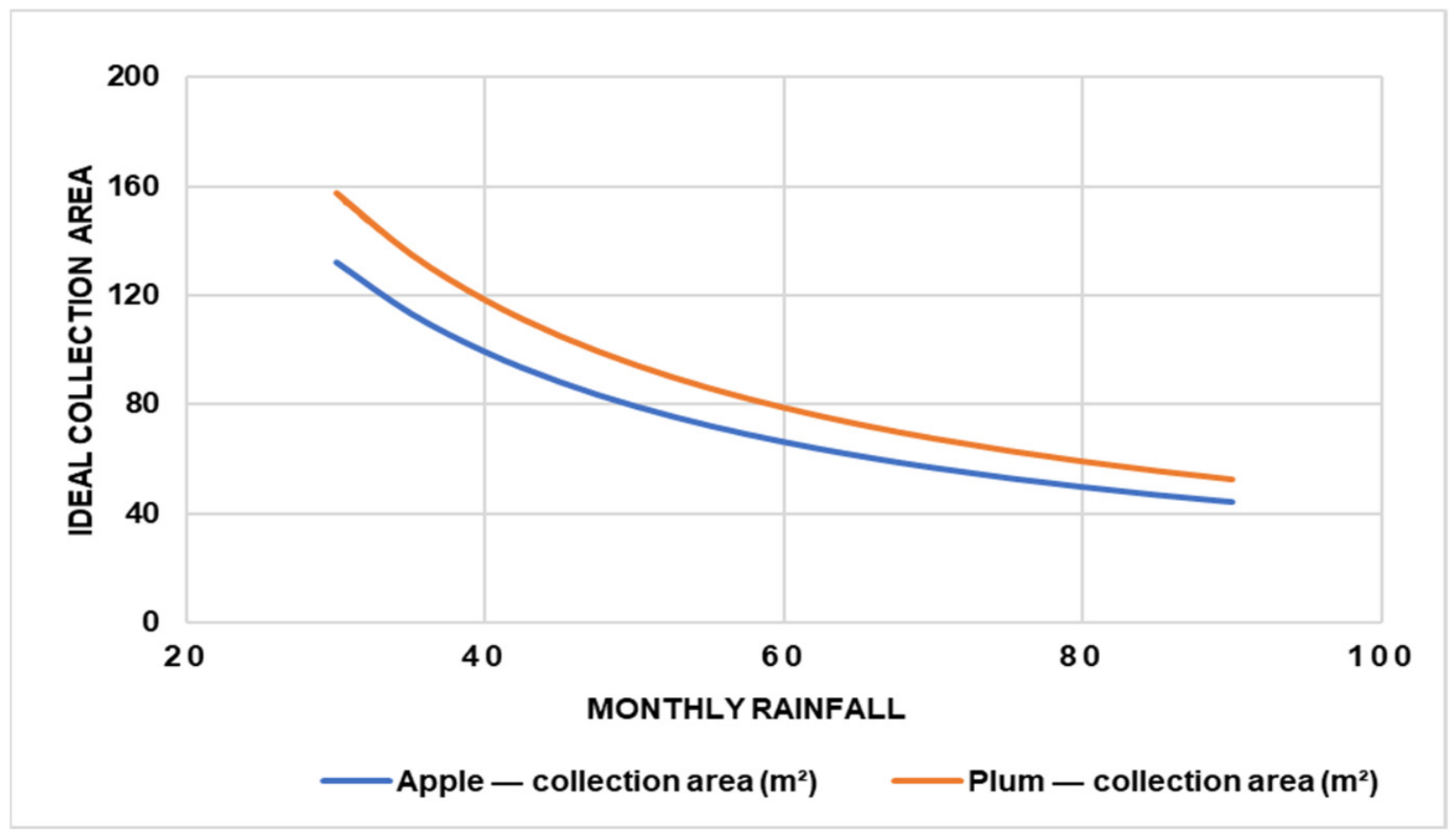
Figure 4 shows how the required area changes with monthly rainfall for fixed design volumes; only the monthly collected volume is considered, without addressing storage capacity or the timing match between rainfall and demand.
Figure 4.
Calculated sensitivity of the ideal rainwater collection area to assumed monthly rainfall for fixed design volumes of 3960 L for apples and 4719 L for plums, c = 1.
The indicative capital cost breakdown for the scenario with additional irrigation of a one-hectare apple orchard is presented in Table 4.
Table 4.
Indecative capital cost breakdown for supplementary irragiation of a one-hectare apple orchard with 600 trees, including a 10% contingency reserve.
One-time capital expenditure per hectare is approximately 16,819.97€, plus a 10% contingency reserve. On the basis of an estimated daily requirement of 12 L per tree for a 30-day period with a 10% buffer, 600 apple trees would require 237.6 m3. Assuming a monthly rainfall of 60 mm and a collection coefficient of 0.80, a catchment area of 150 m2 would provide approximately 7.2 m3 of water, which is an additional resource for the proposed supplementary irrigation strategy. Future tests will evaluate seasonal water supply recovery, the efficiency of gravity drippers, and the overall energy balance of the system to make improvements. Studies on rainwater harvesting for greenhouse irrigation show that reservoir sizing should account for the rainfall regime and the temporal water balance [14]; the present collection-area estimates will therefore be supplemented by a daily storage-balance analysis. Future work could also incorporate photovoltaic production forecasting: Sapundzhi et al. investigated monthly forecasting of photovoltaic energy yield [15] and, subsequently, federated neural forecasting with multilayer perceptron and closed-loop recurrent unit models [16].
4. Conclusions
This paper presented a modular architecture for sensor-controlled rainwater irrigation, integrating field sensing, remote processing, photovoltaic supply, and local backup decision logic, with an analysis of its energy and water needs. Under the adopted assumptions, a periodically operating node supplied at 5 V consumes about 0.364 Wh per day, corresponding to 114 days of theoretical battery-only autonomy. Assuming 60 mm of monthly rainfall and a monthly design volume of 4719 L for ten plum trees, a theoretical collection area of 78.65 m2 is required, increasing to 98.31 m2 for a collection coefficient of 0.80. Future work will focus on experimental validation of sensor calibration and control thresholds, delivered water volumes, communication recovery after interruptions, and the seasonal energy and water balance.
Author Contributions
Conceptualization, P.T. and F.S.; methodology, P.T. and F.S.; software, investigation, data curation, and visualization, P.T.; validation and formal analysis, P.T., F.S. and S.G.; writing—original draft preparation, P.T., F.S. and S.G.; writing—review and editing, P.T., F.S. and S.G.; supervision and project administration, P.T., F.S. and S.G. All authors have read and agreed to the published version of the manuscript.
Funding
This study was supported by FNSE-02, “Scientific Research” Fund of Ruse University.
Institutional Review Board Statement
Not applicable.
Informed Consent Statement
Not applicable. This study did not involve human participants.
Data Availability Statement
The original contributions presented in this study are included in the article. Further inquiries can be directed to the corresponding authors.
Conflicts of Interest
The authors declare no conflicts of interest. The funders had no role in the design of the study; in the collection, analysis, or interpretation of data; in the writing of the manuscript; or in the decision to publish the results.
References
- Froiz-Míguez, I.; Lopez-Iturri, P.; Fraga-Lamas, P.; Celaya-Echarri, M.; Blanco-Novoa, Ó.; Azpilicueta, L.; Falcone, F.; Fernández-Caramés, T.M. Design, Implementation, and Empirical Validation of an IoT Smart Irrigation System for Fog Computing Applications Based on LoRa and LoRaWAN Sensor Nodes. Sensors 2020, 20, 6865. [Google Scholar] [CrossRef] [Scilit] [PubMed]
- Di Gennaro, S.F.; Cini, D.; Berton, A.; Matese, A. Development of a Low-Cost Smart Irrigation System for Sustainable Water Management in the Mediterranean Region. Smart Agric. Technol. 2024, 9, 100629. [Google Scholar] [CrossRef] [Scilit]
- Benameur, R.; Dahane, A.; Kechar, B.; Benyamina, A.E.H. An Innovative Smart and Sustainable Low-Cost Irrigation System for Anomaly Detection Using Deep Learning. Sensors 2024, 24, 1162. [Google Scholar] [CrossRef] [Scilit] [PubMed]
- Zhang, Y.; Wang, X.; Jin, L.; Ni, J.; Zhu, Y.; Cao, W.; Jiang, X. Research and Development of an IoT Smart Irrigation System for Farmland Based on LoRa and Edge Computing. Agronomy 2025, 15, 366. [Google Scholar] [CrossRef] [Scilit]
- Al Mamun, M.R.; Ahmed, A.K.; Upoma, S.M.; Haque, M.M.; Ashik-E-Rabbani, M. IoT-Enabled Solar-Powered Smart Irrigation for Precision Agriculture. Smart Agric. Technol. 2025, 10, 100773. [Google Scholar] [CrossRef] [Scilit]
- Ayat, Y.; El Moussati, A.; Rachdi, O.; Mimouni, A. Design and Experimental Validation of a Low-Power IoT-Based Smart Irrigation System Using LoRa, ET0, and Crop Water Stress Index for Precision Agriculture. IoT 2026, 7, 59. [Google Scholar] [CrossRef] [Scilit]
- Espressif Systems. ESP8266EX Datasheet, Version 7.1. Available online: https://documentation.espressif.com/ (accessed on 1 September 2026).
- Bosch Sensortec. Humidity Sensor BME280. Available online: https://www.bosch-sensortec.com/en/products/environmental-sensors/humidity-sensors-bme280 (accessed on 6 November 2026).
- Adla, S.; Rai, N.K.; Karumanchi, S.H.; Tripathi, S.; Disse, M.; Pande, S. Laboratory Calibration and Performance Evaluation of Low-Cost Capacitive and Very Low-Cost Resistive Soil Moisture Sensors. Sensors 2020, 20, 363. [Google Scholar] [CrossRef] [Scilit] [PubMed]
- Banks, A.; Gupta, R. (Eds.) MQTT Version 3.1.1. OASIS Standard, 29 October 2014. Available online: https://docs.oasis-open.org/mqtt/mqtt/v3.1.1/os/mqtt-v3.1.1-os.html (accessed on 1 September 2026).
- SAS Communities. Iot-Zambretti-Weather-Forcasting. Software Repository. Available online: https://github.com/sascommunities/iot-zambretti-weather-forcasting (accessed on 1 September 2026).
- Allen, R.G.; Pereira, L.S.; Raes, D.; Smith, M. Crop Evapotranspiration: Guidelines for Computing Crop Water Requirements; FAO Irrigation and Drainage Paper 56; Food and Agriculture Organization of the United Nations: Rome, Italy, 1998. [Google Scholar]
- Dobos, A.P. PVWatts Version 5 Manual; NREL/TP-6A20-62641; National Renewable Energy Laboratory: Golden, CO, USA, 2014. Available online: https://docs.nlr.gov/docs/fy14osti/62641.pdf (accessed on 1 September 2026).
- Londra, P.A.; Gkolfinopoulou, P.; Mponou, A.; Theocharis, A.T. Effect of Rainfall Regime on Rainwater Harvesting Tank Sizing for Greenhouse Irrigation Use. Hydrology 2022, 9, 122. [Google Scholar] [CrossRef] [Scilit]
- Sapundzhi, F.; Chikalov, A.; Georgiev, S.; Georgiev, I. Predictive Modeling of Photovoltaic Energy Yield Using an ARIMA Approach. Appl. Sci. 2024, 14, 11192. [Google Scholar] [CrossRef] [Scilit]
- Sapundzhi, F.; Georgiev, S.; Georgiev, I.; Todorov, V. Forecasting Solar Energy Production Through Modeling of Photovoltaic System Data for Sustainable Energy Planning. Appl. Sci. 2026, 16, 5053. [Google Scholar] [CrossRef] [Scilit]

Disclaimer/Publisher’s Note: The statements, opinions and data contained in all publications are solely those of the individual author(s) and contributor(s) and not of MDPI and/or the editor(s). MDPI and/or the editor(s) disclaim responsibility for any injury to people or property resulting from any ideas, methods, instructions or products referred to in the content. |
© 2026 by the authors. Licensee MDPI, Basel, Switzerland. This article is an open access article distributed under the terms and conditions of the Creative Commons Attribution (CC BY) license.