


Abstract
As urban challenges grow increasingly complex, Open Digital Twin Frameworks (ODTFs) offer a sustainable and adaptable approach to managing the dynamic interplay between urban infrastructure, environmental sustainability, and societal needs. This study presents the implementation process of the MetaCities ODTF for smart cities. The importance of this ODTF lies in its ability to unify diverse data sources, technologies, and stakeholders under a common architecture. This study proposes a versatile ODTF that can be tailored to diverse use cases within various regional contexts to address the unique needs of cities and regions across the Southeast Europe (SEE) landscape. The study adopts three consecutive phases. The first phase identified high-impact use cases regarding smart mobility together with their data sources and high-level technical workflows, resulting in a set of functional and technical requirements. The second phase translated these requirements into detailed ODTF specifications. In the final phase, the ODTF specifications were mapped to individual platform components, connecting each component to the corresponding requirements and use cases. By bridging digital, physical and human layers, Digital Twins built on the ODTF provide a reliable, real-time reference environment in which stakeholders can safely evaluate policy options and infrastructure investments prior to full-scale deployment.
1. Introduction
Traffic management is a significant challenge in urban areas worldwide. The modernization of legacy traffic control centers is necessary due to the increasing information load on operators. However, the complexity of these transport management systems increases with the number of people and modes of transport. As vehicle and pedestrian density rises, even minor incidents can trigger unpredictable congestion, making real-time decision making increasingly demanding.
This issue compromises the accessibility goals set by the MetaCities Smart City Research and Innovation (R and I) strategy. MetaCities establishes an Excellence Hub that spans a large geographical area of Southeast Europe (SEE), represented by three location-based innovation ecosystems in Cyprus, Greece, and Bulgaria. Digital Twins and Metaverse Technologies for Smart Mobility are addressed by both the Greek and the Cypriot innovation ecosystems within the context of the project and the Excellence Hub [1].
Addressing urban traffic issues requires understanding the use of vehicles in cities during peak hours and the events that trigger traffic congestion. Searching for available parking is a source of unnecessary traffic [2], as even a short time spent searching for a parking space would generate a considerable amount of traffic. A study of 11 US cities showed that 30% of the traffic spent an average of 8.1 min searching for parking spaces. Furthermore, short response times to traffic incidents are crucial to minimize the impact on congestion. In economic terms, the annual cost of congestion in the EU has been estimated to be 1% of GDP [3]. Congestion also has other negative externalities, such as increased levels of noise, pollution and the potential for accidents and reductions in the useful life of vehicles and the capacity of the network to cope with incidents. According to the European Commission, in 2020, 18,800 people lost their lives on European roads, equating to approximately 360 deaths every week [4].
These numbers, both in absolute and relative terms, have remained largely unchanged for the past 20 years, despite the sustained efforts of the United Nations and other road safety bodies. Recognizing the importance of the problem and the need to act, governments from around the world declared unanimously, through UN General Assembly Resolution 74/299, a Second Decade of Action for Road Safety 2021–2030 with the explicit target to reduce road deaths and injuries by at least 50% during that period. Moreover, in the event of accidents, shorter response times can significantly reduce permanent disability and death rates [5].
Smart mobility solutions play a pivotal role in addressing contemporary urban challenges, especially in densely populated areas such as the Cities of Patras and Nicosia. With the vision of using technological innovations to make Patras and Nicosia inclusive, safe, resilient and sustainable cities, the MetaCities project has emerged as a promising initiative. According to the MetaCities methodologies, policies addressing transport challenges will rely on the design of an efficient Smart Transport digital twin that will monitor the necessary data and provide a testbed for various policies and solutions before implementing them.
The goal is to help vehicles, pedestrians and bicycles move safely and smoothly through complex urban environments, aligned with the Smart Transport priority for Safety, Quality of Life, Green City, Accessibility and Inclusivity goals for the Cities of Patras and Nicosia. These cities face several mobility-related challenges that hinder the efficiency and sustainability of urban transportation systems, including traffic congestion, illegal parking, inadequate public transportation information, limited electric vehicle infrastructure, and environmental concerns.
This study follows a three-phase methodology. The first phase identifies high-impact use cases for smart urban mobility, together with their data sources and technical workflows, resulting in a set of functional and technical requirements. The second phase translates these requirements into detailed Open Digital Twin Framework (ODTF) specifications. The third phase maps the specifications to individual platform components, connecting each component to its corresponding requirements and use cases.
2. Use Case Overview
Three use cases define the smart mobility scope for the Cities of Patras and Nicosia. Each use case describes a key urban mobility challenge, the data sources required to address it, and the high-level technical workflows that inform the requirements derived in Section 3. The three use cases cover smart parking management, environmental monitoring of traffic incidents, and emergency vehicle management.
2.1. Use Case 1: Smart Parking Management in Patras and Nicosia
One of the main problems in the City of Patras and in the city of Nicosia is the existence of limited parking spaces and short-term parking solutions, and bad parking behavior with respect to short-term parking. To propose solutions and policies that address congestion caused by illegal parking, which compromises the safety and accessibility of cyclists, pedestrians, and drivers who visit or work in the city center, it is first necessary to understand the problem. Data will be collected from roadway sensors and specialized cameras to study the impact of illegal parking behavior on traffic congestion. Such behavior includes, among others, violations of restricted parking zones, double parking and violation of the maximum allowed parking time.
2.2. Use Case 2: Environmental Patterns of Traffic Incidents
One of the main problems faced by big cities that compromise the quality of life of their citizens relates to the green aspect of city life. Especially for the Smart Mobility priority, it has been identified as a compromising factor that needs to be dealt with not only for specific stakeholders (cyclists, pedestrians), but for all citizens at large.
Monitoring the environmental indexes is a very important factor for implementing policies and actions that make a city greener, healthier, more sustainable and more attractive for its citizens and visitors. The impact of traffic incidents on environmental indexes needs to be thoroughly analyzed by correlating traffic conditions with environmental (air quality, noise, smoke, etc.) factors.
The application will provide citizens and visitors with valuable real-time information regarding the pollution and noise levels in the city. By providing a heatmap of the air pollution and noise levels, the cyclists and pedestrians may evaluate their travel plans. The application will also evaluate, suggest, and predict alternative solutions. Specifically, Patras smart mobility solution will suggest location-based alternative routes and alternative transportation/intermodal transport to the places of interest.
By monitoring specific indices through sensors (Municipality and University) and crowdsourcing means and making use of the air quality forecasting models already applied to the city of Patras, users can correlate and understand the expected environmental conditions after an incident at a certain city location.
2.3. Use Case 3: Emergency Management
Road accidents are another issue that affects the quality of life and the safety of citizens. The UN General Assembly Resolution 74/299, Improving Global Road Safety: A Second Decade of Action for Road Safety 2021–2030, has set a target of a 50% reduction in road accidents. Studies have reported that in the event of road accidents, shorter response times can significantly reduce permanent disability and death rates. According to the MetaCities R and I strategies and goals for Smart Transport priorities, an Intelligent Transport and Incident Management System (ITIMS) can help achieve this target reduction. This use case supports Emergency service operations with a digital operations center that provides real-time traffic information required by first responders about congestion in the city. In addition, it coordinates the routing of their vehicles when trying to reach an incident.
MetaCities Patras smart mobility application will provide the operating center for emergency services (through which authorities can synchronize their actions after a traffic incident) with data, such as alerts and re-routing info. These actions include rerouting vehicles while facilitating emergency vehicles to access an incident. By simulating various traffic re-routing scenarios, the MetaCities Patras smart mobility application will provide Traffic Police rerouting options to support emergency services. The data will be similar to the data mentioned in use cases 1 and 2. Data from roadway sensors and cameras can also be used for traffic and event predictions.
3. Requirements
Within the MetaCities project, requirements were elicited through a Quadruple Helix approach involving academia, industry, government, and citizens. Table 1 presents a comprehensive requirements analysis for smart mobility applications. The requirements define the specific functionalities and capabilities that the technical outcome must offer to achieve its goals and ensure high performance, usability, and security.
Table 1.
Digital Twin requirements.
By leveraging the insights gathered from the Quadruple Helix actors, tailored solutions that optimize smart mobility, streamline urban planning processes, and enhance energy efficiency and renewable energy applications can be created. The integration of these requirements into the development process ensures that the resulting solutions align with the stakeholders’ needs and contribute to the sustainable development and growth of the cities and communities involved.
4. UML Diagrams
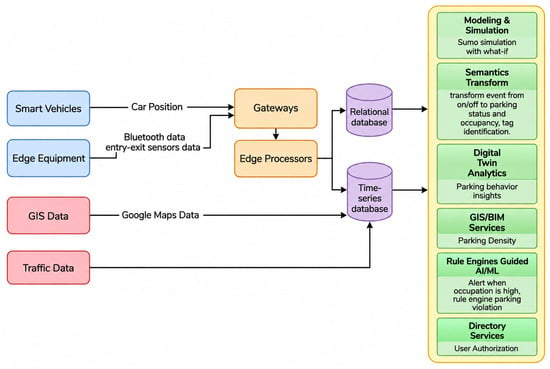
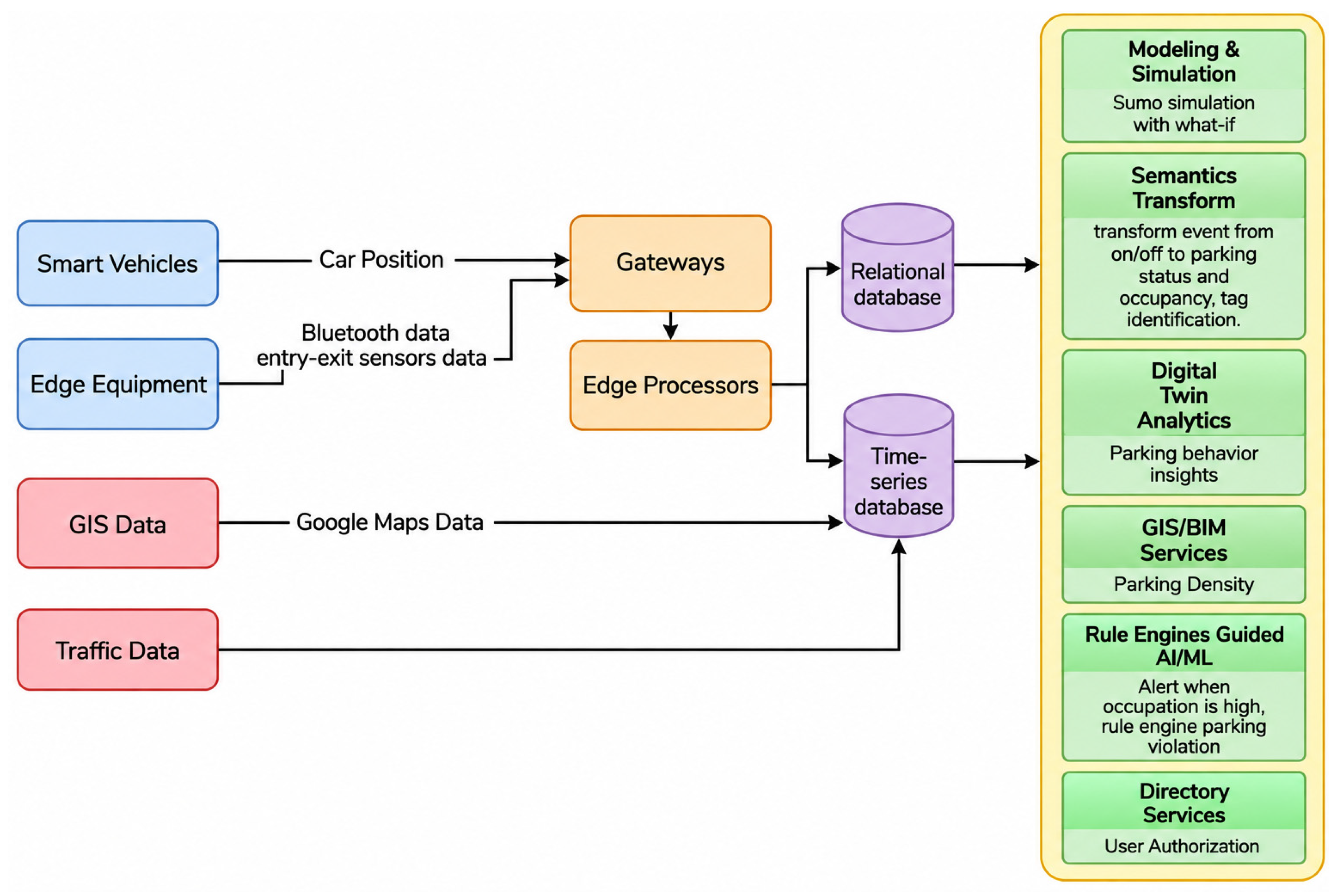
Building on the requirements identified in phase one, phase two translates these into detailed ODTF specifications through data flow diagrams, as shown in Figure 1. To represent the interactions and functions among the architectural components across various use cases, a data flow diagram maps how data flows through the system from acquisition to processing to storage and analytics, leading to outcomes.
Figure 1.
Data flow diagram for use case 1.
The data flow involves smart mobility and parking behavior analysis, with input data including car position, Bluetooth and sensor data, and Google Maps data. The output includes decisions on parking behavior, parking density and parking violations. The components used are shown in green in Figure 1.
For use case 2, environmental patterns of traffic incidents, input data include traffic monitoring and bus traffic data, maps, crowdsourced incidents, as well as flow and blocking events, and support decisions on traffic obstruction and congestion estimation. For use case 3, emergency management, input data include traffic monitoring, air quality and noise intensity, and support decisions on traffic density and traffic re-routes on emergency incidents.
5. Components
Phase three maps the ODTF specifications to individual platform components, connecting each to its corresponding requirements and use cases. Table 2 presents the MetaCities technical components, each assigned to one of the architectural blocks identified in the ODTF Architecture. This classification of components enables the conceptualization of the overall architecture, with the functionalities detailing the scope, functions and objectives of each component.
Table 2.
ODTF components.
6. Blockchain
Integration of blockchain technology with rule engines and digital twin analytics in a cohesive architecture would enhance transparency, security, and trust, while ensuring data integrity in decentralized environments [6,7,8]. This architecture involves several layers and components that interact seamlessly to provide a more robust system.
The rule engine layer, ref. [9] guided by AI and machine learning models, relies on blockchain smart contracts to enforce business rules and logic. These smart contracts are decentralized, ensuring immutability and trust in the decision-making processes. The rule engine processes events triggered by data inputs, such as sensor readings or user actions. Blockchain records the outcomes and decisions made by the AI models, making them auditable and traceable. This layer also benefits from the decentralized validation of rules, where business logic is autonomously executed when predefined conditions are met [10].
In the digital twin analytics layer, the system leverages blockchain to store critical data streams from real-world objects, like IoT devices, as well as simulation outputs [11]. The digital twin, a virtual representation of a physical asset, uses real-time data to mirror and predict the behavior of its physical counterpart. Blockchain ensures the integrity of these data inputs and outputs, recording key state changes and analytics results. This enables organizations to audit any changes or anomalies, improving trust and reliability when collaborating with third parties.
The blockchain layer provides decentralized infrastructure for trusted interactions. Smart contracts store business rules and enforce logic immutably, while consensus verifies transactions across the network so participants can trust shared data and outcomes. Real-time IoT and external data, such as weather or traffic readings, are captured and verified through blockchain to prevent tampering. Sensor data can be hashed and stored on-chain, allowing stakeholders to confirm authenticity before the digital twin uses it for simulations or the rule engine applies business logic.
Blockchain also protects the integrity of AI/ML training data by storing hashes on-chain, making manipulation detectable. AI decisions can be logged to provide transparency, traceability, and later review, especially for applications such as predictive maintenance or anomaly detection. Finally, blockchain supports AI explainability by recording decisions alongside key contributing factors, including input data, model parameters, and rule-engine logic. This creates an audit trail that explains how decisions were reached, which is valuable in regulated sectors such as finance and healthcare.
In a typical workflow, data from IoT devices flows into the rule engine and the digital twin [12]. If the AI model detects an anomaly, such as an off-limits CO2 measurement, a smart contract in the rule engine triggers an action, such as giving an alert or notifying the relevant personnel. This decision, as well as the data that triggered it, is recorded on the blockchain, creating a verifiable record. The digital twin, in parallel, receives continuous updates from its physical counterpart. Blockchain ensures that these updates are immutable, so any changes in the physical state are securely recorded and can be traced back to the source in case of future issues.
In summary, blockchain enhances the overall architecture by providing immutability, auditability, and decentralized trust. The rule engines benefit from transparent, verifiable decision-making, while digital twin analytics leverage blockchain to ensure the integrity and reliability of their data streams and simulations. This architecture creates a resilient, transparent system capable of supporting decentralized decision-making, collaborative environments, and secure, auditable AI-driven processes.
7. Conclusions
This study presented the implementation process of the MetaCities Open Digital Twin Framework (ODTF) for smart cities with three key steps. First, the specifications of the requirements were defined by conducting a thorough analysis of use case demands and stakeholder objectives. This ensured that all identified requirements were aligned with the overarching goals of the MetaCities initiative. Second, the technical components were meticulously detailed, outlining their capabilities, constraints, and relevance to the identified needs. Finally, these components were matched with specific use cases, creating a clear linkage between the conceptual framework and practical implementation.
The main contribution of this study lies in a well-defined description of the technical components, enriched with information regarding their alignment with requirements and use cases. This alignment highlights the coherence of the proposed solutions and demonstrates how they cater to diverse urban scenarios, from smart mobility to green city initiatives, and provide a holistic view of the ODTF architecture. This integration not only facilitates a clear understanding of the framework but also establishes a robust foundation for future developments and applications within the MetaCities ecosystem.
Author Contributions
Conceptualization, E.F. and T.P.; methodology, E.F., T.P., C.I., I.T. and N.T.; validation, V.V. and C.P.A.; formal analysis, C.P.A.; investigation, E.F.; writing—original draft preparation, E.F., T.P., C.I., I.T. and N.T.; writing—review and editing, V.V., C.P.A., N.V. and S.D.; visualization, E.F.; supervision, V.V., C.P.A., N.V. and S.D.; project administration, S.D.; funding acquisition, C.P.A. and N.V. All authors have read and agreed to the published version of the manuscript.
Funding
This research was funded by European Commission, Horizon Europe, Grant Agreement No 101087257, MetaCities Excellence Hub.
Institutional Review Board Statement
Not applicable.
Informed Consent Statement
Not applicable.
Data Availability Statement
No new data were created or analyzed in this study. Data sharing is not applicable to this article.
Conflicts of Interest
The authors declare no conflict of interest.
References
- Politi, T.; Denazis, S.; Koufopavlou, O.; Antonopoulos, C.; Faliagka, E.; Prevedourou, D.; Kostis, N.; Tranoris, C.; Voros, N.; Christophorou, C.; et al. Exploiting Digital Twins and Metaverse Technologies for the Digital Transformation of City Transportation. In Climate Crisis and Resilient Transportation Systems; Nathanail, E.G., Gavanas, N., Adamos, E., Eds.; Lecture Notes in Intelligent Transportation and Infrastructure; Springer: Cham, Switzerland, 2025; pp. 841–854. [Google Scholar] [CrossRef] [Scilit]
- Shoup, D.C. Cruising for Parking. Transp. Policy 2006, 13, 479–486. [Google Scholar] [CrossRef] [Scilit]
- Christidis, P.; Ibanez Rivas, J. Measuring Road Congestion. EUR 25550 EN; JRC69961; Publications Office of the European Union: Luxembourg, 2012. [Google Scholar]
- Road Safety: European Commission Rewards Effective Initiatives and Publishes 2020 Figures on Road Fatalities; European Commission, Directorate-General for Mobility and Transport. 2020. Available online: https://transport.ec.europa.eu/news-events/news/road-safety-european-commission-rewards-effective-initiatives-and-publishes-2020-figures-road-2021-11-18_en (accessed on 5 February 2026).
- United Nations General Assembly. Improving Global Road Safety: Resolution/Adopted by the General Assembly (A/RES/74/299); United Nations General Assembly: New York, NY, USA, 2020. [Google Scholar]
- Faliagka, E.; Christopoulou, E.; Ringas, D.; Politi, T.; Kostis, N.; Leonardos, D.; Tranoris, C.; Antonopoulos, C.P.; Denazis, S.; Voros, N. Trends in Digital Twin Framework Architectures for Smart Cities: A Case Study in Smart Mobility. Sensors 2024, 24, 1665. [Google Scholar] [CrossRef] [Scilit]
- Hewett, N.; Deshmukh, S.; Furuya, S.; Jee, F.; Alhabib, A. Redesigning Trust: Blockchain Deployment Toolkit; World Economic Forum: Geneva, Switzerland, 2020. [Google Scholar]
- Suhail, S.; Hussain, R.; Jurdak, R.; Oracevic, A.; Salah, K.; Hong, C.S.; Matulevičius, R. Blockchain-Based Digital Twins: Research Trends, Issues, and Future Challenges. ACM Comput. Surv. 2022, 54, 1–34. [Google Scholar] [CrossRef] [Scilit]
- Teisserenc, B.; Sepasgozar, S. Adoption of Blockchain Technology through Digital Twins in the Construction Industry 4.0: A PESTELS Approach. Buildings 2021, 11, 670. [Google Scholar] [CrossRef] [Scilit]
- Hasan, H.R.; Salah, K.; Jayaraman, R.; Omar, M.; Yaqoob, I.; Pesic, S.; Taylor, T.; Boscovic, D. A Blockchain-Based Approach for the Creation of Digital Twins. IEEE Access 2020, 8, 34113–34126. [Google Scholar] [CrossRef] [Scilit]
- Putz, B.; Dietz, M.; Empl, P.; Pernul, G. EtherTwin: Blockchain-Based Secure Digital Twin Information Management. Inf. Process. Manag. 2021, 58, 102425. [Google Scholar] [CrossRef] [Scilit]
- Sasikumar, A.; Vairavasundaram, S.; Kotecha, K.; Indragandhi, V.; Ravi, L.; Selvachandran, G.; Abraham, A. Blockchain-Based Trust Mechanism for Digital Twin Empowered Industrial Internet of Things. Future Gener. Comput. Syst. 2023, 141, 16–27. [Google Scholar] [CrossRef] [Scilit]

Disclaimer/Publisher’s Note: The statements, opinions and data contained in all publications are solely those of the individual author(s) and contributor(s) and not of MDPI and/or the editor(s). MDPI and/or the editor(s) disclaim responsibility for any injury to people or property resulting from any ideas, methods, instructions or products referred to in the content. |
© 2026 by the authors. Licensee MDPI, Basel, Switzerland. This article is an open access article distributed under the terms and conditions of the Creative Commons Attribution (CC BY) license.