


Abstract
Classifying highly imbalanced datasets remains a significant challenge in machine learning because conventional Support Vector Machine (SVM) classifiers often generate decision boundaries biased towards majority-class samples, resulting in poor recognition of minority-class instances. This study proposes an Adaptive Imbalance-Aware Hybrid SVM (AIH-SVM) frame-work for robust classification of noisy, overlapping, skewed, and highly imbalanced datasets. It employs a unified SVM architecture that adaptively identifies informative minority-class samples while integrating feature optimization, MLP-assisted SVM hyperparameter optimization, and geometry-aware slack-guided learning. This study consists of six sequential stages: data preprocessing, imbalance analysis, feature optimization, adaptive minority-sample characterization, MLP-assisted SVM hyperparameter optimization, and geometry-aware slack-guided classification. Initially, imbalance characteristics are analyzed to find informative samples, by reducing noise, redundancy and overlapping distributions. Then, an optimal feature set is used to train an adaptive SVM classifier, while the MLP-based surrogate model identifies promising hyperparameter configurations, allowing for the construction of the RBF-SVM classifier. Finally, geometry-aware slack-guided learning selectively reinforces informative minority-class samples located near the decision boundary. A proposed framework is evaluated on synthetic and benchmark imbalanced datasets and compared with conventional SVM classifiers using Precision, Recall, F1-score, G-Mean, Area Under the ROC Curve (AUC), and Matthews Correlation Coefficient (MCC) as performance metrics. On synthetic overlapping datasets the proposed framework improved classification accuracy from 94.5% to 95.1%, increased minority-class recall from 0.82 to 0.84, and improved the minority-class F1-score from 0.90 to 0.91. Improvements were also observed on the highly imbalanced Credit Card Fraud and Breast Cancer datasets, including higher minority-class recall for Credit Card Fraud and fewer false negatives. Thus, these findings provide preliminary empirical evidence that the proposed framework may improve minority-class and balance-oriented classification performance on the evaluated datasets. However, the magnitude and consistency of the observed improvements vary across datasets and evaluation metrics.
1. Introduction
1.1. Background of Imbalanced Classification
Class imbalance has been identified as a major problem in machine learning due to the fact that classifiers tend to be biased in favor of the majority classes and thus fail to recognize samples from the minority classes even when they have high classification accuracy rates [1,2]. This problem is also affected by other factors related to the properties of data including overlapping of classes, sparsely populated minority areas, small disjuncts, and noise [3,4]. Currently available solutions are data-level resampling techniques, modifications at the algorithm level, cost-sensitive learning, ensemble techniques, and hybrid solutions. Recent reviews indicate a gradual movement towards adaptive and data-aware methods of tackling imbalance issues, which imply identification of problematic samples or regions and their selective treatment depending on their properties [5].
1.2. Research Gaps
The current methods addressing the problem of imbalanced learning still have certain weaknesses. The traditional method of oversampling does not make any distinction between useful and useless samples but rather aims at increasing the number of minority samples while the adaptive methods tend to consider features like neighborhood, density, or proximity to decision boundaries. For instance, the adaptive SV-Borderline SMOTE-SVM algorithm considers only minority samples being close to the border of classes [6] and is potentially susceptible to class overlapping and noise. There are also methods utilizing SVM slack and geometric information to address the issue of reinforcing the minority class [7,8]. However, none of the approaches uses simultaneously local overlapping, minority density, proximity to the border, and slack information obtained from the classifier.
1.3. Motivation and Research Objective
Motivated by the above-mentioned limitations, this study proposes the development of the Adaptive Imbalance-Aware Hybrid SVM (AIH-SVM) approach through the incorporation of feature selection, adaptive characterization of the minority samples, MLP-assisted hyperparameter tuning for SVM, and slack-driven reinforcement. Mutual information is employed in order to extract the important features, with local overlap, minority density, and proximity to the decision boundary being the parameters considered in characterizing the informative minority samples [3,7,9]. An MLP-assisted SVM hyperparameter tuning process is done, with slack-driven replication of the informative minority samples subsequently conducted.
1.4. Main Contributions
Contributions of the proposed work can be summarized as:
- (1)
- Optimization of feature selection: Mutual information is applied for feature selection prior to analysis of the minority samples.
- (2)
- Adaptive minority sample representation: Overlap, density, and boundary distance are collectively employed to determine sample informativeness.
- (3)
- Combination of SVM optimization with reinforcement: Hyperparameter optimization via MLP along with SVM slack-driven replication of informative minority samples.
- (4)
- Thorough evaluation: AIH-SVM is compared with standard RBF-SVM using informative minority measures, adaptation-specific ablation and stratified five-fold evaluation on datasets Ecoli1 and Glass2.
1.5. Organization of the Paper
Organization of the rest of the paper is as follows. Section 2 provides an overview of existing techniques for tackling the class imbalance problem through adaptive sampling techniques, SVM techniques, feature optimization techniques, and hyperparameter optimization techniques. Section 3 explains the proposed AIH-SVM approach. Section 4 describes the experimental setup, datasets used for testing, evaluation measures, and reproducibility information. The experimental results are presented in Section 5. The conclusion and future work are discussed in Section 6.
2. Literature Review
2.1. Traditional Methods for Imbalanced Classification
Imbalanced learning methods address the problem of biasness towards the majority class in conventional classifiers that arise due to imbalanced class distributions. The initial solutions were related mostly to class distribution adjustment through oversampling, under-sampling, and combined approaches. Oversampling techniques add duplicates of examples to increase the proportion of the minority class, but too much duplication may lead to overfitting, while under-sampling techniques may ignore the informative examples of the majority class [1,2]. The SMOTE technique, proposed by Chawla et al. [10], improved the minority class learning problem by using interpolation between examples of the minority class and their nearest neighbors for generation of synthetic samples. Further advancements include attempts to increase the quality of generated samples such as the ISMOTE technique, which combines iterative incorporation of misclassified samples [11]. However, the common drawback of these sampling methods is their inability to properly identify the informative and uninformative examples of the minority class. It caused the development of an approach that shifted the paradigm from resampling to adaptive sampling.
2.2. Adaptive and Data-Aware Sampling
Adaptive sampling strategies try to identify minority instances to reinforce through considering their properties including minority density, class overlap, and proximity to the decision boundary [1,3]. The relevance of boundary-aware techniques lies in their ability to address the difficulty of classifying minority instances located close to the decision boundary. In this regard, Guo et al. developed an SV-Borderline-SMOTE-SVM algorithm that selects minority support vectors in the SVM kernel space and conducts neighborhood-based boundary characterization prior to adaptive sampling. Experiment results on 50 KEEL datasets revealed high efficiency in terms of G-Mean and F-value [6].
Density-aware strategies also constitute a foundation of adaptive sampling approaches. For example, Tao et al. proposed a Mean-Shift based oversampling approach that takes into account local distribution of minority and majority instances and dynamically controls oversampling level based on minority density and proximity to majority class [12]. Additionally, generative techniques have considered local and global density with boundary information. Specifically, the AMDA framework employs AWGAN to discriminate between safe and boundary regions and shows improved F1-score, AUC, G-Mean, and MCC results on 21 datasets [13].
From these studies, it can be concluded that minority-sample informativeness cannot be measured using a single criterion. For instance, boundary-based techniques stress decision-boundary difficulty, density-aware strategies concentrate on local distribution, while generative techniques consider both aspects of distribution and boundary information [13]. Therefore, it is important to consider a sample-level characterization combining local overlap, minority density, boundary information, and classifier slack.
2.3. SVM-Based Methods for Imbalanced Learning
Support Vector Machines (SVMs) are widely used for imbalanced classification because their decision boundaries are primarily determined by influential training observations. However, the lack of adequate representation of minority classes leads to the biasing of learned boundaries towards the majority classes. As such, SVM-based algorithms have adopted cost-sensitive learning, resampling, and boundary-aware methods to enhance the impact of the minority classes. The cost-sensitive SVM algorithms emphasize minority-class errors while hybrid methods integrate cost-sensitive learning and resampling to handle distributional imbalance and classification errors [14,15,16].
Decision boundary information of SVM has been employed in generating minority samples. The SV-Borderline-SMOTE-SVM algorithm identifies the minority support vectors and classifies the neighborhood of those support vectors to generate the samples adaptively. The work by Lalit and Gupta analyzed the geometric impact of the position and repetition of support vector observations in SVM hyperplanes [17]. Following this geometric interpretation, the Slack-Guided and Geometry-Aware (SGGA) approach utilized SVM slack information to determine the minority support vectors in the selected slack bands and selectively reinforces the identified vectors instead of uniformly oversampling minority-class samples [18]. Robust SVM formulations have further studied different methods of slack violations in datasets that are subject to class imbalance and noise [19]. Overall, the SVM-based algorithms have concentrated on various individual information sources such as class costs, support-vector geometry, spatial distribution, and slack violations. It, therefore, provides the basis for the integration of distribution and classifier information from the individual samples of the minority classes in AIH-SVM.
2.4. Feature Optimization in Imbalanced Classification
Feature selection could impact significantly on imbalanced classification since the selected features could hide characteristics corresponding to the minority class in the feature space. Thus, feature selection has been applied to imbalanced datasets along with resampling methods in recent studies by showing the positive effect of selection of relevant features on learning [11].
Mutual information (MI) is one of the filter techniques frequently employed to evaluate the dependence of input variables on the output variable. As MI measures the dependence of two variables in a nonlinear manner, it has proven its efficiency for selection of relevant features without any need for an advanced classifier. Recent studies have also examined feature selection in imbalanced and high-dimensional classification settings, including approaches based on mutual information and related dependency measures [20,21,22,23,24].
In AIH-SVM, MI-based feature selection is done prior to the analysis of minority samples adaptively. The candidate feature selection obtained from MI-based feature selection is further analyzed via SVM-based cross-validation to yield a concise feature selection.
2.5. Deep-Learning-Assisted Hyperparameter Optimization
SVM’s performance is significantly determined by the choice of hyperparameters, including the penalty and the RBF kernel parameter. It is especially crucial for the case of imbalanced classification since optimization of overall accuracy does not necessarily result in effective recognition of minority-class samples. Recently, there were attempts to propose automated approaches to hyperparameter tuning that would take into account the properties of imbalanced datasets [25,26].
Among the approaches proposed to solve the problem, evolutionary, Bayesian and multi-objective optimization techniques showed promising results. In particular, deep-kernel Gaussian process models have been used to simultaneously tune the resampling and classifier parameters, and multi-objective techniques have taken into account several performance measures to find better solutions [25,26]. Surrogate models can be especially effective when evaluating each combination of hyperparameters implies training of the model repeatedly. Neural-network-based surrogate models have shown effectiveness in solving optimization problems with expensive objectives [27].
Inspired by the above-mentioned work, AIH-SVM utilizes a Multilayer Perceptron (MLP) as a surrogate model for RBF-SVM hyperparameters optimization. The MLP learns the mapping between different combinations of hyperparameters and their cross-validation performance to perform more efficient exploration before adaptive minority-sample and slack-guided reinforcement phases.
3. Materials and Methods
3.1. Overview of the Proposed AIH-SVM Framework
The proposed approach was designed incrementally. During the preliminary stage, an Adaptive Slack Band Optimized Support Vector Machine (ASBO-SVM) was developed to investigate whether SVM slack information could be applied for the selective reinforcement of informative minority-class samples. The initial experimentation with ASBO-SVM was performed on synthetic overlapping, highly imbalanced, Breast Cancer and Credit Card Fraud datasets. Based on the observations obtained from these experiments, the approach was further extended to develop the Adaptive Imbalance-Aware Hybrid SVM (AIH-SVM) model by integrating feature optimization, adaptive minority-sample characterization using local overlap, minority density, and boundary proximity, MLP-assisted SVM hyperparameter optimization and slack-guided selective replication. Therefore, ASBO-SVM represents the preliminary slack-guided stage of the research, whereas AIH-SVM represents the complete integrated framework evaluated in the main experiments.
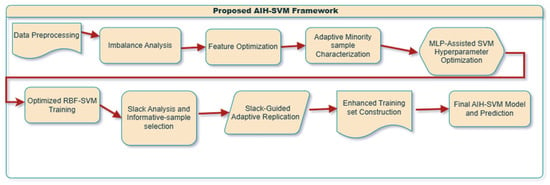
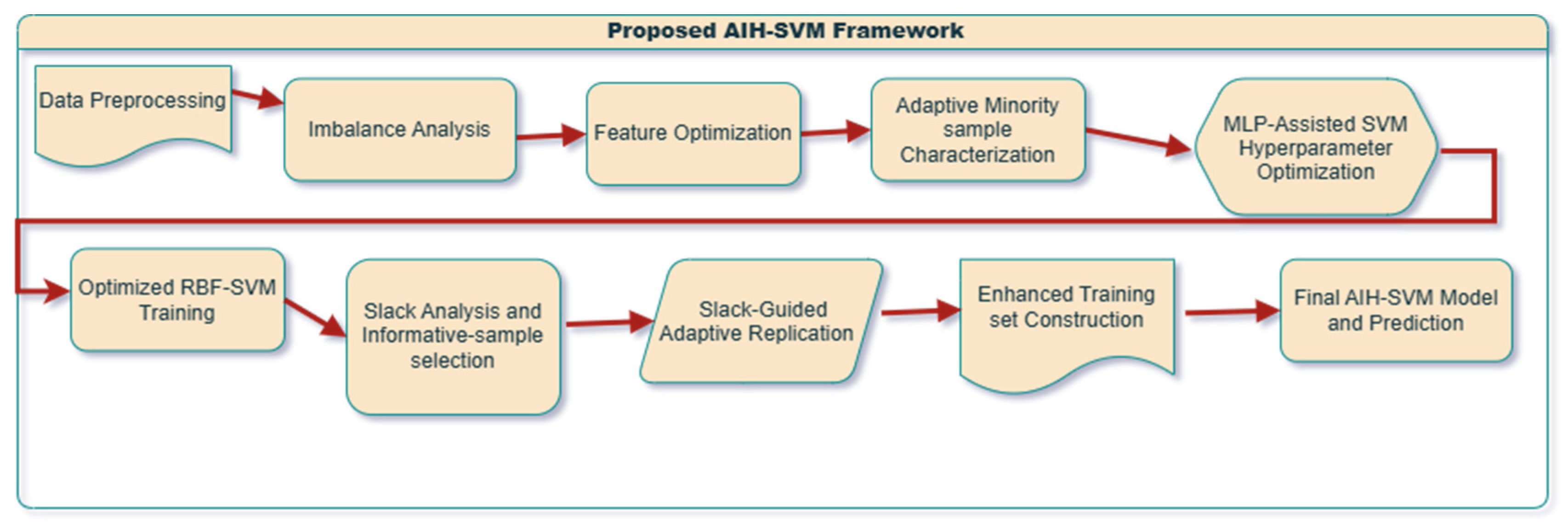
The Adaptive Imbalance-Aware Hybrid Support Vector Machine (AIH-SVM) framework has been developed for classification of imbalanced datasets by enhancing the performance of the minority class while maintaining the discrimination ability of the SVM classifier. The framework follows six sequential stages including data preprocessing, imbalance analysis, feature optimization, adaptive minority-sample characterization, MLP-assisted hyperparameter optimization, and geometry-aware slack-guided classification. Preprocessing and analysis of imbalance are carried out on the dataset to analyze the class distribution. Then, MI is applied for feature optimization, and then, minority sample adaptation is done based on local overlapping, minority density, and closeness to boundary. The optimal RBF-SVM parameters are found using an MLP-based surrogate model. Finally, SVM decision and slack are used for the selection of informative minority samples for slack-guided replication. The overall workflow of the proposed AIH-SVM framework is illustrated in Figure 1.
Figure 1.
Overall workflow of the proposed AIH-SVM framework.
The scheme utilizes adaptive and classifier-based information to effectively amplify informative minority samples. The chosen samples are amplified using adaptive replication factors and are added to the training set, thus increasing the presence of informative minority areas without replicating the entire minority class.
3.2. Data Preprocessing and Dataset Preparation
The two datasets that have been used in this study are the binary imbalanced Ecoli1 and Glass2. The first step before training the models was separating the dependent variable from independent variables. This was done to check each dataset for missing values, duplicate records, and class imbalance.
Stratified train–test split was done at a ratio of 80:20, with a random state of 42. Feature scaling was done through StandardScaler, and the process was carried out using only the training data. All subsequent stages involving feature selection, adaptive minority sampling characterization, SVM hyperparameter tuning, and slack analysis were done using the training data only.
3.3. Mutual-Information-Based Feature Optimization
The optimization of features preceded adaptive minority sample analysis in order to eliminate irrelevant features and retain information that is useful for predicting the target class. Mutual information (MI) served as a measure of statistical dependency of each feature with respect to the class variable. The larger the MI value, the higher the dependence on the target. The MI values were computed based on the training data, and features were chosen based on the level of informativeness. The feature subsets were analyzed with stratified five-fold SVM cross-validation in order to achieve compactness while preserving classification accuracy.
3.4. Adaptive Minority-Sample Characterization
Minority instances after feature optimization are described based on the measures of class overlapping, minority density, and distance from the decision boundary. In order to obtain the decision function values, an RBF-SVM with parameters C = 1.0, and γ = scale is initially trained on the training dataset. Boundary proximity is measured using the absolute decision function value, where smaller absolute values indicate greater proximity to the decision boundary.
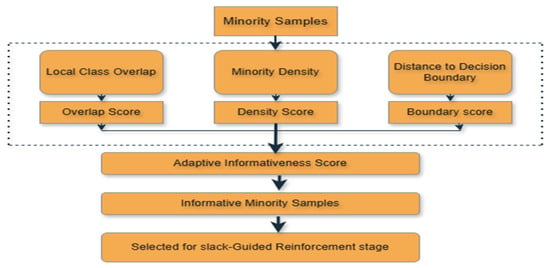
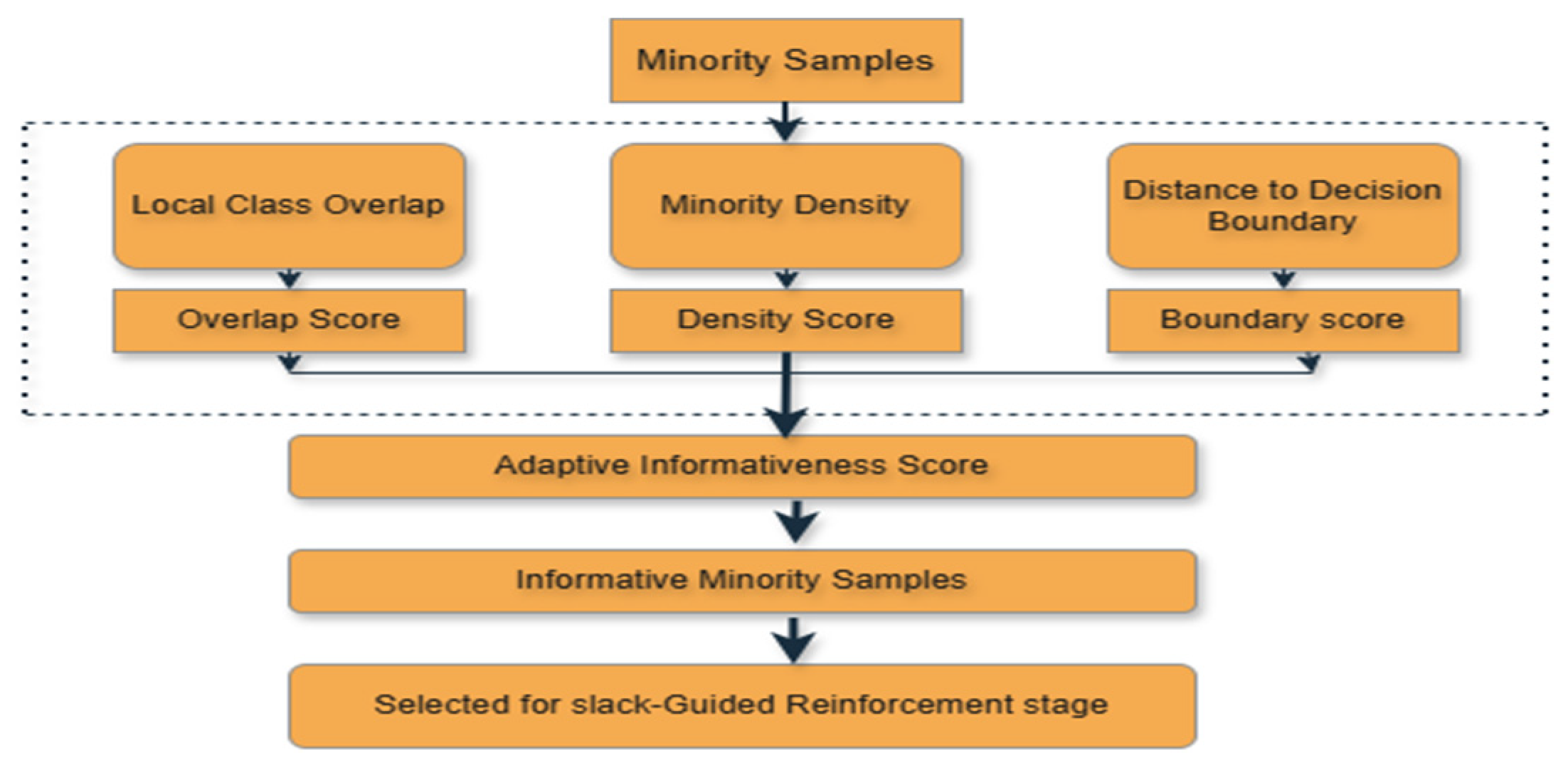
After optimizing the features, the minority samples were then represented in terms of local distributions and decision boundary information. There were three aspects taken into consideration, which include local class overlap, minority density, and boundary distance. Local class overlap is defined as the degree to which a minority sample is surrounded by the other class instances, where greater overlap implies higher local ambiguity. Minority density refers to the density of the minority samples around the neighborhood of the minority sample while boundary distance refers to the distance of the sample to the decision boundary of the SVM classifier. The three aspects were then standardized in order to obtain an adaptive informativeness measure for each minority sample as shown in Figure 2.
Figure 2.
Adaptive minority-sample characterization based on local overlap, minority density and distance to the decision boundary.
3.5. MLP-Assisted SVM Hyperparameter Optimization
The effectiveness of RBF-SVM relies on the selection of the penalty parameter C and kernel parameter γ. To optimize these parameters in the framework described above, an MLP-based surrogate model was utilized. The initial grid included five values of C (0.01, 0.1, 1, 10, and 100) and five values of γ (scale, 0.001, 0.01, 0.1, and 1.0). Stratified five-fold cross-validation was applied to select the best hyperparameter configuration, with Macro-F1 used as the optimization criterion and the mean and standard deviation calculated for each hyperparameter combination. The logarithms of the tested hyperparameters, log10(C) and log10(γ), were used as inputs to the surrogate model. The numerical value of the scale option was calculated based on feature variance, according to the implementation of the SVM. The inputs were standardized prior to MLP Regressor training. An MLP Regressor with two hidden layers consisting of 16 and 8 neurons, respectively, and using the ReLU activation function was selected. The L-BFGS solver with α = 0.001, a maximum of 5000 iterations, and a predefined random state was utilized. The trained surrogate model was used to predict Macro-F1 over a more detailed hyperparameter space with 41 logarithmically spaced values of C from 10−2 to 102 and 41 logarithmically spaced values of γ from 10−3 to 100, resulting in 1681 candidate configurations. The combination with the highest predicted Macro-F1 was selected and used to train the optimized RBF-SVM.
3.6. Slack Analysis and Informative-Sample Selection
Slack values of the minority-class samples were calculated to measure the extent of their violation of the margin constraint. The samples with zero slack value satisfy the margin constraint, whereas samples with positive slack value violate the margin constraint. Minority-class samples were thus assessed based on their slack and decision values from which slack-guided candidates were chosen. The slack values of these candidates were used to rank them and they were then taken into account for selective reinforcement.
3.7. Slack-Guided Adaptive Replication
Slack-guided candidates were replicated based on their normalized slack values. Under the proposed replication rule, higher normalized slack corresponds to a higher replication factor. The related equations are numbered (1)–(3). The slack values were normalized in the range of [0, 1] as:
Then the normalized slack is used to find the replication factor using the following relation:
Replication Factor = 1 + ⌊Normalized Slack × 4⌋
As such, the replication factor lies between 1 and 5. A sample candidate having the maximum slack will have a replication factor of 5, and similarly, a candidate having the minimum slack will have a replication factor of 1. The number of copies made is given by:
Additional Copies = Replication Factor −1
Replication is only performed on the chosen minority samples. The additional samples are added to the existing training set; however, the test set stays the same.
3.8. Complete AIH-SVM Learning Procedure
The complete process of AIH-SVM involves the aforementioned stages of feature optimization, adaptive characterization of minority samples, SVM hyperparameters tuning, slack computation, and selective replication. The overall training procedure of the proposed AIH-SVM is presented in Algorithm 1, which summarizes the sequential steps involved in feature selection, adaptive parameter optimization, minority-sample identification, data augmentation, and final classifier training.
| Algorithm 1: AIH-SVM Training Algorithm |
Inputs: Training samples X, Labels y and Outputs: Trained AIH-SVM Classifier
|
4. Experimental Setup and Evaluation Protocol
4.1. Experimental Design and Evaluation Strategy
The evaluation of the proposed technique focuses on evaluating the effectiveness of AIH-SVM in terms of classification, minority class detection, and robustness. Experiments have been carried out using the Ecoli1 and Glass2 benchmark datasets where AIH-SVM is tested against a regular RBF-SVM method. An adaptive-only ablation was carried out to evaluate the contribution of slack-guided reinforcement.
4.2. Benchmark Datasets and Class Distribution
Six datasets were considered for conducting the experiments. Both synthetic overlapping and synthetic highly imbalanced datasets were constructed as part of the initial validation for moderate and severe class imbalance, respectively. The Breast Cancer Wisconsin (Diagnostic) dataset was collected from the UCI Machine Learning Repository [28]. Another set of Credit Card Fraud Detection dataset was used as part of the initial validation process [29]. The main validation was done by using Ecoli1 and Glass2 benchmark imbalanced datasets from the KEEL repository [30], which consist of seven and nine features, respectively.
4.3. Evaluation Metrics
The performance of AIH-SVM and traditional RBF-SVM is assessed by means of Accuracy, Balanced Accuracy, Macro-F1, G-Mean, ROC-AUC, and Matthews Correlation Coefficient (MCC). Balanced Accuracy, Macro-F1, and G-Mean are more focused on the class imbalance issue than ROC-AUC and MCC.
4.4. Baseline and Ablation Configurations
Three configurations have been considered to evaluate the contributions of the proposed setup.
- (1)
- Classic RBF-SVM: The baseline classification setup was constructed without the use of any of the proposed adaptive minority characterization or the slack-based replication schemes. The same data split, optimized feature extraction, and evaluation measures were used as those for AIH-SVM to have an equitable comparison.
- (2)
- AIH-SVM: The complete architecture was considered where feature optimization, adaptive minority-sample characterization, MLP-based hyperparameter optimization, slack-based sample selection, and selective replication were all used. The classification setup was built using the enhanced training setup and evaluated against the corresponding test setup.
- (3)
- Adaptive Only: The adaptive minority-sample characterization scheme is considered but without the use of the slack-based selective replication scheme.
4.5. Five-Fold Cross-Validation Evaluation
Stratified five-fold cross-validation was applied to examine performance consistency while maintaining the class distribution across folds. The stratified folds for RBF-SVM and AIH-SVM were the same, and the performances achieved were expressed as the mean ± standard deviation.
4.6. Computational Environment and Implementation
The AIH-SVM approach was implemented using Python (version 3.13.18) in the Google Colab environment. NumPy (version 2.4.6) and Pandas (version 2.2.3) were used for numerical computations and data manipulation, respectively, while Scikit-learn (version 1.6.1) was employed for data preprocessing, classification using SVM, and optimization of the parameters of the MLP network. In both experiments, random state 42 was set for data splitting and the five-fold cross-validation process. The same experimental procedure was used independently for the Ecoli1 and Glass2 datasets. All operations related to training were carried out exclusively with training data, and test data remained unseen until final testing to prevent data leakage.
5. Results and Discussion
5.1. Preliminary Validation of Slack-Guided Minority Reinforcement
To evaluate the initial usefulness of slack-guided minority reinforcement, the preliminary ASBO-SVM variant was evaluated before its integration into the complete AIH-SVM framework. The main motive was to determine if the margin information of SVM would aid in selective minority reinforcement depending on the severity of imbalance in the data. For the synthetic overlapping dataset, ASBO-SVM achieved improved accuracy of 0.951 from 0.945, recall of 0.84 from 0.82, F1-score of 0.91 from 0.90, and reduced number of false negatives from 53 to 47. For the synthetic highly imbalanced dataset, ASBO-SVM achieved improved accuracy of 0.979 from 0.977, recall of 0.80 from 0.78, and F1-score of 0.89 from 0.88.
Evaluation on the Breast Cancer Wisconsin dataset demonstrated an increase in accuracy of 0.9895 from 0.9877. For the subset of the Credit Card Fraud dataset, ASBO-SVM produced an increase in accuracy of 0.99840 from 0.99815, and minority-class recall of 0.71 from 0.67, with a decrease in number of false negatives of 25 from 28. The results of the preliminary evaluations are summarized in Table 1. These observations provide preliminary empirical evidence for integrating slack-guided reinforcement into AIH-SVM along with the other learning components.
Table 1.
The preliminary validation of the ASBO-SVM variant.
These preliminary results demonstrate that slack-based replication may contribute to improved minority-class sensitivity while maintaining comparable overall classification performance on the test datasets. Hence, based on these observations, the preliminary ASBO-SVM approach was subsequently extended into the more comprehensive AIH-SVM framework, which integrates slack information with adaptive minority-sample characterization, feature optimization, MLP-assisted SVM hyperparameter optimization, and other learning components.
5.2. Overall Performance of AIH-SVM on Ecoli1 and Glass2
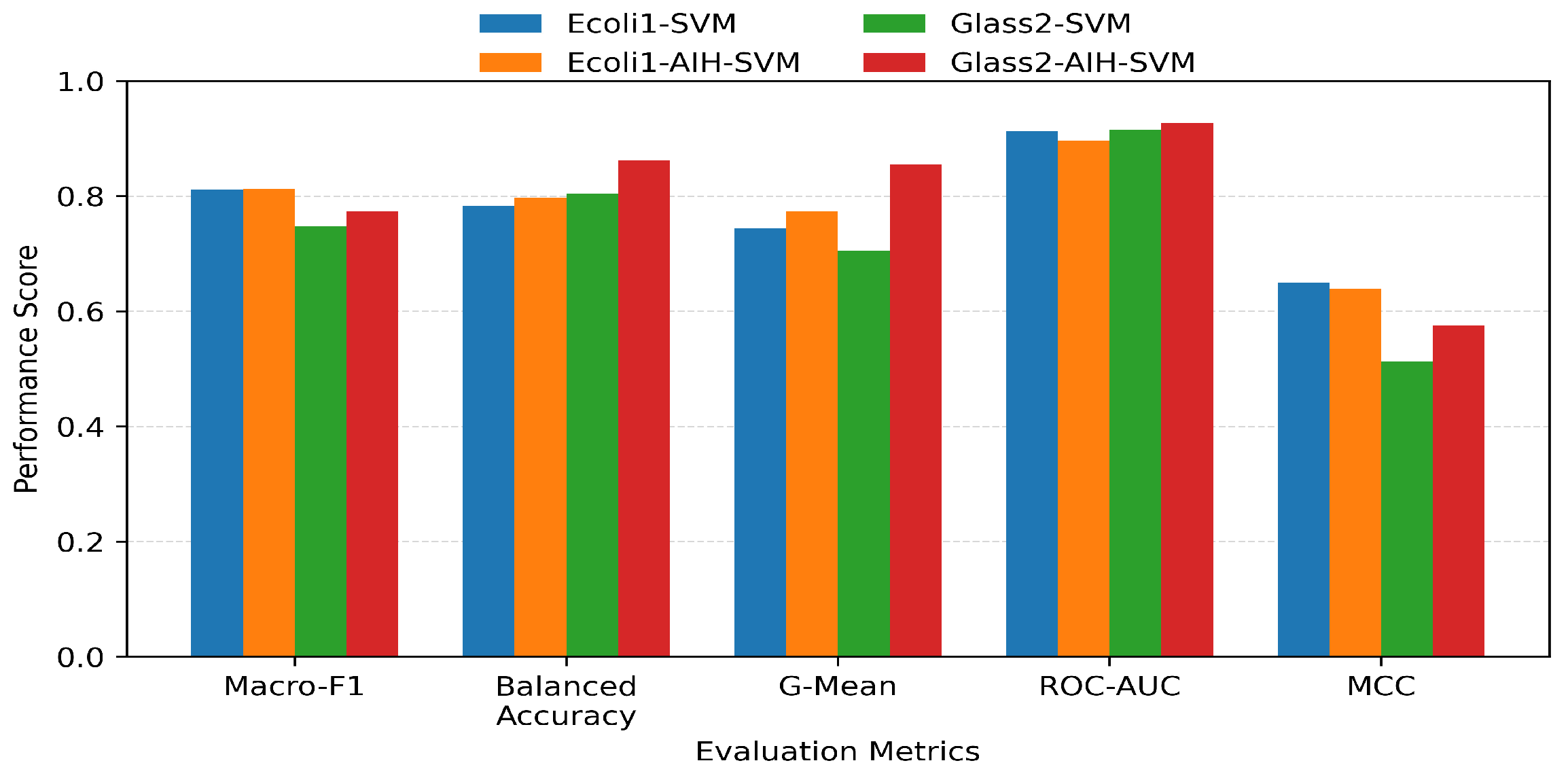
The performance of AIH-SVM was also tested by comparison with a traditional RBF-SVM using Macro-F1, Balanced Accuracy, G-Mean, ROC-AUC, and MCC. For Ecoli1, AIH-SVM achieved better Macro-F1 from 0.8112 to 0.8123, Balanced Accuracy from 0.7821 to 0.7969, and G-Mean from 0.7440 to 0.7728. On the other hand, AIH-SVM showed lower ROC-AUC and MCC with values of 0.9130 to 0.8966 and 0.6491 to 0.6392, respectively. Therefore, the gain in performance by AIH-SVM on Ecoli1 was mainly in terms of metrics that favor balance between classes. The performance comparison for both datasets across the five evaluation metrics is illustrated in Figure 3.
Figure 3.
Performance comparison of conventional SVM and AIH-SVM on Ecoli1 and Glass2 across five evaluation metrics.
For Glass2, AIH-SVM obtained higher mean values across all five metrics. Macro-F1 increased from 0.7480 to 0.7730, Balanced Accuracy from 0.8046 to 0.8618, G-Mean from 0.7055 to 0.8551, ROC-AUC from 0.9149 to 0.9264, and MCC from 0.5130 to 0.5750. The relative performances are shown in Figure 3, and the corresponding values are reported in Table 2.
Table 2.
Performance comparison between conventional SVM and AIH-SVM.
5.3. Ablation Analysis of the Adaptive-Only Configuration
Ablation of the adaptive-only approach was performed in order to study the effect of slack-guided reinforcement. In this configuration, the features of local overlap, minority density, and boundary distance were included but SVM slack-based selective replication was not used. The performance for this setting is presented in Table 3. On Ecoli1, adaptive-only configuration resulted in Accuracy of 0.9706, Balanced Accuracy of 0.9091, Macro-Precision of 0.9831, Macro-Recall of 0.9091, and Macro-F1 of 0.9414. Similarly, on Glass2, the values were 0.9302, 0.8083, 0.7372, 0.8083, and 0.7667, respectively. The results indicate that classification performance can be achieved through adaptive minority characterization alone. AIH-SVM makes use of slack values from the optimized SVM to further identify informative minority samples for selective reinforcement, thereby complementing the adaptive minority characterization with classifier-based information.
Table 3.
Performance of the adaptive-only configuration.
5.4. Five-Fold Cross-Validation Results
Stratified five-fold cross-validation was used to examine the consistency of conventional RBF-SVM and AIH-SVM across different data partitions. The same stratified folds were used for both methods, and the results are reported as mean ± standard deviation in Table 4. For Ecoli1, AIH-SVM showed a slight increase in Macro-F1 from 0.8112 ± 0.1070 to 0.8123 ± 0.0709, Balanced Accuracy from 0.7821 ± 0.1120 to 0.7969 ± 0.0854, and G-Mean from 0.7440 ± 0.1563 to 0.7728 ± 0.1105. The corresponding standard deviations were also lower for AIH-SVM, indicating lower observed variability across the five folds for these metrics. In contrast, ROC-AUC decreased from 0.9130 ± 0.0214 to 0.8966 ± 0.0476, while MCC decreased from 0.6491 ± 0.1970 to 0.6392 ± 0.1354. For Glass2, AIH-SVM showed higher mean values across all five reported metrics. Macro-F1 increased from 0.7480 ± 0.1669 to 0.7730 ± 0.0403, Balanced Accuracy from 0.8046 ± 0.2043 to 0.8618 ± 0.0902, and G-Mean from 0.7055 ± 0.4037 to 0.8551 ± 0.0955. ROC-AUC increased from 0.9149 ± 0.0379 to 0.9264 ± 0.0421, while MCC increased from 0.5130 ± 0.3431 to 0.5750 ± 0.0988. Although the mean values were higher for AIH-SVM, the relatively large standard deviation observed for some metrics, particularly MCC for the conventional RBF-SVM, indicates considerable fold-to-fold variability.
Table 4.
Five-fold cross-validation results for conventional SVM and AIH-SVM.
Overall, the five-fold results indicate that the observed performance differences are dataset- and metric-dependent. AIH-SVM showed improvements in the balance-oriented metrics on both datasets, whereas ROC-AUC and MCC decreased on Ecoli1 and increased on Glass2. Therefore, these mean differences should be interpreted as empirical differences observed on the evaluated benchmarks rather than as evidence of uniformly superior performance.
Although stratified five-fold cross-validation was employed, no statistical tests were carried out on the results obtained from each individual fold. Therefore, the differences reported in Table 4 should be understood as empirical differences rather than statistically supported performance improvements. Further evaluation using appropriate statistical analysis and additional benchmark datasets could provide useful insights into the robustness and generalizability of the observed results.
5.5. Comparative Discussion and Interpretation
Overall, the five-fold results show dataset- and metric-dependent performance patterns. On Glass2, AIH-SVM obtained higher mean values across all five reported metrics, while on Ecoli1, improvements were observed mainly in Macro-F1, Balanced Accuracy, and G-Mean, with lower mean values for ROC-AUC and MCC. These observations suggest that the contribution of slack-guided minority reinforcement depends on the characteristics of the dataset and the evaluation metric. The ablation results further show that adaptive minority-sample characterization alone provides a useful basis for classification, while the complete AIH-SVM framework additionally incorporates classifier-based slack information for selective minority-sample reinforcement.
6. Conclusions and Future Work
6.1. Conclusions
AIH-SVM is an adaptive framework for imbalanced classification that builds on the preliminary ASBO-SVM implementation. The ASBO-SVM was initially evaluated on synthetic overlapping and highly imbalanced datasets, as well as on the Breast Cancer and Credit Card Fraud datasets, to examine the potential of slack information for selective reinforcement of minority samples. Based on these observations, the approach was extended to develop the final AIH-SVM framework. AIH-SVM integrates feature optimization, minority-sample characterization, MLP-based SVM hyperparameter optimization, and slack-guided selective minority-sample reinforcement. The framework uses data-distribution characteristics and classifier-based slack information to identify informative minority samples. Results on the Ecoli1 and Glass2 datasets show improvements in selected balance-oriented evaluation metrics. However, the observed differences are dataset- and metric-dependent and should be interpreted as empirical findings. Overall, the findings suggest that combining adaptive minority-class characterization with classifier-based slack information may provide a useful approach for selectively reinforcing informative minority samples.
6.2. Future Work
Further research will apply the proposed framework on larger and multiclass imbalanced datasets to determine its generalization capability. In addition, further research will analyze parameter sensitivity, scalability, and adaptability of learning under evolving class distribution. Future evaluation will also include appropriate statistical analysis with fold-level performance observations and a broader range of benchmark datasets to further assess the robustness and generalizability of the proposed framework.
Author Contributions
Conceptualization, B.K. and V.W.; methodology, B.K.; software, B.K.; validation, B.K., V.W. and S.S.; formal analysis, B.K.; investigation, B.K.; writing—original draft preparation, B.K.; writing—review and editing, V.W. and S.S.; supervision, V.W. All authors have read and agreed to the published version of the manuscript.
Funding
This research received no external funding.
Institutional Review Board Statement
Not applicable.
Informed Consent Statement
Not applicable.
Data Availability Statement
The Ecoli1 and Glass2 datasets are openly accessible through the KEEL repository. The Breast Cancer Wisconsin (Diagnostic) and Credit Card Fraud Detection datasets are openly accessible via their original sources listed in References [28] and [29], respectively (both accessed on 1 April 2026). The synthetic datasets employed for preliminary testing were created specifically for this study.
Conflicts of Interest
The authors declare no conflicts of interest.
References
- Chen, W.; Yang, K.; Yu, Z.; Shi, Y.; Chen, C.L.P. A survey on imbalanced learning: Latest research, applications and future directions. Artif. Intell. Rev. 2024, 57, 137. [Google Scholar] [CrossRef] [Scilit]
- He, H.; Garcia, E.A. Learning from imbalanced data. IEEE Trans. Knowl. Data Eng. 2009, 21, 1263–1284. [Google Scholar] [CrossRef] [Scilit]
- Hida, G.S.; Nascimento, A.C.A. Overview of machine learning in class imbalance scenarios: Trends, challenges, and approaches. Expert Syst. Appl. 2026, 298, 129592. [Google Scholar] [CrossRef] [Scilit]
- Carvalho, M.; Pinho, A.J.; Br’as, S. Resampling approaches to handle class imbalance: A review from a data perspective. J. Big Data 2025, 12, 71. [Google Scholar] [CrossRef] [Scilit]
- Gao, X.; Xie, D.; Zhang, Y.; Wang, Z.; Chen, C.; He, C.; Yin, H.; Zhang, W. A comprehensive survey on imbalanced data learning. Front. Comput. Sci. 2026, 20, 2011622. [Google Scholar] [CrossRef] [Scilit]
- Guo, J.; Wu, H.; Chen, X.; Lin, W. Adaptive SV-Borderline SMOTE-SVM algorithm for imbalanced data classification. Appl. Soft Comput. 2024, 150, 110986. [Google Scholar] [CrossRef] [Scilit]
- Rezvani, S.; Pourpanah, F.; Lim, C.P.; Jonathan Wu, Q.M. Methods for class-imbalanced learning with support vector machines: A review and an empirical evaluation. Soft Comput. 2024, 28, 11873–11894. [Google Scholar] [CrossRef] [Scilit]
- Batuwita, R.; Palade, V. Efficient resampling methods for training support vector machines with imbalanced datasets. In Proceedings of the 2010 IEEE World Congress on Computational Intelligence (IJCNN), Barcelona, Spain, 18–23 July 2010; IEEE: Piscataway, NJ, USA, 2010; pp. 1–8. [Google Scholar] [CrossRef] [Scilit]
- Cortes, C.; Vapnik, V. Support-vector networks. Mach. Learn. 1995, 20, 273–297. [Google Scholar] [CrossRef] [Scilit]
- Chawla, N.V.; Bowyer, K.W.; Hall, L.O.; Kegelmeyer, W.P. SMOTE: Synthetic Minority Over-sampling Technique. J. Artif. Intell. Res. 2002, 16, 321–357. [Google Scholar] [CrossRef] [Scilit]
- Song, J.; Liu, J. ISMOTE: A more accurate alternative for SMOTE. Neural Process. Lett. 2024, 56, 240. [Google Scholar] [CrossRef] [Scilit]
- Tao, X.; Zhang, X.; Zheng, Y.; Qi, L.; Fan, Z.; Huang, S. A MeanShift-guided oversampling with self-adaptive sizes for imbalanced data classification. Inf. Sci. 2024, 672, 120699. [Google Scholar] [CrossRef] [Scilit]
- Guan, S.; Zhao, X.; Xue, Y.; Pan, H. AWGAN: An adaptive weighting GAN approach for oversampling imbalanced datasets. Inf. Sci. 2024, 663, 120311. [Google Scholar] [CrossRef] [Scilit]
- Batuwita, R.; Palade, V. FSVM-CIL: Fuzzy support vector machines for class imbalance learning. IEEE Trans. Fuzzy Syst. 2010, 18, 558–571. [Google Scholar] [CrossRef] [Scilit]
- Wang, S.; Li, Z.; Chao, W.H.; Cao, Q. Applying adaptive oversampling technique based on data density and cost-sensitive SVM to imbalanced learning. In Proceedings of the 2012 International Joint Conference on Neural Networks (IJCNN), Brisbane, Australia, 10–15 June 2012; IEEE: Piscataway, NJ, USA, 2012; pp. 1–8. [Google Scholar] [CrossRef] [Scilit]
- Elkan, C. The foundations of cost-sensitive learning. In Proceedings of the 17th International Joint Conference on Artificial Intelligence (IJCAI), Seattle, WA, USA, 4–10 August 2001; Morgan Kaufmann Publishers Inc.: San Francisco, CA, USA, 2001; pp. 973–978. [Google Scholar]
- Lalit, R.; Gupta, K. Impact of spatial distribution of repeated samples on the geometry of hyperplanes. In Advances in IoT and Security with Computational Intelligence; Springer: Singapore, 2023; pp. 15–25. [Google Scholar] [CrossRef] [Scilit]
- Lalit, R.; Gupta, K. Slack-Guided and Geometry-Aware (SGGA) Knowledge-Based oversampling for intelligent imbalanced learning. Knowl.-Based Syst. 2026, 340, 115671. [Google Scholar] [CrossRef] [Scilit]
- Mohasel, S.M.; Koosha, H. A robust and lightweight support vector machine for imbalanced and noisy data via Benders decomposition. Neurocomputing 2026, 671, 132629. [Google Scholar] [CrossRef] [Scilit]
- Tsai, C.-F.; Chen, K.-C.; Lin, W.-C. Feature selection and its combination with data over-sampling for multi-class imbalanced datasets. Appl. Soft Comput. 2024, 153, 111267. [Google Scholar] [CrossRef] [Scilit]
- Wild, R.; Sozio, E.; Margiotta, R.G.; Dellai, F.; Acquasanta, A.; Del Ben, F.; Tascini, C.; Curcio, F.; Laio, A. Maximally informative feature selection using Information Imbalance: Application to COVID-19 severity prediction. Sci. Rep. 2024, 14, 10744. [Google Scholar] [CrossRef] [Scilit] [PubMed]
- Gong, H.; Li, Y.; Zhang, J.; Zhang, B.; Wang, X. A new filter feature selection algorithm for classification task by ensembling Pearson correlation coefficient and mutual information. Eng. Appl. Artif. Intell. 2024, 131, 107865. [Google Scholar] [CrossRef] [Scilit]
- Ding, W.; Yao, H.; Huang, J.; Hou, T.; Geng, Y. Evolutionary multistage multitasking method for feature selection in imbalanced data. Swarm Evol. Comput. 2025, 92, 101821. [Google Scholar] [CrossRef] [Scilit]
- Wu, J.; Xue, Z.; Zhang, L.; Yang, X. Adaptive feature selection method for high-dimensional imbalanced data classification. J. Meas. Sci. Instrum. 2025, 16, 612–624. [Google Scholar] [CrossRef] [Scilit]
- Wang, Z.; Wang, S.; Ernst, D.; Xiao, C. Automated Class Imbalance Learning via Few-Shot Multi-Objective Bayesian Optimization With Deep Kernel Gaussian Processes. IEEE Access 2025, 13, 131839–131855. [Google Scholar] [CrossRef] [Scilit]
- Moradpour, M.; Ritter, Z.M.; Hauschild, A.-C. Ensemble multi-objective hyperparameter optimization for the classification of imbalanced heart disease data. Expert Syst. Appl. 2026, 301, 130318. [Google Scholar] [CrossRef] [Scilit]
- Geng, H.; Song, F.; Shen, J.; Li, J. A classification and regression assisted optimization algorithm for high-dimensional expensive many-objective problems. Neurocomputing 2024, 586, 127629. [Google Scholar] [CrossRef] [Scilit]
- Wolberg, W.H.; Mangasarian, O.L.; Street, W.N.; Street, W.H. Breast Cancer Wisconsin (Diagnostic). UCI Machine Learning Repository, 1993. Available online: https://archive.ics.uci.edu/dataset/17/breast+cancer+wisconsin+diagnostic (accessed on 1 April 2026).
- Machine Learning Group, Université Libre de Bruxelles (ULB). Credit Card Fraud Detection. Kaggle. Available online: https://www.kaggle.com/datasets/mlg-ulb/creditcardfraud (accessed on 1 April 2026).
- Alcalá-Fdez, J.; Fernández, A.; Luengo, J.; Derrac, J.; García, S.; Sánchez, L.; Herrera, F. KEEL Data-Mining Software Tool: Data Set Repository, Integration of Algorithms and Experimental Analysis Framework. J. Mult.-Valued Log. Soft Comput. 2011, 17, 255–287. [Google Scholar]

Disclaimer/Publisher’s Note: The statements, opinions and data contained in all publications are solely those of the individual author(s) and contributor(s) and not of MDPI and/or the editor(s). MDPI and/or the editor(s) disclaim responsibility for any injury to people or property resulting from any ideas, methods, instructions or products referred to in the content. |
© 2026 by the authors. Licensee MDPI, Basel, Switzerland. This article is an open access article distributed under the terms and conditions of the Creative Commons Attribution (CC BY) license.